PART II.
Reading edition

DESCRIPTION, ARRANGEMENT, CULTURE, ETC., OF SUITABLE SPECIES, HARDY AND TENDER, ALPHABETICALLY ARRANGED.
SUBTROPICAL GARDENING. PART II.

[*]Acacia Julibrissin.—A native of Persia, with large and elegant much-divided leaves, and flowers somewhat like short tinted brushes from the numerous purple stamens. Though this does not succeed as a standard tree in all parts of England (where it grows well against walls, and sometimes flowers), yet doubtless it would do so in some parts of the south, and I have seen it make presentable standards about Geneva and in Anjou. But for our purposes it is better that it should not be perfectly hardy, as by confining it to a single young stem and using young plants, or plants that have been cut down every year, we shall get an erect stem covered with leaves more graceful than a fern, and that is the kind of ornament we want as a graceful object amidst low-growing flowers. The leaves, like those of some other plants of the pea tribe, are slightly sensitive. On fine sunny days they spread out fully and afford a pleasant shade; on dull ones the leaflets fall down. This interesting phenomenon takes place with other members of the same family—for instance, the elegant A. dealbata of our conservatories. Seed of A. Julibrissin—or the silk-rose, as it is called by the Persians in consequence of its silky stamens—is readily obtained, and it is much better raised from seed, as then you get those single-stemmed and vigorous young plants which are to the flower-garden what an elegant fern is to the conservatory or show-house. To succeed with it in the way above named, it may be protected at the root and cut down every year in spring, or strong young plants may be put out annually, in much the same way as those of A. lophantha.
Acacia lophantha.—This elegant plant, though not hardy, is one of those which all may enjoy, from the freedom with which it grows in the open air in summer. It will prove more useful for the flower-garden than it has ever been for the houses, and, being easily raised, is entitled to a place here among the very best. The elegance of its leaves and its quick growth in the open air make it quite a boon to the flower-gardener who wishes to establish graceful verdure amongst the brighter ornaments of his parterre. It has graceful fern-like leaves and a close and erect habit, which permits us to closely associate it with flowering plants without in the least shading them or robbing them. Of course I speak of it in the young and single-stemmed condition, the way in which it should be used. By confining it to a single stem and using it in a young state, you get the fullest size and grace of which the leaves are capable. Allow it to become old and branched, and it may be useful, but by no means so much so as when young and without side branches. It may be raised from seed as easily as a common bedding plant. By sowing it early
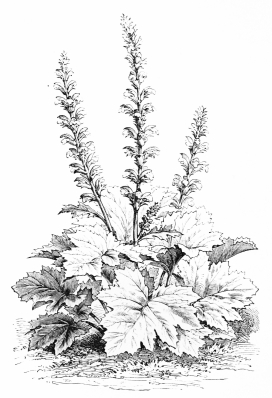
ACANTHUS LATIFOLIUS (lusitanicus). Ornamental foliaged herbaceous Section; retaining its leaves till very late in the year.

in the year it may be had fit for use by the first of June; but plants a year old or so, stiff, strong, and well hardened off for planting out at the end of May, are the best. It would be desirable to raise an annual stock, as it is almost as useful for room-decoration as for the garden. Native of New Holland.
ACANTHUS.
These stout and hardy herbaceous plants are of the greatest importance in the subtropical garden or the pleasure-ground, their effect being very good when they are well established. They thrive in almost any soil, but attain their greatest luxuriance and beauty in deep warm ones. The best uses for these species are as isolated tufts in the grass, in the mixed border, or in picturesque groups with other hardy subjects. In all cases they should be placed in positions where they are not likely to be disturbed, as their beauty is not seen until they are well established. All are easily propagated by division. Few herbaceous genera may be made more useful than this.
*Acanthus hirsutus.—This uncommon species has a narrow spiny leaf, more in the way of Morina longifolia than the ordinary Acanthuses, and is dark green in hue. The leaves grow to a length of about 15 ins. or 16 ins. in ordinary soil. Being distinct, it may be worth growing, though in point of character or importance it is inferior to the larger kinds. South of Europe.
*Acanthus latifolius.—The leaves of this are bold and noble in outline, and the plant has a tendency, rare in some hardy things with otherwise fine qualities, to retain them till the end of the season without losing a particle of their freshness and polished verdure. In fact, the only thing we have to decide about this subject is, what is the best place for it? Now, it is one of those things that will not disgrace any position, and will prove equally at home in the centre of the mixed border, projected in the grass a little from the edge of a choice shrubbery, or in the flower-garden; nobody need fear its displaying anything like the seediness which such things as the Heracleums show at the end of summer. I should not like to advise its being planted in the centre of a flower-bed, or in any other position where it would be disturbed; but in case it were determined to plant permanent groups of fine-leaved hardy plants, then indeed it could be used with great success. Supposing we have an irregular kind of flower-garden or pleasure-ground to deal with (a common case), one of the best things to do with this Acanthus is to plant it in the grass, at some distance from the clumps, and perhaps near a few other things of like character. It is better than any kind of Acanthus hitherto commonly cultivated, though one or two of these are fine. Give it deep good soil, and do not grudge it this attention, because, unlike tender plants, it will not trouble you again for a long time. Nobody seems to know from whence it came. Probably it is a variety of Acanthus mollis. The plant varies a good deal; I have seen specimens of it about a foot high, with leaves comparatively small and stiff and rigid, as if cast in a mould, by the side of others of thrice that development, and of the usual texture.
*Acanthus longifolius.—A fine, distinct, and new species from Dalmatia and S. Europe, 3½ ft. to 4 ft. high, distinguished from A. mollis (to which it is allied) by the length and narrowness of its arching leaves. They are about 2½ ft. long, very numerous, of a bright green colour, growing at first erect, then inclining and forming a sheaf-like tuft, which has a very fine effect. The flowers are of a wine-red colour, becoming lighter before they fall. A specimen in the gardens of the Museum at Paris, in four years after planting, had twenty-five blooming-stems rising from the midst of a round mass of verdure nearly 2½ ft. in height and width. This would be very effective on the undulating and picturesque parts of landscape-gardens. It does not run so much at the root as A. mollis. It seeds more freely than the other kinds, and may be readily increased by seeds as well as by division. Its free-flowering quality makes this species peculiarly valuable, while it is as good as any for isolation or grouping.
*Acanthus mollis.—A well-known old border-plant from the south of Europe, about 3 ft. high, with leaves nearly 2 ft. long by 1 ft. broad, heart-shaped in outline, and cut into angular toothed lobes. The flowers are white or lilac, the inflorescence forming a remarkable-looking spike, half the length of the stem. Well adapted for borders, isolation, margins of shrubberies, and semi-wild places, in deep ordinary soil, the richer the better. Increased by division of the roots in winter or early spring.
*Acanthus spinosissimus.—This is in all respects among the finest of thoroughly hardy “foliage-plants,” growing to a height of 3½ ft., and bearing rosy-flesh-coloured flowers in spikes of a foot or more in length. It is perfectly hardy, very free in growth, and is quite distinct from any of the other species, forming roundish masses of dark-green leaves, with rather a profusion of glistening spines, by which it is known immediately from its relatives. As a permanent object, fit to plant in a nook in the pleasure-ground or on the grass, associated with the nobler grasses or other plants, there is nothing to surpass it. I know of no hardy foliage-plant so thoroughly neat in its habit at all times. It does not often flower; and if it should throw up a spike, it will perhaps be no loss to cut it off, as its leaves are its best ornament, though the flowers too are interesting. Never at any time does it require the least attention; it will stand any exposure; and is, in a word, invaluable as a hardy ornamental plant. It will thrive best in good and deep soil. South of Europe.
*Acanthus spinosus.—This species appears to flower well more regularly than any other. Its leaves are rather narrow, and very deeply divided into almost triangular segments: they are also covered with short spines. The flowering-stems are about 3 ft. high, and bear dense spikes of purplish flowers. Useful for borders, or grouping with the other kinds and plants of similar character and size. South of Europe.
*Adiantum pedatum.—This fern, which abounds in the woods of Canada and the United States, is unquestionably one of the most elegant of those which are able to endure the climate of Britain, and grows from 16 ins. to 20 ins. high. From the tops of the erect black stems the fronds branch and spread horizontally in a very graceful and peculiar manner. The leaflets are slightly wedge-shaped, the upper margin resembling an arc of a circle. The American Maiden-hair flourishes in a light cool soil, and in a half-shaded position, or in a coarsely-broken, shallow, turfy peat soil, covered with a layer of moss to keep it constantly cool. It is commonly grown in the greenhouse with us, but is especially adapted for embellishing the low and shady parts of rockwork, and for ornamenting beds and mounds of peaty soil which have a north aspect or are sheltered from the full sun. It is propagated by division of the tufts in autumn or early spring. If done in autumn, the divisions should be potted and placed under a frame for the winter, as they form new roots more readily if so treated. There can be no question that, if planted in rich moist soil in a shady wood, we should have no trouble in naturalising this graceful fern, the fronds of which are such graceful objects in the dense woods of the “great country.”
Agave americana.—This and its variegated varieties are plants peculiarly suited for subtropical gardening, being useful for placing out of doors in summer in vases, tubs, or pots plunged in the ground, and also for the conservatory in winter. It forms a large rosette of thick fleshy leaves of a glaucous ashy-green colour, overlapping each other at the base, from 4 ft. to 6½ ft. long, and from 6 ins. to 10 ins. broad, ending in a strong spine, and having numerous spines along the margin. When the plant flowers, which it does only once, and after several years’ growth, it sends up a flowering-stem from 26 ft. to nearly 40 ft. high. The flowers are of a yellowish-green colour, and are very numerous on the ends of the chandelier-like branches. It will grow in any moderately dry greenhouse or conservatory in winter, or even in a large hall, and may be placed out of doors at the end of May and brought in in October. All the varieties are easily increased from suckers. N. America.
*Agrostis nebulosa.—This beautiful annual grass forms most delicate feathery tufts about 1 ft. or 15 ins. in height, terminated when in flower by graceful panicles of spikelets, which are at first of a reddish-green colour, and afterwards change to a light red in the upper part, the remaining two-thirds being of a deep green: the pedicels are extremely slender and of a violet colour. It forms very handsome edgings, and is very valuable for bouquets, vases, baskets, room and table decoration, etc. If cut shortly before the seed ripens, and dried in the shade, it will keep for a long time. Dyed in various colours it is much used by makers of artificial flowers. It may be sown either in September or in April or May. In the former case it will flower from May to July, in the latter from July to September. The seed, being very fine, should be only slightly covered. Though small, this deserves a place in groups of the finer and dwarfer plants, such as Thalictrum minus, and also in herbaceous borders. Spain.
*Ailantus glandulosa.—Much trouble and expense are incurred in the purchase, growth, and protection of tender plants with fine compound leaves like this, but which in our climate never display anything like the fresh vigour, health, spotless appearance, and youthful grace characteristic of hardy subjects. This is one of the most valuable of the hardy trees which, if kept in a dwarf state by being planted young and cut down annually, will furnish as good an effect as any tropical plant. The Ailantus should be kept in a young state, with a single stem clothed with its superb pinnate leaves; and we can readily keep it in this form by planting it young and cutting it down annually, taking care to prevent it from breaking into an irregular head, as then the symmetry of the leaf beauty becomes confused and is not at all so effective as when it is kept to a single stem. Vigorous young plants and suckers in good soil will produce handsome, arching, elegantly divided leaves 5 ft. and even 6 ft. long, not to be surpassed by those of any stove-plant. Under such treatment it could be grown conveniently to about from 4 ft. to 7 ft. high, and would thus do grandly for association with the larger class of garden flowers—Gladioli, Dahlias, and Hollyhocks, for example—while among Cannas and the like it will prove fine. The leaves are not liable to be attacked by insects—a good point in a plant used for the purpose I suggest—and they retain their healthy green till the first frosts in November, when they suddenly drop off. It is propagated with facility by cuttings of the roots, but is cheap in all nurseries. China and Japan.
*Aira pulchella.—One of the most ornamental grasses, with numerous hair-like stems, growing in light elegant tufts 6 ins. to 8 ins. high. It is useful for forming very handsome edgings, or for interspersing amongst plants in borders, or growing in vases or pots for room-decoration. Its delicate panicles give an additional charm to the finest bouquets. May be sown either in September or in April. S. Europe.
*Alisma Plantago.—A native perennial water-plant, growing nearly 3 ft. high, and bearing a very handsome pyramidal panicle of rosy-white flowers from June to September. The leaves are oval-lance-shaped with a cordate base, and are borne nearly erect on long stalks for some distance above the surface of the water. A graceful object on the margins of ponds, lakes, etc., where a plant of it transferred from any place where it grows will soon increase.
Alsophila excelsa.—A noble tree-fern, native of Norfolk Island, where it attains a height of 40 ft., crowned with a magnificent circular crest of bipinnate fronds. These fronds or branches fall off every year, leaving an indentation in the trunk. It stands well in the open air in this country in shady, moist, and thoroughly well sheltered places. It should be put out at the end of May, and taken indoors at the end of September or early in October, and receive warm-greenhouse or temperate-house treatment in winter. The same remarks apply to A. australis, and probably others of the family will be found to thrive well in the open air when sufficiently plentiful to be tried in that position.
*THE AMARANTUSES.
Among the common annuals of our gardens I know of none more in want of judicious use and appreciation than these. The few we grow are usually treated as rough common annuals, and sown so thickly that they never attain half their true development, or never fulfil any of the graceful uses for which they are adapted. But the family possesses greater claims on our attention by reason of the more recent additions to it. The old “Love lies bleeding” (A. caudatus), with its dark-red pendent racemes, is a very striking object when well grown, but A. speciosus and some of the more recent varieties are still more so.
*Amarantus caudatus.—A hardy and vigorous-growing species, from 2 ft. to 3¼ ft. high. Flowers from July to September, dark purplish, very small, collected in numerous whorls, which are disposed in drooping spikes so as to form a handsome pendent panicle. There is a variety which has yellow flowers and is equally hardy. It is advisable to give this plant plenty of room to spread; otherwise much of its picturesque effect will be lost; and to use it in positions where its fine and peculiar habit may be seen to advantage,—as, for example, in large vases, edges of large beds of subtropical plants, or dotted among low-growing flowering plants. Although as easily raised as any common annual, it deserves to be properly thinned out, and each plant isolated in rich ground, so that it may attain its full size. E. Indies.
*Amarantus sanguineus.—Is distinguished by the blood-red colour of its leaves, and grows about 3 ft. high. Its purple flowers appear from July to October, disposed partly in small heads in the axils of the upper leaves, and partly in slender, flexible spikes which form a panicle more or less branching. This plant, though a native of the East Indies, is quite hardy, and seems to do best in light soil with plenty of leaf-mould and having a warm aspect. It may be sown in hotbeds in April and pricked out in May, or in the open air at the end of April or beginning of May, and, like the others, should never be allowed to get crowded.
*Amarantus speciosus.—A very large kind, well adapted for associating with subtropical plants, as it grows from 3 ft. to nearly 5 ft. high. The flowers are very numerous, of a dark crimson purple, and arranged in large erect spikes, forming a fine plumy panicle. The leaves are suffused with a reddish tinge. Plants of this species are occasionally met with having leaves with a light green centre surrounded by wavy zones of a reddish hue. This colouring disappears at the time of flowering. It is an effective subject in the autumn months. Culture, the same as for the preceding kind. Nepaul.
*Amarantus tricolor.—Distinguished by the very handsome and remarkable colouring of its leaves, which are of a fine transparent purplish-red, or dark carmine, from the base to the middle. A large spot of lively transparent yellow occupies the greater part of the upper end of the leaf, and sometimes covers it altogether, with the exception of the point, which is mostly green. The leaf-stalk is either of a light green or yellow colour. Sometimes leaves occur which have the lower half green and the upper part red. Another variety (bicolor) has leaves of a tender green variously streaked with light yellow. It is rather delicate, and requires very good soil, and a warm, open aspect. Another variety (bicolor ruber) is hardier than the last-named, and has leaves which are of a brilliant glistening scarlet when young, gradually changing to a dark violet-red mixed with green. Another variety (ruber) has a more squat and ramified habit, and leaves of a deep rose-colour thickly clothing the stems. Other varieties recommended are elegantissimus (with scarlet leaves), Gordoni, melancholicus ruber, and versicolor, all having some claims as bedding plants. The foliage of these varieties is exceedingly ornamental, and rivals the finest flowers in the richness of its hues. Planted along with large-leaved subjects, such as the Cannas, Wigandias, Ricinus, Solanums, etc., the effect is very fine. They may also be advantageously employed in borders and flower-beds of all sizes, and for fringing the edges of shrubberies. The varieties of A. tricolor are a little more tender than the other kinds, and a light soil and a warmer position are necessary for them. They do well in gardens by the seaside. They should be sown in April in a hotbed, pricked out in a hotbed, and finally planted permanently about the end of May. A. t. giganteus is described as very fine in recent catalogues of the nurserymen. To these may be added a beautiful new kind, A. salicifolius, in the possession of the Messrs. Veitch, but not yet sent out. It has highly coloured and very long, narrow, and arching leaves, and is a singularly graceful and brilliant object. E. Indies.
*Andropogon squarrosus is a hardy East Indian grass, which survives the winter with but slight protection, making luxuriant tufts seven feet high, or more, when in flower. It would probably make a beautiful object in the warmer and milder parts of England and Ireland in good soil, but it is not a subject which can with confidence be recommended for every garden. However, all who value fine grasses should try it. Well-drained and deep-sandy loam.
*ARALIAS.
This genus embraces many plants of very diverse aspects, and few that are fitted for the open air in our climate; but in the case of A. canescens, and its relative (A. spinosa), the Angelica-tree of North America, we have subjects which thrive perfectly well in our gardens, and which in the size and beauty of their leaves are far before many “foliage-plants” carefully cultivated in hothouses at a perpetual expense.
*Aralia canescens.—The specimen of this species figured was one of a batch of young plants growing in a London nursery, and sketched in the summer of 1868. The engraving falls far short of rendering the beauty of the plant. It is easy to imagine what a graceful effect may be realised by such an object, either isolated on the turf near the edge of a shrubbery, or grouped with subjects of similar character. Success with these plants may be secured by first selecting a sheltered and warm position, so that their noble leaves may be well developed and not lacerated by storms when they are fully grown; secondly, by giving them a deep, free, and thoroughly-drained soil; and thirdly, by confining them as a rule to a simple and rather dwarf stem, so that the vigour of the individual may not be wasted in several branches. The effect of a plant kept to a single stem, as shown in the plate, is always much superior to that of a branched one. Young plants present this aspect naturally; but old ones may be cut down,
ARALIA CANESCENS. Deciduous fine-leaved Shrub; hardy everywhere.
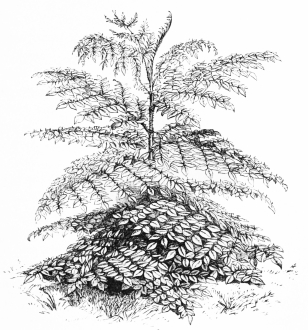
when they will shoot vigorously. If the effect of a full-grown specimen be desired, the shrubbery is the place for it. = A. japonica (Hort.).
*Aralia edulis.—This is a vigorous herbaceous perennial, well suited for those positions in which we desire a luxuriant type of vegetation. It is perfectly hardy, is of a fresh and vigorous habit, and grows 6, 7, and even 8 ft. high in good soil, even so early as the end of June. The leaves attain a length of nearly a yard when the plant is strong, while the shoots droop a little with their weight, and thus it acquires a slightly weeping character. It is rare in this country now, but, being easily propagated, may, it is to be hoped, not long prove so. As it dies down rather early in autumn, it must not be put in important groups, but rather in a position where its disappearance may not be noticed. An isolated position, or one near the margin of an irregular shrubbery, fernery, or rough rockwork by the side of a wood walk, will best suit it. Japan. Division.
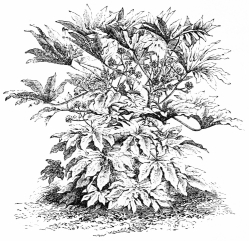
*Aralia japonica.—A valuable species, quite distinct from any of the others, with undivided, fleshy, dark-green leaves. It is usually treated as a green-house plant, but is hardy and makes a very ornamental and distinct-looking shrub on soils with a dry porous bottom. It grows remarkably well in the dwelling-house; in fact it is one of the very few plants of like character that will develop their leaves therein in winter. Not difficult to obtain, it may be used with advantage in the flower-garden or pleasure-ground among medium-sized plants—say those not more than a yard high. It would form striking isolated specimens on the turf, and is also very suitable for grouping. A native of Japan. = A. Sieboldi.
Aralia japonica.
*Aralia nudicaulis.—A very vigorous perennial, with a smooth stem scarcely rising out of the ground, bearing large leaves with long-stalked, oval-oblong, pointed, toothed leaflets, and a shorter naked flower-stem, with from two to seven umbels of blossoms. Roots several feet long and highly aromatic. Similar uses to those directed for A. edulis. North America.
Aralia papyrifera (Chinese Rice-paper Plant).—This, though a native of the hot island of Formosa, flourishes vigorously with us in the summer months, and is one of the most valuable plants in its way, being useful for the greenhouse in winter and the flower-garden in summer. It is handsome in leaf and free in growth, though to do well it must, like all the large-leaved things,
Aralia papyrifera.
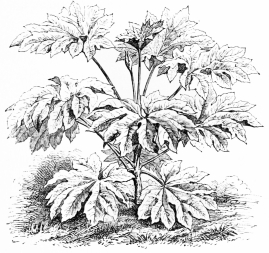
be protected from cutting breezes. If this Aralia be planted in a dwarf and young state, it is likely to give more satisfaction than if planted out when old and tall. The leaves spread widely out near the ground, and then it is very ornamental through the summer. Prefer therefore dwarf stocky plants when planting it in early summer. It should have rich, deep soil and plenty of water during the hot summer months. For the public gardens of Paris it is kept underground in caves during the winter; but in private gardens it will doubtless be thought worthy of a place in the greenhouse throughout that season. In Battersea Park a bed of A. papyrifera, 13 ft in diameter, attained a height of 5 ft, from cuttings struck in the spring of 1868. The plants were left out all the next winter, and, although killed to the ground, the thick fleshy roots next season produced numerous strong shoots or suckers. These were produced irregularly, and so numerously that they had to be thinned out in many places; a few spaces only requiring to be filled up. It is easily increased by cuttings of the root, and is usually planted in masses, edged with a dwarfer plant; but as a small group in the centre of a bed of flowers, or even as an isolated specimen in a like position, it is most excellent.
*Aralia racemosa (American Spikenard).—An herbaceous species, with smooth, widely-branching, diverging stems, about 4 ft. in height, and pinnate, slightly downy leaves with ovate heart-shaped leaflets. Flowers numerous, white, in racemose umbels. Thrives best in good soil in shady or half-shady positions. Similar positions, etc., to those for A. nudicaulis and edulis. N. America.
*Aralia spinosa (Angelica tree of North America) is highly useful, in consequence of its beauty of foliage, among subtropical plants. Like many of the hardy things, it should not be placed in positions where it would be necessary to remove it, nor closely associated with tender plants requiring frequent disturbance of the soil Flowers in autumn, small, white, in numerous umbels arranged on a much-branched panicle beset with velvety stellate down. The leaves are twice and thrice pinnate, with ovate, deeply serrated, smooth leaflets. In most cases it grows with a single erect stem—the very type we require—and it should not be allowed to depart from this habit. The stem is fiercely arrayed with spines. On account of its umbrella-like head this fine thing has often been planted in exposed open spaces, where it would produce a distinct feature, but it is better planted where the great leaves will not be lacerated. It generally grows not more than 10 ft. high; and in every size from that down to a plant with a stem not more than 18 ins. high, it may be effectively used in the ornamental garden. It is propagated by cuttings of the roots. N. America.
Aralia macrophylla is a fine large digitate-leaved species which stands summer exposure pretty well, but does not make any growth in the open air; hence it can be but of comparatively slight importance for this purpose. Norfolk Island.
Areca sapida.—A New Zealand palm from 6½ ft. to nearly 10 ft. high, with a beautiful crown of bright-green pinnate leaves, which when young are tinged with a bronze colour: leaflets from 16 ins. to 2 ft. in length, lance-shaped. The young leafstalks are of a greyish red hue. A fine palm for placing in the open air in summer, and equally so for the conservatory in winter and spring. It is of very easy culture, if supplied with plenty of water.
Aristolochia Sipho.—This well-known huge-leaved plant is capable of being used with excellent effect where large and distinct foliage is desired. Generally it is used as a wall plant; but it is far finer when used to cover bowers or any like structure. I have seen a most effective object formed by making the framework of a tent loosely with rough boughs, and then planting the Aristolochia around it. It formed a dense green and singular-looking wigwam. A. tomentosa is smaller, but distinct in tone of green, well worthy of a place, and to be employed in like manner. N. America.
*Artemisia anethifolia.—A hardy perennial species about 4 ft. high, with a simple round stem, woody at the base, and branching vertically above, clothed from about a foot above the ground with much-divided leaves, the segments of which are almost thread-like. Flowers very numerous, small, in a dense, large, terminal panicle, with erect branches. Useful in groups, or as isolated specimens in beds or borders. Division.
*Artemisia annua (Annual Wormwood).—An exceedingly graceful kind of wormwood, with tall stems reaching to a height of 5 ft. or 6 ft. in a season; the foliage is small and fine, and the flowers inconspicuous but arranged in not inelegant panicles. The hue of the plant is a peculiarly fresh and pleasing green, and it forms an elegant object in the centre of a flower-bed or group with plants of like character. Raised from seed as easily as any half-hardy annual.
*Artemisia gracilis.—An exceedingly graceful plant, 3 or 4 ft. high, with leaves cut into very fine hair-like segments, having some resemblance to fennel or other umbelliferous plants with minutely-cut leaves, and of a deep grass-green, except in the hearts of the shoots, where the young leaves are unfolding, where there is a slight hoary pubescence. The flowers are in compound panicles, quite obscure, of a pale green, not at all ornamental in the common sense, but forming a not ungraceful inflorescence. However, the plant is only likely to be grown for its graceful foliage and habit, and the flowers, which only appear in autumn, may be pinched off if not admired. Similar positions to those recommended for the preceding species. Seed.
*Arum crinitum.—The appearance of this plant when in flower is very grotesque from the singular shape of its broad, speckled, contorted spathe. The leaves are divided into five or seven deep segments, the central division being much broader than the others, and the leaf-stalks, overlapping each other, form a sort of spurious stem a foot or 14 ins. high, marbled and spotted with purplish-black. The treatment for this plant is similar to that given for A. Dracunculus; but as it is rather more tender, it will require more care and shelter in winter. Warm borders, fringes of shrubberies, or beds of the smaller subtropical plants, will suit it best. The appearance of the flower is almost too repulsive for the nerves of some persons. Division. S. of Europe.
*Arum Dracunculus.—A strange-looking but handsome plant, with a white stem curiously marbled with black, about 3 ft. high, and very deeply cut palm-like leaves, broadly veined and spotted with white. The spathe is of a pale green colour on the outside and of a deep purple-violet within, and, as well as the flowers, exhales a powerful carrion odour. Requires a light, deep, and dry soil, and does best in half-shady positions. Easily multiplied by division in spring or autumn. It is best fitted for the fringes of shrubberies, etc., or among the vegetation that sometimes starts from the bottoms of warm walls. S. of Europe.
*Arum italicum.—This plant, which is a native of the Isle of Wight and the Channel Islands, resembles the common A. maculatum in habit and in the shape of its leaves, which are, however, of a dark bluish-green colour, handsomely spotted with white, and marked with yellow veinings. Although it is a very hardy plant, and will thrive almost anywhere in moist soil and a shady position, it will be better to place it in sheltered positions along the sunny fronts of shrubberies, amidst low-spreading evergreens, and in cosy spots about the flanks of rock work and ferneries, to prevent its handsome foliage from being disfigured by cold wintry winds. One great merit of this is that it may be used to ornament positions in which few other plants will thrive,—as, for instance, under trees, groups of shrubs, etc. Easily multiplied by division in the end of summer and in autumn. S. of Europe.
*Arundo conspicua.—A companion for the Pampas grass, though by no means equal to it, as has been stated by some writers. In some very fine deep and free sandy loams it attains a height of nearly 12 ft., but this is rare. As a conservatory subject it is fine in flower, and it will be often seen in large conservatories after a few years. A large pot or tub will be necessary if it is grown indoors. The drooping foliage will always prove graceful, and it sends up long silvery plumes, drooping also, and strikingly beautiful. Judging by its different appearance when freely grown in a tub indoors, and when planted out even in favourable spots, my impression is that it by no means takes so kindly to our northern climate as the Pampas grass. However, it is well worth growing, even in districts where it does not attain a great development. It comes into flower before the Pampas grass, and may be considered as a sort of forerunner of that magnificent herb. New Zealand.
*Arundo Donax.—This great reed of the south of Europe is a very noble plant on good soils. In the south of England it forms canes 10 ft. high, and has a very distinct and striking aspect. It will grow higher than that if put in a rich deep soil in a favoured locality; and those who so plant clumps of it on the turf in their pleasure-grounds will not be disappointed at the result. Nothing can be finer than the aspect of this plant when allowed to spread out into a mass on the turf of the flower-garden or pleasure-ground. It seems much to prefer deep sandy soils to heavy ones; indeed, I have known it refuse to grow on heavy clay soil, and flourish most luxuriantly on a deep sandy loam in the same district. Like all large-leaved plants, it loves shelter. No garden or pleasure-ground in the southern parts of England and Ireland should be without a tuft of it in a sheltered spot. But, fine as it is for effect and distinctness, its variegated variety is of more value for the flower-garden proper.
*Arundo Donax versicolor.—We have already noticed several fine things for grouping together, or for standing alone on the turf and near the margin of a shrubbery-border, and this is as well suited for close association with the choicest bedding-flowers as an Adiantum frond is with a bouquet. It will be found hardy in the southern counties, and, considerably north of London, may be saved by a little mound of cocoa-fibre, sifted coal-ashes, or any like material that may be at hand. In consequence of its effective variegation, it never assumes a large development, like the green or normal form of the species, but keeps dwarf, and yet thoroughly graceful. It is of course best suited for warm, free, and good soils, and abhors clay, though it is quite possible to grow it even on that with a little attention to the preparation of the ground. But it is in all cases better to avoid things that will not grow freely and gracefully on whatever soil we may have to deal with: and it is to those having gardens on good sandy soils, and in the warmer parts of England, that I would specially recommend this grand variegated subject. For a centre to a circular bed nothing can surpass it in the summer and autumn flower-garden, while numerous other charming uses may be made of it. Not the least happy of these would be to plant a tuft of it on the green turf, in a warm spot, near a group of choice shrubs, to help, with many other things named, to fill up the gap that is now nearly everywhere observed between ordinary fleeting flowers and the taller tree and shrub vegetation. It is better to leave the plant in the ground, in a permanent position, than to take it up annually. Protect the roots in the winter, whether it be planted in the middle of a flower-bed or by itself in a little circle on the grass. Increased by placing a shoot or stem in a tank of water, when little plants with roots will soon start from every joint; they should be cut off, potted, and placed in frames, where they will soon become strong enough for planting out.
*Arundo Phragmites (Common Reed).—A native marsh-or water-plant, 5 ft. or 6 ft. high, bearing when in flower a large, handsome, spreading, purplish panicle. The stems are smooth, simple, very erect, and grow closely together. The plant is only attractive when in flower, as its flat, ribbon-like leaves do not of themselves present any very striking appearance. Useful for the margins of artificial waters, etc., to which it may be brought from its wild haunts. It should, however, if possible, be kept in one spot and not allowed to spread too much.
*Asclepias Cornuti.—A handsome hardy perennial from N. America, sending up from its running, underground rootstock a number of erect, unbranched stems, from 4 ft. to 6½ ft. high, thickly covered with large opposite oval leaves. The flowers are of a light rose-colour, and agreeably fragrant, and are borne in large umbels at the tops of the stems. The plant does well in almost any kind of soil or position, and is well adapted for planting in places which do not require much attention. As it spreads very rapidly at the root, it is better to exclude it from small beds or gardens, which would soon be overrun by it. Several other species are in cultivation, the best of which are A. speciosa (Douglasii), A. incarnata, and A. tuberosa.
*Asparagus Broussoneti (Giant Asparagus).—A vigorous, climbing asparagus, with a tapering, shrubby stem, 10 or 12 ft. high. The flowers are small and inconspicuous, and are followed by numerous small red berries. An excellent subject for tall trellises, rustic bowers, stumps of trees, tall poles, etc. Canary Islands.
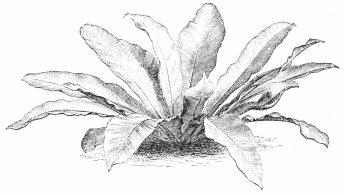
Asplenium Nidus-avis.—This is a remarkable fern, which has been placed out of doors in the garden in summer, from early in June to October; but it is not vigorous or hardy enough to be generally recommended for this purpose. However, as it may have been noticed in abundance at Battersea Park, I allude to it here. The leaves are rather broad, pointed, and undulating, nearly 3 ft. long, and form roundish, spreading, nest-like tufts. It is a favourite subject in places where large collections of tropical ferns are grown, and in such places a plant may be tried in the open air in a very warm, shady, and perfectly sheltered position. E. Indies.
Asplenium Nidus-avis.
*Astilbe rivularis.—A large-leaved and striking plant from Nepaul, with the habit and general appearance of a Spiræa, growing to a height of more than 3 ft., and of a free and graceful habit, which makes it useful for association with the finer-foliaged herbaceous plants, and for dotting here and there in the wild or picturesque garden. It keeps its foliage well through the season, unlike some herbaceous plants, and is therefore all the more valuable. Flowers late in summer, small, yellowish-white, in large panicled spikes. The radical leaves are broad, twice ternate with toothed divisions, and the base of the leaf-stalk is covered with numerous rough tawny hairs. Being pretty hardy, the Astilbe usually succeeds well in any cool rich soil, and best in half-shaded positions. Easily multiplied by division. It is suited for isolation, borders, fringes of shrubberies, or for groups of hardy plants.
*Astilbe rubra.—A very pretty and hardy plant, also resembling a. Spiræa in habit and appearance, and growing from 4 ft. to 6 ft. high. The leaves are twice ternate, with oblique, heart-shaped leaflets, 1 in. to 2 ins. long, and with lengthened serrated points. The flowers are numerous, in dense panicles, and of a rose-colour, appearing late in summer and in autumn. The same positions, etc., as those for the preceding kind. North America, Japan, and mountains of Northern India.
*Bambusa.—I wish to call the attention of all horticulturists who live in the southern and more favoured parts of these islands to the fact that there are several bamboos and bamboo-like plants from rather cool countries that are well worth planting. Nothing can exceed the grace of a bamboo of any kind if freely grown; but if starved in a crowded house, or grown in a cold dry place, where the graceful shoots cannot arch forth in all their native beauty, nothing can be more miserable in aspect. In cold bad soils and exposed dry places in the British Isles these bamboos have little chance; but, on the other hand, they will be found to make most graceful objects in many a sheltered nook in the south and southwestern parts of England and Ireland. We have some knowledge of the capabilities of one kind in this country. In a well-sheltered moist spot at Bicton I have seen Bambusa falcata send up young shoots, long and graceful, like the slenderest of fishing-rods, while the older ones were branched into a beautiful mass of light foliage of a distinct type. The same plant grows in the county of Cork to a height of nearly 20 ft. This is the best known kind we have. At Paris I was fortunate enough to observe various other kinds doing very well indeed, although the climate is not so suitable as that of Cork or Devon. These were Bambusa edulis, aurea, nigra, Simonii, mitis, Metake, and viridi-glaucescens, the first and last of this group being very free and good. All the others will prove hardy in the south of England and Ireland, though, as some of them have not yet been tried there, it requires the test of actual experiment. Those who wish to begin cautiously had better take B. Simonii, viridi-glaucescens, and edulis to commence with, as they are the most certainly hardy, so far as I have observed. The best way to treat any of these plants, obtained in summer or autumn, would be to grow them in a cool frame or pit till the end of April, then harden them off for a fortnight or so, and plant out in a nice warm spot, sheltered also, with good free soil—taking care that the roots are carefully spread out, and giving a good free watering to settle the soil. There are no plants more worthy of attention than these where the climate is at all favourable, and there are numerous moist nooks near the sea-side where they will be found to grow most satisfactorily, as well as in the south.
*Bambusa aurea.—A very hardy and graceful Chinese species, differing but slightly from B. viridi-glaucescens in size and habit, and forming elegant tufts with its slender much-branched stems, which attain a height of from 6½ ft. to 10 ft., and are of a light-green colour when
BAMBUSA AUREA. Thriving in warm and mild southern districts.
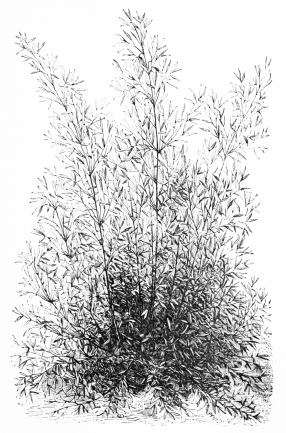
young, changing into a yellowish hue, and finally becoming of a straw-yellow when fully grown. The leaves are lance-shaped acute, light green, and are distinguished from those of B. viridi-glaucescens by having their under surface less glaucescent, and the sheath always devoid of the long silky hairs. The preliminary remarks on culture, etc., will apply to all the species here described.
*Bambusa edulis.—A hardy and vigorous kind, with very elegant light-green shoots and olive-green stems, attaining a height of 10 ft. in the neighbourhood of Paris. The leaves are small, and the plant is not nearly so branching as in some other kinds.
*Bambusa falcata (Arundinaria falcata).—A very ornamental species from Nepaul and the Himalayas, and at present the only kind of bamboo much planted with us. It grows from 7 ft. to 20 ft. high, and has woody, twisted, smooth stems of a yellowish-green or straw-colour, knotty, bearing on one side of each of the knots a bundle of small branches equally knotty and twisted. The whole plant has a pale yellowish hue, except in the young spikelets and sheaths, which are occasionally purplish. The leaves are of a fine delicate green, from 4 ins. to 6 ins. long, ribbon-like, linear-acute, sickle-shaped, in two rows, short-stalked, and sheathing. It is hardy over the greater part of England and Ireland, but only attains full development in the south and west. I have seen it attain great luxuriance in Devon, and nearly 20 ft. high near Cork, though in many districts it is stunted. It loves a deep, sandy, and rich soil, and plenty of moisture when growing fast.
*Bambusa Fortunei.—A pretty dwarf variegated species from Japan, of which I have not seen the green form in cultivation, with very dwarf, slender, branching, hollow, half-shrubby stems, seldom growing more than 18 ins. high, and with very short internodes. The leaves are 3½ ins. to 8 ins. long, linear-lance-shaped, abruptly pointed, somewhat rounded at the base, serrated and often fringed with long hairs on the margin, downy on both sides; they are distinctly variegated, the transverse veins being often of a bottle-green colour; stalks very short and hairy. This kind has proved hardy in our gardens, but it has not the charm of grace possessed by the other kinds, and is chiefly desirable in collections of variegated and edging plants.
*Bambusa japonica (B. Metake).—A large-leaved and rather dwarf species from Japan, growing from 4 ft. to 7 ft. high, with erect thickly-tufted stems, which are entirely covered by the sheaths of the leaves; the branches are also erect. The leaves are lance-shaped, with a very sharp point, dark green, persistent, narrowed into a short leaf-stalk, and nearly a foot long. This species sometimes flowers with extraordinary profusion at the expense of a portion of the foliage, which withers away and leaves the naked stems exposed. This may, however, be prevented to some extent, by placing the plants on mounds somewhat above the level of the surrounding soil. I have seen it thrive very freely in the late Mr. Borrer’s garden in Sussex, and in one or two other places. It loves a peat soil, or a very free moist and deep loam, and runs a good deal at the root.
Bambusa mitis.—A fine and vigorous kind from Cochin China, somewhat tenderer than most of the other
BAMBUSA FALCATA. Hardy Bamboo Section; growing 16 to 20 feet high in the milder southern parts of England and Ireland.
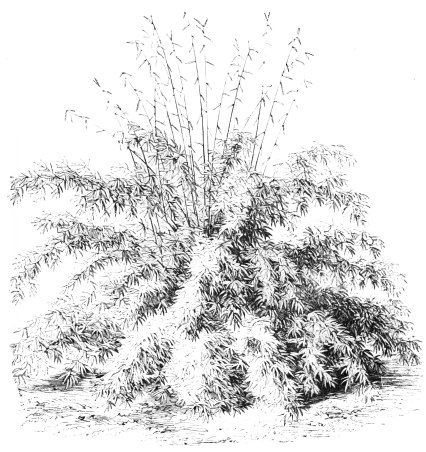
kinds enumerated, though no doubt it will be found to thrive in the milder southern districts; or it may be found useful if grown in the conservatory in winter and placed out in the open air in summer, as is sometimes done with B. arundinacea, which otherwise could not possibly be seen out of doors in our climate. Panicle simple, erect, close; spikes long, imbricated. Leaves rather large, lance-shaped, striated, clasping the stem, which is woody and tapering; nodes rather distant, and not very prominent.
*Bambusa nigra.—A rather compact-growing Chinese kind, with nearly solid stems, and thinner leaves than those of any other species. The stems are smooth and bushy, about 7 ft. high, of a light green, dotted and striped with purple when young, changing to a glistening black when fully grown; they branch very much at the top, and sometimes from the base up. The leaves are oval-oblong, acute, shortly-stalked, with a hard, dry, persistent sheath; their tender green colour contrasting finely with the blackish hue of the stems. It is best planted as isolated specimens near the margins of shrubberies, or on slopes in the pleasure-ground in warm, sunny, and sheltered positions, in deep, sandy, and well-drained soil.
*Bambusa Quilioi.—A Japanese species of vigorous growth, with robust green stems and bright-green leaves, polished above and slightly mealy beneath, the ligule bearing a little bundle of brownish-grey hairs at the top. This kind I first saw in the gardens of the Acclimatisation Society at Paris, where it was thriving vigorously, and I have little doubt of its proving valuable in Britain.
*Bambusa Simonii.—A handsome, distinct, and vigorous species, which has grown very freely for some years past in the neighbourhood of Paris. The stems are numerous and grow as much as 10 ft. high in a season. They are mealy-glaucous at the joints, and the branchlets are numerous and rather closely crowded. The leaves are narrow, sometimes nearly a foot long, and are occasionally striped with white. This species, which was obtained from China some years since, has thriven very well in the gardens at Paris, where M. Carrière first drew my attention to it. From what I have seen it do there I have no doubt it will prove of great value in the milder southern parts of England and Ireland.
*Bambusa violascens.—A hardy and vigorous kind, intermediate between B. nigra and B. viridi-glaucescens, most resembling the last-mentioned however. It has blackish-violet much-branched stems, which assume a yellow tinge with age. The leaves are green above, bluish-grey beneath, with an elongated ligule surrounded by a bundle of black hairs. Native of China.
*Bambusa viridi-glaucescens.—A species from Northern China, which has been proved very hardy and free in the Paris gardens, and will, probably, in warm parts of our islands, make a more vigorous growth and prove a more beautiful object than any other kind. The stems, of a light-yellowish-green, grow from 7 ft. to 12 ft. high, branching from the base, each branch again branching very much. The leaves are very numerous, especially at the ends of the branches, of a pale-green, bluish underneath, sheathing the stem for a considerable length. It forms a fine object when planted as isolated specimens in sheltered warm glades in the pleasure-ground, or in snug open spots near wood-walks, in very deep, rich, light, and well-drained soil.
*Bambusa viridis striata.—Described as a vigorous-growing, hardy kind, with numerous branches, having its long leaves green on both sides, and marked with bands, some of a yellowish and others of a deeper green. It is a native of Japan, and was recommended by MM. Thibaut and Ketteleer of Paris, but I have had no experience of its growth.
*Baptisia australis.—A handsome hardy perennial from N. America, forming strong bushy tufts from 3 ft. to 5 ft. high, and from 3 ft. to 6 ft. across, with sea-green trifoliate leaves which reflect a metallic lustre. The flowers are of a delicate blue, with wings of a greenish-white colour, and are borne in long erect spikes. Grows well in ordinary, deep, well-drained soil, preferring a sandy loam. B. exaltata and B. alba are closely allied to the preceding species, and form equally handsome bushes. The foliage of these is of a character to permit of their being grouped along with some of the finer perennial foliage-plants with good effect. Division.
*Berberis Aquifolium.—A well-known shrub from N. America, with simple stems from 3¼ ft. to 6½ ft. high, and very glistening, bright green leaves, each consisting of 7 or 9 sessile, oval, spiny leaflets. Where the plant is fully exposed to the sun, the foliage frequently acquires an agreeable reddish tinge. There are numerous varieties, of which B. floribunda may be mentioned as very handsome in habit and profuse in flower, and B. nitens, remarkable for the extremely glossy appearance of the old leaves, which when young are of a rich bronze changing to a dark green. This variety is of a dwarf and compact habit. It requires a shady situation and a compost of peat, loam, and sand. Though so very common, it will be found worth planting in some places among groups of hardy things, and also for isolation on the turf, its leaves being very ornamental.
*Berberis Bealii.—This is perhaps the finest of all the hardy species, whether as regards foliage or flower, while the fruit, in colour and size, surpasses that of any other kind. The leaflets vary to a very great degree on the same plant, both in form and size, some being 5 ins. long and 3½ ins. broad, the average size being 3 ins. long by 2 ins. broad: some again are nearly square, while others are long and narrow, with a very stiff triangular point. Shade, shelter from gusts of wind, and rich, well-manured soil are absolutely necessary to do full justice to the merits of this species. By pruning it to a single stem, it may be made to assume a very effective palm-like character. It is easily propagated from seed; a single berry frequently producing three plants. Being a noble subject for quiet half-shady wood-walks in peat or moist sandy loam, it should be much planted in the southern and milder districts. Where it thrives freely, it would prove a fine object on the margins of shrubberies grouped with the hardy “subtropical” plants, or indeed in any position.
*Berberis japonica.—A very handsome species, 5 ft. or 6 ft. high, with very leathery, pinnate, spiny leaves, from 1 ft. to 18 ins. long, slightly tinged with pink when first opened, then becoming pale green, and finally changing to dark green blotched with yellow. Flowers yellow, in large racemes, succeeded by large handsome
BERBERIS NEPALENSIS. Fine-leaved evergreen shrub Section; very effective when well-grown, in the warmer southern districts.
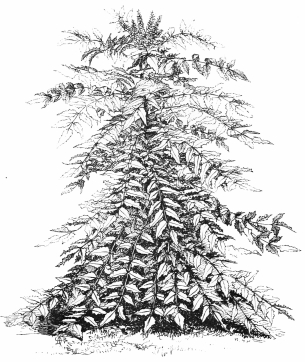
clusters of purple berries. This is also a fine kind for half-shady walks, and for similar positions and soil to those recommended for B. Bealii. Japan.
*Berberis nepalensis.—The noble habit of this plant makes it peculiarly valuable, possessing, as it does, the grace of a luxuriant fern with the rigidity of texture and port of a Cycas. The leaves are occasionally 2 ft. in length and of a pale green colour, sometimes with eight pairs of leaflets and an odd one: some of the leaflets 6 ins. long and nearly 2 ins. broad, with coarse spiny teeth on the margin. The inflorescence is very striking and beautiful. The Nepaul Barberry is one of those subjects that are too hardy to perish in our climate, yet which do not usually attain perfect development in it. It exists about London in the open air, and flowers in early spring; but the leaves seldom attain one-fourth of their full development, and the plant scarcely ever displays its vigorous grace. In mild parts, principally in the south and south-west, it grows more freely, and when judiciously placed in sheltered positions, in deep and rather sandy soil, it becomes a beautiful object. Where it thrives in the open air, it may be most tastefully used in the more open spots near the hardy fernery, here and there among “American plants,” or other choice shrubs with simple leaves, and also isolated in the grass a little way from the margin of the shrubbery in sheltered spots in the pleasure-ground. It should also, in places favourable to its growth in the open air, prove very useful as a hardy “subtropical” plant. Where it does not thrive well in the open air, it should not be planted. Nepaul.
*Beta cicla variegata (Chilian Beet).—Under this name a very showy plant has recently come into cultivation. When well grown the leaves are often more than a yard long, and present a vivid and most striking coloration. Their midribs are 4 ins. or more across, and vary from a dark deep waxy orange to vivid polished crimson. The splendid hue of the lower part of the leaf-stalk flows on towards the point, and spreads in smaller streams through the main veins and ramifications of the great soft blade of the leaf, which is often 1 ft. and even 15 ins. in diameter, if the plant be in rich ground. The under sides of the leaves are most richly coloured, and the habit such that these sides are well seen. It requires the treatment of an annual—to be raised in a gently heated frame, and afterwards planted out in very rich ground, though it may also be kept over the winter in pots. It varies a good deal from seed, and the most striking individuals should be selected before the plants are put out. Used sparingly, its effect would perhaps be more telling than if in quantity, and it is well suited for isolation. Chili.
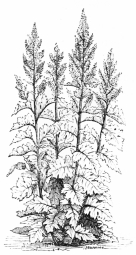
*Bocconia cordata.—This is a fine plant in free soil, but comparatively poor in that which is bad or very stiff. It forms handsome erect tufts from 5 ft. to over 8 ft. high, and is admirably suited for embellishing the irregular or sloping parts of pleasure-grounds. The stems grow rather closely together, and are thickly set with large, reflexed, deeply-veined, oval-cordate leaves, the margins of which are somewhat lobed or sinuated. The flowers, which are rosy-white and very numerous, are borne in very large terminal panicles. The flowers are not in themselves pretty, but the inflorescence, when the plant is well grown,
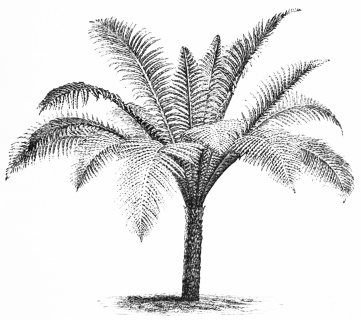
BLECHNUM BRASILIENSE. Dwarf tender Tree Fern: in sheltered shady dells during the summer months.
has a distinct and pleasing appearance. The plant is seen to best effect when isolated, and does well in ordinary garden-soil or free sandy loam. It attains its greatest size when placed in the angle of two walls which shelter it from the north and east, which seems to indicate that it does not like sudden changes of temperature and light. It should not be stirred too often, nor divided for several years. It will prove a good thing for associating with other fine hardy plants in bold groups. Seed or cuttings. China.
Bocconia cordata.
Bocconia frutescens.—A vigorous-growing Mexican shrub, 3½ ft. to nearly 6 ft. high, with few and very brittle branches, large, sea-green, handsome leaves, and greenish flowers. Very effective when placed on grass-plats, either in groups, or as isolated specimens. It requires a somewhat warmer climate than ours to thrive well, though it is sometimes seen in fair condition in the London parks. A mixture of free sandy loam and peat, well-drained ground, and an airy position are necessary. Multiplied by sowing in a hotbed in spring, and may be placed out from June to the end of September. It is difficult to propagate it by cuttings.
*Brassica oleracea crispa.—A handsome kind of cabbage nearly 4 ft. high, with elegantly-cut arching leaves, the divisions of which are finely curled or frizzled. In autumn and winter it may be advantageously employed in the embellishment of winter-gardens, the leaves being at their best during that part of the year.
A still more striking subject is B. o. palmifolia, which attains a height of 6½ ft., and bears its leaves near the summit of the stem, having quite a palm-like appearance in the end of the summer and in autumn. This kind might be used with good effect in various positions, as its “cabbage” character is not so evident. The fact of their being cabbages prevents many people from using these really ornamental plants.
The variegated Kales have been much employed and with a very good result in the winter-garden at Wardie Lodge in Scotland and in other places: they lose their beauty early in spring. “To keep them dwarf and compact, and to bring out their fine colours,” say Messrs. Stuart and Mein, “we sow at the beginning of March thinly. After the plants are a moderate size, we transplant them into a poorish soil, in an open space of ground, but not too closely together. They remain there until they are wanted for use, when they are removed at any time to the winter-garden. We plant out into our beds in November, and keep the heads with their foliage close to the ground. We cut off all the lower rough leaves, leaving the rich-coloured head or centre, which in all weathers will be found to stand up neat and trim, even in bright frosty weather. As the plants are thus much reduced in size, they can be planted much closer in the beds. We may add that, as in other hybrids, worthless plants will occasionally make their appearance: these we discard. No plants should be selected for the beds except those showing pleasing shades of colour.”
Brexia madagascariensis.—A handsome shrub with a slender erect stem (which sometimes attains a height of 25 ft. or 30 ft. in its native country, but with us is seldom seen more than a fourth of that), clothed with alternate, leathery, long, rather narrow, light-green leaves, nearly or quite smooth at the margin. It is one of the tropical stove-plants that have stood well in the open air from June to early in October, but very few places can spare it for this purpose. It requires ordinary stove culture during winter and spring, and should only be placed out after having made a strong growth, and having that growth hardened off. Madagascar.
Buphthalmum speciosum.
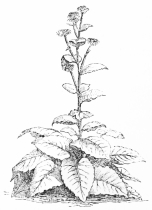
*Buphthalmum speciosum.—A hardy, distinct, and vigorous herbaceous plant, the stems of which are stout, very slightly branching, and about 4 ft. high, with broad, oval-acute leaves mostly clustered around the base of the plant, the lower ones falling gracefully towards the earth. The flowers, which have a red or purple disk and yellow rays, are more than 2 ins. across, and are terminal, solitary, long-stalked, borne in the axils of the upper leaves, and appear in June, July, or August, according to the season. The plant seldom flowers well before the third year. It is of easy culture in any soil, is increased by division in autumn, winter, or spring, and is best fitted for association with the more vigorous herbaceous plants in rough places. S. of Europe.
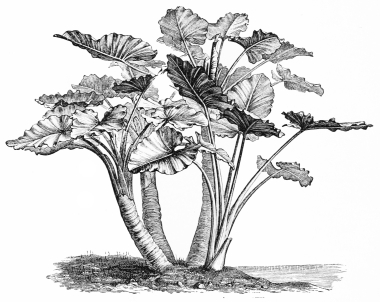
Caladium esculentum.—This species has, for outdoor work, proved the best of a large genus with very fine foliage. It is only in the midland and southern counties of Great Britain that it can be advantageously grown, so far as I have observed; but its grand outlines and aspect when well developed make it worthy of all attention, and of a prominent position wherever the climate is warm enough for its growth. It may be used with great effect in association with many fine foliage-plants; but Ferdinanda, Ricinus, and Wigandia usually grow too strong for it, and, if planted too close, injure it. This may have been noticed particularly in cases where it was used as a bordering to masses of the strong-growing kinds above named. For all kinds of stonework, vases, etc., it is peculiarly effective and beautiful. This plant, requires, above all others, a thoroughly-drained, light, rich, warm soil. In times of great heat, it should be plentifully watered, and occasionally with liquid manure. The month of May is the best time for planting it out; and if groups are formed, the plants should have an interval of 2 ft. or 2½ ft. between them. The foliage generally arrives at its full beauty and development in August and September. At the approach of cold frosty weather, all the leaves, or all but the central one, should be cut down to within an inch or two from the crown, and a few days afterwards the tubers should be taken up and left on the ground for a few hours to dry:
CALADIUM ESCULENTUM. Tender Section; displaying noble leaves during summer in the warmer parts of the southern counties.
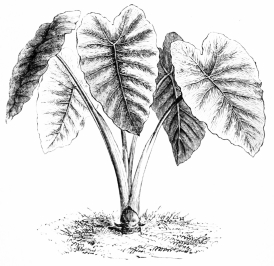
COLOCASIA ODORATA. Tender stove Section; will endure exposure only during summer in the warmest parts of the southern counties.
they should then be stored on the shelves of a greenhouse, or in a cellar or other place where they will be sheltered from frost and moisture. By placing the tubers in a hotbed in March, plants may be obtained with well-grown leaves for planting out in the open air about the end of May or the beginning of June. New Zealand.
Caladium odorum (Colocasia odora).—A very striking plant, with stout stems usually from 3 ft. to 8 ft. in height, but growing much taller in a warm stove. The leaves are erect, very broad, and heart-shaped, marked with strong veinings, and frequently measure more than 3¼ ft. in length. The flowers are exceedingly fragrant. It is a fine subject for isolation on grass-plats, its tall arborescent habit distinguishing it from all the other species; but it is unfortunately too tender to thrive in our climate except in sunny sheltered dells in the southern parts, and should not be planted out until June. E. Indies.
*Calla æthiopica (Lily of the Nile).—This well-known plant may be grown either as an aquatic in pieces of ornamental water, fountain-basins, etc., or in the open ground in cool, moist soil, and equally well in positions exposed to the full sun and in those which are shaded. Being so very distinct in leaf and beautiful in bloom, this old favourite will be seen to as much advantage grouped with the smaller fine-leaved plants in beds as ever it has been in our stoves or windows. S. Africa.
*THE CANNAS.
If there were no plants of handsome habit and graceful leaf available for the improvement of our flower-gardens but these, we need not despair, for they possess almost every quality the most fastidious could desire, and present a useful and charming variety. The larger kinds make grand masses, while all may be associated intimately with flowering-plants—an advantage that does not belong to some free-growing things like the Castor-oil plant. The Canna ascends as boldly, and spreads forth as fine a mass of leaves as these, but may be closely grouped with much smaller subjects. The general tendency of most of our flower-garden plants is to assume a flatness and dead level, so to speak; and it is the special quality possessed by the Cannas for counteracting this that makes them so valuable. Even the grandest of the other subjects preserve this tameness of upper-surface outline when grown in great quantities: not so these, the leaves of which, even when grown in dense groups, always carry the eye up pleasantly from the humbler plants, and are grand aids in effecting that harmony which is so much wanted between the important tree and shrub embellishments of our gardens and their surroundings, and the dwarf flower-bed vegetation. Another good quality of these most useful subjects is their power of withstanding the cold and storms of autumn. They do so better than many of our hardy shrubs and plants, so that when the last leaves have been blown from the Lime, and the Dahlia and Heliotrope have been hurt by frost, you may see them waving as gracefully and as green as the vegetation of a temperate stove. Many of the subtropical plants, used for the beauty of their leaves, are so tender that they go off in autumn, or require all sorts of awkward protection at that season; but the Cannas last
CANNA. The most important and generally useful of tender plants for our climate. Many kinds are hardy if protected in winter.
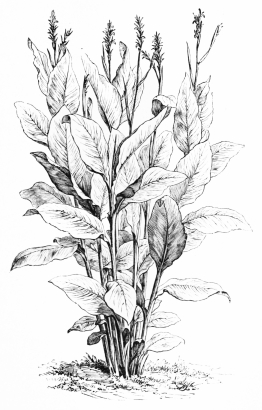
in good trim till the borders must be cleared. All sheltered situations, places near warm walls, and nice snugly-warmed dells, are suitable positions for them. They are generally used in huge and ugly masses, both about Paris and London; but their true beauty will never be seen till we learn to place them tastefully here and there among the flowering-plants—just as we place sprigs of graceful fern in a bouquet. A bed or two solely devoted to them will occasionally prove very effective; but enormous meaningless masses of them, containing perhaps several hundred plants of one variety, are things to avoid and not to imitate. As to culture and propagation, nothing can be more simple: they may be stored in winter, as readily as potatoes, under shelves in the houses, in the root-room, or, in fact, anywhere if covered up to protect them from frost. And then in spring, when we desire to propagate them, nothing is easier than pulling the roots in pieces, and potting them separately. Afterwards it is usual to bring them on in heat, and finally harden them off previous to planting out in the middle of May; but a modification of this practice is desirable, as some kinds are of a remarkably hardy constitution, and make a beautiful growth if put out without so much as a leaf on them. The soil for all Cannas should be deep, rich, and light.
In rambling through the suburbs of Paris, I once came upon a tuft of Canna springing up strongly through a box-edging—pretty good evidence that it had remained there for some years. Upon inquiring of the proprietor of the garden I found this was the case, and that he had no doubt of the hardiness of several other kinds. They were planted not more than 8 ins. or 10 ins. deep. When we remember that the Cannas are amongst the most valuable plants we use for giving grace and verdure to the flower-garden, this surely is a hint worthy of being acted upon, as, of course, they will prove equally hardy with us. Considering their diversity of colour and size, their graceful pointed habit and facility of propagation, we must concede them the first place; but their capability of being used by anybody who grows ordinary bedding-plants, and the fact that they may be preserved so very easily through the winter, enhance their value still more. Cannas, protected by a coating of litter, have been left out in Battersea Park through severe winters, and during the unfavourable summer of 1867 attained a height of nearly 12 ft. Where it is desired to change the arrangements as much as possible every year, it may not be any advantage to leave them in the ground, and in that case they may be taken up with the bedding-plants, and stored as simply and easily as carrots. Wherever they are grown as isolated tufts, in small groups, or in small beds, it will be best not to take them up oftener than every second or third year. These noble plants would also adorn the conservatory, which is often as devoid of any dignified vegetation as the unhappy flower-gardens which are seen all over the country. Few subjects would be more effective, none more easily obtained.
SPECIES AND VARIETIES OF CANNA.
In the following list of the species and varieties of Canna, the first thirteen kinds are considered species: but the finest kinds for garden use will be found among the Hybrids and Varieties.
Canna aurantiaca.—A vigorous kind, 6½ ft. or more in height, with large, broadly oval-lance-shaped leaves, of a pale green colour, slightly waved on the margin. Flowers with rose-coloured outer, and reddish inner, divisions, the upper lip being of an orange colour and the lower one yellow dotted with orange. Rhizome tuberous, with long subterranean shoots. Antilles.
Canna discolor.—One of the finest kinds, and, although it does not flower regularly in the open air, one of the most valuable on account of its foliage. The leaves are very large, broadly oval-oblong, the lower ones tinged with a blood-red hue, and the upper ones veined or streaked with purple. Stems reddish, stout, growing to a height of more than 6 ft. Flowers orange-red, with bright-red inner divisions. S. America.
Canna edulis.—A vigorous species, largely cultivated by the Peruvians for the sake of its edible roots, growing from 6 ft. to 7 ft. high, the stems tinged with deep purple. Leaves broadly oval-lance-shaped, green tinged with purple maroon. Flowers large: external divisions purple, upper internal division scarlet shaded with yellow, the lower one of an orange-red. S. America.
Canna flaccida.—A species remarkable for the great size of its flowers, which bear some resemblance to those of Iris Pseud-acorus. They are entirely yellow, flaccid, few in number, and very transitory. This is not a tall species, seldom exceeding 2 ft. 8 ins. in height. Leaves oval-lance-shaped, erect, glaucescent. South America. This species should not be confounded with the C. flaccida of Willdenow which is found on the shores of the Mississipi.
Canna Gaboniensis.—A species from the Gaboon River, with the habit of C. nepalensis. Rhizomes large and round; stalks green, large; leaves deep green lightly edged with purple, longish, acuminate; flowers medium-sized, clear orange; habit fine, special; height 5½ ft. to 6 ft.
Canna gigantea.—A robust kind, growing about 6½ ft. high. Flowers in summer, large and very handsome; external divisions orange red; internal ones deep purple-red; spathes reddish. Leaves more than 2 ft. long; stalks covered with a velvety down. S. America.
Canna indica.—Flowers in summer, tolerably large, irregular, in erect spikes; external divisions light yellow; upper inner divisions of a carmine-red; the lower one yellow dotted with carmine. Leaves large, alternate, oval-lance-shaped; the stalks sheathing at the base. Stems 3 ft. to 6 ft. high. A variety (C. i. superba) has much larger flowers of a scarlet colour. India. It is not nearly so useful or imposing in appearance as some of the newer hybrid kinds.
Canna iridiflora.—Flowers in midsummer, large, lively rose-colour, with a yellow spot on the lip; divisions of the calyx red, erect, oval-acute; spikes somewhat drooping, issuing several together from the same spathe. Leaves broadly oval-acuminate, slightly membranous at the margin, and having some hairs at the lower part of the midrib. Stems 6 ft. to over 8 ft high. Peru. A somewhat tender species, and although one of the finest, does not flower freely. To secure its blooming, the plants should be taken up towards the end of summer, potted, and kept in a hothouse through the winter. They should be watered moderately, and, treated in this way, will almost always begin to show flower in the ensuing spring.
Canna limbata.—This has numerous stems nearly 3 ft. high, and oblong-lance-shaped, acute leaves. Flowers in long loose spikes issuing from glaucous spathes tinged with red; outer divisions pale yellow; upper lip scarlet edged with a yellow margin; lower lip red, with golden reticulations. Brazil.
Canna musæfolia.—This species was formerly described in the English, Dutch, and German horticultural journals under the name of C. excelsa. It was named musæfolia by M. Année, who introduced it into France in 1858, from the resemblance of its leaves to those of the Musa or banana-tree. It reaches a height of more than 8 ft., and has green, downy stems, and very large, oval, green leaves. Flowers small, orange-yellow. It is a tender species without rhizomes, and requires to be kept constantly growing. Peru.
Canna nepalensis.—A variety of C. glauca (according to M. Chaté), introduced into France by M. Wallich, director of the Botanic Garden at Calcutta. About 6½ ft. high, with oval-lance-shaped glaucous leaves, narrowed at both ends. Outer divisions of flower greenish-yellow; inner ones, sulphur-coloured or light orange.
Canna purpurea spectabilis.—Rhizomes cylindrical. Stalks medium-sized, purple. Leaves deep greenish purple, fair size. Flowers small, scarlet. Rather uncommon; habit fine; height 6 ft. to 6½ ft. This is a very hardy species, and has given rise to all the varieties with red or striped leaves.
Canna Warscewiczii.—A very early-flowering species, easily raised from seed, and if sown early in spring, may be used for decorative purposes the same year. Stems numerous, reaching a height of somewhat over 3 ft. Leaves oval-elliptical, narrowed at both ends, and deeply tinged with dark purple. Flowers with brilliant scarlet inner divisions; outer ones purplish. S. America. There are many handsome varieties of this species in cultivation.
Canna Alfred Dumesnil.—Rhizomes clouded, elongated. Stalks medium thickness, deep greenish-purple. Leaves medium-sized, acuminate and erect, deep green striped with violet-purple. Flowers large, well-formed, scarlet. Free-flowering; height 3½ ft. to 4 ft.
Canna Annei.—A vigorous kind, with numerous stiff stems, of a sea-green colour, 6½ ft. high, and large green, glaucescent, oval-acute leaves, 2 ft. long by 10 ins. wide. Flowers large, well-formed, salmon-colour, continuing to appear from July until the first frosts.
Canna Annei-rosea.—Flowers late and scantily. Stems numerous, dark green with a reddish base, attaining a height of nearly 10 ft. Flowers small, carmine rose-colour. Leaves dark green, very narrow and pointed, erect, about 2 ft. 4 ins. long. Rootstock long, conical-cylindrical, reddish.
Canna Annei-bicolor.—A kind with rather thick green stems nearly 6 ft. high, with a violet-coloured base. Leaves light green, oval-acute. Flowers few, of medium size, orange-coloured; the two upper petals reddish. Rootstock of a violet colour.
Canna Annei-floribunda.—Resembles the type in habit and foliage, but is not so tall, is more free-flowering, and has yellow leaves.
Canna Annei-fulgida.—Stems small, of a dark-red colour, from 3 ft. to 5 ft. high. Leaves deep purple, erect, 20 ins. long and 6 ins. wide. Flowers large, well-opened, orange-red. Very tender.
Canna Annei-marginata.—Stems of medium size, dark-red colour, and about 3½ ft. high. Leaves of a deep green with a dark-red margin. Flowers rather large, orange-red. (Considered an inferior variety.)
Canna Annei-discolor.—Stems five or six in number, vigorous and erect, of a uniform red hue, from 3 ft. to 5 ft. high. Leaves lance-shaped, erect, of a light-red colour, 2½ ft. long and 10 ins. wide. Flowers late and few, small, rose-coloured, tinged with yellow. Rootstock conical, very small and short, covered with violet scales.
Canna Annei-rubra.—Rhizomes of good thickness. Stalks medium thickness, purple. Leaves acuminate, deep green striped with purple, good size; habit fine. Flowers bright orange, well-formed. One of the most free-flowering Cannas. Height 6½ ft.
Canna atronigricans.—Stems of medium thickness, seldom exceeding 3¼ ft. in height. Leaves of a purplish shade passing into dark-red, of a deeper hue than those of C. nigricans. Flowers few, of a golden-brown colour. Rootstocks small and few, with reddish scales. A very handsome but tender kind.
Canna aurantiaca-splendida.—Stems green, downy, rather thick, 6½ ft. to over 8 ft. high. Leaves oval, erect, 2 ft. 4 ins. to 2½ ft. long and 1 ft. wide, with very prominent membranes. Flowers in September, orange, well-formed, and of a good size. Rootstocks small. A very vigorous-growing variety.
Canna aurantiaca-zebrina.—Stems brown, downy, 3¼ ft. to nearly 5 ft. high. Leaves of a light green, striped with fine violet bands, and 2 ft. in length by 10 ins. wide. Flowers very few, light red. Rootstocks few and short.
Canna Amelia.—Stems of a sea-green colour, nearly 5 ft. high. Leaves oval-acuminate, glaucous, and gracefully recurved. Flowers large, well-opened, of a golden yellow, spotted with orange-purple on all the petals. Rootstocks conical and cylindrical. Blooms abundantly and continuously from July till the first frosts.
Canna atropurpurea.—Stems very small and downy, of a reddish hue, and not exceeding 3¼ ft. in height. Leaves small, recurved, of an almost black colour. Flowers rather large, of a reddish golden-brown. Rootstocks small, cylindrical, closely crowded around the plant. This variety seeds well and freely.
Canna Abbé Rosier.—Stems green, nearly 6 ft. high. Leaves erect, of a glaucous sea-green shade. Flowers of medium size, light brown, tinged with vermilion, not well-formed, and opening badly. Rootstocks conical and cylindrical.
Canna Bonetti.—Stems vigorous, of a deep-red colour, glaucous towards the top, and about 8½ ft. high. Leaves deep green, with deep-red veins and edges, 2 ft. 4 ins. long, and over 8 ins. wide. Flowers rather large, yellowish-brown, shaded with dark purple, well-formed and well-opened. Rootstocks thick, elongated. Seeds freely and well.
Canna Bonetti-major.—Very like the preceding, but with much taller stems and larger leaves and flowers.
Canna Bonetti-semperflorens.—Stems brown, 6½ ft. to over 8 ft. high. Leaves lance-shaped, deeply tinged and margined with a dark-red shade. Flowers rather large, of a wine-red colour. A very free bloomer.
Canna Bourcier.—Stems brown, 6½ ft. to nearly 10 ft. high. Leaves long, lance-shaped, of a deep violet-red colour. Flowers of a brick-red shaded with salmon-colour. Rootstocks conical, of medium size, violet-coloured.
Canna Bihorelli.—Stems purple, 3¼ ft. to nearly 5 ft. high. Leaves dark red, with a narrow purple margin. Flowers numerous, light red, in handsome panicles. Rootstocks conical and rather numerous.
Canna compacta-grandiflora.—Stems brown, 3¼ ft. to nearly 5 ft. high. Leaves dark red, not well set. Flowers very large, well-formed, of a salmon-shaded-red, in handsome panicles. Rootstocks conical, rather large, covered with reddish scales.
Canna Chatei-discolor.—Stems purple, very robust, 3¼ ft. to nearly 5 ft. high. Leaves thick and firm, of a deep green, finely rayed and margined with purple. Flowers blood-red, well-formed. Rootstocks conical, of medium size. A very shy bloomer.
Canna Chatei-grandis.—Stems brownish-purple, 6½ ft. high, when not divided year after year. Leaves at first erect, afterwards deflected throughout their entire length and spreading very much, 2 ft. 4 ins. long and 1 ft. wide. Flowers late, crimson, in a handsome panicle. Rootstocks brown, conical, very short. Ripens its seeds well.
Canna Daniel Hooibrenk.—Rhizomes large. Stalks strong, green. Leaves large, glaucous-green, acuminate. Flowers large, bright orange. Free-flowering; fine habit Height over 6 ft.
Canna De Candolle.—Stems green, about 4 ft. high. Leaves green, badly set. Flowers very numerous, vermilion shaded with carmine. Rootstocks conical.
Canna discolor-floribunda.—Stems dark red, 3¼ ft. to 4¼ ft. high. Leaves oblong, 18 ins. long and 10 ins. wide, deep green striped with purple. Flowers small, orange-red. Rootstocks conical, of medium size. Ripens its seeds well.
Canna Député Hénon.—Stems green, not exceeding 4 ft. 10 ins. in height. Leaves of a light glaucous-green, oval, acute, erect. Flowers large, well-formed, of a pure canary-colour, with a brownish-yellow base, in numerous spikes, which rise gracefully above the foliage to the height of about 20 ins. Rootstocks cylindrical, elongated, standing at some distance from the centre of the tuft. Ripens its seeds well.
Canna Edward Morren.—Rhizomes conical. Stalks green, numerous. Leaves clear green, longish. Flowers large, well-formed, yellow, very much spotted with bright nasturtium-colour. Very floriferous. This is the finest Canna with spotted flowers. Height 5 ft. to 5½ ft.
Canna elata-macrophylla.—Stems reddish below, green and downy above, more than 8 ft. high. Leaves light green, very large, oval, slightly waved. Flowers salmon-coloured, small. Rootstocks conical, of medium size. Seeds freely.
Canna expansa.—Stems thicker than in any other variety, green, downy, 6 ft to over 8 ft. high. Leaves of enormous size (over 4 ft. long and from 22 ins. to 2 ft. wide), oval, obtuse, spreading horizontally to a great distance from the stems. Flowers small, vermilion shaded with salmon, in panicles. Roots fibrous. Should be planted in a well-sheltered position to save the huge leaves from being torn by the winds. Never seeds.
Canna expansa-rubra.—Stems numerous, vigorous, very thick, dark-red, 4 ft. to nearly 6 ft. high. Leaves of a dark-red colour, and resembling those of the preceding in size, shape, and arrangement. Flowers large, with rounded divisions, of a dazzling purple colour. Rootstocks very thick, cylindrical, and much swollen in the upper part. Like the preceding, requires a sheltered position.
Canna elongatissima-rustica.—Stems deep-green, very thick, 6½ ft. to over 8 ft. high. Leaves oval, erect, very large, of a deep shining green, with a narrow dark-red margin. Flowers very small, orange-rose-coloured. Rootstocks very small, conical, with fibrous roots. A vigorous-growing variety.
Canna excelsa-zebrina.—Stems dark violet-red, downy, rather thick, 6½ ft. to over 8 ft. high. Leaves very large, oval, erect, deep-green, passing into dark-red, rayed with violet-purple. Flowers small, orange. Rootstocks small, conical. This is the finest striped variety.
Canna guayaquilla.—Rhizomes large, round. Stalks very thick, reddish. Leaves very wide and large, bordered with purple. Flowers small, yellowish-orange. Rather uncommon; fine habit; a remarkable kind. Height over 6 ft.
Canna gigantea-major.—Stems thick and vigorous, of a light-green, slightly reddish below, 6½ ft. to 8½ ft. high. Leaves very large, of a light glistening green. Flowers, medium size, pale-red. Rootstocks whitish, very thick, cylindrical, and swollen. A very hardy variety.
Canna gigantea-rubra.—Stems dark red, 4 ft. to nearly 6 ft. high. Leaves broad, obtuse, green, shaded with dark-red. Flowers blood-red, in panicles. Rootstocks conical, very closely crowded together. Resembles C. Chatei-grandis, but is an inferior variety.
Canna grandis.—Stems green, downy, very thick, from nearly 10 ft. to nearly 12 ft. high. Leaves oval, erect, deep green, very large. Flowers poppy-red, small, but in large panicles. Rootstocks small, with fibrous roots.
Canna grandiflora-floribunda.—Stems small, from 20 ins. to 3¼ ft. high, of a light glistening green. Leaves small, light-green and glistening. Flowers numerous, very large, with rounded divisions, orange-rose colour, in handsome panicles. Rootstocks yellowish, numerous, cylindrical, of medium size. A very hardy variety, of great effect from its brilliant and luxuriant inflorescence.
Canna Heliconiæfolia.—Stems deep green and downy, 6½ ft. to over 8 ft. high. Leaves green, oval, erect, very firm. Flowers small, orange. Roots fibrous. Does not seed before the second year.
Canna Hostei.—Stems chestnut-coloured, about 8 ft. high. Leaves dark-red, lance-shaped. Flowers large, red. Rootstocks dark-red, conical.
Canna involventiafolia.—Stems green, 8 ft. to nearly 10 ft. high. Leaves very large, reflexed, of a light green. Flowers few and small. Rootstocks small, with fibrous rootlets.
Canna Imperator.—Stems vigorous, very thick, green and downy, reddish below, 6½ ft. to over 8 ft. at the close of the season. Leaves half-opened, lance-shaped, light green, with prominent lateral nerve, 2 ft. 4 ins. long by 14 ins. wide. Flowers late, very effective, of a dazzling blood-red. Rootstocks conical, very short.
Canna iridiflora-hybrida.—Stems green, downy, somewhat reddish below, 6½ ft. to over 8 ft. high. Leaves green, very large. Flowers well-formed, very large, blood-red. Rootstocks small, with fibrous roots. Flowers to most advantage in a house, where it is really magnificent.
Canna iridiflora-rubra.—Stems brown, 3¼ ft. to nearly 5 ft. high. Leaves deep green shaded with dark red, and with a narrow dark purplish-red margin. Flowers large, purplish-red. This variety is not so tender as the preceding one.
Canna insignis.—Stems violet, downy, 3¼ ft. to nearly 5 ft. high. Leaves oval, extending horizontally, of a tender green, rayed and margined with purplish-red. Flowers few and small, of an orange-red. This variety is valuable for its fine foliage.
Canna Joseph-Auzende.—Stems green, 4½ ft. high. Leaves green and flaccid. Flowers deep carmine, of medium size. Rootstocks yellowish, small and conical. Not a very good variety.
Canna Jean Bart.—Rhizomes conical; stalks medium thickness, deep green, elongated. Flowers very large, deep purple; height 5½ ft. to 6 ft.
Canna Jean Vandael.—Rhizomes cylindrical, longish; stalks medium thickness, numerous, clear green. Leaves clear green, erect, elongated. Flowers large, well-formed, garnet-red; height 4 ft. to 4½ ft.
Canna Jussieu.—Stems green, from nearly 4 ft. to 4¼ ft. high. Leaves small, glaucous-green. Flowers citron, approaching a chamois-colour. Rootstocks conical cylindrical. (An inferior variety.)
Canna Krelagei discolor.—Stems very thick, from nearly 5 ft. to nearly 6 ft. high. Leaves broad and thick, dark-red, rayed with purplish-red. Flowers large, carmine-red, sometimes rayed with white, in handsome panicles. Rootstocks grey, conical.
Canna Liervalii.—Stems dark-red, 6½ ft. high. Leaves of the same colour, rayed with purple. Flowers orange-red. Rootstocks dark red, conical.
Canna Lavallei.—Stems slender, purplish-brown. Flowers very large, well-formed, vermilion-orange, becoming yellower as they open. Rootstocks cylindrical.
Canna Lemoinei.—Stems green, 6½ ft. to over 8 ft. high. Leaves very leathery, of medium size, and deep green colour. Flowers bright orange.
Canna limbata-major.—Stems green and downy, 5 ft. to 6½ ft. high. Leaves large, lance-shaped, narrow, spreading, deep green, 2½ ft. long, and over 8 ins. wide. Flowers large, orange-red. Rootstocks cylindrical, narrowed towards the top, closely crowded together. Ripens its seeds freely.
Canna maxima.—Stems green and downy, 5 ft. to 6½ ft. high. Leaves very large, lance-shaped, acute, light green, becoming darker in the course of growth, reflexed, from 2½ ft. to 32 ins. long, and 10 ins. to 1 ft. wide, on stalks 6 or 7 ins. long. Flowers small, orange-yellow. Roots fibrous, without rootstocks. Does not flower before the second year, and is valuable only for its foliage.
Canna Maréchal-Vaillant.—Stems robust, from 5 ft. to 6 ft. high. Leaves oblong, lance-shaped, erect, 28 ins. to 32 ins. long, deep green, striped with purplish-red. Flowers large, elegant, of a pure orange, in handsome spikes. Rootstocks rather thick, conical and cylindrical, standing at some distance from the tuft.
Canna musæfolia-peruviana.—Stems green and downy, 5 ft. to 6½ ft. high. Leaves very large, wide, light green. Flowers small, orange. Rootstocks very small.
Canna musæfolia minima.—Leaves of a whitish green, badly set. Flowers small, orange-brown. No rootstocks.
Canna musæfolia-hybrida.—Resembles C. musæfolia, but the stems and leaves are thicker and of a deeper green.
Canna musæfolia-rubra.—Stems dark red, 6½ ft. high. Leaves dark purple-red, oval, very large. Flowers small, salmon-red. Rootstocks very tender, with fibrous roots. Neglected as too tender and not sufficiently distinct from several other varieties, such as C. Chatei-grandis, etc.
Canna musæfolia-perfecta.—Stems from 5 ft. to 6½ ft. high. Leaves broad, very firm, of a handsome whitish green. Flowers small, yellow. Roots fibrous, without rootstocks.
Canna metallica.—Resembles C. nigricans, and has never justified its name.
Canna macrophylla-zebrina.—Stems violet and downy, 4 ft. to over 5 ft. high. Leaves dark-red, rayed and striped with purple. Flowers red, with a perennially withered aspect. Rootstocks very small, conical, closely set round the tuft. This variety is very subject to diseases.
Canna metallicoides.—Stems violet, 5 ft. to 6½ ft. high. Leaves of medium size, dark-red striped with purple. Flowers medium size, light-red. Rootstocks small, with fibrous roots.
Canna nervosa.—Stems reddish, 3¼ ft. to 5 ft. high. Leaves deep green, rayed and margined with purple. Flowers small, blood-red. Rootstocks conical.
Canna nigricans.—Stems purplish-red, 4¼ ft. to over 8 ft. high. Leaves lance-shaped, acuminate, erect, of a coppery red, which exhibits a metallic gleam under sunshine. The old leaves lose their reddish tint, and assume a duller hue. They are 2½ ft. in length by 10 ins. or 12 ins. wide. Flowers few and late, of a sad, tawny-yellow colour. Rootstocks brownish, conical. Seldom seeds. One of the finest kinds.
Canna nana-superba.—Stems green, growing very closely together, and from 20 ins. to 32 ins. high. Leaves small, of a handsome green. Flowers large, badly formed, of a brick-red, becoming darker as they open. Rootstocks grey, small, conical (A very inferior variety.)
Canna nepalensis-grandiflora.—Has the same habit and foliage as the type (C. nepalensis), but is a dwarfer variety with better-shaped flowers of a sulphur-yellow, sometimes dotted with red.
Canna Oriflamme.—Rhizomes conical, stalks deep green. Leaves good size, elongated, acuminate, deep green lightly striped. Flowers very large, deep orange, in panicles which stand up considerably above the foliage. Height 5 ft. to 5½ ft.
Canna Pie IX.—Stems small, green, slightly reddish below, 3¼ ft. to 4 ft. high. Leaves small, of a pale glaucous-green, erect, lance-shaped, acuminate. Flowers large, light yellow with a deep orange claw, very numerous, in closely-crowded panicles. Rootstocks conical and cylindrical. Excellent for edgings.
Canna Parmentier.—Stems small, green, 4 ft. to 5 ft. high. Leaves glaucous-green, small. Flowers brownish-yellow. Rootstocks grey, conical and cylindrical. (An inferior variety.)
Canna purpurea-hybrida.—Stems dark-red, from 4½ ft. to over 5 ft. high. Leaves dark-red, rayed with reddish-purple. Flowers large, brownish-yellow. Rootstocks small, conical, crowded. A very handsome variety, but tender.
Canna Porteana.—Stems small, dark-red, 3¼ ft. to 4 ft. high. Leaves red, with a metallic lustre. Flowers medium-sized, light orange. Rootstocks grey, small, forming a close, compact tuft. A fine but tender variety.
Canna picturata-fastuosa.—Stems numerous, green, 5 ft. to 6½ ft. high. Leaves green, glaucescent, narrow, much pointed, over 2 ft. long by 6 ins. wide. Flowers large, well-opened, light yellow speckled with red. Blooms luxuriantly and continuously from the end of July to the first frosts. Rootstocks white, with grey scales, cylindrical, much elongated.
Canna picturata-nana.—Stems small, green, from 20 ins. to 2 ft. high. Leaves very small, of a light green. Flowers large, yellow, spotted with red. Rootstocks whitish, small, conical. A charming variety for edgings.
Canna Plantieri.—Stems very thick, reddish below, deep green above, 3¼ ft. to over 8 ft. high. Leaves green, glaucous, lance-shaped, acute. Flowers large, bright yellow, changing to orange. Rootstocks greyish, rather thick, conical and cylindrical. A late and shy bloomer.
Canna Prémices-de-Nice.—Stems and leaves like those of C. Annei, 3¼ ft. to 5 ft. high. Flowers very large, bright yellow, sometimes dotted with salmon-colour. Rootstocks conical and cylindrical, rather shorter than those of C. Annei. A very free-flowering and hardy variety.
Canna rubra-superbissima.—Stems dark purple-red, very thick, from nearly 6 ft. to 6½ ft. high. Leaves broad, round, purplish-red, with a metallic lustre. Flowers of medium size, light orange-red. Rootstocks brownish, very thick, conical, crowded together. One of the finest metallic-red-leaved Cannas.
Canna rubricaulis.—Stems dark-red, from nearly 6 ft. to 7½ ft. high. Leaves dark-red, rayed and margined with purple-red. Rootstocks greyish, small, conical. (Inferior to the preceding variety.)
Canna rubra-nerva.—Stems dark-red, from 3½ ft. to 5 ft. high. Leaves long and narrow, lance-shaped, reflexed, dark-red rayed with purple. Flowers large, of a cinnabar red. Rootstocks dark-red, very long, conical, and cylindrical. Resembles a weeping willow.
Canna rubra-perfecta.—Stems dark-red, from 5 ft. to 6½ ft. high. Leaves dark-red, rayed with purple. Flowers of medium size, orange-red. Rootstocks dark-red, conical. Seeds freely.
Canna rotundifolia-vera.—Stems very thick, green, downy below, from 3¼ ft. to 5 ft. high. Leaves round, reflexed, of a deep glistening green. Flowers medium-sized, opening very badly, of a carmine-red. Rootstocks medium-sized, conical. (A tender variety.)