PART II. (continued 2)
Reading edition
Canna rotundifolia-rubra-major.—Stems dark-red, numerous, very thick, vigorous, from 3¼ ft. to 5¼ ft. high. Leaves round, obtuse, spreading almost horizontally, pale-red, with a dark purplish-red midrib and border. Rootstocks dark-red, very thick, cylindrical, much swollen above.
Canna rotundifolia-metallica.—Similar to the preceding, but with coppery-red leaves which have a metallic lustre.
Canna Rendatleri.—Stems light purplish-red, of medium thickness, vigorous, rather distant from each other, from nearly 6 ft. to over 8 ft. high. Leaves much pointed, deep-green tinged with dark-red, badly set. Flowers numerous, very large, well-opened, salmon-red. Rootstocks greyish, conical, cylindrical. Ripens its seeds badly.
Canna Rodezii.—Stems small, numerous, from 4 ft. to 6¼ ft. high. Leaves green, glaucous, lanceolate, acute, very narrow. Flowers large, marigold-orange. Rootstocks whitish, cylindrical, very slender and long. A variety desirable for its flowers, but not ornamental in foliage.
Canna Thibauti.—Stems purplish-brown, from 5 ft. to 6½ ft. high. Leaves broad, thick, dark-red, rayed with purple. Flowers very large, well-opened, poppy-red, in crowded panicles. Rootstocks white, small, crowded together.
Canna striata.—Stems green, slender, 3¼ ft. to 5 ft. high. Leaves small, very narrow, erect, glaucous-green. Flowers yellow, speckled and rayed with red. Rootstocks small, cylindrical, crowded at the base of the plant. Inferior to C. picturata-nana of the same colour.
Canna Warscewiczioides-Chatei.—Stems dark-red, thick, from 6½ ft. to over 7 ft. high. Leaves very large, dark-red. Flowers small, blood-red, in very large panicles. Rootstocks brown, rather thick, cylindrical.
Canna Warscewiczioides-nobilis.—Stems deep-green, tinged with dark-red, from 5 ft. to 6½ ft. high. Leaves deep-green, rayed and margined with dark-red. Rootstocks medium-sized, conical, crowded around the base of the plant.
Canna Van-Houttei.—Stems dark-red, vigorous, from 5 ft. to 6½ ft. high. Leaves lance-shaped, pointed, green, rayed and margined with dark purplish-red, 2 ft. to 2½ ft. long. Flowers large, well-formed, poppy-red. Rootstocks grey, long, cylindrical. A very handsome and hardy variety.
Canna zebrina.—Stems green, tinged with dark-red, small, from 32 ins. to 3¼ ft. high. Leaves deep-green, rayed and striped with dark-red. Flowers small, orange tinged with salmon. Rootstocks whitish, conical. A tardy grower.
Canna zebrina-major.—Stems green tinged with dark-red, downy, of medium size, 5 ft. to 6½ ft. high. Leaves oval, erect, deep-green, rayed and striped with dark purplish-red. Flowers very small, red. Rootstocks brown, rather thick, conical, swollen.
Canna zebrina-elegantissima.—Stems dark-red, vigorous, 4 ft, to 5 ft. high. Leaves very large, lance-shaped, deep-green, striped with dark purplish-red. Flowers of medium size, yellowish-brown tinged with scarlet. Rootstocks greyish, conical, swollen.
Canna zebrina-géant.—Stems deep-green, tinged with violet-red, very thick, downy. Leaves very large, thick, deep-green, rayed with dark-red. Flowers large, light-red. Rootstocks whitish, conical, closely crowded together. Difficult to flower, but very ornamental in foliage.
Canna zebrina-violacea.—Stems violet, downy, slender, about 4 ft. high. Leaves violet, rayed with purple. Flowers of medium size, bright-red. Roots fibrous. A very tender variety, with badly-developed leaves.
Canna zebrina-nana.—Stems green tinged with dark-red, 16 ins. to 20 ins. high. Leaves small, light-green, rayed and margined with purple. Flowers of medium size, light-red. Rootstocks small, crowded on one another. Excellent for large edgings.
Canna Ferrandii.—Stems dark purplish-red, 4 ft. to 5 ft. high. Leaves medium-sized, dark-red, margined with purple. Flowers large, blood-red, very numerous, in handsome panicles.
Canna Auguste Ferrier.—Stems green, very thick, downy, nearly 10 ft. high. Leaves very large, oval, erect, pointed, deep-green, with narrow stripes and margin of dark purplish-red. Flowers of medium size, orange-red. Rootstocks small, but very hardy. A shy bloomer, but of remarkably fine habit and foliage.
Canna Barilletti.—Stems red, vigorous, nearly 10 ft. high. Leaves very large, deep-red. Flowers small, orange-red. Rootstocks very small, conical, with fibrous roots.
The number of Cannas enumerated is so large that it is desirable to make a selection from them. A still narrower selection is indicated by asterisks.
A SELECTION OF CANNAS.
C. AnneiC. *elegantissima rusticaC. peruviana purpurea
“ -discolor Ferrandii“ robusta
atronigricans gigantea*purpurea spectabilis
atropurpurea grandiflora-floribunda*Porteana
*Auguste Ferrier iridiflora*picturata-fastuosa
aurantiaca-splendida“ -hybrida“ -nana
aurantiaca-zebrina“ -rubra Pie IX.
*Amelia insignis Prémices-de-Nice
Barilletti*Imperator Rendatleri
Bihorelli*Krelagei discolor rotundifolia-metallica
Bonetti Lavallei“ -rubra
*Chatei-discolor Liliiflora Thibauti
“ -grandis limbata Van-Houttei
Député Hénon macrophylla zebrina-nana
discolor musæfolia“ -elegantissima
*excelsa-zebrina maxima
expansa Maréchal-Vaillant
“ -rubra*nigricans
*Cannabis sativus (Hemp-plant).—A well-known annual, native of India and Persia, and largely cultivated in Europe for the sake of its fibre. In ordinary situations it grows from 4 ft. to 10 ft. high, but in Italy, under very favourable circumstances, it sometimes grows as high as 20 ft. In plants growing singly the stem is frequently much branched, but when grown in masses it is generally straight and unbranched. The leaves are long-stalked, and composed of from five to seven long, lance-shaped, sharp-pointed leaflets, radiating from the top of the stalk, and with the margins cut into sharp saw-like teeth. This well-known plant is useful where the tenderer subtropical plants cannot be enjoyed. Single well-grown plants of it look very imposing and distinct, and are good for the backs of borders or mixed groups. For these purposes, it should be sown early in April in the open ground. To get large plants it would no doubt be worth while raising it in frames. It loves a warm, sandy loam.
*Carduuse riophorus (Woolly-headed Thistle).—A remarkably conspicuous native plant, with a much-branched, furrowed, hairy stem 3 ft. to 5 ft. high, and very deeply cut and undulated spiny leaves, the lower ones often 2 ft. long. The flower-heads are very large, of a purplish-red colour, and surrounded on the under side with a dense white cottony web. There are few plants more handsome or novel in appearance than an established one of this. It is suitable for borders, or groups of hardy fine-foliaged plants, and grows well in any ordinary garden-soil. Seed.
*Carex paniculata.—A very large sedge, growing somewhat like a dwarf tree-fern, with strong and thick stems, and with luxuriant masses of drooping leaves. The roots form dense elevated tufts, frequently elevated from one to three feet above the surface of the ground; and when the plant is in flower, it generally exhibits a large and spreading panicle. The leaves are rough and broad, and the flower-spike from 3 ins. to 6 ins. long. A few tufts of this are very effective on the margins of water near groups of picturesque plants. The finer specimens are of great age, and must be procured from the bogs where the plant occurs wild.
*Carex pendula.—A very handsome plant, unlike any of the other British Carices, growing in large round tufts, with numerous flowering-stems and barren shoots, which attain a height of from 3 ft. to 6 ft. The leaves are often 2 ft. or more in length, and are chiefly at the base of the plant. It is most attractive when in flower, from the graceful disposition of its pendent spikes, which are usually about half-a-dozen in number, and each from 4 ins. to 7 ins. in length. Very suitable for the margin of water or for boggy or moist spots.
Carlina acaulis.

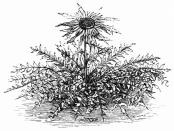
*Carlina acaulis.—A hardy perennial, rather interesting from its foliage, which has some resemblance to the leaves of a miniature Acanthus, and is disposed in a broad, handsome, regular rosette very close to the ground. Its single yellowish flower, 3 ins. or more across, is borne on a very short, erect stalk in the centre of the rosette. Although too dwarf for association with plants of more imposing stature, it is well worthy of a place on a bank or slope, or on the margins of low beds or groups, where its pleasing aspect and very distinct habit will be
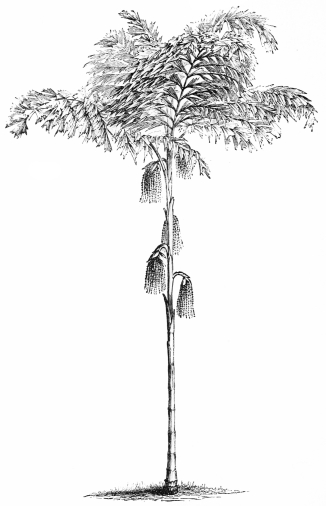
CARYOTA SOBOLIFERA. Tender Palm; for summer use in the southern counties only.
seen to best advantage. It thrives best in dry, stony, calcareous soil, and is easily multiplied by sowing. In the mountainous districts of France the flowers are gathered by the inhabitants, and used as a substitute for artichokes. Central Europe.
Carludovica palmata.—A very ornamental, palm-like plant, from 4 ft. to 7 ft. high, with rich dark-green leaves from 2 ft. to 3 ft. broad, and divided into four lobes, each of which is again divided at the apex into narrow segments. The leaf-stalks are round, smooth, and without spines, and are of the same colour as the leaves. This interesting plant will stand the open air in summer, from early June till October, but requires warm house treatment in winter, with plenty of water at all times. Seed. Peru and New Granada.
Caryota sobolifera.—An elegant Palm, with a slender stem and shining light-green bipinnate leaves. The leaf-stalks, when young, are clothed with a short, black, scaly tomentum, which falls off as the plant grows older. It is often confounded with C. urens, but may be easily distinguished from it by the suckers which it produces very freely from its base. Similar treatment and uses to those given for C. urens, with which it is of much the same value for the open garden. Malacca.
Caryota urens.—An East Indian Palm, with a stout stem, and an elegant crown of spreading bipinnate leaves, from 3 ft. to 12 ft., or more, in length, of a dark-green colour, the leaflets being 6 ins. to 9 ins. long by 2 ins. to 4 ins. wide. When young, it should be potted in equal parts of loam and vegetable mould, with a little sand; the pot to be well drained, and water given liberally during the growing season. It is generally seen in a small state in this country; and though it stands the open air in summer, from June till the end of September, pretty well, it can never be of much importance for our open-air gardening.
*Cassia marilandica.—A hardy, graceful perennial, 3½ ft. to 5 ft. high, with pinnate leaves, resembling those of the Acacia, and slender stems, bearing yellow flowers, in numerous small clusters in autumn. It is somewhat late in growth, but once commenced, grows with great rapidity. It thrives best in a position with a south aspect, and may be multiplied either by division in spring, or by sowing from April to June. It should always be planted in a warm, deep, sandy loam, and is very suitable for borders or association in groups with the finer hardy subjects, its graceful leaves qualifying it for a place in a group of hardy foliage-plants. In naturally warm, deep, and well-drained soils it will prove a noble subject for the back parts of borders. N. America.
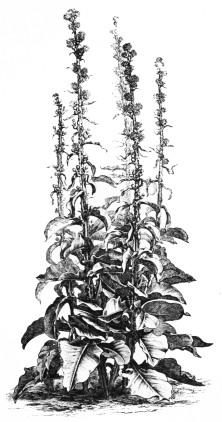
*Centaurea babylonica.—Among the Centaureas there are a few subjects which might be used among hardy fine-leaved plants, but by far the most distinct and remarkable is the very silvery-leaved C. babylonica. This is quite hardy, and when planted in good ground, sends up strong shoots, clad with yellow flowers, to a height of 10 ft. or 12 ft. The bloom, which continues from July to September, is not by any means so attractive as the leaves; but the plant is at all times picturesque. In groups, or, still better, isolated, on rough or undulating parts of pleasure-grounds, it has a very fine effect. A free sandy loam suits it best. Seed. Levant.
CENTAUREA BABYLONICA. Coarse herbaceous Section; for isolation by wood-walks, etc.
Centaurea Clementei.—A plant of robust growth (resembling C. ragusina, but much larger in every part), with broad crowns of leaves, which are deeply serrated and cut into lobes. To the elegance of the foliage must be added its beauty of colouring, the leaf in a young state being covered with down as white as snow, and when fully matured and developed still retaining a silvery appearance. This plant, which I first saw in M. Boissier’s garden, near Lausanne, I have no experience of as a hardy plant in this country; but whatever its value in this respect may be, there can be no doubt that for the summer garden it will prove as effective as either C. gymnocarpa or C. ragusina, both exceptionally fine and useful plants. The same treatment will suit it.
Centaurea dealbata is a dwarf hardy species from the Caucasus, with elegant foliage, white underneath, and rosy flowers: suitable among dwarf hardy subjects.
Centaurea gymnocarpa.—A half-shrubby plant from the South of Europe, nearly 2 ft. high, with hard, branching, bushy stems, and elegantly cut, arching leaves, which are covered with a short, whitish-satiny down. A variety (C. plumosa) has the leaves much more divided, and not so white. This plant is somewhat hardier than C. ragusina, but both require greenhouse treatment in winter. Same soil, positions, and treatment as for C. ragusina. Useful as this is as an edging or bedding plant, it is when grown as fine single specimens that its beauty is most seen.
Centaurea ragusina.—This fine and distinct plant, which has lately become one of the most popular of our flower-garden ornaments, cannot be passed by in a book on fine-leaved plants. It is so abundantly used as a bedding and ribbon-plant, etc., that nothing need be said of it in these respects, but it will be seen to great advantage in single, well-grown tufts or small groups, as its silvery leaves would contrast finely with many of the dark green and glossy things recommended for this purpose. Readily increased by seeds, or by cuttings. Should be planted out in May. S. Europe.
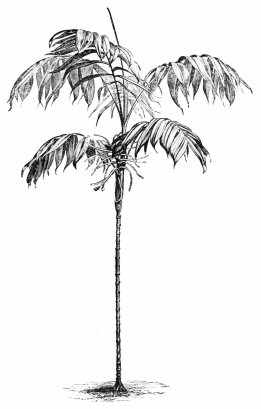
Chamædorea.—A family of Mexican palms, with smooth, fine green stems, resembling those of the bamboos, seldom more than 15 ft. or 20 ft. high and 1 in. or 2 ins. thick, surmounted by tufts of eight or nine pinnate or almost entire leaves, nearly 8 ft. in length. Among the most ornamental species are C. elatior, C. elegans, and C. Ernesti-Augusti. These elegant palms may, with advantage, be placed in the open air in early summer, in sunny but sheltered nooks, and taken in at the end of September. Their small, elegant heads particularly fit them for placing here and there among groups of medium-sized, fine-leaved plants, or among mixed masses of dahlias, cannas, etc.
*Chamæpeuce diacantha.—A spiny-leaved biennial of remarkable habit, growing in tufts of six or eight stems, from 2 ft. to nearly 3 ft. high, which, in the following season, are terminated by dense, spike-like clusters of purplish blooms. It requires light, well-drained soil and a warm position, and should seldom be watered. As the stems are not produced until the second year, the radical rosettes of the first year may be advantageously used in forming edgings, or on the margins of groups, for which
CHAMÆDOREA. Slender Palm Type; for placing amidst groups of dwarfer subjects during the summer months.
their light-green, silver-veined leaves are very suitable, or they may serve to fill a vacant space in the mixed border. Multiplied by sowing in spring or autumn. The plants require the shelter of a house in winter, and are only effective for edgings in the young or rosette stage.
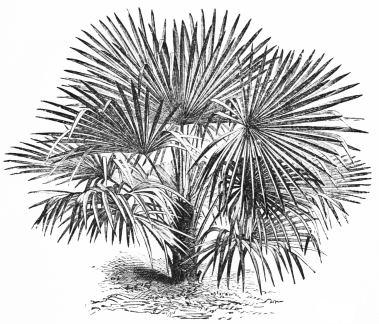
*Chamærops excelsa.—A hardy species, with an erect stem, 20 ft. or 30 ft. high in its native country, and dark-green, erect, fan-shaped leaves, deeply cut into narrow segments. The leaf-stalks are from 3 ft. to 6 ft. long, and are enclosed at the base in a dense mass of rough fibres, and armed at the edges with small, tooth-like spines. This plant remains out during the winter in the neighbourhood of Paris, in sheltered positions, the stem being protected in severe frosts with a covering of straw, etc., and it is worth a trial in the south with us.
*Chamærops Fortunei (The Chusan Palm).—This species is often confounded with C. excelsa, from which, however, it differs in being of a stouter habit, having a more profuse matted network of fibres around the bases of the leaves and crown, the segments of the leaves much broader, and the leaf-stalks shorter and stouter, from 1 ft. to 2 ft. long, and quite unarmed. It grows 12 ft. or more in height, and has a handsome, spreading head of fan-like leaves, which are slit into segments about half-way down.
It may not be generally known that this palm is perfectly hardy in this country. A plant of it in Her Majesty’s gardens at Osborne has stood out for many winters and attained a considerable height. It is also placed out at Kew, though protected in winter. On the water-side of the high mound in the Royal Botanic Gardens, Regent’s Park, it is in even better health than at Kew, though it has not had any protection for years, and stood the fearfully hard frost of 1860. If small plants of this are procured, it is better to grow them on freely for a year or two in the greenhouse, and then turn them out in April, spreading the roots a little and giving them a deep loamy soil. Plant in a sheltered place, so that the leaves may not be injured by winds when they grow up and get large. A gentle hollow, or among shrubs on the sides of some sheltered glade, will prove the best place for it. The establishment of a palm among our somewhat monotonous shrubbery and garden vegetation is surely worthy of a little trouble, and the precautions indicated will prove quite sufficient.
Chamærops Palmetto (Palmetto Palm).—This is a rather slow-growing species, but valuable on account of its hardiness. It grows to a height of about 15 ft., and has glaucous or sea-green, fan-shaped leaves, divided into long narrow segments. The stem is smooth or without prickles. It is a very fine object when planted out; and, grown in tubs in a cool house or conservatory, stands the open air in summer well, and should be put out at the end of May.
*Chenopodium Atriplicis.—A vigorous-growing Chinese annual, with an angular, erect, slightly branched, reddish stem, over 3 ft. in height, the young shoots and leaves covered with a fine rosy violet powder. The leaves are very numerous, nearly spoon-shaped, and long-stalked. This plant is very ornamental in foliage, and well adapted for planting on grass-plats or grouping with
CHAMÆROPS EXCELSA. Hardy Palm: best in sheltered positions.
other plants in pleasure-grounds. May be treated as a half-hardy annual.
Cineraria maritima.—A very handsome bushy perennial, with finely-cut leaves, covered on the under side with a silvery down. It bears numerous heads of bright yellow flowers in summer. When the effect of its foliage only is desired, the flowering-stems should be pinched off on their first appearance. The plant then becomes more leafy and more branching. Multiplied easily by seeds. Useful on the margins of shrubberies, or isolated on banks, or on the grass of the pleasure-ground, where it would form an agreeable variety among the Acanthuses and various other dark-green subjects recommended for this purpose.
Cineraria Acanthifolia is a fine variety of the preceding, and well worthy of cultivation.
Cladium Mariscus.—This vigorous native fen-plant grows from 2 ft. to 6 ft. high, and, when in flower, is crowned with dense, close, chestnut-coloured panicles, which are sometimes 3 ft. in length. The radical leaves are glaucous, rigid, and often 4 ft. long. Worthy of a place near such subjects as Carex pendula or the Typhas on the margin of water.
Colea Commersonii.—A shrub from Madagascar, with very large opposite leaves, each consisting of pairs of oval-obtuse leaflets. This has been used in the subtropical garden at Battersea Park, but it is not likely to be of any practical importance in our outdoor gardening. Indeed it must be a very fine plant in this way which would produce so good an effect as young plants of Ailantus glandulosa.
*Comptonia asplenifolia.—This is a quaint-looking little shrub, fern-like in leaf and neat in habit. The leaves are long, and cut into numerous rounded lobes, somewhat like those of the Ceterach; and the habit of the shrub is spreading and pleasing. It likes peaty soil, and may be increased by layers, suckers, or seeds. It should be used as an isolated specimen on the grass, or associated with such things as the oak-leaved Hydrangea and Aralia japonica. A very pretty object in the woods of New Jersey and many other parts of N. America, where it is called the Sweet Fern. It would be peculiarly appropriate for similar positions in this country, when we have it plentiful enough to naturalise.
Cordyline indivisa.—A magnificent New Zealand plant, with a simple stem, from 2 ft. to 5 ft. high, and well distinguished by its excessively thick and leathery leaves, which are from 1 ft. to 5 ft. long, and 4 or 5 inches broad, lance-shaped, of a dark shining green colour, the midrib and veins being of a rich deep orange. The flowers are white, and very densely crowded, in a large drooping panicle. This fine greenhouse plant may be placed out of doors in summer, from the end of May till October, with a very good effect; best, perhaps, as an isolated specimen, the pot being sunk in the grass.
Corypha australis.—A noble Australian palm, over 30 ft. high in its native country, and forming a very effective subject for the subtropical garden in summer, from June till October. The leaves are nearly circular, often more than 5 ft. broad, of a dark green colour, very much plaited, and divided round the edge into narrow segments, and supported by spiny leaf-stalks, from 6½ ft. to nearly 10 ft. long. It requires abundance of water, and should have a warm, sunny, and sheltered position. Few places, however, can afford to have subjects of this character in the open air, except where there are large conservatories, in which it is a relief to get more room in summer.
*Crambe cordifolia.—This is unquestionably one of the finest of perfectly hardy and large-leaved herbaceous plants. It is as easily grown as the common Seakale—more easily, if anything; and in heavy rich ground makes a splendid head of leaves, surmounted in summer by a dense spray of very small flowers. In planting it, the deeper and richer the soil the finer the result. It will prove a capital thing for any group of fine-leaved hardy plants, and may also be planted wherever a bold though low type of vegetation is desired.
There is another species, *C. juncea, a dwarf kind, with white flowers and much-branched stems, the ramifications of which are very slender and elegant. This is also effective, but not so valuable as C. cordifolia.
*Cucurbita perennis.—A climbing or trailing plant, well adapted for covering walls, ruins, trellises, steep slopes, etc. It is a very vigorous grower, its stems sometimes attaining a length of nearly 40 ft. in one year; but it will probably never do this in our climate. The leaves are strong, rough, and of a glaucous colour; and the shoots run about freely if the plant be in very rich soil. Where a bold trailing plant for high trellis-work, or rough banks, or shaggy rockwork is desired, it will be found useful; but withal we cannot give it a place in the front rank, and the small select garden without any of the above-mentioned appendages will certainly be better without it. For the botanical garden and curious collections it is indispensable. It is strong and lasting when well established, and may be allowed to trail over rough places, stumps, or similar positions. The flowers have a rather strong odour of violets, and are succeeded by roundish fruit, the size of a small orange, of a deep green colour barred and speckled with white. Requires a deep, light soil, and a warm but airy position. Seedlings and plants in exposed places should be covered in winter with litter or leaves. It is easily multiplied in spring by division of the young tuberous stems, or by sowing in light, substantial, well-drained soil from April to July, or in pots in a lukewarm hotbed in March and April. It has not, so far as I am aware, fruited in our climate.
Cyathea dealbata.—This very handsome fern, known in N. Zealand as the Silver Tree-fern, has a slender, branched, almost black stem, 4 ft. to 8 ft. high, ending in a fine crown of broadly-oblong twice-divided fronds of a dark green colour above and milk-white below; the rachis and midribs when young are covered with brown scales, and afterwards with pale deciduous down. This plant may be placed in the open air, in the southern and milder districts, during the summer months from the end of May till the end of September.
Cycas revoluta.—A graceful and well-known plant, with a very stout stem, sometimes, though rarely, reaching a height of from 6 ft. to 10 ft. from the top of which issues a beautiful crown of dark green pinnate
CYCAS (very large and old specimen). Stove Section: suitable for placing in the open air, in warm and sheltered parts of the country, after a strong growth has been made and matured indoors.
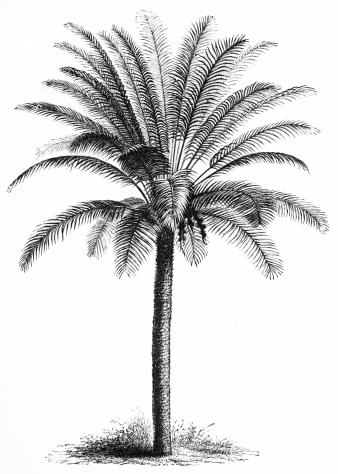
leaves, from 2 ft. to 6 ft. long. It is one of the most valuable of the greenhouse plants that may be placed in the open air in summer from the end of May till October, and is particularly graceful in the centre of a bed of flowering plants, or isolated with the pot or tub plunged to the rim in the turf, always in a warm and sheltered position. Increased by seeds, or by separation of the suckers which are occasionally thrown up.
*Cynara Scolymus (French Artichoke).—This plant, although chiefly grown for culinary purposes, possesses sufficient merit as a foliage-plant to entitle it to a place amongst ornamental subjects. Its long, deeply-divided leaves, white and downy beneath, its height (4 ft. to 5 ft.), its purplish flower-heads, and distinct habit render it very suitable for planting on the irregular and rougher parts of pleasure-grounds, grass-plats, etc., which are often occupied by subjects far less striking.
*Cyperus longus (Galingale).—The stiff, erect, tapering, triangular stem of this plant, which is from 2 ft. to 3 ft. high, is crowned by a handsome loose umbellate panicle of chestnut-coloured flower-spikes, at the base of which there is an involucrum of three or more unequal leaves. These are often 1 or 2 feet long, the lower ones arching gracefully and of a bright shining green, giving the plant a very distinct and pleasing appearance. The rootstock is thick and aromatic, and was formerly much used in medicine as a tonic. A rare native plant, suitable for the bog-bed or the margin of water.
Dahlia imperialis (Lily-flowered Dahlia).—The common Dahlia gives us no more idea of this than the little vernal Scilla of Britain does of Scilla peruviana. The Imperial Dahlia has very large and graceful, much divided leaves, and flowers of a pure and beautiful French white, thrown up in a great cone-like mass, and resembling such lilies as L. tigrinum Fortunei, which, instead of merely developing a head of flowers, shoot up a great candelabrum laden with them. The flowers of this dahlia do not, like most of the flowers of composite plants, open so wide as to stare at you with the brazen look of a sunflower, but, on the contrary, hang pendulous and half open, with some of the modesty of the white lily. There is little chance of this species producing its flowers in the open air in this country, but it will, notwithstanding, be of service both in the flower-garden and conservatory.
Planted in rich soil, and placed in a warm, sheltered position in the open air at the end of May, it grows well with us in summer, and, in consequence of its large and graceful leaves, is an ornament worthy of being used as a “fine-foliaged” or “subtropical” plant. Just at the time that it begins to gather together its flowering energies the best of our season fails, and the plant must soon fail too, if not immediately taken up and placed in a well-lighted and warm greenhouse. If plunged out in a large pot or tub during the summer, it may be taken up without injury, and will in all probability flower under glass in the autumn, and prove a magnificent ornament. We should have very small hopes of its flowering well if planted out so that its great roots must be mutilated when being taken up, and therefore the safe way will be to pot it in a very large pot, and plunge that in the ground. The roots would probably go through the pot and enter the ground, but the main mass of them could be taken up without disturbance,
TREE FERN. For half-shady sheltered dells, in warmer and milder districts, during the summer months.
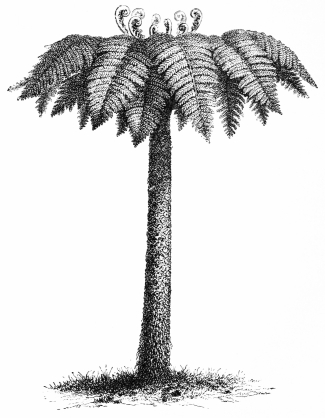
and then it could if necessary be shifted into a larger pot or small tub.
*Datisca cannabina.—A distinct and gracefully-habited herbaceous plant from 4 ft. to 6 ft. high. The long stems are clothed with large and handsome pinnate leaves, and the yellowish-green inflorescence appears towards the end of summer. The male plant has long been known as a very strong, graceful, and effective herb. The female plant, however, remains green much longer than the male, and when profusely laden with fruit, each shoot droops and the whole plant improves in aspect. It should not be forgotten in any selection of hardy plants of free growth and imposing aspect. From seed will probably be found the best way to raise it, and then one would be pretty sure of securing plants of both sexes.
Dicksonia antarctica.—A very noble evergreen tree-fern, with a stout trunk, which varies considerably in thickness, and attains a height of 30 ft. or more. The fronds, which form a magnificent crown 20 ft. or 30 ft. across, are lance-shaped, much divided, of a shining dark green on the upper surface, and paler underneath, from 6 ft. to 20 ft. long, beautifully arched, and becoming pendulous with age. Perhaps the hardiest of tree-ferns, and therefore most suitable for placing in the open air in summer in sheltered shady dells, from the middle of May to the beginning of October.
*Dicentra (Dielytra) eximia.—A plant with dense and very graceful foliage, far more so than any other member of the order in cultivation; and valuable as a flowering plant too, as the brightly-coloured flowers remain on for a long time in spring and early summer. It generally grows from 12 ins. to 16 ins. high, forming thick, almost pyramidal, tufts of pale green, glaucescent, deeply-divided leaves, and bearing handsome drooping clusters of large, rose-coloured flowers, often flowering twice in the year. Although not absolutely necessary, it will be all the better to plant it in light soil. Multiplied by division of the tufts in spring. It should be associated with dwarf subjects like Thalictrum minus, or be used on the margins of mixed beds of fine-leaved hardy plants.
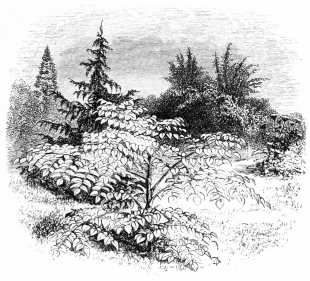
*Dimorphanthus mandschuricus.—A magnificent hardy shrub of erect habit, with very large, much-divided, spiny leaves, which very much resemble those of the Angelica-tree of North America, and in this country attaining a height of 6 ft. to 10 ft., which it will probably much exceed when well established in favourable positions. It is certainly the most remarkable fine-foliage shrub that has been introduced into our gardens for years, and is therefore of the highest importance for the subtropical garden. As to its treatment, it seems to thrive with the greatest vigour in a well-drained deep loam, and would grow well in ordinary garden soil. As to position, isolation in some sheltered but sunny spot will show it to great advantage; but it may also be grouped with like subjects, always allowing space for the spread of its great leaves.
*Dipsacus sylvestris.—A rather singular-looking hardy native plant, 5 ft. to 6 ft. high, with a prickly, leafy, branching stem, and longish opposite leaves joined together at their bases. The flowers are of a pretty purplish rose-colour, and are borne in conical heads 3 ins.
DIMORPHANTHUS MANDSCHURICUS. Hardy deciduous shrub Section.
or more in length. Suited for the embellishment of rough, uneven ground, and will grow well in almost any kind of soil. Still more desirable than the foregoing is D. laciniatus; a native of France, the leaves of which are fringed with silky hairs instead of spines, and which has always whitish flowers. Both these plants are biennials, and are easily raised from seed.
THE DRACÆNAS.
Long as this noble family has been known in our gardens, we have yet to learn a great deal about its use and beauty. Hitherto only allowed to grace a stove or conservatory now and then, the Dracænas in future will be among the indispensable ornaments of every garden where grace or variety is sought. They are among the very best of those subjects which may be brought from the conservatory or greenhouse in early summer, and placed in the flower-garden till it is time to take them in again to the houses in which they are to pass the winter months. And if it were not necessary to protect them through the winter, it would be almost worth our while to bring them indoors at that season, so graceful are they, and so useful for adding the highest character to our conservatories. The hardier and most coriaceous kinds, like indivisa and Draco, may be placed out with impunity very far north. The brightly coloured kinds, like D. terminalis, have been tried in the open air at Battersea, but not with success. It would be dangerous to try them in the open air much farther north, except in very favourable spots. The better kinds are indicated in the select list of subtropical plants. D. indivisa grows well in the open air in the south of England and Ireland.
Dracæna australis.—A fine plant, with a stout, branched stem, from 10 ft. to 40 ft. high; and oblong, lance-shaped, bright green leaves, from 2 ft. to 3 ft. in length and 2 ins. to 4 ins. in breadth, striated with numerous parallel veins. Flowers white, densely crowded, sweet-scented, ¾ in. across; but these are rarely produced except in large houses in botanic or other gardens, where there are old or well-established specimens. This is a useful conservatory species, and may be used out of doors in summer, like D. indivisa, though it is not quite so graceful. This plant is of very easy culture in ordinary soil.
Dracæna cannæfolia.—A very fine species from New Holland, with a tall stem, and leaves from 20 ins. to 2 ft. long, the sides of which are rolled inwards, so as to form a kind of pipe, of a fine sea-green colour, and supported on stalks a foot or more in length. This is a valuable species for warm greenhouse or conservatory use, and also for placing out of doors in the southern counties, though it thrives best indoors.
Dracæna Draco (Dragon tree of Teneriffe).—A large and vigorous species, native of the Canary Islands, where it attains a great height and age; the now perished Dragon-tree at Orotava in Teneriffe having grown, according to Meyen, “70 ft. high and 48 ft. in circumference, with an antiquity which must at least be greater than that of the Pyramids.” In this country it is seldom seen more than 10 ft. high. The stem is tree-like, simple or divided at the top, and often, when old, becoming much branched, each branch terminated by a crowded head of lanceolate-linear entire leaves of a glaucous green colour. The flowers form a large terminal panicle, and are individually small and of a greenish-white colour. This plant is more graceful and effective when in a young state, in which it usually occurs in our gardens, than when old and branched. It thrives well in the greenhouse or conservatory, and in the midland and southern counties may be placed in the open air from the end of May to October, while it is a fine object indoors at all seasons. It is of very easy culture in sandy loam, and requires plenty of pot room.
*Dracæna indivisa.—A very graceful plant, with leaves from 2 ft. to 4 ft. long, and 1 in. to 2 ins. in breadth, tapering to a point, pendent, and dark green. It should not be confounded with the conservatory plant known as Cordyline indivisa, which is too tender to succeed well in the open air, and somewhat difficult to grow. This species, on the contrary, is perfectly hardy in the south of England and Ireland. I saw good specimens of it at Bicton a few years ago, and quite recently as far north as Woodstock, in the county Kilkenny, in Ireland; a plant also stood out in a vase for several years in Mr. A. M’Kenzie’s garden at Muswell Hill, N. D. indivisa lineata is a very fine variety, the leaves of which are much broader than those of the type, measuring sometimes 4 ins. across, and coloured with reddish pink at the sheathing base. Other good varieties are D. indivisa atro-purpurea, which has the base of the leaf and the midrib on the under side of a dark purple; and D. indivisa Veitchii, in which the habit and size of the leaf are the same as in the species, but in addition it has a sheathing base and the midrib on the under side is of a beautiful deep red. It would be difficult to find a plant more worthy of cultivation than this. Where it does well in the garden or pleasure-ground in the southern parts, it surpasses any Yucca or other hardy plant that I know in respect of distinctness and tropical-looking grace; and, this being the case, there can be little need to plead for it to the many who have gardens in the counties south of London. In all districts it may be placed in the open garden in summer with fine effect, the rim of the pots plunged level with, or a little below, the surface, and the plants either isolated on the turf, in the centre of a bed of flowering plants, or grouped with other fine-leaved subjects. In the conservatory it is one of the most effective and graceful subjects at all seasons, and is of very easy culture in rich sandy loam.
The Dracænas are a very numerous family, and many more might be described; but most of the other kinds have not been proved to possess any excellence for the flower-garden, while those enumerated are abundantly sufficient to represent the aspect of this graceful and stately family.
Echeveria metallica.—This is scarcely high enough to be suitable for association with the taller plants, but it is so very distinct in aspect, and has been proved to grow so well in the open air during several unfavourable seasons, that I must not pass it by. I purposely exclude from this book many things sometimes found in lists of “subtropical” plants, but which may be classed most properly with bedding subjects. But this, although not very large, forms an agreeable and distinct object, and is very well calculated for producing a striking effect among dwarf bedding and edging plants. It may be propagated by the leaves, by cuttings, or by seeds, and requires a dry greenhouse-shelf in the winter. Light sandy earth, not of necessity very poor, will suit it best in the open air. It will prove very effective on the margins of beds and groups of the dwarfer foliage-plants, or here and there among hardy succulents, and should be planted out about the middle of May.
*Echinops ruthenicus.—A hardy ornamental plant from S. Russia, with stems 3 or 4 feet high, much branched in the upper part, and covered with a silvery down. The leaves are deeply toothed and spiny, of a dark green above, white and cottony underneath. The flowers are blue, and borne in almost spherical heads on the tops of the erect branches. The plant flourishes best in a calcareous soil, but will do well in almost any well-drained ground. Easily multiplied by seed, division of the tufts, or by cuttings of the roots in spring. This is the most ornamental of its distinct family, and is highly suitable for grouping with the finer herbaceous plants. It would also look remarkably bold and well if isolated on the turf.
*Elymus arenarius.—This wild British grass—a strong-rooting and most distinct-looking herb—is capable of adding a striking feature to the garden here and there, and should be quickly introduced into cultivation. Planted a short distance away from the margin of a shrubbery, or on a bank on the grass, and allowed to have its own way in deep soil, it makes a most striking object. In short, it deserves to rank high among really hardy fine grasses, the Pampas and the two Arundos alone surpassing it. I am not quite certain that it is not more useful than the Arundo, being hardy in all parts of these islands. In very good soil it will grow 4 feet high; and as it is for the leaves we should cultivate it, if the flowers are removed they will be no loss. It is found frequently on our shores, but more abundantly in the north than in the south. The variety called geniculatus, which has the spike pendulous, is also worthy of culture, and in its case the flowers may prove worth preserving. It may possibly be useful for covert, and is certainly so for rough spots in the pleasure-ground and in semi-wild places.
*Elymus condensatus (Bunch grass).—A vigorous perennial grass from British Columbia, forming a dense, compact, column-like growth, more than 8 ft. in height, covered from the base almost to the top with long arching leaves, and crowned in the flowering season with numerous erect, rigid spikes, each 6½ ins. long, and resembling an elongated ear of wheat in form. It is a very ornamental plant, and may be associated with our largest grasses. A very distinct variety has been raised in the Edinburgh Royal Botanic Gardens, in which the spikes or ears are much shorter and broader than those of the original form. For this the name Elymus condensatus compactus has been suggested.
Entelea arborescens.—A small, branching, light-wooded tree, 5 to 10 ft. high, with large, alternate, heart-shaped or three-lobed leaves covered with stellate down, and white flowers, somewhat like those of a small dog-rose, borne in umbels on the ends of a branching panicle. It is peculiar to New Zealand, and is the only species of the genus. This used to grow satisfactorily in the Paris gardens, but I have no experience of it in this country. It will require greenhouse treatment in winter, and is of but secondary importance for open-air culture.
*Epimedium pinnatum.—A hardy dwarf perennial from Asia Minor, from 8 ins. to 2½ ft. high, forming handsome tufts of long-stalked radical pinnate leaves, and bearing long clusters of yellow flowers. The handsome leaves remain on the plant until the new ones appear in the ensuing spring. It is not a good plan to remove them, as they serve to shelter the buds of the new leaves during the winter, and the plants flower much better when they are allowed to remain. Cool, moist, peaty soil, and a slightly-shaded position, will be found most suitable for this, and the novel appearance of its foliage claims a place for it among the dwarfer plants, groups of fine-foliaged hardy herbaceous subjects, Mahonias, etc.
*Equisetum Telmateia (Giant Horse-tail).—A British plant of very noble port and much grace of character when well-developed, growing from 3 ft. to 6 ft. high in favourable soil and positions. The stem is furnished from top to bottom with spreading whorls of slender, slightly drooping, quadrangular branches; the whole forming a pyramidal outline of very distinct and pleasing effect. It is a highly ornamental subject for planting in the hardy fernery, the artificial bog, shady peat borders, near cascades, or among shrubs growing best in moist hollows in vegetable soil. Multiplied by division.
*Equisetum sylvaticum is another native Horse-tail of much dwarfer size, but of the most exquisite grace when grown; the stem standing from 8 to 15 inches high, and well covered with numerous slender, spreading, or deflexed compound branches. Very suitable for rockwork, margins of ornamental water, or any of the positions in which E. Telmateia may be grown. It also does well and looks very graceful when grown in pots in a cold frame. Multiplied by division.
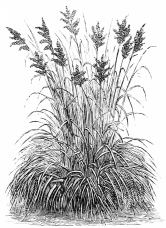
*Erianthus Ravennæ.—A highly ornamental grass from S. Europe, somewhat like the Pampas grass in habit, but smaller in size, and frequently having violet-tinged leaves. The flowering-stems grow from 5 ft. to 6½ ft. high; but as it only flowers with us in a very warm season, it must be valued for its foliage alone. Its dense and handsome tufts thrive well in light, dry, calcareous soil, in positions with a south aspect. It thrives but poorly on cold soils, and will probably not grow well north of London except in peculiarly favourable positions, and in well-drained free loams. It is fitted for association with such grasses as Arundo conspicua. Multiplied by division of the tufts in spring or autumn.
Erianthus Ravennæ.
*Eryngium alpinum.—A singular-looking plant, from 2 ft. to nearly 3 ft. high, forming a rather stiff bush, with leathery and very spiny leaves of a sea-green colour, and bearing numerous roundish heads of bluish flowers, the stems beneath them being also of a very handsome blue for some inches down. Suitable for planting in the wilder parts of pleasure-grounds, for isolation, for borders, or grouping with the finest and most distinct subjects.
*Eryngium amethystinum is not so tall as the preceding, seldom growing more than 2½ ft. high. It is remarkable for the beautiful amethystine bloom which the leaves assume in July, and which they preserve until the approach of frost. It is suitable for the positions recommended for the preceding kind. Various other members of this family are useful in like manner; indeed there is not one of them that is not so, including our own common Sea Holly, E. maritimum.
*Erythrina.—These are very beautiful trees or shrubs, pretty generally distributed through the tropics of both hemispheres. Some attain great dimensions, while others are dwarf bushes with woody rootstocks, and a few have the stems and leaf-stalks beset with prickles. The leaves are trifoliate, with long stalks, and the leaflets oval, lance-shaped, or triangular. Many of the species produce beautiful large pea-flowers, usually of a blood-red or scarlet colour, in terminal racemes. The varieties of these have proved very hardy and useful in the summer garden, flowering freely, and showing considerable beauty of foliage. Two round beds, each of 9 ft., and one oblong bed, 42 ft. by 5 ft., including E. ornata, Marie Belanger, laurifolia, crista-galli, profusa, Madame Belanger, ruberrima, Hendersoni, stood out last winter uninjured in Battersea Park; and, as many people know, the common old Erythrina crista-galli will thrive for years against a warm south wall in a warm soil, if protected about the root in winter.
Eucalyptus.—Handsome Australian trees and shrubs, of which there are a vast number of species, many growing to an immense height. The leaves are of a thick leathery texture, always quite entire, and very variable in shape. In young plants they are opposite, heart-shaped, pointed, and covered with a glaucous bloom; as they grow older, they become alternate and sickle-shaped, the stalks acquiring a peculiar twist, so that the leaves present their edges to the branches. The most hardy kinds are E. globulus and E. Gunni. Other kinds, however, will no doubt be found sufficiently hardy. These are most likely to be attractive in the south of England and Ireland, where a few of the species will be found to thrive in the open air, as the peculiarly distinct and graceful habit of the trees is not observed till they are 12 ft. or more above the ground. Nevertheless some may grow them for the aspect they present after a single year’s growth in the open air about London, in which case they should be put out about the middle of May. I was very much struck with their graceful and singular appearance in California, where they are being planted in great variety.
Farfugium grande.—A very vigorous-growing perennial, with thick fleshy stems, from 1 ft. to nearly 2 ft. high, and broad, cartilaginous, almost heart-shaped leaves, of a light-green colour, variously streaked, and spotted with yellow in one variety, and with white and rose-colour in another. It flourishes best in free, substantial, moist soil which contains a large proportion of vegetable mould, and in a half-shady position. During the heats of summer it will require frequent watering. At the approach of winter it should be removed to the conservatory or cool greenhouse, except in the southern and milder districts, where it survives an ordinary winter. In the colder parts of the country it is scarcely worth planting out, it grows so slowly; but where it thrives it is very ornamental in borders, isolated, or near the margin of beds. Multiplied by division in spring; the offsets to be potted and kept in the propagating-house or in a frame until they are well rooted.
Ferdinanda eminens.—This is one of the tallest and noblest subtropical plants, growing well in the southern and midland counties when it is supplied with rich soil and abundant moisture. It is also very much the better for being sheltered. Where the soil is rich, deep, and humid, and the position warm, it attains large dimensions, sometimes growing over 12 ft. high, and suspending pairs of immense opposite leaves. It will in all cases form a capital companion to the Castor-oil plant, and, though it may not be grown with ease in all parts, it should be in every collection. It requires to be planted out, in a young state, about the middle of May, and grows freely from cuttings. Greenhouse treatment will do in winter. It is better to keep a stock in pots through the summer to afford cuttings, though the old ones may be used for that purpose.
*FERULAS.
I wish it were not necessary to write in praise of such very fine plants as these, so noble in aspect and beautiful in leaf. If 2000 kinds of herbaceous plants are grown, the first things that show clearly above the ground in the very dawn of spring (even in January) are their deep-green and most elegant leaves. In good garden soil they look like masses of Leptopteris superba, that most exquisite of ferns. Their chief charm will probably be found to consist in their furnishing masses of the freshest green and highest grace in early spring. The leaf is apt to lose some of its beauty and fade away early in autumn, but this may to some extent be retarded by cutting out the flower-bearing shoots the moment they appear. Not that these are ugly; for, on the contrary, the plants are fine and striking when in flower. It is indispensable that the Ferulas, like some other hardy foliage-plants, be planted permanently and well at first, as it is only when they are thoroughly established that you get their full effect. At a first view, the best way to treat them would appear to be so to arrange them that they would be succeeded by things that flower in autumn, and only begin their rich growth in early summer; but it will be equally wise to plant them near the margin of a shrubbery, or wherever it is desired to have a diversified and bold type of vegetation. We may look forward to the day when a far greater variety of form will be seen in English gardens than is at present observable, and these Ferulas are thoroughly well worth growing for their superb spring and early summer effect. The best species are
FERULA COMMUNIS. Graceful herbaceous Type; dying down towards the end of summer, and therefore most desirable for isolation near the margins of shrubberies, etc.
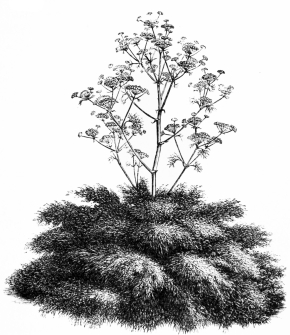
F. communis and tingitana. Probably a few others, including F. glauca, neapolitana, nodiflora, asparagifolia, Ferulago, and persica, may with advantage be added where much variety is sought, but the effect of any of the first three cannot be surpassed. Among the “aspects of vegetation” which we may enjoy in these cold climes, nothing equals that of their grand leaves, pushing up with the snowdrop. In semi-wild spots, where spring flowers abound, it will prove a most tasteful and satisfactory plan to drop a Ferula here and there in a sunny spot, and leave it to nature and its own good constitution afterwards. In general aspect these plants are much alike; it is better, however, to describe some of them individually.
*Ferula asparagifolia.—An ornamental perennial, 4 ft. or 5 ft. high, with very graceful and finely-cut leaves, the radical ones 1 ft. to 2 ft. long (including the leaf-stalk), repeatedly subdivided: the divisions very narrow, linear, pointed, and set with hairs; the upper stem-leaves are reduced to short sheaths, the lowest of which bear a short pinnate limb.
*Ferula communis.—A very fine and striking hardy perennial, growing from 6 ft. to 10 ft. or more high, with much-divided, spreading, shining green leaves, repeatedly subdivided into linear, flaccid segments; the lower leaves spreading more than 2 ft. each way; the sheaths of the upper leaves very large.
*Ferula Ferulago.—A very ornamental kind, with striped stems, 6 ft. to 8 ft. high, and much-divided leaves, with divided spreading leaflets, which are nearly as broad as those of F. tingitana, but longer, and of a darker green.
*Ferula glauca.—A valuable and imposing foliage-plant, 4 ft. to 6 ft. or more high, with very much divided leaves, shining above, glaucous beneath, cut into long, linear, flat segments. The stalks of the upper leaves are widened above.
*Ferula persica.—A hardy perennial from Persia and the Caucasus, with a glaucous stem from 3 ft. to 6 ft. high, tapering gradually upwards, and very handsome, much-divided leaves, with rather distant lance-shaped leaflets, widening and toothed or cut at the apex. Flowers in umbels, without any general or partial involucrum. This plant is easily distinguished by its strong asafœtida odour, and requires warm sandy soil.
*Ferula tingitana.—A very noble plant, from 6 ft. to 8 ft. high, with a stout stem and very glistening leaves, which are broader than those of any other species, and repeatedly subdivided into oblong or lance-shaped deeply-toothed segments.
Ficus Chauvieri.—A noble species, with a faultless habit, which does well in the open air, and is the best kind after F. elastica. The leaves are oval-obtuse in outline, of a very dark glistening green, with pale-yellow veins, and usually have one or more large undulations on the margin. Useful for the same purposes as the following species.
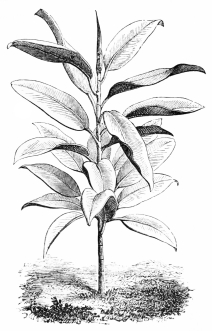
Ficus elastica (India-rubber Plant).—This is one of those valuable leathery-leaved things that are useful in hothouse, drawing-room, or flower-garden. It not only exists in the open air in summer in good health, but makes a good growth under the influence of our weak northern sun. Never assuming the imposing proportions of other plants mentioned herein, it is best adapted for select mixed groups, and, in small gardens, as isolated specimens amongst low bedding plants. It will best enjoy stove treatment in winter, and is propagated from cuttings. It should be put out at the end of May. In all cases it is better to use plants with single stems.
Ficus elastica.
*Fuchsia.—The Fuchsia, one of the most beautiful ornaments of the garden when well grown, is comparatively rarely seen in our flower-gardens. It is to be regretted that this is the case, for assuredly there is nothing in cultivation more calculated to improve the aspect of things therein. Not showy in mass of flower, like many things common enough now, it is of the highest order of beauty; while the drooping habit of the shoots of most kinds gives the plant a grace which is valuable indeed, and which no flower-garden should be without. Even in dwarf lines, where this drooping tendency is not seen to such advantage, or, it may be, presents a disadvantage, the Fuchsia is very valuable; but it is when we use plants with rather tall stems or pyramids that the full beauty of the Fuschia as a flower-garden plant is seen. And the right way to manage them is to make them as far as possible produce all their growth in the open air. That is the secret: start them, nurture them, and make them full of leaves and strong young growth in the spring, so as to go out strong, and most likely you will find them very disappointing indeed; but keep them back and do not let them burst forth into leaf until put in the open air in May, and they will then go on and retain all the strength they gather, suspending quantities of graceful blossoms until the leaves have deserted the trees, when they should be taken up and put in a dry cave, cellar, or shed for the winter. In a cool position of that kind it would not be difficult to “keep them back” in spring. And supposing they seemed inclined to push forth too much before the time had quite arrived when it would be convenient or desirable to put them in the flower-garden, there should be no difficulty in placing them in some quiet, sheltered nook, where they might receive more protection than in the flower-garden proper, and yet have full opportunity to make growth in the open air—the great point to be attained. The freest and hardiest kinds should be chosen for this purpose. In many places refuse plants may be turned to good account in this way. Given a lot of specimen Fuchsias—arrived, perhaps, at that stage when they must be parted with to make way for younger plants and newer kinds—nothing is simpler than to make of these standards for the flower-garden, by cutting away the lower and middle side shoots, and leaving the head to form a standard. Their exceptional grace when placed among fine foliage-plants induces me to allude to them here.
*Funkia Sieboldiana.—A Japanese plant, remarkable for the elegance of its leaves, which are large, broadly heart-shaped, of a greyish-green colour, slightly undulating, and finely marked with regular lines of prominent ribs. The flowers are of a light lilac or bluish colour, and are borne in a drooping unilateral cluster at the extremity of a leafless stem 1 ft. or 16 ins. high. Thrives best in a light, cool, sandy soil in a sheltered half-shady position. It will also thrive well in peat. Multiplied by division of the tufts in autumn, once in three or four years. Useful among the dwarfer herbaceous plants, etc., and occasionally as a groundwork in beds of shrubs with fine foliage.
*Galega officinalis.—A handsome, hardy, and vigorous-growing plant, 3 ft. to 5 ft. high, forming graceful tufts of pinnate leaves, and flowering abundantly and for a long time; the flowers are of a pale blue, in long, dense clusters or spikes. Although it will grow in almost any soil, it does best in a deep, free, moist, sandy clay. This not uncommon herbaceous plant is alluded to here in consequence of its graceful leaves, which fit it for taking a part in the groups of handsome hardy subjects so often suggested in this book.
Geranium anemonæfolium.—A handsome perennial from Madeira, with a simple, woody, erect stem 1 ft. to 14 ins. in height, covered with dry scales. The leaves, which are of a bright green, smooth, and very much divided, are chiefly collected at the base of the plant, from which they extend horizontally on stalks from 20 ins. to 2 ft. long. The flowers are very numerous, and of a lilac rose-colour. It is a highly ornamental plant both in foliage and flower, and may be used with good effect grouped with comparatively dwarf kinds, or occasionally as an edging to tall subjects. It is best raised in frames and put out early in May. Multiplied by seed, which it yields freely.
*Gynerium argenteum (Pampas grass).—This fine plant is so well known that there is no excuse for naming it here, except the opportunity to say a few words as to the splendid use we may make of it in the branch of gardening we are now discussing. It deserves as much attention as any plant in cultivation, and yet how rarely is any thorough preparation made for its perfect development. What is there growing in garden or in wild more nobly distinct and beautiful than the great silvery plumes of this plant waving in the autumnal gusts—the burial plumes as it were of our summer too early dead? What tender plant so effective as this in giving a new aspect of vegetation to our gardens, if it be tastefully placed and well grown? Long before it flowers it possesses more merit for its foliage and habit than scores of things cultivated indoors for their effect—Dasylirions, etc., for example—and it would be well worthy of being extensively used if one of its silken-crested wands were never put forth in autumn. It is not enough to place it in out-of-the-way spots, but the general scene of every garden and pleasure-ground should be influenced by it. It should be planted even far more extensively than it is at present, and given very deep and good soil either natural or made. The
GYNERIUM ARGENTEUM. Giant hardy evergreen ornamental Grass.
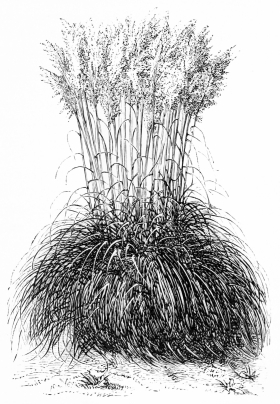
soils of very many gardens are insufficient to give it the highest degree of strength and vigour, and no plant better repays for a thorough preparation, which ought to be the more freely given when it is considered that one preparation suffices for many years. If convenient, give it a somewhat sheltered position in the flower-garden, so as to prevent as much as possible that ceaseless searing away of the foliage which occurs wherever the plant is much exposed to the breeze. We rarely see such fine specimens as in quiet nooks where it is pretty well sheltered by the surrounding vegetation. It is very striking to come upon noble specimens in such quiet green nooks; but, as before hinted, to leave such a magnificent plant out of the flower-garden proper is a decided mistake. Seed and division.
*Gunnera scabra.—Mr. Darwin met with this in a region where the vegetation is so luxuriant that the branches of the trees extend over the sea, somewhat like those of a shrubbery of evergreens over a gravel walk. “I one day noticed growing on the sandstone cliffs some very fine plants of the Panke (Gunnera scabra), which somewhat resembles the rhubarb on a gigantic scale. The inhabitants eat the stalks, which are sub-acid, and tan leather with the roots, and prepare a black dye from them. The leaf is nearly circular, but deeply indented on its margin. I measured one which was nearly 8 ft. in diameter, and therefore no less than 24 ft. in circumference! The stalk is rather more than a yard high, and each plant sends out four or five of these enormous leaves, presenting altogether a very noble appearance.” Of a spot in the same neighbourhood he says: “The forest was so impenetrable that no one who has not beheld it can imagine so entangled a mass of dying and dead trunks. I am sure that often for more than ten minutes together our feet never touched the ground, and we were frequently ten or fifteen feet above it; so that the seamen, as a joke, called out the soundings!” Yet I have grown this plant to great size in a cold British bog. Mr. Darwin does not speak of the inflorescence, which is more remarkable than the leaves. The little flowers and seeds are seated densely on conical fleshy masses a few inches long, and these in their turn being seated as densely as they can be packed on a thick stem, the whole has the appearance of a compound cone a couple of feet high (on strong plants), very heavy, and perhaps the oddest-looking thing ever seen in the way of fructification. This great spike springs from the root itself, the leaves also springing from the root, as in the case of the rhubarbs. I had two plants in a wet peat bog—one in deep rich soil, with the crown well raised above the level, and the whole protected under a couple of barrowloads of leaf mould; the other left exposed, and not allowed any particularly good soil. Both plants survived the severest winters, but the protected and well-fed one grew much the larger. The leaves of the larger plant used sometimes to grow 4 ft. in diameter, the texture being of extraordinary thickness and rugosity. I have, however, in the Royal Gardens at Kew, seen it grown to a larger size than that. The bottom there is the reverse of bog, while the situation is warmer and more sheltered than where I grew it. But the Kew people met its wants very cleverly, by building a little bank of turf around it, so
GUNNERA SCABRA. Hardy herbaceous Section; attaining huge dimensions in deep, rich, moist soil.
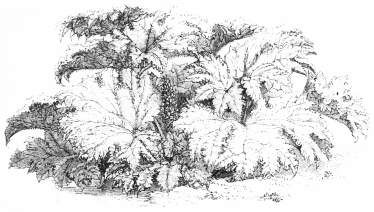
as to admit of its absorbing a thorough dose of water now and then, while in winter it was protected with dry leaves and a piece of tarpaulin. Similar protection, plenty of water in summer, and a warm and sheltered position, are all that are necessary for success with this very striking subject. It is not difficult to obtain, and may be raised from seed, though that is a slow way. It should be planted in some isolated spot, and not as a rule in the “flower-garden proper,” as it must not be disturbed after being well planted, and would associate badly with the ordinary occupants of the parterre. The plant cannot have too much sun or warmth, but makes little progress if its huge leaves are torn by storms. In places with any diversity of surface it will be easy to select a spot well open to the sun and yet sheltered by surrounding objects (shrubs, clumps, etc.). The figure shows more the habit of the plant than the character of its huge compound fleshy spike, on which the small seeds are thickly scattered.
*Gymnocladus canadensis (Kentucky Coffee-tree).—A remarkable hardy forest tree, which, kept in a young state, will furnish a fine head of foliage. It has twice-divided leaves, the leaflets of which stand vertically. On young trees the leaves are more than 3 ft. long, and on subjects confined to a single stem and cut down every year they would prove even larger than that. It grows wild in Canada, but more abundantly and larger in Kentucky and Tennessee, where it used to be employed as a substitute for coffee—hence the common name. It loves a rich deep soil, and is propagated by seeds and cuttings of the roots. It will prove very suitable for planting in similar positions to those recommended for the Ailantus.
Hedychium Gardnerianum.—A stove herbaceous plant from the East Indies, growing from 3¼ ft. to 6½ ft. high, with broadly lance-shaped clasping leaves in two rows, and bearing, in autumn, lemon-coloured flowers with a strong Jonquille perfume, in terminal spikes nearly a foot long. Another species, H. aurantiacum, has handsome orange flowers. These handsome plants may have been seen flowering in the open air in the gardens at Battersea Park, very pleasing and effective in shady nooks—not planted out but kept in the pots in which they were grown. They should be put out about the end of May.
*Helianthus annuus (Sun-flower).—This common and familiar annual plant may be usefully employed in adorning the rougher parts of pleasure-grounds in warm positions, where it will thrive to best advantage. Although very hardy and capable of being grown in almost any soils, it prefers those that are substantial and free.
*Helianthus orgyalis.—A very distinct-looking hardy plant, growing 6 ft. or 8 ft. high. Its distinctiveness arises from the fact that the leaves are recurved in a peculiarly graceful manner. At the top of the shoots, indeed, their aspect is most striking, from their springing up in great profusion and then bending gracefully down. It will form a capital subject for groups of fine-leaved, hardy plants, or for isolation by wood-walks, etc. As it is apt to come up rather thickly, the cultivator will act judiciously by thinning out the shoots when very young, so that those which remain may prove stronger and better furnished with leaves. N. America.
*Hemerocallis fulva.—This is one of those fine old plants formerly grown in almost every garden, but which
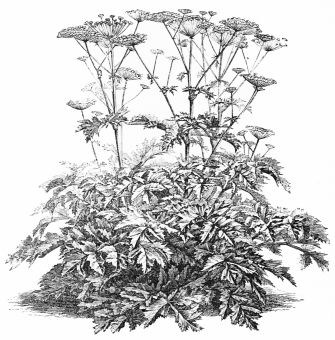
HERACLEUM Coarse herbaceous Type; foliage perishing late in summer.
has latterly sunk into unmerited neglect, as from its luxuriance, the height of its stem (nearly 4 ft.), and its fine, large, tawny-orange flowers, it well deserves a place among vigorous and striking subjects. It is thoroughly hardy and will thrive in almost any soil, but comes to greatest perfection in that which is deep, substantial, and moist, and in almost any position. Multiplied by dividing the tufts once in three or four years in autumn when the leaves are withered, or in spring. There is a variety of this species with double flowers, and one with variegated leaves, both of which are somewhat tender and require well-drained soil and a sheltered position.
Other species in cultivation are H. flava, H. disticha, H. graminea, and H. Dumortieri. All these plants are desirable associates for the hardy fine-leaved plants.
*Heracleums (Cow-parsnips).—No perennials rival these plants in size, and few in distinctness of appearance. The shape and width of their leaves, the height of their stems, and especially the great size of their umbels, produce an effect of a very striking character. Planted singly on slopes in the rougher parts of pleasure-grounds, on or about ruins, rough wild declivities, or by pieces of water or streams, they are seen to excellent advantage; their enormous leaves forming great tufts of vegetation, sometimes nearly 13 ft. in diameter. The period of their greatest vigour and beauty is from May to the end of July; and this should be distinctly borne in mind when arranging them, as, once the great leaves fade away with the heats of early August, they become very ragged, and soon disappear altogether. They delight in a moist, deep, clay soil, but will grow vigorously in almost any kind of cool soil, and even on rubbish-heaps. They are easily multiplied, either from seed or by division of the tufts early in spring, or after the ripening of the seed. They usually sow themselves freely.
*Heracleum eminens.—A peculiarly distinct species, easily known by the blunt or roundish lobes of its trifoliate leaves, which also possess the advantage of lasting longer than the leaves of other kinds. They are of a thick texture, and finely covered with velvety down, which gives them a slightly glaucous appearance, whereby they may also be distinguished. I have only seen the plant in a young state in Paris gardens, and cannot say what it is like when fully grown; but it is probably dwarfer in stature and more compact in habit than most of the other kinds, and, as the leaves last so much longer in perfection, it is suited for grouping among choicer subjects. For isolation on the grass, after the fashion of the Acanthuses, etc., it is particularly well suited. Seed or division.
*Heracleum flavescens.—A vigorous species, 5 ft. to 6 ft. high, with deeply-furrowed rough stems, and convex green leaves, with ovate or oblong serrate divisions. Flowers yellowish, in large umbels. Suitable for banks of rivers or ponds, where effective foliage is desired. S. Europe. Seed.
*Heracleum persicum.—A vigorous perennial, of rapid growth and imposing dimensions, attaining a height of more than 6½ ft., and bearing whitish flowers in umbels, the upper one of which is more than 16 ins. across. The stem does not branch much, and the leaves are chiefly radical and very large. Persia.
*Heracleum pubescens.—This species bears yellowish-white flowers, in umbels about a foot in diameter, and grows to a height of from 6 ft. to 9 ft. or more. The leaves are very large, roughish on the upper side, and much divided into elliptical segments, which are pointed and stand close together. Crimea.
*Heracleum villosum.—A species distinguished by its very downy and fringed fruit, with robust stems, 6½ ft. high or more. Leaves broad, much divided, the segments coarsely toothed, covered with a whitish down on the under side. Flowers in large umbels. Caucasus.
*Heracleum Wilhelmsii.—The leaves of this species are very large, downy, and wrinkled, much divided, with lance-shaped, acute segments distant from each other. The stem is more than 6½ ft. high, and bears whitish flowers, in umbels from 10 ins. to 12 ins. in diameter. Siberia.
Several other species are in cultivation, the principal of which is H. platytænium, a biennial of very large dimensions, and remarkably ornamental in habit and foliage.
Humea elegans.—This well-known plant may be very agreeably associated with many of the subjects mentioned in this book, and is a graceful object in the centres of beds, etc. To be put out early in May. New Holland.
*Hydrangea quercifolia.—This is quite distinct in aspect from the common Hydrangeas, and sufficiently striking to deserve a place where variety of form is sought. The leaves are, as the name indicates, somewhat lobed and oak-like in outline. It is best adapted to form a bush, its natural habit, and is best used singly. I, however, have never tried to train young plants of it with a single stem; it might be worth the trial. It is a native of N. America. A rich and somewhat moist soil, with shelter, will be found to suit it best. Well adapted for isolation.
*Inula Helenium.—A vigorous-growing British plant, about 3 ft. or 4 ft. high, with a stout stem, branching in the upper part, and large, oblong-oval leaves, of a delicate green colour. The flowers are yellow, and are borne in loose clusters. Well suited for planting along with other large-leaved plants, or as isolated specimens on rough slopes, or wild places, in free, moist, good soil. Multiplied by division in spring or autumn, or by seed.
*Jubæa spectabilis.—A very handsome, hardy S. American palm, with a short, arboreous, smooth stem, which sometimes attains a height of nearly 40 ft., and spreading pinnate leaves, of a full, deep-green colour, and from 6 ft. to 12 ft. long, the leaflets being from 1 ft. to 1½ ft. long and about an inch wide, springing in pairs from nearly the same spot, and standing out in different directions. The leaf-stalks are very thick at the base, where they are enclosed in a dense mass of rough, brown fibres, which grow upon their lower edges. The soil for this plant should be a mixture of two parts of rich loam and two parts composed of peat, leaf-mould, and sand. This exists in the open air throughout the winter, near London, but not in such a condition as to encourage many to try it in this way. Grown in tubs in the conservatory in winter, and placed in the open air in summer, it will prove very satisfactory for association with the hardier palms.
*Juncus effusus spiralis.—A very singular-looking rush, forming spreading tufts of leaves, which, instead of growing, straight, like those of other kinds, are curiously twisted in a regular corkscrew form. From its very unusual appearance it is well worthy of cultivation, and may be planted with advantage on the margins of pieces of water, near cascades, etc., or in the artificial bog. It is easily multiplied by division of the tufts.
*Kochia scoparia.—An annual plant of the Goose-foot family, forming a neat, compact, pointed bush, from 3 to 5 ft. in height. The flowers are green and insignificant, but the graceful habit of the plant renders it valuable and effective, placed either singly or in groups, on the slopes of pleasure-grounds, especially from July to September—the time of its full development. It should be sown in April and May, in a hotbed, and afterwards planted out in beds or borders. Southern Europe.
*Kœlreuteria paniculata.—A small sized, hardy, deciduous tree, from N. China, from 15 ft. to 19 ft. high, and handsome both in foliage and flower. The leaves are pinnate, and of a dark, glistening-green colour; the leaflets ovate, and coarsely toothed. Flowers yellow, in terminal, spreading clusters, and succeeded by large, reddish, pendent, bladdery capsules, which render the tree conspicuous till late in the autumn. It does best in rich, moist soil. When planted in a dry and arid position, the leaves are never so large or glistening, and soon turn yellow and fall. It is one of the trees which may, as advised for the Ailantus, be kept in a small state by cutting them down annually, and will, thus treated, furnish a fine effect. Easily multiplied by seed, layers, and cuttings.
Latania borbonica.—A well-known, hardy, and favourite palm, attaining a height of 25 ft., with large, fan-shaped leaves, over 5 ft. broad, of a cheerful green colour, and with pendent marginal segments. The leaf-stalks are over 4 ft. or 5 ft. long, and are armed at the edges for half their length with short reflexed spines. May be placed in the open air about London and southward in sunny dells in summer, and is a fine warm-conservatory or stove ornament in winter.
*Lavatera arborea.—This plant, which has the appearance of a small tree, attains in the southern counties the height of nearly 10 ft. The stem is simple for some distance, and then branches into a broad, compact, roundish, and very leafy head. It may be used to adorn warm and sheltered parts of pleasure-grounds and rough places. In rich well-drained beds it would prove a worthy companion for the Ricinus and the Cannas. It is most at home on dry soils, but during the summer months thrives on all. When planted in the shelter of a south wall it has been known to live for several years and to have almost woody stems from 2 ins. to 4 ins. in diameter at the base. Italy.
*Ligularia macrophylla (Large-leaved L.).—A vigorous perennial, with an erect stem nearly 3½ ft. high, and very large, glaucous, erect, long-stalked, oval leaves. The flowers are yellow, and are borne in a dense long spike at the end of the stem. The most suitable soil for this plant is that which is free, moist, and somewhat peaty. Multiplied by careful division in autumn or in spring. It is a useful subject for grouping with fine-leaved herbaceous plants, but will seldom command a place in the select flower-garden. Caucasus.
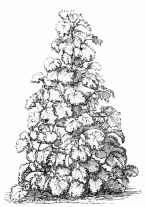
*Malva crispa.—A vigorous-growing annual, 3 to 6½ ft., or more, in height, growing in an erect, pyramidal bush of densely-crowded, broad leaves, with a very undulating curled or frizzled margin. The flowers are small, white, and inconspicuous. Bushes of this are pretty in groups, beds, or borders. It may be sown in cool frames and put out early in May, by which means strong plants may be obtained early in the season.
Malva crispa.
*Martynia lutea.—A very pretty annual from Brazil, about 1½ ft. high, with roundish leaves and handsome yellow flowers, collected in cylindrical clusters at the angles of the principal branches. It requires a light, rich, cool soil, a warm position, and frequent watering in summer. Its large leaves and ornamental bloom make it a desirable subject for beds, groups, and borders. Increased by seed.
*Megaseas.—Some parts of pleasure-grounds for which there may be a difficulty in finding any subject that will either thrive in such places, or that is not too commonplace to be thought of, may be very advantageously occupied by a few specimens of Megasea cordifolia and M. crassifolia, the large, leathery, persistent leaves of which will, in such positions, preserve their freshness through the winter, and in the earliest days of spring be surmounted by dense clusters of very pleasing rose-coloured flowers. These plants are very hardy perennials, and will require hardly any care after planting them. They are well suited for embellishing cascades and rough rockwork, are not fastidious as to soil, and are easily multiplied by division of the tufts.
Melanoselinum decipiens.—An umbelliferous shrub, from Madeira, with a round simple stem, bare below, and large spreading compound leaves with oval toothed segments and sheathing leaf-stalks. Flowers white, borne in umbels. Should be planted out in May. A useful subject for isolation on grass-plats, etc., and requiring greenhouse or warm-frame treatment in winter. Young plants are to be preferred for ornamental purposes. Multiplied by seed.
Melia Azedarach (Pride of India).—A very ornamental tree, but with us usually seen in a small state. It is a native of India, but is now naturalised in various parts of S. Europe. It usually grows from 13 ft. to 17 ft. high, and bears its smooth dark-green pinnate leaves chiefly clustered together at the ends of the branches. The flowers are of a lilac colour, and emit an agreeable perfume: they are produced in large bunches which issue from the axils of the leaves. The fruit is considered poisonous. Healthy young plants kept to a single stem, and cut down to within a foot or two of the base annually, form graceful objects in the ornamental garden, throwing up an erect stout stem regularly clothed with leaves twice and thrice divided, from 16 ins. to more than 2 ft. long and from 1 ft. to nearly 18 ins. across. Plant out in early summer. A substantial, well-manured soil, a shady position, and frequent waterings in summer are necessary for
MELIANTHUS MAJOR. Herbaceous Type: best treated as a perennial, and protected at the roots in winter.
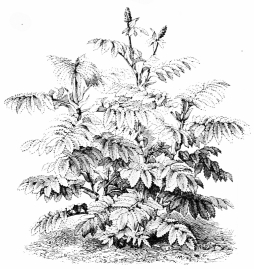
the development of the ornamental qualities of the Melia. In winter it requires the shelter of a greenhouse with us. Multiplied by seed or layers.
*Melianthus major.—This is usually treated as a greenhouse plant, and is sometimes put out of doors in summer. So grown, however, the full beauty of the plant has not time to develope; and much the better way is to treat it as a half-hardy subject, putting it out in some sunny and sheltered spot, where the roots will not suffer from wet in winter. The shoots will be cut down by frost, but the root will live and push up strong stems in spring, forming by midsummer a bush about 3 ft. high, very distinct and beautiful, with large, pinnate, light sea-green leaves, which will not suffer from rain storms. I have grown it in this way to a much more presentable condition than it ever assumes indoors, where it is usually drawn too much. I used to protect the roots in winter by placing leaves over them, and then covering all with a handlight, but have seen the plant survive without this precaution. It is, however, best to make quite sure by using protection, except where the soil and climate are particularly favourable. Melianthus minor has the habit of M. major, but is smaller in every respect and flowers later. Its inflorescence also is different, the flowers being of a yellowish red, and growing in short clusters. Cape of Good Hope.
*Meum athamanticum.—One of the most elegant and gracefully-cut plants in an order second to no other for these qualities. The leaves are divided so finely as to appear as if they were made of vegetable hair, and the plant is dwarf and neat in habit, from 6 inches to 1 foot high; easy of growth in ordinary soils, and perfectly hardy and perennial. It is probable that in dry seasons it might “go off” too soon for association with autumn-flowering plants, but for rockwork, borders, or mixed arrangements of any sort it is invaluable. A British plant, easily increased by division.
*Molopospermum cicutarium.—A very ornamental umbelliferous plant, 5 ft. or more in height, with large, deeply-divided leaves of a lively green colour, forming a dense irregular bush. The flowers, which are insignificant and of a yellowish-white colour, are borne in small roundish umbels. There is a deep green and fern-like beauty displayed profusely by some of the umbelliferous family, but I have rarely met with one so remarkably attractive as this species. Many of the class, while very elegant, perish quickly, get shabby indeed by the end of June, and are therefore out of place in the tasteful flower-garden; but this is firm in character, of a fine rich green, stout yet spreading in habit, growing more than a yard high, and making altogether a most pleasing bush. It is perfectly hardy, and easily increased by seed or division, but rare as yet. Loves a deep moist soil, but will thrive in any good garden soil. It is a fine subject for isolation or grouping with other hardy and graceful-leaved umbelliferous plants. Carniola.
Monstera deliciosa.—This very remarkable-looking plant has been found to bear being placed in the open air with impunity in shady and sheltered spots from the beginning of June till the end of September. Its great perforated leaves look so singular that everybody should grow it who has a stove in which to do so, and it is so
MONSTERA DELICIOSA Tender Section; stands well in the open air in summer in warm and sheltered spots.
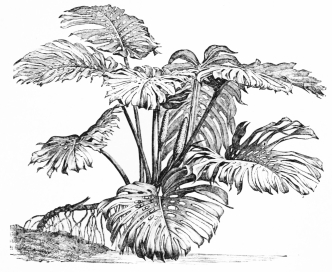
MONTAGNÆA HERACLEIFOLIA (Polymnia grandis). One of the noblest of the tender section, making free growth in the open air during summer.
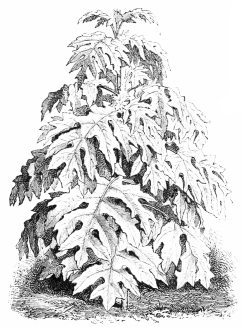
readily grown and propagated that a plant may soon be spared for placing in the open air during the warmer months. Although, however, it will exist in the open air for a few months in warm and sheltered spots in this country, it is only to be seen to perfection in the stove. Few subjects possess nobler or more singular foliage, or are more worthy of a place for effect alone, while its fruit is edible and produced freely enough when the plant is well-grown. The culture is quite simple—plenty of rich soil, a high temperature, and abundance of moisture. I have seen the plant fruit well in what is called an “intermediate house,” but, where convenient, it is much better to place it in a warm stove. Wherever rockwork or any picturesque arrangement is attempted in any of these structures; no nobler plant can be selected for its embellishment. It crawls over such positions with a snake-like stem, and a trail of great leathery leaves perforated in many places, as shown in the plate. Mexico.
Montagnæa heracleifolia (Polymnia grandis).—This is second to no other plant for its dignified and finished effect in the flower-garden, forming a handsome shrub with large, opposite, much-divided, and elegantly-lobed leaves, which are often nearly 3 ft. long, presenting very striking and luxuriant masses of foliage. The stem and leaf-stalks are spotted with white, and the leaves when young are covered with a soft white down. Like most large soft-growing things in this way, it is best planted out in a young state, so as to ensure a fresh and unstinted growth. Easily multiplied from cuttings, which plants freely produce if placed in heat in January. It is best planted out at the end of May, and should be in every collection. Mexico.
*Morina longifolia.—A hardy perennial of handsome and singular appearance, the large spiny leaves resembling those of certain Thistles, while the long spikes of whorled flowers, which are from 2 to 3 ft. high, are almost identical in form with the inflorescence of many of the Labiate family. It grows well in ordinary well-drained soil, preferring that which is mellow, deep, and moist. Easily multiplied by sowing the seed as soon as it ripens, in light, peaty, sandy soil. In our winters it would be advisable to cover the plants with litter, as it is the dampness and sudden changes of the atmosphere which appear to injure it rather than the cold. Being a fine-flowering plant, as well as remarkable for its leaves, it is excellent for every kind of mixed border, and also for grouping with the smaller and medium-sized perennials that have fine foliage or are singular in appearance. Nepaul.
Morina longifolia.
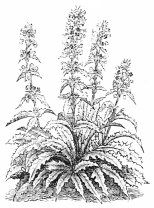
*Mulgedium alpinum.—A tall mountain-plant of the Sow-thistle family, with very broad leaves and stems over 3 ft. high. The flowers are very numerous, of a dark-blue colour, resembling those of the Chicory, and are borne erect on the upper parts of the branching stems. A somewhat shaded position and a very moist deep loam are necessary to the vigorous growth of this plant, which will prove effective in the rougher parts of the pleasure-ground. Multiplied by division. Alps.
*Mulgedium Plumieri.—A vigorous herbaceous perennial, 4 ft. to 6 ft. high, with very large, deeply-cut radical leaves somewhat glaucous underneath, bearing late in summer large spreading terminal corymbs of blue flowers. A good subject for association with strong-growing herbaceous plants in groups, or as isolated tufts by wood-walks, in deep rich soil. S. of France.
Mulgedium alpinum.
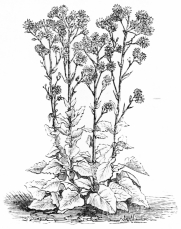
Musa Ensete.—The noblest of all the fine-leaved plants yet used in the flower-garden is Musa Ensete—the great Abyssinian Banana, discovered by Bruce—the stem of which has been known to attain a diameter of more than 3 ft. at the base, and a height of from 13 ft. to nearly 20 ft. The huge leaves, borne nearly erect, are oblong in shape and of a beautiful bright-green colour, with a very stout deep-red midrib. In the open air they often grow nearly 10 ft. long and nearly 2 ft. broad. The fruit of this kind is not edible, like that of the Banana and Plantain (Musa paradisiaca and M. sapientum), but the leaves are magnificent, and they stand the rain and storms of our northern climes with little laceration, while all the other kinds of Musa become torn into shreds. It has hitherto been generally grown in stoves; but it is an interesting and, until recently, little known fact, that the finest of all the Banana or Musa tribe is also the hardiest and most easily preserved. When grown for the open air it will of course require to be kept in a house during winter and planted out the first week in June. In any place where there is a large conservatory or winter-garden it will be found most valuable, either for planting therein or for keeping over the winter, as, if merely housed in such a structure during the cold months, it will prove a great ornament among the other plants, while it may be put out in summer, when the attraction is all out of doors. Other kinds of Musa have been tried in the open air in England, but have barely existed, making it clear that they should not be so cultivated in this country. M. Ensete is the only species really worth growing in this way. Where the climate is too cold to put it out of doors in summer, it should be grown in all conservatories in which it is desired to establish the noblest type of vegetation. It also stands the drought and heat of a dwelling-house remarkably well, and though, when well developed, it is much too big for any but Brobdingnagian halls, the fact may nevertheless be taken much advantage of by those interested in room-decoration on a large scale. The plant is difficult to obtain as yet, but will, I trust, be soon made abundant by our nurserymen.
In September, 1868, I saw a fine plant of this Musa
MUSA ENSETE. Noblest of tender Section; thriving in the open air in summer, in the warmer districts in summer and in the conservatory in winter.
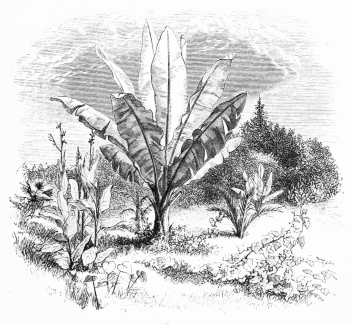
that had remained in the open ground in Baron Haussmann’s garden in the Bois de Boulogne during the preceding winter. It was left in the position in which it grew during the summer of 1867, and in the month of November covered with a little thatched shed, the space about the plant being filled with dry leaves. All the leaves were cut off. In spring the protection was removed and the plant pushed vigorously. It had, when I saw it, 16 leaves, not one of which was torn or lacerated, although it was in an exposed position. It was not more than 5 ft. high, but was more attractive than much larger individuals of the same species, from being so compact and untattered in its foliage. As most people who grow it will have means of keeping it indoors in winter, and as it is so rare, this mode of keeping it is not likely to be taken advantage of with us at present; but that it can and has been so wintered is an interesting fact.
Other species are: M. paradisiaca (the Plantain); M. sapientum (the Banana); M. Cavendishii, a dwarf-growing kind, seldom exceeding 5 ft. or 6 ft. in height, and fruiting freely in a stove; M. superba, and M. zebrina. These, however, are all properly hothouse kinds, and do not thrive in the open air.
Nelumbium luteum.—This is perhaps second to none of its fine family in beauty. In the Paris Garden a plant remained in a fountain-basin, in a very sheltered position, for several years, flowering yearly. On the 11th of September, 1868, the petals of one of these flowers measured each 6 ins. in length! and consequently the flower fully spread out was more than a foot in diameter. The singular-looking disk within these great fragrant flowers is as interesting as the flower itself, and far more peculiar. The flowers are of a pale yellow, with a single deep stain of rosy crimson at the apex of each petal. The leaves push boldly above the water, are quite round, 12 ins. to 15 ins. in diameter, and of a peculiar bluish-green. If the hand be placed under one of them, so as to slightly raise the outer parts of the large plate-like leaf, a hollow will of course be formed; and if water be poured into this so as to cover exactly the centre of the stem which supports and feeds the leaf, a curious result will be noticed. Bubbles of air will rise rapidly one after another from exactly over the part where the leaf joins its stem. In this particular leaf this spot is marked by being of a much lighter green than the remainder of the leaf. This would be well worth trying in the southern counties on the margin of ponds, etc., where it would be fine associated with Nuphar advena, and the like. It should be put out early in May.