The Palace of Vanity
Reading edition
From the French of Madame Émile de Girardin.
It was a magnificent palace, built on the side of a broad highway, along which a great number of travellers passed every day.
This palace had an elegant façade on each of its four sides; a colonnade supported by admirable columns surrounded it. It is true that this colonnade prevented the entrance of any light into the palace; but the exterior view of it was so beautiful that nobody ventured to criticise it objectively; besides, what need of daylight has anybody in a palace? Have they not lustres and candelabra? Why trouble themselves about the sun, then? Every portion of the dome of this palace was gilded, and produced a most dazzling effect.
The queen who lived in this dwelling-place was a tall and handsome woman, who, instead of a heart, had in her bosom a large diamond cut in the form of a heart; it was believed to be on that account that she had never loved.
On the front of her palace were written these words in ruby letters:
"Here You May Obtain Whatever You May Wish For."
A young man passing along the road stopped to look at this superb monument, and having perceived this sign—for it bore a strong resemblance to a sign—he suddenly exclaimed:—
"Faith, I'd like to go inside! I'm tired of being in the condition I'm in, and should not be sorry to be something else."
As he went towards one of the porticos, he noticed a beggar seated near it on a stone and laughing.
"You are laughing at me, old fellow," said the young wayfarer; "but I give you back your laugh; for you must be a fool to remain in rags at the door of a palace where you have only to wish for a new coat to be dressed like a prince. Perhaps you don't know how to read?"
"Oh, yes!—I know how to read—even writing in rubies," replied the old man.
"Well, then, have you nothing to desire, that you do not enter this palace?"
"Truly, yes. I desire more things than one; but not any such as they give away here."
The old man had such an air of cunning as he said this, that the young man mistrusted him.
"He is laying some kind of trap for me," he thought, and was about passing on his way.
"Don't be afraid; no harm will come to you in this palace," the old man went on. "Troubles exist there only for those who ask for them: take my word for it, you may go in fearlessly."
"Yes; but may I come out again?"
"Certainly you may," replied the beggar, "if you find nothing there you wish for."
The young man hesitated. He saw a number of people pass along the road, and not one of them seemed to have an idea of entering this palace. That struck him as being suspicious, and he took alarm.
"Is this palace shunned by travellers? How comes it that not one enters it?"
"It is because they have heard about it; they know that people are bored there, and, in his home, everybody likes to amuse himself." Seeing that the young man was curious to visit this monument, the old beggar said to him: "I'll tell you what I'll do; if you'll give me the price of a bottle of good wine, I'll sacrifice myself and go in with you—and we'll laugh together at the imbeciles who live there."
"Agreed!" cried the young man.
He gave the old beggar a piece of money, and they went up to the door. It was made of crystal, and afforded a view of the interior and of the bell which had to be rung to obtain admission.
On examining it carefully, the young traveller observed that this bell was made of gold, and had for its clapper a fine pear-shaped pearl, of such beauty that it dazzled his sight.
He stood motionless, gazing at it.
"Ring!" cried the old beggar, becoming impatient at length.
"Really, I dare not," replied the young man; "I am afraid of injuring this beautiful pearl by ringing the bell. It would be such a pity; it is so admirable!"
"Bah!" cried the beggar, who knew very little about jewels, "let me do it—I'm not afraid."
"No, no; let us rather knock at the door——"
But he stopped himself; for it occurred to him that, as this handsome door was made of crystal, a blow with the knocker would at least crack it.
Tired by these hesitations, the old beggar seized the knocker and struck so heavy a blow with it that the door was shivered into fragments.
They entered freely.
There was nobody in the vestibule; in the Palace of Vanity nobody would remain in the ante-chamber. And yet this ante-chamber surpassed in luxury many drawing rooms. It was adorned with statues representing gods and goddesses, and pictures representing kings and queens, princes and princesses.
It was paved with jasper and porphyry; but this pavement was so highly polished, so slippery, that the young man, whose shoes were studded with hobnails, was near falling several times within the space of three minutes. He was obliged to cling to the walls, and would rather have walked upon ice, as then he might have had on a pair of skates.
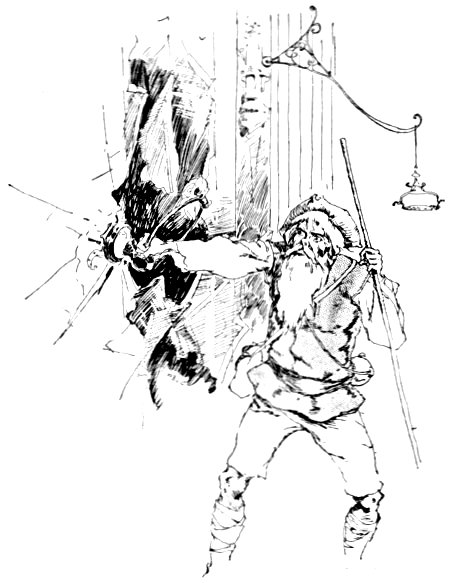
"THE DOOR WAS SHIVERED INTO FRAGMENTS."
The old man also slipped a little, but his beggar's staff supported him.
After much difficulty they at length reached a vast room, in which a number of persons were assembled. Their costumes were magnificent; the women were covered with jewellery. They had jewels even on their rich Court mantles, which trailed along the carpet; their bracelets, their necklaces, their diadems were dazzling. The young traveller, whom we shall henceforth call Alméric, was delighted by the sight.
The men were not much less splendidly decorated than the women in this drawing-room: they wore coats of velvet embroidered with diamonds, and on their heads caps, each ornamented with four ostrich feathers worthy to adorn the hat of a queen.
"Who are these great personages?" Alméric asked the beggar.
"These are the domestics of the house," he replied.
Indeed, as soon as these princes saw the two travellers enter, they came to them to take their orders, and to ask whether they desired to visit the palace.
"Phew!" said Alméric to himself, "here are indeed some well-kept people!" But fear of being indiscreet made him say aloud: "Perhaps we should be incommoding the inhabitants of this palace, by visiting them at this hour; perhaps——"
"Incommode the inhabitants of the Palace of Vanity!" cried the beggar, ironically; "I defy you to do it, young man!—they are here only to show themselves, and they are never troubled by people coming to admire them: you might as well be afraid of incommoding actors by going to the theatre to see them."
The young man could not refrain from laughing at this reflection.
"Show us the wonders of the palace," the old man said to the attendants. "Here is a traveller who desires to live here; but, before expressing his wishes, he wants to know something about you. Go before and conduct us."
The young traveller was greatly surprised at the old beggar's off-hand treatment of these superb valets, and at their readiness to obey him; he did not know that the philosopher's vanity takes the pas of all others. So many things astonished him that he dare not ask any more questions.
A fat woman of ripe age, who filled the functions of housekeeper, at once stepped forward and handed the keys of the house to the valet who was to conduct the two guests. Alméric saw behind her two little pages who were bearing her mantle, and whom the enormity of her bulk had at first entirely hidden from his sight.
These two pages no more quitted her than her shadow. It was a prerogative of her rank not to be able to take a single step, or perform a single act, without the attendance of these two babe-kins.
Her eagerness to obey the beggar made her forget her two little gendarmes, and she advanced so quickly, without warning them, that they did not think of following her, and held on so firmly to her mantle that, in hurrying forward, she pulled them both down upon their noses, while she herself was jerked upon her back. As she was very heavy, she hurt herself considerably, and the other servants hastened to her assistance.
"A Court mantle," said the beggar, "does not appear to me very commodious for housework."
And the young traveller could not refrain from laughing at this reflection.
One of the lackeys having taken up a candelabrum, conducted the strangers through the vast apartments of the palace. They reached the dining-room.
"Do you wish to sup, gentlemen?"
"By all means," said the beggar; "there is nothing but a good meal which is not a vanity."
He seated himself at table. But he had hardly tasted any of the dishes set before him, than he found them so fanciful, so salted, peppered, sugared, truffled, and mixed, that he would not partake of one of them; impossible to recognise the meat of a single animal, so highly was it seasoned.
"What is this?" asked the old man—"rabbit?"
"No, monsieur—they are lamb cutlets."
"And this: lentil soup?"
"No, monsieur; hare soup."
It was a confusion, past all understanding. And yet more: everything served was cold, for the hot-water plates were all of malachite, and nobody dare pour hot water into them.
"Faith," said the beggar, "I'd rather have an omelette on a pewter platter," and he handed to a servant in waiting his gilded plate. The servant in bowing to take it took no heed of the candles burning on the table, and forgot all about the plumes which adorned his head. They approached too near the flame, and a strong odour of burnt feathers announced that the plume was grilling.
"A white panaché does not appear to me to be convenient for waiting at table," said the beggar again; and again the young stranger could not refrain from laughing at this reflection.
"The queen of this mansion, the Princess Vanita, is not here at present, is she?" asked the beggar.
"No, monsieur," replied one of the lackeys; "she is, at this moment, with her favourite adorers, in a country the name of which I forget, but which is highly renowned for its wines."
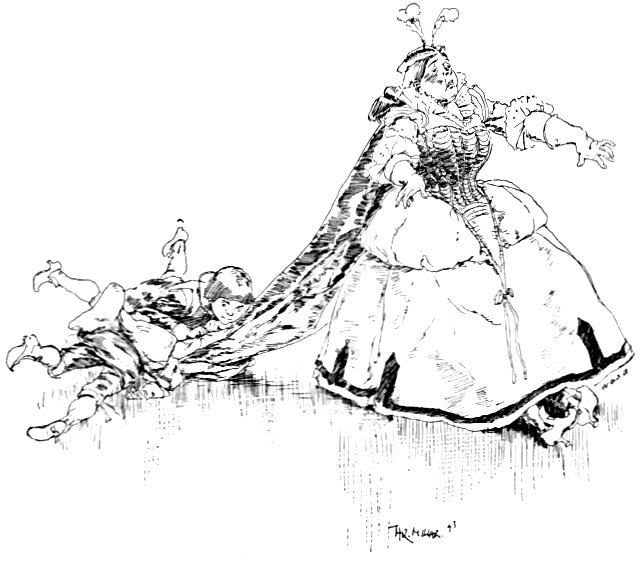
"SHE PULLED THEM BOTH DOWN UPON THEIR NOSES."
"Ah! I guess she is in France," said the beggar: "she will not soon be back."
Perched on a rich rod, a handsome paroquet was screeching at some distance from the table: "Fly quickly! fly quickly! Don't stop in this palace!"
Alméric went over to her.
"Why should we fly?" he asked: "are you not happy here?"
"Alas!—look at me," replied the paroquet; "I wished to be beautiful: I desired claws of gold, ruby wings; and now I am condemned to rest here all my life, motionless, as you see; for it is impossible to fly with wings made of rubies or to walk with feet made of gold."
Near the window they observed a large cat. It did not stir from where it lay, and appeared to be very discontented.
"What is the matter with you, puss?" inquired Alméric.
"Excuse me," replied the cat, "is it a horse, a serpent, a donkey, a man, or a woman to whom I have the honour of speaking? I can't see; pray excuse me."
"You are blind?" said Alméric, compassionately.
"Alas! yes, monsieur—and by my own fault. I had so long heard emerald eyes praised that I wished for them, and ever since that time have lost my sight. I do not even know whether my eyes are as pretty as they have been said to be. Will you be so kind as to tell me what is your impression on the subject? Look at me. Do you think that emerald eyes go well with my face?"
Alméric wished to say that he thought her eyes beautiful, to console her for having lost her sight, but the old beggar was inexorable.
"Your eyes are abominably ugly!" he said, roughly.
"Impossible!" replied the cat. "They must shine?"
"No!" cried the old man; "nothing shines out of its place! Take my advice—hide them, put on spectacles; and if ever you have any more emeralds, make them into rings and not into eyes."
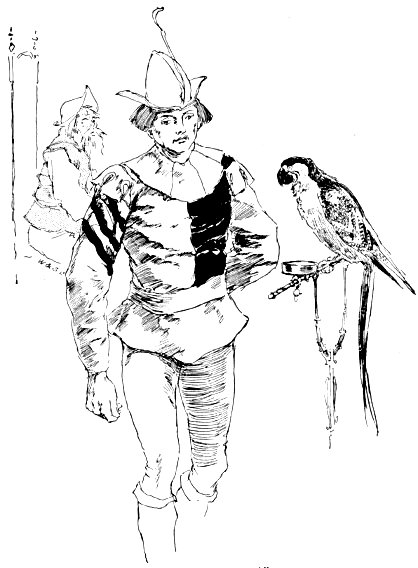
"FLY QUICKLY!"
And, once more, the young man could not refrain from laughing at this reflection.
On quitting the dining-room, they entered a superb court paved in mosaic and surrounded by elegant columns.
They there perceived a bird which, by its plumage, might have been taken for a vulture, but whose timid bearing had nothing of the bird of prey in it.
"There is a vulture that, to me, has a very stupid look," observed the beggar. "Who are you, old fellow?" he added, addressing the vulture.
"I am a vulture, a bird of prey; formerly a turkey, a farmyard bird. I wished to mount in rank and quit the sphere in which I won nothing but disrespect; but I repent—repent the change—for I cannot bring myself to devour them."
"Devour whom?" cried Alméric.
"Alas! those good turkeys who have always been so kind to me."
"Ninny!" exclaimed the old beggar, "why did you get yourself turned into a vulture? Better to be a turkey and liked, than a vulture—and timid."
And again the young man could not refrain from laughing at this reflection.
In one corner of the court there was a bear seated on a bench, his head bowed down upon his chest and plunged in profound meditation.
"There's a fellow, too, who does not seem to know much about the business of a bear," remarked the beggar. "How did he come to be in this palace? What vanity has pushed him into the bear profession? I'd lay a wager he once had a better."
The beggar approached the melancholy animal.
"Bear," he asked, "what were you before you got yourself transformed into your present shape?"
"I was a doctor's assistant."
"A doctor's assistant!" repeated Alméric and the beggar in the same breath.
"Yes, a doctor's assistant," replied the bear; "but everybody made fun of my position. Men pursued me with their irony, made songs about me, burlesqued me on the stage. I wished to escape them, and had myself turned into a bear; but I am tired of my condition. I was not born for solitude."
"You old fool!" cried the beggar, angrily, "why did you leave the calling you were in? You might have avenged yourself on the men you detest; for you do not appear to me to be very learned, and you might have poisoned the universe with your drugs and your blunders."
The beggar was still speaking, when his attention was attracted by a gigantic elephant in an adjoining court.
"An elephant!" he cried. "Who can have asked to be turned into an elephant? an ant, I'll wager."
However, the old man was mistaken; it was not an ant that had desired to be turned into an elephant: it was a rabbit. He had only recently obtained that signal favour, and was still puffed up with pride at his metamorphosis.
He was walking about heavily, and with an air of importance, and received condescendingly all the compliments addressed to him on his new promotion.
The beggar, having learned his history, advanced towards him familiarly.
"Good-day, bunny!" he said. "Well, how do you like your big skin?"
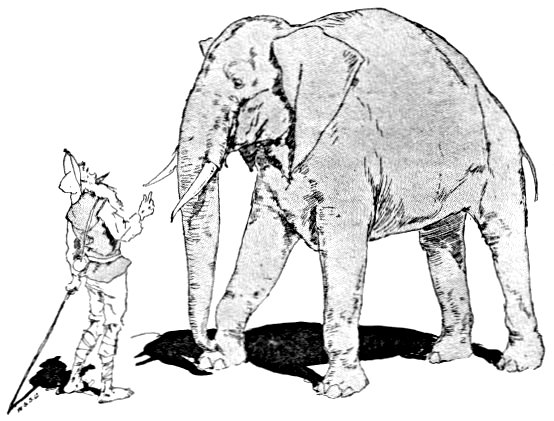
"'AN ELEPHANT!' HE CRIED."
The elephant was greatly shocked at this disrespectful tone; but the small practice he had had in the use of his trunk prevented him from seeking to avenge himself.
"Thoroughly—as you see," he replied, strutting.
"Is it long since you asked this favour?" inquired the beggar, maliciously.
"No," replied the elephant; "a few days ago only; as an old rabbit, I had incontestable claims. I have really only changed in form: my colour remains the same; my ears, instead of standing up, now fall down—that is the only difference."
"The idiot!" thought the beggar; "he does not even believe himself to have been changed!"
"Tell me, my dear fellow," said Alméric, who was greatly amused by the rabbit's stupidity, "don't you find your ordinary habits somewhat deranged?"
"You remind me," replied the rabbit, as if suddenly struck by an idea: "I am afraid I shall find my increased bulk inconvenient, on returning to my burrow this evening."
This time the young man could not possibly refrain from laughing at that reflection.
"Would you like to see the beautiful woman, gentlemen?" asked the lackey who was conducting them.
"Yes, yes," replied Alméric, eagerly. "I should like to see the 'beautiful woman.' Where is she?"
"This way, gentlemen. Be good enough to enter this boudoir."
They passed into a charming room, formed entirely of looking-glasses—the ceiling, the wainscotting, all was of looking-glass, in which one could admire oneself from every point of view.
The beautiful woman was lying upon a sofa. On beholding her, the beggar and Alméric fell back in horror. This beautiful woman was a monstrosity, but believed herself to be a chef d'œuvre.
Every part of her was beautiful, and yet she appeared horrible; because the exaggeration of beauties makes a hideous ensemble; because it is harmony which gives grace to things we admire, movement which gives life; and this beautiful woman had neither grace nor movement.
She had been born very pretty, but the excess of her vanity, and her coquetry, had made her lose all her advantages. She was beautiful as Nature had created her; she wished to be beautiful as beauty is painted: she exaggerated all her graces and changed them into deformities.
She asked for silken hair—she had long locks of silk, without life or colour; she desired to have teeth of pearl, and her teeth appeared horrible: she wished for a wasp-waist, and her body, drawn in by a tight belt, was without grace or suppleness, and looked as if it might snap in two at any moment; she asked for hands of alabaster, and her hands became dull and cold; she desired to have the feet of a child, and these deformed feet were not strong enough to sustain the weight of her body or to permit her to walk. Nothing more hideous was ever seen: it was ideal ugliness.
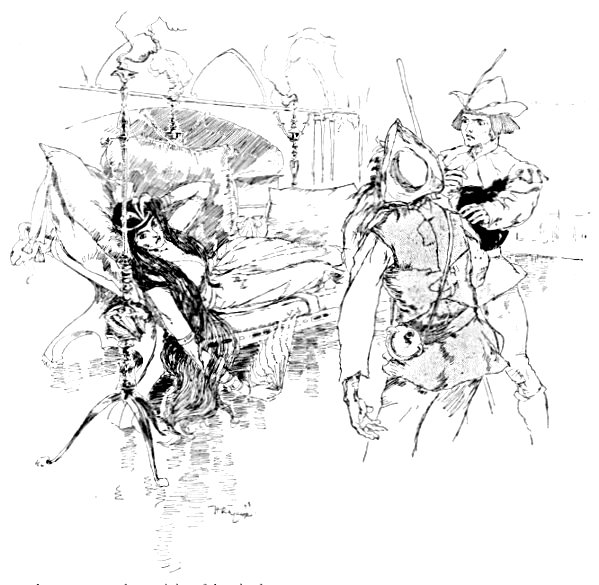
"A BEAUTIFUL WOMAN WAS LYING UPON A SOFA."
"Thousand centimes!" exclaimed the beggar; "how horrible this 'beautiful woman' is!—the sight of her makes me in love again with my old wife!"
Evening being come, a sleeping apartment was offered the strangers for the night.
"A room here will be better than any I can get at an inn," thought Alméric, following the valet, who conducted him to a magnificent bedroom prepared for travellers.
Exhausted by the fatigues of the day, he lost no time in undressing and getting into bed. But he had scarcely stretched himself before beginning to utter loud cries of distress.
"Horror! my skin is being torn from my body! I am in torture! What is the meaning of it? A perfidy! An abominable piece of cruelty!" and a thousand like complaints: and yet all he complained of arose from nothing but the admirable care which had been taken with his bed.
The sheets which covered it were of the finest Indian muslin, embroidered with gold spangles, charming to look upon, but inappreciable by a person used to lie upon sheets of coarse Holland. It takes time to get accustomed to inconveniences of this sort.
Poor Alméric's feet were scratched all over. Every movement he made in getting out of this terrible bed tore his skin; his arms were covered with blood.
"Vanity of vanities!" he cried. "Old man, beggar, let us fly from this place; there is no sleeping in this palace, and I am dying for want of sleep."
"What do you think of sheets embroidered with gold spangles?" asked the old man, laughing. "Could you have a more superb bed to sleep in?"
"Let us get out of this place," cried the young traveller, who was in no jesting mood; "I'll not remain here another hour. The men here are all stupid, the women frightful; one can neither eat here nor sleep. Let us be off, old man—let us be off instantly!"
Alméric, who had hastily redressed himself, roughly pushed the beggar out of the room, the old man laughing heartily all the while, and they quitted the palace together, taking the way to the beggar's hovel.
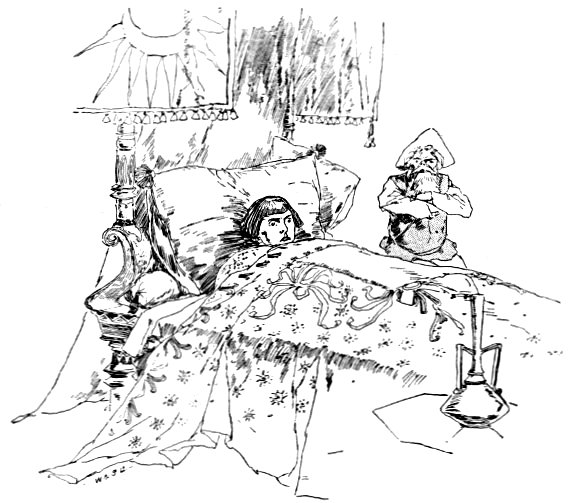
"I AM IN TORTURE!"
"Sleep here," said the old man, pointing to his truckle bed; "this mattress is favourable to sleep, and your rest will not be disturbed by spangled sheets—because there are no sheets of any kind. But what does that matter?—it is sleep that makes good beds, as it is appetite that makes good meals."
Alméric threw himself on to the beggar's bed and was soon sound asleep; and the old man heard him cry out in his dreams:—
"It is all over! I wished to obtain the embassy to Constantinople; but I will remain a simple notary at Saint-Quentin."
And the beggar, in his turn, could not refrain from laughing at this reflection.