The British Embassy at Paris.
Reading edition
By Mary Spencer-Warren.

The post of Ambassador at Paris being the plum of the Diplomatic service, its attainment is the hope and aim of many a statesman; but, skilful though he may have proved himself, brilliant though his services to his country may have been, he is fortunate indeed if his aspirations are ever realized. It is quite conclusive, however, that he who is appointed is a man of sterling merit: and such is the present Ambassador; and most of us can recall the satisfaction with which both political parties hailed his succession.
I have had several opportunities of visiting the Embassy in the Rue du Faubourg Saint Honoré, but certainly the most interesting occasion was the first one, that being the wedding day of Lord Terence Blackwood, the second son, to Miss Davis, of New York.
I am early on the scene, so have ample time to linger at the massive gates, and looking across the courtyard, study the front exterior.
It is a house with a history; for back in the days when Buonaparte was seeking to make himself master of the world, his sister, the Princess Pauline, was its occupant. Beautiful as this Princess was, one can easily imagine the house to have been the rendezvous of the fashionable inhabitants of a fashionable city; although, if report speaks truly, such assemblies were composed more largely of the gay than the wise. A change of ownership came, for in 1814 it was purchased by the British Government; and from being a resort for the idle, it became one of the business centres of Paris. Now we pass the porter's lodge and the offices of the Consulate, and mount the broad steps into the portico. Just now all this presents quite a tropical appearance; stately palm, waving fern, and choice flowers being placed for the occasion. Stepping into the entrance halls, inner and outer, I find a continuance of the floral decorations, making the place look a veritable fairyland. Ionic columns, marble walls, and marble stairs lend themselves for a grand background to this Oriental display, here and there peeping out, costly but not lovely, Burmese idols, elephants' feet, a model of Mandalay, a Pith village, and other valuable curios. Tables with rich Oriental covers, settees and chairs in rich crimson velvet, give colour, making altogether a fine picture.
I am almost immediately joined by Lady Dufferin and her two daughters, and much pleasant talk ensues, and a leisurely survey of some hundreds of costly wedding presents.
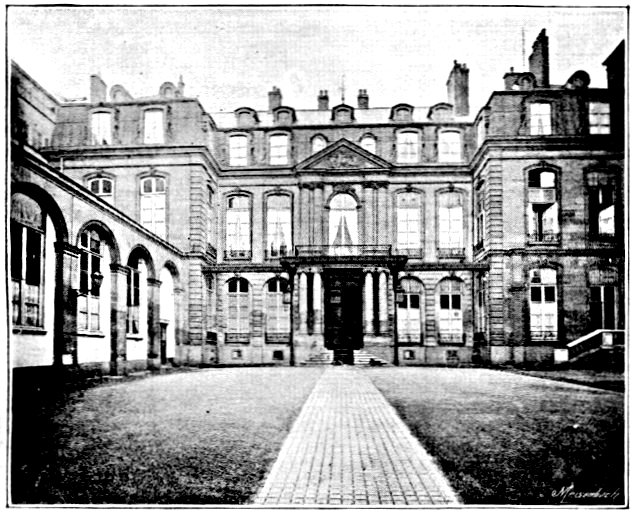
THE BRITISH EMBASSY—FRONT VIEW.
From a Photo. by Gunn & Stuart, Richmond.
A chat with any of this family is an intellectual treat; so much can they tell one of people and places, and so many and varied are the leaves from their eventful lives. Also, the residence is an interesting study. One sees in it so many reminders from friends in all parts: testimonies of esteem and regard bestowed by illustrious donors, and pleasant little reminders come with them all—a little anecdote of this individual, and a little story connected with that place.
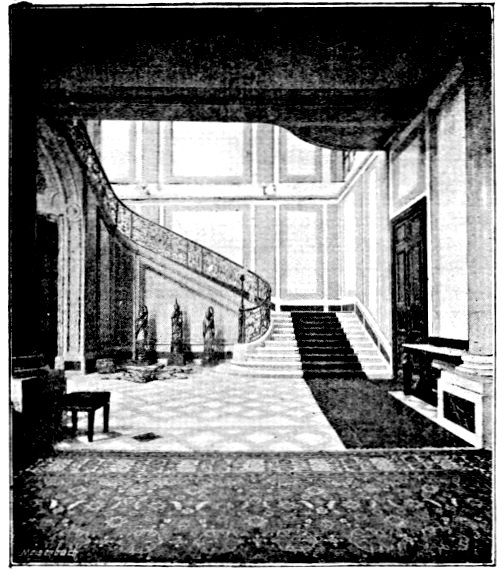
GRAND STAIRCASE.
From a Photo. by Gunn & Stuart, Richmond.
Together we make the tour of the principal rooms, halting every now and again for anything of special interest, such as water-colours by His Excellency, paintings and miniatures collected by him on his foreign stations, furniture and plate formerly the property of the Napoleon family, and the exquisite floral decorations of the suite of rooms set apart for the reception in American style which is to take place after the ceremony.
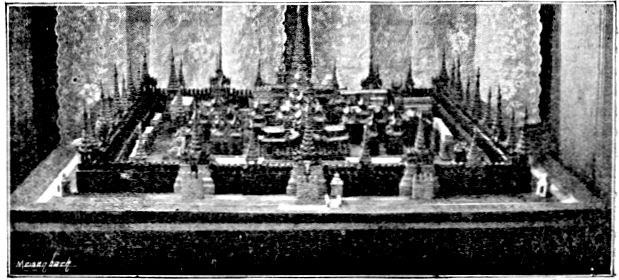
MODEL OF MANDALAY.
From a Photo. by Gunn & Stuart, Richmond.
Here we are presently joined by the Marquis and the bridegroom—Lord Terence Blackwood—together with his two younger brothers; we all turn again to the still arriving presents, everybody laughing and talking together in an unaffected and happy manner. Evidently the coming event affords complete satisfaction to this thoroughly typical English family; but time is getting on, the sight of the men in their gorgeous State liveries of blue and gold, powdered wigs, and pink silk stockings warns each and all of preparations to be made, so we disperse for the present, to meet many times later in the day, and also on subsequent occasions.
Then I wander about at my own will and pleasure, and make myself more thoroughly acquainted with the house and its contents.
The Throne Room and Ball Room are contiguous, only divided by an archway spanned by a double brest-summer supported by carved figures. In the Throne Room, Lord Dufferin, of course, represents the Majesty of Great Britain; and though the number of English residents in Paris is comparatively few since the fall of the Monarchy and the rise of the Republic, yet there is still a fair number of influential families, and also many foreign friends of the British Crown, who, together with the representatives of other Courts, make up a crowded assembly and form a brilliant gathering. Different receptions, these, to some I was told of—some in India and others in Canada. Very peculiar and highly amusing: perhaps the first one given in Canada excelled in this respect. Owing to delay in arrival of luggage, the family were very, very short of even such necessary articles as crockery, managing amongst themselves with about half-a-dozen cracked plates and cups. More must be got somewhere for the reception, which would doubtless be large, so they had to borrow, not priceless Sèvres or dainty Dresden, but thick earthenware, pure and simple. The entire affair was what we should call "scratch"—the bed had to be moved out of the best bed-chamber to make more room; the furniture itself was all "lodging-house." When the company arrived many of them had no cards; the servant could not say their French names, so made them write them on bits of paper at the entrance; and, to crown it all, just as it was all over, the servants of the crockery owners came and fetched it away, right in sight of the guests!
And yet they were very merry over all these affairs—merry even when they had to oil themselves all over with strong smelling oil to keep off the bites of the mosquitoes. And then what outings they had in this same place! How they all went on fishing expeditions; camping out in tents, which had to be entered by creeping in on all fours through a very small hole; then sleeping with a knife under their pillows, so as to cut another way out if a bear should look in! One occasion Lady Dufferin recalls, when, on crawling into her tent in the usual manner, she made a false movement and the entire affair upset on top of her! Canadian life had its drawbacks, but it had its pleasures, not the least of them being the large circle of friends made by the Governor-General and his wife; and it is difficult to say on which side was the most regret at parting—the Dufferin family or the inhabitants of the country.
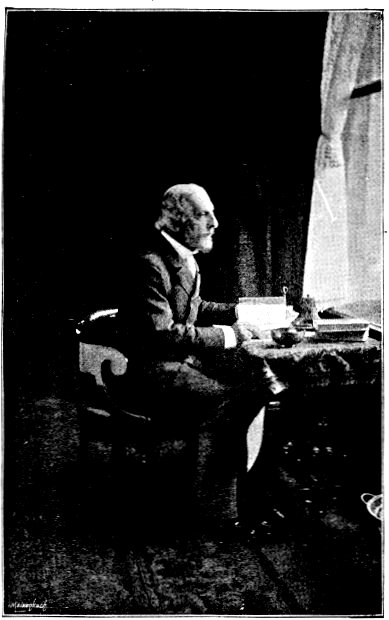
LORD DUFFERIN IN HIS STUDY.
From a Photo. by Gunn & Stuart, Richmond.
Then the reminiscences go away to India, where everything was done on a scale of gorgeous magnificence; where such a reception awaited them on their arrival as completely eclipsed anything they had ever before witnessed; where vast crowds of Europeans and natives of every size and shape lined the streets to give them greeting: some in all the colours of the rainbow, some in "nearly nothing at all." Here the Residence was grand and stately, swarming with native servants in any number of different costumes: some in glittering uniforms, some in ordinary dress, and some in rags and tatters; but men, all men, for every possible duty, and all of them extremely mindful of caste. He who puts water into your jug would not deign to pour it out; one who cleans your shoes would consider it derogatory to pass you a cup of tea; one puts a candle in a candlestick, another sets light to it. At any time you need not be surprised at finding as many as eight men in your bedroom, all gravely performing their different duties!
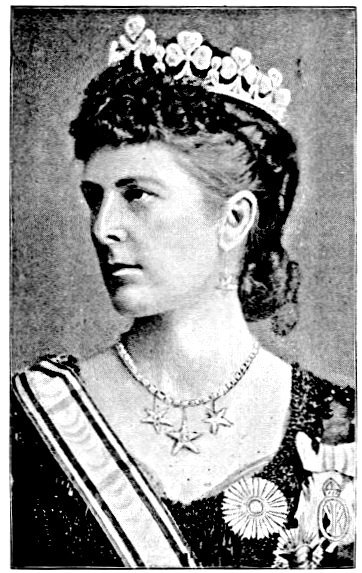
LADY DUFFERIN.
From a Photograph.
Then the receptions of Indian potentates by Lord Dufferin, when, in accordance with the rank of each, so many aides-de-camp must fetch them from their residences, and so far must His Excellency advance to meet them: anywhere from half-way down the room to the steps at the entrance.
Then they all sat about in various positions, some of the time silent, some of it talking with the aid of interpreters; occasionally varying proceedings by offering presents which they did not mean them to accept—Lady Dufferin and others of the family enjoying a private view from a safe hiding-place.
Somewhat embarrassing must have been the situation of Lord Dufferin and his attachés when attending for the first time an Indian organized entertainment. It was in the morning, and they were duly arrayed in orthodox frock-coat. Much to their consternation, wreaths of flowers were brought forward and placed around their necks! Just you imagine such a picture here! I am afraid it would be too much for even the gravity of grave Englishmen!
At Paris things are done in lavish style, be it dinner party for forty to sixty, or garden party attended by fourteen or fifteen hundred; the wedding reception, for instance, bringing several hundreds of the élite of the city, the entire ground suite of rooms being thrown open, in addition to the fine covered promenade gallery, with orange trees, palms, etc., which forms a terrace opening on to grounds in the rear of the house.
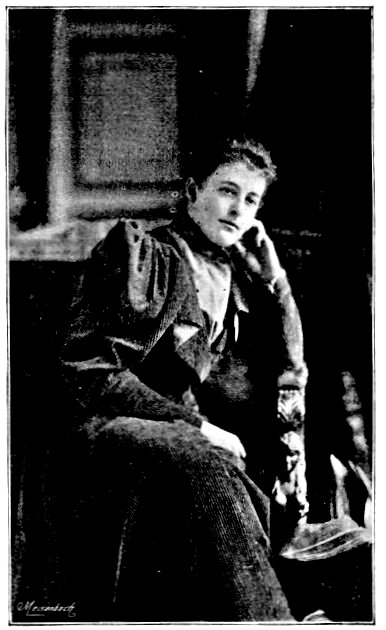
LADY HERMIONE BLACKWOOD.
From a Photo. by Gunn & Stuart, Richmond.
This brings me back to the Throne Room, where I commenced to speak of receptions. This room is somewhat limited in size, but the Ball Room joining more than redeems it, as the two combined have the most magnificent proportions. The walls are hung in crimson, and show a profusion of plate-glass panels; the ceiling is painted cream, with gold relief, crystal chandeliers depend from it; the whole being supported by decorated Doric columns. The Throne chair, on daïs and under a canopy, is of the usual character, crimson upholstery and frame of over-burnished gold; other furniture to match, and all of it showing the Arms of England and V.R., even the carpet—an Axminster—having the same design woven. Passing under the archway into the Ball Room, you step immediately on to a very beautiful parquetry floor, and get a clear view of the pretty lawn and terraces, from windows facing—windows handsomely curtained in cream and gold. Ceiling and walls alike are splendidly decorated in relief, showing musical and armorial designs; the furniture, settees, and chairs to match with those in the Throne Room.
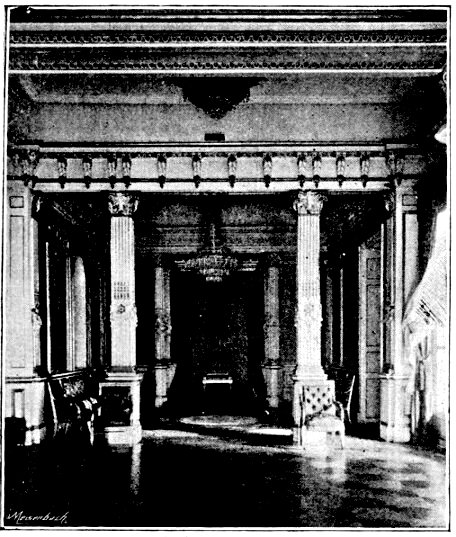
THE THRONE ROOM.
From a Photo. by Gunn & Stuart, Richmond.
Not only did I have the pleasure of witnessing a reception and ball in these rooms, but also attended an assemblage of quite a different character there on another occasion: one of a description that tends very much to make Lord and Lady Dufferin the popular personages they are; showing unmistakably their interest in their less wealthy and less fortunate countrymen and countrywomen. This special meeting was on behalf of the "Girls' Friendly Society," the Paris branch of which has a hard-working president in Lady Dufferin. His Excellency not only threw open his splendid rooms, but also took the chair, and made a hopeful, energetic speech, assuring the society of his continual support. I just mention this to show how ready the family are to accord help to those who need it, and to give up time for the good of others, notwithstanding the heavy pressure of official and social duties devolving upon them.
Thus the Embassy is the very centre of much good work in the city; how much is really done in helping the needy, in suppressing vice, protecting strangers, and supporting charitable objects of all sorts it would be impossible for me to give you any idea.
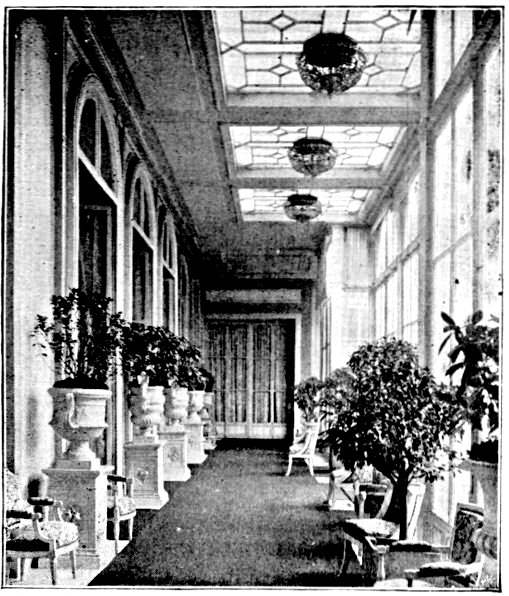
THE GALLERY.
From a Photo. by Gunn & Stuart, Richmond.
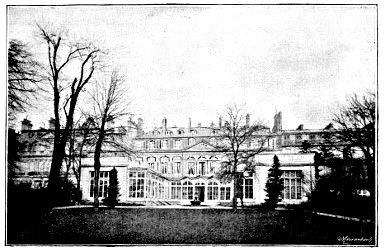
THE LAWNS AND TERRACES.
From a Photo. by Gunn & Stuart, Richmond.
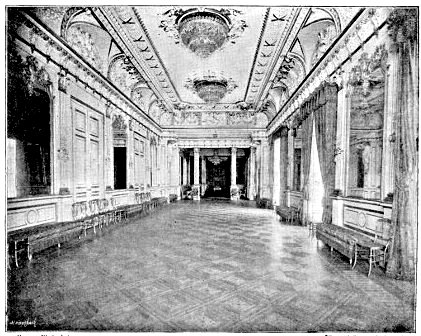
THE BALL-ROOM.
From a Photo. by Gunn & Stuart, Richmond.
Of Lord Dufferin's official life it is not necessary to say much; his appointment here was putting the right man in the right place, such satisfactory proof has he always given of his splendid abilities, keen tact, and nicety of judgment. More than one crisis has he successfully tided over, earning the unbounded gratitude of his country. Few men, perhaps, have held so many and important positions under the Crown as he. Born at Florence in 1826, he was educated at Christ Church, Oxford; became a Lord-in-Waiting to Her Majesty in 1849; went with Lord Russell on a special mission to Vienna in 1855; on a mission to Syria in 1860; was made Lord-Lieutenant of County Down in 1864: Under-Secretary of State for India in 1864; Under-Secretary for War in 1866; Chancellor and Paymaster for the Duchy of Lancaster in 1868; Governor-General of Canada in 1872; Ambassador to St. Petersburg in 1879; to Constantinople in 1881; was sent on a Special Commission to Egypt in 1882; was made Viceroy of India in 1884; Ambassador to the King of Italy in 1888; Ambassador at Paris in 1891.
In the Red Saloon many instances of the artistic ability of Lord Dufferin may be seen: indeed, the crimson-covered walls are profusely hung with his water-colours. Amongst others, I noticed the "Ruins of Fort Ticonderoga" (where the 42nd Regiment was cut up), the "Indian's Grave," "Artillery Ground at Quebec," "Killyleagh Castle," and some descriptive of the Iceland journey of his lordship.
While thinking of the Marquis of Dufferin as a clever statesman, an artist, and a literary man, it must not be forgotten that he is also a very fine orator. His various speeches make splendid reading: instructive, eloquent, and always well to the point before him. Perhaps there are no better of his on record than those made in Canada, when the rugged sons of toil who listened to him went almost wild with delight. At that time people had scarcely commenced to settle in places which are now prosperous cities and towns, and Lord Dufferin did splendid service by visiting outlying regions and pointing out possibilities of new commerce and new sources of income.
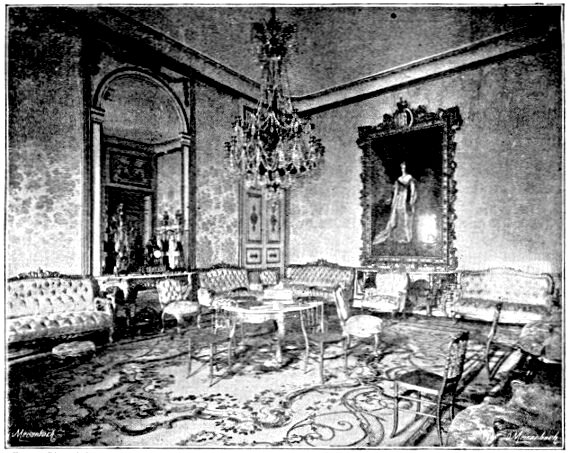
THE QUEEN'S ROOM.
From a Photo. by Gunn & Stuart, Richmond.
The Queen's Room is very handsomely decorated in blue and gold, and is one of the suite of drawing-rooms on the ground floor; it takes its name from a magnificent full-length painting of Her Majesty. Buhl tables, furniture of gold and silk brocade, ormolu decorations, and carved marble combine to make an exquisite display. As with the other drawing rooms, it opens out on to the Promenade Gallery.
The next room, called the Prince of Wales's Room, is very handsome: it has a richly-decorated ceiling in gold relief, with walls draped and embellished to match; Ionic columns and gold-framed panels to doors add to the richness; cream silk curtains to the windows, and quantities of white flowers giving graceful relief to the gold blazonry of furniture and carpet. The carpet, I may mention, has the Prince of Wales's feathers woven in the centre—from this the room is named.
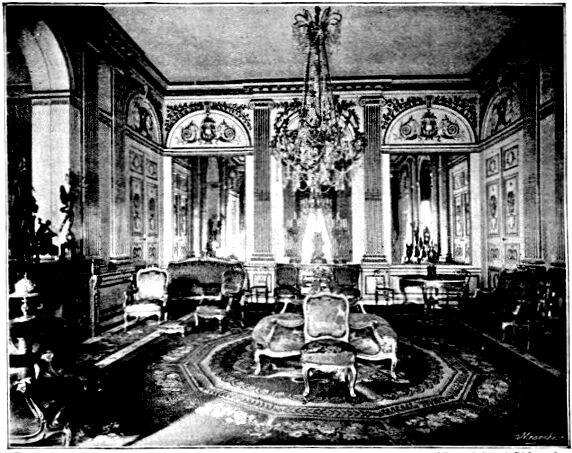
PRINCE OF WALES'S ROOM.
From a Photo. by Gunn & Stuart, Richmond.
On the wedding day I was enabled to be present at an American reception given in this room. Furniture was all cleared out and every niche filled with flowers, with wreaths of same round every picture and panel; a daïs was erected at the top, and on it stood Lord and Lady Terence Blackwood on their return from church, everybody who attended walking up to shake hands and congratulate, then walking off to find their way to the well-spread tables for "five o'clock tea." Lord and Lady Dufferin and family mingled with the crowd, talking to everybody; and though the bride and bridegroom must have been tired with standing so long, and shaking hands with so many, yet the whole affair was a deal more enjoyable than the formal breakfast, with the nervous speeches of the nervous men.
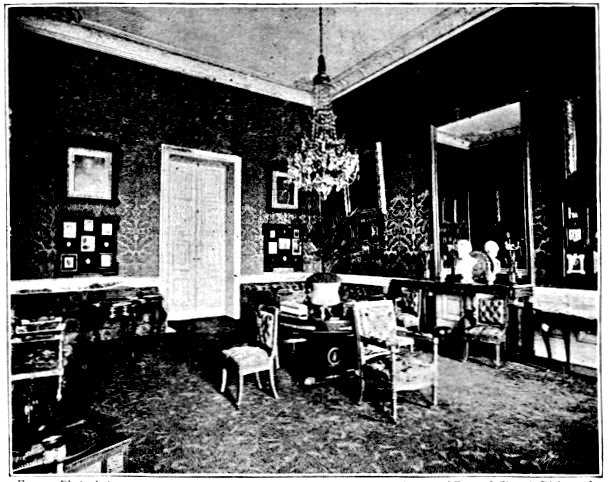
THE RED SALOON.
From a Photo. by Gunn & Stuart, Richmond.
Of course, I congratulated the happy couple on behalf of The Strand Magazine, and of course I carried away a piece of the cake, one of the inimitable Buszard's, all glorious in silver decorations of flowers, fruit, Irish harps, etc., and mounted on a massive silver stand. For the benefit of my lady readers, I may remark that the bride was really beautiful (people generally say they look so, but this one really was); cream satin, Venice point, and orange blossom were all in due order. But what chiefly interested me was the crowd of celebrities present—Rothschilds, Ambassadors (whose names are known and honoured), some of the French nobility, many familiar English faces, musical and dramatic stars, etc.
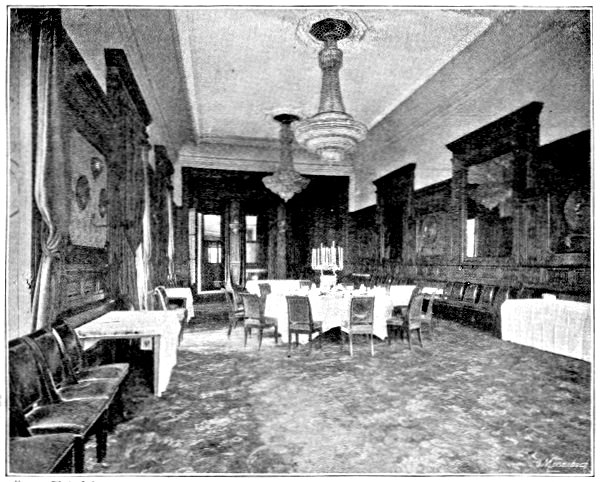
THE DINING-ROOM.
From a Photo. by Gunn & Stuart, Richmond.
From here I proceed to the Dining Room, a fine apartment lighted with crystal chandeliers and silver-gilt candelabra, showing a splendidly painted ceiling, with walls of marble, carved oak, and crimson panels—these being hung with shields and pieces of armour, offensive and defensive. On the tables is a fine display of plate, formerly the property of Jerome Napoleon, a costly Burmese bowl, and other pieces of presentation plate too numerous to mention. I may here say that upstairs in the strong-room I saw a remarkably large collection of plate—some belonging to the Embassy, but a great deal of it the private property of the Marquis; all was of the richest in quality and design, but perhaps the gold Buddha from Burmah, a Burmese cup—wonderfully chased—and some candelabra, copied from originals found in Pompeii, were of the greatest interest.
From here you can step out into the Inner Hall, and then mount the splendidly wide marble staircase, soon finding yourself in a most beautiful suite of apartments.
The Second Red Saloon calls for your particular attention: it has much in it worth close study. The painted ceiling, brocaded walls, and parquetry floors are elegant and costly, and the furniture of the First Empire worth more than passing note; but the chief attraction undoubtedly is the unique collection of Indian Rajahs, paintings on ivory; these—seventy, I believe, in number—were presented to His Excellency before leaving India.
Nearly every one of the miniatures brings up some interesting and may-be amusing recollection, and carries the family back to sojourns in various places: at Calcutta, for instance, where Lady Dufferin tells with glee how on one of her visits she was literally garlanded with flowers, her pocket-handkerchief copiously drenched with a pungent scent, and a scented bouquet ornamented with tinsel thrust into her hands: thus bedecked, she had to drive through the streets, feeling, I should imagine, like a central figure in a circus display. It seems it was customary everywhere to make offerings of flowers, fruit, cakes, and candy; and as these latter were accepted and passed over to the servants, they were much delighted. The rule regarding other presents was curious: jewellery, etc., was accepted, but passed on to the Government Treasury, sold, and presents of equal value returned to the donors: rather aggravating this, when a specially nice article is given. Money, too, was often offered, but this was only touched, not taken!
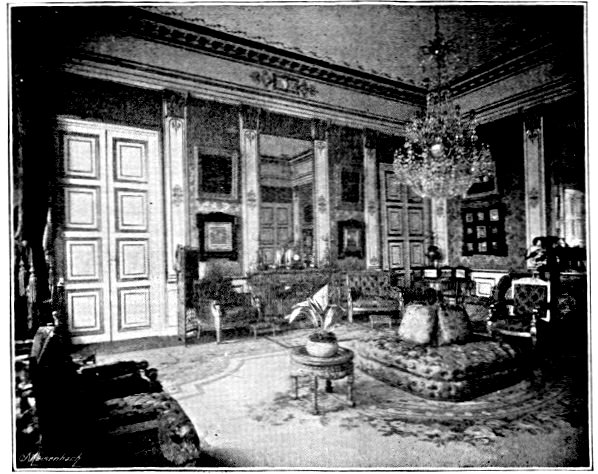
THE YELLOW SALOON.
From a Photo. by Gunn & Stuart, Richmond.
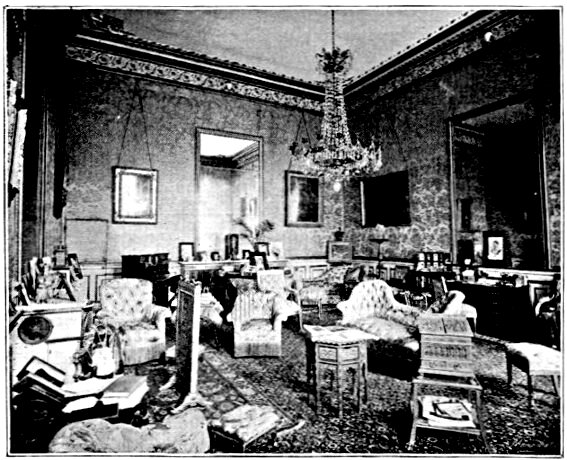
LADY DUFFERIN'S BOUDOIR.
From a Photo. by Gunn & Stuart, Richmond.
Then, again, reminders crop up of Burmah, some not very pleasant ones too, when the bedrooms were kept lively with swarms of lizards, and even scorpions occasionally putting in an unwelcome appearance. Or of Simla, where a small Government House was perched at such a dizzy height as made falling over a precipice a great probability if venturing too far over the threshold: a place where carriages could not get along, where everybody had to go out in "jinrikshas," a species of Bath chair, which was half pulled and half pushed by four and sometimes six men: processions of them going along in single file, the merry occupants shouting remarks to the van or rear as they proceeded. Just you imagine going to church on Sunday morning in this fashion, or mounted on rough ponies, horses, or anything on legs that could be obtained. Fancy what a nondescript congregation it must be; occupants of jinrikshas, ladies in riding gear with boots and spurs complete, and black servants in every colour of the rainbow.
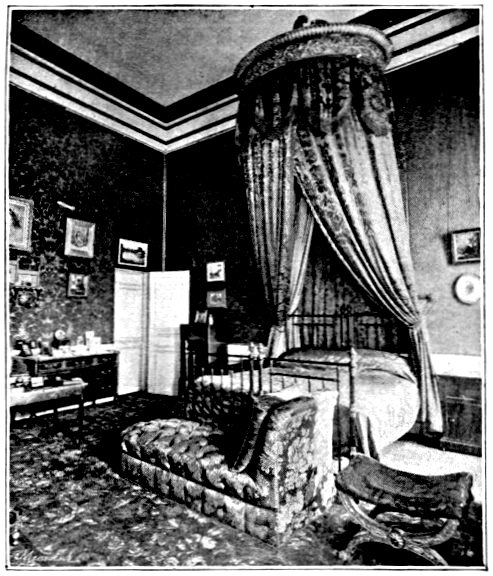
STATE BEDROOM.
From a Photo. by Gunn & Stuart, Richmond.
One might go on for any length of time with these reminiscences, but there are a few more rooms yet unexplored.
The next one I enter is known as the Yellow Saloon, nearly everything in it being gold and cream. The ceiling is painted cream and decorated in gold relief, the walls are hung with gold brocaded silk, carpets and curtains, settees and chairs all in character. On the walls may be seen some costly Italian pictures, collected by Lord Dufferin, also a few more miniatures of Rajahs. The marble mantels in this suite of rooms are also a special feature, so beautifully are they carved; also you will note the graceful crystal chandeliers and parquetry floors.
On one side of the room you will observe a very handsome silver-gilt frame containing a portrait of the Maharajah of Patiala, also a present. Lord and Lady Dufferin were occasional guests at this Prince's palace, he entertaining them right royally, even to providing bagpipe strains for after-dinner performance, the dusky pipers in Scottish attire, with legs cased in pink silk to keep up the semblance. I believe time and tune were not much regarded, but what mattered that? The intention was good.
Opening from here is Lady Dufferin's boudoir, a cosy apartment, crowded with artistic and useful pieces of furniture; music, books, and family photographs abound; and here Lady Dufferin finds time for arrangement and direction of much of the good work in which she is constantly engaged.
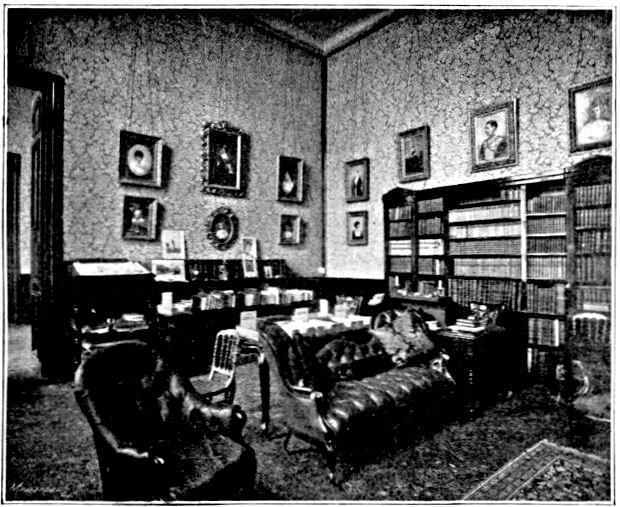
LORD DUFFERIN'S STUDY.
From a Photo. by Gunn & Stuart, Richmond.
I may as well here state that Lady Dufferin is the daughter of the late Archibald R. Hamilton, Esq., of Killyleagh Castle, Co. Down; she has orders, the "Crown of India," the "Victoria and Albert," the "Crescent of the Shefkhat," and "Lion and Sun." Wherever Lord Dufferin has been appointed, there has Lady Dufferin worked zealously for the welfare of the poorer classes, but it is perhaps more especially for her splendid work for the women of India that she is so much honoured. Most of you know the wretched condition of these poor women, sufferers through the custom of the country. Lady Dufferin, by her noble efforts for the training of native women in medical skill, has earned the gratitude and alleviated the misery of thousands. The amount of correspondence alone that all this entails upon her ladyship is prodigious; every minute seems to be fully occupied.
We take a peep into the next room, a State bed-chamber. This, Lady Dufferin tells me, was formerly used by the Princess Pauline. Over the bed is displayed the eagle, and the letter "P.," in ormolu, is on much of the tulip, satinwood, and rosewood furniture, all of which is covered with the richest of brocades.
There is another room which must not be omitted—Lord Dufferin's study. Thither I proceed, and thus get a glance of the enormous amount of business devolving upon the Ambassador and his secretaries.
Everything is of the most orderly in the arrangements: all correspondence sorted up; papers and books of reference ready to hand; well-filled bookshelves containing Parliamentary and technical works, and all the other accessories of a hard-working Minister's room. On the walls I note a number of family portraits, chief of which are Lady Dufferin and Lord Ava—the eldest son.
Of the real work done here, few can form any idea; communications from all parts of the globe, arbitration here, intercession there. Very much fine tact is wanted to keep all this going smoothly: to uphold the majesty, please the public, and give no manner of offence. The multiplicity of affairs, some trivial, some weighty—to an ordinary mind—would be alarming. Not so long ago I was in conversation with one, who, residing in a town not far from Paris, had, as I think deservedly, brought himself under the vengeance of the French law; but he was an English subject. "So," said he, "I shall appeal to the Ambassador!" and appeal he did. This just gave me an instance of the number of petty matters that come for settlement to the Embassy.
Downstairs is another room where any amount of business is transacted, and where I had a few minutes' chat with Austin Lee, Esq., one of the secretaries; and opposite are the offices of the Consulate. To one and another there is a constant stream of people from morning till night; all sorts and conditions, and on all sorts of business. One thing you may be sure of: no one who really needs and deserves help or redress fails in obtaining it; Lord Dufferin and his able assistants—whose portraits are here presented—not only conducting affairs of State with dignified ability, but also giving ready sympathy of a practical nature wherever required.
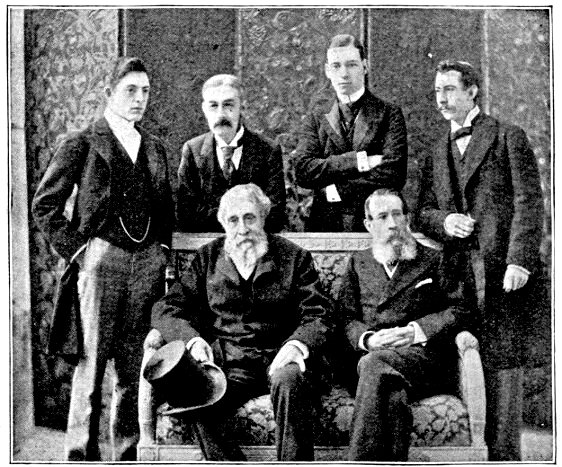
LORD DUFFERIN'S ASSISTANTS.
From a Photo. by Gunn & Stewart, Richmond.