Lost in a Blizzard
Reading edition
By G. H. Lees
[The following is an absolutely true narrative of actual facts, and was written down from Mr. Lees' dictation, the loss of both his hands, of course, precluding him from writing.]

On Christmas morning, 1886, I started about ten o'clock from Indian Head, Manitoba, Canada, with Her Majesty's mail, to travel forty miles. It was a very cold morning, and blowing 30° below zero. I had been on my journey about an hour, when I began to feel very sleepy, through the intense cold, and so got out to walk for a time. The storm increased so that I could not see twenty yards before me, but I still kept the trail till something happened to the harness. I threw my gloves into the sleigh while I put it right, hanging the reins on the front board.
When I went back to get in, the ponies bolted, leaving me without gloves. I ran some distance, when the cold seemed to make me faint; I lay down an hour before I could recover myself sufficiently to start again; when I did, both hands were frozen stiff.
The blizzard cleared, and when I had thawed my eyes (which were frozen up with the drifting snow) I could see a shanty about a mile off the trail. I started to it, but bad luck attended me. When I reached it, it was uninhabited, and my hands were so frozen that I could not move a finger to get in, so sat down in a shed to consider what would be best to do.
Feeling perished as my feet began to freeze, I was obliged to walk on. I saw another place I knew across the prairie, about two miles from where I stood, and started for it as well as I could get along, but still worse luck attended me. I had gone only half my journey when the blizzard increased, so that it froze my eyes up and nearly choked me. I turned my back to the storm and tried to retrace my footsteps, but the snow had completely swept them out; and I was lost, as I thought, for ever.
I walked on, both sore and hungry, but dared not sleep, knowing it would mean death; but could see nothing. As night came on the blizzard abated, but it was no help to me when darkness had set in. I knew it meant that I must walk or die.
Suffering now with hunger and thirst, I ate some snow, but every time I took it, it pulled the skin off my lips. I walked on until I was completely played out, falling down some twenty times, sometimes seven or eight feet, and it took me some time to recover myself, not being able to use my hands, and afraid they would break; my elbows, too, began to feel sore, through the frost and falls. Once or twice I followed a bright star, thinking it might be a light in a shanty; it seemed about on a level with the snow.
I had been walking until about midnight, when I fell down a bank about ten feet right into the snow, where I thought I should lay and die. I had a Scotch collie with me, and he curled up close and kept me warm. I think I must have slept a little time, as the dog was howling when I awoke. I was very stiff, and struggled more than an hour to get up the embankment. When at the top I was on the open plain, and my dog was gone. The moon was shining, and I walked on to a wood, which sheltered me a little from the cold. I was very hungry now, as I had been walking twenty hours without food, and, being famished, I had to bite the snow off the trees, though it pulled the skin off my lips.
Then I lay down again for a time. Presently my dog came back, and I was very pleased to see him, thinking anything to die with was better than being alone. He left me again in the night; his feet were freezing, and he was howling with pain; but came back again when it was getting light, lying down as if he were dead.
I got on to a trail, and thought I should find some shanty. I left my dog, thinking he was dying. The trail ended, and now came my trial. I had to clamber through the wood where it had been burnt a few years before by the dreaded prairie fire, the trees that had fallen and not been burnt lying on the ground, so that I had to clamber over them, often falling and with great difficulty getting up.
At last I got on the prairie again, but the blizzard was worse than ever, the temperature being now 40° below zero. Walking on about a mile I came to a haystack. Thinking there might be a shanty near, but not finding one, I lay down by the side of the stack. I should think this would be about seven o'clock.
After lying a little time I thought I would go back again to my dog and die with him in the wood. I had not gone more than three parts of the way before he met me, barking with delight. I followed him through the wood until we came to a steep hill, impossible for me to walk up; but the dog kept trying to make me start. I crawled on my elbows, as I was now afraid of breaking my hands to pieces. They were like glass. I had got on nicely for about fifty yards, the dog licking my face, when I slipped back about twenty yards. It must have taken me half an hour to get to the top, but when I got there what joy it was to see a shanty and people in it!
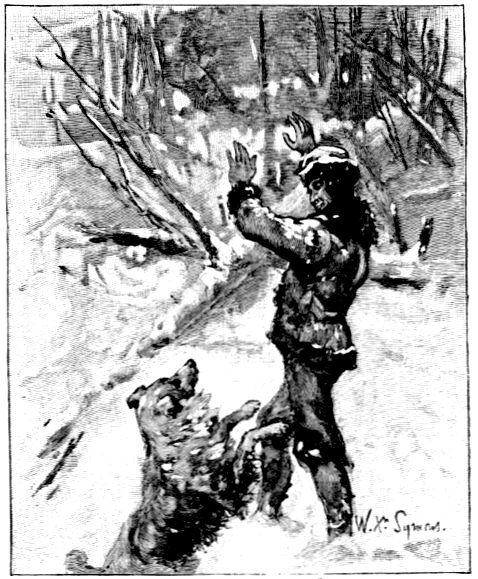
"BARKING WITH DELIGHT."
I was helpless after I got into the warmth for a little time, but soon knew I must try to save my hands and arms. The people were very good, helping in every way to save them, getting me a pail of cold water, in which I held them for twelve hours. The ice came out in balls; but it was of no use. The good lady fed me; trying to ease the pain as much as she could. My eyes, too, were dreadful; she laid cold tea-leaves on them, which I believe saved me much pain.
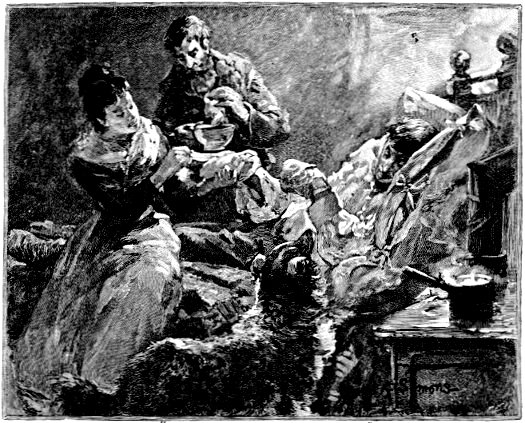
"THEY WRAPPED MY HANDS IN PARAFFIN RAGS."
They removed my boots and socks as quickly as they could, and cut the feet to let the blood out. After I had been lying with my hands in the water so long they took me and laid me on the bed near the stove, and wrapped my hands in paraffin rags. They could not send for the doctor that day, as the blizzard was so bad. After lying in this state for two days he came, but said he could do no good to me there, but I must go to Quappelle, about twenty miles away.
My friends drove me to Indian Head, but I was very sore, their sleigh not being long enough to lie at length in it. After this other friends carried me to the hotel and fed me, whilst the rest got a waggon and put it on sleighs with a spring mattress and rugs, and started me on my journey again.
I went on comfortably for the next ten miles, when I arrived at the Leeland Hotel, where six men carried me upstairs on a blanket. I lay here seven days, Doctor Edwards and the manager of the hotel doing all they could for me. The students from the college used to come and sit up with me. Doctor Edwards told me I must have both hands taken off, if not one foot, so I thought it best to go to the General Hospital, Winnipeg.
I started on January 3rd, at half-past three o'clock in the morning, arriving at Winnipeg at half-past six o'clock at night, being taken from the station in a fly, and admitted about seven o'clock. After having a nice warm bath, I was put to bed, receiving every attention. I had as many as eight doctors to see me, but they gave up my hands as hopeless. On the 23rd of January they took them both off, about two inches above my wrists. I was in bed eleven weeks, and Nurse Reynolds attended and dressed my arms all the time.
I left Winnipeg on April 1st, going West to some friends until strong enough to return home. My fare was paid to Liverpool, and I started the 3rd of June, stopping to see the nurse on Sunday, when I met an old mate who was in the hospital all the time with me to have his big toe taken off. He fed me, sleeping with me to dress me. His name was Tom Collett; he put me on the train Sunday night, and I arrived at Quebec on Wednesday night, late. I stayed with French people at the hotel and found it very comfortable.
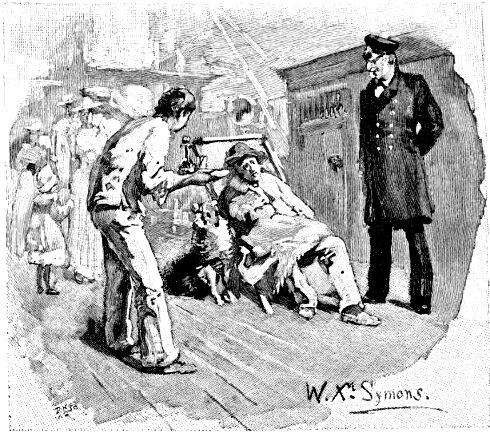
"A SAILOR ATTENDED TO ME."
In the morning I went on to the Allan Liner Sardinian, when we left Quebec about 12 o'clock a.m. I had an intermediate ticket: it was quite as good as first-class. The captain sent a sailor to look after me; he dressed, fed, and attended to me in every way he possibly could. We had a good voyage, arriving at Liverpool on the Saturday before Jubilee Day, but too late to send a telegram home. The sailor saw me in the train at Liverpool at eleven o'clock at night, and I reached London about four o'clock next morning, where a policeman showing me a waiting-room, I slept until seven o'clock, after which I had refreshment, leaving King's Cross at once, and reaching home at eleven o'clock, having been away from England one year and a half.
Note.—All the portraits and pictures in the article in the January Number of The Strand Magazine on "The Signatures of Charles Dickens" were taken from the engravings in "Charles Dickens, by Pen and Pencil," by Mr. Fredrick G. Kitton, published by Mr. Frank T. Sabin and Mr. John F. Dexter, of 118, Shaftesbury Avenue, the proprietors of the work. These engravings were copyright, a fact of which we were not aware, and we hereby express our sincere regret to the owners of the original work for our unintentional infringement of their rights. Mr. Schooling, the writer of the article, is in no way to blame for what has occurred.