VIII COTTAGE SITES
Reading edition
BY referring to the drawing on page 33, we may see that such a village mode of living and working as equal owning partners could in most respects be immensely superior to that of our present co-operation as employers and employees.
It would entirely dispense with the slums, skyscrapers, wage-system, exploiting commercialism, isolated country life, and would very largely, if not entirely, abolish vice and crime, but would fall far short of producing the same degree of efficiency, comforts, conveniences, personal liberty, means of education and congenial sociability of the Co-operative Mansion by a group of refined Co-operators.
The 100 family cottages would have to have 100 kitchens, cookstoves, refrigerators; dining rooms, cellars, furnaces, parlors, libraries, etc. In the Co-operative Mansion, there would need to be only one of each of these.
More than 100 cooks would have to work and drudge in the 100 kitchens. The cottage life would not only leave women and children as lonely kitchen, laundry and nursery toilers, but would also leave them financially dependent on the income and generosity of the man as now. If the husband dies or spends his income 36for booze and tobacco or elopes with another woman, the wife and children are usually in a lonely, precarious plight. No intelligent woman should any longer be satisfied with such a lonely, toilsome, precarious method of living and working as the family cottage inevitably imposes on women and children.
With domestic co-operation, more than seventy-five of the cottage cooks and housekeepers could enter the fields of productive industries where they could become free and independent by personally drawing their own pay checks as equal partners of the association. This domestic co-operation of the Co-operative Mansion would not only cut the average workday in two, but would also greatly enhance the health, freedom and pleasures of cultured life by working side by side as personal friends or lovers in fine Co-operative Mansions instead of toiling early and late in family cottages and lonely country homes.
37TWELVE ADJOINING MODERN PARADISES
EACH FOUR MILES SQUARE
(Fig. 6)
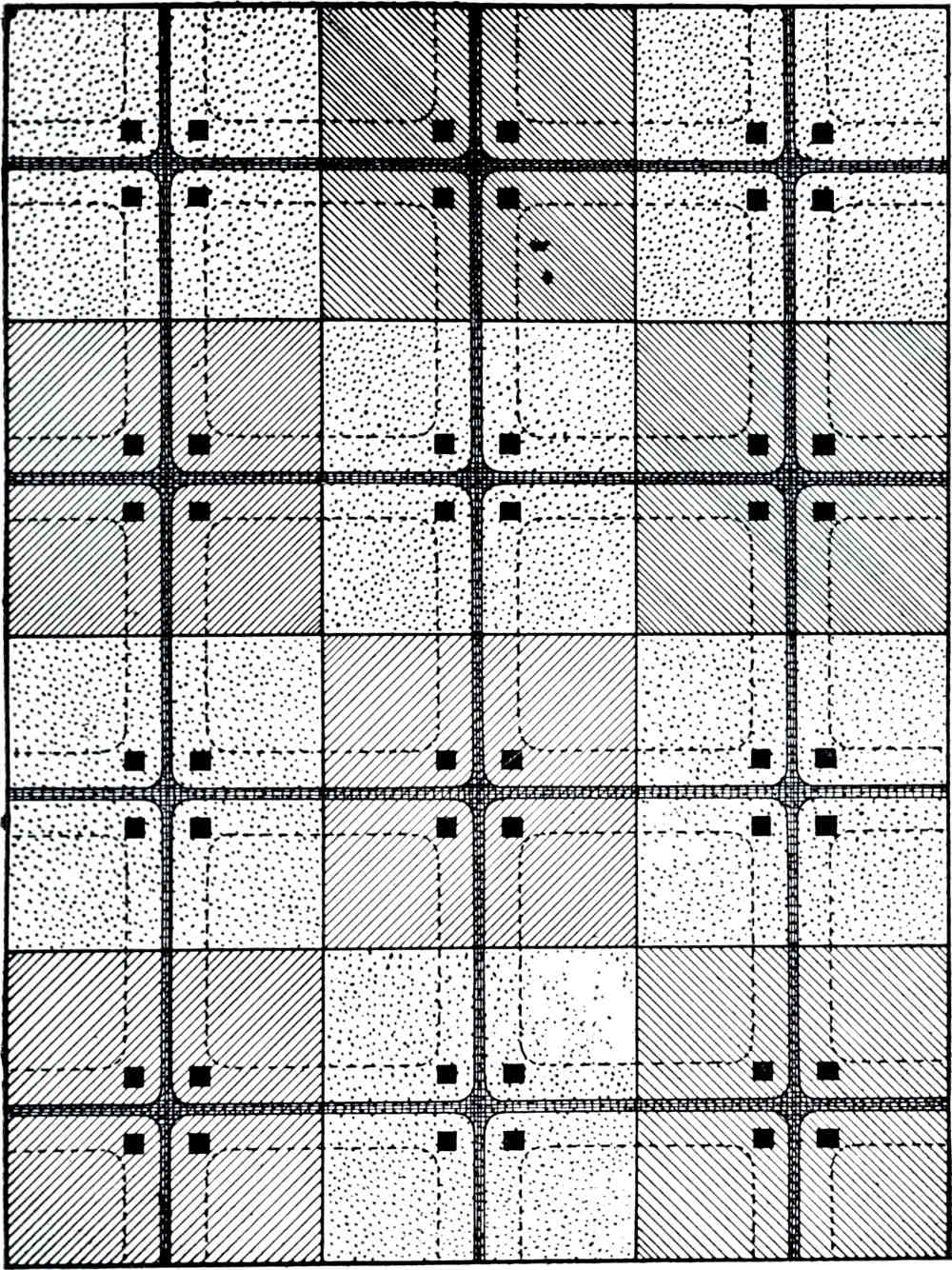
The heavy black lines passing through the center of each Paradise represent firmly-paved highways or boulevards. The four black squares at each boulevard crossing represent the four large buildings of each Modern Paradise.
39