Chapter I · FORETELLING THE FUTURE
Reading edition
IN this unique “Story of the World a Thousand Years Hence,” I shall endeavor to show by simple words and attractive illustrations how our much advanced posterity a thousand years hence will likely think, live, work, play, educate, court, dress, mate, cook, eat, drink, co-operate, raise and train children, build, pave, farm, manufacture, communicate, travel, invent, and do many other things too numerous to mention in a brief forecast of a thousand years.
Foretelling the Future from the experiences of the Past is not such a difficult feat for a competent Sociologist as many seem to think. Prevision, looking into the future, is the only way that we can make use of our education. That is what the Astronomer does when he predicts eclipses; the Electrician when he installs a power station; the Housewife when she kneads her dough; the Author when he writes a book; the Farmer when he plows, sows and reaps his field. They all judge the Future by the experiences of the Past.
10This carefully deduced Forecast is, therefore, not intended as a mere guess or random prophecy, but as cautiously formulated deductions drawn from the known Laws of Progress during the Past, and then extended a thousand years into the Future. Interpreting the Future by the Past is thus merely broad generalization; a question of intelligent Foresight; a problem of knowing Natural Laws and their general operation.
11GEOLOGIC CHART
(Fig. 1)
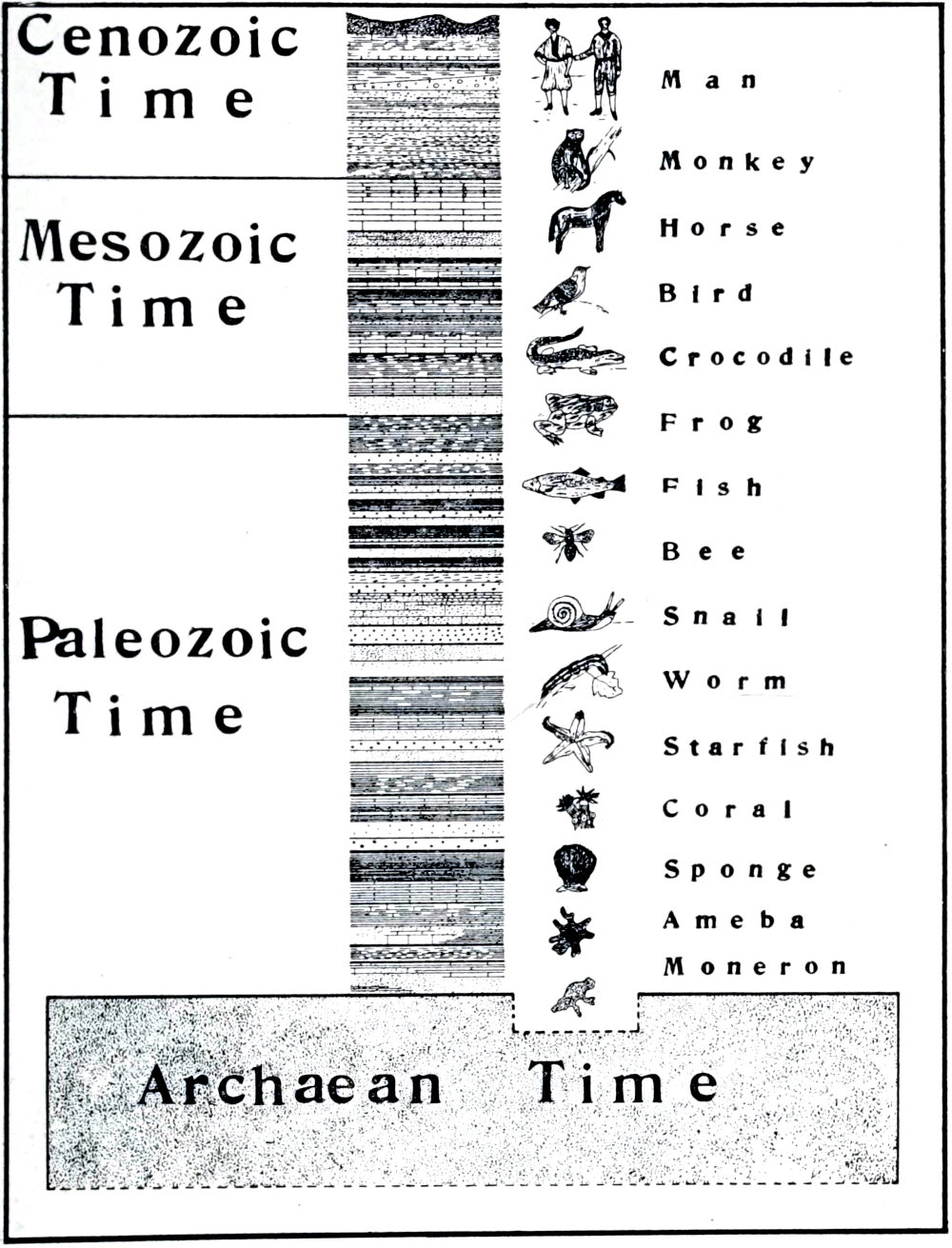
This Chart shows a vertical column of stratified, sedimentary rocks twenty miles thick, with which the earth in an average is covered, and which required some 130,000,000 years in forming.
13