Part 2 — THE PETTY PIRATES.
Reading edition

XV.
THE GENERAL OF THE GALLEYS.
16th, 17th, and 18th Centuries.
The age of the great Corsairs may be said to have ended with the battle of Lepanto, which sounded the knell of the naval supremacy of the Ottomans. It is true that they seemed to have lost little by Don John’s famous victory; their beard was shorn, they admitted, but it soon grew again:—their fleet was speedily repaired, and the Venetians sued for peace. But they had lost something more precious to them than ships or men: their prestige was gone. The powers of Christendom no longer dreaded to meet the invincible Turk, for they had beaten him once, and would beat him again. Rarely after this did an Ottoman fleet sail proudly to work its devastating way along the coasts of Italy. Small raids there might be, but seldom a great adventure such as Barbarossa or Sinān led. Crete might be besieged for years; but the Venetians, pressed by land, nevertheless shattered the Turkish ships off the coast. Damad ’Ali might recover the Morea, and victoriously surround the shores of Greece with his hundred sail; but he would not venture to threaten Venice, to lay siege to Nice, to harry Naples, or attack Malta. The Turks had enough to do to hold their own in the Black Sea against the encroaching forces of Russia.
Deprived of the protection which the prestige of the Turks had afforded, the Barbary Corsairs degenerated into petty pirates. They continued to waylay Christian cargoes, to ravish Christian villages, and carry off multitudes of captives; but their depredations were not on the same grand scale, they robbed by stealth, and never invited a contest with ships of war. If caught, they would fight; but their aim was plunder, and they had no fancy for broken bones gained out of mere ambition of conquest.
Ochiali was the last of the great Corsairs. He it was who, on his return to Constantinople after the fatal October 7, 1571, cheered the Sultan with the promise of revenge, was made Captain-Pasha, and sailed from the Bosphorus the following year with a fleet of two hundred and thirty vessels, just as though Lepanto had never been fought and lost. He sought for the Christian fleets, but could not induce them to offer battle. His operations in 1574 were limited to the recapture of Tunis, which Don John had restored to Spain in 1573. With two hundred and fifty galleys, ten mahons or galleasses, and thirty caramuzels, and supported by the Algerine squadron under Ahmed Pasha, Ochiali laid siege to the Goletta, which had owned a Spanish garrison ever since the conquest by Charles V. in 1535. Cervellon defended the fort till he had but a handful of men, and finally surrendered at discretion. Then Ochiali disappeared from the western seas; he fought for his master in the Euxine during the Persian War, and died in 1580, aged seventy-two, with the reputation of the most powerful admiral that had ever held sway in the Golden Horn.
TUNIS IN 1573. (From a Map in the British Museum.)
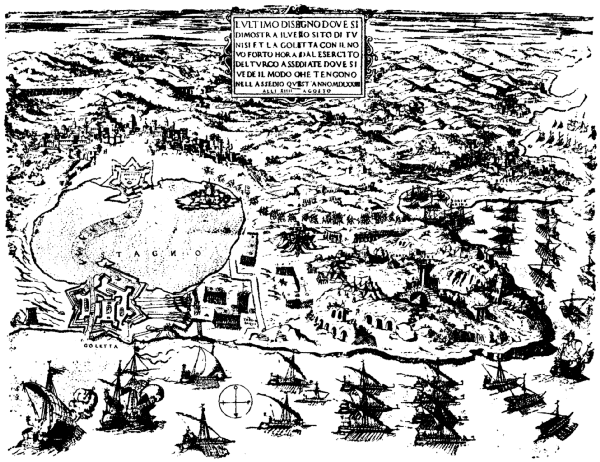
We have not closely followed the succession of the Pashas or Beglerbegs of Algiers, because more important affairs absorbed the whole energies of the Turkish galleys, and the rulers on land had little of consequence to do. Ochiali was the seventeenth pasha of Algiers, but of his predecessors, after the deaths of Urūj and Kheyr-ed-dīn Barbarossa, few attained special eminence. Hasan the son of Barbarossa took part in the siege of Malta, Sālih Reïs conquered Fez and Bujēya; but the rest were chiefly occupied with repressing internal dissensions, fighting with their neighbours, and organizing small piratical expeditions. After Ochiali had been called to Stambol as Captain-Pasha, in 1572, when he had been Pasha of Algiers for four years, nine governors succeeded one another in twenty-four years. At first they were generally renegades: Ramadān the Sardinian (1574-7), Hasan the Venetian (1577-80 and 1582-3), Ja’far the Hungarian (1580-2), and Memi the Albanian (1583-6), followed one another, and (with the exception of the Venetian) proved to be wise, just, and clement rulers. Then the too usual practice was adopted of allotting the province to the highest bidder, and rich but incompetent or rascally Turks bought the reversion of the Pashalik. The reign of the renegades was over; the Turks kept the government in their own hands, and the rôle of the ex-Christian adventurers was confined to the minor but more enterprising duties of a Corsair reïs or the “general of the galleys.” The Pashas, and afterwards the Deys, with occasional exceptions, gave up commanding piratical expeditions, and the interest of the history now turns upon the captains of galleys.
Piracy without and bloodshed and anarchy within form the staple of the records. Tunis, Tripoli, and Algiers showed very similar symptoms. Tripoli was the least powerful, and therefore the least injurious; Algiers dominated the Western Mediterranean and to a considerable extent the Atlantic; Tunis, less venturesome, but still formidable, infested the Eastern Mediterranean, and made the passage of Malta and the Adriatic its special hunting grounds. At Tunis thirty Deys, appointed by the Sublime Porte, succeeded one another from 1590 to 1705—giving each an average reign of less than four years. Most of them were deposed, many murdered, and one is related on credible authority to have been torn to pieces and devoured by the enraged populace. In 1705 the soldiery, following the example of Algiers, elected their own governor, and called him Bey; and the Porte was obliged to acquiesce. Eleven Beys followed one another, up to the French “protectorate.” The external history of these three centuries is made up of lawless piracy and the levying of blackmail from most of the trading powers of Europe, accompanied by acts of insufferable insolence towards the foreign representatives; all of which was accepted submissively by kings and governments, insomuch that William III. treated a flagrant Corsair, ’Ali Reïs, who had become Dey, with the courtesy due to a monarch, and signed himself his “loving friend.” The earliest English treaty with Tunis was dated 1662; many more followed, and all were about equally inefficacious. Civil anarchy, quarrels with France, and wars with Algiers, generally stopped “by order” of the helpless Porte, fill up the details of this uninteresting canvas.
Precisely the same picture is afforded by the modern annals of Algiers. Take the Deys at the beginning of the eighteenth century. Hasan Chāwush was deposed in 1700, and succeeded by the Aga of the Sipāhis, Mustafa, nicknamed Bogotillos or “Whiskerandos,” who, though something of a coward, engaged in two successful campaigns against Tunis and one with Morocco, until he had the misfortune to find the bow-string round his throat in 1706. Uzeyn Khōja followed, and Oran fell during his one year’s reign, after which he was banished to the mountains, and died. Bektāsh Khōja, the next Dey, was murdered on his judgment-seat in the third year of his reign. A fifth Dey, Ibrahīm Deli, or “the Fool,” made himself so hated by his unconscionable licentiousness that he was assassinated, and his mutilated body exposed in the street, within a few months, and ’Ali, who succeeded in 1710, by murdering some three thousand Turks, contrived to reign eight years, and by some mistake died in his bed.
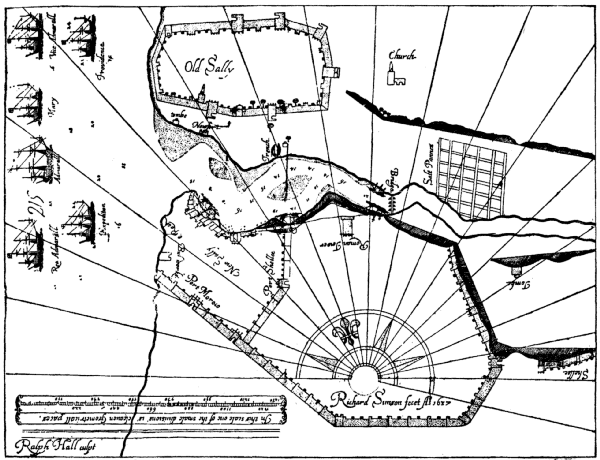
The kingdom of Morocco is not strictly a Barbary state, and its history does not belong to this volume Nevertheless, the operations of the Morocco pirates outside the Straits of Gibraltar so closely resemble those of the Algerine Corsairs within, that a few words about them will not be out of place. At one time Tetwān, within the Straits, in spite of its exposed haven, was a famous place for rovers, but its prosperity was destroyed by Philip II. in 1564. Ceuta was always semi-European, half Genoese, then Portuguese (1415), and finally Spanish (1570 to this day). Tangiers, as the dowry of Charles II.’s Queen, Catherine of Portugal, was for some time English territory. Spanish forts at Peñon de Velez de la Gomera and Alhucemas, and Portuguese garrisons, repressed piracy in their vicinity; and in later times Salē was perhaps the only port in Morocco that sent forth buccaneers. Reefs of rocks and drifts of sand render the west coast unsuitable for anchorage, and the roads are unsafe when the wind is in the south-west. Consequently the piracy of Salē, though notorious and dreaded by merchantmen, was on a small scale; large vessels could not enter the harbour, and two-hundred-ton ships had to be lightened before they could pass the bar. The cruisers of Salē were therefore built very light and small, with which they did not dare to attack considerable and well-armed ships. Indeed, Capt. Delgarno and his twenty-gun frigate so terrified the Salē rovers, that they never ventured forth while he was about, and mothers used to quiet naughty children by saying that Delgarno was coming for them, just as Napoleon and “Malbrouk” were used as bugbears in England and France. There was not a single full-sized galley at Salē in 1634, and accounts a hundred years later agree that the Salē rovers had but insignificant vessels, and very few of them, while their docks were practically disused, in spite of abundance of timber. In the latter part of the eighteenth century there seems to have been an increase in the depredations of the Salē pirates, which probably earned them their exaggerated reputation. At that time they had vessels of thirty and thirty-six guns, but unwieldy and badly built, with which they captured Provençal ships and did considerable mischief, till the Chevalier Acton in 1773, with a single Tuscan frigate, destroyed three out of their five ships. About 1788 the whole Morocco navy consisted of six or eight frigates of two hundred tons, armed with fourteen to eighteen six-pounders, and some galleys. The rovers of Salē formed at one time a sort of republic of pirates, paying the emperor a tithe of prize-money and slaves, in return for non-interference; but gradually the Government absorbed most of the profits, and the trade declined, till the emperors, in return for rich presents, concluded treaties with the chief maritime Powers, and to a large extent suppressed piracy.[51]
SALĒ IN 1637. (From a Map in the British Museum.)
Turning from the monotonous records of internal barbarism, the more adventurous side of Algerine history claims a brief notice. Among the captains who continued to make the name of Corsair terrible to Christian ears, Murād Reïs holds the foremost place; indeed, he belongs to the order of great Corsairs. There were several of the name, and this Murād was distinguished as the Great Murād. He was an Arnaut or Albanian, who was captured by an Algerine pirate at the age of twelve, and early showed a turn for adventure. When his patron was engaged at the siege of Malta in 1565, young Murād gave him the slip, and went on a private cruise of his own, in which he contrived to split his galleot upon a rock. Undeterred by this misadventure, as soon as he got back to Algiers he set out in a brigantine of fifteen banks, and speedily brought back three Spanish prizes and one hundred and forty Christians. He was with Ochiali when that eminent rover seized Saint-Clément’s galleys, and was with difficulty restrained from anticipating his admiral in boarding the St. Ann. He soon gained the reputation of a Corsair of the first water, and “a person, who, for our sins, did more harm to the Christians than any other.” In 1578, while cruising about the Calabrian coast with eight galleots in search of prey, he sighted the Capitana of Sicily and a consort, with the Duke of Tierra Nuova and his retinue on board. After a hot pursuit the consort was caught at sea; the flagship ran on shore; the Duke and all the ship’s company deserted her; and the beautiful vessel was safely brought into Algiers harbour. In 1585 Murād ventured out into the Atlantic out of sight of land, which no Algerine had ever dared to do before, and picking up a reinforcement of small brigantines at Salē, descended at daybreak upon Lanzarote, one of the Canary Islands, sacked the town without opposition, and carried off the governor’s family and three hundred captives. This done, he unblushingly ran up a flag of truce, and permitted the Count and the chief families to come on board and buy back their relations. In 1589, after picking up a stray trader or two, he fell in with La Serena, a galley of Malta, which had a Turkish prize in tow. Far from shirking a conflict with so formidable an antagonist, Murād gave hot pursuit with his single galleot, and coming up with the Serena, boarded and mastered her in half an hour. Then, after stopping to arrest the misdoings of a Majorcan pirate, who was poaching on his own private manor, the Corsair carried his prizes into Algiers, where he was honourably mounted on the Pasha’s own horse and escorted in triumph to the Palace by a guard of Janissaries. In 1594, when he had attained the dignity of “General of the Algerine Galleys,” Murād, with four galleots, encountered two Tuscan galleys off Tripoli; lowering the masts of two of his galleots, so that they should escape observation, he towed them behind the other two, and when the Tuscans had drawn near in full expectation of a couple of prizes, he loosed the vessels astern, and with all four bore down upon the enemy; both galleys were taken, and the Florentine knights and soldiers were chained to the oars in place of the Turks who had lately sat there.[52]
No more typical example of the later sort of pirate can be cited than ’Ali Pichinin, General of the Galleys and galleons of Algiers in the middle of the seventeenth century. This notable slaver, without Barbarossa’s ambition or nobility, possessed much of his daring and seamanship. In 1638, emboldened by the successes of the Sultan Murād IV. against the Persians, ’Ali put to sea, and, picking up some Tunisian galleys at Bizerta, set sail with a squadron of sixteen for the east coast of Italy. He sacked the district of Nicotra in Apulia, carrying off great spoils and many captives, not sparing even nuns; and then scoured the Adriatic, took a ship in sight of Cattaro, and picked up every stray vessel that could be found.
Upon this a strong Venetian squadron, under Marino Capello, sallied forth, and compelled the Corsairs to seek shelter under the guns of the Turkish fortress of Valona in Albania. In spite of the peace then subsisting between Venice and the Porte, Capello attacked, and the fortress naturally defended, the refugees. The Corsairs were obliged to land, and then Capello, carried away by his zeal, and in contravention of his orders, sent in his galleots and, after a sharp struggle, towed away the whole Barbary squadron, leaving ’Ali and his unlucky followers amazed upon the beach. For this bold stroke Capello was severely reprimanded by the Senate, and the Porte was consoled for the breach of treaty by a douceur of five hundred thousand ducats: but meanwhile the better part of the Algerine galley-fleet had ceased to exist, and owners and captains were bankrupt. It was small consolation that in the same summer an expedition to the north, piloted by a renegade from Iceland, brought back eight hundred of his unfortunate countrymen to exchange the cold of their native land for the bagnios of Algiers.
In 1641, however, the Corsairs had recovered from their losses, and ’Ali Pichinin could boast a fleet of at least sixty-five vessels, as we have it on the authority of Emanuel d’Aranda, who was his slave at the time. The wealth and power of the General of the Galleys were then at their zenith. Six hundred slaves were nightly locked up in his prison, which afterwards was known as the Khan of ’Ali Pichinin, and in Morgan’s time was noted for its grape vines, which covered the walls and fringed the windows with the luscious fruit up to the top storey. The son of a renegade himself, he liked not that his followers should turn Turk upon his hands; which “was but picking his pocket of so much money to give a disciple to Mohammed, for whom he was remarked to have no extraordinary veneration. He had actually cudgelled a Frenchmen out of the name of Mustafa (which he had assumed with a Turkish dress) into that of John, which he would fain have renounced. His farms and garden-houses were also under the directions of his own Christians. I have heard much discourse of an entertainment he once made, at his garden, for all the chief Armadores and Corsairs, at which the Pasha was also a guest, but found his own victuals, as fearing some foul play; nothing of which is ill taken among the Turks. All was dressed at town in the general’s own kitchen, and passed along from hand to hand by his slaves up to the garden-house, above two miles’ distant, where as much of the victuals as got safe thither arrived smoking hot, as they tell the story.”[53] A good part, however, disappeared on the road, since, in Corsair’s phrase, “the Christian slaves wore hooks on their fingers,” and the guests went nigh to be starved. ’Ali’s plan for feeding his slaves was characteristic. He gave them no loaves as others did, but told them they were indeed a sorry set of scoundrels, unworthy of the name of slaves, if, during the two or three hours of liberty they enjoyed before sunset, they could not find enough to keep them for a day. His bagnios used to be regular auction-rooms for stolen goods, and were besieged by indignant victims, who were reproached for their carelessness, and made to re-purchase their own valuables: in fine, ’Ali Pichinin “has the honour of having trained up the cleanest set of thieves that were anywhere to be met with.” Once a slave found a costly ring of the general’s, and restored to him without price: for which “unseasonable piece of honesty” ’Ali gave him half a ducat, and called him a fool for his pains; the ring was worth his ransom. Another time, a slave bargained to sell to an ironmaster the general’s anchor from out of his own galley: when discovered, he was commended for his enterprising spirit, and told he was fit to be a slave, since he knew how to gain his living. This slave-dealer had a genius for wheedling the truth out of captives; he was so civil and sympathizing when a new prize was caught, so ready with his “Count” and “my lord” to plain gentlemen, and his “your Eminence” to simple clergymen, that they soon confided in him, revealed their rank, and had their ransom fixed: but, to do him justice, he kept his word, and once promised the release was certain: “My word is my word,” he would say.
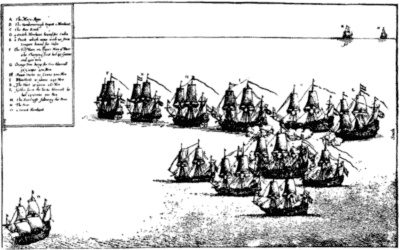
FIGHT OF THE “MARY ROSE” WITH ALGERINE PIRATES, 1669. (Ogilby’s Africa, 1670.)
He was a man of very free views in religion. Once he asked a Genoese priest to tell him candidly what would become of him; “frankly,” said Father Angelo, “I am persuaded that the devil will have you;” and the response was cheerfully accepted. Another time it was a devout Moslem sheykh who begged ’Ali to give him a Christian slave to kill, as he did not feel that he had offered any sufficiently pleasing sacrifice to the prophet Mohammed. ’Ali unchained the stroke-oar of his galley, a muscular Spaniard, and armed him at all points, and sent him to be killed by the holy man. “This Christian,” shrieked the good sheykh, running as hard as he could, “looks as if he rather wanted to kill me than to be killed himself.” “So is it,” said ’Ali, “that you are to merit the prophet’s favour. Thus it is that Christians are to be sacrificed. Mohammed was a brave, generous man, and never thought it any service done him to slaughter those who were not able to defend themselves. Go; get yourself better instructed in the meaning of the Koran.” He was a thorough Corsair, with the rough code of honour, as well as the unprincipled rascality of the sea-rover.
FOOTNOTES:

XVI.
GALLEYS AND GALLEY SLAVES.
16th Century.
“The Corsairs,” says Haedo, “are those who support themselves by continual sea-robberies; and, admitting that among their numbers some of them are natural Turks, Moors, &c., yet the main body of them are renegadoes from every part of Christendom; all who are extremely well acquainted with the Christian coasts.” It is a singular fact that the majority of these plunderers of Christians were themselves born in the Faith. In the long list of Algerine viceroys, we meet with many a European. Barbarossa himself was born in Lesbos, probably of a Greek mother. His successor was a Sardinian; soon afterwards a Corsican became pasha of Algiers, then another Sardinian; Ochiali was a Calabrian; Ramadān came from Sardinia, and was succeeded by a Venetian, who in turn gave place to a Hungarian, who made room for an Albanian. In 1588 the thirty-five galleys or galleots of Algiers were commanded by eleven Turks and twenty-four renegades, including nations of France, Venice, Genoa, Sicily, Naples, Spain, Greece, Calabria, Corsica, Albania, and Hungary, and a Jew. In short, up to nearly the close of the sixteenth century (but much more rarely afterwards) the chiefs of the Corsairs and the governors were commonly drawn from Christian lands. Some of them volunteered—and to the outlaws of Europe the command of a Barbary galley was perhaps the only congenial resort;—but most of them were captives seized as children, and torn from their homes in some of the Corsairs’ annual raids upon Corsica and Sardinia and the Italian or Dalmatian coasts. Most of such prisoners were condemned to menial and other labour, unless ransomed; but the bolder and handsomer boys were often picked out by the penetrating eye of the reïs, and once chosen the young captive’s career was established.
“While the Christians with their galleys are at repose, sounding their trumpets in the harbours, and very much at their ease regaling themselves, passing the day and night in banqueting, cards, and dice, the Corsairs at pleasure are traversing the east and west seas, without the least fear or apprehension, as free and absolute sovereigns thereof. Nay, they roam them up and down no otherwise than do such as go in chase of hares for their diversion. They here snap up a ship laden with gold and silver from India, and there another richly fraught from Flanders; now they make prize of a vessel from England, then of another from Portugal. Here they board and lead away one from Venice, then one from Sicily, and a little further on they swoop down upon others from Naples, Livorno, or Genoa, all of them abundantly crammed with great and wonderful riches. And at other times carrying with them as guides renegadoes (of which there are in Algiers vast numbers of all Christian nations, nay, the generality of the Corsairs are no other than renegadoes, and all of them exceedingly well acquainted with the coasts of Christendom, and even within the land), they very deliberately, even at noon-day, or indeed just when they please, leap ashore, and walk on without the least dread, and advance into the country, ten, twelve, or fifteen leagues or more; and the poor Christians, thinking themselves secure, are surprised unawares; many towns, villages, and farms sacked; and infinite numbers of souls, men, women, children, and infants at the breast, dragged away into a wretched captivity. With these miserable ruined people, loaded with their own valuable substance, they retreat leisurely, with eyes full of laughter and content, to their vessels. In this manner, as is too well known, they have utterly ruined and destroyed Sardinia, Corsica, Sicily, Calabria, the neighbourhoods of Naples, Rome, and Genoa, all the Balearic islands, and the whole coast of Spain: in which last more particularly they feast it as they think fit, on account of the Moriscos who inhabit there; who being all more zealous Mohammedans than are the very Moors born in Barbary, they receive and caress the Corsairs, and give them notice of whatever they desire to be informed of. Insomuch that before these Corsairs have been absent from their abodes much longer than perhaps twenty or thirty days, they return home rich, with their vessels crowded with captives, and ready to sink with wealth; in one instant, and with scarce any trouble, reaping the fruits of all that the avaricious Mexican and greedy Peruvian have been digging from the bowels of the earth with such toil and sweat, and the thirsty merchant with such manifest perils has for so long been scraping together, and has been so many thousand leagues to fetch away, either from the east or west, with inexpressible danger and fatigue. Thus they have crammed most of the houses, the magazines, and all the shops of this Den of Thieves with gold, silver, pearls, amber, spices, drugs, silks, cloths, velvets, &c., whereby they have rendered this city the most opulent in the world: insomuch that the Turks call it, not without reason, their India, their Mexico, their Peru.”[54]
GALLEY RUNNING BEFORE THE WIND. (Jurien de la Gravière.)
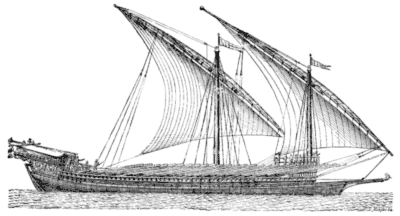
One has some trouble in realizing the sort of navigation employed by Corsairs. We must disabuse our minds of all ideas of tall masts straining under a weight of canvas, sail above sail. The Corsairs’ vessels were long narrow row-boats, carrying indeed a sail or two, but depending for safety and movement mainly upon the oars. The boats were called galleys, galleots, brigantines (“galeotas ligeras o vergãtines,” or frigatas), &c., according to their size: a galleot is a small galley, while a brigantine may be called a quarter galley. The number of men to each oar varies, too, according to the vessel’s size: a galley may have as many as four to six men working side by side to each oar, a galleot but two or three, and a brigantine one; but in so small a craft as the last each man must be a fighter as well as an oarsmen, whereas the larger vessels of the Corsairs were rowed entirely by Christian slaves.
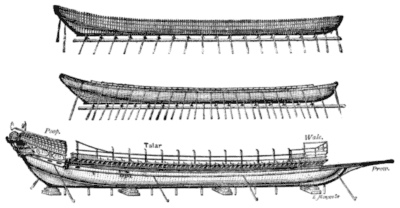
STAGES IN BUILDING A GALLEY. (Jurien de la Gravière.)
PLAN AND SECTIONS OF A GALLEY. (Jurien de la Gravière.)
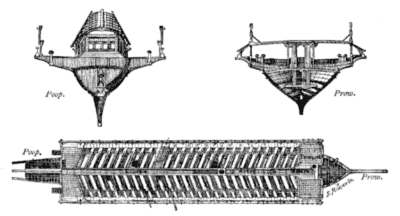
HOLD OF A GALLEY. (Jurien de la Gravière.)
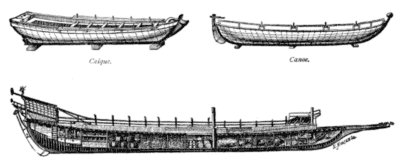
The galley is the type of all these vessels, and those who are curious about the minutest details of building and equipping galleys need only consult Master Joseph Furttenbach’s Architectura Navalis: Das ist, Von dem Schiff-Gebaw, auf dem Meer und Seekusten zu gebrauchen, printed in the town of Ulm, in the Holy Roman Empire, by Jonam Saurn, in 1629. Any one could construct a galley from the numerous plans and elevations and sections and finished views (some of which are here reproduced) in this interesting and precise work.[55] Furttenbach is an enthusiastic admirer of a ship’s beauties, and he had seen all varieties; for his trade took him to Venice, where he had a galleasse,[56] and he had doubtless viewed many a Corsair fleet, since he could remember the battle of Lepanto and the death of Ochiali. His zeal runs clean away with him when he describes a stolo, or great flagship (capitanea galea) of Malta in her pomp and dignity and lordliness, as she rides the seas to the rhythmical beat of her many oars, or “easies” with every blade suspended motionless above the waves like the wings of a poised falcon. A galley such as this is “a princely, nay, a royal and imperial vassello di remo,” and much the most suitable, he adds, for the uses of peace and of war in the Mediterranean Sea. A galley may be 180 or 190 spans long—Furttenbach measures a ship by palmi, which varied from nine to ten inches in different places in Italy,—say 150 feet, the length of an old seventy-four frigate, but with hardly a fifth of its cubit contents—and its greatest beam is 25 spans broad. The one engraved on p. 37 is evidently an admiral’s galley of the Knights of Malta. She carries two masts—the albero maestro or mainmast, and the trinchetto, or foremast, each with a great lateen sail. The Genoese and Venetians set the models of these vessels, and the Italian terms were generally used in all European navigation till the northern nations took the lead in sailing ships. These sails are often clewed up, however, for the mariner of the sixteenth century was ill-practised in the art of tacking, and very fearful of losing sight of land for long, so that unless he had a wind fair astern he preferred to trust to his oars. A short deck at the prow and poop serve, the one to carry the fighting-men and trumpeters and yardsmen, and to provide cover for the four guns, the other to accommodate the knights and gentlemen, and especially the admiral or captain, who sits at the stern under a red damask canopy embroidered with gold, surveying the crew, surrounded by the chivalry of “the Religion,” whose white cross waves on the taffety standard over their head, and shines upon various pennants and burgees aloft. Behind, overlooking the roof of the poop, stands the pilot who steers the ship by the tiller in his hand.
Between the two decks, in the ship’s waist, is the propelling power: fifty-four benches or banks, twenty-seven a side, support each four or five slaves, whose whole business in life is to tug at the fifty-four oars. This flagship is a Christian vessel, so the rowers are either Turkish and Moorish captives, or Christian convicts. If it were a Corsair, the rowers would all be Christian prisoners. In earlier days the galleys were rowed by freemen, and so late as 1500 the Moors of Algiers pulled their own brigantines to the attack of Spanish villages, but their boats were light, and a single man could pull the oar. Two or three were needed for a galleot, and as many sometimes as six for each oar of a large galley. It was impossible to induce freemen to toil at the oar, sweating close together, for hour after hour—not sitting, but leaping on the bench, in order to throw their whole weight on the oar. “Think of six men chained to a bench, naked as when they were born, one foot on the stretcher, the other on the bench in front, holding an immensely heavy oar [fifteen feet long], bending forwards to the stern with arms at full reach to clear the backs of the rowers in front, who bend likewise; and then having got forward, shoving up the oar’s end to let the blade catch the water, then throwing their bodies back on to the groaning bench. A galley oar sometimes pulls thus for ten, twelve, or even twenty hours without a moment’s rest. The boatswain, or other sailor, in such a stress, puts a piece of bread steeped in wine in the wretched rower’s mouth to stop fainting, and then the captain shouts the order to redouble the lash. If a slave falls exhausted upon his oar (which often chances) he is flogged till he is taken for dead, and then pitched unceremoniously into the sea.”[57]
“Those who have not seen a galley at sea, especially in chasing or being chased, cannot well conceive the shock such a spectacle must give to a heart capable of the least tincture of commiseration. To behold ranks and files of half-naked, half-starved, half-tanned meagre wretches, chained to a plank, from whence they remove not for months together (commonly half a year), urged on, even beyond human strength, with cruel and repeated blows on their bare flesh, to an incessant continuation of the most violent of all exercises; and this for whole days and nights successively, which often happens in a furious chase, when one party, like vultures, is hurried on almost as eagerly after their prey, as is the weaker party hurried away in hopes of preserving life and liberty.”[58]
Sometimes a galley-slave worked as long as twenty years, sometimes for all his miserable life, at this fearful calling. The poor creatures were chained so close together in their narrow bench—a sharp cut was the characteristic of the galley—that they could not sleep at full length. Sometimes seven men (on French galleys, too, in the last century), had to live and sleep in a space ten feet by four. The whole ship was a sea of hopeless faces. And between the two lines of rowers ran the bridge, and on it stood two boatswains (comiti) armed with long whips, which they laid on to the bare backs of the rowers with merciless severity. Furttenbach gives a picture of the two boatswains in grimly humorous verse: how they stand,
Beclad, belaced, betrimmed, with many knots bespick; Embroidered, padded, tied; all feathers and all flap; Curly and queued, equipped, curious of hood and cap:
and how they “ever stolidly smite” the crew with the bastinado,
Or give them a backward prod in the naked flesh as they ply, With the point that pricks like a goad, when “powder and shot” is the cry;
in order to send the Turks to Davy’s wet locker:—
As John of Austria nipped them and riddled them with ball, As soon as his eyes fell on them, and ducked or slaughtered them all;
and how the boatswain’s dreaded whistle shrieked through the ship:—
For they hearken to such a blast through all the swish and sweat, Through rattle and rumpus and raps, and the kicks and cuffs that they get, Through the chatter and tread, and the rudder’s wash, and the dismal clank Of the shameful chain which forever binds the slave to the bank.
To this may be added Captain Pantero Pantera’s description of the boatswain’s demeanour: “He should appear kindly towards the crew: assist it, pet it, but without undue familiarity; be, in short, its guardian and in some sort its father, remembering that, when all’s said, ’tis human flesh, and human flesh in direst misery.”
This terrible living grave of a galley, let us remember, is depicted from Christian models. A hundred and fifty years ago such scenes might be witnessed on many a European vessel. The Corsairs of Algiers only served their enemies as they served them: their galley slaves were no worse treated, to say the least, than were Doria’s or the King of France’s own. Rank and delicate nurture were respected on neither side: a gallant Corsair like Dragut had to drag his chain and pull his insatiable oar like any convict at the treadmill, and a future grand master of Malta might chance to take his seat on the rowing bench beside commonest scoundrel of Naples. No one seemed to observe the horrible brutality of the service, where each man, let him be never so refined, was compelled to endure the filth and vermin of his neighbour who might be half a savage and was bound to become wholly one; and when Madame de Grignan wrote an account of a visit to a galley, her friend Madame de Sévigné replied that she would “much like to see this sort of Hell,” and the men “groaning day and night under the weight of their chains.” Autres temps, autres moeurs!
Furttenbach tells us much more about the galley; and how it was rigged out with brilliant cloths on the bulwarks on fête-days; how the biscuit was made to last six or eight months, each slave getting twenty-eight ounces thrice a week, and a spoonful of some mess of rice or bones or green stuff; of the trouble of keeping the water-cans under the benches full and fairly fresh. The full complement of a large galley included, he says, besides about 270 rowers, and the captain, chaplain, doctor, scrivener, boatswains, and master, or pilot, ten or fifteen gentleman adventurers, friends of the captain, sharing his mess, and berthed in the poop; twelve helmsmen (timonieri), six foretop A.B’s., ten warders for the captives, twelve ordinary seamen, four gunners, a carpenter, smith, cooper, and a couple of cooks, together with fifty or sixty soldiers; so that the whole equipage of a fighting-galley must have reached a total of about four hundred men.[59]
What is true of a European galley is also generally applicable to a Barbary galleot, except that the latter was generally smaller and lighter, and had commonly but one mast, and no castle on the prow.[60] The Algerines preferred fighting on galleots of eighteen to twenty-four banks of oars, as more manageable than larger ships. The crew of about two hundred men was very densely packed, and about one hundred soldiers armed with muskets, bows, and scimitars occupied the poop. Haedo has described the general system of the Corsairs as he knew it at the close of the sixteenth century, and his account, here summarized, holds good for earlier and somewhat later periods:—
These vessels are perpetually building or repairing at Algiers; the builders are all Christians, who have a monthly pay from the Treasury of six, eight, or ten quarter-dollars, with a daily allowance of three loaves of the same bread with the Turkish soldiery, who have four. Some of the upper rank of these masters have six and even eight of these loaves; nor has any of their workmen, as carpenters, caulkers, coopers, oar-makers, smiths, &c., fewer than three. The Beylik, or common magazine, never wants slaves of all useful callings, “nor is it probable that they should ever have a scarcity of such while they are continually bringing in incredible numbers of Christians of all nations.” The captains, too, have their private artificer slaves, whom they buy for high prices and take with them on the cruise, and hire them out to help the Beylik workmen when ashore.
The number of vessels possessed at any one time by the Algerines appears to have never been large. Barbarossa and Dragut were content with small squadrons. Ochiali had but fifteen Algerine galleys at Lepanto. Haedo says that at the close of the sixteenth century (1581) the Algerines possessed 36 galleots or galleys, made up of 3 of 24 banks, 1 of 23, 11 of 22, 8 of 20, 1 of 19, 10 of 18, and 2 of 15, and these were, all but 14, commanded by renegades. They had besides a certain number of brigantines of 14 banks, chiefly belonging to Moors at Shershēl. This agrees substantially with Father Dan’s account (1634), who says that there were in 1588 thirty-five galleys or brigantines (he means galleots) of which all but eleven were commanded by renegades. Haedo gives the list[61] of the 35 captains, from which the following names are selected: Ja’far the Pasha (Hungarian), Memi (Albanian), Murād (French), Deli Memi (Greek), Murād Reïs (Albanian), Feru Reïs (Genoese), Murād Maltrapillo and Yūsuf (Spaniards), Memi Reïs and Memi Gancho (Venetians), Murād the Less (Greek), Memi the Corsican, Memi the Calabrian, Montez the Sicilian, and so forth, most of whom commanded galleys of 22 to 24 banks.[62]
It was a pretty sight to see the launching of a galley. After the long months of labour, after felling the oak and pine in the forests of Shershēl, and carrying the fashioned planks on camels, mules, or their own shoulders, some thirty miles to the seashore; or perhaps breaking up some unwieldy prize vessel taken from the Spaniards or Venetians; after all the sawing and fitting and caulking and painting; then at last comes the day of rejoicing for the Christian slaves who alone have done the work: for no Mussulman would offer to put a finger to the building of a vessel, saving a few Morisco oar-makers and caulkers. Then the armadores, or owners of the new galleot, as soon as it is finished, come down with presents of money and clothes, and hang them upon the mast and rigging, to the value of two hundred or three hundred ducats, to be divided among their slaves, whose only pay till that day has been the daily loaves. Then again on the day of launching, after the vessel has been keeled over, and the bottom carefully greased from stem to stern, more presents from owners and captains to the workmen, to say nothing of a hearty dinner; and a great straining and shoving of brawny arms and bare backs, a shout of Allahu Akbar, “God is Most Great,” as the sheep is slaughtered over the vessel’s prow—a symbol, they said, of the Christian blood to be shed—and the galleot glides into the water prepared for her career of devastation: built by Christians and manned by Christians, commanded probably by a quondam Christian, she sallies forth to prey upon Christendom.
The rowers, if possible, were all Christian slaves, belonging to the owners, but when these were not numerous enough, other slaves, or Arabs and Moors, were hired at ten ducats the trip, prize or no prize. If he was able, the captain (Reïs) would build and furnish out his own vessel, entirely at his own cost, in hope of greater profit; but often he had not the means, and then he would call in the aid of one or more armadores. These were often speculative shopkeepers, who invested in a part share of a galleot on the chance of a prize, and who often discovered that ruin lay in so hazardous a lottery. The complement of soldiers, whether volunteers (levents), consisting of Turks, renegades, or Kuroghler (Kuloghler)—i.e., creoles, natives, Turks born on the soil—or if these cannot be had, ordinary Moors, or Ottoman janissaries, varied with the vessel’s size, but generally was calculated at two to each oar, because there was just room for two men to sit beside each bank of rowers: they were not paid unless they took a prize, nor were they supplied with anything more than biscuit, vinegar, and oil—everything else, even their blankets, they found themselves. The soldiers were under the command of their own Aga, who was entirely independent of the Reïs and formed an efficient check upon that officer’s conduct. Vinegar and water, with a few drops of oil on the surface, formed the chief drink of the galley slaves, and their food was moistened biscuit or rusk, and an occasional mess of gruel (burgol): nor was this given out when hard rowing was needed, for oars move slackly on a full stomach.
It was usual to consult an auguration book and a marabut, or saint, before deciding on a fortunate day for putting to sea, and these saints expected a share of the prize money. Fridays and Sundays were the favourite days for sailing; a gun is fired in honour of their tutelary patron; “God speed us!” shout the crew; “God send you a prize!” reply the crowd on the shore, and the galleot swiftly glides away on its destructive path. “The Algerines,” says Haedo, “generally speaking, are out upon the cruise winter and summer, the whole year round; and so devoid of dread they roam these eastern and western seas, laughing all the while at the Christian galleys (which lie trumpetting, gaming, and banqueting in the ports of Christendom), neither more nor less than if they went a hunting hares and rabbits, killing here one and there another. Nay, far from being under apprehension, they are certain of their game; since their galleots are so extremely light and nimble, and in such excellent order, as they always are[63]; whereas, on the contrary, the Christian galleys are so heavy, so embarrassed, and in such bad order and confusion, that it is utterly in vain to think of giving them chase, or of preventing them from going and coming, and doing just as they their selves please. This is the occasion that, when at any time the Christian galleys chase them, their custom is, by way of game and sneer, to point to their fresh-tallowed poops, as they glide along like fishes before them, all one as if they showed them their backs to salute: and as in the cruising art, by continual practise, they are so very expert, and withal (for our sins) so daring, presumptuous, and fortunate, in a few days from their leaving Algiers they return laden with infinite wealth and captives; and are able to make three or four voyages in a year, and even more if they are inclined to exert themselves. Those who have been cruising westward, when they have taken a prize, conduct it to sell at Tetwān, El-Araish, &c., in the kingdom of Fez; as do those who have been eastward, in the states of Tunis and Tripoli: where, refurnishing themselves with provisions, &c., they instantly set out again, and again return with cargoes of Christians and their effects. If it sometimes happens more particularly in winter, that they have roamed about for any considerable time without lighting on any booty, they retire to some one of these seven places, viz:—If they had been in the west their retreats were Tetwān, Al-Araish, or Yusale; those who came from the Spanish coasts went to the island Formentara; and such as had been eastward retired to the island S. Pedro, near Sardinia, the mouths of Bonifacio in Corsica, or the islands Lipari and Strombolo, near Sicily and Calabria; and there, what with the conveniency of those commodious ports and harbours, and the fine springs and fountains of water, with the plenty of wood for fuel they meet with, added to the careless negligence of the Christian galleys, who scarce think it their business to seek for them—they there, very much at their ease, regale themselves, with stretched-out legs, waiting to intercept the paces of Christian ships, which come there and deliver themselves into their clutches.”[64]
Father Dan describes their mode of attack as perfectly ferocious. Flying a foreign flag, they lure the unsuspecting victim within striking distance, and then the gunners (generally renegades) ply the shot with unabated rapidity, while the sailors and boatswains chain the slaves that they may not take part in the struggle. The fighting men stand ready, their arms bared, muskets primed, and scimitars flashing, waiting for the order to board. Their war-cry was appalling; and the fury of the onslaught was such as to strike panic into the stoutest heart.
When a prize was taken the booty was divided with scrupulous honesty between the owners and the captors, with a certain proportion (varying from a fifth to an eighth) reserved for the Beylik, or government, who also claimed the hulks. Of the remainder, half went to the owners and reïs, the other half to the crew and soldiers. The principal officers took each three shares, the gunners and helmsmen two, and the soldiers and swabbers one; the Christian slaves received from 1-1/2 to three shares apiece. A scrivener saw to the accuracy of the division. If the prize was a very large one, the captors usually towed it into Algiers at once, but small vessels were generally sent home under a lieutenant and a jury-crew of Moors.
There is no mistaking the aspect of a Corsair who has secured a prize: for he fires gun after gun as he draws near the port, utterly regardless of powder. The moment he is in the roads, the Liman Reïs, or Port Admiral, goes on board, and takes his report to the Pasha; then the galleot enters the port, and all the oars are dropped into the water and towed ashore, so that no Christian captives may make off with the ship in the absence of the captain and troops. Ashore all is bustle and delighted confusion; the dulness of trade, which is the normal condition of Algiers between the arrivals of prizes, is forgotten in the joy of renewed wealth; the erstwhile shabby now go strutting about, pranked out in gay raiment, the commerce of the bar-rooms is brisk, and every one thinks only of enjoying himself. Algiers is en fête.
FOOTNOTES:

XVII.
THE TRIUMPH OF SAILS.
17th Century.
GALLEASSE OF THE SEVENTEENTH CENTURY. (Jurien de la Gravière.)
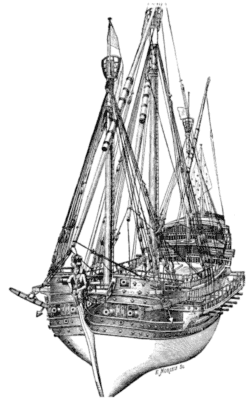
At the beginning of the seventeenth century a notable change came over the tactics of the Corsairs: they built fewer galleys, and began to construct square-sailed ships. In Algiers, Tunis, and Tripoli the dockyards teemed with workmen busily engaged in learning the new build; and the honour, if such it be, of having taught them rests apparently between England and Flanders. Simon Danser, the Flemish rover, taught the Algerines the fashion of “round ships,” in 1606, and an Englishman seems to have rendered the same kind office to the people of Tunis, aided by a Greek renegade, Memi Reïs; where, moreover, another English pirate, “Captain Wer,” was found in congenial company at the Goletta by Monsieur de Brèves, the French ambassador.[65] The causes of the change were twofold: first, Christian slaves were not always to be caught, and to hire rowers for the galleys was a ruinous expense; and secondly, the special service for which the smaller galleots and brigantines were particularly destined, the descents upon the Spanish coasts was to some degree obstructed by the final expulsion of the last of the Moors from Andalusia in 1610.[66] That stroke deprived the Corsairs of the ready guides and sympathisers who had so often helped them to successful raids, and larger vessels and more fighting men were needed if such descents were to be continued. Moreover, the Barbary rovers were ambitious to contend with their old enemies for golden treasure on the Spanish main itself; the science of navigation was fast developing; and they felt themselves as equal to venturing upon long cruises as any European nation. Now a long cruise is impossible in a galley, where you have some hundreds of rowers to feed, and where each pound of biscuit adds to the labour of motion; but sails have no mouths, and can carry along a great weight of provisions without getting tired, like human arms. So sails triumphed over oars. The day of the galley was practically over, and the epoch of the ship had dawned. As early as 1616 Sir Francis Cottington reported to the Duke of Buckingham that the sailing force of Algiers was exciting general alarm in Spain: “The strength and boldness of the Barbary pirates is now grown to that height, both in the ocean and the Mediterranean seas, as I have never known anything to have wrought a greater sadness and distraction in this Court than the daily advice thereof. Their whole fleet consists of forty sail of tall ships, of between two and four hundred tons a piece; their admiral [flagship] of five hundred. They are divided into two squadrons; the one of eighteen sail remaining before Malaga, in sight of the city; the other about the Cape of S. Maria, which is between Lisbon and Seville. That squadron within the straits entered the road of Mostil, a town by Malaga, where with their ordnance they beat down part of the castle, and had doubtless taken the town, but that from Granada there came soldiers to succour it; yet they took there divers ships, and among them three or four from the west part of England. Two big English ships they drove ashore, not past four leagues from Malaga; and after they got on shore also, and burnt them, and to this day they remain before Malaga, intercepting all ships that pass that way, and absolutely prohibiting all trade into those parts of Spain.” The other squadron was doing the same thing outside the straits, and the Spanish fleet was both too small in number and too cumbrous in build to attack them successfully. Yet “if this year they safely return to Algiers, especially if they should take any of the fleet, it is much to be feared that the King of Spain’s forces by sea will not be sufficient to restrain them hereafter, so much sweetness they find by making prize of all Christians whatsoever.”
This dispatch shows that the Corsairs had speedily mastered the new manner of navigation, as might have been expected of a nation of sailors. They had long been acquainted with the great galleasse of Spain and Venice, a sort of compromise between the rowed galley and the sailing galleon; for it was too heavy to depend wholly on its oars (which by way of distinction were rowed under cover), and its great lateen sails were generally its motive power. The galleys themselves, moreover, had sails, though not square sails; and the seaman who can sail a ship on lateen sails soon learns the management of the square rig. The engravings on pp. 5, 11, 165, 197, and 227 sufficiently show the type of vessel that now again came into vogue, and which was known as a galleon, nave, polacca, tartana, barcone, caravel, caramuzel, &c., according to its size and country. The Turkish caramuzel or tartan, says Furttenbach, stands high out of the water, is strong and swift, and mounts eighteen or twenty guns and as many as sixty well-armed pirates. It is a dangerous vessel to attack. From its commanding height its guns can pour down so furious a fire upon a Christian craft that the only alternative to surrender is positive extirpation. If the enemy tries to sneak out of range below the level of fire, the Turks drop grenades from the upper decks and set the ship on fire, and even if the Christians succeeded in boarding, they find themselves in a trap: for though the ship’s waist is indeed cleared of the enemy, the hurricane decks at poop and prow command the boarding party, and through loopholes in the bulwarks—as good a cover as a trench—a hail of grape pours from the guns, and seizing their opportunity the Turks rush furiously through the doors and take their opponents simultaneously in face and rear; and then comes a busy time for scimitar and pike. Or, when you are alongside, if you see the caramuzel’s mainsail being furled, and something moving in the iron cage on the gabia or maintop, know that a petard will soon be dropped in your midst from the main peak, and probably a heavy stone or bomb from the opposite end of the long lateen yard, where it serves the double purpose of missile and counterpoise. Now is the time to keep your distance, unless you would have a hole in your ship’s bottom. The Corsairs, indeed, are very wily in attack and defence, acquainted with many sorts of projectiles,—even submarine torpedoes, which a diver will attach to the enemy’s keel,—and they know how to serve their stern chasers with amazing accuracy and rapidity.[67]
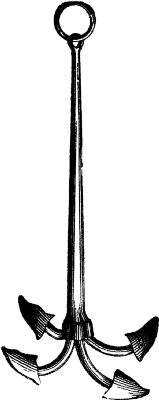
ANCHOR.
With their newly-built galleons, the raids of the Corsairs became more extensive: they were no longer bounded by the Straits of Gibraltar, or a little outside; they pushed their successes north and south. In 1617 they passed the Straits with eight well-armed vessels and bore down upon Madeira, where they landed eight hundred Turks. The scenes that followed were of the usual character; the whole island was laid waste, the churches pillaged, the people abused and enslaved. Twelve hundred men, women, and children were brought back to Algiers, with much firing of guns, and other signals of joy, in which the whole city joined.
In 1627 Murād—a German renegade—took three Algerine ships as far north as Denmark and Iceland, whence he carried off four hundred, some say eight hundred, captives; and, not to be outdone, his namesake Murād Reïs, a Fleming, in 1631, ravaged the English coasts, and passing over to Ireland, descended upon Baltimore, sacked the town, and bore away two hundred and thirty-seven prisoners, men, women, and children, even from the cradle. “It was a piteous sight to see them exposed for sale at Algiers,” cries good Father Dan; “for then they parted the wife from the husband, and the father from the child; then, say I, they sell the husband here, and the wife there, tearing from her arms the daughter whom she cannot hope to see ever again.”[68] Many bystanders burst into tears as they saw the grief and despair of these poor Irish.
As before, but with better confidence, they pursue their favourite course in the Levant, and cruise across the Egyptian trade route, where are to be caught ships laden with the products of Cairo and San’a and Bombay; and lay-to at the back of Cyprus to snare the Syrian and Persian goods that sail from Scanderūn; and so home, with a pleasant raid along the Italian coasts, touching perhaps at an island or two to pick up slaves and booty, and thus to the mole of Algiers and the welcome of their mates; and this in spite of all the big ships of Christendom, “qu’ils ne cessent de troubler, sans que tant de puissantes galeres et tant de bons navires que plusieurs Princes Chrestiens tiennent dans leur havres leur donnent la chasse, si ce ne sont les vaisseaux de Malte ou de Ligorne.”[69] And since 1618, when the Janissaries first elected their own Pasha, and practically ignored the authority of the Porte, the traditional fellowship with France, the Sultan’s ally, had fallen through, and French vessels now formed part of the Corsairs’ quarry. Between 1628 and 1634, eighty French ships were captured, worth, according to the reïses’ valuation, 4,752,000 livres, together with 1,331 slaves. The King of France must have regretted even the days when Barbarossa wintered at Toulon, so great was the plague of the sea-rovers and apparently so hopeless the attempt to put them down.
FOOTNOTES:


XVIII.
THE REDEMPTION OF CAPTIVES.
17th and 18th Centuries.
When galleys went out of fashion, and “round ships” took their place, it may be supposed that the captivity of Christian slaves diminished. In reality, however, the number of slaves employed on the galleys was small compared with those who worked on shore. If the Spanish historian be correct in his statement that at the close of the sixteenth century the Algerines possessed but thirty-six galleys and galleots, (the brigantines were not rowed by slaves,) with a total of twelve hundred oars, even allowing three men to an oar, which is excessive for some of the Corsairs’ light galleots, the number of slaves is but three thousand six hundred. But in 1634 Father Dan found twenty-five thousand Christian slaves in the city of Algiers and roundabout, without counting eight thousand renegades, and so far was the fleet from being diminished (except that there were few galleys) that the priest reckoned no less than seventy sailing cruisers, from large thirty-five and forty-gun ships, to ordinary galleons and polaccas; and on August 7th he himself saw twenty-eight of the best of them sail away in quest of Norman and English ships, which usually came to Spain at that season to take in wine, oil, and spices. He adds that Tunis had then but fourteen polaccas; Salē thirty very swift caravels, drawing little water on account of the harbour bar; and Tripoli but seven or eight, owing to the vigilance of the Knights of Malta. Altogether, the whole Barbary fleet numbered one hundred and twenty sailing ships, besides about twenty-five galleys and brigantines.
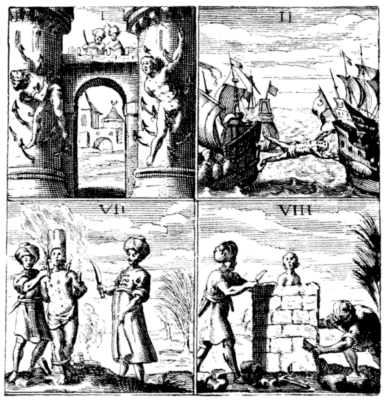
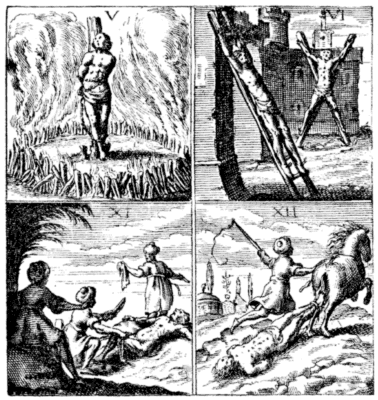
TORMENTS OF THE SLAVES. (Dan, Hist. de Barbarie, 1637.)
Father Dan draws a miserable picture of the captives’ life ashore. Nothing of course could equal the torment of the galley-slaves, but the wretchedness of the shore-slaves was bad enough. When they were landed they were driven to the Besistān or slave-market, where they were put up to auction like the cattle which were also sold there; walked up and down by the auctioneer to show off their paces; and beaten if they were lazy or weary or seemed to “sham.” The purchasers were often speculators who intended to sell again,—“bought for the rise,” in fact; and “Christians are cheap to day” was a business quotation, just as though they had been stocks and shares. The prettiest women were generally shipped to Constantinople for the Sultan’s choice; the rest were heavily chained and cast into vile dungeons in private houses till their work was allotted them, or into the large prisons or bagnios, of which there were then six in Algiers, each containing a number of cells in which fifteen or sixteen slaves were confined. Every rank and quality of both sexes might be seen in these wretched dens, gentle and simple, priest and laic, merchant and artisan, lady and peasant-girl, some hopeful of ransom, others despairing ever to be free again. The old and feeble were set to sell water; laden with chains, they led a donkey about the streets and doled out water from the skin upon his back; and an evil day it was when the poor captive did not bring home to his master the stipulated sum. Others took the bread to the bake-house and fetched it back in haste, for the Moors love hot loaves. Some cleaned the house, (since Mohammedans detest dirt,) whitened the walls, washed the clothes, and minded the children; others took the fruit to market, tended the cattle, or laboured in the fields, sometimes sharing the yoke of the plough with a beast of burden. Worst of all was the sore labour of quarrying stone for building, and carrying it down from the mountains to the shore.
Doubtless Father Dan made the worst of the misery he saw: it was not to the interest of the owners to injure their slaves, who might be ransomed or re-sold, and, at any rate, were more valuable in health than in weakness and disease. The worst part of captivity was not the physical toil and blows, but the mental care, the despair of release, the carking ache of proud hearts set to slave for taskmasters. Cruelty there certainly was, as even so staunch an apologist for the Moors as Joseph Morgan admits, but it can hardly have been the rule; and the report of another French priest who visited Algiers and other parts of Barbary in 1719 does not bear out Dan’s statements: nor is there any reason to believe that the captives were worse treated in 1634 than in 1719.[70] The latter report, with some of Morgan’s comments, may be summarized thus[71]:—
The slaves at Algiers are not indeed so unhappy as those in the hands of the mountain Moors. The policy of those in power, the interests of individuals, and the more sociable disposition of the townspeople, make their lot in general less rigorous: still they are slaves, hated for their religion, overtaxed with work, and liable to apostasy. They are of two sorts: Beylik or Government slaves, and those belonging to private persons. When a Corsair has taken a prize and has ascertained, by the application of the bastinado, the rank or occupation and proficiency of the various captives, he brings them before the governor to be strictly examined as to their place in the captured vessel, whether passengers or equipage: if the former, they are claimed by their consuls, who attend the examination, and as a rule they are set free; but if they served on board the ship for pay they are enslaved. Drawn up in a row, one in eight is chosen by the Dey for his own share, and he naturally selects the best workmen, and the surgeons and ship’s masters, who are at once sent to the Government bagnio. The rest are to be divided equally between the owners and the equipage, and are taken to the Besistān and marched up and down by the dellāls or auctioneers, to the time of their merits and calling, till the highest bid is reached. This is, however, a merely formal advance, for the final sale must take place at the Dey’s palace, whither the captives and their would-be purchasers now resort. The second auction always realizes a much higher sum than the first; but the owners and equipage are only permitted to share the former price, while, by a beautifully simple process, the whole difference between the first and second sales goes absolutely to the Government.
The Government slaves wear an iron ring on one ankle, and are locked up at night in the bagnios, while by day they do all the heavy work of the city, as cleaning, carrying, and quarrying stone. Their rations are three loaves a day. Some have been seen to toil in chains. They have nevertheless their privileges; they have no work to do on Fridays, and they are at free liberty to play, work, or steal for themselves every day for about three hours before sunset, and Morgan adds that they do steal with the coolest impunity, and often sell the stolen goods back to the owners, who dare not complain. Sometimes the Dey sends them to sea, when they are allowed to retain part of the spoil; and others are permitted to keep taverns for renegades and the general riff-raff, both of Turks and Christians, to carouze in. Sometimes they may save enough to re-purchase their freedom, but it often happened that a slave remained a slave by preference, sooner than return to Europe and be beggared, and many of them were certainly better off in slavery at Algiers, where they got a blow for a crime, than in Europe, where their ill-deeds would have brought them to the wheel, or at least the halter.
There were undoubtedly instances, however, of unmitigated barbarity in the treatment of prisoners. For example, the Redemptionists relate the sufferings of four Knights of Malta—three of them French gentlemen, and one from Lucca—who were taken captive at the siege of Oran in 1706, and taken to Algiers. Here they were thrust into the Government prison, along with other prisoners and slaves, to the number of two thousand. Faint with the stench, they were removed to the Kasaba or Castle, where they remained two years. News was then brought that the galleys of Malta had captured the capitana or flagship of Algiers, with six hundred and fifty Turks and Moors aboard, besides Christian slaves, to say nothing of killed and wounded: whereupon, furiously incensed, the Dey sent the imprisoned knights to the castle dungeon, and loaded them with chains weighing 120 lbs.; and there they remained, cramped with the irons, in a putrid cavern swarming with rats and other vermin. They could hear the people passing in the street without, and they clanked their chains if so be they might be heard, but none answered. At last their condition came to the ears of the French consul, who threatened like penalties to Turkish prisoners in Malta unless the knights were removed; and the Dey, on this, lightened their chains by half, and put them in a better room. There these unhappy gentlemen remained for eight long years more, save only at the great festivals of the Church, when they were set free to join in the religious rites at the French consulate; and once they formed a strange and sad feature in the wedding festivities of the consul, when they assumed their perukes and court-dresses for the nonce, only to exchange them again for the badge of servitude when the joyful moment of liberty was over. Their treatment grew worse as time wore on; they were made even to drag trucks of stone, these knights of an heroic Order; and hopeless of obtaining so large a sum as nearly $40,000, which was demanded for their ransom, they managed to file their chains and escape to the shore. But there, to their dismay, the ship they expected was not to be seen, and they took refuge with a marabut or saint. Much to his credit, this worthy Moslem used his vast spiritual influence for their protection, and the Dey spared their lives. At last, by the joint efforts of their friends and the Redemptionists, these poor gentlemen were ransomed and restored to their own country.[72]
Among those who endured captivity in Algiers was one whom genius has placed among the greatest men of all time. In 1575, Cervantes[73] was returning from Naples—after serving for six years in the regiment of Figueroa, and losing the use of his left arm at Lepanto—to revisit his own country; when his ship El Sol was attacked by several Corsair galleys commanded by Arnaut Memi; and, after a desperate resistance, in which Cervantes took a prominent part, was forced to strike her colours. Cervantes thus became the captive of a renegade Greek, one Deli Memi, a Corsair reïs, who, finding upon him letters of recommendation from persons of the highest consequence, Don John of Austria among them, concluded that he was a prisoner of rank, for whom a heavy ransom might be asked. Accordingly the future author of Don Quixote was loaded with chains and harshly treated, to make him the more anxious to be ransomed. The ransom, however, was slow in coming, and meanwhile the captive made several daring, ingenious, but unsuccessful attempts to escape, with the natural consequences or stricter watch and greater severities. At last, in the second year of his captivity, he was able to let his friends know of his condition; whereupon his father strained every resource to send a sufficient sum to release Miguel, and his brother Rodrigo, who was in the like plight. The brother was set free, but Cervantes himself was considered too valuable for the price.
With the help of his liberated brother he once more concerted a plan of escape. In a cavern six miles from Algiers, where he had a friend, he concealed by degrees forty or fifty fugitives, chiefly Spanish gentlemen, and contrived to supply them with food for six months, without arousing suspicion. It was arranged that a Spanish ship should be sent by his brother to take off the dwellers in the cave, whom Cervantes now joined. The ship arrived; communications were already opened; when some fishermen gave the alarm; the vessel was obliged to put to sea; and, meanwhile, the treachery of one of the captives had revealed the whole plot to Hasan Pasha, the Viceroy, who immediately sent a party of soldiers to the cavern. Cervantes, with his natural chivalry, at once came to the front and took the whole blame upon himself. Surprised at this magnanimity, the Viceroy—who is described in Don Quixote as “the homicide of all human kind”[74]—sent for him, and found him as good as his word. No threats of torture or death could extort from him a syllable which could implicate any one of his fellow-captives. His undaunted manner evidently overawed the Viceroy, for instead of chastizing he purchased Cervantes from his master for five hundred gold crowns.
Nothing could deter this valiant spirit from his designs upon freedom. Attempt after attempt had failed, and still he tried again. Once he was very near liberty, when a Dominican monk betrayed him; even then he might have escaped, if he would have consented to desert his companions in the plot: but he was Cervantes. He was within an ace of execution, thanks to his own chivalry, and was kept for five months in the Moor’s bagnio, under strict watch, though without blows—no one ever struck him during the whole of his captivity, though he often stood in expectation of impalement or some such horrible death. At last, in 1580, just as he was being taken off, laden with chains, to Constantinople, whither Hasan Pasha had been recalled, Father Juan Gil effected his ransom for about £100 of English money of the time, and Miguel de Cervantes, after five years of captivity, was once more free. As has been well said, if Don Quixote and all else of his had never been written, “the proofs we have here of his greatness of soul, constancy, and cheerfulness, under the severest of trials which a man could endure, would be sufficient to ensure him lasting fame.”[75]
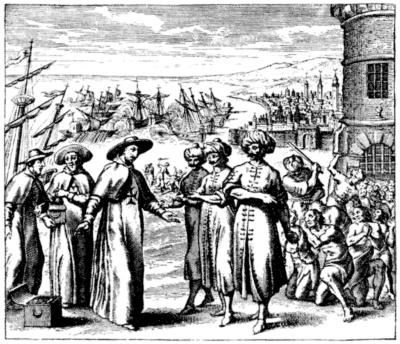
FATHERS OF THE REDEMPTION. (Dan, Hist. de Barbarie, 1637.)
Slavery in private houses, shops, and farms, was tolerable or intolerable according to the character and disposition of the master and of the slaves. Some were treated as members of the family, save in their liberty, as is the natural inclination of Moslems towards the slaves of their own religion; others were cursed and beaten, justly or unjustly, and lived a dog’s life. Those who were supposed to be able to pay a good ransom were for a time especially ill-treated, in the hope of compelling them to send for their money. Escape was rare: the risk was too great, and the chances too small.
Thousands of Christian slaves meant tens of thousand of Christian sympathisers, bereaved parents and sisters, sorrowing children and friends; and it is easy to imagine what efforts were made to procure the release of their unhappy relatives in captivity. At first it was extremely difficult to open negotiations with the Corsairs; but when nation after nation appointed consuls to watch over their interests at Algiers and Tunis, there was a recognized medium of negotiation of which the relations took advantage. As will presently be seen, the office of consul in those days carried with it little of the power or dignity that becomes it now, and the efforts of the consul were often abortive.
There were others than consuls, however, to help in the good work. The freeing of captives is a Christian duty, and at the close of the twelfth century Jean de Matha, impressed with the unhappy fate of the many Christians who languished in the lands of the infidels, founded the “Order of the Holy Trinity and Redemption of Captives.” The convent of S. Mathurin at Paris was immediately bestowed upon the Order, another was built at Rome on the Coelian Hill, another called Cerfroy near Meaux, and others in many countries, even as far as the Indies. Pope Innocent the Third warmly supported the pious design, and wrote a Latin letter recommending the Redemptionists to the protection of the Emperor of Morocco: it was addressed, Illustri Miramomolin, Regi Marochetanorum. Matha’s first voyage (1199) brought back one hundred and eighty-six captives, and in succeeding generations some twenty thousand slaves were rescued by the good fathers, who, clad in their white robes, with the blue and red cross on the breast—three colours symbolical of the Three Persons—fearlessly confronted the Corsairs and bartered for the captives’ ransom.
Father Pierre Dan and his colleagues of the Order of the Redemption set out from Marseilles, in 1634, in the suite of Sanson le Page, premier herald of France, and conversant in the Turkish tongue, to arrange for the exchange of captives.[76] Some Turks confined in the galleys at Marseilles were to be released in return for the freeing of the three hundred and forty-two Frenchmen who were in captivity in Algiers. The good father’s views upon the origin of the Corsairs were very pronounced. He held that they were descended from Ham, the traitor, and were inheritors of the curse of the patriarch Noah; further, that they were the cruellest of all the unnatural monsters that Africa has bred, the most barbarous of mankind, pests of the human race, tyrants over the general liberty, and the wholesale murderers of innocent blood. He did not stop to examine into the condition of the galley-slaves in the ports of his own France, or to inquire whether the word Corsair applied to Moslems alone.
On July 15, 1634, Sanson and the priests arrived at Algiers. A full divan was being held, and the Pasha received them courteously, despite their obstinate refusal to dip the French flag to his crescent. They were forced, in deference to the universal custom at Algiers, to surrender their rudder and oars, not so much to prevent their own unauthorized departure, as to remove the temptation of Christian captives making their escape in the vessel. Orders were given that every respect was to be paid to the envoy’s party on pain of decapitation. Rooms were prepared for them in the house of the agent who represented the coral fisheries of the neighbouring Bastion de France; and here Father Dan made an altar, celebrated Mass, and heard confession of the captives. Two days after their arrival, a new Pasha appeared from Constantinople: he was met by two state-galleys, and saluted by the fifteen hundred guns in the forts and the forty galleys in the harbour. The Aga of the Janissaries, and the Secretary of State, with a large suite of officers, drummers, and fifes, received him on his landing with a deafening noise. The new Pasha, who was robed in white, then mounted a splendid barb, richly caparisoned with precious stones and silk embroidery, and rode to the palace, whence he sent the French envoy a present of an ox, six sheep, twenty-four fowls, forty-eight hot loaves, and six dozen wax candles; to which the Sieur le Page responded with gold and silver watches, scarlet cloth, and rich brocades.
Despite these civilities, the negotiations languished; and finally, after three months of fruitless endeavours, the Mission left “this accursed town” in such haste that they never even looked to see if the wind would serve them, and consequently soon found themselves driven by a Greek Levant, or east wind, to Majorca; then across to Bujēya, which was no longer a place of importance or of piracy, since the Algerines had concentrated all their galleys at their chief port; and then sighted Bona, which showed traces of the invasion of 1607, when six Florentine galleys, commanded by French gentlemen, had seized the fort, made mincemeat of the unfortunate garrison, and carried off eighteen hundred men, women, and children to Leghorn. At last, with much toil, they reached La Calle, the port of the Bastion de France, a fine castle built by the merchants of Marseilles in 1561 for the protection of the valuable coral fisheries, and containing two handsome courts of solid masonry, and a population of four hundred French people. Sanson Napolon had been governor here, but he was killed in an expedition to Tabarka; Le Page accordingly appointed a lieutenant, and then the Mission returned to Marseilles, without results. The fathers, however, soon afterwards sailed for Tunis, whence they brought back forty-two French captives, with whom they made a solemn procession, escorted by all the clergy of Marseilles, and sang a triumphant Te Deum, the captives marching joyfully beside them, each with an illustrative chain over his shoulder.
This is but one example of a long course of determined efforts of the Redemptionists (to say nothing of Franciscans and Dominicans) to rescue their unhappy countrymen. In 1719 Father Comelin and others brought away ninety-eight Frenchmen,[77] and similar expeditions were constantly being made. The zeal of the Order was perhaps narrow: we read that when they offered to pay 3,000 pieces for three French captives, and the Dey voluntarily threw in a fourth without increasing the price, they refused the addition because he was a Lutheran. Nevertheless, they worked much good among the Catholic prisoners, established hospitals and chapels in various parts of the Barbary coast, and many a time suffered the penalty of their courage at the hands of a merciless Dey, who would sometimes put them to a cruel death in order to satisfy his vengeance for some reverse sustained by his troops or ships from the forces of France. Catholic, and especially French, captives at least had cause to be grateful to the Fathers of the Redemption. Those of the Northern nations fared worse: they had no powerful, widespread Church organization to help them, their rulers took little thought of their misery, and their tears and petitions went unregarded for many a long year.
FOOTNOTES:

XIX.
THE ABASEMENT OF EUROPE.
16th to 18th Centuries.
It is not too much to say that the history of the foreign relations of Algiers and Tunis is one long indictment, not of one, but of all the maritime Powers of Europe, on the charge of cowardice and dishonour. There was some excuse for dismay at the powerful armaments and invincible seamanship of Barbarossa or the fateful ferocity of Dragut; but that all the maritime Powers should have cowered and cringed as they did before the miserable braggarts who succeeded the heroic age of Corsairs, and should have suffered their trade to be harassed, their lives menaced, and their honour stained by a series of insolent savages, whose entire fleet and army could not stand for a day before any properly generalled force of a single European Power, seems absolutely incredible, and yet it is literally true.
Policy and pre-occupation had of course much to say to this state of things. Policy induced the French to be the friends of Algiers until Spain lost her menacing supremacy; and even later, Louis XIV. is said to have remarked, “If there were no Algiers, I would make one.” Policy led the Dutch to ally themselves with the Algerines early in the seventeenth century, because it suited them to see the lesser trading States preyed upon. Policy sometimes betrayed England into suffering the indignities of subsidizing a nest of thieves, that the thieving might be directed against her enemies. Pre-occupation in other struggles—our own civil war, the Dutch war, the great Napoleonic war—may explain the indifference to insult or patience under affront which had to be displayed during certain periods. But there were long successions of years when no such apology can be offered, when no cause whatever can be assigned for the pusillanimity of the governments of Europe but sheer cowardice, the definite terror of a barbarous Power which was still believed to possess all the boundless resources and all the unquenchable courage which had marked its early days.
Tunis as much as Algiers was the object of the servile dread of Europe. The custom of offering presents, which were really bribes, only died out fifty years ago, and there are people who can still remember the time when consuls-general were made to creep into the Bey’s presence under a wooden bar.[78] One day the Bey ordered the French consul to kiss his hand; the consul refused, was threatened with instant death, and—kissed it (1740). When in 1762 an English ambassador came in a King’s ship to announce the accession of George III., the Bey made the same order, but this time it was compromised by some of the officers kissing his hand instead of their chief. Austria was forced to sue for a treaty, and had to pay an annual tribute (1784). The Danes sent a fleet to beg leave to hoist their flag over their consulate in Tunis: the Bey asked fifteen thousand sequins for the privilege, and the admiral sailed away in despair. After the Venetians had actually defeated the Tunisians several times in the war of 1784-92, Venice paid the Bey Hamuda forty thousand sequins and splendid presents for the treaty of peace. About the same time Spain spent one hundred thousand piastres for the sake of immunity from piracy; and in 1799 the United States bought a commercial treaty for fifty thousand dollars down, eight thousand for secret service, twenty-eight cannon, ten thousand balls, and quantities of powder, cordage, and jewels. Holland, Sweden, Denmark, Spain, and the United States were tributaries of the Bey!
Yet we have it on the authority of the Redemptionist Fathers, who were not likely to underestimate their adversaries, that in 1719 the Algerines who, “among all the Barbary maritime Powers are much the strongest,” had but twenty-five galleons of eighteen to sixty guns, besides caravels and brigantines; and it appears they were badly off for timber, especially for masts, and for iron, cordage, pitch, and sails. “It is surprising to see in what good condition they keep their ships, since their country affords not wherewithal to do it.... When they can get new timber (brought from Bujēya) sufficient to make a ship’s bottom-parts, they finish the remainder with the ruins of prize vessels, which they perfectly well know how to employ to most advantage, and thus find the secret of making very neat new ships and excellent sailers out of old ones.”[79] Still twenty-five small frigates were hardly a big enough bugbear to terrify all Europe, let them patch them never so neatly. Nevertheless, in 1712, the Dutch purchased the forbearance of these twenty-five ships by ten twenty-four pounders mounted, twenty-five large masts, five cables, four hundred and fifty barrels of powder, two thousand five hundred great shot, fifty chests of gun barrels, swords, &c., and five thousand dollars. Being thus handsomely armed, the Algerines naturally broke the treaty in three years’ time, and the Dutch paid even more for a second truce. So flourished the system of the weak levying blackmail upon the strong.[80]
The period of Europe’s abasement began when the Barbary Corsairs were recognized as civilized states to be treated with on equal terms: that is to say, when consuls, ambassadors, and royal letters began to arrive at Tunis or Algiers. This period began soon after Doria’s disastrous campaign at Jerba, when the battle of Lepanto had destroyed the prestige of the Ottoman navy, but increased if possible the terror of the ruthless Corsairs. No really serious attempt was made to put down the scourge of the Mediterranean between 1560 and Lord Exmouth’s victory in 1816. For nearly all that time the British nation, and most of the other maritime states, were represented at Algiers and Tunis by consular agents. Master John Tipton was the first Englishman to become consul anywhere, and he was consul at Algiers, first appointed by the newly-formed Turkey Company about 1580, and in 1585 officially named consul of the British nation by Mr. Harebone, the ambassador of England at the Sublime Porte. The records of the long succession of consuls, and agents, and consuls-general, that followed him are a title-roll of shame. The state of things at almost any point in this span of two hundred and thirty years may be described in few words. A consul striving to propitiate a sullen, ignorant, common soldier, called a Dey; a Christian king, or government, submitting to every affront put upon his representative, recalling him after mortal insult, and sending a more obsequious substitute with presents and fraternal messages; and now and then a King’s ship, carrying an officer of the King’s navy, or an ambassador of the King’s Council, irresolutely loitering about the Bay of Algiers trying to mollify a surly despot, or perhaps to experiment in a little meaningless bluster, at which the Dey laughs in his sleeve, or even openly, for he knows he has only to persevere in his demands and every government in Europe will give in. Consuls may pull down their flags and threaten war; admirals may come and look stern, and even make a show of a broadside or two; but the Dey’s Christian Brother of St. James’s or the Tuileries—or their ministers for them—have settled that Algiers cannot be attacked: so loud may he laugh at consul and man-of-war.
To attempt to trace in detail the relations of the Pashas, Deys, and Beys of the three Barbary States, and the Sherīfs of Morocco, with the various European Powers, would be a task at once difficult and wearisome. Those with England will be quite sufficient for the purpose, and here, in regard to Algiers, we have the advantage of following the researches of the Agent and Consul-General there, Sir R. Lambert Playfair, who in his Scourge of Christendom,[81] has set forth the principal incidents of British relations with the Dey in great detail, and has authenticated his statements by references to official documents of unimpeachable veracity. The facts which he brings to light in a volume of over three hundred pages can here of course be but slightly touched upon, but the reader may turn to his interesting narrative for such more particular information as space excludes from these pages.
The general results arrived at from a study of Sir Lambert Playfair’s researches are painful to English self-respect. It is possible that our consuls were not always wisely chosen, and it was a vital defect in our early consular system that our agents were allowed to trade. Mercantile interests, especially in a Corsair state, are likely to clash with the duties of a consul. Some consuls, moreover, were clearly unfitted for their posts. Of one it is recorded that he drank to excess; another is described as “a litigious limb of the law, who values himself upon having practised his talents in that happy occupation with success, against every man that business or occasion gave him dealings with;” a third is represented as “sitting on his bed, with his sword and a brace of pistols at his side, calling for a clergyman to give him the Sacraments that he may die contented.” Still, in the long list of consuls, the majority were honourable, upright men, devoted to their country, and anxious to uphold her interests and rights. How were they rewarded? If their own government resented a single act of the ferocious monster they called the Dey—who was any common Janissary chosen by his comrades[82]—the consul went in fear of his life, nay, sometimes was positively murdered. If he was a strong-minded, courageous man, and refused to stoop to the degradation which was expected of him at the Dey’s palace, he could not reckon on support at home; he might be recalled, or his judgment reversed, or he might even pull down the consular flag only to see it run up again by a more temporising successor, appointed by a government which had already endorsed his own resistance. He might generously become surety for thousands of pounds of ransoms for English captives, and never receive back a penny from home. Whatever happened, the consul was held responsible by the Algerines, and on the arrival of adverse news a threatening crowd would surround his house. Sometimes the consul and every Englishman in Algiers would be seized and thrown into prison, and their effects ransacked, and never a chance of restitution. Many were utterly ruined by the extortions of the Dey and governors. Heavy bribes—called “the customary presents”—had to be distributed on the arrival of each fresh consul; and it is easy to understand that the Dey took care that they did not hold the office too long. The government presents were never rich enough, and the unlucky consul had to make up the deficit out of his own pocket. The Dey would contemptuously hand over a magnificently jewelled watch to his head cook in the presence of the donor; and no consul was received at the Palace until the “customary presents” were received. The presence of a remonstrating admiral in the bay was a new source of danger; for the consul would probably be thrown into prison and his family turned homeless into the streets, while his dragoman received a thousand stripes of the bastinado. When the French shelled Algiers in 1683, the Vicar Apostolic, Jean de Vacher, who was acting as consul, and had worked untiringly among the poor captives for thirty-six years, was, by order of Mezzomorto, with many of his countrymen, blown from the cannon’s mouth;[83] and the same thing happened to his successor in 1688, when forty-eight other Frenchmen suffered the same barbarous death. The most humiliating etiquette was observed in the Dey’s court: the consul must remove his shoes and sword, and reverently kiss the rascal’s hand. The Hon. Archibald Campbell Fraser, in 1767, was the first consul who flatly refused to pay this unparalleled act of homage, and he was told, in a few years, that the Dey had no occasion for him, and he might go—as if he were the Dey’s servant. “Dear friend of this our kingdom,” wrote that potentate to H. M. George III. of England, “I gave him my orders,—and he was insolent!” Mr. Fraser went, but was sent back to be reinstated by a squadron of His Majesty’s ships. Admiral Sir Peter Denis sailed into Algiers Bay, and having ascertained that the Dey would not consent to receive Mr. Fraser again, sailed out again. His Majesty’s Government expressed themselves as completely satisfied with the admiral’s action, and resolved to leave the Dey to his reflections. Finally, in the very next year, King George accepts his friend of Algiers’ excuses, and appoints a new consul, specially charged “to conduct himself in a manner agreeable to you.” The nation paid a pension of £600 a year to Mr. Fraser as indemnity for its Government’s poltroonery.
Every fresh instance of submission naturally swelled the overweening insolence of the Deys. A consul had a Maltese cook: the Dey objected to the Maltese, and took the man by force from the consul’s house and sent him away in irons. If the consul objected, he might go too. When Captain Hope, of H.M.S. Romulus, arrived at Algiers, he received no salute; the consul was ordered to go aboard, leaving his very linen behind him; and frigate and consul were ordered out of the harbour. Consul Falcon, so late as 1803, was arrested on a trumped-up charge, and forcibly expelled the city: truly Consul Cartwright might describe the consular office of Algiers as “the next step to the infernal regions.” In 1808, merely because the usual tribute was late, the Danish consul was seized and heavily ironed, made to sleep in the common prison, and set to labour with the slaves. The whole consular body rose as one man and obtained his release, but his wife died from the shock. A French consul about the same time died from similar treatment.
Were all these consuls maltreated for mere obstinacy about trifles? The records of piracy will answer that question. So early as 1582, when England was at peace with the Porte (and as she continued to be for 220 years), gentlemen of good birth began to find a voyage in the Mediterranean a perilous adventure. Two Scottish lairds, the Masters of Morton and Oliphant, remained for years prisoners at Algiers. Sir Thomas Roe, proceeding to his post as ambassador at Constantinople, said that unless checked the Algerine pirates will brave even the armies of kings at sea, and endanger the coasts [which would have been no new thing], and reported that their last cruise had brought in forty-nine British vessels, and that there would soon be one thousand English slaves in Algiers: the pirates were even boasting that they would go to England and fetch men out of their beds, as it was their habit to do in Spain. And indeed it was but a few years later that they sacked Baltimore in County Cork, and literally carried out their threat. The Corsairs’ galleons might be sighted at any moment off Plymouth Hoe or Hartland Point, and the worthy merchants of Bristol, commercial princes in their way, dared not send their richly laden bottoms to sea for fear of a brush with the enemy.
The Reverend Devereux Spratt was captured off Youghal as he was crossing only from Cork to Bristol, and so distressed was the good man at the miserable condition of many of the slaves at Algiers, that when he was ransomed he yielded to their entreaties and stayed a year or two longer to comfort them with his holy offices.[84] It was ministrations such as his that were most needed by the captives: of bodily ill-treatment they had little to complain, but alienation from their country, the loss of home and friends, the terrible fate too often of wife and children—these were the instruments of despair and disbelief in God’s providence, and for such as were thus tormented the clergyman was a minister of consolation. In the sad circle of the captives marriages and baptisms nevertheless took place, and some are recorded in the parish register of Castmell, Lancashire, as having been performed in “Argeir” by Mr. Spratt.