Part 1 — THE CORSAIR ADMIRALS. (continued 2)
Reading edition
The worst day must come to an end: on the morrow the storm was over, and Doria, who had succeeded in taking the greater part of the fleet out to sea, came back to see what new folly was in hand. He was indignant with the Emperor for having rejected his advice and so led the fleet and army into such peril; he was disgusted with his captains, who had completely lost their coolness in the hurricane, and wanted to run their vessels ashore, with the certainty of wreck, sooner than ride out the storm—and yet called themselves sailors!
He found Charles fully aware of the necessity for a temporary retreat, till the army should be revictualled and reclothed. The camp was struck: the Emperor himself watched the operation, standing at the door of his tent in a long white cassock, murmuring quietly the Christian’s consolation: “Thy will be done”—Fiat voluntas Tua! Baggage and ordnance were abandoned; the horses of the field artillery were devoured by the hungry troops; and then the march began.
To retreat at all is humiliation, but to retreat as this luckless army did was agony. Deep mud clogged their weary feet; when a halt was called they could but rest on their halberts, to lie down was to be suffocated in filth; mountain torrents swollen breast-high had to be crossed, the wading men were washed away till they built a rude bridge—O crowning humiliation!—out of the wreckage of their own ships. Hasan and a multitude of Turks and Arabs hung forever on their flanks. The dejected Italians, who had no stomach for this sort of work, fell often into the hands of the pursuers; the Germans, who could do nothing without their customary internal stuffing, were mere impedimenta; and only the lean Spaniard covered the retreat with something of his natural courage.
At last the dejected army reached the Bay of Temendefust (Matifoux), where the remains of the fleet were lying at anchor. It was resolved, in view of the approach of winter and the impossibility of sending supplies to an army in stormy weather, to reëmbark. Cortes in vain protested: the council of war agreed that it was too late in the year to attempt retaliation. Then a new difficulty arose: how was room to be found in a flotilla, which had lost nearly a third of its ships, for an army which was but a couple of thousand less than when it landed? Regretfully Charles gave orders for the horses to be cast into the sea, and, despite their masters’ entreaties, favourite chargers of priceless value were slaughtered and thrown overboard. The famous breed of Spanish horses was well-nigh ruined. It was but one tragedy more. On the 2nd of November most of the troops were on board. Charles resolved to be the last to leave the strand; but the wind was getting up, the sea rising, and at last he gave the order to weigh anchor. Often is the story told in Algiers how the great Emperor, who would fain hold Europe in the palm of his hand, sadly took the crown from off his head and casting it into the sea said, “Go, bauble: let some more fortunate prince redeem and wear thee.”
He did not sail a moment too soon. A new and terrific storm burst forth. The ships were driven hither and thither. Where the tempest drove them, there they helplessly wandered, and many men died from famine and exposure. Some of the Spanish vessels were wrecked at Algiers, and their crews and troops were sent to the bagnios. Charles himself and Doria arrived safely at Bujēya—then a Spanish outpost—with part of the flotilla. Here the unexpected visitors soon caused a famine—and still the tempest raged. The half-starved rovers in vain tried to make head against the waves, and carry the Emperor back to Spain: eighty miles out they gave in, and the ships returned disconsolately to the harbour. Twelve days and nights the storm bellowed along the treacherous coast, and not till November 23rd could the Imperial fleet set sail for the coast of Spain.
There was mourning in Castile that Yuletide. Besides eight thousand rank and file, three hundred officers of birth had fallen victims to the storm or the Moorish lance. Algiers teemed with Christian captives, and it became a common saying that a Christian slave was scarce a fair barter for an onion.
So ended this famous expedition. It was begun in glory, and ended in shame. The whole of Christendom, one might say—for there were English knights there, like Sir Thomas Challoner, as well as Germans, Frenchmen, Spaniards, and Italians in the army—had gone forth to destroy a nest of pirates, and behold, by the fury of the elements and the foolishness of their own counsels, they were almost destroyed themselves. They had left behind them ships and men and stores and cannon: worse, they had left Algiers stronger and more defiant than ever.
The Algerines, for their part, never forgot the valour of the Knights of Malta, and the spot where they made their stand is still called “The Grave of the Knights.” High up on the hillside may be seen “the Emperor’s Castle,” which marks the traditional place where Charles’ great pavilion was pitched on the morning of the fatal 23rd of October.
“The climate of Africa”—it is the caustic comment of Admiral Jurien de la Gravière—“was evidently unsuited to deeds of chivalry.”


XII.
DRAGUT REÏS.
1543-1560.
The name of Dragut has already occurred more than once in this history: it was destined to become as notorious as Barbarossa’s as the century advanced. Dragut—or Torghūd—was born on the Caramanian coast opposite the island of Rhodes. Unlike many of his colleagues he seems to have been the son of Mohammedan parents, tillers of the earth. Being adventurous by nature, he took service as a boy in the Turkish fleet and became “a good pilot and a most excellent gunner.” At last he contrived to purchase and man a galleot, with which he cruised the waters of the Levant, where his intimate acquaintance with all the coasts and islands enabled him to seize and dispose of many prizes. Kheyr-ed-dīn Barbarossa soon came to hear of his exploits, and welcomed him heartily when he came to pay his respects at Algiers, in so far that he gave him the conduct of various expeditions and eventually appointed him his lieutenant with the command of twelve galleys. “From thenceforward this redoubtable Corsair passed not one summer without ravaging the coasts of Naples and Sicily: nor durst any Christian vessels attempt to pass between Spain and Italy; for if they offered it, he infallibly snapped them up: and when he missed any of his prey at sea, he made himself amends by making descents along the coasts, plundering villages and towns, and dragging away multitudes of inhabitants into captivity.”[38]
CASTLE OF JERBA. (Elisée Reclus.)
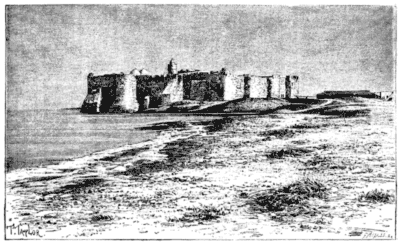
In 1540, as we have seen, Dragut was caught by Giannettino Doria, who made him a present to his great kinsman Andrea, on whose galleys he was forced to toil in chains. La Valette, afterwards Grand Master of Malta, who had once pulled the captive’s oar on Barbarossa’s ships and knew Dragut well, one day saw the ex-Corsair straining on the galley bank: “Señor Dragut,” said he, “usanza de guerra!—’tis the custom of war!” And the prisoner, remembering his visitor’s former apprenticeship, replied cheerfully, “Y mudanza de fortuna—a change of luck!” He did not lose heart, and in 1543 Barbarossa ransomed him for 3000 crowns,[39] and made him chief of the galleys of the western Corsairs. Imprisonment had sharpened his appetite for Christians, and he harried the Italian coasts with more than his ancient zeal. Surrounded by bold spirits and commanding a fleet of his own, Dragut had the Mediterranean in his grasp, and even ventured to seize the most dreaded of all foes, a Maltese galley, wherein he found 70,000 ducats intended for the repair of the fortifications of Tripoli, which then belonged to “the Religion.” As the Turkish annalist says, “Torghūd had become the drawn sword of Islam.”
Dragut’s lair was at the island of Jerba, which tradition links with the lotus-eaters, perhaps because of the luxuriant fertility of the soil. The people of Jerba, despite their simple agricultural pursuits, were impatient of control, and, as often as not, were independent of the neighbouring kingdom of Tunis or any other state. Here, with or without their leave, Dragut took up his position, probably in the very castle which Roger Doria, when lord of the island, began to build in 1289; and from out the wide lake at the back the Corsair’s galleots issued to ravage the lands which were under the protection of Roger Doria’s descendants. Not content with the rich spoils of Europe, Dragut took the Spanish outposts in Africa, one by one—Susa, Sfax, Monastir; and finally set forth to conquer “Africa.”
SIEGE OF “AFRICA,” 1390. (From a MS.)
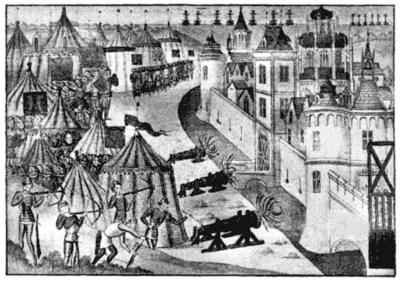
It is not uncommon in Arabic to call a country and its capital by the same name. Thus Misr meant and still means both Egypt and Cairo; El-Andalus, both Spain and Cordova. Similarly “Africa” meant to the Arabs the province of Carthage or Tunis and its capital, which was not at first Tunis but successively Kayrawān and Mahdīya. Throughout the later middle ages the name “Africa” is applied by Christian writers to the latter city. Here it was that in 1390 a “grand and noble enterprize” came to an untimely end. “The Genoese,” says Froissart, “bore great enmity to this town; for its Corsairs frequently watched them at sea, and when strongest fell on and plundered their ships, carrying their spoils to this town of Africa, which was and is now their place of deposit and may be called their warren.” It was “beyond measure strong, surrounded by high walls, gates, and deep ditches.” The chivalry of Christendom hearkened to the prayer of the Genoese and the people of Majorca and Sardinia and Ischia, and the many islands that groaned beneath the Corsairs’ devastations; the Duke of Bourbon took command of an expedition (at the cost of the Genoese) which included names as famous as the Count d’Auvergne, the Lord de Courcy, Sir John de Vienne, the Count of Eu, and our own Henry of Beaufort; and on St. John Baptist’s Day, with much pomp, with flying banners and the blowing of trumpets, they sailed on three hundred galleys for Barbary. Arrived before Africa, not without the hindrance of a storm, they beheld the city in the form of a bow, reaching out its arms to the sea; high were its ramparts; and a colossal tower, armed with stone-projectiles, guarded the harbour. Nevertheless the Knights landed in good heart, after a cup of Grecian or Malmsey wine, on the Vigil of Magdalen Day (July 22nd), unopposed, and each great lord set up his pennon before his tent over against the fortress, with the Genoese crossbows on the right. Here they remained nine weeks. The Saracens never offered battle, but harassed the enemy with their skirmishers, who fired their arrows, then dropped down behind their targets of Cappadocian leather to avoid the enemy’s return volley; then, rising again, cast their javelins with deadly aim. What was to be done? The Duke of Bourbon spent his time in sitting crosslegged before his tent; the nobles and knights had plenty of excellent wine and food; but it was very hot and uncomfortable—the assault had failed—many had died—the Genoese wanted to get their galleys back safe in port before the autumn gales came on; so they packed up their baggage, and re-embarked, blowing their horns and beating their drums for very joy.[40]
GREEK FIRE. (From a MS.)
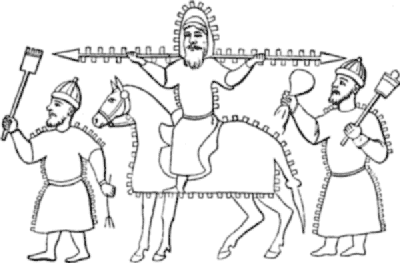
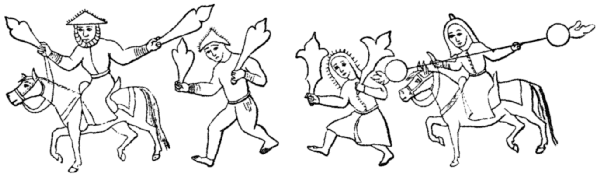
MEDIEVAL FIREARMS. (From a MS.)
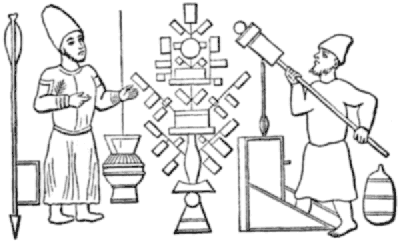
MEDIEVAL PROJECTILES. (From a MS.)
This was the city which Dragut took without a blow in the spring of 1550. Mahdīya was then in an anarchic state, ruled by a council of chiefs, each ready to betray the other, and none owing the smallest allegiance to any king, least of all the despised king of Tunis, Hamīd, who had deposed and blinded his father Hasan, Charles V.’s protégé. One of these chiefs let Dragut and his merry men into the city by night, and the inhabitants woke up to find “Africa” in the possession of the bold Corsair whose red and white ensign, displaying a blue crescent, floated from the battlements.
So easy a triumph roused the emulation of Christendom. Where the Duke of Bourbon had failed, Dragut had conspicuously succeeded. Don Garcia de Toledo dreamed of outshining the Corsair’s glory. His father, the Viceroy of Naples, the Pope, and others, promised their aid, and old Andrea Doria took the command. After much delay and consultation a large body of troops was conveyed to Mahdīya, and disembarked on June 28, 1550. Dragut, though aware of the project, was at sea, devastating the Gulf of Genoa, and paying himself in advance for any loss the Christians might inflict in Africa: his nephew, Hisār Reïs commanded in the city. When Dragut returned, the siege had gone on for a month, without result; a tremendous assault had been repulsed with heavy loss to the besiegers, who were growing disheartened. The Corsair assembled a body of Moors and Turks and attempted to relieve the fortress; but his ambuscade failed, Hisār’s simultaneous sally was driven back, and Dragut, seeing that he could do nothing, fled to Jerba. His retreat gave fresh energy to the siege, and a change of attack discovered the weak places of the defence. A vigorous assault on the 8th of September carried the walls, a brisk street fight ensued, and the strong city of “Africa” was in the hands of the Christians.
The Sultan, Suleymān the Great, was little pleased to see a Moslem fortress summarily stormed by the troops of his ally, the Emperor. Charles replied that he had fought against pirates, not against the Sultan’s vassals; but Suleymān could not perceive the distinction, and emphasized his disapproval by giving Dragut twenty galleys, which soon found their way to Christian shores. The lamentations of his victims roused Doria, who had the good fortune to surprise the Corsair as he was greasing his keels in the strait behind Jerba. This strait was virtually a cul-de-sac. Between the island and the great lake that lay behind it, the sea had worn a narrow channel on the northern side, through which light vessels could pass, with care; but to go out of the lake by the southern side involved a voyage over what was little better than a bog, and no one ever thought of the attempt. Doria saw he had his enemy in a trap, and was in no hurry to venture in among the shoals and narrows of the strait. He sent joyous messages to Europe, announcing his triumph, and cautiously, as was his habit, awaited events.
Dragut, for his part, dared not push out against a vastly superior force; his only chance was a ruse. Accordingly, putting a bold face on the matter, he manned a small earthwork with cannon, and played upon the enemy, with little or no actual injury, beyond the all-important effect of making Doria hesitate still more. Meanwhile, in the night, while his little battery is perplexing the foe, all is prepared at the southern extremity of the strait. Summoning a couple of thousand field labourers, he sets them to work; here a small canal is dug—there rollers come into play; and in a few hours his small fleet is safely transported to the open water on the south side of the island. Calling off his men from the illusive battery, the Corsair is off for the Archipelago: by good luck he picks up a fine galley on the way, which was conveying news of the reinforcements coming to Doria. The old Genoese admiral never gets the message: he is rubbing his eyes in sore amazement, wondering what had happened to the imprisoned fleet. Never was admiral more cruelly cheated: never did Doria curse the nimble Corsair with greater vehemence or better cause.
Next year, 1551, Dragut’s place was with the Ottoman navy, then commanded by Sinān Pasha. He had had enough of solitary roving, and found it almost too exciting: he now preferred to hunt in couples. With nearly a hundred and fifty galleys or galleots, ten thousand soldiers, and numerous siege guns, Sinān and Dragut sailed out of the Dardanelles—whither bound no Christian could tell. They ravaged, as usual, the Straits of Messina, and then revealed the point of attack by making direct for Malta. The Knights of St. John were a perpetual thorn in the side of the Turks, and even more vexatious to the Corsairs, whose vessels they, and they alone, dared to tackle single-handed, and too often with success. Sultan and Corsair were alike eager to dislodge the Knights from the rock which they had been fortifying for twenty years, just as Suleymān had dislodged them from Rhodes, which they had been fortifying for two hundred. In July the Turkish fleet appeared before the Marsa, wholly unexpected by the Knights. The Turks landed on the tongue of promontory which separates the two great harbours, and where there was as yet no Fort St. Elmo to molest them. Sinān was taken aback by the strong aspect of the fortress of St. Angelo on the further side of the harbour, and almost repented of his venture. To complete his dejection, he seems to have courted failure. Instead of boldly throwing his whole force upon the small garrison and overwhelming them by sheer weight, he tried a reconnaissance, and fell into an ambuscade; upon which he incontinently abandoned all thought of a siege, and contented himself with laying waste the interior of Malta, and taking the adjacent island of Goza.
The quantity of booty he would bring back to Constantinople might perhaps avail, he thought, to keep his head on his shoulders, after so conspicuous a failure; but Sinān preferred not to trust to the chance. To wipe out his defeat, he sailed straight for Tripoli, some sixty-four leagues away. Tripoli was the natural antidote to Malta: for Tripoli, too, belonged to the Knights of St. John—much against their will—inasmuch as the Emperor had made their defence of this easternmost Barbary state a condition of their tenure of Malta. So far they had been unable to put it into a proper state of defence, and with crumbling battlements and a weak garrison, they had yearly expected invasion. The hour had now come. Summoned to surrender, the Commandant, Gaspard de Villiers, of the Auvergne Tongue, replied that the city had been entrusted to his charge, and he would defend it to the death. He had but four hundred men to hold the fort withal.
Six thousand Turks disembarked, forty cannons were landed, Sinān himself directed every movement, and arranged his batteries and earthworks. A heavy cannonade produced no effect on the walls, and the Turkish admiral thought of the recent repulse at Malta, and of the stern face of his master; and his head sat uneasily upon his neck. The siege appeared to make no progress. Perhaps this venture, too, would have failed, but for the treachery of a French renegade, who escaped into the trenches and pointed out the weak places in the walls. His counsel was taken; the walls fell down; the garrison, in weariness and despair, had lain down to sleep off their troubles, and no reproaches and blows could rouse them. On August 15th Gaspard de Villiers was forced to surrender, on terms, as he believed, identical with those which Suleymān granted to the Knights of Rhodes.[41] But Sinān was no Suleymān; moreover, he was in a furious rage with the whole Order. He put the garrison—all save a few—in chains, and carried them off to grace his triumph at Stambol.
Thus did Tripoli fall once more into the hands of the Moslems, forty-one years after its conquest by the Count Don Pedro Navarro.[42]
The misfortunes of the Christians did not end here. Year after year the Ottoman fleet appeared in Italian waters, marshalled now by Sinān, and when he died by Piāli Pasha the Croat, but always with Dragut in the van; year by year the coasts of Apulia and Calabria yielded up more and more of their treasure, their youth, and their beauty, to the Moslem ravishers; yet worse was in store. Unable as they felt themselves to cope with the Turks at sea, the Powers of Southern Europe resolved to strike one more blow on land, and recover Tripoli. A fleet of nearly a hundred galleys and ships, gathered from Spain, Genoa, “the Religion,” the Pope, from all quarters, with the Duke de Medina-Celi at the head, assembled at Messina. Doria was too old to command, but his kinsman, Giovanni Andrea, son of his loved and lost Giannettino, led the Genoese galleys. The Fates seemed adverse from the outset. Five times the expedition put to sea; five times was it driven back by contrary winds.[43] At last, on February 10, 1560, it was fairly away for the African coast. Here fresh troubles awaited it. Long delays in crowded vessels had produced their disastrous effects: fevers and scurvy and dysentery were working their terrible ravages among the crews, and two thousand corpses were flung into the sea. It was impossible to lay siege to Tripoli with a diseased army, and when actually in sight of their object the admirals gave orders to return to Jerba.
A sudden descent quickly gave them the command of the beautiful island. The Arab sheykh whose people cultivated it was as ready to pay tribute to the Spaniard as to the Corsair. Medina-Celi and his troops accordingly set to work undisturbed at the erection of a fortress strong enough to baffle the besieging genius even of the Turks. In two months a strong castle was built, with all scientific earthworks, and the admiral prepared to carry home such troops as were not needed for its defence.
Unhappily for him, he had lingered too long. He had wished to see the defences complete, and had trusted to the usual practice of the Turks, not to put to sea before May was advanced. He was about to prepare for departure when news came that the Turkish fleet had been seen at Goza. Instantly all was panic. Valiant gentlemen forgot their valour, forgot their coolness, forgot how strong a force by sea or land they mustered: one thought alone was uppermost—the Turks were upon them! Giovanni Doria hurried on board and embarked his Genoese; Medina-Celi more methodically and with something like sang froid personally supervised the embarcation of his men; but before they could make out of the strait, where Dragut had so narrowly escaped capture, the dread Corsair himself, and Ochiali, and Piāli Pasha were upon them. Then ensued a scene of confusion that baffles description. Despairing of weathering the north side of Jerba the panic-stricken Christians ran their ships ashore, and deserted them, never stopping even to set them on fire. The deep-draught galleons stuck fast in the shallow water. On rowed the Turks; galleys and galleons to the number of fifty-six fell into their hands; eighteen thousand Christians bowed down before their scimitars; the beach, on that memorable 11th of May, 1560, was a confused medley of stranded ships, helpless prisoners, Turks busy in looting men and galleys—and a hideous heap of mangled bodies. The fleet and the army which had sailed from Messina but three months ago in such gallant array were absolutely lost. It was a dies nefas for Christendom.
Medina-Celi and young Doria made good their escape by night. But when the old Genoese admiral learnt the terrible news, the loss of the fleet he loved, the defeat of the nephew he loved yet more, his dim eyes were wet. “Take me to the church,” he said; and he soon received the last consolations of religion. Long as he had lived, and many as had been the vicissitudes of his great career, he had willingly been spared this last most miserable experience. On November 25, 1560, he gave up the ghost: he was a great seaman, but still more a passionate lover of his country;—despotic in his love, but not the less a noble Genoese patriot.
FOOTNOTES:

XIII.
THE KNIGHTS OF MALTA.
1565.
When Sultan Suleymān reflected on the magnanimity which he had displayed towards the Knights of Rhodes in allowing them to depart in peace in 1522, his feelings must have resembled those of Doria when he thought of that inconsiderate release of Dragut in 1543. Assuredly the royal clemency had been ill-rewarded; the Knights had displayed a singular form of gratitude to the sparer of their lives; they had devoted themselves to him, indeed, but devoted themselves to his destruction. The cavaliers whom Charles V. suffered to perch on the glaring white rock of Malta, in 1530, proved in no long time to be a pest as virulent and all-pervading as even Rhodes had harboured. Seven galleys they owned, and never more, but the seven were royal vessels, splendidly armed and equipped, and each a match for two or three Turkish ships.[44] Every year they cruised from Sicily to the Levant, and many a prize laden with precious store they carried off to Malta. The commerce of Egypt and Syria was in danger of annihilation; the Barbary Corsairs, even Dragut himself, shunned a meeting with the red galleys of “the Religion,” or their black capitana; and the Turkish fleet, while holding undisputed sway over the Mediterranean, was not nimble enough to surprise the Maltese squadron in its rapid and incalculable expeditions. Jean de la Valette Parisot, General of the Galleys and afterwards Grand Master, Francis of Lorraine, Grand Prior of France, Romegas, prince of knights-errant, scoured the seas in search of prey:—they were as true pirates as ever weathered the “white squall.” The Knights lived by plunder as much as any Corsair; but they tempered their freebooting with chivalry and devotions; they were the protectors of the helpless and afflicted, and they preyed chiefly upon the enemies of the Faith.
Meanwhile they built and built; Fort St. Elmo rose on the central promontory, Forts St. Michael and St. Angelo were strengthened; bastions were skilfully planned, flanking angles devised, ravelins and cavaliers erected, ditches deepened, parapets raised, embrasures opened, and every device of sixteenth-century fortification as practised by Master Evangelista, chief engineer of the Order, was brought into use. For the Knights knew that Suleymān lived and was mightier than ever. Their cruisers had wrought sad havoc among his subjects, and the Sultan would not long suffer the hornets of Rhodes to swarm at Malta. They lived in constant expectation of attack, and they spent all their strength and all their money in preparing for the day of the Sultan’s revenge. At last the time came: Suleymān swore in his wrath that the miscreants should no longer defy him; he had suffered them to leave Rhodes as gentlemen of honour—he would consume them in Malta as one burns a nest of wasps.
At the time of the siege of 1565 the city or fortress of Malta was situated, not as Valetta now stands on the west, but on the east side of the Marsa or great harbour. To understand even the briefest narrative of one of the most heroic deeds of war that the world has seen, the position of the forts must be understood. (See the Plan.) On the northern coast of the rocky island a bold promontory or rugged tongue of land, Mount Sceberras, separates two deep bights or inlets. The eastern of these was called Marsa Muset, or “Middle Port,” but was unoccupied and without defences at the time of the siege, except that the guns of St. Elmo, the fortress at the point of the Sceberras promontory, commanded its mouth. The Marsa Kebir, or simply La Marsa, the “Great Port,” was the chief stronghold of the Knights. Here four projecting spits of rock formed smaller harbours on the western side. The outermost promontory, the Pointe des Fourches, separated the Port de la Renelle or La Arenela, from the open sea; Cape Salvador divided the Arenela from the English Harbour; the Burg, the main fortress and capital of the place, with Fort St. Angelo at its point, shot out between the English Harbour and the Harbour of the Galleys; and the Isle of La Sangle, joined by a sandy isthmus to the mainland, and crowned by Fort St. Michael, severed the Galley Harbour from that of La Sangle. All round these inlets high hills dominated the ports. Behind Fort St. Elmo, the Sceberras climbed steeply to a considerable height. Behind the Arenela and English Harbour rose Mount Salvador, Calcara, and further back the Heights of St. Catherine. The Burg and Fort St. Michael were overtopped by the Heights of St. Margaret, whilst the Conradin plateau looked down upon the head of the Marsa and the Harbour of La Sangle. To modern artillery and engineering the siege would have been easy, despite the rocky hardness of the ground, since the Knights had not had time to construct those field-works upon the surrounding heights which were essential to the safety of the forts. Even to the skilled but undeveloped artillery of the Turks, the destruction of Malta ought not to have been either a difficult or lengthy operation, had they begun at the right place.
To those who were acquainted with the ground, who had heard of the siege of Rhodes, and knew that the Turks were not less but more formidable in 1565 than in 1522, the issue of the struggle must have appeared inevitable, when the huge Ottoman fleet hove in view on the 18th of May, 1565. One hundred and eighty vessels, of which two-thirds were galleys-royal, carried more than thirty thousand fighting men—the pick of the Ottoman army, tried Janissaries and Sipāhis, horsemen from Thrace, rough warriors from the mountains of Anatolia, eager volunteers from all parts of the Sultan’s dominions. Mustafa Pasha who had grown old in the wars of his master, commanded on land, and Piāli was admiral of the fleet. Dragut was to join them immediately, and the Sultan’s order was that nothing should be done till he arrived.
The Knights had not remained ignorant of the preparations that were making against them. They sent to all Europe for help, and the Pope gave money, and Spain promises: the Viceroy of Sicily would send Spanish reinforcements by the 15th of June. They worked unceasingly at their defences and did all that men could do to meet the advancing storm. All told, they mustered but seven hundred Knights, and between eight and nine thousand mercenaries of various nations, but chiefly Maltese, who could only be trusted behind walls.
The Order was fortunate in its Grand Master. Jean de la Valette, born in 1494, a Knight of St. John before he was of age, and a defender of Rhodes forty-three years ago, though now an old man retained to the full the courage and generalship which had made his career as commander of the galleys memorable in the annals of Mediterranean wars. He had been a captive among the Turks, and knew their languages and their modes of warfare; and his sufferings had increased his hatred of the Infidel. A tall, handsome man, with an air of calm resolution, he communicated his iron nerve to all his followers. Cold and even cruel in his severity, he was yet devoutly religious, and passionately devoted to his Order and his Faith. A true hero, but of the reasoning, merciless, bigoted sort: not the generous, reckless enthusiast who inspires by sympathy and glowing example.
When he knew that the day of trial was at hand, Jean de la Valette assembled the Order together, and bade them first be reconciled with God and one another, and then prepare to lay down their lives for the Faith they had sworn to defend. Before the altar each Knight foreswore all enmities, renounced all pleasures, buried all ambitions; and joining together in the sacred fellowship of the Supper of the Lord, once more dedicated their blood to the service of the Cross.
At the very outset a grave mischance befell the Turks; Dragut was a fortnight late at the rendezvous. His voice would have enforced Piāli’s advice, to land the entire force and attack the Burg and St. Michael from the heights behind. Mustafa, the Seraskier, was determined to reduce the outlying Fort of St. Elmo on the promontory of Sceberras before attacking the main position, and accordingly landed his men at his convenience from the Marsa Muset, and laid out his earthworks on the land side of St. Elmo. He had not long begun when Ochiali arrived with six galleys from Alexandria, and on June 2nd came Dragut himself with a score or more galleys of Tripoli and Bona. Dragut saw at once the mistake that had been made, but saw also that to abandon the siege of St. Elmo would too greatly elate the Knights: the work must go on; and on it went with unexampled zeal.
The little fort could hold but a small garrison, but the force was a corps d’élite: De Broglio of Piedmont commanded it with sixty soldiers, and was supported by Juan de Guaras, bailiff of the Negropont, a splendid old Knight, followed by sixty more of the Order, and some Spaniards under Juan de la Cerda:—a few hundred of men to meet thirty thousand Turks, but men of no common mettle. They had not long to wait. The fire opened from twenty-one guns on the last day of May and continued with little intermission till June 23rd. The besiegers were confident of battering down the little fort in a week at most, but they did not know their foes. As soon as one wall crumbled before the cannonade, a new work appeared behind it. The first assault lasted three hours, and the Turks gained possession of the ravelin in front of the gate; so furious was the onset that the defenders sent to the Grand Master to tell him the position was untenable; they could not stand a second storming party. La Valette replied that, if so, he would come and withstand it himself: St. Elmo must be held to keep the Turks back till reinforcements arrived. So of course they went on. Dragut brought up some of his largest yards and laid them like a bridge across the fosse, and a tremendous struggle raged for five terrible hours on Dragut’s bridge. Again and again Mustafa marshalled his Janissaries for the attack, and every time they were hurled back with deadly slaughter. As many as four thousand Turks fell in a single assault. St. Elmo was little more than a heap of ruins, but the garrison still stood undaunted among the heaps of stones, each man ready to sell his life dearly for the honour of Our Lady and St. John.
The Turks at last remedied the mistake they had made at the beginning. They had left the communication between St. Elmo and the harbour unimpeded, and reinforcements had frequently been introduced into the besieged fortress from the Burg. On June 17th the line of circumvallation was pushed to the harbour’s edge, and St. Elmo was completely isolated. Yet this prudent precaution was more than outweighed by the heavy loss that accompanied its execution: for Dragut was struck down while directing the engineers, and the surgeons pronounced the wound mortal. With the cool courage of his nation, Mustafa cast a cloak over the prostrate form, and stood in Dragut’s place.
Five days later came the final assault. On the eve of June 23rd, after the cannonade had raged all the forenoon, and a hand-to-hand fight had lasted till the evening, when two thousand of the enemy and five hundred of the scanty garrison had fallen, the Knights and their soldiers prepared for the end. They knew the Grand Master could not save them, that nothing could avert the inevitable dawn. They took the Sacrament from each other’s hands, and “committing their souls to God made ready to devote their bodies in the cause of His Blessed Son.” It was a forlorn and sickly remnant of the proudest chivalry the world has ever known, that met the conquering Turks that June morning: worn and haggard faces, pale with long vigils and open wounds; tottering frames that scarce could stand; some even for very weakness seated in chairs, with drawn swords, within the breach. But weary and sick, upright or seated, all bore themselves with unflinching courage; in every set face was read the resolve to die hard.
The ghastly struggle was soon over: the weight of the Turkish column bore down everything in its furious rush. Knights and soldiers alike rolled upon the ground, every inch of which they had disputed to the last drop of their blood. Not a man escaped.
Dragut heard of the fall of St. Elmo as he lay in his tent dying, and said his Moslem Nunc Dimittis with a thankful heart. He had been struck at the soldier’s post of duty; he died with the shout of victory ringing in his ears, as every general would wish to die. His figure stands apart from all the men of his age:—an admiral, the equal of Barbarossa, the superior of Doria; a general fit to marshal troops against any of the great leaders of the armies of Charles V.; he was content with the eager rush of his life, and asked not for sovereignty or honours. Humane to his prisoners, a gay comrade, an inspiriting commander, a seaman every inch, Dragut is the most vivid and original personage among the Corsairs.
St. Elmo had fallen: but St. Angelo and St. Michael stood untouched. Three hundred Knights of St. John and thirteen hundred soldiers had indeed fallen in the first, but its capture had closed the lives of eight thousand Turks. “If the child has cost us so dear,” said Mustafa, “what will the parent cost?” The Turkish general sent a flag of truce to La Valette, to propose terms of capitulation, but in vain. Mutual animosity had been worked to a height of indignant passion by a barbarous massacre of prisoners on both sides, each in view of the other. The Grand Master’s first impulse was to hang the messenger of such foes: he thought better of it, and showed him the depth of the ditch that encircled the twin forts: “Let your Janissaries come and take that,” he said, and contemptuously dismissed him.
A new siege now began. The forts on the east of La Marsa had been sorely drained to fill up the gaps in the garrison at St. Elmo, and it was fortunate that Don Juan de Cardona had been able to send a reinforcement, though only of six hundred men, under Melchior de Robles, to the Old Town, whence they contrived to reach Fort St. Michael in safety.[45] Even six hundred men added materially to the difficulties of the siege: for, be it remembered, six hundred men behind skilfully constructed fortifications may be worth six thousand in the open. It was very hard for the besiegers to find cover. The ground was hard rock, and cutting trenches was extremely arduous work, and the noise of the picks directed the fire of the forts by night upon the sappers. Nevertheless by July 5th four batteries were playing upon St. Michael from the heights of St. Margaret and Conradin, while the guns of Fort St. Elmo opened from the other side; and soon a line of cannon on Mount Salvador dominated the English Port. An attempt to bring a flotilla of gun-boats into the Harbour of the Galleys failed, after a vigorous conflict between a party of Turkish swimmers, who strove with axes to cut the chain that barred the port, and some Maltese who swam to oppose them, sword in teeth. The battle in the water ended in the flight of the Turks.
SKETCH OF THE PORT OF MALTA IN 1565.
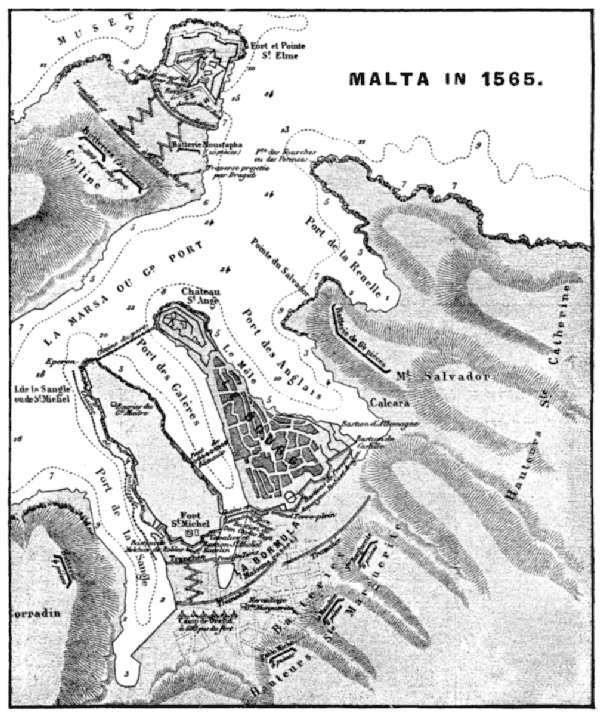
Ten distinct general assaults were delivered with all the fury of Janissaries against the stronghold. First, a grand assault by sea was ordered on July 15th. Three columns simultaneously advanced by night on Fort St. Michael: one landed in the Arenela and marched to attack the eastern suburb La Bormula; the second came down from the heights of St. Margaret and made straight for the bastion defended by De Robles; the third advanced from Conradin on the south-west, and assaulted the salient angle at the extreme point of the spit of land on which the fort was built. In vain the Turks swarmed up the scaling-ladders; company after company was hurled down, a huddled mass of mangled flesh, and the ladders were cast off. Again the escalade began:—the Knights rolled huge blocks of masonry on the crowded throng below; when they got within arms’ reach the scimitar was no match for the long two-handed swords of the Christians. At all three points after a splendid attack, which called forth all the finest qualities of the magnificent soldiery of Suleymān the Great, the Turks were repulsed with terrible loss. The Knights lost some of their bravest swords, and each one of them fought like a lion: but their dead were few compared with the unfortunate troops of Barbary, who had cut off their retreat by dismissing their ships, and were slaughtered or drowned in the harbour by hundreds. The water was red with their blood, and mottled with standards and drums and floating robes. Of prisoners, the Christians spared but two, and these they delivered over to the mob to be torn in pieces.
After the assault by water came the attack by mines; but the result was no better, for the Knights were no novices in the art of countermining, and the attempt to push on after the explosion ended in rushing into a trap. Mustafa, however, continued to work underground and ply his heavy artillery, with hardly a pause, upon the two extremities of the line of landward defences—the Bastion of De Robles, and the Bastion of Castile: both were in ruins by the 27th of July, as Sālih Reïs, son of Barbarossa’s old comrade, satisfied himself by a reconnaissance pushed into the very breach. An assault was ordered for midday of August 2nd, when the Christians were resting after the toils of the sultry morning. Six thousand Turks advanced in absolute silence to Melchior de Robles’ bastion; they had almost reached their goal when the shout of the sentry brought that gallant Knight, readily awakened, to the breach, followed by Muñatones and three Spanish arquebusiers. These five warriors held twenty-six Janissaries and Sipāhis in check till reinforcements came; and they killed fifteen of them. Their valour saved the fort. Four hours longer the struggle lasted, till neither party could deal another blow in the raging August sun; and the Turks at last retired with a loss of six hundred dead.
Nothing daunted, the 7th of August saw them once more scaling the walls and rushing the breaches of the two bastions, this time with nearly twenty thousand men. They poured over the ravelin, swarmed up the breach, and were on the point of carrying the fort. All was nearly lost, and at that supreme moment even the aged Grand Master, whose place was to direct, not to imperil his life, came down to the front of battle, and used his sword and pike like a common soldier. Eight long hours they fought, six times came fresh reserves to the support of the Turks; the Christians were exhausted, and had no reserves. One rush more and the place would be carried.
Just then a body of cavalry was seen riding down from the direction of the Old Town. The Turks took them to be the long-expected reinforcements from Sicily. They are seen to fall upon stray parties of Turks; they must be the advance guard of Philip’s army. Piāli in alarm runs to his galleys; the Turks who had all but carried the long-contested bastion pause in affright lest they be taken in rear. In vain Mustafa, in vain the King of Algiers shows them that the horsemen are but two hundred of the Old Town garrison, with no army at all behind them. Panic, unreasoning and fatal as ever, seizes upon the troops: the foothold won after eight hours of furious fighting is surrendered to a scare; not a Turk stays to finish the victory. The lives of their two thousand dead need not have been sacrificed.
Still Mustafa did not despair. He knew that the main defences of the bastions had been destroyed—a few days more, a heavy cannonade, the explosion of a series of mines which thousands of his sappers were preparing would, he was certain, ensure the success of a final assault. The day came, August 20th, and Mustafa himself, in his coat of inlaid mail and robe of cramoisy, led his army forward; but a well-directed fire drove him into a trench, whence he emerged not till night covered his path. When at last he got back, he found his army in camp; another assault had been repulsed. The next day they went up again to the fatal embrasures, and this time the failure was even more signal; repeated repulses were telling on the spirits of the men, and the veteran Janissaries went to their work with unaccustomed reluctance. Nevertheless, the trenches, cut in the hard rock, continued to advance slowly, and the cavalier behind the ravelin was taken after a severe struggle:—just taken, when La Valette’s mines blew the victorious assailants into the air. On the 30th another well-planned assault was repelled. One more effort—a last and desperate attempt—was to be made on the 7th of September; but on the 5th the news arrived that the Spanish army of relief had at length, after inconceivable delays and hesitations, actually landed on the island. The worn-out Turks did not wait to reconnoitre, they had borne enough: a retreat was ordered, the siege was abandoned, the works that had cost so much labour and blood were deserted, and there was a general stampede to the galleys. It is true they landed again when they learnt that the relieving army numbered but six thousand men; but their strength was departed from them. They tried to fight the relieving army, and then again they ran for the ships. The Spaniards cut them down like sheep, and of all that gallant armament scarce five thousand lived to tell the tale of those terrible three months in Malta.
No more moving sight can be imagined than the meeting of the new-come Brethren of the Order and their comrades of St. Michael’s Fort. The worn remnant of the garrison, all told, was scarcely six hundred strong, and hardly a man was without a wound. The Grand Master and his few surviving Knights looked like phantoms from another world, so pale and grisly were they, faint from their wounds, their hair and beard unkempt, their armour stained, and neglected, as men must look who had hardly slept without their weapons for more than three memorable months. As they saw these gaunt heroes the rescuers burst into tears; strangers clasped hands and wept together with the same overpowering emotion that mastered relievers and relieved when Havelock and Colin Campbell led the Highlanders into Lucknow. Never surely had men deserved more nobly the homage of mankind. In all history there is no record of such a siege, of such a disproportion in the forces, of such a glorious outcome. The Knights of Malta live for ever among the heroes of all time.
FOOTNOTES:

XIV.
LEPANTO.
1571.
The failure of the siege of Malta was a sensible rebuff, yet it cannot be said that it seriously injured the renown of the Turks in the Mediterranean. They had been resisted on land; they had not yet been beaten at sea. Nor could they look back on the terrible months of the siege without some compensating feeling of consolation. They had taken St. Elmo, and its fall had aroused general jubilation in every Moslem breast; the Moors of Granada went near to rising against the Spaniards on the mere report of this triumph of the Turkish arms. Though they had failed to reduce St. Michael, the cause was to be found, at least in part, in a false alarm and an unreasoning panic. To be defeated by such warriors as the Knights of St. John was not a disgrace; like the Highlanders in the Crimean War, these men were not so much soldiers, in their opponents’ eyes, as veritable devils; and who shall contend against the legions of the Jinn? Moreover, forced as they were to abandon the siege, had they not left the island a desert, its people reduced by half, its fortifications heaps of rubbish, its brave defenders a handful of invalids?
So reasoned the Turks, and prepared for another campaign. They had lost many men, but more were ready to take their place; their immense fleet was uninjured; and though Dragut was no more, Ochiali—as the Christians called ’Ali El-Ulūji “the Renegade”—the Turks dubbed him Fartās, “Scurvied,” from his complaint—was following successfully in his old master’s steps. Born at Castelli (Licastoli) in Calabria about 1508,[46] Ochiali was to have been a priest, but his capture by the Turks turned him to the more exciting career of a Corsair. Soon after the siege of Malta he succeeded Barbarossa’s son Hasan as pasha or Beglerbeg of Algiers (1568), and one of his first acts was to retake Tunis (all but the Goletta) in the name of Sultan Selīm II., who, to the unspeakable loss of the Mohammedan world, had in 1566 succeeded his great father Suleymān. In July, 1570, off Alicata, on the southern coast of Sicily, Ochiali surrounded four galleys of “the Religion”—they then possessed but five—and took three of them, including the flagship, which Saint-Clément, the general of the galleys, abandoned in order to throw himself and his treasure on shore at Montichiaro. One galley alone, the St. Ann, made a desperate resistance; the others surrendered. Sixty Knights or Serving Brothers of the Order were killed or made prisoners on this disastrous day, and so intense was the indignation in Malta, that the Grand Master had much ado to save Saint-Clément from being lynched by the mob, and was obliged to deliver him up to the secular court, which at once condemned him to death. He was strangled in his cell, and his body thrown in a sack into the sea. Such a success went far to atone for Mustafa Pasha’s unfortunate siege.
A far more important triumph awaited the Turks in 1570-1:—a siege, and a conquest. The new Sultan, like his father, saw in the island of Cyprus a standing affront to his authority in the Levant. Then, as now, Cyprus was a vital centre in all maritime wars in the Eastern Mediterranean; a convenient depôt for troops and stores; a watch-tower whence the movements of the Turkish fleet could be observed; a refuge for the numberless Christian Corsairs that infested the coast of Syria. Cyprus belonged to Venice, and on the score of her protection of piracy the Sultan found no difficulty in picking a quarrel with the Senate. War was declared, and Piāli Pasha transported a large army under Lala Mustafa (not the Seraskier who commanded at Malta) to lay siege to Nicosia, the capital of the island. After forty-eight days, the city fell, September 9th, and became a shambles. The catastrophe might have been averted, had the Christian fleet owned a single competent chief; but unhappily the relief of Cyprus was entrusted to the least trustworthy of all instruments—a coalition.
Pope Pius V., a man of austere piety, full of the zeal of his high office, and in energy and intellect a born leader, spared no effort to support the Venetians as soon as war became inevitable. Few of the states of Europe found it convenient to respond to his appeal, but Philip of Spain sent a numerous fleet under Giovanni Andrea Doria, and the Pope himself, aided in some degree by the Italian princes, added an important contingent, which he confided to the care of the Grand Constable of Naples, Mark Antony Colonna. Giovanni Zanne commanded the Venetian fleet. The whole force, when united, amounted to no less than two hundred and six vessels, of which eleven were galleasses, and nearly all the rest galleys; while the soldiers and crews numbered forty-eight thousand men. So dire was the dread then inspired by the Turks that this vast armament dared not move till it was known that Ochiali had left the neighbourhood of Italy, and even then the rivalries of the different admirals tended rather to war between the contingents than an attack upon the enemy’s fleet. While the Christians were wrangling, and Doria was displaying the same Fabian caution that had led his grand-uncle to lose the battle of Prevesa, Piāli Pasha, wholly regardless of danger, had bared his galleys almost entirely of soldiers, in order to aid Lala Mustafa in the final assault on Nicosia. Had the allied fleets attacked him on the 8th or 9th of September it is doubtful whether a single Turkish galley could have shown fight. But Colonna and Doria wasted their time in wrangling and discussing, while the foe lay powerless at their feet. Finally they sailed back to Sicily, for fear of bad weather. Such were the admirals who furnished the gibes of Ochiali and his brother Corsairs. Famagusta surrendered August 4, 1571, and despite the promise of life and liberty, the garrison was massacred and the Venetian commander, Bragadino, cruelly burnt to death. Cyprus became a Turkish possession thenceforward to this day.
Meanwhile, the Turkish and Barbary fleets, commanded by ’Ali Pasha, the successor of Piāli, and Ochiali, ravaged Crete and other islands, and coasting up the Adriatic, worked their will upon every town or village it suited their pleasure to attack. Thousands of prisoners, and stores and booty of every description rewarded their industry. At length, in September, they anchored in the Gulf of Lepanto. They had heard that the united Christian fleets were on the move, and nothing would suit the victors of Cyprus better than a round encounter with the enemy. Flushed with success, they had no fear for the issue.
Many a Christian fleet had gathered its members together before then in the waters of the Adriatic. The great battle off Prevesa was in the memory of many an old sailor as the galleys came to the rendezvous in the autumn of 1571. But there was an essential difference between then and now. Prevesa was lost by divided counsels; at Lepanto there was but one commander-in-chief. Pope Pius V. had laboured unceasingly at the task of uniting the Allies and smoothing away jealousies, and he had succeeded in drawing the navies of Southern Europe on to another year’s campaign; then, warned by what he had learned of the wranglings off Cyprus, he exerted his prerogative as Vicar of God, and named as the sole commander-in-chief of the whole fleet, Don John of Austria.
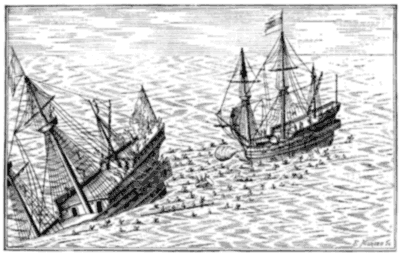
ENGAGEMENT BETWEEN A SPANISH GALLEON AND A DUTCH SHIP. (Jurien de la Gravière.)
Son of the most illustrious monarch of the age, Don John was born to greatness. His mother was the beautiful singer, Barba Blomberg; his father was Charles V. The one gave him grace and beauty; the other, the genius of command. He was but twenty-two when his half-brother, Philip, confided to him the difficult task of suppressing the rebellion of the Moors in the Alpuxarras.[47] Where the experienced veterans of Spain had failed, the beardless general of twenty-two succeeded to admiration. And now, two years later, he was called to the command of the whole navy of Southern Europe. He accepted the post with joy. He had all the hopeful confidence of youth, and he longed to fight one of the world’s great battles. His enthusiasm glowed in his face: one sees it in his portraits and on the medals struck to commemorate his victory. “Beau comme un Apollon, il avait tout le prestige d’un archange envoyé par le Seigneur pour exterminer les ennemis de la Foi.”
Squadron after squadron begins to crowd the Straits of Messina. Veniero, the Venetian admiral, is already there with forty-eight galleys, and sixty more expected, when Colonna enters, in July, with eighteen vessels and moors alongside. Don John has not yet arrived. He has had much ado to get his squadron ready, for no nation understands better than the Spanish the virtue of the adage festina lente. At last he puts off from Barcelona, and laboriously crosses the Gulf of Lyons. One may smile now at the transit, but in those days, what with the mistral and the risk of Corsairs, to cross the Gulf of Lyons was a thing to be thought about. At Genoa Don John is entertained by G. Andrea Doria, and attends a fancy ball in a gay humour that becomes his youth and buoyancy with all his perils still ahead. As he proceeds, he hears how the Turks are laying waste Dalmatia, and how the Allies are quarrelling at Messina, but he hastens not: he knows that a galley on a long voyage has as much a fixed pace as a horse, and that flogging is of no use except for a short course. At Naples he reverently receives the standard blessed by his Holiness himself, and on August 23rd he joins the fleet at Messina. Time is still needed for the other ships to come up, and for the commander-in-chief to mature his plans; before they start, each captain of a galley will have a separate written order, showing him his place during the voyage and his post in any engagement, whereby the risk of confusion and hasty marshalling is almost done away. On the 16th of September the signal is given to weigh anchor. Don John is off first, in his Reale, a splendid capitana galley of sixty oars, with a poop carved with allegorical designs by Vasquez of Seville. After him come two hundred and eighty-five vessels, comprising six galleasses and two hundred and nine galleys, carrying twenty-nine thousand men, and commanded by the most famous names of the great families of Spain, Genoa, Venice, Naples, Rome, Vicenza, Padua, Savoy, and Sicily.[48] Don Juan de Cardona leads the van with seven galleys; Don John himself, between Marcantonio Colonna and Veniero, commands the centre of sixty-two large galleys; G. A. Doria has fifty in the right wing; Barbarigo of Venice fifty-three in the left; Don Alvaro de Bazan commands the reserve of thirty galleys: the galleasses are ranged before the lines, each with five hundred arquebusiers on board. After ten days rowing and sailing they reach Corfu, and the castle greets them with thunders of joy-guns, for the fear of the Turk is removed.
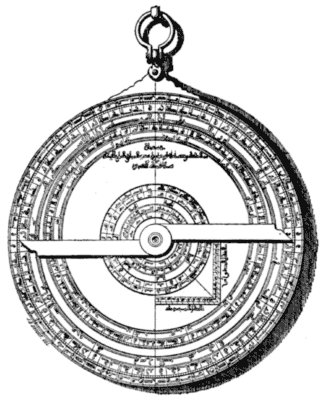
ARABIC ASTROLABE.
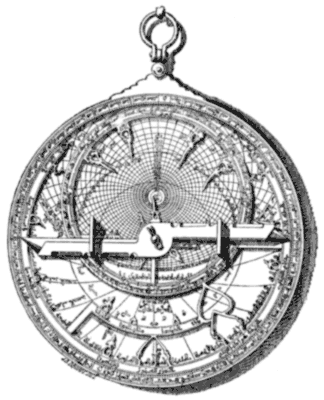
ARABIC ASTROLABE.
’Ali Pasha, hard by in the Gulf of Lepanto, sent out scouts to ascertain the enemy’s strength. A bold Barbary Corsair pushed his bark unseen by night among the Christian galleys, but his report was imperfect, and till the day of conflict neither side knew the exact strength of his opponent. The Turkish fleet numbered about two hundred and eight galleys and sixty-six galleots, and carried twenty-five thousand men. Constantinople furnished ninety-five galleys; twenty-one came from Alexandria, twenty-five from Anatolia, ten from Rhodes, ten from Mitylene, nine from Syria, twelve from Napoli di Romania, thirteen from the Negropont, and eleven from Algiers and Tripoli. The galleots were chiefly Barbary vessels, more useful for piracy than a set battle.
The two fleets unexpectedly came in sight of each other at seven o’clock on the morning of October 7th, at a point just south of the Echinades, and between Ithaca and the Gulf of Patras or Lepanto. A white sail or two on the horizon was descried by Don John’s look-out on the maintop; then sail after sail rose above the sea-line, and the enemy came into full view. Don John quickly ran up a white flag, the signal of battle, and immediately the whole fleet was busily engaged in clewing up the sails to the yards, and making all snug for the conflict. The central banks were removed to make room for the soldiers, and the slaves were served with meat and wine. Old seamen, who had met the Turks again and again from their youth up, prepared grimly for revenge; sanguine boys, who held arms in set fight for the first time that day, looked forward eagerly to the moment of action. Even to the last the incurable vacillation of the allied admirals was felt: they suggested a council of war. Don John’s reply was worthy of him: “The time for councils is past,” he said; “do not trouble yourselves about aught but fighting.” Then he entered his gig, and went from galley to galley, passing under each stern, crucifix in hand, encouraging the men. His calm and confident mien, and the charm of his address, excited universal enthusiasm, and he was met on all hands with the response: “Ready, Sir; and the sooner the better!” Then Don John unfurled the Blessed Standard with the figure of the Saviour, and falling on his knees commended his cause to God.
About eleven o’clock a dead calm set in. The Turks shortened sail and took to their oars: in perfect order and with matchless speed and precision they formed in line of battle, while drums and fifes announced their high spirits. The Christian fleet was slower in falling into line; some of the galleys and most of the galleasses were behindhand. Don John let drop some pious oaths, and sent swift vessels to hurry them up. At last they began to get into order. Barbarigo, the “left guide,” hugged the coast with the left wing; Don John with the centre corps de bataille kept touch with him; but where was the “right guide”? Giovanni Doria, infected with the tactical vanity of his family, resolved to show these landsmen how a sailor can manoeuvre. Conceiving that Ochiali, on the Ottoman left, was trying to outflank the Christian fleet, he bore out to sea in order to turn him. In vain Don John sent to recall him; he had gone out of reach, and the battle had to be fought without the right wing. Doria’s precious manoeuvring went near to losing the day.
The Ottoman fleet was marshalled in the same order as the Christian, except that there were no galleasses. The line of battle, nearly a mile long, was divided into centre, and right and left wing, and behind the centre was the reserve. Mohammed Shaluk (called by Europeans Scirocco) commanded the right wing, opposed to Barbarigo’s left; ’Ali Pasha opposed Don John in the centre; Ochiali was over against the post where Doria should have been. Between the two lines stood forth the heavy galleasses, like great breakwaters, turning aside and dividing the flowing rush of the Ottoman galleys. The fire of these huge floating castles nearly caused a panic among the Turks, but they soon pulled past them, and a general melley ensued. In the Christian left, after a deadly struggle, in which both Barbarigo and Scirocco lost their lives, the Turks were repulsed, and, deprived of their chief, took to the shore, but not before the Christians had lost many galleys and a host of brave men. Soon after the left had been engaged, the centre came into action. ’Ali Pasha made straight for Don John’s Reale, and his beak rammed it as far in as the fourth bank of oars. Close by were Pertev Pasha and the capitanas of Colonna and Veniero. The ships became entangled, and formed one large platform of war. Twice the Spaniards of the Reale boarded the Fanal of ’Ali Pasha as far as the mainmast, and twice they were driven back with terrible loss. ’Ali himself was preparing to leap upon Don John’s galley when Colonna rammed him on the poop, penetrating as far as the third oar, and delivered a withering fire from his arquebuses. The Christians had all the advantage of armour and firearms, and fired behind bulwarks; the Turks were unprotected by cuirass or helmet or bulwark, and most of them had bows instead of guns. Colonna’s volleys decided the fate of the Fanal, and ’Ali Pasha departed this life. An hour and a half had sufficed to disperse the Ottoman right and to overpower the flagship in chief. When the fleet saw the Christian ensign at the peak of the Turkish capitana they redoubled their efforts: Veniero, severely wounded, still fought with the Seraskier Pertev Pasha; the Turks fled, and Pertev took to the land. In half an hour more Don John’s centre was completely victorious. Then a new danger arose: Ochiali, seeing that Doria was well away to sea, sharply doubled back with all the right wing, and bore down upon the exhausted centre. He rushed upon the capitana of Malta, and massacred every soul on board. Dragut is avenged! Juan de Cardona hastened to the rescue, and of his five hundred soldiers but fifty escaped; on the Fiorenza seventeen men alone remained alive; and other terrible losses were incurred in the furious encounter. Upon this the ingenious Doria perceived that he had outwitted only his own cause, and at last turned back. The Marquis de Santa Cruz was already upon the enemy; Don John was after him with twenty galleys; Ochiali was outnumbered, and after a brilliant effort, made off in all haste for Santa Maura, bearing with him the Standard of “the Religion” to be hung up in St. Sophia. The battle of Lepanto is fought and won: the Turks have been utterly vanquished.[49] Well might the good Pope cry, as the preacher cried in St. Stephen’s a century later when Sobieski saved Vienna,[50] “There was a man sent from God, whose name was John.”
The Turkish fleet was almost annihilate: one hundred and ninety galleys were captured, besides galleots, and fifteen more burnt or sunk; probably twenty thousand men had perished, including an appalling list of high dignitaries from all parts of the empire. The Christians lost seven thousand five hundred men, including many of the most illustrious houses of Italy and Spain. Cervantes, who commanded a company of soldiers on board the Marquesa, fortunately escaped with a wound in his left arm; and to many the Battle of Lepanto is familiar only from the magical pages of Don Quixote. Seventeen Venetian commanders were dead, and among them Vicenzo Quirini and the valiant, chivalrous, and venerable Proveditore Barbarigo. Sixty Knights of the diminished Order of St. John had given up the ghost. Twelve thousand Christian slaves were freed from the Ottoman galleys.
The brilliant young conqueror did not wear his well-earned laurels long. His statue was erected at Messina; his victory was the subject of Tintoret and Titian; he was received with ovations wherever he went. Two years later he recaptured Tunis. Then he was employed in the melancholy task of carrying on Alva’s detestable work in Flanders. He inflicted a sanguinary defeat upon the Dutch at Gembloux, and then, struck down by fever, the young hero died on October 1, 1578, in his thirty-first year, the last of the great figures of medieval chivalry—a knight worthy to have been commemorated in the Charlemagne gestes and to have sat at Arthur’s Round Table with Sir Galahad himself.
FOOTNOTES: