Part 1 — THE CORSAIR ADMIRALS.
Reading edition

III.
URŪJ BARBAROSSA.
1504-1515.
The island of Lesbos has given many gifts to the world—Lesbian wine and Lesbian verse, the seven-stringed lyre, and the poems of Sappho; but of all its products the latest was assuredly the most questionable, for the last great Lesbians were the brothers Barbarossa.
When Sultan Mohammed II. conquered the island in 1462, he left there a certain Sipāhi soldier, named Ya’kūb—so say the Turkish annalists, but the Spanish writers claim him as a native Christian—who became the father of Urūj Barbarossa and his brother Kheyr-ed-dīn. Various stories are told of their early career, and the causes which led to their taking to the sea; but as Lesbos had long been famous for its buccaneers, whether indigenous or importations from Catalonia and Aragon, there was nothing unusual in the brothers adopting a profession which was alike congenial to bold hearts and sanctioned by time-honoured precedent.[5] Urūj, the elder, soon became the reïs, or captain, of a galleot, and finding his operations hampered in the Archipelago by the predominance of the Sultan’s fleet, he determined to seek a wider and less interrupted field for his depredations. Rumours had reached the Levant of the successes of the Moorish pirates; prodigious tales were abroad as to great argosies, laden with the treasures of the New World, passing and repassing the narrow seas between Europe and Africa, and seeming to invite capture; and it was not long (1504) before Captain Urūj found himself cruising with two galleots off the Barbary coast, and spying out the land in search of a good harbour and a safe refuge from pursuit.
TUNIS IN THE SIXTEENTH CENTURY. (Sphère des deux Mondes, 1555.)
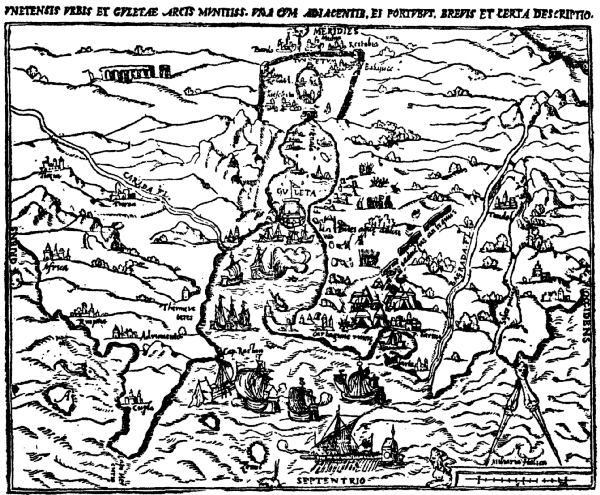
The port of Tunis offered all that a Corsair could wish. The Goletta in those days was but slightly fortified, and the principal building, besides the castle, was the custom-house, where the wealth of many nations was taxed by the Sultan of the House of Hafs. The very sight of such an institution was stimulating to a pirate. Urūj paid his court to the King of Tunis, and speedily came to an understanding with him on the subject of royalties on stolen goods. The ports of Tunis were made free to the Corsair, and the king would protect him from pursuit, for the consideration of a fixed share—a fifth—of the booty. The policy of the enlightened rulers of Tunis evidently no longer suited their latest representative.
The base of operations thus secured, Urūj did not keep his new ally long waiting for a proof of his prowess. One day he lay off the island of Elba, when two galleys-royal, belonging to his Holiness Pope Julius II., richly laden with goods from Genoa, and bound for Cività Vecchia, hove in sight. They were rowing in an easy, leisurely manner, little dreaming of Turkish Corsairs, for none such had ever been seen in those waters, nor anything bigger than a Moorish brigantine, of which the Papal marines were prepared to give a good account. So the two galleys paddled on, some ten leagues asunder, and Urūj Reïs marked his prey down. It was no light adventure for a galleot of eighteen banks of oars to board a royal galley of perhaps twice her size, and with no one could tell how many armed men inside her. The Turkish crew remonstrated at such foolhardiness, and begged their captain to look for a foe of their own size: but for reply Urūj only cast most of the oars overboard, and thus made escape impossible. Then he lay to and awaited the foremost galley She came on, proudly, unconscious of danger. Suddenly her look-out spied Turkish turbans—a strange sight on the Italian coast—and in a panic of confusion her company beat to arms. The vessels were now alongside, and a smart volley of shot and bolts completed the consternation of the Christians. Urūj and his men were quickly on the poop, and his Holiness’s servants were soon safe under hatches.
Never before had a galley-royal struck her colours to a mere galleot. But worse was to follow. Urūj declared he must and would have her consort. In vain his officers showed him how temerarious was the venture, and how much more prudent it would be to make off with one rich prize than to court capture by overgreediness. The Corsair’s will was of iron, and his crew, inflated with triumph, caught his audacious spirit. They clothed themselves in the dresses of the Christian prisoners, and manned the subdued galley as though they were her own seamen. On came the consort, utterly ignorant of what had happened, till a shower of arrows and small shot aroused her, just in time to be carried by assault, before her men had collected their senses.
Urūj brought his prizes into the Goletta. Never was such a sight seen there before. “The wonder and astonishment,” says Haedo,[6] “that this noble exploit caused in Tunis, and even in Christendom, is not to be expressed, nor how celebrated the name of Urūj Reïs was become from that very moment; he being held and accounted by all the world as a most valiant and enterprizing commander. And by reason his beard was extremely red, or carroty, from thenceforwards he was generally called Barba-rossa, which in Italian signifies Red-Beard.”[7]
GALLEY OF THE SIXTEENTH CENTURY. (Jurien de la Gravière.)
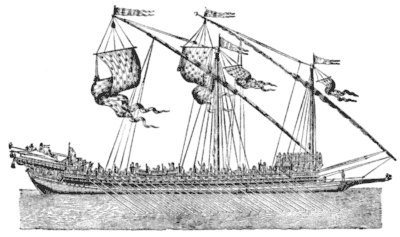
The capture of the Papal galleys gave Urūj what he wanted—rowers. He kept his Turks for fighting, and made the Christian prisoners work the oars; such was the custom of every Corsair down to the present century, and the Christian navies were similarly propelled by Mohammedan slaves. The practice must have lent a strange excitement to the battle; for then, assuredly, a man’s foes were of his own household. A Venetian admiral knew well that his two or three hundred galley slaves were panting to break their irons and join the enemy; and the Turkish Corsair had also his unwilling subjects, who would take the first chance to mutiny in favour of the Christian adversary. Thus it often happened that a victory was secured by the strong arms of the enemy’s chained partizans, who would have given half their lives to promote a defeat. But the sharp lash of the boatswain, who walked the bridge between the banks of rowers, was a present and acute argument which few backs could withstand.
Urūj had made his first coup, and he did not hesitate to follow it up. Next year he captured a Spanish ship with five hundred soldiers on board, who were all so sea-sick, or spent with pumping out the leaky vessel, that they fell an easy prey to his galleots. Before five years were out, what with cruising, and building with the timber of his many prizes, he had eight good vessels at his back, with two of his brothers to help. The port of Tunis now hardly sufficed his wants, so he established himself temporarily on the fertile island of Jerba, and from its ample anchorage his ships issued forth to harry the coasts of Italy.
To be king of Jerba was all too small a title for his ambition. He aimed at sovereignty on a large scale, and, Corsair as he was by nature, he wished for settled power almost as much as he delighted in adventure. In 1512 the opportunity he sought arrived. Three years before, the Mohammedan King of Bujēya had been driven out of his city by the Spaniards, and the exiled potentate appealed to the Corsair to come and restore him, coupling the petition with promises of the free use of Bujēya port, whence the command of the Spanish sea was easily to be held. Urūj was pleased with the prospect, and as he had now twelve galleots with cannon, and one thousand Turkish men-at-arms, to say nothing of renegades and Moors, he felt strong enough for the attempt. The renown of his exploits had spread far and wide, and there was no lack of a following from all parts of the Levant when it was known that Urūj Reïs was on the war-path. His extraordinary energy and impetuosity called forth a corresponding zeal in his men, and, like other dashing commanders, he was very popular.
JĪJIL, 1664. (From a Map in the British Museum.)
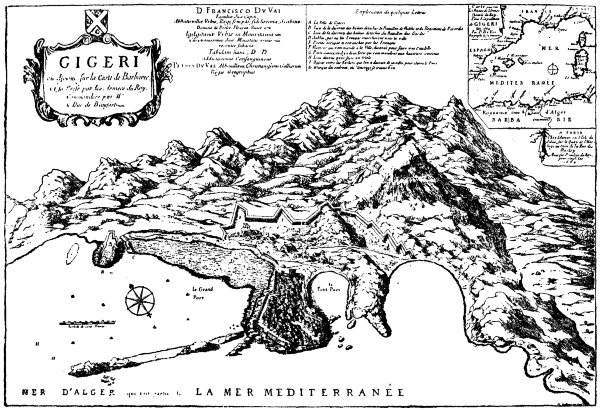
Well supported, and provided with such a siege-train as the times permitted, he landed before Bujēya in August, 1512, and found the dethroned king expecting him at the head of three thousand mountain Berbers. The Spanish garrison was collected in the strong bastion, which the Count Don Pedro Navarro had fortified when he took the city, and for eight days the fortress withstood the battering of the Corsair’s ordnance. Just when a breach began to be opened, Urūj was disabled; a shot took his left arm away above the elbow. In the absence of their leader’s heroic example, the Turks felt little confidence in their superiority to Spanish steel; they preferred carrying their wounded captain to the surgeons at Tunis. Bujēya for the moment escaped, but the Corsairs enjoyed some little consolation in the capture of a rich Genoese galleot which they met on its voyage to the Lomellini’s mart at Tabarka. With this spoil Urūj returned to recover from his wound, while his brother, Kheyr-ed-dīn, kept guard over the castle of the Goletta, and began to bring the galleots and prizes through the canal into the Lake of Tunis, where they would be safe from pursuit.
He was too late, however. The Senate of Genoa was highly incensed at the loss of the galleot, and Andrea Doria, soon to be known as the greatest Christian admiral of his time, was despatched with twelve galleys to exact reparation. He landed before the Goletta, and drove Kheyr-ed-dīn before him into Tunis. The fortress was sacked, and half Barbarossa’s ships were brought in triumph to Genoa. Thus ended the first meeting between Doria and Kheyr-ed-dīn: the next was less happy for the noble Genoese.
Kheyr-ed-dīn, well aware of his brother’s fierce humour, did not dare to face him after this humiliation, but left him to fume impotently in his sickroom, while he stole away to Jerba, there to work night and day at shipbuilding. Urūj joined him in the following spring—the King of Tunis had probably had enough of him—and they soon had the means of wiping out their disgrace. The attempt was at first a failure; a second assault on the ominous forts of Bujēya (1514) was on the point of success, when reinforcements arrived from Spain. The Berber allies evinced more interest in getting in their crops after the rain than in forcing the bastion; and Barbarossa, compelled to raise the siege, in a frantic rage, tearing his red beard like a madman, set fire to his ships that they might not fall into the hands of the Spaniards.
He would not show himself now in Tunis or Jerba. Some new spot must shelter him after this fresh reverse. On his way to and from Bujēya he had noticed the very place for his purpose—a spot easy to defend, perched on inaccessible rocks, yet furnished with a good harbour, where the losses of recent years might be repaired. This was Jījil, some sixty miles to the east of Bujēya; whose sturdy inhabitants owed allegiance to no Sultan, but were proud to welcome so renowned, although now so unfortunate, a warrior as Barbarossa. So at Jījil Urūj dwelt, and cultivated the good-will of the people with spoils of corn and goods from his cruisers, till those “indomitable African mountaineers,” who had never owned a superior, chose him by acclamation their king.
FOOTNOTES:

IV.
THE TAKING OF ALGIERS.
1516-1518.
The new Sultan of Jījil was now called to a much more serious enterprize than heading his truculent highlanders against a neighbouring tribe—though it must be admitted that he was always in his element when fisticuffs were in request. An appeal had come from Algiers. The Moors there had endured for seven years the embargo of the Spaniards; they had seen their fregatas rotting before their eyes, and never dared to mend them; they had viewed many a rich prize sail by, and never so much as ventured a mile out to sea to look her over: for there were keen eyes and straight shots in the Peñon which commanded the bay, and King Ferdinand the Catholic held a firm hand over the tribute which his banished subjects had to pay him for his condescension in ruining them. Their occupation was gone; they had not dragged a prize ashore for years; they must rebel or starve. At this juncture Ferdinand opportunely died (1516), and the Algerine Moors seized their chance. They stopped the tribute, and called in the aid of Salim, the neighbouring Arab sheykh, whose clansmen would make the city safe on the land side. “But what are they to do with the two hundred petulant and vexatious Spaniards in the fort, who incessantly pepper the town with their cannon, and make the houses too hot to hold them; especially when they are hungry? Little would the gallant Arab cavalry, with their fine Libyan mares and horses, rich coats-of-mail, tough targets, well-tempered sabres, and long supple lances, avail them against the Spanish volleys. And who so proper to redress this grievance as the invincible Barbarossa, who was master of a naval force, and wanted not artillery? Had he not been twice to reinstate the unfortunate King of Bujēya, and lost a limb in his service?
“Without the least deliberation Prince Salim despatched a solemn embassy to Jījil, intreating Barbarossa, in whom he and his people reposed their entire confidence, to hasten to their assistance. No message whatever could have been more welcome to the ambitious Barbarossa than one of this nature. His new-acquired realm brought him in but a very scanty revenue; nor was he absolute.... He had been wretchedly baffled at Bujēya, but hoped for better success at Algiers, which, likewise, is a place of much greater consequence, and much more convenient for his purpose, which, as has been said, was to erect a great monarchy of his own in Barbary.”[8]
ALGIERS IN THE SIXTEENTH CENTURY. (Sphère des deux Mondes, 1555.)
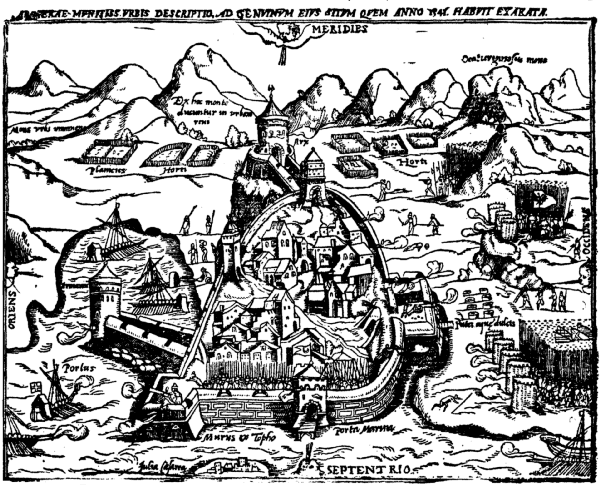
With some six thousand men and sixteen galleots Urūj set forth by sea and land to the rescue of Algiers. First he surprised Shershēl, a strong position fifteen leagues to the west of Algiers, which had been occupied by Moors from Granada, and was now commanded by a bold Turkish Corsair, Kara Hasan, who, emulating his old comrade’s success with the people of Jījil, had induced the Shershēl rovers to accept him as their leader. Urūj had no liking for two Kings of Brentford, and took off Black Hasan’s head as a friendly precaution, before exposing himself to the perils of another contest with the Spaniards.
Soon he was at Algiers, hospitably lodged and entertained, he and all his men, Turks and Jījilis alike, by Sheykh Salim and the people of the town. There, at the distance of a crossbow-shot, stood the fortress he had come to reduce, and thither he sent a message offering a safe conduct to the garrison if they would surrender. The Spanish captain made reply that “neither threats nor proffered curtesies availed aught with men of his kidney,” and told him to remember Bujēya. Upon which Urūj, more to please his unsuspicious hosts than with much prospect of success, battered the Peñon for twenty days with his light field-pieces, without making any sensible breach in the defences.
Meanwhile, the Arabs and Moors who had called him to their aid were becoming aware of their mistake. Instead of getting rid of their old enemy the Spaniard, they had imported a second, worse than the first, and Urūj soon showed them who was to be master. He and his Turks treated the ancient Moorish families, who had welcomed them within their gates, with an insolence that was hard to be borne by descendants of the Abencerrages and other noble houses of Granada. Salim, the Arab Sheykh, was the first to feel the despot’s power: he was murdered in his bath—it was said by the Corsair himself. In their alarm, the Algerines secretly made common cause with the soldiers of the Peñon, and a general rising was planned; but one day at Friday prayers Barbarossa let the crowded congregation know that their designs were not unsuspected. Shutting the gates, the Turks bound their entertainers with the turbans off their heads, and the immediate decapitation of the ringleaders at the mosque door quelled the spirit of revolt. Nor was a great Armada, sent by Cardinal Ximenes, and commanded by Don Diego de Vera, more successful than the Algerine rebellion. Seven thousand Spaniards were utterly routed by the Turks and Arabs; and to complete the discomfiture of the Christians a violent tempest drove their ships ashore, insomuch that this mighty expedition was all but annihilate.
An adventurer who, with a motley following of untrained bandits and nomads, could overthrow a Spanish army was a phenomenon which the Christian States now began to eye with considerable anxiety. From the possessor of a strong place or two on the coast, he had become nothing less than the Sultan of Middle Barbary (Maghrib el-Awsat). When the Prince of Tinnis raised the whole country side against him, and a mighty host was rolling down upon Algiers, Urūj marched out with one thousand Turks and five hundred Moors, and never a cannon amongst them, and smote the enemy hip and thigh, and pursued them into their own city. The prince of Tinnis took to the mountains, and Urūj Barbarossa reigned in his stead (1517). Then Tilimsān fell into his possession, and save that the Spaniards held Oran and two or three fortresses, such as the Peñon de Alger and Bujēya, his dominions coincided with modern Algeria, and marched with the kingdoms of Tunis and Fez. He was in a position to form alliances with Fez and Morocco. His galleots were punctilious, moreover, in returning the call of Don Diego de Vera, and many an expectant merchant in Genoa, or Naples, or Venice, strained his eyes in vain for the argosy that, thanks to the Corsair’s vigilance, would never again sail proudly into the harbour.
When all this came to the ears of the new King of Spain, afterwards the Emperor Charles V, he yielded to the prayer of the Marquis de Comares, Governor of Oran, and despatched ten thousand veterans to make an end of the Corsairs once and for ever. Urūj Barbarossa was then stationed at Tilimsān with only 1,500 men, and when the hosts of the enemy drew near he made a bolt by night for Algiers, taking his Turks and his treasure with him. The news soon reached the enemy’s scouts, and the Marquis gave hot pursuit. A river with steep banks lay in the fugitives’ path: could they pass it, they would have the chances in their favour. Urūj scattered his jewels and gold behind him, vainly hoping to delay the greedy Spaniards; but Comares trampled over everything, and came up with the Turkish rear when but half their force had crossed the river. Their leader was already safe on the other side, but the cries of his rear-guard brought him back. The Corsair was not the man to desert his followers, and without an instant’s hesitation he recrossed the fatal stream and threw himself into the fray. Hardly a Turk or a Moor escaped from that bloody field. Facing round, they fought till they dropped; and among them the vigorous figure of Barbarossa was ever to be seen, laying about him with his one arm like a lion to the last.
“Urūj Barbarossa, according to the testimony of those who remember him, was, when he died, about forty-four years of age. He was not very tall of stature, but extremely well set and robust. His hair and beard perfectly red; his eyes quick, sparkling and lively; his nose aquiline or Roman; and his complexion between brown and fair. He was a man excessively bold, resolute, daring, magnanimous, enterprizing, profusely liberal, and in nowise bloodthirsty, except in the heat of battle, nor rigorously cruel but when disobeyed He was highly beloved, feared, and respected, by his soldiers and domestics, and when dead was by them all in general most bitterly regretted and lamented. He left neither son nor daughter. He resided in Barbary fourteen years, during which the harms he did to the Christians are inexpressible.”[9]
FOOTNOTES:

V.
KHEYR-ED-DĪN BARBAROSSA.
1518-1530.
Urūj Barbarossa, the gallant, impulsive, reckless, lovable soldier of fortune was dead, and it seemed as if all the power he had built up by his indomitable energy must inevitably vanish with its founder. The Marquis de Comares and the Spanish army held the fate of Algiers in their hands; one steady march, and surely the Corsairs must be swept out of Africa. But, with what would seem incredible folly, if it had not been often repeated, the troops were shipped back to Spain, the Marquis returned to his post at Oran, and the opportunity was lost for three hundred years. The Algerines drew breath again, and their leader began to prepare fresh schemes of conquest.
The mantle of Urūj had fallen upon worthy shoulders. The elder brother possessed, indeed, matchless qualities for deeds of derring-do; to lead a storming party, board a galleon,—cut and thrust and “have at you,”—he had no equal: but Kheyr-ed-dīn, with like courage and determination, was gifted with prudent and statesmanlike intelligence, which led him to greater enterprizes, though not to more daring exploits. He measured the risk by the end, and never exposed himself needlessly to the hazard of defeat; but when he saw his way clear, none struck harder or more effectual blows.[10]
His first proceeding was typical of his sagacious mind. He sent an ambassador to Constantinople, to lay his homage at the feet of the Grand Signior, and to beg his Majesty’s favour and protection for the new province of Algiers, which was now by his humble servant added to the Ottoman Empire. The reply was gracious. Selīm had just conquered Egypt, and Algiers formed an important western extension of his African dominion. The sage Corsair was immediately appointed Beglerbeg, or Governor-General, of Algiers (1519), and invested with the insignia of office, the horse and scimitar and horsetail-banner. Not only this, but the Sultan sent a guard of two thousand Janissaries to his viceroy’s aid, and offered special inducements to such of his subjects as would pass westward to Algiers and help to strengthen the Corsair’s authority.
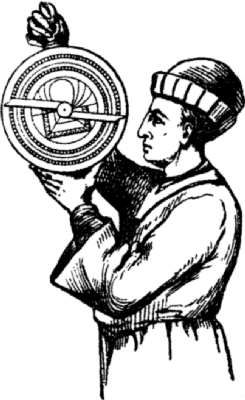
OBSERVATION WITH THE CROSSBOW. (Jurien de la Gravière.)
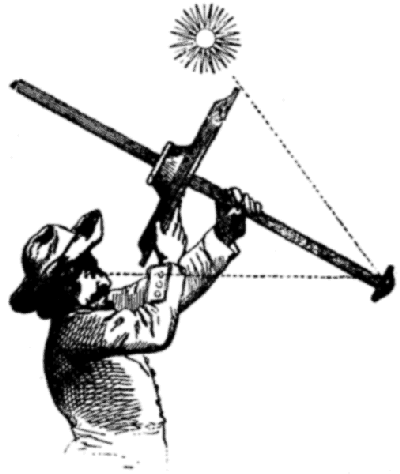
The Beglerbeg lost no time in repairing the damage of the Spaniards. He reinforced his garrisons along the coast, at Meliana, Shershēl, Tinnis, and Mustaghānim, and struck up alliances with the great Arab tribes of the interior. An armada of some fifty men-of-war and transports, including eight galleys-royal, under the command of Admiral Don Hugo de Moncada, in vain landed an army of veterans on the Algerine strand—they were driven back in confusion, and one of those storms, for which the coast bears so evil a name, finished the work of Turkish steel (1519). One after the other, the ports and strongholds of Middle Barbary fell into the Corsair’s hands: Col, Bona, Constantine, owned the sway of Kheyr-ed-dīn Barbarossa, who was now free to resume his favourite occupation of scouring the seas in search of Christian quarry. Once or twice in every year he would lead out his own eighteen stout galleots, and call to his side other daring spirits whom the renown of his name had drawn from the Levant, each with his own swift cruiser manned by stout arms and the pick of Turkish desperadoes. There you might see him surrounded by captains who were soon to be famous wherever ships were to be seized or coasts harried;—by Dragut, Sālih Reïs, Sinān the “Jew of Smyrna,” who was suspected of black arts because he could take a declination with the crossbow, and that redoubtable rover Aydīn Reïs, whom the Spaniards dubbed Cachadiablo, or “Drub-devil,” though he had better been named Drub-Spaniard. The season for cruising began in May, and lasted till the autumn storms warned vessels to keep the harbours, or at least to attempt no distant expeditions. During the summer months the Algerine galleots infested every part of the Western Mediterranean, levied contributions of slaves and treasure upon the Balearic Isles and the coasts of Spain, and even passed beyond the straits to waylay the argosies which were returning to Cadiz laden with the gold and jewels of the Indies. Nothing was safe from their attacks; not a vessel ran the gauntlet of the Barbary coast in her passage from Spain to Italy without many a heart quaking within her. The “Scourge of Christendom” had begun, which was to keep all the nations of Europe in perpetual alarm for three centuries. The Algerine Corsairs were masters of the sea, and they made their mastery felt by all who dared to cross their path; and not merchantmen only, but galleys-royal of his Catholic Majesty learnt to dread the creak of the Turkish rowlock.
One day in 1529 Kheyr-ed-dīn despatched his trusty lieutenant “Drub-Devil” with fourteen galleots to make a descent upon Majorca and the neighbouring islands. No job could be more suited to the Corsair’s taste, and Sālih Reïs, who was with him, fully shared his enjoyment of the task. The pair began in the usual way by taking several prizes on the high seas, dropping down upon the islands and the Spanish coasts, and carrying off abundance of Christians to serve at the oar, or to purchase their liberty with those pieces-of-eight which never came amiss to the rover’s pockets. Tidings reaching them of a party of Moriscos who were eager to make their escape from their Spanish masters, and were ready to pay handsomely for a passage to Barbary. “Drub-Devil” and his comrades landed by night near Oliva, embarked two hundred families and much treasure, and lay-to under the island of Formentara. Unfortunately General Portundo, with eight Spanish galleys, was just then on his way back from Genoa, whither he had conveyed Charles V. to be crowned Emperor by the Pope at Bologna; and, being straightway informed of the piratical exploit which had taken place, bore away for the Balearic Isles in hot pursuit. “Drub-Devil” hastily landed his Morisco friends, to be the better prepared to fight or run, for the sight of eight big galleys was more than he had bargained for; but to his surprise the enemy came on, well within gun-shot, without firing a single round. Portundo was anxious not to sink the Turks, for fear of drowning the fugitive Moriscos, whom he supposed to be on board, and for whose recapture he was to have ten thousand ducats; but the Corsairs imputed his conduct to cowardice, and, suddenly changing their part from attacked to attackers, they swooped like eagles upon the galleys, and after a brisk hand-to-hand combat, in which Portundo was slain, they carried seven of them by assault, and sent the other flying at topmost speed to Iviça. This bold stroke brought to Algiers, besides the Moriscos, who had watched the battle anxiously from the island, many valuable captives of rank, and released hundreds of Moslem galley-slaves from irons and the lash.[11] “Drub-Devil” had a splendid reception, we may be sure, when the people of Algiers saw seven royal galleys, including the capitana, or flagship, of Spain, moored in their roads; and it is no wonder that with such triumphs the new Barbary State flourished exceedingly.
Fortified by a series of unbroken successes, Kheyr-ed-dīn at last ventured to attack the Spanish garrison, which had all this time affronted him at the Peñon de Alger. It was provoking to be obliged to beach his galleots a mile to the west, and to drag them painfully up the strand; and the merchantmen, moored east of the city, were exposed to the weather to such a degree as to imperil their commerce. Kheyr-ed-dīn resolved to have a port of his own at Algiers, with no Spanish bridle to curb him. He summoned Don Martin de Vargas to surrender, and, on his refusal, bombarded the Peñon day and night for fifteen days with heavy cannon, partly founded in Algiers, partly seized from a French galleon, till an assault was practicable, when the feeble remnant of the garrison was quickly overpowered and sent to the bagnios. The stones of the fortress were used to build the great mole which protects Algiers harbour on the west, and for two whole years the Christian slaves were laboriously employed upon the work.
To aggravate this disaster, a curious sight was seen a fortnight after the fall of the Peñon. Nine transports, full of men and ammunition for the reinforcement of the garrison, hove in sight, and long they searched to and fro for the well-known fortress they had come to succour. And whilst they marvelled that they could not discover it, out dashed the Corsairs in their galleots and light shebēks, and seized the whole convoy, together with two thousand seven hundred captives and a fine store of arms and provisions.[12]
Everything that Kheyr-ed-dīn took in hand seemed to prosper. His fleet increased month by month, till he had thirty-six of his own galleots perpetually on the cruise in the summer season; his prizes were innumerable, and his forces were increased by the fighting men of the seventy thousand Moriscos whom he rescued, in a series of voyages, from servitude in Spain. The waste places of Africa were peopled with the industrious agriculturists and artisans whom the Spanish Government knew not how to employ. The foundries and dockyards of Algiers teemed with busy workmen. Seven thousand Christian slaves laboured at the defensive works and the harbour; and every attempt of the Emperor to rescue them and destroy the pirates was repelled with disastrous loss.
FOOTNOTES:


VI.
THE OTTOMAN NAVY.
1470-1522.
No one appreciated better the triumphs of the Beglerbeg of Algiers than Sultan Suleymān. The Ottomans, as yet inexperienced in naval affairs, were eager to take lessons. The Turkish navy had been of slow growth, chiefly because in early days there were always people ready to act as sailors for pay. When Murād I. wished to cross from Asia to Europe to meet the invading army of Vladislaus and Hunyady, the Genoese skippers were happy to carry over his men for a ducat a head, just to spite their immemorial foes the Venetians, who were enlisted on the other side. It was not till the fall of Constantinople gave the Turks the command of the Bosphorus that Mohammed II. resolved to create for himself a naval power.
That fatal jealousy between the Christian States which so often aided the progress of the Turks helped them now. The great commercial republics, Genoa and Venice, had long been struggling for supremacy on the sea. Venice held many important posts among the islands of the Archipelago and on the Syrian coast, where the Crusaders had rewarded her naval assistance with the gift of the fortress of Acre. Genoa was stronger in the Black Sea and Marmora, where, until the coming of the Turks, her colony at Galata was little less than an Oriental Genoa. The Genoese tower is still seen on the steep slope of Pera, and Genoese forts are common objects in the Bosphorus, and in the Crimea, where they dominate the little harbour of Balaklava. The Sea of Marmora was the scene of many a deadly contest between the rival fleets. In 1352, under the walls of Constantinople, the Genoese defeated the combined squadrons of the Venetians, the Catalonians, and the Greeks. But next year the Bride of the Sea humbled the pride of Genoa in a disastrous engagement off Alghero; and in 1380, when the Genoese had gained possession of Chioggia and all but occupied Venice itself, the citizens rose like one man to meet the desperate emergency, and not only repulsed, but surrounded the invaders, and forced them to capitulate. From this time Genoa declined in power, while Venice waxed stronger and more haughty. The conquest of Constantinople by the Turks, followed rapidly by the expulsion of the Genoese from Trebizond, Sinope, Kaffa, and Azov, was the end of the commercial prosperity of the Ligurian Republic in the East. The Black Sea and Marmora were now Turkish lakes. The Castles of the Dardanelles, mounted with heavy guns, protected any Ottoman fleet from pursuit; and though Giacomo Veniero defiantly carried his own ship under fire through the strait and back again with the loss of only eleven men, no one cared to follow his example.
AN ADMIRAL’S GALLEY. (Furttenbach, Architectura Navalis, 1629.)
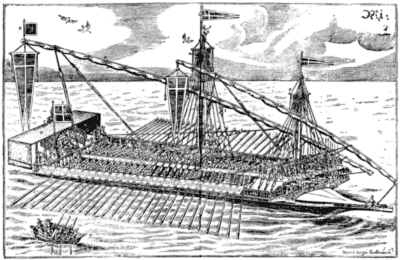
When Mohammed II. issued forth with a fleet of one hundred galleys and two hundred transports, carrying seventy thousand troops, and ravished the Negropont away from Venice in 1470, he had only to repass the Hellespont to be absolutely safe. All that the Venetian admirals, the famous Loredani, could do was to retaliate upon such islands of the Archipelago as were under Turkish sway and ravage the coasts of Asia Minor. Superior as they were to the Turks in the building and management of galleys, they had not the military resources of their foe. Their troops were mercenaries, not to be compared with the Janissaries and Sipāhis, though the hardy Stradiotes from Epirus, dressed like Turks, but without the turban, of whom Othello is a familiar specimen, came near to rivalling them. On land, the Republic could not meet the troops of the Grand Signior, and after her very existence had been menaced by the near approach of a Turkish army on the banks of the Piave[13] (1477), Venice made peace, and even, it is said, incited the Turks to the capture of Otranto. The Ottoman galleys were now free of the Adriatic, and carried fire and sword along the Italian coast, insomuch that whenever the crescent was seen at a vessel’s peak the terrified villagers fled inland, and left their homes at the mercy of the pirates. The period of the Turkish Corsairs had already begun.
There was another naval power to be reckoned with besides discredited Genoa and tributary Venice. The Knights Hospitallers of Jerusalem, driven from Smyrna (in 1403) by Timur, had settled at Rhodes, which they hastened to render impregnable. Apparently they succeeded, for attack after attack from the Mamlūk Sultans of Egypt failed to shake them from their stronghold, whence they commanded the line of commerce between Alexandria and Constantinople, and did a brisk trade in piracy upon passing vessels. The Knights of Rhodes were the Christian Corsairs of the Levant; the forests of Caramania furnished them with ships, and the populations of Asia Minor supplied them with slaves. So long as they roved the seas the Sultan’s galleys were ill at ease. Even Christian ships suffered from their high-handed proceedings, and Venice looked on with open satisfaction when, in 1480, Mohammed II. despatched one hundred and sixty ships and a large army to humble the pride of the Knights. The siege failed, however; D’Aubusson, the Grand Master, repulsed the general assault with furious heroism, and the Turks retired with heavy loss.[14]
Finding that the Ottomans were not quite invincible, Venice plucked up heart, and began to prepare for hostilities with her temporary ally. The interval of friendliness had been turned to good account by the Turks. Yāni, the Christian shipbuilder of the Sultan, had studied the improvements of the Venetians, and he now constructed two immense kokas, seventy cubits long and thirty in the beam, with masts of several trees spliced together, measuring four cubits round. Forty men in armour might stand in the maintop and fire down upon the enemy. There were two decks, one like a galleon’s deck, and the other like a galley, each with a big gun on either side. Four-and-twenty oars a side, on the upper deck, were propelled each by nine men. Boats hung from the stern; and the ship’s complement consisted (so says Hājji Khalīfa)[15] of two thousand soldiers and sailors. Kemāl Reïs and Borāk Reïs commanded these two prodigies, and the whole fleet, numbering some three hundred other vessels, was despatched to the Adriatic under the command of Daūd Pasha. The object of attack was Lepanto.
Towards the end of July, 1499, they sighted the Venetian fleet, which was on the look-out for them, off Modon. They counted forty-four galleys, sixteen galleasses, and twenty-eight ordinary sail. Neither courted an action, which each knew to be fraught with momentous consequences. Grimani, the Venetian admiral, retired to Navarino; the Turks anchored off Sapienza. On August 12th Daūd Pasha, who knew the Sultan was awaiting him with the land forces at Lepanto, resolved to push on at all costs. In those days Turkish navigators had little confidence in the open sea; they preferred to hug the shore, where they might run into a port in case of bad weather. Daūd accordingly endeavoured to pass between the island of Prodano and the Morea, just north of Navarino. Perfectly aware of his course, the Venetians had drawn out their fleet at the upper end of the narrow passage, where they had the best possible chance of catching the enemy in confused order. The Proveditore of Corfu, Andrea Loredano, had reinforced the Christian fleet that very day with ten ships; the position was well chosen; the wind was fair, and drove full down upon the Turks as they emerged from the strait. But the Venetian admiral placed his chief reliance in his galleasses, and as yet the art of manoeuvring sailing vessels in battle array was in its youth. Bad steering here, a wrong tack there, and then ship ran against ship, the great galleasses became entangled and helpless, carried by the wind into the midst of the enemy, or borne away where they were useless, and the Turkish galleys had it all their own way. Loredano’s flagship burnt down to the water, and other vessels were destroyed by fire. Yāni’s big ships played an important part in the action. Two galleasses, each containing a thousand men, and two other vessels, surrounded Borāk Reïs, but the smaller ships could not fire over the koka’s lofty sides, and were speedily sunk. Borāk Reïs threw burning pitch into the galleasses, and burnt up crews and ships, till, his own vessel catching fire, he and other notable captains, after performing prodigies of valour, perished in the flames. Wherefore the island of Prodano is by the Turks called Borāk Isle to this day.[16] To the Christians the action was known as “the deplorable battle of Zonchio,” from the name of the old castle of Navarino, beneath which it was fought.
GALLEASSE. (Furttenbach, Architectura Navalis, 1620.)
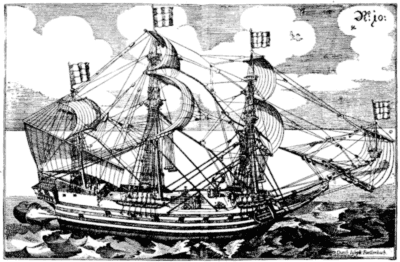
In spite of his success at Zonchio, Daūd Pasha had still to fight his way up to Lepanto. The Venetians had collected their scattered fleet, and had been reinforced by their allies of France and Rhodes; it was clear they were bent on revenge. The Turks hugged the land, dropped anchor at night, and kept a sharp look-out. It was a perpetual skirmish all the way. The Venetians tried to surprise the enemy at their moorings, but they were already at sea, and squally weather upset Grimani’s strategy and he had the mortification of seeing his six fire-ships burning innocuously with never a Turk the worse. Again and again it seemed impossible that Daūd could escape, but Grimani’s Fabian policy delivered the enemy out of his hands, and when finally the Turkish fleet sailed triumphantly into the Gulf of Patras, where it was protected by the Sultan’s artillery at Lepanto, the Grand Prior of Auvergne, who commanded the French squadron, sailed away in disgust at the pusillanimity of his colleague. Lepanto fell, August 28th; and Grimani was imprisoned, nominally for life, for his blundering: nevertheless, after twenty-one years he was made Doge.[17]
Venice never recovered from her defeat. The loss of Lepanto and the consequent closing of the gulfs of Patras and Corinth were followed by the capture of Modon, commanding the strait of Sapienza: the east coast of the Adriatic and Ionian seas was no longer open to Christian vessels. The Oriental trade of the republic was further seriously impaired by the Turkish conquest of Egypt (1517),[18] which deprived her of her most important mart; and the discovery of the New World brought Spanish traders into successful competition with her own. Venice indeed was practically an Oriental city; her skilled workmen learned their arts in Egypt and Mesopotamia; her bazaars were filled with the products of the East, with the dimity and other cloths and silks and brocades of Damietta, Alexandria, Tinnis, and Cairo, cotton from Ba’lbekk, silk from Baghdād, atlas satin from Ma’din in Armenia; and she introduced to Europe not only the products of the East, but their very names. Sarcenet is Saracen stuff; tabby is named after a street in Baghdād where watered silk was made; Baldacchini are simply “Baldac,” i.e., Baghdād, canopies; samite is Shāmī, “Syrian,” fabric; the very coat of the Egyptian, the jubba, is preserved in giuppa, jupe.[19] With the loss of her Oriental commerce, which the hostility of the Turks involved, Venice could no longer hold her own. She bowed to her fate and acknowledged the Turkish supremacy by sea as well as by land. She even paid the Sultan tribute for the island of Cyprus. When Suleymān the Magnificent succeeded Selīm and took Belgrade (1521), Venice hastily increased her payment and did homage for Zante as well. So meek had now become the Bride of the Sea.
Turkey still suffered the annoyance of the Rhodian Corsairs, and till they were removed her naval supremacy was not complete. Genoa and Venice had been humbled: the turn of the Knights of St. John was come. Selīm had left his son, the great Suleymān, the legacy of a splendid fleet, prepared for this very enterprize. One hundred and three swift galleys, thirty-five galleasses, besides smaller craft, and 107 transports, “naves, fustes, mahones, tafforées, galions, et esquirasses,”[20] formed a noble navy, and Rhodes fell, after an heroic defence, at the close of 1522. For six months the Knights held out, against a fleet which had swollen to four hundred sail and an army of over a hundred thousand men commanded by the Sultan in person. It was a crisis in the history of Europe: the outpost of Christendom was at bay. The Knights realized their duty nobly, but they had the best engineers in the world against them, and all the resources of a now mighty empire, wielded by a master-mind. Suleymān surrounded the city with his works, and made regular approaches for his advancing batteries and mines; yet at the end of a month not a wall was down, and the eight bastions of the eight Tongues of the Order—the English, French, Spanish, Italian, Portuguese, German, Provençal, and Auvergnat—were so far unmoved. Gabriel Martinego of Candia superintended the countermines with marked success.[21] At last the English bastion was blown up; the Turks swarmed to the breach, and were beaten back with a loss of two thousand men. A second assault failed, but on September 24th they succeeded in getting a foothold, and the destruction of the Spanish, Italian, and Provençal bastions by the Turkish mines and the consequent exposure of the exhausted garrison rendered the defence more and more perilous. The Ottoman army too was suffering severely, from disease, as well as from the deadly weapons of the Knights, and in the hope of sparing his men Suleymān offered the garrison life and liberty if they would surrender the city. At first they proudly rejected the offer, but within a fortnight, finding their ammunition exhausted and their numbers sadly thinned, on December 21st they begged the Sultan to repeat his conditions, and, with an honourable clemency, Suleymān let them all depart unmolested in his own ships to such ports in Europe as seemed best to them.[22]
The fall of Rhodes removed the last obstacle to the complete domination of the Ottoman fleet in the eastern basin of the Mediterranean. Henceforward no Christian ship was safe in those waters unless by the pleasure of the Sultan. The old maritime Republics were for the time reduced to impotence, and no power existed to challenge the Ottoman supremacy in the Aegean, Ionian, and Adriatic Seas.
Almost at the same time the brothers Barbarossa had effected a similar triumph in the west. The capture of Algiers and the firm establishment of various strong garrisons on the Barbary coast had given the Turkish Corsairs the command of the western basin of the Mediterranean. Suleymān the Magnificent saw the necessity of combination; he knew that Kheyr-ed-dīn could teach the Stambol navigators and ship-builders much that they ought to learn; his Grand Vezīr Ibrahīm strenuously urged a closer relation between the Turkish powers of the east and west; and Kheyr-ed-dīn received the Imperial command to present himself at Constantinople.
FOOTNOTES:


VII.
DORIA AND BARBAROSSA.
1533.
Kheyr-ed-dīn was in no hurry to visit the Sublime Porte. He had to provide for the safety and government of Algiers during his absence, when exposed to the dangers both of foreign attack and internal intrigue. He had to reckon with the galleys of the Knights of St. John, who, after wandering homeless for a longer time than was at all creditable to that Christendom which they had so heroically defended at Rhodes, had finally settled in no less convenient a spot than Malta, whence they had every opportunity of harassing the operations of the Corsairs (1530). Moreover Andrea Doria was cruising about, and he was not the sort of opponent Barbarossa cared to meet by hazard. The great Genoese admiral considered it a personal duel with Kheyr-ed-dīn. Each held the supreme position on his own side of the water. Both were old men and had grown old in arms. Born in 1468, of a noble Genoese family, Doria was sixty-five years of age, of which nearly fifty had been spent in warfare. He had been in the Pope’s guard, and had seen service under the Duke of Urbino and Alfonso of Naples, and when he was over forty he had taken to the sea and found himself suddenly High Admiral of Genoa (1513). His appointment to the command of his country’s galleys was due to his zealous services on shore, and not to any special experience of naval affairs; indeed the commander of the galleys was as much a military as a naval officer. Doria, however, late as he adopted his profession, possessed undoubted gifts as a seaman, and his leadership decided which of the rival Christian Powers should rule the Mediterranean waves. He devoted his sword to France in 1522, when a revolution overthrew his party in his own republic; and so long as he was on the French side the command of the sea, so far as it did not belong to the Barbary Corsairs, belonged to France. When in 1528 he judged himself and his country ill-used by Francis I., he carried over his own twelve galleys to the side of Charles V.; and then the Imperial navies once more triumphed. Doria was the arbiter of fortune between the contending states. Doria was the liberator of Genoa, and, refusing to be her king, remained her idol and her despot. No name struck such terror into the hearts of the Turks; many a ship had fallen a prey to his devouring galleys, and many a Moslem slave pulled at his oars or languished in Genoese prisons. Officially an admiral, he was at the same time personally a Corsair, and used his private galleys to increase his wealth.
Kheyr-ed-dīn’s fame among Christians and Turks alike was at least as great and glorious as his rival’s. He had driven the Spaniards out of Algiers and had inflicted incalculable injuries upon the ships and shores of the Empire. Though the two had roved the same sea for twenty years, they had never met in naval combat: perhaps each had respected the other too much to risk an encounter. Long ago, when Kheyr-ed-dīn was unknown to fame, Doria had driven him from the Goletta (1513); and in 1531 the Genoese admiral made a descent upon Shershēl, which Kheyr-ed-dīn had been strengthening, to the great detriment and anxiety of the opposite coast of Spain. The Imperialists landed in force, surprised the fort, and liberated seven hundred Christian slaves. Then, contrary to orders and heedless of the signal gun which summoned them on board, the soldiery dispersed about the town in search of pillage, and, being taken at a disadvantage by the Turks and Moriscos of the place, were driven in confusion down to the beach, only to perceive Doria’s galleys rapidly pulling away. Nine hundred were slaughtered on the seashore and six hundred made prisoners. Some say that the admiral intended to punish his men for their disobedience; others that he sighted Kheyr-ed-dīn’s fleet coming to the rescue. At all events he drew off, and the two great rivals did not meet. The Genoese picked up some Barbary vessels on his way home to console him for his failure.
ANDREA DORIA.
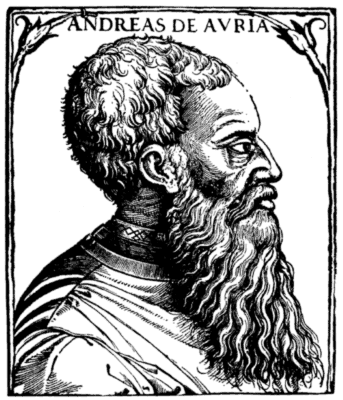
In the following year he retrieved his fame by a brilliant expedition to the coasts of Greece. With thirty-five sail and forty-eight galleys he attacked Coron, by way of making a diversion while Sultan Suleymān was invading Hungary,[23] and after a heavy bombardment succeeded in landing his men on the curtain of the fort. The Turkish garrison was spared and marched out, and Mendoza was left in command, while Doria bore up to Patras and took it, occupied the castles which guard the Gulf of Corinth, and returned in triumph to Genoa before the Turkish fleet could come up with him. This was in September, 1532. In the following spring a yet more daring feat was accomplished. Coron was running short of supplies, and a Turkish fleet blockaded the port. Nevertheless Cristofero Pallavicini carried his ship in, under cover of the castle guns, and encouraged the garrison to hold out; and Doria, following in splendid style, fought his way in, notwithstanding that half his fleet, being sailing galleons, became becalmed in the midst of the Turkish galleys, and had to be rescued in the teeth of the enemy. Lutfi Pasha was outmanoeuvred and defeated. This revictualling of Coron, says Admiral Jurien de la Gravière, was one of the skilfullest naval operations of the sixteenth century.[24]
It was clear that, while Doria had effected almost nothing against the Barbary Corsairs, he always mastered the Turks. The Sultan was eager to discover Kheyr-ed-dīn’s secret of success, and counted the days till he should arrive in the Golden Horn. The Corsair, for his part, had heard enough of Doria’s recent exploits to use more than his habitual caution, and he was not disposed to cheapen his value in the Sultan’s eyes by a too precipitate compliance with his Majesty’s command. At last, in August, 1533, having appointed Hasan Aga, a Sardinian eunuch, in whom he greatly confided, to be viceroy during his absence, Kheyr-ed-dīn set sail from Algiers with a few galleys; and after doing a little business on his own account—looting Elba and picking up some Genoese corn-ships—pursued his way, passing Malta at a respectful distance, and coasting the Morea, till he dropped anchor in the Bay of Salonica.[25] By his route, which touched Santa Maura and Navarino, he appears to have been looking for Doria, in spite of the smallness of his own force (which had, however, been increased by prizes); but, fortunately, perhaps, for the Corsair, the Genoese admiral had returned to Sicily, and the two had missed each other on the way.
Soon the eyes of the Sultan were rejoiced with the sight of a Barbary fleet, gaily dressed with flags and pennons, rounding Seraglio Point, and, in perfect order, entering the deep water of the Golden Horn; and presently Kheyr-ed-dīn and his eighteen captains were bowing before the Grand Signior, and reaping the rewards due to their fame and services. It was a strange sight that day at Eski Serai,[26] and the divan was crowded. The tried generals and statesmen of the greatest of Ottoman emperors assembled to gaze upon the rough sea-dogs whose exploits were on the lips of all Europe; and most of all they scrutinized the vigorous well-knit yet burly figure of the old man with the bushy eyebrows and thick beard, once a bright auburn, but now hoary with years and exposure to the freaks of fortune and rough weather. In his full and searching eye, that could blaze with ready and unappeasable fury, they traced the resolute mind which was to show them the way to triumphs at sea, comparable even to those which their victorious Sultan had won before strong walls and on the battle plain. The Grand Vezīr Ibrahīm recognized in Kheyr-ed-dīn the man he needed, and the Algerine Corsair was preferred before all the admirals of Turkey, and appointed to reconstruct the Ottoman navy. He spent the winter in the dockyards, where his quick eye instantly detected the faults of the builders. The Turks of Constantinople, he found, knew neither how to build nor how to work their galleys.[27] Theirs were not so swift as the Christians’; and instead of turning sailors themselves, and navigating them properly, they used to kidnap shepherds from Arcadia and Anatolia, who had never handled a sail or a tiller in their lives, and entrust the navigation of their galleys to these inexperienced hands.[28] Kheyr-ed-dīn soon changed all this. Fortunately there were workmen and timber in abundance, and, inspiring his men with his own marvellous energy, he laid out sixty-one galleys during the winter, and was able to take the sea with a fleet of eighty-four vessels in the spring. The period of Turkish supremacy on the sea dates from Kheyr-ed-dīn’s winter in the dockyards.
FOOTNOTES:
VIII.
TUNIS TAKEN AND LOST.
1534-1535.
The dwellers on the coasts of Italy soon discovered the new spirit in the Turkish fleet; they had now to dread Corsairs on both hands, east as well as west. In the summer of 1534 Kheyr-ed-dīn led his new fleet of eighty-four galleys forth from the Golden Horn, to flesh their appetite on a grand quest of prey. Entering the Straits of Messina, he surprised Reggio, and carried off ships and slaves; stormed and burnt the castle of S. Lucida next day, and took eight hundred prisoners; seized eighteen galleys at Cetraro; put Sperlonga to the sword and brand, and loaded his ships with wives and maidens. A stealthy inland march brought the Corsairs to Fondi, where lay Giulia Gonzaga, the young and beautiful widow of Vespasio Colonna, Duchess of Trajetto and Countess of Fondi. She was sister to the “heavenly Joanna of Aragon,” on whose loveliness two hundred and eighty Italian poets and rimesters in vain exhausted the resources of several languages;—a loveliness shared by the sister whose device was the “Flower of Love” amaranth blazoned on her shield. This beauty Kheyr-ed-dīn destined for the Sultan’s harem, and so secret were the Corsairs’ movements that he almost surprised the fair Giulia in her bed. She had barely time to mount a horse in her shift and fly with a single attendant,—whom she afterwards condemned to death, perhaps because the beauty revealed that night had made him overbold.[29] Enraged at her escape the pirates made short work of Fondi; the church was wrecked, and the plundering went on for four terrible hours, never to be forgotten by the inhabitants.
Refreshed and excited by their successful raid, the Turks needed little encouragement to enter with heartiness upon the real object of the expedition, which was nothing less than the annexation of the kingdom of Tunis. Three centuries had passed since the Sultans of the race of Hafs had established their authority on the old Carthaginian site, upon the breaking up of the African empire of the Almohades. Their rule had been mild and just; they had maintained on the whole friendly relations with the European powers, and many treaties record the fair terms upon which the merchants of Pisa, Venice, and Genoa were admitted to the port of Tunis. Saint Louis had been so struck with the piety and justice of the king that he had even come to convert him, and had died in the attempt. Twenty-one rulers of their line had succeeded one another, till the vigour of the Benī Hafs was sapped, and fraternal jealousies added bloodshed to weakness. Hasan, the twenty-second, stepped to the throne over the bodies of forty-four slaughtered brothers, and when he had thus secured his place he set a pattern of vicious feebleness for all sovereigns to avoid. A rival claimant served as the Corsair’s pretext for invasion, and Kheyr-ed-dīn had hardly landed when this miserable wretch fled the city, and though supported by some of the Arab tribes he could make no head against the Turkish guns. Tunis, like Algiers, had been added to the Ottoman Empire, against its will, and by the same masterful hands. It may be doubted whether the Sultan’s writ would have run in either of his new provinces had their conqueror gainsaid it.
TUNIS, 1566. (From a Map in the British Museum.)
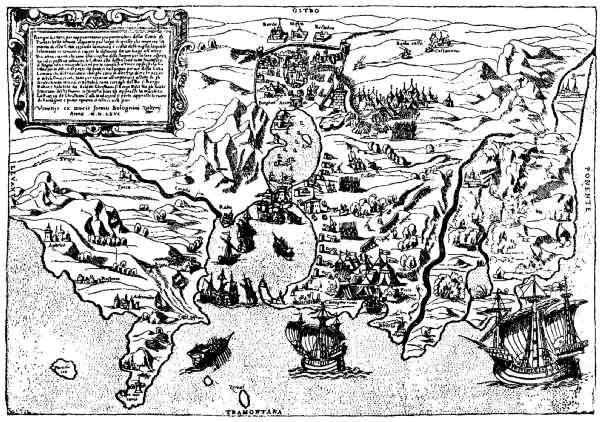
Tunis did not long remain in the possession of Barbarossa. The banished king appealed to Charles V., and, whatever the emperor may have thought of Hasan’s wrongs, he plainly perceived that Barbarossa’s presence in Tunis harbour was a standing menace to his own kingdom of Sicily. It was bad enough to see nests of pirates perched upon the rocks of the Algerine coast; but Tunis was the key of the passage from the west to the eastern basin of the Mediterranean, and to leave it in the Corsairs’ hands was to the last degree hazardous. Accordingly he espoused the cause of Hasan, and at the end of May, 1535, he set sail from Barcelona with six hundred ships commanded by Doria (who had his own grudge to settle), and carrying the flower of the Imperial troops, Spaniards, Italians, and Germans. In June he laid siege to the Goletta—or halk-el-wēd, “throat of the torrent,” as the Arabs called it—those twin towers a mile asunder which guarded the channel of Tunis. The great carack St. Ann, sent, with four galleys, by “the Religion” (so the Knights of Malta styled their Order), was moored close in, and her heavy cannon soon made a breach, through which the Chevalier Cossier led the Knights of St. John, who always claimed the post of danger, into the fortress, and planted the banner of “the Religion” on the battlements[30] (14 July). Three desperate sallies had the besieged made under the leadership of Sinān the Jew; three Italian generals of rank had fallen in the melley; before they were driven in confusion back upon the city of Tunis, leaving the Goletta with all its stores of weapons and ammunition, and its forty guns, some of them famous for their practice at the siege of Rhodes, and more than a hundred vessels, in the hands of the enemy. Barbarossa came out to meet the emperor at the head of nearly ten thousand troops; but his Berbers refused to fight, the thousands of Christian slaves in the Kasaba (or citadel), aided by treachery, broke their chains and shut the gates behind him; and, after defending his rampart as long as he could, the Corsair chief, with Sinān and Aydīn “Drub-Devil,” made his way to Bona, where he had fortunately left fifteen of his ships. The lines of Kheyr-ed-dīn’s triple wall may still be traced across the neck of land which separates the lake of Tunis from the Mediterranean. Fifteen years ago this rampart was cut through, when nearly two hundred skeletons, some Spanish money, cannon balls, and broken weapons were found outside it.[31]
For three days Charles gave up the city of Tunis to the brutality of his soldiers. They were days of horrible license and bloodshed. Men, women, and children were massacred, and worse than massacred, in thousands. The infuriated troops fought one with the other for the possession of the spoil, and the luckless Christians of the Kasaba were cut down by their deliverers in the struggle for Kheyr-ed-dīn’s treasures. The streets became shambles, the houses dens of murder and shame: the very Catholic chroniclers admit the abominable outrages committed by the licentious and furious soldiery of the great Emperor. It is hard to remember that almost at the very time when German and Spanish and Italian men-at-arms were outraging and slaughtering helpless, innocent people in Tunis, who had taken little or no hand in Kheyr-ed-dīn’s wars and had accepted his authority with reluctance, the Grand Vezīr Ibrahīm was entering Baghdād and Tebrīz as a conqueror at the head of wild Asiatic troops, and not a house nor a human being was molested. Fas est et ab hoste doceri.
So far as Tunis was concerned the expedition of Charles V. was fruitless. Before he sailed in August he made a treaty with Hasan, which stipulated for tribute to Spain, the possession of the Goletta by the crown of Castile, the freeing of Christian slaves, the cessation of piracy, and the payment of homage by an annual tribute of six Moorish barbs and twelve falcons; and he and the Moor duly swore it on Cross and sword. But the treaty was so much parchment wasted. No Moslem prince who had procured his restoration by such means as Hasan had used, who had spilt Moslem blood with Christian weapons and ruined Moslem homes by the sacrilegious atrocities of “infidel” soldiers, and had bound himself the vassal of “idolatrous” Spain, could hope to keep his throne long. He was an object of horror and repulsion to the people upon whom he had brought this awful calamity, and so fierce was their scorn of the traitor to Islam that the story is told of a Moorish girl in the clutch of the soldiers, who, when the restored King of Tunis sought to save her, spat in his face; anything was better than the dishonour of his protection. Hasan pretended to reign for five years, but the country was in arms, holy Kayrawān would have nothing to say to a governor who owed his throne to infidel ravishers; Imperial troops in vain sought to keep him there; Doria himself succeeded only for a brief while in reducing the coast towns to the wretched prince’s authority; and in 1540 Hasan was imprisoned and blinded by his son Hamīd, and none can pity him. The coast was in the possession of the Corsairs, and, as we shall see, even the Spaniards were forced ere long to abandon the Goletta.
Nevertheless, the expedition to Tunis was a feat of which Europe was proud. Charles V. seldom suffered from depreciation of his exploits, and, as Morgan quaintly says, “I have never met with that Spaniard in my whole life, who, I am persuaded, would not have bestowed on me at least forty Boto a Christo’s, had I pretended to assert Charles V. not to have held this whole universal globe in a string for four-and-twenty hours; and then it broke: though none had ever the good nature or manners to inform or correct my ignorance in genuine history, by letting me into the secret when that critical and slippery period of time was.”[32] Naturally admirers so thoroughgoing made the most of the conquest of Tunis, the reduction of the formidable Goletta, the release of thousands of Christian captives, and, above all, the discomfiture of that scourge of Christendom, Barbarossa himself. Poets sang of it, a painter-in-ordinary depicted the siege, a potter at Urbino burnt the scene into his vase; all Europe was agog with enthusiasm at the feat. Charles posed as a crusader and a knight-errant, and commemorated his gallant deeds and those of his gentlemen by creating a new order of chivalry, the Cross of Tunis, with the motto “Barbaria,” of which however we hear no more. Altogether “it was a famous victory.”
The joy of triumph was sadly marred by the doings of Kheyr-ed-dīn. That incorrigible pirate, aware that no one would suspect that he could be roving while Charles was besieging his new kingdom, took occasion to slip over to Minorca with his twenty-seven remaining galleots; and there, flying Spanish and other false colours, deceived the islanders into the belief that his vessels were part of the Armada; upon which he rowed boldly into Port Mahon, seized a rich Portuguese galleon, sacked the town, and, laden with six thousand captives and much booty and ammunition, led his prize back in triumph to Algiers. In the meanwhile Doria was assiduously hunting for him with thirty galleys, under the emperor’s express orders to catch him dead or alive. The great Genoese had to wait yet three years for his long-sought duel.
Having accomplished its object, the Armada, as usual, broke up without making a decisive end of the Corsairs. Kheyr-ed-dīn, waiting at Algiers in expectation of attack, heard the news gladly, and, when the coast was clear, sailed back to Constantinople for reinforcements. He never saw Algiers again.
FOOTNOTES:

IX.
THE SEA-FIGHT OFF PREVESA.
1537.
When Barbarossa returned to Constantinople Tunis was forgotten and Minorca alone called to mind: instead of the title of Beglerbeg of Algiers, the Sultan saluted him as Capudan Pasha or High Admiral of the Ottoman fleets. There was work to be done in the Adriatic, and none was fitter to do it than the great Corsair. Kheyr-ed-dīn had acquired an added influence at Stambol since the execution of the Grand Vezīr Ibrahīm,[33] and he used it in exactly the opposite direction. Ibrahīm, a Dalmatian by birth, had always striven to maintain friendly relations with Venice, his native state, and for more than thirty years there had been peace between the Republic and the Porte. Barbarossa, on the contrary, longed to pit his galleys against the most famous of the maritime nations of the Middle Ages, and to make the Crescent as supreme in the waters of the Adriatic as it was in the Aegean. Francis I. was careful to support this policy out of his jealousy of the Empire. The Venetians, anxious to keep on good terms with the Sultan, and to hold a neutral position between Francis and Charles V., found themselves gradually committed to a war, and by their own fault. Their commanders in the Adriatic and at Candia were unable to resist the temptation of chasing Ottoman merchantmen. Canale, the Proveditore of Candia, caught a noted Corsair, the “Young Moor of Alexander,” as his victims called him, sunk or captured his galleys, killed his Janissaries, and severely wounded the young Moor himself;—and all this in Turkish waters, on Turkish subjects, and in time of peace. Of course when the too gallant Proveditore came to his senses and perceived his folly, he patched the young Moor’s wounds and sent him tenderly back to Algiers: but the Sultan’s ire was already roused, and when Venetian galleys actually gave chase to a ship that carried a Turkish ambassador, no apologies that the Signoria offered could wipe out the affront. War was inevitable, and Venice hastily made common cause with the Pope and the Emperor against the formidable host which now advanced upon the Adriatic.
Before this, some stirring actions had been fought off the coasts of Greece. Doria, sallying forth from Messina, had met the governor of Gallipoli off Paxos, and had fought him before daybreak. Standing erect on the poop, conspicuous in his cramoisy doublet, the tall figure of the old admiral was seen for an hour and a half directing the conflict, sword in hand, an easy mark for sharpshooters, as a wound in the knee reminded him. After a severe struggle the twelve galleys of the enemy were captured and carried in triumph to Messina. Barbarossa was sorely wanted now, and in May, 1537, he sailed with one hundred and thirty-five galleys to avenge the insult. For a whole month he laid waste the Apulian coast like a pestilence, and carried off ten thousand slaves, while Doria lay helpless with a far inferior force in Messina roads. The Turks were boasting that they might soon set up a Pope of their own, when the war with Venice broke out, and they were called off from their devastation of Italy by the Sultan’s command to besiege Corfu. The Ionian islands were always a bone of contention between the Turks and their neighbours, and a war with Venice naturally began with an attack upon Corfu. The Senate had shut its eyes as long as possible to the destination of the huge armaments which had left Constantinople in the spring: Tunis, or perhaps Naples, was said to be their object. But now they were undeceived, and on the 25th of August, Captain Pasha Barbarossa landed twenty-five thousand men and thirty cannon under Lutfi Pasha, three miles from the castle of Corfu. Four days later the Grand Vezīr Ayās, with twenty-five thousand more and a brilliant staff, joined the first-comers, and the Akinji or light troops spread fire and sword around. A fifty-pounder fired nineteen shots in three days, but only five struck the fortress: the Turks fired too high, and many of their missiles fell harmlessly into the sea beyond. In spite of storm and rain the Grand Vezīr would not desist from making the round of the trenches by night. Suleymān offered liberal terms of capitulation, but the besieged sent back his messenger with never an answer. Alexandro Tron worked the big guns of the castle with terrible precision. Two galleys were quickly sunk, four men were killed in the trenches by a single shot—a new and alarming experience in those early days of gunnery—four times the Fort of St. Angelo was attacked in vain; winter was approaching, and the Sultan determined to raise the siege. In vain Barbarossa remonstrated: “A thousand such castles were not worth the life of one of his brave men,” said the Sultan, and on the 17th of September the troops began to re-embark.[34]
Then began a scene of devastation such as the isles of Greece have too often witnessed,—not from Turks only, but from Genoese and Venetians, who also came to the Archipelago for their oarsmen,—but never perhaps on so vast a scale. Butrinto was burnt, Paxos conquered, and then Barbarossa carried fire and sword throughout the Adriatic and the Archipelago. With seventy galleys and thirty galleots, he raged among the islands, most of which belonged to noble families of Venice—the Venieri, Grispi, Pisani, Quirini. Syra, Skyros, Aegina, Paros, Naxos, Tenos, and other Venetian possessions were overwhelmed, and thousands of their people carried off to pull a Turkish oar. Naxos contributed five thousand dollars as her first year’s tribute; Aegina furnished six thousand slaves. Many trophies did Barbarossa bring home to Stambol, whose riches certainly did his own and the Sultan’s, if not “the general coffer, fill.” Four hundred thousand pieces of gold, a thousand girls, and fifteen hundred boys, were useful resources when he returned to “rub his countenance against the royal stirrup.”[35] Two hundred boys in scarlet, bearing gold and silver bowls; thirty more laden with purses; two hundred with rolls of fine cloth: such was the present with which the High Admiral approached the Sultan’s presence.
Suleymān’s genius was at that time bent upon three distinct efforts: he was carrying on a campaign in Moldavia; his Suez fleet—a novelty in Ottoman history—was invading the Indian Ocean, with no very tangible result, it is true (unless a trophy of Indian ears and noses may count), save the conquest of Aden on the return voyage, but still a notable exploit, and disturbing to the Portuguese in Gujerat; and his High Admiral was planning the destruction of the maritime power of Venice.
In the summer of 1538, Barbarossa put off to sea, and soon had one hundred and fifty sail under his command. He began by collecting rowers and tribute from the islands, twenty-five of which had now been transferred from the Venetian to the Turkish allegiance, and then laid waste eighty villages in Candia. Here news was brought that the united fleet of the Emperor, Venice, and the Pope was cruising in the Adriatic, and the Captain Pasha hastened to meet it. The pick of the Corsairs was with him. Round his flagship were ranged the galleys of Dragut, Murād Reïs, Sinān, Sālih Reïs with twenty Egyptian vessels, and others, to the number of one hundred and twenty-two ships of war. The advance guard sighted part of the enemy off Prevesa—a Turkish fortress opposite the promontory of Arta or Actium, where Antony suffered his memorable defeat.
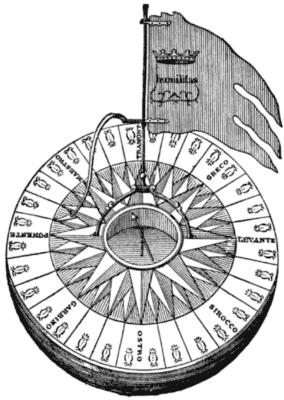
COMPASS OF THE SIXTEENTH CENTURY. (Jurien de la Gravière.)
The Christian strength was really overwhelming. Eighty Venetian, thirty-six Papal, and thirty Spanish galleys, together with fifty sailing galleons, made up a formidable total of nearly two hundred ships of war, and they carried scarcely less than sixty thousand men, and two thousand five hundred guns. Doria was in chief command, and Capello and Grimani led the Venetian and Roman contingents. Barbarossa had fortunately received but an imperfect report of the enemy’s strength and so boldly pursued his northerly course up the Adriatic. When he reached Prevesa, the combined fleets had gone on to Corfu, and he was able to enter unopposed the spacious gulf of Arta, where all the navies of the world might safely anchor and defy pursuit.
On September 25th, the allied fleets appeared off the entrance to the gulf, and then for the first time Barbarossa realized his immense good fortune in being the first in the bay. Outnumbered as he was, a fight in the open sea might have ended in the total destruction of his navy; but secure in an ample harbour, on a friendly coast, behind a bar which the heavier vessels of the enemy could not cross, he could wait his opportunity and take the foe at a disadvantage. The danger was that Doria might disembark his guns and attack from the shores of the gulf, and to meet this risk some of the Turkish captains insisted on landing their men and trying to erect earthworks for their protection; but the fire from the Christian ships soon stopped this manoeuvre. Barbarossa had never expected Doria to hazard a landing, and he was right. The old admiral of Charles V. was not likely to expose his ships to the risk of a sally from the Turks just when he had deprived them of the men and guns that could alone defend them.
The two fleets watched each other warily. Doria and Barbarossa had at last come face to face for a great battle, but, strange as it may seem, neither cared to begin: Barbarossa was conscious of serious numerical inferiority; Doria was anxious for the safety of his fifty big sailing vessels, on the heavy artillery of which he most relied, but which a contrary wind might drive to destruction on the hostile coast. As it was, his guideship on the extreme left had but a fathom of water under her keel. Each felt keenly the weighty responsibility of his position, and even the sense that now at last the decisive day of their long rivalry had come could not stir them from their policy of prudence. Moreover, it was no longer a question of the prowess of hot-blooded youth: Doria and Barbarossa and Capello were all men of nearly seventy years, and Doria was certainly not the man he once was; politics had spoilt him.
So the two great admirals waited and eyed each other’s strength. Will Barbarossa come out? Or must Doria risk the passage of the bar and force his way in to the encounter? Neither event happened: but on the morning of the 27th the Corsairs rubbed their eyes to feel if they were asleep, as they saw the whole magnificent navy of Christendom, anchor a-peak, sailing slowly and majestically—away! Were the Christians afraid? Anyhow no one, not even Barbarossa, could hold the Turks back now. Out they rushed in hot pursuit, not thinking or caring—save their shrewd captain—whether this were not a feint of Doria’s to catch them in the open. “Get into line,” said Barbarossa to his captains, “and do as you see me do.” Dragut took the right wing, Sālih Reïs the left. Early on the 28th the Christian fleet was discovered at anchor, in a foul wind, off Santa Maura, thirty miles to the south. Doria was not at all prepared for such prompt pursuit, and eyed with anxiety the long battle line of one hundred and forty galleys, galleots, and brigantines, bearing down upon him before the wind. His ships were scattered, for the sails could not keep up with the oars, and Condulmiero’s huge Venetian carack was becalmed off Zuara, a long way behind, and others were in no better plight. Three hours Doria hesitated, and then gave the order to sail north and meet the enemy. Condulmiero was already fiercely engaged, and soon his carack was a mere unrigged helmless waterlog, only saved from instant destruction by her immense size and terrific guns, which, well aimed, low on the water, to gain the ricochet, did fearful mischief among the attacking galleys. Two galleons were burnt to the water’s edge, and their crews took to the boats; a third, Boccanegra’s, lost her mainmast, and staggered away crippled. What was Doria about? The wind was now in his favour; the enemy was in front: but Doria continued to tack and manoeuvre at a distance. What he aimed at is uncertain: his colleagues Grimani and Capello went on board his flagship, and vehemently remonstrated with him, and even implored him to depart and let them fight the battle with their own ships, but in vain. He was bent on tactics, when what was needed was pluck; and tactics lost the day. The Corsairs took, it is true, only seven galleys and sailing vessels, but they held the sea. Doria sailed away in the evening for Corfu, and the whole allied fleet followed in a gale of wind.[36]
OBSERVATION WITH THE ASTROLABE. (Jurien de la Gravière.)
So, after all, the great duel was never fairly fought between the sea-rivals. Barbarossa was willing, but Doria held back: he preferred to show his seamanship instead of his courage. The result was in effect a victory, a signal victory, for the Turks. Two hundred splendid vessels of three great Christian states had fled before an inferior force of Ottomans; and it is no wonder that Sultan Suleymān, when he learnt the news at Yamboli, illuminated the town, and added one hundred thousand aspres a year to the revenues of the conqueror. Barbarossa had once more proved to the world that the Turkish fleet was invincible. The flag of Suleymān floated supreme in all the waters of the Mediterranean Sea.
FOOTNOTES:

X.
BARBAROSSA IN FRANCE.
1539-1546.
Barbarossa’s life was drawing to a close, but in the eight years that remained he enhanced his already unrivalled renown. His first exploit after Prevesa was the recapture of Castelnuovo, which the allied fleets had seized in October, as some compensation on land for their humiliation at sea. The Turkish armies had failed to recover the fortress in January, 1539; but in July Barbarossa went to the front as usual, with a fleet of two hundred galleys, large and small, and all his best captains; and, after some very pretty fighting in the Gulf of Cattaro, landed eighty-four of his heaviest guns and bombarded Castelnuovo, from three well-placed batteries. On August 7th, a sanguinary assault secured the first line of the defences; three days later the governor, Don Francisco Sarmiento, and his handful of Spaniards, surrendered to a final assault, and were surprised to find themselves chivalrously respected as honourable foes. Three thousand Spaniards had fallen, and eight thousand Turks, in the course of the siege.
One more campaign and Barbarossa’s feats are over. Great events were happening on the Algerine coasts, where we must return after too long an absence in the Levant and Adriatic: but first the order of years must be neglected that we may see the last of the most famous of all the Corsairs. To make amends for the coldness of Henry VIII., Francis I. was allied with the other great maritime power, Turkey, against the Emperor, in 1543; and the old sea rover actually brought his fleet of one hundred and fifty ships to Marseilles. The French captains saluted the Corsair’s capitana, and the banner of Our Lady was lowered to be replaced by the Crescent. Well may a French admiral call this “the impious alliance.” On his way Barbarossa enjoyed a raid in quite his old style; burnt Reggio and carried off the governor’s daughter; appeared off the Tiber, and terrified the people of Cività Vecchia; and in July entered the Gulf of Lyons in triumph. Here he found the young Duke of Enghien, François de Bourbon, commander of the French galleys, who received him with all honour and ceremony.
GALLEY AT ANCHOR. (Jurien de la Gravière.)
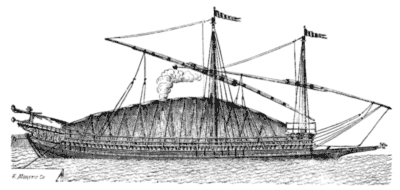
Barbarossa had hardly arrived when he discovered that his great expedition was but a fool’s errand. The King of France was afraid of attempting a serious campaign against the Emperor, and he was already ashamed of his alliance with the Musulmans: his own subjects—nay, all Europe—were crying shame. Barbarossa grew crimson with fury, and tore his white beard: he had not come with a vast fleet all the way from Stambol to be made a laughing-stock. Something must evidentially be done to satisfy his honour, and Francis I. unwillingly gave orders for the bombardment of Nice. Accompanied by a feeble and ill-prepared French contingent, which soon ran short of ammunition—“Fine soldiers,” cried the Corsair, “to fill their ships with wine casks, and leave the powder barrels behind!”—Barbarossa descended upon the Gate of Italy. The city soon surrendered, but the fort held out, defended by one of those invincible foes of the Turk, a Knight of Malta, Paolo Simeoni, who had himself experienced captivity at the hands of Barbarossa; and as the French protested against sacking the town after capitulation on terms, and as Charles’s relieving army was advancing, the camps were broken up in confusion, and the fleets retired from Nice.
The people of Toulon beheld a strange spectacle that winter. The beautiful harbour of Provence was allotted to the Turkish admiral for his winter quarters. There, at anchor, lay the immense fleet of the Grand Signior; and who knew how long it might dominate the fairest province of France? There, turbaned Musulmans paced the decks and bridge, below and beside which hundreds of Christian slaves sat chained to the bench and victims to the lash of the boatswain. Frenchmen were forced to look on, helplessly, while Frenchmen groaned in the infidels’ galleys, within the security of a French port. The captives died by hundreds of fever during that winter, but no Christian burial was allowed them—even the bells that summon the pious to the Mass were silenced, for are they not “the devil’s musical instrument”?[37]—and the gaps in the benches were filled by nightly raids among the neighbouring villages. It was ill sleeping around Toulon when the Corsair press-gangs were abroad. And to feed and pay these rapacious allies was a task that went near to ruining the finances of France.
The French were not satisfied of the Corsair’s fidelity, and it must be added that the Emperor might have had some reason to doubt the honesty of Doria. The two greatest admirals of the age were both in the Western Mediterranean, but nothing could tempt them to come to blows. The truth was that each had a great reputation to lose, and each preferred to go to his grave with all his fame undimmed. Francis I. had a suspicion that Barbarossa was meditating the surrender of Toulon to the Emperor, and, improbable as it was, some colour was given to the King’s anxiety by the amicable relations which seemed to subsist between the Genoese Corsair and his Barbary rival. Doria gave up the captive Dragut to his old captain for a ransom of three thousand gold crowns—a transaction on which he afterwards looked back with unqualified regret. The situation was growing daily more unpleasant for France. From his easy position in Toulon, Barbarossa sent forth squadrons under Sālih Reïs and other commanders to lay waste the coasts of Spain, while he remained “lazily engaged in emptying the coffers of the French king.”
At last they got rid of him. Francis was compelled to furnish the pay and rations of the whole crews and troops of the Ottoman fleet up to their re-entry into the Bosphorus; he had to free four hundred Mohammedan galley slaves and deliver them to Barbarossa; he loaded him with jewellery, silks, and other presents; the Corsair departed in a Corsair’s style, weighed down with spoil. His homeward voyage was one long harrying of the Italian coasts; his galley sailed low with human freight; and his arrival at Constantinople was the signal for the filling of all the harems of the great pashas with beautiful captives. Barbarossa, laden with such gifts, was sure of his welcome.
Two years later he died, in July, 1546, an old man of perhaps near ninety, yet without surviving his great fame. “Valorous yet prudent, furious in attack, foreseeing in preparation,” he ranks as the first sea captain of his time. “The chief of the sea is dead,” expressed in three Arabic words, gives the numerical value 953, the year of the Hijra in which Kheyr-ed-dīn Barbarossa died.
Long afterwards no Turkish fleet left the Golden Horn without her crew repeating a prayer and firing a salute over the tomb at Beshiktash, where lie the bones of the first great Turkish admiral.
FOOTNOTE:
XI.
CHARLES AT ALGIERS.
1541.
When Barbarossa left Algiers for ever in 1535 to become the High Admiral of the Ottoman Empire, the Corsairs lost indeed their chief; but so many of his captains remained behind that the game of sea roving went on as merrily as ever. Indeed so fierce and ruthless were their depredations that the people of Italy and Spain and the islands began to regret the attentions of so gentlemanly a robber as Barbarossa. His successor or viceroy at Algiers was a Sardinian renegade, Hasan the Eunuch; but the chief commanders at sea were Dragut, Sālih Reïs, Sinān, and the rest, who, when not called to join the Captain Pasha’s fleet, pursued the art of piracy from the Barbary coast. Dragut (properly Torghūd) worked measureless mischief in the Archipelago and Adriatic, seized Venetian galleys and laid waste the shores of Italy, till he was caught by Giannettino Doria, nephew of the great admiral, while unsuspectingly engaged in dividing his spoils on the Sardinian coast (1540). Incensed to find his vast empire perpetually harassed by foes so lawless and in numbers so puny, Charles the Emperor resolved to put down the Corsairs’ trade once and for ever. He had subdued Tunis in 1535, but piracy still went on. Now he would grapple the head and front of the offence, and conquer Algiers.
He had no fears of the result; the Corsair city would fall at the mere sight of his immense flotilla; and in this vainglorious assurance he set out in October, 1541. He even took Spanish ladies on board to view his triumph. The season for a descent on the African coast was over, and every one knew that the chance of effecting anything before the winter storms should guard the coast from any floating enemy was more than doubtful; but “the Spaniards commonly move with gravity”; and besides, Charles had been delayed during a busy summer by his troubles in Germany and Flanders, and could not get away before.
Now at last he was free; and, in spite of the earnest remonstrances of Doria and the entreaties of the Pope, to Algiers he would go. Everything had long been prepared—a month, he believed, at the outside would finish the matter—in short, go he would. At Spezzia he embarked on Doria’s flagship; the Duke of Alva, of sanguinary memory, commanded the troops, many of whom had been brought by the Emperor himself from the German highlands. Ill-luck attended them from the outset: a storm, no unusual phenomenon with November coming on, drove the ships back into shelter at Corsica. At length the seas subsided, and the fleet, picking up allies as it went along, cautiously hugged the land as far as Minorca, where the mistral, the terror of seamen, rushed down upon the huge armada—masts strained, yards cracked, sails were torn to rags, and there was nothing for it but to row—row for their lives and for Charles. They were but seven miles from Port Mahon, yet it took half the night to win there—an endless night which the panting crews never forgot.
In the bay of Palma, at Majorca, the fleet was assembled. There were the Emperor’s hundred sailing vessels carrying the German and Italian troops, commanded by such historic names as Colonna and Spinosa; there were Fernando Gonzago’s Sicilian galleys, and a hundred and fifty transports from Naples and Palermo; there were the fifty galleys of Bernadino de Mendoza, conveying two hundred transports with the arms and artillery, and carrying the corps of gentlemen adventurers, mustered from the chivalry of Spain, and including one only who had climbed up from the ranks—but that one was Cortes, the conqueror of Mexico. Over five hundred sail, manned by twelve thousand men, and carrying a land force of twenty-four thousand soldiers, entered the roads of Algiers on October 19, 1541.
SIEGE OF ALGIERS, 1541. (From a map in the British Museum.)
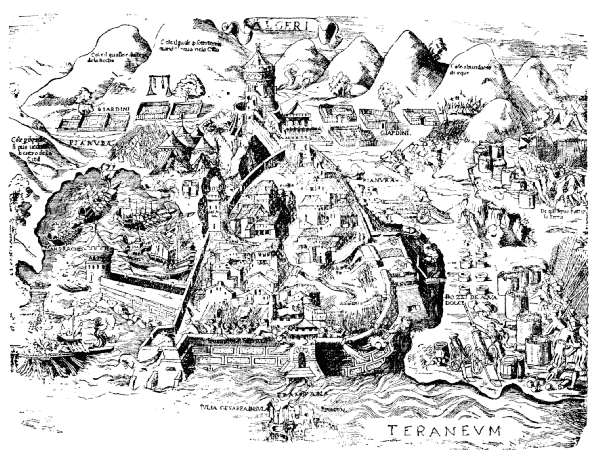
At last the great Emperor set eyes upon the metropolis of piracy. On the rocky promontory which forms the western crest of the crescent bay, high up the amphitheatre of hills, tier upon tier, in their narrow overshadowed lanes, the houses of the Corsairs basked in the autumn sun, crowned by the fortress which had known the imperious rule of two Barbarossas. On the right was the mole which Spanish slaves had built out of the ruins of the Spanish fort. Two gates fronted the south and north, the Bab Azūn and Bab-el-Wēd.
Avoiding the promontory of Cashina, the galleys, with furled sails, drew up before the low strand, backed by stretches of luxuriant verdure, south of the city, and out of range, at the spot which is still called the “Jardin d’essai.” A heavy swell prevented their landing for three days, but on the 23rd, in beautiful weather, the troops disembarked. The Berbers and Arabs, who had lined the shore and defied the invaders, hastily retired before the guns of the galleys, and the Spaniards landed unopposed. The next day they began the march to the city some few miles off. The Spaniards formed the left wing on the hill side; the Emperor and the Duke of Alva with the German troops composed the centre; the Italians and one hundred and fifty knights of Malta marched on the right by the seashore. Driving back the straggling bands of mounted Arabs, who ambushed among the rocks and ravines, and picked off many of the Christians, the invaders pushed steadily on, till Algiers was invested on all sides save the north. Its fate appeared sealed. A brief bombardment from Charles’s heavy cannon, and the Spaniards would rush the breach and storm the citadel. Hasan Aga, within, with only eight hundred Turks, and perhaps five thousand Arabs and Moors, must almost have regretted the proud reply he had just made to the Emperor’s summons to surrender.
Then, when the end seemed close at hand, the forces of Nature came to the rescue. The stars in their courses fought for Algiers: the rains descended and the winds blew and beat upon that army, till the wretched soldiers, with neither tents nor cloaks, with barely food—for the landing of the stores had hardly begun—standing all night knee-deep in slush in that pinguid soil, soaked to the skin, frozen by the driving rain and bitter wind, were ready to drop with exhaustion and misery. When morning dawned they could scarcely bear up against the blustering gale; their powder was wet; and a sudden sally of the Turks spread a panic in the sodden ranks which needed all the courage and coolness of the Knights of Malta to compose. At last the enemy was driven out of the trenches and pursued, skirmishing all the way, to the Bab Azūn. It looked as though pursuers and pursued would enter together; but the gate was instantly shut, and a daring Knight of Malta had barely struck his dagger in the gate to defy the garrison, when the Christians found themselves under so heavy a fire from the battlements, that they were forced to beat a retreat: the Knights of Malta, last of all, their scarlet doublets shining like a fresh wound, and their faces to the foe, covered the retreat.
Hasan then led out his best horsemen from the gate, and driving their heels into their horses’ flanks, the cloud of Moslems poured down the hill. The Knights of Malta bore the shock with their iron firmness, though they lost heavily. The Italians ran for their lives. The Germans whom Charles hurriedly despatched to the rescue came back at the double without drawing a sword. The Emperor himself put on his armour, spurred his charger into the midst of the fugitives, sword in hand, and with vehement reproaches succeeded in shaming them into fight. “Come, gentlemen,” then said he to the nobles around, “forwards!” And thus he led his dispirited troops once more to the field; this time the panic alarm of the rank and file was controlled and banished by the cool courage of the cavaliers, and the Turks were driven back into the town. The skirmish had cost him three hundred men and a dozen Knights of Malta. All that day the Emperor and his officers, great signiors all, stood at arms in the pouring rain, with the water oozing from their boots, vigilantly alert.
Had Charles now run his ships ashore at all hazard, and dragged up his heavy siege train and stores and tents and ammunition, all might yet have been won. But several precious days were wasted, and on the morning of the 25th such a storm sprang up as mortal mariner rarely encountered even off such a coast—a violent north-easterly hurricane—still known in Algiers as “Charles’s gale”—such as few vessels cared to ride off a lee shore. The immense flotilla in the bay was within an ace of total destruction. Anchors and cables were powerless to hold the crowded, jostling ships. One after the other they broke loose, and keeled over to the tempest till their decks were drowned in the seas. Planks gaped; broadside to broadside the helpless hulks crashed together. Many of the crews threw themselves madly on shore. In six hours one hundred and fifty ships sank. The rowers of the galleys, worn out with toiling at the oar, at last succumbed, and fifteen of the vessels ran on shore, only to be received by the Berbers of the hills, who ran their spears through the miserable shipwrecked sailors as soon as they gained the land.