STARS ON THE FLAG.
Reading edition
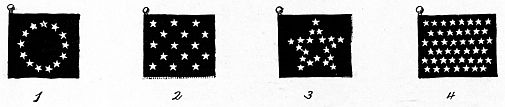
The Home Magazine contains the following beautiful suggestion regarding the placing of the stars on the flag:
Number 1 is the field of our first stars and stripes made by Betsy Ross.
Number 2 represents that field of flag of 1814 which inspired the “Star Spangled Banner.”
Number 3 the field of 1818 designed by Capt. S. C. Reid.
Number 4, field of our present flag.
Although there is no law saying who shall arrange the stars on our flag, or how they shall be arranged, it is customary for the changes to be made in the war department when new states have been admitted to the Union.
The incongruous variations in figures A, B, C, which are reproductions of unions taken from new flags, made by different manufacturers, would not exist if there was a law fixing the arrangement of the stars.
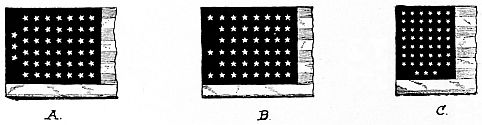
It is believed by many that the stars on our flag should be arranged into a permanent and symmetrical form, fixed by law, instead of the present changeable and uncertain form, which is subject in a great measure, to the caprice or convenience of the flag maker. It is not generally known that among the many flags in use in our country to-day, there is an utter lack of uniformity in the arrangement of the stars.
In the selection of a form, three different things should be considered—its historical significance, symmetry, and adaptability. The stars should be so arranged that it will not be necessary to make any noticeable change when new ones are added. The stars should always remain equal in size, representing the equality of the states.
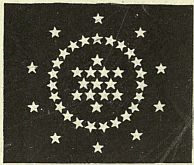
In the form which is submitted, No. 8, with the group of thirteen stars in the center, representing the thirteen original states, they are arranged in exactly the same form as they appear on the great seal of the United States. The circle containing twenty-three stars, represents the states which were admitted to the Union up to the close of the civil war. These two features are symbolic of the two great events in the nation’s history—the one which brought our flag into existence, and the other which made its life permanent by welding the sisterhood of states into a perfect and indestructible union. The circle is also symbolic of unity, peace, and preservation.
The outside circle of nine stars, represents the states which have been added to the Union since the civil war. New stars can be added to this circle without changing the symmetry of the arrangement, as will be seen by reference to the illustration. As this circle will always remain an open one, there will always be room for one more star, and it is thus significant of progression.
One great advantage in this form is, that it is suggestive of a constellation, and thus carries out, as far as practicable, the idea of the framers of the resolution of 1777 in establishing the flag.
John F. Earhart is the author of the above description of the different forms of flags.
THE LIBERTY CAP.
The historians who have searched the archives of ancient and medieval times tell us that this has been a symbol of liberty since the Phrygians made the conquest of the eastern part of Asia Minor.
After the conquest they stamped it on their coins, and to distinguish themselves from the primitive peoples they used the liberty cap as a head dress. The Romans used a small red cap called a “pileus,” which they placed on the head of a slave in making him free, and when Caesar was murdered a Phrygian cap was carried through the streets of Rome proclaiming the liberty of the people. The liberty cap of the English is blue with a white border.
It remained for the United States to adopt the British cap, adding to it the crescent of thirteen stars. Generals Lee and Schuyler, with the Philadelphia Light Horse troop, adopted it in 1775. This is the famous troop that escorted Washington to New York.
It is most familiar to us as seen on our coins, on which it was first used after the Revolution as a symbol of freedom.
Edward Everett Hale, in one of his impressive orations, says: “The starry banner speaks for itself; its mute eloquence needs no aid to interpret its significance. Fidelity to the Union blazes from its stars; allegiance to the government beneath which we live is wrapped in its folds.”
The Stars and Stripes was officially first unfolded over Ft. Schuyler, a military port in New York state, now the city of Rome, Oneida county. It was first saluted on the sea by a foreign power, when floating from the masthead of the Ranger, Capt. Paul Jones commanding, at Quiberon Bay, France, February 14, 1778. The salute was given by Admiral La Motte, representing the French government.
The first vessel over which the Union flag floated was the ship Ranger, built at Portsmouth, New Hampshire, whose gallant commander was the famous Paul Jones.
Its first trip around the world was on the ship Columbia, which left Boston September 30, 1787, commanded by Captains Kendrick and Gray. It was three years then in circling the globe. To-day it waves in every clime, on every sea.
It is pleasing to note how Franklin, when minister to France, secured the ship Doria from the French and gave to Paul Jones the command, who immediately renamed the old ship “Bon homme Richard,” in honor of Franklin.
ORIGIN OF “OLD GLORY.”
The term Old Glory is said to have been originated by an old sailor—Stephen Driver.
While upon the seas he performed an act of bravery for which he was rewarded by the gift of an American flag, whereupon he pledged its givers to always defend it faithfully.
At the outbreak of the civil war he was living in Nashville, Tenn.
In order to keep the flag safely he concealed it in a bed-quilt under which he slept. To the enemies of the Union he declared that Old Glory would yet float from the staff of the Tennessee state house, and sure enough when Nashville fell into the hands of Gen. Buell he secured the flag from its hiding place and hoisted it to a more fitting position on the state house—thus his nick-name for it became popular.
JOHN JAY AT MOUNT KISCO, JULY 4, 1861.
He said, “Swear anew and teach the oath to our children, that with God’s help the American Republic shall stand unmoved though all the powers of piracy and European jealousy should combine to overthrow it. That we shall have in the future as we have had in the past, one country, one constitution, one destiny; and that when we shall have passed from earth, and the acts of to-day shall be matters of history, and the dark power which sought our overthrow shall have been overthrown, our sons may gather strength from our example in every contest with despotism that time may have in store to try their virtue, and that they may rally under the Stars and Stripes with our old time war cry,
“‘Liberty and Union, now and forever, one and inseparable.’”
UNCLE SAM.
This term originated at the time of our war with England in 1812. Provisions were purchased at Troy, N. Y., and the agent was Elbert Anderson, the work being superintended by Ebenezer and Samuel Wilson, the packages being marked E. A. U. S. Samuel Wilson was known all over as Uncle Sam and he was often joked about his amount of provisions, then the newspapers took it up and the term Uncle Sam came into general use and is typical of our increasing national prosperity. Quite recently a portrait of an actual personage whose features are identical with those made familiar by caricatures of Uncle Sam, was found in possession of a family near Toledo, Ohio. The portrait was painted about 1818, but nothing is known of the shrewd, kindly old man represented. His face was undoubtedly the origin of the accepted caricature.
BROTHER JONATHAN.
Jonathan Trumbull, governor of Connecticut, was a warm friend of General Washington, who had great confidence in his judgment.
When in need of ammunition and the question arose as to where they could get the necessary means for defense Washington said: “We will consult Brother Jonathan.”
After that whenever they needed help the expression became a common one and naturally came to mean the United States Government.
THE AMERICAN EAGLE.
Our bald headed eagle, so called because the feathers on the top of the head are white, was named the Washington eagle by Audubon. Like Washington it was brave and fearless, and as his name and greatness is known the world over, so the greatest of birds can soar to the heights beyond all others.
In 1785 it became the emblem of the United States.
It is used on the tips of flag staffs, on coins, on the United States seals, and on the shield of liberty.