COLONIAL AND PATRIOTIC MUSIC.
Reading edition
The colonial music was mostly borrowed and adapted to the occasion. The Pilgrims had more important duties to perform and in those years of stirring events no one was in a mood to write music.
The first song to be used was that old and familiar one, “Yankee Doodle.” It made a powerful rallying cry in calling to arms against England. It is so old that it is impossible to decide just where the term came from.
It has been traced back to Greece—“Iankhe Doule,” meaning “Rejoice, O Slave,” and to the Chinese—“Yong Kee,” meaning “Flag of the Ocean.” It is said the Persians called Americans “Yanki Doon’iah,” “Inhabitants of the New World.” The Indians too, come in for their share of the credit of originating the term, as the Cherokee word “Eankke,” which means “coward” and “slave,” was often bestowed upon the inhabitants of New England.
At the time of the uprising against Charles the First, Oliver Cromwell rode into Oxford, on an insignificant little horse, wearing a single plume in a knot called a “macaroni.” The song was sung derisively by the cavaliers at that time. The tune is said to have come from Spain or France, there being several versions of the words.
It came into play when our ancestors flocked into Ticonderoga in answer to the call of Abercrombie. At that early day no one refused, but all answered the call and came equipped as best they could, but hardly any two alike, and to the trained English regulars must have presented a ridiculous appearance. Dr. Shamburg changed the words of the old satire to fit the new occasion. But in less than a year it was turned by the Yankees against the English in the form of a rallying cry and possessed new meaning.
History had emphasized it, and with the accompaniment of the shrill pipe and half worn drum calling the simple cottagers together, it must have aroused all their noble and sturdy patriotism.
Who that has viewed that stirring picture in the Corcoran Art Gallery at Washington, “Yankee Doodle,” could fail to catch the inspiration of the scene. The old man with his thin grey locks, but head erect and face glowing with enthusiasm as he keeps time to the old tune, followed by the small boy with his drum. One scarcely knows whether humor or pathos predominates: but certain we are that all alike stepped to its chords; it found an answering echo in each heart and led them on to glory.
YANKEE DOODLE.
Father and I went down to camp. Along with Captain Goodwin, And there we saw the men and boys As thick as hasty pudding. CHORUS. Yankee Doodle, keep it up. Yankee doodle dandy; Mind the music and the step. And with the girls be handy. And there was Captain Washington, Upon a slapping stallion. A giving orders to his men. I guess there was a million.—Cho. And then the feathers on his hat. They looked so tarnal finey, I wanted peskily to get To give to my Jemima.—Cho. And there they had a swamping gun. As big as a log of maple, On a duced little cart, A load for father’s cattle.—Cho. And every time they fired it off It took a horn of powder; It made a noise like father’s gun, Only a nation louder.—Cho. I went as near to it myself As Jacob’s underpinin’, And father went as near again, I th’t the duce was in him.—Cho. It scared me so, I ran the streets, Nor stopped as I remember, Till I got home and safely locked In granny’s little chamber.—Cho. And there I see a little keg. Its heads were made of leather; They knocked upon it with little sticks To call the folks together.—Cho. And then they’d fife away like fun And play on corn-stalk fiddles; And some had ribbons red as blood All bound around their middles.—Cho. The troopers, too, would gallop up, And fire right in our faces; It scared me almost to death To see them run such races.—Cho. Uncle Sam came there to change Some pancakes and some onions, For ’lasses cake to carry home To give his wife and young ones.—Cho. But I can’t tell you half I see, They keep up such a smother: So I took off my hat, made a bow, And scampered off to mother.—Cho.
AMERICA.
Rev. Samuel Francis Smith was born in Boston October 21, 1808, and graduated in the class of ’29 from Harvard University. He enjoyed the honor of having for his classmate Oliver Wendell Holmes, in whose beautiful poem, entitled “The Boys,” the name of the author of “America” is affectionately mentioned.
And there’s a nice youngster of excellent pith; Fate tried to conceal him by naming him Smith. But he shouted a song for the brave and the free, Just read on his medal—“My Country of Thee”!
“America” was written in 1832, the tune being the old one of “God Save the Queen,” and first rendered on the 4th of July of the same year by the children of Park St. Church, Boston.
AMERICA.
My country, ’tis of thee, Sweet land of liberty, Of thee I sing! Land where my fathers died, Land of the pilgrims’ pride, From every mountain side Let freedom ring. My native country, thee— Land of the noble free, Thy name I love. I love thy rocks and rills, Thy woods and templed hills. My heart with rapture thrills Like that above. Let music swell the breeze And ring from all the trees Sweet Freedom’s song! Let mortal tongues awake, Let all that breathe partake, Let rocks their silence break, The sound prolong. Our fathers’ God, to thee, Author of Liberty! To Thee we sing: Long may our land be bright With freedom’s holy light, Protect us by Thy might, Great God, our king!
Peace follows where it finds the Old Thirteen, the nucleus around which the other stars have gathered in their glory.
—Letitia Green Stevenson, Honorary Vice President General National Society, Daughters of the American Revolution.
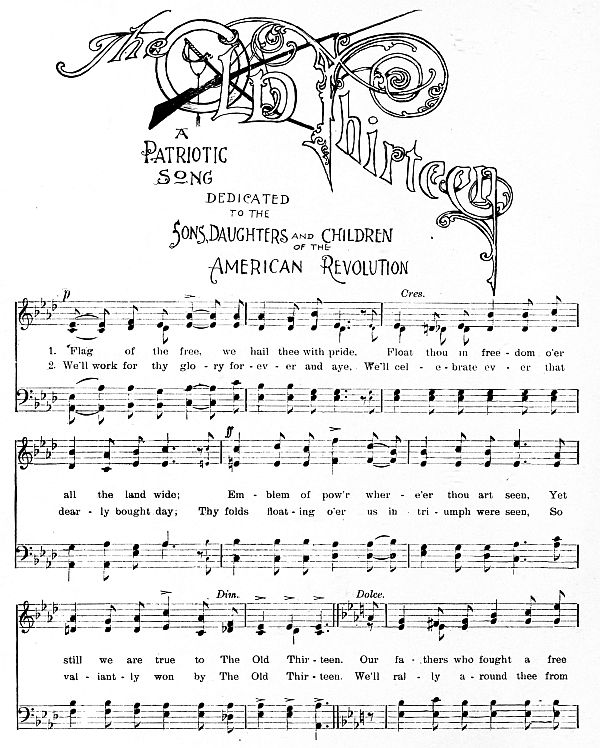
The Old Thirteen
A Patriotic Song DEDICATED TO THE Sons, Daughters and CHILDREN OF THE American Revolution
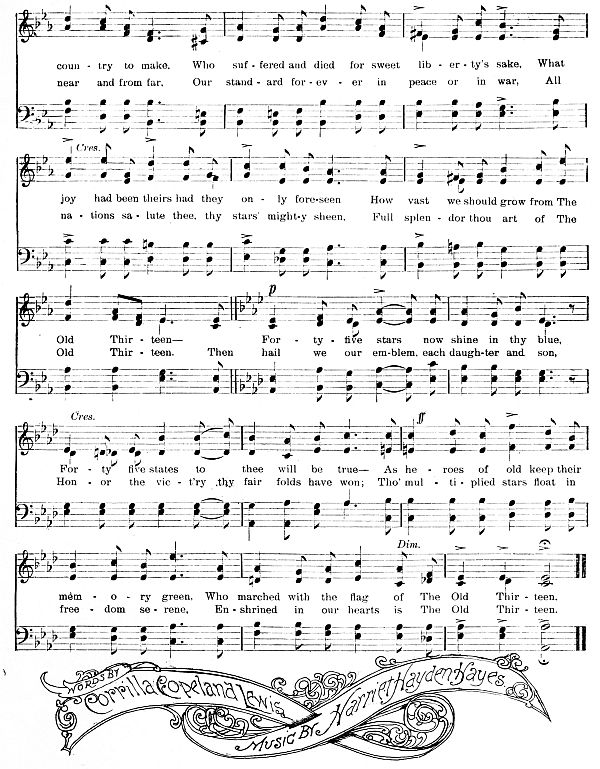
1. Flag of the free, we hail thee with pride. Float thou in freedom o’er all the land wide; Emblem of pow’r where’er thou art seen. Yet still we are true to The Old Thirteen. Our fathers who fought a free country to make. Who suffered and died for sweet liberty’s sake. What joy had been theirs had they only foreseen How vast we should grow from The Old Thirteen— Forty-five stars now shine in thy blue, Forty-five states to thee will be true— As heroes of old keep their memory green. Who marched with the flag of The Old Thirteen. 2. We’ll work for thy glory forever and aye. We’ll celebrate ever that dearly bought day; Thy folds floating o’er us in triumph were seen, So valiantly won by The Old Thirteen. We’ll rally around thee from near and from far, Our standard forever in peace or in war, All nations salute thee, thy stars’ mighty sheen, Full splendor thou art of The Old Thirteen. Then hail we our emblem, each daughter and son, Honor the vict’ry thy fair folds have won; Tho’ multiplied stars float in freedom serene, Enshrined in our hearts is The Old Thirteen.
Words By Corrilla Copeland Lewis Music By Harriet Hayden Hayes.