George Manville Fenn (continued 9)
Reading edition
There was a faint cheer, and quite a little crowd gathered round the wreck while Mr Girtley turned to speak to Hallett.
“Thank you,” said the latter, smiling; “you will excuse me now; I feel rather faint and giddy, and I will get off home.”
“I’ll go with you, Hallett,” I cried.
“No, no: I shall be all right,” he said, with a sad smile. “I’ll take a cab at the corner on the strength of my success. Come to me after you leave.”
“I would rather go with you,” I said.
“No, no, I want you to represent me here,” he whispered. “Stay, Antony; it will seem less as if I deserted the ruin like a rat, and I am not man enough to command myself now.”
“But you are not fit to go alone,” I said earnestly.
“Yes, I am,” he replied; “the sick feeling has gone off. It was nothing to mind. I am not much hurt.”
I should have pressed him, but he was so much in earnest that I drew back, and after a formal leave-taking he left the room, and descended the stairs, while a burst of angry remarks followed his departure.
“Ruddle,” said one grey-haired old gentleman, “I think, for your credit’s sake, you ought to have in a detective to try and trace out the offender.”
“I mean to,” said Mr Ruddle firmly, and he glanced at Grimstone, who seemed to shrink away, and looked thin and old.
“For my part,” said another, “I believe fully in the invention and I congratulate the man of genius who—halloa! what’s wrong?”
A burst of yells and hooting arose from the street below, and with one consent we hurried to the windows, to see poor Hallett standing at bay in a corner, hemmed in by about a hundred men and boys, evidently the off-scourings of the district, who, amidst a storm of cries of “Who robbed the poor man of his bread?”—“Who tries to stifle work?” and a babel of similar utterances, were pelting the poor fellow with filth, waste-paper full of printing-ink, mud, and indescribable refuse, evidently prepared for the occasion.
Heading the party, and the most demonstrative of all, was a fat ruffian, in inky apron and shirt-sleeves, whom I recognised as what should have been the manhood of my old enemy, Jem Smith, while in the same glance I saw, standing aloof upon a doorstep, a spectator of the degrading scene, no less a person than John Lister, fashionably dressed, and in strange contrast to the pallid, mud-bespattered man who stood there panting and too weak to repel assault.
What I have said here was seen in a moment, as I cried out, “Tom Girtley, quick!” rushed to the door, and down the stairs.
It took me very little time to reach the street, but it was long enough to bring my blood to fever-heat, as, closely followed by Tom, I rushed past John Lister, and fought my way through the yelling mob of ruffianly men and boys.
Before I could reach Hallett, though, I caught sight of a carriage farther up the street, and just then the noise and yelling ceased as if by magic, while my efforts to reach Hallett’s side became less arduous.
I, too, stopped short as I reached the inner edge of the ring which surrounded my friend, for there, richly dressed, and in strange opposition to the scene, was Miriam Carr, her veil thrown back, her handsome face white, and her large eyes flashing as she threw herself before Hallett.
“Cowards! wretches!” I heard her cry; and then, “Oh, help I help!”
For as, regardless of his state, she caught at Hallett, he reeled and seemed about to fall!
Then I was at his side.
“Don’t touch me!” he gasped, recovering himself and recoiling from the vision that seemed to have come between him and his persecutors. “Miss Carr, for heaven’s sake!—away from here!”
For answer she caught his hand in hers, and drew his befouled arm through her own.
“Come,” she said, as her eyes flashed with anger; “lean on me. They will not dare to treat a woman ill.”
“Antony,” cried Hallett hoarsely. “Miss Carr—take her away!”
“Lean on me,” she cried proudly. “Antony, beat a way for us through these curs.”
I took Hallett’s other arm, and as we stepped forward, Jem Smith uttered a loud “Yah!” but it seemed as if it was broken before it left his lips, and he went staggering back from a tremendous blow right in the teeth, delivered by Tom Girtley.
Then there was an interlude, for some one else forced his way to the front.
“Miss Carr! great heavens! what is all this?” he cried. “Give me your hand. This is no place for you. What does this outrage mean? Quick! let me help you. This is horrible.”
“Stand back, sir!”
“You are excited,” he cried. “You don’t know me. I see now; there is your carriage. Stand away, you ruffians. How thankful I am that I was near! Take this man away. Is he drunk?”
As he spoke, John Lister, with a look of supreme disgust, pushed poor fainting Hallett back, and tried to draw Miss Carr out of the crowd.
“Coward! Villain! This is your work!” she cried in a low, strange voice; and as he tried to draw her away, she sharply thrust him from her.
The crowd uttered a cry of excitement as they witnessed the act; and, stung almost to madness with rage and mortification, Lister turned upon me.
But I again found a good man at my back, for, boiling with rage, Tom Girtley struck at him fiercely and kept him off, while in the midst of the noise, pushing, and hustling of the crowd, a confusion that seemed to me now as unreal as some dream, we got Hallett along towards the carriage, he, poor fellow, seeming ready to sink at every step, while the true-hearted woman at his side clung to him and passed one arm round him to help him.
The coachman now saw that his mistress seemed to be in need of help, and he shortened the distance by forcing his horses onward through the gathering crowd.
But the danger was past, for those who now thronged out from the buildings on either side were workpeople attracted by the noise, and they rapidly outnumbered John Lister’s gang of scoundrels, got together by his lieutenant, Jem Smith, for the mortification of the man he hated, while his triumph had been that the woman they loved had come to his rival’s help, glorified him, as it were, by her presence, and rained down scorn and contempt upon his own wretched head.
As I said before, it seems now like some terrible dream, in which I found myself in Miss Carr’s carriage, with her sister looking ghastly with fear beside me, and Hallett in the back seat, nearly unconscious, beside Miss Carr.
“Tell the coachman to stop at the nearest doctor’s, Antony,” she said; and I lowered the glass and told Tom Girtley, who had mounted to the driver’s side.
“No, no,” said Hallett, faintly, for her words seemed to bring him to. “For pity’s sake. To my own home. Why have you done this?”
She did not speak, but I saw her take his hand, and her eyes fix themselves, as it were, upon his, while a great sob laboured from her breast.
“Mr Grace,” faltered Miss Carr’s sister, “this is very dreadful;” and I saw her frightened eyes wander from the mud-besmeared object opposite her to her sister’s injured attire, and the sullied linings of the carriage.
“Antony,” said Miss Carr then, “do what is for the best.”
For answer, I lowered the window again and uttered to Tom Girtley the one word, “Home.”
Fortunately, Revitts was on night duty, and ready to come as the carriage stopped at the door, where we had to lift the poor fellow out, and carry him to his bed, perfectly insensible now from the effects of the blow.
I was rather surprised to find the carriage gone when I descended, but my suspense was of short duration, for it soon came back with a neighbouring doctor, whom Miss Carr had fetched.
Mary was at hand to show him up, while I ran down to the carriage-door, where Miss Carr grasped my hand for a moment, her face now looking flushed and strange.
“Come to me to-night, Antony,” she said in a low voice—“come and tell me all.”
She sank back in the carriage then, as if to hide herself from view, while in obedience to her mute signal, I bade the coachman drive her and her sister home.
Chapter Fifty Seven.
I Find I Have a Temper.
I went to Miss Carr’s nearly every evening now, to report progress; for her instructions to me, after a consultation between Mr Jabez, Mr Ruddle, Mr Girtley, and myself, were that neither expense nor time was to be spared in perfecting the machine.
We had gone carefully into the reasons for the breakdown, and were compelled reluctantly to own that sooner or later the mechanism would have failed; for besides the part I named, we found several weak points in the construction—faults that only a superhuman intelligence could have guarded against. The malignant act had only hastened the catastrophe.
It was a cruel trick, and though we could not bring it home, we had not a doubt that the dastardly act was committed by Jem Smith, who was the instrument of John Lister. A little examination showed how easily the back premises could be entered by anyone coming along behind from Lister’s, and there was some talk of prosecution, but Hallett was ill, and it was abandoned.
For the blow he had received from a piece of the machinery had produced serious injury to the head, and day after day I had very bad news to convey to Miss Carr. The poor fellow seemed to have broken down utterly, and kept his bed. He used to try to appear cheerful; but it was evident that he took the matter bitterly to heart, and at times gave up all hope of ever perfecting the machine.
It was pitiful to see his remorseful looks when Mr Jabez came to see him of an evening; Mr Peter, who always accompanied his brother, stopping in my room to smoke a long pipe I kept on purpose for him, whether I was at home or no, and from time to time he had consultations with Tom Girtley, who kept putting off a communication that he said he had to make till he had his task done.
I used to notice that he and Mr Peter had a great deal to say to each other, but I was too much taken up with my troubles about Hallett and the machine to pay much heed; for sometimes the idea forced itself upon me that my poor friend would never live to realise his hopes.
Time glided on, and I used to sit with him in an evening, and tell him how we had progressed during the day; but it made no impression whatever; he used only to lie and dream, never referring once to Miss Carr’s behaviour on that wretched day; in fact, I used to fancy sometimes that he was in such a state from his injury that he had not thoroughly realised what did occur.
It was indeed a dreary time; for poor Mrs Hallett, when, led by a sense of duty, I used to go and sit with her, always had a reproachful look for me, and, no matter what I said, she always seemed to make the worst of matters.
But for Linny and Tom Girtley, the place would have been gloomy indeed, but the latter was always bright and cheerful, and Linny entirely changed. There was no open love-making, but a quiet feeling of respect seemed to have sprung up between them, and I hardly knew what was going on, only when it was brought to my attention by Mr Jabez, or Revitts, or Mary.
“I should have thought as you wouldn’t have liked that there friend of yourn cutting you out in the way he do, Ant’ny,” said Revitts, one day; “I don’t want to make mischief, but this here is my—our—house,” he added by way of correction, “and I don’t think as a young man as is a friend of yourn ought to come down my stairs with his arm round a certain young lady’s waist.”
“Go along, do, with your stuff and nonsense, William,” exclaimed Mary sharply. “What do you know about such things?”
“Lots,” said Bill, grinning with delight, and then becoming preternaturally serious; “I felt it to be my dooty to tell Ant’ny, and I have.”
“You don’t know nothing about it,” said Mary, tittering; “he don’t know what we know, do he, Master Antony?”
“I don’t know what you mean, Mary,” I replied.
“Oh do, of course not, Master Antony; but I shouldn’t like a certain young lady down at Rowford to hear you say so.”
“Phew!” whistled Revitts, and feeling very boyish and conscious, I made my retreat, for I was bound for Westmouth Street, and had stopped to have ten minutes’ chat downstairs with my old friends on the way.
I found Miss Carr looking very thin and anxious, and she listened eagerly to my account of howl was progressing at the works.
“Mr Girtley tells me that you are doing wonders, Antony,” she said, in a curious, hesitating way, for we both seemed to be fencing, and as if we disliked to talk of the subject nearest to our hearts.
She was the first to cast off the foolish reserve though, and to ask after Hallett’s health.
“The doctors don’t seem to help him a bit,” I said sadly. “Poor fellow! he thinks so much about the failure of his hopes, and it is heart-breaking to see him. He toiled for it so long. Oh, Miss Carr, if I only knew for certain that it was John Lister who caused the breakdown, I should almost feel as if I could kill him.”
“Kill him with your contempt, Antony,” she said sternly; and then, as we went on talking about Hallett’s illness, she became very much agitated, and I saw that she was in tears, which she hastily repressed as her sister entered the room.
The next evening when I went, I found her alone, for her sister had gone to stay a few days with some friends. My news was worse than ever, and there was no fencing the question that night, as she turned very pale when I gave my report.
“But the invention, Antony,” she exclaimed excitedly; “tell me how it is going on.”
“We are working at it as fast as possible,” I replied; “it takes a long time, but that is unavoidable.”
“If you love Stephen Hallett,” she said suddenly, and she looked full in my face, “get his invention finished and perfect. Let it succeed, and you will have done more for him than any doctor. Work, Antony, work. I ask you for—for—Pray, pray strive on.”
“I will—I am striving,” I said, “with all my might. It was a cruel blow for him though, just as success was in his grasp.”
“Mr Lister is here, ma’am,” said the servant, entering the room.
“I have forbidden Mr Lister my house,” said Miss Carr sternly.
“Yes, ma’am, but he forced his way in, and—”
Before the man could finish his sentence, John Lister was in the room, looking flushed and excited, and he almost thrust the servant out and closed the door.
As he caught sight of me his face turned white with rage, but he controlled himself, and turned to where Miss Carr was standing, looking very beautiful in her anger.
I had started up, and stepped between them, but she motioned me back to my seat, while he joined his hands in a piteous way, and said in a low voice:
“I could not help it. I was obliged to come. Pray, pray, Miriam, hear me now.”
“Mr Lister!” she said, with a look of contempt that should have driven him away—“Mr Lister! and once more here?”
“Miriam,” he exclaimed, “you drive me to distraction. Do you think that such a love as mine is to be crushed?”
“Love!” she said, looking: at him contemptuously.
“Yes; love,” he cried. “I’ll prove to you my love by saying that now—even now, knowing what I do, I will forgive the past, and will try to save you from disgrace.”
“Mr Lister, you force me to listen to you,” she replied, “for I will not degrade you by ringing for the servants and having you removed. Pray say what you mean. Hush, Antony, let him speak. Perhaps after he has said all he wishes, he may leave me in peace.”
“Leave you in peace—you will not degrade me!” he cried, stung to madness and despair by her looks and words. “Look here, Miriam Carr, you compel me to speak as I do before this wretched boy.”
“Hush, Antony, be silent,” she cried, as I started up, stung in my turn by his contemptuous tone.
“Yes: sit down, spaniel, lap-dog—miserable cur!” he cried; and I felt my teeth grit together with such a sensation of rage a as I had never known before. “And now, as for you—you blind, foolish woman,” he continued, as I awakened to the fact that he had been drinking heavily, “since fair means will not succeed, foul means shall.”
“Say what you wish to say, Mr Lister,” she replied coldly, “for I warn you that this is the last time you shall speak to me. If you force yourself into my presence again, my servants shall hand you over to the police.”
“What!” he cried, with a forced laugh, “me?—hand me over to the police? You—you think I have been drinking, but you are wrong.”
No one had hinted at such a thing, but he felt it, and went on.
“I came to tell you to-night, that I will ignore the past, that I will overlook your disgraceful intimacy with this low, contemptible compositor, the blackguardly friend of this boy—the man who has obtained a hold upon you, and who, with his companions, is draining your purse—I say I will overlook all this, and, ignoring the past, take you for my wife, if you will promise to give up this wretched crew.”
There was no answer, but I sat there feeling as if I must fling myself at him, young and slight as I was, in her defence, but she stood there like a statue, fixing him with her eyes, while he went on raving. His face was flushed, and there was a hot, fiery look in his eyes, while his lips were white and parched.
“You shall not go on like this,” he continued. “You are my betrothed wife, and I will not stand by and see your name dragged in the mire by these wretched adventurers. Even now your name has become a by-word and a shame, the talk in every pot-house where low-class printers meet, and it is to save you from this that I would still take you to be my wife.”
Still she did not speak, and a look from her restrained me, when I would have done something to protect her from his insults, every one of which seemed to sting me to the heart.
“I know I am to blame,” he said passionately, “for letting you take and warm that young viper into life; but I could not tell. It shall end, though, now. I have written to your brother-in-law, and he will help to drag you from amongst this swindling crew.”
“Have you said all you wish to say, Mr Lister?” she replied coldly.
“No,” he cried, stung into a fresh burst by her words; “no, I have not. No, I tell you,” he cried, taking a step forward, as if believing in his drunken fit that she was shrinking from him, and being conquered by his importunities; “No, I tell you—no: and I never shall give up till you consent to be my wife. Do you take me for a drivelling boy, to be put off like this, Miriam?” he cried, catching at her hand, but she drew it back. “Do you wish to save your name from disgrace?”
She did not answer, while he approached closer.
“You don’t speak,” he said hoarsely. “Do you know what they say about you and this fellow Hallett?”
Still she made no reply.
“They say,” he hissed, and thrusting out his face, he whispered something to her, when, in an instant, I saw her countenance change, and her white hand struck him full across the lips.
Uttering an oath, he caught her tightly by the arms, but I could bear no more. With my whole strength called up I leaped at him, and seized him by the throat, believing in my power of turning him forcibly from the room.
The events of the next few moments seem now as if seen through a mist, for in the brief struggle that ensued I was easily mastered by the powerful man whom I had engaged.
I have some indistinct memory of our swaying here and there, and then of having a heavy fall. My next recollection is of feeling sick and drowsy, and seeing Miss Carr and one of the servants bending over me and bathing my face.
For some few minutes I could not understand what it all meant but by degrees the feeling of sickness passed away, and I looked hastily round the room.
Miss Carr, who was deadly pale, told the maid to fetch some brandy, and as soon as we were alone, she knelt by me, and held one of my hands to her lips.
“Are you much hurt, Antony?” she said tenderly. “I did not send for the doctor. That wretched man has made sufficient scandal as it is.”
“Hurt? No—not much,” I said rather faintly. “Where is he?”
“Gone,” she said; and then she uttered a sigh of relief, as I sat up and placed one hand to my head, feeling confused, and as if I had gone back some years, and that this was not Miss Carr but Mary, and that this was Mr Blakeford’s again.
The confusion soon passed off, though, and after I had drunk the spirit that was brought me, I felt less giddy and strange.
Miss Carr sat watching me, looking very pale, but I could realise now that she was terribly agitated.
Before an hour had passed I felt ready to talk to her, and beg her to take some steps for her protection.
“If I had only been a strong man,” I exclaimed passionately. “Oh, Miss Carr, pray, pray do something,” I cried again; “this is horrible. I cannot bear to see you insulted by that wretch.”
“I have decided to do something, Antony,” she said in a low voice; and a faint colour came into her pale cheeks. “He will not be able to force his way to me again.”
“I don’t know,” I said. “He is a madman. I am sure he had been drinking to-night.”
“No one but a madman would have behaved as he did, Antony,” she said. “But be at rest about me. I have, after a bitter struggle with myself, decided what to do.”
“But you will not go away?” I said.
She shook her head.
“No; my path lies here,” she said quietly. “Antony, I want your help to-morrow.”
“Yes: what shall I do?” I asked.
“Will you ask Miss Hallett to come here to me—will you bring her?”
“Bring Linny Hallett here?” I exclaimed in surprise.
“Yes: bring her here,” she said softly; and there was a peculiar tone in her voice as she spoke. “And now about yourself. Do you feel well enough to go home? Shall one of the servants see you safely back?”
“Oh no,” I said; “I am better now. I shall take a cab. But I do not feel comfortable to leave you alone.”
“You need not fear,” she said quietly. “The house will be closed as soon as you leave. To-morrow I shall take steps for my protection.”
I left her soon after, thinking about her request, and as far as I could make out she intended to keep Linny with her, feeling that Lister would not dare to face her again, when the woman he had sought to injure had been made her companion.
Still I did not feel satisfied, and the only consoling thing was to be found in Lister’s own words, that he had sent for Miss Carr’s relative; and, in the hope that he might soon arrive, I reached home and went up at once to see Hallett, who looked very ill, but smiled sadly, as I sat down by his side.
“Better,” he said; “I think I’m better, but I don’t know, Antony: sometimes I feel as if it would be happier if I could be altogether at rest.”
“Oh, Hallett!” I cried.
“Yes, you are right,” he said. “What would become of them? I must get better, Antony, better, but sometimes—sometimes—”
“Don’t speak to him any more,” whispered Mary; “he is so weak that his poor head wanders.”
“But, Mary, the doctor; does he say there is any danger?”
“No, no, my dear. He is to sleep all he can. There, go down now. I’m going to sit up to-night.”
I went down, leaving Mary to her weary vigil; for my head ached terribly, and I was very giddy.
Linny was in the sitting-room, and she uttered an exclamation.
“Why, how bad you look, Antony!” she cried.
“Do I?” I said with a laugh; “I had a bit of a fall, and it has shaken me. But, Linny dear, I have a message for you.”
“For me, Antony?” she said, turning white.
“Yes; Miss Carr bade me ask you to come with me to her house to-morrow.”
“I go to her house!” faltered Linny.
“Yes, dear, you will—will you not? I am sure it is important.”
“But I could not leave poor Steve.”
“It need not take long,” I said; “you will go and see what she wants?”
Linny looked at me in silence for a few moments, and there was something very dreamy in her face.
“If you think it right that I should go, Antony,” she said at last, “I will. Shall I speak to Stephen first?”
“No,” I said. “Hear first what she has to say.”
She promised, and I went down to my own room, glad to lay my aching head upon the pillow; where I soon fell into a troubled sleep, dreaming of my encounter with John Lister, and feeling again the heavy blow as we fell, and my head struck the broad, flat fender with a sickening crash, that seemed to be repeated again and again.
Chapter Fifty Eight.
This Crisis.
By my advice, then, Linny said nothing to Hallett about where she was going, and as I had stayed at home from the works on purpose, we started in pretty good time for Westmouth Street, my companion’s flushed cheeks making her look extremely bright and pretty. She was terribly nervous though, and when we neared the door I feared that she would not muster up courage enough to enter.
“I feel as if I dare not meet her, Antony,” she faltered.
“What nonsense!” I said, smiling. “Why, she is gentleness and tenderness itself. Come, be a woman.”
“It is not that,” she whispered. “There is so much more behind. Take me back, Antony. Why does she want to see me?”
“I don’t know,” I replied; “but you may be sure that it is for some good purpose.”
“Do—do you think she will be angry with me—about—about, you know whom I mean? Do you think it is to reproach me?”
“I am sure it is not, Linny. Come, come, make an effort. I don’t know, but I feel sure it is to try and help poor Hallett.”
“Do you think so?” she faltered, “or is this only to persuade me to go on? Oh, Antony, you cannot think how my heart beats with dread. I am afraid of this Miss Carr, and feel as if I ought to hate her.”
“Come along, you foolish girl,” I said; and, yielding to me, I led her up to the door, when we were admitted, and at once ushered into the drawing-room.
I did not at first see Miss Carr, but the door had hardly closed before I heard the rustle of her dress, and the next moment Linny was folded in her arms, and returning the embrace.
I stood for a moment listening to Linny’s passionate sobs, and then stole softly away, going down into the dining-room to stand gazing out of the window, but seeing nothing of the passers-by, only in imagination the scene upstairs, and wondering why Miss Carr had sent for Linny.
I was kept in doubt for quite an hour, and then the servant came and asked me to step upstairs, where, to my surprise, I found Miss Carr dressed for going out.
She held out her hand to me as I entered, and pressed mine.
“Don’t speak to me, Antony,” she whispered, in a broken voice. “I am going home with Linny Hallett.”
“You—going home—with—”
The rest died on my lips as I saw her draw down her veil to hide her convulsed face, and then, without a word, she rang the bell, the door was opened for us, and, feeling like one in a dream, I walked in silence by their side to the house in Great Ormond Street, where, as I placed my latchkey in the door, it was snatched open, and Mary, with her face red with weeping, stood there.
“Oh, Miss Linny! Oh, Master Antony!” she sobbed, “I’m so glad you’ve come. The doctor sent me out of the room, and I’ve been waiting for you.”
“Is my brother worse?” sobbed Linny hysterically.
“Yes, yes, my dear, I’m—I’m afraid so;” and as she spoke, a hand clutched mine, and I heard Miss Carr moan:
“God help me! Am I too late?”
Linny was already half up the first flight, when Miss Carr whispered to me in agonised tones:
“Take me to him, Antony, quick. This is no time for pride and shame.”
With my heart beating painfully, I led her upstairs, and, as we reached the first floor, we met the doctor coming down.
I felt Miss Carr’s hand pressing mine convulsively, and I spoke, my voice sounding hoarse and strange.
“Is he worse, doctor?”
“I’m afraid he cannot last many hours longer,” he said. “I have done all I can, but I have a patient a few streets off whom I must see, and I will return in a short time. He must not be left.”
“Shall I go in and try to prepare him for your coming?” I whispered to Miss Carr, as we stood outside his door.
“No, no!” she cried. “Take me to him at once, or I cannot bear it. Don’t speak to me, Antony. Don’t let anybody speak to me; but you must not leave me for a moment.”
Linny was at the door, standing with the handle in her hand, but she drew back as we approached, and then ran sobbing into the next room, where Mrs Hallett was sitting helpless and alone.
I obeyed Miss Carr, leading her quickly inside, and closing the door, where she stood for a moment with one hand pressing her breast; then she hastily tore off bonnet and veil, gazing at the pale face and great dreamy eyes fixed wistfully upon the window.
The noise of our entry, slight as it was, seemed to rouse him, for he turned his gaze heavily from the light towards where we stood, and I saw that he held in his thin wasted hand a little grey kid glove, the glove we had found in Epping Forest that happy day when we met the sisters in our wait.
But that was forgotten in the change I saw come over the poor fellow’s face. It seemed to light up; the dull dreamy eyes dilated; a look of dread, of wonder, or joy seemed to come into them, and then he seemed to make an effort, and stared wildly round the room, but only to gaze at Miss Carr again as she stood with her hands half raised in a beseeching way, till, with a wild cry, his head seemed to fall back and he lay without motion.
I heard steps outside, but I darted to the door, and stopped Linny and Mary from entering, hardly knowing what I did, as Miss Carr took a step or two forward, and threw herself upon her knees by the bed, dinging to his hands, placing one arm beneath the helpless head, and sobbing and moaning passionately.
“I have killed him—I have killed him! and I came that he might live. Stephen, my love, my hero, speak to me—speak to me! God of heaven, spare him to me, or let me die?”
I was one moment about to summon help, the next prepared to defend the door against all comers, and again the next ready to stop my ears and flee from the room. But she had bidden me stay, and not leave her, and I felt it a painful duty to be her companion at such a time. So there I stayed, throwing myself in a chair by the door, my head bent down, seeming to see all, to identify every act, but with my face buried in my hands, though hearing every impassioned word.
“No,” I heard him say softly; “no: such words as those would have brought me from the grave. But why—why did you come?”
“I could bear it no longer,” she moaned. “I have fought against it till my life has been one long agony. I have felt that my place was here—at your side—that my words, my prayers would make you live; and yet I have stayed away, letting my pride—my fear of the world—dictate, when my heart told me that you loved me and were almost dying for my sake.”
“Loved you!” he whispered faintly; “loved you—Miriam, I dare not say how much!”
His voice was the merest whisper, and in my dread I started up, and approached them, fearing the worst; but there was such a smile of peace and restfulness upon his lips as Miss Carr bent over him, that I dared not interrupt them, the feeling being upon me that if he was to die it would be better so.
There was a long silence then, one which he broke at last.
“Why did you come?” he said.
The words seemed to electrify her, and she raised her head to gaze on his face.
“Why did I come?” she whispered; “because they told me you were dying, and I could bear it no longer. I came to tell you of my love, of the love I have fought against so long, but only to make it grow. To tell you, my poor brave hero, that the world is nothing to us, and that we must be estranged no more. Stephen, I love you with all my soul, and you must live—live to call me wife—live to protect me, for I want your help and your brave right hand to be my defence. This is unwomanly—shameless, if you will—but do you think I have not known your love for me, and the true brave fight that you have made? Has not my heart shared your every hope, and sorrowed with you when you have failed? And, poor weak fool that I have been, have I not stood aloof, saying that you should come to me, and yet worshipped you—reverenced you the more for your honour and your pride? But that is all past now. It is not too late. Live for me, Stephen, my own brave martyr, and let the past be one long sad dream: for I love you, I love you, God only knows how well!” She hid her burning, agitated face in his breast, and his two thin hands tremblingly and slowly rose to clasp her head; and there the white fingers lay motionless in the rich, dark hair.
There was again a pause, which he was the first to break, and his voice was still but a whisper, as he muttered something that I did not hear, though I gathered it from her smothered reply.
“Oh, no, no: let there be an end to that!” she sobbed. “Money? Fortune? Why should that keep us apart, when it might help you in your gallant fight? Let me be your help and stay. Stephen—Stephen!” she wailed piteously, “have I not asked you—I, a woman—to make me your wife?”
“Yes,” he said softly, and I heard him sigh; “but it cannot be—it cannot be.”
“What?” she cried passionately, as she half-started from him, but clung to him still; “now that I have conquered my wretched, miserable pride, will you raise up another barrier between us?”
“Oh, hush, hush!” he whispered; “you are opening to me the gates of a worldly heaven, but I dare not enter in.”
“Then I have done nothing,” she wailed, as she seemed to crouch there now in shame and confusion by his bed. “Stephen, you humble me in the dust; my shameless declaration—my appeal—do I not ask you to take me—pray you to make me your wife? Oh, what am I saying?” she cried passionately; “it is too late—too late!”
“No,” he panted; and his words seemed to come each with a greater effort, “not—too late—your words—have—given—me life. Miriam—come—hold me in your arms, and I shall stay. A little while ago I felt that all was past, but now, strength seems to come—we must wait—I shall conquer yet—give me strength to fight—to strive—wait for me, darling—I’ll win you yet, and—God of heaven! hear her prayer—and let me—ah—”
“Quick, Miss Carr, he has fainted,” I whispered, as his head sank back. “Let me give him this.”
His face was so ghastly that I thought he had passed away; but, without waiting to pour it out in a glass, I hastily trickled some of the strong stimulant medicine he was taking between his lips, and as Miss Carr, with agonised face, knelt beside him, holding his hand, there was a quiver in his eyelids, and a faint pressure of the hand that held his.
The signs were slight, but they told us that he had but fainted, and when, at last, he re-opened his eyes, they rested upon Miss Carr with such a look of rest and joy, that it was impossible to extinguish the hope that he might yet recover.
He was too weak to speak, for the interview had been so powerful a shock to his system, that it was quite possible for the change we saw in his face to be but the precursor of one greater, so that it was with a sense of relief that I heard the doctor’s step once more upon the stairs, and Mary’s knock at the door.
I offered Miss Carr my hand to take her into the next room, and as if waking out of a dream, she hastily rose and smoothed back her hair, but only to bend down over the sufferer, and whisper a few words, to which he replied with a yearning look that seemed to bring a sensation of choking to my throat.
The doctor passed us on his way in, and I led Miss Carr into the front room, where Linny was sobbing on the couch, and Mrs Hallett was sitting back, very white and thin, in her chair.
As we entered Linny started up, and in response to Miss Carr’s extended hands, threw her arms round her neck, and kissed her passionately.
“Dear sister!” I heard Miss Carr murmur; and then she turned from Linny, who left her and glanced at me.
“Mrs Hallett,” I said simply, “this is Miss Carr.”
I hardly knew what I said, for Miriam was so changed. There was a look of tenderness in her eyes, and a sweet smile just dawning upon her lip as she advanced towards the invalid’s chair, and bent down to kiss her; but with a passionate look of jealousy and dislike, Hallett’s mother shrank from her.
“Don’t touch me!” she cried. “I knew that you were here, but I could not leave my chair to curse you. Murderess, you have killed him! You are the woman who has blasted my poor boy’s life!”
A piteous look of horror came into Miss Carr’s face, and she sank upon her knees by the great cushioned chair.
“Oh, no, no!” she said piteously. “Do not accuse me. You do not—you cannot know.”
“Know!” cried Mrs Hallett, whiter than ever with the feeling of dislike and passion that animated her; “do I not know how you have robbed me of my poor dying boy’s love; how you have come between us, and filled his head with foolish notions to invent—to make money—for you?”
“Oh, Mrs Hallett, for shame!—for shame!” I exclaimed indignantly.
“Silence, boy!” she cried, looking at me vindictively. “Do you think I do not know all because I sit helpless here? You, too, have helped to encourage him in his madness, when he might have been a professional man by now. I know all, little as you think it, even how you, and this woman, too, fought against me. That child might have been the wife of a good man now, only that he was this wretched creature’s lover.”
“Mother,” cried Linny passionately, “are you mad? How dare you say such things!”
“That’s well,” she cried. “You turn against me now. My boy is dying: you have killed him amongst you, and the same grave will hold us both.”
“Mrs Hallett,” said Miss Carr, in her low, sweet voice; and the flush of pride that had come for a few moments into her face faded out, leaving nothing but resignation there, as she crouched there upon her knees by the invalid’s chair, “you do not know me, or you would not speak to me like this. Don’t turn from me,” she said, taking One of the poor weak woman’s trembling hands.
“Out of my sight, wretch!” she cried. “Your handsome face fascinated him; your pride has killed him! and you have come to triumph in your work.”
“No, no, no,” sobbed Miss Carr in a broken voice, “do not condemn me unheard; I have come to tell him how I love him. Mother, dear mother,” she cried, “be pitiful to me, and join your prayers to mine that he may live.”
Poor weak suffering Mrs Hallett’s face changed; her lips quivered, her menacing hands trembled, and with a low moaning wail she bent down, clasping Miriam to her breast, sobbing aloud as she rocked herself to and fro, while Miriam clung to her, caressing the thin worn face, and drawing herself closer and closer in a tight embrace.
How long this lasted I cannot tell, but it was interrupted by the entrance of the doctor, who came in very softly.
“He is in a very critical state,” he said in answer to the inquiring eyes of all. “Hush, my good woman, you must try and be firm,” he said parenthetically to Mary, who was trying hard to smother her sobs in her apron. “A nurse ought to have no feelings—I mean no sympathies. As I said,” he continued, “our patient is in a very critical state, but he has now sunk into a very restful sleep. There is an access of strength in the pulse that, however, may only be due to excitement, but your visit, ma’am,” he continued to Miss Carr, “seems to have wrought a change—mind,” he added hastily, “I don’t say for the better, but there is a decided change. I will come in again in a couple of hours or so; in the meantime, let some one sit by his bed ready to give him the stimulant the instant he wakes, but sleep may now mean life.”
The doctor went softly away, and as he closed the door, Miss Carr knelt down once more by Mrs Hallett’s chair, holding up her face, and the poor invalid hung back for a moment, and then kissed her passionately.
“God forgive me!” she wailed. “I did not indeed know you, but you have robbed me of my poor boy’s love.”
“No, no,” whispered Miss Carr softly. “No, no, dear mother, we will love you more and more.”
Miriam Carr’s place was by the sick man’s pillow all that afternoon and evening, and right through the weary night. I had been to Westmouth Street to say that she might not return, and at her wish had brought back from Harley Street one of the most eminent men in the profession, who held a consultation with Hallett’s doctor.
The great man endorsed all that had been done, and sent joy into every breast as he said that the crisis was past, but that on no account was the patient to be roused.
And all that night he slept, and on and on till about eight o’clock the next morning, Miss Carr never once leaving his side, or ceasing to watch with sleepless eyes for the slightest change.
I had gone softly into the room the next morning, just as he uttered a low sigh and opened his eyes.
“Ah, Antony,” he said in a low whisper, “I have had such a happy, happy dream! I dreamed that—Oh, God, I thank Thee—it was true!”
For just then there was a slight movement by his pillow, and the next moment his poor weary head was resting upon Miriam’s breast.
Chapter Fifty Nine.
My Inheritance.
“Oh, Master Antony, ain’t she a’ angel!” exclaimed Mary.
This was one day during Stephen Hallett’s convalescence, for from the hour of Miriam Carr’s visit, he had steadily begun to mend. He showed no disposition, however, to take advantage of his position, and I was not a spectator of his further interviews with Miss Carr. She looked brighter and happier than I had seen her look for a long time, and by degrees I learned that with his returning strength Hallett had determined upon achieving success before he would ask her to be his wife.
He asked her, so she told me, if he had not her to thank for the assistance he had received, and she had confessed to the little deception, begging him to let her help him in the future; but this he had refused.
“No,” he said; “let me be worthy of you, Miriam. I shall be happier if I try,” and she gave way, after exacting a promise from him that if he really needed her assistance he would speak.
Hallett seemed rapidly to regain his strength now, and appeared to be living a new life as he devoted himself heart and soul to the perfection of his invention.
I believe that I honestly worked as hard, but, in spite of all our efforts, nine months passed away, and still the work was not complete.
It was a pleasant time, though, and I could not help noticing the change that had come over Miriam Carr.
Her sister’s husband had given up his appointment, and was now in town, residing with his young wife in Westmouth Street, where, about once a fortnight, there was a meeting, when Hallett would take Linny, and Tom Girtley, Mr Ruddle, and several of our friends would assemble.
I look back upon it as a very happy time. The old sordid feeling of my wretched early life seemed to have dropped away, now that I was winning my way in the world; and Hallett had told me that I was to share in his success, even as I had shared his labours.
There was no love-making in the ordinary sense of the word, but when Miriam Carr and Hallett met, there would be one long earnest look, a pressure of the hand; and then—they waited. It was his wish, and she reverenced his noble pride.
One evening we were very few at Westmouth Street; only Linny, Tom Girtley, Mr Jabez, Hallett, and myself, when I found that there was a surprise for me.
Tea was over, and I was just about to propose some music, when Tom Girtley took a black bag from under one of the settees, and opening it, drew out a packet of papers.
What was going to happen? I asked myself. Was it a marriage settlement, or some deed of gift, or an arrangement by which Hallett was to be forced to take what was needful to complete his work?
Neither. For at the first words uttered by Tom Girtley, I realised that it was something to do with the half-forgotten papers brought up by Mr Peter Rowle.
“Miss Carr wished me to enter into the business matters here, Grace,” he said; “and I should have talked to you more about it, only we thought it better to elucidate everything first, and to make perfectly sure.”
“But—” I began.
“Wait a moment,” he said, in regular legal form. “This has been a very intricate affair, and I was obliged to tread very cautiously, so as not to alarm the enemy. Before I had been at work a fortnight, I found that I needed the help of more experienced brains, so I consulted my principals.”
“And ran up a long bill?” I said, laughing.
“Yes, a very long one,” he said, “which Miss Carr, your friend and patroness, has paid.”
“Oh, Miss Carr!” I exclaimed.
“Listen, Antony,” she said, looking at me with a proud and loving look.
“Being sure, then, of our pay,” said Tom Girtley, laughing, “we went to work with the greatest of zeal, making another long bill, and for result—after completely disentangling everything—after finding out, without his knowing it, that the enemy was well worth powder and shot—in short, after making the ground perfectly safe under our feet, I have the pleasure of announcing to you, my dear fellow, that not only is there a sum of five hundred pounds a year belonging to you in your lawful right—”
“Five hundred!” I ejaculated.
“But the same amount, with interest and compound interest, due to you for the past eight or nine years, and which that scoundrel Blakeford will be obliged to refund.”
“Oh!” I exclaimed, as I realised my position.
“The rascal plundered your poor father of goodness knows how much, but of that we can get no trace. This five hundred pounds a-year, though, and the accumulation, is as certainly yours as if you had inherited it at once, and no judge in England can gainsay it. Let me be the first to—”
“No!” exclaimed Miss Carr, rising; “let me, Antony, my dear boy, be the first to congratulate you, not so much because of the amount, as that it will give you a feeling of independence, and take away that sense of obligation to pay your father’s debts.”
She took my hands in hers, and kissed me, and then, feeling giddy with surprise, I turned away for a moment, but only to falter out something in a disconnected way.
“Peter’s delighted,” cried Mr Jabez; and he took a tremendous pinch of snuff, “I shall be turning out somebody’s long-lost child myself before long, only we are twins, and I shall have to share it.”
“I am very, very glad, Antony,” said Hallett, shaking hands.
“And now, if you like, Grace,” continued Tom Girtley, “we will set to work to-morrow to make that scoundrel Blakeford disgorge; and before a fortnight is passed, if he doesn’t mind, he will be cooling his heels in prison, for I have undeniable proofs of his illegal practices. At the very least he will be struck off the Rolls. It is utter professional ruin.”
I did not speak, for the scene seemed to change to that wretched office once more, and I saw the black, forbidding, threatening face gazing down into mine. I heard the harsh, bitter voice reviling my poor dead father, and a shudder ran through me. The next moment, though, I was dwelling on the soft sweet face of Hetty, and as I recalled the child’s many gentle, loving acts, there was a strange choking sensation at my breast, and I walked into the little drawing-room to be alone.
“Antony, dear,” said a soft, sweet voice, “you seem quite overcome.”
“I shall be better directly,” I said. “But, dear Miss Carr, this must be stopped. You all meant so kindly by me, but if proceedings have begun they must not go on.”
“They have commenced, Antony, by my wishes,” she said in a low voice, as she took my hand. “Antony, my dear boy, you have always seemed to me like a younger brother whom it was my duty to protect, and I have felt quite a bitter hatred against this man for the wrongs he did you.”
“Not wrongs,” I said. “It was through him I came to know you and Hallett.”
“Yes, but he has wronged you cruelly.”
“Miss Carr,” I said—“let me call you sister.”
“Always,” she whispered, as she laid her hand upon my shoulder. “This would be ruin and disgrace to Mr Blakeford?”
“Which he richly deserves,” she said warmly.
“And it would be ruin and disgrace—”
“Yes,” she said, for I had stopped—“ruin and disgrace—”
“To his poor child?”
“Hetty?”
“Yes: to the tender-hearted little girl whose bright face is the only sunny spot in that time of sorrow. I don’t know,” I said passionately, “I may be wrong. I may see her now, and the fancy be driven away, but I feel as if I love little Hetty Blakeford with all my heart.”
There was silence in the little drawing-room, where all was in shadow, while in the larger well-lighted room the others talked in a low voice, and as I glanced there once, and saw Linny Hallett gazing up in Tom Girtley’s face, I wondered whether Hetty Blakeford would ever look as tenderly in mine.
It was a passing fancy, and I was brought back to the present by feeling Miss Carr’s warm lips brush my cheek.
“We will wait and see, Antony,” she said gravely. “Miss Blakeford’s feelings must be spared.”
Chapter Sixty.
At Last.
The work of two years was complete, and I stood by Hallett as he watched the trial of the machine where it was set up at our great factory; and though we tried hard to find weak points, we were compelled to declare that it was as near perfection as human hands could make it.
Hallett was very pale and quiet; he displayed no excitement, no joy; and I felt rather disappointed at his apathy.
“Well,” said Mr Jabez, aside to me, “if I didn’t know that the poor fellow was ill, I should have said that he didn’t care that! whether the thing succeeded or not.”
That! was the snap of the fingers which followed the taking of a pinch of snuff.
But he was ill. Poor fellow! He never seemed to have recovered from the shock his system had received during his late illness; and, though he had rallied and seemed strong and well, there had been times when he would turn ghastly white, and startle me by his looks.
I mentioned it more than once to Miss Carr, who begged him to see a physician; but he said it was nothing, and with a smile he used to tell her that the perfection of the machine and a change would completely restore him to health.
This we both believed;—and I can honestly say that I strove with all my might to inspire the workmen with the spirit in which I toiled.
And now the new machine was finished. All that remained was to have it removed to Mr Ruddle’s place for a public inspection of its merits.
There had been something so depressing in the fate of the lost machine that I strenuously advised that the trial should be made where the present one now stood, but Hallett was averse to it.
“No, Antony,” he said quietly; “I am neither vindictive nor spiteful, and doubtless that man feels that he has good cause for hating me. Men of his stamp always blame others for their own failings. I am, I say, neither vindictive nor spiteful, but, feeling as I do, that he was the cause of our last breakdown, I am determined that the scene of our last failure shall also be the scene of our triumph.”
This silenced opposition, and the workpeople were soon at work, taking down and re-setting up Hallett’s masterpiece at the old place.
For my part, I was regularly worn out. I had worked very hard, and felt as if I was so deeply interested in the success that I must make it this time a foregone conclusion. Hallett’s health worried me a great, deal too, and in addition to this, I was in more trouble than I can very well express about my affair with Mr Blakeford.
My objections to the proceedings had come too late. As Tom Girtley said, it was quite within our province to withdraw, and leave him in possession of his ill-gotten gains, but the attack upon his character as a solicitor was one which he was bound to disprove—in other words, he could not afford to let it drop.
“And what is he doing?” I asked.
“Riding the high horse,” said Tom. “Tony, my boy, I think you are wrong.”
“If Linny’s father were alive, and he had injured you, Tom, would you seize the first opportunity to ruin him?”
“Am I to answer that question as solicitor to client, or between friends?”
“As you like, only let’s have the truth.”
Tom Girtley rubbed one of his ears, and a dry comical look came into his countenance.
“Well, Tony, old fellow—” he began.
“Oh, come,” I cried, “that form of address is not legal, so it is between friends.”
“Just as you like,” he said, laughing. “Well, Tony, old fellow, under the circumstances, I should put the screw on, especially if I knew him to be a scoundrel. First and foremost, I should have his consent to our marriage; secondly, I should inspect his money affairs, and if they were in a satisfactory state, I should make the sneak disgorge.”
“But you would not ruin him, and blast his character, for his child’s sake?”
“No, of course not.”
“Then, suppose the young lady did not care for you?”
“Then I should fire at the old man hotter and stronger, so us to ease my wounded feelings.”
“No, you wouldn’t, Tom,” I said; “so don’t humbug.”
“You’re a rum fellow, Tony,” he retorted, “and ’pon my word it’s precious disappointing. Here’s old Peter Rowle been hoarding this up for his ‘dear boy,’ as the smoky old cockolorum calls you, and old Jabez in a high state of delight too. Then Miss Carr has spent no end over it, and thought she had secured you your rights, and now you kick us all over.”
“I can’t help it, Tom,” I said. “I feel as if I should be a brute if I went on.”
“I say, Tony,” he said, after a pause, “how long is it since you have seen the young lady?”
“Nine years.”
“What do you say to a run down to Rowford?”
“Run down?” I said eagerly. “No, I could not. I am too busy over the preparations for the trial.”
“Nonsense, man. You told me only yesterday that you had done all your part, and that you meant to take a rest. I should like a run in the country.”
“At Miss Carr’s expense,” I said spitefully, “and charge it in her bill of costs as out of pocket.”
“Oh, that settles it,” he cried, jumping up and stamping about the room, roaring with laughter. “You must go for a run. Why, my dear boy, your liver’s out of order, or you, Antony Grace, the amiable, would never have made a speech like that. Look here, Tony, you have overdone it, and nothing will do you good but a week’s walking-tour.”
“Nonsense! Impossible!” I cried.
“Then you’ll break down like the governor did once. Ever since, he says that a man must oil his wheels and slacken his bands. Now you’ve got to oil your wheels and slacken your bands for a week. When shall we start?”
“I tell you it’s impossible,” I said testily.
“I tell you that, so far from its being impossible, if you don’t give in with a good grace—that isn’t meant for a pun—I’ll go and frighten Miss Carr, and see the governor, and tell him how bad you are.”
“Rubbish, Tom,” I cried. “Why, you couldn’t go and leave Linny Hallett for a week,” I added.
“Sneering, too,” he said, with a mock assumption of concern. “My dear Tony, this is getting serious. You are worse, far worse, than I thought for.”
“Don’t talk stuff,” I cried petulantly.
The result of it all was, that as he was pulling the string in the direction that pleased me, I began to yield, and a proposition he made carried the day.
“Look here, Tony,” he cried, as if in a fit of inspiration. “A walking-tour is the thing! you told me all about your tramp up when you ran away from Blakeford’s. Let’s go and tramp it all down again, over the very road.”
His words seemed to strike an electric chord, and I grasped eagerly at the plan. The result was, that after arranging with Hallett to keep an eye on the preparations, and after winning from him a declaration that he would not think I was forsaking him at a critical time, and also after receiving endorsement and persuasion from Miss Carr, I found myself one bright summer morning at Paddington, lightly equipped for the start, and together Tom Girtley and I strode along by the side of the dirty canal.
How familiar it all seemed again, as we walked on! There was the public-house where I had obtained the pot of beer for Jack’s father, when I had to part, from them at the end of my journey up; and there, too, directly after, was just such a boy in charge of a couple of bony horses, one of which had a shallow tin bucket hanging from the collar-hames, as they tugged at a long rope which kept splashing the water, and drew on Londonward one of the narrow red and yellow-painted canal-boats, covered in with just such a tarpaulin as that under which Jack and I had slept.
Resting on the tiller was just such another heavy, red-faced, dreamy man, staring straight before him as he sucked at a short black pipe, while forming herself into a living kit-cat picture was the woman who appeared to be his wife, her lower portions being down the square hatch that led into the cabin where the fire burned, whose smoke escaped through a little funnel.
I seemed to have dropped back into the boy again, and half wondered that I was not tired and footsore, and longing for a ride on one of the bony horses.
And so it was all through our journey down.
Every lock seemed familiar, and at more than one lock-house there were the same green apples and cakes and glasses of sticky sweets, side by side with two or three string-tied bottles of ginger-beer.
Two or three times over I found myself getting low-spirited as I dwelt upon my journey up, and thought of what a poor, miserable little fellow I was; but Tom was always in the highest of spirits, and they proved at last to be infectious.
We had pretty well reached the spot at last where I had first struck the river, when we stopped to see a canal-boat pass through the lock, the one where I had stared with wonder to see the great boat sink down some eight or nine feet to a lower level.
The boat, which was a very showily painted one, evidently quite new, was deeply laden, and in one place a part of a glistening black tarpaulin trailed in the water. As the boat’s progress was checked, and the lock-keeper came out, the short, thick-set man who had been at the tiller shouted something, and a round-faced girl of about twenty, with a bright-coloured cotton handkerchief pinned over her shoulders, came up the hatch, and took the man’s place, while he douched forward to alter the tarpaulin where it trailed.
He was quite a young man, and I noticed that his hair was fair, short, and crisp about his full neck, as he bent down, pipe in mouth, while a something in the way in which he shouted to the boy in charge of the horses settled my doubts.
“Jack!” I shouted.
He rose up very slowly, took the pipe out of his mouth, and spat in the water; then, gradually turning himself in my direction, he stared hard at me and said:
“Hello!”
“Don’t you know me again, Jack?”
He stared hard at me for some moments, took his pipe out of his mouth again, spat once more in the water, said surlily, “No!” and bent down slowly to his work.
“Don’t you remember my going up to London with you nine years ago this summer?”
He assumed the perpendicular at once, stared, scowled, took his pipe out of his mouth with his left hand, and then, as a great smile gradually dawned all over his brown face, he gave one leg a smart slap with a great palm, and seemed to shake himself from his shoulders to his heels, which I found was his way of having a hearty laugh.
“Why, so it is!” he cried, in a sort of good-humoured growl. “Missus, lash that there tiller and come ashore. Here’s that there young chap.”
To Tom’s great amusement, Jack came ashore at the lock, and was followed by his round-faced partner, for whom he showed his affection by giving her a tremendous slap on the shoulder, to which she responded by driving her elbow into his side, and saying, “Adone, Jack. Don’t be a fool!” and ending by staring at us hard.
“I didn’t know yer agen,” growled Jack. “Lor’ ain’t you growed!”
“Why, so have you, Jack,” I exclaimed, shaking hands with him; and then with the lady, for he joined our hands together, taking up hers and placing it in mine, as if he were performing a marriage ceremony.
“Well, I s’pose I have,” he said in his slow, cumbersome way. “This here’s my missus. We was only married larst week. This here’s our boat. She was born aboard one on ’em.”
“I’m glad to see you again, Jack,” I said, as the recollection of our journey up recurred to me, strengthened by our meeting.
“So am I,” he growled. “Lor’! I do wish my old man was here, too: he often talked about you.”
“About me, Jack?”
“Ah! ’member that pot o’ beer you stood for him when you was going away—uppards—you know?”
“Yes; I remember.”
“So do he. He says it was the sweetest drop he ever had in his life; and he never goes by that ’ere house without drinking your health.”
“Jack often talks about you,” said “my missus.”
“I should think I do!” growled Jack. “I say, missus, what’s in the pot?”
“Biled rabbit, inguns, and bit o’ bacon,” was the prompt reply.
“Stop an’ have a bit o’ dinner with us, then. I’ve got plenty o’ beer.”
I was about to say no, as I glanced at Tom; but his eyes were full of glee, and he kept nodding his head, so I said yes.
The result was that the barge was taken through the lock, and half-a-mile lower down drawn close in beneath some shady trees, where we partook of Jack’s hospitality—his merry-hearted, girlish wife, when she was not staring at us, striving hard to make the dinner prepared for two enough for four.
I dare say it was very plebeian taste, but Tom and I declared honestly that we thoroughly enjoyed the dinner partaken of under the trees upon the grass; and I said I never knew how good Dutch cheese and new crusty country loaf, washed down by beer from a stone bottle, were before.
We parted soon after, Jack and I exchanging rings; for when I gave him a plain gold gipsy ring for his handkerchief, he insisted upon my taking the home-made silver one he wore; while his wife was made happy with a gaily coloured silk handkerchief which I used to wear at night.
The last I saw of them was Jack standing up waving his red cap over his head, and “my missus” the gaily coloured handkerchief. After that they passed on down stream, and Tom and I went our way.
I could not have been a very good walker in my early days, for my companion and I soon got over the ground between the river and Rowford, even though I stopped again and again—to show where I had had my fight; where I had hidden from Blakeford when the pony-chaise went by; and, as if it had never been moved, there by the road was a heap of stones where I had slept and had my bundle stolen.
It was one bright summer’s evening that we entered Rowford, which seemed to have shrunk and its houses to have grown dumpy since the days when I used to go out to post letters for Mr Blakeford.
“There’s his house, Tom,” I said; and I felt my pulses accelerate their beat, as I saw the gates, and the wall over which I had climbed, and found myself wondering whether the same dog was in there still.
We were too tired with our long walk to take much notice, and made straight for the inn, where, after a hearty meal, we were glad to go early to bed.
Tom was sleeping soundly when I woke the next morning, and finding it was not yet seven, I dressed and went out for a walk, to have a good look round the old place, and truth to tell, to walk by Mr Blakeford’s house, thinking I might perhaps see Hetty.
We had made no plans. I was to come down to Rowford, and the next day but one I was due in London, for our walk had taken some time—though a few hours by rail would suffice to take us back.
It was one of those delicious fresh mornings when, body and mind at rest, all nature seems beautiful, and one feels it a joy only to exist.
I was going along the main street on the opposite side of the way, when I saw a tall slight figure in deep mourning come out of Mr Blakeford’s gateway, and go on towards the end of the town.
I followed with my heart beating strangely. I had not seen her face, but I seemed to feel that it was Hetty, and following her slowly right out of the town, and along the main road for a time till she struck up a side lane, I kept on wondering what she would be like, and whether she would know me; and if she did—what then?
Perhaps after all it was not Hetty. It might be some friend; and as I thought this, a strange pang of disappointment shot through me, and I seemed to have some faint dawning realisation of what Stephen Hallett’s feelings must have been at many a bitter time.
Is this love? I asked myself as I walked on, drinking in the deliciously sweet morning scents, and listening to the songs of the birds and the hum of the insects in the bright June sunshine.
I could not answer the question: all I knew was that I was in an agony to see that face, to be out of my state of misery and doubt; but though a dozen times over I was on the point of walking on fast and then turning back so as to meet her, I had not the courage.
For quite half-an-hour this went on, she being about a hundred yards in advance. We were now in rather a secluded lane, and I was beginning to fear that she intended to cut across the fields, and return by the lower road, when, all at once, she faced round and began to retrace her steps.
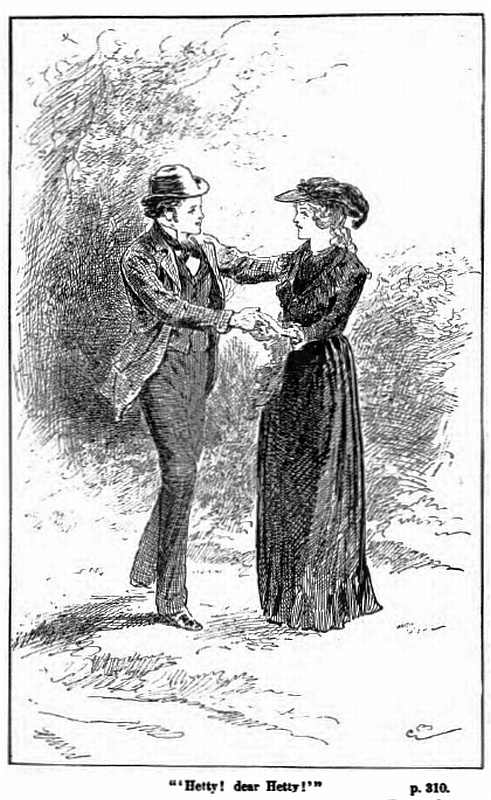
I saw her hesitate a moment as she became aware that she had been followed, but she came straight on, and as she drew near my doubts were set at rest. It was unmistakably Hetty, but grown sweeter looking and more beautiful, and my heart began to throb wildly as the distance between us grew short.
She did not know me—that was evident; and yet there was a look of doubt and hesitation in her face, while after a moment’s wonder as to how I should address her, I saw her countenance change, and troubled no more about etiquette, but, carried away by my feelings, I exclaimed: “Hetty! dear Hetty!” and clasped her hands in mine.
Chapter Sixty One.
My Meeting with my Enemy.
These things are a mystery. No doubt we two, parting as we did, boy and girl, ought to have met formally as strangers, perhaps have been re-introduced, and I ought to have made my approaches en règle, but all I knew then was that the bright, affectionate little girl who had been so kind to me had grown into a beautiful woman, whom I felt that I dearly loved; and as for Hetty, as she looked up in my face in a quiet, trusting way, she calmly told me that she had always felt that I should come back some day, and that though she hardly recognised me at first, she was not a bit surprised.
Terribly prosaic and unromantic all this, no doubt; but all young people are not driven mad by persecution, and do not tie their affections up in knots and tangles which can never perhaps be untied. All I know is that I remember thinking that when Adam awoke and found Eve by his side in Paradise, he could not have felt half so happy as I did then; and that, walking slowly back with Hetty’s little hand resting upon my arm, and held in its place by one twice as large, I thought Paradise might have been a very pleasant kind of place, but that this present-day world would do for me.
We said very little, much as we wanted to say, but walked on, treading as it were upon air, till, as if in a moment, we were back at the town, when she said with a quiver in her voice:
“I must leave you now. Papa will be waiting for me to pour out his coffee. He will not touch it unless I do.”
“You are in mourning for Mrs Blakeford,” I said, and my eyes fell upon the little shabby silver brooch I had given her all those years ago.
“Yes, and papa has not been the same since she died. He has very bad health now, and is sadly changed. He is in some great trouble, too, but I don’t know what.”
I did; and I walked on thoughtfully by her side till we reached the gate, where we stopped, and she laid her hand in mine.
But the next moment my mind was made up, and, drawing her arm through mine, and trying with a look to infuse some of my assurance, I walked with her into the house, and into the apparently strangely dwarfed sitting-room.
“Who’s that?” cried a peevish voice. “I want my coffee, Hetty. It’s very late. Has the post come in? Who’s that, I say, who’s that?”
I stared in astonishment at the little withered yellow man with grizzly hair and sunken eyes, and asked myself—Is this the Mr Blakeford who used to make me shudder and shrink with dread?
I could not believe it, as I stood there five feet ten in my stockings, and broad-shouldered, while he, always below the middle height, had terribly shrunk away.
“Who is it, I say, Hetty? Who have you brought home?” he cried again in a querulous voice.
“It is I, Mr Blakeford,” I said—“Antony Grace; and I have come to see if we cannot make friends.”
He sank back in his chair, his jaw dropped, and his eyes dilated with dread; but as I approached with extended hand, he recovered somewhat, and held out his own as he struggled to his feet.
“How—how do you do?” he faltered; “I’ve been ill—very ill. My wife died. Hetty, my dear, quick, Mr Grace will have breakfast with us. No, no, don’t ring; fetch a cup yourself, my dear—fetch it yourself.”
Hetty looked at him wonderingly, but she obeyed; and as the door closed upon her, Blakeford exclaimed, in quick trembling tones:
“She doesn’t know—she knows nothing. Don’t tell her. For God’s sake don’t tell her. Don’t say you have.”
“I have told her nothing, Mr Blakeford,” I replied.
“Don’t tell her, then. Bless her, I could not bear for her to know. I won’t fight, Mr Grace, I won’t fight. I’m a broken man. I’ll make restitution, I will indeed; but for God’s sake don’t tell my child.”
“Then he is not all bad,” I thought, “for he does love her, and would be ashamed if she knew that he had been such a consummate villain.”
And as I thought that, I recalled her brave defence of him years ago, and then wondered at the change as she entered the room.
I breakfasted with them, the old man—for, though not old in years, he was as much broken as one long past seventy—watching me eagerly, his hands trembling each time terribly as he raised his cup, while Hetty’s every action, her tender solicitude for her father’s wants, and the way in which she must have ignored every ill word that she had heard to his injury, filled me with delight.
He must have read my every word and look, for I have no doubt I was transparent enough, and then he must have read those of Hetty, simple, unconscious and sweet, for it did not seem to occur to her that any of the ordinary coquetries of the sex were needed; and at last, when I roused myself to the fact that Tom Girtley must be waiting breakfast, it was nearly eleven, and I rose to go.
“You are not going, Mr Grace,” said Hetty’s father anxiously. “Don’t go yet.”
“I must, sir,” I said, “but I will soon be back.”
“Soon be back?” he said nervously.
“Yes, sir. And that business of ours. That settlement.”
“Yes, yes,” he said, with lips quivering, “it shall all be done. But don’t talk about it now, not before Hetty here.”
“I think Hetty, Mr Blakeford, will help the settlement most easily for us both, will you not, dear?” I said, and I drew her to my side. “There, Mr Blakeford,” I said, holding out my hand once more, “are we to be good friends?”
He tried to answer me, but no words came, and he sank back, quivering with nervous trepidation in his chair.
He was better, though, in a few minutes, and when I left him he clung to my hand, his last words being:
“I will make all right, I will give you no trouble now.”
Tom Girtley laughed at me when I rejoined him and told him where I had been.
“This is a pretty way of doing business!” he exclaimed. “You play fast and loose with your solicitor, and end by coming down and compromising the case with the defendant. Really, Mr Grace, this is most reprehensible, and I shall wash my hands of the whole affair.”
“Glad of it,” said I, laughing. “A solicitor should always have clean hands.”
We chatted on merrily as we walked, for we had started to go as far as my old home, where, as I pointed out to him the scene of many a happy hour, a feeling of sadness more painful than I had experienced for years seemed to oppress me, and it was not until I had once more left the old home far behind that I was able to shake it off.
When we returned to the hotel it was to find Mr Blakeford waiting for us, and to the utter surprise of both, we were soon put in possession of all that was necessary to give me that which was my own by right, but which he saw plainly enough that his child would share.
“I don’t like to turn prophet, Tony,” said my companion, “but I should say that our friend Blakeford is putting his affairs in order on account of a full belief that a summons is about to issue that he is soon to meet. Well, I congratulate you,” he said, “and I don’t wonder now why it was that I did not find we were rivals.”
This was after we had spent one evening at Blakeford’s; and in the morning, after a tender leave-taking, we were on our way back to London.
My presence was needed, for the test of the machine would take place next day, and I found Hallett had been taken so ill that all prospect of his attending the public trial had been swept away.
“It does not matter,” he said to me quietly, when I was sitting with him, propped up in an easy-chair, beside Mrs Hallett. “It is better as it is, Antony, my dear boy. I shall not be there for the miserable scamps to pelt when the poor old idol breaks down again.”
“Breaks down!” I cried exultingly; “I was there last night till after twelve, and there will be no tampering this time, for a policeman is on the watch, and Mr Jabez and Mr Peter were going to take turn and turn in the room all night, the one with a box full of snuff, and the other with a couple of ounces of tobacco, and the longest clay pipe I could get.”
“‘There’s many a slip ’twixt cup and lip,’” he said, looking at me with a piteous smile upon his wasted face. “Antony, lad, inventors do not often reap much from the crops they sow, but there is the unselfish pleasure of helping others. If I do not prosper from my work others may. God bless you, lad! I believe I have a trusty friend in you, and one who will be true to my poor mother here and Linny.”
“Why, my dear Hallett,” I exclaimed, “what a doleful tone to take on this, the day of success. Come, come, come, you want a dose of good news. I’m off now, and the fastest cab shall luring me back the moment the verdict is pronounced.”
“‘There’s many a slip ’twixt cup and lip,’” he said again softly; and there was a strange and meaning smile upon his face.
“Out upon you, raven!” I cried merrily. “In two hours I’ll be here with such news as shall bring the colour back in those white cheeks; and to-morrow you shall come down into the country with me. I shall ask for another fortnight, and you shall wander with me in the green fields, and we’ll idle and rest, for when the work is done there should surely be some play.”
He smiled and nodded.
“Yes,” he said, “some rest.”
I hurried away at the last, leaving Linny with him, and a more easy cheerful look upon his countenance, and soon after I was at Mr Ruddle’s, to find all ready, our friends collected, and the invited people coming fast.
“‘Festina lente’ is a good motto, Grace,” said old Mr Girtley, taking me by the button. “A little more patience, and we should have had this right last time, though or course we could not guard against the accident. Ah, Tom,” he continued, “how’s parchment? I’d rather have seen you the schemer of this machine, my boy, than the winner of the most tangled legal case.”
“Rather hard that, Tony, when I have just won you five hundred a year and a wife, eh?” said Tom, laughing; and then my attention was taken up in a dozen ways. There were the brothers Rowle to talk to; Mr Grimstone to shake my hand; Mr Ruddle to chat with about the success of the machine, and about Lister, concerning whom he made a significant motion, turning his hand into a drinking-vessel, and shaking his head.
Then there was a hitch. Everything was declared in readiness, when it was found that the shaft that ran through the building was ceasing to revolve.
It came like a black cloud over the proceedings, but it was only the stoker’s neglect. Half an hour after, the steam was well up once more, and, with the room crowded, Mr Girtley, just as on the last occasion, gave the long leathern band a twitch; shaft was connected with shaft; a touch from a long lever tightened the driving-wheel and its fellow portion; there was a whirring, clanking noise, the spinning of wheels, the revolving of cylinders; ink-rollers ran round; the great reel of paper began to give its fair surface to the kiss of the type; the speed was increased, faster—faster—faster, and those who had shrunk back at first, as if expecting an accident, grew excited and drew in, while the ponderous machine, working as easily as a watch, turned off perfected newspaper sheets at a rate that seemed astounding.
There was no hesitation now; there were no doubting looks, but a hearty cheer arose, one that was taken up again on the staircase, and ran from room to room, till the girls, busy folding down below, joined their shrill voices merrily in the cry.
“Success, Tony!” cried Tom, catching my hand.
“And Hallett not here!” I cried.
The next minute I seized one of the printed newspapers that came from the machine, doubled it hastily, and dashed downstairs.
There was a hansom cab waiting, and as I gave my breathless order, “Great Ormond Street,” the horse started, and panting with excitement, I thought I had never gone so slowly before.
“I shall be within three hours, though,” I said to myself, as I glanced at my watch. “That want of steam spoiled me for keeping my word.”
“Faster!” I shouted, as I thrust up the trap; “another half-crown if you are quick!”
The horse sprang forward, and I carefully redoubled my precious paper, holding the apron of the cab-door open, my latchkey in my hand, and being ready to spring out as the vehicle stopped at the door—not quite though, for the doctor’s brougham was in the way.
No need for the latchkey, for the door was open, and, dashing along the hall, I sprang up the stairs, flight after flight, from landing to landing, and rushed breathlessly into the room, waving the paper over my head.
“Victory, victory!” I shouted. “Hur—”
The paper dropped from my hands, as my eyes lighted upon the group gathered round a mattress laid upon the floor, on which was stretched my poor friend, supported by Miriam Carr, upon whose arm his head was lying.
Doctor, Linny, Mary, Revitts, all were there, watching him in silence, while the poor stricken mother was bending forward like some sculptured figure to represent despair.
“Hallett! Stephen?” I cried, “my news.”
My words seemed to choke me as I fell upon my knees at his side; but I saw that he recognised me, and tried to raise his hand, which fell back upon the mattress.
Then, making a supreme effort, he slightly turned his head to gaze upon the face bending over him, till a pair of quivering lips were pressed upon his brow.
There was a smile upon his countenance, and he spoke, but so low that the whisper did not reach our ears, and then the smile seemed to grow fixed and hard, and a silence that was awful in its intensity fell upon that group.
I did not catch those words, but she told me afterwards what they were.
“At last! Now let me sleep.”
Fallen when victory was won.
Chapter Sixty Two.
Miss Carr has Another Offer.
“Antony,” said Miss Carr to me one day, “you are very young yet to think of marriage.”
“But it is not to be yet for quite a year.”
“I am glad of it,” she said, laying her hand on mine; and as I took it and held it, looking up with a feeling akin to awe in her dark, far-off-looking eyes, I could not help thinking how thin it was, and how different to the soft, white hand that used to take mine years ago.
“We both think it will be wiser,” I said, talking to her as if she were an elder sister, though of late there had grown up in me a feeling that she looked upon me as if I were her son.
“Marriage must be a happy state, Antony, when both love, and have trust the one in the other.”
I looked at her, feeling in pain, for I dared not speak, knowing that she must be thinking of poor Hallett; and as I looked I could not help noticing how the silver hairs were beginning to make their presence known, and how much she had changed.
“You think it strange that I should talk like this, do you not?”
I could not answer.
“Yes, I see you do,” she said, smiling. “Antony, I have had another offer of marriage.”
“You have!” I exclaimed. “From whom? Who has asked you?”
I felt almost indignant at the idea; and my indignation became hot rage as she went on.
“John Lister has asked me again to be his wife.”
“The scoundrel! the villain!” I exclaimed.
“Hush, Antony,” she said quietly, as she laid her thin white fingers upon my lips. “He says that he has bitterly repented the past; that he is a changed man, and he begs me not to blight the whole of his life.”
“You? Blight his life!” I exclaimed hotly. “He has blighted yours.”
She did not speak for a few moments, and then she startled me by her words.
“He is coming here to-day to ask for my answer from my lips. He begged that I would not write, but that I would see him, and let him learn his fate from me.”
“But you surely will not see him?” I exclaimed.
“I have told him that I will. He will be here, Antony, almost directly.”
I was for the moment stunned, and could do nothing but gaze helplessly in Miss Carr’s face, for the question kept asking itself, “Will she accept him?” and it seemed to me like an insult to the dead.
She returned my gaze with a quiet look, full of mournfulness, and as the minutes flew on, I felt a kind of irritation growing upon me, and that I should be bitterly hurt if she should be weak enough to accept John Lister.
“She will consider it a duty, perhaps,” I thought; “and that she does it to save him, now that he has repented and become a better man.”
My ponderings were brought to an end by the servant bringing in a card, and I rose to go, but she laid her hand upon my arm.
“Going, Antony?” she said.
“Yes,” I replied angrily, and I pointed to the card.
“Sit down, Antony,” she said, smiling; “I wish you to be present.”
“No, no, I would rather not,” I exclaimed.
“I beg that you will stay, Antony,” she said, in a tone of appeal that I could not have disobeyed, and I petulantly threw myself back in a chair, as the door opened, and John Lister was announced.
He came forward eagerly, with extended hands, as Miss Carr rose, but changed colour and bowed stiffly as he saw me.
Recovering himself, however, he took Miss Carr’s extended hand, raised it to his lips, and then drew back as if waiting for me to go.
“I felt,” he said, to put an end to our awkward silence, “that you would grant me this private interview, Miriam.”
He emphasised the word “private,” and I once more half rose, for my position was most painful, and the hot anger and indignation in my breast more than I could bear.
“Sit still, Antony,” said Miss Carr quietly; “Mr Lister has nothing to say to me that you do not already know.”
“But you will grant me a private interview, Miriam,” said Lister appealingly.
“Mr Lister,” said Miss Carr, after pointing to a chair, which her visitor refused to take, remaining standing, as if resenting my presence, “you wrote and begged me to see you, to let you speak instead of writing. I have granted that which you wished.”
“Yes,” he said bitterly, “but I did not ask for an interview in presence of a third party, and that third person Mr Antony Grace.”
There was something so petty in his emphasis of the title of courtesy Mr, that I once more rose.
“Miss Carr,” I said, “I am sure it will be more pleasant for all. Let me beg of you to excuse me now,” and as I spoke I moved towards the door.
“I wish you to stay,” she said quietly; and as I resumed my seat and angrily took up a book, “Mr Lister, Antony Grace is my very dear friend and adviser. Will you kindly say what you wish in his presence?”
“In his presence?” exclaimed Lister, with the colour coming into his cheeks.
“In his presence,” replied Miss Carr.
“Am I to understand, Miriam,” he said imploringly, “that you intend to go by Mr Grace’s advice?”
“No, Mr Lister; I shall answer you from the promptings of my own heart.”
“Then for heaven’s sake, Miriam,” he cried passionately, “be reasonable with me. Think of the years of torture, misery, probation, and atonement through which I have passed. Come into the next room, I implore you, if Mr Grace has not the good feeling and gentlemanly tact to go.”
He began his speech well, but it seemed as if, for the life of him, he could not refrain from being petty, and he finished by being contemptible in his spite against one whom he evidently looked upon as being the cause of his disappointment.
“I wish for Antony Grace to stay,” said Miss Carr quietly; “Mr Lister, you have resumed your addresses to me, and have asked me by letter to forgive you, and let you plead your cause; and more, you tell me that you bitterly repent the past.”
“Miriam,” he cried, “why do you humiliate me before this man?”
“John Lister,” she continued, “I am but repeating your words, and it is no humiliation for one who repents of the wrong and cruelty of his ways to make open confession, either by his own lips or by the lips of others. You do repent the ill you did to me, and to him who is—dead?”