George Manville Fenn (continued 7)
Reading edition
We were both weary, and when the tea had been finished, Mary carefully washed up the things, saw that there was a sufficiency of water, and kept it nearly on the boil. Then she reset the tea-things in the tidiest way, ready for Revitts if he should like a cup when he came home, and, on second thoughts, put out another cup and saucer.
“It will be more sociable like, Master Antony,” she said, by way of excuse; “for, of course, I don’t want no more, though I do bless them Chinese as invented tea, which is a blessing to our seck.”
These preparations made, and a glance round the sitting-room having been given, Mary uttered a deep sigh, took up her work-basket, placed it on her knees, thrust her hand into a black stocking, and began to darn.
I sat talking to her in a low voice for some time, feeling sincerely sorry for her, and wondering what could have become of Revitts, but at last, in spite of my honest sympathy, I began to nod, and the various objects in the room grew indistinct.
“Hadn’t you better go to bed, my dear?” said a voice near me; and I started into wakefulness, and found Mary standing near me, with the black stocking-covered hand resting on one shoulder, while with the other she brushed my hair off my forehead.
“Bed? No!” I exclaimed, shaking myself. “I couldn’t help feeling sleepy, Mary; but I shan’t go to bed.”
“But it’s close upon twelve o’clock, dear, and you must be tired out.”
“Never mind, Mary; to-morrow’s Sunday,” I said, with a yawn; and I went on once more talking to her about the engineer’s office, and how I got on with young Girtley and his father, till my voice trailed off, and through a mist I could see Mary with that black stocking upon her hand poking about it with a great needle.
Then the black stocking seemed to swell and swell to a mountain’s size, till it was like one huge mass, which Mary kept attacking and stabbing with a long, bright steel lance, but without avail, for it still grew, and grew, and grew, till it seemed about to overwhelm me, and in my horror I was trying vainly to cry to her to stab it again, when I started up into wakefulness, for there was the faint tinkle of a bell.
Mary, too, had leaped to her feet, and was clinging to me.
“Once!” she whispered.
There was another tinkle, very softly given.
“Twice!” whispered Mary.
Then another very faint ring.
“Three?” whispered Mary; “it’s Jones.”
“It’s Revitts come home!” I said joyfully.
“No,” she said, still clinging to me. “He has the latchkey.”
“Lost it,” I said. “Let me run down and let him in.”
“No, no. Wait a moment,” said Mary faintly. “I can’t bear it yet. There’s something wrong with my poor boy.”
“There isn’t,” I cried impatiently.
“There is,” she said hoarsely; “and they’ve come to bring the news.”
She clung to me spasmodically, but loosed me directly after, as she said quietly: “I can bear it now.”
I ran down softly, and opened the door to admit the wandering husband; but to my astonishment, in place of Revitts, there stood Stephen Hallett.
“Hallett!” I exclaimed.
“Yes,” he said. “I saw a light in the rooms. Is Revitts there?”
“No,” I said. “Not yet.”
“On duty?”
“No; he was married to-day.”
“Yes, yes,” he said, in a strange tone of voice. “I remember now. Who is upstairs?”
“Mrs Revitts—Mary.”
“Let us go up,” he said; “I’ll step up quietly.”
I was the more confused and muddled for having just awakened from a deep sleep, and somehow, all this seemed to be part of the dream connected with the great black mass that had threatened to fall upon me. I should not have been the least surprised if I had suddenly awakened and found myself alone, when, after closing the door, I led Hallett upstairs to the little front room where Mary was standing with dilated eyes, staring hard at the door.
“You, Mr Hallett?” she exclaimed, as he half staggered in, and then, staring round, seemed to reel, and caught my hand as I helped him to a seat.
“Tell me,” gasped Mary, catching at his hand; “is it very bad?”
He nodded.
“Give me—water,” he panted. “I am—exhausted.”
Mary rushed to the little cupboard for a glass, and the brandy that had been kept on Revitts behalf, and hastily pouring some into a glass with water, she held it to him, and he drained it at a draught.
“Now, tell me,” she exclaimed. “Where is he—what is it—have you seen him?”
“No,” he cried hoarsely, as he clenched his fist and held it before him! “no, or I should have struck him dead.”
“Mr Hallett!” she cried, starting. Then, in a piteous voice, “Oh, tell me, please—what has he done? He is my husband, my own dear boy! Pray, pray, tell me—he was half-mad. Oh, what have—what have I done!”
“Is she mad?” cried Hallett angrily. “Where is her husband—where is Revitts?”
“We don’t know,” I said hastily. “We are waiting for him.”
“I want him directly,” he said hoarsely. “I could not go to a stranger.”
“What is the matter, Hallett?” I cried. “Pray, speak out. What can I do?”
“Nothing,” he said hoarsely. “Yes; tell him to come—no, bring him to me. Do you hear?”
“Yes,” I faltered.
“At any hour—whenever he comes,” said Hallett, speaking now angrily, as he recovered under the stimulus of the brandy.
“Then there is something terribly wrong,” I said.
“Wrong? Yes. My God!” he muttered, “that I should have to tell it—Linny has gone?”
Chapter Forty One.
The Bridegroom’s Return.
“Oh, Hallett!” I cried, catching his hand, as the poor fellow sat blankly gazing before him in his mute despair. “It is a mistake; she could not be so wicked.”
“Wicked!” he said with a curious laugh. “Was it wicked, after all her promises—my forgiveness—my gentle, loving words? I was a fool. I believed that she was weaning herself from it all, and trying to forget. A woman would have read her at a glance; but I, a poor, mad dreamer, always away, or buried in that attic, saw nothing, only that she was very quiet, and thin, and sad.”
“Did she tell you that she would go, Hallett?” I asked, hardly knowing what I said.
“No, Antony,” I replied, in a dreary tone.
“Did you have any quarrel?”
“No; not lately. She was most affectionate—poor child! and her heart must have been sore with the thought or what she was about to do. Only this evening, before I went up into the attic to dream over my invention, she crept to my side, put her little arms round my neck, and kissed me, as she used when she was a tiny child, and said how sorry she was that she had given me so much pain. Antony, lad,” he cried passionately, “I went up to my task to-night a happy man, thinking that one heavy load was taken off my shoulders, and that the future was going to be brighter for us both. For, Antony, in my cold, dreamy way, I love her very dearly, and so I have ever since she was a little wilful child.”
He sat gazing at me with such a piteous expression in his face that his words went to my heart, and I heard Mary give quite a gulp.
“But, Hallett,” I said, “you are not sure; she may have gone to some friend’s. She may have come back by this time.”
“Come back?” he said fiercely. “No; she has not come back. Not yet. Some day she will return, poor strayed lamb!” he added, gazing straight before him, his voice softening and his arms extending, as if he pictured the whole scene and was about to take her to his heart.
“But are you sure that she has really gone?” I cried.
“Sure? Read that.”
I took the crumpled paper with trembling fingers, and saw at a glance that he was right. In ill-written, hardly decipherable words, the poor girl told her brother that she could bear it no longer, but that she had fled with the man who possessed her heart.
I stared blankly at poor Hallett, as he took the note from my hand, read it once more through, crushed it in his hand with a fierce look, and thrust it back in his pocket.
“Is it—is it your poor dear sister who has gone?” said Mary excitedly.
“Yes,” he cried, with his passion mastering him once more; and his hands opened and shut, as if eager to seize some one by the throat—“yes; some villain has led her away. But let me stand face to face with him, and then—”
He paused in his low, painful utterance, gazing from me to Mary, who stood with her hand upon his arm.
“And I thought my trouble the biggest in the world,” she sobbed; “but you’ve done right, sir, to come for my William. He’ll find them if they’re anywhere on the face of this earth, and they shall be found. Poor dear! and her with her pretty girlish gentle face as I was so jealous of. I’m only a silly foolish woman, sir,” she cried, with the tears falling fast, “but I may be of some good. If I’m along with my William when he finds ’em, she may listen to me and come back, when she wouldn’t mind him, and I’ll follow it out to the end.”
“You’re—you’re a good woman,” said Hallett hoarsely, “and may God bless you. But your husband—where is your husband? We must lose no time.”
“Master Antony?” cried Mary, and then, as if awakening once more to her position, and speaking in tones of bitterness—“Oh, what has come to my William? He must be found!”
“Send him on to me,” said Hallett. “I’ll go back now. Antony, will you come?”
“Why, there’s your poor mother, too,” cried Mary, “and all alone! I can help her, at all events!”
As Mary spoke, she hurried to get her work-a-day bonnet and shawl, while Hallett stood gazing at her in a dazed and helpless way.
“Your pore sister did come and help my pore boy when he was bad, and—Oh!”
Mary uttered a fierce, angry cry. Bonnet and shawl fell from her hands, her jaw dropped, her ruddy face grew mottled with patches of white, and her eyes dilated. Her whole aspect was that of one about to have a fit, and I took a step towards her.
She motioned me fiercely back, and tore at her throat, as if she were suffocating.
“I see it now!” she cried hoarsely, “I see it now! Oh, the wretch, the wretch! Only let me find him again!”
“Mary!” I cried, “what is it?”
“I see it all now!” she cried again. “Then I was right. She come—she come here, and poisoned him with her soft looks and ways, and he’s left me—to go away with her to-night!”
Mary made a clutch at vacancy; and then, tottering, would have fallen, had not Hallett been close at hand to catch her and help her to the couch, where the poor woman lay perfectly insensible, having fainted for probably the first time in her life.
“What does she mean?” cried Hallett, as he made, with me, ineffectual efforts to restore her.
“She was angry and jealous the night she came and found Linny here attending on Revitts,” I cried in a bewildered way, hardly knowing what I said. “And now she thinks, because he has left her to-night, that he has gone away with Linny.”
“Poor fool?” he said sadly.
“Revitts was very strange to-day,” I said, “and—and—and, Hallett—oh, forgive me,” I said, “I’ve kept something from you.”
“What!” he cried, catching me so fiercely by the arm that he caused me acute pain. “Don’t tell me that I have been deceived, too, in you!”
“No, Hallett, I haven’t deceived you,” I said. “I kept something back that I ought to have told you.”
“You kept something back!” he cried. “Speak—speak at once, Antony, or—or—speak, boy; I’m not master of myself!”
“Linny begged me so hard not to tell you, and I consented, on condition that she would mind what you said.”
“Then—then you knew that she was carrying on with this man,” he cried savagely, neither of us seeing that Mary had come to, and was watching us with distended eyes.
“No, no, Hallett,” I cried. “I did not—indeed, I did not; I only knew it was he who so beat poor Revitts.”
“Who was he—what’s his name?” cried Mary, seizing my other arm, and shaking it.
“I don’t know; I never knew,” I cried, faring badly between them. “Linny begged me, on her knees, not to tell that it was her friend who beat Revitts when he interfered, and when she promised me she would always obey you, Hallett, I said I would keep her secret.”
“Then Linny was the girl poor Revitts saved,” said Hallett hoarsely.
“Yes!” cried Mary. “The villain! he likes her pretty face. I was right; and I’ve been a fool to faint and go on. But that’s over now,” she cried savagely. “I’ll wait here till he does come back; for I’m his lawful wife; and when he does come—Oh!”
Mary uttered that “Oh!” through her closed teeth, and all the revenge that was in her nature seemed to come to the surface, while Hallett walked up and down the room.
“You have no idea, Antony, who he is?”
“No, on my word, Hallett,” I cried; “I never knew. Pray forgive me! I thought it was for the best.”
“Yes, yes, lad,” he said; “you did it from kindness. It has made no difference. I could not have borne it for you to deceive me, Antony,” he said, with a sweet, sad smile lighting his face as I caught his hand. “Come, let us go. Mary, my good soul, you are labouring under a mistake. Good-night!”
“No, you don’t!” cried Mary, setting her back against the door. “You don’t go till he comes back. He’ll come and bring your sister here. And you may take her home. I’ll talk to him. What?” she cried triumphantly; “what did I say?”
She turned, and threw open the door; for just then a heavy step was heard below, and, as if expecting some strange scene, Hallett and I stood watching, as step after step creaked beneath a heavy weight, till whoever was coming reached the landing and staggered into the room.
“You—”
Mary’s sentence was never finished; for her husband’s look, as he strode in with Linny in his arms, seemed to crush her.
“I couldn’t get him, too, but I marked him,” he said, panting, “and I’ve stopped his little game.”
“Linny!” cried Hallett to the half-insensible girl, who seemed to glide from Revitts’ arms, and sink in a heap at his feet, while I stood gazing in utter amazement at the turn things had taken.
“Mary, my lass! a drop of something—anything—I’m about done.”
Mary’s teeth gritted together, and she darted a vindictive look at her husband; but she obeyed him, fetching out a bottle of gin and a glass, which he filled and drained before speaking.
“Not so strong as I was,” he cried excitedly. “Glad you’re here, sir. I ketched sight of him with her from the ’bus as we come in. I’d a known him from a thousand—him as give it me, you know. ‘Look arter Mary,’ I says to Master Antony here, and I was after him like a shot, hanging on to the hansom cab he’d got her in, and I never left ’em till it stopped down at Richmond, at a willa by the water-side.”
“Richmond?” said Hallett blankly.
“Richmond, as I’d been through twice that very day. When the cab stops—I’d made the man right with half-a-crown, and—telling him I was in the police—my gentleman gets out, and I had him like a shot. I might have got help a dozen times, but I wanted to tackle him myself, as I allus swore I would,” cried Revitts savagely; “but he was too much for me again. I’m stronger than him, but he’s got tricks, and he put me on my back after a good tussle—just look at my noo things!—and afore I could get up again, he was off, running like a coward as he is. But I brought her back, not knowing till I had her under the gas-lamp as it was Master Ant’ny’s friend and your sister, and she’d told me who she was, and asked me in a curious crying way to take her back to Master Ant’ny, as she said was the only one who’d help her now.”
“You—you brought her home in the cab?” cried Mary hoarsely.
“Yes, my lass, and it’s cost me half-a-sov altogether; but I’ve spoilt his game, whoever he is. Poor little lass, she’s been about mad ever since I got into the cab, a-clinging to me.”
“Yes,” hissed Mary.
“And crying and sobbing, and I couldn’t comfort her, not a bit.”
“No!” said Mary softly, through her teeth.
“It was rather rough on you, Mary, my gal,” said Revitts; “but you would marry a police-officer, and dooty must be done.”
Mary was about to speak; but he held up his hand, for Linny seemed to be coming to, and Hallett was kneeling on the floor by her side.
“Mary—Bill,” I whispered; for the right thing to do seemed to be suggested to me then. “Let us go and leave them.”
“Right you are, Master Ant’ny, and always was,” said Bill hoarsely; and, passing his arm round Mary’s waist, he drew her into the other room, by which time the scales seemed to have fallen from poor Mary’s eyes, for the first thing she did, as soon as we were in the room, was to plump down on her knees, clasp those of her husband, lay her cheek against them, and cry, ready to break her heart.
Probably the excitement of his adventure had had a good effect upon Revitts; for the strange fit of petulance and obstinacy had passed away, and he was all eagerness and smiles.
“Why, what a gal you are, Polly!” he exclaimed. “Don’t cry, my lass; I was obliged to go off. Pleecemen ain’t their own masters.”
“Oh, Bill dear,” sobbed Mary, “and I’ve been thinking sich things.”
“Of course you have, Polly,” he said; “and I’ve been wishing myself at home, but I knew Ant’ny would take care of you. Poor little lass! I’ve had a nice job, I can tell you. I say, Ant’ny, is she quite right in her head?”
“Oh yes,” I said.
“Well, she don’t look it then, poor little woman. One minute she was begging and praying me to take her home, the next she was scolding me for interfering. Then she’d be quiet for a few minutes, and then she’d want to jump out of the cab; and it’s my belief that if I’d let her go, she’d have throwed herself into the river.”
“Poor soul?” murmured Mary.
“Then she’d take a fit of not wanting to go home, saying that she daren’t never go there any more, and that I wasn’t to take her home, but to you, Ant’ny; and that sorter thing’s been going on all the time, till she seemed to be quite worn out, and I was so puzzled as to what to do, that I thought I would bring her on here, and let Mary do what she thought best.”
“Did you think that, Bill?” said Mary eagerly.
“Of course I did. I don’t understand women-folk, and I hate having jobs that puts ’em in my care. ‘Mary’ll settle it all right,’ I says, ‘and know what’s best to be done.’”
“Antony,” said a voice at the door just then, and I went out to find Hallett looking very pale, and Linny lying insensible upon the couch.
“Oh, Hallett!” I exclaimed. “Shall Mary come?”
“Yes—directly,” he said hoarsely; and there was something very strange about his manner. “Shut the door, boy,” he continued. “Look here, Antony; this note was inside the neck of her dress, as I opened it to give her air. You need not read it; but look at it. Tell me whether you have ever seen the handwriting before.”
I took the letter from him, and looked at the bold, free, rather peculiar hand, which I recognised on the instant.
“Oh yes!” I exclaimed, “often.”
“Whose writing is it?” he said, pressing his hand upon his breast to keep down the emotion that seemed ready to choke him. “Don’t speak rashly, Antony; make sure before you give an answer.”
“But I am sure,” I exclaimed, without a moment’s hesitation. “I have often seen it—it is Mr Lister’s writing. What does it mean?”
“Mean?” cried Hallett, in a low, deep voice, as if speaking to some one across the room, for he was not looking at me. “My God, what does it not mean, but that John Lister is a villain!”
Chapter Forty Two.
A Question of Law.
Stephen Hallett’s model was still at rest; for, poor fellow, he had now a fresh trouble upon his hands.
The excitement had been too much for Linny, and he got her home to find her delirious; a severe attack of brain fever came on, and her life was, for many days, hanging by a thread.
I was there every evening, to find that Mary had installed herself head nurse, and whenever Hallett spoke to her, she was always ready with the one reply:
“Didn’t she come and tend my pore Bill?” This went on for a time, but Hallett insisted, and Mary proving obdurate, he talked to Revitts about remuneration.
“Oh, never mind about that,” said the bluff fellow. “She says she’s got plenty of time on her hands, and we’ve both saved a bit, and as long as she gets what I want, and is at home when I come, it don’t interfere with me; and bless your heart, Mr Hallett, what would life be if one on us wouldn’t do a good turn to another?”
“Yes, but I cannot feel satisfied to let your good wife work for me for nothing.”
“Ah,” said Bill sagely. “That’s the worst of eddication, it makes a man so uppish. No offence, Mr Hallett, sir, but you being a highly eddicated man—”
“Tut—tut! nonsense!” said Hallett, smiling. “Oh, but you are, you know,” said Revitts. “Ant’ny says you are, and it’s wonderful what a power o’ stuff that there young chap’s got in his head. I come the top-sawyer over him when he first come up to London; but, Lor’ bless you! I give in to everything out o’ the ornerary in no time. It’s on’y nat’ral that eddication should make a man uppish. I’ve felt a deal more so since Ant’ny’s given me a lift in spellin’. I always was a good writer, but my spellin’, Mr Hallett, sir! Ha—ha—ha!” he cried, bursting out in a guffaw; “I know now when I looks back at some of my old books, it was a rum ’un. Them big words was just like so many forty-barred gates to my getting promoted.”
“I suppose so,” said Hallett; “but about payment for your wife’s services?”
“Why, you do pay me,” said Revitts sturdily. “She gets braxfuses, and dinners, and teas—no end.”
“Yes, but that counts for nothing.”
“Oh, don’t it,” said Revitts, laughing. “You ask Ant’ny about that, and how him and me used to dodge to make the money run to good meals. Look here, Mr Hallett, sir, I’m only a humble sort of a chap, but you’ve always been kindly to me, and I hope it ain’t no disrespect to you to call you a friend.”
“I’m only too glad to call you ‘friend,’ Revitts,” said Hallett, holding out his hand, which the other gripped like a vice, “and I thank Antony Grace for making me known to two such good hearted people as you and your worthy wife.”
“Thanky, sir, for Mary—thanky,” exclaimed Revitts, nodding his head. “She’s a good one, and no mistake; and as for her bit of temper, Antony,” he said, speaking as if he were very much moved, as he turned to me, “that bit of rough is like ballast to her, and keeps her down; for, if it wasn’t for her tantrums, I believe she’d have been an angel long ago, and then—what should I have done? Lor’ bless you both, they call us pleecemen lobsters, raw lobsters, to distinguish us from the soldiers, and because we’re dark blue and so hard; but I’m soft enough inside, and that woman knows it, too. Well, sir, about this remooneration—as you call it. Look here, she won’t take no money, so I’ll tell you what you do by-and-by when she’s nursed Miss Linny back to health—as she will, you mark my words if she don’t—better than any doctor. It’s a treat, to be ill under her. Lord’s truth!” cried the great fellow, smiling and looking as silly as a fat boy, “the way she’d wash my face and neck, and go in an’ out o’ my ears with the sponge and towel without hurting, was ’eavenly.”
Hallett could not forbear a smile, and I roared.
“Ah, you may grin, Ant’ny my lad, but you’ll see, some day when you’re on your back, she’s the best nuss that ever lived. There!”
“She is, indeed, Revitts,” cried Hallett, “and—Heaven bless her! my poor mother has not been so well for months as she has been since your wife has tended her.”
“There, Ant’ny, hear that!” cried Revitts. “She’s a woman to be proud on—that she is.”
“That she is, Bill,” I echoed, clapping the dear old fellow on the shoulder.
“Well, as I was saying,” he exclaimed, “just you give her a noo gownd, something bright and with some colour in it, and if so be as she isn’t at home when I get back, p’r’aps you wouldn’t mind my coming in for a snack here, for if I don’t get my corn reglar I’m nowhere.”
“My dear fellow, I shall never be able to thank you enough,” cried Hallett.
“Oh, that’s all right among friends, ain’t it, Ant’ny? He knows me better, and Mary, too, than you do, so let’s drop all that, sir; and now I want to talk serious to you about this here affair. I feel, sir, as a sergeant of police, that I oughtn’t to rest till I’ve brought that chap to justice.”
I saw Hallett start and change colour. Then, getting up, he began to walk up and down the room, ending by coming and laying his hand upon Revitts’ shoulder.
“Revitts,” he said, “that man has done you a very serious injury.”
“Never mind about that, Mr Hallett, sir; I dare say I shall put that square. I was thinking about you.”
“Yes, and he has done me a deadly injury,” said Hallett, in a low, dreamy voice; “but I cannot retaliate. You will think me strange and weak perhaps; but I cannot take any steps toward punishing this man.”
Revitts looked disappointed.
“I’d been hoping, sir,” he said, “that you’d got to know who I was, and could give me a hint or two, so that I could put my ban upon him. You know who it is, sir?”
Hallett looked at him searchingly, and a deep frown came upon his forehead.
“Yes,” he said, “I know who it is; but for many reasons I cannot stir in the matter. Besides, what could I do? He has committed no punishable offence against me.”
“No, that’s true,” said Revitts quickly; “but he has against me. Assaulting the police is ’most as bad as high-treason, and if you’ll give me his name, sir, or put me in the way of getting a hand on him, I’ll give him a twelvemonths’ imprisonment.”
Hallett shook his head.
“No, Revitts,” he said, “I look upon him as my most deadly enemy, and some day I may take the scoundrel by the throat, but I cannot help you here.”
“Now, that’s where you’re wrong, sir, if you’ll ’scuse me. A man mustn’t take the law into his own hands. You think better of it, sir. You can’t punish, though he richly deserves it, but I can; and if ever I get a chance, I will.”
Revitts soon after rose to go, Mary having announced her intention of sitting up all night with Linny, and Hallett and I were left alone.
“No, Antony,” he said, looking me in the face, just as if I had spoken to him on the subject. “My hands are tied: John Lister must go free. I can do nothing.”
“He deserves flogging!” I exclaimed, “and I feel that I ought to tell Miss Carr.”
He started, and half turned away.
“Have you told Miss Carr, Antony?”
“No,” I said, “I can’t be so mean; but she ought to know, for she believes him to be very true and honourable. I wish some one would tell her. Can’t you?”
“I? Tell Miss Carr? Antony, are you mad?” he cried, with a show of excitement that I could not understand. “No, I could not tell her. What would she think of me?”
“Yes, she is so high-minded and good,” I replied, “that she would think anybody a miserable talebearer who told her what a scoundrel Mr Lister is. I don’t think she would believe it, either.”
“No,” he said softly, “she could not believe such a thing of the man she loves.”
“Do you know,” I said, innocently enough, “I don’t think she does love Mr Lister very much.”
His eyes flashed as he looked at me; but he made no reply, and only sat gazing before him in a wistful, saddened way that I did not comprehend then as I went on chatting to him.
“No, I shall not tell her—I couldn’t,” I said. “It would be too mean, and yet it would be horrible for her to marry such a man as that. Have you seen him, since, Hallett?”
“Seen him?—Since? No, Antony, I have not been to the office since that night. I could never go there again.”
I looked at him anxiously, for his ways and looks were very strange; but I attributed everything to anxiety on Linny’s behalf, and we very soon changed the topic; and after hearing the last account about Linny, I rose to go, Hallett coming downstairs, and out into the starlit street, walking a few hundred yards with me towards my lodgings, before finally taking his leave, and going thoughtfully away.
Chapter Forty Three.
A Scene.
I have often thought since upon the magnanimity of Hallett’s character. Loving Miss Carr, as he did, with a passionate, hopeless love, he knew her to be engaged to John Lister, and feeling bound in honour to be just to the man he served, he crushed down his passion, and hid it in his breast. Hopeless he knew it was, from his position; but, however hopeless, it must have been agony to him to hear of his rival’s success. How much greater, then, must his sufferings have been when he found that the man to whom the woman he adored had promised to give her hand was a scoundrel of the basest kind!
He loved her so well that her future happiness must have been his constant thought, and now he learned that she was bound to the man who cared so little for the treasure of her love that he was ready to engage in any intrigue; while the very fact that the object chosen for this cruel intrigue was Hallett’s own sister must have been maddening.
He must have felt fettered by his position, for he could not accuse John Lister to the woman he loved. He felt that he was too full of self-interest, and besides, how could he speak words that would inflict such a sorrow upon the peaceful life of Miriam Carr?
No: he felt bound in honour to be silent, and, crushing down his love and his honest indignation against John Lister, he sought employment elsewhere, and spent his leisure in keeping watch over his home.
He took one step, though, that I did not know of till long afterwards; he wrote to John Lister, telling him that his perfidy was known, and uttering so fierce a warning against him if he pursued Linny, or even wrote to her again, that the careful watch and ward kept over the house in Great Ormond Street proved to be unnecessary, for the sensual tiger, foiled in his spring, had slunk away.
On the day after my talk with Hallett, and Revitts’ visit to the house, I made my way after office-hours to Miss Carr’s, to find my welcome warmer than ever; for she flushed with pleasure, and sat for some time talking to me of her sister, who had written to her from abroad.
“Now, Antony,” she exclaimed, “you and I will dine together, and after that you shall be my escort to a concert at Saint James’s Hall.”
“A concert!” I exclaimed eagerly.
“Yes; I was about to send the tickets away, but you have come in most opportunely.”
I was delighted; for I had never heard any of our best singers, and we chatted through dinner of the music we were to hear, after which I was left in the drawing-room, to amuse myself, while Miss Carr went up to dress.
I took up a book, and began to read; but the thoughts of Linny Hallett and Mr Lister kept coming into my head, and I asked myself whether I ought not to tell Miss Carr.
No; I felt that I could not, and then I began wondering whether the engagement that had been extended might not after all come to nothing, as I hoped it would. It was horrible to me now, that John Lister should be allowed to keep up ties with my patroness, knowing what I did of his character; and yet I felt could not, I dared not, tell. At last, in the midst of my contending thoughts, some of which were for telling, some against, I forced myself into reading the book I had taken up, striving so hard to obtain the mastery over self that I succeeded—so well that I did not hear a cab stop, nor the quick step of him who had occupied so large a share of my thoughts.
“Ah, Grace,” said John Lister cavalierly, as he entered the room unannounced, completely taking me by surprise as I started up from the book. “You here again! Well, how’s engineering? Like it as well as printing, eh? Why, you are growing quite the gentleman, you lucky dog! I suppose we must shake hands now.”
I felt as if all the blood in my body had rushed to my face, and a strange sensation of rage half choked me as I drew back.
“Why, what’s the matter with you, boy?” he exclaimed. “Hold out your hand.”
“I’ll not,” I exclaimed indignantly; “how dare you ask me!”
“Dare I ask you—puppy!” he exclaimed, with an insolent laugh. “Why, what do you mean?”
“How dare you come here?” I cried, my indignation getting the mastery of me.
“Dare I come here!” he exclaimed, frowning. “Why, you insolent young upstart, what do you mean?”
“I mean that you ought to be ashamed to show your face here again after your behaviour to Mr Hallett’s sister.”
“Hush!”
As he uttered that word he caught me by the throat, thrust his face close to mine, and I saw that he was deadly pale.
“You dog!” he whispered; “if you dare to utter another word, I’ll—”
He did not finish, but gave me a vindictive look that was full of threatenings of ill.
But unfortunately for him, he had hurt me severely as he caught me by the throat, and the pain, instead of cowing me, filled me full of rage. With one quick wrest I was free, and turning upon him fiercely, I exclaimed:
“I will speak in spite of what you say. You are a coward, and treacherous, and no gentleman!”
“Silence, dog!” he cried, in a hoarse whisper. “Have you dared to tell Miss Carr lies about me?”
“I’m not a tell-tale,” I cried scornfully, “and I’m not afraid of you, Mr Lister. I would not tell Miss Carr, but I dare tell you that you are a coward and a scoundrel!”
He raised his fist, and I believe that he would have struck me, but just then his hand fell to his side, and his lips seemed to turn blue as he stared straight over my shoulder, and turning hastily, I saw Miriam Carr standing white and stern in the doorway, dressed ready for the concert.
“Ah, Miriam,” he exclaimed, recovering himself; and he forced a smile to his lips; “Grace and I were engaged in a dispute.”
She did not answer him, but turned to me. “Antony,” she said sternly, “repeat those words you just said.”
“No, no; mere nonsense,” exclaimed John Lister playfully. “It was nothing—nothing at all.”
“Repeat those words, Antony Grace,” cried Miss Carr, without seeming to heed him: and she came towards where I stood, while I felt as if I would gladly have sunk through the floor.
For a few moments I hesitated, then a feeling of strength seemed to come to me, and I looked up at her firmly as I said:
“Don’t ask me, Miss Carr! I cannot tell.”
“Antony!” she exclaimed.
“My dear Miriam—” began John Lister; but she turned from him.
“Antony,” she cried imperiously, and her handsome eyes flashed as she stamped her foot; “I insist upon knowing the meaning of those words.”
I was silent.
“It was nothing, my dear Miriam,” exclaimed John Lister. Then in a low voice to me, “Go: I’ll cover your retreat.”
Go, and run off like a coward? No; that I felt I could not do, and I looked indignantly at him.
“If you value my friendship, Antony,” cried Miss Carr, “tell me, I insist, what you meant by that accusation of Mr Lister.”
“I do—I do value your friendship, Miss Carr,” I cried passionately, “but don’t, pray don’t ask me. I cannot—I will not tell.”
“I command you to tell me,” she cried: and to my young eyes she looked queen-like in her beauty, as she seemed to compel me to obey.
Mature thought tells me that she must indeed have seemed even majestic in her bearing, for John Lister looked pale and haggard, and I saw him again and again moisten his dry lips and essay to speak.
“I cannot tell you,” I said; “Miss Carr, pray do not ask me!” I cried piteously.
“Tell me this instant, or leave my house, ungrateful boy!” she exclaimed passionately; and, casting an imploring look at her, I saw that she was pointing towards the door.
I would have given the world to have obeyed her; but there seemed to be something so cowardly, so mean and despicable, in standing there and accusing John Lister before the face of his affianced wife, that, with a piteous look, I slowly turned towards the door.
It was terrible to me to be driven away like that, and I felt my heart swell with bitterness; but I could not speak, and as I once more looked in her pitiless eyes, she was still pointing at the door.
The handle was already in my hand, and, giddy and despairing, I should have gone, had not Miriam Carr’s clear voice rang out loudly:
“Stop!”
Then, as I turned:
“Come here, Antony!” and the pointing finger was there no longer, but two extended hands, which I ran across the room and seized, struggling hard to keep back the emotion that was striving for exit, for I was but a boy.
“My dear Miriam—” began John Lister once more.
“Mr Lister,” she said, and her voice was very low and stern, as she placed one arm round my waist and laid her right hand upon my shoulder, “will you have the goodness to leave my house?”
“My dear Miriam, pray be reasonable!” he exclaimed. “That foolish boy has got some crotchet into his head. It is all a silly blunder, which I can explain in a few words. I assure you it is all a mistake.”
“If it is a mistake, Mr Lister, you have nothing to mind; I now wish to be alone.”
“But, Miriam, dearest Miriam, grant me a few minutes’ conversation. I assure you I can set myself right in your eyes.”
“If it is all a mistake, Mr Lister, why did you threaten Antony Grace, if he dared to tell me the words I heard?”
“Because I was angry with him for making such a blunder, and I feared that it would upset you. Let me speak to you alone. Miriam, dear Miriam, you force me to speak to you like this before Antony Grace. I tell you,” he cried, desperately trying to catch her hand, “I swear to you—what he said is a tissue of lies.”
“And I tell you,” she cried scornfully, “that Antony Grace never told an untruth in his life. Mr Lister, I am a woman, and unprotected. I ask you now to leave my house.”
“I cannot leave you with that boy, and no opportunity for defending myself. I must have a counsellor.”
“You shall have one, John Lister,” she said in a low, dull voice. “I will be your counsellor when he accuses you.”
“Heaven bless you?” he exclaimed excitedly. “Your loving heart will take my part.”
“My womanly duty, John Lister, and my plighted faith will join to defend you from this grave charge.”
“Let me stay and plead my own cause, dearest Miriam,” he cried, stretching out his hands and fixing his eyes upon hers; but her look was cold, stern, and pitiless, and for answer she pointed to the door.
He made another appeal, but she seemed to be absolute, to master him, and at last, trembling, white with passion and disappointment, he turned and left the room, shrinking from that stern, pointing finger, and half-staggering down the stairs. I heard him hurry across the hall, and the door closed so loudly that the house seemed to be filled with echoes, while his steps were perfectly audible as he strode along the street.
Chapter Forty Four.
I am Forgiven.
“Oh, Miss Carr,” I cried at last, as I broke the painful silence, “what have I done?”
She did not answer for some moments. Then, leading me to the couch, she threw off her opera-cloak, and sat looking at me for a few moments before passing her hand across my forehead to brush aside the hair, and kissing me on the brow.
“What have you done, Antony? Shown me that I was not mistaken in you when I thought you all that was honest and true.”
I could not speak; only sat gazing at her face as she fought hard to conquer her agitation.
“Ring the bell, Antony,” she said at last. “You must bear with me to-night, and not be disappointed. Do not let James enter the room, but meet him on the landing, and say that I shall not want the carriage.”
I hastened to obey her, and then I returned, to stand before her, anxious and sick at heart; but she pointed to the seat at her side.
“Antony,” she said, after some time had elapsed, “why did you not tell me this—this piteous story at once? Was I not worthy of your confidence?”
“Yes, yes,” I said; “but how could I tell you? I dared not.”
“Dared not?”
“I felt that it would be so cowardly and mean to tell tales of Mr Lister, and I hoped that you might find out yourself that he was not so good a man as you thought.”
She drew a long, deep breath.
“But you might have caused me the deepest misery, Antony,” she said.
“But what could I do?” I cried passionately. “I wanted to tell you, and then I felt that I could not; and I talked to Mr Hallett about it, and he said, too, that I could not speak.”
“You must tell me now, Antony,” she said, as she turned away her face. “Tell me all.”
I drew a breath full of relief, and proceeded to tell her all, referring to Linny’s first adventure and Revitts’ injuries, and going on to all I knew of Linny’s elopement, to the end.
“But, Antony,” she exclaimed, as I finished, and she now turned her face towards mine, “can this be true? Is it certain that it was Mr Lister?”
“Yes,” I said; “certain. His letters to poor Linny show all that; and she talks about him in her delirium, poor girl!”
“I cannot believe it of him,” she said; “and yet—How long is it since your friend was hurt?”
I told her the very night, from my pocket-book.
“His hands were injured from a struggle, he told me, with some drunken man,” she said half to herself. Then aloud, “Antony, did you see either of these letters?”
“Yes; Mr Hallett asked me to look at them, to see if I knew the handwriting as well as he; and, besides, in one of her intervals of reason, poor Linny clung to her brother, and begged him never to let Mr Lister see her again.”
“Did she say why?” asked Miss Carr hoarsely.
“Yes; she said he had such power over her that she was afraid of him.”
A half-hysterical sob seemed to rise to Miss Carr’s lips, but her face was very stern and unchanged.
Then, rising quickly, as if a sudden thought occurred to her, she crossed the room to a little Japanese cabinet, and took out a short, thick cord, as it seemed to me; but, as she placed it in my hands, I saw that it was a short hair watch-guard, finished with gilded swivel and cross.
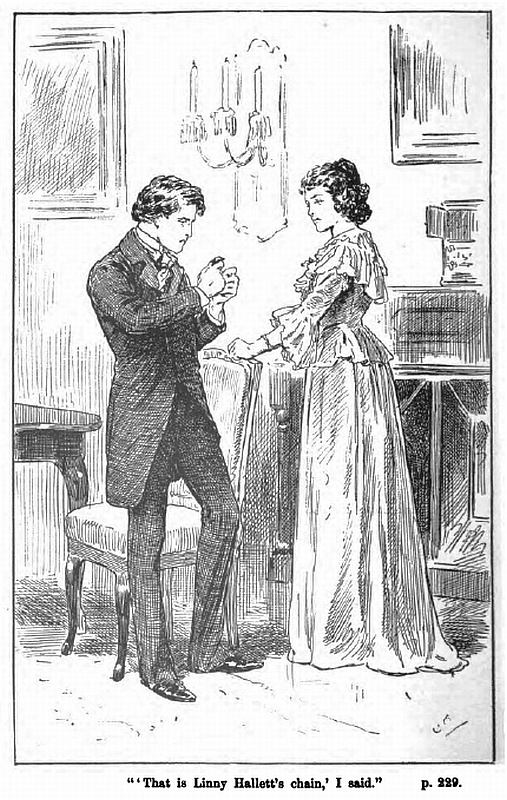
She placed it in my hands without a word, looking at me intently the while, as if questioning me with her eyes.
“That is Linny Hallett’s chain,” I said. “She made that guard herself, of her own hair. How did it come here?”
“Mr Lister dropped it, I suppose,” she said, with a look of scorn flashing from her eyes. “It was found by one of my servants in the hall after he was gone, and brought to me. I had forgotten it, Antony, until now.”
There was again a deep silence in the room, but at last she broke it with an eager question.
“Tell me about this Linny Hallett,” she said. “You have often told me that she is pretty. Is she good?”
“Oh yes, I am sure she is,” I said; “but she is weak and wilful, and she must have loved Mr Lister very much to turn as she has from so true a brother as Mr Hallett.”
“And—Mr Hallett—is he a good brother to her?”
“Good brother!” I exclaimed, my admiration for my friend carrying me away; “he is all that is noble and patient and good. Poor Hallett! he is more like a father to Linny than a brother, and then his patience with his poor mother! Oh, Miss Carr, I wish you knew him, too!”
She darted an inquiring look at me and then turned away her head, speaking no more, but listening intently as I told her of poor Hallett’s patience under misfortune, relating the story again of his noble sacrifice of self to keep those who were dear to him; of the anxiety Linny caused him, and of his tenderness of the unreasonable invalid he made his care.
Then, being thus set a-going, I talked, too, of the model, and our labours, and again of my ambition to get to be an engineer in order to help him, little thinking how I had turned myself into a special pleader to the advancement of my poor friend’s cause.
At last, half-ashamed of my earnestness, I looked inquiringly in my companion’s face, to find that she was listening intently, and she looked up at me as I ceased.
“And this Mr—Mr Hallett,” she said softly, “is still a workman in Messrs Ruddle and Lister’s employ?”
“Oh no! Miss Carr,” I exclaimed; “he told me he could never enter the place again, and that he dared not trust himself to meet Mr Lister face to face. He has not been there since, and he never will go there now.”
Miss Carr seemed to breathe more freely as I said these words, and then there was another interval of silence.
“Is Mr Hallett poor?” she asked then.
“Oh yes, very poor,” I said. “He has been obliged to stop his work over his invention sometimes, because the money has to go to buy wine and little choice things for poor Mrs Hallett. She is always repining and talking of the days when she had her conservatory and carriage, and, worst of all, she blames poor Hallett so for his want of ambition. Yes, Miss Carr,” I said, repeating myself to willing ears, “and he is one of the truest and best of men. He was not always a workman, you know.”
“Indeed!” she said; and I saw that she bent her head lower as she listened.
“No,” I said enthusiastically, as I, in my heart, set up Stephen Hallett as the model I meant to imitate. “His father was a surgeon in Warwickshire, and Mr Hallett was at college—at Oxford, where he was working to take honours.”
Miss Carr’s lips parted as she still sat with her head bent.
“He told me all about it one evening. He was sent for home one day to find his father dying; and, a week later, poor Mr Hallett found himself with all his father’s affairs upon his hands, and that he had died heavily in debt.”
Miss Carr’s head was slowly raised, and I felt proud then to see how I had interested her.
“Then,” I continued, “he had to try what he could do. He could not go back to college; for it took everything, even the furniture, to pay off his father’s debts, and then, one day, Miss Carr, he had to sit down and think how he was to keep his widowed mother, and his sister, and himself.”
Miss Carr was now sitting with her head resting upon her hand, her elbow upon her knee, listening intently to all I said.
“Mr Hallett and his father had some type and a little press in one of the rooms, with which they used to print poems and little pamphlets, and Mr Hallett had learnt enough about printing to make him, when he had taken his mother and sister up to London, try and get employment in an office. And he did; and he says he used to be horribly afraid of being found out and treated as an impostor; but by working with all his might he used to manage to keep up with the slow, lazy ones, and then, by degrees, he passed them; and now—oh, you should see him!—he can set up type much faster than the quickest man who ever came into the office.”
“And does he keep his mother and sister now?” she said dreamily.
“Oh yes,” I said; “Mrs Hallett has been an invalid ever since Mr Stephen Hallett’s father died.”
Miss Carr had sunk back in the corner of the couch, closing her eyelids, and I thought I saw a couple of tears stealing down her cheeks; but directly after she covered her face with her hands, remaining silent like that for quite half-an-hour—a silence that I respected to the end.
At last she rose quietly, and held out her hand.
“Antony,” she said softly, “I am not well to-night. Forgive me if I have disappointed you. Another time we must make up for this.”
“Oh, Miss Carr,” I said, “you have been so grieved.”
“Yes, greatly grieved, Antony, in many ways—not least that I spoke to you so harshly as I did.”
“But you are not angry with me?” I said. “You forgive me for not speaking out.”
“Forgive you?” she said softly—“forgive you, my boy?—yes. But go now; I do not feel myself. Good-night, Antony, my dear boy; go.”
To my surprise, she took me tenderly in her arms and kissed me, leading me afterwards to the door, and laying her cheek against my forehead before she let me out.
“Come to me to-morrow, Antony; come again to dinner; perhaps the next day I may be leaving town.”
Chapter Forty Five.
Hallett’s New Landlord.
A year slipped rapidly away, full of changes for some people, no doubt; but to me it was very uneventful. I worked away at my profession steadily, liking it better every day, and for nothing more strongly than that it gave me knowledge that I felt would be of advantage to Stephen Hallett, with whom I grew more intimate than ever.
The home at Great Ormond Street seemed now less sombre and desolate; for since her serious illness, from which poor Linny had been literally nursed back into life by Mary and Hallett, the girl was completely changed.
As she began to mend, I used to find a great deal of time to go and sit with her; for her return to strength was very slow, and the poor worn face would light up and the great staring eyes brighten whenever I went into the room with some little offering or another that I thought would please her. Sometimes it would be flowers, or fruit, or any little delicacy that I thought she would fancy; but the greatest pleasure I could give her was to take some fresh book, and sit and read.
She used to lie upon a couch near the window, where she could look out upon the sky, and when I was not there I suppose she would lie like that, thinking, for hours, without speaking a word.
Mary had grown to be quite an institution at the place, and the two invalids at last took up so much of her time, that a scheme was one day proposed by me, consequent upon an announcement made to me by Hallett.
“We shall be obliged to leave,” he said. “The tenants of this house are going away.”
“But it will be terrible work, Hallett,” I said. “How will Linny and Mrs Hallett bear the change?”
“I hope patiently and well,” he said quietly, and the subject dropped; but an idea had occurred to me which I hastened to put in force.
My first step was to write to Miss Carr, whom I had not seen for many, many months, as, directly after the meeting with Mr Lister she had gone on the Continent with her newly-married sister, whose husband had an official appointment at Marseilles, and had resided with her ever since.
I was grievously disappointed at having to part with so good a friend; but she promised to write to me every week, and gave me the strictest injunctions to send to her for advice or help whenever I should find myself in need.
I had no hesitation whatever, then, in asking her in my weekly letter for help to carry out my plan, and that was to find Revitts and Mary the money to buy the lease of the house in Great Ormond Street, so that Mary would be better able to attend to her friends, and, while acting as their landlady, supply me with better rooms as well.
I broached the subject to Revitts and his wife that very evening, and the former nodded.
“How much would it take, Ant’ny?” he said.
“The lease would be a hundred pounds,” I said. “Then the rent is eighty.”
“That’s a deal of money, my dear,” said Mary; “and then there’s the rates.”
“Yes,” I said; “but then look here, Mary; I should like a sitting-room as well as a bedroom now, and I could pay you twenty-five or thirty pounds a year for that. I know Mr Hallett pays twenty-six for what he has, and you could, as you often said you would like to, let another floor; for it is a large house. I think you would live rent-free.”
“There,” cried Revitts, giving the table a slap. “What do you think of that, Polly?”
“Think of what?” she said tartly; for the seriousness of the subject unsettled her.
“What he says. D’ye hear his business-like way of reckoning it up: so much for this here, and so much for that there? He couldn’t have talked like that when he come up to London first, as green as a bit o’ grass. That’s my teaching, that is. I knew I could sharpen him up.”
“Don’t be so conceited, Bill,” she exclaimed. “But a large house means lots of furniture, Master Antony. No, I don’t think it would do. We haven’t enough.”
“But I’ve written to Miss Carr, to ask her to let me have the money for you.”
Revitts got up out of his chair, where he was partaking of tea and bread and butter in a rather wholesale style, pulled himself together, buttoned up his coat, took a couple of official strides to where I sat, and, taking my hand, began shaking it up and down for some moments.
Then he gave Mary three or four wags of the head and nods, and went back to his tea, unbuttoning the while.
“That’s very nice and kind of you, Master Antony,” she said; “but that money would be only borrowed, and it would have to be paid back again, and sit upon us like lumps of lead till it was—”
“Oh, nonsense, Mary, I don’t believe Miss Carr would ever want it back—I think she’ll give me the money. And besides, I mean to furnish my own rooms, so that will be two less.”
“Hark at that now!” said Revitts, giving his head a wag.
“I don’t want to seem conceited, but I should like to improve my room, and have a place for my books, and be able to bring a friend home to have tea or supper with me when I liked.”
“That’s quite right,” said Revitts approvingly; “but we should want close upon two hundred pounds, Master Ant’ny, you know.”
“Yes, you ought to have two hundred and fifty pounds.”
Mary shook her head, and seemed to tighten up her face, buttering the bread she had before her the while.
“Here, I say, come, Polly, I know we should have to begin saving,” said Revitts, in tones of remonstrance; “but don’t begin to-night. Stick a little more butter on that there bread.”
Mary complied, the meal went on, and I left them at last to talk the matter over, thoroughly upset by my proposals.
They opposed them for some days to come; but when, at last, I received a kind letter from Miss Carr, bidding me tell Mary how glad she was to hear of her plans, and that they were to be sure and include a comfortable bed and sitting-room for me, the day was carried, especially as the letter contained a cheque for 250 pounds; though they would not take all this, the steady, hoarding couple being able to produce between them enough to pay in full for the lease, which was duly assigned and placed in Revitts’ hands by Tom Girtley, who was progressing fast with the firm of solicitors to whom he had been articled.
The first intimation that Hallett received of the change was from Revitts himself, who called one day on his way home to announce with suppressed glee that he was the new landlord, and to ask if there was anything that Mr Hallett would like done.
Hallett stared in astonishment, and then turned sharply to me—
“This is your doing, Antony,” he said.
I pleaded guilty.
“Well, what could be better?” I said; “I’m going to have two rooms, and Mary will be always at hand to attend upon us, and you will not have to turn out.”
“But the money?” he said, looking at me searchingly.
“Revitts and his wife have been saving people,” I replied, “and they had their savings to invest. I don’t think they could have done better.”
Hallett did not seem satisfied, but he was too much of a gentleman to push his questions home, and the matter dropped. The old tenant of the house moved out at once; Mary had a charwoman at work for a general clean up, and ended by dismissing her for smelling of gin, and doing the cleaning herself; and before a fortnight was over the change had been made, and I was able to congratulate myself on a capital arrangement.
“You think it is now,” I said, “Hallett, don’t you?”
“I do now, Antony,” he said, “for more reasons than one.”
“What do you mean?” I said; for he looked very peculiar and stern.
“I have seen that man hanging about here once or twice.”
“Mr Lister?”
He nodded.
“Oh, but surely that is all over. He would never dare.”
“He hates me, I am sure, Antony,” he replied, “and would do anything to injure me; and, besides, such a man as that would not lightly give up his plans.”
“But Linny dislikes him now, I am sure,” I said.
“I am not,” he replied sadly; and no more was said.
Chapter Forty Six.
Linny Awakes.
But those words “I am not,” made no little impression on me, and a day or two later, when I had taken Linny in some flowers, I was thinking very deeply about them, and perhaps my thoughts may have influenced the mind of the poor girl, for she suddenly laid her thin white hand upon my arm and said: “Antony, do you ever see Mr Lister now?”
“No,” I said; “I have never seen him since the day of that scene with Miss Carr.”
“Tell me about it—all about it,” she said sharply. I stared at her aghast, and tried to excuse myself, but her eyes looked at me so imploringly that I felt compelled, and related all that I had heard and seen.
She lay with her eyes half-closed during my recital, and when it was ended the poor, weak, wasted girl took one of my hands between both of hers, and held it to her breast, caressing it silently the while.
“Oh, Linny, dear,” I said, “what have I done! I ought not to have told you all this. You are going to be worse. Let me call Stephen!”
“No, no, no,” she wailed. “Hush, hush! You must not wake poor mamma?”
“Let me call up Mary.”
“No, no,” she sobbed; “sit still—sit still, Antony dear; you have always been to me like a brother, and you have known all. I have no girl friends of my own age, but I can talk to you.”
“No; let’s talk of something else,” I said earnestly. “You must not think about the past.”
“I must think about it, or I shall die,” she said, adding pathetically, “no, no, don’t get up. I shall be better now. There, you see, I have left off crying.”
She seemed to make an effort over herself, and in a few minutes she looked up at me smiling, but her poor face was so wasted and thin that her smile frightened me, and I was again about to call for help.
“No, no,” she said; “I am better now. Antony dear, I could not get well, but felt as if I was wasting away because I could not see him. Oh, Antony, I did love him so, and I felt obliged to obey him in all he wished. But it was because I thought him so fond and true. I have felt all these long months that he loved me very dearly, and that if I could only see him—if I could only lay my head upon his arm, and go to rest, I should wake up well. I always thought that he loved me very dearly, and that some day he would come and say I was to be his wife. Stephen thought I hated him for his cruel ways, but I did not, I could not. I do not even hate him now. I am only sorry.”
“But you don’t want to see him again, Linny?” I said.
“No, no: not now,” she replied with a shudder. “I know now that he never loved me. I never understood it all before, Antony. I pray God I may never see his face again.”
There was something very impressive in her words, and, closing her eyes, she lay back there so still that I thought she was asleep, but the moment I tried to withdraw my hand she clung to it the more tightly, and looked up at me and smiled.
“Antony,” she said suddenly; and there seemed to be a new light in her eyes as she opened them wildly, “I am going to get well now. I could not before, for thinking about the past.”
“I hope and pray that you will,” I said, with a strange sensation of fear creeping through me.
“I shall,” she said quickly. “I can feel it now. Last week I thought that I was going to die. Now talk to me about Miss Carr. Is she very beautiful?”
“Yes,” I said eagerly, “very beautiful.”
“More handsome than I used to be?” she said, laughing.
“Oh, she’s very different to you, Linny,” I said, flushing. “She is tall and noble-looking, and dark, while you are little and fair. One could not compare you two together.”
“It was no wonder, then, that Mr Lister should love her.”
“Oh no,” I said. “Any man who saw her would be sure to love her.”
She sighed softly.
“Is she—is she a good woman?”
“Good?” I cried enthusiastically; “there could not be a better woman.”
“And—and—” she faltered, moistening her dry lips, “do you think she will marry Mr Lister?”
“I am sure she will not,” I said indignantly.
“But she loved him.”
“No,” I said thoughtfully; “I don’t think she did much.”
“But he loved her.”
“Ye-es, I suppose so,” I said; “but he could not have loved her much, or he would not have behaved as he did.”
There was a pause then, during which Linny lay playing with my hand.
“Antony,” she cried suddenly, “Miss Carr will forgive him some day.”
“Forgive him!” I said. “Yes, she is so good a woman that I dare say she will forgive him, but everything is over between them now.”
“I am very glad,” she said dreamily, “for I should be sorry if anything else took place.”
“What! should you be jealous, Linny?”
“No,” she said decidedly, “only very, very sorry for her. Oh! Antony,” she said, bursting into passionate tears, “I was very ignorant and very blind.”
“Linny, Linny, my child, what is the matter?” cried Hallett, entering the room, and flying with all a woman’s solicitude to the couch, to take the light wasted form in his arms. “Heaven help me, she’s worse. The doctor, Antony, quick!”
“No, no, no,” cried Linny, throwing her arms round her brother’s neck; “I am better, Steve, better now. It is only sorrow that I have been so blind.”
“So blind, my darling?”
“Yes, yes,” she sobbed excitedly, pressing her brother’s dark hair from his forehead, and covering his face with her kisses, “that I was so blind, and weak, and young. I did not know who loved me, and who did not; but it’s all over now, Steve dear. Dear brother, it’s all over now.”
“My darling,” he whispered, “let me send for help!”
“No, no,” she cried, “what for? I am better—so much better, Stephen. That is all taken off my mind, and I have nothing to do now but love you, love you all, and get well.”
Poor little thing! She lay there clasped in her brother’s strong arms, sobbing hysterically, but it was as if every tear she shed washed away from her stricken mind a portion of the canker that had been consuming her day by day.
It was more than I could bear, and if it had not been that I was called upon to speak to and comfort poor, weak Mrs Hallett, who had been awakened by Linny’s passionate sobs, I should have run out of the room and away from the house; but somehow I had grown to be part and parcel of that family, and the weak invalid seemed to love me like her own son.
At last, to my inexpressible relief, I saw Linny calm gradually down and sink to sleep in her brother’s arms, like some weary, suffering child.
Hallett did not move, but sat there fearing to disturb her, and as the evening wore on, his eyes sought mine inquiringly again and again, to direct my attention to her look: and as I watched her in that soft evening glow—a mellow light which told of a lovely evening in the country lanes—a soft, gentle calm seemed to have come upon the wasted face, its old hard angularity had gone, and with it that wistful air of suffering and constant pain, her breathing was faint, but it was soft and regular as that of a sleeping child, and at last there was a restful smile of content upon her lips, such as had not been there for years.
“What had you been saying to her, Antony?” whispered Hallett sternly, as I sat there by his side.
“She asked me questions about Lister and Miss Carr,” I said, “and I think that she woke up for the first time to know what a rascal he is.”
Hallett looked anxiously at his sister before he spoke again, but she was evidently plunged in a deep sleep.
“You are very young, Antony, but you are getting schooled in nature’s secrets earlier than many are. Do you think that is over now?”
“I am sure of it,” I said.
“Thank God!” he said fervently, “for I was in daily dread.”
“She would never—there,” I said excitedly; “she prayed herself that she might never see his face again.”
“But they say women are very forgiving, Antony,” he said with a tinge of bitterness; and then, with his brow furrowing but a cynical smile upon his lip, he said, “We shall hear next that Miss Carr has forgiven him, and that they are married.”
“For shame!” I exclaimed indignantly. “You do not know Miss Carr, or you would not speak like that.”
He half closed his eyes after glancing at where his mother lay back in her easy-chair, asleep once more, for so she passed the greater part of her time.
“No,” he said softly, “I do not know her, Antony.”
I don’t know what possessed me to say what I did, but it seemed as if I was influenced to speak.
“I wish you did know her and love her, Hallett, for she is so—”
He started as if he had been stung.
“Are you mad?” he exclaimed angrily.
“No,” I said quietly, “but I think she likes you.”
“How could she?”
“I have talked so much about you, and she has seemed so interested in all you do.”
“You foolish fellow,” he said, with his face resuming its old calm. “You are too young yet to thoroughly understand such matters. When you grow older, you will learn why it was that I could not play, as you seemed to wish, so mean a part as to become John Lister’s accuser. It would have been contemptible in the extreme.”
“I could not help feeling that Miss Carr ought to know, Hallett.”
“Yes, my lad, but you shrank from telling her yourself.”
He was silent for a minute.
“Ah, Antony,” he said, “Fate seems to have ordained that I am always to wear the workman’s coat; but I console myself with the idea that a man may be a poor artisan and still at heart a gentleman.”
“Of course!”
“My father was a thoroughly honourable man, who left us poor solely from misfortune. The legacy he left to me, Antony, was the care of my dear mother and Linny.”
He looked down tenderly on the sleeping girl, and softly stroked her hair; the touch, light as it was, waking her, to smile in his face with a look very different from that worn by her countenance the day before.
Chapter Forty Seven.
Miss Carr Hears the Truth.
I was surprised one morning by my weekly letter from Miss Carr containing the welcome news that she was coming back; in fact, that she was following the letter, and it expressed a wish that I should meet her at the terminus and see her home.
It was with no small feeling of pride that I found myself chosen for this duty, and quite an hour before it was possible for the train to come in, I was waiting at the station.
Soon after I saw the carriage drive up, and at last, after looking endless times at the clock, I saw the train come gliding in, and the next minute I was hurrying along the platform, looking eagerly at each carriage in turn, when I found myself brushing by John Lister, who started and scowled at me as I passed.
Just then I caught sight of Miss Carr, looking from one of the carriages, and handing a bundle of wraps to her maid.
I ran eagerly up, but only to find myself rudely thrust aside by John Lister, who, in his excitement, studied nothing so that he could reach her first.
“At last,” he whispered passionately. “Let me be the first to welcome you back.”
Flushed and angry, my fists involuntarily clenched, and I felt ready to strike him as I started forward once again.
I had my recompense, though, directly, for I saw Miss Carr draw down her veil, and; completely ignoring the extended hands, she beckoned to me, and, summoning up as much importance as I could, I said sharply:
“Will you have the goodness to stand aside?”
He was so taken aback by the determined refusal of Miss Carr to renew their acquaintance that he stood back involuntarily, recovering himself though, directly, and approaching once more; but he was too late: Miss Carr had taken my arm, and I led her to the carriage, the footman, who had seen her, taking the wraps and a case or two from the maid, whom he ushered to a cab, which was then being loaded with luggage, as I sprang in beside my patroness, and gave the word to the coachman, “Home!”
I was too young not to feel excited by the importance of my position, and as the horses started and the carriage moved forward, think now that I must have been more than human if I had not darted a look of triumph at John Lister, as he stood there just beneath one of the swinging lamps, his brow furrowed and a furious look of disappointment and malice upon his face.
I heard Miss Carr draw her breath as if with pain, but the next moment her hands were in mine.
“My dear Antony,” she exclaimed, “I am very glad to get back. Why, my dear boy, what a difference one year has made in you.”
“Has it?” I said, laughing.
“Oh, yes! Why, Antony, you will soon be growing into a man.”
“I hope so, Miss Carr; but I don’t think you look well.”
“No?”
“You look thin and careworn.”
“Marseilles is a very hot place, Antony,” she said evasively, “and does not suit English people. Of course, you are my property this evening, Antony. You have no engagement?”
“No,” I said, smiling. “I should have gone to spend the evening with Mr Hallett if I had been alone.”
Her hand gave a slight twitch as I said these words, and her voice sounded a little hoarse as she continued:
“You must come and dine with me, Antony, and we will have a long, long chat. It seems like old times to be with you again.”
I was delighted to have her back, and chatted on in the most unreserved way, until we reached Miss Carr’s house, where the door flew open as the carriage stopped.
I jumped down, and was in the act of holding out my right hand and the carriage-door open with the left, when I started with surprise; for a swift hansom cab had brought John Lister there before us, and he stood on the other side, holding out his hand.
“I must speak to you, Miriam!” he exclaimed in a low voice, when, seeing her shrink back in alarm, and with an unmistakable look of horror in her face, boy as I was, I felt some sense of manhood flush to my cheek, and, feeling no fear of him for the moment, I placed my hand upon his chest, and thrust him with all my might away.
“Stand back, sir!” I cried, “or I call the police.”
Ere he could recover from his astonishment, Miss Carr had lightly touched my hand, stepped out, and hurried in, while I, with my heart beating fast at my temerity, slowly closed the brougham-door, and stood facing John Lister.
“You insolent dog?” he cried threateningly; and I thought he was about to strike me, but at that moment, as I stood before him with my teeth set, I would hardly have run in to save my life.
“How dare you insult Miss Carr!” I exclaimed.
“Insult! Oh, this is too much!” he muttered. Then, half-raising his hand, he let it fall once more, turned upon his heel, and strode away.
The coachman seemed disposed to speak, but the field being now my own, I walked—very pompously, I’m afraid—into the hall, Miss Carr coming out of the dining-room as soon as the front door was closed, to catch my hand in hers, and look eagerly in my flushed face.
“You have grown brave too, Antony,” she whispered, as she led me upstairs. “Thank you, thank you; I did not know that I could look for a protector in you.”
I had calmed down by the time Miss Carr had dressed; and then followed one of those, to me, delightful evenings. We dined together; she chatted of her life in Southern France, and at last, over our tea in the drawing-room, as she was sitting back in her lounge-chair, with her face in the shade, she said, in what was meant to be a perfectly calm voice:
“Well, Antony, you have not said a word to me about your friends.”
I did not answer directly, for I felt a strange hesitation in so doing; and a similar emotion must have been in my companion’s breast, for she sat there for some minutes in silence, till I said:
“Linny Hallett seems to have quite recovered now, and is bright and happy again, though very much changed.”
Miss Carr did not speak.
“Mrs Hallett is precisely the same. I do not think she has altered in the least since I have known her.”
Miss Carr seemed to turn her face more away from me, or else it was the shadow, and now, instead of speaking of Stephen Hallett, something seemed to prompt me to turn off, and talk of Revitts and Mary, and of how admirably the arrangement had answered of their taking the house in Great Ormond Street.
There seemed to be a slight impatient movement as I prattled on—I can call it nothing else. It was not from a spirit of mischief, but all the time I seemed to feel that she must want to know about Stephen Hallett, and somehow I could not mention his name.
“It is quite droll, Miss Carr,” I said. “Mrs Hallett says that it is such an admirable arrangement, having a police-constable on the premises, and that she has never before felt so safe since she has been in London.”
“You have not spoken to me yet of your friend—Mr Hallett.”
I started, for it did not sound like Miss Carr’s voice, and when I looked up I could not see her face.
“No; not yet,” I said. “He is toiling on still as patiently and enduringly as ever.”
“And the invention, Antony?”
“The invention,” I said bitterly, “lags behind. It is impossible to get on.”
“Is—is it all waste of time, then?”
“Waste? No,” I said. “The invention is one that would carry all before it; but, poor fellow, he is tied and fettered at every turn. He has nearly got it to perfection, but, after months of constant toil, some wretched part breaks down, and the whole thing has to be done again.”
“But is it likely to succeed?”
“Likely?” I said: “it must succeed; but it never can until it has been made and tried. It should be carefully constructed at some large engineering establishment like ours.”
“Yes,” she said, evidently listening intently.
“But how can it be? Poor Hallett earns about two pounds a week, and the demands upon his pocket, through his mother’s and sister’s illness, have been terrible. He is heavily in debt now to the doctors.”
“Why do you not help your friend, then, Antony?” she said in tones of reproach.
“Because he will not let me,” I replied quietly. “He is too proud.”
Miss Carr was silent.
“What amount would it take,” she said at last, in a strange tone, “to perfect the machine?”
“Amount?” I said eagerly; “an awful deal. It is impossible to say how much. Why, the patent would cost nearly a hundred. Poor fellow! I wish sometimes he would give it up.”
“Why?” she exclaimed softly.
“Because,” I said, “it is breaking his heart.”
“Is—is he so constant in his attentions to it?”
“Oh yes, Miss Carr. Whenever he can spare a minute, he is working or dreaming over it; he calls it his love—his mistress, in a half-mocking sort of spirit. Poor fellow, it is a sad life.”
There was again a deep silence in the room.
“Antony,” she said again, “why do you not help your friend?”
“I do,” I said eagerly. “I have worked at it all night with him sometimes, and spent all my pocket-money upon it—though he doesn’t know it. He thinks I have turned some of the wheels and spindles myself, but I set some of our best workmen to do it, and cut me the cogs and ratchets.”
“And paid for them yourself?”
“Yes, Miss Carr. I could not have made them well enough.”
“But why not help him more substantially, Antony? With the money that is required?”
“I help him?” I said.
She did not answer for a few moments, for a struggle was going on within her breast, but she spoke at last. Her pride and feminine shrinking had given way before the love that she had been striving these many months to crush, but which was sweeping all before it now.
“Antony,” she said softly, “I can trust to you, I know; and I feel that whatever I help you in will be for the best. You shall help your friend Mr Hallett. My purse shall be open to you, and you shall find the means to enable him to carry his project to success.”
“Oh, Miss Carr!” I cried; and in my new delight I caught and kissed her hand.
She laid one upon my shoulder, but her head was averted still, and then she motioned me to resume my seat.
“Does that satisfy you, Antony?” she said.
“Yes—no,” I cried, getting up and walking up and down the room. “He would not take the money; he would be a great deal too proud.”
“Would not take the money, Antony? Why?”
“Because he would know that it came from you.”
“And knowing that the money came from me, Antony, would he not take it?”
“No, I am sure he would not.”
“Why?”
“Because—because—Miss Carr, should you be angry with me if I told you the truth?”
She paused again, some minutes, before she replied softly, but in so strange a tone: “No, Antony. How could I?”
“Because, Miss Carr, I am sure he loves you: and he would think it lowered him in your eyes.”
She turned upon me a look that seemed hot with anger, but the next moment she had turned her face away, and I could see that her bosom was heaving with suppressed emotion.
A great struggle was evidently going on within her breast, and it was some time before she could master it. At last, however, she turned to me a face that was deadly pale, and there was something very stern in her looks as she said to me:
“Antony, we have been separated for a year, but can you speak to me with the same boyish truth and candour as of old, in the spirit taught you, my dear boy, by the father and mother you have lost?”
“Oh yes, Miss Carr,” I said frankly, as I laid my hand in hers, and looked in her beautiful eyes.
“Yes, Antony, you can,” she said softly. “Tell me, then, has Mr Hallett ever dared to say such a thing as—as that to you?”
“Never, Miss Carr.”
“Has—has my name been made the subject of conversation amongst your friends?”
“Never, Miss Carr.”
“Or been coupled with his?”
“Oh! no, no,” I cried, “never. Mr Hallett has rarely mentioned your name.”
“Then how can you—how can you dare to make such an assertion as you did?”
“I don’t know,” I replied thoughtfully. “I could not tell you how it is, but I am sure he does love you as much as I do, Miss Carr.”
“I believe you do, Antony,” she said, bending forward and kissing my forehead. “But, you foolish boy, drive that other notion from your head, and if you do love me, Antony—and I would have you love me, my boy, as dearly as you loved her who has gone—never speak to your dearest friend of our words to-night.”
“Oh, you may trust me for that,” I said proudly.
“I do trust you, Antony, and I see now that your ideas are right about the money. Still, I should like you to help your friend.”
“So should I,” I said; and I sat thinking dreamily over the matter, being intensely desirous of helping Hallett, till it was time to go, when an idea occurred to me which I proposed to Miss Carr, one which she gladly accepted, joining eagerly in what was, perhaps, a deception, but one most truly and kindly meant.
Chapter Forty Eight.
An Invitation.
“Hallo, young Grace,” said Mr Jabez Rowle, as I was shown up one evening into his room, to find him, snuff-box on the table and pen in hand, reading away at his paper, and, as I entered, smiling with satisfaction as he pounced upon a literal error, and marked it in the margin. “How are you?”
I said I was quite well, and he pointed to several pen marks at the side of the column.
“There’s reading,” he said contemptuously. “I’m ashamed of these daily papers, that I am. Well, how are wheels and lathes and steam-engines, eh? Bah! what a contemptible young sneak you were to leave so good a business for oil and steam and steel-filings. I give you up now. Glad to see you, though; sit down. Have a pinch or snuff?”
“No, thanks,” I said, smiling.
“Humph! how you grow, you young dog; why, you’ll soon be a man. Better have a pinch; capital bit of snuff.”
I shook my head, and he went on, smiling grimly at me the while.
“No business to have left me, Grace. I should have made a man of you. Well, how are you getting on?”
“Capitally,” I said.
“Don’t believe it. Better have stopped with me. Heard from Peter?”
“No,” I said eagerly. “Have you?”
“Yes. Just the same as usual. Down at Rowford still, smoking himself to death. Hah! capital pinch of snuff this,” he added, regaling himself again. “Sent his love to you, and said I was to tell you—tell you—where the dickens did I put that letter?” he continued, pulling a bundle of dip-proofs out of his breast-pocket, and hunting them over—“said I was to tell you—ah, here it is—to tell you—Ah—‘Tell young Grace I shall come up to town and see him some day, and I’ll give you a look up too.’ Bah! Don’t want him: won’t have him. We should be sure to quarrel. He’d come here, and sit and smoke all day—where’s my—oh, here it is.”
He took a couple of pinches of snuff in a queer, excited way, and snapped his fingers loudly.
“I shall be very, very glad to see him when he does come,” I said warmly.
“Ah, yes, of course you will. He’s got some papers or something, he says, for you.”
“Has he?”
“So he says. Hang Peter! I don’t like him, somehow.”
There was a comical look of chagrin in the old man’s face as he spoke; but it was mingled with a dry, humorous air that refused to be concealed, and I seemed to feel in my heart that if the brothers met, Mr Jabez would be thoroughly cordial.
“Well, I’m glad you did condescend to call, young engine-driver,” he said at last; “as it happens, I’m not busy to-night. You won’t take a pinch of snuff?”
I shook my head.
“What will you have, then? Have some almonds and raisins? Figs? Some oranges? Well, some sweetstuff? They’ve got some capital cocoa-nut candy downstairs! No? Well, have some candied peel?”
“No, thank you, Mr Jabez,” I said, laughing. “Why, what a baby you do think me.”
“Well, so you are,” he growled. “You don’t want me to ask you to have beer, or grog, or cigars, do you?”
“Oh no!” I said, laughing.
“Good job, too, because you wouldn’t catch me giving them to you. Well, how’s your policeman?”
“Quite well.”
“Ever see Hallett now?”
“Every day nearly.”
“Humph! Decent fellow, Hallett; sorry he left us. Cleanest proofs I ever had. That man always read his stick, Grace. You always read yours?”
“But you forget I am not a printer now, Mr Jabez.”
“No, I don’t, stupid. Can’t you see I was speaking in metaphors? Always read your stick, boy, through life. When you’ve done a thing, go over it again to see if it’s right; and then, at the end, you’ll find your proof-sheets of life are not half so foul. Tell Hallett, when you see him again, to give me a look up. I rather liked him.”
“Why, you never seemed to like him, Mr Jabez,” I said.
“Well, what of that, boy? Can’t a man like anybody without always going about and grinning?”
He took another pinch of snuff, and then nodded and tapped his box.
“How’s Mr Grimstone?” I said, smiling.
“Oh, hard as a nut, and as awkward. Gives me a deal of trouble.”
“And is Jem Smith with you still?”
“With me? No; but he’s in a house close by, the great stupid lout! He’s got whiskers now, and grown more thick-headed than ever. Grimstone had a sharp illness, though, over that affair.”
“What affair?” I asked.
“Why, when the partnership was broken up—you know?”
“No,” I said, wonderingly.
“Why, you must have heard. When John Lister was bankrupt. He was dead in with the money-lenders, and he had to give up, you know.”
“What! was he ruined?”
“Ruined? yes, a gambling fool; and if Mr Ruddle hadn’t been pretty firm, the rascal would have ruined him too—pulled the house down.”
“This is news,” I said.
“Yes, and bad news, too,” said the old fellow. “Five hundred pounds of my savings went—lent money—for him to make ducks and drakes!”
“Oh, Mr Jabez,” I said: “I am very sorry.”
“Don’t deserve it,” he said, taking another pinch; “served me right for being such a fool. I don’t mind now; I never cry over spilt milk, but it nearly broke poor old Grim’s heart. Five hundred of his went, too, and it was very nearly being more.”
“I remember something about it,” I said. “You were speaking on the subject once before me.”
“Ah, so we were. Well, it was a warning to me, Grace. Temptation, you know.”
“Temptation?”
“Yes, to get bonus and high interest. Playing usurer, my boy. Serve us both right. Don’t you ever be led on to lending money on usury.”
“I’m not likely ever to have any to lend,” I said, laughing.
“I don’t know that,” he said, making another reference to his snuff-box. “Peter said in one of his letters that he thought there was some money that ought to come to you.”
“I’m afraid not,” I said, laughing. “I’ve a long debt to pay yet.”
“You!—you in debt, you young rascal!” he exclaimed angrily.
“I always said I would some day pay off my father’s debts, Mr Jabez,” I said; and then my words brought up such a flood of sad recollections, that I was about to eagerly change the subject, when Mr Jabez leaned over to me and took my hand.
“Good lad,” he said, shaking it up and down. “Good lad. I like that. I don’t believe you ever will pay them, you know; but I like the sound of it all the same.”
He kept on shaking my hand some time, and only left it to take another pinch of snuff.
“And has Mr Lister quite gone from the firm?”
“Oh, yes, quite, my lad. He was up to his eyes in debt, and when he didn’t marry that girl, and get her money to pay himself off clear, he went smash at once. Lucky escape for her. I’m afraid he was a bad one.”
“And what is he doing now?”
“What, Lister? Set up a rival shop on borrowed money; doing all he can to cut down his old partner, but he’ll do no good. Can’t get on. Hasn’t got a man on the premises who can read.”
“Indeed!” I said.
“Not a soul, Grace. Why, you wouldn’t believe it, my lad,” he continued, tapping me in the shirt-front with his snuff-box, “but I had one of their Chancery-bills in the other day—big quarto, you know, pica type—and there were two turned n’s for u’s in the second page.”
“Never?” I said, to humour him.
“Fact, sir, fact,” he said, taking another pinch of snuff and snapping his fingers triumphantly. “Why, I’d hardly forgive that in a daily paper where there’s a rush on, and it’s got up in the night; but in a thing like a Chancery-bill it’s inexcusable. Well, now about yourself, Grace. I’m glad you are getting on, boy. Never mind what I said; it’s better than being a reader, and growing into a snuffy cantankerous old scarecrow like me. Read your stick well, my boy, and I hope—no, I’m sure you’ll get on. But I say, what will you have to eat?”
“I’m not hungry, Mr Jabez,” I said; “and, look here, I haven’t delivered my message to you.”