George Manville Fenn (continued 4)
Reading edition
I got on pretty well, for my home training had made manuscript easy to me. In fact, I had often copied pieces for my father, containing letters from various naturalist friends, while my sojourn at Mr Blakeford’s had made anything of a legal character perfectly clear.
That night, when it was time to go, and I had had no greater unpleasantness to contend with than several severe fits of sneezing brought on when the little man used his snuff-box, I timidly asked him if I was wanted the next day, for as yet no opportunity had served for making known my knowledge of his brother.
“Wanted!” he cried; “why, I had serious thoughts of locking you up, boy, so as to make sure of you to-morrow. Wanted! Yes: I’ve got you, and I mean to keep you; and if Grimstone says another word—but only let him. Look here: you are very stupid yet, but you’ll soon improve; and mind this, come with clean hands and face to-morrow, and clean apron.”
“Yes, sir,” I said, and then I hesitated.
“Well, what is it?”
“Please, sir, you are Mr Jabez Rowle, are you not?”
“Yes, and what then?” he said shortly.
“Only, sir, that Mr Peter Rowle, who is a friend of mine, said I might mention his name to you.”
“Oh, he did, did he? Well, he need not have taken the trouble. There, be off, and mind you are here in good time.”
This was damping, especially as Mr Jabez Rowle took snuff viciously, and stood staring before him, tapping his box, and muttering angrily, in which state I left him, and made the best of my way home.
I was in good time next morning, but, all the same, there sat Mr Jabez Rowle in his glass case waiting for me, and as I entered and said “Good-morning, sir,” he just nodded shortly and pointed with the penholder in his hand to a piece of paper.
“Go on?” he said; and, taking it up, I began to read.
“Not quite so fast, and say par when you come to a fresh paragraph.”
I read on, making a good many blunders in my anxiety to be right, but, I presume, getting on very well, for Mr Rowle found but little fault, as he seemed to dart his pen down at every error in the slip proofs before him—turned letters, p’s where q’s should be, and b’s for d’s; c’s were often in the place of e’s; and then there were omissions, repetitions, absence of spaces or points, a score of different little omissions on the compositor’s part; and, besides all these, the busy pen made marks and signs that were cabalistic to me.
This had gone on about a couple of days, and I was reading away to him what I believed was a prayer in a chancery-bill, when Mr Jabez suddenly laid down his pen, took out his snuff-box, and said, looking me full in the face, “How’s Peter?”
“I beg your pardon, sir?”
“I say, how’s Peter?”
“How’s Peter, sir?”
“Don’t pretend to be stupid, boy, when you’re as sharp as a needle,” he cried, tapping the desk angrily with his snuff-box. “Didn’t you say you knew my brother Peter?”
“Oh yes, sir! he was very kind to me, but I haven’t seen him for some weeks. He was quite well then.”
“Humph! look old?”
“He looks very much like you, sir.”
“Then he does look old. We’re very fond of one another, boy, but we; always quarrel; so we never meet. ‘And your petitioner furthermore sayeth—’”
“I beg your pardon, sir.”
“‘And your petitioner furthermore sayeth’—get on, boy: go on.”
I dashed at the manuscript again, for he had resumed his work, and read on to the end, for he made no further inquiries about his brother.
I soon grew quite accustomed to reading, and found that Mr Jabez Rowle meant what he said about keeping to me, for I was regularly installed as reading-boy, and, as I have said, I was delighted with the change. I often met Jem Smith, and, from his looks, it was evident that he bore me no good will, and, to be frank, I felt rather revengeful for his treatment. One day, during the dinner hour, I went down into the lower part before the men came back, and, after getting some slips which Mr Rowle had told me to have ready for him, my enemy pounced upon me, coming in at the door just as I was about to leave.
“Now I’ve got yer, then,” he cried, with a malicious grin, and, rushing at me, I had only time to evade the first onslaught by running round the frames, when a hot chase ensued, ending in my being brought to bay, and receiving blow after blow from my stronger antagonist.
I did all I could to defend myself, till, closing with me, he held me tight with one arm, and struck me so cruelly in the face, that it roused me to greater efforts, and, after a short wrestle, I was free.
It was but a moment’s respite before he dashed at me again, and, in my rage and desperation, I struck out at him so fiercely that my fist caught him full between the eyes, making him stagger and catch at the first object he could to save himself, and the result was that he pulled over a full case of small type. There was a crash, I uttered a cry, and some twenty pounds of type were scattered in confusion all over the floor.
Before I had recovered from my horror, the door was thrown open, and Mr Grimstone came hurrying in.
“What’s this—what’s this?” he cried.
“Please, sir, Grace was playing larks with one of the cases, and he let it fall.”
“Then Mr Grace shall soon find out what it is to destroy the property of the firm in this wanton way,” he cried.
“Indeed, sir—” I began.
“Not a word, sir—not a word!” he cried. “Smith, go about your work. You, Grace, pick up every bit of that pie at once.”
“But please, sir, I did not knock it down, and Mr Rowle is waiting for me.”
“Pick it up, sir.”
“But Mr Rowle—”
“Pick it up, sir.”
I was so hot and excited that I was about to declare angrily that I would not, when I caught Mr Hallett’s eyes gazing fixedly at me, and without a word, but feeling half-choked with anger and indignation, I fetched a galley and began to pick up the fallen type.
I had not been engaged in my uncongenial task many minutes before Mr Jabez Rowle came down to see where I was, and I noticed that there was quite a triumphant look in Mr Grimstone’s eyes as he said I must stay and pick up all the type, the matter being compromised on the understanding that as soon as the metal was picked up I was to resume my reading upstairs, and, by Mr Grimstone’s orders, stay in every dinner-time and get to the office an hour sooner every morning till I had set up and distributed the whole of the pie.
How I dwelt on the injustice of that task! It was one which seemed to give Mr Grimstone great satisfaction, for it took my inexperienced fingers many weeks, and I had to toil very hard. But all the same, it was no waste of time, for it gave me dexterity in handling type such as I should not otherwise have had.
I had suffered a great deal from anxiety lest some morning Mr Blakeford should step into the office and claim me; for, unpleasant as were my dealings with Mr Grimstone, Jem Smith, and through the latter with several of the other boys, I thoroughly enjoyed my present existence. Revitts was very kind, and, in spite of his sharp abruptness, I did not dislike quaint old Mr Jabez Rowle, who seemed never to be happy unless he was correcting proofs.
My dread arose from the thought that Revitts might in some communication to Mary be the cause of her naming my whereabouts to the lawyer. Then I was afraid that Mr Ruddle might write down and make inquiries. Lastly, that Mr Jabez Rowle might mention me in writing to his brother. But I grew more reassured as it became evident that Mr Ruddle had not written, while Mr Jabez Rowle said one day, just in the middle of some corrections:
“Ah, I’m very fond of Peter, so I never write to him.”
Then, too, I found that Mr Revitts never wrote to Mary without, in a half-bashful way, showing me the letter.
“Lookye here,” he would say, “we said we’d help one another, lad. Some o’ these days you’ll want to write such a letter as this here, and so you may as well see how it’s done. Then you can just shove your pen through where the spellin’ ain’t quite square, and I’ll write it out again. I don’t know as it’s quite right to let her get thinking as I’m such a tip-topper at spellin’, but she came the same game with me over the writing, making me think as she’d improved wonderful, when it was you; so it’s six o’ one and half-a-dozen o’ t’other. What do you say?”
“I don’t think Mary meant to deceive you, Bill,” I said. “Poor girl, she had to work very hard, and her hands were not used to holding a pen. I don’t suppose she ever thought of saying who wrote for her. There’s nothing to be ashamed of in trying to improve your spelling.”
“No, there ain’t, is there, lad?”
“Nothing at all. Mr Hallett says we go on learning all our lives.”
“Hah! I suppose we do. What would you do then?”
“I should tell Mary I helped you.”
“So I will—so I will,” he said, in his quiet simple way; for as sure as the subject Mary was in question, all William Revitts’ sharp police-constable ways dropped off, and he was as simple and smiling as a child.
“Give my love to her, Bill,” I said.
He looked heavily and steadily at me for a few moments, and then in a very stupid way he began:
“I say, youngster, do you think Mary is fond of you?”
“I’m sure she is—very,” I said.
He fidgeted in his chair, and then continued:
“And you like her?”
“Very, very, very much. She was horribly cross at first, but towards the last nobody could have been kinder.”
“I say, how old are you?”
“Between thirteen and fourteen,” I said.
“Ah, to be sure; of course, lad, so you are,” he said, brightening up and shaking hands. “Yes, I’ll give your love to her. I say, boy, it won’t be long first,” he continued, rubbing his hands.
“Won’t it?” I said, easily divining what he meant.
“No, not long now, for we’ve been engaged a precious long while.”
Chapter Twenty.
The Wayzegoose.
Long before the fallen type was sorted I had heard rumours of the annual holiday and dinner of the employés of the firm; and on a delicious autumn morning I found myself in a great covered van, one of three conveying the large party down to Epping Forest.
According to old custom, the members of the firm did a great deal to encourage the affair, supplying a large proportion of the funds required, and presiding at the dinner at an inn in the forest.
Boy-like, I was very eager to go, and looked forward to joining in a projected game at cricket; but, somehow, when we reached the inn, after a drive made noisy by a good deal of absurd mirth, the result of several calls at public-houses on the way to give the horses hay and water, the pleasure seemed to be taken a good deal out of the affair, and the presence of Mr Grimstone did not tend to make me feel upon the highest pinnacle of enjoyment.
Somehow or another the boys seemed to look upon me as a sort of butt, and, headed by Jem Smith, they had played several practical jokes upon me already, so that at last I was standing wistfully looking on instead of playing cricket, and wishing I was alone, when a handsome waggonette was driven by, and to my surprise I saw in it Mr Ruddle, Mr Lister, his partner, and the two young ladies whom I had met on my first day in Short Street.
As I started forward and took off my cap, Miss Carr saw me, and smiled and nodded: and then as I stood gazing after the departing carriage, a change seemed to have come over the day, and I began to wonder whether I should see them again, and, if so, whether they would speak to me, when a hand was laid upon my shoulder, and turning round, there stood Mr Hallett.
“Well, my solitary little philosopher,” he said, in a quiet, half-cynical way, “what are you doing? Not playing with the boys at cricket, and not drinking more beer than is good for you, according to the immemorial custom of a British workman taking a holiday?”
“No,” I said, “I was looking after that carriage.”
“Carriage? Oh, that! Well, what was there in it to take your attention?”
“Mr Ruddle and Mr Lister were in it, with Miss Carr and her sister.”
“What, in that?” he said. “Are you sure?”
“Yes, sir, quite sure. Miss Carr nodded to me.”
“Nodded? to you, Grace?”
“Oh yes, Mr Hallett, it was through Miss Carr that I was engaged;” and I told him how it happened.
“And so you are not going to play cricket?” he said dreamily, as he stood gazing wistfully in the direction taken by the waggonette.
“No, thank you,” I replied sadly. “I’d rather not.”
“Well, I’m going for a ramble in the forest. Dinner will not be ready for two hours. Will you come?”
“Oh yes, sir.”
“Come along then, Grace, and well throw away the work for one day, and enjoy the country.”
I had never seen him look so bright and pleasant before. The stern, cold, distant air was gone, and his eyes were bright and eager. He seemed to unbend, and it was delightful to find him take so much interest in me as he did.
“Well,” he exclaimed, as we turned right into the wood by the first narrow foot-path, “and how are you getting on with the pie?”
“Very slowly, sir,” I said sadly.
“Never mind, my boy; patience, and you will do it all; and it will not hurt you.”
“But it was so unjust, sir. It was Smith who upset it.”
“Ah! and he said it was you?”
“Yes, sir; and it was a lie.”
“I thought as much; a young rascal! but never mind, Grace. I would rather be the lad who manfully bears an injustice like a hero, than be the big successful blackguard who escapes his punishment by a contemptible lie.”
“So would I, sir,” I said, swallowing down something which seemed to rise in my throat as I gazed in his bright, intelligent face.
“Bah! It was a pitiful bit of triumph for the young idiot; but never mind, my lad: work at it and finish it like a man, and it will be a piece of self-denial that you may be proud of to the end of your days.”
We walked on for some distance in silence, he evidently thoroughly enjoying the beauty of the forest as we rambled on, knee-deep in ferns and heather, and I feeling that the old days were coming back, such as I used to love when wandering with my father through one of our woods, botanising or collecting bird and insect. Almost involuntarily as Mr Hallett took off his soft felt hat to let the breeze blow on his broad white forehead, I began, as of old, to pick a specimen here and there, till, after being in a musing fit for some time, he suddenly noticed what I was doing, and became interested.
“What have you got there?” he said, pointing to a plant I had just picked.
“Oh, that’s a twayblade,” I replied, “one of the orchis family.”
“Indeed,” he said, looking at me curiously, “and what is this?”
“Oh, a very common plant—dog’s mercury.”
“And this, Grace?” he continued, pointing to another, with its bulbous roots in the water.
“Water hemlock, sir.”
“Why, Antony Grace, you are quite a young botanist,” he said, smiling and showing his white teeth, while I gazed up at him wonderingly, he seemed so changed.
“I only know a little that papa—I mean my father, taught me.”
“He used to take you for walks, then, my boy?”
“Oh, such delicious walks, sir.”
“And you learned a good deal? Look! What a great toadstool! Don’t handle it, my boy, some of these things are very poisonous.”
“This is not, sir,” I said eagerly; “this is Boletus edulis, and very good eating.”
“Indeed; and pray what does Boletus edulis mean?”
“The eatable boletus, sir. There is a family of fungi called the boleti, sir, and you can easily tell them, because they are all full of pores, or little holes, underneath, while the ordinary agarics have gills like this.”
I picked up one with a brilliant scarlet top as I spoke, and showed him the white gills beneath.
“And has that a name?” he said.
“Oh yes; that is a very poisonous and rather rare specimen: it is Russula emetica.”
“Why, Grace,” he said, laying his hand on my shoulder, “you and I must come for country walks together. You must take me for a pupil. Good heavens?” he muttered, “how one does live to find out one’s ignorance.”
His whole manner from that moment was changed towards me. He seemed to throw off his mask of cold reserve, and laughed and chatted; ran up banks to get rare ferns, and climbed a tree to look at a late wood-pigeon’s nest, so that the time flew by till, on referring to his watch, he found that we should have enough to do to get back to the dinner.
“I would rather stay in the forest,” he said.
“So would I, sir,” I replied rather dolefully.
“But no,” he continued, “the firm are very kind, and we should be wanting in respect if we stayed away. Come along; you sit beside me, and we’ll slip off afterwards and have another run.”
We hurried back just in time for the dinner, but I did not get a place by Mr Hallett; and as soon as this was over speech-making began. It did not interest me, for my eyes were fixed upon a kind of gallery above the heads of the people at the upper table, in which I could see Miss Carr and her sister had taken their places, apparently to listen to the speeches made by Mr Ruddle and Mr Lister in turn.
They seemed, however, to pay little attention to them after the first, and as I sat watching them, and wishing Miss Carr could see me, to my disappointment I saw them rise to go, just as, after a good deal of whispering between Mr Grimstone, Mr Jabez Rowle, and Mr Hallett, the latter, evidently unwillingly, rose to propose the health of the firm.
At the first sound of his voice I saw Miss Carr pause and stay her sister, and as he went on, she paid more and more attention, leaning over the rail to catch every word, while he, quite unconscious of the presence of such listeners, warmed to his task, and in well-chosen vigorous language, spoke in praise of the firm, and, at the same time, urged his fellow-workmen to give them in the future their best support as earnestly as they would promise it upon this present day.
He grew eager and excited as he spoke, and carried his eloquent speech on to such a climax that he sat down amidst a perfect tempest of cheering, both Mr Ruddle and Mr Lister leaving their seats afterwards to go and quietly shake hands with him, Mr Grimstone all the while apparently seeing in him a rival, for he scowled ominously, and Mr Jabez Rowle completely emptied his box of snuff.
My eyes, though, were principally fixed upon the ladies in the little gallery, and I was near enough to see that Miss Carr’s lips were parted, and her eyes looked eager and strange as she leaned forward more and more, till the speech was at an end. The next time I looked, she was gone.
Soon after I felt some one pull my arm, and starting round, there stood Mr Hallett, and hurriedly following him out of the hot, noisy room, we made our way once more into the forest.
As we rambled on, delighted with the delicious coolness and the sweet scents of the woodlands, Mr Hallett asked me a few questions about myself, soon learning my little history, while my respect for him had increased as I found out more and more how different he was from the ordinary workmen at the office. He was evidently a scholar, and seemed to have a great depth of knowledge in mechanical contrivances.
“We must know more of one another, Grace,” he said; “I am glad we have been together to-day. What do you do on Sundays?”
I explained that when Mr Revitts was off duty we went for a walk.
“And pray who is Mr Revitts?” he said.
I explained that he was a policeman, and had been very kind to me since I had lodged with him in town.
“I am quite alone in London, you see, Mr Hallett,” I said in an old-fashioned way at which I now can smile.
He nodded, and seemed thoughtful for a few minutes.
“Mine is not a very cheerful home, Grace,” he said at length; “but if you will come and spend a Sunday—say Sunday week—with us, I shall be glad to see you. Will you come?”
“I should be so glad,” I cried, and then I stopped short.
“What is it?” he said.
“Mr Revitts will be off duty that day, sir; and he would be so disappointed if I were not at home. He has been so very kind to me.”
Mr Hallett looked amused.
“Do you mind, sir?” I said.
“No, Grace. You are quite right,” he quietly said. “Always be faithful to your friends. You shall come next Sunday instead,” he added, as we turned into a beautiful little glade that looked bright and golden with the setting sun. “Never throw a trusted friend over for the sake of one you believe to be—”
He stopped short, for we had come suddenly upon two ladies, one of whom was Miss Carr.
Chapter Twenty One.
In the Forest.
Miss Carr started slightly on seeing my companion, and it seemed to me that she coloured for the moment, but she recovered her composure on the instant, responded to Mr Hallett’s salute with a quiet bend of the head, and turned at once to me, talking in a sweet grave way, as if there were no one else present, though Mr Hallett stood close by me, hat in hand.
“Antony,” she said, laying; her hand upon my shoulder, “I am very glad to see you again. Mr Ruddle tells me that you are striving very hard, and that you have already made a step upwards. Mind, though I do not see you, I always hear how you progress, and, now that you have begun so well, I have no fear for your future. Are you happy and comfortable where you are?”
“Oh yes, ma’am,” I said, flushing red with pride and pleasure, as I gazed in her face; “and—and I have made such good friends.”
“Indeed!” she said quickly. “I hope you are careful.”
“Oh yes, ma’am; Mr Revitts is very good to me, and Mr Hallett, here.”
Miss Carr turned her face to him for the moment, and once more there was a slight flush upon her cheeks; then she seemed very pale.
“I am glad to hear it,” she said, in a firm, distinct tone; “and I hope your friend Mr Hallett will remember your unprotected position, and advise you for your good.”
Mr Hallett was about to speak, but she had turned from him, and now laid her other hand upon my shoulder.
“Good-bye, Antony,” she said; “you know where I live; come to me if ever you should require help. And mind this, I shall expect you to fight hard and rise. It is no disgrace to be a common workman,”—she glanced hastily, and as if in apology, towards Mr Hallett, as she spoke—“My dead father was but a workman, but he rose to a higher position in life, and I think those who fight the battle well and are self-made, are quite as worthy of honour and respect as those who are born to wealth. Good-bye.”
I could not speak, but I stood there gazing in her bright animated face, and listened to the sweet grave voice, whose every word seemed to fix itself in my mind. I was only recalled from my dreamy state by those words “good-bye,” and the sight of the soft white hand that she held out.
It was from no sentimental feeling of politeness that I acted as I did, for I felt moved to my very soul, and the same feelings came over me that had animated me in the past days in my pleasant old home. I loved Miss Carr—loved her with the same sweet wholesome love that, a boy feels towards a tender mother, and my eyes felt suffused, and things looked dim, as with quite a natural effort I took the hand extended to me, kissed it, and held it for a moment against my cheek. Then it seemed to glide from my hold, there was a faint rustle of silken garments over the heath and grass, and Mr Hallett and I were alone.
I turned to speak to him, to find that he was still standing, hat in hand, gazing down the path by which the sisters had gone; then it seemed to me that he drew a long breath as he stood looking at me apparently, but evidently recalling that which was past.
“Oh, Mr Hallett!” I cried enthusiastically, and with all the impulsiveness of a boy; “isn’t she beautiful?”
“As beautiful as true, Grace,” he said softly, and his manner seemed reverent and strange.
“She was so kind to me—spoke so kindly for me when I first came to the office,” I cried.
“Yes, my boy,” he said in the same low, soft voice; “you are very fortunate—you have found a true friend.”
“And I will try,” I cried. “She shall find that I have remembered what she told me.”
“Come and sit down here, my boy,” he said, throwing himself upon a patch of heath and fern. “Let’s forget the smell of oil and steam and printing-ink for a time. Come and tell me all about your meeting with Miss Carr.”
I was eager to tell him, and I had a willing listener, and as I sat there at his feet I told him of the interview at the office, and all about how Mr Lister seemed so attentive to Miss Carr: what he had said, and how he seemed to love her. In my ignorance I dwelt at length upon even Mr Ruddle’s words of congratulation, talking rapidly and well in my enthusiasm—blind and ignorant that I was—for I could not read then why the lines in Stephen Hallett’s face grew deeper and more marked, nor yet why his eyelids should droop down, and then his head, till it rested upon one hand, while the other plucked slowly at the strands of grass and scraps of heath.
Once or twice I thought he was asleep, but if I stopped he spoke to me softly, asking some questions till I had done, when he startled me again with inquiries about myself and my old life, gradually winning from me all I had to tell.
The sun had set, and the soft evening shadows were descending as we still sat there drinking in the moist fresh air of the forest, till, as if rousing himself from a dream, Mr Hallett rose hastily, and I too sprang to my feet.
“Come, Grace,” he said, with an effort to be cheerful, “we must get back to the inn, or we shall be left behind. One minute, though; let us walk along here.”
I looked at him wonderingly as he strode hastily to where we had met the ladies, and I saw that he had removed his hat as he stood gazing slowly around.
It might have been from the heat, but I do not think so now; and he was just turning away, when I saw him stoop hastily and snatch from among the ferns a grey kid glove.
“Why, that must be Miss Carr’s,” I said eagerly.
“Yes,” he replied softly; “it is Miss Carr’s.”
He stood holding it pressed in his hand; and his brow was knit, and he stood gazing straight before him, struggling with himself before saying, as he doubled the glove:
“You must take it back, my boy. You will see her again; perhaps I never shall.”
I looked at him curiously as I took the glove, for he seemed so strange, but the next moment his dreamy manner was cast aside, as he clapped me on the shoulder.
“Come, Grace,” he said; “no, I will not call you Grace,” he added, laughing; “it sounds as if you were a girl, and you are rather too girlish, my boy; I will call you Antony in future.”
“Yes, do, please, Mr Hallett,” I said; though I flushed a little at being called girlish.
“Come along, then. Our pleasant day has nearly come to an end.”
“Yes,” I said with a sign; “pleasant days do so soon come to an end.”
“To be sure they do,” he cried; “but never mind, my boy; others will come.”
“Yes,” I sighed; “and miserable ones, too, full of Grimstone, and Jem Smith, and pie, and mistakes.”
“Of course,” he cried; “bitters, all of them, to make life the sweeter. Why, Antony—no, Tony’s better—why, Tony, if you could be always revelling in good things, such a day as this would not have seemed so delightful as it has.”
“And it has been delightful!” I cried, as we walked on, my friend resting his hand almost affectionately upon my shoulder.
“Yes,” he said softly; “a day to be marked with a white stone—a tombstone over the grave of one’s brightest hopes,” he added, very, very softly; but I caught the import of his words, and I turned to him quite a troubled look, when there was a sound of cheering some distance away. “Come, Tony,” he said cheerfully, “there are our men hurrahing. We must join them now.”
“Do you know what time we were to start back, sir?” I said.
“Eight o’clock,” he replied, taking out an old-fashioned gold watch, and then starting. “Why, Tony, my lad, it’s past nine. Come along, let’s run.”
We started off, and ran at a steady trot till we reached the inn, to find that the cheering had been when the vans set out.
“Yes, they was a-cheerin’ away like fun,” said our informant, a rather beery-looking public-house hanger-on. “What, are you two left behind?”
“Yes,” said Mr Hallett, shortly. “How long have they been gone?”
“More’n quarter of ’n ’our,” said the man; “and I say, they just was on—all of ’em. The driver o’ the last one couldn’t hardly hold his reins.”
“What time did Messrs Ruddle and Lister go?”
“Who?” said the man.
“The gentlemen with the waggonette.”
“What, with them two gals? Oh! more’n ’n ’our ago. They wasn’t on.”
“How can we get back to town?”
“Walk,” said the man; “’less you like to take a fly.”
“It is very tiresome, Tony,” said Mr Hallett. “Are you a good walker?”
“Pretty well,” I said. “How far is it?”
“Twelve or thirteen miles. Shall we try it?”
“Oh yes,” I said. “It’s a beautiful night, and we shall see plenty of moths.”
“Come along, then, my boy,” he cried; and away we went.
Our long rest since dinner had made me better able to manage the task; and I noticed that Mr Hallett did all he could to lighten the way by talking, and he could talk well. As, then, we trudged along the wide, firm road, he told me a little about himself and his home; and so it was that I learned that he had an invalid mother and a sister, who were dependent upon him; that his early life had been in the country, where his father had been a surgeon, and that on his father’s death he had been compelled to come to London.
“To seek your fortune, Mr Hallett?” I asked.
“Well, yes, if you like to call it so, Tony,” he said, laughing. “Ah, my boy, let me give you advice that I am only too loth to take myself—don’t degenerate into a dreamer.”
“A dreamer, Mr Hallett?”
“Yes, boy; one whose mind is set on what people call making a fortune—that miserable style of enthusiast, who ignores the present in his search for something that he may never find, and which, even if he does, he may never enjoy. Tony, my boy, don’t heed what people say about this being a miserable world and a vale of tears; it is a very beautiful and a very glorious world with heights and mountains bright in the sunshine of truth. We all have to wander down into the valley sometimes, but there are other times when we are in the sunshine on the heights. When we are there, let’s take it and enjoy it, and not sit down and grumble, and strive to climb to another mountain, close by, that seems higher and brighter than the one we are on. Take what fate sends you, my dear boy, and take it patiently. Use your strength to bear it, and—there, let’s come back out of the imaginary into the rear—go on setting up your pied type, and enjoy the pleasure after of having won a victory, or, in the present case, stride out manfully. Every step takes us nearer to London; and when we have got there, and have slept off our fatigue, we can laugh at our adventure. Why, we must be halfway there now. But how you limp!”
“I’m afraid it’s my boot rubs my foot, sir,” I said, wincing.
“Tut, tut!” he exclaimed. “This won’t do. Sit down and have a rest, and let’s think, Tony.”
“Oh, I can go on yet, sir,” I said hastily.
“No, no; sit down, my boy, sit down,” he said; and I sat down upon a bank. “I can’t carry you, Tony,” he said kindly. “I could manage you for a couple of miles or so; I don’t think I could get you right up home. We are unlucky to-night, and—there is something turning up.”
“On ahead, Tony. Yonder is a roadside inn, with a couple of hay-carts. Come along, my lad, and well see if one of them cannot be turned into a chariot to convey us to London Town.”
I limped on beside him to where the hay-carts were standing by a water-trough at the roadside, the horses tossing their nose-bags so as to get at the oats at the bottom, and the carters just coming out of the public-house.
“Can you give us a lift on to London?” said Mr Hallett. “This boy has turned lame.”
“What’ll you stand?” said the man heavily.
“A couple of pints,” said Mr Hallett.
“All right; up you get,” said the man. “You must lie atop o’ the hay. I only goes to Whitechapel, you know.”
“That will do,” said Mr Hallett. And together we climbed up, and lay down, twelve or fifteen feet above the road, on the top of the sweet-scented trusses of hay; the carter cracked his whip, and away we went jolting over the road, with the stars above us, and my couch seeming delicious to my weary limbs, as the scent seemed to bring up my sleeping place by the hay-rick, when I ran away from Rowford and my slavery at Mr Blakeford’s house.
“That’s one of the peculiarities of the true-born Briton, Tony,” said Mr Hallett, after a pause.
“What is, sir?”
“The love and reverence for beer. If I had offered that man sixpence or a shilling to give us a ride, he would have laughed me to scorn. Two pints of beer, you see, carry us right to town, and another pint would have acted like a return ticket to bring us back.”
“To bring us back?” I said in drowsy accents; and, trusting to my companion to save me from a fall, I dropped into a heavy dreamless sleep, from which I was aroused by Mr Hallett, who shook my arm and told me that we were once more in town.
Chapter Twenty Two.
William Revitts is Angry.
Mr Hallett saw me right to the door of my lodgings before he left me, shaking hands warmly as he said “Good-night,” and altered it to “Good-morning.”
I was thoroughly awake now, and somewhat refreshed as I ascended the stairs very gently, having risen now to the honour of a latchkey. It was Revitts’ turn for day-duty, and I was unwilling to disturb him, so I had slipped off my boots, and cautiously turning the handle of the door, I entered, to find, to my surprise, a light burning, and Mr Revitts buttoned up in his uniform and with his heavy hat upon his head.
“Oh, here you are, then,” he cried roughly.
“What, not in bed!” I said.
“In bed? How was I going to bed? I was just orf to the station to send word round as you was missing, and to make inquiries where the vans went from.”
“Oh, Mr Revitts! Oh, Bill, I am sorry!” I cried.
“Don’t you Bill me, young man,” he cried. “Now, lookye here. Was it an accident to the van as made you late?”
“No,” I said; “it was—”
“There!” he cried, bringing his fist down heavily upon the table. “I won’t hear another word. I won’t listen to you. Those vans was doo back at ten thirty—say eleven, and it’s now two forty-five.”
“Yes, Bill, but—”
“Don’t Bill me,” he cried; and, running to the corner of the room, he caught up a black silver-topped cane, with shabby silk tassels. “Look here,” he said; “for the last hour or two I’ve been thinking whether, as your best friend, I oughtn’t to give you a good wilting down, only you’re such a man now that I can’t stoop to hit the feller as I’ve made my friend.”
“But will you listen to me, Bill?” I cried angrily.
“No, I won’t,” he said, throwing down the cane. “You’ve been up to your larks, you have, and I tell you what it is, I won’t have larks.”
“I haven’t,” I cried.
“You have, sir, so don’t deny it. What am I to say to my Mary when she comes up, if she finds you going wrong? I won’t have larks, so there’s an end of it, d’ye hear? There, you needn’t look sulky, and you won’t go and lodge somewhere else. You’ll stay here and I won’t have no larks. I know what it means; I’ve seen boys begin with stopping out o’ nights, and I know what sort o’ chickens they turn out. Stopping out late o’ nights an’ larks means going to the bad; and you ain’t going to the bad if I know it.”
“I couldn’t help it, Bill; I’ve been along with Mr Hallett.”
“Then I’ll punch Mr Hallett’s head,” he cried in a rage, as he stamped up and down the room, till some one rapped at the ceiling of the floor below. “No, I won’t. I’ll pay him a visit in full uniform with my bracelet on, that’s what I’ll do with him.”
“Don’t be so foolish, Bill,” I cried, as in imagination I saw Mr Revitts stalking along amongst the frames at the office, as if about to take Mr Hallett into custody.
“Foolish?” he cried. “And look here, once for all, don’t you Bill me. As for that Hallett, he’s a bad ’un, that’s what he is, and I’ll let him know—carrying on larks with a youngster like you.”
“Mr Hallett’s a gentleman,” I said indignantly.
“Oh, is he?” said Revitts excitedly; “then I’d rather be a pore police-constable. Why, I never so much as took you inside a public to have half-a-pint o’ beer, I was so particular over your morals; and your precious gentleman takes you to dozens, and keeps you out till two forty-five. Why, you make the whole room smell o’ beer.”
“I don’t, Bill,” I cried; “it’s that hay. Look here, it’s sticking to my clothes.”
“Then, what ha’ yer been sleeping under haystacks for, when here was your own bed waiting for you? That’s the way. That’s the first step to being a rogue and a vagabond. Do you know, young fellow, as I could have taken you and locked you up, and had you afore the magistrates next morning, if I’d found you lying under haystacks?”
“What a dear old stupid you are, Bill,” I cried, half angry, half amused; for he had talked so fast and been in such a rage, that I could not get a chance to explain.
“Am I?” he cried, just as if I had added fresh fuel to the flame. “If I am—I’m honest, so now then. That’s more than your Mr Hallett can say. But I haven’t done with him yet.”
“Why don’t you be quiet, Bill?” I said.
“Quiet, when you get out on larks?”
“You won’t let me speak.”
“Let you speak! No, I won’t. Here have I been worried to death about you, thinking all the chaps had got on, and that the van was upset, and all the time it was your games.”
“We went strolling about the forest, Bill,” I said, as I removed my stockings and bathed my sore feet, “and had to walk ever so much of the way home, and that’s what made me so late.”
He snatched up my boots from where I had set them, and found that they were covered with dust.
“But you said you’d been sleeping in the hay,” he said stubbornly.
“Yes; on the top of a hay-cart, coming up to Whitechapel, and I went to sleep.”
Revitts began rubbing his ear in a puzzled way; and then, as if seized by a bright idea, he took out his notebook and pencil.
“Now look here,” he said, making believe to take down my words and shaking his pencil at me in a magisterial way. “Why should you have to walk nearly all the way home, because you went for a stroll in the woods with that there Hallett?”
This last with a contemptuous emphasis on the name of my companion.
“Why, I told you, Bill. When we got back to the inn the last van had gone.”
“There; now, you’re shuffling,” he said. “You never said a word about the van being gone.”
“Didn’t I, Bill? Well, I meant to say so. Mr Hallett thought it would be much nicer to go for a walk in the woods than to sit in that hot room where the men were drinking and smoking, so we did, only we stopped too long.”
Revitts shut his pocket-book with a snap, scratched his head with the end of his pencil, wetted the point between his lips, and had another scratch; then pushed the pencil into the loop at the side, replaced the book in his breast, and buttoned it up tight, as he stood staring hard at me. Then he coughed behind his hand, rubbed his ear again, unbuttoned his coat, buttoned it up tightly, cleared his throat again, and then said:
“Well, it was circumstantial evidence, cert’nly.”
“It’s too bad, Bill,” I said, in an injured tone; “you had no business to doubt me.”
“More I hadn’t, old lad,” he replied in a deprecating way. “But you know, Ant’ny, I had been a-sitting here wait-wait-waiting and thinking all sorts o’ things.”
“Why didn’t you go to bed?”
“I’d been thinking, old lad, that being a holiday, you might be hungry, and look here.”
He opened the little cupboard and took out a raised pork pie and a bottle of pale ale.
“I’d got the cloth laid and the knives and forks out ready, but I got in such a wax about one o’clock that I snatched ’em all off and cleared ’em away.”
“And why did you get in a wax, Bill?” I said. “You ought to have known me better.”
“So I ought, old lad,” he said penitently; “but I got thinking you’d chucked me over, and was out on larks with that there Hallett; and it ain’t nice to be chucked over for a chap like that, specially when you seem to belong to me. You’ll shake hands, won’t you, Tony?”
“Of course I will.”
“And I won’t doubt you another time; let’s have the pie, after all.”
We did; and in a dozen ways the good fellow strove to show me his sorrow for his past doubts, picking me out the best bits of the pie, foaming up my glass with the ale, and when I expressed my fears of not being awake in time for the office, he promised to call me; and though he never owned to it, I have good reason for believing that he sat up writing out corrections in an old dictation lesson, calling me in excellent time, and having the breakfast all ready upon the table.
Chapter Twenty Three.
Mr Hallett at Home.
Punctual to the appointed time, I rang the topmost of four bells on the doorpost of one of the old-fashioned red-brick houses in Great Ormond Street, and a few minutes after it was opened by Mr Hallett, whose face lit up as he offered me his hand.
“That’s right, Antony!” he exclaimed; “now we’ll go upstairs and see the ladies, and then you and I will have a walk till dinner-time.”
I followed him up the well-worn, uncarpeted stairs to the second floor, where he introduced me to his mother, a stern, pale, careworn-looking woman in a widow’s cap, half sitting, half reclining in a large easy-chair.
“How do you do?” she said, wearily, as she gazed at me through her half-closed eyes. “You are Stephen’s friend. I am glad to see you; but you are very young,” she added in an ill-used tone.
“Not a very serious failing, mother dear,” said Mr Hallett cheerfully.
“No,” said Mrs Hallett, “no. I am sorry we have not a better place to receive him in.”
“Tut—tut, dear,” said Mr Hallett. “Antony Grace comes to see us, not our rooms or our furniture.”
I had already glanced round the large, old-fashioned room, which was shabbily furnished, but scrupulously clean, while everything was in good taste, and I hastened to say something about how glad I was to come.
“Yes,” said Mrs Hallett wearily; “it is very polite and nice of you to say so, but it is not the home I expected for my old age.”
“My mother is—”
“You always used to call me mamma, Stephen,” said Mrs Hallett, with the tears in her eyes.
“Did I love you any more tenderly then, dear?” he said, bending over her and kissing her wrinkled forehead with reverent affection, and then placing his lips upon her hand.
“No, Stephen, no,” she cried, bursting into a fit of sobbing; “but—but we might cling to some of our old respectability, even if you will persist in being a workman and lowering our family by wearing aprons like a common man.”
“There, there, dear, don’t fret,” he said cheerfully. “You are in pain this morning. I am going for a walk with Antony Grace, and we’ll bring you back a bunch of flowers.”
“No, no, don’t—pray don’t, Stephen,” said Mrs Hallett querulously; “you cannot afford it, and it only puts me in mind of happier days, when we had our own garden, and I was so fond of my conservatory. You remember the camellias?”
“Yes, yes, dear,” he said, passing his arm round her; “and some day you shall have your conservatory again.”
“Never, Stephen—never, while you are so obstinate.”
“Come, come, dear,” he said, kissing her again; “let me put your pillow a little more easy, and we won’t talk of the past; it cannot interest Antony Grace. Where has Linny hidden herself?”
“I suppose she is seeing after the cooking,” said Mrs Hallett querulously. “We have no servants now, Mr Grace.”
“No, Antony,” said Mr Hallett, laughing; and I could not help contrasting the man I saw before me—so bright, airy, and tender in his ways—with the stern, rather grim-looking workman of the office. “No servants; I clean my own boots and help with the cooking, too. It is inconvenient, for my dear mother here is a great invalid.”
“Helpless for seventeen years, Mr Grace,” said the poor woman, looking at me piteously. “We used to have a carriage, but we have none now. Stephen is very kind to me, only he will be so thoughtless; and he is so wanting in ambition, clever as he is.”
“There, dear, we won’t talk about that now,” said Mr Hallett. “Come Antony; my sister will not show herself, so we’ll find her blooming in flour, or carving potato rings, or handling a truncheon bigger than that of your friend Mr Revitts as she makes the paste. Oh, here she is!”
A door opened as he spoke, and I quite started as a bright, pretty girl entered, and came forward smiling pleasantly to shake hands. She seemed to bring sunshine into the room, and, damped as I was by Mrs Hallett’s reception and the prospect of a dull, cheerless day, the coming of Miss Hallett seemed quite to change the state of affairs.
“I am very glad to see you,” she said, showing her little white teeth. “Stephen has so often talked about you, and said he would bring you home.”
“Ah, me, yes, home!” sighed Mrs Hallett, glancing round the shabby apartment.
Not that it seemed shabby any longer to me, for Linny, in her tight, well-fitting, plain holland dress, white collar and cuffs, and with her long golden-brown, naturally curling hair, seemed to me to radiate brightness all around. For she certainly was very pretty, and her large, well-shaded eyes seemed to flash with animation as she spoke.
“Antony Grace and I are going for a walk, Linny, and we shall come back hungry as hunters. Don’t make any mistake in the cooking.”
She nodded and laughed, and her fair curls glistened in the light, while Mrs Hallett sighed again; and it struck me that she was about to say something in disparagement of the dinner, but she did not speak.
“Come along then, Antony,” said Mr Hallett; and, after kissing the invalid, he led the way down stairs, and we strolled off towards Regent’s Park.
As we left the house, the shadow seemed to come down again over Mr Hallett’s face, and from that time I noticed that he seemed to lead a double life—one in which he was bright and merry, almost playful, before his mother and sister; the other, a life of stern, fixed purpose, in which his soul was bent upon some pursuit.
He shook off his gloom, though, directly, and we had a good walk, during which he strove hard to make himself a pleasant companion, chatted to me of myself, hoped that I made use of my spare time, and read or studied in some way, promising to help me with my Latin if I would go on.
“It wants an effort, Antony,” he said; “especially after a hard day’s work at the office.”
“Yes,” I said, with a sigh; “I do feel tired of reading when I get back.”
“Never mind,” he said; “make an effort and do something. It is only the first start. You’ll soon grow interested in what you are doing; and recollect this, my boy, learning is a treasure that no one can take away.”
“Yes, my father used to say so, Mr Hallett,” I said thoughtfully, as I glanced sidewise at my companion’s face as we lay on the turf close by the water.
“What an imitation of the country this is, Antony!” he said, with a sigh. “I love the country. I could live there always.”
“Yes, I don’t like London, Mr Hallett,” I said; “but—but do you study anything in your spare hours?”
He turned round upon me sharply, and his eyes seemed to look me through and through.
“Did my mother say anything to you?” he exclaimed. “Oh no! of course not—you were not alone. Yes, Antony, I do study something—a great deal—in my spare hours.”
“Oh yes, of course. I know you do, Mr Hallett,” I cried. “I’ve seen you take out your pocket-book and draw and make calculations.”
He looked at me again in a curious, suspicious way that set me wondering, and then, jumping up:
“Come, Antony,” he cried, with a forced laugh, “it is time we were off. Linny will be wanting to go to church, and we shall be punished if we are late for dinner.”
He chatted merrily all the way back, and I had no opportunity of asking him what he studied. Dinner was waiting, and a very pleasant simple meal it was, only that Mrs Hallett would sprinkle everything with tears. I noticed that really, as well as metaphorically, she dropped a few into her glass of beer, a few more into the gravy, of which she had the best share, soaked her bread with others, and still had a few left to drop into her portion of red-currant and raspberry tart. Nothing was nice, poor woman—nothing was comfortable; and while Linny took her complaints with a pettish indifference, Mr Hallett left his place from time to time, to attend to her at her little table in front of her easy-chair, waiting upon her with the tenderness of a woman, smoothing back her hair, and more than once kissing her on the forehead before resuming his place.
“No, Stephen,” she said, several times; “I have no appetite—nothing tempts me now.”
He bent over and whispered to her, evidently in a tender, endearing way, but her tears only flowed the faster, and she shook her head despondently.
“Cheese, Stephen?” she said in her peevish way, towards the end of the repast. “You know my digestion is such that it will not bear cheese. At least,” she said, “you would have known it if you had had ambition enough to follow your father’s profession.”
“Ah! I ought to have known better, dear,” he said, smiling pleasantly; “but doctors starve in London, mother. There are too many as it is.”
“Yes, of course, of course,” said the poor woman tearfully; “my advice is worthless, I suppose.”
“No, no, dear, it is not,” said Mr Hallett, getting up and laying his hand upon that of the invalid. “Come, let me take your plate. We’ll have the things away directly, and I’ll read to you till tea-time, if Antony won’t mind.”
“Is Linny going out this afternoon?” said Mrs Hallett querulously.
“Yes, mamma, and I shall be late,” said Linny, colouring, apparently with vexation, as she glanced at me, making me feel guilty, and the cause of her disappointment.
“We won’t keep you, Linny,” exclaimed Hallett; “go and get ready. Antony, you will not mind, will you? My sister likes to go to church of an afternoon; it is nicer for her than the evening.”
“Oh no, I won’t mind,” I said eagerly.
“All right, then; be off, Linny. Antony and I will soon clear away the pie—eh, Antony?”
I laughed and coloured at this double entendre, which Mrs Hallett did not comprehend, for as Linny with a grateful look hurried out of the room, the invalid exclaimed fretfully:
“I wish you would say tart, Stephen, my son. If you will persist in working as a mechanic, and wasting your time in fruitless schemes—”
“Hush, mother!” said Mr Hallett, with an uneasy glance at me.
“Yes, my son; but I cannot bear you to forget all our old genteel ways. We may be poor, but we can still be respectable.”
“Yes, yes; of course, dear,” said Mr Hallett nastily, as he saw that his mother was about to shed tears. “Come, Antony, let’s be waiters.”
I jumped up to assist him, just as Linny, looking very rosy and pretty in her bonnet and jacket, hurried out of a side room, and kissing her mother, and nodding to us, hastened downstairs.
“Ah?” said Mrs Hallett, with another sigh, “we ought not to be reduced to that.”
“To what, dear?” said Mr Hallett, as he busily removed the dinner things.
“Letting that young and innocent girl go about the streets alone without a protector, offering herself as a prey to every designing wretch who casts his eyes upon her fresh, fair face.”
“My dear mother,” said Mr Hallett, laughing, “London is not quite such a sink of iniquity as you suppose, and you have tutored Linny too well for there to be any occasion for fear. There, come, lean back and rest till we have done, and then I will read you one of your favourites.”
Mrs Hallett allowed herself to be gently pressed back in her seat, and lay there still complaining that a son of hers should have to stoop, and also ask his visitor to stoop, to such a degrading toil.
“Oh, Antony doesn’t mind, dear,” he said cheerfully. “We do worse things than this at the office—eh, Antony?”
“That we do, Mr Hallett,” I cried, laughing.
“Yes,” said Mrs Hallett, “at the office. Ah, well, I suppose it is of no use to complain.”
She complained all the same, at everything, while Mr Hallett bore it with a most patient manner that set me wondering. He was never once irritable, but took every murmur in a quiet, resigned way, evidently excusing it on the score of his mother’s sufferings.
Then he got out a book to read to her, but it would not do. Then another and another one, supposed to be her favourite authors; but nothing would do but Dodd’s “Thoughts in Prison,” and the reading of this cheerful volume went on till Linny came back, as I noticed, looking hot and flushed, as if she had been hurrying; and she glanced, as I thought, suspiciously at me, her brother not raising his eyes from his reading.
Then followed tea, and a walk with Mr Hallett, and after that supper, when he walked part of the way home with me.
“Good-night, Antony,” he said. “I hope you have not found your visit too gloomy an one to care to come again.”
“Will you ask me again?” I said eagerly.
“To be sure. My poor mother is a little fretful, as you saw; but she has been an invalid now these seventeen years, and she misses some of the comforts of the past. Good-night, my boy.”
“Good-night, Mr Hallett;” and we parted—he to walk slowly away, bent of head and serious, and I to begin thinking of his unwearying patience and devotion to his invalid mother: after which I recalled a great deal about Linny Hallett, and how pretty and petulant she seemed, wondering at the same time that neither mother nor brother took any notice of her flushed and excited look as she came in from church.
“Hullo! got back, then?” said Mr Revitts, rather grumpily, as I entered the room. “Had a pleasant day?”
“Oh yes, Bill, very!” I exclaimed.
“Oh yes! It’s all very fine, though, and it’ll be all Hallett soon. But you have got back in decent time. Well, I’m tired, and I’m off to bed.”
An example I followed directly after.
Chapter Twenty Four.
Linny’s Secret.
My visit to Great Ormond Street was the first of many. In a short time the office labours with Mr Jabez Rowle were merely the mechanical rounds of the day; and, like Stephen Hallett, I seemed to live only for the evening, when I took my Latin exercises and translations to him, he coming down from the attic, where he worked at some project of his own, concerning which poor murmuring Mrs Hallett and her daughter were forbidden to speak, and then returning, after making the corrections.
I felt a good deal of curiosity about that attic, but Mr Hallett had told me to wait, and I waited patiently, having, young as I was, learned to school myself to some extent, and devoted myself to my studies, one thought being always before my mind, namely, that I had to pay Mr Blakeford all my father’s debt, for that I meant to do.
I had grown so much at home now at the Halletts’, that, finding the door open one evening, I walked straight in, knocked twice, and, receiving no answer, tried the door, which yielded to my touch, swung open, and I surprised Linny writing a letter, which, with a flaming face, she shuffled under the blotting-paper, and held up a warning finger, for Mrs Hallett was fast asleep.
“Where’s Mr Hallett?” I said.
“In Bluebeard’s chamber,” cried Linny playfully; “I’ll go and tell him you are here.”
I nodded, thinking how pretty she looked with her flushed cheeks, and she went softly to the door, but only to come back quickly.
“Antony, dear,” she whispered, laying her hand on my shoulder, “you like me, don’t you?”
“Of course I do,” I replied.
“Did you see what I was doing?” she continued, busily readjusting my neckerchief, and then looking me full in the face.
“Yes; you were writing a letter.”
She nodded.
“Don’t tell Stephen,” she whispered.
“I was not going to.”
“He would want to know who I was writing to, and ask me such a lot of questions. You won’t tell him, will you?”
“No,” I said, “not unless he asks me, and then I must.”
“Oh, he won’t ask you,” she said merrily; “no fear. Now I’ll go and tell him.”
I sat down, wondering why she should want to keep things from her brother, and then watched Mrs Hallett, and lastly began thinking about the room upstairs—Old Bluebeard’s chamber, as Linny playfully called it—and tried to puzzle out what Stephen Hallett was making. That it was something to improve his position I was sure, and I had often thought of what hard work it must be, with so little time at his disposal, and Mrs Hallett so dead set against what she openly declared to be a folly, and miserable waste of money.
My musings were brought to an end by the reappearance of Linny, who came down holding her pretty little white hand to me.
“There, sir,” she said, “you may kiss my hand; and mind, you and I have a secret between us, and you are not to tell.”
I kissed her hand, and she nodded playfully.
“Now, sir, Bluebeard’s chamber is open to you, and you may go up.”
“Go? Upstairs?”
“Yes, sir,” she said, stroking her pretty curls; “the ogre said you were to go up.”
“Are you—sure?” I said.
“Sure? Of course. There, go along, or you’ll wake mamma.”
I went softly upstairs, with my heart beating with excitement, turning my head, though, as I closed the door, and seeing Linny drawing her letter hastily from under the blotting-paper.
It was before the shabby door of a sloping-roofed back attic that I paused for a moment to knock, Stephen Hallett’s clear, calm voice uttering a loud “Come in,” and I entered to find him seated before a large old deal kitchen table, upon which were strewed various tools, pieces of iron and brass, old clock-wheels, and spindles. At one end was fitted a vice, and at the other end what seemed to be the model of some machine—or rather, a long, flat set of clock-works, upon which Hallett was evidently engaged.
“Well, Antony,” he said, looking up at me in a weary, disappointed way; “glad to see you, my boy.”
“Why, you are busy,” I exclaimed, looking with all a boy’s curiosity at the model, or whatever it was before me.
“Yes,” he said, “I generally am. Well,” he added, after a pause, as he seemed to derive rest and amusement from my curiosity, “what do you think of my sweetheart?”
“Your sweetheart?”
“Yes, my sweetheart, of which poor mother is so jealous. There she is.”
“I—I don’t understand you,” I said.
“Well, the object of my worship—the thing on which I lavish so much time, thought, and money.”
“Is—is that it?” I said.
“That’s it,” he replied, enjoying my puzzled looks. “What do you think of it?”
I was silent for a few moments, gazing intently at the piece of mechanism before I said: “I don’t know.”
“Look here, Antony,” he said, rising and sweeping away some files and pieces of brass before seating himself upon the edge of the table: “do you know why we are friends?”
“No, but you have been very kind to me.”
“Have I?” he said. “Well, I have enjoyed it if I have. Antony, you are a gentleman’s son.” I nodded.
“And you know the meaning of the word honour?”
“I hope so.”
“You do, Antony; and it has given me great pleasure to find that, without assuming any fine airs, you have settled down steadily to your work amongst rough boys and ignorant prejudiced men without losing any of the teachings of your early life.” I looked at him, wondering what he was about to say. “Now look here, Antony, my boy,” he continued; “I am going to put implicit faith in your honour, merely warning you that if you talk about what you have seen here you may do me a very serious injury. You understand?”
“Oh yes, Mr Hallett,” I cried; “you may depend upon me.”
“I do, Antony,” he said; “so let’s have no more of that formal ‘Mr’ Let it be plain ‘yes’ and ‘no;’ and now, mind this, I am going to open out before you my secret. Henceforth it will be our secret. Is it to be so?”
“Yes—oh yes!” I exclaimed, flushing with pride that a man to whom I had looked up should have so much confidence in me.
“That’s settled, then,” he said, shaking hands with me. “And now, Antony, once more, what do you think of my model?”
I had a good look at the contrivance as it stood upon the table, while Hallett watched me curiously, and with no little interest. “It’s a puzzle,” I said at last. “Do you give it up?”
“No; not yet,” I said, leaning my elbows on the table. “Wheels, a brass table, a roller. Why, it looks something like a mangle.” I looked at him, and he nodded.
“But you wouldn’t try to make a mangle,” I said. “It might do to grind things in. May I move it?”
“No; it is out of gear. Well, do you give it up?” He rose as he spoke, and opened the attic window to let in the pleasant, cool night air, and then leaned against the sloping ceiling gazing back at me.
“I know what it would do for,” I said eagerly, as the idea came to me like a flash. “What?”
“Why, it is—it is,” I cried, clapping my hands, as he leaned towards me; “it’s a printing machine.”
“You’re right, Antony,” he said; “quite right. It is the model of a printing machine.”
“Yes,” I said, with all a boy’s excitement; “and it’s to do quickly what the men do now so slowly in the presses, sheet by sheet.”
“Yes, and in the present machines,” he said. “Have you noticed how the machines work?”
“Oh, yes!” I said; “often. The type runs backwards and forwards, and the paper is laid on by boys and is drawn round the big roller and comes out printed.”
“Exactly,” he said. “Well, Antony, you have seen the men working at the presses?”
“Yes.”
“It is hard work, and they print about two hundred or two hundred and fifty sheets an hour, do they not?”
“Yes; I believe so.”
“And the great clumsy machines print six or seven hundred an hour. Some a thousand.”
“And will your machine do more?” I asked.
“Antony,” he cried, catching my arm in his—and his face lit up as we stood by that attic window—“if my machine succeeds it will be the greatest invention of the age. Look, boy; do you see what I mean to do?”
“N-no,” I said; “not yet.”
“No; of course not,” he cried. “It has been the work of years to think it out, and you cannot grasp it yet. It has grown month by month, my boy, till it has assumed so great a magnitude that I shrink at times, half crushed by my own offspring. There seems to be too much—that I attempt to climb too high—and when I give up almost in despair it lures me on—beckons me in my dreams, and points to the success that might be achieved.”
I looked at him wonderingly; he seemed to be so transformed.
“I began with quite a small idea, Antony,” he continued. “I will show you. My idea was this. You see now, my boy, that with the present machine the type is laid on a table, and it goes backwards and forwards under a great iron cylinder or roller, grinding continually, and being worn out.”
“Yes, I know; the type gets thick and blurred in its fine upstrokes.”
“Exactly,” he said, smiling. “Well, Antony, I tried to invent a simple process of making a mould or seal, when the type was ready, and then—”
“Making a solid block of fresh type in the big mould. I know,” I cried.
“Right, my boy, right,” he cried; “and I have done it!”
“But does it want a machine like that?”
“Oh no,” he replied: “that grew out of the idea. I was not satisfied then with my solid block of type, which might be used and then melted down again. It struck me, Antony, that it would be better if I made that solid block curved, so as to fit on a big cylinder, and let it go round instead of the paper. I could then print twice as many.”
“Ye-yes,” I said, “but I hardly see it.”
“I will show you presently, my boy,” he replied. “Well, I worked at that idea till I felt satisfied that I could carry it out, when a greater idea came.”
He paused and wiped his forehead, gazing now, though, out at the starry night, and speaking in a low earnest voice.
“It seemed to me then, Antony, that I ought to do away with the simple, clumsy plan of making men or boys supply or lay-on paper, sheet by sheets as the machine was at work.”
“What could you do?” I said.
“Ah, that was the question. I was thinking it over, when going through Saint Paul’s Churchyard I saw in one of the draper’s shops a basket of rolls of ribbon, and the thing was done.”
“How?” I asked.
“By having the paper in a long roll, a thousand yards upon a reel, to be cut off sheet by sheet as it is printed between the cylinders.”
“But could you get paper made so long?”
“To be sure,” he said; “the paper-mills make it in long strips that are cut up in sheets as they are finished. In my machine they would be cut up only when printed. Now, what do you say?”
“It’s like trying to read Greek the first time, Mr Hallett,” I said. “My head feels all in a muddle.”
“Out of which the light will come in time, my boy. But suppose I could make such a machine, Antony, what would you say then?”
“It would be grand!” I exclaimed.
“It would make a revolution in printing,” he cried enthusiastically. “Well, will you help me, Antony?” he said, with a smile.
“Help you! May I?”
“Of course. I shall be glad; only, remember, it is our secret.”
“You may trust me,” I said. “But it must be patented.”
“To be sure. All in good time.”
“It will make your fortune.”
“I hope so,” he said dreamily, “For others’ sake more than mine.”
“Yes,” I cried; “and then you could have a nice place and a carriage for Mrs Hallett, and it would make her so much happier.”
“Yes,” he said, with a sigh.
“And you could be a gentleman again.”
He started, and a curious look came over his face; but it passed away directly, and I saw him shake his head before turning to me with a smile.
“Antony,” he said quietly, “suppose we build the machine, the castles in the air will build themselves. I tell you what; you shall work sometimes and help me to plan; but, as a rule, while I file and grind you shall read some Latin or German author, and you and I can improve ourselves as we go.”
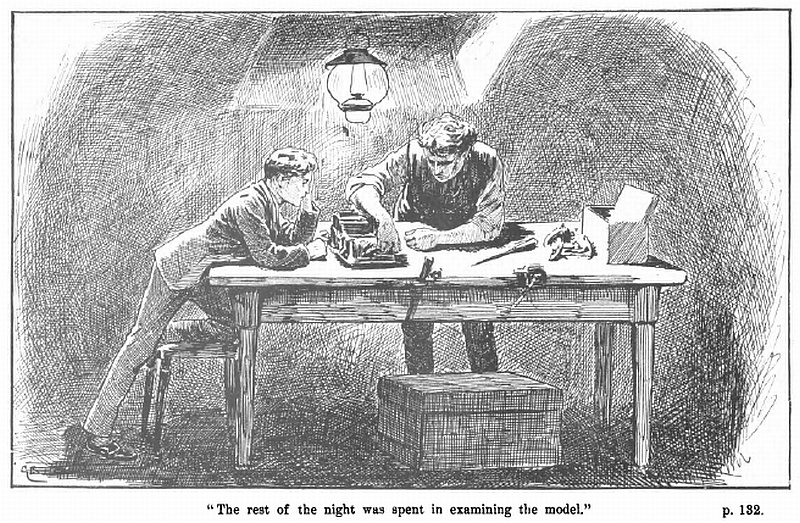
“Agreed!” I cried, and then the rest of the night was spent—a very short night, by the way—in examining the various parts of the little model, Hallett seeming to give himself fresh ideas for improvements as he explained the reason for each wheel and spindle, and told me of the difficulties he had to contend with for want of proper tools and the engineer’s skill.
“I want a lathe, Antony,” he said; “and a good lathe costs many pounds, so I have to botch and patch, and buy clock-wheels and file them down. It takes me a whole evening sometimes wandering about Clerkenwell or the New Cut hunting for what I want.”
“But I can often help you in that way,” I said, “and I will.”
We went down soon after to a late supper, Hallett jealously locking up his attic before we descended. Mrs Hallett had gone to bed and Linny was reading, and jumped up as if startled at our entrance.
Hallett spoke to her as we sat down to supper, and I noticed that he seemed to be cold and stern towards her, while Linny was excited and pettish, seeming to resent her brother’s ways, and talked to me in a light, pleasant, bantering manner about Bluebeard’s secret chamber.
I noticed, too, that she always avoided her brother’s eye, and when we parted that night Hallett seemed a good deal troubled, though he did not tell me why.
Chapter Twenty Five.
Seven-and-a-Half and a Bonus.
It was the common talk at the office that Mr Lister was going to be married soon to the rich Miss Carr; and one day, when I was busily reading to Mr Jabez Rowle—who, snuff-box before him, kept drawing in his breath, hissing viciously, and sometimes smacking his lips as he dug his pen into some blunder in the slips before him—Mr Grimstone came bustling in, with his spectacles shining as much as his bald head, his scanty hair standing straight up, and, what was very rarely the case, a smile upon his face.
“Well, Rowle,” he said, rubbing his hands, “how is it this morning?”
“Foul—foul foul,” said Mr Jabez, with a dab at a stop he had missed before. “Those fellows of yours make more literals every day.”
“I’m always telling them of it, Rowle, always,” said Mr Grimstone, nodding his head sharply. “How does this boy get on?”
“Fairly—fairly,” said Mr Rowle, screwing himself round upon his stool, and gazing full in the overseers face. “Now, then, Grimstone, what is it?—what’s on the cards?”
“Oh, nothing—nothing. I only looked in. Give me a pinch!”
Mr Rowle handed his little brown box, and Mr Grimstone refreshed himself with a pinch before handing back the snuff to Mr Rowle, who also took a pinch loudly, and with a defiant flourish, while I took up a slip and a pen, and began to practise reading and correcting, a thing Mr Rowle always encouraged.
Grimstone had evidently come in for a gossip, business being rather slack, following a good deal of night-work and the finish of an important order; and after another pinch and an allusion to the political topic of the day, they seemed to forget my presence and went on talking.
“When’s the happy day to be?” said Mr Grimstone.
“What, Lister’s? Oh, I don’t know: soon, I suppose. Seen her?”
“Yes, twice,” said Mr Grimstone, giving his lips a smack; “beautiful!”
“So I hear,” said Mr Jabez Rowle; “plenty of money too, I suppose.”
“50,000 pounds, and more to come. I never had such luck.”
“I never wanted it,” said Mr Jabez Rowle with a growl. “I don’t know why a man should want to tie himself up to a woman.”
“Not with 50,000 pounds and more to come, eh?” said Mr Grimstone waggishly.
“Might have tempted me twenty years ago,” growled Mr Jabez; “it wouldn’t now.”
“S’pose not. You’re too warm, Rowle—much too warm. I say, though,” he continued, lowering his voice, but quite ignoring me, “is a certain person safe?”
“A certain person?”
“Yes, you know. Suppose, for instance, he quietly asked you to let him have 500 pounds for a few months at seven-and-a-half and a bonus, would you, always considering that he soon touches 50,000 pounds and more to come, would you let him have it?”
Mr Jabez took a pinch of snuff furiously, shut the box with a loud snap, and, evidently completely thrown of his guard, exclaimed:
“Hang him for a fool! Curse me if ever I do so again.”
“What do you mean?” said Mr Grimstone, milling up, “Do you mean to say I’m a fool?”
“No, no: he is, to go and blab.”
“Blab?”
“Yes, to let it out to you.”
“I say! What do you mean?” said Mr Grimstone again.
“Mean? Why, you as good as said he told you I had let him have 500 pounds at seven-and-a-half and a bonus. Lent on the strength of his going to marry a woman with 50,000 pounds and more to come.”
“I didn’t.”
“You did.”
“Whew!” whistled Mr Grimstone, snatching the snuff-box out of Mr Jabez Rowle’s hand, taking a vigorous pinch, and scattering so much of the fine brown dust in the air that I should have had a violent fit of sneezing if I had not become hardened to its effects.
The two stared at one another for a minute, and Mr Jabez now snatched the box back and took a hearty pinch, some of which went on to his shirt-front—and some upon his sleeve.
“Why, you don’t mean to say that he has borrowed 500 pounds of you?” said Mr Grimstone, in a whisper.
“But I do mean to say it,” replied Mr Jabez. “How came he to tell you? I never told a soul.”
“He didn’t tell me,” said Mr Grimstone thoughtfully.
“Then who did?”
“No one.”
“Then how came you to know?” said Mr Jabez, passing his box. “Why, you don’t mean to say he has been to you for five hundred?”
Mr Grimstone nodded.
“And offered you seven-and-a-half, and a bonus of thirty pounds?”
Mr Grimstone nodded again, and this time it was Mr Jabez Rowle’s turn to whistle.
“He wanted it done quietly, and I, after a bit, agreed to do it. But though we ain’t friends over business matters, Jabez Rowle, I know you to be a man of strong common-sense and integrity, and I thought you would give me a good bit of advice. But this seems to alter the case. Would you lend it?”
“Humph! Two five hundreds are not much out of fifty thousand,” said Mr Jabez; “but what does he want the money for? ’Tain’t for the business.”
“No,” said Mr Grimstone, “because he said he didn’t want Mr Ruddle to know. I say, what would you do? I shouldn’t like to offend Lister.”
“Do? Well, I’ve lent the money,” said Mr Jabez, taking a savage pinch.
“And would you do the same if you were me?” replied Mr Grimstone. “It’s a lot of money; years of savings, you know, and—”
He made some kind of gesticulation, and I fancy he pointed with his thumb over his shoulder at me.
“Look here, Grace,” said Mr Rowle, “go downstairs and ask Mr Ruddle to send me up Mr Hendry’s letter about his book.”
I got down off my stool, and left them together in the glass case, going straight down to the office, where, in place of Mr Ruddle, I round Mr Lister, and told him my business.
“I don’t know where it is,” he replied. “I leave it till Mr Ruddle comes in. But look here, Grace, I wanted you. Miss Carr was asking how you got on. Take this note there—you know where she lives—and give it to her herself. But before you go up there take this note to Norfolk Street, Strand. No answer.”
He took four written slips of stamped blue paper from his pocket, and I saw him write across them, blot them hastily, and refold and place them in a letter, which he carefully sealed. After which, I noticed that he tore off and destroyed the piece of blotting-paper that he had used. I thought no more of it then, but it came up in connection with matters that afterwards occurred.
I hurried upstairs, and told Mr Jabez Rowle that Mr Lister wanted me to go out, Mr Grimstone being still in close conference with him in the glass case.
“Where are you going, boy?” said the latter.
“To Miss Carr’s with a note, sir,” I said; and the two old men exchanged glances of intelligence.
“All right, Grace,” said Mr Jabez, nodding; “we’re not busy. You can go.”
I hurried away, thinking no more of them or their conversation; but I was obliged to go into the composing-room below, to hurry up to Mr Hallett’s frame, where, stern-looking and half-repellent, he was rapidly setting a piece of manuscript.
“I’m going to Miss Carr’s,” I whispered, while my face glowed with pleasure.
“Indeed!” he said, starting; and my bright face might have been reflected in his, such a change passed over his speaking countenance.
“I’ve to take a note from Mr Lister and to wait for an answer,” I said; and I felt startled at the rapid change as he heard these last words. “Are you ill?” I cried anxiously.
“No—no,” he said hastily, and his voice sounded hard and harsh. “Go away now, I am very much pressed for time.”
I left him, wondering, for I could not read him then, and bounding down the stairs, I was soon in Fleet Street, and soon after in Norfolk Street, Strand.
I quickly found the number and the door, with a large brass plate thereon bearing the name “Brandsheim,” and in small letters in the corner “Ground Floor.”
A boy clerk answered my knock, and I was told to sit down in an outer office while the clerk went in with the note and to see if Mr Brandsheim was at home.
Mr Brandsheim was at home, and was ushered into his presence, to find him a dark, yellow-looking man with a wrinkled face and very keen eyes. He quite startled me for the moment, for, though not in personal appearance in the slightest degree resembling Mr Blakeford, there was a something about him that suggested that worthy and his ways.
He was dressed in the first style of fashion, a little exaggerated. He might have been a slave of the great Plutus himself, for round his neck and lashing his chest was a thick gold chain; diamond rings were on the fingers of each hand; a great opal and diamond pin was in his black satin stock; at his wrists were jewelled sleeve-links that glistened and sparkled when he moved. There was nothing sordid about him, for he sat in an easy-chair at a polished secretary; there was a Turkey carpet beneath his feet, and the furniture of the room was massive and good; but, all the same, I had no sooner entered the place than I began to think of Mr Blakeford and Mr Wooster, and I involuntarily wondered whether this man could be in any way connected with my late employer, and whether I had unconsciously walked into a trap.
As my eyes wandered about the room in search of tin boxes containing different people’s affairs, of dusty parchments and sale bills, I felt better; for they were all absent. In their place were large oil pictures against the walls, hung, and leaning back, resting on the floor. On a sideboard was a row of little stoppered bottles with labels hanging from their necks in a jaunty fashion, and in the bottles were richly tinted liquids—topaz, ruby, purple, and gold. They might have been medicines, but they looked like wines, and I felt sure they were, as I saw piled upon the floor some dozens of cigar-boxes.
Mr Brandsheim might have been a picture dealer, a wine merchant, or an importer of cigars, for in those days I had yet to learn that he was a bill-discounter who contrived that his clients should have so much in cash for an acceptance, and the rest in old masters, Whitechapel Havanas, and Hambro-Spanish wines.
Mr Brandsheim’s words somewhat reassured me, as he nodded pleasantly to me and smiled.
“Sit down, my man,” he said; “sit down, and I’ll soon be ready for you. Let me see—let me see.”
He busied himself behind his secretary, rustling papers and making notes, and now and then looking at me and tapping his teeth with a heavy gold pencil-case, while I furtively watched him and wondered how he managed to make his jet black hair so shiny, and why it was he spoke as if he had been poking cottonwool up his nose, till it suddenly occurred to me that he must be a German.
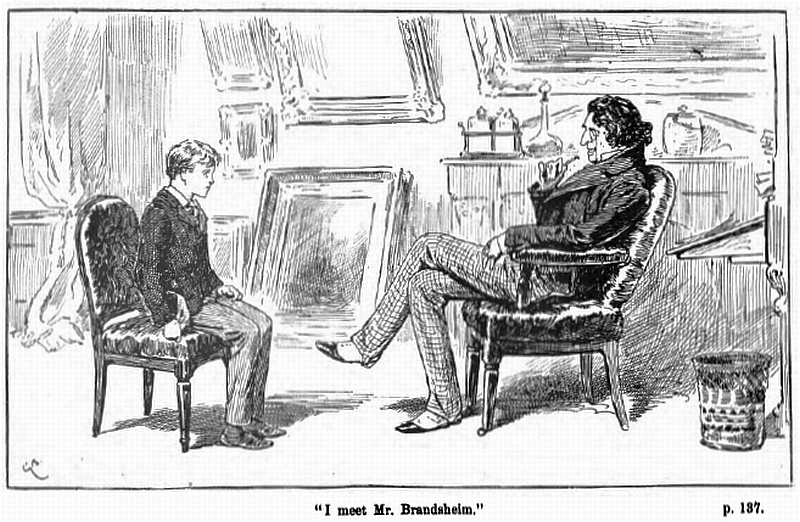
“Ah!” he said, at last; “let me see—let me see—let me see—see—see. Mr Lister quite well?”
“Yes, sir; quite well, thank you.”
“That’s right. Let me see—let me—how’s business?”
“Oh! we’ve been very busy, sir. The men have often had to stop up all night to get things finished.”
“Have they really, though?” he said, nodding and smiling; “and did you stay up, too?”
“No, sir; I read for Mr Jabez Rowle, and he said he wouldn’t sit up all night and upset himself for anybody.”
“Mr Jabez Rowle is quite right, my lad.”
“He said, sir, his work was so particular that after he had been correcting for twelve hours his eyes and mind were exhausted, and he could not do his work properly.”
“Mr Jabez Rowle is a man of business, my lad, evidently. And Mr Lister, is he pretty busy?”
“I think he comes to the office every day.”
“Have a glass of wine, my lad,” he said, getting up and taking a decanter, glass, and a dish of biscuits from a cellaret. “No. Good sherry won’t hurt you. Take some biscuits, then.”
I took some of the sweet biscuits, and Mr Brandsheim nodded approval.
“I won’t keep you long,” he said; “but I must compare these papers. You are not going anywhere else, I suppose?”
“Yes, sir; I am going up to Westmouth Street, Cavendish Square.”
“Indeed! Hah! that’s a good walk for you; or, no, I suppose Mr Lister told you to take a cab?”
“No, sir,” I said colouring; “I am going to walk.”
“Oh, absurd! Too far. Lawrence,” he cried, after touching a bell, and the boy clerk appeared, “have a cab to the door in ten minutes.”
“Yes, sir.”
“That will pay for the cab, my lad,” continued Mr Brandsheim, slipping a couple of shillings into my hand. “I must keep you waiting a little while. Let me see—let me see—you didn’t go to the races, I suppose?”
“Oh no, sir.”
“Mr Ruddle and Mr Lister did, eh?”
“Mr Lister did, sir, I believe. Mr Ruddle never goes, I think.”
“Doesn’t he, though? How strange! I always go. Let me see—five hundred and sixty-six is—is—So Mr Lister’s going to be married, eh?”
“Yes, sir, I believe so.”
“That’s right. Everybody should marry when the time comes. You will some day. I hope the lady’s young and rich.”
“She’s beautiful, sir,” I said, with animation, feeling sorry, though, the next moment, for I did not like the idea of this man being so interested in her.
“Is she, though?” he said insidiously. “But you’ve not seen her.”
“Oh yes, sir, more than once.”
“Have you, though? Well, you are favoured. Let me see,” he continued, consulting a little thick book which he took from a drawer. “Seven hundred and fifty and two hundred and—er—er—oh, to be sure, yes; I think I heard who it was to be. Beautiful Miss Wilson, the doctor’s daughter. Let’s see, she’s very poor, though.”
I did not want to say more, but he seemed to lead me on, and get answers from me in an insidious way that I could not combat; and in spite of myself I said:
“No, sir, it is Miss Carr; and she is very rich.”
“You don’t say so!” he exclaimed, staring at me in surprise. “You don’t mean the Carrs of Westmouth Street?”
“Yes, sir.”
“Well, I am surprised,” he exclaimed. “Lister’s a lucky dog. Why, I see, you dog!” he said, in a bantering way, “you carry the love-letters backwards and forwards.”
“Oh no, sir, I—”
“Hush, hush, hush! Not a word. I won’t listen to you. Don’t betray your master’s secrets, my lad. You’re a confidential messenger, and must clap a seal upon your lips.”
“But, sir, I—”
“No, no. How much?” he said, with mock severity. “Don’t speak, don’t interrupt me; I’m reckoning up. Let me see—let me see—ha! that’s it exactly. There we are,” he continued, fastening down a note and handing it to me. “Run along, my young Mercury, and if I were you I should make cabby drive me to Oxford Street for a shilling, and save the other. That’s the way to grow rich. Off you go. Take care of this.”
He thrust a letter into my hands, and almost pushed me out of the room, so that I had not time to speak; and before I had quite recovered from my confusion, I was in the cab, and heard the boy clerk say:
“Put him down at Oxford Circus.”
Then the wheels began to rattle, and the door to jangle, and I sit feeling angry with myself for saying so much about Mr Lister and Miss Carr, as I recalled William Revitts’ advice, often given, to “let other people talk while you make notes.”
The thought of where I was going soon drove my interview with Mr Brandsheim out of my head, and getting out of the cab at the Circus, I made the best of my way to the great imposing house in Westmouth Street, rang, and asked to see Miss Carr.
The man-servant looked at me rather dubiously, and asked my name. Then, bidding me sit down in the great sombre-looking hall, he went up the heavy staircase, and came back to bid me follow him.
I noticed as I went upstairs that the place was heavily but handsomely furnished. There were pictures on the walls of staircase and landing, and the stone steps were covered with a rich thick carpet. The wealthy look of the place, however, did not seem to abash me, for the atmosphere of refinement in which I found myself recalled old days; and the thoughts of the past seemed strengthened, as I was ushered into a prettily furnished little drawing-room, all bright with flowers, water-colour drawings, and books, from a table strewn with which latter Miss Carr arose to welcome me.
And again the feeling was strengthened at her first words:
“Ah, Antony!”
For the printing-office, Mr Revitts’ shabby room, Hallett’s attic, my own downfall, were forgotten, and, bright and eager, I half ran to meet her, and caught her extended hand.
Her sad face brightened as she saw the eager pleasure in my eyes, and retaining my hand, she led me to a couch and seated herself by my side.
“Then you had not forgotten me?” she said.
“Forgotten you?” I cried reproachfully, “I have been so longing to see you again.”
“Then why did you not come?”
“Come!” I said, with the recollection of my present state flashing back; and my heart sank as I replied, “I did not dare; I am so different now. But I have a note for you, Miss Carr.”
I took Mr Lister’s note from my pocket, and gave it to her, noticing at the time that she took it and laid it quietly down, in place of opening it eagerly.
“I shall always be glad to see you, Antony, that is, so long as you prove to me that you have not been unworthy of my recommendation.”
“I will always try,” I cried eagerly.
“I feel sure you will,” she said. “Mr Ruddle tells me you are rising fast.”
I coloured with pleasure, and then reddened more deeply as I saw that she noticed me, and smiled.
“But now, come, tell me of yourself—what you do and how you get on;” and by degrees, almost without questioning, I told her all my proceedings. For somehow, it seemed the highest delight to me to be once more in the society of a refined lady. Her looks, her touch, the very scent emanating from her dress and the flowers, seemed so to bring back the old days that I felt as if I were once more at home, chatting away to my mother. And so the time slipped by till I imperceptibly found myself telling Miss Carr all about my old pursuits—our life at homeland my favourite books, she being a willing listener, when, suddenly, a clear, silvery-toned clock began to strike and dissolved the spell. The old drawing-room, the lawn beyond the French window, the scent of the flowers, seemed to pass away to give place to the great printing-office and my daily work, and with a choking sensation in my throat, I remembered what I was—the messenger who had forgotten his errand, and I started to my feet.
“Why, Antony!” exclaimed Miss Carr, “what is it?”
“I had forgotten,” I said piteously; “I brought you a note; Mr Lister will be angry if I do not take back the answer.”
The aspect of Miss Carr’s face seemed to change from a look of anxious wonder to one of sternness. There was a slight contraction of the handsome brow, and her voice was a little changed as she said quietly—
“Sit down again, Antony; both you and I have much to say yet.”
“But—the letter, ma’am?” I faltered.
“The letter can wait,” she replied. Then, smiling brightly as she took my hand once more, “You cannot take back the answer till I write it; and come, I am alone to-day; my sister is away upon a visit; you shall stay to lunch and dinner with me, and we’ll read and talk till we are tired.”