Front matter (continued 5)
Reading edition
As soon as Daily and his men had been left out of sight Arthur Hastings began making the pace; and he made it so rapid that scarcely twenty minutes elapsed before they passed through an open gate and drew up before the back door of Mr. Holmes's house. They knew it when they saw it; and as they looked at all the evidences of thrift and comfort with which it was surrounded, they wished most heartily that Daily and all the rest of the Buster band might be brought to justice and that speedily.
"Boys, we'll not put this fine property in jeopardy by stopping here," said Joe, in a low tone. "We'd be worse than heathen if we did, and Mr. Holmes ought to kick us off the place for hinting at such a thing. Good-evening, sir," he added, touching his cap to a gray-headed man in his shirt sleeves who just then came around the corner with a bucket of water in his hand. "Have you a pitcher of milk to spare, and can you give us a good big lunch to eat along the way?"
"Oh, yes, I can do that," replied the man, whose countenance grew clouded when he saw the boys getting off their wheels, but brightened again at once when he learned that they did not intend to ask him for lodgings. "Plenty of milk and provender to spare, but no beds made up."
"Mr. Holmes, we understand you perfectly," Joe hastened to reply. "We know just how you are situated, we sympathize with you, and we wouldn't stay in your house to-night if we knew your doors were open to us. We met Daily up the road a piece."
"You did?" exclaimed Mr. Holmes. "And did you tell him you were going to stop here?"
"We simply told him we should stop somewhere in town long enough to buy a glass of milk or beg a drink of water, and he raised no objection to it. I think you ought to know that Matt Coyle's dogs have been on the warpath again, and you have lost another sheep. Daily said it was in your mark."
"That's too bad; too bad," said the old man, who had long ago ceased to hope for better times. "If they keep on they will kill all my stock. The members of the Buster band don't always go into the woods after meat now. The pastures are handier, and a sheep, calf, or nice young heifer is easier to shoot than deer. We can't prove anything against them, and are afraid to prosecute if we could."
"Those dogs will never kill any more sheep for you," said Roy. "They wouldn't give us the road and we shot them. They're deader than herrings."
I noticed that Roy always said "we" when speaking of this little circumstance. If anything unpleasant grew out of it, he did not mean that his friend Arthur should bear all the blame or take all the punishment. Mr. Holmes's face grew bright again, but he showed a little anxiety when he asked:
"Did Daily see you do it, or does he know anything about it? Then I am surprised that he didn't make you pay for the dogs. Say," he went on, in a more guarded tone, "where are you going to stop to night?"
Joe answered that they intended to camp in the woods, and hoped he could furnish them grub enough for supper and breakfast the next morning.
"Of course I'll do that," said Mr. Holmes. "But take my advice and don't light a fire. The owner of the dogs you shot is a savage. He gets around at night as well as in the day-time, and since he came here last fall, he has put more mischief into the Buster band than they ever had in them before, and that was quite unnecessary. They never thought of shooting stock for their own use before he went among them, but they often do it now. They seem to take delight in breaking open every door that is fastened of nights, no matter whether they want to steal anything or not. I'd give something to know positively what that man Coyle intended to do with the spades, crowbar and axes he took out of my tool-house the other night."
"What do you think he meant to do with them?" inquired Arthur, who thought from the way the man spoke that he had his suspicions.
"I'm almost afraid to speak it out loud, for it don't seem possible that any man can be so wicked," replied Mr. Holmes. "The lawless acts of the Buster band have driven nearly everything away from us, but we've got the post-office left, and last night I got my weekly papers out of it. In one of them I read that a terrible railroad accident had been averted by the coolness and courage of a wheelman who rode across a trestle in the dark to warn the engineer of an approaching train that there was a rock on the track."
"He rode over a trestle in the dark?" exclaimed Roy, who, impatient as he was to hear what else Mr. Holmes had to say, could not resist the temptation to torment Joe Wayring. "Now that's what I call pluck."
"That is what the papers call it too," said Mr. Holmes. "Well, when the trainmen came to look into things they found that that rock didn't get upon the track by accident, but had been dug out of its bed on the top of the bluff and rolled there. Since then that bluff has been examined by detectives in the employ of the railroad, who found there a couple of spades, an axe and a crowbar all marked J.H. Those are the initials of my name, and they are on every tool I've got. They're in New London now, and if I thought anything would come of it, I would run down and look at them. If they are mine, that man Coyle was the leader of the gang who tried to wreck the train. At least he stole the tools, and I say he is the leader because the Buster band never would have thought of such a thing if he had not put it into their heads."
"How do you know he stole your tools?" asked Roy, in some excitement.
"Because I saw the prints of his feet in front of the door of the shop. They're as big as all out-doors, and his shoes are so nearly torn to pieces that it is a wonder to me how he can keep them on. Mebbe it's a little thing to build so much upon, but I know I am right," said the old man, earnestly. "If you could see that track once you would recognize it again the minute you saw it."
Now, when it was too late to make amends for the oversight, Roy Sheldon proceeded to take himself severely to task for not making a closer examination of those big footprints he had seen about the rock. If Matt Coyle's track was there he could have picked it out from among the rest, for hadn't he and his companions taken a good look at it on the night Mr. Swan "surrounded" Matt's camp, and Matt crept up in their rear and stole all their boats? That "hoof" of his, as Mr. Swan called it, had "given the squatter away" on one occasion, and seemed in a fair way to do it again. Evidence that Matt was one of those who had tried to wreck the train was accumulating with encouraging rapidity. No doubt he and his gang had expected to bring a rich harvest out of that gulf after the sleeping passengers had been plunged into it, and that was what Daily's companion meant by saying that Matt would make them all wealthy when he came back. But what would they say when they learned that he had not brought a cent with him?
"Of course it is not my place to offer advice, Mr. Holmes," said Arthur, at length, "but I really think it would be a good plan for you to go to the city and look at those tools. If they are yours you can say so, and may be the means of breaking up this nest of ruffians. There'll be a detective sent up."
"But I don't want one sent here," exclaimed Mr. Holmes. "I'd be afraid to have him around, for the minute he went away I'd lose everything I've got."
"He need not come near you," replied Arthur.
"And he need not come on a wheel, either," added Joe. "If he does, he may get some innocent tourist into trouble. Let him be a tramp or a fugitive from justice, if you please."
"That's the idea," interrupted the old man, excitedly. "Young fellow, your head's level. That would be his game, if he would only consent to play it, for fugitives and tramps are the ones the Buster band always receive with open arms."
"That is what I thought. Well, they have a good one now, and what's more, they must like him, for Daily said Matt was a fine fellow; or something like that," soliloquized Joe. He did not utter the words aloud, for he wasn't sure it would be prudent to tell Mr. Holmes that he and his two friends were better acquainted with Matt Coyle than anybody in the Glen's Falls country. If they could help it, the boys did not mean to tell who they were or where they came from, for fear that the information might reach Matt's ears in a roundabout way. He was glad when Roy said:
"Haven't we stayed here about long enough? If we want this to be our last night in the mountains we had better take to the road again."
"I guess you had," replied Mr. Holmes, reluctantly. "I never was guilty of so inhospitable an act before, except when I showed Daily's letter to the detective who was stopping with me and asked him what I had better do about it, and I would not be guilty of it now if I could do as I pleased. Remember my advice and go to bed in the dark; for if you don't I am afraid you will have visitors before morning."
The boys promised to bear the matter in mind, at the same time assuring the old man that it was no hardship for them to sleep out of doors, and Mr. Holmes hurried away to get the pitcher of milk and have a supper and breakfast put up for them. Being apprehensive that some of the Buster band might be on the watch, hoping to collect some damaging evidence against the farmer that would warrant them in burning his house, Joe Wayring and his friends did not once venture across the threshold, although often urged, but ate a lunch and drank their fill of milk while sitting on the back steps. When the boys offered to pay for being so royally entertained, Mr. Holmes would not listen to it. By putting it out of the power of those sheep-killing dogs to do any more mischief, they had done him and all the rest of the law-abiding men in the settlement a kindness, and he wished they could stay there for a week so that he and his neighbors might show them how grateful they were for it. If any citizen of that region had shot those dogs, he would have been homeless before another week had passed over his head.
"I hope that Matt will not think that a citizen did do it, and proceed to wreak vengeance upon some one against whom he happens to hold a grudge," said Roy, as they moved swiftly out of the gate and turned down the road. "I still think that if Mr. Holmes and a few determined men would wake up and go about it in earnest, they could put an end to this reign of terror. I can't see why they don't try it."
But there was one thing that Roy and his friends did not know, and Mr. Holmes had forgotten to speak of it. There was not a single building in Glen's Falls that had a dollar's worth of insurance upon it. The risks had all been canceled at the breaking out of the war of the Rebellion, and there had been none taken there since. This was one thing that made Mr. Holmes and his neighbors so very timid.
The town of Glen's Falls was a dreary looking spot, as the boys found when they came to ride through it. There was a forest of fine shade-trees on each side of the wide principal thoroughfare, but there was grass instead of walks under them, and the buildings behind were rapidly falling to pieces. The evidences of former prosperity that met their eyes on every hand proved that there had once been money and brains in the place, and that it would have amounted to something before this time if Dave Daily and the rest of the Buster band had been out of the way. They slaked their thirst at a pump on the corner of a cross-road and continued on their way without meeting a single person. If it had not been for an occasional head they saw through the windows of some of the houses they passed, they would have said that the town was deserted.
Their guide-book told them that the road that led from Glen's Falls through the mountains to the low country beyond was so plain it could not be missed, and perhaps it was when the man who wrote the book passed that way on his wheel; but it was not so now. Roads there were in abundance, and they all ran down hill in the direction the boys wanted to go; but they were filled with obstructions, and no particular one of them showed more signs of travel than another.
"I'd like to see the fellow who says he had a mile of the best of coasting along this road try his hand at it now," said Roy, seating himself on a log and cooling his flushed face with his cap while he waited for one or the other of his friends to go ahead and take the lead. "I'm tired out, and if I was sure it would be quite safe to do so, I should be in favor of going into camp."
"I don't believe he ever came along this road," said Joe. "We've got a little out of our reckoning, that's all."
"And not only are there no cows near by to give us a drink of milk, but we wouldn't dare go after it if there were, for fear of that villain Matt Coyle," groaned Roy. "Doesn't it beat you how that fellow keeps turning up?"
"And at the very time he isn't wanted," chimed in Arthur. "If you want to stop, all right; but don't let's stop here. I think it would be safer to go into the bushes and hide. I don't much like the idea of passing the night without a fire, but I confess that what Mr. Holmes said frightened me. I wish we might get a hundred miles away before Matt comes home and hears that his watch-dogs have been shot."
The others wished so too, but they hadn't energy enough to go any farther that night, and besides the appearance of the road ahead of them was discouraging. It ran down a steep bank until it was lost among the trees and bushes as its foot, and probably there was another bank just as rough and steep on the other side of the brook which ran through the gully. They made the descent, and there they found a stream of water so sparkling and cold that the sight of it was more than they could resist. They carried their wheels into the bushes, making as little trail as possible, and at the distance of ten or fifteen yards from the road found a camping place; or, rather, a thicket that would be a nice spot for a camp when some of its interior was cut away so that they could spread their blankets. They did not use their camp-axes for fear that the noise they would necessarily make in chopping away the brush would serve as a guide to some one they did not care to see. They worked silently with their knives, and at the end of half an hour had as comfortable a camp as a tired boy would wish to see, if there had only been a cheerful fire to light it. They ate their supper in the dark, took a refreshing bath in the brook, and then lay down with their blankets about them and their loaded pocket rifles close at hand. This was the first time they had found it necessary to adopt this precaution, and they hoped it would be the last.
About an hour after my master's regular breathing told me that he had fallen fast asleep, I was startled by hearing voices a little distance away. I could not tell which direction they came from, but I knew they were men's voices, and that they were angrily discussing some point on which there seemed to be a difference of opinion. I was still more startled when Arthur Hastings raised himself upon his elbow, shook Joe Wayring roughly by the shoulder, and whispered in his ear:
"Wake up, here. Matt Coyle's coming."
"Where?" asked Joe, who was wide awake in an instant.
"Coming along the very road we'd had to go up if we'd climbed the hill on the other side of the brook," replied Arthur. "Do you hear that? They're stopping for a drink. Reach over and give Roy a shove. Be careful to put your hand on his mouth for he is apt to speak out when he is suddenly aroused."
Be careful maneuvering on Joe's part Roy was awakened without betraying his presence to the men, who had by this time halted at the brook, and then the three boys sat up on their blankets and listened.
CHAPTER XVI.
TWO NARROW ESCAPES.
"I tell you I feel so savage that I could bite a nail in two an' not half try," were the first words that came to the ears of the listening wheelmen. They were preceded by a long-drawn sigh of satisfaction, such as a thirsty boy sometimes utters when he has taken a hearty drink of water. "Seems to me that I can't turn in no direction no way but I find them oneasy chaps at my heels to pester the life out of me. They're to blame for me losin' them six thousand dollars of mine that I worked hard fur, dog-gone 'em."
How the boys trembled when that harsh voice grated on their ears. It was Matt Coyle's, sure enough. They had heard it so often that there could be no mistake about it.
"They was the ones that blocked this little game of mine, an' sent me an' the fellers hum empty-handed when we thought to come back rich," Matt went on, growing angrier and raising his voice to a higher key as he proceeded. "I seen 'em as plain as daylight; an' now I come hum to find that they've been here an' shot them two dogs that I was dependin' on to keep the constable away from my shanty. Did anybody ever hear of sich pizen luck?"
"If you saw them there at the rock, what was the reason you did not drive them off so't the train could run into it?" inquired another familiar voice,—in point of fact, the voice of Dave Daily. The boys were surprised to know that he was there, and wondered if he had come out to meet Matt and put him on their trail. If he had, what was his object in doing it? Did he want to see them punished for shooting those savage dogs, or did he want to have them robbed?
"You say you and your crowd worked hard to get that rock down the bluff and onto the track, and yet you sot there in the bresh and let one single boy turn you from your purpose, which was to bust up the train," continued Daily. "He must have been alone, for you say yourself that one of his friends went one way and t'other went t'other to tell the engineer to watch out. Why didn't you go down and pitch him into the ravine?"
"What would have been the good of doin' that, seein' that Joe an' Arthur had already went off?" demanded the squatter, with some show of spirit. "An' don't I tell you that he had a pistol or something in his hand."
Daily uttered an exclamation of impatience.
"'Twasn't a pistol nor nothing of the sort," said he. "It was a little pop-gun that wouldn't hit the side of a barn nor shoot through a piece of card-board. Before I would say that I was scared by a little thing like that I would go off and hide myself; wouldn't you, Spence?"
"Them pop-guns was big enough an' ugly enough to kill them two dogs of mine, an' I ain't got no call to face sich we'pons," retorted Matt, who, as you know, always took care to look out for number one. "An' here we've been hidin' around in the bresh fur most a week, fearin' the officers, when we might as well come hum to onct. That's another thing that makes me mad. I do wish I could get my two hands onto them boys fur a little while, an' you fellers here to help me. I'd larrup 'em so't they wouldn't ever come nigh here agin, I bet you."
"I don't know whether you would or not," replied Daily. "I kinder liked 'em, and as long as they ain't officers—"
"That's so," interrupted Matt. "But they're jest the chaps to put the constables onto your trail an' mine. That's their best holt. Didn't you say that if you was in my place you wouldn't rest easy till everybody who had had a hand in mistreatin' you had been burned outen house an' home? Well, them are three of 'em."
"Now why didn't you say so?" demanded the chief of the Buster band.
"If we'd only knowed that, we'd a kept 'em for you," added Spence's voice. "Wouldn't we, Dave? Now that I come to think of it, the youngsters never told us who they was or where they come from, and we didn't think to ask them."
"They'd a lied to you if you had," said Matt, and the boys judged by the sound of crunching gravel that he was pacing back and forth across the road like some caged wild animal. "That's the kind of fellers they be; an' now I'll tell you what's a fact: If you don't help me ketch them fellers an' hold 'em so't they can't get away till we get ready to let 'em, this country of your'n will be thick with officers afore two weeks more has gone by. That's the way it was down to Injun Lake."
"And this is what we get by taking you in and feeding you when you was nigh about dead, is it?" exclaimed Daily, in angry tones. "I bet you that the next tramp who comes this way will be kicked out before he has time to tell his story. You've brought some of our boys into trouble by talking them big notions of your'n into their heads, and telling how easy it was to smash a train and get thousands of dollars outen the pocket of the folks—Ugh! I can't bear to think of what fools we made of ourselves by listening to you. Now you clear yourself, before we make an end of you for good."
"I come here 'cause I had to go somewhere, didn't I?" said Matt, in tones that were fully as angry and fierce as Daily's. "I'm sorry enough I done it, for you're not the men I took you for. You're willin' to stand here with your hands in your pockets an' let them rich folks tell you what an' when you shall eat."
"No, we ain't," roared Daily. "We're free Amerikin citizens, and we don't allow nobody to tell us what we shall do."
"Well, then, what makes you talk to me that-a-way?" cried Matt. "I come here to help, an' I've told you of more ways to bother the folks who want to make laws for you than you would have thought of in ten years' time. As fur puttin' that rock on the track, nobody suspicions who done it, an' we laid around in the bresh so't the officers, if any happened to be here, shouldn't see us comin' from t'wards the railroad. I'm free to say that I didn't want to go down to the track alone an' face the we'pon that Sheldon boy had in his hand (I knowed him dark as it was), but I offered to go if any one would go with me; an' they wouldn't. Ask 'em if it ain't so."
This proved to Roy Sheldon's entire satisfaction that he had done the right thing when he pulled his pocket rifle from its case, shoved a cartridge into it, and prepared to defend himself if the train-wreckers thought it best to attack him. It seems that they did watch him and discuss plans for getting him out of their way, but some of the timid ones among them saw the light reflected from the nickel-plated ornaments on his rifle, and could not muster courage enough to show themselves.
"Nobody don't suspicion that we put the rock on the track," repeated Matt, "an' that ain't why the officers will come here. You're the one who done the mischief—you, yourself. As soon as one of them boys began to let on that they knowed who you was, you showed them all the letters an' things you writ for the papers, an' talked to 'em like they was friends of your'n. You will find yourself in trouble all along of that nonsense, if you don't do what I say."
"That puts a different look on the matter," said Daily, in a much milder tone, "and, Matt, I'm sorry I jawed you that-a-way. Fact of it is, I couldn't help it. We've been in a power of trouble and trib'lation ever since them rich folks down to Washington sent for us to go and fight their war for 'em, and then went and made laws against shooting deer and ketching trout, and we've got pretty well riled up. What do you think we had best do?"
"Nab them boys fust an' foremost," said the squatter emphatically. "That's the fust thing; then, after I have had my satisfaction outen 'em, by tyin' 'em to a tree an' larrupin' 'em with hickories, like I would have done with that there pizen Joe Wayring if them friends of his'n hadn't come up an' rescooed him—after I've done all that, I'll take a day off an' think what we'll do next. One thing is sartin: them boys must not be let go out of these mountings till their mouths has been shut about the Buster band in some way or 'nuther."
"Ketching of 'em is going to be the hardest part of the whole business," remarked Spence. "They skum along right peart after we let them go, and I b'lieve they are plumb outen the mountings by this time. If they are—"
"But they ain't, I tell you," Matt Coyle interposed. "It don't lay in no steam injun, let alone a bisickle, to get outen these mountings betwixt five o'clock an' dark. They're camped summers between here an' Ogden, an' all we've got to do is to circle round to our usual lookin'-out place an' stay there till we see 'em comin'; then we'll run down an' stop 'em. When I get my hands onto 'em they'd best watch out, fur I feel jest like poundin' 'em plumb to death to pay'em fur stickin' that innercent ole woman of mine in jail. An' the boys too; the very best, honestest an' hardest workin' boys that any pap ever had. They're likewise shut up all along of that pizen Joe Wayring an' his rich friends."
These words were followed by the strangest sounds the boys had ever heard. If they had not known Matt Coyle as well as they did, they would have been sure he was crying.
All this while the men (and there seemed to be a large party of them) had been taking turns drinking at the brook; and having quenched their thirst they started on again with a common impulse, not along the road, but up the stream on whose right-hand bank the boys were encamped. There could be no doubt of it, for there was no longer any crunching of gravel under the heels of their heavy boots, but the bushes snapped and swayed, and the voices came more distinctly to their ears. Matt Coyle was the one who did most of the talking. He did not seem to take his failure to wreck the train so very much to heart, but he bewailed the loss of his dogs, whose good qualities could not be enumerated by any one man, and asked who would warn him now if the officers came to his shanty some dark night to arrest him.
"They are coming this way as sure as the world," whispered Roy, drawing his feet closer to him and placing an elbow on each knee so that he could have a dead rest with his rifle. "Why don't the fools stick to the road? It's easier walking there than it is in the bushes."
"This is no doubt a short cut to their hiding-place," replied Joe. "Stand together, fellows, and we'll show them what we are made of. We'll give them fair warning, and if they are foolish enough to disregard it, they will have to take the consequences."
"That's what's the matter," whispered Arthur, cautiously moving a little closer to his friends. "I'm afraid, but I'll never be tied to a tree and whipped; they can bet on that."
I can not begin to tell you how frightened I was as I stood there and listened to the voices and footsteps of those desperate men who were every minute drawing nearer to our place of concealment. Remember, I was utterly helpless. However good my will may have been, I did not possess the power to do the first thing to aid my master in the fight which I firmly believed would be commenced in less than ten seconds. And bear another thing in mind: If the young wheelmen were found there, and were overpowered and taken captive, the shooting of Matt Coyle's worthless dogs was not the only thing for which they would be punished. They knew Matt's secret. They knew that he and some of his party had tried to wreck a train. They had talked about it where the boys could plainly hear every word they uttered. Of course Matt would know it, if he found them there in the bushes, and what would he do? How would he go to work to "shut up their mouths," as he had spoken of doing? I assure you this thought was enough to make even my steel nerves shake; and I believe it must have passed through Joe Wayring's mind and frightened him, for I heard him say, in a scarcely audible whisper:
"It's do or die, fellows. That villain will be wild with rage if he learns that we heard all he said to Dave Daily. If the worst must come, be sure of your man before you shoot."
That moment's terrible suspense is something I never shall forget; then the reaction came, and I felt as if I were going to fall in a heap like a piece of wet rope. There was a tolerably well-beaten path along the bank of the brook, but it was on the other side. Dave Daily and his gang of villains followed it, and that was all that saved us. If there had been a spark of fire on our side the brook as big as the end of your finger, I should have had a different story to tell. I was so confused that I could not pay any attention to their conversation, but I counted them as they passed along in Indian file, and when at last they were out of hearing and Roy Sheldon spoke, I knew his count agreed with mine.
"Thirteen," was all he said; and then he lay down on his blanket and probably looked as nerveless as I felt.
"And at least half of them must have been with Matt," added Arthur Hastings. "I know it took six or seven men to roll that bowlder out of the ditch and place it on the track. Great Scott! Wasn't that a narrow escape!"
"I'd like to know how we shall come out to-morrow," said Joe, anxiously. "That 'looking-out place' that Matt spoke of must command a view of the road along which we will have to go to get to Ogden, and if we do not mind what we are about, Matt will meet and stop us there."
This was another thing the young wheelmen had to worry over, and taken in connection with the vivid recollection of the exciting scene through which they had just passed, it effectually banished sleep from their eyes for the rest of the night. And daylight was a long time coming, as it always is when anxiously waited and watched for. They ate breakfast as they had eaten supper—in the dark—and when the birds began singing picked up their wheels and struck out for the road, which they found to be quite as bad as it looked on the previous evening. The first hill they encountered was a hard one, as they knew it was going to be, and when they gained the top they had to go down again on the other side. Of course the woods were about as dark as they could be, and it was anything but pleasant for the leading boy to feel his way while trundling his wheel beside him. But the fear of Matt Coyle's wrath and the hope of passing his "looking-out place" before the sun arose, drove them on, and to such good purpose that, by the time they could see to ride, they found themselves on a smooth, well-traveled highway. They did not stop to ask one another whether or not it was the road they wanted to find. It led away from the mountains, and that was all they cared to know.
"Away we go on our wheels, boys," sang Joe; and suiting the action to the word he sprang into his saddle and set out at a lively pace. "Now, Matt Coyle, come on. It would take a better horse than you ever did or ever will own to stop us."
"But a stick thrown into the road might do the business for us," suggested Roy.
"You don't suppose Matt knows that, do you?" said Arthur. "Does anybody see anything that looks as though it might be used for a lookout station?"
Nobody did. There was nothing to be seen but a cultivated field on the right hand, a thickly wooded hill-side on the left, and a farm house in the distance. True there was a high, bald peak a little to the left of the hill over which the road disappeared, but it was all of ten or fifteen miles away, and a man stationed on its summit would have needed a good glass to make us out. At least that was what Joe Wayring said, and then he dismissed all fears of Matt Coyle from his mind, and made a motion with his hand as if to throw open the breech of his pocket rifle, which he had thus far carried in readiness for any emergency that might arise, and remove the cartridge; but, on reflection, he decided to wait a little longer. It was lucky he did so, and that his companions followed his example.
If the Buster band really had a "looking-out place" anywhere within sight of the road I don't know it, but I do know that by taking short cuts through the mountains they managed to reach the highway in advance of us, for when we reached the top of the hill of which I have spoken, and the wheelmen were about to stow the rifles in their cases preparatory to a coast, Matt Coyle and Dave Daily suddenly stepped out of a thicket on one side of the road, and as many more ruffians arose from behind the fence on the other. They were about thirty yards away, and although all except Matt carried guns in their hands, I was relieved to see that there was not a club or stone among them. They supposed that all they had to do was to form across the road, call upon the boys to halt, and they would be obeyed.
"Them's the fellers—the very chaps I've been a-lookin' fur," yelled the squatter, shaking his fists in the air and striking up a war-dance in the middle of the road. "Now I'll have the whole on you, an' there won't be nobody to interfere when I—"
"Full speed, boys," said Joe, in a low tone. "Hold fast to your guns and be ready to stop if anybody gets unhorsed. It's our only chance. Get out of the way," he cried, flourishing his cocked rifle above his head with one hand while he guided me with the other. "Get out of the way or we will run you down. If we strike you, you are dead men."
It never occurred to Matt and Dave to ask each other what would become of the boys themselves if their headlong progress were suddenly stopped, and neither did they linger to try the experiment. The three Columbias fairly whistled through the air; and when Matt saw that his peremptory orders to halt were disregarded, and that we were charging down upon him with apparently irresistible force, he scuttled out of the way with the greatest haste, and Dave Daily, the terrible man who hid in the woods and shot at officers unawares, was not an inch behind him.
"Look out for them pop-guns," he yelled.
"Yes, look out for them," shouted Arthur. "They're death on all sorts of varmints."
In less time than it takes to tell it the danger was over. Moving abreast and going at almost railroad speed we flew down the hill, and the way was clear. I caught just one glimpse of Matt Coyle's scowling and astonished face as we sped by, and that was the first and last time I ever saw him. After that I did not wonder that my master and his friends were resolved to fight to the death and take any risks rather than fall into his power, for if I ever saw an evil face I saw it then. But the man who carried it around with him was a coward, and so was the leader of the Buster band, who was afraid of the pocket rifles. If those handy little weapons had brought their owners into difficulty, they had also assisted in getting them out of it.
Being afraid to apply the brakes the boys regulated their speed with the pedals as well as they could, and when the foot of the hill was reached they stopped and looked behind them. There was no one in sight.
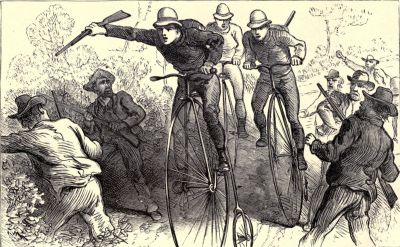
The Run for Safety.
"That was another tight squeak," said Roy, holding fast to his wheel with one hand and fanning himself with the other, as he always did when a halt was made, "and nothing but Matt's ignorance and Dave's brought us through. Well, I don't know that we are to blame if they didn't have sense enough to throw something in the road in front of us."
The excitement for that day was all over now, and I was very glad of it. The road being good and the coasting places frequent, we bowled along at a lively pace, and at four o'clock in the afternoon rode into the village of Ogden, where we halted for the night. One of the loungers on the porch was reading aloud from a weekly paper which had but just arrived with news that was no news to city people by this time. Of course the work of the train-wreckers was given a prominent place, as well as a lengthy notice. As I leaned against the porch and listened, I asked myself what those loungers would have said if some one had told them that the three dusty boys who had just disappeared through the doorway were the ones who brought the efforts of the train-wreckers to naught. Roy and Arthur respected Joe's wishes, and never, in any one's hearing, spoke of what he had done that night.
CHAPTER XVII.
AN UNEXPECTED MEETING.
From the morning Joe Wayring and his friends left Ogden up to the time they wheeled over the old familiar road that led into Mount Airy, not a single thing happened to mar the pleasure of their trip. I do not mean to say that the roads were always good, or that they were never weather-bound; for those petty annoyances fall to the lot of every tourist, he expects them, and knows how to make the best of them. But they found no more train-wreckers along the route, nor were there any Buster bands or Matt Coyles to be afraid of. They spent many a night in camp; their pocket rifles brought them all the young squirrels they cared to eat; they encountered tramps on nearly every mile of the way, and although they never had the least trouble with these social outcasts, they listened to a story from the lips of two of them that interested them exceedingly, and proved to Roy Sheldon's entire satisfaction that the clear-sighted Joe Wayring had hit pretty close to the mark when he declared that Roy's presence aboard the White Squall had not been brought about by accident.
Their destination was Plymouth, a little sea-port town situated on a bay of the same name. They spent a day roaming about the wharves, looking at everything there was to be seen, especially the ships, which would hardly have attracted more than a passing notice from them, had it not been for Roy's experience in New London harbor. They went aboard of one, looked all over it, marveled at its strength and more at the power of the winds and waves which could so easily make a wreck of man's best handiwork. They turned up their noses at the dingy forecastle, smelling of tar and bilgewater, and wondered how any one could bring himself to bunk in it during a long voyage.
"I would much rather sleep on a bed of hemlock boughs," said Joe, "and go out in the morning and catch my own breakfast from the sparkling waters of a lake or brook, and serve it up on a piece of clean bark. If I had been in love with the sea when I came here, I would be all over it now."
"It's rough, isn't it?" said Roy, as he and his companions went down the gang-plank to the wharf; and he trembled all over when he thought how near he had come to being carried to distant countries against his will. "The little I saw of a sailor's life while I was on the White Squall convinced me that the officers are more to be dreaded than the forecastle. They can be as brutal as they please when they are out of sight of land, and there's no law to touch them."
"There's law enough," answered Joe, "but the trouble is, a sailor man can't use it. Suppose he has the officers of his vessel arrested for cruelty while he has the rest of the crew at hand to prove it against them. They are put under bonds, but the case is postponed on one pretext or another, and while that is being done, how is Jack going to live? Of course the minute he gets ashore he makes haste to spend his wages, and when his last dollar is gone what recourse has he but to ship for another voyage? Then the case is called, and there being no one to prosecute, the captain and his mates are discharged and go aboard their vessel to play the same game over again."
"That's about the way those light-ship men put it when I threatened to have Captain Jack punished for kidnapping me," said Roy. "That may be law, but it isn't justice. I wonder where the White Squall and Tony and Bob are now."
"I shouldn't think you would care," replied Arthur. "I know I shouldn't if I had been treated as you have."
"I don't much care what becomes of the ship and her officers, but I am sorry for the crew. I tell you that Tony and Bob were shanghaied the same as I was."
Becoming weary of Plymouth and its surroundings at last, the boys took the road again, this time with their faces turned toward Mount Airy. They went back by a different route, as they intended to do when they set out; but they had another reason for it now. Money would not have hired them to return across the mountains and take their chances of capture by Matt Coyle and the Buster band. Now that they could think over their adventures with calmness, they were surprised at the ease with which they had slipped through those ruffians' fingers. They knew they couldn't do it again, and they would have gone home by rail rather than try the mountain route a second time. There was one thing about it, Arthur repeatedly declared: The man who wrote their guide-book must be posted so that he could warn wheelmen to keep away from Glen's Falls until the mischief-making squatter and his new allies had been arrested and lodged in jail.
On the afternoon of the second day after leaving Plymouth, the boys came suddenly upon a couple of tramps who had halted under the shade of a tree by the road-side to eat the bread and meat they had begged at the nearest farmhouse. But these men were not like the other tramps they had seen. They were sailors on the face of them, and looked out of place there in the country so far from salt water. Roy Sheldon was sure there was something familiar about them, and hardly knowing why he did so, he called out, as he moved past them, "Bob, Tony," whereupon the men jumped to their feet and stared hard at him without saying a word. They were evidently frightened, and would have taken to their heels if they had seen the least chance for escape.
"I declare, I believe they are Tony and Bob," said Roy, who was utterly amazed at the effect his words had produced upon the tramps; and turning about, he rode back to the tree under which they stood. "How in the name of all that's wonderful did you get stranded here?"
"Is—is it Rowe Shelly?" one of the men managed to ask.
"Yes, sir, they are Tony and Bob," exclaimed Roy, getting off his wheel and nodding at his companions. "Dusty as they are, I know them. What's the matter?" he added, as the men began backing away as if they did not want him to come any nearer. "You are not afraid of me, are you? I am not a ghost, and neither am I Rowe Shelly, although my name sounds somewhat like his, and I have been told that I look like him. I am a different boy altogether. Now let's have the straight of this thing before we go any farther. I saw you carried to sea on the White Squall. How did you escape from her, and where is she now?"
"At the bottom of the ocean," replied one of the men; and the boys thought from the way he spoke he was glad to be able to say it.
"At the bottom of—" began Roy, incredulously. "Serves her just right. She had no business to—but everything goes to show that you took me aboard of her on purpose to have me kidnapped. What have you to say about it? Sit down and eat your dinner. You can talk just as well, and you act as though you were very hungry."
"So we are, sir," said the one whom Roy had picked out, and who he afterward addressed as Tony. "We never done such a thing before, sir, but we had to come to it. It's no use trying to hide the truth any longer, for it has come out on us. Yes, sir; me and Bob did take you aboard that ship on purpose."
"There, now," cried Joe, indignantly, while Arthur Hastings looked and acted as though he wanted to light.
"But what object did you have in doing it?" continued Roy. "Who put you up to it—Willis?"
"He's the very chap, sir: but we've been punished for it, and we hope—"
"You've nothing whatever to fear from me, if that is what you want to say," interposed Roy, who was impatient to get at the bottom of what was to him a deep mystery. "You know how I got away, and here I am, safe and sound. Your actions proved that you did not think you were going to be shanghaied yourselves—what are you looking for?"
"You're right we didn't know it, sir," answered Tony, who pulled out his ditty-bag, and after a little fumbling in it drew forth a piece of soiled paper which he handed to Roy. "That, sir, is the letter I took to Cap'n Jack that night. If I had only known what was writ onto it, me and Bob would have kept clear of that ship, you may be sare. The cap'n dropped it on deck shortly after you went overboard, and I made bold to pick it up without saying a word to him about it. I thought it would come handy some day. Read it for yourself, sir, and you will see that me and Bob was innocent of any intention of doing the least harm to you, sir."
"Didn't you know that I was going to be kidnapped?" exclaimed Roy, almost fiercely. "You did. Everything goes to prove it; but you thought you could get me into trouble and slip off the ship without getting into trouble yourselves."
"Not a bit of it, sir," said Tony, with so much earnestness that Roy was almost ready to believe him. "Read that paper, and then I will tell you just what was said and done in my house on the beach while you was fast asleep up-stairs."
The letter, which bore neither date nor signature, ran as follows:
"Captain Jack Rowan:—Knowing that you have been delayed nearly three weeks waiting for a crew, I send you three men who, I think, will be of use to you. Two of them used to be sailors, but the other is green and will have to be broken in. Ask no questions, but take them along.
A Friend."
Roy Sheldon was so surprised that he could not speak again immediately. He leaned his wheel against the tree, looked first at Tony and then at his friends, and finally sat down on a convenient bowlder.
"Seems to me that there letter clears me and Bob of everything except taking you aboard the White Squall when we didn't want to do it," said Tony, after a pause. "We was as innocent as babbies of what happened afterwards."
"If you didn't want to do it what made you?" demanded Joe.
This brought Tony to the story he had to tell; and as I believe I can make it clearer to you than he did to Joe and his friends, I will tell it in my own language.
Rowe Shelly's guardian, who was fond of the water, kept a swift sailing-vessel as well as a steam yacht, and Tony and Bob Bradley belonged to it. The colonel furnished them a house, gave them regular employment during the yachting season, and in the winter time permitted them to make what money they could by shooting water-fowl at the lower end of the island for the New London markets. They knew nothing whatever of the colonel's private affairs. They had heard a good many rumors.
"I want to say a word right there," interrupted Roy. "Where did those rumors come from?"
The boys had seated themselves on the ground on each side of the sailors, who ate their dinner as they talked. Tony acted as spokesman, but his brother jogged his memory with a word now and then. The former could not say where the rumors came from, but the mischief was all done by an old sailor, who settled on one of the uninhabited islands in the harbor and went to fishing for a livelihood. Rowe Shelly chanced to run athwart his hawse one day while sailing about in his boat. He talked with the old fellow for more than two hours, and when he came home he exploded a bomb-shell in his guardian's ear. In other words, he told the colonel that there was no relationship between them; that he had no business with the money he was squandering; that his father had not been lost at sea, as the colonel affirmed; that he was still alive, and so was his mother; that they lived in Chelsea, Maryland; and that he was going to them as soon as he could get off the island.
"I know that was a sassy way for him to talk to the man who had always been so good to him, seeing that he hadn't no better evidence than an old sailor-man's unsupported word to back him up," said Tony, "but the way the colonel acted satisfied Rowe at once that there was more'n a grain of truth in what he had heard. The first thing he done was to take away the boy's boat, and shut him up on the island as close as if it had been a jail, and his second, to get rid of the fisherman. How he done it nobody seems to know; but he wasn't never seen again, nuther by Rowe Shelly nor nobody else. But the mischief had been done, and the first thing we knowed, Rowe Shelly couldn't be found. How he got off the island nobody couldn't tell, but he and his bisickle was gone. They was gone for more'n two weeks; but Willis, who acts like he was as big a man on the island as the colonel himself, follered him up and ketched him with the help of detectives."
"How did this fisherman happen to know so much about Rowe's father and mother?" inquired Arthur.
"He was shipmates with 'em; lived next door to them in some town down South," replied Tony. "He knowed the little boy, Rowe Shelly, and used to trot him on his knee and tell him stories of furrin parts, and he knowed well enough that there was some sort o' hocus-pocus about it, or the colonel wouldn't never had that money the old grandfather left. You see it sorter hurt the old feller when Cap'n Shelly, who was his only child, married a widder with a growed-up son against his will, and it hurt him, too, to have the cap'n keep on going to sea when he didn't want him to; and so he said that the cap'n shouldn't never have a red cent of his money. But when Grandfather Shelly found that he'd got to pass in his checks, and that the dark river was waiting for him, he gives in and willed all the money to the cap'n, provided he would settle down on shore."
When this happened, as you have already heard, Captain Shelly was at sea. His ship, the Mary Ann Tolliver, was lost, and as nothing was heard from him or any of the crew everybody supposed that all hands had been lost with her. This was the opportunity for the rascally step-son, and straightway he was up and doing. With his mother's full and free consent he was appointed Rowe's guardian and administrator of the property that had fallen to him, and then he was in clover. Finding that the boy's mother was in his way, and that she was strenuously opposed to any squandering of Rowe's money, he proceeded to rid himself of her presence. He did not exactly turn her out of doors, as Rowe thought he did, but he lost her—sent her away on a visit, and when she returned he wasn't to be found. He and Rowe were in Europe, and there they stayed until the guardian thought she had had ample time to die or forget him. Then he came back, bought an island in New London harbor, so that he could not readily be intruded upon and Rowe could not easily slip out of his grasp if he wanted to, and set himself up for a gentleman of wealth and leisure.
In the mean time Captain Shelly and some of his men, who had been picked up and carried to some distant port, returned, and the captain and his wife were reunited; but the former, being broken in health and spirits and ruined financially (every dollar he owned in the world went down with his ship), did not and could not make any very persevering effort to find out what had become of his scapegrace step-son and the little boy who was worse than orphaned. After a year or two spent in useless search he gave them up for lost; but others interested themselves in the matter, not for the purpose of aiding in restoring Captain Shelly to his rights, but simply to benefit their own pockets, and two of them, who succeeded in learning enough to keep Rowe's guardian in constant fear of exposure, were Willis and his son, Benny, who were given a home and paying situations on the island.
"If that isn't the biggest piece of villainy I ever heard of I wouldn't say so," exclaimed Joe, his face flushing with honest indignation. "Did you ever talk to Rowe Shelly about these things?"
"Who? Me?" cried Tony, in surprise. "Not by a great sight, sir. If I had, I would have been bundled off that there island so quick that I couldn't have told what my name was. I had a good home, and didn't want to lose it by meddling in things that didn't concern me."
"Well, your story agrees with the one Rowe told us on the night our friend was kidnapped and taken to the island, and I, for one, am inclined to believe it."
"I give it to you, sir, just as I got it," answered Tony. "You asked what them rumors was that we heard, and I have told you. If there wasn't no truth in 'em, what made the colonel act as he did—take the boy's boat away from him and keep him close about home, with orders to all of us from Willis to watch out for him?"
"That also confirms Rowe's story," said Arthur. "You know he told us he thought every one on the island was hired to keep an eye on him. We are all satisfied so far," he continued, turning to the old sailor. "Now, go ahead and tell us how you came to take Roy Sheldon over to that ship when you didn't want to?"
"Me and Bob never served aboard that ship till we was shanghaied on her," answered Tony, "but we had heard enough about her to make our hair stand on end. She was so rotten in some places that you could jab a knife into her timbers the whole length of the blade, and the companies wouldn't put a cent of insurance on her, and nobody but such reckless men as Cap'n Jack and his mates would sail on her. They got good pay for doing it, and for shipping crews against their will and holding a still tongue about the vessel's condition. But she's gone now," said Tony, rubbing his horny hands together almost gleefully, "and nobody will ever be fooled with her again. She sprung a leak in less'n half a gale 'bout two hunderd miles off the Cape, and went down like a log spite of all we could do at the pumps. We kept her afloat for seventy-two hours, and just as we were nigh going down, the brig Sarah West took us off and brung us into Plymouth."
"Where are you going now?" asked Roy.
"Back to the island where our families is," replied Tony. "We ain't got no place else to go, but we ain't going to stay there. We'll take our dunnage and go somewheres else, for fear that the island may sink into the harbor with such men aboard of it. We dassent stay there no longer. If Rowe has got safe off, knowing what he does, he'll kick up a row there, and if they'll let me into court, I'd just like to shove this paper at the judge and ask him will he take a squint at it, if he wants to see what sort of a landshark that man Willis is. We are powerful glad to see you again," he added, extending his hand to Roy, who shook it cordially, "and to know you didn't come to no harm all along of our taking you aboard the White Squall."
After this Tony went on with his story, to which, in order to make it plain to you, I will add a few things that he did not know. They came out months afterward, but this is the place to speak of them.
Although the housekeeper and all the people who were on the jetty when the yacht arrived were willing to believe that Roy Sheldon was really Rowe Shelly, Willis himself was perfectly well satisfied that he and Babcock had made the biggest kind of a blunder. The question was: How should he get out of his difficulty? Willis looked everywhere for Benny, who was his right-hand man in all emergencies; but that worthy had gone over to the city that afternoon, and would probably return on a hired tug some time in the morning. You will remember that while Mrs. Moffatt was talking to Roy, and urging him to let her send up a lunch to that he might have a bite handy in case he became hungry before morning, the superintendent paced the room lost in thought. As he looked at the matter, it was absolutely necessary that Roy should be got rid of before daylight, and so effectually that no trace of him could be discovered. The superintendent's first thought was to drug him, put him into a boat, and shove him out into the harbor in time for the storm, which was already muttering in the distance, to blow him to sea. But that would involve too many risks of a rescue, and Willis at last decided to hold to his original plan and "take Tony into his confidence."
When he went downstairs with Mrs. Moffatt he left the house and hurried to Tony's cabin on the beach.
"The minute he come into the door I knew there was something the matter of him," said the sailor, "for I had never seen him look so queer and wild before; but how he ever made out to pull the wool over my eyes and Bob's as he done by the ridikilis tale he told us, is something I can't now get through my head. Nuther can Bob, and we've talked about it a hunderd times or more. Seems now that we'd oughter known it wasn't so, but we didn't. 'Boys,' says he, mighty soft and palavering like, but all the while acting as though there wasn't nothing wrong, 'I want you to do something for me. Two weeks ago Cap'n Jack Rowan of the White Squall borrered five hundred dollars of the old man (that was Colonel Shelly, you know), and the old man told me to be sure and get it of him before he sailed. While I was in the city I got a letter from the cap'n stating that if I would send for the money to-night, I could have it; so I want you and Bob to take Rowe and go and get it. I'll give him an order for it. Be lively, for there'll be a gale on in an hour or so.' That was what Willis said to me and Bob; and although we didn't much like the idee of going aboard the White Squall, knowing what sort of a chap Cap'n Jack was, we told him we'd go, like a couple of fools. 'All right,' says he. 'You get the boat ready, and I'll go and tell Rowe to hurry up. But mind, you mustn't say one word to him where you're going. If you do, he'll stay ashore and I won't get that money.' And then what does that old scamp do," exclaimed Tony, with rising indignation, "but run up to the house and write this here letter to Cap'n Jack, telling him that here was three men for him, and he'd best take us along without asking no questions."
"Then he came into the room where I was and told me a funny story, too," said Roy, who was listening with all his ears. "I should like to know who came in with him, and what the pair of them would have done if I had not awakened just as I did."
"I guess it was Benny," said Bob; and he guessed right. "Them two is both tarred with the same stick."
Benny was ashore, as I told you, and by the merest chance met the detective Babcock, who made a clean breast of the whole business; whereupon Benny hired a tug, and started for home. By the time he got there he was as frightened as was his father, whom he met setting out for Tony's house.
"You needn't waste words with me," said the dutiful son, the minute he saw that his sire was about to begin a lengthy explanation. "I saw Bab, and he told me all about it. You are a pretty pair, I must say. Who is this chap who looks so much like Rowe, and what are you going to do with him?"
"His name is Roy Sheldon, and he is a Mount Airy wheelman," replied Willis. "I am going to send him to sea on the White Squall."
"The very plan I had in my own head," said Benny, approvingly. "Who's going to take him there?"
"I thought of asking Tony and Bob. I'll offer—"
"Don't offer them a cent," interrupted Benny. "Tell them to go and get five hundred dollars that Cap'n Jack borrowed of the old man, and send this wheelman along as Rowe Shelly, to get it. Understand?"
No; the superintendent did not quite grasp his son's meaning, and he was afraid Roy might not be willing to personate Rowe Shelly. It took Benny a long time to explain, but he succeeded at last, and then he asked his father if there was not some way in which he could get a glimpse of Roy so that he could satisfy himself that a mistake had been made. This was the way he came to be introduced into the presence of the young wheelman, who was fast asleep. The moment Benny's eyes rested upon the boy's face he knew he had never seen him before.
"You've done it as sure as the world," said he, in a savage whisper. "Get rid of him. Send him to the White Squall, and have Tony and Bob shanghaied at the same time, or they will get you into deeper trouble. Wake him up, tell him you have found out who he is, and say that you're going to send him back to his friends. In that way you can get him off without any fuss, and—"
Just then Roy stirred in his sleep, and Benny took to his heels, barely having time to close the door behind him before the boy was wide-awake.
CHAPTER XVIII.
CONCLUSION.
"Benny is old man Willis's son," Tony hastened to explain. "If you was to shake 'em both up in a hat, it is hard to tell which one of 'em would come out first for meanness. That's our story, sir. You know what happened after we got aboard the White Squall."
"What did Willis mean when he called you off on one side saying that he had an order for you?" inquired Roy. "Did he want me to believe that he was about to send you to the city for goods?"
"I don't know what he meant you should believe; he jest wanted to give me a few parting instructions. He said you didn't much like the idee of going out in that wind, and that if you raised a fuss about it after we got started, we must quiet you by saying that we dassent turn around for fear of a capsize. He said, furder, that we mustn't talk to you more'n we could help, for you'd kick if you found you was going aboard the White Squall. He said you had the order for the money in your pocket, and what was writ on the paper he give me was meant to hurry Cap'n Jack up, so't we could get back to the island before the wind riz any higher. But t'wasn't no such thing," continued Tony, wrathfully. "It told Cap'n Jack to take us to sea and say nothing about it."
"And were you stupid enough to believe that our friend Roy was Rowe Shelly? You stood within arm's-length of him, and it looks to me as if you ought to have seen at a glance that it wasn't any one you knew," said Arthur, forgetting that he had once stood within less than arm's-length of Rowe Shelly, and never suspected that he wasn't Roy Sheldon until he had come pretty near being thrown on his head.
"We never knew the difference," said Tony, earnestly, "for the reason that we didn't know there was anything wrong. We knew Rowe had run away, and as me and Bob supposed that he had been ketched and brung back, like he was before, we didn't ask no questions. Of course we thought it was Rowe that we were going to take off to the ship after that money, and why should we not? How could we tell one from t'other when the night was so dark, and they were both dressed alike and the wind blowed so loud that we couldn't recognize his voice?"
"What did you think when you saw him jump into the harbor?" inquired Joe.
"Well, sir, we was scared to death, and there isn't no manner of sense in saying we wasn't. We wouldn't never dared to show our faces in New London again if I hadn't found this letter, 'cause we'd been afraid that we might be tooken up for trying to make way with Rowe, though Lord knows we wouldn't a raised a finger against him. What's writ onto this here paper will clear us, won't it, sir?"
"I think it will; but if you need any more evidence, drop a line to me. I will give you my address," said Roy. "What made you back away from me when I got off my wheel and walked toward you? Did you think I was a ghost?"
"I ain't quite sure that there is such things as ghosts in the world," replied Tony, "though in my time I've talked to more'n one who has seen 'em; but wouldn't you feel kinder oneasy under them circumstances? We took you aboard the ship a purpose, like we told you, but we didn't do it to get you used like you was."
"Then you knew that ship was the White Squall, and that she was not going into the harbor for shelter?" said Joe.
"Course we did, sir. What would any craft want to run from a fair sailing wind like that for? We knew she was going to sea, and was in a hurry to get you aboard so't you could get the money we thought you wanted. We thought it kinder queer 'cause you didn't give the cap'n the order when I give him the letter, but we didn't mistrust anything till we seen you go overboard. Of course we knew before that, that we had all been shanghaied; but what I mean is, that we never mistrusted till then that mebbe you wasn't Rowe Shelly. We didn't think he'd have the pluck to jump overboard, for he isn't much of a boy for going a swimming. When we was running into Plymouth some of them Bethel fellers flung a lot of papers aboard of us, and me and Bob happened to get hold of one that told us all about it, only it didn't say anything about Rowe Shelly. Ain't your name Peter Smith?"
"Not much," replied Roy, with a laugh. "But I am the fellow who jumped overboard, all the same. Now, what induced you two to tramp back to New London instead of shipping on some vessel that would take you there?"
"There are two reasons for it," answered Tony. "In the first place, there wasn't no ship in port that was going where we wanted to go; and in the next, we've had enough of the water and thought we'd like to stay on shore for a spell. You see, we ain't by no means as young as we used to be, and can't stand the hard knocks as well. We never got a blow after we was drove for'ard that night, 'cause we know what a sailor man's duty is and we done it; but them was a rough lot of officers, I tell you. Do you know where Rowe Shelly is now?"
"I am sorry to say we don't," replied Arthur. "We hoped to hear from him before this time, but if he has written us, the letter hasn't caught up with us. But we can tell you one thing: when you get back to the island you'll not find matters as they were when you left. My two friends here saw Rowe, mistook him for me just as Willis and Babcock mistook me for Rowe, had a long talk with him, and put some ideas into his head. Colonel Shelly will have to give up Rowe's money and get out of that—you'll see; and if Captain Shelly is still alive, he will come to that island and take possession."
Joe Wayring and his friends spent the best part of the afternoon in Tony's company and Bob's, and did not take leave of them until they had learned as much of Rowe Shelly's history as the men were able to tell them. They also asked after Captain Jack; but that worthy and his mates had disappeared the moment the Sarah West had reached the wharf at Plymouth, and Tony could not say where they were. No doubt they had gone to New London on the cars, while the foremast hands, having no money at their command, had to ship again as soon as they could, or turn tramps for a season as Tony and Bob had done. Roy gave them his address, advised them to use all the means in their power to open communication with Rowe when they reached the city, and stand by to aid him in getting his rights; and then he and his friends shared their small stock of money with them, and once more turned their faces toward Mount Airy.
"Didn't I tell you that you were taken aboard the White Squall on purpose?" said Joe, as they shot around the first bend in the road and left the sailors out of sight. "I guess you are willing to believe it now."
"And I think you are equally willing to believe that I was right when I said that Tony and Bob were shanghaied the same as I was," retorted Roy. "That man Willis is a schemer from way back. I shall always think that the easiest way for him to get out of his difficulty would have been to send me ashore, as I thought he was going to do. I never would have made him trouble, for up to the time I was sent aboard that ship I was treated as well as I wanted to be."
"I think Willis was afraid he would lose his situation if he told the colonel that he had made a mistake, captured the wrong boy, and given Rowe a chance to get away," said Arthur.
"I don't see why he should be, for if I understand the situation, his employer would not dare discharge him," continued Roy. "For some reason or other Willis made up his mind that the only thing he could do was to get rid of me; he was afraid to hire Tony and Bob to take me aboard that ship and leave me there, for that would give them a hold upon him; so he thought the best way was to get rid of the whole of us in a lump. I will say this much for Willis: he came pretty near doing it. I felt tolerable mad at Tony and Bob when you fellows suggested that they had been hired to have me kidnapped, and here I've gone and divided my last dollar with them."
"And we felt just as angry at Rowe for getting you into a scrape, and yet we are ready to stand by him," said Joe. "On the whole, I am satisfied with what we have done on this trip."
I thought he had reason to be. There was no one along the route who knew what Joe had done to avert that railroad disaster, but the folks at home had been posted before this time. On the day they left Plymouth Arthur and Roy mailed the full details of Joe's "Wild Ride," but the latter knew nothing of it until a week had passed, and they stopped for the night at a railway station where they found their trunks and a package of mail waiting for them. When Joe glanced at his mother's letter beginning: "My dear boy, how could you do it? I am frightened every time I think of it," and the first line of Uncle Joe's, which ran: "I am proud of my brave namesake. You have covered yourself with glory enough for one summer, and had better come home and relieve your mother's anxiety," he knew just what had been going on, and congratulated himself on having escaped return orders until his face was toward Mount Airy. All he said to his friends was:
"You fellows spread ink a trifle too freely while we were in Plymouth. If I had suspected it, I would have dropped the pair of you over the end of the pier like a couple of kittens."
"Perhaps that wouldn't have been so easy, either," replied Arthur. "More than twenty days' steady wheeling has brought us a tolerable muscle, I want you to remember. But what's the odds? It was bound to come out, and Roy and I kept still about it until we were homeward bound. When you write all you've got to do is to tell Uncle Joe we're coming."
Joe wrote that very night, and his letter contained a complete history of Roy's doings in New London harbor, and told how Arthur had come near getting them into serious trouble by shooting Matt Coyle's watch-dogs. He omitted nothing, and when he finished, he flattered himself that he had described the thing in language so graphic that Roy and Arthur would be invited to expedite their return.
The next time they came up with their letters, they also found papers containing some surprising as well as gratifying intelligence. Every man in the Buster band, including Matt Coyle and his gang of train-wreckers, had been arrested and put under lock and key. Acting upon the advice given him by the young wheelmen, Mr. Holmes had gone to New London and identified his property; that is, the implements that had been used to force that big rock from its bed and roll it upon the track. It was by his suggestion (which in the first place came from one of our three friends, as you will remember) that a couple of officers, disguised as tramp hunters, came to Glen's Falls and proceeded to "spot" every man they wanted. More strange tramps came in at intervals, and when the officers, for that was what they really were, were nearly equal in number to the law-breakers, they "corralled the whole business and ran them in." To quote from Roy Sheldon, who was so highly excited that he wanted to yell, it was a "pretty slick scheme," and by the time Matt was through serving the sentence that would surely be passed upon him, they would no longer stand in any fear of him, for they would be big enough to punch his head if he didn't let them alone.
"But I am really afraid our friend Bigden will see fun now," said Roy, in conclusion. "If Matt gets half a chance he will tell all he knows."
"I don't believe the things he did in the Indian Lake country will be brought against him," said Joe. "He'll come in for trying to wreck the train; and by the time he has been punished for that, he won't want to get into any more scrapes."
"And where will we come in? Look here, Bub," exclaimed Roy, shaking his finger at Joe. "When you took that unworthy revenge upon Art and me, and told your mother what we have done and suffered since we have been on the road, you told her that we laid in the bushes and heard all Matt and his fellow rascals had to say, didn't you? I thought as much. Well, that will be sure to come out, with all the rest of the things, and the last one of us will be subp[oe]naed. If any one of us spread ink too freely, you are the man."
"I didn't see Matt that night," protested Joe, "for it was so dark I couldn't see anybody."
"No matter, you heard his voice. You will be called upon to tell how you knew it was his voice, and all that, and the first thing you know there'll be something wormed out of you that you don't mean to tell."
Joe Wayring did not like to think about that, but still he did not eat or sleep any the less for fear of it. He enjoyed the homeward run and so did his friends, for they had done what they set out to do, and more too. They stopped for one night at the Lafayette House, and spent the evening at the Academy of Music; but there was no detective waiting to take one of them by the arm when they came out, and neither did they meet any one who could give them any information concerning Rowe Shelly. They sent a despatch to their parents, telling where they were, and when they would be home, and the result was that about three miles out of Mount Airy they found a delegation of wheelmen waiting for them. Of course the drug-store crowd was not represented, but Tom Bigden and his cousins were there. Joe thought he knew what Tom had come for, and was made sure of it when Tom ranged alongside of him, after a short halt had been made and the hand-shaking was over, and in a roundabout way began making inquiries concerning Matt Coyle. Joe was sorry he couldn't tell much about him, but he said enough to set Tom's fears at rest. He declared—not as if he thought Tom had the least interest in the matter, but merely as an item of news—that he would not prosecute Matt for stealing his canoe or tying him to a tree, because he would have enough to answer for when he was brought up for putting that rock on the railroad track. Joe was not revengeful, but he did want to see the squatter punished for that.
It is hardly necessary to add that Tom Bigden breathed easier after his talk with Joe, and when he left the latter at his gate and told him he was glad he and his friends had had an enjoyable run and come safely home, in spite of everybody and everything that had tried to hinder them, the words came from his heart. Tom had been on nettles ever since he read in the papers that Matt was still alive, and in a fair way to be brought to justice, and although he felt relieved, he knew he would not sleep soundly until Matt's trial was over and prison doors had closed upon him.
"Six hundred and forty-two miles in thirty-five days," said Joe, when he had kissed his mother and shaken hands with every one who was on the back porch. "A little over eighteen miles a day. That wouldn't be anything to brag of if the roads had been good all the way; but when you take the mountains and long patches of sand into consideration—"
"And Matt Coyle and the train-wreckers," added Uncle Joe.
"They didn't delay us any to speak of," replied the young wheelman, "but that Roy Sheldon, with his black eyes and lame arm, did. Well, I'm glad to get back, and why don't you say you are glad to see me?"
Every one of them had said so more than once, for I had heard them, and besides, they showed it very plainly by their actions. Everybody in town was glad to see him, and he had so much visiting to do that for a time I was entirely neglected. One morning I had a chance to say "hello!" to the Canvas Canoe and Fly-rod as they were carried across the porch and down the path that led to the lake, and when they returned at dark I exchanged a few words with them before they were taken up-stairs. In as few words as possible I told them where I had been and what I had seen during my long absence, and in return Fly-rod told me that he had that day seen two old acquaintances; or as he expressed it, "the whole of one and a part of the other."
"In the show-case in which I stood before Joe Wayring bought me, were a couple of high-priced lads, a split-bamboo and a double-barrel shot-gun, who wouldn't say a civil word to me because I was worth only six dollars and a half," said Fly-rod, with a ring of triumph in his tones. "The gun was purchased by a dude who went into the woods because it was fashionable, and the bamboo became the property of one of the handsomest little girls you ever saw. Well, I saw that rod to-day lying flat in the mud, while his owner was paddling in the water with bare feet. He was rusted all over where there was any thing to rust, and you could see daylight between his ribs where they had been glued together. He was ashamed to speak to me, for he had boasted that he was going to Canada to do battle with the lordly salmon. A little while afterward we heard a booming up the lake and saw a commotion in a boat whose crew were engaged in shooting wood-ducks. The Canvas Canoe took us up there in a hurry, and we found that a gun had burst in the hands of one of the party—the very dude who bought that double-barrel shot-gun. There wasn't much left of the gun, nothing but the stock and locks, in fact, but I knew him. The dude wasn't hurt, for a wonder, but he was mad, and the minute he recovered from the fright into which he had been thrown, he grabbed the wreck of that gun and sent it as far as he could into the bushes. Here I am, sound as a dollar, thanks to the good treatment I have received, supple as ever and ready to catch another black bass any time I am called upon."
The next thing that interested me was hearing a letter from Rowe Shelly read on the porch. He hadn't written before for the very good reason that he had nothing to say; and although he had plenty now, he had no time to say it, for he was going after his father and mother who were alive and well, but poor owing to ill health. He went into hiding, as Joe said he did, and found a lawyer to interest himself in his case; but although the latter went to work very quietly, Colonel Shelly and Willis and Benny had taken the alarm and cleared out. His parents had been advertised for and found, and Rowe was going to them by the first train. He would have more to tell them in his next letter, and wanted them, one and all, to get ready to visit him the minute he sent them word. He owed them everything he had, or was going to have, and they would see that he wasn't the boy to forget such things.
And neither did Roy Sheldon forget those men on the light-ship. Of course they did nothing more than their duty when they pulled Roy out of the water and took care of him, but that did not lessen the boy's gratitude nor his father's, either. Mr. Sheldon made it his business to drop into a bank shortly after Roy came home, and when he left it those old sea dogs had a handsome sum of money to draw on, though they were advised to let it accumulate so that they would have something to fall back upon when they became too old to attend to the light-ship.
Before I went into winter quarters I had the satisfaction of knowing that everything had turned out just as Joe Wayring and his friends wished. Rowe Shelly found his parents and easily established their identity, with his lawyer's help, and the rascally guardian, as well as those who aided him in keeping the boy out of his rights, were overhauled before they had left the city many miles behind; but they were not brought to trial. They simply surrendered their ill-gotten gains, Captain Shelly took quiet possession of his island home, and that was the end of the matter so far as they were concerned; but the gossips had something to talk about for weeks afterward. Joe Wayring and his friends were not needed when Matt Coyle was brought before the court in Bloomingdale, for those tramp detectives had all the evidence they wanted to send him and his gang to prison. Then Tom Bigden felt safe, and I hope he has turned over a new leaf as he has often promised to do. Although every one in Mount Airy heard of the things that George Prime threw up to him, there were few who believed them, thanks to the way Joe and his chums stuck to him through thick and thin.
A few days ago Rowe Shelly wrote that he was ready and waiting for Joe and the "rest of his crowd," and the sooner they came to see him the better he would like it. They will accept the invitation for the coming holidays; and if I am any judge of boys' tastes they will find few topics of conversation that will be of more interest to them than the incidents I have attempted to describe in my story, and which happened during The Rambles of a Bicycle.
THE END.
FAMOUS CASTLEMON BOOKS.
GUNBOAT SERIES. By Harry Castlemon. 6 vols. 12mo.
Frank the Young Naturalist. Frank in the Woods. Frank on the Lower Mississippi. Frank on a Gunboat. Frank before Vicksburg. Frank on the Prairie.
ROCKY MOUNTAIN SERIES. By Harry Castlemon. 3 vols. 12mo. Cloth.
Frank among the Rancheros. Frank in the Mountains. Frank at Don Carlos' Ranch.
SPORTSMAN'S CLUB SERIES. By Harry Castlemon. 3 vols. 12mo. Cloth.
The Sportsman's Club in the Saddle. The Sportsman's Club Afloat. The Sportsman's Club among the Trappers.
FRANK NELSON SERIES. By Harry Castlemon. 3 vols. 12mo. Cloth.
Snowed Up. Frank in the Forecastle. The Boy Traders.
BOY TRAPPER SERIES. By Harry Castlemon. 3 vols. 12mo. Cloth.
The Buried Treasure. The Boy Trapper. The Mail-Carrier.
ROUGHING IT SERIES. By Harry Castlemon. 3 vols. 12mo. Cloth.
George in Camp. George at the Wheel. George at the Fort.
ROD AND GUN SERIES. By Harry Castlemon. 3 vols. 12mo. Cloth.
Don Gordon's Shooting Box. The Young Wild Fowlers. Rod and Gun Club.
GO-AHEAD SERIES. By Harry Castlemon. 3 vols. 12mo. Cloth.
Tom Newcombe. Go-Ahead. No Moss.
FOREST AND STREAM SERIES. By Harry Castlemon. 3 vols. 12mo. Cloth.
Joe Wayring. Snagged and Sunk. Steel Horse.
WAR SERIES. By Harry Castlemon. 5 vols. 12mo. Cloth.
True to his Colors. Rodney the Overseer. Marcy the Refugee. Rodney the Partisan. Marcy the Blockade-Runner.
Other Volumes in Preparation.
Copyright, 1888 by Porter & Coates.
FAMOUS STANDARD JUVENILE LIBRARIES.
ANY VOLUME SOLD SEPARATELY AT $1.00 PER VOLUME
(Except the Sportsman's Club Series, Frank Nelson Series and Jack Hazard Series.).
Each Volume Illustrated. 12mo. Cloth.
HORATIO ALGER, JR.
The enormous sales of the books of Horatio Alger, Jr., show the greatness of his popularity among the boys, and prove that he is one of their most favored writers. I am told that more than half a million copies altogether have been sold, and that all the large circulating libraries in the country have several complete sets, of which only two or three volumes are ever on the shelves at one time. If this is true, what thousands and thousands of boys have read and are reading Mr. Alger's books! His peculiar style of stories, often imitated but never equaled, have taken a hold upon the young people, and, despite their similarity, are eagerly read as soon as they appear.
Mr. Alger became famous with the publication of that undying book, "Ragged Dick, or Street Life in New York." It was his first book for young people, and its success was so great that he immediately devoted himself to that kind of writing. It was a new and fertile field for a writer then, and Mr. Alger's treatment of it at once caught the fancy of the boys. "Ragged Dick" first appeared in 1868, and ever since then it has been selling steadily, until now it is estimated that about 200,000 copies of the series have been sold.