Front matter (continued 2)
Reading edition
"No doubt you did; and that man, if you are thinking of the same one I am, is now on his way around the world. The run wouldn't trouble you, but finding the objects of your search would not be so easy as you seem to think. You have gone about it in the wrong way."
"How would you act, if you were in my place?"
"My first hard work would be to rid myself of that guardian," exclaimed Joe.
"Haven't I told you that he was appointed by the court?"
"Of course he was, or else he could not have slipped into the position. But you were too young to have any voice in the matter. You are older now than you were then, and have reached an age when the law says you are capable of choosing your own guardian."
Howe became greatly excited when he heard this. He threw his pen upon the table, jumped to his feet, and paced the floor with long and rapid strides.
"I hope you know what you are telling me," said he, as soon as he could say anything.
Joe replied that he was sure of his ground.
"How shall I go to work?" continued Rowe. "What shall I do first?"
"Go to some honest lawyer, tell him your story just as you have told it to us, going rather more into details, and he will tell you what to do. If you give the case into his hands, he will probably advertise for your people. He'll not start off alone to hunt them up, unless he knows pretty near where they are; I can tell you that much."
"And will the law really help me to rid myself of that man?" cried Rowe, as if he could hardly believe it. "And will I have my father and mother to live with me, and be free to come and go, as other fellows do? It seems too good to be true. Why didn't you tell me this long ago?"
"I have been on the point of telling you half a dozen times," answered Joe, "but somehow I always got switched off on another track. You know it now, and if you remain shut up any longer deprived of your rights, it will be your own fault."
"I shall not let the grass grow under my feet, I assure you," said Rowe, seating himself at the table and once more taking up his pen. "I shall not leave the city until this thing has been settled. How would it do to add a line to the letter I have written to Willis?"
"Telling him what you intend to do?" exclaimed Joe. "I wouldn't. Spring it on 'em and take them by surprise before they have a chance to run away with any of the money. If the man who claims to be your uncle got his position by fraud, he wouldn't be above cheating you if he saw an opportunity to do it without detection."
It was much harder work for Rowe to write this letter than it was to write the first, because he was so nervous and excited that he could scarcely hold his pen steady. But he finished it at last, and handed it over to Joe to read. It was much the same as the other, except that there was no allusion made to the story that Willis or somebody else had spread abroad, that Rowe had appropriated a sum of his guardian's money to help him in his runaway scheme. Then the letters were sealed, stamped and addressed, and Joe went out to put them into the box. He wanted them to reach their destination as soon as possible; and furthermore, he intended to allow the one that was addressed to the detective ample time to have an effect before he called at the agency on the following morning. They had done all that could be done that night, and when Joe went back to the reading-room he announced his intention of going to bed.
"Then I will bid you good-by, for it is not at all likely that I shall be here when you come down in the morning," said Rowe, shaking each of them cordially by the hand. "If you only knew what a terrible load you have lifted from my heart by the friendly encouragement and advice you have given me, you would believe me when I say that I am glad to have met you, and sorry indeed that your friend got into trouble through me. Please say as much, to him when you see him, and add that I shall live in hopes of some day making his acquaintance. I suppose you can't tell me where to address you in case I should have anything interesting to communicate?"
Joe was sorry to say that he could not; for although their proposed route had been marked out in their road-book before they left home, there was no certainty that they would stick to it. But he and his friends would like much to know how Rowe succeeded in his efforts to assert his rights, and a letter addressed to them at Mount Airy would follow them until it caught them. There were their cards. Good-night and good luck!
"He's a simple-hearted fellow and totally unused to the ways of the world; and although he hasn't got much sense to boast of in some things, he can sling ink better than I can," said Arthur, as he and Joe ascended to their rooms. "Do you suppose he has ever been to school?"
"No, I don't. He had a private teacher."
"Then why didn't he make a confidant of him?"
"Because he was afraid to. Perhaps his teacher was some poverty-stricken scholar, who was told to keep his mouth, eyes and ears closed as long as he remained on the island, and was well paid for doing it. More than that, the guardian was careful to tell his side of the story first, so that the tutor would be likely to take anything Rowe said to him with a grain or two of allowance."
"It does not seem possible that such things can happen in this day and age of the world," said Arthur reflectively. "That fellow told us a strange story, and I shall do as I please about believing it until we hear from Roy Sheldon. Well, good-night. Call me when you get up."
The first thing the two friends did when they went down to the office in the morning was to inquire for Robert Barton; for you will remember that that was the name the runaway signed to the register.
"He left a message for you to the effect that he had decided to take the night boat for Bloomingdale," replied the clerk. "He will put in the time visiting friends there until you arrive."
"That means that Rowe Shelly has gone into hiding somewhere in the city," said Joe, as he followed Arthur into the dining-hall. "Of course he wouldn't be foolish enough to say that he was going up the river on a steamer if he really meant to do it."
"I don't know whether he would or not," answered Arthur, doubtfully. "He acknowledges to doing a great many foolish things. Putting up at this hotel was one of them."
After eating a very slender breakfast the boys inquired the way to Bank street, and left the hotel to obtain an interview with Mr. Wilcox. About half an hour later a carriage was driven up to the sidewalk, and a boy clad in a bicycle uniform got out and hurried into the hotel; but I doubt if such a boy and such a uniform had ever been seen in the Lafayette House before. He seemed anxious to escape observation, for it was not until he had concealed himself behind one of the wide front doors that he stopped to pay his hackman. Then he stepped up to the desk and looked at the astonished clerk with his right eye. He wore a handkerchief over the other one, and there was a suspicion of blood on the handkerchief. One sleeve of his shirt had disappeared, and so had his cap; and when the clerk came to take a second look at him, he saw that, although his uniform was dry, it looked as though it had been dumped in the harbor—as indeed it had.
"Well, well," exclaimed the clerk, as soon as he had in some measure recovered from his astonishment. "What in the world have you been doing to yourself, Mr.—ah—er—Barton?" he added, consulting the register to make sure of the name. "Did the steamer sink or burn up?"
"What steamer? I don't know anything about a steamer."
"Why, didn't you tell the clerk whom I relieved that you were going to take the night boat for Bloomingdale?"
"Not much I didn't. I wasn't here last night, and furthermore, my name isn't Barton. There's my name, Roy Sheldon; and I came to town yesterday afternoon in company with that fellow and that one," said the new-comer, pointing out Joe's name and Arthur's.
"Then, who was the chap who left a message for Wayring and Hastings?" exclaimed the puzzled clerk.
"I'm sure I don't know. Did he beat you out of anything?" inquired Roy, thinking of the swindler who had tried to palm off those bogus greenbacks upon him and his friends.
"Oh, no! He settled up all fair and square, and said he would wait for Wayring and Hastings at Bloomingdale. It couldn't have been your brother, could it? He looked like you."
"Don't own any brother. Say," cried Roy, an idea striking him. "Wasn't it Rowe Shelly?"
The clerk backed away from his desk and looked at Roy without speaking.
"I don't know who else it could have been, for I was mistaken for him, kidnapped, and carried over to the island, and just escaped being taken to sea by the skin of my teeth," continued Roy, growing excited as he thought of it. "Rowe must have been here and scraped an acquaintance with my friends, or he wouldn't have left a message for them. I did say I would make trouble for somebody if I ever got ashore, but since I have had time to think the matter over, I am not as mad as I was. Did it blow much here last night and early this morning? Well, I was out in the whole of it."
"Do you mean to say that that fool Rowe Shelly has run away from home again?" said the clerk, as if he could hardly believe the story.
"He has run away, but I don't know whether he's a fool or not. I am inclined to think he isn't. Where are those friends of mine?"
The clerk didn't know. They left the hotel after inquiring the way to Bank street, but he couldn't tell what business they had on hand, or how long they would be gone.
"They'll show up when they get ready," said Roy. "In the mean time, if you will give me the key to forty-seven, I will go up and try to make myself a little more presentable."
"What have you been doing to get yourself into such a plight?" asked the interested clerk.
"The story is too long to be told in detail, and all I can say just now is that I have had a time of it. But if Rowe got away I don't care. I would go through as much more to help him, although he is a perfect stranger to me. Don't say anything about this, please, for I positively decline to be interviewed. I don't want my folks to hear of it, for fear they will order me home," added Roy to himself. "That's the plain English of the matter."
So saying he took his key and went up to his room.
CHAPTER V.
ROY IN TROUBLE.
You will remember that it was during the crush which occurred at the Academy of Music when the "gallery gods" came pouring down into the main hall from both sides, that Roy Sheldon became separated from his friends Joe and Arthur. While he was making his way slowly toward the door, he felt a hand laid upon his arm, and without turning his head to see who it was, supposing, of course, that one of his companions was close at his side, Roy took hold of the hand and drew it through his arm. When he reached the sidewalk he looked around to say something uncomplimentary regarding the rough fellow who had elbowed him rather too sharply in his haste to get out, and then he found that it was not a boy who had hold of him, but a man whom he had never seen before—a brown-whiskered man dressed in gray clothes. Thinking of the swindler whom he and his friends had encountered during the early part of the evening, Roy made an effort to twist himself out of the stranger's grasp, but found that he could not do it. The man had a grip like a vise.
"Softly, softly," said he, in a low tone. "The game's up, and you might as well give in. You know me, and you know, too, that I wouldn't see you harmed. The carriage is ready and waiting."
"I don't know you, either," said Roy, greatly astonished. "Let go my arm, or I'll black your eye for you."
"If you strike me," said the man, who seemed rather surprised at this display of spirit, "I shall have to put the irons on you right here, and you don't want to make a scene before all these people. It wouldn't look well for a young fellow of your standing."
Roy, too amazed to speak again, looked around for his friends; but they seemed to have disappeared very mysteriously. He was surrounded by strange people, the majority of whom seemed to be paying no sort of attention to him, while others looked on in wonder, and the rest laughed at him. An arrest in the crowded streets of New London was too common an occurrence to attract more than a passing notice.
All this while Roy was being led slowly but surely toward a carriage, whose door was held invitingly open by a rather genteel-looking man who carried a heavy cane in his hand. When Roy saw that preparations had been made to convey him away secretly, he recovered his power of action and the use of his tongue at the same instant. He resisted with all his strength, and finally appealed to a policeman who, for a wonder, chanced to appear at that opportune moment.
"What do you mean, anyway?" he exclaimed, giving his arm a sudden wrench, but with no other effect than to cause the man in gray to tighten his grasp until Roy could scarcely endure the pain. "Mr. Officer, do you see what this villain is doing? I ask you to interfere for my protection."
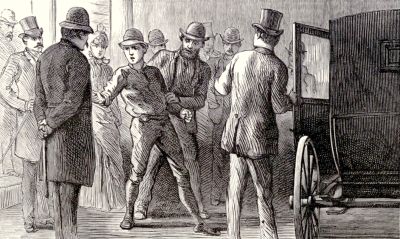
The Arrest.
Roy, in his simplicity, supposed that the guardian of the city's peace would rush up and knock his assailant down with his club, or else take him into custody; but he did nothing of the sort. He strolled leisurely up to the carriage, saying, in a drawling tone:
"I suppose it is all right, Bab?"
"Of course it is," replied the man in gray, "or I wouldn't be in it. I am too old a dog to bark up the wrong tree."
"It's all right, sonny," said the policeman, soothingly. "Go along quiet and peaceable and you won't get into trouble with Bab. He'll take good care of you."
"But who is he, and by what authority does he commit this outrage?" demanded Roy, who was so angry and astonished that he hardly knew what he was saying.
But his indignant words met with no verbal response. The policeman, who, according to Roy's way of thinking, ought to have helped him, lent effective assistance to his assailant by taking the boy by the other arm and gently pushing him into the carriage. The minute the two men released their hold of him, Roy jumped for the other side of the vehicle, intending to open the door and take to his heels, but the man who carried the heavy cane was there before him.
"What's the use of cutting up like this?" said he, with a cunning smile that exasperated the prisoner to the highest degree. "One would think, from your actions, that you were going to prison, instead of to the pleasantest home that any boy of your size ever had. Why can't you stay there and be contented? There's many a youngster in this city who would be glad to be in your boots."
As the man said this he mounted to a seat on the box beside the driver, and at the same moment his companion, who had got into the carriage and closed the door behind him, seized Roy by the arm and drew him away from the window.
"Sit down and take it easy," said he, pleasantly. "The game is up, as I told you, and you might as well give in and wait until you see another chance to run away."
"Run away!" repeated Roy. "Where from?"
"Oh, come now. What's the use of playing off in that way? I know it's quite a while since I saw you, but I knew you the minute I put eyes on you. That chap didn't fool you, did he?"
"What chap?"
"Why, the fellow who tried to play the pocket-book game on you and those two wheelmen you picked up somewhere."
"Did you see that operation?" exclaimed Roy, forgetting for the moment that he was being taken somewhere against his will, and that there might be disagreeable things in store for him.
"I saw it all. I followed you from the Lafayette House—say, Rowe, don't you think you were foolish to go to that hotel where all the wheelmen stop? That was the very first place I went to find you when Willis told me that you had skipped again. What made you go there?"
"Who is Willis?" asked Roy, in reply.
"Oh, get out!" exclaimed his companion, in a tone of disgust. "If you want me to talk to you, you must talk sense."
"Well, then, where are you going to take me?"
"That isn't sense, either. I might be liable to make a mistake, seeing it's two years and better since I last met you, but Willis ought to know you."
"Who does he think I am?"
"Oh, quit your nonsense. I am in no humor for foolishness. I was up all last night working on a case, and now I've got to stay up till I see you safe at home. I'm cross for want of rest."
"You don't talk as if you were cross," said Roy. "I'll stop bothering you if you will tell me who you are, who you think I am, and why you kidnapped me as you have done."
"Bless your heart, you won't bother me if you will only talk sense. I didn't kidnap you. I arrested you for a runaway, and there's my authority for doing it."
As the man said this he squared around on his seat, drew back the lapel of his coat, and the light of a street lamp, which streamed in through the window at that moment, fell full upon a detective's shield.
"My name is Babcock," he continued. "Of course you remember me now. Bab, you know; the same man who arrested you when you lit out two years ago. Bab, you recollect."
"Never heard your name before, and never saw you, till you bounced me back there in the hall," said Roy, who told himself that he was learning something every minute.
"Oh, come now," replied the detective, in an injured tone. "Everybody knows Bab."
"Everybody except me, perhaps. But you never arrested me for the simple reason that I never ran away from home. It's much too pleasant a place for me to leave voluntarily, I can tell you. It is plain enough to me that you have mistaken me for somebody else."
"But there's Willis," said the detective; and if Roy could have seen his face distinctly he would have had the satisfaction of knowing that he had aroused a train of disagreeable thoughts in that official's mind.
"Who's Willis?" asked Roy, again.
"Your uncle's superintendent; the man on top with the driver. He has known you all your life, and he says you are Rowe Shelly."
"Well, I am not. I am Roy Sheldon, and my home is in Mount Airy. If you don't want to take my word for it, tell your hackman to drive us to the Lafayette House. You will find a couple of my friends there, and in an hour I can bring a hundred more from among New London's best business men."
"If you have so many acquaintances in the city, why did you put up at a hotel? That statement will hardly wash."
"It's the truth whether it will wash or not," Roy insisted. "Having just so much time at our disposal, we made all our arrangements before we left home, and we didn't want our friends to interfere with our plans in any way. You may save yourself trouble by going to my hotel."
"No; I don't guess I would," replied the detective, with a yawn. "I'd a little rather trust Willis than you, for you know that you are full of tricks, and that you came within one of giving me the slip two years ago. Remember it, don't you?"
Roy replied that it had slipped his mind entirely, and then went back to the point from which he started, hoping that by setting out on a new tack he could induce the detective to tell him who Rowe Shelly was, where he lived, and why he had run away from home.
"If you are an officer, as you pretend to be, what is the reason you did not arrest that fellow when he was trying to play the pocket-book game on my friends and me?" said he. "You say you saw it all."
"And I say so yet; but I didn't want to have anything to do with him just then, for I had bigger game in sight. That was you, and I was afraid you would recognize me if I showed you my face. So I just nodded to the swindler to let him know that I was on to his little performance, pointed down the street, and he took the hint and cleared out."
"Oh, that's the reason he went off in such a hurry, was it?" exclaimed Roy. "We thought it was because he was afraid his game was about to be exposed. Now that I think of it, I believe I did see you standing near by, but your back was turned toward us."
"No doubt. And you saw me when I took you in at Peach Grove two years ago, didn't you? Come, now, be honest."
"I don't know where Peach Grove is, and I tell you I never saw you before to-night," replied Roy. "How far do you intend to take me in this close carriage?"
"Not much farther. We're most to the pier now."
"Then I've got to go the rest of the way by water, have I?" said Roy. "Why don't you let down the windows? It's suffocating in here."
"It's pretty warm, that's a fact," assented the detective, taking off his hat and drawing his handkerchief across his forehead. "You'd holler if I put the windows down."
"No, I wouldn't," protested the boy.
"And that wouldn't be pleasant; because it would attract attention," continued the detective. "You'd be sorry enough for it after you'd had time to cool off, and, besides, your uncle wouldn't like to have so much publicity given to this matter. He wants everything done on the quiet, and I promise you it shall be, if you will do just as I say."
"Who's my uncle?" asked Roy, believing that he had got upon the right track at last.
"Why, your uncle; Colonel Shelly; the man who owns the island where you live," answered the detective. And then, as if he was angry at himself for giving his questioner this much satisfaction, he added: "I declare, if Job was here in my place he'd lose patience and be tempted to shake you. But go on with your foolishness. I've got to keep awake somehow."
"Then let down the windows so that a fellow can breathe," said Roy, prompt to take advantage of this permission. "If I speak louder than my ordinary tone of voice it will not take you long to put them up again. There, now. That's better. You say you are going to take me to an island. Are there any people on it?"
"A dozen, or such a matter, I should say."
"Have they been long in Colonel Shelly's employ?"
"Some have been there always, and some ain't."
"That's all I want to know on that point," said Roy, who was greatly relieved. "Of course the minute those old-timers see me they will know that you have made a mistake."
"Of course, they won't know nothing of the kind," replied the detective, angrily. "They know, and so does everybody else, that Bab understands his business and is not in the habit of making mistakes. Don't you build any hopes on that."
"Colonel Shelly will know that I am not his nephew, won't he? I can at least build some hopes on that."
"He ain't at home, and you know it as well as I do. If he was, you and I wouldn't be here in this carriage. You waited until he went off somewhere on business, and then you skipped."
"Oh, that was the way of it. The colonel must be rich if he can afford to own a whole island so near a big city like New London, mustn't he?"
"Aw! Go on now," replied the detective. "He's awful rich, and so are you. At least you will be one of these days."
"That's news to me. I've seen the time when I thought I was well off if I had fifteen cents in my pocket. What's the matter?" inquired Roy, seeing that his companion was twisting uneasily about on his seat. "Don't I talk fast enough to keep you awake?"
"You make me tired," answered the detective. "But I'll tell you one thing, young man. If Willis has made a mistake and you are not Rowe Shelly, you're a trifle the coolest customer I have seen for many a day."
"I don't deny that I was frightened at first," said Roy, "but I don't feel at all uneasy now. Of course I know that you have made a mistake, for there's nothing that you or any one else can gain by running me off in this way."
"Well, look here," said the detective earnestly. "If there's been a blunder made, you mustn't blame me for it. Blame Willis."
"What's the name of the boy you took me for—Rowe Shelly? Do I look much like him?"
"That's another question that makes me tired," answered Babcock. "Look like him! You are him, otherwise you wouldn't be here."
"But I say I am Roy Sheldon and nobody else, as I can prove if you will give me a chance. When we get to some place where we can borrow a light, I want you to take a good look at my face. You never saw a boy who looked exactly like me, and I'll bet on it."
This was just what the detective had determined to do. The boy was altogether too much at his ease to suit him; he did not act at all as a disappointed runaway ought to act, and the fear that, for once, he had committed a blunder was almost enough to drive Babcock frantic. If he had made a prisoner of the wrong boy he could look for nothing but a prompt discharge from his employer, who would not be likely to recommend him to any other private detective bureau. But then he never would have made the arrest if Willis had not urged it, and repeatedly declared that he knew Rowe Shelly when he saw him, and that there was no chance for a mistake. And besides, there was the money that Rowe was said to have stolen from his guardian! To do the detective justice he did not believe that part of the story, but told himself that the superintendent had concocted it in order to make the case against the runaway as bad as it could be.
"I don't much like this private detective business, and never did," thought Babcock. "If there is a mean piece of work to be done, something so low down that the city officers won't touch it, we are called upon to do it. I'll have a good look at this boy's face as soon as we reach the pier, and if I am not entirely satisfied with what I see there, I'll wash my hands of the whole business, and leave Willis to take him to the island and get out of the scrape afterwards as well as he can. That's what I'll do."
Seeing that his companion had suddenly grown very unsociable, Roy settled back on his seat and thought over the situation. What would Joe and Arthur think when they missed him, and what would they do about it? When they found that he had not returned to the hotel would they become frightened, report the matter at police headquarters, and write to the folks in Mount Airy about it? The bare thought of such a thing alarmed Roy, who was almost tempted to burst open the door and take to his heels.
"But that plan wouldn't work at all," said he to himself. "Babcock would have me hard and fast before I could get fairly on my feet. I must wait until we reach the pier, and then I'll make a dash, if they give me the least show. If Joe and Arthur write home about it, that will be the end of our trip, and I'll pick a quarrel with the pair of them as soon as I can find them."
But, after all, Roy did not borrow a great deal of trouble on this score. His friends had never yet "gone back on him," and Roy did not believe they would do it now, when there was so much at stake.
While these thoughts were passing through his mind, the carriage, which had been driven at as high a rate of speed as the hackman thought he could venture upon without attracting the attention of the police, turned off the main thoroughfare into a narrow street, then into another, and finally into a third, which was so dark and gloomy that the street lamps looked as though they were shining through a fog. Presently it came to a standstill.
"Here we are," said Babcock, with alacrity. "Jump out. Not that side, but this one. Aha! You'll bear watching, won't you?"
But Roy could not have made his exit through the door toward which he turned, without bringing on a useless struggle with his captors: for the minute the carriage stopped, the man Willis clambered down from the box and appeared at the window.
"Rowe Shelly must be a slippery fellow," thought Roy, as he faced about and followed the detective, "and no doubt he has given these two men a lesson that they will not soon forget. They won't let me have the ghost of a chance to run."
When Roy got out of the carriage he saw that it had stopped at the end of a pier which jutted out into the harbor for a hundred feet or more. There was no possible chance for escape, unless he were reckless enough to jump into the water and trust himself to the tide, which was running out at a rapid rate, but his captors were so very much afraid of him, that they kept fast hold of both his arms while they marched him to the farther end of the pier, where they found a natty little yacht with steam up, ready for a start.
"Do you intend to take me away on this thing?" inquired Roy. "Well, before you do it, hadn't you better get a lantern and satisfy yourselves that you have made no mistake in the boy? I tell you I am not Rowe Shelly. If he has any good reason for running away from his uncle, I hope he is a thousand miles from here at this moment, and that you will never catch him. But if you don't quit fooling with me here and now, I'll make trouble for you as sure as I live to get ashore."
"I'm used to such talk as that," said Willis, with a laugh. "Yes," he added, in reply to a low question from a man on the forecastle who proved to be the captain of the yacht, "we've found him already. Had no trouble at all in tracking him. Are you ready? Then cast off and—"
"Hold on," interrupted the detective. "I want to say a few words to you in private, Willis. Captain, can this boy be locked in the cabin with any certainty that we shall find him there when we want him?"
The man appealed to said he was sure of it; whereupon Roy was conducted down the companion ladder, and into an elegantly furnished little room in the stern of the yacht. The hanging lamp gave out a brilliant light, and Roy, believing that the detective would never have a better opportunity to take a good look at his face, placed his hands on his hips and stood in such a position that the rays from the reflector fell full upon him.
"Now what do you think?" said he. "Can you truthfully say that you ever saw me before?"
"Why, what's the matter?" inquired Willis, while Roy was sure he looked somewhat concerned and anxious. "What are you talking about, Rowe? You don't pretend to deny yourself, do you? If that's your scheme, it won't work."
"Of course I do not mean to deny my identity," replied Roy. "But I do say I am not Rowe Shelly."
"What nonsense!" exclaimed Willis. "Shove off, captain. We are wasting time here. Mr. Babcock will go to the island with us, as he did before."
"Don't be in a hurry, captain," interposed the detective. "It is possible that I shall want to stay ashore. Now, Willis, come on deck and tell me who is to pay me for this night's work."
Willis knew, and so did Roy Sheldon, that this was simply a ruse on Babcock's part to take the superintendent out of the prisoner's hearing so that he could speak his mind to him without fear of being overheard. I afterward learned all about that rather stormy interview, and so I will tell of it here in its proper place.
"Look here," said Babcock, as soon as he and Willis had gained the deck. "You have brought me into a pretty mess, and I am going to get out of it with the least possible delay. I am as near the island as I am going to-night."
"You—you don't suppose—" began Willis.
"Yes; I mean to say that you have made me arrest the wrong boy," exclaimed the detective, as if he read the thoughts that were passing in his companion's mind; "and if you don't know it, too, your face belies you. What do you say, captain? Who is that boy we just left in the cabin?"
"Why, it's Rowe Shelly, of course. Who else should it be?"
"Did you take a good look at him?"
"I did. I would know him if I had met him in Europe."
"There, now," said Willis, angrily, "I hope you're satisfied. I've heard that boy talk. He can almost make one believe that black is white, and I can see plain enough that he tried his blarney on you while you were in the carriage with him. You wouldn't have made the arrest if it hadn't been for me."
"You're right, I wouldn't. I believed you when you said you knew the boy, and now I've got into a nice pickle by it. I hope the colonel will give you your walking-papers the minute he hears of it."
"Oh, he dassent do that. I know too much about—" began Willis, and then he stopped, frightened at what he had said.
"You know too much about him and his affairs, do you?" exclaimed Babcock, finishing the sentence for him. "That's what I have thought for a long time."
"I didn't say so," replied Willis, hastily, at the same time taking the detective by the arm and leading him out of earshot of the captain of the yacht. "You ought not to have spoken so plainly in the presence of a third party. I tell you it's all right."
"And I tell you I am sure it isn't. If you will take my advice, you will bring that boy out of the cabin and show him the way to his hotel at once. If he is a stranger in town he could not find his way there alone on a dark night like this."
"I wouldn't do that for no money," said Willis, alarmed at the mere mention of such a thing. "Just see the trouble I'd get into."
"You'll get into more if you don't do as I say. Well, good-by. I'm off."
"Won't you see Rowe safe to the island?"
"Not by a great sight. I'll have no more to do with the case."
So saying the detective jumped ashore, and Willis was left to his own discretion.
CHAPTER VI.
ANOTHER SURPRISE FOR ROY.
"Well, this is a pretty way to treat a fellow, I do think," soliloquized the puzzled and anxious superintendent, as he stood on the yacht's deck and watched the retreating form of the detective until it was swallowed up in the darkness. "He gets me into difficulty and then clears out, leaving me to sink or swim, he don't care which. What do you say, captain?" he added, turning to the master of the yacht, who came up when he saw Babcock spring ashore. "You're quite positive that the boy below is Rowe Shelly, and nobody else?"
"What's the matter with you and Babcock?" asked the captain, testily. "You act like a couple of—I don't know what."
"And that's the way I feel," replied Willis. "Babcock has been worked upon in some mysterious way, and now he's gone away and left me to bear the brunt of the whole thing alone."
"Well, wasn't that what you expected to do when you got back to the island?" inquired the captain. "His guardian being absent, you will have to take full charge of Rowe until he returns. That's what you did the last time he ran away, and you never made any fuss over it. I know it is disagreeable business, this standing guard over an uneasy fellow who won't stay where he is put, but seeing that we are well paid for it, and know that it is for the boy's best good, where's the harm?"
"But Babcock seems to think that Rowe has slipped through our fingers, and that we have brought back the wrong boy."
The captain made a gesture of impatience but said nothing.
"All right," exclaimed Willis. "Cast off the fasts and get under way as quickly as possible."
"Where's his wheel?" inquired the captain. "I didn't see you bring it aboard."
"We didn't stop for it," answered Willis, "for the youngster was in fighting humor, and would have drawn a crowd about us if we hadn't hustled him into the carriage just as we did. We'll have to send for it when he gets ready to tell us where he left it."
"Don't he feel inclined to talk? That isn't at all like Rowe, who usually has gab enough."
"Bless you, he's nothing but talk; but the trouble is, he won't tell the truth. He has hit upon a new plan this time. He says he is somebody else, and sticks to it. But you know him and I know him, even if Babcock doesn't; so it's all right. Now get underway. It must be all right, although I confess that Babcock frightened me by talking and acting as he did," said Willis, as the master of the yacht hastened forward to take his place at the wheel. "I had a good view of him while he stood in front of that window with those two young wheelmen; I sat almost within reach of him during the entire evening; and I've had several good looks at him since. Babcock had all the chances he wanted to compare his face with the photograph I gave him, and he didn't think there was anything wrong until after Rowe had had opportunity to talk to him. I'd give something handsome to know what passed between them while I was on the box with the driver; then, perhaps I should know what to do. I ought to have stayed with them, but I never dreamed of anything like this. However, I shall be prepared for any emergencies. I'll take Tony into my confidence just as soon as I can get Rowe into the house and up to his room."
So saying, the superintendent faced about and went into the cabin to see what the prisoner thought of the situation. To his surprise he found him reading a paper he had taken from the table. According to Willis's way of thinking, that was a bad sign. Why didn't he walk the floor and shake his fists in the air and utter threats, and in various other ways act as if he had taken leave of his senses? That was the way he did the last time he was captured, and Willis could not understand why he didn't do so now.
"Well," said Roy, laying down his paper and squaring around in his chair. "What conclusion did you and Babcock come to?"
"What conclusion?" repeated Willis, innocently.
"Yes. You went on deck to hold a private confab, and I should like to know what came of it. It is a matter in which I am somewhat interested."
"I don't see how you can be. Bab wanted to know who was to pay him for interfering with your plans, and I told him he would have to go to your uncle for that. There was nothing private about it."
"I suppose I am at liberty to believe that or not," replied Roy. "Babcock knows that when he caught me he didn't get the boy he wanted, and you know it, too. I don't say you knew it when you took me away from my friends in front of the hall, but you do now!"
Roy said this at a venture, and, no doubt, would have been greatly amazed if he had known just how close he had shot to the mark. He was sitting a little to one side of the reflector, so that the rays from the hanging lamp fell squarely upon him, and now that Willis had leisure to look at him without fear of interruption from a crowd of curious by-standers, the cold chills began creeping over him. There was a wonderful resemblance, it is true, between the prisoner and Rowe Shelly, and yet Willis could not help seeing that they were different in a good many particulars. Roy had a way of holding his head, and even of sitting in his chair, which were unlike anything the superintendent had ever noticed in Rowe. How earnestly he wished that Roy would own up, confess that he was the runaway, and thus put an end to his suspense!
"Where's Babcock now?" asked Roy, after a short pause.
"On deck," answered Willis, who did not think it would be good policy to tell the prisoner just what had passed between himself and the detective. "It always makes him sea-sick to remain in a close cabin when on the water, and so he stayed where he could get the breeze."
"It works that way with me, too," said Roy; but Willis could not be made to believe it.
"It won't do, Rowe," said he, with something that was intended for a good-natured smile. "I've seen you on the water too often, and you can't crowd any such story down me. I wouldn't mind allowing you to go on deck if I could trust you; but I have learned that I can't. Your word isn't good for anything."
"Your remarks may apply to Rowe Shelly, but I want you to understand that they don't hit me. My word is always good. But what's the use of talking?" said Roy, again, picking up the paper. "I've told my story to the detective, who probably told it to you, and in a few hours you will learn that it is a true one. Where has Colonel Shelly gone, and when is he expected to return?"
Willis answered that he didn't know.
"It's immaterial," said Roy. "When my friends come to the island after me, as they surely will as soon as they find out where I have been taken, I shall go ashore with them, no matter whether the colonel is there or not."
It was right on the point of Roy's tongue to add: "And you will go also, for I don't intend to submit to treatment of this sort." But he did not utter the words. It came into his mind like a flash, that possibly this man Willis might have it in his power to shut him up in some strong room on the island, and if that was the case Roy did not wish to make him angry.
"You still stick to it that you are not Rowe Shelly, do you?" exclaimed Willis, trying to look and speak as if he were becoming indignant, though the effort was a sorry failure. He was frightened, and Roy saw it plain enough. "You might as well give up, for everybody who has ever seen you knows who you are."
"Oh, I'll give up because I can't well help myself," replied Roy. "In fact I have a curiosity to see the thing out, and to know what you and Babcock will do when you find that you have put your feet in it. So long as I get good treatment, a soft bed to sleep in—I have been in the saddle nearly all day, and consequently I feel rather tired—and plenty to eat, I would just as soon—indeed, I would rather stay on an island to-night than sleep at my hotel. I never did like a city hotel, and if I were sure that my friends are not worrying about me, my mind would be quite at rest. Hal-lo! What have I said now, I wonder."
"By the piper that played before Moses, that ain't Rowe Shelly," said Willis, to himself, as he sprang from his chair and bolted up the companion-ladder. "Babcock was right, and I'm in for it, sure enough. Rowe's got sublime cheek, but it can't compare with this fellow's. Now what shall I do?"
It was plain as daylight to me, when I heard of it, that there was but one course of action open to the superintendent, and that was the honest and manly one. When he became convinced, or even suspected, that he had made a blunder, the best thing he could do was to order the yacht back to the pier and conduct Roy Sheldon to his hotel with such apologies as he could think up on the spur of the moment. But, unfortunately, Willis had never been known to do an honest and manly thing. Probably he never thought of it. He wasn't above a mean act, and when detected in it generally did something meaner to cover it up. And that was what he decided to do in this case. He did not go into the cabin again, but paced the deck, lost in thought. He turned over in his mind a dozen wild schemes for ridding himself of the prisoner in case he did not prove to be the boy he wanted, but through it all he clung to the hope that he was Rowe Shelly, and nobody else. It couldn't be possible, he told himself, that there was a boy in the world who looked enough like the runaway to deceive everybody at first sight. At any rate, it would not take long to settle the matter now, for here was the island close at hand. There were several people on the jetty awaiting the yacht's return, and every one of them would be able to tell at a glance whether or not he had brought Rowe Shelly with him.
"I'll not so much as drop a hint that I am afraid there is something wrong," said Willis, to himself. "I'll just walk him ashore as if it was all right, and leave them to find a difference between him and the runaway, if they can. If they don't say anything, I shall know that I have been a fool for allowing Babcock's words to have so much weight with me."
When the yacht whistled for the landing, Willis stuck his head down the companion-way and told Roy he might come on deck; a privilege of which the weary prisoner was prompt to avail himself. He had been asleep, with his head resting on the table, and now all he cared for was to get to bed. It would be time enough, he thought, to look into his surroundings and inquire about Rowe Shelly and his reasons for leaving home, after he had had a good night's rest. But by the time the yacht was stopped at the jetty and the lines made fast and the gang-plank shoved out, he was wide awake.
"He's come," said somebody on the jetty. "Don't you see his white shirt and cap? That's him. That's Rowe."
"Now this is mighty strange," said Roy to himself. "These folks appear to be friendly to the boy I am supposed to be, and yet they don't want to have him run away, although he must have good reasons for it, having tried it twice. When they get a closer view of my face we'll see how quick they will sing another tune."
But, to Roy's surprise, they didn't do anything of the sort. They crowded about him, as he walked down the staging by the superintendent's side (for a wonder the man did not take hold of his arm, as Roy expected him to do), all eager to shake him by the hand. They even gazed into his face, which was plainly visible, owing to the bright light emitted by the blazing torch that was standing among the rocks at the end of the jetty. The climax was reached when a motherly-looking woman, who was waiting for them at the shore end of the jetty, threw her arms around the neck of the startled boy and kissed him on the nose before he knew what she was going to do.
"Bless his heart, has he come back again?" she exclaimed, holding him off at arm's length so that she could get a good view of him. "Come right into the house and get a good supper before you go to bed. I know you must be tired to death, and don't suppose you have had a bite to eat since you went away, seeing that you did not take any money with you."
"Let us go in, Mrs. Moffat," interrupted Willis, who grew nervous when the housekeeper began talking about money.
"I'll tell you what's a fact: this is getting serious," soliloquized Roy, as he moved toward the house in company with Willis and Mrs. Moffat, one walking on each side of him. "But I don't know that I care so very much. I'll see how it looks in the morning." Then aloud he said: "I don't want anything to eat, Mrs.—beg pardon, I didn't quite catch the name."
"Good laws! Just listen at the child," exclaimed the housekeeper, throwing up her hands and looking the picture of astonishment.
"He's been going on that way ever since we found him, Mrs. Moffat," said Willis in a low tone. "He don't know me nor Babcock nor the captain nor nobody. He acts as if he had lost all his senses."
"That's just what I have been afraid of for a longtime," answered the housekeeper in a loud, shrill whisper. "No boy who was in his right mind would want to run away and leave a kind uncle and a beautiful home like this. I've suspected it, and so have others whose names I could mention."
Willis started when he heard this, and so did Roy. The woman's words suggested an idea to both of them.
"I've sense enough to know that I am not hungry," said Roy. "All I ask is to get to bed and be left alone for the rest of the night. I'm tired and sleepy; and besides, I want a chance to think about this business," he added, to himself.
The housekeeper hastened to assure him that it should be just as he said, and a few minutes later Roy was conducted up the front steps and into a wide hall from which winding stairs led to the floor above. Fortunately, his guides did not leave him here, for if they had, Roy would not have known what to do. No doubt he would have confirmed the housekeeper's suspicions by requesting her to show him to his room. But she and Willis did that without being asked. They led him up-stairs to a handsomely furnished apartment, and even accompanied him into it. There was a student lamp on the center-table, a bright wood-fire burning in the grate (although it was summer, the breeze that came off the Sound was raw and chilly), and everything looked cheerful and inviting.
"I haven't touched the room since you went away, except to slick it up a little," said Mrs. Moffatt. "Now, is there anything I can do for you before I say good-night? Hadn't you better let me bring up a little lunch for fear that you may get hungry before morning?"
"I don't care for any, because I never eat during the night. When I once fall asleep, I don't know anything more till daylight comes. There's nothing you can do, thank you," replied Roy.
The motherly housekeeper was evidently disappointed because the boy did not make some complaints or order something, for she lingered as if waiting for him to speak again, while Willis walked the floor with his hands behind his back. He was lost in a brown study from which he presently aroused himself to say:
"Very well. If there is nothing we can do for you, we'll bid you good-night. If you want anything you know how to get it."
"I'll be shot if I do," said Roy, mentally. "Rowe Shelly must be a queer chap if he has to be waited on during the night. If that's the way he has been brought up he had better stay at home as long as he can, for he'll have to take hard knocks when he gets out into the world. I declare, he lives in clover, does he not?" added Roy, glancing around at the expensive furniture, the pictures on the walls, the ornaments on the mantel, which included the model of a full-rigged ship, and the well-filled book-cases that stood on each side of the fire-place. Through an open door at the farther end of the apartment, Roy caught a glimpse of the runaway's bed-room.
"But I'll not go in there," said he, to himself. "I'll move this sofa pillow to the lounge, borrow a book, if I can find one to suit me, and read myself to sleep. So long as I am treated like one of the masters of the house instead of an interloper, I don't see why I shouldn't make the best of the situation. Of course Joe and Art will be along in the morning, and they will be able to prove to Willis's satisfaction that I don't belong here. I knew it would be of no use to argue the matter with Mrs. Moffatt after Willis told her I was out of my head."
While Roy talked to himself in this way he ran his eye over the volumes in one of the book-cases, took out "Gulliver's Travels," and lay down upon the lounge; but before he had read half a page the hand that held the book gradually fell away from his face until the volume rested on the floor by his side. There was no sham about his weariness. His thirty-six mile ride had tired every muscle in his body, and Roy was fast asleep. Would his slumber have been as peaceful as it was if he he had known what was going on outside the house?
When Roy awoke it was with a start and the indescribable feeling that sometimes comes over a sleeper when a stranger unexpectedly enters his room. He looked around, and sure enough he was not alone. Willis was standing a little distance away, and Roy was almost certain that he saw him turn and signal to another man, who whisked out of the door before he could obtain a fair view of him. It might have been nothing but the vagary of a dream, but still Roy thought it worth while to speak of it.
"What do you want now?" he demanded. "Why do you come in without awaking me, and who was that fellow who just went out?"
"What fellow?" asked Willis, answering the last question first, and at the same time facing about and looking at the door, which was still slowly and softly closing.
"That's what I asked you," replied Roy, springing off the lounge, jerking the door wide open and looking out into the hall. There was no one there. If there had been Roy certainly would have seen him, for the lamps were still burning.
"Why, what's the matter?" inquired Willis, as if he thought this a very strange proceeding on Roy's part. "What are you afraid of?"
"I don't know that I am afraid of anything; but I'd like to have you to tell me who came into this room with you, and why you are here. I told you I shouldn't want anything to-night."
"I thought you might, and that's why I came," replied the man. "There is no one with me. I am alone." And then, as if he had just thought of the object of his visit, he continued: "I was sure you would like to hear some word from your friends—the two who were with you when that bunco-steerer tried to cheat you out of some money. I know I might have waited until morning, and since you were sleeping so soundly, I am sorry I didn't. I have found out—"
"Great Scott, man!" interrupted Roy, who could scarcely believe that he heard aright. "Don't talk about waiting till morning when you have good news to tell. Where are my friends? Are they here—on the island? How did you get word from them? Go on, please, and tell me what you have found out."
If Willis had not already received as good evidence as he wanted that the boy before him was not Rowe Shelly, he had it now. The real runaway could not have talked and acted as Roy did at that moment.
"I heard of them through Babcock," Willis began.
"Then he didn't come to the island with us, did he? I wondered why I did not see him."
"No. He left me at the pier and went to the city to make inquiries about you. He went straight to the—the—"
"Lafayette House," prompted Roy, when the man hesitated.
"That's the place. The Lafayette House, and saw your name on the register. Let me see; what did he say it was?"
"Was it Roy Sheldon?"
"Yes, it was. Sounds a good deal like Rowe Shelly, don't it? He found your name there, and also the names of—"
Here Willis hesitated again, for he was not quite sure of his ground. You must remember that he did not know as much about the prisoner as Babcock did, for Roy had not had the same chance to talk to him. So he stopped as often as he needed posting, and, strange to say, Roy never suspected that there was anything wrong. He afterward had occasion to take himself to task for his stupidity.
"My two friends, Joe Wayring and Arthur Hastings?" again prompted Roy. "Did Babcock see them, and what did they have to say about my disappearance? I hope they haven't thought of writing home about it. I wouldn't have them do that for anything."
This was something that Roy ought to have kept to himself; but he said it, and Willis was quick to make a note of it.
"I don't know about that," he replied. "Babcock didn't see 'em to speak to 'em, and they didn't come off with him."
"Now—why didn't they?" exclaimed the disappointed Roy, who had secretly cherished the hope that the fellow who so suddenly disappeared through the door was one of his chums. It would have been just like Art Hastings to play a trick of that kind on him.
"I'll tell you why he didn't speak to—what's their names?" answered Willis. "He spoke to the clerk instead, because he did not want to raise a row, and he told him all about you."
"The clerk did?" said Roy. "Why, he doesn't know anything about me. He never saw me until I went into his hotel in company with my friends."
"That's what he told Bab; but he knew you were from—what is the name of that place again?"
"Mount Airy?"
"That's it. He knew you came from there, and more than that, he saw the genuine Rowe Shelly."
"There, now," cried Roy. "That's evidence worth having. Did he catch him?"
"No; but he is close on his trail. He brought this news over to me just now, Babcock did, and then went back to follow him up."
"I hope he'll not catch him," said Roy. "I'm sure I can't understand why a boy as well fixed and as kindly treated as young Shelly seems to be should want to run away from home, but I suppose he has good reasons for it."
"Not the first; not the smallest shadow of a reason," protested Willis.
"Then he's crazy; that's flat."
"Now you have hit it. That's what's the matter with him, and you heard Mrs. Moffatt say she had suspected it for a long time. You look surprisingly like Rowe, or else all those folks who met us on the jetty wouldn't have taken you for him. You've got the same hair, eyes, and mustache, and your clothes are exactly like his; but when I had a chance to exchange a word with you, I knew that Bab had made a big mistake."
"Bab says you are the one who made the mistake, and that if I blame anybody for what has happened to me to-night, I must blame you."
"Well, you wouldn't blame anybody if you could see Rowe Shelly," said Willis, deprecatingly. "Of course any amends that—"
"Oh, I don't ask any amends," interposed Roy. "I've had an agreeable adventure, and I shall not make any trouble on account of it. All I ask is that you will send me to the city at once, so that I may relieve the anxiety of my friends. Now, what do you want me to do? Are you going to send me off in the yacht?"
"I'd like to, but I can't," answered Willis. "The captain's asleep, and steam has gone down, so that it would take an hour to get ready for the start. I'll have to send you ashore in a boat, if you don't mind going that way."
"Any way to get there," said Roy, picking up his cap. "I'm ready if you are."
Willis left the room at once, and Roy followed him downstairs and out of the house. Did the man move with cautious footsteps as if he were afraid of disturbing somebody? Roy was sure he did, and thought it looked suspicious.
CHAPTER VII.
SOME STARTLING NEWS.
"I don't much like the idea of sneaking out as if I were a thief," said Roy, involuntarily following the guide's motions and speaking in a low and guarded tone. "What's the object of so much secrecy? I know I have no right here, but since I was brought against my will, I have a perfect right to go out open and above board."
"Easy, easy," whispered Willis, raising his hand with a warning gesture. "We don't want to disturb Mrs. Moffatt for nothing. The timid old soul lives in constant fear of a visit from New London burglars, and if we should wake her up she would be scared to death."
Roy did not think to ask himself whether or not this was a good reason for Willis's stealthy movements, for his mind was too busy with other matters. He wanted to see the boat that was to take him across to the city, and fervently hoped it might prove to be a large and seaworthy one; for when he got out of the house he saw that the sky was overcast, that the wind was rising, and that the surface of the bay looked dark and threatening.
"Isn't it going to be an ugly night?" said he, as he accompanied his guide down one of the broad carriageways that had been laid out along the beach. "What a lovely road for a wheel," he went on, without giving Willis a chance to reply. "It is as hard as rock and level as a floor."
"Yes; here's where Rowe learned to ride," said Willis. "We have twenty miles of just such roads on the island."
"Then that was what you meant when you said Rowe's clothes were just like mine; he is a wheelman," said Roy. "He has a nice place for his regular runs, and I should much like to see it by daylight; but I should think he would get lonely and long to take a spin on the mainland now and then. I tell you it's going to blow," he added, as a strong gust of wind shook the branches of the trees that shaded the road on both sides. "Are you going to the city with me?"
"I can't leave the island until I put the hands to work in the morning," replied Willis. "But I will give you a good crew and a stanch boat. You'll go over all right. You are not afraid of a capful of wind, I hope?"
"No, but I am afraid of a gale. I am used to smooth water, and don't at all relish the idea of being out in a storm."
"Oh, it isn't going to storm. But if you get frightened after you are out a little way, tell the men to bring you back or to put you aboard some coaster, bound in. Here we are."
As Willis said this he turned off the road and led the way down the bank and to the beach, where Roy found a boat and two men who were evidently waiting for him.
"Here he is," said Willis, laying his hand on the boy's shoulder. "He doesn't much like the idea of going out in this breeze—"
"The breeze don't blow to hurt anything," growled one of the men, pulling his sou'wester lower over his forehead and turning the collar of his pea-jacket up around his ears.
"That's what I told him; but of course his wishes must be respected, and I want you to mind this: If it gets too heavy for you, you will either bring him back, or put him aboard some larger craft, bound in. If you will step this way a minute, Tony, I will give you an order for some goods I want brought from the city."
The superintendent drew off on one side out of earshot, and one of the muffled figures followed him.
"Me and Bob hain't yet made up our minds whether we'll have a hand in this business or not," said he, in a hoarse whisper. "Looks most too risky, don't it?"
"There isn't a particle of risk about it," replied Willis. "Do you think I would put the colonel's nephew in danger for the sake of a paltry five hundred dollars? I tell you, there's nothing to fear. The colonel told me to attend to this business for him, and when he finds I've not done it, what shall I say to him? Do you want me to tell him that you wouldn't obey orders because you were afraid?"
"Well, I am afraid, and that's flat," said Tony, doggedly. "I have heared of Cap'n Jack, and I'm scared to trust myself on board his ship."
"You needn't be, for the colonel will protect you. Give him this the minute you get aboard, and it will see you through," said Willis, slipping an envelope into the pocket of Tony's pea-jacket. "Now, hurry up, for the captain is in a great taking to go to sea, and he's liable to run out at any moment. He's been waiting a long time—"
"He's been waiting long enough to get good and mad, and I wouldn't be one of the crew he takes to sea with him this trip for all the money there is in the broad world," said Tony, with a shudder. "He'll haze 'em till they'll be glad to jump overboard."
"You and I have nothing whatever to do with the way Captain Jack Rowan sees fit to treat his crew," said Willis impatiently. "All you and Bob have to do is to set this boy on board the White Squall, so that he can get that money. But mind you: You are not to tell him where you are going. He's as much afraid of the White Squall as you seem to be, and wouldn't put a foot over her rail if he knew it. He thinks he going into the city, and that you are to take him straight to a hack-stand. Say yes or no, and be quick about it. The wind is rising every moment, and if you don't start pretty soon you'll not be able to get away from the beach."
"All right, Mr. Willis. We'll tend to the business for you."
Tony spoke these words in a tone loud enough to reach the ears of Roy Sheldon, who remained near the boat in company with the man Bob. The former supposed the words had something to do with the "order" of which Willis had spoken, but Bob knew they were intended to convey to him the information that the job on hand was to be carried out just as it had been planned.
"Jump aboard, lad," said he, motioning Roy to get into the boat. "Holler good-by to the old man, and that will do just as well as shaking hands with him."
But Roy had no opportunity to "holler" his farewell, even if he had thought of it; for by the time the boat was fairly afloat, the crew in their places, and the oars shipped, the thick darkness of the on-coming storm closed down over them, and the beach was shut out from view.
"I reckon that's the last of this scrape for one while," soliloquized Willis, as he pulled his hat down over his ears and retraced his steps to the house. "If there ever were two born fools in the world, they are me and Babcock. How we managed to make such a blunder, I can't for the life of me imagine. Now Rowe Shelly can cut his lucky and go and find his father and mother, for all me. I'll never try to catch him, for my cue now is to make folks believe I've had him here, and that he gave me the slip and cleared out. Is that you, Benny? You don't know how you startled me."
Just then some one stepped out into the road and confronted the superintendent. It was his son; and all I know about him is that he was called "a chip of the old block," so he must have been a rascal. The first words the young man spoke proved that this was not the first interview they had had that night.
"Well, how is it?" said he.
"They've gone," replied his father shortly.
"Then we've seen them for the last time; for when they get back we'll not be here. Captain Jack will be sure to carry them off with him."
"Ain't you kinder sorry to treat Tony and Bob that way? They've been good, faithful fellows, and I hate to think of their being kicked and knocked about by those mates."
"They're used to it," replied Benny indifferently. "Besides, what else could you do? You couldn't keep the boy, for he was not Rowe Shelly; and if you had let him go, he would have had the law on you for abduction. You couldn't have hired Bob and Tony to take him aboard the White Squall and leave him there, because they wouldn't have done it, and they would have blabbed about it into the bargain. By doing as I said, you've got rid of the whole of them at once, and they'll never come back to trouble you."
The superintendent groaned.
"I know what you're afraid of," continued Benny. "You're scared that the ship will go to the bottom with all hands. Well, then, what made you be such a dunce as to capture the wrong boy? You got into the scrape and you had to get out, didn't you? Now I'm going to bed."
"There's going to be the biggest kind of a commotion on this island, and before long, too," said Willis dolefully. "I have warning of it in every breath of wind that comes off the bay."
I do not suppose that Willis closed his eyes in slumber that night. It would have been a wonder if he had slept, with so guilty a conscience for company. He arose at an early hour, saw the yacht when she put off through the white-caps shortly after daylight to bring the morning's mail from the city, and waited with what patience he could for her return. She did not bring any of Roy Sheldon's friends with her, but she landed a larger supply of mail than usual, and in it the superintendent found a letter addressed to himself in Rowe Shelly's well-known handwriting. Its contents were enough to drive one frantic, Willis told himself. He had hoped that the runaway would be satisfied now that he had got off the island, and that he would quietly disappear and never "turn up" again; but here he was threatening the superintendent with the terrors of the law if he did not at once release the boy who had been mistaken for himself.
"Somebody put him up to that," groaned Willis, "for Rowe never would have thought of such a thing himself. I wish I could send that boy back where he belongs, and if I had ever dreamed of this, I would have done it. I made a mistake in taking Benny's advice and sending Roy Sheldon away to be "shanghaied," for instead of getting out of trouble, I have only pulled myself deeper into it. What is it, Jobson?" he added, addressing himself to one of the hired men who just then appeared at the door.
"I came in to see if you could tell me anything about Tony and Bob Bradley," was the reply; and the words added big weight to the superintendent's heavy load of anxiety. "They are not on the island, and a boat that looks wonderfully like theirs is being driven ashore from the Sound. I didn't know but you might have sent them to the city for something."
"In all that storm?" exclaimed Willis. "Say, Jobson," he continued, changing the subject, for it was one he did not like to dwell upon, "was the storm so very hard? I mean, was it severe enough to keep vessels from going and coming?"
"Oh, no. I see the White Squall has left her anchorage. She must have gone out in the height of it, for she was there when I went to bed."
"If those two men went away last night they did it without any orders from me," said Willis. "It's nothing to worry over. No doubt they will come around presently. So the White Squall has gone at last!" he added, as Jobson left to continue his search for Bob and Tony. "She has been anchored out there in the bay for more than two weeks, waiting for a chance to drug and steal a crew, and if she has sailed, that interloper must have sailed with her. In that case it will be a long time before he shows up again, for he'll not touch land this side of Cape Town. This is too damaging a thing to lay around loose, so I will chuck it in there," he added, tossing Rowe's letter into the grate. "Those people from the city will be along in the course of an hour or so, and I know what I am going to say to them. Now, why doesn't Mrs. Moffatt come in and tell me that Rowe has run away again?"
Willis picked up one of the papers which the yacht had brought from the city, and the minute it was opened his eye fell upon this startling paragraph:
MUTINY IN THE HARBOR.
An Infamous Vessel and a Rebellious Crew.—A Sailor Prefers Death to a Voyage in the White Squall.
"Pilot-boat No. 29, Caleb Rogers master, which was driven into the harbor by the gale, reports a suicide committed under peculiarly distressing circumstance. When off the light-ship bound in, Captain Rogers passed the White Squall going out. As the readers of The Tribune have often been told, this interesting ship had lain at anchor in the outer bay for nearly three weeks, waiting for a crew; but no man who sails out of this port, so long as he kept a level head on his shoulders, could be induced to affix his name to her shipping articles. Now and then a few foreigners, under promise of big pay, plenty to eat and kind treatment, have been coaxed aboard of her, but they always deserted when they found out where they were and who the captain was. With the aid of shipping agents, or in some other underhanded way, the captain at last succeeded in mustering crew enough to handle his vessel, and this morning she went out in the teeth of the storm that forced Captain Rogers to seek shelter. When off the light-ship a man was seen to spring upon her rail and deliberately throw himself into the water. At the same time a white fishing-boat was cut loose from her starboard quarter, and the wind blew it out of sight. This, Captain Rogers thinks, made it evident that the crew had laid their plans to desert in a body, and that the plot was discovered and thwarted by the officers. Captain Rogers at once rounded to, lowered a boat, and made diligent search for the poor fellow who preferred to die rather than trust himself to the tender mercies of Captain Jack Rowan and his brutal mates, but he must have sunk immediately, for he was not seen after striking the water. At certain stages of the tide, heavy vessels like the White Squall are obliged to pass quite close to the ledge that bounds the northern side of the channel, and in ordinary weather a fair swimmer might succeed in reaching the light-ship; but under the circumstances Captain Rogers thinks there was no chance for this unfortunate man's life. The White Squall kept on her way without making the least effort to pick him up. Now what is the use of having any law, we should like to know, if it is not intended to reach just such ruffians as this Captain Jack and his officers? If that sailor made way with himself in his desperate efforts to escape their brutality, they ought to be punished with the utmost severity."
Willis read this paragraph with eyes that seemed ready to start from their sockets, and long before he finished the paper was shaking so violently in his hands that the noise it made could have been heard across the room. He understood some portions of the paragraph as well as though he had stood upon the White Squall's deck and witnessed the thrilling scenes that must have taken place there before that unhappy sailor gave himself up to the mercy of the waves. But was it a sailor who jumped overboard? Might it not have been some one else? How did he know but it was—The exclamations that fell from the superintendent's lips when this thought came into his mind can not be expressed in words, for I do not know how to spell them.
"Benny's plan worked too well," said Willis, throwing down the paper and getting upon his feet. "Why didn't he stay here and see me through, instead of going off in the yacht the first thing in the morning? They were all shanghaied, as we meant they should be; but was there any one in the white fishing-boat that was cast adrift from the ship and which Jobson says is now coming toward the island? And who was the fellow who jumped overboard? That is a question that will haunt me till I go ashore and learn the truth. I do not think Tony or Bob would do a thing like that, for they are used to hard treatment at the hands of shipmasters; and if it was Roy—Gracious Peter! I'm in a worse scrape than I thought."
Willis did not have time to follow out this train of thought, for just then Mrs. Moffat came into the room. The man knew well enough what she was going to say, for the look of anxiety her face wore could be easily interpreted.
"Good morning, Mr. Willis," said she, with a sorry attempt to appear as cheerful as usual. "Have you seen Rowe since we left him in his room last night?"
"I have not," replied the superintendent, resuming his seat and once more unfolding the paper. "What makes you ask?"
"Why, I went up just now to tell him breakfast would soon be ready, and he wasn't there," answered the housekeeper. "More than that, his bed was not slept in."
"That doesn't signify. He took to the lounge probably, and went out before any of us were up for his usual morning's spin on his wheel."
"But he took his wheel when he went to the city, and you did not bring it back," Mrs. Moffatt reminded him.
"That's so. I had forgotten about it. I'll send for it as soon as he is ready to tell me where he left it. Then he took his pony."
"The pony hasn't been out this morning. The hostler told me so. Mr. Willis," said the housekeeper, becoming earnest, "I'm afraid he's gone."
"Again?" exclaimed Willis, as if the thought had just been suggested to him. "Why, we only brought him back last night."
"I can't help that. I don't believe he is on the island."
The man knew he must make a stir about it, for any lukewarmness or show of indifference on his part would be reported when the colonel returned, and Willis was not yet ready to give up his lucrative position. He wanted to make a little more money out of it first. So he hurried from the house, making a great show of nervousness and apprehension; and every man he met he sent off to make inquiries about Rowe Shelly.
"If he has run away again I shall surely think he is out of his head," he took occasion to remark, in Mrs. Moffatt's hearing. "He couldn't go back to the city without crossing the bay, and no boy, or man either, would think of trying that in such a gale as we had last night and this morning, unless he was clean gone crazy. Have you brought any news, Jobson?"
"The little I've got is bad enough," replied the hired man. "The boat I was telling you about a while ago has come ashore down there in the cove—"
"And there's nobody in it," exclaimed the superintendent. "Mrs. Moffatt, I fear the worst. Rowe tried to reach the city in that boat, and the storm capsized him. I am afraid we shall never see him again."
"If Rowe went off in that boat Bob and Tony must have gone with him," said Jobson, "for they ain't either one of them to be found on the island, and their folks don't know anything about them."
"Do you think it possible that Rowe could have bribed them to take him across to the mainland?" said Willis anxiously. "If he did, then they have all gone to their death."
"How could he have bribed anybody when he had no money?" cried Mrs. Moffatt.
"Madam," replied the superintendent impressively, "he had money, and plenty of it, too."
"When and how did he get it?"
"You tell. All I know is, that every dollar of the funds the colonel left in my hands to pay expenses during his absence has disappeared."
"I don't care if it is," snapped the housekeeper. "Rowe Shelly never took it. He isn't capable of such a thing."
To an inexperienced rascal it would have seemed as though the situation was about as bad as it could be, and even Willis trembled when he tried to look far enough into the future to see what the outcome was likely to be. But, as it happened, he was saved from the consequences of his folly and wickedness (for the present, at least), by one of those unexpected freaks of fortune that sometimes happen in this world. He did not want to talk about the stolen money, especially to a person as sharp of tongue and as firmly convinced of Rowe's innocence as Mrs. Moffatt was, so he sent word to the captain of the yacht to get ready for an immediate return to the city, and hastened to his room. His first care was to make some important changes in his wearing apparel, and his second to hide the morning papers and take possession of a well-filled pocket-book he found in his bureau.
"I don't know as there is any sense in putting those papers out of Mrs. Moffatt's sight," said he to himself, "but somehow I don't want her to see the account of that suicide until I am away from here and out of reach of her tongue. I thought, by the way she looked at me, that she rather suspected me of stealing that money; and didn't Rowe say in his letter that if there was any money gone, he'd sooner think I took it than accuse anybody else? Well, here it is, and more besides, and into my pocket it goes. It sort of runs in my head that I am going to see and hear something before I get back; and if it should be anything unpleasant, I shall be prepared to take the train."
Having arranged things so that he could run or stay, as circumstances seemed to require, Willis hurried to the jetty and ordered the captain of the yacht to shove off. Of course the strange events that had taken place on board the White Squall were in the mouths of all the yacht's crew, for they had heard all about them during their first trip to the city, and besides they had read the Tribune. Wherever Willis went, into the pilot-house, the engine-room, or on the forecastle, he was sure to hear them discussed; and after repeatedly declaring that he didn't know anything about them, and that he was going to New London to see if he could learn any additional particulars, Willis finally retreated to the cabin and tried to interest himself in a paper.
What it was that induced him to jump ashore the minute the yacht landed, and draw a bee-line for the Lafayette House, the superintendent could not have told. But he went, as if impelled by some impulse he could not resist, and the first person he saw when he entered the reading-room was the very one he did not want to see. It was Roy Sheldon. He wore a bandage over one eye, the other was slightly discolored, and Willis noticed that when he moved his right arm he did it with some difficulty. It had evidently been injured in some way. He had on different clothes, a dress suit, in fact, consisting of blue broadcloth knickerbockers and shirt, black silk stockings, low shoes, and new white helmet. If Willis had never seen him before, he would have rushed up and called him Rowe Shelly; but he knew it wasn't Rowe. He took just one glance at him, then wheeled about to retire without attracting his notice, when Roy, who was impatiently waiting for Joe and Arthur, looked up and saw him. In an instant he was on his feet and coming toward the man, who could not retreat. Roy had but to say a word to bring in the policeman who was standing in front of the hotel. But, to the superintendent's great surprise, he did not say it. On the contrary he held out his hand, and even tried to smile. What in the world did it mean? Willis asked himself.
"Good-morning," said Roy, in cheery tones. "I made it, as you see, but I had a tight squeak for it. Say! I am sorry for Tony and his friend. The waves and wind got so heavy they couldn't make headway against them; they dared not round to and go back to the island for fear of a capsize, so they hailed a ship that was getting under way. We supposed that she was going to pull farther into the harbor for shelter; in fact, one of her officers told us so. But, by gracious! the minute we got aboard what did that scoundrel of a captain do but—Sit down, and I will tell you all about it. It's a little ahead of anything I ever heard of. Seen this morning's Tribune?"
"No; that is to say, yes. I've seen the Tribune, but no other paper," replied Willis, who was so astounded that he hardly knew what he said.
"Then, of course, you know about the poor sailor-man who preferred death to a voyage in the White Squall," continued Roy. "Well, there wasn't any suicide. The fellow who deliberately threw himself into the water was I; and I tell you—Why don't you sit down? I'm as lame as though I had been pounded with a club, although I know I was struck only twice, once in each eye, and almost had my arm jerked out of place. I can't stand long at a time."
Willis mechanically seated himself and listened like one in a dream, while Roy related the following story of his adventure.
CHAPTER VIII.
ON BOARD THE WHITE SQUALL.
"Just one word before you begin your story," said Willis, who was not entirely satisfied with Roy's friendly speech and manner, believing, as he did, that the boy might have some sinister object in view. He was afraid to trust anybody, knowing full well that he could not be trusted himself.
"As many words as you please," replied Roy, resuming his seat and placing his injured arm in a comfortable position on the table at his side. "I told the clerk when I first came back that I wouldn't be interviewed; but I know he has sent three reporters after me. All they learned didn't do them much good. You see I don't want my name to appear in the papers, for my folks would be sure to see it; then good-by to all my fine plans for the summer. Of course you'll not say a word."
"Not I," replied Willis. "I don't want everybody to know what fools Babcock and I made of ourselves. By the way, have you seen Bab this morning?"
Roy said he hadn't.
"That's all right," said Willis to himself; and he was so immensely relieved that he could scarcely keep still in his seat. "Then of course you don't know that I didn't tell you the truth when I said Bab had warned me that you were not Rowe Shelly. That's all right. Now, how much does this boy know or suspect, I wonder?" Then aloud he added: "I am sorry you haven't seen Bab, for he would show you a photograph of Rowe Shelly he has in his possession; and after you had taken one look at it, you would see how we came to mistake you for our runaway. I hope you don't bear me any ill-will for—"
"Of course I don't," interrupted Roy. "I don't feel hard toward you or Babcock either. I came within an ace of losing my life (I don't see how I managed to save it, having never swum a stroke in so rough water before), but here I am, safe if not sound, and all's well that ends well."
"You and Rowe are as much alike as two peas," began Willis.
"I can easily believe that, for when I walked up to the desk the clerk began asking me questions I couldn't understand; but I can see the drift of some of them now, for those three reporters have been at me since then, and I know Rowe Shelly was here in this hotel last night, and that he went somewhere on a steamer. When I came in all bunged up, the clerk wanted to know if the boat had burst her boiler."
"Which way did Rowe go?" asked Willis, who was deeply interested.
"I don't know, and you wouldn't expect me to tell you if I did, would you? I have seen how nicely he is fixed over there on the island, and I am sure that if there wasn't some good reason for it, he would never leave a home like that and go out among strangers."
"He might if he was crazy," suggested Willis.
"And where's the boy who would not go crazy after years of solitary confinement, no matter if his prison was furnished like a palace?" exclaimed Roy. "I'll bet you that you could not keep me shut up in any such place as that. I would find some way to open communication with a lawyer, who would call upon that uncle of mine to show cause for detaining me against my will."