Front matter (continued 4)
Reading edition
"That's no way to do business," said Roy, who brought up the rear with the cup in his hand. "Go straight up to her as if you had a secret to tell her, for if you go to sneaking she'll get suspicious and dig out. That's the way to do it, Joe. Now scratch her on the neck or behind the horns, and I'll soon have a cupful of that beverage which is the best of all drinks anywhere, and especially on the road. I declare, she's as gentle as an old cow, and it's going to be a good deal easier than I thought. Art, you had better lumber back to the bikes and bring two more cups. We'll have a jolly tuck-out on milk while we are about it."
In a few minutes more three hungry and tired boys, each with a brimming cup of rich country milk in one hand and a sandwich in the other, were sitting on the ground under the shade of a spreading beech, enjoying a substantial lunch and fervently thanking the author of their road-book for his timely suggestions regarding cow-paths and the kindly animals which made them. Of course it was much better than any lunch they ever had at home, and they had but one fault to find with it; there wasn't enough of it.
"I move that we let that trout brook alone," said Joe. "We are not so hungry but that we can stand it until we reach the end of our day's run, and besides, we can find better angling nearer home when we have more time at our disposal."
"That's what I say," chimed in Arthur. "We've twelve miles farther to go, and I am in favor of setting out at once; for the longer we stay here the lazier we'll get. Let's follow the path until we get on the other side of those patches of sand, and then make the pace hot and get to Dorchester as soon as we can. We'll have to lie by to-morrow, for it's going to rain."
The clouds certainly looked threatening, and the prospect of being caught in a smart shower before they could reach the shelter of the hotel at which they intended to stop for the night, was enough to put energy even into Roy Sheldon, who was called the laziest boy in the party. He didn't want to be put to the trouble of cleaning the mud off his fine wheel before he went to bed; so he led the way at a brisk gait, paying little or no attention to where he was going so long as the path was smooth and plain, and the first thing he knew he was brought up standing by a brush pile in front of him.
"This bangs me; now where's the trail?" was all he had to say about it.
"It has ended as nearly all trails do," replied Joe, quoting from one of his favorite authors and trying to get a glimpse at the clouds through the net-work of branches above his head. "It branched off to right and left, grew dimmer and slimmer, degenerated into a rabbit path, petered out in a squirrel track, ran up a tree and lost itself in a knot-hole."
"But I don't think I shall go up to find it," answered Roy. "It will be easier to take the back track."
And it was easier to say that than it was to do it, as Arthur Hastings found when he came to make the attempt. When the line faced about he became the leader, and before he had gone a dozen yards he found himself at fault. The ground was so hard and so thickly covered with leaves that their wheels left no trail that could be followed, and as the bell had been left out of hearing they could not find the glade. To make matters worse, all the signs seemed to indicate that the cows which were pastured there had done nothing during the past year but travel about from one end of the wood-lot to the other; for the trails they had made were numerous, and twisted about in the most bewildering way. In sheer desperation Arthur turned into every one he came to, trundling his wheel beside him, and his companions blindly followed in his wake.
"This will begin to get interesting if we don't get out pretty soon," said Joe, glancing at his watch. "Night is coming on apace and we're twelve miles from shelter."
"But we are within easy reach of our blankets, matches and camp-axes," replied Arthur, "and if we have to sleep in the woods, it will not be the first time we have done it."
"But we haven't a bite to eat," groaned the hungry boy of the party.
At last Arthur fell back to the rear and gave place to Joe Wayring, who in his turn gave way to Roy; but one guide was about as good as another, for all the best of them did was to lead his companions farther from the road they wanted to find and deeper into the woods. There were paths enough, otherwise they would have found it impossible to walk as far as they did, for the bushes on each side were so thick that they could not have carried their wheels through them. But the difficulty was, those paths ran in every direction, and did not tend toward any particular point of the compass. The woods grew darker every minute, and at last, when they were beginning to talk seriously of making a camp and going supper-less to bed, Roy Sheldon shouted out that he could see daylight before him, and presently the three boys emerged from the woods.
"I knew I could bring you out if you would trust to my superior knowledge of woodcraft," said Roy complacently. "I tell you, you can't lose me in any little piece of woods like this."
"But what sort of a place have you brought us to with your superior knowledge?" exclaimed Arthur. "This isn't our road."
"I didn't say it was, my friend," was Roy's reply. "I simply said I had brought you out of the woods."
"Only to lose us again," chimed in Joe. "This is a railroad."
"And a one-track concern at that," said Arthur. "Crooked as a ram's horn, so that we can't see a train until it is close upon us, and consequently dangerous. It's been raining hard here. The ditches on each side are full of water."
"Which means muddy wheels to clean to-night in case a train drives us off the track. Shall we try it?"
"Of course. But which end of the road will take us to our destination? That's what I should like to know."
"Ask us something easy," answered Joe, as he lifted his wheel over the ditch and placed it upon the track. "Dorchester must be at one end or the other, but we'll have to go it blind. Which way shall we start?" added Joe, who while he was speaking kept turning his wheel first up and then down the track. "The majority rules."
"That way," said Roy.
"Come on then. Let's cover as many miles as we can while daylight lasts. We'll have to touch a match to our lamps pretty soon."
It was fine wheeling on the hard road-bed, and Joe Wayring made the pace hot enough to satisfy anybody but a professional racer; but fast as he went, the darkness traveled faster, and when they had gone about three miles, he suggested that the lamps ought to be lighted.
"These thick woods and high banks on each side shut out what little light there is," said he, "and it is darker where we are than it ought to be. We have never been this way before, and no one knows how soon we may blunder into a cattle-guard and get a broken head without a chance to see what hurt us."
Another start at a more moderate pace was made as soon as the lamps had been lit, and by the time the fourth mile had been left behind, it was as dark as a pocket. This was a new experience, and the boys did not like it. Although they had often seen wheelmen running about the streets when it was so dark they could not tell where they were going, Joe and his chums had never tried to do it themselves, because they did not like to trust so much to luck. A small stone or a stick which some careless boy had left in the track might send them to the ground, and my master was not fond of taking headers. Thus far he and his friends had been very fortunate in avoiding any very serious falls, and they did not care to run any risk of spoiling their record. But Joe came within a hair's breadth of scoring a bad fall on this particular night. Although he thought he was paying especial attention to the road close in front of him, he was really paying more to the rippling of a brook that flowed through a yawning gulf on his right hand, and at the same time he was keeping a bright lookout for a locomotive headlight.
"That's an awful pokerish place over in there," Arthur remarked, jerking his head sideways toward the ravine of which I have spoken, "and the railroad seems to have been built on the very brink of it. Why didn't the engineers cut out more of the hill on the opposite side and put it farther—eh?"
A warning shout from Joe Wayring cut short Arthur's criticism, and brought him and Roy to a sudden halt. There was a rock lying on the track, and it was so large that it covered the rails on both sides. Then followed that hurried consultation which I have recorded at the beginning of my story. While it was going on Joe, with the aid of his lamp, examined the face of the bluff, and could distinctly trace the path made by the bowlder when it rolled down from the top, and the others took a good look at the rock itself. Two things were plain to them: The rock was on the track, and they could not muster force enough to get it off. The first train that came along would find it there, as well as a gulf of unknown depth ready to receive all the cars that were tumbled into it.
"Suppose it should be a passenger train?" gasped Roy.
"Or an excursion?" added Arthur.
Something must be done, and that, too, with out the loss of a moment.
CHAPTER XII.
JOE'S WILD RIDE.
"Boys, we've got to stop that train," said Joe, speaking rapidly but calmly.
"But how do we know which way it is coming from?" asked Roy, who did not show half as much pluck now as he did while he was struggling with the mate on board the White Squall.
"We don't know," answered Joe. "It's our business to find out. Art, you go back along the way we have come, and I'll go ahead. Roy, you stay here and be ready to signal either way in case anything happens to us and we don't succeed in stopping the train. Raise your lamp as high in the air as you can and lower it suddenly. That's 'down brakes' on the Mount Airy road, and I suppose the signal is the same the world over. At any rate an engineer with half sense will understand it. Off we go now. Don't be reckless of headers, Art, but speed along lively."
In two seconds more my master and Arthur Hastings were hurrying away in different directions, and Roy, having carried his wheel across the ditch and placed it against the face of the bluff, was sitting on the rock with his lamp in his hand. In another two seconds Joe and I whirled around a sharp bend and were out of sight of everybody.
That was the wildest and most reckless run I ever undertook, for my master did not by any means follow the advice he had given Arthur Hastings. When Joe Wayring went into a thing he went in with his whole heart. I went ahead faster that I had ever been driven before, but a tricycle could not have run with more steadiness. Joe did not need the whole road-bed to travel in as he would if he had attempted a fast gait a week before, but held me firmly in one track. I could plainly see the way for a short distance in front of me, catch the glimmering of the wet rails on each side, and hear the faint "swishing" sound made by the rubber tires as they spurned the ground under them; but all on a sudden this sound ceased—or, rather, it gave way to a very low rumble, such as I had never heard before. The high bank on the left sank out of sight; the gurgling of the stream far below became a roar; solid walls of blackness surrounded us on all sides, relieved only by that little streak of light in front; and to my inexpressible horror I discovered that we no longer had the firm road-bed beneath us. We had left it, and were rushing with almost breathless speed over a trestle-work whose height could only be guessed at. An eight-inch plank nailed to the timbers between the tracks was our pathway. It was plenty wide enough for Joe, now that he had "mended his style of riding," if the plank had only been on the ground, and he had had daylight to show him where he was going; but there was plenty of room for accident. Suppose the plank should not extend entirely across the trestle, which was so long that I began to wonder if there was any other end to it! Or what if a tire should come off? Such accidents sometimes happen to the most careful bicyclists, and when I pictured to myself Joe Wayring lying stunned and bleeding among those timbers, and in danger of slipping through into the rocky bed of the stream beneath while I toppled over the edge—when I thought of these things, I shivered so violently that my nickel-plated spokes would have rattled if they had not been tangent and tied together.
As for Joe Wayring, there was not the faintest exclamation from him to show that he realized his danger, although I knew well enough that he couldn't help seeing it. If his nerves had not been in perfect health, something disastrous would surely have happened. He struck the plank and passed over thirty feet of its length before he had time to take in the situation. Once started along the trestle he had to go on; there was no help for it. The light from the lamp was all thrown ahead, and an effort to dismount in the darkness might have resulted in a disabling fall among the timbers with me on top. Then what would become of the train, if it approached from the direction in which he was going? Plainly his only chance was to keep in motion; and Joe not only did that, but he laid out extra power on the pedals, and sent me ahead with increased speed. The rails looked like two continuous streaks of light, and the timbers passed behind with such rapidity that they presented the appearance of a solid floor. So great was our speed that by the time I had thought of all this, and become so badly frightened that I would have tumbled over if my momentum had not kept me right side up, that low rumbling sound ceased as suddenly as it had begun, the graveled road-bed, trodden smooth in the middle, shot into view and came rushing under the wheels, two high bluffs came out of the darkness and shut us in on both sides, and the trestle and its terrors were left behind. At the same instant, as if by a preconcerted signal, a bright light appeared far up the track, which at this point was perfectly straight, and another still nearer. The first was from the headlight of the approaching train, and the second was emitted by a lantern in the hands of a man who seemed to be searching for something, for he held his light first toward one rail and then toward the other. He was moving away from us.
"It's the track-walker," gasped Joe, as he sounded his bell; and those were the first words I had heard him speak since we left the rock. "Suppose I had run onto him while I was scooting along that narrow plank! I'd be dead now, sure."
The moment the man with the lantern heard the bell he faced about; but, to my surprise, he did not appear to be at all alarmed. The orders he straightway began shouting at us showed conclusively that he was used to wheelmen and their methods.
"Git aff the track, ye shpalpeen," he yelled, frantically flourishing his lantern in the air. "Don't ye see the kyars coming forninst ye, an' haven't I towled ye times widout number, that if ye gets killed ye can't get no damages from the company? Will yees git aff the track?"
"Stop that train," shouted Joe, in reply. "There's an obstruction on the track just beyond the trestle."
"What for lookin' abstraction is it?" inquired the track-walker, incredulously.
"A big rock," replied Joe; and seeing at once that he had a stupid, and no doubt an obstinate, man to deal with, he did not neglect to make preparations to stop the train himself. He promptly got me out of the way and detached the lamp; and when he bent over so that the light fell upon his face, I started in spite of myself. He was as white as a sheet.
"Aw! G'long wid ye now," said the track-walker. "Don't I be goin' down beyant there onct or twicst bechune trains iv'ry blessed day of me loife for three years an' better? An' don't I know—"
"I don't care what you have done during the last three years, or what you know," interrupted Joe, as he ran back to the track and signaled "down brakes" with his lamp. "There's a rock on the track—What are you trying to do, you loon?" exclaimed Joe, hotly, as the man made an effort to push him away and take his lamp from him. "Let me alone or I will report you. There'll be a wreck here in a minute more, and you will lose your place on the road."
Although the man didn't like the idea of allowing an outsider to interfere with his business, Joe's words had just the effect upon him that the boy intended they should have, and after a little hesitation he began signaling with his own light. Between them they succeeded in attracting the attention of the engineer, who called for brakes, and stopped his train within a few feet of the place where Joe and the track-walker stood.
"What's the trouble?" he asked from his cab window; and while Joe was explaining, the conductor came up and listened. The latter looked first at my master and then at me, and presently said:
"You didn't ride across the trestle, of course."
"Of course I did," replied Joe, "I couldn't have got across any other way. I would have been afraid to walk that narrow plank in the dark. How high is it above the water?"
"Sixty feet in some places, and the trestle is just half a mile long," answered the conductor. "Here, boys, put that wheel into the baggage car. Young man, you come with me, and I will take you to Dorchester."
"That's where we want to go," said Joe, surprised to learn that he and his friends had been riding on the back track ever since they struck the railroad.
In obedience to the conductor's order I was hoisted into the baggage car, placed against a pile of trunks so that I could see through the wide-open door and the engineer pulled slowly ahead. I had little idea how far we had run after leaving the trestle, but we were fully five minutes in getting back to it, and much longer in crossing it. There seemed to be no bottom to the gulf it spanned. It was so deep that I could see nothing but the tops of the trees that grew in it. About the time we got to the other end of it the baggage-master, who had been leaning half-way out the opposite door, drew in his head long enough to remark to some one whom I took to be his assistant:
"There's a chap out there calling for brakes the best he knows how," and I straightway made up my mind that it must be Roy Sheldon. "This would be a bad place for an accident with such a trainful of passengers as we've got. There's the rock," he added, a moment later, "and it's as big as this car."
It wasn't quite as large as that, nor do I suppose it was even half as large as Rube Royall's cabin; but it was big and heavy enough to tax the strength of all the men who could get around it, including the engineer, fireman, conductor, all the brakemen, some of the passengers and two wheelmen. With the aid of levers and much lifting and pushing they got it started at last, and it went down into the gulf with a terrific crash. I heard the engineer say, as he climbed back into his cab, that if he had struck that rock going as fast as he usually did at that place, he would have demolished his train so completely that it would have taken a microscope to find the wreck.
"All clear," shouted the conductor. "All aboard. Pass along that other wheel."
"One moment, please. There's another man in our party who went down that way because we didn't know where to look for the first train," said Joe, waving his hand in the direction in which Arthur Hastings had disappeared. "He'll be back directly, and as we don't care to be separated, perhaps you had better leave us here. We're just as much obliged to you, however."
"Has the other man got a lamp? All right, Jake," said the conductor, addressing the engineer, "keep a lookout for another wheelman a mile or so down the road. That'll be all right. Pile in."
Joe and Roy went into one of the passenger cars, while the latter's wheel was placed at my side against the trunks. The first words he uttered were:
"It's just dreadful to think of, isn't it?"
"Not so much so as it might be," said I. "If I had broken Joe Wayring's head for him while he was driving me at top speed across that trestle, then you might have had something to talk about."
"We've enough as it is. I know it might have been worse, and some unknown villains meant it should be. Roy Sheldon showed the marks to the engineer as soon as he got out of his cab."
"What marks?"
"Why, the marks on the rock. The engineer called the conductor's attention to them, and together they made it up not to say a word about it in the hearing of the passengers for fear of frightening them."
"What in the world did the passengers have to be frightened about so long as Joe and I stopped the train and averted the disaster? They ought to be tickled."
"Well, they wouldn't be if they knew how that rock came to be on the track. You probably did not see the conductor when he threw some pieces of round wood over the brink into the ravine, but I did, and I know that they were the rollers that were used to bring that bowlder into place after it had been tumbled down from the bluff. There's train-wreckers in this country, I tell you."
Roy's bike was so excited over what might have happened if we had found that railroad half an hour later, that he could not tell a straight story; but this is what I managed to draw from him after much patient and ingenious questioning:
When Joe and I disappeared in one direction and Arthur Hastings and his wheel sped swiftly away in the other, Roy Sheldon seated himself upon the rock with his lamp in his hand, and whistled softly, keeping time with his heels, for a full minute; then he grew tired of doing nothing, jumped off the rock and made a circuit of it, looking closely at it on all sides. It had cut a deep gash in the bluff as it came down, but Roy thought the ditch ought to have stopped it, because it was lower than the track. Somehow Roy could not bring himself to believe that it had come down with speed enough to run across a three foot ditch, up a hill that was eighteen inches high and six feet long, and stop so squarely in the middle of the track.
"There's something rather queer about it," soliloquized the young wheelman, as he moved around the obstruction. "Now, then, what's that?"
Just then something attracted his attention, and he bent over to examine it. It was the print of a foot in the soft earth at the end of one of the sleepers. Roy placed his own foot within it, and found, to his consternation, that it was at least a third larger than his shoe. Then he made another impression beside it, and the difference in size satisfied him beyond all doubt that he had not made that suspicious track himself. There were hobnails in the track, and that proved that none of Roy's party could have stepped in that particular spot, for there were no nails of that sort in their foot-gear.
"This rock was put here for a purpose," said Roy; and when the thought passed through his mind the cold chills crept all over him. "There must have been a good many of them in the gang, for half a dozen men couldn't roll so heavy a weight out of the ditch unless they had something to work with. What's this and this, and those pieces of timber over there?"
The longer the boy continued his investigations, the more he found to confirm the alarming suspicions that had arisen in his mind. The objects that now attracted his notice were several pieces of round wood, with the bark scratched and torn from them, and as many sticks of timber that were likewise covered with wounds and abrasions. There were other large footprints too in abundance—in fact the ground about looked as though a large party of men had been at work there for a long time—and presently the boy discovered marks upon the bowlder itself which might have been made with a spade or crowbar.
"Were we all blind that we didn't notice these things when we first came here?" said Roy to himself. "Probably we were so highly excited that we couldn't notice any thing except the rock. The fiends who put this thing on the track with the intention of wrecking the train ought to be hanged without judge or jury. I am glad I didn't know what I know now, for I wouldn't have had the courage to stay here alone."
Just then the thought flashed through Roy's mind that perhaps the would-be train-wreckers were concealed somewhere in the vicinity waiting for the time when they could descend into the gulf and complete their work, and that their evil eyes might at that very moment be fastened upon him, while they were discussing plans for getting him out of their way. If Joe and Arthur had known all this, would they have been so ready to dash off into the darkness to warn the unsuspecting engineer of his peril? How easily one of those concealed villains could have tumbled both his friends out of their saddles with a shot from a revolver! And what had prevented them, when the boys first started away, from throwing from the top of the bluff an obstruction upon the track that would have sent both the wheelmen to the ground? No doubt it was because Roy and his friends acted with so much promptness that they did not have time to think of it; but hadn't they had plenty of time since then to recover from their surprise and plan vengeance? This fear almost unnerved Roy. He took one step toward his wheel, but the thought that passed through his mind was driven out as quickly as it came. Come what might, he would not desert his post. He would stay there and warn the train, if one of his companions did not succeed in doing it, and in the mean time if those scoundrels wanted a fight, they could have it.
Roy's first care was to put his lamp behind the rock out of sight, and his second to pull his bicycle case off his shoulder and take out the rifle it contained. He had done considerable shooting with it since he had been on the road, although it had not yet brought him a young squirrel for his dinner. As often as he and his companions halted for a rest their little weapons were brought out, and Roy had learned by actual test that the one he owned could be depended on to shoot "right where it was held."
"Now I am ready for them," said Roy, taking his stand behind the rock outside the circle of light that came from the lamp. "If they advance along the road they had better make sure work of me at the start, for if they don't, some of them will get hurt."
If the train-wreckers were hidden where they could see him (and it was reasonable to suppose they were), they must have taken note of Roy's movements, and perhaps they saw that he had a weapon of some sort in his hands and was ready to defend himself. Be that as it may, they did not molest him, and the boy stuck to his post until the glare of the locomotive headlight fell upon him. The train was moving slowly, and that was proof enough that Joe Wayring had warned it; but to make sure of it, Roy caught up his lamp and "called for brakes the best he knew how." The engineer was the first man to speak to him, and when Roy called his attention to the marks on the rock, the big footprints on the ground and the timbers that were scattered about, the brave fellow turned so white that it showed through the black on his face. He in turn told the conductor, and the latter at once threw the timbers into the ditch, and pitched the pieces of round wood into the gulf.
"Don't lisp a word of it," he said, earnestly. "We've got a heavy, packed train, and the folks would be scared to death. Young fellow," he added, turning to give Joe Wayring a hearty slap on the shoulder, "you have been the means of preventing a slaughter. I'll bet there isn't another wheelman in the State who can ride over that trestle."
"Haw, haw!" laughed Joe. "I guess you haven't seen many wheelmen, have you?"
"Or who would have the courage to attempt it in daylight, let alone a dark night like this," continued the conductor. "Why, man alive, it's a very narrow plank that was put there for the convenience of the track-walker, and the trestle is sixty feet high and half a mile long."
"I am glad I didn't know that when I was going over it," was all Joe had to say in reply.
This is what I meant when I said a while ago that little things often bring about great events. I now know that my master was frightened out of a year's growth when he found himself on that trestle, but he had confidence and nerve enough to go ahead without attempting to dismount. It was that short interview with the strange wheelman that did it, and made Joe Wayring the steady rider he was that night. He knew as well as anybody that he "wobbled too much," but he supposed that was something every novice did, and that the fault would correct itself without any care or trouble on his part. But as soon as his attention was called to it he promptly set about "mending his style," and this was the result. He was glad of it now. It was the only thing that put it in his power to save the train, for on the day he encountered that strange wheelman he could not have ridden fifty feet on an eight-inch plank at full speed without falling off.
By this time all the trainmen had come forward, accompanied by some of the wakeful passengers who wanted to inquire into the cause of this second stoppage, and by their united efforts the rock was tumbled harmlessly over the brink of the gulf and the engineer pulled out for Dorchester, keeping watch along the way for Arthur Hastings. He found him about two miles farther on, but the boy was not signaling, because the appearance of the train was proof enough that Joe had met and warned it. Arthur was surprised to see it come to a stop at the place where he got off the track, and to hear the engineer shout at him to chuck his bike into the baggage car and get aboard, for he was half an hour behind already. But he lost not a moment in thinking about it after he saw Joe and Roy beckoning to him from the platform of one of the passenger cars, and the train once more started on its way, this time moving at a rate of speed that gave me a faint idea of the crash that would have followed and the fearful loss of life that would have taken place if it had come in contact with that bowlder.
This is the substance of the story Roy's wheel told me during the run to Dorchester, and the one to which Joe and Arthur listened while perched upon the wood-box in one of the crowded cars. The conductor could not give them a seat, for every one was filled with weary travelers who had slumbered serenely through it all, and who when they awoke at intervals, and looked with sleepy eyes toward the three dusty, white-faced boys behind the stove-pipe, never dreamed that one of them, a short half-hour before, held all their lives in his hand. The conductor knew it and could hardly find words with which to express his gratitude, although he tried hard enough. The young wheelmen conversed in whispers and looked frightened, as indeed they were; and Joe Wayring hoped from the bottom of his heart that no such responsibility would ever devolve upon him again.
"I don't know what you fellows want to go to Dorchester for," said the conductor, who came into their car as soon as the train was fairly under way. "The place has a big name, but there are only three houses in it. There's no hotel at which you can stop. There is a boarding-house, but I tell you plainly that it will be of no use to go there, for old man Kane won't let you in. He says he can eat anybody who comes along, but he can't and won't sleep 'em."
"That's queer," said Joe. "The author of our road-book has been through here, and says he got the best kind of treatment at Kane's boarding-house."
"Oh, the old fellow sets a good table, and can be civil and obliging enough when he feels like it; but he won't get up after he has gone to bed. It's against his principles."
"Why do you stop at such an out-of-the-way place?"
"Because there's a horse railroad there that connects with a little town a few miles back in the country, and there are some people aboard who want to get off. The depot is always kept locked at night, and I am afraid you will have to bunk on the platform unless you will go on with me. Will you? I'll bring you back."
The boys thanked him, but said they didn't think that was the best thing they could do. Their route ahead was laid out, and they wanted to stick as closely to it as they could. They were used to camping out, had warm blankets in their bundles, and would just as soon sleep on the platform as in a bed, provided old man Kane could be prevailed upon to give them a good breakfast in the morning.
"But there's one thing about it," said Joe. "Every wheelman in the State ought to be warned that if he intends to travel this route, he had better time his runs so as to pass through this contemptible little Dorchester in daylight, unless he is prepared to camp out."
Arthur Hastings thought it would be a good plan for one of them to state the facts of the case to the man who wrote the guide-book, so that he could have the warning put in subsequent editions.
CHAPTER XIII.
GOING INTO A HOT PLACE.
"Where have you started for, anyway?" inquired the conductor, after a little pause.
Joe replied that they had set out from Mount Airy to run across the State, and that when they reached the farther end of their route they would be about three hundred miles from home.
"I suppose your object is to have fun and see the country, isn't it?" said the conductor. "Now of course I don't know anything about wheeling, but I should say that you could not have selected a worse route. You'll see the wildest bit of country there is, but how much fun you'll have I don't know. After you leave Dorchester you'll get into the mountains, and then your road will be all up-hill."
"But the ascent is so gradual that we can easily accomplish it," said Roy. "Our road-book tells us it is so very gradual that we will hardly know we are going up. We understand that there is plenty of sport in the way of hunting and trout fishing in the neighborhood of Glen's Falls, and we intend to take our first rest there, if we can find any one who is willing to board us for a few days."
"And if we can't do that, we shall camp out," added Joe. "We came prepared to do it."
"I don't know much about hunting and fishing either," said the conductor. "All I do know is railroading; but some of my friends used to spend a month or so about the Glen every year, and always came back with the report that they had had the best kind of a time. But I notice they don't go there any more."
"What's the reason they don't?"
"Doesn't your guide-book warn you that there are some fellows up that way you had better keep clear of?" asked the conductor in reply.
"It doesn't hint at such a thing."
"It ought to. How long since it was written?"
"Two years; but it has been revised since then."
"Couldn't it be possible that no change was made in this particular route—I mean the one you are now taking?" inquired the official. "A good many things have happened at the Glen during the last two years. To begin with, the town had over a thousand inhabitants, and now it has hardly a quarter as many. Take 'em as a class, they're a rough set up there. They are lazy and shiftless, hate work as bad as so many tramps, and would be called tramps if it were not for the fact that they have permanent abodes most of the year. The rest of the time they are in the woods shooting game in violation of the law."
"Are there no officers in the vicinity?" asked Arthur.
"Oh, there are officers enough, but they are afraid to do anything toward bringing the law-breakers to justice. You see the latter are in the majority. They steal timber as often as they feel like it, go through every logging camp they find unguarded, and if you lodge a complaint against one of them, the whole band will turn in to clear him by false swearing, and then they will take satisfaction out of you by burning your mill, barn or house, and by shooting or poisoning your cattle. They're a fine lot, I assure you, and I shouldn't think you would like to go among them."
"What a splendid place that would be for Matt Coyle if he were on deck now!" exclaimed Roy. "Why didn't he hunt up that band—did you say there was a band of them?"
"Yes; and I have heard it is regularly organized, and that when one of them has to stand trial or give bonds to keep the peace with those he has threatened, he gets help from all over the county."
"Why didn't Matt hunt up that band and live among them instead of going to such a place as Indian Lake?" said Roy.
"Perhaps he wouldn't have got any independent guiding in that part of the State," suggested Joe.
"There are, or used to be, plenty of guides up there," said the conductor, "but I don't suppose they get much to do now. A man who goes into the woods for fun doesn't pick guides from among a lot of fellows who will rob him the first chance they get. Of course there are some nice people about the Glen, and they will be glad to take you in if the Buster band will let them do it."
"What has the Buster band to say about it?" demanded Joe.
"Who are they, and where did they get that name?" added Roy.
"They are the ones I have been telling you about—the lawless people in the Glen's Falls neighborhood," replied the conductor. "They 'bust up' property when things don't go to suit them, and that's the reason they call themselves the Buster band."
"But what's the reason they will not allow any of the nice folks in town to board us if they want to?" asked Arthur.
"Of course I am not sure that they will object to any arrangements you may be able to make with the family whose name I shall presently give you, but I think they will," answered the conductor. "You see, Dave Daily, the leader of the band, was indicted for arson, and there's a warrant out for him now. He and a companion were arrested for stealing timber; but they got out of jail somehow (every one says they must have had help from the outside in order to do it), and that night the man who complained of them lost everything he had in the world. Everything that would burn went up in smoke, and his stock was either poisoned or shot. After that Daily and his friend took to the woods, and Daily is there yet, or was the last I heard of him; but the friend was run down by a Middleport officer who went up there for that purpose."
"That was all right," said Joe, when the conductor paused. "I wish he had caught Daily also."
"So do I; but it seems he didn't. What I was going to say is this: That officer went up to Glen's Falls on his wheel."
"Ah! That explains it, and the matter is perfectly clear to me now," said Arthur. "You think that Daily or his friends will think we are officers too, and that they will tell this man to whom you are going to direct us—what did you say his name is?"
"I didn't say," answered the conductor, with a laugh. "But his name is Holmes, and he lives on the road you will have to take to reach the town. I don't know him personally, but my friends who have been there say he keeps the best house, and that he is the best guide for that neck of the woods. Yes; that is what I was thinking of. Some of the band will be sure to see you if you stop there, and they may—mind I don't say they will, but they may—send him word to get rid of you in short order. He'll have to do it, for the board you would be likely to pay him wouldn't recompense him for the loss of his cow, horse, or barn."
"Of course it wouldn't," replied Joe. "We'll state the case to him as plainly as we know how, if we can find him, and if we learn that your suspicions are well-grounded, we'll not ask him to shelter us."
"Well, if this isn't a pretty state of affairs I wouldn't say so," exclaimed Arthur, who was very much disgusted. "They must be a brave lot up there to let a few lawless people keep them so completely under their thumbs."
"But don't you know that they are in the minority?" demanded Joe.
"Yes; and a big one, too," added the conductor.
"If the members of that Buster band don't work, how do they live?" inquired Roy.
"They don't live; they just stay. They all own a little land, and work it enough to raise a few vegetables, like turnips and potatoes, and a little corn. Their meat they get out of the woods. They will steal timber, and then walk up and sell it to the man to whom it belongs, and who is generally the owner of a saw-mill he can't afford to have burned down. They sell their pigs, and by various other shifts make out to keep themselves in tobacco and clothes. And between you and me," added the conductor, sinking his voice to a whisper, "I believe they had something to do with the rock you young gentlemen found on the track."
"Is that the sort of folks they are?" exclaimed Joe.
"Of course I can't prove anything against them, but I bet you that when I make my report, there'll be a detective sent up there to look into the matter. I understand that there are spies in that band now, working in the interests of law and order, and if the detective can only strike one of them, he may learn something. There's Dorchester," he continued, as a long whistle from the engine awoke the echoes of the woods, "and I must say good-by. I don't want you to forget that you have made a friend of every man on the road by—"
"We should think you a mighty queer set if we hadn't," Joe interposed. "It's all right. Any decent fellows in the world would do the same, of course, but it happened to come in our way. We are greatly obliged for the information and warning you have given us."
"You will change your route then?" replied the conductor, and the boys thought he looked relieved when he said it. "I was sure you would, when you knew what sort of folks they are in that section of the country. Good-by and good luck to you."
When the young wheelmen stepped upon the platform they shook hands with all the trainmen, who wished them a pleasant trip and no end of fun while it lasted, and then leaned their wheels under the eaves of the little building that served as warehouse, operator's office and waiting-room, and looked about them. The light that shone from the conductor's lantern, and from the windows of the horse-car standing upon the branch track, gave them a clear view of their surroundings, which were so cheerless that the boys wondered how any road-book maker could advise wheelmen to come that way, unless he wanted to have them fooled as he had been fooled himself. At least that was the way Arthur Hastings expressed it.
"He probably came through here in the day-time, when old man Kane had a good dinner ready for him, and everything looked different," said Joe. "He wouldn't have had so much to say in favor of Dorchester's boarding-house if he had passed through in the night and been shut out of doors."
"Are we going to let what the conductor said about that Buster band induce us to change our route?" inquired Roy, who, as soon as the train pulled out and the horse-car disappeared down the branch track, began untying his bundle and taking out his blankets as if it were a settled thing that he and his companions were to camp right where they stood. "That's the question now before the house."
"I stand ready to yield to the majority, but for myself I say 'No,'" answered Joe.
"Hear, hear!" cried Arthur. "But it does look dark now that the lights have gone, don't it? To tell the truth, I wish that detective had not gone up there on his wheel. Somehow it brings to my mind all the stories I have read about the sudden and mysterious disappearance of men who have been foolish enough to wear blue blouses through the regions where the moonshiners hang out. Those interesting people think that every one who dresses in blue must be a revenue officer, and make it a point to shoot him from the bushes without troubling him with any questions."
"That's a cheerful way to talk to homeless boys who have nearly sixty miles of mountain travel before them," said Joe, driving his knife into the side of the building and hanging his lighted lamp upon it. "That makes things look a little pleasanter, doesn't it? I don't know how it is with you, but I am tired and sleepy, and I'm going to lie down."
After fastening their wheels together with a couple of chains and padlocks, so that if any light-footed prowler happened along and carried one of them off he would have to take all, the boys spread their blankets upon the platform, and went to sleep. Just before he closed his eyes Arthur said he knew he would dream of that rock and a train tumbling over into the gulf, but he slept too soundly to dream about anything until he was aroused by the stentorian voice of old man Kane, the man who would eat anybody who came that way but wouldn't sleep him. As soon as he opened his doors he saw the wheels resting against the station-house, and came over to ask the boys if they didn't think it about time to get up to breakfast.
"All right," replied Arthur. "We'll be there directly. It was that jolly, good-natured face of his that deceived the author of our road-book, and made him think Kane was a bully landlord," he added, as the man turned away to hurry up the breakfast. "If we had a piece of bread as big as a walnut I'd see him happy before I would show my face inside the house he keeps locked against belated wheelmen. No one will ever come this route by my advice."
But after he had bathed his hands and face in the cold water that came from the spring behind the house, drank two big cups of coffee, and eaten two boys' share of the excellent breakfast that was placed before him, Arthur did not feel quite so much disposed to growl at old man Kane. He voted him a number one caterer, and that was more than could be said of every boarding-house keeper.
While they were at the table they heard a train stop at the station-house, and after what seemed a long delay, they saw the horse-car pass the window with a lot of passengers aboard; but they thought nothing of it until they went into the office, which was also the sitting and loafing room, and stepped up to the desk to pay their bill.
"Put that back! Put that money back," exclaimed the landlord, almost fiercely. "Bless my heart! I've a good notion to come out from behind the desk and shake the last one of you boys, and I can do it too, old as I am. I've just heard about it. Why didn't you wake me up last night, instead of going to bed there on the platform?"
Roy tried to explain that they did not want to disturb him after he had gone to bed (he didn't say why), and that their blankets afforded them as soft a bed as they cared for, but the old man did so much talking himself that Roy finally gave it up. He listened while the landlord told that the men on the up-train, as well as the passengers they had seen go by the dining-room window, had brought a full report of last night's doings, and he wanted to give them a breakfast to pay them for it, because he would have felt bad if that train had run into the rock and been smashed up.
"I always did look upon wheelmen as a nuisance," said he, with refreshing candor. "They eat you out of house and home, and the fifty cents you charge 'em for it don't begin to pay for the damage they do; but now I know that they ain't a nuisance. I've seen that trestle, and I say that the boy who can ride over it in the dark has got the right kind of pluck to make a man out of him some of these days. No, sir, I won't tax you a cent for that breakfast; but I want to see the chap that went over that plank. Which one was it?"
"It's nothing to make a fuss about," answered Joe, who knew that if he did not speak Roy and Arthur would. He thought the man would have something complimentary to say to him; but instead of that he pushed the register toward him with the request that Joe would draw a line under his name so that he (Kane) would know it the next time he saw it.
"Do you know what I am going to do?" said he, when the boy handed back the pen. "I'm going to show that name to every wheelman who comes along, and double-dare him to go up to the trestle and ride over that plank. If he'll do it, and prove that he does it, I'll give him all he can eat as long as he has a mind to stay."
It was right on the point of Roy Sheldon's tongue to inquire: "And will you expect him to sleep on the platform of nights?" But instead of that he said: "Then you will be bankrupt in less than six months if many wheelmen come this way."
Old man Kane declared that he didn't believe a word of it, and the boys went out on the porch and sat down to read over the day's route, and fix it firmly in their minds, so that they would not be obliged to refer constantly to the guide-book. It was a short one, only twenty-six miles, but it was all they would want to do in one day, because it was the worst part of the sixty-mile mountain road that lay before them. The next day's run would take them to Glen's Falls, which, so the book said, was just the place for a brain-weary wheelman to stop and take a few days' rest. But in order to reap the full benefit of it, he ought to go at once, before telegraph communication was opened with the rest of the world, as it certainly would be next year.
"As the book was written two years ago that means last year," said Joe. "Unless that conductor was greatly mistaken, the town is as much secluded now as it was then."
"More so, and further away from telegraphic communication with the rest of the world," said Roy, "because that Buster band has driven every one away from there. Who knows but it will drive us away too? Let's get there and see."
Having taken leave of old man Kane and thanked him for the good breakfast he had given them, the boys mounted and rode away. Joe Wayring was right when he said that Dorchester probably looked more cheerful in broad daylight than it did in the dark. Although there were but few people stirring, and they were mostly section hands, and there was little business done except at train time, it was a pleasant spot, and one that many a sweltering city boy would be glad to get away to during his summer vacation. The guide-book said there was fine fishing in the neighboring ponds, and the boys knew that squirrels were abundant, for they heard them barking on all sides as they crossed the railroad and wheeled away among the trees on the other side.
This proved to be the hardest day's run so far, but the boys "took it easy," stopped beside every babbling brook they found, and long before the hands on their watches told them it was twelve o'clock, every crumb of the generous lunch that old man Kane put up for them had disappeared. The road was steeper than they expected to find it, the log bridges over the streams were not in the best of repair, and there were so many stones on the hill that any attempt at coasting would have been perilous. The house at which they intended to stop for the night, provided the owner did not object to the company of strangers, looked very cool and inviting when they came within sight of it. It was nestled among the trees at the farther end of a long bridge, there was a neat mill beside it, and the rumble of the machinery was just dying away as the boys drew up in front of the open door.
"Hallo!" said a voice from the interior, removing all doubts from their minds at once. "How many of you fellows are there, anyway? Went down to New London t'other day and saw as many as seventy-five or thirty of you, all going somewhere, but you're the first to come our way this season. Alight and hitch."
"Thank you; but our horses stand without hitching," replied Arthur. "Will it be convenient for you to keep us to-night?"
The dusty miller, following his voice to the door, said it would not only be quite convenient, but he would be glad to do it, for he was lonely up there in the hills, and he and his family were always pleased to see new faces. The first wheelman who ever came that way stopped with him for a week, and promised to tell any who came after him to do the same. The miller was surprised when Arthur produced the road-book, showed him his name, and told him that they had had him and his house in mind ever since they left Mount Airy.
"And do you mean to say that you have come that distance with nothing but a book to guide you?" he exclaimed. "Now that is the neatest kind of a trick, ain't it? Well, come in and we'll get some of the dust off."
That night after supper, while they were sitting on the porch, the boys told Mr. Hudson (that was the miller's name) that they were going on to Glen's Falls with the intention of taking a few days' rest there, and to their surprise and relief he did not say a word to turn them from their purpose, as they were sure he would have done if the people in that neighborhood had been the desperate lot that the conductor represented them to be. This led Joe to believe that the conductor had been misinformed, and I heard him say as much to his chums when the miller went into the house after his pipe.
"And don't you believe in the existence of the Buster band either?" I heard Roy ask him.
"Oh, there may be lawless men about Glen's Falls, and where in the world will you go amiss of them?" answered Joe. "But I don't, and never have, put any faith in that story about an organized band of outlaws who terrorize the country, and roam around destroying buildings and stock when things do not go to please them. Why, just think of the absurdity of it! How long would it be before the whole power of the State would be put forth to bring them to justice?"
"I never placed much faith in the tales I have heard and read of men being shanghaied and taken to sea against their will," said Roy, with a wink at Arthur; "but I do now."
"I don't blame you," answered Arthur, "and we may be quite as willing to swallow all we have heard about that Buster band before we are a week older. I don't think that conductor meant to fool us, but he certainly did exaggerate things and make mountains out of mole-hills."
I had hoped so all along, and now I began to be sure of it. You can imagine, then, how astounded and frightened I was when I heard the miller say to his wife, after Joe and his friends had gone up-stairs to bed:
"I really wish those boys would keep away from Glen's Falls, for I am afraid they will get into trouble if they do not. I suppose I ought to tell them about the Buster band, who make targets of the officers of the law, and destroy the houses of those who complain of them, but, Mollie, I am afraid to do it. Every dollar I have in the world is invested right here beside this little stream of water, and if I tried to put the boys on their guard, and they should go up to the Falls and repeat what I said to them, how long do you think my buildings would stand? They're strangers to me, and I don't know how far to trust them."
"And don't you remember that the detective who arrested that friend of Dave Daily's came up here on a wheel?" said Mrs. Hudson. "And haven't the band said that every man who comes into the country on a wheel can make up his mind to go out of it on foot? I think myself that your safest plan is to keep still. If you knew the boys could be depended on, the case would be different. I'm almost sorry you agreed to keep them all night."
"So am I," said the miller. "I don't believe I shall ever do the like again."
I shivered all over as I leaned against the side of the house and listened to this conversation. If my master had heard it, I am sure he would have turned back and given Glen's Falls a wide berth.
CHAPTER XIV.
ARTHUR'S READY RIFLE.
Knowing nothing of the fears that disturbed the minds of the miller and his wife Joe and his friends slept soundly, and after an early breakfast resumed their journey with light hearts; but there was something in Mr. Hudson's manner, more than in his words, when he bade them good-by that made the boys wonder if he had anything on his mind that he was keeping from them.
"You've had the best kind of luck so far and I hope it may continue; but I don't know," said he, kicking a pebble out of the path. "Looks to me as though wheeling through a country that you are not acquainted with, and going among people you don't know anything about, is mighty risky business. If I was your folks, I'd be sort o' uneasy till I saw you safe back."
"I don't know whether we've had the best kind of luck so far or not," said Arthur, as the three lifted their caps to the miller's wife and wheeled away. "What would he say if he knew about Roy's long swim in New London harbor?"
"Or about Joe's wild ride over that trestle?" chimed in Roy. "Of course he had good luck in getting over without a broken head, but it was bad luck that brought him into the scrape."
"Mr. Hudson probably had reference to the dangers of wheeling, and not to anything else," replied Joe. "I wouldn't give a cent to go on a trip of this kind if we did not pass through a strange country and see new faces at every mile of the way. Now for a coast; the first we have had since we struck this lovely road. Look out for heads everybody."
"And for the corduroy bridge at the bottom of the hill," added Arthur, quoting from the guide-book.
The latter faithfully warned them of all the bad places that were to be found in the road when its author passed that way two years before, but it was silent on the subject of some things that were more to be feared than sticks, stones, and corduroy bridges. They encountered two of them about three o'clock that afternoon, when they thought they ought to be within a mile or two of Glen's Falls. Joe Wayring, who was leading the way, was the first to discover them. They were vagabond dogs which came slowly out of the thick bushes on one side of the road, dragging after them something that proved to be the carcass of a freshly slaughtered sheep.
Now if there was anything in the world that Joe was afraid of it was an ugly dog; and that these brutes were ugly as well as bold (if they hadn't been bold they would not have killed that sheep in broad daylight) was quickly made apparent. The minute Joe came within sight of them he sounded his bell, whereupon the dogs dropped their prey and raised their heads; but instead of taking themselves off, as my master thought they would, they stood their ground, snarling and showing their white, gleaming fangs as a welcome to the advancing wheelman.
"By gracious! They want a fight!" exclaimed Joe.
"All right. They can have it," replied Roy. "Sheep-killing dogs have no rights that any one is bound to respect, and these villains have been caught in the act."
"Down with them," cried Arthur, whipping his ready rifle from its case before his wheel fairly came to a standstill. "We've more right to the road than they have, and if they won't let us go by—"
"Don't do anything hasty," interrupted Joe. "Think of the reputation of the people to whom these brutes undoubtedly belong, and bear in mind that we've got to go through Glen's Falls or turn back."
"We haven't come almost fifty miles over the worst road in the United States to be turned back now," answered Roy. "Did anybody ever see uglier looking things, I wonder?" he added, as the two yellow, stump-tailed dogs, with their dripping lips raised, and their short ears laid back close to their heads, crouched upon the body of the sheep like panthers preparing for a spring. "Let's see what effect a stone will have upon their courage."
By this time the young wheelmen had dismounted; they had to, for the savage beasts had possession of the road. There was room enough on one side to run by them, and Joe and his friends would have made the attempt if they had had any reason to suppose that the dogs would remain close to the sheep while they were doing it; but that would be taking too much risk. If the dogs jumped at them while they were going by, no matter whether they succeeded in laying hold of one of their number or not, they would be pretty certain to throw somebody from his saddle, and then there would be trouble. The unfortunate sheep's throat looked as though it had been cut with a knife, and that proved that their long teeth were sharp. Joe and Arthur were not in favor of beginning a fight with the dogs, hoping that if they were left alone they would drag the sheep across the road and into the woods on the other side; but before they could say or do anything to prevent it, Roy Sheldon made one of his sure, left-hand shots; a heavy stone took one of the canine vagabonds plumb in the mouth and tumbled him over backward.
"Whoop-pee! That was a bully shot, Jakey," yelled Roy, recalling some of the incidents of the first battle he and his chums had with Matt Coyle and his family. "Throw another, Jakey. Great Scott! They're coming for us."
That was plain enough to boys who could see as well as Joe and Arthur could. The stone certainly had an effect upon them, for they no longer stood on the defensive. They charged at once, the stricken brute leading the way, and his companion keeping close at his heels. I tell you the sight they presented was enough to frighten anybody, unless his nerves were made of steel, as mine were, but we did not run. I couldn't without help, and Joe and his chums wouldn't. In less time than it takes to tell it one of the charging brutes was knocked flat by a second stone from Roy's unerring hand, and the other fell with a bullet in his brain, shot fairly in the eye by Arthur Hastings's pocket rifle. But the death of his companion and the crack of the cartridge did not take the fight out of the surviving dog. Almost stunned as he was, he sprang up again in an instant, only to be floored by Joe Wayring. A second later Arthur's little rifle spoke again, and this time the dog did not get up. He was as dead as the sheep he had helped pull out of the bushes.
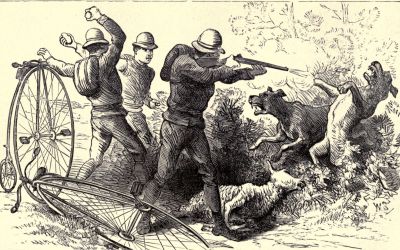
The Death of Matt Coyle's Dogs.
"This is rather ahead of my time," said Joe, who was the first to speak. "I never dreamed that domestic dogs could be so savage. Why, a couple of wild-cats or panthers couldn't have made a worse fight, nor frightened me more," he added, lifting his cap and wiping the big drops of perspiration from his forehead. "I hope this is the last of it, but I'm afraid it isn't."
Before Joe's friends had time to ask him what he meant, or to recover from the nervousness into which they had been thrown by the sudden onset of the sheep-killers, they heard a great crashing in the bushes, which were so thick on both sides of the road that one could not see any object in them at the distance of ten feet, and a heavy voice called out:
"So you've come again, have you? Three on you this time 'stead of one. All right. I'll be there directly. I'm coming jest as fast as the bresh'll let me."
"There comes the owner of these dogs," said Joe. "Now we are in for it sure."
"Who cares?" replied Roy. "If he thinks we are going to stand still and let his ferocious dogs eat us up, he don't know us; that's all."
Meanwhile the noise in the bushes grew louder, and now a tall, heavily built man forced his way out and stepped into the middle of the road.
"Come again, have you?" was the way in which he greeted the boys. "And brung two fellers with you to help. Wal, you'll need 'em all. Take me, if you want to. See!" he went on rapidly, laying his rifle upon the ground and standing erect with his arms spread out as if to show that he had no other weapon about him. "I'll put my shooting-iron outen my hands and ask you again to take me if you have come here for that purpose. I double-dare you to lay a finger on me. Come now!"
A blind man could have told by the tones of his voice that the new-comer was "as full of mad as he could hold"; so very angry in fact, that he scarcely took two looks at the boys to whom he was talking until after he had laid down his rifle and spread out his arms. When he saw that he was confronting a trio of boys, and not bearded men, he dropped his hands and gave utterance to two emphatic words; but as they were swear-words I don't repeat them.
"Who did you think we were?" inquired Joe, who saw at once that the broad-shouldered backwoodsman had make a mistake.
"I took you for jest what I thought you was—the detective that come up here on one of them two-wheeled wagons and run my pardner to earth like a woodchuck in his hole," said the man, nodding at the bicycles. "But you ain't, be you?"
"Of course we are not officers," answered Roy. "We are tourist-wheelmen traveling for pleasure."
"Oh," said the man, in a rather doubtful tone, as if he did not quite understand what the boys were, after all. Then he turned his head over his shoulder and shouted at the woods: "It is all right, boys, and you can come along without shooting. You see," he went on, as another crashing in the bushes told Joe and his friends that there were more men coming, "I seen you from my place up there on the mounting when you crossed over the brook below, and I was kinder laying for you. Understand? These here fellers are pardners of mine," he continued, as two stalwart woodsmen presented themselves to view. "They was laying back there in the bresh where they had a fair squint at you; if you'd a put a finger on to me when I dropped my rifle and told you to come on, some of you would have been deader now than them dogs you plumped over. What did you do it with? I heared something pop like a gun-cap, and over them dogs went."
Arthur Hastings handed over his rifle because he held it in plain sight, and did not think it would be prudent to do anything else. The man seemed to grow friendly as soon as he was satisfied that the boys were not detectives who had come to the mountains for the purpose of arresting him, and Arthur was afraid that if anything were done to excite his rage, he might become as savage as the dogs from whose fangs he and his chums had been saved by his good shooting.
The man took the pocket rifle with many exclamations of wonder and amusement, and while he and his "pardners" were giving it a good looking-over, Arthur and his friends improved the opportunity to take an equally close survey of the mountaineers; but there was some apprehension mingled with their curiosity, for they knew, as well as they knew anything, that they were in the presence of some of the Buster band. The first one who showed himself was Dave Daily, the leader of the band, who had been in hiding for a year or so to escape arrest.
"That's a mighty cute little trick of a gun," said the latter, when he handed back the pocket rifle. "But you wouldn't like to bet a dollar that she can beat my deer-killer at the distance of a hundred yards, would you? No, I don't reckon you would, because you would be certain sure to lose your dollar. Do you know who's talking to you?" he added, abruptly.
Joe replied that they not only knew his name, but that they had heard something about him down at Dorchester; and then he wondered why the man did not say something about the dogs that were lying in plain sight. Did they belong to him, and was he going to raise a fuss with his friend Arthur for shooting them? If he did, there would be but one way out of the scrape, and that was to pay the man every cent he chose to demand for the worthless brutes.
"I'll bet you didn't hear nothing good about us down Dorchester way," said Daily, for it was he. "But I'll tell you what is a fact: We're not the terrible chaps that some folks would try to make you think we are. So long as everybody minds their own business and lets us alone, so long do we mind our business and let other folks be. Set down a while," he added, growing communicative, "and I'll tell you jest how the fuss commenced in the first place."
There was nothing for it but to comply with this request, for Daily did not look or speak like a man who would take "no" for an answer unless he felt like it. So the boys leaned their wheels against convenient trees, seated themselves by Daily's side under the shade of another, while his two friends stretched their heavy frames upon the leaves close by, and the leader went on with his story.
"Us and our folks was raised right here in this neck of woods, we've always lived here, and we don't know no other country outside," said he. "We never had no fuss with nobody so long as we was let alone. We cultivated our little craps, shot our meat in the woods when we wanted it, ketched our trout in the brooks, sot lines through the ice for pickerel in winter, went to school when we wanted to, and were happy like the Injuns was before the white man come to this country and drove them out. First thing we knew, some fellers down in Washington, wherever that is, kicked up a war with somebody else, and sent word to our folks that they'd got to come and help fight it out. Well, they wouldn't do it, our folks wouldn't, because it wasn't their fight, they hadn't no hand in getting it up, they didn't care which one whipped, and so they said they'd stay to home. Then what does them big fellers in Washington do but send an officer of some sort up here to take down the names of all of us, except the little boys, so't they could be drafted into the army. Our folks told him he wasn't wanted here and that he'd better go home, but he wouldn't, and so they run him out and everybody like him who came here afterwards."
"In short, you resisted the draft," said Joe.
"You're right we did, and we'll do it again," said Daily, in savage tones. "Whenever we raise a fight amongst ourselves, we stick to it till one or t'other gets licked; but we don't take up outsiders' quarrels. Well, that was where the fuss commenced, and for as much as four years our folks had to keep hid in the mountings so't them drafting officers couldn't get a hold of 'em. When the war was over we thought we should have peace and be let alone like we was before; but we wasn't. Some smart Alecks, who had been elected to go to the Capital, and who had never been up here, passed a law—without once asking us, mind you—that deer shouldn't be killed at such and such times; that trout mustn't be ketched only jest when they said so; and that if we didn't give some heed to them laws, they would take us up and put us in jail. Well, they tried it, and how did they come out? Tell me that, will you?"
"At the little end of the horn," said one of the "pardners," who had thus far kept silent.
"You're right they did, Spence; at the little end of the horn," exclaimed Daily. "And that's the way everybody will come out who takes it upon himself to make laws for us. We're free Amerikin citizens and we mean to keep so. We don't ask no outsiders to make laws for us, because we can take care of ourselves. We kept right along jest as we had always been doing, shooting deer whenever we wanted the meat (violating the law they called it), and one night Zeb Harris and me was took outen our beds and slapped into the jail down at Machias. You see we didn't have no jail up here at Glen's Falls, because we never needed such a thing. We knew well enough who it was that complained of us, for our friends kept us posted; so I writ him a little letter telling him what Zeb and me allowed to do as soon as we got out. We did get out pretty quick, and somehow everything happened to him jest as we said it would. While I was in jail I writ to the papers about it, so't the folks outside could know how we had been treated and trod upon, and all my pieces was published jest as I writ 'em. Don't believe it, do you?" said Daily, thrusting his hand into an inside pocket and pulling out a greasy note-book. "I want you to understand that I can write as well as anybody, even if I haven't had much schooling, and when it comes to poetry, I don't give in to no living man on top of the broad earth. Look at that, and see if you can beat it with all your education."
As Daily said this he placed in Roy Sheldon's hands a clipping from a newspaper, with the request that he would "read her out loud so't everybody could hear it." The boy found that it was going to be a task to read it at all, for the paper had been so often and so roughly handled that in some places the words were quite obliterated. The poem, if that was the right name for the chief law-breaker's effusion, was nearly a column in length, and it required no little effort on Roy's part to make out the first two verses of it. They ran as follows:
"it was in the town of glens fals as you shal understand thair lived a crowd of young men thay was cald the buster band and thay was accused of menny a bad deed let them be gilty or not but thay hunted deer the year round and for the wardens made it hot thair was one young man among them the wardens all knew wel and by this felows rifl thair was menny a fine deer fel he hunted upon an old stream i would have you all to know and sed that that was one place the wardens dast not go"
"What was the reason the wardens dared not go there?" inquired Arthur, when Roy handed back the paper declaring that the letters were so dim he could not make sense out of the rest of it. "What were they afraid of?"
"Of me. I was up there," answered Daily, who seemed to think he had done something very brave when he concealed himself in the woods and sent word back to the settlement that he would fire upon the first officer who came along his trail to arrest him. "I tell you it wasn't healthy around where I was about that time for anybody but me and my friends. If you don't believe it, read that."
With the words another choice bit of composition was thrust into Roy's hand. It proved to be a warning to one of the recently appointed wardens that the Buster band, having "commenced the fun" by burning the house of the man who had dared to enter complaint against Dave Daily and his friend Zeb Harris, would keep it up by visiting the home of the warden if he did not at once throw up his office and let unlawful deer-hunters alone. There was still a third clipping which proved of more interest to the boys than either of the others, for it related to the detective who had come to Glen's Falls on his wheel. It was addressed to the very man whose house they had intended to make their headquarters during their stay at the Falls. It ran thus:
"Mr. Jon Homes:—if you keep that black whiskered felow with the nee britches about your house any longer you will have roast pig to and in short order we know he is a detektive be cause he has been talking with one of our boys who he thinks is a spy on us in the pay of what you call the law and order sosiation but thair ant no spies amongst our crowd i want you to understand git rid of him for if you dont you will be burnt out before a week goes by we have started the fun and we will keep it up we mean bisness git rid of him and your all rite if you dont down she comes by the time you git this we shal have taken some of your stock as proof that we mean bisiness, from a frind remember."
By the time Roy Sheldon had finished reading this precious document he and his two friends were so angry that they could scarcely refrain from telling Dave Daily what they thought of so mean and cowardly a villain as these productions of his proved him to be. Joe Wayring showed very plainly that he had had quite enough of this nonsense. He got upon his feet, brushed the leaves from his clothes, and remarked that it was high time he and his chums were moving.
"What's your hurry?" inquired Dave. "You can't find no better company than we be anywhere about the Falls. Where do you stop when you get there, seeing there ain't no hotel to put up at?"
"We're not going to put up at the Falls," replied Joe. "We shall stop there just long enough to buy a glass of milk or beg a drink of water of somebody, and then we shall take to the road for a ten-mile run before dark."
"Those dogs over there," said Roy, jerking his head toward the prostrate animals, "disputed the right of way with us, and when I tried to drive them out of the road they came at us with such fury that we had to shoot them in self-defense. I hope they don't belong to any of you?"
Roy said this, not because he cared a straw who owned the worthless curs, but for the reason that he felt some curiosity to know why Daily and his companions were so very indifferent regarding them and their fate. He had looked for a row the minute the men saw the bodies of the four-footed vagabonds; but instead of that, the woodsmen had not referred to the matter since they asked to see the weapon with which the shooting was done.
"No; the dogs don't belong to none of us nor the sheep, neither," answered Daily. "Do you see them letters on the critter's head all mixed up together? That's Holmes's mark, and them dogs or any others are welcome to kill all the sheep he's got, for all we care. We don't like him none too well, for he harbored that detective till we told him to shove him out, and he would be one of the wardens if he wasn't afraid. Matt'll be staving blind mad when he hears of it, and mebbe you'd best keep outen his way when you get started, for he'll make you pay ten times what the critters was fairly worth. He sets a heap of store by them, for he brought 'em up here for watch-dogs to tell him when there was anybody coming to his shanty."
"Did you say Matt would be mad?" asked Joe, with a strange look on his face. "Matt who? What is his other name?"
"His whole name is Matt Coyle," replied Daily.
CHAPTER XV.
MR. HOLMES'S WARNING.
This was a surprise, and for some reasons it was a most disagreeable one. Of course Joe Wayring and his chums were not sorry that their old enemy, Matt Coyle, had escaped with his life when the canvas canoe was snagged and sunk in Indian River, but they were sorry that they had stumbled upon him in this unexpected way. Beyond a doubt Matt's failure to make himself master of the six thousand dollars that had been stolen from the Irvington bank, taken in connection with the loss of all his worldly goods and the imprisonment of his wife and boys, had had an effect upon him, and if such a thing were possible, Matt hated Joe and his friends with greatly increased hatred. The fact that the boys were in no way to blame for his misfortunes would not make the least difference to Matt Coyle. His bad luck began on the very day he made the acquaintance of the Wayring family, he looked upon Joe as his evil genius, and the young wheelmen knew well enough that unless they got out of the Glen's Falls neighborhood before Matt learned they were there, they would surely find themselves in trouble of some sort.
"His whole name is Matt Coyle," repeated Daily. "He was the best guide, boatman and hunter down the Injun Lake way, but for some reason or other the rest of the men who were in that business didn't take to him, and so they clubbed together and drove him out. That wouldn't have been so very hard on Matt, for Ameriky is a tolerable big country and there's plenty of places for a guide and hunter to go; but they had to go and smash up everything he had so't he couldn't stay. They even took all his money and his rifle and clothes away from him, and turned him out to starve. He made his way up here by accident, and he's been living with us ever since. He's a good chap, and when he told me his story, I said to him that if I was in his place, I wouldn't sleep sound till every man and boy who had had a hand in mistreating me was burned outen house and home. Why, he lost six thousand dollars in hard money, Matt did; all the savings of years of honest work."
"But he knows a way to get it all back and more too," said one of Dave's partners. "We expect him home with some of the boys to-day, and when he comes we'll all be rich."
"Spence, you talk too much for a little man," said Dave, sternly. "Matt won't take it kind of you telling all his secrets. He warned us all not to say anything about it."
"Fellows, we must be going," exclaimed Joe. "I know that everything these men have to say is full of interest, but listening to stories will not take us to our journey's end. By the way, how far is the railroad from here? I mean the one that runs through Dorchester?"
"Fifteen miles, or such a matter," answered Daily. "But you couldn't never get there. The woods is so thick you couldn't take them wagons through. Your best plan is to stick to the road. Where did you say you was going to stop to-night?"
"If we stay here much longer we'll have to stop in town," replied Joe. "We don't want to do that, so we shall keep going and get as close to a level country as we can before the dark overtakes us. Good-by."
This was a moment that all the boys had been looking forward to with many misgivings. Would Daily and his men permit them to leave when they got ready? was a question that had often shaped itself in their minds, and which would now be answered in a very few seconds. To their immense relief the men who had been ready to shoot them half an hour before, showed no disposition to molest them or their property. They might be thieves and law-breakers, but they were not highwaymen. They said "So-long" very cordially, and saw the boys mount and ride away.
"Now here's a mess, or will be if we don't make the best time we know how before night comes," said Arthur, when the first turn in the road took them out of sight of Dave Daily and his friends. "I don't know when I have been more astounded than I was when that outlaw pronounced Matt Coyle's name."
"Didn't that juryman say that he believed Matt would some day turn up alive and as full of mischief as ever?" said Roy Sheldon. "And didn't we say that the Glen's Falls neighborhood would be just the place for him if he were on deck? Well, he's here. He must have had a time of it tramping all the way from Sherwin's Pond through the woods. But then I suppose he is used to such things."
"He is at home wherever night overtakes him," said Arthur. "But I shouldn't think he would stick to the woods when there were so many roads handy."
"Wouldn't he want to keep out of sight of the officers who were looking for the money he was known to have in his possession? So those six thousand dollars were the fruits of his honest toil, were they? And Matt was the best guide, boatman, and hunter in the Indian Lake country? That's news to me."
"It's news to all of us," answered Joe; "but, to my notion, there's worse behind it. Where has Matt been with those men who are going to make the Buster band rich when they return?"
"That's so," exclaimed Arthur. "Where has he? I noticed you inquired the distance to the railroad, and that made me think you were disturbed by the same suspicions I was. Do you believe Matt and his crowd were down there, and that they had anything to do with the rock we found on the track?"
"I don't know what else to think," replied Joe. "It was the way those men acted rather than what they said that aroused my suspicions. Matt has been rich once, that is to say, he has had the handling of more money than he will ever make by his own labor, and isn't it natural to suppose that when he lost it he set his wits at work to conjure up some plan to get more? A man who will do the things Matt Coyle has done and threatened, will do worse if he gets the chance. It's time that fellow was shut up. The next time he tries to wreck a train he may be successful."
This was all the boys had to say on the subject, but it was easy enough to see that they had resolved to put an officer on the squatter's track at the first opportunity. But then there was Tom Bigden, with whose doings I was by this time pretty well acquainted. Would they want him disgraced by the revelations Matt would be sure to make if he were brought before a court to be tried for his crimes? As Roy Sheldon afterward remarked, a big load would have been taken off Tom Bigden's shoulders if Matt Coyle had never been born.