THE RIJKS MUSEUM
Reading edition
THE WAY TO THE RIJKS
On taking the tramway at the Dam, the traveller will find the short trip to the Rijks Museum a very pleasant one. The car glides rapidly through a busy part of Amsterdam, crossing canal after canal,—the Singel, Heeren, Keizers, and Prinsen grachts,—bordered with leafy trees and houses that present a picturesque appearance. Alighting at Willems Park, on the canal long known as the Buiten Singel, or outer girdle, separating the old from the new town, we walk a short distance along the Stadhouders-Kade to the imposing red brick building with granite bands, arches, tympans, entablatures, etc., in the transition style between the Gothic and the Dutch Renaissance, which covers nearly three acres of ground. The principal façade, turned toward the Buiten Singel, presents a somewhat majestic appearance, with its two fine towers and central gable surmounted by a statue of Victory, by Vermeylen.
History of this Collection.—Before entering, we may note that this splendid Museum was opened in the name of the King of Holland in 1885. Perhaps we may pause also to recall the history and development of this great collection, which was formed of the remnant of the pictures and curiosities left by the last Stadtholder, William V.
In 1798 the Government decreed the formation of a National Museum, and this was installed in the Huis ten Bosch (House in the Wood), near The Hague, and opened to the public in 1800. From time to time the collection was increased by purchases, and in 1805 it received the name of Cabinet National. When the King of Holland removed his residence, however, from Utrecht to Amsterdam, in 1808, he ordered that a Royal Museum for the preservation of pictures, drawings, prints, sculpture, carvings, engraven gems, antiquities, and curiosities of all kinds should be formed.
Opening of the Royal Museum in 1808.—This Museum was opened in the Palace on the Dam in December, 1808. Here were gathered ninety-six pictures from the National Museum of 1798 (one hundred and fifty-four remaining pictures being sent to The Hague); fifty-seven pictures bought in 1808 at the sale of G. van der Pot van Groeneveld in Rotterdam; eight old pictures given by The Hague in 1808; seven old pictures lent by the city of Amsterdam (among them The Night Watch and Syndics and The Banquet of the Civil Guard); six pictures and a marble statuette by J. B. Xavery, given by Baron van Spaen de Biljoen; a few modern pictures bought at the exposition of 1808; one hundred and thirty-seven pictures forming the Van Heteren Collection, bought in 1809 for 100,000 florins; and seven pictures bought in the same year at the Bicker sale; several casts of antique statues from the Musée Napoléon of Paris; and some antiquities found chiefly in Drenthe.
Removal to the Trippenhuis.—In 1810 the name was changed from the "Royal Museum" to the "Dutch Museum," and in 1814 the collections were transferred to the Trippenhuis, where they remained until 1885.
Numerous Additions from 1825 to 1885.—In 1825 some pictures were exchanged with the Royal Museum at The Hague (Mauritshuis); and in 1828 some duplicates were sold for 23,701 florins, with which sum other pictures were purchased. In 1828 William I. made a present of some pictures he had acquired at the Brentano and Muller sales to the State Museum, as it was now called.
In 1838 many of the modern pictures were transferred to the Paviljoen Welgelegen, which became, therefore, a gallery of the works of living painters of the Netherlands; and this collection was gradually enriched by gifts and purchases. In 1885 the one hundred and eighty-four pictures of this collection were sent to the Rijks.
Bequests.—The principal bequests have been as follows: Madame la Ve Balguerie Van Rijswijck, twenty-two family portraits (1823); M. L. Dupper, Wz., sixty-four superb pictures (1870); Mlle. J. E. Liotard, an enamel of great value, and fifteen pastels by the Genevese painter, J. E. Liotard, to which Mme. Liotard sent six other pastels by the same artist in 1885 (1873); Jhr. Me. J. de Witte van Citters some objects of art, curios, prints, and thirty-five family portraits (1875); Mme. J. J. van Winter Bicker, forty-four portraits of the Bicker family (1879); Jhr. J. S. H. van de Poll, fifty-two pictures of great value (1880); and a gift of Jhr. J. S. R. van de Poll, comprising thirty-five family portraits.
Two Important Collections added.—Two important collections have yet to be mentioned: the famous Van der Hoop Collection and The Collection of Contemporary Art. The former was gathered by M. Adriaan van der Hoop, head of the house of Hope & Co., and knight of several orders, who made a magnificent collection of about two hundred and twenty-four ancient and modern pictures. These he left to the city of Amsterdam in 1854. It was lodged in the Académie des Beaux Arts until removed to the Rijks in 1885. In 1880 Mme. Van der Hoop left twenty-four more pictures, which had adorned her house, to complete the gift. The Collection of Contemporary Art is the work of an association of Amsterdam art-lovers founded in 1875.
The Staircase and the Rembrandt Room.—Before ascending the stairs guarded by two lions couchant, we may stop to notice a picture by Pieter Cornelisz van Rijck (1568-16—), representing an old Dutch kitchen with all sorts of eatables, and in the background a feast representing the parable of the Rich Man and Lazarus. This staircase leads to the Entrance Hall, from which we go to the Grand Gallery, which leads directly into the famous Rembrandt Room, in which The Night Watch holds the place of honor. The Grand Gallery is bordered on each side by four compartments, or cabinets, hung with pictures of the seventeenth century.
A Tour through the Rooms.—To the left of the Rembrandt Room is the Carlovingian Room; and from this we pass into International Hall, where pictures of foreign masters are gathered. In the next room are assembled the oldest pictures of the Dutch School. The next room contains masters of the sixteenth century, and next to it comes Dupper Hall, devoted to the glorious period of Dutch art, the seventeenth century. Here are sixty-four paintings, many of which are masterpieces. Next comes Van der Poll Hall with fifty-two pictures, then the Hall of Anatomy Pictures, and next Portrait Hall. From this we visit the five cabinets, containing such pictures of the Old Dutch School as from their small dimensions and minute finish are best seen in small rooms. On the opposite side of the vestibule are five similar cabinets with similar pictures. Beyond these is Pavilion Hall, containing portraits, many of which are painters' portraits of themselves. Then come the Van der Hoop Museum and two galleries of modern pictures, one of which is called Waterloo Hall, because of The Battle of Waterloo, by J. W. Pieneman, hanging there. From this we enter the Old Dutch Governors' Room, representing a typical room of the seventeenth century with allegorical ceiling, tapestries, and old furniture. From this we pass into the adjoining Gold Leather Room, where there is a picture representing a marriage party, and a collection of drinking vessels of the seventeenth and eighteenth centuries in one of the cupboards. The Dutch Governors' Room leads into the Rembrandt Room, which again leads us into the Grand Gallery, our starting point.
Rembrandt's Work in his Middle and Last Periods.—We have seen in The Hague the great works of Rembrandt's early period; in the Rijks we find the full flowering of his genius in his middle and last periods. The Night Watch was painted in 1642; the Portrait of Elizabeth Bas, about 1645; the fragment of the Anatomy picture, representing Dr. Deyman, in 1656; The Syndics, in 1661; and The Jewish Bride, or Ruth and Boaz, about 1663. The Rijks owns two other pictures: a mythological composition and the head of his father, painted in Leyden in 1630.
Description of The Night Watch.—Let us look carefully at The Night Watch, Rembrandt's most famous picture and also his largest (11 feet by 14). It was painted in 1642, ten years after the Lesson in Anatomy, for the Kloveniers Doele (Arquebusiers Shooting Company).
The great Sortie of the Banning Cock Company, which is the more correct name for The Night Watch, represents twenty-nine life-sized civic guards issuing from their guardhouse in a great state of bustle and confusion, while the drums beat and the dog barks. The dominant color is the citron-yellow uniform of the lieutenant, wearing a blue sash, while a Titian-like red dress of a musketeer, the black velvet dress of the captain, and the varied green of the girl and the drummer, all produce a rich and harmonious effect. The background has become dark and heavy by accident or neglect, and the scutcheon on which the names are painted is scarcely to be seen.[23]
In the middle, in front, marches the captain in a dark brown, almost black, costume, at his side Lieutenant Willem van Ruitenberg, in a yellow buffalo jerkin, both figures in the full sunlight, so that the shadow of the captain's hand is distinctly traceable on the jerkin. On the right hand of the captain are an arquebusier loading his weapon, and two children, of whom the one in front, a girl, has a dead cock hanging from her girdle (perhaps one of the prizes). On a step behind them is the flag-bearer, Jan Visser Cornelissen. The other side of the picture is pervaded with similar life and spirit, from the lieutenant to the drummer, Jan van Kamboort, at the extreme corner, who energetically beats his drum. In an oval frame on a column in the background are inscribed the names of the members of the guild.
The Night Watch a Misnomer.—The remarkable chiaroscuro of the whole picture (seen to greatest advantage in the afternoon) has led to the belief that Rembrandt intended to depict a nocturnal scene; but the event represented really takes place in daylight, the lofty vaulted hall of the guild being lighted only by windows above, to the left, not visible to the spectator, and being therefore properly obscured in partial twilight. The peculiar light and the spirited action of the picture elevate this group of portraits into a most effective dramatic scene, which ever since its creation has been enthusiastically admired by all connoisseurs of art. Each guild member represented paid 100 florins for his portrait, so that, as there were originally sixteen in the group, the painter received 1,600 florins for his work. The painting was successfully cleaned by Hopman in 1889.
The picture is so deeply enveloped in shadow that it is some time before the spectator can see figures emerge, although they always retain something of a supernatural quality, derived partly from the phosphorescent gleams that here and there illuminate faces, figures, drum, halberds, flag-pole, and lances.
The Mutilation of the Picture.—When The Night Watch was removed from the Kloveniers Doele to the small military council chamber of the Town Hall on the Dam, in 1715, portions of it were cut off on the right and left and at the bottom, which has greatly interfered with its appearance. A photograph of an old drawing hangs near the picture, which shows the (supposed) original form of the composition.
The Syndics.—Some critics consider The Syndics Rembrandt's greatest achievement; and all are agreed that it is one of the finest groups of portraits ever painted. This work, finished in 1662—twenty years after The Night Watch—was ordered by the Guild of Clothmakers, who wished to have a portrait group of their Syndics to hang in their chamber at the Staalhof (sample hall) in the Staalstraat in Amsterdam.
Rembrandt's Special Traits exhibited in this Picture.—Here Rembrandt's special traits are exhibited: his wonderful treatment of light, his grouping of figures, and his study of character. The five Syndics, all dressed alike in black with flat white collars and broad-brimmed-high-crowned hats, are grouped around a table verifying their accounts. The yellow oak wainscot behind them and the scarlet table-cloth contribute the only color to the sombre group.
Six canvases of portraits of Syndics formerly hung in the Staalhof, the oldest of which was painted in 1559. Only two now remain: the one by Rembrandt, and another, also in the Rijks, by Aert Pietersen, painted in 1599. Upon the frame of the latter is a Dutch inscription, which, translated, reads:
"Consider your oath In what you know. Live uprightly. Through favor or hatred Or self-interest Don't give an opinion."
Rembrandt's five Dutch gentlemen look as if they had closely followed this excellent moral advice.
Description of The Jewish Bride.—The Jewish Bride depicts two life-size figures, standing and seen to the knees, one a young woman dressed in a red gown with white sleeves and white cape. Her complexion is rosy, and she has an abundance of brown hair. She is simply covered with jewels,—a comb, earrings, collar, large chain, bracelets, rings of pearls, and sparkling gems. Her face is tranquil and radiant. Her gallant companion is about to embrace her, his face full of tenderness. He wears a long wig with curls falling over his shoulders and has no beard; this was the fashion after 1660. He has a large black cap on his head, and his pourpoint, mantle, and wide and embroidered sleeves are yellow. The head of the man is very highly finished, slightly recalling in manner those in The Syndics; but his clothing is somewhat hastily done. The picture is unfinished, but in the dark fantastic background some architecture with foliage and a vase of flowers suggesting a park may be discerned to the left; also the vague form of a dog. On the right, there are some shrubs and a wall. Burger thinks this was painted in 1669, the last year of Rembrandt's life. The canvas is about five feet long and four feet high.
The Celebrated Portrait of Elizabeth Bas.—The portrait of Elizabeth Bas, the widow of Lieutenant Admiral Joachim Swartenhout, painted in 1642, is considered one of Rembrandt's most celebrated portraits. Seated in an easy chair and wearing a rich dress profusely ornamented with buttons, the stern, commanding face of the old lady looks directly at the spectator. Her marvellously painted hands are folded over a handkerchief, and she wears a cap and a fluted ruff.
Two other portraits by Rembrandt can be seen here: one, of a lady; and the other, of his father (a copy).
Multiplicity of Portraits in the Rijks.—In the Rijks Gallery portraits, either single or groups, outnumber all other branches of art. Some of these have a world-wide reputation, while others are interesting only to the special student. No less famous than Rembrandt's Elizabeth Bas is that of another old lady, Maria Voogt, Madame van der Meer, painted by Frans Hals in 1639, which hangs in the Van der Hoop Room.
"An old woman is seated in an arm-chair almost full face and of natural size. She is dressed in black velvet, with a white ruff. Her right hand holds a book with a silver clasp, the left hand rests on the arm of the chair. The tone is neutral. A superb portrait of the first order. You read above the coat-of-arms Ætatis suæ 64. Ao 1639."[24]
Hals's Portrait of Himself and his Wife.—Hals's portrait of himself and his wife, Lysbeth Reyniers, represents the couple as life-size and seated in a rather uncomfortable position on a bank under the trees, in a garden ornamented with statues and fountains. In the distance a peacock struts; and the scene is so cheerful that the smiling faces of Hals and his wife are quite explicable. The latter's ruff is of enormous size and marvellously painted.
Hals's The Jester.—Hals always loved to render the face in action, to fix forever a rapid fleeting expression; and one of his most notable achievements is the famous Jester owned by Baron Rothschild in Paris. As few art lovers can ever have the chance of seeing this masterpiece, the admirable copy that hangs in the Rijks, said to have been made by Dirck Hals, should be carefully examined. The canvas is variously known as The Jester, The Fool, The Mandolin Player, and The Lute Player; and is said to be a portrait of the artist's pupil, Adriaen Brouwer; but whoever he is, he is a rascally, impudent fellow with a mocking, cynical smile, and belongs to the same class as Touchstone, Dogberry, Launcelot Gobbo, and other of our prized and disreputable Shakespearian acquaintances. Hals's Jester is a creation. Look at the vagabond well, first because he will soon twang the chords of his lute, break out into a song of the day, then doff his cap and beg for money. Look at the pose of his left hand and the strong, flexible thumb. He can play. Next look at the artist's work and note the broad sweeps of the brush that so simply but surely create the features and expression.
A Jolly Man is another of Hals's pictures that may be classed as portraits, a splendid piece of work. Go closely up to the picture and notice how the broad brush strokes are made.
MOREELSE The Little Princess
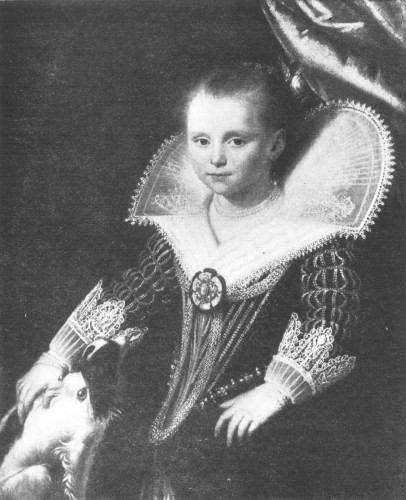
Moreelse's The Little Princess.—A very charming portrait is that of The Little Princess by Moreelse. The child looks somewhat demurely at the spectator, with large brown eyes. Her face is round, her forehead high, and her light brown hair, brushed severely from her face, is ornamented with a pink rose held in place by a jewelled band. Her large earrings are coral and pearl. A necklace and bracelets of three rows of handsome pearls adorn her neck and wrists, and a brooch containing a miniature set with jewels fastens the rosette at the point of her collar. Her dress is of dark green velvet embroidered with gold and fastened by rich girdles and chains. Marvellously indeed has the artist executed the lace and transparent lawn of which the "butterfly" ruff and dainty cuffs are made. The little right hand rests lovingly on the head of a King Charles spaniel, whose neck is adorned with bells. An old rose curtain gives a charming note of color to the background.
Moreelse's Great Success as a Portrait-painter.—Paulus Moreelse (1571-1638), a native of Utrecht and a pupil and follower of Mierevelt in Delft, became so successful as a portrait-painter that all the great ladies desired to sit to him. He visited Rome in 1604, and on his return painted for a time historical and architectural subjects. He was also a capable engraver and architect.
Other Portraits by Moreelse.—In addition to The Little Princess, we may see in this gallery a very fine portrait of Maria van Utrecht, wife of Joan van Oldenbarnevelt, at the age of sixty-three (1615); also a Portrait of Himself; one of A Woman; another of Frederick V., King of Bohemia; another of Colonel Wtenhoghe; and The Beautiful Shepherdess, dated 1630, with flowers and a veil on her head, yellow draperies, and a rake in her hand. This picture was purchased for 2,150 florins in 1817. In all probability it is a portrait.
MIEREVELT Prince Maurits of Nassau
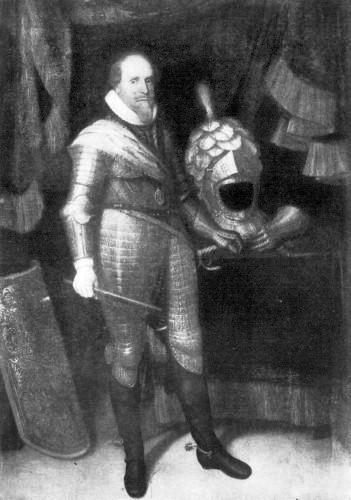
Mierevelt, a Popular Portrait-painter.—Michael Mierevelt (1567-1641), the son of a goldsmith and pupil of Anthony van Montfoort at Utrecht, attained notoriety by his portraits of some of the princes of the House of Nassau. From that time he was never without orders; and he is supposed to have painted a greater number of portraits than any other artist of his country. Mierevelt spent most of his life in Delft. The Rijks contains a great number of his works, among which are: portraits of Jacob Cats; Johan v. Oldenbarnevelt; F. Hendrik; Philips Willem, Prince of Orange; Prince Maurits; Johannes Uitenbogaert; Frederick V., Elector of the Palatinate; Lubbert Gerritz; Paulus van Beresteyn; Volckera Nicolai; Henrick Hooft, and of Aegje Hasselaer, wife of Henrick Hooft.
Portraits by Honthorst.—The student of history and lover of portraits will be attracted by the following Honthorsts: Frederick Wilhelm, Elector of Brandenburg, and his wife, Louise Henriette of Orange; William II., Prince of Orange; William II. with his wife, Princess Maria Stuart of England; Frederik Hendrik; Amalia v. Solms; and the Princes of Orange, William I., Maurits, Frederik Hendrik, William II., and William III.
Portraits by Van der Helst.—By Van der Helst there are portraits of Maria Stuart, Princess Royal of England, widow of William II., Prince of Orange; Portrait of a Warrior; and Portraits of Andries Bicker, Burgomaster of Amsterdam (1586-1652); and Gerard A. Bicker (1623-66).
Rubens's Portrait of Helena Fourment.—Rubens's portrait of Helena Fourment shows his second wife, in a different mood and costume from the one in the Mauritshuis. Here she is represented full face, with hair curled in tufts, a satin bodice, high fan-shaped ruff spreading behind the head, throat half bare, with necklace and many jewels. He has also a portrait of Anna Maria, wife of Louis XIII. of France.
Portraits by Van Dijck.—Van Dijck is represented by a Portrait of William II., Prince of Orange, and his Betrothed, Mary Stuart, painted in 1641; a Portrait of a Man; and one of Johannes Baptist Franck, a young man of twenty-eight, with light hair, pointed beard, and moustache, and wearing a black cloak draped in graceful folds. This was once in Lucien Bonaparte's collection.
Portraits by T. de Keijser.—A few examples of Theodor de Keijser, though of small dimensions, rank among the best specimens of this painter.
Change of Fashion in Portrait-painting exemplified by Maes.—Maes, more familiar by his genre, has no less than eight portraits here, besides a large corporation picture representing the Chiefs of the Corporation of Surgeons of Amsterdam, 1680-81. The great difference in style and quality between the early and late portraits of this master has led many to believe that they are the work of more than one master. The change is attributed to his visit to Antwerp; but it has been pointed out that the fashion was changing everywhere, including Amsterdam, where even Rembrandt during the closing years of his life was despised and neglected by the fashionable public. Maes, on the other hand, made concessions to the vulgar taste; and, for a quarter of a century, produced an enormous quantity of secondary or mediocre portraits, in which all trace of his master's qualities was lost.
Artists' Portraits of Themselves.—Though not so great in the line of painters' portraits of themselves as the Uffizi, the Rijks possesses a good number of men who thought they saw themselves as others saw them, or at any rate, as they wished posterity to know them. Among these are Jan Steen, Gerrit Dou, Ferdinand Bol, Honthorst, Ter Borch, and L. Bakhuysen.
A fine portrait by Bol of the famous sculptor Artus Quellin; a Male Portrait by Dou; one of Amalia v. Solms by Flinck; and the Portrait of an Architect with his Wife and Child, by Bernhart Fabritius, deserve notice.
Van der Helst, a Great Portrait-painter.—Bartholomew van der Helst (1613-70) was considered the greatest portrait-painter of his time, and received more money for his portraits than any other Dutch painter; yet, notwithstanding his industry and the money that he received, he died poor. He is thought to have been a pupil of Nicholas Eliasz Pickenoy at Amsterdam, where he fell under the influence of Rembrandt.
Description of The Civic Guard Banquet.—Bartholomew van der Helst's great work, The Schuttersmaaltijd (Civic Guard Banquet), held June 18, 1648, in the upper hall of the Cross-bow, or St. George Company House, at the Singel, in celebration of the Peace of Münster, always fascinates.
The twenty-five figures are all portraits. At the head of the table Captain Wits is seated in a chair of black oak with a velvet cushion. He is dressed in black velvet, his breast covered with a cuirass, and on his head is a broad-brimmed black hat with white plumes. His left hand, supported on his knee, holds a magnificent silver drinking-horn ornamented with a St. George and the Dragon,—which valuable piece of silver, by the way, is on permanent exhibition with other beakers and drinking-horns of the old guilds in the Rijks. The good-humored Captain is cordially grasping the hand of Lieutenant Van Waveren, who wears a handsome pearl-gray doublet richly brocaded with gold, and lace collar and cuffs. His feet are crossed, and he wears boots of yellow leather with large tops and gold spurs. His hat is black, with dark brown plumes. Behind him, in the centre of the picture, is the standard-bearer, Jacob Banning, in easy, martial attitude, hat in hand, his right hand on his chair, his right leg on his left knee. He holds the flag of blue silk, on which the Virgin is embroidered. The banner covers his shoulder, and he looks out toward the spectator frankly and complacently. The man behind him is probably a sergeant. He wears a cuirass, yellow gloves, gray stockings, and boots with large tops and kneecaps of cloth. On his knee is a napkin, and in his hands a piece of ham, a slice of bread, and a knife. The old man behind him is thought to be William the Drummer. In one hand he holds his hat, and in the other a gold-footed wineglass filled with the most marvellously painted white wine. He wears a black satin doublet slashed with yellow silk, and a red sash. Behind him are two matchlock men seated at the end of a table. One, with a napkin on his knee, is eating with his knife; the other holds a long glass of white wine, also a marvel of the painter's skill. Four musketeers, with differently shaped hats, stand behind; one holds a glass, the others have their guns on their shoulders. Between the standard-bearer and the Captain several guests are placed: one is carving a fowl; another, with his hat off and hand uplifted, is talking to his neighbor; a third is filling a cup from a silver flagon; and a fourth holds a silver plate. Behind the Captain are two other figures, one of whom is peeling an orange. Two others with halberts are standing, and one holds a plumed hat. Between Banning and the Captain there are three others, one of whom holds a pewter pot, engraved with the name Pocock, the landlord of the Hotel Doele. At the back a maidservant is bringing in a pasty on which rests a turkey. The façades of two houses are seen through the panes of the window in the background. In the left-hand corner stands a very handsome wine-cooler.
Reynolds's Opinion of this Picture.—"The best picture in this house is painted by Van der Helst. It represents a company of trained bands, about thirty figures, whole-length, among which the Spanish Ambassador is introduced shaking hands with one of the principal figures. This is perhaps the first picture of portraits in the world, comprehending more of those qualities which make a perfect portrait than any other I have ever seen: they are correctly drawn, both head and figures, and well colored; and have great variety of action, characters, and countenances, and those so lively and truly expressing what they are about, that the spectator has nothing to wish for. Of this picture I had before heard great commendations; but it far exceeded my expectations." ...
A Portrait Group by Rembrandt, and another by Van der Helst.—"A Frieze over one of the doors in chiaroscuro by De Witt, is not only one of the best deceptions I have seen, but the boys are well drawn; the ceiling and side of the room are likewise by him, but a poor performance. The academy of painting is a part of this immense building: in it are two admirable pictures, composed entirely of portraits,—one by Rembrandt, and the other by Bartholomew van der Helst. That of Rembrandt contains six men dressed in black; one of them, who has a book before him, appears to have been reading a lecture; the top of the table not seen. The heads are finely painted, but not superior to those of his neighbor. The subject of Van der Helst is the Society of Archers bestowing a premium: they appear to be investing some person with an order. The date on this is 1657; on the Rembrandt 1661."
Van der Helst's Masterpiece.—Captain Roelof Bicker's Company, painted in 1639, has been termed Van der Helst's masterpiece. It is the largest picture of its class in the gallery and contains thirty-two figures. Captain Bicker and Lieutenant Jan Blaeu have brought their men from their headquarters, and are welcoming a new ensign before the Brewery de Haen (the Cock) on the corner of the Lastaadje (Geldersche Kade and Bloomsloot), in 1639. The picture is remarkable for its wonderful display of color and the vitality that every figure possesses.
B. VAN DER HELST Company of Captain R. Bicker
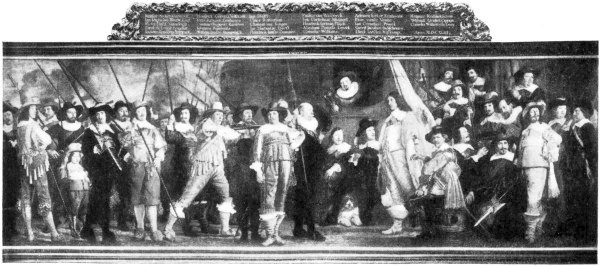
Regent, Doelen, and Corporation Pictures.—In every gallery in Holland the traveller will come across the life-size groups known as "Regent," "Doelen," and "Corporation" pictures. These are always portraits of members of shooting, charitable, and medical civic societies and guilds of merchants, and were painted at the order of these various companies to hang in their guild halls, shooting galleries (doelen), and hospitals. Rembrandt, Frans Hals, and Bartholomew van der Helst brought these pictures to their highest expression and made of them artistic compositions. Hals's great works of this class are in Haarlem; but the Rijks owns, as we have seen, the celebrated Night Watch and The Syndics, and B. Van der Helst's masterpieces, Schuttersmaaltijd and Company of Captain Roelof Bicker.
Similar Pictures by Govert Flinck.—Next in importance are the works of Govert Flinck (1615-60), a pupil and close imitator of Rembrandt, who devoted his energies to portraits and historical and religious subjects. Three "Corporation" or "Doelen" pictures by his hand hang in this gallery; also Isaac Blessing Jacob, dated 1638; and three portraits, including one of J. van den Vondel, who thought so highly of Flinck that he compared him to the Greek Apelles.
His Greatest Work.—His most important "Corporation" picture depicts the same scene as Van der Helst's. This, called Arquebusiers of Amsterdam at a Banquet Celebrating the Signing of the Peace of Münster in 1648, is considered this artist's greatest work; it is particularly interesting from the fact that it contains a portrait of the painter himself standing in the doorway. This picture is in two groups: on the left, nine men are coming from the St. Jorisdoele, led by Captain Jan Huidecoper van Maarseveen, dressed in black velvet, with a blue sash; and the other group, consisting of eleven figures, is led by Lieutenant Frans van Waveren, also dressed in black velvet with a blue sash, who is congratulating the Captain.
The two other "Regent" pictures are: Four Chief Masters of the Arquebusiers' Shooting Company and The Company of Captain Bas and Lieutenant Conyn.
Bol's Pictures of this Class.—Burger, however, when looking at Ferdinand Bol's pictures of this class in the Rijks, especially The Regents of the Leprozenhuis in Amsterdam, and its companion The Lady Patronesses of the Leprozenhuis, placed the artist second to none but Rembrandt, and even the superior of B. van der Helst.
Description of the First of These.—The first picture (8 by 6 feet) represents the Regents of the establishment, among whom are the Burgomaster Hofdt and the Receiver of Amsterdam, Pieter van Uitenbogaard, Rembrandt's friend. All are dressed in black, with large hats, and are seated around a table covered with a Persian carpet. The custos is bringing before them a little bare-headed leper. The figures are life-size, and "have the distinction of Van Dijck's personages," writes Burger, "and the solidity and depth of Rembrandt's."
Dujardin's Regents of the House of Correction.—Karel Dujardin's Regents of the House of Correction in Amsterdam, painted in 1669, is another remarkable work and very unusual in style for this artist. The canvas is no less than 12 feet 8 inches by 7 feet 8 inches, and represents the five Regents. Of natural size, these are grouped around a table with a violet velvet cover. (Violet, it may be noted, was Karel Dujardin's favorite color.) One of the Regents, his body turned to the left and his head three-quarters, is seated in front, with his right hand on the table; he holds a paper with a coat-of-arms dated February, 1669, and signed "Medelman"; his left hand rests on his hip. Another holds out his hand to a servant, who is bringing him a paper. One only is standing. All are dressed in black, with large black hats and white neckbands. Some white marble columns in the style of G. de Lairesse are seen in the background, where a servant with her hands crossed over her waist is entering the open door and turning her head to listen to a young man. Heads, hands, faces, and costumes are all remarkably depicted.
Other Pictures of the Same Class.—Before dismissing the Corporation pictures we may mention J. van Sandrart's Captain van Swieten's Company Preparing to Escort Queen Dowager Marie de Médici, painted in 1638, and considered the artist's chief work; P. Moreelse's Amsterdam Arquebusiers; N. Elias's Banquet of Captain J. Backer's Company; B. van der Helst's Presidents of the Voetboog-doelen and Presidents of the Handboog-doelen.
One of the earliest pictures of this class is Cornelis Teunissen's Banquet of the Civic Guards of the Cross-bow Company, painted in Amsterdam in 1533. Another by the same artist, Guards of the Cloveniers-doelen, was painted in 1557. A still earlier one, Dirck Jacobsz's Civic Guards of the Cloveniers-doelen, was painted in 1529. This artist is also represented by Civic Guards of the Arquebusiers, which hangs near Dirck Barentsz's Civic Guards and Civic Guards of the Cross-bow Company. A number of Regent pictures also hang in the Hall of Anatomy Pictures, including Lessons in Anatomy, by Thomas de Keijser, Nicolaes Elias, Dr. J. Deyment, and Rembrandt (the latter a fragment). It is unlikely, however, that the visitor will care to linger in this lugubrious hall.
The Portrait Hall.—We now pass into the Portrait Hall, which contains two portrait collections, consisting of portraits bequeathed by the Bicker family of Amsterdam, and twenty-six pictures purchased in 1895 from the descendants of the great Admiral de Ruyter. Here we again find a number of Corporation and Regent pictures, chief among which is Rembrandt's Syndics of the Guild of Clothmakers, which has been described.
Abundance of Dutch Landscapes in the Rijks.—The Rijks is rich in landscapes of every period of Dutch art. Ruisdael is particularly well represented. His pictures are The Torrent, Château de Bentheim, Winter, The Forest, View of Haarlem, Landscape, Wooded Landscape, Landscape in Norway, and View of the Rhine near Wijk bij Duurstede.
Description of Ruisdael's View of the Rhine near Duurstede.—Burger thought that the picture of the banks of the Rhine taken from Wijk near Duurstede deserved to be placed by the side of the superb Tempest in the Louvre; for it has "the same original grandeur of execution and the same depth of sentiment." This is almost a marine. The water occupies almost all the left foreground, where you note a sail-boat. A large boat, the masts of which you see only, has taken refuge in the little bay in the centre. On the right, upon a tongue of land that juts out and is bordered by piles, stands a windmill; behind this is a house, and on the horizon a steeple. A little to the left of the mill and far distant is a castle with turrets. On the road that leads to the mill come three peasant women in white aprons. One wears a white head-dress; the two others have yellow ones. You can also distinguish some other tiny figures by the little bay where the boat lies. The incomparable sky is gray, and the clouds are of the same hue.
Burger on the Same Picture.—"Earth, water, sky, all are so beautifully combined in a harmony so strong and dominating, so simple and magnificent, that you are impressed with that strange—almost terrible—effect produced, and you can't tell why. Indeed, there is only a large mill with a round, tower-like base in the ordinary fashion of the country, and three women who are returning to the village. There is nothing to excite the imagination. Yet, notwithstanding, you are filled with an irresistible melancholy. The character and nature of the people are so strongly marked that you are taken out of yourself and transported by the force of the artist's heart and creation."
Another picture represents a mill with its wheel in the water; and on the right some wood-cutters at work. This is a strong picture, but a little sombre.
Burger on The Cascade.—"The Cascade [6 feet long by 4 feet high] seems to have been composed with various elements of Nature herself. The water bounds and foams in the foreground and over the entire canvas. Above this great torrent on the right are tall trees, beneath which are four little figures; and on the left, a clump of shrubs, in the shadows of which a flock of sheep is passing by the brook. In the background, behind the meadows, a belfry is seen on the horizon. It is very rich, very vigorous, very beautiful."
Influence of Everdingen.—The Norwegian Landscape (about five feet long) is also a large picture. Here the cascade tumbles over little rocks, and on the right are rocks, trees, a house, and one tall, isolated tree. This is cleverly painted, but the composition is not happy. The true accents of nature are lacking; for it is certain that Ruisdael never was in Norway, and that he devoted himself to cascades and rocks on account of his intimacy with Van Everdingen, whose bold landscapes, so different from Holland, surprised and delighted the Dutch. Everdingen had suffered shipwreck in Norway, and had been greatly taken with its bold, savage scenery. His favorite subject was a waterfall in a glen with sombre fringes of pines mingled with birch, and log huts at the base of rocks and craggy slopes. The prevalence of falling water in his pictures, when others could paint only the monotonous Dutch lowlands, gained for him the name "Inventor of Cascades."
Salomon Ruisdael (?-1670) has two fine landscapes, The Halt, dated 1660, and The Village Inn, dated 1655.
Description of Hobbema's Water Mill.—Hobbema is represented by two Water Mills and a Landscape. The picture in the Van der Hoop Collection shows a wooden mill with red-tiled roof in the centre of the picture; and behind it a background of tall trees. Hollowed-out-tree-trunks supported by boards carry the water to the mill wheel, over which it falls. The foreground is occupied with water in which ducks are swimming. In the shadows of the door of the house, a tiny figure of a man appears; and a small figure of a woman in bright red bodice, upon which the sunlight falls, is busy washing clothes in a copper. On the right, an old peasant in brown is holding by the hand a little boy who wears a red cap. The Landscape is diversified with trees and thickets. The sky is full of clouds, between which the rays of sunlight issue to gild the verdure. Delicate tones of olive and gray distinguish this beautiful picture.
HOBBEMA The Water Mill
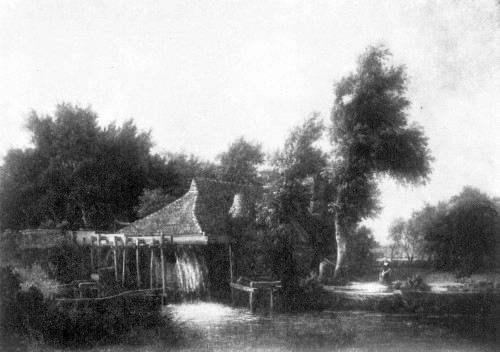
Description of Hobbema's Landscape.—In the Landscape, which by some is thought superior to the Water Mill, a house and barn are seen on the right; two small figures are in front of the house, a man in black, standing, and a woman in red, bending over; and there are a group of trees, a large elm, and a hedge. All this is beautifully reflected in a sheet of water in the foreground,—a reflection that seems to tremble. This picture is only one foot five inches long by one foot high.
Hobbema and his most Frequent Scenes.—Meyndert Hobbema (1638-1709), supposed to have been a pupil of Jacob Ruisdael, or of Jacob's brother Salomon, was long neglected, and died in penury. He is now regarded second to none but Ruisdael and his works are worth their weight in gold. His most frequent scenes are villages surrounded by trees, such as are frequently met with in Guelderland, with winding pathways leading from house to house. A water mill occasionally forms a prominent feature,—so prominent, indeed, as to give its name to the picture. Again, he paints a slightly uneven country diversified by trees in groups or rows, wheat fields, meadows, and small pools; occasionally a view of a town with gates, or canals with sluices and quays; and more rarely the ruins of an old castle or a stately residence in the far distance.
Hobbema, a Master of the Still Life of Woods and Waters.—"It is doubtful whether any one ever mastered so completely as he did the still life of woods and hedges, or mills and pools. Nor can we believe that he obtained this mastery otherwise than by constantly dwelling in the same neighborhood, say in Guelders or on the Dutch Westphalian border, where day after day he might study the branching and foliage of trees and underwood embowering cottages and mills, under every variety of light, in every shade of transparency, in all changes produced by the season. Though his landscapes are severely and moderately toned, generally in an olive key, and often attuned to a puritanical gray or russet, they surprise us, not only by the variety of their leafage, but by the finish of their detail as well as the boldness of their touch. With astonishing subtlety light is shown penetrating cloud, and illuminating—sometimes transiently, sometimes steadily—different portions of the ground, shining through leaves upon other leaves, and multiplying in an endless way the transparency of the picture. If the chance be given him he mirrors all these things in the still pool near a cottage, the reaches of a sluggish river, or the swirl of a stream that feeds a busy mill. The same spot will furnish him with several pictures. One mill gives him repeated opportunity of charming our eye. And this wonderful artist, who is only second to Ruisdael because he had not Ruisdael's versatility and did not extend his study equally to downs and rocky eminences or torrents and estuaries,—this is the man who lived penuriously, died poor, and left no trace in the artistic annals of his country. It has been said that Hobbema did not paint his own figures, but transferred that duty to Adriaen van de Velde, Lingelbach, Barent Gael, and Abraham Storck. As to this, much is conjecture."[25]
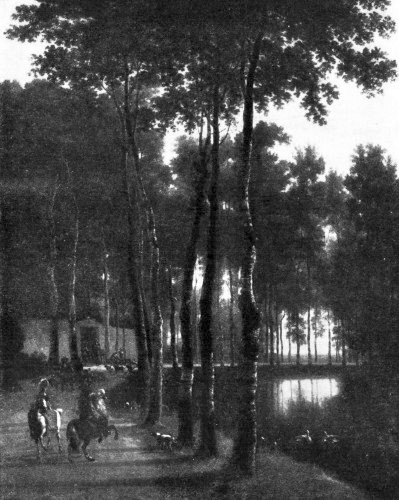
Hackaert's Pictures.—Jan Hackaert is perfect when he is simple and inspired by the character and style of his own country. The Rijks owns his beautiful Avenue of Ash-trees; a Clearing in the Forest; a Landscape with Cattle; and a Landscape, which is full of light and delicacy, and recalls the manner of Wijnants, although the arrangement follows the pseudo-Italians.
Hackaert's Avenue of Ash-trees.—The Avenue of Ash-trees is a charming picture, representing a park from which a hunting-party is about to set forth in the early morning. The light shines on the trunks of the trees that border the park, to the right of which is a large sheet of water. Huntsmen accompanied by dogs, one of which is barking at two swans in the pool, ladies and gentlemen on horseback, servants, and dogs, all issue forth with good wishes from the master of the château at the gate. All of these elegantly painted little figures are the work of A. van de Velde.
JAN HACKAERT Avenue of Ash-trees
Joos van Winghen.—Joos van Winghen (1544-1603) travelled to Rome, where he lived for four years; and, on his return, was appointed Court Painter to the Prince of Parma. He painted portraits, interiors, and Biblical subjects. A Banquet and Masquerade at Night is one of his best-known pictures.
Pieter Aertsen.—This artist has a picture called The Egg Dance, which claims attention by its life and spirit.
Jan Lijs.—Jan Lijs (d. 1629) was a pupil of Goltzius; and then visited France and Italy, where he executed large works under Caravaggio's influence. His Music Party is signed and dated 1625; and therefore belongs to his last and not his first period, as the catalogue informs us.
Pieter van Rijck.—Pieter Cornelisz van Rijck (1568-1628) painted interiors, especially kitchens, and landscape. He was a pupil of H. Jacobs Grimani, whom he accompanied to Italy; he remained there fifteen years. The big picture in the Rijks representing a kitchen interior was described in enthusiastic terms by Van Mander.
Willem Duyster.—Willem Cornelisz Duyster (1599-1635) was a pupil of Pieter Codde. His picture of Backgammon Players is matched by a similar subject in St. Petersburg, and another in Dresden. Another picture in the Rijks, variously attributed to J. v. Bijlert, Jan Lijs, P. Codde, Jan Miense Molenaer and others, has by recent discoveries been finally recognized as the work of Duyster. The subject is The Marriage of Adriaen Ploos van Amstel, Lord of Oudegein and Tienhoven, to Agnes van Bijler, widow Broekhuysen. A contemporary of whom little is known, Abraham van der Hecken (fl. 1650), has a Butcher's Shop, painted with much truth and spirit.
Pieter de Bloot.—Pieter de Bloot (1600-52) was a pupil of Jordaens; he painted, however, more closely after Teniers, with fine grasp of chiaroscuro and perspective, with a soft and agreeable coloring. He copied nature so faithfully as to reproduce his subjects in all their ignobleness. Kermesses and interiors chiefly occupied his brush. The Lawyer's Office is signed and dated 1628; it is a fine specimen of the work of this artist in his prime.
Van Gaesbeeck and Van der Kuyl.—Adriaen van Gaesbeeck (?-1650), of the same period, was probably one of G. Dou's pupils. He painted genre pictures of small dimensions. His Young Man in a Study is full of the feeling found in his master's work. Another painter of genre, who is represented here by two charming pictures, is Gysbert van der Kuyl (?-1673). He was a pupil of the famous Wouter Crabeth the Younger, and like his early master, spent many years in France and Italy. Later in life he modelled himself on Honthorst and Abraham Bloemaert. His Ruse Surpasses Force and The Music Party are worth more than a passing glance.
Nicolas Moeyaert.—Nicolas Cornelisz Moeyaert was a forerunner of Rembrandt in his treatment of light and shade. His powers of portraiture are exemplified here in a group of Regents; and another side of his art is charmingly displayed in the Choice of a Lover.
Jan van Bijlert.—Jan van Bijlert (1603-71) was a painter of genre, mythological, and historical subjects. Almost all his known pictures were ordered by foreign rulers. The Guitar Player is a small example of his work, for he usually painted his figures life-size. His style so much resembles that of G. Honthorst that his pictures have frequently been confounded with those of the latter.
Adriaen Brouwer.—Adriaen Brouwer studied with Adriaen van Ostade and under Hals; and afterwards adopted the Flemish style when he returned to Antwerp in 1631. However, he remained true to one ideal,—the striving after true action and physiognomy, and the feeling for character and expression. No finer examples of his powers in this field exist than The Village Orgy and The Peasant Combat. These both belong to the days when he was under the influence of Hals.
Cornelis Saftleven.—Cornelis Saftleven (1606-81) also took Brouwer as his model, for his usual types and favorite motives are borrowed from that master. Like Brouwer, he painted tavern interiors with men sitting at table before a pot of beer and a game of cards. Sometimes he mixes with his jovial companions a peasant who seems to have escaped from one of Teniers's kermesses; and sometimes he makes an excursion into the simple representation of rustic scenes. He is full of spirit, and groups his little characters with fine art. His compositions are full of life and movement, but his color is tame and lacks brilliance. His three pictures here are Peasants at an Inn (1642); Landscape with Peasants and Cattle (1652); and Peasants Praying: an Approaching Storm.
Jan Olis.—Jan Olis (1610-70) was a painter of genre and landscape. An interesting picture of a kitchen here is signed and dated 1645. Until recently, however, this picture was attributed to Sorgh.
Van der Oudenrogge.—Johannes van Oudenrogge (1622-53) also was a painter of this class. His picture of Peasants in a Weaving Factory is dated 1652.
Egbert van der Poel.—Egbert van der Poel (1621-64) was a prolific and versatile painter of the school of Isaac van de Velde and A. van der Neer. He painted pictures of all kinds,—portraits, still life, figures, landscapes, perspective, kitchen interiors, moonlit landscapes, and more particularly devoted his talents to conflagrations at night, in which he was very successful. Nothing could be more natural and animated than the large number of tiny figures he shows occupied in extinguishing the flames. His color is clear and strong. In his Ruins in the Town of Delft after the Explosion of the Powder Magazine, October 12, 1654, we have a good example of his style. He has also another picture of the Interior of a Farm, dated 1646.
Pieter J. Quast.—Pieter Jansz Quast (1606-47) was a follower in the steps of Adriaen Brouwer. His selection of subjects often verges on caricature. His characterization is well displayed in The Card Players. The figure of the young woman in this picture, however, has been entirely repainted by another hand.
Thomas Wijck's Versatility.—Thomas Wijck (1616-77) was another artist who visited Italy and painted its landscapes, especially coast scenery, after having been taught, or at least influenced, by P. de Laer. Besides marines, he painted interiors, fairs, etc. He had the talent to depict sea-gates full of movement, figures and merchandise, in the taste of J. B. Weenix, markets, outlandish charlatans, public squares, hunts, ruins, tavern scenes, and everything that the Italians call capricci.
Chemical Laboratories his Forte.—But the subject that he treated with the greatest care and taste, and with which he was most happily successful, was that of chemical laboratories. These he arranges, illuminates, and paints in a style entirely his own. Without endowing them with the magic of A. van Ostade, or enveloping them in that master's full and warm atmosphere, Wijck gave much charm to his alchemistic interiors, and the objects he multiplied therein are full of the right kind of feeling.
His Picture of The Alchemist.—Moreover, he has a sound comprehension of chiaroscuro, as may be seen here in his picture The Alchemist. He casts a shadow over the skeleton fish and stuffed crocodiles and other monstrous animals hanging from the ceiling. The principal light usually falls full upon a medley of phials, retorts, furnaces, bellows, and alembics—a whole apparatus of strange utensils that in a subject of this kind could not be regarded as mere accessories, and which are touched with spirit but also with sobriety. A second window at the end of the apartment admits a softer light that forms an echo to the principal one, and faintly illumines other objects that are toned down by the intervening atmosphere. Placed in the centre of his laboratory, wearing a red cap, Wijck's alchemist is quite individual in not being old, bald, bent, or grizzled; on the contrary, here is a man in the prime of life and full of health, with a bright eye and an open countenance that has no such melancholy in it as is generally affected by alchemists. It is therefore reasonable to conclude that Wijck has represented himself in the person of this seeker after gold.
The Rustic Interior depicts a woman spinning, with a child and a dog near her.
Karel Slabbaert.—Karel Slabbaert (1619-54), whose Grace before Meat is in this gallery, is supposed to have been one of G. Dou's pupils. His pictures are scarce. This one shows a woman cutting bread, while two children are saying grace. He paints in warm tones; his composition is good and full of feeling.
Jan Wolfert.—Jan Baptist Wolfert (1625-87) also travelled in Italy, and was famous for his classical landscapes with animals and human figures; he also painted genre. He was very learned; and his works show fine spirit and imagination. The Bagpipe Player is dated 1646, and is therefore an early work of this artist before he was subjected to foreign influence.
Caspar Netscher.—Besides three portraits of brilliant quality, Caspar Netscher has a beautiful little interior called Maternal Care, in which the influence of his master, Ter Borch, is noticeable. This picture of a mother arranging her child's hair is generally considered this artist's masterpiece. There is some story told with each of his portraits. He marvellously rendered the texture of stuffs; and his drawing is always full of grace and truth. Inferior to Ter Borch in harmony and chiaroscuro and to Metsu in touch, and to both in feeling for color, he equals them in the tasteful composition and the elegance of his figures, and surpasses them in beauty of form.
Esaias Bourse.—Esaias Bourse (1630-?) was a follower of Rembrandt. He had a roving career, making many voyages to the East Indies during sixteen years as an officer, and then working as a painter in Italy. His color is usually brownish in tone. His pictures have sometimes been confused with those of another of Rembrandt's pupils—Pieter de Hooch. An Interior with a Woman Spinning enables us to compare the merits of the two artists.
Daniel Boone.—Daniel Boone (1631-98) painted mythological subjects and familiar scenes of peasant life. In the latter, his chief aim was to provoke laughter by the representation of grotesque situations and grimaces. In this he was generally successful. Peasants Playing Cards is painted in this vein.
Pictures by Maes.—Nicholas Maes is represented in the Dupper Collection by The Spinner. The old woman is seated before her wheel in a simply furnished room, which is dimly lighted from a window on the left. Through this the fading daylight falls, illuminating the rich red of her costume and the dull colors of the table-cloth. There is something inexpressibly still, solemn, and charming about the figure, the room, and the light.
N. MAES The Spinner
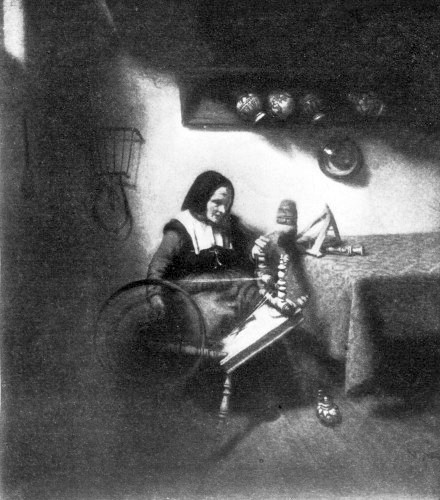
Another Spinner, in the Van der Hoop Collection, is seated by her wheel. She wears a black cap, and the sleeves of her dress are red. She stands out boldly from the brightly lighted wall. The lights and the figure are heavily impasted. The forehead of the old woman is in sunlight, the rest of the face is in shadow.
A very pleasing picture of his earlier period is The Dreamer, sometimes called Musing, representing a young woman who is looking out of a window. From her glance we gather that she has spied her lover, who is looking up to her casement, so gracefully decorated with apricots and peaches.
L. de Moni, an Imitator of Dou.—Louis de Moni (1698-1771) was a pupil of F. van Kessel and K. E. Biset at Breda, and later (1721-25) of Philip van Dijk at The Hague. Blanc says that this mediocre painter endeavored to resuscitate the long-extinct style of G. Dou and the elder Mieris, and to constitute himself their posthumous disciple. In this he only partially succeeded, but at least he exhibited, along with a certain delicacy of touch, great care and patience. More than once he borrowed a subject from Dou—familiar scenes, and small pictures of one or two figures. He is good in detail but poor in color. The Rijks has a small and pleasing picture of his called The Gardener.
J. Quinckhard.—Julius Quinckhard (1736-76) was a pupil of his father, Jan Maurits, but soon abandoned art for commerce. He was an able painter of portraits and genre nevertheless, as his Amateurs of Music (dated 1755) and Amateurs of Art (1757) attest. The figures in the latter are portraits of the painter and his friend, M. J. C. Ploos van Amstel.
Eight Pictures by Paul Potter in the Rijks.—Although there is nothing of Paul Potter's in the Rijks to compare in reputation with The Bull, or in beauty with La Vache qui se mire, there are no less than eight of his pictures there. Horses in a Meadow (1649) and Cows in a Meadow (1651), the latter having a dark sky that proclaims approaching rain, were acquired with the Van der Hoop Collection. The Shepherd's Hut, painted in 1645, is only ten inches long and six high, but is as brilliant in color as a Cuijp. The composition is simple: a shepherd guarding his cows and sheep is seated near his lowly dwelling. A Little Dog is dated 1653, as is also a Landscape with Cattle.
Description of The Bear Hunt.—An extraordinary picture is The Bear Hunt, eleven feet square. No one would ever imagine who the painter was if his signature were not in enormous letters on the trunk of a tree. This gigantic work was painted two years after The Bull and represents a gentleman on horseback and one on foot, six dogs, and two bears. The bloody contest is taking place in the foreground. This work was repainted during the first half of the nineteenth century, and only two dogs remain of the original painting.
Crowe's Opinion of Orpheus Charming Animals.—The celebrated Orpheus Charming Animals, painted in 1650, is much smaller (3 by 2 feet), and is much admired by critics. Crowe says:
"For power and fulness of warm tones this is one of his most beautiful works. The left is occupied with little hills crowned with trees; the right shows a forest, and a glimpse of the sky. In the foreground is a meadow, where we see a camel, a boar, a cow, a buffalo, an ass, a ram, a goat, a sheep, and a hare. In the middle distance, at the foot of a hill, sits Orpheus playing his lyre; behind him is a dog, and in front of him a crouching lion, an elephant, a horse, a white unicorn, a wolf, and various other animals. On the right, at the border of the forest, emerges a deer."
Description of Shepherds and Flocks.—Shepherds and Flocks, painted in the next year (1651), is also a masterpiece, remarkable for the clearness of its light golden tones, especially in the sky. It represents a hilly landscape with a shepherd playing on the bagpipes, a shepherdess singing to her child, and flocks of sheep, goats, and oxen grouped variously. By the side of the shepherd is a black dog. At the Van der Pot sale, in 1808, this picture brought 10,050 florins!
Description of A. van de Velde's The Artist and his Family.—A very beautiful work by Adriaen van de Velde is The Artist and his Family in the Van der Hoop Collection. It is generally considered one of the most incomparable and precious works in the gallery. This is a landscape bathed in the light of a lovely Autumn evening. The scene is probably near Haarlem, where the artist is enjoying the country with his family. Adriaen himself, about twenty-eight, is standing in the foreground, dressed very simply but elegantly in brown with a white collar, his hat under his left arm while his right rests on his huge and fashionable walking-stick. He has blue eyes, chestnut hair, a small moustache, a fine mouth, and a charming expression. On his left stands his wife, whose handsome figure is dressed in a crimson skirt, brown corsage, a white fichu, and a black cloak. She wears a little cap and long, ash-colored gloves. Her hands are crossed over her waist. Near this attractive couple is a little boy of seven dressed just like his father, leading a little spaniel by a string to a fountain. He has thrown his hat on the ground. A nurse dressed in a blue skirt, white apron, and yellow bodice is sitting at a little distance on a tree-trunk, taking care of the little daughter, who is playing with some flowers. Around them are some bushes and stumps, a kind of hedge, and an undulating and sandy ground that leads into a group of trees. On the road, in the middle distance behind Adriaen, is the carriage that has brought them here,—an open four-wheeled chariot, with red seats, drawn by two fine dappled-gray horses, whose harness a servant in gray is examining. On the right, a shepherd is lying on the grass, near a flock of sheep and a goat. In the background is a meadow with cattle, a winding stream, a house half hidden in the woods, and the distant line of the horizon. The landscape has all the delicacy of a Wijnants, but more breadth and harmony.
Crowe's Opinion of this Picture.—"This picture, signed and dated 1667, and of considerable size (4 ft. 8-1/2 in. high by 5 ft. 7 in. wide), is without question the finest work of the master. The composition of the whole is picturesque in no common degree; while the union of a tenderly graduated tone in keeping with the most delicate carrying out of all the parts shows what a height of perfection the school had attained at this time."
This picture was bought in London in 1833 for 15,700 florins.
Description of The Chase.—The Chase (1669) shows a beautiful picture with a wooded background. On the left, through the gate of a park comes a huntsman with the hounds. A large chestnut palfrey with a green saddle embroidered with silver is led by a valet in red livery, and a little farther away a gray horse with trappings of scarlet velvet is led by another valet. On the right are seated two men: one in red, the other in brown, and before them a big fawn and a white dog; another large dog is sniffing the ground in the foreground on the left.
Other Works by A. van de Velde.—A Landscape with Cattle shows a somewhat sombre country with clumps of trees; on the left, sheep, goats, and a little shepherd; in full light two cows, one white standing in profile, and the other black, seen from behind and foreshortened. It brought 5,650 florins in 1838. A Landscape with Ferry (1666), The Cabin (1671), and another Landscape complete the list of A. van de Velde's works in the Rijks.
An Appreciation of A. van de Velde's Pictures.—His cattle browse in velvet meadows under a beautiful sky. Animals, meadows, grassy hills, and trees—he painted them all with affection. He excels in depicting the various hides and skins of goats, sheep, horses, and asses. Animals always occupy a prominent place in Van de Velde's canvases. The air seems to circulate—light, pure air gently moving the trees or slightly waving the grass. The blue sky is filled with vaporous clouds, which are often mirrored in tranquil lakes. The chestnut with its thick foliage, the willow with its flexible branches, the oak, he paints in masses, or singly, with exquisite skill.
General Description of Aelbert Cuijp's Style.—Aelbert Cuijp (1620-91), son and pupil of Jacob Cuijp, first followed his father's style, as is evidenced in the Hilly Landscape in the Rijks. Little by little he formed his own style and became thoroughly original. He excelled in depicting the humid atmosphere about Dordrecht, and on the horizon of all his landscapes generally the clock-tower of his native city is represented half veiled in golden mist emerging from the lush meadows, where placid cows repose in the bright sunshine.
His Versatility.—Though Cuijp loves to paint the calm meadows of Holland under a golden light, his elegant figures of men and animals, dashing cavaliers, boats driven by the approaching storm, and landscapes seen under the enchantment of moonlight prove how versatile he was. Moreover, he was a brilliant painter of still life, as the partridges in The Return from the Chase (in the Louvre), the Salmons Offered to Mr. de Roovere Directing the Fisheries in Dordrecht (in The Hague), and the Dead Game (in the Rotterdam Gallery) show.
A. CUIJP Fight between a Turkey and a Cock
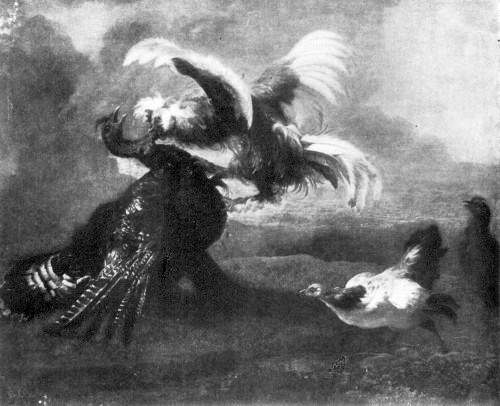
His Skill in painting Living Birds.—As for painting living birds he is only equalled by Melchior d' Hondecoeter. It is only necessary to look at his magnificent Fight between a Turkey and a Cock which hangs in the Rijks. The sky has darkened in sympathy, as it were, with this epic combat, where two splendid specimens are using their beaks and claws with the greatest fury, and the brilliant feathers fly in all directions. Splendid in color, furious of action, and beautiful in its arrangement of light and shade, it deserves its great reputation.
The Rijks owns four other pictures: Portrait of a Young Man, Shepherds with their Flocks, Cattle, and View of Dordrecht.
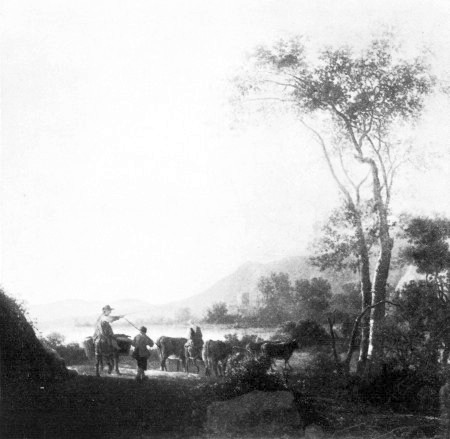
Description of Shepherds with their Flocks.—Shepherds with their Flocks represents an Autumn morning in a meadow, where four grazing cows and a shepherd on a mule occupy the foreground; on the left, a man on an ass and a man on foot wearing a red vest; on the right, two large trees; in the middle distance, some trees, a river, and a tower; and in the background, mountains.
A. CUIJP Shepherds with their Flocks
Description of Cattle.—This painting represents a great red ox with a white head, standing in profile on the left, occupying half the picture; a little behind is seen a black ox, full face; both stand out from the gray wall of a house. In front of the red ox three lovely pigeons are pecking. On the left, in the middle distance, a brown and a dun-colored ox are lying down. In the background, on the horizon, are trees and the spires and towers of Dordrecht. The sky is superb.
The View of Dordrecht seen from a great expanse of water, marvellously painted, is also a beautiful picture.
Jacob G. Cuijp's Scène Champêtre.—Jacob Gerritsz Cuijp (1594-1651?), father of Aelbert, is a painter whose pictures are very scarce. His Portrait of a Woman is dated 1651; and a very fine Scène Champêtre, which brought no less than 4,000 florins in 1849, represents, according to Immergeel, the family of the painter Cornelis Troost, a gay and large family. The grandmother, father, mother, four boys, and two girls are walking in a landscape where is also seen a chariot drawn by a handsome black horse of the Frisian race that Aelbert Cuijp so often paints.
The Cuijp Family.—The founder of this family was Gerrit Gerritsz Cuijp, originally from Venlo, who settled in Dordrecht, where in 1585 he entered the Guild of St. Luke as a painter on glass. He sent his talented son, Jacob, to study with Abraham Bloemaert. Jacob Cuijp became known as a portrait-painter, and was noted for his fine drawing, splendid coloring, and force of expression. His pictures were ranked with those of Th. de Keijser. He was no less skilful in painting animals and landscapes and family groups in the open air, undisturbed by browsing cattle.
Benjamin G. Cuijp's Style.—Benjamin Gerritsz Cuijp (1612-52), brother of Jacob and uncle of Aelbert, a painter who has attracted much attention of late years, differed entirely in taste and style from them both. He was particularly fond of historical and mythological subjects, and belonged to the Italian group of Dutch painters, who tried to amalgamate the traditions of classic art with the growing realism of the day. Some of his works show the influence of the young Rembrandt. His Joseph Interpreting Dreams was acquired by the Rijks in 1883.
Jan van Goyen.—Jan van Goyen has five beautiful landscapes: River Scene, View on the Meuse and Town of Dordrecht, View of Valkenhof at Nimeguen, View of Dordrecht, and a Landscape.
JAN VAN GOYEN View of Dordrecht
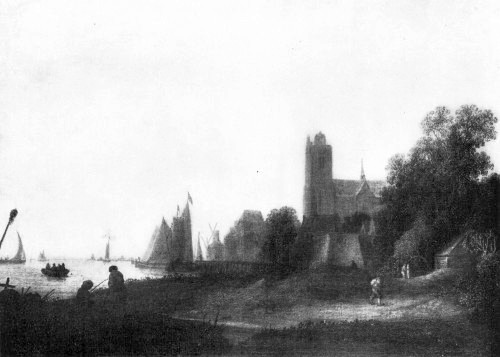
Burger's Explanation of the River Scene.—"The view of a river in the Van der Hoop Collection is the last expression of his magnificent and exalted manner. A better name for this picture would be The Windmill. In a few words here is the picture: A bit of the Meuse; on the right a piece of ground covered with trees and houses, and on the summit a black mill with its sails spread to the winds, extending high upon the canvas; a stockade, against which the waves of the river break gently, the water heavy, soft, and admirable; and a little corner of the almost lost horizon, very attenuated, very firm, very pale, yet very distinct, on which rises the white sail of a boat, a flat sail without the slightest wind in the canvas, but having a value tender and perfectly exquisite. Above, a great sky filled with clouds; through the rifts and holes the shining blue that they efface, the clouds all gray and filling the space from the stockade to the top of the canvas; so that there is no light in any part of this powerful tonality, composed of dark brown and sombre slate colors. In the centre of the picture one ray of light glimmers like a smile upon the clouds. A great square grave picture, of an extreme sonority in the deepest register, and my notes add merveilleux dans l'or."
Karel Dujardin (1625-78).—Of the Portrait of a Gentleman with a Dog and a Dead Hare (1670), Burger says:
A Dead Picture of a Dead Hare.—"The deadest one in the lot is not the hare; for if the hare were alive the dog certainly could not run after him, nor could the gentleman run after his dog. The gentleman is dressed in tin-plate and is represented to the knees and of natural size, with the background of a dark sky. The hands have been praised; but they do not look as if they could move."
A Good Portrait of Gerard Reinst.—A Portrait of Gerard Reinst, a celebrated art collector of Amsterdam, who died in 1658, and who was a patron of Dujardin, is painted sympathetically. He is bareheaded, with a blond wig, and is dressed in a grayish violet with chocolate tones. One hand rests on his hip; the other is marvellously represented. A landscape and sky form the background, and two greyhounds are at the gentleman's side.
A Portrait of Himself.—A portrait of himself is signed and dated 1660. This is only nine inches by six and one-half inches. It is only a bust showing a shaven face with a thread of a moustache, long black hair, brilliant eyes, and handsome mouth. He wears a grayish costume with puffed sleeves, and his right hand somewhat pretentiously holds the drapery of his cloak on his chest.
Dujardin's Other Works.—A Landscape, dated 1655, and showing a peasant winnowing corn, is noted for its silvery tone; A Trumpeter on Horseback shows a cavalier in a blue mantle and on a white horse, stopping before the door of an inn, and drinking from a glass offered by the hostess, who is standing at the door. His other works are an Italian Landscape with Animals and The Muleteers. Another Landscape in the Van der Hoop Collection was bought at the Duchesse de Berry's sale in 1837 for 4,000 florins. A copy after Karel Dujardin shows an Italian Landscape with figures, and a white horse.
Adam Pynacker.—Adam Pynacker has four landscapes: Border of a Lake in Italy, Italian Landscape, Landscape, and Pilgrimage.
Johannes Both's Pictures.—Johannes Both may be studied in The Courtyard of a Farm; two Italian Landscapes, one of which is a luminous picture of a summer morning, with mountains on the horizon on the left, trees to the right in the foreground, and many small figures on the road; and in Painters Studying from Nature. Here we see on a canvas about six feet by seven, a vast landscape of much beauty, having the Apennines for a background. Beneath a tall oak tree on the right and among the rocks, Johannes Both himself is seated, with his back turned to the spectator. He has a sketch book before him and is talking to a beggar; his brother Andries is facing us; and the fourth person is talking to some one in the distance. The time is a beautiful Summer morning.
Jan Asselijn.—Jan Asselijn (1610-60) was a pupil of Esaias van de Velde, but went when young to Italy, where he was called by the band of Dutch painters "Krabbetje," on account of a contraction in his fingers. His pictures are highly valued, representing, as a rule, views of Rome, enriched with figures and cattle in the style of N. Berchem. He greatly resembles Jan Both.
His Italian Landscape in the Rijks is considered a very true and important landscape, with a background of bluish mountains, and a bridge on the left. The artist has introduced Italian ruins and some muleteers. He is also represented by a Cavalry Combat, signed and dated 1646; and the Allegory on John de Witt.
Philips Wouwermans's Hawking Scene.—Of the thirteen pictures by Philips Wouwermans we may pause before the well-known Hawking Scene, noted as a specimen of his delicacy and precision on a small scale. It is only one foot high by eight inches wide. The exceedingly animated composition shows about a dozen people on horseback scattered through a delicate landscape. Other figures of men, women, and children enliven the scene. This is painted in his last and most prized period.
His Horse-pond.—The Horse-pond is a lovely picture, with a silvery sky filled with luminous morning clouds, and, far away in the distance, hills, trees, and women bleaching linen. In the centre of the picture, a lovely stream in which children are bathing, and a ferry with persons and animals passing over in little boats. It is the moment when grooms and peasants are taking their horses and animals to water; and naturally, therefore, we have some beautiful groups: here a man is leading two horses, one of which is kicking at a barking dog; other horses are at the edge of the stream; others have plunged in. Among the eight horses, there is one splendid white one, and there are about twenty figures, including washerwomen and children. It is impossible, even with Wouwermans, who is so spirituel and clever, to find a richer, more animated, more varied, and more brilliant composition.
A Landscape with Water belongs to the first period when Wouwermans followed Wijnants; The Camp shows horsemen and other people; a horseman turned to the right and mounted on a white and brown horse is very remarkable.
Description of The Kicking White Horse.—A celebrated canvas is The Kicking White Horse. Two mounted horses and one lead horse are under a tree in the foreground. The white horse, after having knocked over an old woman with a basket of fruit, is kicking the lead horse on the right, while a dog is snarling at his heels. On the extreme left, a richly dressed lady and gentleman are watching the affair with interest, and in the middle distance, on the right, two men are watering their horses at a ford. There is fine painting of distance in the low landscape and beautiful aërial perspective in the Summer sky with its floating clouds.
Besides landscapes, a camp, and others in his usual style, there are two pictures of fighting peasants.
His brother, Pieter Wouwermans (1623-82), is represented by two works: Assault on the Town of Koevorden, 1672, and The Hunting Party. His works have frequently been mistaken for Philips's, though, as may be seen in these pictures, his brush work has less freedom, and his tones are heavier than his brother's.
Jan Wijnants Unsuccessful in peopling his Scenery.—Jan Wijnants (1600-79), who is said to have been the master of Philips Wouwermans, has eight pictures by which his qualities may be compared with those of that painter. These are Landscape in the Dunes, with Hunters; Mountainous Country; The Farm; and Flock in a Landscape; and four landscapes in the Van der Hoop Collection. He was a painter of extreme care and finish; and in painting nature he ranks among the highest. Like so many other Dutch landscape-painters, however, he was not successful with figures; and for peopling his scenery he availed himself of the assistance of his great pupil, Adriaen van de Velde (as in the case of the above-mentioned Landscape in the Dunes), Lingelbach, Wouwermans, Helt Stokade, and others.
Jan Wijnants's Love of painting the Dunes.—Durand Gréville says:
"His dated pictures are of his last period, 1641-79, so that he may claim the honor of first having introduced into the landscape the neighboring dunes of Haarlem and of having been the first to love them. He faithfully translated in their blond harmony the dunes, gray or golden, with the sun, the trees with their pale foliage, and the skies with their light vaporous veilings. To his last hour he went back again and again to that inexhaustible theme in its apparent monotony. He put into the execution of the dazzle of the sand, tree-trunks, spaces of moss and clumps of grasses an astonishing sincerity, perhaps even somewhat too minute from the point of view of the impression of the whole, but, even by that, quite accessible to the taste of the majority of people. None the less he remains to-day one of the most remarkable landscape-painters of Holland."
Cornelis van Poelenburg.—Cornelis van Poelenburg has four characteristic pictures in his favorite Italian style: The Bathers, Women Coming from the Bath, Adam and Eve Expelled from Paradise, and The Bathers Spied Upon.
Winter Scenes by A. van der Neer.—The most noted painter of winter scenes and of the magic beauty of snow and ice is Aart van der Neer (1603-77), a friend of A. Cuijp, from whom he doubtless learned much, as they frequently worked together on the same canvas. His winter pieces are generally warm in their lighting. Two fine specimens hang in this gallery, one of which is brightened by numerous figures skating and playing ball on a frozen canal. The sky is full of dark snow-clouds. He may also be studied by a Landscape.
His Moonlight Scenes.—He is also famous for his beautiful towns on the canals, lighted by the moon, and his conflagrations. No other painter has depicted the broad masses of shadow, and the effects of light and tranquillity of character peculiar to a moonlight night, with so much truthfulness as Van der Neer. In his rendering of the warm glow of sunset he has been compared to his friend Cuijp.
Hendrick Averkamp.—In this connection The Skaters, by Hendrick Averkamp (1585-after 1663), should be noted. This artist was surnamed "the Mute of Kampen" because of his taciturnity. He produced many marines, landscapes, and festivals on the ice, which have, unfortunately, lost their color.
Esais van de Velde's Pictures.—Winter amusements by Esais van de Velde will afford pleasure to the student, who may also see this artist's Dutch Landscape, painted in 1623; The Surrender of Bois-le-Duc (1629-30), and an original replica of his curious satire on religious quarrels in 1618-19, Prince Maurice Fastening Bells on a Cat. Many of the architectural painters have depicted the well-known street scenes and buildings under the mantle of winter.
Three Excellent Pictures by Hendrik Dubbels.—Hendrik Dubbels (1620-76?), about whom comparatively little is known, has three pictures of great excellence: A Marine, a Calm, and a River Scene. Dubbels is supposed to have taught Ludolf Bakhuysen (1631-1708), who was also a pupil of Allart van Everdingen.
Bakhuysen, Painter of Stormy Seas.—Bakhuysen loved the ocean in its angry moods, and used to hire fishermen to take him out in their boats in the fury of storms. His works are highly valued, and some critics prefer them to the more placid pictures of Willem van de Velde. The Rijks owns two views of The Ij (or Y) near Amsterdam; The Port of Amsterdam, painted in 1673; Agitated Water: Haarlemmer Meer (for which 3,500 florins was paid in 1840); Stormy Sea After the Storm (1672); Embarkation of Jan de Witt on the Dutch Fleet; and Portrait of the Painter by himself.
Van de Velde, the Elder and the Younger.—Willem van de Velde the Elder (1611-93), who was Court Painter to Charles II. and James II. of England, is represented in the Rijks by eleven marine drawings. We have already seen fine examples of his more famous son, Willem van de Velde, at the Mauritshuis, but thirteen splendid examples hang in this gallery.
Some Notable Pictures of Naval Warfare.—The Ij (or Y) at Amsterdam, dated 1686, which formerly hung in the Schreierstoren in Amsterdam, was described by Sir Joshua Reynolds as follows:
"At the office of the Commissary of the Wharfs is one of Vandervelde's most capital pictures: it is about twelve feet long; a view of the port of Amsterdam with an infinite quantity of shipping."
W. VAN DE VELDE The Ij or Y at Amsterdam
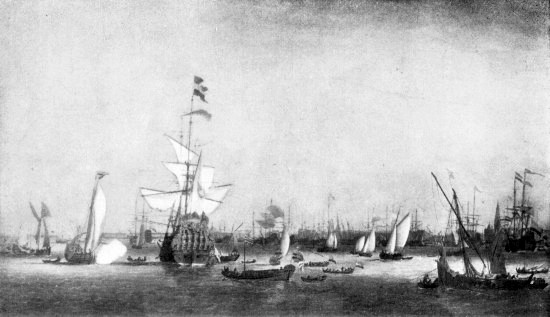
The Four Days' Combat is a picture of the moment when the English flag-ship, the "Prince Royal," is striking her colors in the fight with the Dutch fleet in 1666; and its companion, The Capture, shows four English men-of-war brought in as prizes in the same fight. Here the painter has represented himself in a small boat, for in such a position he actually witnessed the battle. An Agitated Sea, with various sailing-vessels, is delightful because of the warm lighting and movement of the waves; two Calms represent the painter in the mood he best loves to paint the sea. Other canvases represent the sea under squalls, light breezes, etc. The Canon Shot, with a large ship in the foreground, was bought in 1834 for 3,000 florins.
A Beautiful Picture of the Dutch Coast.—View on the Coast of Scheveningen shows the dunes on the right, above which rises the steeple of a church; on the left is the calm sea under a lovely afternoon light. Two fishing-boats are seen in the distance; a boat lies on the beach; a fisherman walks by with his nets, and in the foreground are three men. The sea, the dunes, the tiny figures, and the light all combine to make a beautiful picture.
How some Painters helped each Other.—The great geniuses could do everything well—portraits, landscapes, marines, figure subjects, architecture, interiors, and still life. Some, however, excelled in one particular branch, and, sometimes against their will bowed to the popular demand for their works in that line, and devoted themselves entirely to it. This specialization was carried to great lengths; and it seems strange to us to find one master of landscape calling upon a famous figure-painter to people his landscapes à la mode, and vice versa, as happened in numberless instances. Sometimes even cattle were supplied; and, more particularly, live and dead game, flowers, fruits, household stuff, and all kinds of still life.
The Effect of this on their Reputation.—Sometimes a young artist's facility in a certain field was detrimental to high esteem. Paul Potter, for example, had to live down the reproach that he was nothing but a painter of animals,—which he very quickly did. Those who made a specialty of live animals apart from landscape are very few. With the exception of the works of Snyders, hunting scenes are rare. Wouwermans's hunts are confined to the start and the return of the cavalcades.
Blanc's Description of Weenix's Style.—J. B. Weenix must have loved hunting also, for it forms one of the familiar motives in his landscapes in the Italian style. However,
"as he painted above all for the pleasure of painting, his usual custom was to group in the foreground of his composition the products of the chase rather than to represent the hunt itself. It is only in the distance that hounds and huntsmen are seen hunting the hare, while the poor animal is already dead and hanging by its foot to a branch of a tree in the foreground. A brilliant gamecock, one or two partridges, some ribbons and flowers, and a big garden vase will accompany the hare and form a charming picture for the mere delight of the eyes. Truth, finesse of local color, delightful light and shade, exquisite handling, and the whole technique of art are employed to make us admire this still life. We cannot help noticing the masterly manner in which the artist has rendered the fur of his dead hare, crimsoned with blood; and how lovingly he has caressed the plumage of the neck and crop of his partridges, and reproduced the beautiful lustrous black of the cock, whose wings are splashed with white; how he has made us feel the velvet of the skin at the joining of the muscles, and accentuated the feet and claws. But the final luxury of the palette seems to have been reserved for a superb hunting-dog with delicate ears, that watches with an eye full of life over his master's gun and the glorious trophies of the chase; and distends his nostrils as if to snuff the odor of the gunpowder, the aroma of the gin, and the strong scents of the venison."
Painters of Still Life.—Usually the painters of inanimate objects take the trouble to arrange their inert models, just as a historical painter would dispose his living figures. The human figures in Snyders's pictures were painted by Rubens, Jordaens, or Martin de Vos. His pupils were Jan Fyt, Nicasius Bernarts, and Pieter Boel. The Rijks Gallery has two splendid pictures by him: one, a dish garnished with fruits and dead game; and the other, a dead roebuck, a wild boar's head, and vegetables.
Snyders's Dead Game and Vegetables.—Beautiful in composition and color is his Dead Game and Vegetables. On a shelf are placed choice specimens of china, glass, earthenware, fruit stands, etc., and these are balanced on the left by a beautiful glass vase of roses and iris standing in a niche. A large basket of apples, peaches, melons, pears, and grapes, a hung deer, a boar's head, a lobster, a few artichokes, and a bunch of asparagus show the artist's wonderful arrangement of form and color.
FRANS SNYDERS Dead Game and Vegetables
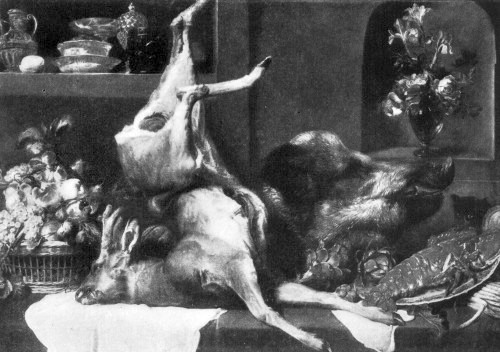
Savery's Landscapes and other Pictures.—Roelandt Savery (1576-1639) was famous as a landscape-painter. The landscapes are somewhat artificial, and really are used as framework for the animal life he loved to introduce. His execution is sometimes rather heavy but with strong tones. The landscapes usually consist of grassy swards with brownish-green trees and shrubs in the foreground, while the background is bathed in the bluish tints so dear to Brueghel. Animals and birds of all kinds animate Savery's pictures, as well as human figures, all drawn with much talent. The Hague has a famous picture, by this artist, of Orpheus Charming the Animals; and the Rijks owns Elijah Fed by the Ravens (1634) and A Stag Hunt in a Rocky Landscape (1626).
Adriaen van Utrecht and his Still Life.—Adriaen van Utrecht was ten years ahead of Jan Fyt in painting those pictures of live or dead animals, game, fruits, and implements of the chase that we still admire so much. Although his lights are sometimes somewhat heavy and his brush work is not so fine as Fyt's, yet he equals the latter in certainty of touch and especially in his feeling for life and nature. His pictures are very scarce: Amsterdam possesses only one, called Still Life, signed and dated 1644. On a canvas eight by ten feet the painter has grouped pies, hams, a lobster, grapes, peaches, and lemons on a table. On the left, on the floor, are some musical instruments; on a chair some golden vases; above, a parrot; on the right a great sculptured basin and a little white spaniel, and in the centre a monkey playing with some fruit from an overturned basket.
Ten Pictures by M. Hondecoeter.—Melchior d' Hondecoeter can be studied to great advantage in the Rijks, which owns several pictures of the first order: The Floating Feather, The Philosophical Magpie, Animals and Plants, The Country House, The Duck Pond, The Frightened Hen, The Menagerie, Dead Game, and two of birds.
Hondecoeter's Father and Grandfather.—The great Hondecoeter was a pupil of his father, Gijsbert d' Hondecoeter (1604-53), the pupil of his father Gillis d' Hondecoeter (1583-1638), a painter of portraits and landscapes in the manner of R. Savery and David Vinck Boons. Gijsbert followed his father's style of landscapes; but he attained a great reputation for his birds, and particularly his ducks. Both styles may be seen in the Rijks: A Landscape with Figures, dated 1652, and Aquatic Birds, dated 1651. In the duck pond, where ducks and pigeons are sporting, is also a feather floating on the water, for the artist was fond of repeating this little touch.
The Philosophical Magpie regards from a tree-trunk a dead heron, a goose, and ducks; its pendant shows a living peacock near a large vase and a dead hare and pheasant. Dead Game, a small picture, exhibits a dead partridge and a string of four little birds, and the others represent parrots and other exotic birds, flowers, and plants, and some monkeys. The Frightened Hen is defending her chickens against the attack of a pea-hen. The most famous of all, however, is The Floating Feather.
M. D'HONDECOETER The Floating Feather
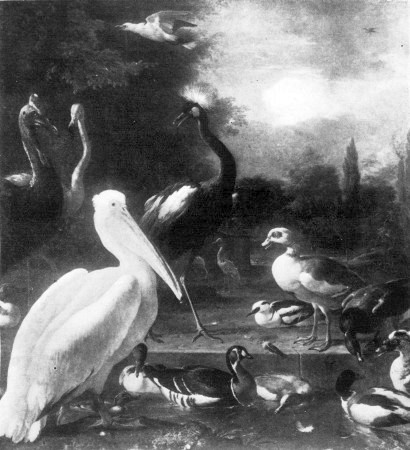
Burger's Criticism of The Floating Feather.—"To make a pilgrimage to Amsterdam without admiring The Floating Feather, would be committing the crime of lèse-peinture. Hondecoeter has painted this most carefully and in his happiest vein. In a park luxuriantly decorated with beautiful trees and springing fountains, he has grouped strange and rare birds with domestic fowls. On the left in the foreground may be recognized a pelican, a crane, a flamingo, and a cassowary; on the right are ducks and geese of various breeds; a magpie cleaves the air with rapid wings; and, lastly, a light feather floats on the surface of a quiet pool, and this detail has given the picture its name."
Dr. Bredius says:
"The pelican on the left is particularly remarkable; but the ducks do no less credit to this artist, who has expressed with such penetration the life of the feathered world, the movements of these creatures, I should indeed say their expression; and he has rendered their physiognomy and character with such profound truth that no other artist can approach Hondecoeter in this respect."
The Philosophical Magpie, the Country House, and, better still, the modest frame in which the artist, putting aside for a moment his usual style, has brought together lizards, butterflies, and sparrows amid shrubs and large-leaved plants, are Hondecoeters of the most admirable quality, whether in frankness of detail, or for the mastery of execution and accent of color.
Asselijn's Allegorical Bird Picture.—The curious Allegory of the Vigilance of the Grand Pensionary John de Witt by Jan Asselijn is a bird picture. Here a great white swan is defending her nest against the attack of a black dog swimming rapidly toward it. Beneath the swan is the Dutch legend The Grand Pensionary; on the eggs, Holland; and under the dog, The Enemy of the State (intended for England). The feather lost by the bird is beautifully painted, and has challenged comparison with Hondecoeter's Floating Feather.
ASSELIJN The Swan
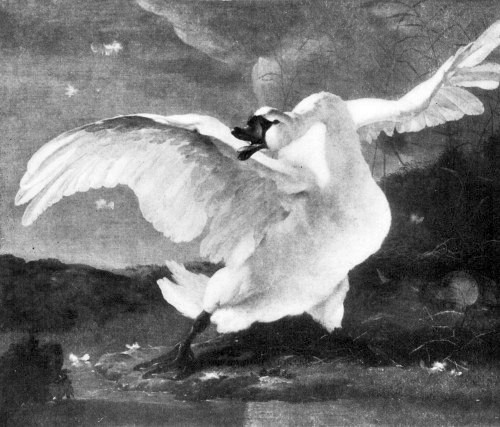
Eckhout.—G. van der Eckhout (1621-74) has a Huntsman with Two Greyhounds, painted about 1670. The huntsman, wearing a red vest, is seated on the grayish earth. The general tone of the picture is chocolate or chestnut.
Jan Vonck.—Jan Vonck (1630-?), another painter who devoted himself principally to still life, especially dead birds, sometimes was responsible for the birds in Ruisdael's pictures. His brush work is that of a master; his color is strong and agreeable with a transparent touch. The Rijks owns one example, Dead Birds.
Jan Weenix.—Jan Weenix (1640-1719) was the pupil of his celebrated father during the latter's lifetime; and later he studied still life under his uncle G. Hondecoeter, Elias Vonck (brother of Jan), and Matthys Bloem. He surpassed his father in his pictures of dead game, one of which hangs in this gallery. His animals—swans, hares, and various birds, arranged with flowers and fruits around sumptuous antique vases—are not so strong in character as those in Hondecoeter's works; but they are very true to nature and have the great charm of harmony and picturesqueness. They richly deserve their original popularity which their wonderful finish and execution have preserved till the present day.
Coninck a Good Animal-painter.—David de Coninck (1636-87), who had many affinities with Fyt, also painted landscapes, animals, and birds. He received the nickname Ramelaer from his fondness for painting rabbits especially. He was quite at home in hunting scenes, two of which are in the Rijks,—The Bear Hunt and The Stag Hunt.
Another painter of this period, Pieter Jan Ruijven (1651-1716), has a fine picture of a cock and hens.
Bosch, an Early Painter of Flowers.—One of the early Dutch painters of flowers was L. J. van den Bosch (?-1517), who painted with a transparent color and a light touch. He treated fruits, flowers, and insects with sympathy and truth. He often represented flowers in vases; his insects are so minute that they have to be examined with a magnifying glass.
Delff's Poultry Seller.—Pictures of this school, however, do not abound in the Dutch galleries till we come to the artists who lived a century later. The first of these who appears in the Rijks is Cornelis Jacobsz Delff (1571-1643), a pupil of Cornelis Cornelisz. Delff was renowned for his pictures of still life. He is represented in the Rijks by The Poultry Seller.
Other Still-life Painters in this Gallery.—Other still-life painters born in the sixteenth century, who are represented in this gallery, are Ambrosius Bosschaert (1570-?), Pieter Noort (1592-1650), Pieter Symonsz Potter (1597-1652), Adriaen van Utrecht (1599-1652), and Hans Boulengier (1600-45). Bosschaert has a picture, Flowers, dated 1619. He had a son of the same name who also painted flowers.
Of Pieter Noort little is known beyond the fact that he painted still life, and especially Fish, as in the two pictures here signed P. van Noort.
P. S. Potter painted on glass and was the manager of a gilded leather establishment at Amsterdam. His model was Hals. Besides portraits and landscapes, his preference was for still life. The Straw Cutter and Still Life (signed and dated 1646) are worthy of attention.
Two Pictures by Heem of Utrecht.—Jan Davidsz de Heem (1606-84) of Utrecht was a son of David de Heem, so famous for his déjeuners spread with game, oysters, lobsters, fruits, wine, china, glass, and silver. Jan inherited his father's tastes, and much of his talent, as is evidenced by two pictures in the Rijks. One shows flowers and fruits of natural size; and the other represents a table on which are a cup, a glass, and a vase of wrought silver loaded with fruits.
Gréville on his Style.—"At Antwerp, under Seghers, he enriched his palette and learned the art of composing a delicious harmony by setting flowers and fruits and glass and silver vases on an Oriental table-cloth. To the most minute exactitude and almost microscopic details, he added the most brilliant coloring and an unfailing taste in the arrangement of his flowers and still life."
Pieter de Ring.—A picture of a table covered with blue velvet and spread with lobsters, oysters, bread, fruit, etc., is typical of the work of Pieter de Ring (1615-60), one of De Heem's pupils, a Fleming, who spent his whole life in Holland, and was noted for his picturesque arrangement and fine execution.
Hans Boulengier has a flower piece signed 1625. He painted still life, genre, and sometimes "fantasmagories." Little is known about him.