THE HAGUE GALLERY (continued 3)
Reading edition
Fruits and Flowers his Forte.—It is doubtful if any artist ever surpassed Van Huysum in the representation of fruits and flowers, to which he finally devoted himself with the greatest success. He set himself the task of surpassing De Heem and Abraham Mignon; and he studied the most exquisite fruits and flowers known. His taste in the arrangement of his groups in elegant vases, of which the ornaments and bas-reliefs were finished in the most polished and beautiful manner, and in graceful baskets on marble tables, is generally considered to be superior to that of any other flower-painter. He also shows great art in relieving flowers of various colors against each other, and often they stand out from a light transparent background. His fame rose to the highest pitch, and the first florists of Holland were ambitious of supplying him with their choicest flowers for subjects. Naturally, therefore, we find on his canvases beautiful groups and bunches of hyacinths, roses, pinks, primroses, and other garden buds and blossoms.
His Skill in depicting Dewdrops and Insects.—With marvellous skill he frequently introduces dewdrops of incomparable transparency that trickle down the leaves or sprinkle the fresh delicate petals. Butterflies and other insects are also depicted with a truthfulness and precision that give a perfect illusion, and often a bird's nest with eggs is introduced.
His Exquisite Taste.—Jan van Huysum's pictures are so bright that they have even been accused of being gaudy; but no critic has yet found fault with his exquisite taste and faultless velvet-like finish that seems to rival nature. His fruit pieces are inferior to his flowers, though they are worthy of great admiration. Those painted on a clear or yellow background are the most esteemed, and are distinguished from his early works, which are usually on a dark one, by a superior style of pencilling and a more harmonious color.
Rachel Ruijsch.—Another charming flower and fruit painter,—noted especially for her flowers,—Rachel Ruijsch (1664-1750), is represented in The Hague Gallery by two Bouquets. In 1693 she was married, but she always signed her maiden name, and in several ways,—Ruijsch, Ruysch, and Ruisch. She took great pains with her pictures, and the amount of time spent on them limited their number. She is said to have given seven years to two pictures, Flowers and Fruits, which she gave to one of her daughters for a wedding present.
Blanc has most sympathetically described her qualities. He says:
Her Truthfulness to Nature.—"Whether she is painting the flowers of the gardens or those of the field, which she groups so beautifully on marble tables and calls around them fluttering butterflies and droning bees, or beautiful ripe fruits that refresh the eyes and mind, Rachel is always truthful, graceful, and clever. A colorist, she frankly selects the brightest tones and combines them marvellously; a draughtsman, she reproduces splendidly the most complicated forms, while preserving to each plant its individual elegance, its aspect, its way of holding itself, and foreshortening."
Her Love of Nature.—"In all justice, therefore, the Dutch rank Rachel Ruijsch among their most excellent painters. She retained her love of nature in all its freshness; it even seems as if she had a weakness for rustic beauty, and that she found the same pleasure in wandering about the country that others have in gardens and greenhouses. Sometimes she even mingles thistles with her field flowers, which she carelessly throws on a table; sometimes she chooses an old tree-trunk overgrown with moss, upon which she places her bunch of spring blossoms, while the insects hum around them, and the wings of a beetle gleam through the shadow. Sometimes she brings a green frog from some pool in the neighboring meadow and gives him a place in her picture. In the infinite little world of great nature Rachel finds no creature unworthy of her brush—not even the snail that crawls on the leaf and is hunted away by the gardener, nor the little worm who moves his variegated rings and spins his thread, destined to clothe magnificent ladies, as he elevates himself into the air. Those insects that we deem vile she honors in her paintings: she lets them lie on her marble tables, crawl on the stem of the glass in which her peonies and pinks are arranged; and she even allows them to devour the plums and grapes of her picturesque collations. Nothing, however, is more charming than her birds' nests, lined with lightest down and tiny blades of grass, moss, and straw, expressed with the art and industry of a wren or a tomtit."
The larger picture in The Hague Gallery is a charming group of roses and tulips, with butterflies and insects.
Rachel Ruijsch was a pupil of Willem van Aelst (1626-83?), whose Flowers (dated 1663) and Still Life (dated 1671) hang in The Hague Gallery.
Description of One of Willem van Aelst's Pictures.—M. de Burtin has described a picture by Willem van Aelst which gives an idea of all the works of this master:
"A table covered with a crimson velvet carpet bordered with golden fringe, on which stands a drinking-vessel of antique shape half filled with Rhine wine. The sides of this glass cup reflect several times and in different views the street with the most magical and astounding way, and in the very centre you see the reflection of the painter himself, holding his palette. On one side of the cup are placed, on a glass dish, four superb peaches and some roasted chestnuts; on the other side are bunches of red and white grapes. Butterflies and other insects add to the illusion, and the vine and peach leaves are artistically used to decorate the beautiful pyramidal group that stands out from a looped-back curtain of brownish yellow."
Resemblance of his Work to that of Van Huysum.—Although his name is less celebrated than that of Van Huysum, Willem Aelst is not very far removed from him in his beautiful productions; and certainly he surpasses Evert van Aelst (1602-58) who was his uncle and master. Without carrying finish to excess and preserving a certain freedom of touch, he knows how to express marvellously the delicate wings of a butterfly, the down of a peach, the dewdrops on a bunch of grapes, the feathers of a dead bird, and the wrinkles of a game-pouch.
In Favor with Princes and Cardinals.—Many of his works are in France, where he spent four years, and in Italy, where he lived seven years filling orders for princes and cardinals. He was only thirty years old when he returned to his native town, Delft; but he removed to Amsterdam, where his works brought high prices.
His Favorite Subjects.—The pictures by him representing dead birds are, as respects picturesque arrangement, finely balanced harmony of cool but transparent color, perfect nature in every detail, and delicate, soft treatment, admirable types of the perfection of the Dutch School. Specimens of this class are a picture in the Munich Gallery of two dead partridges and instruments of the chase, and another in the Berlin Museum signed "W. v. Aelst, 1653," representing a marble table with two woodcocks and other small birds, and two French partridges suspended above. His favorite subjects, however, were fruit and other eatables, herrings, oysters, bread, etc., with glasses and gorgeous vessels in gold and silver. Although Willem van Aelst owed much to his uncle Evert van Aelst, so famous for his dead birds and instruments of the chase, perhaps he owed still more to his other teacher, Otho Marcellis van Schrieck (1613-73), who acquired celebrity, excelling in a singular branch of art. He painted the humblest creatures,—frogs, snails, lizards, worms, serpents, and curious plants. The name of his master is unknown; but he painted entirely from nature and is said to have kept a kind of museum of serpents, vipers, insects and other curiosities. These he studied with great attention, and drew them with extraordinary fidelity and care, reproducing also their glowing and metallic hues.
Two Pictures by Beijeren, and Two by Seghers.—Another famous Flowers is that by Abraham van Beijeren (1620 or 1621-75), which was acquired at the Van Pappelendam sale in Amsterdam in 1889. A fine Fish and Lobster by the same painter should also be studied. The visitor will perhaps notice as he passes two pictures by Daniel Seghers (1590-1661), one a garland of flowers around a statuette of the Virgin; the other, a garland of flowers around the bust of William III. The bust was a later addition.
Other Painters belonging to the Same Group.—An interesting and curious work is Shells, by Balthasar van der Ast (?-1656). There is also a still life (1644) by Pieter Claez. To this group should be added Pieter Roestraeten (1627-1700), famous for his great vases of gold and silver, bas-reliefs, musical instruments, etc., which he designed with precision. He spent most of his time in London, where he was injured in the Great Fire (1666). Belonging to the same group are Pieter de Ring and Willem Kalf, whom we shall see in the Rijks, and the strange Christoffel Pierson, whose specialty was still life (particularly the attributes of the chase) and portraits. His works are very rare; but a peculiar combination of portraiture and still life hangs in The Hague Gallery, representing the pastor of the Protestant Church at Hoorn, Joris Goethals, and noticeable for the number of hunting implements and objects hanging on the wall. Though sombre and monotonous in tone, his touch and drawing are masterly. He thoroughly understood composition and distributed lights and shadows with skill. Pierson was turned aside from painting historical subjects and portraits by the success of Leemens, a painter of dead game, guns, etc., and speedily surpassed his model.
Jan van Os, Georgius Jacobus Johannes van Os, and Marie Margrita van Os we shall see in the Rijks.
Portrait of Rubens's Second Wife.—Although Holland is not the land where we can study Rubens (1577-1640) in all his greatness, yet the Amsterdam Gallery and more particularly The Hague Gallery possess some splendid pictures by his hand. In the latter hang the portraits of his two wives. That of his second wife, the buxom Helena, whom he married on December 6, 1630, and who bore him five children, is a masterpiece of the first rank; certainly an entirely individual work of the artist's later period.
Much of Rubens's Work done by his Pupils.—Thus we immediately come to the question: What has the master himself and what have his pupils done on it? No master has left behind him a larger amount of painted surface of canvas and wood; but how unequal is the artistic value of all this material! We know how that happened. Overwhelmed with pressing orders and surrounded by a large throng of sometimes very able pupils, he often only made a sketch, leaving the chief work to his best pupils, and finally adding a few corrections; perhaps here or there a head or a figure that particularly interested him. Rubens made no secret of this fact; he often openly acknowledged what he and what his scholars had done on a work.
Dr. Sperling's Visit to Rubens's Studio.—An eye-witness, the Danish physician, Otto Sperling, who visited Rubens's studio in 1621, describes the master as walking up and down in his vast hall among his many pupils, making remarks and going over a picture here and there finally with a few brush-strokes. The Doctor jocularly adds: "It is supposed that everything is the work of Rubens, by which this man has amassed enormous wealth, and has been rewarded by kings and princes with great gifts and many jewels."
His Pupils not very often allowed to assist him in Portraits.—One should remember that this assistance of his pupils was generally confined to his greater historical pictures and church pieces; but the portraits that Rubens painted are not always entirely the work of his hand. Sometimes an order for a portrait was repeated, and his students made the replica of a well-known personality. Rubens painted portraits of small dimensions and then left them to be enlarged by able pupils; but he himself added the final touches.
Dr. Bredius on the Portraits of Rubens's Two Wives.—"Even in the case of the portrait of one of his wives, we are not quite sure whether the work is exclusively his own. There exist such a marvellous number of these portraits, and, moreover, of such varied artistic value, that we must at last conclude that the family and friends of these ladies, who belonged to the best families in Antwerp, all ordered portraits from Rubens, who painted some of them entirely and others only in part.
"While, for example, the present portrait of Rubens's first wife, Isabella Brandt, whom he married in 1609, betrays the master's own hand in the head and in part of the costume, the hands look to me to be so extraordinarily like Van Dijck's work that I ask myself whether the latter (about 1618) might not have had some part in this portrait. On the other hand, the portrait of Helena Fourment, whom he married in 1630 (Isabella Brandt died in 1626) is handled with such a gush, although very rapidly and with such geniality that hardly anybody would say that this spirited portrait is not all his own.
"What flesh! what brilliance! what glow of color! what virtuosity in the painting of the details and the material! What life streams from this warm, youthful, proud wife upon her husband!"
RUBENS Helena Fourment
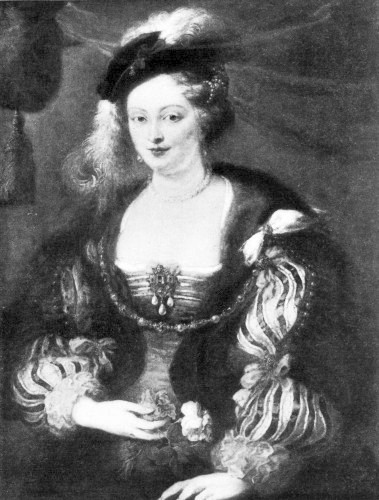
Sir Joshua Reynolds describes these portraits thus: "Two portraits, Kitcat size, by Rubens, of his two wives, both fine portraits, but Eleanor Forman is by far the most beautiful and the best colored."
Description of Helena's Portrait.—This is one of the most beautiful of all Rubens's portraits of his second wife. Her face and figure are not only wonderfully modelled and painted, but her red mouth has a sweet, half-smiling expression, and dimples are ready to break out at any moment and render the brilliant face even more brilliant. The eyes are lustrous and handsome, beneath finely arched brows. The light silky hair is roped with pearls, and a long plume falls gracefully from the coquettish toque of velvet adjusted at an angle that suits the face exactly. A pearl necklace and earrings adorn the ears and snowy neck, a magnificent jewel with three pear-shaped pearls for pendants clasps the front of the dress, jewels ornament the sleeves, and a great rope of goldsmith's work passes from shoulder to shoulder. She wears a light blue satin dress the sleeves of which are slashed with white, and a black velvet cloak with gold buttons and a fur collar. The sleeves end with delicate filmy frills at the wrist, and she gracefully holds in her hand a couple of beautiful pink roses. The background is gray and the curtain is red. This picture was painted in 1634, four years after Rubens's marriage to the daughter of Daniel Fourment.
After Rubens's death the beautiful Helena was married to Jan B. Broekhoven, Baron of Bergeijck. She died in 1673.
Burger's Admiration for the Portrait of the First Wife.—Not far away from her portrait hangs that of Isabella Brandt, painted in 1620. Burger admired it more than that of Helena, and went into ecstasies over the "beautiful hands" crossed over her girdle. Isabella is dressed in black, with a square and low-cut bodice and a gauze fichu. Her hair is adorned with pearls.
Portrait of Father Ophovius.—The Mauritshuis possesses also a famous portrait by Rubens of quite another character; this is that of a friend whom he had sufficient influence to have made Bishop of Bois-le-Duc, the Rev. Father Michael Ophovius, a Dominican monk. He is seen full face in the costume of his order. He has an energetic head and is in robust health. It is a broad and vigorous painting, and formerly adorned the Dominican monastery at Antwerp.
Two Pictures painted Partly by Rubens.—Two other pictures by Rubens should be studied. Adam and Eve in Paradise, in which, however, only the figures are by Rubens (Dr. Bredius thinks the horse also); while the landscape and other animals are by Jan Brueghel, also called Velvet Brueghel. The latter also painted the landscape in the Naiads Filling the Horn of Plenty, a picture that was once attributed to Van Bolen, but now to Rubens. It is interesting to compare the landscape of the Terrestrial Paradise by Jan Brueghel (Velvet) with the landscapes in the above-mentioned pictures.
Copies of six pictures by Rubens are also owned by this gallery.
Portraits by Van Dijck in The Hague.—There are only three portraits by Van Dijck (1599-1641) in The Hague Gallery: Portrait of Sir —— Sheffield, painted in 1627; a Portrait of Anna Wake, his Wife, painted in 1628; and a Portrait of the painter, Quintijn Simons. Of the latter, Sir Joshua Reynolds said:
"A portrait by Van Dyck of Simon the painter. This is one of the very few pictures that can be seen of Van Dyck which is in perfect preservation; and on examining it closely it appeared to me a perfect pattern of portrait-painting: every part is distinctly marked, but with the lightest hand and without destroying the breadth of light; the coloring is perfectly true to nature, though it has not the brilliant effect of sunshine, such as is seen in Rubens's wife; it is nature seen by common daylight."
A Picture by Frans Snijders.—Anthonie van Dijck is said to have painted the huntsman in the picture of still life and game by which Frans Snijders is represented here. Fuller knowledge of Snijders, however, is to be gained in the Rijks.
A Picture by Several Artists.—One of the most curious and interesting pictures in the entire gallery is The Interior of a Picture Gallery, painted by a number of Antwerp artists, but which is catalogued under the name of Gonzales Coques (1618-84). This artist and his family are represented in the centre of a picture gallery, and are by the hand of Coques himself. The pictures on the walls were painted by pupils of Rubens, Van Dijck, Rembrandt, and others, and represent still life, landscapes, mythological and allegorical scenes. Many of them possess great charm. On the left are: the Meeting of Christ and a Centurion, by Pieter Yykens (1648-95); The Earth, an allegory, by Erasmus Quellinus (1607-78); an Italian Landscape, by Antoni Goubau (1616-98); The Metamorphosis of Ascalaphus, by Carel Emanuel Biset (1633-after 1691); A Boar Hunt, by Peter Boel (1622-89); a Moonlight and Landscape, signed J. v. K.; a Landscape, by Pieter van Bredael (1629-1719), signed P. v. B.; a Marine (unknown); The Nymphs Spied On, by Jan de Duyts (1629-76); and a Marine, by Jan Peeters (1624-77). Above the door in the centre are two pictures: The Judgment of Paris, by Theodoor Boeyermans (1620-78), and Leda, by the same artist. On the left: The Triumph of Silenus, by Jan Cossiers (1600-71); Water, an allegory, by Theodoor Boeyermans; the Four Seasons, by the same artist; a Landscape (unknown); Still Life (unknown); The Descent from the Cross and View of a City, both by Johan van den Hecke (1620-84); Landscape (unknown); a Village Festival, by Peter Spierinckx (1635-1711); a Landscape, by Johan van den Hecke (1620-84), and Bathers, by the same artist; Still Life, by Peter Gysels (1621-90); and a Venus and Adonis, by Casper Jacob van Opstal (1654-1717). The architecture of the room was painted in 1674 by Willem van Ehrenberg (1637-about 76). The picture is 5-3/4 feet high by 7 feet broad, and was offered in 1683 by the Brotherhood of Painters in Antwerp to Jan van Bavegom, Procureur of the Court of Brussels, as a reward for the services he had rendered to the Brotherhood in the lawsuit against the armies of the Six Guilds. It finally became the property of William V.
"The Little Van Dijck."—Gonzales Coques was a pupil of Pieter Brueghel III. and David Ryckaert, whose daughter he married. He was fond of painting portraits of his family walking in a park or engaged in various occupations and pleasures indoors; and very frequently he was assisted by other artists, as in the case of the picture just described. Coques was a man of letters, and presided over the Chamber of Rhetoric in his native city, Antwerp. His elegance, taste, and delicacy have procured for him the name of "The Little Van Dijck." In his own day he enjoyed great renown, and was honored with orders for pictures and presents from many sovereigns, including Charles I. of England, the Prince of Orange, and the Archdukes of Austria.
Francken, Painter of Allegories and Festive Scenes.—A historical picture of interest is that of A Ball at the Court of Albert and Isabella in 1611, by Frans Francken the Younger (1581-1642). He was famous for his scenes from the Bible, allegories, landscapes, mythological pictures, and particularly for his balls, masquerades, and other scenes of festivity in which he introduced figures of small size. Frequently, too, he painted figures in the pictures of the elder Neeffs, the younger De Momper, and Bartelmees van Bassen.
Description of the Picture of a Historical Ball.—This ball scene, which belonged to William V. at Het Loo, was painted between 1611 and 1616. The couple who are dancing in the centre are Philip William of Nassau, Prince of Orange, and his wife, Eleonore de Bourbon, Princess of Condé. Albert and his wife, Isabelle Claire Eugénie, and five other portraits are by the hand of Frans Pourbus the Younger.
Pictures by Vinck Boons and Droochsloot.—Pictures of peasants enjoying the kermesse, by David Vinck Boons (1578-1629), (1622), a landscape and genre painter, whose figures are often of repulsive ugliness, and by J. C. Droochsloot (1586-1666), also represented by a Dutch Village (1652), bring us to a more brilliant painter of such scenes.
David Teniers the Younger a Conspicuous Painter of Still Life.—David Teniers the Younger (1610-90) is one of those Flemish painters who were known and sought after in Holland during their lifetime. This may have arisen from the fact that he was closely allied with the Dutch school and with Brouwer, who lived and worked for a long time in Holland and was very highly prized there. Teniers painted in particular little cabinet pictures, soldier scenes, alchemists and cooks, and in them often showed a conspicuous love of still life, so greatly liked in Holland. Another circumstance which must be taken into consideration is that his brothers Hendrik and Julius, both painters, lived for some time in Holland and occupied themselves—the former in Middelburg and the latter in Amsterdam—with the sale of the pictures of their famous brother.
The Resemblance of his Pictures to those of his Master.—The younger Teniers developed himself principally in the school of Adriaen Brouwer. Some of his early pictures, painted between 1630 and 1640, stand so closely sometimes beside those of Brouwer that they have been attributed to the latter. In his first period, Teniers, quite trickily copied Brouwer's real types, and many of his mannerisms, such as the famous red cap which he so often put on his figures. The spirited painting, the clear bright light with the finely expressed chiaroscuro, and the beautiful harmony of tone he followed in the happiest way. He became Brouwer's successor; and he is greatest when he is still under the inspiration of his great prototype. Splendid pictures of this style are possessed by the Museums of Madrid, the Louvre, Berlin, Dresden, St. Petersburg, and many of the great private collections.
A Gradual Change in the Tone of Teniers's Pictures.—About 1650 the warm golden tone of the master falls more and more into a cooler silver tone. Bright and clear in the highest degree are the treasured works of this period. At the end of his life, however, he grades more and more into a brown, dull tone far removed from the vigor and transparency of his youth. Still in his old age he maintained a careful drawing, a great completeness in the painting, only the very last pictures show that the hand of the old man at length had begun to tremble.
Description of The Good Kitchen.—The Hague possesses two fine examples of this artist. In The Good Kitchen, a splendid work of his middle period, painted in 1644, he delights us especially with masterly representation of assembled details. Magnificently painted are the fish and fowl, pots and kitchen stuff; only, perhaps, is the background keyed up a little too high. The figures, as unfortunately so frequently happens with Teniers, are somewhat uninteresting; only the little boy who is holding the dish for his mother (evidently the portrait of a child) looks out at us in a lifelike and endearing manner.
A famous kitchen it is, in fact; and it is evident that a feast of some consequence is in preparation. Fowl, game, fish, vegetables, fruits, all are there on the tables and the floor. In the background, before a big fire, a cook is roasting joints, and a man and woman are very busy close beside him. In front, in the middle, and in the bright light, is seated the young mistress of the house, also aiding in the preparations. For the moment she is peeling a lemon, and the little boy is standing beside her holding a plate. She wears a blood-colored skirt, and on her sky-blue bodice expands a broad collar of a whiteness that Metsu would envy. The whole is very ably and broadly painted with that just and free touch and those spirited accents which characterize the technique of Teniers. It is painted at the beginning of his best period when his silvery period begins: he was then thirty-four years old.
Burger cleverly says: "Like certain of those fishes that he has painted so well, Teniers is excellent between the head and tail." The Good Kitchen is painted on copper and is only two feet and a half broad. A small picture on wood shows an alchemist with a gray beard seated beside a table holding a book. His assistant is kneeling beside a furnace.
Sir Joshua Reynolds said:
"The works of David Teniers, Jun., are worthy the closest attention of a painter who desires to excel in the mechanical knowledge of his art. His manner of touching, or what we call handling, has perhaps never been equalled: there is in his pictures that exact mixture of softness and sharpness which is difficult to execute."
Tilborgh's Picture of A Dinner.—We must not neglect now to look at the one picture by Tilborgh, A Dinner, particularly interesting on account of the personages represented.
Tilborgh (1625-78), supposed to have been a pupil of Teniers, certainly follows him in choice of subject—interiors of taverns, peasants merry-making, kermesses, village feasts, etc. He was popular in his day,—even more so, it is said, than Teniers himself. The dinner is taking place in the home of Adriaen van Ostade, who is seated in the middle, with his wife on his right, beyond whom are a man and a woman. On the left is Paul Potter, with long hair and a large hat, dressed in a pearl-gray doublet and red stockings. His general appearance is very gay, and quite a contrast to the melancholy portrait by B. van der Helst, which also hangs in this gallery. Near Potter stands his silly little wife, dressed in light blue,—a not specially graceful figure. Two other painters are standing on the left, talking together. Burger thinks they may be Tilborgh himself and Isaak van Ostade.