THE HAGUE GALLERY (continued 2)
Reading edition
"Some pictures painted in his last years have suffered by the sinking in and change of color (notably the increase of blue in the green leafage), by which some of their effect has been lost. The Landscape with Cattle has not sunk in; but it has, nevertheless, lost some of its original color in the green of the trees. The idyllic landscape with its joyous, bright sunlight and its peaceful animal life, is a good specimen of this style of Van de Velde's work. The picture is signed 'A. V. Velde, 1663.'"[5]
His Sea Pieces.—The second picture of this artist in this gallery, A Dutch Strand (1665) with numerous figures, is more important. Two similar views of the seashore by him are at Cassel and in the Six collection; and all these examples show that great and simple representation of the sea, in which he is also remarkable for his fine poetic feeling, equalling that in similar works by his brother Willem.
Wouwermans's Delight in painting Horses.—Philips Wouwermans's (1619-68) half century of life was industriously spent in producing about eight hundred pictures. Although his preference for the representation of the horse is evident in almost all his works, there is great variety in the treatment. Wouwermans is at the same time a striking landscape-painter. In many of his pictures the landscape is astonishingly often foreign and sometimes even Italian in subject, and the figures are merely lay-figures. The Country Riding-School plainly exhibits the artist's delight in horses. How beautifully painted are the grays on the right! He draws a brown horse so often that it must have been in particular favor. Some of his pictures must certainly have cost the painter a great deal of time, especially when numerous figures occur in them; as, for instance, in his horse-fairs and battle pictures.
The Fruits of his Great Industry.—It would appear that Wouwermans was well paid, for he was able to give his daughter, who married the flower-painter, De Fromantiou, a handsome dower,—Houbraken says 20,000 gulden! He was buried with pomp in Haarlem, on May 23, 1668, having bequeathed to his widow, who was destined not to survive him two years, a very good estate; and to us such a treasury of his art that we can enjoy it all over the world, in almost every important public and private collection.
The Variety and Abundance of his Works.—Whether he shows us the horse wildly rearing in the battle or quietly watering at the river, or being trained by an expert hand, or returning home to a well-cared-for stall after a long ride, we always admire again the rich variety of the master, who, an eminent horseman of knowledge and enthusiasm, never wearies us as such. Many of his pictures are a true reproduction of the farm life, or of the warfare of his day; and, on that account, have, moreover, a historical value. Dresden alone possesses sixty-two, and St. Petersburg fifty, of his pictures. The Hague Gallery has to be content with nine. These are a Battle; the Hunt with Falcon; Arrival and Departure from an Inn; A Country House; The Hay-Wagon; the Hunters' Halt, a charming example of his earliest period; A Landscape with Horses; and a Camp. In all these the horse plays an important part.
P. WOUWERMANS The Hay Wain
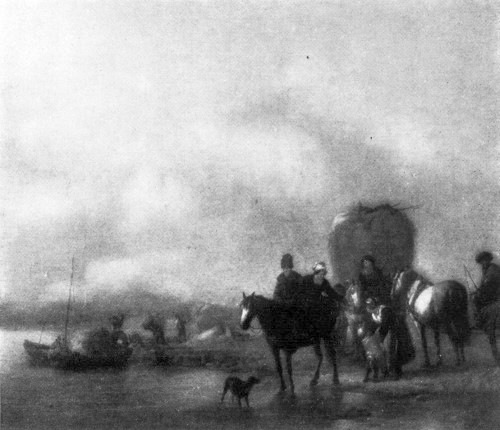
Description of The Hay-Wagon.—The Hay-Wagon is a popular work representing a large canal and a large hay-wagon drawn by two horses, and a man on horseback with a woman behind him on a pillion; farther away are seen men loading boats with the hay. In the foreground on the right are a woman with a little boy, a chariot drawn by a horse which is led by a peasant.
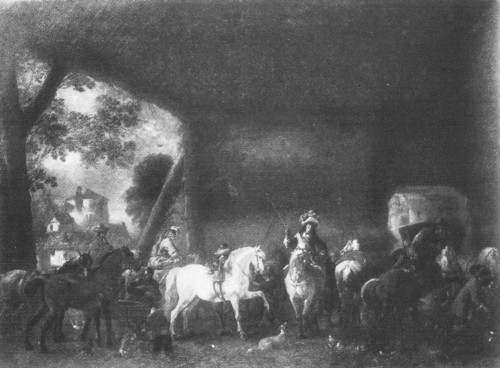
The Arrival at an Inn.—The beautiful Arrival at an Inn represents an inn and a barn. On the one side a coach is arriving, and on the left a mounted lady and cavalier. Others are getting booted and spurred and saddling mettlesome steeds prefatory for departure. In the left foreground, a dwarf, a charlatan, and a monkey, eating a simple meal, regardless of the bustle around them, give a touch of the life of the travelling mountebank. A handsome castle closes the view on the left.
P. WOUWERMANS The Arrival at the Inn
Crowe's Appreciation of Wouwermans.—"Wouwermans's authentic works are distinguished by great spirit and animation, and are infinitely varied and full of incident, though dealing recurrently with cavalry battle pieces, military encampments, scenes of cavalcades, and hunting and hawking parties. He is equally excellent in his vivacious treatment of figures, in his skilful animal painting, and in his admirable and appropriate introduction of landscape backgrounds. Three different styles have been observed as characteristic of the various periods of his art. His earlier works are marked by the prevalence of a foxy brown coloring, and by a tendency to an angular form in the draughtsmanship; the productions of his middle period have greater purity and brilliancy, and his latest and greatest pictures possess more of force and breadth, and are full of a delicate silvery gray tone."[6]
Reynolds on Wouwermans's Three Different Manners.—On his visit to the Royal Collection in 1781, Sir Joshua Reynolds was greatly impressed with the pictures of this artist, and said:
"Here are many of the best works of Wouwermans whose pictures are well worthy the attention and close examination of a painter. One of the most remarkable of them is known by the name of The Hay-Cart; another, in which there is a coach and horses, is equally excellent. There are three pictures hanging close together in his three different manners: his middle manner is by much the best; the first and last have not that liquid softness which characterizes his best works. Besides his great skill in coloring, his horses are correctly drawn, very spirited, of a beautiful form, and always in unison with their ground. Upon the whole, he is one of the few painters whose excellence in his way is such as leaves nothing to be wished for."
Johannes Lingelbach (1623-74), a native of Frankfort-on-the-Main, settled in Amsterdam on his return from Italy. He was frequently employed by Wijnants to insert figures and animals in his landscapes. He was a successful imitator of Wouwermans.
Crowe's Estimate of Lingelbach's Powers.—"Lingelbach's coloring, as was almost always the case with Wijnants's, and also with Wouwermans's in his latest manner, is characterized by a cool and often delicate silvery tone, which with him sometimes degenerates into coldness and want of harmony. In his flesh, especially, a cold red tone often prevails, added to which, neither in clearness nor impasto, does he equal the above-named masters. He ranks, however, high for skill in composition, good drawing, careful execution, to which is sometimes added a happy vein of humor. He may be studied under all his different aspects in the galleries of the Louvre, The Hague, and Amsterdam. Of the four pictures by him in the gallery of The Hague, the Italian Seaport, dated 1670, is remarkable for a power and warmth quite unusual in this painter."[7]
Examples showing the Variety of Lingelbach's Style.—The variety of his style is well exhibited in The Hague Gallery by four pictures of different dates. These are the Italian Seaport, with large figures, signed and dated 1670; the Departure of Charles II. from Scheveningen for England in 1660, a very rich, luminous, and fine work; a small Cavalry March, in which the little figures are beautifully executed and are thoroughly original; and a Landscape with a Hay-Wagon, much in the manner of Philips Wouwermans.
Weakness of the Mauritshuis in Marines.—The Mauritshuis is weak in marines: two by Willem van de Velde; three by Backhuysen, two by Abraham Storck, a view of the Amstel at Amsterdam by Torenburg (1737-86), a few Italian Seaports, and a few Beaches at Scheveningen painted by the landscape artists are all that the gallery owns.
Excellence of W. van de Velde's Marines.—Willem van de Velde (1633-1707) stands very high in the ranks of the marine painters of the seventeenth century. In the last years of that century we have artists like Simon de Vlieger, Jan van de Capelle, Hendrik Dubbels, and Abraham van Beyerex (in his rare marines); but Van de Velde is a master in his sphere, especially when he represents the calm sea under bright sunlight.
In his View on the Y we obtain enjoyment from the fine aërial perspective, the correct drawing of the ships, and the numerous little figures. The accuracy of the detail does not detract from the wonderful composition, the play of the sunlight on sail and water, and the beautiful sky, lightly flecked with clouds. Probably, the gaily decorated ship on the left is the yacht of the Princes of Orange; the boat which is being rowed away from it is bringing important visitors to shore, while the trumpeter on the ship loudly announces their departure.
Although not of the very first rank, this picture belongs to the best work of the master's middle period.
The other picture, of exactly the same size, is also identical in subject and treatment. Both are small. The other picture owned in the Mauritshuis is the Capture of the Royal Prince (June 18, 1666).
His Greatness as a Marine Painter.—"There is no question that Willem van de Velde the younger is the greatest marine painter of the whole Dutch school. His untiring study of nature of which his numerous sepia drawings are the best evidence, his perfect knowledge of lineal and aërial perspective and the incomparable technical process which he inherited from his school,—all these qualifications enabled him to represent the great element under every form, whether that of the raging storm, the gentlest crisping wind, or of the profoundest calm, with the utmost truth of form and color. Nor are his skies, with their transparent ether and light and airy clouds, less entitled to admiration than his seas; the surface of which he diversified, with the purest feeling for the picturesque, by various vessels, near and distant, which are drawn with a knowledge that extends to every rope. Finally his various lightnings create the most charming effect of light and shade. With this combination of qualities, so calculated to please a seafaring nation, it is no wonder that he should have become the most popular painter with the Dutch and English."[8]
The Fulness of his Knowledge of the Sea and Ships.—Both England and Holland, the two greatest sea nations, agree that Willem van de Velde was the greatest marine painter up to his time. In fact, no one had so well observed the motion of the waters, their breaking, or their repose; and no one knew so well the habits of sailors, the rigging of boats, their behavior and their variety. He knew how to make them picturesque, whether isolated between the sky and the water in the most beautiful lines, or in cleverly foreshortening them while they gently rock on the waves singly, or in picturesque groups. Nobody has better understood the profound calm of the ocean, or better expressed the emotion produced by an infinite horizon.
The Van de Velde Family.—The family was talented. Willem the Elder, born at Leyden in 1611, was a magnificent draughtsman, and taught his sons, Willem and Adriaen, drawing. Willem, however, became a pupil of Simon de Vlieger, and the pictures that he sent to his father, then in the service of the English king, astonished the Court. James II. sent for the young man and offered him a pension. In England he frequently colored his father's drawings; and on the Thames from Greenwich to London he had a great opportunity for the study of shipping.
The Simplicity of W. van de Velde's Pictures.—With very simple details, Willem van de Velde produces marvellous effects. He paints the ocean from the shore to the distant horizon; and this straight line is in beautiful contrast to the rounded clouds, while the severity of the tall masts is relieved by the curves of the puffing sails. Sometimes a group of fishermen on the beach or the end of a wharf of piles is seen in the foreground; but he more frequently begins his picture in the middle distance and gives the foreground up to waves slightly agitated or with a buoy tossing in the rising tide, in such a way as to suggest that the picture was painted not from the shore but from a vessel at anchor.
W. van de Velde compared with other Painters.—Sir Joshua Reynolds said: "Another Raphael might be born; but there could never be a second Willem van de Velde"; and Havard calls him "not only the greatest marine painter of the Dutch school, but also one of the greatest in the whole world." Blanc draws the following distinction between Van de Velde and Backhuysen: "Backhuysen makes us fear the sea, whilst Van de Velde makes us love it."
Backhuysen, a Painter of Ships and Shipping.—Backhuysen (1631-1708) probably owed his darker moods to his master Allart van Everdingen, who was a pupil of Pieter Molijn (1600-54), whose works are now so rare, and who was also one of the founders of Dutch landscape-painting. Backhuysen was a painter of ships and shipping, as well as of the sea, and had a practical knowledge of nautical matters.
Examples showing his Style.—Three pictures in The Hague Gallery afford good examples for study of his style. One, Entrance to a Dutch Port, dated 1693, shows an agitated sea, very remarkable for the happy distribution of sunlight and shadows of clouds upon the water, and broad yet delicate treatment; another is a View of the Wharf Belonging to the Dutch East India Company, and is dated 1696; and the third has for its subject The Landing of William III. of England in the Oranje Polder in 1692.
Imitators of Backhuysen.—Pictures by Jan van de Capelle and Jan Dubbels often pass for Backhuysen's; and another imitator is Abraham Storck, who is greatly inferior in elegance of touch. Good examples of Storck's style—a Marine and a Shore—hang in The Hague Gallery. Storck was much influenced by Lingelbach. The latter was also quite successful with his harbors and quays, with their shipping and human figures.
Simon de Vlieger as a Painter of the Ocean.—A greater painter, however, is Simon de Vlieger (1601-59), who is supposed to have studied under Jan van Goyen, and painted landscapes in the style of that master; he is famous for his marines. He frequently painted sea pieces which included the coast. He was the first to represent the ocean in its varying moods. His execution is free and soft, and his aërial perspective very fine. Like the majority of the Dutch painters he loved to paint Scheveningen. His Beach at Scheveningen, signed and dated 1643, is a fine example of his work.
The Diversity of his Subjects.—"De Vlieger often paints birds of the farmyard, which, both in truth and delicacy, are equal to anything produced either by Hondecoeter or Flamen. His horses, hares, and sheep may certainly pair with those of Van der Hecke, Jouckeer, or Jean Leducq; his pigs are observed differently from those of Karel Dujardin, but perhaps they are more true to nature because he has not put any malice or irony into his representation of them. The diversity of his subjects, the talent he displays in grouping figures and animals in an extensive landscape, or in a boat passing along a canal, or on the beach of Scheveningen where, in The Hague picture, we see them huddling together as if the ocean had just cast them ashore with its shells and fishes; the art of lighting them so as to delight the eyes without too greatly distracting the mind from the spectacle of vast nature and the infinite ocean—all that makes Simon de Vlieger one of the most remarkable Dutch masters."[9]
De Vlieger was as eminent in interiors, ruins, and processions as in marines and landscapes. He loved to frame familiar and rustic scenes in beautiful landscapes; and he had no need to call upon others, such as Barent Gael, Schellinkx or Van de Velde, for his figures, as so many of his contemporaries did.
Painters of Architectural Pictures: De Vries.—Pictures in which architecture forms the chief interest had their beginning with Jan Vriedeman de Vries, who devoted himself to the study of Vitruvius and Serlio. His works were very successful, though in the mannered taste of his time.
Hendrik van Steenwyck and his Son.—A scholar of his, Hendrik van Steenwyck (1550-1604), who became a master in Antwerp in 1577, painted chiefly interiors of Gothic churches of fine perspective, both lineal and aërial, and was the first to represent the light of torches and tapers on architectural forms. One of the very numerous Francken family usually added the human figures. His son Hendrik van Steenwyck was his pupil and follower, though he painted in a cooler tone and was inferior in all respects.
Pieter Neeffs and his Son.—Pieter Neeffs (1620-75), however, was the elder Steenwyck's best pupil. He followed him in style but excelled him in warmth of tone, power, and truthfulness in expressing torchlight effects. Many of his pictures contain figures by Frans Francken the younger, Jan Breughel, and David Teniers the elder. In the Mauritshuis we find a good example of Pieter Neeffs,—The Interior of a Church, with figures by Frans Francken III.
His son of the same name was his pupil and follower, but produced pictures of inferior merit. To this group belongs Bartholomew van Bassen, who painted interiors of the Renaissance churches and halls.
Van der Heyden's Architectural Paintings.—Jan van der Heyden (1637-1712) is "the Gerrit Dou of architectural painters." His subjects chiefly are well-known buildings, palaces, churches, etc., in Holland and Belgium, canals in Dutch towns with houses on their banks, fine perspective, the views selected with great taste. The trees are rather minute in foliage. The figures in many of his works were supplied by A. van de Velde, and after his death by Eglon van der Neer and Lingelbach. A View of the Church of the Jesuits at Düsseldorf, signed and dated 1667, is a valuable work. The figures are by A. van de Velde. "The warm, clear chiaroscuro in which the whole foreground is kept is admirable, while the sunlight falling on the middle distance has a peculiar charm."[10] He is also represented in The Hague Gallery by a still life.
Other Architectural Painters.—Other architectural painters are Gerrit Berckheyde, who painted exteriors of buildings in his own country, and occasionally interiors of churches; Jacob van der Ulft (1627-90), whose large picture in the Mauritshuis of troops marching has already been mentioned; Pieter Saenredam, whose works form a transition from the earliest architectural painters like Pieter Neeffs to the maturest expression of this class; Dirck van Deelen, a pupil of Frans Hals, who has a view of the Binnenhof with the last great Meeting of the States General; Emanuel de Witte, who, strange to say, was a pupil of Evert van Aelst, the painter of dead game and still life; Hendrik van Vliet, pupil of his father, Willem, who has an interior of part of the Old Church at Delft in the Mauritshuis, of peculiar warmth, brilliancy of effect, and delicate treatment of reflected lights; and last of all, Gerard Houckgeest (?-1655), who is represented by the Interior of the New Church at Delft and Tomb of William I. in the New Church at Delft.
The Excellence of Houckgeest's two Paintings.—"This almost unknown artist is a new proof of the astonishing efflorescence of excellent painters in Holland about the middle of the seventeenth century. Two views of the Interior of the New Church at Delft, in The Hague Museum, are on a level with the highest development of the school. It would be difficult to render the brilliancy and transparency of full sunlight more completely than in the one which contains the monuments of the Princes of the House of Orange. The other picture also, inscribed with the master's monogram, and 1631, is in every respect, and especially in the soft and full treatment, of the utmost excellence."[11]
Dou, Founder of the Leyden School.—The founder of the Leyden school of painters, Gerrit Dou (1613-75), is represented in the Mauritshuis by a masterpiece of the first rank, which is considered one of the gems of the gallery. It is known as The Good Housekeeper, The Household, and The Young Mother.
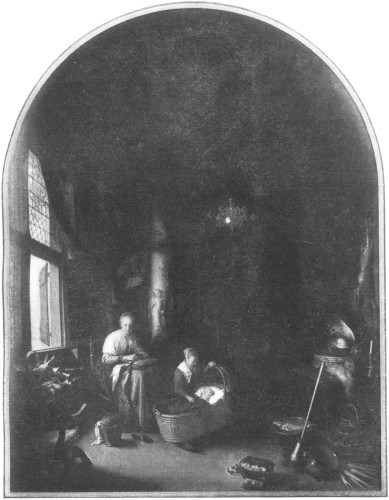
Description of The Good Housekeeper.—In a large room that serves as hall, dining-room, and sitting-room, as well as kitchen, is seated a lady, handsomely dressed in a morning costume. She has evidently just returned from market; for there is a plucked fowl in a basket on the window seat and an unplucked bird on the table, where a cabbage also lies. A hare hangs on the wall above, and below the table one notes a fish on a platter, and near a pot a bunch of carrots. A lantern has fallen on the floor in the foreground. The lady is sewing, with a basket beside her and a sewing-pillow on her knee; while a little servant watches the baby in its basket cradle. The pillar that supports the roof is carved, the brass chandelier is of splendid design, the draperies are heavy, and a coat-of-arms is painted on the windows. Everything betokens wealth and comfort.
The young mother looks at us in a very friendly way with her attractive little face. Our attention is first attracted to the group in the foreground; but gradually we admire the complete representation of all the little things around; the wonderful, finely expressed chiaroscuro, the beautiful stream of light, and the boldness of the shadowed yet plainly visible group in the background. The picture belongs to the artist's middle period and is dated 1658; and although it has darkened, it is still full of rich color.
GERRIT DOU The Good Housekeeper
The Good Housekeeper presented to Charles II.—When Charles II. left Holland for his Restoration in England, the directors of the East India Company could think of no finer present to offer him than a picture by Gerrit Dou, which they bought for 4,000 florins from M. de Bie. It was this very picture of The Good Housekeeper, which was afterwards brought back to Holland by William III. and hung in his castle at Loo.
Dou's Style imitated by his Pupils.—It is by such pictures that we test the numerous works of his pupils, which are now, and have been from the end of the seventeenth century, offered for sale as Dou's. Very early in life Dou made use of magnifying glasses, and with great care he ground his own colors. Sandart relates that he once went with Pieter de Laer to pay a visit to Dou, who was painting a broomstick "which was slightly longer than a finger-nail." When Sandart praised his great industry, he answered that he "had to work about three days longer on it."
His Devotedness to his Work.—When the weather was not fine, he stopped his work. He devoted his whole life to work. His palette, colors, and brushes he carefully protected from dust, which gave him much trouble; he put them away with the utmost care, and when he sat down to paint he would wait a long time until the dust had entirely settled. His studio was a large one with high lights, facing the north and looking out on the still waters of the canal.
His Fondness for Domestic Subjects.—He almost always depicts a view of the interior of a burgher's dwelling. He is the painter of nice, quiet domesticity, and his people almost invariably look gay and happy. When he attempts to portray strong emotions, his people do not look as if they felt them; even his Dropsical Woman in the Louvre is dying peacefully and with resignation. Dou was an excellent observer of all surroundings, and the slightest objects in his pictures are represented with the utmost completeness. Dou could readily please, and form a school, in a Northern and Protestant country, where people lead an indoor life, a silent, concentrated family life, where man is attached to his dwelling, adorns it with care, and closes it in, with the feeling of a sanctuary. In fact, Dou painted only familiar subjects on canvases or panels of small size, such as are suited to the small cabinet of a curieux, and he was one of the first to set in honor the most recherché style of painting in Holland,—that of little pictures executed in that precious manner which the French of the eighteenth century called the beau fini.
Dou and Rembrandt contrasted.—Dou differed greatly from his master, Rembrandt. The one had the fire of genius; the other had patience. Even when Rembrandt highly finished his pictures, he knew when to neglect some accessory, to sacrifice some detail to the expression of the essential parts, and thus to give full value to everything in the picture that could appeal to the heart or interest the mind. Dou, on the contrary, applying himself to what he considered the last word of painting, tried to give equal importance to everything that entered into his composition, without admitting any of those negligences that are often such happy artifices, and taking as much care in the finish of a pewter pot as in expressing the feeling in a woman's features, or the thought in a man's physiognomy. Therefore, Dou's natural tendency, instead of being modified by Rembrandt, became only more pronounced. As his master broadened, his manner grew more smooth and polished.
The Fruit of Dou's Precautions.—His care in making his own brushes, colors, and varnishes, and his precautions to keep his wet canvases free from dust (he chose a studio overlooking stagnant water) have been rewarded by the present condition of admirable preservation of his pictures. His minuteness wearied his sitters and he soon failed as a portrait-painter. It is related that he made a distinguished Dutch lady, Madame Spiering, pose five days for her hand alone.
He forsakes Portraits for Scenes in Common Life.—As his sitters left him one after another, Dou devoted himself entirely to represent the scenes of common life without giving himself any trouble in selection, being sure that in them he would find opportunities to display his veritable genius, that of detail. He was content to take what first offered as a subject, and the circle of his invention did not go beyond that. He simply observed life in the neighboring shops: the pepper-seller, when she is dangling the scales with the tips of her fingers; the marketwoman verifying the transparence of her eggs by the light of a candle, and the mysterious interior of the barber-surgeon. If he sees in the street a servant coming home from market loaded with vegetables, counting what she has spent and what she is going to steal from the change, there is a picture already made. In the public square he stops to study the faces of the simple dupes gathered around a charlatan vaunting his elixir, teaching the practice of love-philtres, and drawing teeth painlessly. His artist's eye finds motives readily at hand; sometimes in the room of the embroiderer, absorbed in her needlework; sometimes in the juvenile schoolroom, where the martinet overawes his frolicsome pupils. He also delights in representing the joys of the domestic hearth, that ever simple and ever charming picture of the mater familias busy with household cares, while the children are rolling about on the floor at their grandmother's feet. Finally, he sometimes goes so far as to be malicious and to complicate the picturesque accidents of a winding staircase which a woman descends softly to surprise her husband in the kitchen with the servant.
The simplicity of trivialities Dou made the subject of the finest and most precious pictures in the world. The Herring Seller is as finely and minutely painted as The Philosopher in Meditation.
He preferred Interiors to Open-Air Scenes.—Dou seldom painted open-air pictures. Interior light suited him better; and moreover he had learned chiaroscuro from Rembrandt. However, one of his most famous pictures, The Charlatan (in the Old Pinakothek, Munich), is an exception.
"Upon the whole, the single figure of the Woman Holding a Hare, in Mr. Hope's collection, is worth more than this large picture, in which perhaps there is ten times the quantity of work."[12]
His Foreground in Many Cases bordered by a Window.—His small pictures of one or two figures were usually framed by a window. He has often painted his own portrait thus, sometimes holding a trumpet, and sometimes playing a violin. Having once found this natural border, the painter framed all his models with it. To-day we see the girl with beautiful blond hair blowing soap bubbles and smilingly watching the prismatic globes rise in the air; to-morrow, the pretty girl who is not sorry to have on her window-sill more than one pretext for showing herself,—the canary-cage, hanging outside; a letter to read; a pot of geraniums to water, and what not. And this fresh face, which has for a background the transparent shadow of a room wherein a group of people are conversing, comes forward to be gracefully framed by the vine that runs along the sash, and with its contours relieves the cold regularity of the architecture.
It is certain that this patient imitator of nature must have been very industrious, if we may judge from the number of his pictures and the time he devoted to each. His pupil, Karel de Moor, says so. The pronounced liking of his countrymen for his pictures left him no repose.
The Best Example of his Candle-light Scenes.—He frequently painted by the aid of a concave mirror, and to obtain exactness, looked at his subject through a frame crossed with squares of silk thread. The Evening School, in the Amsterdam Gallery, is the best example of the candle-light scenes in which he excelled. President van Spiering of The Hague paid him 1,000 florins a year simply for the right of preëmption.
Godfried Schalcken, Pupil and Imitator of Dou.—The other picture credited to Dou, A Young Woman Holding a Lamp in her Hand, and which was so greatly admired by Sir Joshua Reynolds, is thought to be by Godfried Schalcken (1643-1706). Those who are curious on this question may turn to a picture by Schalcken called a Lady at her Toilette, by candle-light, an effect which he was so fond of painting.
His Device for securing Candle-light Effects.—Schalcken was a pupil of Dou, under whom he acquired delicacy of finish and skill in the treatment of light and shade. He gained a reputation for his small domestic scenes, chiefly with candle-light effects; and, to treat these accurately, he is said to have placed the object he intended to paint in a dark room with a lighted candle and peeping through a small hole painted by daylight the effects he saw. A pupil of Samuel van Hoogstraaten and Gerrit Dou (who were pupils of Rembrandt), he became an imitator of the latter, following him in his depth of tone, extreme finish, and preference for night scenes.
Schalcken's Weakness in Drawing.—Blanc says he was aware of his weakness in drawing, particularly the extremities of the human body, and this was one reason he liked partly to conceal his subjects in shadows and half-lights. His master, Dou, had made a sensation with his Evening School (in the Rijks) in which the effect of candle-light is treated with such skill; but what was a caprice with Dou, Schalcken made a habit. His pictures are a series of fantastic scenes and illusions. This painter saw the night only; his pictures whether mythological, historical, religious, or commonplace scenes, are always nocturnal ones. Blanc says: "His brush was a permanent candle."
His Great Popularity.—Schalcken, however, attained an enormous vogue, and many of the wealthy Dutch had their portraits painted by him, pleased with the mysterious or piquant light he threw upon them. He went to London, where he painted William III. with a candle in his hand. This is now in the Rijks. Schalcken found Kneller too strong a rival, and returned to Holland, having, however, acquired a good deal of money. The Mauritshuis also contains four others of his pictures: a Portrait of William III., King of England; La morale inutile; A Visit to the Doctor; and a Venus.
The Best Examples of Ostade's Work.—Among the best recognized examples of Ostade's work are: The Fiddler and his Audience (1673) and Peasants in an Inn (1662), in The Hague; The Village School (1662), in the Louvre; the Tavern Courtyard (1670), at Cassel; and The Sportsman's Rest (1671), at Amsterdam.
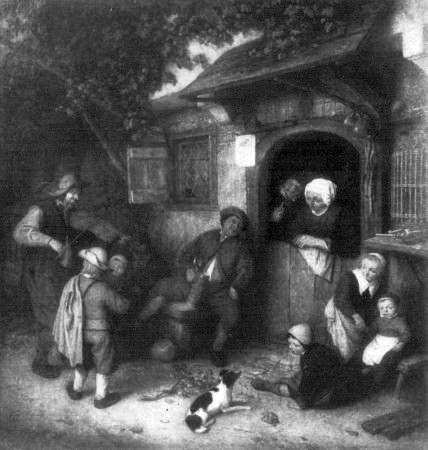
Description of The Fiddler.—One of the gems of The Hague Gallery is The Fiddler by Adriaen van Ostade (1610-85). The old dilapidated inn with its broken casement window is picturesque because of the graceful festoons of vine-leaves that grow above the roof and penthouse. A wandering fiddler is playing to the innkeeper and his wife, who lean over the door, while five children and a dog are variously grouped. A young man with a large tankard in his hand also enjoys the music in his lazy position.
A. VAN OSTADE The Fiddler
Description of Peasants in an Inn.—"Peasants in an Inn was painted in 1662; but it exhibits all the qualities of Ostade's best work. The figures are drawn true to life. Very charming is the poodle gazing with great interest at the child, who is eating his bread and butter. By allowing the full daylight to fall from the left through the door while the background is lighted by a high window, Ostade gives himself every opportunity to express his chiaroscuro as beautifully as he desires. The little pot on the tree-trunk and all the other still life of this picture forcibly remind us that Ostade was an unusually great master in this field. His small pictures of still life, principally representing pots and other kitchen stuff, are pearls of the first water; but they are somewhat rare. The coloring of this picture is warm, but it melts into cool tones, which we find still more strongly in The Organ Grinder of the same gallery, which was painted eleven years later."[13]
The Demand in Marriage, painted between 1650 and 1655, also hangs in the Mauritshuis. This picture is owned by Dr. A. Bredius.
Ostade's Pictures Generally taken from Low Life.—The number of Ostade's pictures as given by Smith is 385; but it is thought that he painted even more. About 220 pictures have been traced in public and private collections.
Adriaen Ostade was the contemporary of David Teniers and Adriaen Brouwer, and, like them, chiefly devoted himself to painting rustic and village life, tavern and gambling scenes, brawls and open-air games. Smokers, drinkers, fish-wives, quacks, strolling musicians, itinerant players, wood-cutters, children at play, alehouse-keepers and their wives, all find sympathetic treatment. Like Brouwer, Ostade wandered about the towns and country, finding his models in the taverns and cottages.
Increase in the Value of his Pictures.—He painted with equal vigor at all times; and so highly appreciated is he that pictures worth little in his day now bring large sums. For instance, in 1876 Earl Dudley paid £4,120 for a cottage interior. According to Houbraken, Ostade was a pupil of Frans Hals, while he was also teaching Brouwer.
Crowe's Opinion of Ostade's Style.—"There is less of the style of Hals in Adriaen Ostade than in Brouwer, but a great likeness to Brouwer in Ostade's early works. During the first years of his career, Ostade displayed the same tendency to exaggeration and frolic as his comrade. He had humor and boisterous spirits, but he is to be distinguished from his rival by a more general use of the principles of light and shade, and especially by a greater concentration of light on a small surface in contrast with a broad expanse of gloom. The key of his harmonies remains for a time in the scale of grays. But his treatment is dry and careful, and in this style he shuns no difficulties of detail, representing cottages inside and out, with the vine leaves covering the poorness of the outer side, and nothing inside to deck the patch-work of rafters and thatch, or tumble-down chimneys and ladder staircases, that make up the sordid interior of the Dutch rustic of those days. His men and women, attuned to these needy surroundings, are invariably dressed in the poorest clothes. The hard life and privations of the race are impressed on their shapes and faces, their shoes and hats, worn at heel and battered to softness, as if they had descended from generation to generation, so that the boy of ten seems to wear the cast-off things of his sire and grandsire. It was not easy to get poetry out of such materials. But the greatness of Ostade lies in the fact that he often caught the poetic side of the life of the peasant class, in spite of its ugliness and stunted form and misshapen features. He did so by giving their vulgar sports, their quarrels, even their quieter moods of enjoyment, the magic light of the sungleam, and by clothing the wreck of cottages with gay vegetation."[14]
Ostade the Greatest Dutch Painter of Peasant Life in his Day.—Adriaen van Ostade is rightly regarded as the greatest of the Dutch painters of the seventeenth century who represented the peasant life of that day. In song and dance, weddings and kermesses, at bowling, love-making, and drinking, Ostade always was an observer of country folk, although he himself was a townsman, and held a rather exalted position in the world. His second wife seems to have raised him into a very high social class of Amsterdam families, as numerous records of executions of wills, which the painter must have signed in Amsterdam, inform us. To some extent, his peasants involuntarily progress parallel with the force of his own life. In his earliest pictures, when Ostade was still a modest artist, his peasants are also still quite peasant-like; in his tavern-scenes things are still very lively. Later, when the painter became closely related to refined and well-to-do patricians, his peasants also became more prosperous and polite; in a word, more decorous. Unfortunately, his painting also became somewhat more polished and smooth, so that the early pictures, and particularly those of the middle period, more strongly delight the heart of an artist than the cool, smooth works of the later period. Ostade is eminent in his coloring, chiaroscuro, and composition: he knows how to arrange his groups in the most spontaneous and natural manner; and truly artistic is his method of illumination, for which, knowingly or unknowingly, he has to thank Rembrandt. In his earliest pictures, which have a somewhat cold tone grading into gray, reminding us of his teacher Hals (from 1631 to 1640), there still remains some local color. The subjects, mostly peasants in poor homes or in the tavern, are energetically conceived. Bode rightly says:
"Instead of the pleasant humor and the poetry of the prosperous middle class which are common to the later pictures, these earlier works display an effort for characterizing according to life and movement; a keen humor in the spirit of Hals and Brouwer; and, particularly, a characteristic inquiry into the separate individualities, such as the lifelike representation of an expressive scene, the feasting, round dances, and fighting of his jovial peasant folk."
Bredius on the increasing Brightness of his Pictures.—"He died in 1685. Before 1640 his chiaroscuro was already finer, and between 1640 and 1655 (his flowering-time) many of his pictures show no traces of Rembrandt's influence. The tone of his works was quite different and approaches a warm brown; the chiaroscuro, as, for instance, in his well-known Painter's Studio in Amsterdam; and later, very closely repeated (Dresden, 1663), attains the highest degree of freedom; then his pictures become somewhat slowly cooler, the tone gets constantly grayer, but the drawing always remains strikingly correct, the grouping natural, and the pictures become brighter, smoother, and more polished. In the meantime Ostade had become a finer, more respectable gentleman. Well on in years, he could leave this life without worry, and was buried at Haarlem by his admirers and pupils on May 2, 1685."
Ter Borch's Freedom from Grossness.—Ter Borch (1617-81) is excellent as a portrait-painter, but still greater as a painter of genre subjects. He depicts with admirable truth the life of the wealthy and cultured classes of his time, and his work is free from any touch of the grossness which finds so large a place in Dutch art. His figures are well drawn and expressive in attitude; his coloring is clear and rich, but his best skill lies in his unequalled rendering of textiles in draperies.
The Elegance of his Sitters.—Ter Borch was not only an excellent painter of Conversations, he was, indeed, the creator of his genre. With a little less wit and a little less taste, perhaps, than Metsu, he charms you with his family concerts, his tête-à-tête lovers, his light afternoon repasts, and in selecting for heroes the most elegant cavaliers of the world in which he lived. His pretty pages with great puffed sleeves striped with velvet, and those blond ladies with transparent complexions, plump hands, and round waists, constitute a type that no artist has so well represented as Ter Borch. Before depicting these delightful and familiar scenes, he first learned to imitate all that could add to the charm of these pictures of private life,—silken draperies, Turkish rugs, leather, ermine, velvet, and satin,—more particularly satin, and white satin above all else. The most striking example we shall see at the Rijks, in the picture called Paternal Advice, known also as the Robe de Satin.
Resemblance between his Paintings and those of Metsu.—There is so much resemblance between Gerard Ter Borch (or Terburg) and Metsu that at first it is hard to distinguish them. Their subjects are much the same; for instead of painting scenes of low life—inns with carousing peasants, etc.—both turn with sympathy to high life; sujets de mode is the name given to their works in which satins, velvets, silks, and lace, rich robes and mantles, elegant hangings, and table-carpets figure so largely.
The Difference between Ter Borch and Metsu.—The difference between Ter Borch and Metsu is defined by Blanc, who says it is the difference between bonhomie and finesse; the one is naive and gracious, the other ingenious and piquant. Both, however, are charming in the way they introduce us into a house and show us some little comedy that is being played by the unconscious lovers, family group, or party of friends. Like Metsu, Ter Borch is particularly fond of making music a motive of his pictures. A timid love often expresses itself to the notes of a mandolin or lute; sometimes we surprise a musical party singing and playing instruments; a lady composing music or trying a new piece for the first time, while her gallant and richly dressed lover stands by her side. Sometimes we see a young lady quite alone in jacket of puce-colored velvet plucking her lute, which rests on her satin skirt. Sometimes again the conversation takes place in front of a clavecin, where the lady's hands are painted in correct position, though she pauses to hear what her lover has to say, while her spaniel sleeps on the foot-warmer.
Ter Borch's Conversations characterized.—"Pretty little dramas," Blanc calls these Conversations of Ter Borch, "dramas without action or noise, which excite the thought only, and whose intrigue consists only in a clasp of the hand, the lowering of an eyelid, or the exchange of a glance and a smile." He also calls attention to the type of woman represented by Ter Borch, Van Mieris, and Metsu, all of whom have high foreheads on which a few little curls wander, like those made fashionable at this period by Ninon de Lenclos, and known as "boucles à la Ninon."
The Women of Ter Borch's Pictures.—The women of Ter Borch's pictures are like Rousseau's pen-portrait of Madame de Warens, who
"had an air caressing and tender, a very gentle glance, ash-colored hair of uncommon beauty, which she arranged in a very négligé style that produced a piquant effect. She was small and a little thick in the waist; but it would be impossible to find a more beautiful head or a lovelier bust, hands, and arms."
Dr. Bredius, who calls attention to Ter Borch's position in the hall of fame as singular in the fact that he has never been assailed by critics, nor, on the other hand, sufficiently appreciated, says:
"Without striking originality, without any commanding dramatic quality, without humor, and without any startling light effects, Ter Borch is yet entitled to the name of the first genre painter of Holland,—indeed, of all schools,—merely by his perfect talent and fulfilment as an artist. Rightly is Ter Borch called the most eminent painter of the Dutch school. Not only does he paint high society almost exclusively, but he does it in a distinguished style. The pose of his figures, the composition of his picture, the fine color, the admirable drawing, all breathe an elegance which is not met with elsewhere in the Dutch school. Thereby, he is the one and only master of his subject. What he paints is always completed to the highest degree. We never find in him a trace of effort. What he does must be so and not otherwise. We look for humor in him in vain; but nobility we always find, and not least in his likenesses, which, notwithstanding their small dimensions, are 'the last word of a portrait.'"
TER BORCH The Despatch
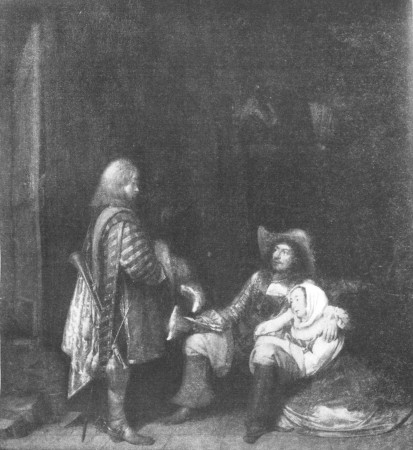
Description of The Despatch.—The Despatch, dated 1655, belongs to his second period. On a low chair beside a table on which stand a decanter and beaker, an officer is sitting with his wife or sweetheart. She is sitting on the floor reclining against his knee. Both are young. He holds the despatch in his hand and she looks somewhat distressed. In front of them stands the trumpeter, who, it appears, has brought the message. The officer is fully dressed, and on the table beside him lie his weapons.
His own Likeness, painted by Himself.—The other picture of Ter Borch's in this gallery is his own likeness, painted by himself about 1660. He is dressed entirely in black and stands out strongly against a gray background. He wears a large wig, the curls of which shade his rather melancholy face, distinguished by a long nose and grayish moustache. It was probably painted while Ter Borch was a burgomaster of Deventer.
Caspar Netscher's Family Group.—Much in the same style as Ter Borch's Conversations is Netscher's Family Group. Caspar Netscher (1639-84) was a pupil of Ter Borch, and this is one of the best works of his best period. The painter, in a red slashed jacket, is accompanying on his lute his daughter, who is singing, and whose timidity is well expressed. She wears a dress of white satin and has feathers in her hair. On the other side of the table covered with a Persian carpet, and in the half light, sits Netscher's wife. On the back of the arm-chair in which Netscher is sitting is his signature and the date 1665. Netscher is also represented by two portraits—Mr. and Mrs. Van Waalwijk.
Few Examples of Metsu.—Metsu, like many other Dutch masters, is poorly represented in the great public galleries of his own country. While The Hague Gallery has but three and the Rijks only four, the Louvre, for example, has eight and Dresden six.
Those who have seen pictures by Metsu (1630-67), Ter Borch, or Caspar Netscher, will have a better knowledge of the customs and costumes of the upper classes at the period of the Stadtholders, their faces, their polished manners, their interiors, and even their thoughts, than if they had read many books of travel, whole volumes of geography, description, and history.
The Rich Dutchman as painted by Metsu.—As he appears in the pictures of Gabriel Metsu, the rich Dutchman is domesticated, methodical, and well regulated in his life. His house is the universe for him. In this cherished and well-arranged abode, he concentrates as many joys as the ancient kings of Asia assembled in the palaces of Susa or Ecbatana. His country's and his own ships have "ploughed the sea from end to end, penetrating to Japan for porcelain and amber, and bringing back from Goa pepper and ginger." From the ends of the earth have come to him all things that could charm his family life and distract the melancholy that the sad nature of the North and its long winters inspire. Asia has sent to him her muslins, spices, and diamonds; the polar ice has furnished him with the furs that edge the velvet robes which his wife and his eldest daughter wear indoors. The birds, insects, shells, and mineral specimens of the most distant climes fill his cabinet, carefully arranged under glass. In his gardens flourish rare plants, the choicest flowers and bulbs cultivated by himself or under his own eyes. His furniture, of exquisite taste and workmanship, carefully looked after and incessantly cleaned, does not suffer by the changes of fashion; it is transmitted from father to son, and lasts for generations. His alcove bed is supported by ebony columns and closed in with green damask curtains. Hanging from the ceiling, a candelabrum of gilt bronze spreads its branches twisted into elegant volutes. The floors are waxed till they are a pleasure to the eye, the windows are polished, the door-knob is shining, the furniture gleams like a mirror, and yet the daylight falling through lightly tinted taffeta curtains sheds over all these objects only a soft, moderate, and harmonious radiance.
How Metsu depicts the Manners of the Dutch.—"The manners of Holland, as well as its material physiognomy in civil life, its interiors, its furniture, the decoration and luxury of its apartments, are all written down in Metsu's pictures with charming clearness, which is all the more pleasing since this merit seems to be involuntary in the painter. After two hundred years, his work may serve for the complete reconstitution of a well-to-do interior as it was composed in the seventeenth century by the climate of the country, the character of its inhabitants, and the historic circumstances in the midst of which the Dutch merchants, the masters of the commerce of the world, then lived.
"By Metsu's favor we are able to penetrate into those interiors which are so jealously closed to strangers. Most often it is by a window that serves as a frame for his picture that Metsu gives us access to the boudoirs of fashionable ladies, and makes us take them by surprise, sometimes in velvet déshabille writing their secrets; sometimes finishing their toilette in view of a hoped-for visit; and sometimes breathing over the keys of their clavecin the sighs of their hearts and the thoughts they do not express."
His Carefulness in selecting Details.—"Metsu rarely paints an interior without introducing the pet spaniel of the period, which often contributes much to our comprehension of the scene by the character of its attitude.
"There are some Dutch masters who unintelligently accumulate innumerable details everywhere. They make a picture of manners the pretext for a ridiculous display of furniture, crystal, lustres, chinoisarie and curiosities of every kind; their interiors resemble bazaars. Metsu puts beside his subjects only those details necessary to make the intrigue clear, and to explain the conversation.
His Treatment of Still Life.—"However great may have been his talent for painting still life, he never allowed himself to be carried away, like so many others, by that vulgar pleasure; but, on the other hand, what finish! what a precious touch! And then how he loves to give full value to the beauties of local color, or to shade a Turkey carpet, or to grade down the lights on gold and silver vases. What pleasure he takes in the Bohemian glasses and the transparent liquors that half fill them! The glasses in his pictures have great importance, for the life of a retired Dutchman is spent in continual smoking and drinking; but in Metsu we no longer see the Pantagruelesque glasses of several stages that Van Ostade's peasants always have in their hands; these are fine and more discrete glasses, of elegant form, tall and oblong glasses in which the Haarlem beer froths; glasses cut and fashioned in twenty different ways, octagon glasses each facet of which ends with a curve and which cut the light with their sharp edges, or glasses the calyx of which forms a reversed cone on a heron's claw, or elongates into a swan's neck, and finishes like a trumpet; lastly, the glasses of the grandparents, sometimes of an imperishable thickness and solidity, sometimes as delicate, light, and thin as an onion skin."[15]
Favorite Subjects.—Metsu is fond of representing the patricians of his day and their womankind either in pleasant entertainment, or, more frequently, in individual figures engaged in quiet work. A picture of this class is The Amateur Musicians. The lady on the left is very quietly playing her instrument with the same sense of repose that is expressed by the lady who seems to be writing down the notes. Only on the face of the elegant gentleman standing behind her chair is painted a merry, almost roguish, smile.
METSU The Amateur Musicians
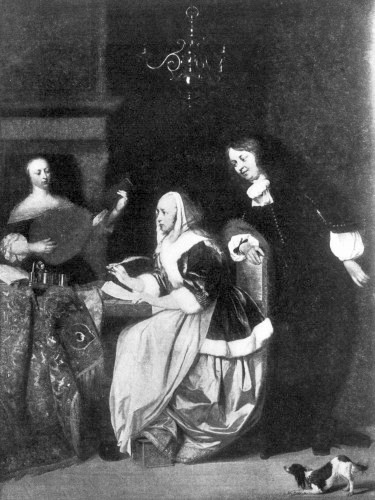
The Elegance of Metsu's Figures.—The figures are drawn with certainty; the artistic handling of the subject is remarkable; and a fine feeling for color is shown in the selection of the tones. In Metsu's figures we notice an elegance and a nobility which are not found elsewhere except in Ter Borch.
The Influence of other Artists on Metsu.—It is strange that the earliest works of Metsu, which are the most broadly painted ones, show little of Dou's influence, which is always so unmistakable in his pupils, so that Bode believes he finds in them the working of Hals's influence; and, in fact, the large pictures of Metsu's early period are painted with a broad brush in Hals's gray tones. When Metsu removed to Amsterdam, he fell more under Rembrandt's influence, and the beautiful chiaroscuro of his later works incontestably proves this.
His Miscellaneous Works.—Metsu's Biblical and allegorial pictures are the least important of his works. Besides The Amateur Musicians, signed by Metsu, the Mauritshuis possesses a fine Portrait of a Huntsman dated 1661, and a great academical, constrained allegory of Justice Protecting the Widow and Orphan, a picture that was found in the vestibule of a house in Leyden in 1667. It was painted in 1655.
Crowe, who does not believe that this "rough and frosty composition" is the work of Metsu, says:
"What Metsu undertook and carried out from the first with surprising success was the low life of the market and tavern, contrasted with wonderful versatility by incidents of high life and the drawing-room. In each of these spheres he combined humor with expression, a keen appreciation of nature, with feeling and breadth, with delicacy of touch, unsurpassed by any of his contemporaries. In no single instance do the artistic lessons of Rembrandt appear to have been lost on him. The same principles of light and shade which had marked his school work in The Woman Taken in Adultery[16] were applied to subjects of quite a different kind. A group in a drawing-room, a series of groups in the market-place, a single figure in the gloom of a tavern or parlor, was treated with the utmost felicity by fit concentration and gradation of light; a warm flush of tone pervaded every part, and, with that, the study of texture in stuffs was carried as far as it had been by Terburg, or Dou, if not with the finish or the brio of De Hooch. Metsu's pictures are all in such admirable keeping and so warm and harmonious in his middle, or so cool and harmonious in his closing time, that they always make a pleasing impression. They are more subtle in modulation than Dou's, more spirited and forcible in touch than Terburg's; and, if Terburg may of right claim to have first painted the true satin robe, he never painted it more softly or with more judgment as to color than Metsu."
One of the best pictures of Metsu's middle period is The Market Place of Amsterdam, in the Louvre.
Two Fine Portraits by F. van Mieris.—Frans van Mieris (1635-81) reached the highest rung of art in his portraits, of which The Hague Gallery possesses two fine examples. One is of Florentius Schuyl, Professor of Medicine and Botany in the University of Leyden, painted in 1666, and a still more important picture of the painter himself and his wife. He has made a charming genre picture of it, which Sir Joshua Reynolds admired, not knowing who the characters were. The artist shows himself standing and pulling the ear of the beautiful little dog which his wife holds in her lap, while, to protect her pet, she gently wards off her smiling husband with her right hand. The little dog's mother is trying to spring into the lady's lap in order to take care of her offspring. Both the drawing and modelling here are masterly, and endow the scene with such charm that this work must be pronounced one of the best by his brush. The tablecloth and the lute lying upon it are beautifully painted.
Description of Soap Bubbles.—Sir Joshua also noticed the picture of Soap Bubbles dated 1663, representing a boy at an open and vine-framed window, blowing bubbles that are exquisitely painted and show beautiful reflections and prismatic colors. His red hat with white plumes is lying on the window-sill, near a bottle containing a sprig of heliotrope, and above hangs a cage. Behind the child in the half-light stands a young woman with a dog in her arms. On the window-frame is written the date in Roman numerals. Willem van Mieris often imitated this composition of his father's, who frequently repeated it himself.
Pictures by Van Mieris Full of Refinement.—Van Mieris takes us into an elegant world, although he himself was fond of low life, a heavy drinker and the companion of Jan Steen. He was the son of a goldsmith and diamond-setter of Leyden, who wanted him to follow his business. He was naturally influenced by his earliest surroundings, and in his father's shop became familiar with the dress and manners of people of distinction. His eye was also fascinated by the sheen of jewelry and stained glass. Houbraken writes:
"Seeing his talent for painting his father placed him with Abraham Torenvliet, a famous glass painter and a good draughtsman. From him he passed to the school of Gerrit Dou, where in a short time he eclipsed every one and gained the affection of the master, who loved to call him 'the prince of his pupils.' At the end of a few years, his father sent him to the historical painter Abraham van Tempel; but he did not remain long with him, for his natural taste would allow him to follow no other manner than that of Gerrit Dou,—a manner extremely finished, demanding attention and excessive care."
His Love of Elegant Accessories.—Houbraken calls Metsu a painter of sujets de mode. This term applies also to Frans van Mieris; for certainly with him costumes, materials, and accessories play an important part. If his people were less attractive one might imagine that they were only a pretext for showing off the velvet jackets, satin skirts, and rich furs. Very often Van Mieris shows us a spacious and magnificently decorated hall, in the background of which a richly dressed lady and her lover are walking; again he allows us to peep into a charmingly furnished room where a lady in white satin is playing the lute to entertain her guest, a handsome cavalier in black velvet; or we surprise a lady as she is about to drink a glass of wine which a page offers her on a silver salver. At other times we find a group of ladies and gentlemen about to enjoy a light repast; or see a table invitingly spread with luscious fruit in rich silver dishes; or watch a lady feed her parrot. Sometimes the pet monkey is discerned behind the looped-back curtains of taffetas. Frans van Mieris seldom chose panels above 12 by 15 inches in size. He never ventured to design life-sized figures.
The Kind of Subjects he treated Best.—"Characteristic of his art in its minute proportions is a shiny brightness and metallic polish. The subjects which he treated best are those in which he illustrated the habits or actions of the wealthier classes; but he sometimes succeeded in homely incidents and in portraits, and not unfrequently he ventured on allegory. He repeatedly painted the satin skirt which Terburg brought into fashion, and he often rivalled him in the faithful rendering of rich and highly colored woven tissues. But he remained below Terburg and Metsu, because he had not their delicate perception of harmony, or their charming mellowness of touch and tint; and he fell below Gerard Dou, because he was hard and had not his feeling for effect by concentrated light and shade. In the form of his composition, which sometimes represents the framework of a window enlivened with greenery, and adorned with bas-reliefs, within which figures are seen to the waist, his model is certainly Gerard Dou."
His Lack of Humor.—"It has been said that he possessed some of the humor of Jan Steen, who was his friend, but the only approach to humor in any of his works is the quaint attitude and look of a tinker in a picture at Dresden, who glances knowingly at a worn copper kettle which a maid asks him to mend.... If there be a difference between his earlier and later work, it is that the former was clearer and more delicate in flesh, whilst the latter was often darker and more livid in the shadows."[17]
Blanc says:
"Among so many Dutch painters who copy nature it is very pleasant to find one who deigns to select his models, and who, preferring grace to ugliness, would rather paint beautifully women elegantly dressed than magots. Strange, indeed! He loved distinction, yet lived in a tavern; he loved luxury, and was soon ruined; and, in spite of a life devoid of dignity, Van Mieris always kept a love of beauty and elegance, as is shown in his delicate faces, fine complexions, beautiful hands, grace of attitude, taste in costume and furniture, and choice of splendid materials."
Willem van Mieris.—The Grocer's Shop, by his son and pupil, Willem van Mieris (1662-1747), signed and dated 1717, also hangs in The Hague Gallery. In extreme finish and minuteness of painting, this picture would not disgrace Mieris the Elder or Gerrit Dou.
Its Wealth of Still Life.—You see only two figures, a young boy who is buying and a young woman who is selling; but these figures are of no more importance than the foods of all kinds exposed in the shop, on the sill of the window, and outside. The lower part of the window is decorated with a bas-relief, representing Cupids playing with a bird. This bas-relief is half hidden by a superb piece of tapestry, on which the painter has placed a basket of dried fruits. Great bags of grain, peas, and beans, and everything that is sold by the bushel are exposed on the pavement of the street, with a bucket and some tubs filled with olives, sardines, and anchovies. On the wall hang a basket and a bird-cage, and a magnificent damask curtain with large flowers falls in graceful folds from an outside ring. Among the innumerable details of the shop you note a little rat gnawing at the grains which have fallen through a hole in one of the sacks.
The pendant to this picture hangs in the Louvre, where it is called Marchande de Volailles.
W. van Mieris influenced by his Father and by G. de Lairesse.—Willem van Mieris was a pupil of his father, and at first had no other ambition than to imitate his style and produce those charming Conversations in which rich furniture, shining chandeliers of brass or copper, Japanese porcelains, silken curtains, Turkish table-carpets, flowers, and elegantly dressed people make a somewhat restricted, although delightful, world. Willem, falling under the influence of Gérard de Lairesse, who was much in vogue in Holland, selected such subjects as a young lady playing on the clavecin, or making lace, or walking in the country in a lilac satin robe with large sleeves that reveal through their slashes a beautiful arm, and a straw hat ornamented with a sweeping plume. Becoming a shepherdess this attractive lady next sits in his pictures with bare feet, in the shade of an oak, and beside her Corydon talks of love.
His Success with Mythical and Biblical Subjects.—Next he turned his attention to subjects from fable, romance, and mythology; and Diana, Armida, Cleopatra, Bacchus, Jupiter, Tarquin, the Sabines, etc., fill his panels or copper plates, which were hardly larger than your hand. Biblical and religious subjects occupied him for a time and then he again turned pagan. His success grew greater every day, and his Dutch patrons who loved scenes of familiar life demanded from Van Mieris pictures in the style of his famous father—those charming genre pictures still being produced by Slingelandt, Van Tol, and other imitators of Gerrit Dou.
A Window-frame his Favorite Setting.—Like Gerrit Dou, Willem van Mieris selects a window-frame of stone, which he often decorates with graceful creepers or a bouquet of tulips or jonquils placed on the sill, or throws over it a bright piece of tapestry. From it a blond lady leans to flirt with the unseen passer, a child blows bubbles, a portly dame waters her flowers; or the artist himself sits calmly by. When tired of this, Willem van Mieris takes us to his favorite shop.
Arie de Vois.—Among the portraits one must not fail to notice the picture of A Huntsman Holding a Partridge by Arie de Vois (1630-80). This was originally in the collection of William V. and was bought for 1,210 florins. His pictures are so rare that we are not surprised that the Mauritshuis contains but one example. The Rijks is more fortunate in owning four by this delightful painter.
Abraham de Pape's Style.—Abraham de Pape (1625-66), supposed to have been a pupil of Gerrit Dou, is represented by An Old Woman Plucking a Cock, with a little boy kneeling beside her. It is a very good example of this master; and at the Gerrit Muller sale brought no less than 490 florins. Crowe says:
"This almost unknown artist is decidedly one of the best genre painters of this time. He is true and speaking in action, animated in his heads, harmonious, and even in some of his pictures warm in coloring, and very careful and soft in execution."
A. van der Werff's Biblical and Mythological Pictures.—Adriaan van der Werff (1659-1722) occupied a peculiar position among Dutch painters. While his contemporaries were devoting themselves to the study of nature and becoming realistic, he adhered to the pursuit of the ideal and produced pictures inspired by Biblical or mythological subjects,—pictures noted for their beauty and elegance, and moreover finished with wonderful smoothness of touch, which he had learned from his master Eglon van der Neer. His figures as a rule are small, and the flesh-tints are of an ivory tone. Van der Werff was so popular that it was impossible for him to execute all the commissions sent him. His greatest patron was the Elector Palatine John William; the pictures that Van der Werff painted for him are now in Munich, where this master may best be studied.
Description of The Flight into Egypt.—He is fairly well represented in the Rijks; but The Hague has only two of his works,—a Portrait of a Man, dated 1689, and The Flight into Egypt, dated 1710. This is only one foot six inches high and one foot two inches wide. The Virgin is in profile in a Prussian-blue mantle, accompanied by St. Joseph, who is leading an ass. The road runs by the side of a brook, and the landscape is diversified with trees, ruins, and a portico. This picture was given by the artist to his daughter, who sold it to Mr. Schuijlenberg for 4,000 florins. At the Schuijlenberg sale at The Hague in 1765 it brought 6,500 florins.
Reynolds on Van der Werff's Manner.—This picture was much admired by Sir Joshua Reynolds, who saw it in the King's collection. In describing Van der Werff's manner he said:
"He has also the defect which is often found in Rembrandt,—that of making his light only a single spot. However, to do him justice his figures and heads are generally well drawn and his drapery is excellent; perhaps there are in his pictures as perfect examples of drapery as are to be found in any other painter's work whatever."
Philip van Dijk and his pupil, Louis de Moni.—To this group belongs Philip van Dijk (1680-1753), a pupil of Arnold Boonen, and an imitator of Van der Werff. Judith with the Head of Holofernes is a good example of his historical work; and two good genre pictures, A Lady Playing the Guitar, and A Lady at her Toilet, show this artist in a happier mood, where he gives free play to his more delicate touch. His Bookkeeper also hangs in this gallery. His pupil, Louis de Moni, shows the decline of the school. An Old Woman and a Boy, in a window, the boy blowing soap bubbles, is dated 1742.
Ochtervelt a follower of Metsu and of Pieter de Hooch.—Jacob van Ochtervelt (?-1700), who occupies a first place among the second-rate painters of his day, was a follower of Metsu and also of Pieter de Hooch. The Fish Vender, representing a woman in a room where a man is offering her fish, in conception and careful finish recalls Metsu, while in lighting and combination of color it reminds one of Pieter de Hooch. The general tone is warmer than most of Ochtervelt's pictures.
Jan Steen's Favorite Subjects.—One of the greatest of all the Dutch genre painters is Jan Steen (1626-79), "the jolly landlord of Leyden." As a draughtsman and colorist he takes high rank, and as a student of human nature he has been compared to Hogarth and Molière. His pictures are studies of life and character, and are full of humor. He paints feasts and merry-makings, weddings, quacks, tavern-brawls, dentists, invalids, children at play, family parties, etc., with sympathy and joyousness.
His Character-painting.—As a character-painter, he is unapproachable. Nobody so well as he has understood all human passions, all emotions—hilarious joy, deep-seated satisfaction, fear, grief, and Weltschmerz with such mastery, and known how to represent them in the smallest possible space.
His Method of showing Background to Advantage.—With regard to Jan Steen's interiors it is interesting to note that, like Ostade's, they are painted from an elevation, so that the figures in the background are not hidden by those in the foreground. Ordinarily he opens a window in the background to illuminate the distant figures and thus is formed an echo of the principal light. The number of utensils is less than with most painters of this class, for Jan Steen had too much sense to multiply them uselessly. Like Metsu, he often painted little pictures on the walls of his interiors, and it is singular that these depict heroic landscapes, battle scenes, mythological subjects, etc., and never tavern or genre scenes such as he himself painted.
Refinement and Culture in his Pictures.—Another thing to notice is that whether in houses of affluence or in common taverns his people do not drink grossly and from jugs, as in the taverns of Adriaen Brouwer. Each one takes his place gracefully and naturally at the table or in the room; and the details of the furniture accord with the politeness of the people or the players. On the mantelpiece, for instance, stands a bronze figure of Love; a guitar hangs from one of the panels; and here hangs a fine landscape in an ebony frame. The collation consists of delicious fruits that rejoice the eyes; perhaps also open oysters, which glisten in the light like pearls; ripe grapes and beautiful peaches, whose furry skins are blushing like the cheeks of a young girl, and finally some lemons half peeled, the skin falling in a golden spiral. All this shows the influence of Van Mieris, who was a friend of Steen and who spent many hours in his tavern at Leyden.
Reynolds's Appreciation of Jan Steen.—Sir Joshua Reynolds, who was so delighted with the Steens he saw in Holland, wrote the following appreciative criticism of the artist:
"Jan Steen has a strong manly style of painting, which might become even the design of Raffaelle, and he has shown the greatest skill in composition and management of light and shadow as well as great truth in the expression and character of his figures."
Jan Steen's Fondness for painting his own Family.—Jan Steen was very fond of painting his own family; his wives, his aged parents, and his children provided him with varied models of assorted ages and sizes. He had six children by his wife Marguerite van Goyen, daughter of the painter; and when she died, he married a widow, named Mariette Herkulens, who had two. He has characterized the pleasures of all ages in his picture called The Family of Jan Steen, bearing the legend "Soo de ouden songen pypen de jongen." (As the old ones sing so will the young ones pipe.) This is particularly interesting, because the artist has painted himself between his wife Marguerite van Goyen and Mariette Herkulens, who was destined to be his second wife. They were both quite handsome, especially Marguerite. Mariette Herkulens was a meat vender.
How he ridiculed the Physicians.—Physicians were always butt for Steen's caustic wit. It was a common practice in the seventeenth century to turn them into ridicule; and as Molière brought them on the French stage, Jan Steen painted them with all their charlatanism and gravity and that severity of costume so studied for effect.
Description of The Young Lady who is Ill.—The Hague Gallery contains two of these,—one known as The Young Lady who is Ill (sometimes called The Doctor Feeling the Pulse of a Young Woman). In this picture a doctor dressed in black, with a pointed hat like that worn by Sagnarelle in the Médecin malgré lui, is seated at the bedside of a young and pretty girl with round arms and clear, pale complexion, who looks with interest at the potion that is being prepared according to the doctor's instructions. The latter pretends to be looking at the medicine which an elegant woman is bringing, but he is really looking at the beautiful throat of the blond and well-dressed Dutch lady, who lowers her eyes, charmed to let him gaze at her brilliant white neck, her little retroussé nose, and her hair arranged à la Ninon, which is half covered with a sort of black cap. "If it were not for a little touch of malice and certain inconsistencies in the somewhat careless execution," Blanc says, "this picture might pass for a Van Mieris or a Metsu."
Description of The Doctor's Visit.—In The Doctor's Visit, a physician dressed in black, with pointed hat and holding his gloves in one hand, with the other is feeling the pulse of a young lady who is sitting near her bed in a négligé costume. With a very knowing and solicitous manner the doctor seems to interrogate the throbs of the pulse; but while he seeks for the secret of the illness, the chamber-maid has found it out, as her glance indicates; and, that you may not be left in doubt, the painter has placed on the corner of the chimney a little statue of Love the Conqueror. In some of his pictures of this class Steen adds the legend "Wat baet hier medecyn—het is der minne pijn" (Of what use is medicine here? Love is the trouble).
Other Pictures by Jan Steen, in the Mauritshuis.—In addition to those already mentioned, the Mauritshuis owns A Village Feast, a picture of his first period; the Dentist, who is extracting the tooth of a peasant; A Menagerie; and an Interior known as The Oyster Feast and Jan Steen's Tap-room.
Description of Jan Steen's Tap-room.—The latter is not an inn of the common or rustic type such as is seen in Ostade's or Brouwer's pictures, for the room is furnished in the best style of the period. In it we see about twenty figures in several groups. On the left, an old man is playing with a little child; near him a young girl is kneeling as she cooks the oysters; and in the centre an old man offers an oyster to a seated woman. Children are amusing themselves everywhere: here one is making a cat dance; another is holding a dog; another is carrying a jug and a basket of fruit. At the table on the right and a little back Jan Steen sits playing a lute, a young woman is listening to him, a fat companion with a glass of liquor in his hand is laughing; and in the background are groups of players and smokers. Above and in the foreground a large violet curtain is looped and casts its shadow over a part of the interior. This fine picture is only 2 feet 3 inches by 2 feet 8 inches.
Description of A Menagerie.—A Menagerie is nearly four feet square, and represents the courtyard of a country house—that of William III. at Honsholredijk, which is seen in the distance. Near the stone terrace, beneath the steps of which is a pool, a peacock sits on a branch of an old tree; ducks are swimming in the pool, and hens, turkeys, and pigeons are picking up grains in the courtyard. A little girl in a pale straw-colored dress and a white apron is sitting on the steps and giving a lamb milk out of a cup. A man, carrying a basket of eggs and a green pot, is laughing and talking with her. Another old farm-servant is also laughing as he regards his young mistress; another person, who carries a hen under his left arm and her brood of chickens in a basket, is one of those dumpy and deformed creatures that Jan Steen likes to paint. Burger considers the head of the man with the basket of eggs is one of the most wonderful heads that were ever painted by Jan Steen or any of the Dutch Little Masters.
Troost, the Dutch Watteau or Hogarth.—Cornelis Troost (1697-1750) was born at the close of the great period of Dutch art. The great painters were all dead. Dutch painting had lost its originality and native vigor. Under these circumstances Troost made himself the painter of his period and of his country. Impelled by a witty and caustic humor, he thought to bring back in the eighteenth century what Jan Steen had illustrated in the seventeenth. But, inferior in every way to that master, he saw contemporary society only on the stage or in books; and, instead of painting manners, customs, and absurdities of the middle classes by observing them in nature, he painted them as they were represented on the stage. Almost all his heroes were characters of the comedy or the novel. Troost has been called the Dutch Watteau and the Dutch Hogarth. His pictures may be classified as follows: Conversations, Comic subjects, Portraits, and Military subjects. The first follow the style of Watteau; the second, Hogarth; and the last are reminiscent of Frans Hals.
His Excellence in Drawing and Color.—Excellence of drawing and richness of color distinguish all his works, which are also valuable for their accurate portrayal of the manners and customs, costume and furniture of his day. Troost worked in oil, pastel, and gouache with equal facility; and produced many excellent mezzotints and etchings.
Blanc on Troost's Style.—"What we admire in him to-day is the talent of the painter properly so-called, the art of enlightening and grouping his figures and placing them on the stage, the brush-work, the selection and quality of the tones,—in other words, order, chiaroscuro, color, and touch. A man of wit, he shines in composition; although adroitly calculated, his own humor always appears spontaneous and natural. Troost never introduces useless personages nor superfluous ornaments into his pictures. He clearly sets forth what he wants to show; and, contrary to the habits of the other masters of his nation who take pleasure in the accumulation of accessories, he only puts into his interiors necessary furniture and significant utensils; and in his open-air Conversations the surroundings are not overloaded with detail, but simple and agreeable, being calculated to achieve the idea of the picture, so admirably are they connected with the action of the figures. Troost and Terburg, of all the Dutch masters of genre, are the ones who best understood the concentration of the interest of a picture, and what is called the repose of the composition."[18]
A Picture Illustrative of the Concentration of its Interest.—"On looking over his pictures in the little room devoted to his work in the Mauritshuis, we find more than one example of this intelligent sobriety. Take for instance L'Amour mal assorté. Here we have an old man declaring his love to a young widow. He has thrown on the floor his cane, hat, and gloves; and, in his senile ardor, he clasps the facilely chaste Susanna. What a pretty interior! A Slingelandt, a Gerard Dou, or a Mieris would have multiplied here the details of domestic comfort; here there is not a detail, not a single piece of furniture too much; but yet there is nothing lacking that should be there,—neither the clock, the canary in its cage, the portrait of the deceased husband whose place the guest desires to fill, nor the flower-vase with its full-blown rose, like the charmer whom the admirer wants to gather."
Pictures of Love and Intrigue.—"Again we have The Deceived Tutor, a scene anticipated from 'The Barber of Seville.' Here we see coming down the street a maiden led prisoner by her tutor, a jealous bear clothed all in black. While she occupies his attention with a sweet smile, her little hand receives the kiss of a lover whom chance has led that way. Other scenes of similar intrigue treated in this light vein are The Lover in Disguise and The Lover Artist. The scenes are taken from the comedies and vaudevilles of Langendijk, Lingelbach, Asselijn, Van der Hoeven, Van Paffenrode, and D. Buysero."
The Dispute of the Astronomers.—"A picture that does not deal with love and intrigue, but is full of a different kind of humor is The Dispute of the Astronomers, from a comedy by P. Langendijk, in which two astronomers in the heat of their discussion on the systems of Copernicus and Ptolemy make use of the plates and bottles on the supper table to illustrate the sun and the planets. Another interesting pastel is one depicting the old Dutch custom of a band of men and children singing hymns before the doors of the village on Twelfth Night, carrying a huge paper star, lighted within."
Hondecoeter, Painter of Living Birds.—The great Melchior d'Hondecoeter (1636-95) began his career with marines; but it was not long before he acquired celebrity as a painter of birds only, which he represented not exclusively like Fyt, after a day's shooting, or as stock in a poulterer's shop, but as living beings with passions of joy and fear and anger. Though without Fyt's brilliant tone and high finish, his birds are always full of action. William III. employed him to paint his menagerie at Loo, and this picture shows that he could overcome the difficulty of painting India's cattle, elephants, and gazelles. Hondecoeter's best pictures have remained in Holland, and The Hague and Amsterdam galleries possess his most interesting canvases. The four at the Mauritshuis are: Geese and Ducks, Hens and Ducks, The Menagerie of William III. at Loo, and The Jackdaw Stripped of his Borrowed Feathers. All these are worthy of study, although Hondecoeter's most celebrated picture, The Floating Feather, hangs in the Rijks.
Blanc says:
"In one of these the artist has amused himself with making his usual heroes play a scene of human comedy; and, as a professional fabulist would have imagined it, he has shown a jackdaw stripped of the borrowed plumes with which he had adorned himself in his vanity. This is a very fine picture, although it has somewhat blackened in certain parts. Hondecoeter seems to us to have been happier in another canvas in which he has grouped various birds. It seems as if on this occasion he wanted to prove what prodigies he was capable of in the touch of divers plumages; and the effect he has obtained is, in truth, astonishing. We could not find the equivalent of this lightness of touch and of this coloring either in Gryff[19] or in the two Weenixes, or in any of the masters who have tried to paint birds, with the possible exception of Giacomo Victor."[20]
His Preparation for Bird-painting.—"It is true that before having succeeded so well in the representation of the bird, Hondecoeter made a long study, not only of its external form, but of its habits, customs, and manner of life. His studio had been turned into a menagerie, or, rather, a game preserve. He had paid particular attention to the education of a handsome cock, which seemed to comprehend every word and gesture of his master; and who, at the slightest sign, came near the easel and posed, often in very fatiguing attitudes, for hours."
Hondecoeter's Skill in painting Farmyard Scenes.—"In painting, Melchior d'Hondecoeter was a very able man without leaving the poultry yard, and was satisfied with painting on the spot either the bloody dramas or the peaceful scenes of the farmyard—the hen teaching her chickens to scratch for grubs, the duck giving her little ones their first swimming lesson, the superb cock keeping watch over his seraglio, the peacock spreading his magnificent tail, and those memorable combats in which for a fine-plumaged Helen, two rivals spur one another while awaiting the hawk's talons. He painted 'the crested gentry' and knew how to interest us in them by means of picturesque truth, rustic grace, color, and spirit.
"Melchior, after the death of his father, found an excellent guide in his uncle, J. B. Weenix, and followed his manner till his death in 1660 without servility."[21]
Burger says:
His Pictures of Bird Families.—"No one has painted better than he cocks and hens, ducks and drakes, and particularly little chicks and ducklings. He has understood such families as the Italians have the mystical Holy Family; he has expressed the motherhood of the hen as Raphael has the motherhood of the Madonna. In fact, the subject is more naturally treated because it has less sublimity. Hondecoeter gives us here a mother-hen, who could face the Madonna of the Chair. She bends over with solicitude, with outspread wings, beneath which peep the excited heads of the little chickens; while on her back is perched the privileged bambino: she does not dare move, the good mother!"
A picture of Cock and Hens by his father, Gijsbert d'Hondecoeter (1604-53), was acquired in 1876. He was the teacher of his more talented son, who also studied with his uncle, Jan Baptist Weenix (1621-60), no pictures of whom are owned by the Mauritshuis.
Jan Weenix's Tasteful Compositions.—Two pictures of Jan Weenix (1640-1719) hang in this gallery and are good examples. One is The Dead Swan, the other is Game. Though Weenix painted portraits, landscapes, and even seaports, his chief works represent dead animals, the size of life. Peacocks, pheasants, partridges, geese, and most frequently swans, figure in his pictures. Sometimes, too, he introduces a living dog and paints it in the most spirited manner. Weenix had great taste in composition and arranged his models (more often dead than living) around the base of a handsome vase or urn in a beautiful park.
Reynolds and Blanc on Jan Weenix's Paintings.—"What excellence in coloring and handling is to be found in the dead game of Weenix!" exclaimed Sir Joshua Reynolds, who declared that he saw no less than twenty dead swans by this painter during his walks through the Holland galleries. "In his works of small dimensions," says Blanc, "his execution is delicate and caressing; but it is broad and accentuated in his decorative paintings. At his best he was the equal of his father, which is no small praise."
Jan David de Heem, the Greatest of the Group of Fruit and Flower Painters.—First in this group comes Jan David de Heem (1606-03 or 04), the pupil of his father, David de Heem, and not only the first to develop the art of fruit-painting, but the greatest master of the class that the school produced. In the beautiful arrangement of his subjects he has been compared to Giovanni da Udine. He is also a great colorist; some of his early works approach Rembrandt in their golden tone.
Although his two most important works are in the galleries of Vienna and Berlin, and splendid examples hang in the Louvre, Dresden, and Cassel, the Mauritshuis owns two very fine examples. One is a Table with Fruits, very tasteful in arrangement and soft in treatment; the other is a Garland of Flowers and Fruits, enlivened with insects.
When Sir Joshua Reynolds visited the Prince of Orange's collection, he saw these pictures and noted: "Fruits by De Heem, done with the utmost perfection."
His Greatness as a Painter of Fruits, Flowers, and Insects.—De Heem was one of the greatest painters of still life in Holland; no artist of his class combined form and color more successfully. His drawing is correct, and his colors are brilliant and combined harmoniously. He is familiar with every object of stone and silver, every flower, whether humble or gorgeous, every fruit of Europe or the tropics, every twig and leaf and blossom. Burger has said of Heda, but it is true of De Heem, that "he glorified insects, butterflies, and all the minute beings that swarm in vegetation, and made the moths drink in cups of chased gold."
His Pictures that point a Moral.—De Heem was also famous for his pictures that point a moral or illustrate a motto—those canvases known as Vanitas. Here the snake lies coiled under the grass; there a skull rests on blooming plants. "Gold and silver tankards or cups suggest the vanity of earthly possessions; salvation is allegorized in a chalice amid blossoms; death, as a crucifix inside a wreath." Sometimes De Heem painted alone, or with men of his school, Madonnas or portraits surrounded by festoons of fruits and flowers. He was so fond of the festoon that he sometimes painted it alone. Sometimes, too, a nosegay is figured alone.
Cornelis de Heem's Subjects like those of his Father.—The Hague Gallery also owns Fruits by his son Cornelis (1631-95). The latter painted precisely the same subjects as his father and with scarcely less success. Still life, flowers, fruits, oysters, and lemons on a plate; cold hams, boiled lobsters, flowers, knives, forks, glasses, watches, clocks, etc., are all treated by him with the utmost cleverness. Crowe says:
"He is not inferior to his father in drawing and warmth of color, and with an equally solid impasto, almost surpasses him in melting softness of touch. He is, however, in rare instances, somewhat gaudier. Under these circumstances it is easy to understand that his works are often mistaken for those of his father."
Abraham Mignon, Pupil and Imitator of De Heem.—Another pupil was Abraham Mignon (1640-79), who is represented in the Mauritshuis by Flowers and Fruits, and two canvases called Summer Flowers, which show the influence of his master. Mignon's fruits and flowers have all the bloom of nature; his butterflies and other insects seem to live and feed on the leaves, buds, and blossoms; and the dewdrops on the leaves and petals have all the transparency of real water. He was very popular in his day and was overwhelmed with commissions.
Jacob Walscapelle.—Jacob Walscapelle is also supposed to have been a pupil of De Heem, and many of his pictures have been attributed to one of the De Heems.
Maria van Oosterwyck, an Excellent Painter of Flowers.—Another pupil was Maria van Oosterwyck (1630-93), who usually painted flowers in vases or glasses, and occasionally fruits. In 1882 the Mauritshuis acquired a picture of Flowers, by this artist, who, perhaps, because of the rarity of her pictures, is not so widely known as she deserves to be. Although her flowers are not always arranged with taste and the colors are often gaudy, yet Crowe thinks she represents them with the
"utmost truth of drawing, and with a depth, brilliancy, and juiciness of local coloring unattained by any other flower-painter. At the same time, her execution, in spite of great finish, is broad and free, and the impasto excellent."
She was much admired in her day and received commissions from Louis XIV., William III. of England, Augustus I. of Poland, and the Emperor Leopold.
Jan van Huysum, the Correggio of Flowers and Fruits.—"If De Heem, by the harmony of his warm golden color, be called the Titian of flowers and fruits, Jan van Huysum's bright and sunny treatment entitles him to the name of the Correggio of the same branch of art. In masterly drawing and truth of single objects, both masters may be classed on the same level, only that De Heem's principal subjects were fruit; Van Huysum's were flowers, in which he entered into greater detail; for instance, in the gloss of the tulip, the pollen of the auricula, and the dewdrop on the petal. It is to these merits, fitted as they are to the capacity of the greater number of admirers of art, that Van Huysum owed the eager demand for, and high payment of his pictures by princes and wealthy amateurs, even in his own day, and also that of all painters of his class he still commands the highest prices."[22]
Van Huysum's Pictures in The Hague.—Jan van Huysum (1682-1749) is not so well represented in his own country as in the Louvre (which contains eleven fine examples), Berlin, St. Petersburg, Munich, Hanover, and Dresden. The Rijks owns but six, and The Hague only three,—an Italian Landscape, Fruits, and Flowers. The two latter are such beautiful examples of Van Huysum's art that they deserve study. In the one are found that marvellous blush and downy bloom for which he was so famous, while the other reveals his delicate treatment of petals and his graceful arrangement. In Fruits, a peach, two plums, a small bunch of grapes and some gooseberries are beautifully grouped, as to form and color, on a marble table. Its pendant, Flowers, is an exquisite picture of a full-blown rose and a rosebud, a pink and a convolvulus, placed on a marble console. A butterfly of the admiral variety has alighted on the rosebud.
His Earliest Works.—In his earliest period he painted landscapes representing views of imaginary lakes and harbors, woods with tall, lifeless trees, and classic buildings and ruins—finished in a glossy and smooth style—which are now of little value in comparison with his fruit and flower pieces. The Italian Landscape, which the Mauritshuis acquired in 1816, is a very good example of this style.