Front matter
Reading edition
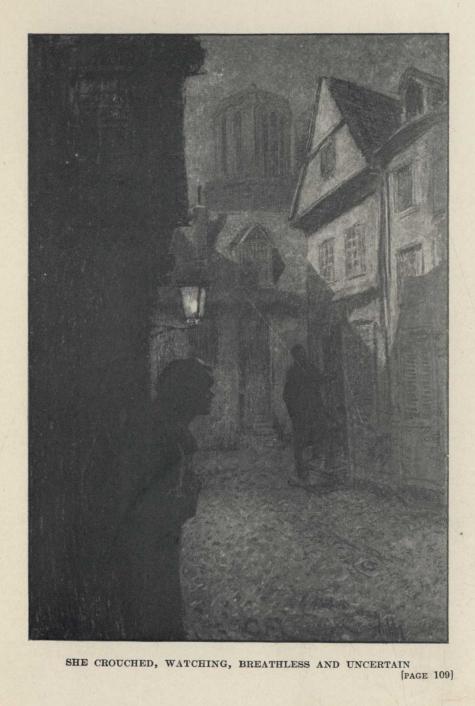
SHE CROUCHED, WATCHING, BREATHLESS AND UNCERTAIN. (PAGE 109)
The SPLENDID OUTCAST
BY
GEORGE GIBBS
AUTHOR OF "THE SECRET WITNESS," "THE GOLDEN BOUGH," "THE YELLOW DOVE," ETC.
ILLUSTRATED BY GEORGE GIBBS
D. APPLETON AND COMPANY NEW YORK LONDON 1920
COPYRIGHT, 1920, BY D. APPLETON AND COMPANY
Copyright, 1919, by THE RED BOOK CORPORATION
CONTENTS
CHAPTER
The Convalescent
The Mystery Deepens
The Goose
Outcast
Piquette
Youth Triumphant
Awakening
Threats
Piquette Takes a Hand
The Samaritan
Confessions
Quinlevin Speaks
Beginning a Journey
A Night Attack
Green Eyes
Nora Speaks
Jim Makes a Guess
At Bay
In the Dark
Freedom
The Petit Bleu
Mystery
Escape
The Clue
The Conclusion
ILLUSTRATIONS
She crouched, watching, breathless and uncertain . . . Frontispiece
Moira talked gayly
Through Moira's clear intelligence the epic filtered
The mirror sent her back a haggard reflection, pale and somber
THE SPLENDID OUTCAST
CHAPTER I
THE CONVALESCENT
Jim Horton awoke in high fever and great pain but the operation upon his skull had been successful and it was believed that he would recover. Something as to the facts of the exploit of the wounded man had come to the hospital and he was an object of especial solicitude by both surgeons and nurses. They had worked hard to save him that he might be alive for the decoration that was sure to come and the night had brought a distinct improvement in his condition. The nurse still watched his breathing eagerly and wrote down the new and favorable record upon the chart by his bedside. Miss Newberry was not in the least sentimental and the war had blunted her sensibilities, but there was no denying the fact that when the dressing was removed from his head the patient was extremely good to look at. He rewarded her on the morrow with a smile.
"How long have I been here?" he murmured hazily.
"Six days," she replied; "but you mustn't talk."
"Six—? Wounded——"
"Sh—. In the head, shoulder and leg, but you're doing nicely."
"Won't you tell me——?" he began.
But she soothed him gently. "Not now—later perhaps. You must sleep again. Drink this—please."
Horton obeyed, for he found himself too weak to oppose her. It was very restful here; he wriggled his toes luxuriously against the soft sheets for a moment. If things would only stop whirling around.... And the pain ... but that seemed to cease again and he slept. Indeed his awakening was only to half-consciousness. Other days and nights followed when he lay in a sort of doze, aware of much suffering and a great confusion of thought. But slowly, as he grew stronger, the facts of his present position emerged from the dimness and with them a mild curiosity, scarcely lucid as yet, as to how he had gotten there. At last there came a morning when the fog upon his memory seemed to roll aside and he began to recall one by one the incidents that had preceded his unconsciousness.
There had been a fight. Some fight that was. Huns all over the place—in a ring around the rocks, up in the branches of the trees—everywhere. But he had held on until the Boches had started to run when the American line advanced. He remembered that the Engineers could do other things besides build saps and bridges. Good old Engineers! Something was wrong—somewhere.
Out of his clouded brain, slowly, the facts came to him—things that had happened before the fight—just before. Harry—his twin brother Harry, lying in the ditch just behind Jim's squad of Engineers, a coward, in a blue funk—afraid to carry out his Major's orders to go forward and investigate. A coward, of course! Harry would be. He had always been a coward.
Jim Horton sighed, his mind, ambling weakly into vacancy, suddenly arrested by a query.
What else?—What else had happened? Something to do with the remarkable likeness between himself and Harry? The likeness,—so strong that only their own mother had been able to tell them apart.
Memory came to him with a rush. He remembered now what had happened in the darkness, what he had done. Taken Harry's lieutenant's uniform, giving the coward his own corporal's outfit. Then he, Jim Horton, had gone on and carried out the Major's orders, leaving the coward writhing in the ditch.
By George!——the fight—he, Jim Horton, had won the victory at Boissière Wood for the —th Infantry—for Harry!—as Harry!
Perhaps, he was really Harry and not Jim Horton at all? He glanced around him curiously, as though somewhat amused at the metempyschosis. And then thoughtfully shook his head.
No. He was Jim Horton, all right—Jim Horton. There was no mistake about that.
But Harry! Imagine meeting Harry in a situation like that after all these years! A coward! Not that that was a very surprising thing. Harry had always been a quitter. There was nothing that Harry could do or be that wasn't utterly despicable in the eyes of his brother Jim, and after having spent the best part of five years trying to live the memory of Harry down——
The nurse appeared silently and looked into Jim Horton's eyes. He closed them a moment and then smiled at her.
"How do you feel?" she asked.
"Better—lots better," he answered; "you see, I can really think——"
"I wouldn't try to do that—not yet."
"Oh, I'm all right." And the nurse was ready for the first time to believe that her patient was to remain this side of the border line of the dim realm into which she had seen so many go, for his eyes were clear and he spoke with definite assurance. But the question that he asked made her dubious again.
"I say, nurse, would you mind telling me what my name is?"
She gazed at him a moment as though a little disappointed and then replied quietly: "Lieutenant Henry G. Horton, of the —th Infantry."
"Oh," said the patient, "I see."
"I think you'd better sleep a while, then I want the Major to see you."
"Oh, don't bother; I'm coming through all right, now. I'm sure of it. But I want to tell you——"
The nurse silenced him gently, then felt his pulse and after another glance at him moved to the next bed. It had been a wonderful operation, but then they couldn't expect the impossible.
Jim Horton closed his eyes, but he didn't sleep. With the shadow of death still hovering over him, he was trying to think charitably of Harry, of the man who had worked such havoc in the lives of those nearest him. The five years that had passed since the death of their mother—poor, tired soul who until the end believed the whole thing a mistake—could not have been fruitful in anything but evil in the life of the reprobate twin-brother who had robbed the family of what had been left of the estate and then fled away from the small town where they lived to the gay lights of New York. And now here he was—an officer of the United States Army where commissions do not come without merit. What did it mean? Harry was always clever enough, too clever by half. Had he quit drinking? Was he living straight? There seemed but one answer to these questions, or he could not have held his job in the army. His job! His commission wouldn't last long if his commanding officer knew what Jim Horton did.
They all thought that the patient in the hospital bed was Harry Horton, a Lieutenant of the —th Infantry, The corporal had won the lieutenant some glory, it seemed, instead of the ruin that awaited the discovery of the cowardice and disobedience of orders. But the substitution would be discovered unless Jim Horton could find his brother Harry. And how was he going to manage that from his hospital bed?
A gentle perspiration exuded from Jim Horton's pores. Being surrounded by Boches in the wood was distinctly less hazardous than this. And so when the nurse returned with the Major, he did his best to straighten out the tangle. The Major was much pleased at the patient's progress, made a suggestion or two about a change in the treatment and was on the point of turning away when Horton spoke.
"Would you mind, sir—just a word?"
"Of course. Something bothering you?"
"Yes. You see——" the patient hesitated again, his lip twisting, "this whole thing is a mistake."
The doctor eyed the sick man narrowly.
"A mistake?" And then kindly, "I don't understand."
Horton frowned at the bed-rail. "You see, sir, I'm not Henry G. Horton. I—I'm somebody else."
He saw the nurse and the doctor exchange glances,
"Ah, well," said the medical man with a smile, "I wouldn't bother about it."
"But I do bother about it, sir. I've got to tell you. I'm another man. I changed uniforms with—with another fellow in the dark," he finished uneasily.
The same look passed between nurse and surgeon and then he saw Miss Newberry's head move slightly from left to right. The doctor rose.
"Oh, very well. Don't let it bother you, my man. We'll get you all untangled presently. Just try not to think; you're doing nicely."
And the Major moved slowly down the ward.
Jim Horton frowned at the medical officer's broad back.
"Thinks I'm nutty," he muttered to himself, and then grinned. The story was a little wild.
When the Major had left the ward, the nurse came back and smoothed Horton's pillow. "You're to be very quiet," she said gently, "and sleep all you can."
"But, nurse," he protested, "I don't want to sleep any more. I told him the truth. I've taken another man's place."
"You did it very well, from all accounts," she said with a smile; "and you'll take another man's before long, they say."
"What do you mean?"
"Promotion," she laughed; "but you won't get it if you have a relapse."
"I'm not going to have a relapse. I'm all right. Better every day, and I'd like you to understand that I know exactly what I'm saying. I took another man's job. He was—was sick and I took his place. I'm not Lieutenant Horton, nurse."
"You may be whatever you please, if you'll only go to sleep."
"Bless your heart! That isn't going to change my identity."
His positiveness rather startled her and made her pause and stare at him soberly. But in a moment her lips curved into a smile, rather tender and sympathetic. It wouldn't do to let this illusion grow, so gently she said: "Your authenticity is well vouched for. The report of your company Captain—the Sergeant-Major of your battalion. You see, you've become rather a famous person in the —th. I've seen some of your papers, they're all quite regular. Even your identification disk. It's here in the drawer with some other things that were in your pockets, so please relax and sleep again, won't you? I mustn't talk to you. It's contrary to orders."
"But nurse——"
She patted him gently on the arm, put a warning finger to her lips, and silently stole away. His gaze followed her the length of the room until she disappeared through the door when he sank back on his pillows with a groan.
"Nutty!" he muttered to himself; "wonder if I am." He touched the bandage and realized that his head was beginning to throb again. "No, I'm Jim Horton all right, there's no doubt about that, but how I'm going to make these seraphic idiots believe it is more than I can see. That Sergeant! And the men.... By George! And the Sergeant-Major. Probably looked me over at the dressing station. Oh, Lord, what a mess!"
Things began whirling around and Jim Horton closed his eyes; he wasn't quite as strong as he thought he was, and after a while he slept again.
Downstairs in the Major's office two surgeons and the nurse in charge were discussing the case.
"Queer obsession that. Thinks he's another man. There may be some pressure there yet. It ought to have cleared up by this."
"It's shock, sir, I think. He'll come out of it. He's coming on, Miss Newberry?"
"Splendidly. That's what I can't understand. He looks as though he knew what he was saying."
"Any chance of there being a mistake?"
"None at all, sir. Doctor Rawson came down with him in the ambulance, his own company captain was there when the patient was given first aid. He would have known his own lieutenant, sir. There can't be any mistake, but he has scarcely any fever——"
"Never mind, keep an extra eye on him. The wound is healing nicely. He'll come through all right."
So Nurse Newberry returned to the ward, somewhat gratified to find her charge again peacefully asleep.
The next day the patient did not revert to his obsession, but lay very quiet looking out of the window. His failure to reveal his secret left him moody and thoughtful. But his temperature was normal and he was without pain.
"You say there were some things in the pockets of—of my blouse," he asked of the nurse.
"Yes, would you like to have them?" The patient nodded and she gave them to him, the identification disk, a wrist watch, some money, a note-book and some papers. He looked them over in an abstracted way, sinking back on his pillow at last, holding the letters in his hand. Then at last as though coming to a difficult decision, he took one of the letters out of its envelope and began reading.
It was in a feminine hand and added more heavily to the burden of his responsibilities.
"Dear Harry" (it ran):
"I'm just back to my room, a wife of three hours with a honeymoon in a railway station! It all seems such a mistake—without even an old shoe to bless myself with. If I've helped you I'm glad of it. But I'm not going to lie just to square us two with the Almighty for the mockery I've been through. I don't love you, Harry, and you know that. I did what Dad asked me to do and I'd do it again if he asked me.
"He seems restless to-night, and talks about going back to Paris. I suppose I could do something over there for I've lost all impulse for my work. Perhaps we'll come and then you could run up and see us. I'll try to be nice to you, Harry, I will really. You know there's always been something lacking in me. I seem to have given everything to my painting, so there's very little left for you, which is the Irish in me saying I'm a heartless hussy.
"Soon I'll be sending you the pair of gray socks which I knitted with my own hands. They're bunchy in spots and there's a knot or two here and there, but I hope you can wear them—for the Deil's own time I had making them. Good-night. I suppose that I should be feeling proud at my sacrifice; I don't, somehow, but I'll be feeling glad if you have another bar to your shoulder. That might make me proud, knowing that I'd helped.
MOIRA."
"P. S. Don't be getting killed or anything; I never wanted to marry anybody but I don't want you done away with. Besides, I've a horror of crêpe.
M."
Jim Horton read the letter through furtively with a growing sense of intrusion. It was like listening at a confessional or peering through a keyhole. And somehow its ingenuous frankness aroused his interest. Harry had been married to this girl who didn't love him and she had consented because her father had wanted her to. He felt unaccountably indignant on her account against Harry and the father. Pretty name—Moira! Like something out of a book. She seemed to breathe both youth and hope tinged horribly with regret. He liked her handwriting which had dashed into her thoughts impulsively, and he also liked the slight scent of sachet which still clung to the paper. He liked the girl better, pitied her the more, because her instinct had been so unerring. If she had thrown herself away she had done it with her eyes wide open. A girl who could make such a sacrifice from lofty motives, would hardly condone the thing that Harry had been guilty of. A coward....
There was another letter, of a much later date, in a masculine hand. Jim Horton hesitated for a moment! and then took it out of its envelope.
"Harry boy," he read, "so far as I can see at this writing the whole thing has gone to the demnition bow-wows. Suddenly, without a by-your-leave, the money stopped coming. I wrote de V. and cabled, but the devil of a reply did he give. So I'm coming to Paris with Moira at once and it looks as though we'd have to put the screws on. But I'd be feeling better if the papers were all ship-shape and Bristol fashion. You'll have to help. Maybe the uniform will turn the odd trick. If it don't we'll find some way.
"I feel guilty as Hell about Moira. If you ever make her unhappy I'll have the blood of your heart. But I'm hoping that the love will come if you play the game straight with her.
"Meanwhile we'll feather the nest if we can. He's got to 'come across.' There's some agency working against us—and I've got to be on the scene to ferret—instanter. Moira got some portraits to do or we wouldn't have had the wherewithal for the passage. As it is, I'll be having to make the move with considerable skill, leaving some obligations behind. But it can't be helped, and Moira won't know. The world is but a poor place for the man who doesn't make it give him a living. Mine has been wretched enough, God knows, and the whisky one buys over the bar in New York is an insult to an Irishman's intelligence, to say nothing of being a plague upon his vitals.
"Enough of this. Come to the Rue de Tavennes, No. 7, in your next furlough, and we'll make a move. By that time I'll have a plan. Moira sends her love.
"Yours very faithfully,
"BARRY QUINLEVIN.
P. S. There was a pretty squall brewing over the Stamford affair, but I reefed sail and weathered it. So you can sleep in peace.
B. Q."
Jim Horton lay for a while thinking and then read the two letters again. The masculine correspondent was the girl's father. Barry Quinlevin, it seemed, was a scoundrel of sorts—and the girl adored him. Many of the passages in the letter were mystifying. Who was de V——? And what was Harry's connection with this affair? It was none of Jim Horton's business, but in spite of himself he began feeling an intense sympathy for the girl Moira, who was wrapped in the coils of what seemed on its face to be an ugly intrigue, if it wasn't something worse.
Strange name, Quinlevin. It was Moira's name too, Irish. The phrase about having Harry's heart's blood showed that Barry Quinlevin wasn't beyond compunctions about the girl. But why had he connived at this loveless marriage? There must have been a reason for that.
Jim Morton put the letters in the drawer and gave the problem up. It wasn't his business whom Harry had married or why. The main thing was to get well and out of the hospital so that he could find his brother and set the tangle straight.
He couldn't imagine just how the substitution was to be accomplished, but if Harry had played the game there was a chance that it might yet be done. He didn't want Harry's job. And he silently cursed himself for the unfortunate impetuous moment that had brought about all the trouble. But how had he known that he was going to be hit? If he had only succeeded in getting back to the spot where Harry was waiting for him, no one would ever have been the wiser. No one knew now, but of course the masquerade couldn't last forever. The situation was impossible.
Meanwhile what was Harry doing? Had he succeeded in playing out the game during Jim Horton's sickness, or had he found himself in a tight place and quit? It would have been easy enough. Horton shivered slightly. Desertion, flight, ignominy, disgrace. And it wasn't Harry Horton's good name that would be in question, but his own, that of Jim Horton, Corporal of Engineers. As a name, it didn't stand for much yet, even out in Kansas City, but he had never done anything to dishonor it and he didn't want the few friends he had to think of him as a quitter. Nobody had ever accused him of being that. What a fool he had been to take such a chance for a man like Harry!
In the midst of these troublesome meditations, he was aware of Nurse Newberry approaching from the end of the ward. Following her were two people who stopped at his bed, a man and a girl. The man was strong, with grizzled hair, a bobbed Imperial and a waxed mustache. The girl had black hair and slate-blue eyes. And even as Jim Horton stared at them, he was aware of the man confidently approaching and taking his hand.
"Well, Harry, don't you know me?" a voice said. "Rather hazy, eh? I don't wonder...."
Who the devil were these people? There must be a mistake. Jim Horton mumbled something. The visitor's eyes were very dark brown shot with tiny streaks of yellow and he looked like an amiable satyr.
"I've brought Moira—thought ye'd like to see her."
The patient started—then recovered himself. He had forgotten the lapse of time since the letters had been written.
"Moira," he muttered.
The girl advanced slowly as the man made place. Her expression had been serious, but as she came forward she smiled softly.
"Harry," she was whispering, as he stared at her loveliness, "don't you know me?"
"Moira!" he muttered weakly. "I'm not——" But his hands made no movement toward her and a warm flush spread over the part of his face that was visible.
"You've been very sick, Harry. But we came as soon as they'd let us. And you're going to get well, thank the Holy Virgin, and then——"
"I'm not——" the words stuck in Jim Horton's throat. And he couldn't utter them.
"You're not what?" she questioned anxiously.
Another pause of uncertainty.
"I—I'm not—very strong yet," he muttered weakly, turning his head to one side.
And as he said it, he knew that in sheer weakness of fiber, spiritual as well as physical, he had made a decision.
The Satyr behind her laughed softly.
"Naturally," he said, "but ye're going to be well very soon."
They were both looking at him and something seemed to be required of him. So with an effort,
"How long—how long have you been in France?" he asked.
"Only three weeks," said Quinlevin, "watching the bulletins daily for news of you. I found out a week ago, but they wouldn't let us in until to-day. And we can stay only five minutes."
Then Moira spoke again, with a different note in her voice.
"Are you glad that I came?" she asked. "It was the least I could do."
"Glad!"
The word seemed sufficient. Jim Horton seemed glad to utter it. If she would only recognize the imposture and relieve him of the terrible moment of confession. But she didn't. She had accepted him as Quinlevin, as all the others had done, for his face value, without a sign of doubt.
And Barry Quinlevin stood beaming upon them both, his bright eyes snapping benevolence.
"If ye get the V.C., Harry boy, she'll sure be worshiping ye."
Jim Horton's gaze, fixed as though fascinated upon the quiet slate-blue eyes, saw them close for a moment in trouble, while a quick little frown puckered the white forehead. And when she spoke again, her voice uttered the truth that was in her heart.
"One cannot deny valor," she said coolly. "It is the greatest thing in the world."
She wanted no misunderstandings. She only wanted Harry Horton to know that love was not for her or for him. The fakir under the bed clothes understood. She preferred to speak of valor. Valor! If she only knew!
Jim Horton gathered courage. If he wasn't to tell the truth he would have to play his part.
"Everybody is brave—out there," he said, with a gesture.
"But not brave enough for mention," said Quinlevin genially. "It won't do, Harry boy. A hero ye were and a hero ye'll remain."
Horton felt the girl's calm gaze upon his face.
"I'm so glad you've made good, Harry. I am. And I want you to believe it."
"Thanks," he muttered.
Why did she gaze at him so steadily? It almost seemed as though she had read his secret. He hoped that she had. It would have simplified things enormously. But she turned away with a smile.
"You're to come to us, of course, as soon as they let you out," she said quietly.
"Well, rather," laughed Quinlevin.
The nurse had approached and the girl Moira had moved to the foot of the bed. Barry Quinlevin paused a moment, putting a slip of paper in Horton's hand.
"Well, au revoir, old lad. In a few days again——"
The wounded man's gaze followed the girl. She smiled back once at him and then followed the nurse down the ward. Jim Horton sank back into his pillows with a gasp.
"Well—now you've done it. Now you have gone and done it," he muttered.
CHAPTER II
THE MYSTERY DEEPENS
In a courageous moment, a day or so later, the patient requested Nurse Newberry to try to get what information she could as to the whereabouts of his cousin, Corporal James Horton, B Company, —th Engineers, and waited with some impatience and anxiety the result of her inquiries. She discovered that Corporal James Horton had been last seen in the fight for Boissière Wood, but was now reported as missing.
Missing!
The blank expression on the face of her patient was rather pitiful.
"It probably means that he's a prisoner. He may be all right. H.Q. is pretty cold-blooded with its information."
But the patient knew that Corporal Horton wasn't a prisoner. If he was missing, it was because he had gone to the rear—nothing less than a deserter. Nevertheless the information, even indefinite as it was, brought him comfort. He clung rather greedily to its very indefiniteness. In the eyes of the army or of the world "missing" meant "dead" or "prisoner," and until Harry revealed himself, the good name of the corporal of Engineers was safe. That was something.
And the information brought the wounded man abruptly to the point of realizing that he was now definitely committed to play the role he had unwittingly chosen. He had done his best to explain, but they hadn't listened to him. And when confronted with the only witnesses whose opinions seemed to matter (always excepting Harry himself), he had miserably failed in carrying out his first intentions. He tried to think of the whole thing as a joke, but he found himself confronted with possibilities which were far from amusing.
The slate-blue Irish eyes of Harry's war-bride haunted him. They were eyes meant to be tender and yet were not. Her fine lips were meant for the full throated laughter of happiness, and yet had only wreathed in faint uncertain smiles.
Barry Quinlevin was a less agreeable figure to contemplate. If Jim Horton hadn't read his letter to Harry he would have found it easier to be beguiled by the man's genial air of good fellowship and sympathy, but he couldn't forget the incautious phrases of that communication, and having first formed an unfavorable impression, found no desire to correct it.
To his surprise it was Moira who came the following week to the hospital at Neuilly on visitors' day. Jim Horton had decided on a course of action, but when she approached his bed, all redolent with the joy of out of doors, he quite forgot what he meant to say to her. In Moira, too, he seemed to feel an effort to do her duty to him with a good grace, which almost if not quite effaced the impression of her earlier visit. She took his thin hand in her own for a moment while she examined him with a kindly interest, which he repaid with a fraternal smile.
"Father sent me in his place," she said. "I've put him to bed with a cold."
"I'm so glad——" said Horton, and then stopped with a short laugh. "I mean—I'm glad you're here. I'm sorry he's ill. Nothing serious?"
"Oh, no. He's a bit run down, that's all. And you—you're feeling better?"
He liked the soft way she slithered over the last syllable.
"Oh, yes—of course."
All the while he felt her level gaze upon him, cool and intensely serious.
"You are out of danger entirely, they tell me. I see they've taken the bandage off."
"Yesterday," he said. "I'm coming along very fast."
"I'm glad."
"They promise before long that I can get out into the air in a wheel-chair."
"That will do you all the good in the world."
In spite of himself, he knew that his eyes were regarding her too intently, noting the well modeled nose, the short upper lip, firm red mouth and resolute chin, all tempered with the softness of youth and exquisite femininity. He saw her chin lowered slightly as her gaze dropped and turned aside while the slightest possible compression of her lips indicated a thought in which he could have no share.
"I have brought you some roses," she said quietly.
"They are very beautiful. They will remind me of you until you come again."
The sudden raising of her eyes as she looked at him over the blossoms was something of a revelation, for they smiled at him with splendid directness.
"You are improving," she laughed, "or you've a Blarney Stone under the pillow. I can't remember when you've said anything so nice as that at all."
He was thoughtful for a moment.
"Perhaps I have a new vision," he said at last. "The bullet in my head may have helped. It has probably affected my optic nerve."
She smiled with him.
"You really do seem different, somehow," she broke in. "I can't exactly explain it. Perhaps it's the pallor that makes the eyes look dark and your voice—it's softer—entirely."
"Really——!" he muttered, uncomfortably, his gaze on the gray blanket. "Well, you see, I suppose it's what I've been through. My eyes would seem darker, wouldn't they, against white, and then my voice—er—it isn't very strong yet."
"Yes, that's it," she replied.
Her eyes daunted him from his purpose a little, and he knew that he would have to use extreme caution, but he had resolved whatever came to see the game through. After all, if she discovered his secret, it was only what he had tried in vain to tell her.
"I'm sure of it," he went on. "When a fellow comes as near death as I've been, it makes him different. I seem to think in a new way about a lot of things—you, for instance."
"Me——?" He fancied that there was a hard note in her voice, a little toss, scarcely perceptible, of the rounded chin.
"Yes. You see, you oughtn't ever to have married me. You're too good for me. I'm just a plain rotter and you—oh, what's the use?"
He paused, hoping that she would speak. She did, after a silence and a shrug.
"Father wanted it. It was one way of paying what he owed you. I don't know how much that was, but I'm still thinking I went pretty cheap." She halted abruptly and then went on coolly, "I didn't come here to be thinking unpleasant thoughts—or to be uttering them. So long as we understand each other——"
"We do," he put in eagerly, almost appealingly. "I want you to believe that I have no claim upon you—that my—my relations with Barry Quinlevin will have nothing to do with you."
"And if I fell in love with another man— That never seems to have occurred to either of you——"
He laughed her soberness aside. "As far as I'm concerned, divorce or suicide. I'll leave the choice to you."
He gained his purpose, which was to bring the smile to her lips again.
"Your wounds have inoculated you with a sense of humor, at any rate," she said, fingering the roses. "You've always been lacking in that, you know."
"I feel that I can laugh at them now. But it might have been better for you if I hadn't come out of the ether."
"No. I don't like your saying that. I haven't the slightest intention of falling in love with any man at all. I shan't be wanting to marry—really marry——" she added, coloring a little. "I've begun my work. It needed Paris again. And I'm going to succeed. You'll see."
"I haven't a doubt of it. You were made for success—and for happiness."
"Sure and I think that I was—now that you mention it," she put in quaintly.
"I won't bother you. You can be certain of that," he finished positively. And then cautiously, "Things have not gone well—financially, I mean?"
"No. And of course father's worried about it. Our income from Ireland has stopped coming—something about repairs, he says. But then, I suppose we will get it again some day. Dad never did tell me anything, you know."
Horton thought for a moment.
"He doesn't want to worry you, of course. And you oughtn't to be worried. Things will come out all right."
"I intend that they shall. Father always gave me the best when he had it. I'll see that he doesn't suffer now."
"But that's my job, Moira. We'll get some money together—some way—when I get out."
"Thanks. But I'm hoping to do a lot of painting. I've got one portrait to begin on—and it doesn't cost much in the Quartier."
Horton sat up in bed and looked out of the window.
"I'll get money," he said. "Don't you worry."
He saw her eyes studying him quietly and he sank back at once in bed out of the glare of the sunlight. He wondered if he had gone too far. But he had found out one of the things that he had wanted to know. She knew nothing of what Barry Quinlevin was doing.
Her next remark was disquieting.
"It's very strange, the way I'm thinking about you. You've grown different in the army—or is it the sickness? There's a sweeter look to your mouth, and a firmer turn to your jaw. Your gaze is wider and your heart has grown soft, with the suffering. It's like another man, I'm seeing somehow, Harry, and I'm glad."
"Suffering—yes, perhaps," he muttered.
She leaned forward impulsively and put her hand over his, smiling brightly at him.
"We'll be good friends now, alanah. I'm sure of it."
"You like me a little better——?"
"Sure and I wouldn't be sitting here holding hands if I didn't," she laughed. Then with a quick glance at her wrist watch she rose. "And now I must be going back to father. Here is the nurse. Time is up."
"You will come soon again?" he asked slowly.
"Yes—with better news, I hope. Au revoir, mon brave."
And she was gone.
The visit gave him more food for thought. But he hadn't learned much. What he did know now was that the girl Moira trusted Barry Quinlevin implicitly and that he had managed to keep her in ignorance as to the real sources of his livelihood. The Irish rents had failed to reach them! Were there any Irish rents? And if so, what had "de V" to do with them? He took Quinlevin's letter from under the pillow and re-read it carefully. Nothing about Irish rents there. Perhaps other letters had followed, that Harry had destroyed. In any case he would have to play the game carefully with the girl's father or Quinlevin would find him out before Horton discovered what he wanted to know. The quiet eyes of the girl Moira disturbed him. Her eyes, her intuitions, were shrewd, yet he had succeeded so far. If he could pass muster with the daughter, why shouldn't he succeed with the father? The weakness, the failing memory of a sick man, could be trusted to bridge difficulties. If there had only been a few more letters he would have been better equipped for the interview with Barry Quinlevin, which must soon follow. He inquired of Miss Newberry, but she had given him everything that had been found in his uniform. He scrutinized the notebook carefully, which contained only an expense account, some addresses in Paris, and a few military notes, and so he discarded it. It seemed that until Quinlevin came to the hospital "de V" must remain one of the unsolved mysteries of his versatile brother.
But Moira's innocence, while it failed to enlighten him as to the mystery, made him more certain that her loveless marriage with Harry had something to do with the suspected intrigue. Did Harry love the girl? It seemed scarcely possible that any man who was half a man could be much with her without loving her. It wasn't like Harry to marry any girl unless he had something to gain by it. The conversation he had just had with Moira showed exactly the relationship between them, if he had needed any further evidence than her letter.
As to his own personal relations with Moira, he found it necessary to fortify himself against a more than strictly fraternal interest in her personality. She was extremely agreeable to look at and he had to admit that her very presence had cheered up his particular part of the hospital ward amazingly. Her quaintness, her quiet directness and her modest demeanor, were inherent characteristics, but they could not disguise the overflowing vitality and humor that struggled against the limitations she had imposed. Her roses, which Nurse Newberry had arranged in a bowl by the bedside, were unnecessary reminders of the giver. Like them, she was fragrant, pristine and beautiful—altogether a much-to-be-desired sister-in-law.
The visit of Barry Quinlevin was not long delayed and Jim Horton received him in his wheel chair by an open window in the convalescent ward. He came in with a white silk handkerchief tied about his neck, but barring a husky voice showed no ill effects of his indisposition. He was an amiable looking rogue, and if the shade of Whistler will forgive me, resembled much that illustrious person in all the physical graces. It would be quite easy to imagine that Barry Quinlevin could be quite as dangerous an enemy.
"Well, Harry boy, here I am," he announced, throwing open his coat with something of an air, and loosening his scarf. "No worse than the devil made me. And ye're well again, they tell me, or so near it that ye're no longer interesting."
"Stronger every day," replied Horton cautiously.
"Then we can have a talk, maybe, without danger of it breaking the spring in yer belfry?"
"Ah, yes,—but I'm a bit hazy at times," added Horton.
"Well, when the fog comes down, say the word and I'll be going."
"Don't worry. I want to hear the news."
Quinlevin frowned at his walking stick. "It's little enough, God knows." Then glanced toward the invalid at the next window and lowered his voice a trifle.
"The spalpeen says not a word—or he's afflicted with pen-paralysis, for I've written him three times—twice since I reached Paris, giving him the address. So we'll have to make a move."
"What will you do?"
"Go to see him—or you can. At first, ye see, I thought maybe he'd gone away or died or something. But I watched the Hôtel de Vautrin in the Rue de Bac until I saw him with my own eyes. That's how I took this bronchitis—in the night air with devil a drink within a mile of me. I saw him, I tell you, as hale and hearty as ye please, and debonair like a new laid egg, with me, Barry Quinlevin, in the rain, not four paces from the carriage way."
The visitor paused as though for a comment, and Horton offered it.
"He didn't see you?"
"Devil a one of me. For the moment I thought of bracing him then and there. But I didn't—though I was reduced to a small matter of a hundred francs or so."
"Things are as bad as that——?"
Quinlevin shrugged. "I bettered myself a bit the next night and I'll find a way——"
He broke off with a shrug.
"But I'm not going to be wasting my talents on the little officer-boys in Guillaume's. Besides, 'twould be most unpatriotic. I'm out for bigger game, me son, that spells itself in seven figures. Nothing less than a coup d'état will satisfy the ambitions of Barry Quinlevin!"
"Well?" asked Horton shrewdly.
"For the present ye're to stay where ye are, till yer head is as tight as a drum, giving me the benefit of yer sage advice. We'll worry along. The rent of the apartment and studio is a meager two hundred francs and the food—well, we will eat enough. And Moira has some work to do. But we can't be letting the Duc forget I've ever existed. A man with a reputation in jeopardy and twenty millions of francs, you'll admit, is not to be found growing on every mulberry bush."
Horton nodded. It was blackmail then. The Duc de Vautrin——
"You wrote that you had a plan," he said. "What is it?"
Barry Quinlevin waved a careless hand.
"Fair means, as one gentleman uses to another, if he explains his negligence and remits the small balance due. Otherwise, we'll have to squeeze him. A letter from a good lawyer—if it wasn't for the testimony of Nora Burke!"
He was silent in a moment of puzzled retrospection and his glittering generalities only piqued Jim Horton's curiosity, so that his eagerness led him into an error that nearly undid him.
"Nora Burke——" he put in slowly.
"I wrote ye what happened——"
"I couldn't have received the letter——"
He stopped abruptly, for Quinlevin was staring at him in astonishment.
"Then how the devil could ye have answered it?"
Horton covered the awkward moment by closing his eyes and passing his fingers across his brow.
"Answered it! Funny I don't remember."
The Irishman regarded him a moment soberly, and then smiled in deprecation.
"Of course—ye've slipped a cog——"
Then suddenly he clapped a hand on Horton's knee.
"Why, man alive,—Nora Burke—the Irish nurse who provides the necessary testimony—Moira's nurse, d'ye mind, when she was a baby, who saw the Duc's child die—now do ye remember——?"
Horton ran his fingers over his hair thoughtfully and bent his head again.
"Nora Burke—Moira's nurse—who saw the Duc's child die," he repeated parrot-like, "and the Duc—de Vautrin——" he muttered and paused.
"Thinks his child by this early marriage is still alive——" said Quinlevin, regarding him dubiously.
"Yes, yes," said Horton eagerly. "It's coming back to me now. And de Vautrin's money——"
"He'll pay through the nose to keep the thing quiet—unless——"
Barry Quinlevin paused.
"Unless—what?"
There was a moment of silence in which the visitor frowned out of the window.
"I don't like the look of things, I tell ye, Harry. Ye're in no fit shape to help 'til the fog clears up, but I've a mind that somebody's slipped a finger into the pie. Nora Burke wants more money—five hundred pounds to tell a straight story and where I'm going to get it—the devil himself only knows."
"Nora Burke—five hundred pounds!" muttered Horton vaguely, for he was thinking deeply, "that's a lot of money."
"Ye're right—when ye haven't got it. And de Vautrin's shutting down at the same time. It looks suspicious, I tell ye."
He broke off and fixed his iridescent gaze on Horton. "Ye're sure ye said nothing to any one in Paris before ye went to the front?"
Of this at least Jim Horton was sure.
"Nothing," he replied.
"Not to Piquette Morin?"
Here was dangerous ground again.
"Nothing," he repeated slowly, "nothing."
"And ye wouldn't be remembering it if ye had," said Quinlevin peevishly as he rose. "Oh, well—I'll have to raise this money some way or go to Galway to put the gag on Nora Burke until we play the trick——"
"I—I'm sorry I can't help——" said Horton, "but you see—I'm not——"
"Oh, yes, I see," said Quinlevin more affably. "I shouldn't be bothering ye so soon, but may the devil take me if I know which way to turn."
"Will you see de Vautrin?"
"Perhaps. But I may go to Ireland first. I've got to do some thinking—alone. Good bye. Ye're not up to the mark. Be careful when Moira comes, or ye may let the cat out of the bag. D'ye hear?"
"Don't worry—I won't," said Horton soberly.
He watched the tall figure of Quinlevin until it disappeared into the outer hall and then turned a frowning gaze out of the window.
CHAPTER III
THE GOOSE
Jim Horton had had a narrow escape from discovery. But in spite of his precarious position and the pitfalls that seemed to lay to right and left, he had become, if anything, more determined than ever to follow the fate to which he had committed himself. There now seemed no doubt that Moira was in all innocence involved in some way in the blackmailing scheme which had been the main source of livelihood for the Quinlevin family for many years. And Moira did not know, for the Duc de Vautrin, of course, was the source of the Irish rents to which she had alluded. And now he was refusing to pay.
It was clear that something unpleasant hung in the air, an ill wind for the Duc de Vautrin and for the plotters, Moira's father and Jim Horton's precious brother. And it seemed quite necessary in the interests of honesty that he, Jim Horton, should remain for the present in the game and divert if possible the currents of evil which encompassed his interesting sister-in-law.
One thing he had learned—that by taking refuge behind the barriers of his failing memory, it might be possible to keep up the deception, at least until he was out of the hospital and a crisis of some sort came to relieve him of his responsibility. Indeed there was something most agreeable in the friendly regard of his brother's loveless wife, and under other circumstances, the calls of this charming person would have been the source of unalloyed delight. For as the days passed, more and more she threw off the restraint of her earlier visits and they had now reached a relationship of understanding and good-fellowship, most delightful and unusual in its informality.
Jim Horton was progressing rapidly and except for occasional lapses of memory, easily explained and perfectly understood by his visitors, gained health and strength until it was no longer a question of weeks but of days when he should be able to leave the hospital and accept the invitation of his newly discovered relatives to visit the studio apartment. He had made further efforts through the hospital authorities to find some trace of the missing man but without success, and in default of any definite plan of action chose to follow the line of least resistance until something should happen. Barry Quinlevin visited him twice, but spoke little of the affair of the Duc de Vautrin which it seemed was being held in abeyance for the moment, preferring to wait until the brain and body of the injured man could help him to plan and to execute. And Jim Horton, finding that safety lay in silence or fatigue, did little further to encourage his confidences.
Thus it was that after several weeks he impatiently awaited Moira outside the hospital. It was a gorgeous afternoon of blue and gold with the haze of Indian Summer hanging lazily over the peaceful autumn landscape. An aromatic odor of burning leaves was in the air and about him aged men and women worked in road and garden as though the alarms of war had never come to their ears. The signing of the armistice, which had taken place while Horton was still in his bed, had been the cause of much quiet joy throughout the hospital. But with the return of health, Jim Horton had begun wondering what effect the peace was to have upon his strange fortunes—and upon Harry's. He knew that for the present he had been granted a furlough which he was to spend with the Quinlevins in Paris, but after that, what was to happen? He was a little dubious too about his relations with Moira.... But when he saw her coming down the path to the open air pavilion with Nurse Newberry, all flushed with the prospect of carrying him off in triumph in the ancient fiacre from which she had descended, he could not deny a thrill of pleasure that was not all fraternal.
"Behold, mon ami," she cried in greeting, "I've come to take you prisoner."
He laughed gayly as he took her hand.
"And there's a goose in the pantry, bought at a fabulous price, just waiting for the pan——"
"Be sure you don't kill your prisoner with kindness," put in Nurse Newberry.
"I'll take that risk," said Horton genially.
"Sure and he must," put in Moira. "It isn't every day one brings a conquering hero home."
"Especially when he's your husband," said the artless Miss Newberry wistfully.
Jim Horton had a glimpse of the color that ran like a flame up Moira's throat to her brow but he glanced quickly away and busied himself with a buckle at his belt.
"I want to thank you, Miss Newberry," he said soberly, "for all that you've done for me. I'll never forget."
"Nor I, Lieutenant Horton. But you're in better hands than mine now. A week or so and you'll be as strong as ever."
"I've never felt better in my life," he replied.
They moved toward the conveyance, shook hands with the nurse, and with Harry's baggage (which had just been sent down from regimental headquarters) upon the box beside the rubicund and rotund cocher, they drove out of the gates and toward the long finger of the Eiffel Tower which seemed to be beckoning to them across the blue haze above the roof tops.
Neither of them spoke for a moment. In the ward, in the convalescent rooms or even in the grounds of the hospital, Moira had been a visitor with a mission of charity and cheer. Here in the fiacre the basis of their relationship seemed suddenly and quite mysteriously to change. Whether Moira felt it or not he did not know, for she looked out of her window at the passing scene and her partly averted profile revealed nothing of her thoughts. But the fact that they were for the first time really alone and driving to Moira's Paris apartment gave him a qualm of guilt on account of the impossible situation that he had created. He had, he thought, shown her deep gratitude and respect—and had succeeded in winning the friendship that Harry had perhaps taken too much for granted. It had given Jim Horton pleasure to think that Moira now really liked him for himself alone, and the whole-heartedness of her good fellowship had given him every token of her spirit of conciliation. She had had her moods of reserve before, like the one of her present silence, but the abundance of her vitality and sense of humor had responded unconsciously to his own and they had drawn closer with the artless grace of two children thrown upon their own resources. And now, here in the ramshackle vehicle, for the first time alone, Jim Horton would have very much liked to take her by the hand (which lay most temptingly upon the seat beside him) and tell her the truth. But that meant Harry's disgrace—the anguish of her discovering that such a friendship as this with her own husband could never be; for in her eyes Jim Horton had seen her own courage and a contempt for all things that Harry was or could ever hope to be. And so, with an effort he folded his arms resolutely and stared out of his window.
It was then that her voice recalled him.
"Can't you smell that goose, Harry dear?" she said.
He flashed a quick smile at her.
"Just can't I!" he laughed.
"And you're to help me cook it—and vegetables and coffee. You know"—she finished, "nothing ever tastes quite so good as when you cook it yourself."
"And you do all the cooking——?" he asked thoughtfully.
"Sometimes—but more often we go to a café. Sometimes Madame Toupin helps, the concierge—but father thinks my cooking is the best."
"I don't doubt it. I shall, too." And then, "where is your father to-day?"
She looked at him, eyes wide as though suddenly reminded.
"I forgot," she gasped. "He asked me to tell you that he was obliged to be leaving for Ireland—about the Irish rents. Isn't it tiresome?"
"Oh," said Horton quietly. "I see."
He turned his thoughtful gaze out of the carriage window into the Avenue de Neuilly. The situation had its charm, but he had counted on the presence of Barry Quinlevin.
"How long will he be gone?" he asked.
"I don't know," she replied, "a week or more perhaps. But I'll try to make you comfortable. I've wanted so to have everything nice."
He smiled at her warmth. "You forget that—that I've learned to be a soldier, Moira. A blanket on the floor of the studio and I'll be as happy as a king——"
"No. You shall have the best that there is—the very best—mon ami——"
"I don't propose to let you work for me, Moira. I can get some money. I can find a pension somewhere near and——"
She turned toward him suddenly, her eyes very close to tears. "Do you wish to make me unhappy—when I've tried so hard to—to——"
"Moira!" He caught her hand to his lips and kissed it gently, "I didn't mean——"
"I've wanted so for you to forget how unkind I had been to you—to make this seem like a real homecoming after all you've been through. And now to hear you talking of going to a pension——"
"Moira—I thought it might be inconvenient—that it might be more pleasant for you——"
He broke down miserably. She released her fingers gently and turned away. "Sure Alanah, and I think that I should be the judge of that," she said.
"We'll say no more about it," he muttered. "But I—I'm very grateful."
Moira's lips wreathed into an adorable smile.
"I've been thinking the war has done something to you, Harry. And now I'm sure of it. You've been learning to think of somebody beside yourself."
"I'd be pretty rotten if I hadn't learned to do some thinking about you," he said, as he looked into her eyes with more hardihood than wisdom.
She met his gaze for the fraction of a minute and then raised her chin and laughed merrily up at the broad back of the cocher.
"Yes, you've changed, Harry dear. God knows how or why—but you've changed. You'll be paying me some compliments upon my pulchritude and heavenly virtues by and by."
"Why shouldn't I?" he insisted soberly when her laughter subsided. "Your loveliness is only the outward and visible sign of the inward and spiritual grace. I'm so sure of it that I don't care whether you laugh or not."
"Am I lovely? You think so? Well—it's nice to hear even if it only makes conversation. Also that my nose is not so bad, even if it does turn piously to Heaven—but there's a deep dent in my chin which means that I've got a bit of the devil in me—bad cess to him—so that you'd better do just what I want you to—or we'll have a falling out. And that would be a pity—because of the goose."
He laughed as gayly as she had done.
"I've a notion, Moira," he said, "that it's my goose you're going to cook."
"And I've a notion," she said poising a slim gloved finger for a second upon his knee, "I've a notion that we're both going to cook him."
It seemed too much like a prophecy to be quite to his liking. Her moods were Protean and her rapid transitions bewildered. And yet, under them all, he realized how sane she was, how honest with him and with herself and how free from any guile. She trusted him entirely as one good friend would trust another and the thought of any evil coming to her through his strange venture into Harry's shoes made him most unhappy. But her pretty dream of a husband with whom she could at least be on terms of friendship must some day come to an end ... And yet ... suppose the report that Harry was missing meant that he was dead. A bit of shrapnel—a bullet—he didn't wish it—but that chance was within the range of the possible.
They had passed down the avenue of the Grande Armée, into the place de l'Étoile, and were now in the magnificent reaches of the Champs Élysées. Jim Horton had only been in Paris for five hours between trains, little more than long enough to open an account at a bank, but Moira chattered on gayly with the point of view of an intime, showing him the places which they must visit together, throwing in a word of history here, an incident or adventure there, giving the places they passed, the personality of her point of view, highly tinged with the artist's idealism. From her talk he gathered that she had lived much in Paris during all her student days and except for the little corner in Ireland where she had been born and which she had visited from time to time, loved it better than any place in the world.
"And I shall teach you to speak French, Harry—the real argot of the Quartier—and you shall love it as I do——"
"I do speak it a little already," he ventured.
"Really! And who was your instructress?"
The dropping intonation was sudden and very direct.
Jim Horton looked out of the window. He was sure that Harry wouldn't have been able to meet her gaze.
"No one," he muttered, "at least no girl. That's the truth. We had books and things."
"Oh," she finished dryly.
Her attitude in this matter was a revelation. The incident seemed to clarify their relations and in a new way, for in a moment she was conversing again in a manner most unconcerned. Friendly she might be with Harry for the sake of the things that he had accomplished, companionable and kind for the sake of the things he had suffered, but as for any deeper feeling—-that was another matter. Moira was no fool.
But at least she trusted him now. She dared to trust him. Otherwise, why did she conduct him with such an air of unconcern to the apartment in the Rue de Tavennes? But he couldn't be unaware of the alertness in her unconcern, an occasional quick and furtive side glance which showed that, however friendly, she was still on her guard. Perhaps she wanted to study this newly-discovered Harry at closer range. But why had she chosen the venture? He had given her her chance. Why had she refused to take it?
The answers to these questions were still puzzling him when they drove up the hill by the Boulevard St. Michel—Boul' Miché she called it—reached the Luxembourg Gardens and then turning into a smaller street were presently deposited at their porte cochère. Her air of gayety was infectious and she presented him to the good Madame Toupin, who came out to meet them with the air of one greeting an ambassador.
"Welcome, Monsieur le Lieutenant. Madame Horton has promised us this visit since a long time."
"Merci, Madame."
"Enter, Monsieur—this house is honored. Thank the bon Dieu for the Americans."
Jim Horton bowed and followed Moira into the small court and up the stairway, experiencing a new sense of guilt at having his name coupled so familiarly with Moira's. Harry's name too—. And yet the circumstances of the marriage were so strange, the facts as to her actual relations with her husband so patent, that he found himself resenting Moira's placid acceptance of the appellation. There was something back of it all that he did not know.... But Moira gave him no time to think of the matter, conducting him into the large studio and showing him through the bedroom and kitchen, where she proudly exhibited her goose (and Jim Horton's) that she was to cook. And after he had deposited his luggage in a room nearby which he was to occupy, she removed her gloves in a business-like manner, took off her hat and coat, and invited him into the kitchen.
"Allons, Monsieur," she said gayly in French, as she rolled up her sleeves.
"We shall now cook a goose, in this modern apparatus so kindly furnished by the Compagnie de Gaz. There's a large knife in the drawer. You will now help me to cut up the potatoes—Julienne,—and the carrots which we shall stew. Then some lettuce and a beautiful dessert from the pâtisserie—and a demi-tasse. What more can the soul of man desire?"
"Rien," he replied with a triumphant grin of understanding from behind the dish pan. "Absolument rien."
"Ah, you do understand," she cried in English. "Was she a blonde—cendrée? Or dark with sloe-eyes? Or red-haired? If she was red-haired, Harry, I'll be scratching her eyes out. No?"
He shook his head and laughed.
"She was black and white and her name was Ollendorff."
"You'll still persist in that deception?"
"I do."
"You're almost too proficient."
"You had better not try me too far."
She smiled brightly at him over the fowl which she was getting ready for the pan, stuffing it with a dressing already prepared.
"I wonder how far I might be trying you, Harry dear," she said mischievously.
He glanced at her.
"I don't know," he said quietly "but I think I've learned something of the meaning of patience in the army."
"Then God be praised!" she ejaculated with air of piety, putting the fowl into the pan.
"Here. Cut. Slice to your heart's content, thin—like jack-straws. But spare your fingers."
She sat him in a chair and saw him begin while she prepared the salad.
"Patience is by way of being a virtue," she resumed quizzically, her pink fingers weaving among the lettuce-leaves. And then, "so they taught you that in the Army?"
"They did."
"And did you never get tired of being patient, Harry dear?"
He met the issue squarely. "You may try me as far as you like, Moira," he said quietly, "I owe you that."
She hadn't bargained for such a counter.
"Oh," she muttered, and diligently examined a doubtful lettuce leaf by the fading light of the small window, while Horton sliced scrupulously at his potato. And when the goose was safely over the flame she quickly disappeared into the studio.
He couldn't make her out. It seemed that a devil was in her, a mischievous, beautiful, tantalizing, little Irish she-devil, bent on psychological investigation. Also he had never before seen her with her hat off and he discovered that he liked her hair. It had bluish tints that precisely matched her eyes. He finished his last potato with meticulous diligence and then quickly rose and followed her into the studio where a transformation had already taken place. A table over which a white cloth had been thrown, had been drawn out near the big easel and upon it were plates, glasses, knives and forks and candles with rose-colored shades, and there was even a bowl of flowers. In the hearth fagots were crackling and warmed the cool shadows from the big north light, already violet with the falling dusk.
"Voilà, Monsieur—we are now chez nous. Is it not pleasant?"
It was, and he said so.
"You like my studio?"
"It's great. And the portrait—may I see?"
"No—it doesn't go—on sent le souffle—a French dowager who braved the Fokkers when all her family were froussards—fled in terror. She deserves immortality."
"And you—were you not afraid of the bombardments?"
"Hardly—not after all the trouble we had getting here—Horrors!" she broke off suddenly and catching him by the hand dashed for the kitchen whence came an appetizing odor—"The goose! we've forgotten the goose," she cried, and proceeded to baste it skillfully. She commended his potatoes and bade him stir them in the pan while she made the salad dressing—much oil, a little vinegar, paprika, salt in a bowl with a piece of ice at the end of a fork.
He watched her curiously with the eyes of inexperience as she brought all the various operations neatly to a focus.
"Allons! It is done," she said finally—in French. "Go thou and sit at the table and I will serve."
But he wouldn't do that and helped her to dish the dinner, bringing it in and placing it on the table.
And at last they were seated vis-à-vis, Horton with his back to the fire, the glow of which played a pretty game of hide and seek with the shadows of her face. He let her carve the goose, and she did it skillfully, while he served the vegetables. They ate and drank to each other in vin ordinaire which was all that Moira could afford—after the prodigal expenditure for the pièce de résistance. Moira, her face a little flushed, talked gayly, while the spurious husband opposite sat watching her and grinning comfortably. He couldn't remember when he had been quite so happy in his life, or quite so conscience-stricken. And so he fell silent after a while, every impulse urging confession and yet not daring it.
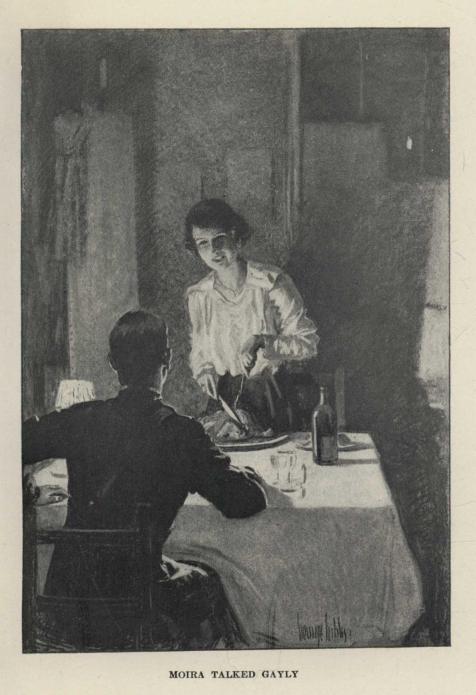
MOIRA TALKED GAYLY
They took their coffee by the embers of the fire. The light from the great north window had long since expired and the mellow glow of the candles flickered softly on polished surfaces.
Suddenly Moira stopped talking and realized that as she did so silence had fallen. Her companion had sunk deep into his chair, his gaze on the gallery above, a frown tangling his forehead. She glanced at him quickly and then looked away. Something was required of him and so,
"Why have you done all this for me?" he asked gently.
She smiled and their glances met.
"Because—because——"
"Because you thought it a duty?"
"No——," easily, "it wasn't really that. Duty is such a tiresome word. To do one's duty is to do something one does not want to do. Don't I seem to be having a good time?"
"I hope you are. I'm not likely to forget your charity—your——"
"Charity! I don't like that word."
"It is charity, Moira. I don't deserve it."
The words were casual but they seemed to illumine the path ahead, for she broke out impetuously.
"I didn't think you did—I pitied you—over there—for what you had been and almost if not quite loathed you, for the hold you seemed to have on father. I don't know what the secret was, or how much he owed you, but I know that he was miserable. I think I must have been hating you a great deal, Harry dear—and yet I married you."
"Why did you?" he muttered. "I had no right to ask—even a war marriage."
"God knows," she said with a quick gasp as she bowed her head, "you had made good at the Camp. I think it was the regimental band at Yaphank that brought me around. And then you seemed so pathetic and wishful, I got to thinking you might be killed. Father wanted it. And so——" she paused and sighed deeply. "Well—I did it.... It was the most that I could give—for Liberty...."
She raised her head proudly, and stared into the glowing embers.
"For Liberty—you gave your own freedom——" he murmured.
"It was mad—Quixotic——" she broke in again, "a horrible sacrilege. I did not love, could not honor, had no intention of obeying you...." She stopped suddenly, and hid her face in her hands. He thought that she was in tears but he did not dare to touch her, though he leaned toward her, his fingers groping. Presently she took her hands down and threw them out in a wild gesture. "It is merciless—what I am saying to you—but you let loose the floodgates and I had to speak."
He leaned closer and laid his fingers over hers.
"It was a mistake——" he said. "I would do anything to repair it."
He meant what he said and the deep tones of his voice vibrated close to her ear. She did not turn to look at him and kept her gaze on the fire, but she breathed uneasily and then closed her eyes a moment as though in deep thought.
"Don't you believe me, Moira?"
She glanced at him and then leaned forward, away—toward the fire.
"I believe that I do," she replied slowly. "I don't know why it is that I should be thinking so differently about you, but I do. You see, if I hadn't trusted you we'd never have been sitting here this night."
"I gave you your chance to be alone——"
"Yes. You did that. But I couldn't let you be going to a pension, Harry. I think it was the pity for your pale face against the pillows."
"Nothing else?" he asked quietly.
His hand had taken the fingers on the chair arm and she did not withdraw them at once.
"Sure and maybe it was the blarney."
"I've meant what I've said," he whispered in spite of himself, "you're the loveliest girl in all the world."
There was a moment of silence in which her hand fluttered uneasily in his, while a gentle color came into her face.
Then abruptly she withdrew her fingers and sprang up, her face aflame.
"Go along with you! You'll be making love to me next."
He sank back into his chair, silent, perturbed, as he realized that this was just what was in his heart.
"Come," she laughed, "we've got all the dishes to wash. And then you're to be getting to bed, or your head will be aching in the morning. Allons!"
She brought him to himself with the clear, cool note of camaraderie, and with a short laugh and a shrug which hid a complexity of feeling, he followed her into the kitchen with the dishes. But a restraint had fallen between them. Moira worked with a business-like air, rather overdoing it. And Jim Horton, sure that he was a blackguard of sorts, wiped the dishes she handed to him and then obediently followed her to the room off the hall where his baggage had been carried.
She put the candle on the table and gave him her frankest smile.
"Sleep sound, my dear. For to-morrow I'll be showing you the sights."
"Good-night, Moira," he said gently.
"Dormez bien."
And she was gone.
He stood staring at the closed door, aware of the sharp click of the latch and the faint firm tap of her high heels diminishing along the hall—then the closing of the studio door. For a long while he stood there, not moving, and then mechanically took out a cigarette, tapping it against the back of his hand. Only the urge of a light for his cigarette from the candle at last made him turn away. Then he sank upon the edge of the bed and smoked for awhile, his brows furrowed in thought. Nothing that Harry had ever done seemed more despicable than the part that he had chosen to play. He was winning her friendship, her esteem, something even finer than these, perhaps—for Harry—as Harry, borrowing from their tragic marriage the right to this strange intimacy. If her dislike of him had only continued, if she had tolerated him, even, or if she had been other than she was, his path would have been smoother. But she was making it very difficult for him.
He paced the floor again for awhile, until his cigarette burnt his fingers, then he walked to the window, opened it and looked out. It was early yet—only eleven o'clock. The thought of sleep annoyed him. So he took up his cap, blew out the candle and went quietly out into the hall and down the stairs.
He wanted to be alone with his thoughts away from the associations of the studio, to assume his true guise as an alien and an enemy to this girl who had learned to trust him. The cool air of the court-yard seemed to clear his thoughts. In all honor—in all decency, he must discover some way of finding his brother Harry, expose the ugly intrigue and then take Harry's place and go out into the darkness of ignominy and disgrace. That would require some courage, he could see, more than it had taken to go out against the Boche machine gunners in the darkness of Boissière Wood, but there didn't seem to be anything else to do, if he wanted to preserve his own self-respect....
But of what value was self-respect to a man publicly disgraced? And unless he could devise some miracle that would enable him to come back from the dead, a miracle that would stand the test of a rigid army investigation, the penalty of his action was death—or at the least a long term of imprisonment in a Federal prison, from which he would emerge a broken and ruined man of middle age. This alternative was not cheering and yet he faced it bravely. He would have to find Harry.
* * * * *
The feat was not difficult, for as he emerged from the gate of the porte cochère of the concierge and turned thoughtfully down the darkened street outside, a man in a battered slouch hat and civilian clothes approached from the angle of a wall and faced him.
"What the H—— are you doing at No. 7 Rue de Tavennes?" said a voice gruffly.
Jim Horton started back at the sound, now aware that Fortune had presented him with his alternative. For the man in the slouch hat was his brother, Harry!
CHAPTER IV
OUTCAST
When Jim Horton, Corporal of Engineers, took his twin brother's uniform and moved off into the darkness toward the German lines, Harry Horton remained as his brother had left him, bewildered, angry, and still very much afraid. The idea of taking Jim Horton's place with his squad nearby did not appeal to him. The danger of discovery was too obvious—and soon perhaps the squad would have to advance into the dreadful curtain of black that would spout fire and death. He was fed up with it. The baptism of fire in the afternoon had shaken him when they lay in the field. It was the grinning head of Levinski of the fourth squad that had done the business. He had found it staring at him in the wheat as the platoon crawled forward. It wasn't so much that it was an isolated head, as that it was the isolated head of Levinski, for he hadn't liked Levinski and he knew that the man had hated him. And now Levinski had had his revenge. Harry had been deathly ill at the stomach, and had not gone forward with the platoon. He had seen the whites of the eyes of his men as they had glanced aside at him—and spat.
Why the H—— he had ever gone into the thing ... And now ... suppose Jim didn't come back! What should he do? Why had the Major picked him out for this duty! His thoughts wandered wildly from one fancied injury to another. And Jim—it was like him to turn up and plunge into this wild venture that would probably bring them both to court-martial. And if Jim was shot, what the devil was he to do? Go on through the service as Jim Horton, Corporal of Engineers? He cursed silently while he groveled in the gully waiting for the shots that were to decide his fate.
For a moment he gathered nerve enough to pick up Jim's rifle and accoutrement with the intention of joining the squad of engineers. But just at that moment there were sounds of shots within the wood, followed by others closer at hand, and then bullets ripped viciously through the foliage just above him. By a movement just ahead of him he knew that the line was advancing. He couldn't ... his knees refused him ... so he crawled into the thicket along the gully and lay upon the ground among the fallen leaves. More shots. Cries all about him. A grunt of pain after a shrapnel burst nearby ... the rush of feet as the second wave filtered through ... then the rapid crackle of the engagement in the wood. Jim was there—in his uniform. He'd be taking long chances too. He had always been a fool....
From his cover he marked the dawn while the fighting raged—then sunrise. The fire seemed to slacken and then move farther away. The line was still advancing and only the wounded were coming in—some of them walking cases, with bandaged heads and arms. He eyed them through the bushes furtively—vengefully. Why couldn't he have gotten a wound like that—in the afternoon in the wheat field—instead of finding the head of Levinski and the terror that it had brought? Other wounded were coming on stretchers now. The gully near him made an easy path to the plain below and many of them passed near him ... but he lay very still beneath the leaves. What if Jim came back on a stretcher...! What should he do?
Then suddenly as though in answer to his question two men emerged from the hollow above and approached, carrying something between them. There was a man of Harry's own platoon and a sergeant of the company. He heard their voices and at the sound of them he cowered lower.
"Some say he showed yellow yesterday in the wheat field," said the private.
"Yellow! They'd better not let me hear 'em sayin' it——"
They were talking about him—Harry Horton. And the figure, lying awkwardly, a shapeless mass——?
At the risk of discovery, the coward straightened and peered down into the white face ... Jim!
Harry Horton didn't remember anything very distinctly for a while after that, for his thoughts were much confused. But out of the chaos emerged the persistent instinct of self preservation. There was no use trying to find Jim's squad now. He wouldn't know them if he saw them. And how could he explain his absence with no wound to show? For a moment the desperate expedient occurred to him of thrusting himself through the leg with the bayonet. He even took Jim's weapon out of its scabbard. But the blue steel gave him a touch of the nausea that had come over him in the wheat field.... That wouldn't do. And what was the use? They had Harry Horton lying near death on the stretcher. What mattered what happened to the brother? There was no chance now to exchange identities. Perhaps there was never to be a chance.
He sank down again into the thicket, pulling the leaves about him. He would find a way. It could be managed. "Missing"—that was the safest way out.
That night, limping slightly, he emerged and made his way to the rear. It was ridiculously easy. Of the men he met he asked the way to the billets of the —th Regiment. But he didn't go where they told him. He followed their instructions until out of sight of them, and then went in the opposite direction.
He managed at last to get some food at a small farm house and under the pretext of having been sent to borrow peasant clothing for the Intelligence department, managed to get a pair of trousers, shirt, coat and hat. He had buried his rifle the night before and now when the opportunity came he dropped the bundle of Jim Horton's corporal's uniform, weighted by a stone, into deep water from a bridge over a river. With the splash Corporal James Horton of the Engineers had ceased to exist.
At the end of two weeks, thanks to some money that he had found in Jim's uniform—and a great deal of good luck—he was safe in a quiet pastoral country far from the battle line. Here he saw no uniforms—only old men and women in blouses and sabots, occupying themselves with the harvest, aware only that the Boches were in retreat and that their own fields were forever safe from invasion. He represented himself as an American art student of Paris, driven by poverty from the city, and offered to work for board and lodging. They took him, and there he stayed for awhile. There was a girl in the family. It was very pleasant. The nearest town was St. Florentin, and Paris was a hundred miles away. But after a few weeks he wearied of it, and of the girl, and having twenty francs left in his pockets stole away in the middle of the night.
Paris was the place for him. There identities were not questioned. He knew something of Paris. Piquette Morin! He could get her help without telling any unnecessary facts. As to Barry Quinlevin and Moira—that was different. It wouldn't be pleasant to fall completely in the power of a man like Barry Quinlevin—even if he was now his father-in-law. And Moira ... No. Moira mustn't ever know if he could prevent it. And yet if Jim Horton in Harry's uniform had been killed Harry would be officially dead. He was already dead, to Moira, if Jim Horton had revived enough to tell the truth. It wasn't a pretty story to be spread around. But if Jim were alive ... what then?
There were ways of getting along in Paris. He would find a way even if ... Moira! He would have liked to be able to go to Moira. She was the one creature in the world whose opinion seemed to matter now. She would have been his on the next furlough. He knew women. If you couldn't get them one way you could another. Already her letters had been gentler—more conciliatory. His wife—the wife of an outcast! God! Why had he ever gone into the service? How had he known back there that he wouldn't have been able to stand up under fire—that he would have found the grinning head of the hated Levinski in the wheat field? Waves of goose flesh went over him and left him cold and weak.... A sullen mood followed, dull, embittered, and vengeful, against all the world, with only one hope.... If Jim were alive—and silent!
That opened possibilities—to substitute with his brother and come back to his own—with all the honors of the fool performance! It was his name, his job that Jim had taken, and his brother couldn't keep him out of them. He could make Jim give them up—he'd make him. If he couldn't come back himself, he would drag Jim down with him—they would be outcast together. In the dark that night he would have managed in some way to carry out the Major's orders if Jim hadn't found him just at the worst moment. What right had Jim to go butting in and making a fool of them both! D—n him!
He found his way into Paris at the end of a dreary day of tramping. He had a few francs left but he was tired and very hungry. With a lie framed he went straight to the apartment of Piquette Morin. She had gone out of town for a few days.
That failure baffled him. He had a deposit in a bank, but he dared not draw it out. So he trudged the weary way up to Montmartre, saving his sous, and hired a bed into which he dropped more dead than alive.
Thus it was that two nights later, unable yet to bring himself to the point of begging from passersby, with scant hope indeed of success, his weary feet brought him at last to the Rue de Tavennes. Hiding his face under the shadow of his hat he inquired of the concierge and found that the apartment of Madame Horton was au troisième. He strolled past the porte cochère and walked on, looking hungrily up at the lighted windows of the studio. Moira was there—his wife, Barry Quinlevin perhaps. Who else? He heard sounds of laughter from somewhere upstairs. Laughter! The bitterness of it! But it didn't sound like Moira's voice. He walked to and fro watching the lighted windows and the entrance of the concierge, trying to keep up the circulation of his blood, for the night was chill and his clothing thin. He had no plan—but he was very hungry and his resolution to remain unknown was weakening. A man couldn't let himself slowly starve, and yet to seek out any one he knew meant discovery and the horrible publicity that must follow. The lights of the troisième étage held a fascination for him, like that of a flame for a moth. He saw a figure come to a window and throw open the sash. He stared, unable to believe his eyes. It was a man in the uniform of an officer of the United States Army—his own uniform and the man who wore it was his brother Jim! Alive—well, covered with honors perhaps—here—in Moira's apartment? What had happened to bring his brother here? And Moira ...
His head whirled with weakness and he stood for a moment leaning against the wall, but his strength came back to him in a moment, and he peered up at the window again. The light had gone out. Jim masquerading in his shoes—with Moira—as her husband—alone, perhaps, in the apartment! And Moira? The words of conciliation in her last letters which had seemed to promise so much for the future, had a different significance here. Fury shook him like a leaf, the fury of desperation, that for the moment drove from his craven heart all fear of an encounter with his brother.
There was a sound of a door shutting and in a moment he saw the man in uniform emerge by the gate of the concierge. He walked toward the outcast, his head bent in deep meditation. There was no doubt about its being Jim. With clenched fists Harry barred his way, the thought that was uppermost in his mind finding utterance.
Jim Horton stopped, stepped back a pace and then peered at the man in civilian clothing from beneath his broad army hat-brim.
"Harry!" he muttered, almost inaudibly.
"What are you doing here—in this house?" raged Harry in a voice thick with passion. And then, as no reply came, "Answer me! Answer me!"
One of Harry's fists threatened but his brother caught him by the wrist and with ridiculous ease twisted his arm aside. He was surprised as Harry sank back weakly against the wall with a snarl of pain. "D—n you," he groaned.
This wouldn't do. Any commotion would surely arouse the curiosity of Madame Toupin, the concierge.
"Keep a civil tongue in your head, Harry," he muttered, "and I'll talk to you."
He caught him firmly by the arm, but Harry still leaned against the wall, muttering vaguely.
"A civil tongue—me? You—you dare ask me?"
"Yes," said Jim gently, "I've been trying to find you."
"Where?" leered Harry, "in my wife's studio?"
Jim Horton turned suddenly furious, but shocked into silence and inertia by the terrible significance of the suspicion. But he pulled himself together with an effort.
"Come," he said quietly. "Let's get away from here."
He felt Harry yield to the pressure of his fingers and slowly they moved into the shadows down the street away from the gas lamps. A moment later Harry was twitching at his arm.
"G-get me something to cat. I—I'm hungry," he gasped.
"Hungry! How long——?"
"Since yesterday morning—a crust of bread——"
And Jim had been eating goose——! The new sense of his own guilt appalled him.
"Since yesterday——!" he muttered in a quick gush of compassion. "We'll find something—a café——"
"There's a place in the Rue Berthe—Javet's," he said weakly.
Jim Horton caught his brother under an elbow and helped him down the street, aware for the first time of the cause of his weakness. He marked, too, the haggard lines in Harry's face, and the two weeks' growth of beard that effectually concealed all evidence of respectability. There seemed little danger of any one's discovering the likeness between the neatly garbed lieutenant and the civilian who accompanied him. But it was well to be careful. They passed a brilliantly lighted restaurant, but in a nearby street after awhile they came to a small café, not too brightly lighted, and they entered. There was a polished zinc bar which ran the length of a room with low, smoke-stained ceilings. At the bar were two cochers, in shirt sleeves, their yellow-glazed hats on the backs of their heads, sipping grenadine. There was a winding stair which led to the living quarters above, but through a doorway beside it, there was a glimpse of an inner room with tables unoccupied. They entered and Jim Horton ordered a substantial meal which was presently set before the hungry man. The coffee revived him and he ate greedily in moody silence while Jim Horton sat, frowning at the opposite wall. For the present each was deeply engrossed—Jim in the definite problem that had suddenly presented itself, and the possible courses of action open to do what was to be required of him; Harry in his food, beyond which life at present held no other interest. But after a while, which seemed interminable to Jim, his brother gave a gasp of satisfaction, and pushed back his dishes.
"Give me a cigarette," he demanded with something of an air.
Jim obeyed and even furnished a light, not missing the evidences of Dutch courage Harry had acquired from the stimulation of food and coffee.
It was curious what little difference the amenities seemed to matter. They were purely mechanical—nor would it matter what Harry was to say to him. The main thing was to try to think clearly, obliterating his own animus against his brother and the contempt in which he held him.
Harry sank back into his chair for a moment, inhaling luxuriously.
"Well," he said at last, "maybe you've got a word to say about how the devil you got here."
"Yes," said Jim quickly. "It's very simple. I was hit. I took your identity in the hospital. There wasn't anything else to do."
Harry glowered at the ash of his cigarette and then shrugged heavily.
"I see. They think you're me. That was nice of you, Jim," he sneered, "very decent indeed, very kind and brotherly——"
"You'd better 'can' the irony," Jim broke in briefly. "They'd have found us out—both of us. And I reckon you know what that would have meant."
"H—m. Maybe I do, maybe I don't," he said shrewdly. "It was you who found me—er—sick. Nobody else did."
"We needn't speak of that."
"We might as well. I'd have come around all right, if you hadn't butted in."
"Oh, would you?"
"Yes," said Harry sullenly.
Jim Horton carefully lighted a cigarette from the butt of the other, and then said coolly:
"We're not getting anywhere, Harry."
"I think we are. I'm trying to show you that you're in wrong on this thing from start to finish. And it looks as though you might get just what was coming to you."
"Meaning what?"
"That you'll take my place again. This——!" exhibiting with a grin his worn garments. "You took mine without a by-your-leave. Now you'll give it back to me."
An ugly look came into Jim Horton's jaw.
"I'm not so sure about that," he said in a tone dangerously quiet.
"What! You mean that——" The bluster trailed off into silence at the warning fire in his brother's eyes. But he raised his head in a moment, laughing disagreeably. "I see. The promotion has got into your head. Some promotion—Lieutenant right off the reel—from Corporal, too. Living soft in the hospital and now——" He paused and swallowed uneasily. "How did you get to the Rue de Tavennes?"
"They came to the hospital—Mr. Quinlevin and—and your wife. I—I fooled them. They don't suspect."
"How—how did you know Moira was my wife?"
"Some letters. I read them."
"Oh, I see. You read them," he frowned and then, "Barry Quinlevin's too?"
"Yes—his too. I had to have facts. I got them—some I wasn't looking for——"
"About——?"
"About the Duc de Vautrin," Jim broke in dryly. "That's one of the reasons why I'm still Harry Horton and why I'm going to stay Harry Horton—for the present."
If Jim had needed any assurance as to his brother's share in this intrigue he had it now. For Harry went red and then pale, refusing to meet his gaze.
"I see," he muttered, "Quinlevin's been talking."
"Yes," said Jim craftily, "he has. It's a pretty plan, but it won't come off. You always were a rotter, Harry. But you're not going to hurt Moira, if I can prevent."
It was a half-random shot but it hit the mark.
"Moira," muttered Harry somberly. "I see. You haven't been wasting any time."
"I'm not wasting time when I can keep her—or even you—from getting mixed up in dirty blackmail. That's my answer. And that's why I'm not going to quit until I'm ready."
Harry Horton frowned at the soiled table cover, his fingers twitching at his fork, and then reached for the coffee pot and quickly poured himself another cup.
"Clever, Jim," he said with a cynical laugh. "I take off my hat to you. I never would have thought you had it in you. But you'll admit that living in my wife's apartment and impersonating her husband is going a bit too far."
The laughter didn't serve to conceal either his fear or his fury. But it stopped short as Jim's fingers suddenly closed over his wrist and held it in a grip of iron.
"Don't bring her into this," he whispered tensely. "Do you hear?" And after a moment of struggle with himself as he withdrew his hand, "You dared to think yourself worthy of her. You!"
"Be careful what you say to me," said Harry, trying bravado. "She's my wife."
"She won't be your wife long, when I tell her what I know about you," finished Jim angrily.
He saw Harry's face go pale again as he tried to meet his gaze, saw the fire flicker out of him, as he groped pitiably for Jim's hand.
"Jim! You—you wouldn't do that?" he muttered.