Front matter (continued 4)
Reading edition
"You won't do that," she went on breathlessly. "I can't permit it. I've heard all you said. I've been listening—-there——"
"Ah, you heard," said Quinlevin with a quick glance at her. "Then perhaps it's just as well. I would be having to tell you some day." And then, with quick decision. "Ye're not my daughter. Ye're the child of the Duc de Vautrin."
As he shot this bolt at her, he watched its effect. Moira grew even paler and stared at him as though he were a person she had never seen before.
"The daughter—of the Duc de Vautrin?" she stammered.
"That's not true, Moira," broke in Jim's voice, "but you're not his daughter either. I'll take my oath on it."
She glanced at Jim as though the deep tones of his voice had steadied her for a moment.
"Not his daughter—then who——?" She paused and sought Quinlevin's eyes uncertainly.
"I've told ye the truth, my dear. It was my crime not to have told ye before—but that's all ye can lay against me—that and the love for ye that has made the confession difficult."
Moira faltered. But Barry Quinlevin's eyes were upon her, alive, it seemed, with the old affection. And across her brain flitted quick visions of their careless past, their years of plenty, their years of privation, in which this man, her father she had thought, had always loomed the dominant figure, reckless perhaps, aloof at times—but always kindly—considerate.... But there was Jim Horton just beside her.... She felt his presence too—the strength of him—the honesty and the love of her that gave him the courage to face oblivion for her sake. The silence was deathly, and seemed to have gone on for hours. Jim did not speak. There was Harry too, standing like a pale image, the ghost of her happiness—staring at her. Were they all dumb? Something seemed to be required of her and her instinct answered for her. She moved toward Jim Horton, her fingers seeking his.
"I—I love him," she found herself saying. "I—want you both to know. It has all been a horrible mistake—But it's too late to cry over. It has just happened—that's all. I can never love any one else——"
"Moira——," whispered Jim.
"But I know that—that there's nothing to be done. I only wanted you to know," she finished firmly, "that any one who harms him, harms me——"
"Moira," Jim's voice broke in pleadingly at her ear. "Come away with me—now. You can't stay here. The situation is impossible."
She felt Barry Quinlevin's eyes before he spoke.
"I don't need to remind ye, Moira—of yer vows at the altar——"
"What vows!" broke in Jim, fiercely facing his brother. "A travesty—a cruel hoax. There's no law that will keep it binding——"
"She married me—with her eyes open," muttered Harry. "And unless I release her——"
"Stop! For God's sake," Moira's voice found itself in pity for her own humiliation. "There's no release—no hope for either of us. There's no divorce—except death——"
"I ask nothing of you, Moira," Jim was pleading again, "only to go with me—away from here—to-night—for your own self-respect."
"An outcast——," sneered Quinlevin.
He saw how the game was going, but he went too far. She turned on him defiantly.
"An outcast!" she said. "I would be proud to be facing the world alone with such an outcast as Jim Horton—the shame and the glory of following blindly where my heart was leading me——"
"Come, then," said Jim.
"No. Don't you see? I can't. What Harry says is true. I married with my eyes open. I swore to a lie. And I've got to abide by that lie. I've got to, Jim. For God's sake, have pity."
She sank helplessly into a chair, relinquishing his hand. All hope, all life, it seemed, had gone out of her. Jim Horton stood regarding her for a moment and then silently walked to the door, when he heard her voice again.
"Jim," she cried despairingly.
He turned in the doorway and their glances met for a moment.
"Will you come, Moira?" he asked quietly.
"I can't, Jim. I can't——"
He waited a moment, and then laying Quinlevin's weapon on the table in front of him, turned again and walked out of the door and into the darkness of the corridor.
CHAPTER XIII
BEGINNING A JOURNEY
It would have been easy for Quinlevin to have shot him in the back, and at the moment Jim Horton wouldn't much have cared if he had. He went down the stairs slowly, across the court and out into the street, wandering aimlessly, bare headed, with no sense of any intention or direction. "There's no divorce—but death." Moira's words rang again and again in his brain. That was a part of her creed, her faith, her religion. She had once spoken of what her Church had always meant to her—her Mother, she had called it,—and she was true to her convictions. "There's no divorce—but death." The revelation of her beliefs was not new to him, yet it came to him with a sense of shock that she had chosen at the last to remain with Harry and Quinlevin and all the degradation that the association meant to her. It had been a choice between two degradations, and force of habit had cast the last feather into the balance. In the bitterness of his own situation—isolated, outcast, with no hope of regeneration, he tried to find it in his heart to blame her. But the thought of the pain and bewilderment he had seen in her eyes made him only pitiful for her misfortunes. It seemed as though the shock of the many revelations of the evening had deadened her initiative, enfeebled her fine impulses and made her like a dependent child—at the mercy of custom and tradition. And he could not forget that he had gone to her asking nothing, expecting nothing, and that in spite of all the barriers that she recognized between them, in spite of the deception he had practiced, she had still clung to him and even acknowledged him in the presence of her husband and the man she called her father. Love had glowed in her eyes and in her heart, lifting her for a time above the tragic mystery of her origin and the broken ideals of a lifetime. It was almost enough for him to ask of her.
It didn't seem to matter much now what happened to him. But almost unconsciously he found himself casting an occasional glance over his shoulder to see if he was followed. He had no fear of Harry. His brother had shown to-night in his true colors, but the picturesque scoundrel whose name Moira bore was clearly a person to be reckoned with. Why Quinlevin hadn't taken a pot-shot at him on the stairs was more than Jim Horton could understand, unless some consideration for Moira had held his hand. The impulse of fury that had made him draw his revolver had faded. But their controversy was still unsettled and Jim Horton knew that the one duty left him must be done at once. After he had told what he knew to de Vautrin, Quinlevin could try to kill him if he liked—but not before....
Would the memories of the past prevail in Moira's relations with Quinlevin? Would he be able to convince her that she was the Duc's daughter? He remembered that most of what he had heard from his place of concealment could be susceptible of a double interpretation under the skillful manipulation of the resourceful Irishman.
Jim Horton knew that Piquette had told him the straight story, from Harry's own lips, but he could not violate her confidence by using her name. It meant danger for Piquette from Quinlevin and perhaps a revelation of her breech of Pochard's confidence and a greater danger even from Tricot. He knew that he must move alone and reach the ear of de Vautrin at once with his testimony.
He approached the café of Leon Javet when he heard the light patter of feet behind him and stopped and turned. It was Piquette, divested of her fine raiment and dressed in the simple garb of a midinette.
"Jeem——," she said. "I 'ave been waiting for you—outside——"
"Oh, Piquette——"
"You mus' not go in Javet's—come, mon ami, to de oder side of de street——"
"Why, Piquette?" he asked curiously.
"Because Tricot and Le Singe are looking for you and dey will watch Javet's."
"H-m. Who told you this?"
But he let her take him by the elbow to the darkness opposite.
"Pochard. De house in de Rue Charron is watch' by de police. Dey are afraid you will give de evidence——"
"They needn't worry just now," he muttered. "I've something else to do."
"But you mus' keep away from de Quartier——"
"I expect to. I'm going away, Piquette——"
"Jeem! Where?"
"To Nice. I've got to see your friend de Vautrin, at once."
"Ah—de Vautrin!"
She walked along with him for a moment in silence.
"Where is your 'at, mon ami?"
He ran his fingers through his hair, aware for the first time of his loss.
"I left it——"
"In the Rue de Tavennes?"
"Yes."
"Ah, you mus' tell me. Come to de Boulevard Clichy. It is safer."
"I've taken a lodging in the Rue Jean Paul."
"No," she insisted. "You mus' take no more chances on dis side of de river jus' now—nor mus' I."
"You mean that they suspect——?"
"Not yet—but dey will if dey see us—you and I——"
"You can't run that chance, Piquette."
"We are quite safe in de Boulevard Clichy. Come."
And so he yielded to her persuasions and followed her by a roundabout way across the Pont Carrousel and so toward their destination, while he told her in general terms of the events of the evening. She listened, putting in an exclamation or a brief question here and there, but made no comments until they reached her apartment, where she made him comfortable in her best chair, gave him a cigarette and getting out of her street dress, slipped into her dressing gown. To the western mind, unused to the casual ways of the atelier, this informality might have seemed indecorous. But Jim Horton was deeply absorbed in his own thoughts and for the moment did not think of her. And when she drew her robe around her and took up a cigarette, she seemed for the first time to be aware of his abstraction. To Piquette's mind those things which were natural to her must be natural to every one else, and this, after all, is only the simple philosophy of the child. As she curled herself up on her chaise longue and lighted her cigarette he smiled at her.
"Well, mon Jeem*," she said, "what you t'ink of Monsieur Quinlevin?" (She pronounced it Canl'van.)
"He's just about the smoothest proposition that ever happened," he replied. "He'd have gotten me, if I hadn't moved in close."
"An' 'Arry——? 'E did not'ing?"
"No. Just stood there. He's lost his nerve again. He won't bother me, but the Irishman is in this game for keeps."
"He is dangerous, mon ami. You 'ad better not go on wit' dis affair."
"Yes, Piquette, I must," he said quietly. "I got into this situation by being a moral coward, I'm not going to get out of it by being a physical one. Besides, I've promised."
"Who?"
"Myself. It's a duty I owe——," he paused.
"To Madame 'Orton? An' what t'anks do you get?" She shrugged expressively. "A bullet or a knife in de ribs, perhaps. You 'ave already almos' enough been shot and beaten, mon vieux."
"And yet here I am quite comfortable in your best chair, and none the worse—thanks to you, Piquette."
"But you cannot always be so lucky. I would be ver' onhappy if you were kill', mon Jeem."
"Would you, Piquette?" he said, taking her hand impulsively and kissing it gently.
"An' den it is too late to be onhappy——," she sighed and put her other hand over his. "Oh, mon Jeem, life is so short, so sweet. It is not right to take a chance of dying before one's time."
"I don't want to die just yet, and I don't expect to, but life doesn't mean a whole lot to me. It's too complex, you understand?—difficile——" He gave a sigh and sank back in his chair, relinquishing her fingers. "I guess I was meant for the simple life," he said, with his slow smile.
She was silent for a moment, regarding him soberly.
"What 'as happen', mon ami? She 'as let you go?"
He paused, frowning at the ash of his cigarette.
"What else could she do?" he asked quietly. "I asked nothing—expected nothing of her."
"Then you cannot be disappoint'!" said Piquette dryly. "She is not worth de trouble. You run a risk of being kill', to save 'er from 'er 'usban' who is a vaut rien, you offer 'er de bes' you 'ave an' she send you away alone into de darkness. You t'ink she loves you. Saperlotte! What she knows of love! If I love a man I would go wit' 'im to de end of de worl', no matter what 'e is."
He sat watching her as she spoke—listening to the clear tones of her voice, watching the changes in her expressive features.
"I believe you would, Piquette," he muttered.
"An' you," she went on shrilly, "you who 'ave save' 'er 'usban' from disgrace, you who win 'im de Croix de Guerre an' den go into de darkness an outcas'—she let you go—she let you go——!"
"Sh——," he broke in. "She had to—I understand—she is a Catholic——"
She paused and then went on. "Why 'as she marry your broder if she does not love 'im? La la!" She stopped and shrugged her pretty shoulders. "Perhaps you onderstan' now, mon petit Jeem, why I 'ave not marry. Not onless I love, and den——," her voice sank to a tense whisper, "and den ontil deat' I would be true——"
"Yes, Piquette. You are that sort. But this——," and he glanced about the room.
She shrugged as she caught his meaning.
"Monsieur 'as much money. Why should I not be content as well as some one else?"
Deep in his heart he was sorry for her, but he could see that she was not in the least sorry for herself. And the unconventionality of her views, the total lack of moral sense, seemed somehow less important than the rugged sincerity of her point of view and the steadfastness of her friendship.
"And you have never loved well enough to marry?" he asked.
"No, mon Jeem," she said gently.
Their glances met, his level and friendly. And it was her look that first turned away. "No, mon Jeem," she repeated slowly. "One does not meet such a man, ontil it is too late." She gave a sharp little gasp and sat up facing him. "An' I speak of my troubles when you 'ave greater ones of your own. I want to 'elp you, mon ami. You 'ave in your mind a duty to do with Monsieur the Duc de Vautrin. You 'ave make me t'ink. Perhaps it is my duty too."
"I've got to see him at once, before Quinlevin does."
"Eh bien. He is on the Riviera—Nice. We s'all find 'im."
"We?"
"Parfaitement! Perhaps I can make it easier for you to see him——"
"You'll go with me?"
"Why not? Onless you do not want me——?"
"Of course I'll be only too happy, only——"
"What, mon petit?"
"It seems a great deal to ask. You've already done so much."
"No," she said with a smile. "It will perhaps be safer for both of us away from Paris. An' you are onhappy. Will I perhaps not cheer you up a little?"
"There's no doubt of that, Piquette——"
"I would like to go wit' you. It will give me pleasure—if you do not mind."
"But Monsieur the Duc——"
"Je ne me fiche pas. Besides, shall I not now be doing him a service?"
"Yes, that's true." He stopped as a thought came to him. "The Duc suspects something. What made him go to Ireland and question Nora Burke?"
"Perhaps I talk' a little too much dat night——"
"Has he spoken of it since?"
"Yes. But I tol' 'im not'ing. I did not wish to get 'Arry in trouble. But now——," she shrugged and lighted a fresh cigarette. "I do not care about what 'appen to 'Arry or Monsieur Quinlevin. It is only what 'appens to you dat matters, mon Jeem.
"But in befriending me you've made enemies of all that crowd——"
"Not onless dey find out. It is you who are in danger. After what you 'ave 'eard to-night, you are more dangerous to Quinlevin dan ever."
"I gave him his chance. He didn't take it."
"But he'll make anoder chance. You do not know dat man. Even Tricot is afraid of 'im."
"Well, I'm not. He thinks the world owes him a living. But he wouldn't last half an hour out in the country where I come from. He's clever enough, to put it over Moira all these years——"
"Yes, mon Jeem. An' 'e may 'put it over' still—now dat you go from 'er——"
"Perhaps," he muttered, with a frown. "But that doesn't matter. She's not de Vautrin's daughter—or his—I'd take an oath on it. I've got to clear her skirts of this dirty mess. She wouldn't come. They've got her there now—a prisoner. She can't help herself. I can't be losing any time."
He rose suddenly as though aware of the passage of time and took a few paces away from her.
"Not to-night?" said Piquette.
"The first train. I've got to go and find out."
She glanced at the small enameled clock upon the mantel.
"It is too late. Dere would be no fas' express until de morning."
"Very well. I'll see." And he strode toward the door.
"At de Hotel Gravelotte—at de corner you will find out, but wait——" She had sprung up and running out of the apartment, returned in a moment with a soft hat, which she gave him.
"Thanks, Piquette—you're my good angel. I do seem to need you, don't I?"
"I 'ope you do, mon vieux," she said quietly. And then, "Go an' 'urry back. I will wait for you."
Thus it was that the next day found Jim Horton and Piquette together in a compartment of the Marseilles Express on their way to the Riviera. Jim had managed to get reservations in a train which was now running regularly, and then, after advising Piquette, had returned to his lodgings in the Rue Jean Paul, meeting her at the Gare de Lyon at noon. Piquette seemed to have thought of everything that he had forgotten, and greeted him with an air of gayety which did much to restore his drooping spirits. It was very cozy, very comfortable, in their compartment à deux, and Piquette looked upon the excursion from the angle of the child ready and willing to take a new pleasure in anything. Curiously enough, she had traveled little—only once to the Côte d'Azur, and looked forward with delight to the southern sunshine, the blue of the sea, and the glimpse of the world of fashion which was once more to be seen upon the Promenade des Anglais. The passing landscape she greeted with little childish cries as she recognized familiar scenes—the upper reaches of the Seine, Juvisy, then Arpajon, Etampes and Orleans.
And Jim Horton sat watching her, detached by her magnetism from the gloom of his thoughts, aware of the quality of her devotion to this newly found friend for whom with joyous carelessness she was risking the good-will of her patron, the displeasure of her bloodthirsty friends of earlier days and even perhaps her very life. She was a new event in his experience, giving him a different meaning for many things. There had been no new passages of anything approaching sentiment between them and he watched her curiously. It seemed that what she wished him to understand was that she was merely a good friend that he could tie to and be understood by. Even when he took her hand in his—a natural impulse on Jim's part when it lay for a moment beside him—she only let it rest there a moment and then gave a careless gesture or made a swift useful motion which dispelled illusions and exorcised sentiment. And yet of sentiment of another sort she was full, fairly bubbling over with sympathy and encouragement, inviting him to share her enjoyment of the gray and brown pastoral from the car window, peaceful, beautiful and untouched by the rough hand of war. It was a kind of friendship he couldn't understand and wouldn't have understood perhaps even if he had been skilled in the knowledge of women. And yet, there it was, very real, very vital to him in all its beauty and self-effacement.
Whatever her past, her strange philosophy of life, her unique code of morals, he had to admit to himself that she was a fine young animal, feminine to the last glossy hair of her head, and compact of splendid forces which had been diverted—of virtues which refused to be stifled by the mere accident of environment. But most of all was she that product of the Latin Quarter, which knows and shares poverty and affluence, friendship and enmity,—the gamine, the bonne camarade.
She thought nothing of her exploit in rescuing him from the house in the Rue Charron, nor would she permit a repetition of his admiration and gratitude. The impulse that had driven her to the rescue was spontaneous. He was one she knew, an American soldier, a friend of France, in trouble. Was not that enough?
As the day wore on Piquette grew tired looking at the scenery and after yawning once or twice, laid her head quite frankly upon his shoulder with all the grace of a tired child and immediately went to sleep. Jim Horton smiled down at her with a new sense of pride in this strange friendship, admiring the fine level brows, the shadows on her eye-lids, slightly tinted with blue, the well-turned nose, the scarlet curve of her under lip and the firm line of her jaw and chin. Two outcasts they were, he and she, strangely met and more strangely linked in the common purpose of protecting the destinies of a decadent French gentleman whom Jim Horton had never seen and in whom he had no interest. And Piquette——? What was her motive? Her loyalty to de Vautrin, unlike that which she had shown for him, was spasmodic, actuated by no affection but only by the humor of the moment. She did not love this man. He had never been to her anything more than a convenience.
He smiled. The word suggested a thought to him. Convenience! Was this relation of Piquette to her patron any worse than those marriages of the ambitious girls of his own country, without love, often without hope of love, to bring themselves up in the world? Piquette at least was honest—with the patron and with herself.
The vows at the altar were sacred. He knew how sacred now. He had not dared to think of Moira and he knew that it was well that Piquette had kept his thoughts from her. But now as his companion slept, his arm around her slim figure, he began to think of Moira and the tragic decision that he had given her to make. She had chosen to remain there in the Rue de Tavennes because that was the only home she knew, and in the agony of her mind she felt that she must find sanctuary in her own room with her thoughts and her prayers. And the love she bore him, he knew was not a mere passing fancy, born of their strange romance, but a living flame of pure passion, which could only be dimmed by her duty to her conscience—but not extinguished.
* * * * *
Piquette stirred slightly in her sleep and spoke his name. "Mon Jeem," she muttered, and then settled herself more comfortably against his shoulder. Jim Horton did not move for fear of awakening her, but his gaze passed over her relaxed features and a generous wave of gratitude swept over him for all that she had done for him. What a trump she was! What a loyal little soul to help him with no hope of reward but the same kind of loyalty she had given him. He must not fail her. If there were only some way in which he could help her to happiness. In sleep she was so gentle—so child-like—so confiding. Thinking of all that he owed her, he bent over and kissed her gently on the brow.
She did not waken, and Jim Horton raised his head. Then suddenly, as if in response to an impulse, looked at the small, uncurtained window that let out upon the corridor of the carriage. There, two dark eyes stared at him as though fascinated from a pallid face, the whiter for its frame of dusky hair—the face of Moira Quinlevin. He thought for a moment that the vision was a part of his obsession and for a second did not move—and then started forward, awakening Piquette, for behind the face, in the obscurity of the corridor, he made out another head—and the iridescent eyes of Barry Quinlevin.
CHAPTER XIV
A NIGHT ATTACK
And even as he looked the faces were merged into the obscurity and vanished.
Piquette clung to his arm, whispering.
"I'd such a dreadful dream— Why, Jeem, what is it?"
He started to his feet.
"Barry Quinlevin—there!" he gasped. "With her!"
Her clutch on his arm tightened.
"Here—impossible!"
"I saw them."
"You dreamed, like me. I can't believe——"
"They were there a moment ago. Let me go, Piquette."
"No," she gasped in a frightened whisper. "You mus' not follow——"
"I've got to—to explain," he muttered.
But she only clutched his arm the more firmly and he could not shake her off, for she held him with the strength of desperation.
"Not now, mon Jeem," she pleaded. "I—I am frighten'——"
He glanced at her quickly and it seemed as if this were so, for her face had gone so white that the rouge upon her lips looked like the blood upon an open wound.
"It is jus' what 'e want', mon Jeem, for you to go after him."
"What do you mean?"
"It would give him de excuse he want' to shoot you——"
"Nonsense."
"Defense personnelle. He knows de law. He will kill you, mon Jeem."
"I'm not afraid. I've got to go, Piquette——"
"No. You s'all not. An' leave me here alone——?"
"There's nothing to be frightened about on a train full of people——"
He managed to reach the door with Piquette clinging to him and peered out into the corridor. A guard was approaching.
"Ou est ce monsieur et cette dame——" he stammered,
Ollendorf fashion, and then his French failed him and he floundered helplessly, pleading with Piquette to finish what he wished to say.
But the man understood, rattled off a rapid sentence and disappeared.
"It is dat dey have gone into anoder carriage," she translated. "You see. It will be impossible to find dem."
"No," he muttered, but he knew that the delay had cost him his opportunity.
"You mus' not leave me, mon petit," Piquette pleaded at his ear. "I 'ave fear of him. 'E 'as seen us together. Now 'e knows that it is I who 'ave tol' about Monsieur le Duc—I who 'ave 'elp you from de house in de Rue Charron—everyt'ing. I 'ave fear——"
Jim laid a hand over hers and patted it reassuringly.
"Don't worry. He can't harm you."
"I am not afraid when you are 'ere,——" she whispered.
And she won her way. It was the least that he could do for her; so he sat again thinking of the look in Moira's eyes and frowning out of the window, wondering how best to meet this situation, while Piquette clung to his arm and patted his hand nervously.
"We should 'ave watch' for 'im, mon Jeem—at de Gare de Lyon. I don' on'erstan'——"
"Nor I—how he got her to come with him," muttered Jim fiercely.
"'Ave I not tol' you 'e is a man extraordinaire—a man to be watch'—to be fear'——?"
"How did he get her to come?" Jim repeated, as though to himself. "How did he——?"
There seemed no necessity to find a reply to that, for there she was, in the next carriage, perhaps, with this shrewd rascal, whose power and resource seemed hourly to grow in importance.
It was difficult to believe that Moira had listened to Quinlevin, had believed the story he had chosen to tell her, directly after the convincing proof of his villainy, directly after Jim Horton's own plea to save her. What art—what witchcraft had he employed?
The answer came in a shrewd guess of Piquette's.
"Dis was de firs' fas' express to de Mediterranean," she said. "'E knew you would go to Monsieur de Vautrin. Las' night 'e foun' out I would go wit' you."
"But how——?"
"Who knows——?" she shrugged uneasily.
He turned with a frown and examined Piquette with quick suspicion, but her gaze met his frankly. The thought that had sped through his mind was discreditable to her and to him for thinking it. There was no possibility of her collusion with Quinlevin. Her fear of him was too genuine.
"H-m. He arranged things nicely. To show her me with you——"
"Parfaitement! It is dat only which made 'er come, mon petit."
"Smooth!" muttered Jim. "And she saw me, all right," he finished bitterly.
Piquette was silent for awhile.
"She is ver' 'andsome," she said at last. And then, "An' she foun' me asleep wit' my 'ead on your shoulder."
"Yes," muttered Jim. "She did."
At the moment he could not think how much his words wounded her.
"I am sorry, mon petit," she said gently.
His conscience smote him at the tone of contrition.
"Oh, it doesn't matter, of course," he said. "There was no hope—for me—none. But it complicates things a little."
"Yes, I comprehend. Monsieur hopes to keep you from reaching the Duc."
"He won't succeed—but I'd rather he hadn't seen me in the train."
"Or Madame."
Jim Horton made no reply and was at once enwrapped in his thoughts, which as Piquette could see, excluded her. And after a glance at his face, she too was silent. The train, stopping here and there, rushed on through the darkness, for hours it seemed to Piquette, and her companion still sat, staring at the blank wall before him, absorbed in his problem. He seemed to have forgotten her—and at last she could bear the silence no longer.
"Mon pauvre Jeem, you love 'er so much as dat?" she asked.
He started at the sound of her voice and then turned and laid his hand over hers.
"I'm a fool, Piquette," he muttered.
"Who s'all say?" She shrugged. Then she turned her palm up and clasped his. "I am ver' sorry, mon ami."
The touch of her hand soothed him. In spite of the danger that she now ran, only half suggested by what she had said, she could still find words to comfort him. Selfish brute that he was, not to think of her!
"Piquette! I have gotten you into trouble."
"No. I got myself into it, mon Jeem."
He made no reply—and sat frowning. The train had stopped again. By contrast with the roar to which their ears had become accustomed, the silence was eloquent as though their train had stopped breathless upon the edge of an abyss. Then small sounds emerged from the silence, a complaining voice from an adjoining compartment, the buzzing of an insect, a distant hissing of steam. Then suddenly, the night was split with a crash of sound and glass from the window was sprinkled over them. Another crash. And before Piquette had realized what was happening Jim had seized her bodily and thrown her to the floor of their compartment, and was crouching over her, while the missiles from outside, fired rapidly, were buried in the woodwork above the place where they had sat.
Six shots and then a commotion of voices here, there, everywhere, and the sound of feet running inside the train and out.
"Lucky I pulled that blind," said Jim as he straightened, glancing at the bullet holes.
"Quinlevin," gasped Piquette as she rose to a sitting posture.
Jim Horton got up and opened the door just as the guards came running with excited inquiries, and seeing Piquette upon the floor.
"Madame has been shot——?"
But Piquette immediately reassured them by getting up, frightened but quite unhurt.
"By the window—the shots came," she explained quickly in French, while Jim exhibited the damaged paneling. "Some one outside has fired at us——"
They understood and were off again, out into the darkness where there was much running about with lanterns and many cries of excitement, while the other passengers crowded into the compartment and examined the bullet holes, mouths agape.
"Is it the Boches?" asked an excited mondaine of her compagnon de voyage.
"Not unlikely," replied the other.
But Jim Horton knew better. Consideration for Moira's position had kept him silent and inactive until the present moment, but he was angry now at Quinlevin's dastardly attempt at the murder of either or both of them, so nearly successful. And so, when the officials of the train led by a fussy, stout, black-bearded individual in buttons, returned to question him, he answered freely, his replies quickly translated by Piquette, describing Quinlevin.
"A monsieur with a mustache and Imperiale?" echoed the stout official, taking notes rapidly on a pad. "And mademoiselle had dark hair and blue eyes——?"
"They were of the party of four in the second carriage——," broke in the guard whom Jim had questioned earlier in the day.
"It is impossible, Monsieur. They left the train at St. Etienne."
"A party of four?" questioned Piquette, astonished.
"Oui, Madame. The two you mention besides another man and an older woman."
"What did the other two look like?" asked Jim, thinking of Harry.
"The old woman had reddish hair streaked with gray—the man was small, with a hooked nose."
"And the man with the hooked nose, did he leave at St. Etienne too?" asked Jim.
"Parbleu, now that you mention it——," said the guard, scratching his head, "I think I saw him a while ago at the rear of the train."
Jim Horton scowled. "Find the man with the hooked nose, Monsieur," he muttered.
But the fussy official was now shrugging and gesticulating wildly. It was impossible to do anything more. It was like hunting for a needle in a hay-mow. His train was already an hour late. The search would be taken up in the village where they had stopped, but nothing could be done for the present. The train would be thoroughly searched and then they must go on. In the meanwhile perhaps it would be better for Monsieur and Madame to change to a vacant compartment.
Jim Horton protested, but to no avail. And after another wait, during which there were more waving of lanterns outside and more shouts, the train went on upon its way. He had to confess himself astonished at the desperate measures his enemies had taken to prevent his revelations. Who was the small man with the hooked nose? It wasn't Harry, who was tall—and whose nose was straight. But when they were seated in the new place provided for them, a thought came to Jim and when the guard came around again he questioned.
"Was there anything especially noticeable about the small man with the hooked nose?" asked Jim.
"I don't comprehend, M'sieu."
"Did you notice anything curious in the way he walked for instance?"
"No—yes. Now that you mention it, I think he walked with a slight limp."
Piquette and Jim exchanged quick glances.
"Tricot!" gasped Piquette.
"You're sure he is nowhere on the train?"
"Positive, M'sieu. We have searched everywhere."
It was with a feeling of some security therefore that Jim settled himself again and tried to make Piquette comfortable for the remainder of the journey. Neither of them felt like sleeping now and they talked eagerly of the extraordinary happening. There seemed no reason to doubt that their assailant was Tricot and that the clever brain of Quinlevin had planned the whole affair. There was no doubt either that Quinlevin had told the apache of Piquette's part in the affair of the Rue Charron and that the shots were intended as much for Piquette as for him. This was the danger in the path of those who betrayed the secrets of the underworld. But Piquette having recovered from her fright was now again quite composed.
"It's very clear why Monsieur Quinlevin left the train at St. Etienne with Madame."
"He was afraid she would make trouble."
"Yes, mon Jeem. Also, 'e t'ought Tricot would have success." She caught his hand and held it a moment. "'E would 'ave kill' me if you 'adn' push' me on de floor."
"Pretty clever, sizing us up like that, then letting Tricot do his dirty work. He didn't think I'd see him. But we know what we're up against now. And they'll waste no time in following. I've got to get a 'gun' somewhere, that's sure, and you've got to stop at Marseilles."
"At Marseilles?"
He nodded. "I'm not going to let you run your head any further into this noose. You see what the danger is——"
But Piquette only smiled.
"I knew what de danger was when I offer'd to come, mon ami. I'm not going to stay at Marseilles. I'm going on wit' you, as I promis'."
"But, Piquette——"
She put her fingers over his lips.
"You do not know my great force of mind. Besides," she added, "dey cannot catch us now."
"I can't have you running any more risks," he muttered.
"I s'all run de risk you run, mon Jeem."
He smiled at her gently. There was something animal-like in her devotion.
In the dusk of the soft illumination from above, the shadows at her eyes and lips seemed more than ever wistful and pathetic.
"Why do you dare all this for me, Piquette?"
"Why should I not tell you?" she said gently. "It makes no difference to you, but I t'ink I should like you to know. It is because I love you, mon Jeem."
"Piquette!"
"It's true, mon ami. It 'as never 'appen to me before. Dat's why I know.... No, mon Jeem. It is not necessaire for you to make believe. Voila! You can 'old my 'and. So. But I want you to know. It was from de firs'—at Javet's—'Ow else should I 'ave care' enough to go find you in de Rue Charron? 'Ow else would I care enough to fin' out de difference between you an' 'Arry?" She took a long breath before she went on. "It did not take me long, I assure you—for you, mon ami, were de man I was to love an' 'Arry——" she paused painfully. "'Arry was jus' a mistake."
"I—I'm not what you think I am, Piquette," he broke in awkwardly.
"Let me finish, mon ami," she said with a wave of the hand. "Confession is good for de soul, dey say. I want you to know about me. I am on'y what de bon Dieu make me—a gamine. If 'E wish' me to be fille honnête, 'E would not make a gamine. C'est la destinée."
"Don't, Piquette. I know."
"Mos' men are si bête—always de same. Dey talk of love—Pouf! I know. Toujours la chair.... But you—mon ami—" She held her breath and then gasped gently. "You touch' me gently—wit' respec', like I was a queen—you kiss me on de brows—like I was a fille bonnête. Mon Dieu! What would you? Is it not'ing to be care' for by a man clean like dat?"
"I do care," he said impulsively. "Yes—and like that. I'd give anything to make you happy."
She gently disengaged his arm from about her waist.
"Den care for me like dat—like you say you care," she said gently. "It is what I wish—all I wish, mon petit Jeem."
He touched her hand with his lips but there seemed nothing to say.
"C'est bien," whispered Piquette with a smile. "I t'ink you 'ave taught me somet'ing, mon Jeem——"
"As you've taught me," he blurted out, "but I won't lie to you, Piquette."
"Dat is as it mus' be. An' now we on'erstan' each oder. I am ver' content."
Jim Horton, from embarrassment at the astonishing confession, began to understand its motive and sat silent, Piquette's hand in his, aware of the bond of sympathy between them.
"It's a queer world, Piquette," he said at last, with a dry laugh. "I care for somebody I can't have—you care for me—why, God knows. I've made a fine mess of things and will probably go on making a mess of things—her life, mine, yours—when you and I might have hit it off from the beginning."
"No, mon Jeem, you were not for me."
"Piquette!"
She caught his hand in both of her own and with one of her swift transitions from the womanly to the child-like she pleaded.
"An' now you will not 'ide me away in Marseilles?"
He smiled at her earnestness and it wasn't in his heart any longer to refuse her.
"No, Piquette. You shall go."
And impulsively, with the innocence that was a part of her charm, she kissed him fair upon the lips.
"Ah, mon Jeem. You are ver' good to me."
But at Marseilles he armed himself with a new automatic and with the weapon in his pocket felt a reasonable sense of security, at least until they reached their destination.
Piquette was resourceful. And on the train to Nice found the answer to the problem that neither of them had been able to solve.
"De ol' woman, wit' de gray hair," she said with an air of conviction after a long period of silence—"it is Nora Burke."
"By George!" cried Jim, awakening. "I believe you're right, Piquette. Nora Burke! And he's bringing her along to clinch the thing—down here—at Nice."
She nodded. "But we s'all reach Monsieur le Duc firs', mon Jeem——"
Delays awaited them when they reached the Hôtel Negresco. Piquette was provided with the name which Monsieur the Duc chose to use when traveling. Upon inquiry of the polite gentleman who presided over the destinies of the guests of this newest addition to the luxuries of the Promenade des Anglais, they were informed that Monsieur and Madame Thibaud had gone upon a motor-journey along the Cornice Road.
At the information, Piquette laughed outright and the polite Frenchman frowned.
"Is there anything so extraordinary in a motor-trip with Madame?" he asked frigidly.
"No—nothing, Monsieur," she replied and laughed again. But Jim Horton understood. Monsieur the Duc was relieving Piquette of a great moral responsibility.
They were shown adjoining rooms where they removed the traces of their journey, and then met for dinner, when they held a consultation as to their future plans. If Monsieur the Duc had gone on a motor-trip he might be back that night, or he might be away for a week. They found that Monsieur and Madame had taken only a suitcase and the chances were that they would return to the Negresco by the morrow. But time was precious—and it would not be long before Quinlevin and his queerly assorted company would be arriving in Nice, ready in some nefarious way to interfere with their plans. And so after dinner they took the train for Monte Carlo, hoping that de Vautrin's weakness for gaming would have led him to that earthly paradise of loveliness and iniquity.
It was late when they reached there, but Piquette had made no mistake, for they found their man at the tables, so deeply engrossed that he did not notice their approach or even look up when Piquette, ignoring the wonderfully accoutered lady at his side, addressed him in her most mellifluous tone.
Jim Horton took him in with a quick glance of appraisal—a man still in his fifties, about the age of Barry Quinlevin, but smaller, with a thin nose, sharp, black eyes, a bald head, and a dyed mustache waxed to long points. And the hands upon the green baize of the table wore large rings, one set with a ruby, the other with an emerald. That he was losing some money was indicated by the pucker of his bushy eyebrows and the nervous tapping of his jeweled fingers upon the cloth.
It was not until Piquette had spoken his Christian name several times that he seemed to hear and then looked up, his face a cloud of impatience and ill-temper.
"It is I, Olivier," she repeated—"Piquette."
"You—Madame!" he said with a glance at his companion.
"Yes, Monsieur," said Piquette coolly, "and it seems that I've brought you luck," for at that moment a pile of gold and bank notes was swept in his direction.
"Ah—perhaps," he said confusedly. And then, "But it isn't possible. I was told that you were coming. I can't see you or this monsieur who comes with you. Go away if you please."
His attitude was uncompromising, his announcement bewildering, but Piquette was undismayed.
"The red, Monsieur," she said calmly, and before he could prevent, shoved a pile of the gold coins upon the color. And the Duc, aghast at her impudence, sat for a moment scowling at his pile of money, the gambler in him arrested by the fascinating click of the little ball.
"Red wins," announced Piquette, echoing the croupier. "You see, Monsieur, it will be wise for you to treat me with more politeness."
And as he still sat as though fascinated by the turn of his fortune, and made no motion to prevent her, she put all the money she had won for him on the black. Black won and Piquette laughed gayly, while the woman beside de Vautrin sat in silence.
"It does not do to venture here with strange Goddesses."
She glanced rather scornfully at the Duc's companion and straightened.
"Again, Madame," muttered de Vautrin, "the wheel runs for you."
"I have finished," said Piquette firmly. "It is enough."
"No," growled the Duc, thrusting his winnings again upon the black.
"You will lose," said Piquette calmly, watching the leaping of the little ball. He did—all that she had won for him. He tried again, lost more, then turned on her with a frown.
"Sacré——" he began.
"Sh——," she silenced. "Allons. I did not come to interfere with your games, but if Madame Thibaud will permit us——" and she smiled with diabolical irony at de Vautrin's companion—"I would like to have a word with you at once."
"I will not listen to you—or him." He scowled at Jim. "I know what it's all about. I don't wish to see you."
"Are you mad?"
"No."
"Then what do you mean by this? I've come to save you from a great financial disaster——"
"You——?" he sputtered. "What are you doing here, with this man? It is infamous. I want no more of you. Go."
"No, Olivier. I stay," she said quietly. "You will kindly compose yourself and tell me who has been sending you lying telegrams."
"A—a friend in Paris."
"Ah! What did he say?"
"What does it matter to you what he said?" gasped de Vautrin. "You are in love with this monsieur. Eh bien! Go to him. I don't care. I'm through with you."
"Ah, no, you're not, Olivier," said Piquette, smiling calmly, "not until I'm through with you." And then, soberly: "Don't be a fool. Your petit bleu was sent by Monsieur Quinlevin. He has the best of reasons for not wanting you to see us. Will you listen to me now?"
Quinlevin's name had startled him.
"What do you mean?" he sputtered.
CHAPTER XV
GREEN EYES
For a moment after Jim Horton's departure Moira sat in her arm-chair, her head buried in her arms, more than half stupefied. One horrible revelation had followed another with such rapidity that she was aghast at the complete disruption of all the ties that had made her life. And this last tie—the strongest and the weakest of all—that too had been broken as relentlessly as the others.
She straightened slowly, her face haggard with her suffering, but she did not move from her chair and her fingers clutched its arms fiercely. Her eyes, staring blankly past Quinlevin, were following Jim out into the darkness of the Rue de Tavennes, but her fingers still clung to the chair-arms and her body did not move. It seemed that her limbs refused to obey her will to follow. Then after a moment, she sank down again, crushed, bruised and nerveless.
She felt the touch of Quinlevin's hand upon her shoulder and his voice whispering at her ear.
"There, acushla! I'll be explaining it all to you in the morning. Go to your room now, child, and rest."
She obeyed him silently, mechanically, not replying or looking at him or at Harry. Her throat like her eyes was dry, and parched, as though with fever, but her hands, like her heart, were ice cold. In the sanctuary of her own room with the doors closed, she threw herself headlong upon the bed, racked for a while by shuddering soundless sobs—and then after a while merciful tears came.
"Jim," she whispered hopelessly into the darkness. "Jim, forgive me!"
Her fingers groped for her crucifix and clung to it, seeking strength and courage. And after a long while the spasm of weeping stopped and she lay motionless and soundless, scarcely breathing. She knew in her heart that what she had done was best for Jim's soul's good and her own, but her heart cried out against the cruelty of it. And yet she was sure that if she had followed him beyond the studio door, she would have gone out with him into the world, glorying in her shame. She had chosen. Her one brief, gorgeous, pitiful romance was over.
And what was there left for her here at the studio but the shattered fragments of ruined affections? She had lived a lie—was living it now—like her father.... She started up at the horror that she had forgotten and sat on the edge of the bed, trying to collect her thoughts; then she rose with an effort, groped for the matches and lighted her candle. Her father? By his own admission—her father no longer. Who was she then? A waif? The daughter of de Vautrin? Her mirror sent her back a haggard reflection, pale, somber, but with blue-black eyes that gazed steadily from their swollen lids. Strength she had prayed for, and courage to do what was right to do, and she needed them both now....
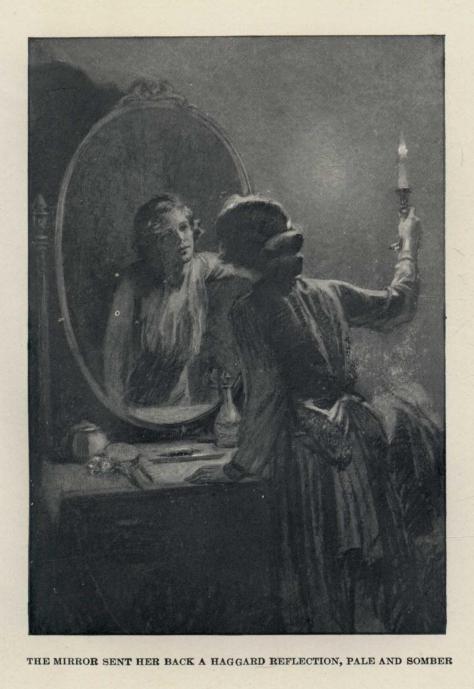
THE MIRROR SENT HER BACK A HAGGARD REFLECTION, PALE AND SOMBER
There was no sound from the studio. She glanced at her clock. For hours it seemed she had lain upon her bed of pain.
With a new resolution she bathed her face and wrists in cold water, then went through the kitchenette into the studio to find Barry Quinlevin. He was not there, but her husband was,—crouched in the armchair by the table and the whisky bottle was empty.
She shuddered a little but approached him resolutely. He tried to rise but, with a dull laugh and fumbling the arm of the chair, fell sideways into a grotesque attitude.
"Where is——?" she began, and halted.
"Gone out," he mumbled, struggling into a straighter posture, "back soon."
"Where has he gone?"
He shook his head. "Dunno. Asked me to stay—take care of you, m'dear."
She turned away from him, in disgust.
"Oh—don' worry," he went on—"not goin' bother you. After t'morr'—won' see me, y'know——"
She turned quickly and he laughed again.
"Goin' join m'regimen'. Furlough up t'morr'."
She whispered a "Thank God" below her breath as she stood looking at him. And then aloud, gently, in a new kind of pity for him.
"You'd better lie down, Harry, and get some sleep," she said, "or you'll be in no condition to go on duty."
"Thanks. Ought to sleep. Haven' slep' f'r weeks, seems to me. Don' seem to care though."
"You'd better. There's a room outside. Your baggage is there too."
"Um—that's nice of you, Moira. R'turnin' good for evil. Baggage. He brought it—didn' he?"
"Yes, Harry."
He paused a moment and then leaned forward in his chair while she watched him curiously.
"Rotten mess! What?" he mumbled.
She didn't reply. And he went on, concentrating thought with difficulty. "He told you I tried—kill him—didn' he?" He wagged his head comically. "I couldn' do that—not kill 'im—wouldn't do y'know—m'own brother—no—not that——"
He put his hands to his eyes a moment and swayed, but Moira steadied him by the shoulder.
"Harry—come. I'll help you. You must go to bed."
"Not yet—in a minute. Somethin'—say."
He groped for her hand on his shoulder, found and clung to it.
"Shame I'm such rotter, Moira. Beas'ly shame. I'm not half bad sort if leave me 'lone. I was sick—out there. Head of Levinski—grinned at me. Gold tooth—grinned at me—in wheatfield——"
"Come, Harry," she broke in again, "lean on me. I'll help you to bed."
"Ah, I was sick awright——" he shuddered, oblivious of her. "Makes me sick now—think of it. Jus' a head, Moira, nothin' else. But God! What a head!"
"It won't do you any good now to think about that," she put in quickly, for he was shivering as though with a chill.
"No. No goo' now. Awf' rotter, ain't I?"
"Come——"
He stumbled to his feet and she helped him to support himself.
"Will you forgive me, Moira?"
"Of course."
And as she urged him out of the door toward the vacant room, "Knew y'would," he mumbled. And then, "Goo' ol' Moira!"
In the room she helped him off with his coat, puttees and shoes and then pulling a blanket over him left him to his own devices and went back to the studio to wait for Barry Quinlevin.
But she wasn't weary now. From the same reserve force from which she drew the strength to stand for hours and paint even when her sitters were weary, she gained new courage and resolution for the return of Quinlevin. But for a moment she was tempted again. The way was clear. What was to prevent her from going and finding Jim? For a moment only. Then she sank, into the chair by the fireplace—to fight her battle with herself and wait. Her glance restlessly passed from one familiar object to another, the portrait on the easel, the lay figure in the corner in its fantastic pose and heterogeneous costume, the draperies for her backgrounds, hanging just as they had hung this afternoon, and yet all so strangely changed. The door of the closet where Jim had been hidden remained open, exhibiting its untidy interior. Instinctively she rose and closed it, her sense of order triumphant even over her mental sufferings. Then she went back and sat down to think. There was much that she and her—that she and Barry Quinlevin would have to say to each other.
He came at last, expecting to find Harry and not the straight figure of the woman who faced him like a pale fury. The shadows of pain at her eyes were gone, lost in deeper shadows of anger and determination.
"You! Moira," he said in surprise.
"Yes, I——"
"Where's Harry?"
"I put him to bed. He was drunk," she said shortly.
"The devil he was!" He frowned darkly and then seemed as ever, quite the master of himself. If the glance he cast at her discovered her state of mind, he gave no sign of uneasiness. He approached her with his easy air as if nothing unusual had happened, but when he spoke again his voice was pitched low and his eyes were soft.
"I thought you'd be in bed, child——"
"I've something to say to you——" she cut in quickly.
"Oh, very well,—say on, my dear. You don't mind if I smoke a cigarette?"
As she made no reply he lighted one and sank into the most comfortable chair with a sigh of content.
"At least you owe me something, Barry Quinlevin," she began tensely, trying to keep her voice under control, and announcing her leit motif, so to speak, in her first phrase. "I'm no chattel of yours, no infant any longer, to be bandied about as a dupe in your wild plans for the future. It's my future you're dealing with just as you've dealt with my past——"
"Have ye had any cause to complain of my treatment of ye?" he broke in calmly.
"You've cheated me—lied to me all my life—isn't that enough? Kept me in ignorance of the source of our livelihood—God knows what else—made me a partner in a crime—without my knowledge—made me help you to get dishonest money——"
"Hardly," he said. "It was yer own money."
"I don't believe you," she said icily, "if it was my money you would have gotten it for me—all of it—long ago."
"And lost yerself, my dear, to the Duc de Vautrin," he countered quickly.
She started slightly. That possibility hadn't occurred to her. But she went on rapidly.
"You forget that I heard what you said to Harry—That I know what has been in your heart all these years. I was your decoy and you used me as you pleased, glad of my working, which kept me busy so that I couldn't be inquiring what was going on. You forget that I heard why you wanted me to marry Harry, but I can't forget it—would to God I could—and you'd dare to ask me if I have anything to complain of, knowing all that and knowing that I know it. Do you think I'm a mere piece of furniture without a soul, not to care what my heritage is, not to cherish my traditions——? You've built my life on a lie, destroyed my very identity in a breath, torn down all the sacred idols of my girlhood and young womanhood and ground them under your feet. You!"
She caught at her heart and took a step nearer him.
"My mother—who was my mother?" she gasped.
He shrugged. "Mary Callonby—the Duchesse de Vautrin," he said easily. "And you are Patricia Madeline Aulnoy de Vautrin."
"Impossible. I'm no longer credulous."
"You'll have to believe the truth!"
"And who are you to ask me to believe? You who dared to speak to me of the sanctity of motherhood, who taught me that I was your own daughter—and that my mother, your wife——"
She broke off with a sob, quickly controlled.
"It was because I loved ye, Moira dear," he said very quietly.
She halted, aghast at this tenderness, the familiar tones of which made her wonder for a moment whether she weren't dreaming all the dreadful accusations on her tongue's end. But a pain shot through her heart to remind her of her sufferings.
"And was it because you loved me that you dared obliterate me, sneered at my pitiful love affair—the only passion I've had in my life or will have—and even tried to murder in cold blood—the—the object—of it? Answer me that—Barry Quinlevin!"
The Irishman's manner now changed. His brows drew together in a tight knot and the long fingers upon the chair-arm clenched until the knuckles were white.
"I'll answer ye that," he said abruptly. "And more. I've heard what ye had to say with patience and chagrin. I'll take the blame for me sins of omission where blame is due, trusting to yer conscience to be forgiving me presently for yer harsh tones to one who sinned for the very love of ye. But when ye speak of this other man who by a trick forces his way into yer lodgings and yer affections, learns yer family secrets and mine, reads yer letters and mine, makes love to his own brother's wife behind his back,—yer own brother-in-law, mind ye—and then tells one lie after another to make his story good, its time there was a man about the place to protect ye, if ye can't protect yerself——"
"Stop——!"
"No. I've heard you. Now ye'll be listening to me. If Harry isn't man enough to be looking out fer what belongs to him, then I am. Ye've given this man yer heart, acknowledged yer affections before us all. God be praised that's all it amounts to! But when ye hear me out, ye'll be wishing yer tongue had rotted before ye'd made such an admission."
He saw her shrink and he rose from his chair, following up his advantage quickly. "There—there my dear, Ye've almost had enough of trouble for one night——"
"Go on," she murmured stanchly, "but if you're going to speak ill of Jim Horton I won't believe you."
"Ye can do as ye please about that, but I'll be telling ye what I know of him just the same. And when I tell ye I wish I'd shot him dead before yer eyes, I'd only be satisfying the conscience of yer life-long guardian and protector——"
"Conscience! You!" she laughed hysterically. "Go on."
"I will, little as ye'll like it. When I went from here where d'ye suppose I went? To Pochard. And I wrung from him the truth about yer friend Jim Horton. It was Piquette Morin who helped him from the house in the Rue Charron——"
"I know it. I thank God for it."
"It was Piquette Morin who took him back to her apartment in the Boulevard Clichy and kept him there until he recovered."
"I know that too. Go on——"
"But ye didn't know that Piquette Morin was a woman without a shred of conscience or morals, a woman of the streets, who glories in her infidelities to the Duc de Vautrin, whose mistress she is——"
"I care nothing for that," stammered Moira.
"Ye may not care, since Jim Horton has lied about that too, but ye will care about the relations that exist between the two of them."
"I won't listen," said Moira, making for the door. But he barred her way.
"Oh, yes, ye'll listen, Moira dear, and I'll be giving ye all the proofs ye need before I'm through."
"Proofs! I dare you."
"All in good time. If ye'll be patient. Where do ye think I went from Pochard's? To the Boulevard Clichy, where yer precious friend had returned to the arms of Madame Morin——"
She waved a hand in protest.
"I watched the door of the apartment. He came out. I followed, and where do you suppose he went? To the ticket office where he booked a compartment for two—on the twelve o'clock train to-morrow for Marseilles."
"And what of that?" she stammered.
"Merely that yer friend Jim Horton, failing of success with his brother's wife, has decided upon a honeymoon to the Riviera with a lady who is more complaisante than yerself."
"I don't believe it."
"Ye'd find it less difficult to believe if ye guessed how mad she was for him, how handsome she is and how skilled in the wily arts of her sex and trade," he said keenly. "Oh," he said, with a shrug, "it could only have been a great passion that would have dared the rescue from the house in the Rue Charron. And no man remains long ungrateful for such an act of unselfishness."
Moira leaned against the mantel-shelf, staring at him wide-eyed, but he met her look with one more steady than hers, hardy, indignant, but injured and grieved too at her attitude. Skillfully he had baited his hook with a truth that she knew. He saw the fleeting question in her eyes and answered it quickly.
"If ye want the proofs——go to the Boulevard Clichy now." He paused to give the suggestion weight, "Or if ye've no heart to-night for such a brutal encounter—to-morrow—on the train to Marseilles."
He had caught her ear. He knew it by the sudden shutting of her teeth over her words, the proud lift of her chin, the hard look that came into her eyes. And though she answered him still defiantly, her tone had no body in it and trembled with the new uncertainty.
"I don't believe you."
"I don't ask ye to. But ye will believe in the evidence of yer eyes, and I'll be providing ye with that, my dear."
"How you hate him!" she gasped.
He shrugged and turned half toward her.
"Hate? Hardly. I merely despise him. I would have killed him to-night with a clean conscience, knowing what I do." He dropped the cigarette he had taken up and approached her a pace or two. "Oh, Moira, alanah, won't ye see? Is it blind ye are to the truth that lies before yer very eyes——? Can't ye see that it's the love of ye that drives me to protect yer happiness? Have I ever failed ye, all these years? Haven't I given ye yer share of all I had? Answer me that—aye—even when there was not too much for the both of us?"
"I—I've heard enough—to-night," she said wearily.
"I'm sorry. I—I've done what I thought was the best. I'm still yer guardian—until ye come into yer own——"
"I can't listen to that," she shuddered. "De Vautrin—my father!"
He bowed his head with tragic grace.
"The same—bad cess to him."
She sank into a chair, bewildered and helpless.
"I want nothing—only to go away somewhere alone. I've heard enough."
"That you shall do presently, alanah," he said, touching her gently, the familiar voice close at her ear. "But now you must be going to bed and trying to sleep. 'Tis a cruel day ye've had—cruel! But to-morrow when ye've had some rest——"
"To-morrow——?" she raised a despairing face.
"Ye've got to be facing it. But no more to-night. Come."
She let him take her by the arm to the door.
"Forgive me, acushla," he whispered.
But she made no reply and left him standing there. And Quinlevin watched her merge into the darkness within, then turned and picked up the cigarette he had dropped, lighted it with great care, and sat and smoked, ruminating over the ashes in the fireplace.
But he had played his cards with the true gambler's knowledge, of the psychology of his victim. Jealousy! Such a weapon at his very hand. It was almost a pity to use it. Poor child. As if she hadn't already suffered enough! But there was no choice. And she would get over it. Love never killed—only hate ... only hate. He finished one cigarette and then glanced toward the door through which Moira had passed. Then lighted another and composed himself for awhile longer.
It was not until he was near the end of this cigarette that a slight sound caused him to look up over his shoulder. Framed against the black opening Moira stood, pale, dark eyed, her black hair streaming over her flimsy dressing-gown, and then came forward noiselessly.
"Moira, child——!" he cried, rising, with an air of surprise.
"You must show me the proof——," she stammered, "what you said—to-morrow."
"Yes. If ye insist——"
"I do. It's a test—of the truth—between you and—and him——"
"I'll provide it. Ye'll leave with me on the twelve o'clock train for Marseilles?"
"Yes—anything."
"Very well," he muttered. "I'll arrange for it. I've some business in Nice. It's just as well if you come along."
"Anything——," she whispered, shivering and still protesting, "but I don't believe—I don't believe——"
"Go to bed again, child. I'll call ye in the morning."
As she disappeared he turned toward the mantel, hiding the smile of triumph that crossed his lips. Then he leaned for a long while looking into the hearth.
"Poor child!" he whispered. "'Tis a cruel pity, but—" He paused and then turned toward the bottle upon the table, which he raised and examined carefully, then set down with an air of disgust. "The drunken scut!" he muttered, then swore softly below his breath.
* * * * *
What remained of Quinlevin's task was not difficult, for he had already anticipated his success with Moira by making arrangements with Nora Burke and Tricot, Nora to face de Vautrin with her confession and her evidence, Tricot to help him in keeping Jim Horton from reaching the Duke.
By the expression of Moira's face when they met in the studio in the morning, he discovered that his poison had worked its slow course through her veins. Irish she was—all Irish now—slow to love and quick to jealousy—proud to the quick, and capable of a fine hatred when the proofs were brought as Barry Quinlevin intended to bring them. She listened with an abstracted air as he told her that her old nurse, Nora Burke, and a man, a friend of his, were to be the other members of their party. She showed some surprise and then a mild interest, but he could see that to Moira her companions meant very little. She was thinking, brooding somberly over what he had told her, and his air of confidence in his undertaking did nothing to give her courage for her decision. And yet he knew that she would abide by it—a choice between Jim Horton and himself. And he knew already what that choice was to be. For reasons of his own it was important that Jim Horton and Piquette should not see him on the train; nor that Moira should be presented merely with the evidence of the two of them entering the train. The evidence must be condemnatory. He would wait and trust to circumstances.
The thing was simplicity itself. The window into the corridor was like a dispensation. He passed the compartment once or twice to make sure that the shade of the little window had not been drawn and then when it grew dark saw that Piquette had gone fast asleep with her head on Horton's shoulder. Then he acted quickly.
"Come," he said to Moira. "It is time I showed you who is the liar."
And resolutely she followed him, looked—and saw.
* * * * *
Nothing seemed to matter to her after that. Incredulity, surprise and then guilt, all expressed so clearly in Jim Horton's face in the brief moment when their glances had met. The pretty painted face upon his shoulder, the arm that he withdrew from around the woman's waist, her sudden awakening as he started—all these brief impressions so vivid, so terrible in their significance, armed her with new strength and courage to hide her pain from Nora Burke and Barry Quinlevin. He watched her with admiration. Her heart might be breaking but she'd never whimper now. He knew her.
"Are ye satisfied, my dear?" he asked.
"Yes. Quite," she gasped.
"And you'll be listening to Nora while she tells ye the truth?"
"I will."
"Good. I must be leaving ye for a while to talk with my friend. And don't be distrusting me again, alanah."
Moira was silent and gazed out of the window into the darkness until Nora came. And she listened to the tale that Nora Burke told, or seemed to listen, and thus Quinlevin found them later, the girl's hand in that of her old nurse.
The announcement that they were to get out of the train at St. Etienne created no astonishment. Moira moved as in a dream, obeying blindly as she had always been accustomed to obey the suggestions of her protector, caring nothing for their significance and reassured as to the integrity of his intentions with regard to herself. There was no doubting that he loved her in his strange way. And the fury he had expended upon Jim Horton seemed scarcely less than that she now felt for him. A man could kill—but a woman could only despise.
She was at least thankful when she saw the train bearing the couple pass out of her sight into the darkness, and followed Quinlevin where he led—to a hotel for the night—to another train in the morning, to Marseilles, to Nice, and the Hôtel Ruhl, where in the privacy of a room of her own, she threw herself upon the bed and gazed dry-eyed at the ceiling.
CHAPTER XVI
NORA SPEAKS
The attention of Monsieur de Vautrin having been attracted by Piquette's news of the immediate threat against his fortune, it was no longer difficult to persuade him to listen to what Jim Horton had to say. Madame Thibaud was therefore conducted with scant ceremony to an apartment in the Hôtel de Paris, after which the Duc rejoined Piquette and Jim in the Casino. The unflattering opinion Jim Horton had formed of this French nobleman was, upon closer acquaintance, in no way modified. The peevish and supercilious air with which he had greeted Piquette had changed to one scarcely less unpleasant,—a fidgety anxiety and apprehension which revealed weaknesses of fiber one would not have expected to discover between the points of so long and so imposing a mustache. He gave Jim the impression of being very weary in the pursuit of a will-o'-the-wisp. And in repose, his face bore the scars worn by those who live for pleasure alone. Altogether he seemed a person scarcely worth borrowing so much trouble about. His attitude of suspicion toward Jim Horton was illy concealed, but he listened, frowning and questioning, until at last convinced of the reality of his danger at the hands of the renegade Irish adventurer to whose venial cleverness he had so long paid handsome tribute.
"But they can do nothing," he said at last in excellent English, with an air of bravado which was meant to be effective, and which was only pitiful.
"I'm not so sure about that," said Jim, "the mere fact of your having paid for the support of the child for so many years makes it seem as though you believed in the thing."
"What do I care? I have the money. Let them take it if they can."
"Oh, they'll take it all right, if you don't find some way to meet their evidence."
"Lies."
"Yes, of course. But you've got to prove that they are. Where's your defense? You didn't even know you had a daughter until Barry Quinlevin told you you had. What proof have you that your own child died? And if you believed Quinlevin then, why shouldn't you believe him now——?"
"I had my suspicions——"
"Pardon me. Suspicions won't satisfy an Irish court or a French one. What proof have you that Madame Horton isn't your own child? None? Exactly! But everybody who could have known anything about the matter is dead except Nora Burke, and you've already heard what she has to say."
"H—m. And what is your interest in this matter, Monsieur?"
"That's a fair question," said Jim slowly. "I'll give you a fair answer. Madame Horton is my brother's wife. The story I've given you is straight—as Piquette will tell you since she heard much of it from my brother. Your daughter died shortly after her mother, your wife. My interest in this affair is personal to this extent. I don't intend to have Madame Horton used any longer by an unprincipled blackmailer."
"Surely then you would have told Madame Horton the truth and saved me this unpleasantness——"
"Yes—I've told her," said Jim slowly, "but she's helpless. Can't you see, Monsieur? It has all been very sudden—for her. She doesn't know what to believe. Besides, Monsieur Quinlevin has the birth certificate and the testimony of the nurse."
"But if Madame Horton is an honorable woman——"
"You can count on that," put in Horton quickly. "She doesn't want your money—she isn't Quinlevin's kind——"
"Then why doesn't she renounce him?"
"She might—but what difference would that make? She might permit herself to think she was Joan of Arc, but that wouldn't make her any one but Patricia Madeleine Aulnoy de Vautrin, if Barry Quinlevin has evidence enough to prove that she is...."
De Vautrin frowned darkly and twitched his jeweled fingers.
"But she would have something to say about her own desires in the matter," he said.
"Her own desires haven't anything to do with it. See here, Monsieur de Vautrin—Barry Quinlevin proves her birth by a certificate; he also proves by the nurse that she was the child brought into his house, and the child he has brought up as his ward, bearing his name and accepting your money for twenty-one years—hush money, monsieur, that you paid to keep her out of a fortune you thought belonged to her."
"But it doesn't belong to her," cried de Vautrin, gesticulating. "It's mine since the child is dead. Monsieur Harry Horton——"
Piquette broke in. "Monsieur 'Arry 'Orton could be call' to the stan' of course, but 'is testimony is not to be relied upon."
"Your brother, Monsieur——?"
"Yes, Monsieur de Vautrin," replied Jim, "my brother—but an intimate of Barry Quinlevin's——"
"Ah, I comprehend—an accomplice?"
"You might call him that—if you like." He shrugged and turned aside. "We don't get along, my brother and I, but I don't think you'll find much to gain by putting him on the witness stand. Besides, it won't look very pretty in the papers. It's as much to my interest as yours to keep it out."
The Duc eyed him suspiciously again.
"But you must have some other interest besides this in wishing to help me. What's the ax you have to grind, Monsieur?"
Jim Horton grinned and shrugged.
"For myself—nothing."
"That is difficult to believe."
"Then I would advise you to tax your imagination to the utmost. I don't want Madame Horton to figure in an affair that she will regret the rest of her life."
"But why——?"
"Monsieur is in love wit' Madame 'Orton——" Piquette's voice broke in very calmly.
There was a silence for a moment in which Jim Horton looked at Piquette, Piquette gazed at de Vautrin and de Vautrin stared from one to the other in astonishment.
His knowledge of the world had given him no instinct to appraise a situation such as this. But Piquette met his gaze clearly.
"It is de trut', Olivier," she repeated. "An' now perhaps you on'erstan'."
"It is extraordinary," he gasped. "And you two——?"
"I brought 'im to you. Your interests are de same—and mine, wit' both."
"Parbleu! If I could believe it——!"
Jim Horton rose, aware of a desire to pull the waxed mustaches to see if they were real.
"You needn't believe it, if you don't want to," he said carelessly. "And you don't have to believe my story. But I've given you your warning. Barry Quinlevin may be in Nice now, with his birth certificate and his Nora Burke." He buttoned his overcoat and turned toward the door. "I think I'll be going back to Nice, Piquette," he said coolly, and then to the bewildered Frenchman, "Good-night, Monsieur."
"One moment," gasped the Duc, toddling after him and catching him by the hand, "I believe you, Monsieur. Why should I not believe you since what you say is what I wish to believe? It is all very bewildering. I should have thanked you long ago for your kindness."
Jim Horton turned with a smile.
"It's about time. And it ought to be fairly clear that I have little interest in your fortune or even in you, Monsieur. I don't mind being shot at for my interference in Mr. Quinlevin's affairs, but I might have been hit—or Piquette might—which would have been worse, and I don't relish having my word doubted—or hers."
"I beg forgiveness. You have been shot at?"
Piquette explained quickly while de Vautrin's watery eyes grew larger.
"Mon Dieu! And you say they are coming here?"
"Yes. If their dinky little train ever reaches its destination. I'm afraid you're in for it, Monsieur de Vautrin."
De Vautrin threw out his arms wildly.
"I will not see them. I will go away."
Jim Horton nodded. "That's all right—but it's only putting off the evil moment. When they get their evidence working you'll have to meet it, someway. And then what will you do?"
De Vautrin had caught Jim by the coatsleeve and pulled him down into the seat beside him. And then with a pseudo-dramatic air which failed of conviction,
"I shall fight, Monsieur."
"With what?"
"With the evidence you've given me."
"It's not enough."
Horton shook his head and laughed.
"It looks to me as though you were elected President of the Quinlevin Endowment Association."
"But there must be some way of getting at the truth," cried the Frenchman, now really pitiful in his alarm.
"Ah, that's it," laughed Jim. "You know Madame Horton is not your daughter and I know it, but that doesn't beat Quinlevin."
"What then, Monsieur?"
"You've got to kill his evidence."
"But how?"
"With stronger evidence of your own. You haven't it, or any prospect of getting it that I can see. So there's only one course open."
"And that, Monsieur?" asked de Vautrin eagerly.
"To break down Quinlevin's. I'm no lawyer, but that's only common sense. Nora Burke is a liar bribed with five thousand pounds. And there never was a lie that didn't have its weak points. You've got to make her speak the truth——"
"How?"
"I don't know. But I wouldn't mind trying. Then you've got to get that birth certificate——"
"I don't see how you expect to do that."
"Neither do I—Quinlevin is no fool, but then he's not super-natural either."
The Duc was silent, appalled by the undertaking which had presented itself. And the calm way in which his visitor discussed his projects filled him with wonder.
"Justice, Monsieur de Vautrin, is on your side. Will you fight for it?"
"Assuredly, Monsieur—if you will but help."
Jim Horton laughed.
"Then you no longer believe I have an ax to grind?"
"No—no, Monsieur."
"And you no longer cherish evil thoughts of Piquette?"
"Upon my honor," said the Duc, a jeweled hand at his heart. "And yet, Monsieur, you can hardly blame me for some irritation at meeting her here with you."
Jim Horton glanced toward the door significantly. And then dryly, "You hardly deserve her, Monsieur de Vautrin. I am proud of her friendship. It's the finest thing in my life."
De Vautrin wagged his head foolishly and then shrugged a futile shoulder.
"What do you want me to do, Monsieur?" he asked peevishly.
Horton lighted a cigarette carefully and took Piquette by the hand.
"First, Monsieur de Vautrin," he said coolly, "you will send Madame Thibaud about her business——"
"Monsieur!" said the Duc with a show of dignity.
"Suit yourself. But she's in the way. This is no time for fooling. Does she go or doesn't she?"
De Vautrin's injured dignity trembled in the balance for a moment and then fell away, merged in his apprehension for the immediate future.
"That can—can doubtless be arranged," he said with a frown.
"Good," said Horton jovially. "And the sooner the better. It will clear the atmosphere amazingly. Then we will prepare to fight Monsieur Quinlevin with his own weapons."
"Yes. You—I—Piquette. That's what we came here for. You've made the mistake of under-rating Barry Quinlevin. He's desperate. He is playing a big game and if you don't want to be the goat you'll do what I advise."
"I'm listening."
"If I'm not mistaken he will reach here to-morrow afternoon with Madame Horton and Nora Burke. And you've got to see them."
"I—Monsieur?"
"Yes—you—here in your rooms in the Hôtel de Paris. You will give it out that you are here for a week. They must take rooms in Monte Carlo. Then you will listen politely to everything Quinlevin has to say—to everything Nora Burke has to say, but you yourself will say nothing."
"But you, Monsieur?"
"I shall be in an adjoining room, but they must not know it."
"But Barry Quinlevin will discover that you have been here."
"Of course. You will tell him that. They will tell you that I have lied. But you won't believe them. And then you will tell them that I have gone away."
"But when will you come in to my assistance?"
"That depends upon what I hear through the keyhole."
"But would it not be simpler to pay this Nora Burke for telling the truth?"
Horton laughed. "It does seem simple, doesn't it? I don't know much about French law, but I wouldn't want to be caught at it out where I come from. Let's play this game straight and trust to luck. If Quinlevin is too sharp for us we'll try something else. Do you agree?"
"Of course, Monsieur."
And so it was settled. On the following morning Madame Thibaud was sent back to Paris. And Piquette and Jim Horton ostentatiously took the train for Nice, returning subsequently by automobile to Monte Carlo, where they were hidden in rooms in the Hôtel de Paris. In this they were aided by an official of the Hotel who proved to be an old acquaintance of Piquette's in Paris. And so when Barry Quinlevin arrived from Nice in the afternoon, with Moira and Nora Burke, inquiring for the Duc, the information was conveyed directly to Horton, who was happy to learn that Tricot had not yet caught up with the party.
Monsieur de Vautrin, who had been carefully rehearsed in the part he was to play, seemed to enter into the game with some spirit, and was sent over to the Casino to play trente et quarante where after awhile Barry Quinlevin found him, deeply absorbed in his game of chance. The Duc manifested polite surprise, Quinlevin polite insistence, and then they talked for awhile, the Duc indifferently, Quinlevin impressively,—to the end that an appointment was made for an hour later the following afternoon in the Duc's apartment, where he would listen in all good nature and tolerance to what his visitors would have to say. He hoped his "daughter" was handsome. It would be a pity if all this money was to go to one who could not use it with dignity. All this in an ironic and jocular mood which only brought a dour smile upon Quinlevin's face.
But the main object of the preliminary encounter was achieved, for Barry Quinlevin accepted without reservation the Duc's assertion that Jim Horton, having performed his mission, had returned to Paris.
When the hour of the appointment arrived, Jim Horton sat behind the door into the bedroom of Monsieur de Vautrin, carefully studying the pages of an English-French dictionary. The Duc sat over his paper with an air of unconcern he was far from feeling. Piquette, at the American's instructions, was elsewhere.
Quinlevin, shown to the door of the room by a servant of the hotel, met the Duc with his most amiable smile and introduced the women of his party. Moira was pale, Nora Burke uncomfortable but arrogant.
"Monsieur de Vautrin," Quinlevin began with something of an air, "permit me to present to ye yer daughter, Patricia Madeleine Aulnoy de Vautrin."
The Duc smiled politely, bowed—and stared. Moira, who, as though in duty, had taken a step toward him, paused. And then as she saw the look that Monsieur de Vautrin swept over her, the color flamed into her cheeks. The Duc's rebuff gave for the first time a true perception of the position in which she had voluntarily placed herself. If she were a mere adventuress he could not have accused her more eloquently and the admiration in his impudent stare was even more insulting. This man—this effete boulevardier—her father——? Impossible! And the repulsion she felt at the sight of him made her wish only to go anywhere away from the sight of him. What else she had expected, she didn't know, for even Barry Quinlevin had not been too explicit as to what would be likely to happen. But there was her mentor at her side, a gentle hand upon her elbow urging her forward into the arm-chair by the window, which Monsieur de Vautrin was indicating with a rather exaggerated gesture of formality.
"Thanks, Monsieur," said Quinlevin with an easy laugh, sinking into another chair. "Ye're not to be blamed for not flying to each other's arms after all these years, when yer acquaintance in the beginning was to say the least a most trivial affair. But in a while, perhaps, ye'll be knowing each other better and I'm sure, Monsieur, ye'll be finding my ward as I have done, a fine creature capable of a most filial devotion."
"Ah," said de Vautrin. "I don't doubt that. It would truly be a great pleasure to me to discover so beautiful a creature to be a daughter of mine, but the facts of the matter unfortunately——"
"One moment, Monsieur," broke in Quinlevin, "before we arrive at the facts in the matter. Ye must be aware that this situation is none of my ward's choosing. She came because she knew that it was a sacred duty which she owed to the memory of her mother. Many years have passed since yer affairs—er—called ye away from Ireland and she lays no fault to yerself for yer desertion, for which I have taken all the blame. She knows that ye've provided for her comfortably, and that I have made it my pleasure to act as yer substitute, as well as I could. But the time has come when she must take her place in the world to which she belongs, and it's my duty to be putting her there. To this end, as ye'll see, I've brought with me her old nurse, Nora Burke, with whom ye're already acquainted, and who will be answering any questions that ye would like to put to her."
Monsieur de Vautrin frowned and moved his gaze from Moira to the servant who stood, her large hands, badly gloved, folded upon her stomach, her feet shifting uneasily.
"I've heard something of Nora Burke's story," said de Vautrin dryly, "but there are parts of it that I have not heard."
"Ye're quite at liberty to question, Monsieur," put in Quinlevin, "Nora too is merely an instrument of truth in the hand of Providence."
"Since Providence has ceased providing," said the Duc dryly, "I comprehend. But I will listen to this extraordinary tale again, since I have promised to do so. It can do no harm. Allons! Proceed, Nora Burke. My poor wife, you say, engaged you some weeks before my daughter was born?"
"She did, yer Highness——" And, as the woman hesitated——
"Go on, Nora," said Quinlevin.
"The choild was born, this very girl they call Moira Quinlevin, who sits before ye, a beautiful choild she was, fine and healthy that the poor Duchesse never lived to see, for she died that night, God rest her soul, faded away before our very eyes."
"And who was there beside yourself," asked the Duc coolly.
"Dominick Finucane, the doctor from Athlone, and Father Reilly, the priest who gave her Absolution——"
"And who has since died," said de Vautrin dryly.
"Yes, yer Highness—but the birth certificate I was afther kapin' since no father came near us, nor any relation. Mary Callonby was a lonely kind and when she came back to Galway took to living solitary-like on the small farm with only the one servant, Mrs. Boyle, to look afther her."
"And Mrs. Boyle is also dead?" put in de Vautrin keenly.
"She is."
"It's very unfortunate that all the witnesses have seen fit to die."
"All but me, yer Highness," said Nora assertively.
De Vautrin shrugged. "Well. What happened then?"
"Well, Mrs. Boyle and meself, we didn't know what to be afther doing, so we just followed the advice of Father Reilly."
"And what did he tell you to do?"
Nora glanced at Quinlevin, who nodded.
"In a whoile he brought Mr. Barry Quinlevin—this gentleman here—who lived on the only place nearby, and tould us to be going to his home. Mr. Quinlevin was afther bein' very lonely, he said, his own wife and colleen havin' died a few months before."
"That was kind of Mr. Quinlevin."
"We thought so—yer Highness—but it was kind of Father Reilly too—for nobody was afther coming to see about the poor choild and Mr. Quinlevin was that grateful—he watched the babby like it was his own——"
"That's true enough. He would," sneered the Duc. "And what happened then?"
"Mrs. Boyle and I we lived in the house of Mr. Quinlevin, her as cook and me as nurse, bringin' up the choild as Miss Moira Quinlevin,—alone in the house for wakes at a toime, when Mr. Quinlevin was afther bein' away to London or Paris on business. But all the whoile I was kapin' the birth certificate an' all the whoile tryin' me best to take the place of poor Mary Callonby."
"And you were well paid for this service?" asked de Vautrin.
"I had me wages. It was enough."
"And when you heard that Mr. Quinlevin had seen me in Paris, two years afterward, you received more money?"
Nora's glance sought Quinlevin, who broke in calmly.
"I gave Nora as well as Mrs. Boyle a bit more, ye understand—a proper share of the sum for the support of the child. And they agreed to say nothing." He fingered in his pocket and brought forth a paper. "This, as ye can plainly see, is a copy of the birth certificate of yer child."
"And the original?" asked the Duc.
"Will be produced at the proper time," said Quinlevin shrewdly.
De Vautrin took the paper and read it carefully.
"And where is Mrs. Boyle at the present moment?" he asked. "Dead also?"
"Three weeks ago," said Quinlevin calmly. "It's most unfortunate—but her signature can be verified."
"H—m. And Father Reilly also. Of course," said the Duc with a quick glance toward his bedroom door. "And there are other papers?"
"Yes," said Quinlevin. "Letters from you—accompanying yer checks—which guarantee yer verbal agreement in Paris. The will of Patrick Callonby and a few other trifles which are important to ye."
"And you think your case is complete?"
"Oh, yes, quite. An Irish court won't hesitate very long just at this time in carrying out the provisions of this will."
Monsieur de Vautrin smiled. "And what do you wish me to do?" he asked quietly.
"To perform merely an act of restitution, an act of justice to yer own. Ye know the terms of the will. In the event of the mother dying, her fortune was to revert unconditionally to the child. But she's to be considerate of yer age and the relation that exists between ye, which however strange it may seem to ye both at this time, is that of father and only daughter. Ye've both formed the habits of yer lives—yerself living bachelor-fashion in Paris and London. Yer daughter is disposed to be generous and does not wish to interfere with yer plans for the future. She will, if you please, still keep the matter secret, and go on living with me—yerself to continue in the comfortable life of yer bachelorhood."
"And your terms?" asked de Vautrin quietly.
Barry Quinlevin pocketed the copy of the birth certificate which Monsieur de Vautrin had put upon the table.