Front matter (continued 2)
Reading edition
Jim released his hand, shrugged and leaned back in his chair.
"Not if you play straight with me—and with her. You want me to pay the penalty of what I did for you—to go out into the world—an outcast in your place. Perhaps I owe it to you. I don't know. But you owe me something too—promotion—the Croix de Guerre——"
"The Croix de Guerre! Me——?"
"Lieutenant Harry G. Horton to be gazetted captain—me!" put in Jim, with some pride. "Not you."
A brief silence in which Harry rubbed his scrawny beard with his long fingers.
"That might be difficult to prove to my Company captain," he said at last.
"You forget my wounds," laughed Jim. "Oh, they're my wounds all right." And then, with a shrug, "You see, Harry, it won't work. You're helpless. If I chose to keep on the job, you'd be left out in the cold."
"You won't dare——"
"I don't know what I'd dare. It depends on you."
"What do you mean?" broke in Harry with some spirit. "I couldn't be any worse off than I am now, even if I told the truth."
Jim laughed. "I tried to tell in the hospital and they thought I was bug-house. Try it if you like."
Harry frowned and reached for another cigarette.
And then after awhile, "Well—what do you want me to do?"
His brother examined him steadily for a moment, and then went on.
"I don't know whether you've learned anything in the army or not. But it ought to have taught you that you've got to live straight with your buddy or you can't get on."
"Straight!" sneered Harry, "like you. You call this straight—what you're doing?"
"No," Jim admitted. "It's not straight. It's crooked as hell, but if it wasn't, you'd have been drummed out of the Service by now. I don't want you to think I care about you. I didn't—out there. It was only the honor of the service I was thinking about. I'd do it again if I had to. But I do care about this girl you've bamboozled into marrying you—you and Quinlevin. And whatever the dirty arrangement between you that made it possible, I want to make it clear to you here and now that she isn't going to be mixed up in any of your rotten deals. She isn't your sort and you couldn't drag her down to your level if you tried. I'll know more when Quinlevin gets back and then——"
Jim Horton paused as he realized that he had said too much, for he saw his brother start and then stare at him.
"Ah, Barry Quinlevin—is away!"
Jim nodded. "Yes," he said, "in Ireland."
Harry had risen, glowering.
"And you think I'm going to slink off to-night to my kennel and let you go back to the studio. You in my uniform—as me—to Moira."
Jim Horton thought deeply for a moment and then rose and coolly straightened his military blouse.
"Very well," he said, "we'll go back to her together."
He took out some money and carelessly walked toward the bar in the front room. But Harry followed quickly and caught him by the arm.
"Jim," he muttered, "you won't do that!"
"We'll tell her the truth—I guess you're right. She ought to know."
"Wait a minute——"
His hand was trembling on the officer's sleeve and the dark beard seemed to make the face look ghastly under its tan.
"Not yet, Jim. Not to-night. We—we'll have to let things be for awhile. Just sit down again for a minute. We've got to find a way to straighten this thing out—to get you back into your old job——"
"How?" dryly.
"I—I don't know just now, but we can work it somehow——"
"It's too late——"
"You could have been captured by the Boches. We can find a way, when you let me have my uniform."
Jim Horton grinned unsympathetically.
"There are two wounds in that too, Harry," he said. "Where are yours?"
And he moved toward the door.
"Listen, Jim. We'll let things be as they are for the present. Barry Quinlevin mustn't know—you've got to play the part. I see. Come and sit down a minute."
His brother obeyed mechanically.
"Well," he said.
"I'll do what you say—until—until we can think of something." He tried a smile and failed. "I know it's a good deal to ask you—to take my place—to go out into the world and be what I am, but you won't have to do it. You won't have to. We'll manage something—some way. You go back to the studio——" he paused uncertainly, "You're not——?" he paused.
Jim Horton read his meaning.
"Making love to your wife? And if I was, it would only be what you deserve. She doesn't love you any too much, as it is."
Harry frowned at the floor, and was silent, but his brother's answer satisfied him.
"All right. You go back—but I've got to get some money. I can't starve."
"I don't want you to," Jim fumbled in his pockets and brought out some bills. "Here—take these. They're yours anyway. We'll arrange for more later. I've an account at a bank here——"
"And so have I—but I don't dare——"
"Very good. What's your bank?"
"Hartjes & Cie."
"All right. I'll get some checks to-morrow and you can make one payable to yourself. I'll cash it and give you the money. And I'll make one out at my bank for the same amount, dated back into October, before the Boissière fight, payable to bearer. You can get it cashed?"
"Yes."
"Who?"
"A woman I know."
Jim shrugged. "All right. But be careful. I'll meet you here to-morrow night. And don't shave."
Harry nodded and put the bills into his pocket while Jim rose again.
"You play the game straight with me," he said, "and I'll put this thing right, even if——"
He paused suddenly in the doorway, his sentence unfinished, for just in front of him stood a very handsome girl, who had abandoned her companion and stood, both hands outstretched, in greeting.
"'Arry 'Orton," she was saying joyously in broken English. "You don seem to know me. It is I—Piquette."
The name Quinlevin had spoke in the hospital!
Jim glanced over his shoulder into the shadow where Harry had been, but his brother had disappeared.
CHAPTER V
PIQUETTE
She wore a black velvet toque which bore upon its front two large crimson wings, poised for flight, and they seemed to typify the girl herself—alert, on tip-toe, a bird of passage. She had a nose very slightly retroussé, black eyes, rather small but expressive, with brows and lids skillfully tinted; her figure was graceful, svelte, and extraordinarily well groomed, from her white gloves to the tips of her slender shiny boots, and seemed out of place in the shadows of these murky surroundings. For the rest, she was mischievous, tingling with vitality and joyous at this unexpected meeting.
Horton glanced past her and saw a figure in a slouch hat go out of the door, then from the darkness turn and beckon. But Jim Horton was given no opportunity to escape and Harry's warning gesture, if anything, served to increase his curiosity as to this lovely apparition.
"Monsieur Valcourt—Monsieur 'Orton," she said, indicating her companion with a wave of the hand. And then, as he shook hands with her companion, a handsome man with a well-trimmed grayish mustache, "Monsieur Valcourt is one day de greatest sculptor in de world—Monsieur 'Orton is de 'ero of Boissière wood."
"You know of the fight in Boissière——?" put in Jim.
"And who does not? It is all in le Matin to-day—an' 'ere I find you trying to 'ide yourself in the obscure café of Monsieur Javet."
She stopped suddenly and before he realized what she was about had thrown her arms over his shoulders and kissed him squarely upon the lips. He felt a good deal of a fool with Monsieur Valcourt and the villainous-looking Javet grinning at them, but the experience was not unpleasant and he returned her greeting whole heartedly, wondering what was to come next.
And when laughing gayly she released him, he turned toward Monsieur Valcourt, who was regarding her with a dubious smile.
"For all her prosperity, Monsieur 'Orton," Valcourt was saying, in French, "she is still a gamine."
"And who would wonder, mon vieux! To live expensively is very comfortable, but even comfort is tedious. Does not one wish to laugh with a full throat, to kick one's toes or to put one's heels upon a table? La la! I do not intend to grow too respectable, I assure you."
Jim Horton laughed. She had spoken partly in English, partly in French, translating for both, and then, "Let me assure you, Madame," said Valcourt with a stately bow, "that you are not in the slightest danger of that."
But she was already turning to Horton again.
"A 'ero. The world is full of 'eros to-day, but not one like my 'Arry 'Orton. Allons! I mus' 'ave a talk with you alone. Lucien," she said sharply, turning to Valcourt, "I will come to de studio to-morrow. Monsieur le Duc t'inks I am gone away, but now I would be a poor creature not to give my brave soldier a welcome."
"If Monsieur will excuse me——" said Valcourt, offering his hand.
Jim Horton took it, wondering where the adventure was to lead. She was a very remarkable person and her élan had already carried him off his feet. Taking his hand in hers, with a charming simplicity, she led him into the room at the rear, now occupied by a number of persons of both sexes, and bade Monsieur Javet himself serve them. And when they were seated at a table, her hand still in his, she examined him with a new interest.
"It is indeed you," she said gayly, "and yet you seem different—more calm, more silent. What is it?"
"I've had two months in the hospital."
"And you're quite strong again?"
"Oh yes. And you have been well—Piquette?"
"Well—but so ennuyée. It is why I come back here to de Quartier to get a breath of fresh air. I've been posing for Monsieur Valcourt—La Liberté. He says my figure is better than ever. And Valcourt knows."
"I'm sure you are very lovely."
"La, la, mon vieux, but you are the grand serieux. Of course I am lovely. It is my business. But you do not show me 'ow lovely I am, for you are so quiet—so cool——"
Jim Horton laughed and caught her fingers to his lips.
"You are—Piquette. That is enough."
"C'est mieux. But you are change'. One does not look deat' in de eyes wit'out feeling its col' touch. Oh, but I am glad that you are come back to me. You s'all be 'ere long?"
"I don't know—when I shall get my orders."
"But until then—t'ings s'all be as dey were wit' us two, eh, my little one? An' I s'all 'elp you now in de great affair? But Monsieur de Vautrin becomes more onpleasant. He is a very tiresome ol' man...."
Jim Horton started unconsciously. Then remembered that it was in connection with de Vautrin that Quinlevin had mentioned this very girl Piquette. He understood better now the reason for Harry's gesture from the outer darkness. The meeting had been a stroke of Fate. Perhaps she held the key to the riddle.
"Tiresome, yes," he said slowly, "all old men are tiresome——"
"And difficile," she mused, sipping at her glass. "While I am pretty he likes to have me nearby. But I know. He cares not'ing. He will leave me not'ing. I am not content. So I say I want to help in de great affair. You have planned somet'ing in the hospital—you and Monsieur Quinlevin?"
"Er—nothing definite."
"Monsieur le Duc still pays?"
Horton meditated for a moment.
"No," he said, "he has stopped paying."
Piquette Morin leaned further over the table, frowning.
"Ah! Since when?"
"For—er—three months or more."
"Then you t'ink he suspects somet'ing?"
"I don't know. It looks so, doesn't it?"
"Yes, perhaps." She paused a moment and then, "I make him talk about de past, as you ask' me to. I am no saint and de bon Dieu has taught me to look out for myself. I shall continue. If he tries to get rid of me de way he did wit' his wife, he will find me troublesome."
Horton laughed. "I don't doubt it." And then, carefully, "You heard how he got rid of her?" he questioned.
"It was 'er riches, of course. 'E spent 'er 'dot' in a few month gambling at Monte Carlo, and den when 'e came to 'er for more 'e abuse and beat 'er." She paused and her dark eyes snapped viciously. "'E would not have beaten me," she finished.
"And then?" he asked, wondering whither the conversation was leading.
"And den, as you know, she ran away to Ireland——"
"To Ireland——" he muttered eagerly.
"Of course," she said with a glance at him. "And when 'e got enough money 'e sail 'round de worl' enjoying himself. Even now sometimes 'e is a beast. It is den I come back to de Quartier where I am born and bred—to be merry again." She sighed and then laughed gayly. "But to-night we mus' not talk of dis tiresome matter. It is your night, mon vieux, and we s'all make it 'appy."
He kissed the rosy palm she thrust to his lips, with difficulty concealing his curiosity.
"But the child of Monsieur the Duc——" he urged after the moment of badinage. "He said nothing——?"
He paused as though in doubt.
She shrugged carelessly and lighted a cigarette.
"Monsieur is cautious. 'E spoke not'ing of de child, except to say dat it died wit' de mother. De money came to 'im. Dat was all 'e cared about, mon 'Arry."
To Jim Horton no light seemed to dawn. And how to question without arousing the girl's suspicions was more that he could plan. But he remembered Quinlevin's uncertainty in the hospital—his thought that Harry might have talked to this girl. So he took a chance.
"You asked the Duc no questions that might have aroused his suspicions?"
"No. I t'ink not. And yet I remember once 'e ask' me if I know Monsieur Quinlevin."
"And what did you reply?"
"Of course, dat I never heard of 'im."
He frowned at the cigarette in his fingers as Harry would have frowned and imitated as nearly as possible the sullen mood of his brother.
"The money has stopped coming to Quinlevin. We've got to do something."
"Parfaitement," said Piquette carelessly. "De time 'as come to produce de girl Moira and de papers."
Her glance was not upon his face or she would have seen the look of bewilderment and surprise suddenly distend his eyes. But she heard him gasp and turned again toward him. But by this time the missing pieces of the puzzle were at his fingers' ends and he gathered them quickly. It was Moira who all these years had unconsciously impersonated the dead child who would have inherited. And Quinlevin had bled the Duc for years with promises of silence. Harry had connived at the plot and now the coup they planned meant a sum of not less than "seven figures." And Piquette knew all. Blackmail it was—of the blackest.
For a moment he did not dare to speak for fear of betraying himself. And then only assented safely to her suggestion.
"Yes; it is the only thing to be done."
"It mus' be manage' carefully. You are sure de papers are all correct?"
"It is as to that Monsieur Quinlevin has gone to Ireland."
"Ah, I see—we mus' wait until 'e comes back. But I s'all 'elp you, mon ami. You will rely upon me, n'est ce pas?"
"Yes, I will."
His mind was so full of this astonishing revelation that he sat silent and motionless while she changed the subject and chattered on. The charm of the chance encounter was gone. Gamine she might be, and irresponsible like others of her kind in Paris or elsewhere, but she was not for him. He had a standard to measure her by.
"You are so triste, 'Arry," she broke in suddenly. "I do not t'ink I like you so triste. What s'all we care, you and I, for Monsieur le Duc an' 'is money? To be young an' in love——"
She caught both of his hands across the table and held them. "You are not yet well, 'Arry. I can see. It is dat for so long you do not know comfort an' 'appiness. Allons! I s'all make you laugh again, until de triste look come no more into your eyes."
He was about to give some token of his appreciation that would satisfy her when he saw her glance past his shoulder toward the door which led into the bar.
"Your frien' who was wit' you—'e 'as come back again," she whispered.
"Ah——" he turned and saw Harry peering through the door.
"'E wants you to come? C'est embêtant! Sen' 'im away."
"I'm afraid I——" He rose uncertainly and turned. "Wait," he said, "I'll see." And then walked out into the bar where Harry obstinately awaited him.
"I've had enough of this," growled his brother. "You come out of here with me or I'll——"
"Don't be a fool. You could see that I couldn't help it."
"You can help it now——"
"All right. We'll have this thing out, you and I—to-night. You meet me at the corner toward the Boulevard in twenty minutes. I'll get rid of her."
And without waiting for a reply he returned to Piquette, his mind made up.
"I'm sorry," he said to her, "but I've some urgent business with this man. It can't be put off. But I must see you soon——"
She pouted and rose.
"I can't explain—not now. You won't be cross——"
"It is not—anodder woman——?" she asked shrewdly.
"Another——? How can you ask? No. There are no other women in Paris, Piquette."
"You are cruel," she muttered in a low tone, her dark eyes flashing.
"No. It is a matter of importance. Will you let me have your address——?"
"No 82 Boulevard Clichy—de same place."
"Good. To-morrow I will write you."
Without a word she gathered up her cloak and led the way out, looking about curiously for her enemy of the evening. But Harry had disappeared. She said nothing and they went out into the street where Jim Horton found a cab and put her into it.
"Méchant!" she whispered softly.
"It is not my fault, Piquette. Soon——"
He gave the address to the cocher and she was gone.
Jim Horton stood for a moment listening to the sounds of the retreating fiacre as it rattled away over the cobblestones and then turned slowly back, his anger at his discoveries, long repressed by the necessities of his masquerade, suddenly bursting the barriers of his self-control. Moira—innocent—the catspaw, the stool-pigeon for these two rascals! How much did she know? How could Quinlevin have carried the deception out all these years without de Vautrin suspecting something? And if, as it seemed, he was suspicious of them now, who had told? His own duty seemed very clear. Every impulse of honor and decency urged that he find this Duc de Vautrin and tell the whole truth. But there was Moira ... his first duty was to her. But telling her meant revealing the secret of Harry's disgrace and his own part in it. That would be a difficult thing to do, but he would have to do it. He would tell her to-morrow.
As for Harry—he would make short work of him. He went with long determined strides to the appointed spot and Harry met him with a threatening air.
"What the Hell has she been saying?" he muttered.
Jim Horton was angry, but he kept himself well in hand, aware of his own physical superiority to this blustering shell of intrigue, deceit and cowardice, built in his own image. If earlier in the evening he had had his moments of pity for his brother's misfortunes, if he had planned to make restitution for the imprudence that had resulted in their undoing, he had no such gentle feeling or purpose now.
As he didn't reply, his brother continued angrily. "You've gone about your limit, I tell you. What did she tell you?"
"Everything. I've got the whole story. And I'd like to tell you before we go any further that you're just about the crookedest——" He broke off with a shrug.
"What's the use? The worst thing I could say would be a compliment. But you've come to the end of your tether. I don't know why I hoped there might be a chance of getting you to go straight—for her—but I did. The interesting revelations of this charming lady have removed the impression. The money you took from the estate, your questionable deals in America, your habits, put you outside the pale of decency, but the blackmail of the Duc with your own wife as stool-pigeon——"
Harry in a sudden blind fury that took no thought of consequences struck viciously, but Jim, who had been watching for the blow, warded it, tripped his brother neatly and sent him spinning against the wall where he fell and lay motionless. But he was unhurt—only bewildered by the result of his own incapacity.
"Get up!" Jim ordered. "Somebody will be coming along in a moment and we'll both be going with the police."
Harry saw reason in that and slowly got to his feet, pale, still trembling with rage, rubbing his hip joint, but subdued. The place they had chosen was in the shadow and the hour was late, and no one was about, but Jim Horton took a glance up and down the deserted street before he resumed his interrupted remarks.
"I don't want any man's uniform when it's been defiled. You ought to have known that. I'm going to take it off and give it back to you."
He saw the eager surprised look that came into Harry's face and raised his hand in warning—"But not yet. First I'm going to tell your wife the truth and then I'm going to warn the Duc de Vautrin."
Harry started back as though to dodge another blow, the reaction of his venture setting in with the terror of this information.
"Jim!" he whispered, clutching at his arm. "You wouldn't do that, Jim. My God! It's ruin to me—and you too."
"I'm prepared for that——"
"Don't, for God's sake don't! Wait. I've met you half way, haven't I? I'll do anything you say. I'll steer Quinlevin off and drop the thing. It was his idea—not mine. And he wouldn't have thought of it if the old man hadn't shut off the allowance——"
"Tell me the truth," Jim broke in sternly. "How much money did Quinlevin owe you?"
"Twenty thousand dollars——"
"And that was Moira's price——" contemptuously.
"I wanted her. I loved her. I swear to God I did. I love her now. I'd give anything to be able to go to her to-night——"
"You——! You forget what I know."
"It's the truth."
"How much were you to get of this money of the Duc's?"
Harry halted, mumbling, "That wasn't settled."
"Well, it's settled now," said Jim, with an air of finality, turning aside.
"What are you going to do?"
"Tell her—in the morning."
"You can't, Jim. Why, she'd go right to Quinlevin."
"I expect her to—and the Duke."
Harry leaned back against the wall, his fingers working at his trouser legs, but he was speechless.
"That's about all, I think," said Jim dryly. "Good-bye."
"Then you won't listen—not if I promise——"
"What——?"
"Anything. Why, you've got me, Jim. I can't do a thing with you ready to tell Moira—even if I wanted to. What's the use? It only means ruin for you. Wait a few days and we'll have another talk; just wait until to-morrow night. Give me a chance to think. I'll even—I'll even get out of France and go out West somewhere and make a fresh start. I will. I mean it. I did you a dirty trick once, but I'll try to square myself. Give me a chance. Think it over. Meet me to-morrow. I'm all in to-night. Promise you won't speak."
"No," said Jim, after a moment of deliberation. "I'll promise nothing, but I'll meet you to-morrow night at Javet's—at twelve—with the money."
Harry gasped a sigh of relief and straightened, offering his hand. "Thanks, Jim. To-morrow. And you won't tell her, I know. You couldn't. It would be too cruel. She'll suffer—my God! You know her. Can't you see how she'd suffer?"
"I—I didn't start this thing——"
"But you'll finish it, Jim. She believes in him, even if she doesn't believe in me. It will kill her."
He saw that he had made an impression on his brother. Jim stood silent, his head bowed.
"Don't tell her to-morrow, Jim," Harry pleaded. "Promise."
Jim shrugged and turned.
"All right," he said at last. "I'll sleep on it."
He turned away and walked slowly out into the dim light of the street, moving toward the Rue de Tavennes. He did not even turn his head to see what became of his brother. Already he had forgotten him. The heat of his passion had suffered a strange reaction. To resolve to tell Moira the truth, even to threaten to tell her was one thing, but to tell was another. And curiously enough Harry's picture of the consequences, drawn even in the stress of fear, was true enough—Jim knew it—was true. He knew her pride, her spirit. The revelation would kill them—and destroy her.
She was so dependent on him. She didn't know how greatly. And he had been until the present moment so dependent upon her. He realized what her visits had meant to him, how deep had been the joy of their evening alone in the studio. He did not dare to think of her now as he had been thinking of her then—for during the weeks of his convalescence and the culmination of their friendship to-night Harry had seemed far off, vague and impalpable. But their meeting had changed all this and he was thankful that he had had enough manhood to keep his wits when he had been alone with her. Moira—the pity of it—had given him signs (that he might read and run) that the mockery of the marriage was a mockery no longer. And it was her very confession of indifference and pity for Harry as she had known him, that seemed to give Jim the right to care for and protect her. He did care for her, he was now willing to confess in a way far from fraternal. He had always been too busy to think about women, but Moira had crept into his life when he was ill and unnerved, needing the touch of a friendly hand, and their peculiar relationship had given him no chance of escape—nor her. She had captured his imagination and he had succeeded where Harry had not in winning her affection.
It was a dangerous situation and yet it fascinated him. The knowledge that he must cause her suffering had weakened his resolve for a moment, but as he walked into the Rue de Tavennes he saw it for the fool's paradise that it was. He would spend to-morrow with her—just to-morrow—that could do no harm and then—she should know everything.
He found his way into the court and up the stairs. The studio door was closed, implacable as the destiny that barred him from her.
He went into his room, closed the door and slowly undressed. Then lay on the bed, staring for a long while at the reflection of the street-lamp upon the ceiling: Moira ... happiness ... reputation—and dishonor. Or ... outcast ... but honorable.
CHAPTER VI
YOUTH TRIUMPHANT
But weariness and anxiety had to pay tribute at last and he slept. It was broad daylight when he awoke to the sound of a loud hammering upon the door and a high, clear, humorous voice calling his name.
"Lazy bones! Get up! Will you be lying abed all day?"
"A—all right——"
He opened his eyes with an effort and glanced at his wrist watch—— Eight o'clock.
"Coffee in the studio, Harry dear, in ten minutes."
"Oh! All right——"
The hammering stopped, foot-steps retreated and Jim Horton tumbled out, rubbing his eyes and gazing at the golden lozenges of light upon the wall. It was a most inspiriting reveille, arresting as the shrill clarion of camp on a frosty morning; but sweeter far, joyous with promise of the new day. It was only during the progress of his hasty toilet that the douche of cold water over his head and face recalled to him with unpleasant suddenness and distinctness the events of the night before, and he emerged from vigorous rubbing exhilarated but sober. There was a lot of thinking to be done and a difficult resolution to make, and with Moira at his elbow it wasn't going to be easy. But by the time he knocked at the door of the studio, the pleasure of the immediate prospect made ready his good cheer for the morning greeting. He heard her voice calling and entered. A new fire blazed on the hearth, and an odor of coffee filled the air. She emerged from the door of the small kitchen, a coffee-pot and a heaping plateful of brioches in her hands.
"Good morning! I've been waiting for you an hour or more. You've been developing amazing bad habits in the hospital."
"Why didn't you call me before?"
"Sure and I believed you might be thinking I was anxious to see you."
"And aren't you?"
"And do you think I'd be telling—even if I was?"
"You might."
"And I won't. Will you have your coffee with cream and sugar?"
"If you please."
It was real cream and real sugar—some magic of Madame Toupin's, she explained, and the brioches were unsurpassed. And so they sat and ate, Moira chattering gayly of plans for the day, while the ancient dowager upon the easel who had braved the Fokkers and the long-range cannon looked down upon them benignly and with a little touch of pity, too, as though she knew how much of their courage was to be required of them.
Horton ate silently, putting in a word here and there, content to listen to her plans, to watch the deft motions of her fingers and the changing expressions upon her face. Once or twice he caught her looking at him with a puzzled line at her brows, but he let his glance pass and spoke of casual things, the location of the bank where he must get his money, the excellence of the coffee, the kindness of Nurse Newberry, aware that these topics were not the ones uppermost in his mind, or in hers.
"You're a bit subdued this morning, Harry dear," she said at last, whimsically. "Maybe that goose was too much for you."
"Subdued!" he laughed.
"You have all the air of a man with something on his conscience. You used to wear that look in America, and I let you be. But somehow things seemed different with us two. Would you be willing to tell me?"
"There isn't a thing—except—except your kindness. I don't deserve that, you know."
She looked at him seriously and then broke into laughter.
"Would it make you feel more comfortable if I laid you over the shoulders with a mahl stick?"
"I think it would," he grinned.
"Sure and that is one of the few pleasant prerogatives of matrimony—in Ireland."
"And elsewhere——" added Horton.
"But I do want to know if anything's troubling you. Are you still worried——" she took a brioche and smiled at it amiably, "because we're not appropriately chaperoned?"
"No—not so much. I see you're quite able to look out for yourself."
"And you derive some comfort from the fact?" she asked.
He looked at her, their eyes met and they both burst into laughter.
"Moira—you witch! But you'd better not tempt me too far."
"Sure and I'm not afraid of you, alanah," she said, sedate again and very cool, "or of any man," and then, mischievously, "But your doubts needn't have kept you from kissing me a good morning."
"It's not too late now," said Horton, abruptly rising and spilling his coffee. He passed the small table toward her but she held him off with a hand.
"No. The essence is gone. You'll please pick up your coffee-cup and pass the butter. Thanks. It's very nice butter, isn't it?"
"Excellent," he said gloomily.
"And now you're vexed. Is there no pleasing a man?"
"If you'd only stop pleasing—you'd make it easier for me to see a way——"
She was all attention at once, listening. But he paused and set his coffee-cup down with an air of finality.
"Stop pleasing! Sure and you must not ask the impossible," she said, her mouth full.
But he wouldn't smile and only glowered into the fire. "I want you to let me try to pay you what I owe you—to earn your respect and affection——"
"Well, I'm letting you," she smiled over her coffee-cup.
"I—I've gotten you under false pretenses—under the spell of a—a temporary emotion—a sense of duty," he rambled, saying partly what Harry might say and partly what was in his own heart. "I want to win the right to you, to show you that—that I'm not as rotten as you used to think me——" He didn't know how far the thought was leading and in fear of it, rose and walked away, suddenly silent.
"Well," he heard her saying, "I don't think you are."
Was she laughing at him? He turned toward her again but the back of her dark head was very demure. He approached quite close, near enough to touch her, but she held the coffee-cup to her lips, and then when she had drunk, sprang up and away.
"What's the use of thinking about the past or the future, alanah, when we have the present—with a gorgeous morning and happy Paris just at our elbows. Allons! You shall wash the coffee-cups and the pot while I put on my hat, for there's nothing like sticking something into a man's hands to keep them out of mischief. And then we'll be wandering forth, you and I, into the realms of delight."
He was glad at the thought of going out into the air, away from the studio, for here within four walls she was too close to him, their seclusion too intimate. If he only were Harry! He would have taken her tantalizing moods as a husband might and conquered her by strength and tenderness. But as it was, all he could feel beside tenderness was pity for her innocence and helplessness, and contempt and not a little pity for himself.
But the air of out-of-doors was to restore him to sanity. It was one of those late November days of sunshine, warm and hazy, when outer wraps are superfluous, and arm in arm, like two good comrades, and as the custom was in the Quartier, they sauntered forth, in the direction she indicated. There were to be no vehicles for them, she insisted, for fiacres cost much and money was scarce. Life seemed to be coursing very strongly through her veins, and the more he felt the contagion of her youth and joy, the more trying became the task he had set himself. But sober though he was, within, he could not resist the spell of her enthusiasms and he put the evil hour from him. This day at least should be hers as nearly as he could make it, without a flaw. They turned down the Boul' Miche' and into the Boulevard St. Germain, past the Beaux Arts which she wished to show him, then over the Pont des Arts to the Right Bank. They stopped on the quai for a moment to gaze down toward the towers of Notre Dame, while Moira painted for him the glories that were France. He had lived a busy life and had had little time for the romances of great nations, but he remembered what he had read and, through Moira's clear intelligence, the epic filtered, tinctured with its color and idealism.
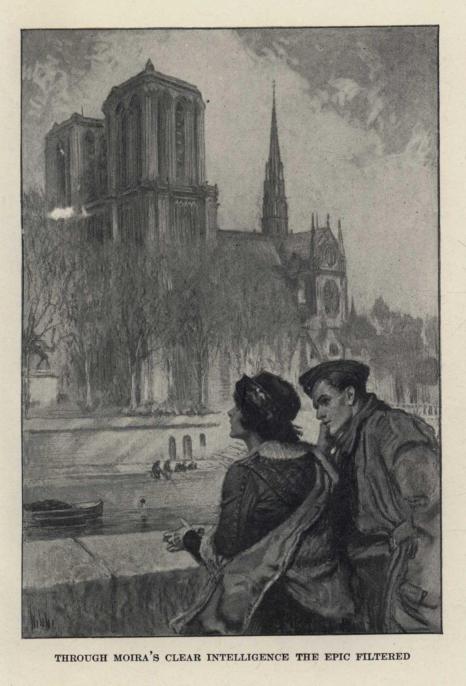
THROUGH MOIRA'S CLEAR INTELLIGENCE THE EPIC FILTERED
Then under the arches of the Louvre to the Avenue de l'Opera, and toward the banking district. All Paris smiled. The blue and brown mingled fraternally and the streets were crowded. Except for the uniforms, which were seen everywhere, it was difficult to believe that hardly a month ago the most terrible war in history had been fought, almost at the city's gates.
When he reached his bank, which was in the Boulevard des Italiens, near the Opera, Jim Horton had to move with caution. But Moira fortunately had some shopping to do and in her absence he contrived to get some checks, and going into the Grand Hotel drew a check signed with his own name, and payable to Henry G. Horton, and this he presented for payment. There was some delay and a few questions, for the amount was large—three thousand francs—but he showed the letters from Moira and Quinlevin. It was with a sigh of relief that he went out and met Moira near the Opera. With a grin he caught her by the arm, exhibiting a large packet of bank-notes, and led the way down the avenue by which they had come.
"And where now, Harry dear?"
"I'm hungry. To the most expensive restaurant in Paris for déjeuner. If I'm not mistaken we passed it just here."
"But you must not—I won't permit——"
He only grinned and led her inside.
"For to-day at least, Moira, we shall live."
"But to see Paris, en Anglais, that is not to live——"
"We shall see."
The tempting meal that he ordered with her assistance, did much to mollify her prudence and frugality and they breakfasted in state on the best that the market provided.
Afternoon found them back in the Boulevard St. Germain again, after an eventful interim which Jim Horton had filled, above her protests, in a drive through the Bois and a visit, much less expensive, to a cinema show, during which she held his hand. And now a little weary of all the world, but happy in each other, they drifted like the flotsam of all lovers of the Rive Gauche toward the Gardens of the Luxembourg. They sat side by side on the balustrade overlooking the esplanade and lawn in front of the Palace, watching the passers-by, always paired, piou-piou and milliner, workman and bonne, flaneur and grisette, for the warm weather had brought them out. There was no military band playing, but they needed no music in their hearts, which were already beating in time to the most exquisite of interludes. Twilight was falling, the Paris dusk, full of mystery and elusive charm; lights beyond the trees flickered into being, and the roar of the city beyond their breathing-spot diminished into a low murmur. For a while their conversation had relapsed into short sentences and monosyllables, as though the gayety of their talk was no longer sufficient to conceal their thoughts, which, throwing off subterfuge, spoke in the silences. At last Moira shivered slightly and rose.
"Come," she said gently, "we must be going," and led the way toward the exit from the Gardens on the Boulevard St. Michel. Horton followed silently—heavily, for the end of his perfect day was drawing near and with it the duty which was to bring disillusionment and distress to Moira and ostracism and hell to him.
But when they reached the studio Moira set with alacrity at putting things to rights and preparing the evening meal.
"We shall be having cold goose and a bit of salad, you extravagant person," she said. "I feel as though I had no right to be eating again for a week."
And so they dined upon the remains of their feast, but warmed by the cheerful blaze, both conscious of the imminent hour of seclusion and affinity. Moira had little to say and in the silences Jim caught her gaze upon him once or twice as though in inquiry or incomprehension, and wondered whether in their long day together, he had said or done anything which might have led her to suspect the truth. But he had been cautious, following her leads in conversation, and playing his discreditable role with rather creditable skill. The end was near. He would see Harry to-night at Javet's and to-morrow he would tell her, but it was like the thought of death to him—after to-day—and he failed to hide from her the traces of his misery.
"I wish that you would tell me what worries you," she said gently, after a long silence.
He started forward in his chair by the fire. "Er—nothing," he stammered, "there's nothing."
"Yes, there is," she said, evenly. "I know. I've felt it all day—even when you seemed most happy." And then quickly, "Is it me that you're worrying about?"
"About you?" he asked to gain time, and then, grasping at the straw she threw him, "about—you—yes—Moira," he said quietly.
It was the first definite return to the topic of the morning, which they had both banished as though by an understanding. But Moira was persistent.
"Why?" she asked.
"Because—because I don't deserve—all this—from you."
She smiled softly from her chair nearby.
"Don't you think I'm the best judge of that?"
"No," he said miserably. "No."
"You can't deny a woman the faith of her intuitions."
"And if I proved your intuitions false——"
"Sure and I'd never speak to you again," she put in quaintly.
"It might be better if you didn't," he muttered, half aloud.
She heard him, or seemed to, for she turned quickly and laid her hand over his.
"Don't be spoiling our day, dear," she said earnestly. "God has been good in bringing you back to me. Whatever happens I won't be regretting it."
His fingers caught and pressed hers and then quickly relinquished them as he rose, struggling for his composure.
"You will regret it," he said fiercely. "I tell you you can't thank God for me, because I'm not what you want to think me. I'm what the Harry you knew in America was, only worse—a liar, a cheat——"
He paused as she rose, saving himself the revelation on the tip of his tongue by the sight of her face in the firelight as she turned. It was transfigured by her new faith in him, and in her joy in the possession. She came to him quickly, and put her soft fingers over his lips, while the other arm went around his shoulders.
"Hush, alanah," she said.
"No—you mustn't, Moira," he muttered, taking her hands down and clasping them both in his. "You mustn't." And then, at the look of disappointment that came into her eyes, caught both her hands to his lips and covered them with kisses. Against the sweet allure of her he struggled, sure that never mortal man had been so tried before, but surer still that the love he bore for her was greater than all temptation.
She looked at him, flushed at the warmth of this formal caress, which left no doubt of him, but marveling at his renunciation of her lips, which had been so near.
"I can't be listening when you call yourself such names."
"You don't understand—and I can't tell you—anything more just now. I haven't—the will."
He noted the look of alarm which was a token of the suffering he must cause her and he led her to his chair and made her sit.
"I can't make you unhappy—not to-night. I—I'm sorry you read my thoughts. I shouldn't have let you see."
He had turned to the fire and leaned against the chimney piece. And after a moment, clear and very tender, he heard her voice.
"You must tell me everything, alanah. I've got the right to it now."
He shook his head in silent misery.
"But you must."
"No. I can't."
"Yes. You see, things are different with us two. You've made me know to-day how different. Last night I called to your mind the mockery we'd been through, calling it marriage. But it was a marriage, and the dear God has willed that my heart should beat for you as gently as that of any mother for its babe. It softened in the hospital, dear, when I saw you lying there so pale and weak against the pillows, and I knew that if God spared you for me I would make amends——"
"You—make amends——" he gasped.
"By giving you all that I had of faith, hope and charity. Whatever you were, whatever you are, dear, you're mine, for better or for worse, and I believe in you. And your troubles, whatever they are—I'll take my half of them."
"You can't——" he groaned.
"Not if they concern me," she continued simply, "for they're mine already."
He took a pace or two away from her.
"You mustn't speak to me like this."
"And why not? You're mine to speak to as I please. Is it that you don't love me enough, alanah?"
He knew that she wouldn't have asked that question, if she hadn't already seen the answer in his eyes.
"Love you——?" he began, his eyes shining like stars. And then suddenly, as though their very glow had burned them out, they turned away, dull and lusterless. She watched him anxiously for a moment and then rose and faced him.
"Well——" she said softly, "I'm waiting for your answer."
"I—I can't give you an answer," he said in a colorless voice.
"Then I'll be giving the answer for you, my dear, for I'm not without eyes in my head. I know you love me and I've been knowing it for many days. And it's the kind of love that a woman wants, the love that gives and asks nothing." She paused, breathing with difficulty, the warm color rising to her temples, and then went on gently, proudly, as though in joy of her confession. "And I—it is the same with me. I've tried to make you understand.... It is not for you to give only...." She halted in her speech a moment and then came close to him, her clear gaze seeking his. "I love you, not for what you have suffered, dear——" she whispered, "but for what you are to me—not because you are my husband, but because you are you—the only one in all the world for me."
"Moira," he whispered, tensely, as his arms went about her. "God forgive me—I worship you."
"God will forgive you that, alanah," he heard her say happily, "since I do."
He touched his lips to her brow tenderly ... then her lips.
"You love me," he muttered. "Me? You're sure that it's me that you love?"
Her eyes opened, startled at his tone.
"If it isn't you that I love, then I'm sure that I can't be loving any one at all."
"And you'll believe in me—whatever happens?"
"I will——" she repeated proudly. "Whatever happens—since this has happened to us both."
"Some day—you'll know," he muttered painfully, "that I—I'm not what I seem to be. And then I want you to remember this hour, this moment, Moira, as it is to me.... I want you to remember how you came into my arms when I hadn't the strength to repel you, remember the touch of my lips in tenderness—and in reverence—Moira ... that love was too strong for me ... for it has made me false to myself ... false to you...."
She drew away from him a little, deeply perturbed. "You frighten me, alanah."
"I—I don't want to. To-morrow——" he paused, searching for strength to speak. But it did not come.
"To-morrow. What do you mean?"
The repetition of the word seemed like a confirmation of his resolution and shocked him into action. Quietly he took her hands down from his shoulders, kissed them in farewell, and turned away.
"What do you mean?" she repeated.
"That—that to-morrow—you shall judge me."
The tense expression of her anxiety relaxed and she smiled.
"You needn't fear what that will be."
He did not reply but stood staring fixedly into the fire. She came around to him and laid her fingers over his. "Why should we bother about to-morrow, dear? To-day was yesterday's to-morrow and see what's happened to us."
"But it shouldn't have happened," he groaned, "it shouldn't have happened."
"Then why should I thank God for it——?"
"Don't——"
"Yes. Everything will be right. A woman knows of these things."
He smiled at her tenderly, but he didn't attempt to take her in his arms.
"Come," she said, "let us sit down by the fire near the blaze, and we will not speak of to-morrow—just of to-day and yesterday and the day before, when you and I were learning this wonderful thing."
But he did not dare.
"Moira, I—I've got to go out for awhile—a matter of duty——"
"Now?" she faltered.
"I must. An engagement. I'm in honor bound——"
Now really alarmed, she caught him by the elbows and looked into his eyes.
"An engagement—to-night! And to-morrow——?"
His meaning seemed to come to her with a rush.
"Harry——! This engagement to-night has something to do with us—with me. To-morrow——! What is it, Harry? Speak!"
"I can't. I've promised."
"I won't let you go, Harry. It is something that has come between us——"
"It has always been—between us——" he muttered.
She clung to him and held him as he moved toward the door.
"Nothing—nothing shall come between us. Nothing can. I don't care what it is. 'Until death us do part'—Don't you understand what that means, Harry?"
The repetition of his brother's name, the phrase from the marriage service, gave him resolution to avert his face from the piteous pleading in her eyes.
"It is because I understand what it means that I have—the courage to go—now—before you despise me."
"I have said that nothing makes any difference. I swear it. I love you, dear. There's some mistake. You'll never be different in my eyes, whatever happens—whatever has happened."
"Good-bye, Moira," he whispered, his hands clasping her arms.
"No, no. Not now—not to-night. I knew that to-day was too beautiful to last. You—you've frightened me. Don't go—please don't go."
"Yes," he said firmly. "I must."
But she was strong, and greater than her strength was her tenderness.
"Look me in the eyes, dear, while I'm pleading with you. If your love were as great a thing as mine——"
To look in her eyes, he knew, was fatal. One brief struggle and then he caught her in his arms and held her close for a long moment, while he whispered in broken sentences.
"My love! ... if you hadn't said that! You've got to know what my love means ... sacrifice.... This moment ... is mine.... Remember it, dear—as it is ... its terrible sweetness—its sanctity—remember that, too ... because that's the essence of it ... sanctity. God bless you, Moira—whatever happens——"
"Whatever happens?"
As in a daze he straightened and looked around. Then almost roughly broke away from her and rushed to the door, taking up his cap and overcoat on the way.
"Harry——!"
"Good-bye," he called hoarsely as he opened the door and went out.
She rushed after him but he was already running furiously down the stairs into the dark.
"Harry," she called, "Harry—come back!"
But the name of his brother made him rush on the more blindly, the echoes following him down into the court and past the open gate of Madame Toupin. He hadn't any definite idea of what he was going to do. The only thing that he was sure of was that he must get away—anywhere—away from Moira ... from the reproach of her innocent eyes, of her confessions, of her tributes of submission and surrender. On he plunged blindly down the street toward the Luxembourg Gardens, into the outer darkness where he must lose himself away from her—to-night, to-morrow,—for all time.
He had failed. He had trusted himself too far—trusted her too far. Fool that he was not to have seen that love, begun by trivial happenings, had been gathering strength and momentum and like an avalanche had swept down and engulfed them both. In a moment of reaction, of guilty triumph, he rejoiced, defiant of the conscience that drove him forth, that it was him that she loved—not Harry; his lips that had taken tribute—his ears that had received her confessions, meant for them alone.
But reason returned after awhile ... and with it the sense of his dishonor. The thing was over, definitely. There would be scorn enough in her eyes for him to-morrow, when he told her all the truth. He comforted himself with that thought and yet it brought him a pang too, for he knew that it was Moira who was to suffer most.
He seemed to be the only person in the gardens, for the night was chill and a thin mist of rain was falling. From time to time there were footsteps here and there, and the murmur of voices, and through the turmoil of his thoughts he was conscious of them vaguely. But they meant nothing to him. He went on into the darkness, his head bowed, in the conflict of his happiness and his remorse, reaching a dimly lighted spot near the Rue d'Assas, when he heard quick footsteps behind him. He turned just in time to dodge the blow of a stick aimed at his head, which fell heavily on his shoulder. He struck out but another man caught him around the waist, bearing him to the ground. He struggled to one knee, striking viciously, but they were too many for him. He got a glimpse of an automatic pistol which flashed before his eyes and then something heavy struck him on the head. The last thing he noted before losing consciousness was the pale face of the man with the automatic. It was his brother—Harry.
CHAPTER VII
AWAKENING
Moira moved about in a daze, attempting in the commonplaces of the daily routine to forget the thought of the revelation which she knew could not be long delayed. She had lain all night on the divan in the studio, listening and waiting for the return of the soldier, and at last, toward daylight, from sheer exhaustion of mind and body, had fallen asleep. When she awoke, her first impulse was to go to the room in the hallway and knock. She opened the door. The bed had not been occupied.
Slowly, thoughtfully, she went back to the studio and the business of preparing the coffee—for herself—and for Harry—when he should arrive. Her mind was filled with strange doubts,—not of him, because she had learned to have a complete, a perfect faith in this soldier that she had married, who had left New York under a cloud of uncertainties and suspicions and had come back to her spiritually reborn. The doubts in her mind were those that he had purposely created in it, and fragments of phrases that he had uttered in their moments of tenderness came back to alarm and disturb her, because if he hadn't thought it necessary to alarm and disturb her, he would have remained silent and permitted himself to enjoy with her the hours that had been theirs together. Yes ... there was something that had come to thrust itself between them—some impediment to their union. She smiled softly at the memory of the restraint in his caresses, the purity of his smile and the gentleness of his abnegation.... He had underestimated the quality of her new faith in him.
Was this shadow out of the past? Perhaps. But it wouldn't matter. Together they would exorcise it. Only the future mattered now—their future together.
She stopped for a moment in her work of putting the studio to rights and listened. She thought that she heard a step upon the stair. She waited a while and then went to the door and peered out. No one. It was a little cruel that he had not sent her a message—a note, a petit bleu even, telling when she must expect him, whatever his appearance might bring. For this, she realized, was the "to-morrow" of which he had spoken yesterday ... the day of revelations....
She tried to sing at her work but the effort was a failure. A morbid fear of the thing that was to happen, if it hadn't already happened, obsessed and held her. Nine—ten o'clock—eleven.... With a courage born of desperation she went into her room and put on her hat. It was insupportable, the suspense. There were some things to buy. She must order them. And leaving word with Madame Toupin that she would return within the hour, she walked briskly forth, breasting the keen air and trying to smile. But even her walk was a failure, and in a short while she was back, eagerly questioning Madame Toupin. No, Monsieur le Lieutenant had not arrived. No doubt he was busy about the ceremony of the presentation of the medals. Moira inquired and Madame Toupin showed her an article in the paper about the honors to be given both French and American officers next week in the Place de la Concord. There was his name, "Henry G. Horton—Croix de Guerre." Madame Toupin let her have the paper and she ran up to the studio, where she read it eagerly, thrilling with pride.
Of course he had his reasons for not coming to her and telling her everything. She must be patient—her faith in him unwavering. He would come to her to-night again—and whatever he told her was to make no difference in her love and faith in him—whatever he told her—she swore it.
* * * * *
Late that night he came. She had built a fire of fagots against the chill of the night and was sitting in the big armchair by the hearth when she heard a knock at the studio door. With a cry of welcome she rose and rushed to greet him, throwing herself impulsively into his arms.
"Harry," she gasped happily, "at last!"
She couldn't help noting the slight movement of recoil before her tenderness. Then, bending his head,
"Hello, Moira," he muttered.
She helped him off with his overcoat and led him over to the fire, making him sit in the big arm-chair. He obeyed awkwardly, as one in a daze, his brows frowning. The light was uncertain, but what she saw alarmed her.
"Harry! What has happened to you?" she cried, catching him by the hands and holding them. "You're ill—your fingers are cold—you look as though—— What has happened?"
"Nothing," he murmured with an attempt at a smile. "Nothing at all." But even the smile was different, as though the muscles acted in obedience to an effort.
She had struck a match to make a light.
"What—what are you doing?" he asked.
"I'm going to see what's the matter with you. You look sick. You need medicine."
"No," he protested. "I'm just tired. A drink of whisky if you've got one——"
She went into Barry Quinlevin's room and brought forth a bottle, a glass and a pitcher of water. With a hand that trembled a little, he poured himself a drink and took it at a draught, and then gave a gasp of relief. She had sat down near him and was regarding him with an expression of intentness and eagerness, though the pucker at her brows indicated a doubt and a fear. The gas light was at his back and she could not clearly see his face, but there was something strange about him that she had missed at his first entrance, a brooding sullenness, remote, self-centered, that even the smile could not temper with sweetness. And even while she watched he poured out another glass of whisky.
"What is it, Harry?" she asked. "Tell me."
"It's nothing," he said. "I'm all in, I've had some worries. I'll be all right.'
"Have you had something to eat?"
"Yes. I'm not hungry."
His voice too ... thin, weary, somber.
Now greatly alarmed, she caught his hand in both of hers.
"You must tell me everything, Harry. I don't care what it is—I—I've got to know. You told me that you'd tell me to-day—to-night, and now you must keep your promise. I've tried so hard not to worry and—and when you didn't come back to me last night, I—I was really frightened——"
"Were you?" he said, with a frown. "I was all right."
"I'm glad. But it was cruel of you not to send me a message."
"I couldn't. But I'm here now, Moira. So there's no need worrying any more."
He put his hand over hers and leaned toward her. His words, which last night would have given her happiness, seemed somehow to mean nothing to her to-night. For his very presence in this condition was a threat against her peace of mind. And his fingers might have been wax for all that their touch meant to her.
"You—you're trying to make things seem better than they are," she said steadily, wondering at her own words. "I—I'm not easily deceived. Last night I knew that something had come between us. I know now that it's still between us, Harry, whatever you say."
He turned away toward the glass at his elbow,
"No," he murmured, "that difficulty—has been removed."
He couldn't repress the smile of triumph as he took his drink, and she saw it. It wasn't a pleasant smile.
"Come," he went on more easily, "aren't you glad to see me?"
"I—God knows whether I am or not. Something has happened to you—to me.... You've been through something terrible—since yesterday—something that has burnt the soul of you. What is it? What is it? The touch of your fingers—your voice, they come from a distance-like, with nothing of you in them. Am I ill that I should be thinking of you so? Take me in your arms, Harry, and shield me from this terror that you're not yourself, but some one else."
He obeyed, putting his arms around her and holding her close to him. But at the touch of his lips to hers, she struggled free and faced him by the hearth, pale as death. The look of bewilderment at her brows had intensified into a steady gaze, almost of terror at the thought that had suddenly mastered her. And yet she did not dare give utterance to it. It was so outlandish, so mad and incomprehensible.
She saw the frown of anger, quickly masked in a smile of patience as she broke away from him, and that confirmed her in her madness. She was reading him keenly now from top to toe, missing nothing. And the thought that dominated her was that the man with whom she had mated during the past weeks, the man who had passed through the shadow of death, reborn in body and spirit, the Harry that she had recently learned to love—was dead; and that this man who had come to take his place—this man—was what he might have been if God's grace had not fallen on him. Madness? Perhaps. And yet how otherwise would the touch of his lips, which last night she had sought in tenderness, have been so repellent to her? Harry—her husband—unregenerate—the same Harry that....
She kept her gaze fixed upon him and she saw his look flicker and fade.
If this reality was Harry, her husband, then were all the weeks that had passed since she found him in the hospital merely a dream, was yesterday a dream—last night?
"I—I don't know—what is the matter," she said at last, passing a hand across her brows. "I—I am not well, perhaps. But you—you're not the—not the same. I know it. The thoughts that I have of you frighten me."
He forced a laugh and sank into his chair again, lighting a cigarette with an assumption of ease.
"I'm sorry," he said quietly.
She only stood staring at him, her deep blue eyes never wavering from his face, which was still averted from the light. He met that gaze once—a second time, and then looked away, but still they stared at him, wide like a child's, but full of a dawning wisdom.
"You—you are Harry Horton—my—my husband?" she whispered in a kind of daze.
"Well, rather."
She paused another long moment as though on the verge of a difficult decision and then spoke searchingly.
"If you are Harry—my husband—then who—who is the other?"
Harry Horton started. "The other——?"
"The other—who was here with me yesterday, who was ill in the hospital at Neuilly, wounded—the hero of Boissière wood?"
"Moira," he said, rising, "this is serious. There has been no other here."
"Yes," she repeated doggedly, "the other has been here—your twin——" The word seemed born of her necessity. "Your twin," she repeated.
He winced at the word and she saw the change in his expression.
"Tell me the truth of this thing," she went on quickly, "he said yesterday that something was to come between us. It was you." And then, as he made no reply, "For God's sake, speak——"
He turned away from the light.
"I'm your husband," he muttered hoarsely.
"Show me your wounds," she gasped suddenly, reasoning with singular directness.
He glanced at her once, then bent forward. There upon the left side of his head in a shaved spot was a cross of adhesive tape. She touched it aimlessly with her fingers and then suddenly, before he could rise, with a quick deft movement tore it away from his skull. And quickly as he straightened she had seen enough.
There was no wound.
"What's this deviltry?" he muttered, his face an angry red.
But the look that he met in her eyes pierced all subterfuge.
"You have not been wounded," she gasped.
He leaned forward in his fury as though to strike her, but she stood up to him resolutely until the color faded from his face and he straightened slowly.
"Well," he muttered with a shrug, "I haven't." And then, folding his arms he found her gaze. "What of it?" he asked shortly.
She glanced down at the slips of adhesive tape and then let them fall through her fingers.
"I'm glad," she said coolly, "that you've decided not to carry on the lie——"
He laughed again. "Well, it looks as though it were hardly worth while."
Already all her thoughts were beyond him.
"Who—who is the other?" she asked at last, with a cold precision that might have come from a disembodied spirit.
He waited a moment before replying and then his tone matched her own.
"I can hardly wonder at your interest after the warmth of your greeting when I came in."
The shot told and she colored painfully.
"Who—who is he?" she repeated with an effort.
He smiled. "There's no harm in your knowing, since you've guessed the rest. He's my twin brother, Jim Horton."
"Jim," she gasped below her breath.
"We met in the confusion on the battlefield," he went on. "I had been shell-shocked and he put on my uniform to lead my men——"
"Shell—shock——"
"Yes. He took my uniform. It was a fool proceeding. When I came to, everything was in confusion. He would have been courtmartialed and shot if I had turned up, so I went back to the lines and came to Paris——"
"While he won you the Croix de Guerre. And you're going to step into his shoes——"
"They're my shoes. It's not my fault——"
"And he—what's to become of him?"
"That's his lookout. He merely disappears from the scene."
She leaned heavily against the mantel shelf, breathing fast. But she had no reply, and so he went on unpleasantly.
"Now, perhaps you would like to explain."
"I have nothing to explain."
"Not the joy in your eyes when I came in? The kisses you gave me that you thought were for him?"
"I ask no forgiveness," she said in a hollow tone.
"Of course you thought he was your husband. And he let you think so."
"Yes. He let me think so," she repeated, parrot-like.
And all the while her horror of her situation increased—her anger at "the other" who had dared to place her in this false position.
She saw her husband's bony fingers clasp the chair arm.
"You were easily deceived," he went on. "It's hardly flattering to me. I would like to know——"
He stopped suddenly, his question in abeyance before the challenge in her eyes, aroused by the tone of his voice. She read his thought and answered him.
"He came here from the hospital night before last. He wanted to go to a pension but I would not permit it——"
"That was kind of you. But I'm not blind. And your kisses for him were warm on your lips when you greeted me."
She paled and drooped in her shame.
"What have you to say about that?" he went on tensely. "Do you think that I'm the kind to stand by idly and see a man take my wife's kisses?"
"No. You're not," she answered slowly. "You've already answered me." And then, with a painful effort, "What have you done with him?"
He sank into the armchair with a laugh. "With him? Nothing. He has gone. That's all."
"I don't believe you."
"That's your privilege. He has gone. He thought he had gone about far enough. And I'm almost ready to believe that you agree with him."
"No," she stammered, pleading against her own will, against her outraged pride. "There was a reason for what he did—an honorable reason. There must have been."
"The marks of it are not very clear to me. If you can see anything honorable in trying to steal the love of one's brother's wife——"
He paused, for he saw the danger signals flying in her eyes, and tried to shrug his anger off. "What's the use? I'm no fool. Whether he tried to win you or not, it's clear that neither of you was over-scrupulous about me."
She didn't reply at once and when she did speak her words came slowly and with dignity.
"I don't know why it is that he should have kept silent about you. He has done me a hurt—irreparable. When I visited him in the hospital, it was you that I visited, you that I went to cheer, to take my place by your side. I thanked God when I saw you that you had grown to be—what you were, what I had wanted you to be. And I loved you for what you had suffered."
He started up from his chair.
"Moira——"
"Wait a moment," she insisted, still struggling to give her thoughts expression. "I want you to understand. I thought that it was you who had come back to me—as I wished you to come back—in honor and pride of your service of your country. And instead of you I find—another—with your wounds, your honors—if it was your brother—in spite of the false position he's placed me in—I honor him for those wounds as I would have honored you—and I honor him still more—because he has thought enough of his honor and of mine—to give up everything that he has won and gone out into the darkness—alone."
At this, Harry Horton's fury relaxed in a laugh. He poured himself out another drink.
"You can spare him these new honors."
She glanced at him keenly but he was too angry to notice.
"He went—away—because he had to," he muttered.
"What do you mean?"
"What I say. It was getting too hot for him."
The meaning under his words came to her slowly. She watched him for a moment curiously, leaning toward him, studying the ugly lines at lip and brow that he no longer took pains to conceal. And then she guessed at the truth.
"What have you done with him?" she whispered.
"N—nothing."
"You lie." She knew no fear of him now, and leaned forward, clutching at his shoulder. "You've dealt unfairly with him—you've——" She halted in terror of her thoughts.
"He got what he deserved," he muttered sullenly.
"What have you done?" she repeated.
"Put him where he won't mess in my affairs again. See here, Moira," he caught her wrists and held her, "I'm just about fed up with this. I've been patient about long enough. You're my wife. And I'm going to keep you. Do you think after all I've suffered I'm going to stand for this kind of treatment now?"
"Let go my wrists—you're hurting me——"
"No——" Instead, he drew her closer to him. "I don't care about this foolishness with Jim. I think you can see that you've made a fool of yourself and of me. But I'm willing to forget it, if you'll do the square thing. I'm back here and I'm back to stay—and I'm going to make you love me whether you want to or not."
"Let me go, Harry."
"Kiss me."
"No." She struggled in his arms, but he only held her the more closely. "Moira. I want you. You're mine. You belong to me by every law——"
"No—no."
But he mastered her, pressing her throat back and kissing her upon the lips. She lay quiet in his arms, weak from the struggle. He took her immobility for acquiescence and caught her more tightly in his arms.
"Let me go," she gasped. "Do you hear?"
A saner man would have caught the warning note. But Harry Horton was beyond warnings. She fought with renewed strength and then, all else failing, struck him full in the face with her clenched fist.
His arms relaxed in astonishment and she sprang away, putting a small table between them.
Breathing rapidly, she saw him put his fingers to his cheek and then look at them in a bewildered way.
"I see," she heard him muttering to himself, "so that's the way of it——"
The blow brought him to his senses, and he stared at her for a moment as though at a person he had never seen before. Her eyes burned like a blue flame in the pallor of her face and the hand that clutched the table trembled violently. And yet it was not the fear of him that made her tremble, but the fear of herself and of the sudden dreadful awakening at the edge of the chasm that yawned between them.
CHAPTER VIII
THREATS
The silence seemed endless and yet she dared not trust herself to speak. Her throat closed and it seemed that the blood from her heart was drowning her. And yet she watched him tensely, aware of the crisis, aware too of the revelations that seemed to have laid her heart bare to all the world.
Her husband reached the large table and poured out what remained of the whisky. Then she heard his laugh again, and saw him leering at her over his glass.
"Lucky dog, I am. Pretty little devil to come home to. Love tap!" He shrugged and raised his glass. "To our better acquaintance!"
She made no sound, but while her eyes watched, her mind was working rapidly. His air was braggart, but she could see that he wasn't any too sure of himself. He had thought to come here and by the ruse of the adhesive plaster merge his identity into that of his brother Jim. The lapse of time since she had seen him and the illness had deceived her in the hospital. And so he had figured on the remarkable resemblance to his brother to help him carry off this situation with a careless hand. But he hadn't reckoned with the alertness of her woman's intuitions, or—God help her—the tenderness of yesterday, which held the image of the brother so close to her heart. Something of what was passing in her mind seemed to come to him.
"So you've fallen in love with my pretty brother?" he muttered.
"No."
"Complaisant husband—mari complaisant. You wanted Jim to take you in his arms—and you only had me. You don't care for my kisses. Why not? We're just alike—as like as two peas in a pod. What's the difference? Come now. Tell me. I'll be a good sport."
"We—we've got to come to an understanding——" she gasped at last desperately.
"Exactly—an understanding. That's what I'm getting at——" he laughed and sank into a chair by the lay figure. "Oh, don't be disturbed. I'm not going to try to kiss you again. It's too dangerous."
She watched him intently while he took out a package of cigarettes and lighted one. And then, with a wave of the hand, "An understanding—by all means. Fire away."
"It isn't necessary to go into the past, except to say what you know already—that our marriage was a horrible mistake. But we did have an understanding then—that you were to wait—that you were to—to make good—and that I was to try to—to care for you."
"Quite so. And we've both failed?"
"Thanks. We—we have both failed," she repeated. "I can't say I ever really believed we should succeed until——"
"Until you went to the hospital."
She bent her head. "The main thing is," she went on more evenly as she gathered courage, "that whatever my hopes were for you, now at least you've forfeited all claim to consideration."
"Why? Because I take a fancy to my own uniform—my own personality?"
"Because you——" she paused to catch her breath, "because you've stooped to something—something unworthy—something vile and terrible, perhaps—God knows, to get rid of a man—your own brother,—who did you a service; and because you'll dare to receive honors that don't belong to you." And then, as he started up, "One moment. I don't know what happened on the battlefield. If you were injured, it was a glorious—foolish thing Jim Horton did for you. But whatever he did and whatever his motive, it deserves something of you—something different from what you've confessed. Tell me what you have done with him and I'll try to believe you."
"He's quit, I told you," he protested. "There wasn't anything else for him——"
"Where is he?"
"What does it matter? He's out of your life—out of mine."
"No—not out of your life——" she paused.
"What do you mean?"
"Merely that the truth of this thing must be told."
"Impossible. It would ruin us both."
She gave a little gasp of relief.
"Tell me where he is."
"He's safe——"
She deliberated a moment.
"You've got to prove it to me. He said he was coming back to the studio to-day. Instead, you came—in the uniform he wore. He didn't give it to you willingly——"
"Yes," he lied sullenly. "He gave it to me. There wasn't anything else to do when I turned up. He realized he couldn't stay here—with you." And then, "Oh, he was square enough about it."
There was a long pause. He didn't ring true. She had almost forgotten, as he had, what he had said in the fury of his jealousy. She was aware that he had risen unsteadily from his chair and was approaching her.
"So here, Moira," he said in an ingratiating tone. "I'm not a bad sort—really I'm not. I—I was out of my head awhile ago—the way you came up to me, thinking I was him. I guess I wanted to hurt you—the way you had hurt me. I'm sorry. I won't touch your fingers even, if you don't want me to. I was a rotter to try to kiss you. I ought to have known you didn't want me to—when I—I had had one or two too many. I've been worried too—devilish worried about the whole thing. Let's forget it and talk the thing over sensibly. There may be a way out. I don't want any honors that don't belong to me, but I don't want to be dismissed from the service, either, or shot—on Jim's account. But we've got to keep this thing quiet."
She understood his drift. The facts in her possession made her dangerous.
"It can't be kept quiet, so long as Jim Horton is in danger."
"Who said he was in danger? I said he'd quit——"
"But you lied. He hasn't quit. He isn't the quitting kind. He was to have come to me to-day, and told me the truth—I didn't know what it all meant then. But I do now. He has got to have his chance."
She saw him glare at her somberly.
"What do you want me to do?"
"Take me to him—to-night."
"That's impossible. I couldn't find him."
"Yes. You can find him. Or he would have found me."
He smeared out the ash of his cigarette in a receiver and rose, his face livid.
"You seem very sure of him—and of yourself. And if I don't find him for you, what are you going to do?"
"I shall tell what I know to the proper authorities."
He stood for a moment balked and then before she knew what he was about he stumbled to the studio door and turning the key in the lock put it in his pocket. She was frightened by the significance of the action, and ran quickly toward the door of her own room. He turned and moved to intercept her but awkwardly and she slammed the door in his face, catching the bolt on the inside.
She was frightened now, desperately frightened, but resolved to escape and tell what she knew. The brother—Jim—was in danger—a prisoner somewhere—otherwise he would have come to her. Much as his silence had injured her, deeply as her pride was hurt at the position in which he had placed her, she knew now that he had intended to tell the truth from his own lips and warn her of Harry's return before he left her and went away alone. He loved her.... It was his love that had sought to spare her the humiliation of this very knowledge that had come to her. Shell-shock! There was another reason for the substitution. What? But whatever it was, there seemed little difficulty in choosing between them. The other—Jim—the man she loved ... she acknowledged it in every impulse ... would have come to her. She had to find him. Just what she meant to do she didn't know, except to get away from Harry. He was hammering on the door now—pleading with her. But she didn't answer. Catching up her hat and a heavy coat, she went quietly to her own door into the hall, and, while he still hammered and pleaded, fled quickly down the stairs and into the lodge of the concierge.
Madame Toupin, aroused suddenly from her doze, started up in amazement.
"Madame Horton, what is it?" she asked in French.
"It is a game we play, Madame Toupin. You shall hide me in your closet. And when Monsieur le Lieutenant comes you shall say that I have run out into the street. You understand?"
"Parfaitement, Madame. Ah, les jeux d'amour. Entrez vite." And she opened the door of the closet which Moira entered quickly.
Then Madame Toupin with a smile of wisdom composed herself to read her paper. And in a moment a clatter of boots upon the stairway and the sound of footsteps upon the paving of the courtyard announced the approach of the officer. Through a crack in the door Moira listened to the conversation which Madame conducted with her amiable smile, and presently Harry Horton withdrew frowning and went out hurriedly into the Rue de Tavennes.
But while she stood upright in the closet listening, Moira had formulated a plan. It was clear from the tone of Harry's voice and his haste to go that her escape had frightened him. For his judgment was not amiss when he decided that Moira was fully capable of carrying out her threat to tell the whole story to the military authorities. But instead of clinging to her original intention, a new idea had come to her.
If she followed him, she could perhaps get a clue to the mystery of Jim Horton's disappearance. She couldn't understand yet—couldn't make herself believe that this man that she had married could be capable of a thing so vile. But the evidence—his own words stammered in his fury, were damning. The familiar formulas seemed to have no bearing now. The war had made men demi-gods or devils and Harry.... It did not seem very difficult to decide to-night what Harry was.
She slipped on her heavy coat and the hat she had brought and with a word of explanation and caution to Madame Toupin, she went out into the street. Far down upon the opposite sidewalk she saw a tall figure striding away into the darkness. She followed, keeping at a distance, her coat collar turned up and her broad-brimmed hat pushed well down over her eyes. She hurried along, keeping in the shadow of the opposite side of the street, trembling with the excitement of her venture and wondering what was to be its outcome, but sure from his gait that the situation she had created had developed in Harry Horton's hazy brain some definite plan of action. She noticed too that he no longer swayed or stumbled and that he glanced furtively to left and right at the street corners, peering back toward her from time to time. But she matched her wits to his, crouching into corners as he turned and then running forward breathlessly in the dark places, keeping him in sight. He turned into the narrow reaches of the Rue de Monsieur le Prince, past the Lycée and the École de Médicine, and crossed the Boulevard St. Germain into the network of small streets in the direction of the river, twisting and turning in a way which confirmed her belief in the dishonesty of his purposes. It was now long after midnight, and the streets into which they moved were quiet and almost deserted. From the direction of the Boule' Miche' came a rumble of vehicles, the glare of lights, the distant grunt of an automobile-horn, the clatter of a cab horse down an echoing street. The neighborhood was unfamiliar to her, a part of old Paris near the Isle de la Cité, where the houses, relics of antiquity, were huddled into ghostly groups, clinging to one another, illumined fitfully by murky bracket-lamps which only served to make their grim façades more somber and fantastic. Dark shapes emerged from darker shadows and leered at her—evil figures, bent and bedraggled, or painted and bedizened, the foul night-creatures of the city, the scavengers, the female birds of prey, the nighthawks, the lepers. Twice she was accosted, once by a vile hag that clutched at her arm with skinny talons, and again by a man who tried to bar her way, but with a strength born of her desperation she thrust him aside and ran on, her gaze seeking the tall figure that she followed.
More than once she lost sight of him as he plunged deeper and deeper into the maze and she paused trembling in the shadows, not knowing which way to turn, but gathering courage again hurried on to catch the glint of a street light on his brown overcoat in the distance.
Above the roofs, almost hanging over her, she caught a glimpse of the grim towers of Notre Dame, the sentinels of a thousand years of time, and the sight of them gave her courage in this region of despair. With an effort she threw off her terror of the evil that seemed to hang in every shadow, trying to remember that this was Paris, her Paris, with familiar places close at hand; and that this man whom she followed was no creature of the middle ages, but Harry, her husband; that this was the Twentieth Century, and that here was the very heart of the civilization of the world. But the facts that had come to her were amazing, and Harry's confessions damnable. It was clear that his position was desperate and his intentions none less so. Here somewhere, hidden, she believed, Jim Horton lay, helpless and injured, if not by his brother's hand by that of some one in his employ. It was the only answer to the riddle of his failure to come back to her. She must find him—before they took him away—before they ... Her thoughts terrified her again. Harry wouldn't dare. He was a coward at heart. She knew it now. Besides, there must be some spark of decency and manhood left to restrain him from so desperate, so terrible an expedient to save himself.
She crept cautiously to the corner of a small street into which Harry Horton had turned. It was scarcely more than an alley-way—a vestige of the old city, hedged in by squat stone houses with peaked roofs, deserted it seemed and unoccupied. Beyond she could see the Quai, the loom of the Hôtel Dieu and Notre Dame. The house at which he had stopped was but a few yards from the river front. She stole into the blackness of an angle of wall and watched. He was knocking upon the door—three quick taps followed by two slower ones. For awhile he waited impatiently and then, as no one answered the summons, he tried the window and then started up a small passage at the side not twenty feet from where she crouched.
Her pulses were throbbing violently, but the terror of her surroundings had passed. And she tried to convince herself that she did not fear Harry.... And yet she hesitated to confront him, fascinated by her discovery.... The brother—Jim—was here—she was as sure of it as though she had seen him. She knew that she must intercede in some way, but she was very helpless. How many were there in this house? And if she revealed herself, would not the warning give them time to carry out whatever plan they had in mind? And so she crouched watching, breathless and uncertain.
She saw him go back to the door and repeat the knock more loudly, cursing under his breath and, calling a name at the key-hole.
"Tricot!" he called. "Tricot! Tricot!"
And in a moment she heard a sound at the door, which was opened a few inches.
"C'est moi, Tricot," she heard Harry say, and then the door was opened wide, giving her a glimpse of a short man with tousled hair and a diabolic face, holding a lantern.
"Oh, Monsieur——" growled the man with the lantern, stepping aside as Harry Horton entered. And just as Moira sprang up, her husband's name on her lips, the door was closed and bolted. She ran to it and then paused in uncertainty, trying to plan what it was best to do. She felt very small, very helpless, for the sight of the villainous looking man with the lantern frightened her terribly. He seemed to typify all the evil in all the world—to explain in a glimpse all that was sinister and terrifying in the disappearance of Jim Horton. An ugly creature of the world of underground, an apache! There were others like him here. And Harry....
There was no time to be lost. Her thoughts seemed to clear, her courage to return as she cautiously returned by the way that she had come—out into the wider street, up which she hurried, turning in the direction of the Boule' Miche'. Her one idea now was to find a policeman,—any one with a vestige of authority. Men she met but she shrank away from them as she saw what they were and what they thought she was. Ten—fifteen minutes of rapid searching without result and she turned toward the Quai and, failing there, over the Petit Pont to the Island and the Prefecture de Police. It was curious that she had not thought of it before. The buildings were dark but she found at last a man in uniform to whom excitedly she told her story. He listened with maddening politeness and at last took her to an office where several other men in uniform were sitting around a stove. More alarmed than ever at the passage of time, she told her story again. Here she seemed to make some impression at last, for an older man, who sat at a desk, finally aroused himself and gave some orders. And in a few moments with two of the policemen she was leading the way back to the Quai St. Michel. She was almost running now in her eagerness so that the men had to take their longest strides to keep up with her, but more than ten minutes had already passed, it seemed an eternity to Moira, and there was still some distance to go.
"What was the name this man spoke at the door?" asked one of the policemen.
She told him.
"Ah, Tricot! Parbleu! I think perhaps, Mademoiselle, that there may be some reason in your anxiety."
"You know——?"
"An apache of the old régime, Mademoiselle. We would do well to find him."
And so, explaining her fears, but not yet revealing all the reasons for them, she led the way down the streets by which she had come and to the house which Harry Horton had entered.
The older man knocked loudly upon the door. There was no response. Again. Silence. The other man went up the alley way on the side and called to them. There was a shutter and a window open. Without hesitation, he drew a weapon and crawled over the sill, the other man following, leaving Moira alone. She listened, as they moved about inside, saw the glint of an electric torch and then heard the bolts of the door shot back and the police officer calling to her.
"Enter, Mademoiselle," he said, when she had come around. "You are sure that this is the house?"
"Yes, Monsieur."
"There is no one here. The house is deserted. It is a street of deserted houses."
"That is impossible——" she stammered. "With my own eyes, less than an hour ago, this Tricot met the other at the door."
"Allons! We will search a little further, then."
She followed them up the rickety stairway and then they found evidences of recent occupation—two pallets of straw—some food—a bottle containing absinthe.
"Mademoiselle, you are right. This bottle is not yet empty. There's something suspicious here."
And now moving with more rapidity they explored the house thoroughly, descending at last into the cellar, with, weapons drawn, Moira, half-hoping, half-fearing, following just behind them, her gaze searching the shadows. The place smelled of the earth and the walls were damp to the touch, but a quick examination with the torch showed the marks of many foot-prints in the earthen floor. The astonishing feature of the cellar was its size, for it seemed to extend under two houses, and its vaulted ceiling of rough stone of great antiquity was upheld by huge piers, that might at one time have supported the walls of a great edifice. At first they could make out nothing but a litter of papers, bottles and packing cases, but as the torch of the police officer searched the shadows in a distant corner, they heard his exclamation of astonishment. There was another pallet of straw here covered with rags and quite distinctly there came to their nostrils the odor of chloroform. Moira peering over the shoulders of the man with the light saw him bend over and pick up a rag and examine it carefully. There were dark stains upon it. And then with another exclamation he picked up some pieces of rope.