Chapter V · EXPANSION—INSIDE AND OUTSIDE LAP AND LEAD; ADVANCE AFFECTED THEREBY—COMPRESSION.
Reading edition
Expansion.—In order that the expansive properties of steam may be utilised, it must be cut off before the piston arrives at the end of its stroke, and on being cut off must not be allowed to commence exhausting immediately, but must be confined in the cylinder, in order that by expanding it may force the piston further before it. The old valve, as we have seen it, did not allow this, and to effect it the faces of the valve are lengthened, so that after the steam is cut off by the edge (a) of the valve (fig. 15) the steam is confined, and expands in the cylinder until the edge (b) arrives at c, when exhaust immediately commences. Now put the piston at the end of its stroke, and put the new valve in a central position (fig. 16). The distance that the valve, when in this central position, overlaps the outer edge 32of the steam-port, is called the “outside or steam lap,” or more commonly the “lap” of the valve, that is, the distance d a (fig. 16).
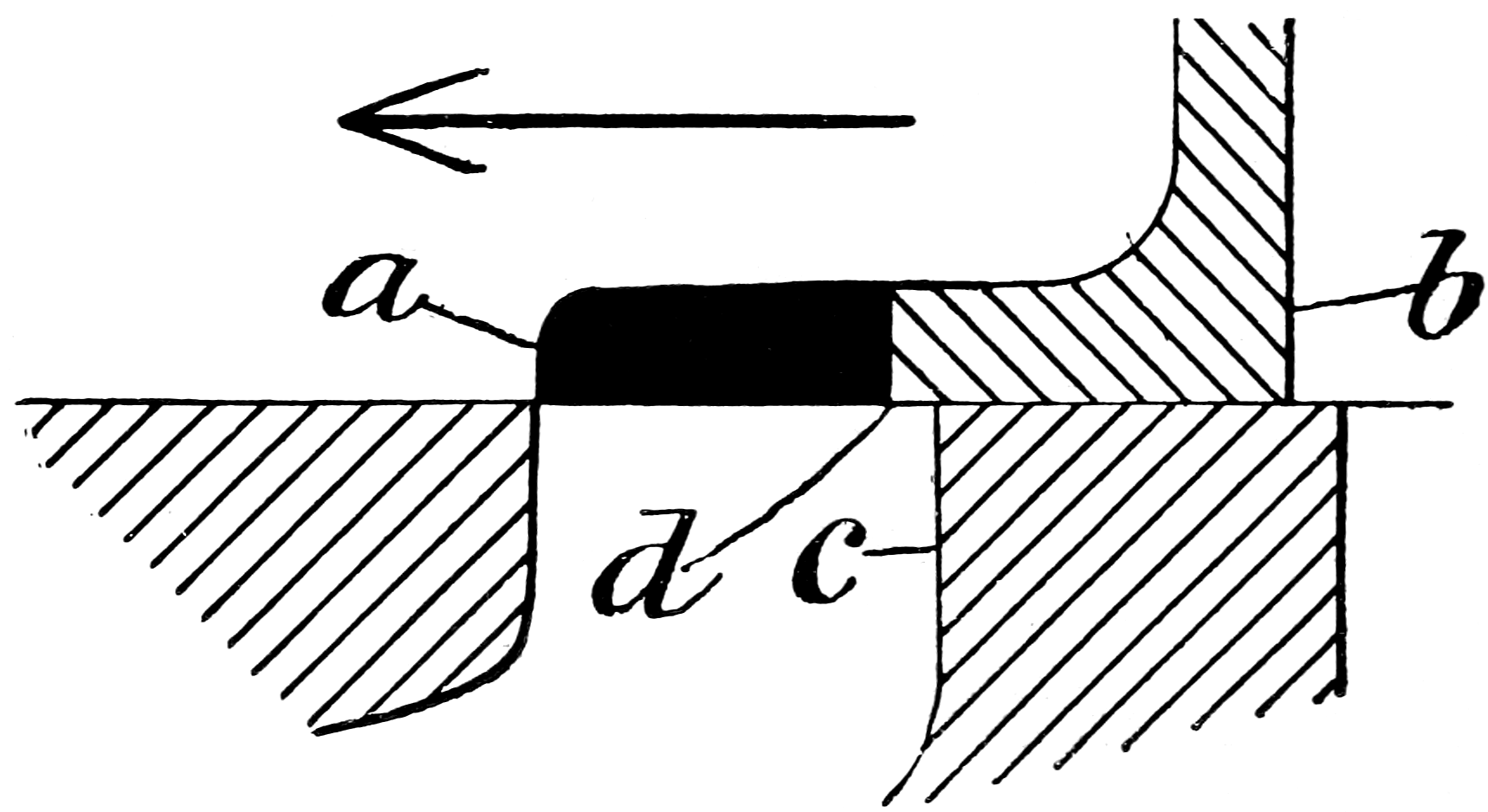
Fig. 15.
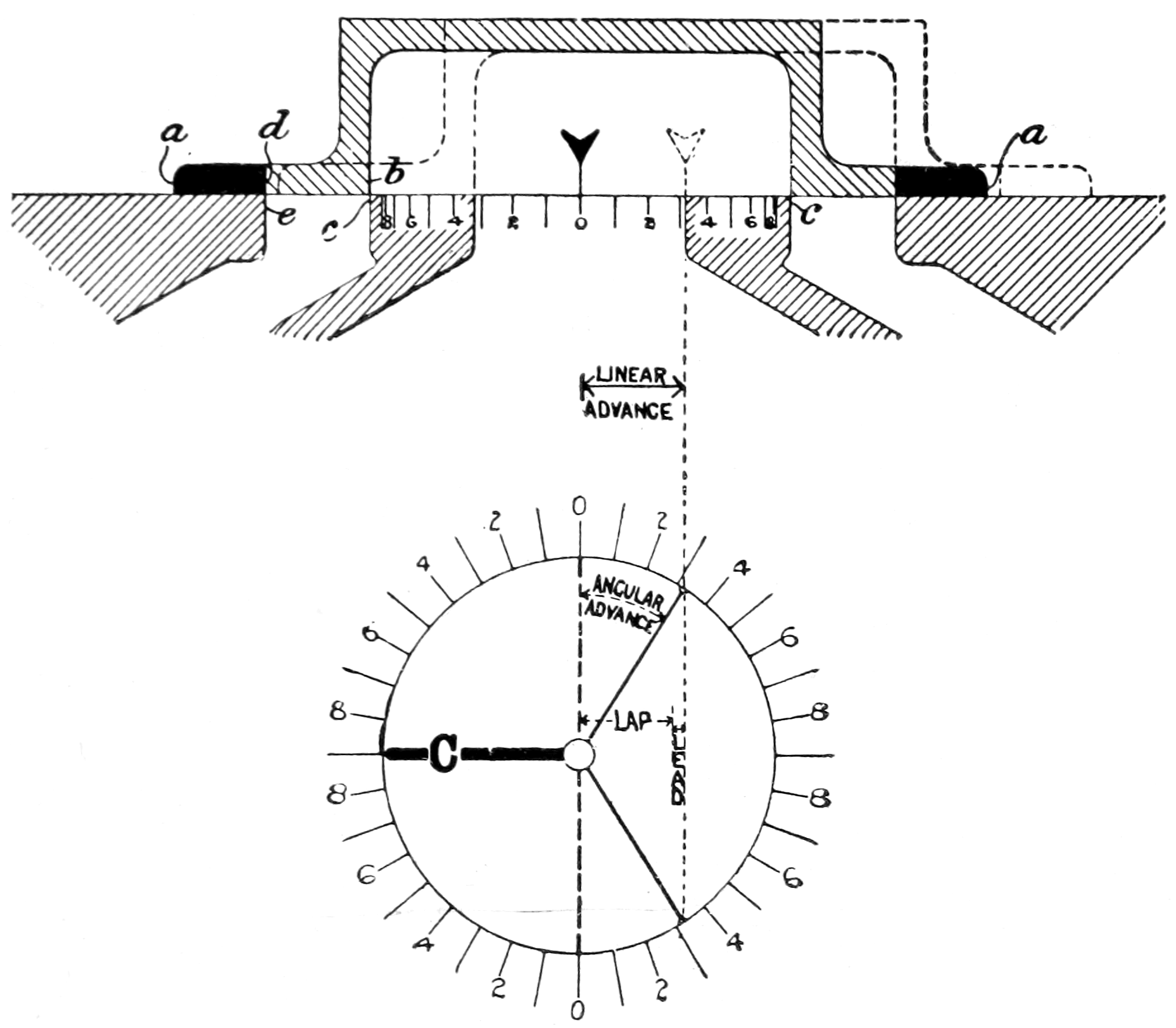
Fig. 16.
The first thing noticeable is that this valve must be given considerably more travel than the old one, as, to open fully each port to steam, we have to bring the edge a to c, first for one end of the valve and then for the other, so that the travel of this valve must be twice the distance from a to c—i.e. (lap plus port-opening) × 2, whereas for the old valve it was the distance from d to c which had to be multiplied by two to give the travel.
Increased travel means increased throw of the eccentric, and we draw on the disc in fig. 16 two longer eccentric-arms than before 33(the bolder dotted lines) for the forward and backward eccentrics. We want “lead” with this valve, and we must therefore give each eccentric more advance than the 90 degs. shown. Now with the old valve we give each eccentric an advance upon the 90 degs. which was determined solely by the lead, no lap being then in question; but we now have a lap to deal with, therefore each eccentric must be set on past 90 degs. until it first has drawn 34edge a of the lap to the outer edge of the port, and then still further until the edge a gives the necessary “lead.” Hence we see that the linear advance of the eccentric = lap plus lead, so as to draw the valve out of its central position by that amount.
Travel, then, depends upon outside lap and port-opening, and lead does not affect it.
Advance depends upon lap and lead.
The advance of the eccentric is usually stated by specifying the angle of advance or the number of degrees exceeding 90 degs. that the eccentric is in advance of the crank—for instance, “an angle of advance of 10 degs.” means 90 degs. + 10 degs. = 100 degs. in advance of the crank.
The line of travel of the valve is sometimes inclined to the line of travel of the piston; in such cases, one of which is illustrated in fig. 17, the angle of advance must, of course, be measured from a line at right angles to the valve-travel line, and not at right angles to the line of piston-travel, as we have hitherto assumed.
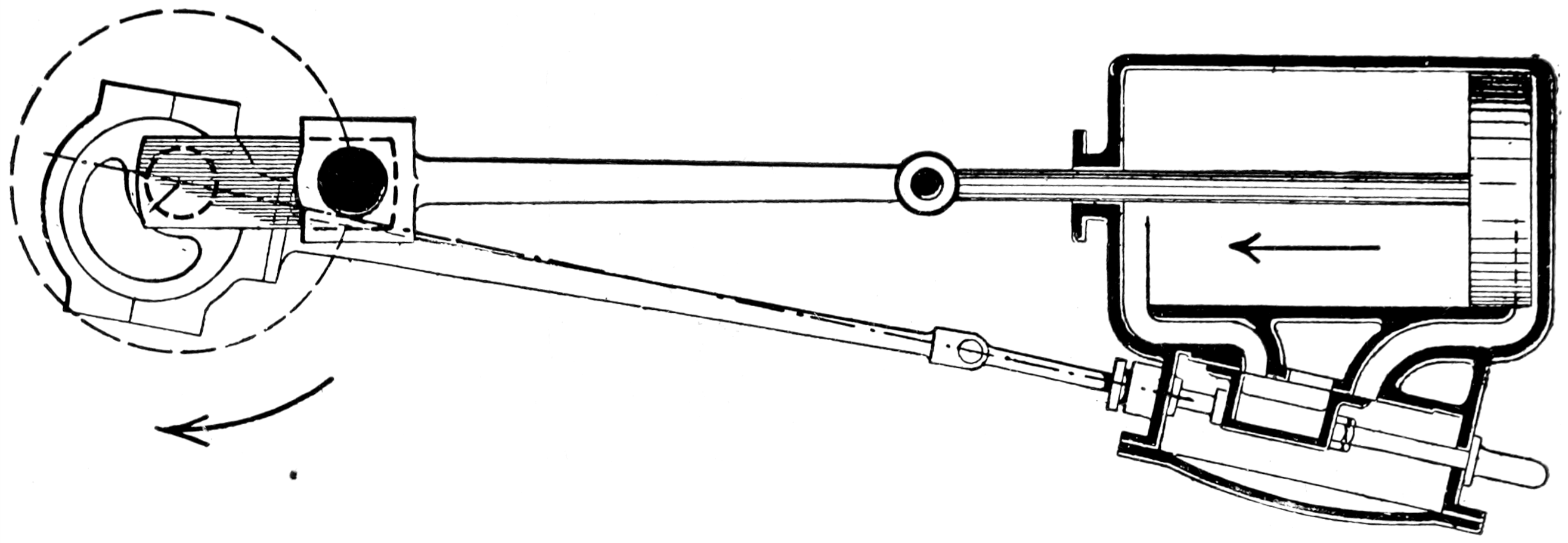
Fig. 17.—Engine in which the Line of Travel of Valve is Inclined in Relation to that of the Piston.
We must now carefully consider the further results obtained by the use of a valve having lap and giving lead, and whose eccentric of greater throw is advanced accordingly.
We should expect cut-off to take place 36earlier than with the old valve, for the eccentric is advanced, and the edge a (fig. 15) would arrive at e a little earlier than would the edge d of the old valve, even without advance of the new eccentric.
This seen, we can understand that in causing the edge a (fig. 18) to reach the edge e earlier in the stroke of the piston than it otherwise would do, we shall have hastened all the other operations so that they must occur earlier in the stroke (not necessarily by exactly the same amount for each, however, as we shall see further on), hence the edge b (fig. 18) arriving earlier at c, exhaust will commence before the piston completes its 37stroke, and also in returning to the right (fig. 19) the valve is earlier, and instead of the exhaust lasting during the whole of the return stroke some of it will be shut in by b and compressed before the returning piston until the edge a arrives at e, whereupon the lead commences coming in on and reinforcing the compressed steam. Thus it is that compression and lead together affect the cushioning, and consequently the piston is eased in stopping, and the return stroke is commenced without injurious shock or jar. A similar operation, of course, takes place at the opposite end of the cylinder when the piston arrives there.
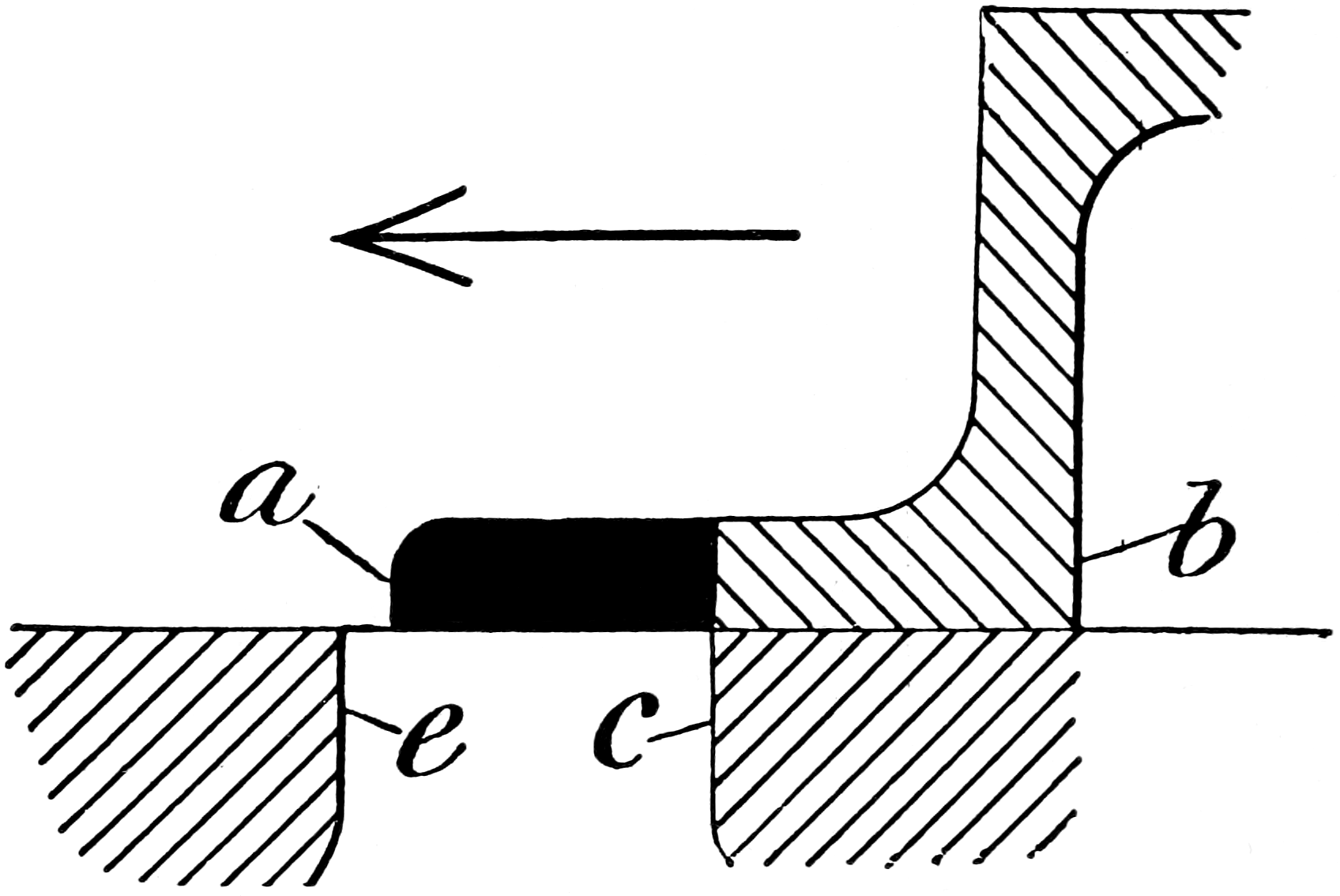
Fig. 18.
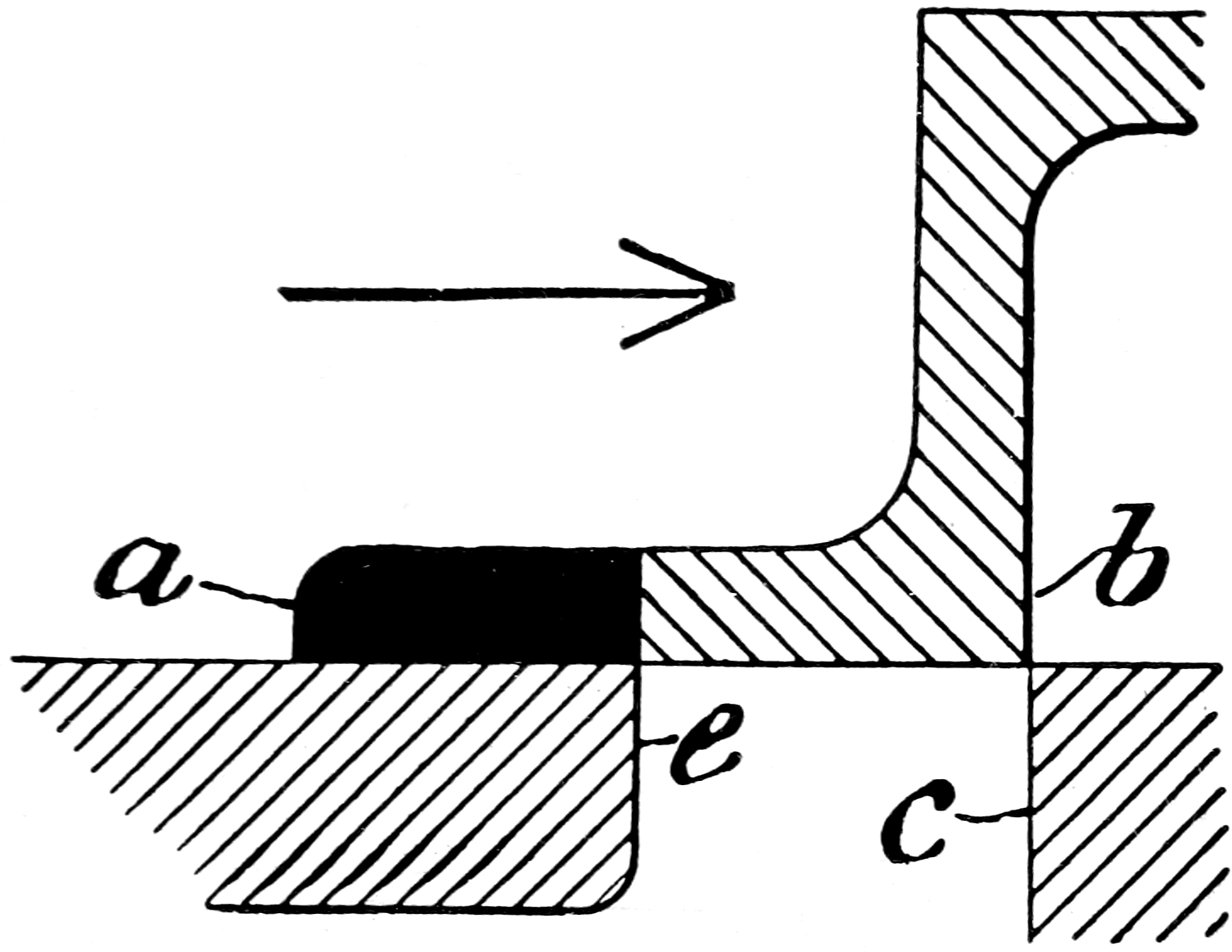
Fig. 19.
38The distribution-diagram for a valve with lap, lead, and a suitable eccentric is given in fig. 20, which should be compared carefully with figs. 10 and 14.
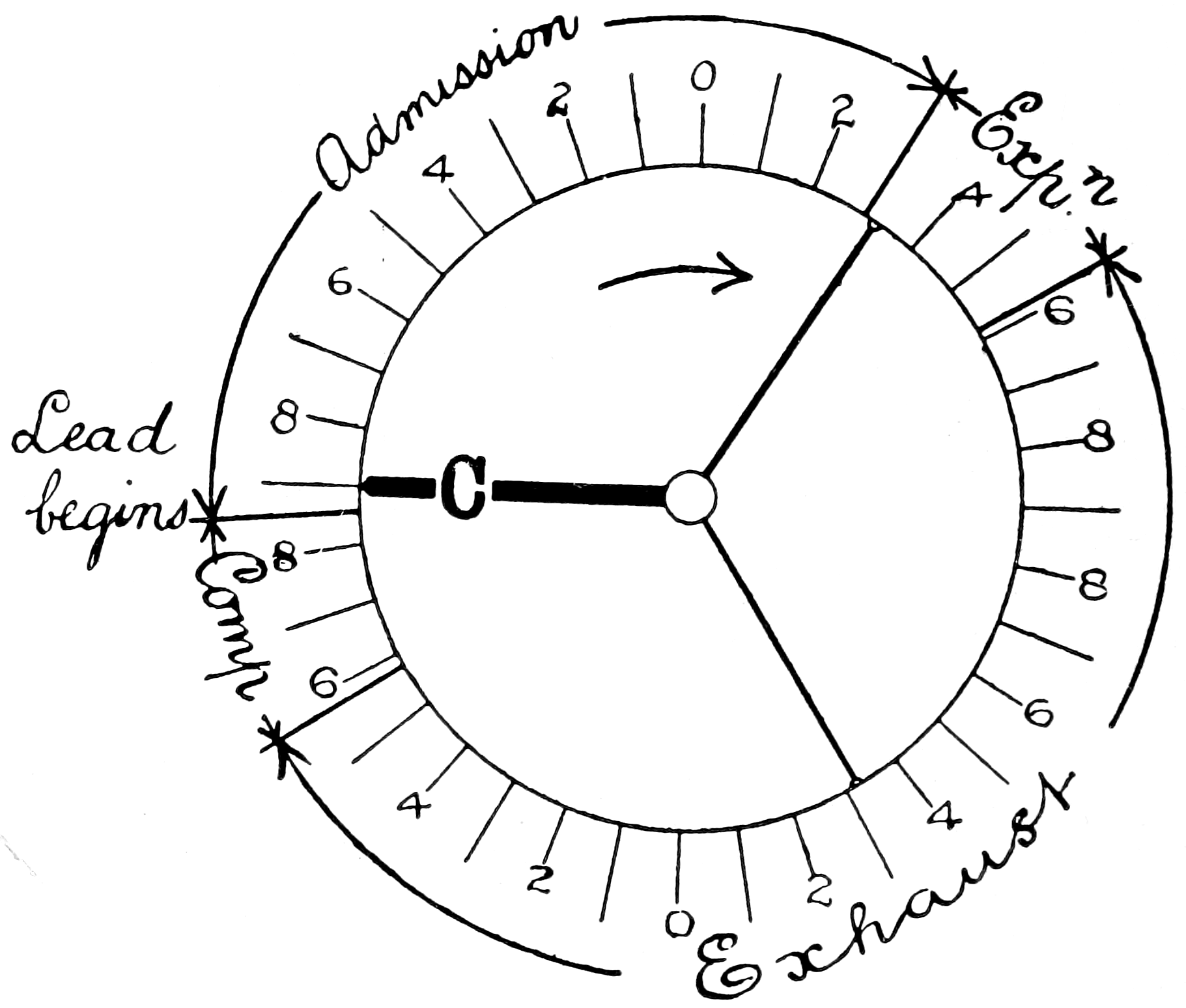
Fig. 20.
Inside Lap, exhaust lap, or “cover” as it is sometimes called, is possessed by many slide valves, and it is the amount that the valve when in its central position overlaps the inner edges of the steam-ports. Conversely,
Inside Lead is the amount of space left, in certain cases, between the inner edge of the 39valve and the inner edge of the steam-port when the valve is in its central position.
The amount of inside lap does not affect the setting of the eccentric, neither does it necessitate any alteration in the travel of the valve. With a given cut-off, steam is confined longer in the cylinder by a valve having inside lap because of the lengthening of the valve-face due to the inside lap, and compression will commence earlier and will be of longer duration from the same cause; exhaust being shortened in two ways—by the amount added to the duration of expansion at its end, and by a similar amount added to the compression at the commencement thereof.
Inside lead may be considered as something taken off the exhaust edge of the valve, and in effect, exactly the opposite to exhaust lap, for, as may easily be seen, it shortens expansion and compression by reason of the shortening of the valve-face, and lengthens the exhaust at commencement and end by the amounts by which the operations of expansion and compression are shortened. The left-hand side of the valve in fig. 21 has inside lap, whilst the right-hand side has inside lead, and the circular distribution-diagram below compares the distribution in the case of valves having 40inside lap and inside lead with the distribution for an ordinary valve such as was considered with reference to fig. 20. By reference to the lower portion of fig. 21, it may be seen that the operations of admission and cut-off are unaffected, as they are performed by the outer edges of the valve; but
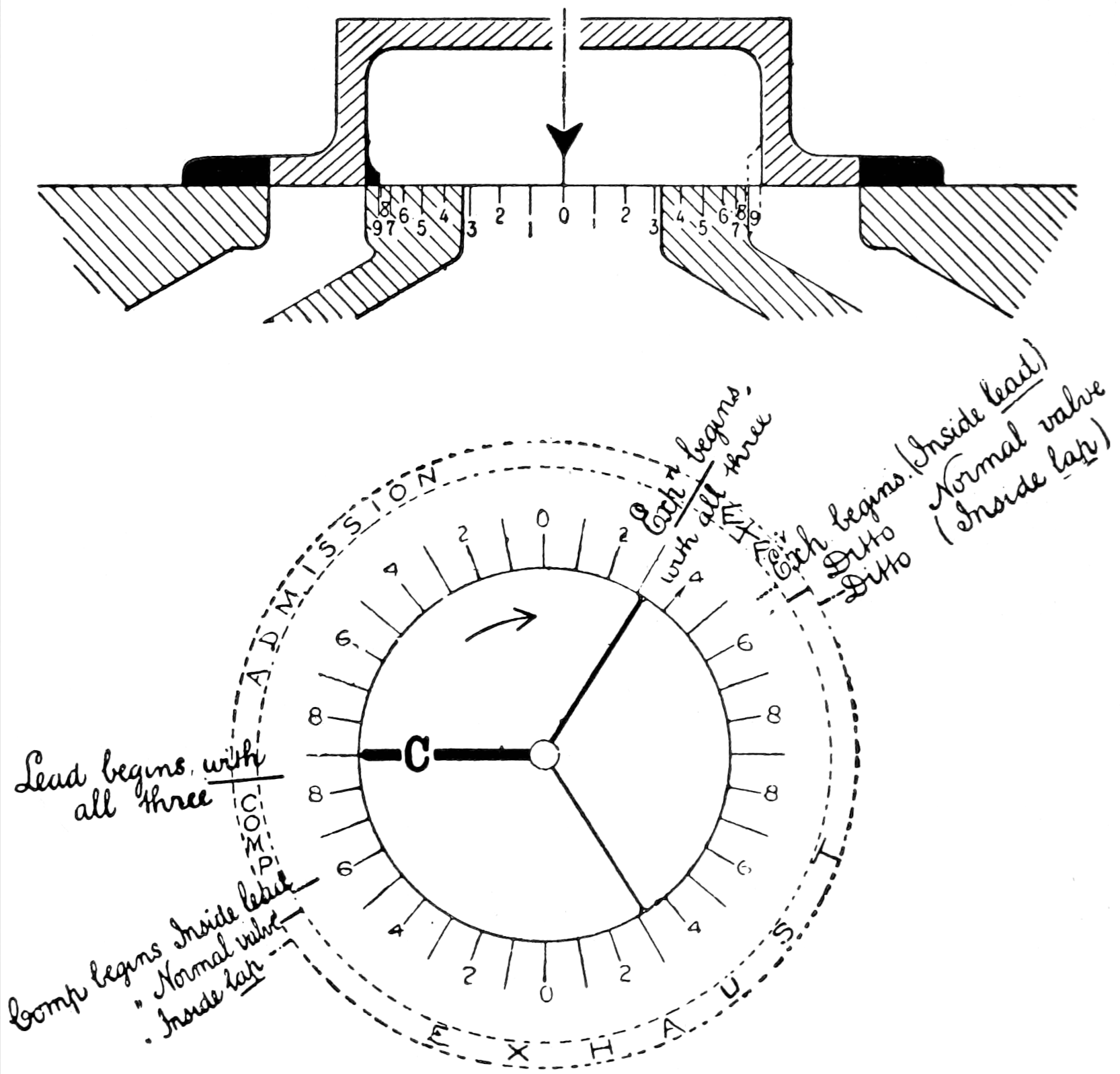
Fig. 21.
41
Expansion is shorter and exhaust earlier with inside lead.
is longer and exhaust later with inside lap.
Compression is later and shorter with inside lead.
is earlier and longer with inside lap.
From this it will be obvious why many express locomotives are given inside lead, and why many good engines have inside lap.
Free Exhaust.—In order to give as free a passage as possible to the exhaust steam, so that it may leave the cylinder easily, and not have to be forced out by the returning piston and cause back pressure thereupon, it is customary to make the steam-ports wider than 42the amount to which they are open to steam. This must on no account be confused with inside lead, which is quite a distinct matter. The effect of having wide ports is that the exhaust may be opened to any extent up to the half-travel of the valve, although the steam-opening may be much smaller, as may be understood from the exaggerated diagram (fig. 22), whence also should be seen that this widening of the port does not affect the duration of expansion or of any other operation of the valve, neither does it necessitate any allowance in the setting of the eccentric. It simply provides a free exhaust.
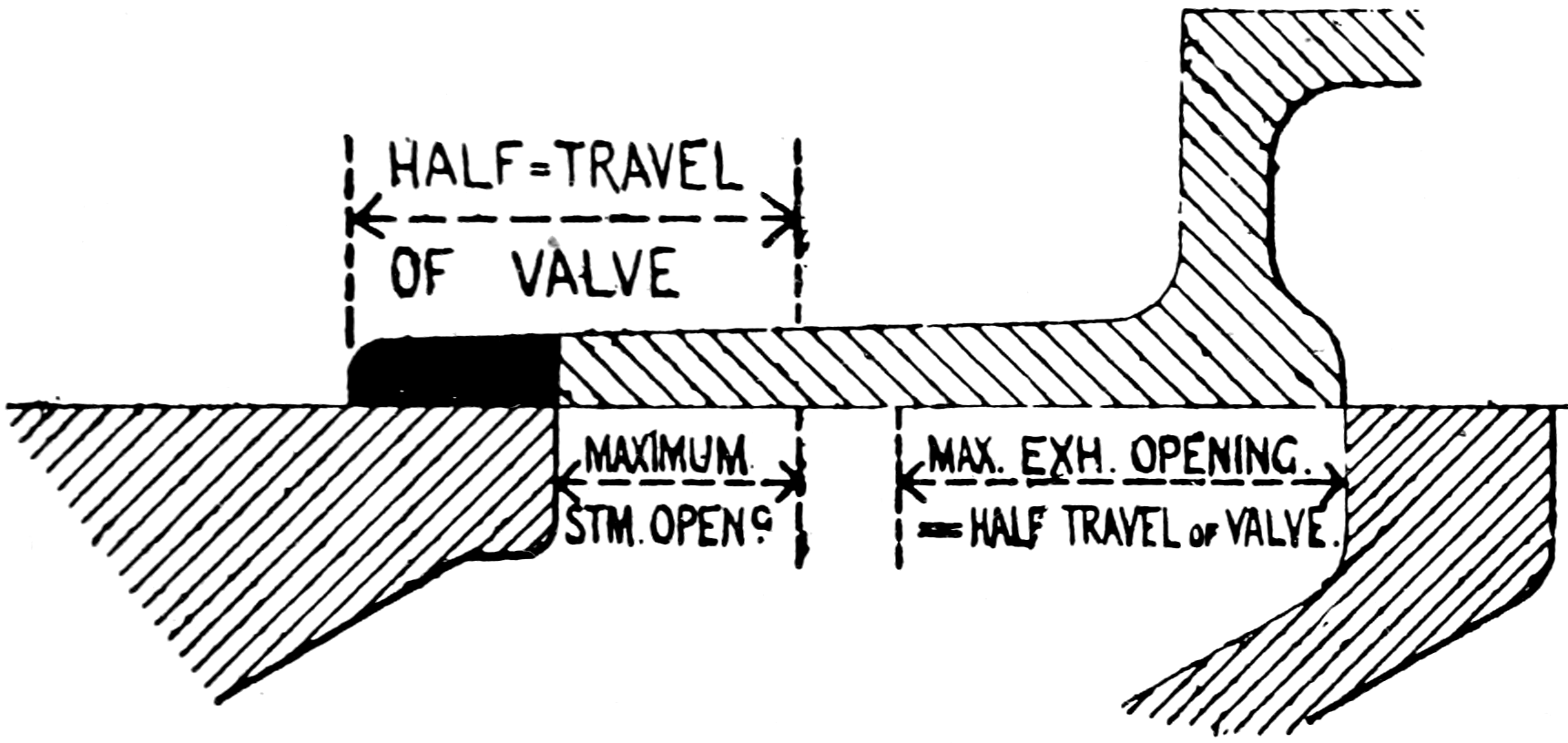
Fig. 22.
43