Front matter (continued 5)
Reading edition
"If they can see through that," he said, "they're a lot smarter than I think they are. Even if they're bright enough to have figured out what I was doing while I was doing it, it won't do them any good, because this outfit will scramble any beam they can send through that band."
"I must bow to your superior knowledge, of course," Radnor said gravely, "but I should like to ask one question. You are working a full materialization through less than a quarter of the gravity band—something that has always been considered impossible. Is there no danger that the Chlorans may analyze your patterns and thus duplicate your feat?"
"Not a chance," Seaton assured him positively. "This stuff I am using is on a tight beam, so tight that it is absolute proof against analysis or interference. It took the Norlaminians—and they're a race of real thinkers—over eight thousand years to go from the beams you and the Chlorans are using down to what I'm showing you. Therefore I'm not afraid that the opposition will pick it up in the next week or two. But we'd better get busy in a big way. Your most urgent need, I take it, is for something—anything—that will stop that surface of force before it reaches the skirt of your defensive dome and blocks your dissipators?"
"Exactly!"
"All right. We'll build you a four-way fourth-order projector to handle full materializations—four way to handle four attackers in case they get desperate and double their program. With it you will send working images of yourselves into the power rooms of the Chloran ships and clamp a short circuiting field across the secondaries of their converters. Of course they can bar you out with a zone of force if they detect you before you can kill the generators of their zones, but that will be just as good, as far as we're concerned—they can't do a thing as long as they're on, you know. Now put on the headset again and I'll give you the dope on the projector. Better get a recorder, too, as there'll be some stuff that you won't be able to carry in your head."
The recorder was brought in and from Seaton's brain there flowed into it and into the mind of Radnor the fundamental concepts and complete equations and working details of the new instrument. Upon the Valeronian's face was first blank amazement, then dawning comprehension, and lastly sheer, wondering awe as, the plan completed, he removed the headset. He began a confused panegyric of thanks, but Seaton interrupted him briskly.
"'Sall right, Radnor, you'd do the same thing for us if things were reversed. Humanity has got to stick together against all the vermin of all the universes. But, say, I'm getting a yen to see this mess all cleaned up, myself—think I'll stick around and help you build it. You're all in, clear to the neck, but you won't rest until the Chlorans are whipped—I can't blame you for that, I wouldn't either—and I'm fresh as a daisy. Let's go!"
In a few hours the complex machine was done. Radnor and Siblin were seated at two of the sets of controls, associate physicists at the others.
"Since I don't know any more about their system of conversion than you do, I can't tell you in detail what to do," Seaton was issuing final instructions. "But whatever you do, don't monkey with their primaries—shortening them would overload their liberators and blow this whole Solar System over into the next Galaxy. Take time to be dead sure that you've got the secondaries of their main converters, and slap a short circuit on as many of them as you can before they cut you off with a zone. You'll probably find a lot of liberator-converter sets on vessels of that size, but if you can kill the ones that feed the zone generators they're our meat."
"You are much more familiar with such things than we are," Radnor remarked. "Would you not like to come along?"
"I'll say I would, but I can't," Seaton replied instantly. "This isn't me at all, you know. But let's see—"
"Oh, of course," Radnor apologized. "In working with you so long and so cordially I forgot for the moment that you are not here in person."
"Nope, can't be done." Seaton frowned, still immersed in the hitherto unstudied problem of the reprojection of a projected image. "Need over two hundred thousand relays and—um—synchronization—neuro-muscular—not on this outfit. Wonder if it can be done at all? Have to look into it sometime—but excuse me, Radnor, I was thinking and got lost. Ready to go? I'll watch you on the plate here and be ready to offer advice—not that you'll need it. Shoot!"
Radnor snapped on the power and he and his aid shot their projections into one of the opposing fortresses, Siblin and his associate going into the other. Through compartment after compartment of the immense structures the as yet invisible projections went, searching for the power rooms. They were not hard to find, extending as they did nearly the full length of the stupendous structures; vaulted caverns filled with linked pairs of mastodonic fabrications, the liberator-converters.
Springing in graceful arcs from heavily insulated posts in the ends of one machine of each pair were five great bus-bars, which Radnor and Siblin recognized instantly as secondary leads from the converters—the gigantic mechanisms which, taking the raw intra-atomic energy from the liberators, converted it into a form in which it could be controlled and utilized.
Neither Radnor nor Siblin had ever heard of five-phase energy of any kind, but those secondaries were unmistakable. Therefore all four images drove against the fivefold bars their perfectly conducting fields of force. Four converters shrieked wildly, trying to wrench themselves from their foundations; insulation smoked and burst wildly into yellow flame; the stubs of the bars grew white-hot and began to fuse; and in a matter of seconds a full half of each prodigious machine subsided to the floor, a semimolten, utterly useless mass.
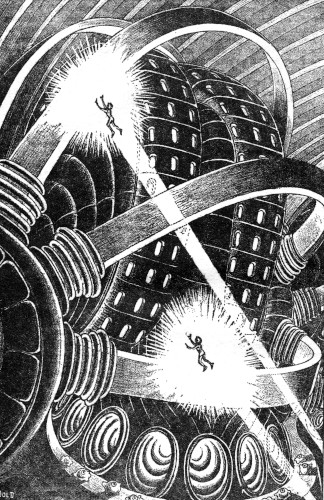
They drove their fields of force against the fivefold bars.
Similarly went the next two in each fortress, and the next—then Radnor's two projections were cut off sharply as the Chloran's impenetrable zone of force went on, and that fortress, all its beams and forces inoperative, floated off into space.
Siblin and his partner were more fortunate. When the amœbus commanding their prey threw in his zone switch nothing happened. Its source of power had already been destroyed, and the two Valeronian images went steadily down the line of converters, in spite of everything the ragingly frantic monstrosities could do to hinder their progress.
The terrible beam of destruction held steadily upon that fortress by the beamers in Valeron's mighty dome had never slackened its herculean efforts to pierce the Chloran screens. Now, as more and more of the converters of that floating citadel were burned out those screens began to radiate higher and higher into the ultra-violet. Soon they went down, exposing defenseless metal to the blasting, annihilating fury of the beam, to which any conceivable substance is but little more resistant than so much vacuum.
There was one gigantic, exploding flash, whose unbearable brilliance darkened even the incandescent radiance of the failing screen, and Valeron's mighty beam bored on, unimpeded. And where that mastodonic creation had floated an instant before there were only a few curling wisps of vapor.
"Nice job of clean-up, boys—fine!" Seaton clapped a friendly hand upon Radnor's shoulder. "Anybody can handle them now. Better you take a week off and catch up on sleep. I could do with a little shut-eye myself, and you've been on the job a lot longer than I have."
"But hold on—don't go yet!" Radnor exclaimed in consternation. "Why, our whole race owes its very existence to you—wait at least until our Bardyle can have a word with you!"
"That isn't necessary, Radnor. Thanks just the same, but I don't go in for that sort of thing, any more than you would. Besides, we'll be here in the flesh in a few days and I'll talk to him then. So long!" and the projection disappeared.
In due time Skylark Two came lightly to a landing in a parkway near the council hall, to be examined curiously by an excited group of Valeronians who wondered audibly that such a tiny space ship should have borne their salvation. The four Terrestrials, sure of their welcome, stepped out and were greeted by Siblin, Radnor, and the Bardyle.
"I must apologize, sir, for my cavalier treatment of you at our previous meeting." Seaton's first words to the coördinator were in sincere apology. "I trust that you will pardon it, realizing that something of the kind was necessary in order to establish communication."
"Speak not of it, Richard Seaton. I suffered only a temporary inconvenience, a small thing indeed compared to the experience of encountering a mind of such stupendous power as yours. Neither words nor deeds can express to you the profound gratitude of our entire race for what you have done for Valeron.
"I am informed that you personally do not care for extravagant praise, but please believe me to be voicing the single thought of a world's people when I say that no words coined by brain of man could be just, to say nothing of being extravagant, when applied to you. I do not suppose that we can do anything, however slight, for you in return, in token that these are not entirely empty words?"
"You certainly can, sir," Seaton made surprising answer. "We are so completely lost in space that without a great deal of material and of mechanical aid we shall never be able to return to, nor even to locate in space, our native Galaxy, to say nothing of our native planet."
A concerted gasp of astonishment was his reply, then he was assured in no uncertain terms that the resources of Valeron were at his disposal.
A certain amount of public attention had of course to be endured; but Seaton and Crane, pleading a press of work upon their new projectors, buried themselves in Radnor's laboratory, leaving it to their wives to bear the brunt of Valeronian adulation.
"How do you like being a heroine, Dot?" Seaton asked one evening, as the two women returned from an unusually demonstrative reception in another city.
"We just revel in it, since we didn't do any of the real work—it's just too perfectly gorgeous for words," Dorothy replied shamelessly. "Especially Peggy." She eyed Margaret mischievously and winked furtively at Seaton. "Why, you ought to see her—she could just simply roll that stuff up on a fork and eat it, as though it were that much soft fudge!"
Since the scientific and mechanical details of the construction of a fifth-order projector have been given in full elsewhere there is no need to repeat them here. Seaton built his neutronium lens in the core of the near-by white dwarf star, precisely as Rovol had done it from distant Norlamin. He brought it to Valeron and around it there began to come into being a duplicate of the immense projector which the Terrestrials had been obliged to leave behind them when they abandoned gigantic Skylark Three to plunge through the fourth dimension in tiny Two.
"Maybe it's none of my business, Radnor," Seaton turned to the Valeronian curiously during a lull in their work, "but how come you're still simply shooting away those Chloran vessels by making them put out their zones of force? Why didn't you hop over there on your projector and blow their whole planet over into the next Solar System? I would have done that long ago if it had been me, I think."
"We did visit Chlora once, with something like that in mind, but our attempt failed lamentably," Radnor admitted sheepishly. "You remember that peculiar special sense, that mental force that Siblin tried to describe to you? Well, it was altogether too strong for us. My father, possessing one of the strongest minds of Valeron, was in the chair, but they mastered him so completely that we had to recall the projection by cutting off the power to prevent them from taking from his mind by force the methods of transmission which you taught us and which we were then using."
"Hmm! So that's it, huh?" Seaton was greatly interested. "Maybe I'll take one on the chin, but I'm going to lock horns with that bunch of squidges myself, one of these days. When this projector gets itself done I'll skip over there and try them a whirl—with this fifth-order outfit I think maybe I'll be able to make big medicine on them."
True to his word, Seaton's first use of the new mechanism was to assume the offensive. He first sought out and destroyed the Chloran structure then in space—now an easy task, since zones of force, while impenetrable to any ether-borne phenomena, offer no resistance whatever to forces of the fifth order, propagated as they are in that inner medium, the sub-ether. Then, with the Quedrins standing by, to cut off the power in case he should be overpowered, he invaded the sanctum sanctorum of all Chlora—the private office of the Supreme Great One himself—and stared unabashed and unaffected into the enormous "eye" of the monstrous ruler of the planet.
There ensued a battle royal. Had mental forces been visible, it would have been a spectacular meeting indeed! Larger and larger grew the "eye" until it was transmitting all the terrific power generated by that frightful, visibly palpitating brain. But Seaton was not of Valeron, nor was he handicapped by the limitations of a fourth-order projector. He was now being projected upon a full beam of the fifth, by a mechanism able to do full justice to his stupendously composite brain.
The part of that brain he was now employing was largely the contribution of Drasnik, the First of Psychology of ancient Norlamin; and from it he was hurling along that beam the irresistible sum total of mental power accumulated by ten thousand generations of the most profound students of the mind that our Galaxy has ever known.
The creature, realizing that at long last it had met its mental master, must have emitted radiations of distress, for into the room came crowding hordes of the monstrosities, each of whom sought to add his own mind to those already opposing the intruder. In vain—all their power could not turn Seaton's penetrating glare aside, nor could it wrest from that glare's unbreakable grip the mind of the tortured Great One.
And now, mental waves failing, they resorted to the purely physical. Hand rays of highest power blasted at that figure uselessly; fiercely driven bars, spears, axes, and all other weapons rebounded from it without leaving a mark upon it, rebounded bent, broken, and twisted. For that figure was in no sense matter as we understand the term. It was pure force—force made palpable and coherent by the incomprehensible power of disintegrating matter; force against which any possible application of mechanical power would be precisely as effective as would wafted thistledown against Gibraltar.
Thus the struggle was brief. Paying no attention to anything, mental or physical, that the other monstrosities could bring to bear, Seaton compelled his victim to assume the shape of the heretofore-despised human being. Then, staring straight into that quivering brain through those hate-filled, flaming eyes, he spoke aloud, the better to drive home his thought:
"Learn, so-called Great One, once and for all, that when you attack any race of humanity anywhere, you attack not only that one race, but all the massed humanity of all the planets of all the Galaxies! As you have already observed, I am not of the planet Valeron, nor of this Solar System, nor even of this Galaxy; but I and my fellows have come to the aid of this race of humanity whom you were bold enough to attack.
"I have proved that we are your masters, mentally as well as scientifically and mechanically. Those of you who have been attacking Valeron have been destroyed, ships and crews alike. Those en route there have been destroyed in space. So also shall be destroyed any and all expeditions you may launch beyond the limits of your own foul atmosphere.
"Since even such a repellent civilization as yours must have its place in the great scheme of things, we do not intend to destroy your planet nor such of your people as remain upon it or near it, unless such destruction shall become necessary for the welfare of the human race. While we are considering what we shall do about you, I advise you to heed well this warning!"
XXI.
The four Terrestrials had discussed at some length the subject of Chlora and her outlandish population.
"It looks as though you were perched upon the horns of a first-class dilemma," Dorothy remarked at last. "If you let them alone there is no telling what harm they will do to these people here, and yet it would be a perfect shame to kill them all—they can't help being what they are. Do you suppose you can figure a way out of it, Dick?"
"Maybe—I've got a kind of a hunch, but it hasn't jelled into a workable idea yet. It's tied in with the sixth-order projection that we'll have to have, anyway, to find our way back home with. Until we get that working I guess we'll just let the amœbuses stew in their own juice."
"Well, and then what?" Dorothy prompted.
"I told you it's nebulous yet, with a lot of essential details yet to be filled in—" Seaton paused, then went on, doubtfully: "It's pretty wild—I don't know whether—"
"Now you must tell us about it, Dick," Margaret urged.
"I'll say you've got to," Dorothy agreed. "You've had a lot of ideas wild enough to make any sane creature's head spin around in circles before this, but not one of them was so hair raising that you were backward in talking about it. This one must be the prize brain storm of the universe—spill it to us!"
"All right, but remember that it's only half baked and that you asked for it. I'm doping out a way of sending them back to their own Solar System, planet and all."
"What!" exclaimed Margaret.
Dorothy simply whistled—a long, low whistle highly eloquent of incredulity.
"Maintenance of temperature? Time? Power? Control?" Crane, the imperturbable, picked out unerringly the four key factors of the stupendous feat.
"Your first three objections can be taken care of easily enough," Seaton replied positively. "No loss of temperature is possible through a zone of force—our own discovery. We can stop time with a stasis—we learned that from watching those four-dimensional folks work. The power of cosmic radiation is practically infinite and eternal—we learned how to use that from the pure intellectuals. Control is the sticker, since it calls for computations and calculations at present impossible; but I believe that when we get our mechanical brain done, it will be able to work out even such a problem as that."
"What d'you mean, mechanical brain?" demanded Dorothy.
"The thing that is going to run our sixth-order projector," Seaton explained. "You see, it'll be altogether too big and too complicated to be controlled manually, and thought—human thought, at least—is on one band of the sixth order. Therefore the logical thing to do is to build an artificial brain capable of thinking on all bands of the order instead of only one, to handle the whole projector. See?"
"No," declared Dorothy promptly, "but maybe I will, though, when I see it work. What's next on the program?"
"Well, it's going to be quite a job to build that brain and we'd better be getting at it, since without it there'll be no Skylark Four—"
"Dick, I object!" Dorothy protested vigorously. "The Skylark of Space was a nice name—"
"Sure, you'd think so, since you named her yourself," interrupted Seaton in turn, with his disarming grin.
"Keep still a minute, Dickie, and let me finish. Skylark Two was pretty bad, but I stood it; and by gritting my teeth all out of shape I did manage to keep from squawking about Skylark Three, but I certainly am not going to stand for Skylark Four. Why, just think of giving a name like that to such a wonderful thing as she is going to be—as different as can be from anything that has ever been dreamed of before—just as though she were going to be simply one more of a long series of cup-challenging motor boats or something! Why, it's—it's just too perfectly idiotic for words!"
"But she's got to be some kind of a Skylark, Dot—you know that."
"Yes, but give her a name that means something—that sounds like something. Name her after this planet, say—Skylark of Valeron—how's that?"
"O.K. by me. How about it, Peg? Mart?"
The Cranes agreed to the suggestion with enthusiasm and Seaton went on:
"Well, an onion by any other name would smell as sweet, you know, and it's going to be just as much of a job to build the Skylark of Valeron as it would have been to build Skylark Four. Therefore, as I have said before and am about to say again, we'd better get at it."
The fifth-order projector was moved to the edge of the city, since nowhere within its limits was there room for the structure to be built, and the two men seated themselves at its twin consoles and their hands flew over its massed banks of keyboards. For a few minutes nothing happened; then on the vast, level plain before them—a plain which had been a lake of fluid lava a few weeks before—there sprang into being an immense foundation-structure of trussed and latticed girder frames of inoson, the hardest, strongest, and toughest form of matter possible to molecular structure. One square mile of ground it covered and it was strong enough, apparently, to support a world.
When the foundation was finished, Seaton left the framework to Crane, while he devoted himself to filling the interstices and compartments as fast as they were formed. He first built one tiny structure of coils, fields, and lenses of force—one cell of the gigantic mechanical brain which was to be. He then made others, slightly different in tune, and others, and others.
He then set forces to duplicating these cells, forces which automatically increased in number until they were making and setting five hundred thousand cells per second, all that his connecting forces could handle. And everywhere, it seemed, there were projectors, fields of force, receptors and converters of cosmic energy, zones of force, and many various shaped lenses and geometric figures of neutronium incased in sheaths of faidon.
From each cell led tiny insulated wires, so fine as to be almost invisible, to the "nerve centers" and to one of the millions of projectors. From these in turn ran other wires, joining together to form larger and larger strands until finally several hundred enormous cables, each larger than a man's body, reached and merged into an enormous, glittering, hemispherical, mechano-electrical inner brain.
For forty long Valeronian days—more than a thousand of our Earthly hours—the work went on ceaselessly, day and night. Then it ceased of itself and there dangled from the center of the glowing, gleaming hemisphere a something which is only very vaguely described by calling it either a heavily wired helmet or an incredibly complex headset. It was to be placed over Seaton's head, it is true—it was a headset, but one raised to the millionth power.
It was the energizer and controller of the inner brain, which was in turn the activating agency of that entire cubic mile of as yet inert substance, that assemblage of thousands of billions of cells, so soon to become the most stupendous force for good ever to be conceived by the mind of man.
When that headset appeared Seaton donned it and sat motionless. For hour after hour he sat there, his eyes closed, his face white and strained, his entire body eloquent of a concentration so intense as to be a veritable trance. At the end of four hours Dorothy came up resolutely, but Crane waved her back.
"This is far and away the most crucial point of the work, Dorothy," he cautioned her gravely. "While I do not think that anything short of physical violence could distract his attention now, it is best not to run any risk of disturbing him. An interruption now would mean that everything would have to be done over again from the beginning."
Something over an hour later Seaton opened his eyes, stretched prodigiously, and got up. He was white and trembling, but tremendously relieved and triumphant.
"Why, Dick, what have you been doing? You look like a ghost!" Dorothy was now an all solicitous wife.
"I've been thinking, and if you don't believe that it's hard work you'd better try it some time! 'Sall right, though, I won't have to do it any more—got a machine to do my thinking for me now."
"Oh, is it all done?"
"Nowhere near, but it's far enough along so that it can finish itself. I've just been telling it what to do."
"Telling it! Why, you talk as though it were human!"
"Human? It's a lot more than that. It can outthink and outperform even those pure intellectuals—'and that,' as the poet feelingly remarked, 'is going some'! And if you think that riding in that fifth-order projector was a thrill, wait until you see what this one can do. Think of it"—even the mind that had conceived the thing was awed—"it is an extension of my own brain, using waves that traverse even intergalactic distances practically instantaneously. With it I can see anything I want to look at, anywhere; can hear anything I want to hear. It can build, make, do, or perform anything that my brain can think of."
"That is all true, of course," Crane said slowly, his sober mien dampening Dorothy's ardor instantly, "but still—I can not help wondering—" He gazed at Seaton thoughtfully.
"I know it, Mart, and I'm working up my speed as fast as I possibly can," Seaton answered the unspoken thought, rather than the words. "But let them come—we'll take 'em. I'll have everything on the trips, ready to spring."
"What are you two talking about?" Dorothy demanded.
"Mart pointed out to me the regrettable fact that my mental processes are in the same class as the proverbial molasses in January, or as a troop of old and decrepit snails racing across a lawn. I agreed with him, but added that I would have my thoughts all thunk up ahead of time when the pure intellectuals tackle us—which they certainly will."
"Slow!" she exclaimed. "When you planned the whole Skylark of Valeron and nobody knows what else, in five hours?"
"Yes, dear, slow. Remember when we first met our dear departed friend Eight, back in the original Skylark? You saw him materialize exact duplicates of each of our bodies, clear down to the molecular structures of our chemistry, in less than one second, from a cold, standing start. Compared to that job, the one I have just done is elementary. It took me over five hours—he could have done it in nothing flat.
"However, don't let it bother you too much. I'll never be able to equal their speed, since I'll not live enough millions of years to get the required practice, but our being material gave us big advantages in other respects that Mart isn't mentioning because, as usual, he is primarily concerned with our weaknesses—yes? No?"
"Yes; I will concede that being material does yield advantages which may perhaps make up for our slower rate of thinking," Crane at last conceded.
"Hear that? If he admits that much, you know that we're as good as in, right now," Seaton declared. "Well, while our new brain is finishing itself up, we might as well go back to the hall and chase the Chlorans back where they belong—the Brain worked out the equations for me this morning."
From the ancient records of Valeron, Radnor and the Bardyle had secured complete observational data of the cataclysm, which had made the task of finding the present whereabouts of the Chlorans' original sun a simple task. The calculations and computations involved in the application of forces of precisely the required quantities to insure the correct final orbit were complex in the extreme; but, as Seaton had foretold, they had presented no insurmountable difficulties to the vast resources of the Brain.
Therefore, everything in readiness, the two Terrestrial scientists surrounded the inimical planet with a zone of force, so that it would lose none of its heat during the long journey; and with a stasis of time, so that its people would not know of anything that was happening to them. They then erected force-control stations around it, adjusted with such delicacy and precision that they would direct the planet into the exact orbit it had formerly occupied around its parent sun. Then, at the instant of correct velocity and position, the control stations would go out of existence and the forces would disappear.
As the immense ball of dazzlingly opaque mirror which now hid the unwanted world swung away with ever-increasing velocity, the Bardyle, who had watched the proceedings in incredulous wonder, heaved a profound sigh of relaxation.
"What a relief—what a relief!" he exclaimed.
"How long will it take?" asked Dorothy curiously.
"Quite a while—something over four hundred years of our time. But don't let it gnaw on you—they won't know a thing about it. When the forces let go they'll simply go right on, from exactly where they left off, without realizing that any time at all has lapsed—in fact, for them, no time at all shall have lapsed. All of a sudden they will find themselves circling around a different sun, that's all.
"If their old records are clear enough they may be able to recognize it as their original sun and they'll probably do a lot of wondering as to how they got back there. One instant they were in a certain orbit around this sun here, the next instant they will be in another orbit around an entirely different sun! They'll know, of course, that we did it, but they'll have a sweet job figuring out how and what we did—some of it is really deep stuff. Also, they will be a few hundred years off in their time, but since nobody in the world will know it, it won't make any difference."
"How perfectly weird!" Dorothy exclaimed. "Just think of losing a four-hundred-year chunk right out of the middle of your life and not even knowing it!"
"I would rather think of the arrest of development," meditated Crane. "Of the opportunity of comparing the evolution of the planets already there with that of the returned wanderer."
"Yeah, it would be interesting—'sa shame we won't be alive then," Seaton responded, "but in the meantime we've got a lot of work to do for ourselves. Now that we've got this mess straightened out I think we had better tell these folks good-by, get into Two, and hop out to where Dot's Skylark of Valeron is going to materialize."
The farewell to the people of Valeron was brief, but sincere.
"This is in no sense good-by," Crane concluded. "By the aid of these newly discovered forces of the sixth order there shall soon be worked out a system of communication by means of which all the inhabited planets of the Galaxies shall be linked as closely as are now the cities of any one world."
Skylark Two shot upward and outward, to settle into an orbit well outside that of Valeron. Seaton then sent his projection back to the capital city, fitted over his imaged head the controller of the inner brain, and turned to Crane with a grin.
"That's timing it, old son—she finished herself up less than an hour ago. Better cluster around and watch this, folks, it's going to be good."
At Seaton's signal the structure which was to be the nucleus of the new space traveler lifted effortlessly into the air its millions of tons of dead weight and soared, as lightly as little Two had done, out into the airless void. Taking up a position a few hundred miles away from the Terrestrial cruiser, it shot out a spherical screen of force to clear the ether of chance bits of débris. Then inside that screen there came into being a structure of gleaming inoson, so vast in size that to the startled onlookers it appeared almost of planetary dimensions.
"Good heavens—it's stupendous!" Dorothy exclaimed. "What did you boys make it so big for—just to show us you could, or what?"
"Hardly! She's just as small as she can be and still do the work. You see, to find our own Galaxy we will have to project a beam to a distance greater than any heretofore assigned diameter of the universe, and to control it really accurately its working base and the diameter of its hour and declination-circles would each have to be something like four light-years long. Since a ship of that size is of course impracticable, Mart and I did some figuring and decided that with circles one thousand kilometers in diameter we could chart Galaxies accurately enough to find the one we're looking for—if you think of it, you'll realize that there are a lot of hundredth-millimeter marks around the circumference of circles of that size—and that they would probably be big enough to hold a broadcasting projection somewhere near a volume of space as large as that occupied by the Green System. Therefore we built the Skylark of Valeron just large enough to contain those thousand-kilometer circles."
As Skylark Two approached the looming planetoid the doors of vast airlocks opened. Fifty of those massive gates swung aside before her and closed behind her before she swam free in the cool, sweet air and bright artificial sunlight of the interior. She then floated along above an immense, grassy park toward two well-remembered and beloved buildings.
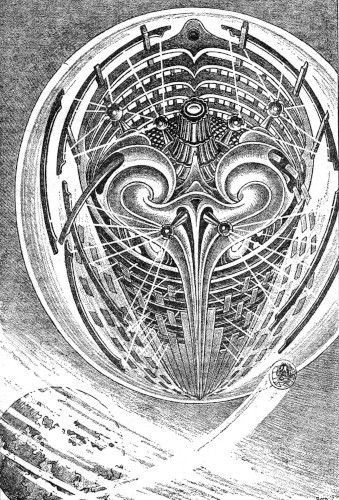
As the tiny ship approached, the doors of vast airlocks opened.
"Oh, Dick!" Dorothy squealed. "There's our house—and Cranes! It's funny though to see them side by side. Are they the same inside, too—and what's that funny little low building between them?"
"They duplicate the originals exactly, except for some items of equipment which would be useless here. The building between them is the control room, in which are the master headsets of the Brain and its lookouts. The Brain itself is what you would think of as underground—inside the shell of the planetoid."
The small vessel came lightly to a landing and the wanderers disembarked upon the close-clipped, springy turf of a perfect lawn. Dorothy flexed her knees in surprise.
"How come we aren't weightless, Dick?" she demanded. "This gravity isn't—can't be—natural. I'll bet you did that, too!"
"Mart and I together did, sure. We learned a lot from the intellectuals and a lot more in hyperspace, but we could neither derive the fundamental equations nor apply what knowledge we already had until we finished this sixth-order outfit. Now, though, we can give you all the gravity you want—or as little—whenever and wherever you want it."
"Oh, marvelous—this is glorious, boys!" Dorothy breathed. "I have always just simply despised weightlessness. Now, with these houses and everything, we can have a perfectly wonderful time!"
"Here's the dining room," Seaton said briskly. "And here's the headset you put on to order dinner or whatever is appropriate to the culinary department. You will observe that the kitchen of this house is purely ornamental—never to be used unless you want to."
"Just a minute, Dick," Dorothy's voice was tensely serious. "I have been really scared ever since you told me about the power of that Brain, and the more you tell me of it the worse scared I get. Think of the awful damage a wild, chance thought would do—and the more an ordinary mortal tries to avoid any thought the surer he is to think it, you know that. Really, I'm not ready for that yet, dear—I'd much rather not go near that headset."
"I know, sweetheart," his arm tightened around her. "But you didn't let me finish. These sets around the house control forces which are capable of nothing except duties pertaining to the part of the house in which they are. This dining-room outfit, for instance, is exactly the same as the Norlaminian one you used so much, except that it is much simpler.
"Instead of using a lot of keyboards and force-tubes, you simply think into that helmet what you want for dinner and it appears. Think that you want the table cleared and it is cleared—dishes and all simply vanish. Think of anything else you want done around this room and it's done—that's all there is to it.
"To relieve your mind I'll explain some more. Mart and I both realized that that Brain could very easily become the most terrible, the most frightfully destructive thing that the universe has ever seen. Therefore, with two exceptions, every controller on this planetoid is of a strictly limited type. Of the two master controls, which are unlimited and very highly reactive, one responds only to Crane's thoughts, the other only to mine. As soon as we get some loose time we are going to build a couple of auxiliaries, with automatic stops against stray thoughts, to break you girls in on—we know as well as you do, Red-Top, that you haven't had enough practice yet to take an unlimited control."
"I'll say I haven't!" she agreed feelingly. "I feel lots better now—I'm sure I can handle the rest of these things very nicely."
"Sure you can. Well, let's call the Cranes and go into the control room," Seaton suggested. "The quicker we get started the quicker we'll get done."
Accustomed as she was to the banks and tiers of keyboards, switches, dials, meters, and other operating paraphernalia of the control rooms of the previous Skylark, Dorothy was taken aback when she passed through the thick, heavily insulated door into that of the Skylark of Valeron. For there were four gray walls, a gray ceiling, and a rugged gray floor. There were low, broad double chairs and headsets. There was nothing else.
"This is your seat, Dottie, here beside me, and this is your headset—it's just a visiset, so you can see what is going on, not a controller," he hastened to reassure her. "You have a better illusion of seeing if your eyes are open, that's why everything is neutral in color. But better still for you girls, we'll turn off the lights."
The illumination, which had seemed to pervade the entire room instead of emanating from any definite sources, faded out; but in spite of the fact that the room was in absolute darkness Dorothy saw with a clarity and a depth of vision impossible to any Earthly eyes. She saw at one and the same time, with infinite precision of detail, the houses and their contents; the whole immense sphere of the planetoid, inside and out; Valeron and her sister planets encircling their sun; and the stupendous full sphere of the vaulted heavens.
She knew that her husband was motionless at her side, yet she saw him materialize in the control room of Skylark Two. There he seized the cabinet which contained the space chart of the Fenachrone—that library of films portraying all the Galaxies visible to the wonderfully powerful telescopes and projectors of that horrible race.
That cabinet became instantly a manifold scanner, all its reels flashing through as one. Simultaneously there appeared in the air above the machine a three-dimensional model of all the Galaxies there listed. A model upon such a scale that the First Galaxy was but a tiny lenticular pellet, although it was still disproportionately large; upon such a scale that the whole vast sphere of space covered by the hundreds of Fenachrone scrolls was compressed into a volume but little larger than a basketball. And yet each tiny Galactic pellet bore its own peculiarly individual identifying marks.
Then Dorothy felt as though she herself had been hurled out into the unthinkable reaches of space. In a fleeting instant of time she passed through thousands of star clusters, and not only knew the declination, right ascension, and distance of each Galaxy, but saw it duplicated in miniature in its exact place in an immense, three-dimensional model in the hollow interior of the space-flyer in which she actually was.
The mapping went on. To human brains and hands the task would have been one of countless years. Now, however, it was to prove only a matter of hours, for this was no human brain. Not only was it reactive and effective at distances to be expressed in light-years or parsecs: because of the immeasurable sixth-order velocity of its carrier wave it was equally effective at distances of thousands upon thousands of light—millionia—reaches of space so incomprehensibly vast that the rays of visible light emitted at the birth of a sun so far away would reach the point of observation only after that sun had lived through its entire cycle of life and had disappeared.
"Well, that's about enough of that for you, for a while," Seaton remarked in a matter-of-fact voice. "A little of that stuff goes a long ways at first—you have to get used to it."
"I'll say you do! Why—I—it—" Dorothy paused, even her ready tongue at a loss for words.
"You can't describe it in words—don't try," Seaton advised. "Let's go outdoors and watch the model grow."
To the awe, if not to the amazement of the observers, the model had already begun to assume a lenticular pattern. Galaxies, then, really were arranged in general as were the stars composing them; there really were universes, and they really were lenticular—the vague speculations of the hardiest and most exploratory cosmic thinkers were being confirmed.
For hour after hour the model continued to grow and Seaton's face began to take on a look of grave concern. At last, however, when the chart was three fourths done or more, a deep-toned bell clanged out the signal for which he had been waiting—the news that there was now being plotted a configuration of Galaxies identical with that portrayed by the space chart of the Fenachrone.
"Gosh!" Seaton sighed hugely. "I was beginning to be afraid that we had escaped clear out of our own universe, and that would have been bad—very, very bad, believe me! The rest of the mapping can wait—let's go!"
Followed by the others he dashed into the control room, threw on his helmet, and hurled a projection into the now easily recognizable First Galaxy. He found the Green System without difficulty, but he could not hold it. So far away it was that even the highest amplification and the greatest power of which the gigantic sixth-order installation was capable could not keep the viewpoint from leaping erratically, in fantastic bounds of hundreds of millions of miles, all through and around its objective.
But Seaton had half expected this development and was prepared for it. He had already sent out a broadcasting projection; and now, upon a band of frequencies wide enough to affect every receiving instrument in use throughout the Green System and using power sufficient to overwhelm any transmitter, however strong, that might be in operation, he sent out in a mighty voice his urgent message to the scientists of Norlamin.

XXII.
In the throne room of Kondal, with its gorgeously resplendent jeweled ceiling and jeweled metallic-tapestry walls, there were seated in earnest consultation the three most powerful men of the planet Osnome—Roban and Karfedix [1], Dunark the Kofedix [2], and Tarnan the Karbix [3]. Their "clothing" was the ordinary Osnomian regalia of straps, chains, and metallic bands, all thickly bestudded with blazing gems and for the most part supporting the full assortment of devastatingly powerful hand weapons without which any man of that race would have felt stark naked. Their fierce green faces were keenly hawklike; the hard, clean lines of their bare green bodies bespoke the rigid physical training that every Osnomian undergoes from birth until death.
"Father, Tarnan may be right," Dunark was saying soberly. "We are too savage, too inherently bloodthirsty, too deeply interested in killing, not as a means to some really worth-while end, but as an end in itself. Seaton the overlord thinks so, the Norlaminians think so, and I am beginning to think so myself. All really enlightened races look upon us as little better than barbarians, and in part I agree with them. I believe, however, that if we were really to devote ourselves to study and to productive effort we could soon equal or surpass any race in the System, except of course the Norlaminians."
"There may be something in what you say," the emperor admitted dubiously, "but it is against all our racial teachings. What, then, of an outlet for the energies of all manhood?"
"Constructive effort instead of destructive," argued the Karbix. "Let them build—study—learn—advance. It is all too true that we are far behind other races of the System in all really important things."
"But what of Urvan and his people?" Roban brought up his last and strongest argument. "They are as savage as we are, if not more so. As you say, the necessity for continuous warfare ceased with the destruction of Mardonale, but are we to leave our whole planet defenseless against an interplanetary attack from Urvania?"
"They dare not attack us," declared Tarnan, "any more than we dare attack them. Seaton the overlord decreed that the people of us two first to attack the other dies root and branch, and we all know that the word of the overlord is no idle, passing breath."
"But he has not been seen for long. He may be far away and the Urvanians may decide at any time to launch their fleets against us. However, before we decide this momentous question I suggest that you two pay a visit of state to the court of Urvan. Talk to Urvan and his Karbix as you have talked to me, of coöperation and of mutual advancement. If they will coöperate, we will."
During the long voyage to Urvania, the third planet of the fourteenth sun, however, their new ardor cooled perceptibly—particularly that of the younger man—and in Urvan's palace it became clear that the love of peaceful culture inculcated upon those fierce minds by contact with more humane peoples could not supplant immediately the spirit of strife bred into bone and fiber during thousands of generations of incessant warfare.
For when the two Osnomians sat down with the two Urvanians the very air seemed charged with animosity. Like strange dogs meeting with bared fangs and bristling manes, Osnomian and Urvanian alike fairly radiated hostility. Therefore Tarnan's suggestions as to coöperation and understanding were decidedly unconvincing, and were received with open scorn.
"Your race may well wish to coöperate with ours," sneered the Emperor of Urvania, "since, but for the threats of that self-styled overlord, you would have ceased to exist long since. And how do we know where that one is, what he is doing, whether he is paying any attention to us? Probably you have learned that he has left this System entirely and have already planned an attack upon us. In self-defense we shall probably have to wipe out your race to keep you from destroying ours. At any rate your plea is very evidently some underhanded trick of your weak and cowardly race—"
"Weak! Cowardly! Us? You conceited, bloated toad!" stormed Dunark, who had kept himself in check thus far only by sheer power of will. He sprang to his feet, his stool flying backward. "Here and now I demand a meeting of honor, if you know the meaning of the word honor."
The four enraged men, all drawing weapons, were suddenly swept apart, then clutched and held immovably as a figure of force materialized among them—the form of an aged, white-bearded Norlaminian.
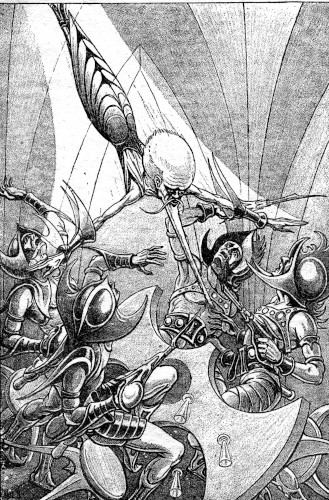
The four enraged men, all drawing weapons, were suddenly swept apart.
"Peace, children, and silence!" the image commanded sternly. "Rest assured that there shall be no more warfare in this System and that the decrees of the overlord shall be enforced to the letter. Calm yourselves and listen. I know well, mind you, that none of you really meant what has just been said. You of Osnome were so impressed by the benefits of mutual helpfulness that you made this journey to further its cause; you of Urvania are at heart also strongly in favor of it, but neither of you has strength enough or courage enough to admit it.
"For know, vain and self-willed children, that it is weakness, not strength, which you have been displaying. It may well be, however, that your physical bravery and your love of strife can now be employed for the general good of all humanity. Would you join hands, to fight side by side in such a cause?"
"We would," chorused the four, as one.
Each was heartily ashamed of what had just happened, and was glad indeed of the opportunity to drop it without losing face.
"Very well! We of Norlamin fear greatly that we have inadvertently given to one of the greatest foes of universal civilization weapons equal in power to the overlord's own, and that he is even now working to undo all that had been done. Will you of Osnome and you of Urvania help in conducting an expedition against that foe?"
"We will!" they exclaimed.
Dunark added: "Who is that enemy, and where is he to be found?"
"He is Dr. Marc C. DuQuesne, of Earth."
"DuQuesne!" barked Dunark. "Why, I thought the Fenachrone killed him! But we shall attend to it at once—when I kill any one he stays killed!"
"Just a moment, son," the image cautioned. "He has surrounded Earth with defenses against which your every arm would be entirely impotent. Come you to Norlamin, bringing each of you one hundred of his best men. We shall have prepared for you certain equipment which, although it may not enable you to emerge victorious from the engagement, will at least insure your safe return. It might be well also to stop at Dasor, which is not now far from your course of flight, and bring along Sacner Carfon, who will be of great assistance, being a man both of action and of learning."
"But DuQuesne!" raved Dunark, who realized immediately what must have happened. "Why didn't you ray him on sight? Didn't you know what a liar and a thief he is, by instinct and training?"
"We had no suspicion then who he was, thinking, as did you, that DuQuesne had passed. He came under another name, as Seaton's friend. He came as one possessing knowledge, with fair and plausible words. But of that we shall inform you later. Come at once—we shall place upon your controls forces which shall pilot you accurately and with speed."
Upon the aqueous world of Dasor they found its amphibious humanity reveling in an activity which, although dreamed of for centuries, had been impossible of realization until the Skylark had brought to them a supply of Rovolon, the metal of power. Now cities of metal were arising here and there above her waves, airplanes and helicopters sped through and hovered in her atmosphere, barges and pleasure craft sailed the almost unbroken expanse of ocean which was her surface, immense submarine freighters bored their serenely stolid ways through her watery depths.
Sacner Carfon, the porpoiselike, hairless, naked Dasorian councilor, heaved his six and a half feet of height and his five hundredweight of mass into Dunark's vessel and greeted the Osnomian prince with a grave and friendly courtesy.
"Yes, friend, everything is wonderfully well with Dasor," he answered Dunark's query. "Now that our one lack, that of power, has been supplied, our lives can at last be lived to the full, unhampered by the limitations which we have hitherto been compelled to set upon them. But this from Norlamin is terrible news indeed. What know you of it?"
During the trip to Norlamin the three leaders not only discussed and planned among themselves, but also had many conferences with the Advisory Five of the planet toward which they were speeding, so that they arrived upon that ancient world with a complete knowledge of what they were to attempt. There Rovol and Drasnik instructed them in the use of fifth-order forces, each according to his personality and ability.
To Sacner Carfon was given high command, and he was instructed minutely in every detail of the power, equipment, and performance of the vessel which was to carry the hope of civilization. To Tarnan, the best balanced of his race, was given a more limited knowledge. Dunark and Urvan, however, were informed only as to the actual operation of the armament, with no underlying knowledge of its nature or construction.
"I trust that you will not resent this necessary caution," Drasnik said carefully. "Your natures are as yet essentially savage and bloodthirsty; your reason is all too easily clouded by passion. You are, however, striving truly, and that is a great good. With a few mental operations, which we shall be glad to give you at a later time, you shall both be able to take your places as leaders in the march of your peoples toward civilization."
Fodan, majestic chief of the Five, escorted the company of warriors to their battleship of space, and what a ship she was! Fully twice the size of Skylark Three in every dimension she lay there, surcharged with power and might, awaiting only her commander's touch to hurl herself away toward distant and now inimical Earth.
But the vengeful expedition was too late by far. DuQuesne had long since consolidated his position. His chain of interlinked power stations encircled the globe. Governments were in name only. World Steel now ruled the entire Earth and DuQuesne's power was absolute. Nor was that rule as yet unduly onerous. The threat of war was gone, the tyranny of gangsterism was done, everybody was working for high wages—what was there to kick about? Some men of vision of course perceived the truth and were telling it, but they were being howled down by the very people they were trying to warn.
It was thus against an impregnably fortified world that Dunark and Urvan directed every force with which their flying superdreadnought was armed. Nor was she feeble, this monster of the skyways, but DuQuesne had known well what form the attack would take and, having the resources of the world upon which to draw, he had prepared to withstand the amassed assault of a hundred such vessels—or a thousand.
Therefore the attack not only failed; it was repulsed crushingly. For from his massed generators DuQuesne hurled out upon the Norlaminian space ship a solid beam of such incredible intensity that in neutralizing its terrific ardor her store of power-uranium dwindled visibly, second by second. So rapidly did the metal disappear that Sacner Carfon, after waging the unequal struggle for some twenty hours, put on high acceleration and drove back toward the Central System, despite the raging protests of Dunark and of his equally tempestuous fellow lieutenant.
And in his private office, which was also a complete control room, DuQuesne smiled at Brookings—a hard, thin smile. "Now you see," he said coldly. "Suppose I hadn't spent all this time and money on my defenses?"
"Well, why don't you go out and chase 'em? Give 'em a scare, anyway?"
"Because it would be useless," DuQuesne stated flatly. "That ship carries more stuff than anything we have ready to take off at present. Also, Dunark does not scare. You might kill him, but you can't scare him—it isn't in the breed."
"Well, what is the answer, then? You have tried to take Norlamin with everything you've got—bombs, automatic ships, and projectors—and you haven't got to first base. You can't even get through their outside screens. What are you going to do—let it go on as a stalemate?"
"Hardly!" DuQuesne smiled thinly. "While I do not make a practice of divulging my plans, I am going to tell you a few things now, so that you can go ahead with more understanding and hence with greater confidence. Seaton is out of the picture, or he would have been back here before this. The Fenachrone are all gone. Dunark and his people are unimportant. Norlamin is the only known obstacle between me and the mastery of the Galaxy, therefore Norlamin must either be conquered or destroyed. Since the first alternative seems unduly difficult, I shall destroy her."
"Destroy Norlamin—how?" The thought of wiping out that world, with all its ancient culture, did not appall—did not even affect—Brookings' callous mind. He was merely curious concerning the means to be employed.
"This whole job so far has been merely a preliminary toward that destruction," DuQuesne informed him levelly. "I am now ready to go ahead with the second step. The planet Pluto is, as you may or may not know, very rich in uranium. The ships which we are now building are to carry a few million tons of that metal to a large and practically uninhabited planet not too far from Norlamin. I shall install driving machinery upon that planet and, using it as a projectile which all their forces cannot stop, I shall throw Norlamin into her own sun."
Raging but impotent, Dunark was borne back to Norlamin; and, more subdued now but still bitterly humiliated, he accompanied Urvan, Sacner Carfon, and the various Firsts to a consultation with the Five.
As they strolled along through the grounds, past fountains of flaming color, past fantastically geometric hedges intricately and ornately wrought of noble metal, past walls composed of self-luminous gems so moving as to form fleeting, blending pictures of exquisite line and color, Sacner Carfon eyed Drasnik in unobtrusive signal and the two dropped gradually behind.
"I trust that you were successful in whatever it was you had in mind to do while we set up the late diversion?" Carfon asked quietly, when they were out of earshot.
Dunark and Urvan, his fierce and fiery aids, had taken everything that had happened at its face value, but not so had the leader. Unlike his lieutenants, the massive Dasorian had known at first blast that his expedition against DuQuesne was hopeless. More, it had been clear to him that the Norlaminians had known from the first that their vessel, enormous as she was and superbly powerful, could not crush the defenses of Earth.
"We knew, of course, that you would perceive the truth," the First of Psychology replied as quietly. "We also knew that you would appreciate our reasons for not taking you fully into our confidence in advance. Tarnan of Osnome also had an inkling of it, and I have already explained matters to him. Yes; we succeeded. While DuQuesne's whole attention was taken up in resisting your forces and in returning them in kind, we were able to learn much that we could not have learned otherwise. Also, our young friends Dunark and Urvan, through being chastened, have learned a very helpful lesson. They have seen themselves in true perspective for the first time; and, having fought side by side in a common and so far as they knew a losing cause, they have become friends instead of enemies. Thus it will now be possible to inaugurate upon those two backward planets a program leading toward true civilization."
In the Hall of the Five the Norlaminian spokesman voiced thanks and appreciation for the effort just made, concluding:
"While as a feat of arms the expedition may not have been a success, in certain other respects it was far from being a failure. By its help we were enabled to learn much, and I can assure you now that the foe shall not be allowed to prevail—it is graven upon the sphere that civilization is to go on."
"May I ask a question, sir?" Urvan was for the first time in his bellicose career speaking diffidently. "Is there no way of landing a real storming force upon Earth? Must we leave DuQuesne in possession indefinitely?"
"We must wait, son, and work," the chief answered, with the fatalistic calm of his race. "At present we can do nothing more, but in time—"
He was interrupted by a deafening blast of sound—the voice of Richard Seaton, tremendously amplified.
"This is the Skylark calling Rovol of Norlamin—Skylark calling Rovol of Norlamin—" it repeated over and over, rising to a roar and diminishing to a whisper as Seaton's broadcaster oscillated violently through space.
Rovol laid a beam to the nearest transmitter and spoke: "I am here, son. What is it?"
"Fine! I'm away out here in—"
"Hold on a minute, Dick!" Dunark shouted. He had been humble and sober enough since his return to Norlamin, realizing as he never had before his own ignorance in comparison with the gigantic minds about him, the powerlessness of his entire race in comparison with the energies he had so recently seen in action. But now, as Seaton's voice came roaring in and Rovol and his brain-brother were about to indulge so naïvely and so publicly in a conversation which certainly should not reach DuQuesne's ears, his spirits rose. Here was something he could do to help.
"DuQuesne is alive, has Earth completely fortified, and is holding it against everything we can give him," Dunark went on rapidly. "He's got everything we have, maybe more, and he's undoubtedly listening to every word we're saying. Talk Mardonalian—I know for a fact that DuQuesne can't understand that. They've got an educator here and I'll give it to Rovol right now—all right, go ahead."
"I'm clear out of the Galaxy," Seaton's voice went on, now speaking the language of the Osnomian race which had so recently been destroyed. "So many Galaxies away that none of you except Orlon could understand the distance. The speed of transmission is due to the fact that we have perfected and I am using a sixth-order projector, not a fifth. Have you a ship fit for really long-distance flight—as big as Three was, or bigger?"
"Yes; we have a vessel twice her size."
"Fine! Load her up and start. Head for the Great Nebula in Andromeda—Orlon knows what and where that is. That isn't very close to my line, but it will do until you get some apparatus set up. I've got to have Rovol, Drasnik, and Orlon, and I would like to have Fodan; you can bring along anybody else that wants to come. I'll sign on again in an hour—you should be started by then."
Besides the four Norlaminians mentioned, Caslor, First of Mechanism, and Astron, First of Energy, also elected to make the stupendous flight, as did also many "youngsters" from the Country of Youth. Dunark would not be left behind, nor would adventurous Urvan. And lastly there was Sacner Carfon the Dasorian, who remarked that he "would have to go along to make the boys behave and to steer the ship in case the old professors forgot to." The space ship was well on its way when at the end of the hour Seaton's voice again was heard.
"All right, put me on a recorder and I'll give you the dope," he instructed, when he had made sure that his signal was received.
"DuQuesne has been trying to put a ray on us and he may try to follow us," Dunark put in.
"Let him," Seaton shot back grimly, then spoke in English: "DuQuesne, Dunark says that you're listening in. You have my urgent, if not cordial, invitation to follow this Norlaminian ship. If you follow it far enough, you'll take a long, long ride, believe me!"
Again addressing the voyagers, he recounted briefly everything that had occurred since the abandonment of Skylark Three, then dived abruptly into the fundamental theory and practical technique of sixth-order phenomena and forces.
Of that ultramathematical dissertation Dunark understood not even the first sentence; Sacner Carfon perhaps grasped dimly a concept here and there. The Norlaminians, however, sat back in their seats, relaxed and smiling, their prodigious mentalities not only absorbing greedily but assimilating completely the enormous doses of mathematical and physical science being thrust upon them so rapidly. And when that epoch-making, that almost unbelievable, tale was done, not one of the aged scientists even referred to the tape of the recorder.
"Oh, wonderful—wonderful!" exclaimed Rovol in ecstasy, his transcendental imperturbability broken at last. "Think of it! Our knowledge extended one whole order farther in each direction, both into the small and into the large. Magnificent! And by one brain, and that of a youth. Extraordinary! And we may now traverse universal space in ordinary time, because that brain has harnessed the practically infinite power of cosmic radiation, a power which exhausted the store of uranium carried by Skylark Three in forty hours. Phenomenal! Stupendous!"
"But do not forget that the brain of that youth is a composite of many," said Fodan thoughtfully, "and that in it, among others, were yours and Dunark's. Seaton himself ascribes to that peculiar combination his successful solution of the problem of the sixth order. You know, of course, that I am in no sense belittling the native power of that brain. I am merely suggesting that perhaps other noteworthy discoveries may be made by superimposing brains in other, but equally widely divergent, fields of thought."
"An interesting idea, truly, and one which may be fruitful of result," assented Orlon, the First of Astronomy, "but I would suggest that we waste no more time. I, for one, am eager to behold with my own inner consciousness the vistas of the Galaxies."
Agreeing, the five white-bearded scientists seated themselves at the multiplex console of their fifth-order installation and set happily to work. Their gigantic minds were undaunted by the task they faced—they were only thrilled with interest at the opportunity of working with magnitudes, distances, forces, objects, and events at the very contemplation of which any ordinary human mind would quail.
Steadily and contentedly they worked on, while at the behest of their nimble and unerring fingers there came into being the forces which were to build into their own vessel a duplicate of the mechano-electrical brain which actuated and controlled the structure, almost of planetary proportions, in which Seaton was even then hurtling toward them. Hurtling with a velocity rapidly mounting to a value incalculable; driven by the power liberated by the disintegrating matter of all the suns of all the Galaxies of all the universes of cosmic space!
XXIII.
With all their might of brain and skill of hand and with all the resources of their fifth-order banks of forces, it was no small task for the Norlaminians to build the sixth-order controlling system which their ship must have if they were to traverse universal space in any time short of millenia. But finally it was done.
A towering mechano-electrical brain almost filled the mid-section of their enormous sky rover, the receptors and converters of the free energy of space itself had been installed, and their intra-atomic space-drive, capable of developing an acceleration of only five light-veloci ties, had been replaced by Seaton's newly developed sixth-order cosmic-energy drive which could impart to the ship and its entire contents, without jolt, jar, or strain, any conceivable, almost any calculable, acceleration.
For many days the Norlaminian vessel had been speeding through the void at her frightful maximum of power toward the Skylark of Valeron, which in turn was driving toward our Galaxy at the same mad pace. Braking down now, since only a few thousand light-years of distance separated the hurtling flyers, Seaton materialized his image at the brain control of the smaller cruiser and thought into it for minutes.
"There, we're all set!" In the control room of the Skylark Seaton laid aside his helmet and wiped the perspiration from his forehead in sheer relief. "The trap is baited and ready to spring—I've been scared to death for a week that they'd tackle us before we were ready for them."
"What difference would it have made?" asked Margaret curiously. "Since we have our sixth-order screens out they couldn't hurt us, could they?"
"No, Peg; but keeping them from hurting us isn't enough—we've got to capture 'em. And they'll have to be almost directly between Rovol's ship and ours to make that capture possible. You see, we'll have to send out from each vessel a hollow hemisphere of force and surround them. If we had only one ship, or if they don't come between our two ships, we can't bottle them up, because they have exactly the same velocity of propagation that our own forces have.
"Also, you can see that our projector can't work direct on more than a hemisphere without cutting its own beams, and that we can't work through relay stations because, fast as relays are, the Intellectuals would get away while the relays were cutting in. Any more questions?"
"Yes; I have one," put in Dorothy. "You told us that this artificial brain of yours could do anything that your own brain could think of, and here you've got it stuck already and have to have two of them. How come?"
"Well, this is a highly exceptional case," Seaton replied. "What I said would be true ordinarily, but now, as I explained to Peg, it's working against something that can think and act just as quickly as it can."
"I know, dear, I was just putting you on the spot a little. What are you using for bait?"
"Thoughts. We're broadcasting them from a point midway between the two vessels. They're keen on investigating any sixth-order impulses they feel, you know—that's why we've kept all our stuff on tight beams heretofore, so that they probably couldn't detect it—so we're sending out a highly peculiar type of thought, that we are pretty sure will bring them in from wherever they are."
"Let me listen to it, just for a minute?" she pleaded.
"W-e-l-l—I don't know." He eyed her dubiously. "Not for a minute—no. Being of a type that not even a pure intellectual can resist, they'd burn out any human brain in mighty short order. Maybe you might for about a tenth of a second, though."
He lowered a helmet over her expectant head and snatched it off again, but that moment had been enough for Dorothy. Her violet eyes widened terribly in an expression commingled of amazedly poignant horror and of dreadfully ecstatic fascination.
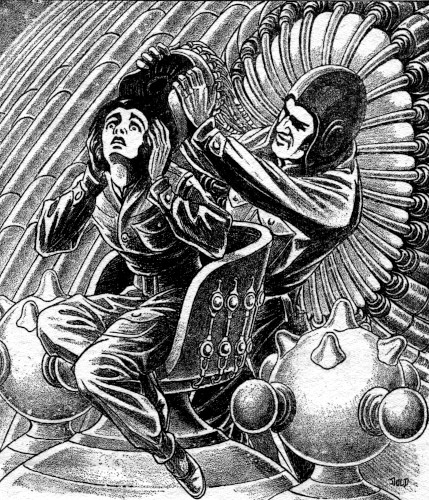
Her whole body trembled violently. "Oh, Dick, Dick!" she gasped. "How horrible!"
"Dick—Dick!" she shrieked; then, recovering slowly: "How horrible—how ghastly—how perfectly, exquisitely damnable! What is it? Why, I actually heard babies begging to be born! And there were men who had died and gone to heaven and hell; there were minds that had lost their bodies and didn't know what to do—were simply shrieking out their agony, despair, and utter, unreasoning terror for the whole universe to hear! And there were joys, pleasures, raptures, so condensed as to be almost as unbearable as the tortures. And there were other things—awful, terrible, utterly indescribable and unimaginable things! Oh, Dick, I was sure that I had gone stark, staring, raving crazy!"
"'Sall right, dear," Seaton reassured his overwrought wife. "All those things are really there, and more. I told you it was bad medicine—that it would tear your brain to pieces if you took much of it."
Seaton paused, weighing in his mind how best to describe the really indescribable signal that was being broadcast by the Brain, then went on, choosing his words with care:
"All the pangs and all the ecstasies, all the thoughts and all the emotions of all evolution of all things, animate and inanimate, are there; of all things that ever have existed from the unknowable beginning of infinite time and of all things that ever shall exist until time's unknowable end. It covers all animate life, from the first stirring of that which was to vitalize the first uni-cell in the slime of the first world ever to come into being in the cosmos, to the last cognition of the ultimately last intelligent entity ever to be.
"Our present humanity was of course included, from before conception, through birth, through all of life, through death, and through the life beyond. It covers inanimate evolution from the ultimate particle and wave, through the birth, life, death, and re-birth of any possible manifestation of energy and of matter, up to and through the ultimate universe.
"Neither Mart nor I could do it all. We carried everything as far as we could, then the Brain went through with it to its logical conclusion, which of course we could not reach. Then the Brain systematized all the data and reduced it to a concentrated essence of pure thought. It is that essence which is being broadcast and which will certainly attract the Intellectuals. In the brief flash you got of it you probably could understand at all only the human part—but maybe it's just as well."
"I'll say it's just as well!" Dorothy emphatically agreed. "I wouldn't listen to that again, even for a millionth of a second, for a million dollars—but I wouldn't have missed it for another million, either. I don't know whether to beg you to listen to it, Peggy, or to implore you not to."
"Don't bother," Margaret replied positively. "Anything that could throw you into such a hysterical tantrum as that did, I don't want any of at all. None at all, in fact, it would be altogether too much for—"
"Got them, folks—all done!" Seaton exclaimed. "You can put on your headsets now."
A signal lamp had flashed brightly and he knew that those two gigantic brains, working in perfect synchronism, had done instantaneously all that they had been set to do.
"Are you dead sure that they got them all, Dick?"
"Absolutely, and they got them in less time than it took the filament of the lamp to heat up. You can bank on it that all seven of them are in the can. I go off half cocked and make mistakes, but those Brains don't—they can't."
Seaton was right. Though far away, even as universal distances go, the Intellectuals had felt that broadcast thought and had shot toward its source at their highest possible speed. For in all their long lives and throughout all their cosmic wanderings they had never encountered thoughts of such wide scope, such clear cogency, such tremendous power.
The discarnate entities approached the amazing pattern of mental force which was radiating so prodigally and addressed it; and in that instant there were shot out curvingly from each of the mechano-electrical brains a gigantic, hemispherical screen.
Developing outwardly from the two vessels as poles with the unimaginable velocity possible only to sixth-order forces, the two cups were barriers impenetrable to any sixth-order force, yet neither affected nor were affected by the gross manifestations which human senses can perceive. Thus Solar Systems, even the neutronium cores of stars, did not hinder their instantaneous development.
Hundreds of light-years in diameter though they were, the open edges of those semiglobes of force met in perfect alignment and fused smoothly, effortlessly, instantaneously together to form a perfect, thought-tight sphere. The violently radiating thought-pattern which had so interested the Intellectuals disappeared, and at the same instant the ultrasensitive organisms of the entities were assailed by the to them deafening and blinding crash and flash of the welding together along its equator of the far-flung hollow globe.
These simultaneous occurrences were the first intimations that everything was not what it appeared, and the disembodied intelligences flashed instantly into furious activity, too late by the smallest possible instant of time. The trap was sprung, the sphere was impervious at its every point, and, unless they could break through that wall, the Intellectuals were incarcerated until Seaton should release his screens.
Within the confines of the globe there were not a few suns and thousands of cubic parsecs of space upon whose stores of energy the Intellectuals could draw. Wherefore they launched a concerted attack upon the wall, hurling against it all the force they could direct. But they were not now contending against the power of any human, organic, finite brain. For Seaton's mind, powerfully composite though it was of the mightiest intellects of the First Galaxy, was only the primary impulse which was being impressed upon the grids and was being amplified to any desirable extent by the almost infinite power of those two cubic miles of coldly emotionless, perfectly efficient, mechano-electrical artificial Brains.
Thus against every frantic effort of the Intellectuals within it the sphere was contracted inexorably, and as it shrank, reducing the volume of space from which the prisoners could draw energy, their struggles became weaker and weaker. When the ball of force was only a few hundred miles in diameter and the two vessels were relatively at rest, Seaton erected auxiliary stations around it and assumed full control.
Rapidly then the prisoning sphere, little larger now than a toy balloon, was brought through the inoson wall of the Skylark and held motionless in the air above the Brain room. A complex structure of force was built around it, about which in turn there appeared a framework of inoson, supporting sixteen massive bars of uranium.
Seaton took off his helmet and sighed. "There, that'll hold them for a while, I guess."
"What are you going to do with them?" asked Margaret.
"Darned if I know, Peg," he admitted ruefully. "That's been pulling my cork ever since we figured out how to catch them. We can't kill them and I'm afraid to let them go, because they're entirely too hot to handle. So in the meantime, pending the hatching out of a feasible method of getting rid of them permanently, I have simply put them in jail."
"Why, Dick, how positively brutal!" Dorothy exclaimed.
"Yeah? There goes your soft heart again, Red-Top, instead of your hard head. I suppose it would be positively O.K. to let them loose, so that they can dematerialize all four of us? But it isn't as bad as it sounds, because I've got a stasis of time around them. We can leave them in there for seventeen thousand million years and even their intellects won't know it, because for them no time at all shall have lapsed."
"No-o-o—of course we can't let them go scot-free," Dorothy admitted, "but we—I should—well, maybe couldn't you make a bargain with them to give them their liberty if they will go away and let us alone? They're such free spirits, surely they would rather do that than stay bottled up there forever."
"Since they are purely intellectual and hence immortal, I doubt very much if they'll dicker with us at all," Seaton replied. "Time doesn't mean a thing to them, you know; but since you insist I'll check the stasis and talk it over with them."
A tenuous projection, heterodyned upon waves far below the band upon which the captives had their being, crept through the barrier screen and Seaton addressed his thoughts to the entity known as "One."
"Being highly intelligent, you have already perceived that we are vastly more powerful than you are. Living in the flesh possesses many advantages over an immaterial existence. One of these is that it permitted us to pass through the fourth dimension, which you cannot do because your patterns are purely three-dimensional and inextensible. While in hyperspace we learned many things. Particularly we learned much of the really fundamental natures and relationships of time, space, and matter, gaining thereby a basic knowledge of all nature which is greater, we believe, than any that has ever before been possessed by any three-dimensional being.
"Not only can we interchange matter and energy as you do in your materializations and dematerializations, but we can go much farther than you can, working in levels which you cannot reach. For instance, I am projecting myself through this screen, which you cannot do because the carrier wave is far below your lowest attainable level.
"With all my knowledge, however, I admit that I cannot destroy you, since you can shrink as nearly to a mathematical point as I can compress this zone, and its complete coalescence would of course liberate you. Upon the other hand, you realize your helplessness inside that sphere. You can do nothing about it since it cuts off your sources of power.
"I can keep you imprisoned therein as long as I choose. I can set upon it forces which will keep you imprisoned until this two-hundred-kilogram ingot of uranium has dwindled down to a mass of less than one milligram. Knowing that the half-life period of that element is approximately five times ten to the ninth years, you can calculate for yourself the length of time during which you shall remain incarcerated.
"My wife, however, has a purely sentimental objection to confining you thus, and wishes to make an agreement with you whereby we may set you at liberty without endangering our own present existences. We are willing to let you go if you will agree to leave this universe forever. I realize, of course, that you are beyond either sentiment or passion and are possessed of no emotions whatever. Realizing this, I give you a choice, upon purely logical grounds, thus:
"Will you leave us and our universe alone, to work out our own salvation or our own damnation, as the case may be, or shall I leave you inside that sphere of force until its monitor bars are exhausted? Think well before you reply; for, know you, we all prefer to exist for a short time as flesh and blood rather than for all eternity as fleshless and immaterial intelligences. Not only that—we intend so to exist and we shall so exist!"
"We shall make no agreements, no promises," One replied. "Yours is the most powerful mind I have encountered—almost the equal of one of ours—and I shall take it."
"You just think you will!" Seaton blazed. "You don't seem to get the idea at all. I am going to surround you with an absolute stasis of time, so that you will not even be conscious of imprisonment, to say nothing of being able to figure a way out of it, until certain more pressing matters have been taken care of. I shall then work out a method of removing you from this universe in such a fashion and to such a distance that if you should desire to come back here the time required would be, as far as humanity is concerned, infinite. Therefore it must be clear to you that you will not be able to get any of our minds, in any circumstances."
"I had not supposed that a mind of such power as yours could think so muddily," One reproved him. "In fact, you do not so think. You know as well as I do that the time with which you threaten me is but a moment. Your Galaxy is insignificant, your universe is but an ultramicroscopic mote in the cosmic all. We are not interested in them and would have left them before this had I not encountered your brain, the best I have seen in substance. That mind is highly important and that mind I shall have."
"But I have already explained that you can't get it, ever," protested Seaton, exasperated. "I shall be dead long before you get out of that cage."
"More of your purposely but uselessly confused thinking," retorted One. "You know well that your mind shall never perish, nor shall it diminish in vigor throughout all time to come. You have the key to knowledge, which you will hand down through all your generations. Planets, Solar Systems, Galaxies, will come and go, as they have since time first was; but your descendants will be eternal, abandoning planets as they age to take up their abodes upon younger, pleasanter worlds, in other systems and in other Galaxies—perhaps even in other universes.
"And I do not believe that I shall lose as much time as you think. You are bold indeed in assuming that your mind, able as it is, can imprison mine for even the brief period we have been discussing. At any rate, do as you please—we will make neither promises nor agreements."
XXIV.
Immense as the Norlaminian vessel was, getting her inside the planetoid was a simple matter to the Brain. Inside the Skylark a dome bulged up, driving back the air; a circular section of the multilayered wall disappeared; Rovol's space-torpedo floated in; the wall was again intact; the dome vanished; the visitor settled lightly into the embrace of a mighty landing cradle which fitted exactly her slenderly stupendous bulk.
The Osnomian prince was the first to disembark, appearing unarmed; for the first time in his warlike life he had of his own volition laid aside his every weapon.
"Glad to see you, Dick," he said simply, but seizing Seaton's hand in both his own, with a pressure that said far more than his words. "We thought they got you, but you're bigger and better than ever—the worse jams you get into, the stronger you come out."
Seaton shook the hands enthusiastically. "Yeah, 'lucky' is my middle name—I could fall into a vat of glue and climb out covered with talcum powder and smelling like a bouquet of violets. But you've advanced more than I have," glancing significantly at the other's waist, bare now of its wonted assortment of lethal weapons. "You're going good, old son—we're all behind you!"
He turned and greeted the other new-comers in cordial and appropriate fashion, then all went into the control room.
During the long flight from Valeron to the First Galaxy no one paid any attention to course or velocity—a handful of cells in the Brain piloted the Skylark better than any human intelligence could have done it. Each Norlaminian scientist studied rapturously new vistas of his specialty: Orlon the charted Galaxies of the First Universe, Rovol the minutely small particles and waves of the sixth order, Astron the illimitable energies of cosmic radiation, and so on.
Seaton spent day after day with the Brain, computing, calculating, thinking with a clarity and a cogency hitherto impossible, all to one end. What should he do, what could he do, with those confounded Intellectuals? Crane, Fodan, and Drasnik spent their time in planning the perfect government—planetary, systemic, galactic, universal—for all intelligent races, wherever situated.
Sacner Carfon studied quietly but profoundly with Caslor of Mechanism, adapting many of the new concepts to the needs of his aqueous planet. Dunark and Urvan, their fiery spirits now subdued and strangely awed, devoted themselves as sedulously to the arts and industries of peace as they formerly had to those of war.
Time thus passed quickly, so quickly that, almost before the travelers were aware, the vast planetoid slowed down abruptly to feel her cautious way among the crowded stars of our Galaxy. Though a mere crawl in comparison with her inconceivable intergalactic speed, her present pace was such that the stars sped past in flaming lines of light. Past the double sun, one luminary of which had been the planet of the Fenachrone, she flew; past the Central System; past the Dark Mass, whose awful attraction scarcely affected her cosmic-energy drive—hurtling toward Earth and toward Earth's now hated master, DuQuesne.
DuQuesne had perceived the planetoid long since, and his robot-manned ships rushed out into space to do battle with Seaton's new and peculiar craft. But of battle there was none; Seaton was in no mood to trifle. Far below the level of DuQuesne's screens, the cosmic energies directed by the Brain drove unopposed upon the power bars of the space fleet of Steel and that entire fleet exploded in one space-filling flash of blinding brilliance. Then the Skylark, approaching the defensive screens, halted.
"I know that you're watching me, DuQuesne, and I know what you're thinking about, but you can't do it." Seaton, at the Brain's control, spoke aloud. "You realize, don't you, that if you clamp on a zone of force it'll throw the Earth out of its orbit?"
"Yes; but I'll do it if I have to," came back DuQuesne's cold accents. "I can put it back after I get done with you."
"You don't know it yet, big shot, but you are going to do exactly nothing at all!" Seaton snapped. "You see, I've got a lot of stuff here that you don't know anything about because you haven't had a chance to steal it yet, and I've got you stopped cold. I'm just two jumps ahead of you, all the time. I could hypnotize you right now and make you do anything I say, but I'm not going to—I want you to be wide awake and aware of everything that goes on. Snap on your zone if you want to—I'll see to it that the Earth stays in its orbit. Well, start something, you big, black ape!"
The screens of the Skylark glowed redly as a beam carrying the full power of DuQuesne's installations was hurled against them—a beam behind which there was the entire massed output of Steel's world-girdling network of superpower stations. But Seaton's screens merely glowed; they did not radiate even under that Titanic thrust. For, as has been said, this new Skylark was powered, not by intra-atomic energy, but by the cosmic energy liberated by all the disrupting atoms in all the suns of all the Galaxies of all the universes. Therefore her screens did not radiate; in fact, the furious blasts of DuQuesne's projectors only increased the stream of power being fed to her receptors and converters.
The mighty shields of the planetoid took every force that DuQuesne could send, then Seaton began to compress his zones, leaving open only the narrow band in the fourth order through which the force of gravitation makes itself manifest. Not only did he leave that band open, he so blocked it open that not even DuQuesne's zones of force, full-driven though they were, could close it.
In their closing those zones brought down over all Earth a pall of darkness of an intensity theretofore unknown. It was not the darkness of any possible night, but the appalling, absolute blackness of the utter absence of every visible wave from every heavenly body. As that unrelieved and unheralded blackness descended, millions of Earth's humanity went mad in unspeakable orgies of fright, of violence, and of crime.
But that brief hour of terror, horrible as it was, can be passed over lightly, for it ended forever any hope of world domination by any self-interested man or group, paving the way as it did for the heartiest possible reception of the government of right instead of by might so soon to be given to Earth's peoples by the sages of Norlamin.
Through the barriers both of mighty space ship and of embattled planet Seaton drove his sixth-order projection. Although built to be effective at universal distances the installation was equally efficient at only miles, since its control was purely mental. Therefore Seaton's image, solid and visible, materialized in DuQuesne's inner sanctum—to see DuQuesne standing behind Dorothy's father and mother, a heavy automatic pistol pressed into Mrs. Vaneman's back.
"That'll be all from you, I think," he sneered. "You can't touch me without hurting your beloved parents-in-law and you're too tender-hearted to do that. If you make the slightest move toward me all I've got to do is to touch the trigger. And I shall do that, anyway, right now, if you don't get out of this System and stay out. I am still master of the situation, you see."
"You are master of nothing, you murderous baboon!"
Even before Seaton spoke the first word his projection had acted. DuQuesne was fast, as has been said, but how fast are the fastest of human nervous and muscular reactions when compared with the speed of thought? DuQuesne's retina had not yet registered the fact that Seaton's image had moved when his pistol was hurled aside and he was pinioned by forces as irresistible as the cosmic might from which they sprang.
DuQuesne was snatched into the air of the room—was surrounded by a globe of energy—was jerked out of the building through a welter of crushed and broken masonry and concrete and of flailing, flying structural steel—was whipped through atmosphere, stratosphere, and empty space into the control room of the Skylark of Valeron. The inclosing shell of force disappeared and Seaton hurled aside his controlling helmet, for he knew that his iron self-control was fast giving way. He knew that wave upon wave of passion, of sheer hate, was rising, battering at the very gates of his mind; knew that if he wore that headset one second longer the Brain, actuated by his own uncontrollable thoughts, would passionlessly but mercilessly exert its awful power and blast his foe into nothingness before his eyes.
Thus at long last the two men, physically so like, so unlike mentally, stood face to face; hard gray eyes staring relentlessly into unyielding eyes of midnight black. Seaton was in a towering rage; DuQuesne, cold and self-contained as ever, was calmly alert to seize any possible chance of escape from his present predicament.
"DuQuesne, I'm telling you something," Seaton gritted through clenched teeth. "Prop back your ears and listen. You and I are going out in that projector. You are going to issue 'cease firing' orders to all your stations and tell them that you're all washed up—that a humane government is taking things over."
"Or else?"
"Or else I'll do, here and now, what I've been wanting to do to you ever since you shot up Crane's place that night—I will scatter your component atoms all the way from here to Valeron."
"But, Dick—" Dorothy began to protest.
"Don't butt in, Dot!"
Stern and cold, Seaton's voice was one his wife had never before heard. Never had she seen his face so hard, so bitterly implacable.
"Sympathy is all right in its place," Seaton went on, "but this is the showdown. The time for dealing tenderly with this piece of mechanism in human form is past. He has needed killing for a long time, and unless he toes the mark quick and careful he'll get it, right here and right now.
"And as for you, DuQuesne," turning again to the prisoner, "for your own good I'd advise you to believe that I'm not talking just to make a noise. This isn't a threat, it's a promise—get me?"
"You couldn't do it, Seaton, you're too—" Their eyes were still locked, but into DuQuesne's there had crept a doubt. "Why, I believe you would!" he exclaimed.
"I'll tell the cockeyed universe I will!" Seaton barked. "Last chance! Yes or no?"
"Yes." DuQuesne knew when to back down. "You win—temporarily at least," he could not help adding.
The projection went out and the required orders were given. Sunlight, moonlight, and starlight again bathed the world in wonted fashion. DuQuesne sat at ease in a cushioned chair, smoking Crane's cigarettes; Seaton stood scowling blackly, hands jammed deep into pockets, addressing the jury of Norlaminians.