Front matter (continued 2)
Reading edition
So bewilderingly rapid were the changes in form that no one appearance could be intelligently grasped. Before one outlandish and unearthly shape could really be perceived it had vanished—had melted and flowed into one entirely different in form and in sense, but one equally monstrous to Terrestrial eyes. Even if grasped mentally, no one of those grotesque shapes could have been described in language, so utterly foreign were they to all human knowledge, history, and experience.
And now, the sixth-order projections in perfect synchronism, the thoughts of the Outlanders came clearly into the minds of the four watchers—thoughts cold, hard, and clear, diamondlike in polish and in definition; thoughts with the perfection of finish and detail possible only to the fleshless mentalities who for countless millions of years had done little save perfect themselves in the technique of pure and absolute thinking.
The four sat tense and strained as the awful import of those thoughts struck home; then, at another thought of horribly unmistakable meaning, Seaton snapped off his power and drove lightning fingers over his keyboard, while the two women slumped back, white-faced and trembling, into their seats.
"I thought it was funny, back there that time, that that fellow couldn't integrate in the ninety-seven dimensions necessary to dematerialize us, and I didn't know anything then." Seaton, his preparations complete, leaned back in his operator's seat at the console. "He was just kidding us—playing with us, just to see what we'd do, and as for not being able to think his way back—phooie! He can think his way through ninety-seven universes if he wants to. They're certainly extragalactic, and very probably extrauniversal, and the one that played with us could have dematerialized us instantly if he had felt like it."
"That is apparent, now," Crane conceded. "They are quite evidently patterns of sixth-order forces, and as such have a velocity of anything they want to use. They absorb force from the radiations in free space, and are capable of diverting and of utilizing those forces in any fashion they may choose. They would of course be eternal, and, so far as I can see, they would be indestructible. What are we going to do about it, Dick? What can we do about it?"
"We'll do something!" Seaton gritted. "We're not as helpless as they think we are. I've got out five courses of six-ply screen, with full interliners of zones of force. I've got everything blocked, clear down to the sixth order. If they can think their way through those screens they're better than I think they are, and if they try anything else we'll do our darnedest to block that, too—and with this Norlaminian keyboard and all the uranium we've got that'll be a mighty lot, believe me! After that last crack of theirs they'll hunt for us, of course, and I'm pretty sure they'll find us. I thought so—here they are! Materialization, huh? I told him once that if he'd stick to matter that I could understand, I'd give him a run for his money, and I wasn't kidding him, either."
VI.
Far out in the depths of the intergalactic void there sped along upon its strange course the newly materialized planet of the intellectuals. Desolate and barren it was, and apparently destitute of life; but life was there—eternal, disembodied life, unaffected by any possible extreme of heat or cold, requiring for its continuance neither water nor air, nor, for that matter, any material substance whatsoever. And from somewhere in the vacuum above that planet's forbidding surface there emanated a thought—a thought coldly clear, abysmally hopeless.
"I have but one remaining aim in this life. While I have failed again, as I have failed innumerable times in the past, I shall keep on trying until I succeed in assembling in sufficient strength the exact forces necessary to disrupt this sixth-order pattern which is I."
"You speak foolishly, Eight, as does each of us now and again," came instant response. "There is much more to see, much more to do, much more to learn. Why be discouraged or disheartened? An infinity of time is necessary in which to explore infinite space and to acquire infinite knowledge."
"Foolish I may be, but this is no simple recurrent outburst of melancholia. I am definitely weary of this cycle of existence, and I wish to pass on to the next, whatever of experience or of sheer oblivion it may bring. In fact, I wish that you, One, had never worked out the particular pattern of forces that liberated our eleven minds from the so-called shackles of our material bodies. For we cannot die. We are simply patterns of force eternal, marking the passage of time only by the life cycles of the suns of the Galaxies.
"Why, I envy even the creatures inhabiting the planets throughout the Galaxy we visited but a moment ago. Partially intelligent though they are, struggling and groping, each individual dying after only a fleeting instant of life; born, growing old, and passing on in a minute fraction of a millionth of one cycle—yet I envy even them."
"That was the reason you did not dematerialize those you accompanied briefly while they were flitting about in their crude space ship?"
"Yes. Being alive for such an infinitesimal period of time, they value life highly. Why hurry them into the future that is so soon to be theirs?"
"Do not dwell upon such thoughts, Eight," advised One. "They lead only to greater and greater depths of despondency. Consider instead what we have done and what we shall do."
"I have considered everything, at length," the entity known as Eight thought back stubbornly. "What benefit or satisfaction do we get out of this continuous sojourn in the cycle of existence from which we should have departed æons ago? We have power, it is true, but what of it? It is barren. We create for ourselves bodies and their material surroundings, like this"—the great hall came into being, and so vast was the mentality creating it that the flow of thought continued without a break—"but what of it? We do not enjoy them as lesser beings enjoy the bodies which to them are synonymous with life.
"We have traveled endlessly, we have seen much, we have studied much; but what of it? Fundamentally we have accomplished nothing and we know nothing. We know but little more than we knew countless thousands of cycles ago, when our home planet was still substance. We know nothing of time; we know nothing of space; we know nothing even of the fourth dimension save that the three of us who rotated themselves into it have never returned. And until one of us succeeds in building a neutralizing pattern we can never die—we must face a drab and cheerless eternity of existence as we now are."
"An eternity, yes, but an eternity neither drab nor cheerless. We know but little, as you have said, but in that fact lies a stimulus; we can and shall go on forever, learning more and ever more. Think of it! But hold—what is that? I feel a foreign thought. It must emanate from a mind powerful indeed to have come so far."
"I have felt them. There are four foreign minds, but they are unimportant."
"Have you analyzed them?"
"Yes. They are the people of the space ship which we just mentioned; projecting their mentalities to us here."
"Projecting mentalities? Such a low form of life? They must have learned much from you, Eight."
"Perhaps I did give them one or two hints," Eight returned, utterly indifferent, "but they are of no importance to us."
"I am not so sure of that," One mused. "We found no others in that Galaxy capable of so projecting themselves, nor did we find any beings possessing minds sufficiently strong to be capable of existence without the support of a material body. It may be that they are sufficiently advanced to join us. Even if they are not, if their minds should prove too weak for our company, they are undoubtedly strong enough to be of use in one of my researches."
At this point Seaton cut off the projections and began to muster his sixth-order defenses, therefore he did not "hear" Eight's outburst against the proposal of his leader.
"I will not allow it, One!" the disembodied intelligence protested intensely. "Rather than have you inflict upon them the eternity of life that we have suffered I shall myself dematerialize them. Much as they love life, it would be infinitely better for them to spare a few minutes of it than to live forever."
But there was no reply. One had vanished; had darted at utmost speed toward the Skylark. Eight followed him instantly. Light-centuries of distance meant no more to them than to Seaton's own projector, and they soon reached the hurtling space ship; a space ship moving with all its unthinkable velocity, yet to them motionless—what is velocity when there are no reference points by which to measure it?
"Back, Eight!" commanded One abruptly. "They are inclosed in a nullifying wall of the sixth order. They are indeed advanced in mentality."
"A complete stasis in the sub-ether?" Eight marveled, "That will do as well as the pattern—"
"Greetings, strangers!" Seaton's thought interrupted. Thoughts as clear as those require no interpretation of language. "My projection is here, outside the wall, but I might caution you that one touch of your patterns will cut it off and stiffen that wall to absolute impenetrability. I assume that your visit is friendly?"
"Eminently so," replied One. "I offer you the opportunity of joining us; or, at least, the opportunity of being of assistance to science in the attempt at joining us."
"They want us to join them as pure intellectuals, folks." Seaton turned from the projector, toward his friends. "How about it, Dottie? We've got quite a few things to do yet in the flesh, haven't we?"
"I'll say we have, Dickie—don't be an idiot!" She chuckled.
"Sorry, One!" Seaton thought again into space. "Your invitation is appreciated to the full, and we thank you for it, but we have too many things to do in our own lives and upon our own world to accept it at this time. Later on, perhaps, we could do so with profit."
"You will accept it now," One declared coldly. "Do you imagine that your puny wills can withstand mine for a single instant?"
"I don't know; but, aided by certain mechanical devices of ours, I do know that they'll do a terrific job of trying!" Seaton blazed back.
"There is one thing that I believe you can do," Eight put in. "Your barrier wall should be able to free me from this intolerable condition of eternal life!" And he hurled himself forward with all his prodigious force against that nullifying wall.
Instantly the screen flamed into incandescence; converters and generators whined and shrieked as hundreds of pounds of power uranium disappeared under that awful load. But the screens held, and in an instant it was over. Eight was gone, disrupted into the future life for which he had so longed, and the impregnable wall was once more merely a tenuous veil of sixth-order vibrations. Through that veil Seaton's projection crept warily; but the inhuman, monstrous mentality poised just beyond it made no demonstration.
"Eight committed suicide, as he has so often tried to do," One commented coldly, "but, after all, his loss will be felt with relief, if at all. His dissatisfaction was an actual impediment to the advancement of our entire group. And now, feeble intellect, I will let you know what is in store for you, before I direct against you forces which will render your screens inoperative and therefore make further interchange of thought impossible. You shall be dematerialized; and, whether your minds are strong enough to exist in the free state, your entities shall be of some small assistance to me before you pass on to the next cycle of existence. What substance do you disintegrate for power?"
"That is none of your business, and since you cannot drive a ray through this screen you will never find out!" Seaton snapped.
"It matters little," One rejoined, unmoved. "Were you employing pure neutronium and were your vessel entirely filled with it, yet in a short time it would be exhausted. For, know you, I have summoned the other members of our group. We are able to direct cosmic forces which, although not infinite in magnitude, are to all intents and purposes inexhaustible. In a brief time your power will be gone, and I shall then confer with you again."
The other mentalities flashed up in response to the call of their leader, and at his direction arranged themselves all about the far-flung outer screen of the Skylark. Then from all space, directed inward, there converged upon the space ship gigantic streamers of force. Invisible streamers, and impalpable, but under their fierce impacts the defensive screens of the Terrestrial vessel flared into even more frenzied displays of pyrotechnic incandescence than they had exhibited under the heaviest beams of the superdreadnought of the Fenachrone. For thousands of miles space became filled with coruscantly luminous discharges as the uranium-driven screens of the Skylark dissipated the awful force of the attack.
"I don't see how they can keep that up for very long." Seaton frowned as he read his meters and saw at what an appalling rate their store of metal was decreasing. "But he talked as though he knew his stuff. I wonder if—um—um—" He fell silent, thinking intensely, while the others watched his face in strained attention; then went on: "Uh-huh, I see—he can do it—he wasn't kidding us."
"How?" asked Crane tensely.
"But how can he, possibly, Dick?" cried Dorothy. "Why, they aren't anything, really!"
"They can't store up power in themselves, of course, but we know that all space is pervaded by radiation—theoretically a source of power that outclasses us as much as we outclass mule power. Nobody that I know of ever tapped it before, and I can't tap it yet; but they've tapped it and can direct it. The directing is easy enough to understand—just like a kid shooting a high-power rifle. He doesn't have to furnish energy for the bullet, you know—he merely touches off the powder and tells the bullet where to go.
"But we're not quite sunk yet. I see one chance; and even though it's pretty slim, I'd take it before I would knuckle down to his nibs out there. Eight said something a while ago, remember, about 'rotating' into the fourth dimension? I've been mulling the idea around in my mind. I'd say that as a last resort we might give it a whirl and take a chance on coming through. See anything else that looks at all feasible, Mart?"
"Not at the present moment," Crane replied calmly. "How much time have we?"
"About forty hours at the present rate of dissipation. It's constant, so they've probably focused everything they can bring to bear on us."
"You cannot attack them in any way? Apparently the sixth-order zone of force kills them?"
"Not a chance. If I open a slit one kilocycle wide anywhere in the band they'll find it instantly and it'll be curtains for us. And even if I could fight them off and work through that slit I couldn't drive a zone into them—their velocity is the same as that of the zone, you know, and they'd simply bounce back with it. If I could pen them up into a spherical—um—um—no use, can't do it with this equipment. If we had Rovol and Caslor and a few others of the Firsts of Norlamin here, and had a month or so of time, maybe we could work out something, but I couldn't even start it alone in the time we've got."
"But even if we decide to try the fourth dimension, how could you do it? Surely that dimension is merely a mathematical concept, with no actual existence in nature?"
"No; it's actual enough, I think—nature's a big field, you know, and contains a lot of unexplored territory. Remember how casually that Eight thing out there discussed it? It isn't how to get there that's biting me; it's only that those intellectuals can stand a lot more grief than we can, and conditions in the region of the fourth dimension probably wouldn't suit us any too well.
"However, we wouldn't have to be there for more than a hundred thousandth of a second to dodge this gang, and we could stand almost anything that long, I imagine. As to how to do it—rotation. Three pairs of rotating, high-amperage currents, at mutual right angles, converging upon a point. Remembering that any rotating current exerts its force at a right angle, what would happen?"
"It might, at that," Crane conceded, after minutes of narrow-eyed concentration; then, Crane-wise, began to muster objections. "But it would not so affect this vessel. She is altogether too large, is of the wrong shape, and—"
"And you can't pull yourself up by your own boot straps," Seaton interrupted. "Right—you've got to have something to work from, something to anchor your forces to. We'd make the trip in little old Skylark Two. She's small, she's spherical, and she has so little mass compared to Three that rotating her out of space would be a lead-pipe cinch—it wouldn't even shift Three's reference planes."
"It might prove successful," Crane admitted at last, "and, if so, it could not help but be a very interesting and highly informative experience. However, the chance of success seems to be none too great, as you have said, and we must exhaust every other possibility before we decide to attempt it."
For hours then the two scientists went over every detail of their situation, but could evolve no other plan which held out even the slightest gleam of hope for a successful outcome; and Seaton seated himself before the banked and tiered keyboards of his projector.
There he worked for perhaps half an hour, then called to Crane: "I've got everything set to spin Two out to where we're going, Mart. Now if you and Shiro"—for Crane's former "man" and the Skylark's factotum was now quite as thoroughly familiar with Norlaminian forces as he had formerly been with Terrestrial tools—"will put some forces onto the job of getting her ready for anything you think we may meet up with, I'll put in the rest of the time trying to figure out a way of taking a good stiff poke at those jaspers out there."
He knew that the zones of force surrounding his vessel were absolutely impenetrable to any wave propagated through the ether, and to any possible form of material substance. He knew also that the sub-ether was blocked, through the fifth and sixth orders. He knew that it was hopeless to attempt to solve the problem of the seventh order in the time at his disposal.
If he were to open any of his zones, even for an instant, in order to launch a direct attack, he knew that the immense mentalities to which he was opposed would perceive the opening and through it would wreak the Terrestrials' dematerialization before he could send out a single beam.
Last and worst, he knew that not even his vast console afforded any combination of forces which could possibly destroy the besieging intellectuals. What could he do?
For hours he labored with all the power of his wonderful brain, now stored with all the accumulated knowledge of thousands upon thousands of years of Norlaminian research. He stopped occasionally to eat, and once, at his wife's insistence, he snatched a little troubled and uneasy sleep; but his mind drove him back to his board and at that board he worked. Worked—while the hands of the chronometer approached more and ever more nearly the zero hour. Worked—while the Skylark's immense stores of uranium dwindled visibly away in the giving up of their inconceivable amounts of intra-atomic energy to brace the screens which were dissipating the inexhaustible flood of cosmic force being directed against them. Worked—in vain. At last he glanced at the chronometer and stood up. "Twenty minutes now—time to go," he announced. "Dot, come here a minute!"
"Sweetheart!" Tall though Dorothy was, the top of her auburn head came scarcely higher than Seaton's chin. Tightly but tenderly held in his mighty arms she tipped her head back, and her violet eyes held no trace of fear as they met his. "It's all right, lover. I don't know whether it's because I think we're going to get away, or because we're together; but I'm not the least bit afraid of whatever it is that's going to happen to us."
"Neither am I, dear. Some way, I simply can't believe that we're passing out; I've got a hunch that we're going to come through. We've got a lot to live for yet, you and I, together. But I want to tell you what you already know—that, whatever happens, I love you."
"Hurry it up, Seatons!"
Margaret's voice recalled them to reality, and all five were wafted upon beams of force into the spherical launching space of the craft in which they were to venture into the unknown.
That vessel was Skylark Two, the forty-foot globe of arenak which from Earth to Norlamin had served them so well and which had been carried, life-boatlike, well inside the two-mile-long torpedo which was Skylark Three. The massive doors were clamped and sealed, and the five human beings strapped themselves into their seats against they knew not what emergency.
"All ready, folks?" Seaton grasped the ebonite handle of his master switch. "I'm not going to tell you Cranes good-by, Mart—you know my hunch. You got one, too?"
"I cannot say that I have. However, I have always had a great deal of confidence in your ability. Then, too, I have always been something of a fatalist; and, most important of all, like you and Dorothy, Margaret and I are together. You may start any time now, Dick."
"All right—hang on. On your marks! Get set! Go!"
As the master switch was thrown a set of gigantic plungers drove home, actuating the tremendous generators in the holds of the massive cruiser of space above and around them; generators which, bursting into instantaneous and furious activity, directed upon the spherical hull of their vessel three opposed pairs of currents of electricity; madly spinning currents, of a potential and of a density never before brought into being by human devices.
VII.
DuQuesne did not find Seaton, nor did he quite comb the Galaxy star by star, as he had declared that he would do in that event. He did, however, try; he prolonged the vain search to distances of so many light-years and through so many weeks of time that even the usually complacent Loring was moved to protest.
"Pretty much like hunting the proverbial needle in the haystack, isn't it, chief?" that worthy asked at last. "They could be clear back home by this time, whoever they are. It looks as though maybe we could do ourselves more good by doing something else."
"Yes; I probably am wasting time now, but I hate to give it up," the scientist replied. "We have pretty well covered this section of the Galaxy. I wonder if it really was Seaton, after all? If he could blow up that planet through those screens he must have a lot more stuff than I have ever thought possible—certainly a lot more than I have, even now—and I would like very much to know how he did it. I couldn't have done it, nor could the Fenachrone, and if he did it without coming closer to it than a thousand light-years—"
"He may have been a lot closer than that," Loring interrupted. "He has had lots of time to make his get-away, you know."
"Not so much as you think, unless he has an acceleration of the same order of magnitude as ours, which I doubt," DuQuesne countered. "Although it is of course possible, in the light of what we know must have happened, that he may have an acceleration as large as ours, or even larger. But the most vital question now is, where did he get his dope? We'll have to consider the probabilities and make our own plans accordingly."
"All right! That's your dish—you're the doctor."
"We shall have to assume that it was Seaton who did it, because if it was any one else, we have nothing whatever to work on. Assuming Seaton, we have four very definite leads. Our first lead is that it must have been Seaton in the Skylark and Dunark in the Kondal that destroyed the Fenachrone ship from the wreck of which he rescued the engineer. I couldn't learn anything about the actual battle from his brains, since he didn't know much except that it was a zone of force that did the real damage, and that the two strange ships were small and spherical.
"The Skylark and the Kondal answer that description and, while the evidence is far from conclusive, we shall assume as a working hypothesis that the Skylark and the Kondal did in fact attack and cut up a Fenachrone battleship fully as powerful as the one we are now in. That, as I do not have to tell you, is a disquieting thought.
"If it is true, however, Seaton must have left the Earth shortly after we did. That idea squares up, because he could very well have had an object-compass on me—whose tracer, by the way, would have been cut by the Fenachrone screens, so we needn't worry about it, even if he did have it once.
"Our second lead lies in the fact that he must have got the dope on the zone of force sometime between the time when we left the Earth and the time when he cut up the battleship. He either worked it out himself on Earth, got it en route, or else got it on Osnome, or at least somewhere in the Green System. If my theory is correct, he worked it out by himself, before he left the Earth. He certainly did not get it on Osnome, because they did not have it.
"The third lead is the shortness of the period of time that elapsed between his battle with the Fenachrone warship and the destruction of their planet.
"The fourth lead is the great advancement in ability shown; going as he did from the use of a zone of force as an offensive weapon, up to the use of some weapon as yet unknown to us that works through defensive screens fully as powerful as any possible zone of force.
"Now, from the above hypotheses, we are justified in concluding that Seaton succeeded in enlisting the help of some ultrapowerful allies in the Green System, on some planet other than Osnome—"
"Why? I don't quite follow you there," put in Loring.
"He didn't have this new stuff, whatever it is, when he met the battleship, or he would have used it instead of the dangerous, almost hand-to-hand fighting entailed by the use of a zone of force," DuQuesne declared flatly. "Therefore he got it some time after that, but before the big explosion; and you can take it from me that no one man worked out a thing that big in such a short space of time. It can't be done. He had help, and high-class help at that.
"The time factor is also an argument in favor of the idea that he got it somewhere in the Green System—he didn't have time to go anywhere else. Also, the logical thing for him to do would be to explore the Green System first, since it has a very large number of planets, many of which undoubtedly are inhabited by highly advanced races. Does that make it clearer?"
"I've got it straight so far," assented the aid.
"We must plan our course of action in detail before we leave this spot," DuQuesne decided. "Then we will be ready to start back for the Green System, to find out who Seaton's friends were and to persuade them to give us all the dope they gave him. Now pin your ears back and listen to this, every word of it.
"We are not nearly as ready nor as well equipped as I thought we were—Seaton is about three laps ahead of us yet. Also, there is a lot more to psychology than I ever thought there was before I read those brains back there. Both of us had better get in training mentally to meet Seaton's friends, whoever they may be, or else we probably will not be able to get away with a thing.
"Both of us, you especially, want to clear our minds of every thought inimical to Seaton in any way or in even the slightest degree. You and I are, and always have been, two of the best friends Seaton ever had on Earth—or anywhere else, for that matter. And of course I cannot be Marc DuQuesne, for reasons that are self-evident. From now on I am Stewart Vaneman, Dorothy's brother—No; forget all that—too dangerous. They may know all about Seaton's friends and Mrs. Seaton's family. Our best line is to be humble cogs in Seaton's great machine. We worship him from afar as the world's greatest hero, but we are not of sufficient importance for him to know personally."
"Isn't that carrying caution to extremes?"
"It is not. The only thing that we are certain of concerning these postulated beings is that they know immensely more than we do; therefore our story cannot have even the slightest flaw in it—it must be bottle-tight. So I will be Stewart Donovan—fortunately I haven't my name, initials, or monogram on anything I own—and I am one of the engineers of the Seaton-Crane Co., working on the power-plant installation.
"Seaton may have given them a mental picture of DuQuesne, but I will grow a mustache and beard, and with this story they will never think of connecting Donovan with DuQuesne. You can keep your own name, since neither Seaton nor any of his crowd ever saw or heard of you. You are also an engineer—my technical assistant at the works—and my buddy.
"We struck some highly technical stuff that nobody but Seaton could handle, and nobody had heard anything from him for a long time, so we came out to hunt him up and ask him some questions. You and I came together because we are just like Damon and Pythias. That story will hold water, I believe—do you see any flaws in it?"
"Perhaps not flaws, but one or two things you forgot to mention. How about this ship? I suppose you could call her an improved model, but suppose they are familiar with Fenachrone space-ship construction?"
"We shall not be in this ship. If, as we are assuming, Seaton and his new friends were the star actors in the late drama, those friends certainly have mentalities and apparatus of high caliber and they would equally certainly recognize this vessel. I had that in mind when I shoved the Violet off."
"Then you will have the Violet to explain—an Osnomian ship. However, the company could have imported a few of them, for runabout work, since Seaton left. It would be quicker than building them, at that, since they already have all the special tools and stuff on Osnome."
"You're getting the idea. Anything else?"
"All this is built around the supposition that he will not be there when we arrive. Suppose he is there?"
"The chances are a thousand to one that he will be gone somewhere, exploring—he never did like to stick around in any one place. And even in the remote possibility that he should be on the planet, he certainly will not be at the dock when we land, so the story is still good. If he should be there, we shall simply have to arrange matters so that our meeting him face to face is delayed until after we have got what we want; that's all."
"All right; I've got it down solid."
"Be sure that you have. Above all, remember the mental attitude toward Seaton—hero worship. He is not only the greatest man that Earth ever produced; he is the king-pin of the entire Galaxy, and we rate him just a hair below the Almighty. Think that thought with every cell of your brain. Concentrate on it with all your mind. Feel it—act it—really believe it until I tell you to quit."
"I'll do that. Now what?"
"Now we hunt up the Violet, transfer to her, and set this cruiser adrift on a course toward Earth. And while I think of it, we want to be sure not to use any more power than the Skylark could, anywhere near the Green System, and cover up anything that looks peculiar about the power plant. We're not supposed to know anything about the five-light drive of the Fenachrone, you know."
"But suppose that you can't find the Violet, or that she has been destroyed?"
"In that case we'll go to Osnome and steal another one just like her. But I'll find her—I know her exact course and velocity, we have ultrarange detectors, and her automatic instruments and machinery make her destructionproof."
DuQuesne's chronometers were accurate, his computations were sound, and his detectors were sensitive enough to have revealed the presence of a smaller body than the Violet at a distance vastly greater than the few millions of miles which constituted the unavoidable error. Therefore the Osnomian cruiser was found without trouble and the transfer was effected without untoward incident.
Then for days the Violet was hurled at full acceleration toward the center of the Galaxy. Long before the Green System was reached, however, the globular cruiser was swung off her course and, mad acceleration reversed, was put into a great circle, so that she would approach her destination from the direction of our own solar system. Slower and slower she drove onward, the bright green star about which she was circling resolving itself first into a group of bright-green points and finally into widely spaced, tiny green suns.
Although facing the completely unknown and about to do battle, with their wits certainly, and with their every weapon possibly, against overwhelming odds, neither man showed or felt either nervousness or disorganization. Loring was a fatalist. It was DuQuesne's party; he was merely the hired help. He would do his best when the time came to do something; until that time came there was nothing to worry about.
DuQuesne, on the other hand, was the repose of conscious power. He had laid his plans as best he could with the information then at hand. If conditions changed he would change those plans; otherwise he would drive through with them ruthlessly, as was his wont. In the meantime he awaited he knew not what, poised, cool, and confident.
Since both men were really expecting the unexpected, neither betrayed surprise when something that was apparently a man materialized before them in the air of the control room. His skin was green, as was that of all the inhabitants of the Green System. He was tall and well-proportioned, according to Earthly standards, except for his head, which was overlarge and particularly massive above the eyes and backward from the ears. He was evidently of advanced years, for his face was seamed and wrinkled, and both his long, heavy hair and his yard-long, square-cut beard were a snowy white, only faintly tinged with green.
The Norlaminian projection thickened instantly, with none of the oscillation and "hunting" which had been so noticeable in the one which had visited Skylark Two a few months earlier, for at that comparatively short range the fifth-order keyboard handling it could hold a point, however moving, as accurately as a Terrestrial photographic telescope holds a star. And in the moment of materialization of his projection the aged Norlaminian spoke.
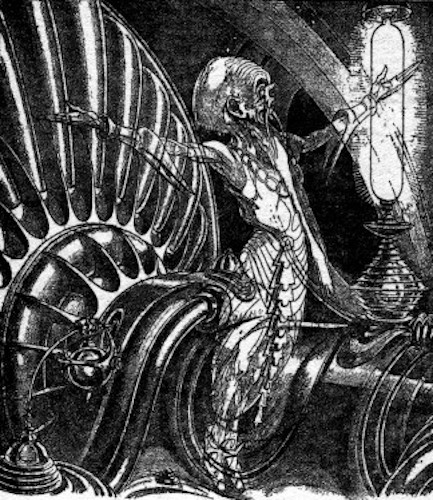
"I welcome you to Norlamin, Terrestrials," spoke the projection. "I suppose that you are close friends of Seaton and Crane, and that you come to learn why they have not communicated with you?"
"I welcome you to Norlamin, Terrestrials," he greeted the two marauders with the untroubled serenity and calm courtesy of his race. "Since you are quite evidently of the same racial stock as our very good friends the doctors Seaton and Crane, and since you are traveling in a ship built by the Osnomians, I assume that you speak and understand the English language which I am employing. I suppose that you are close friends of Seaton and Crane and that you have come to learn why they have not communicated with you of late?"
Self-contained as DuQuesne was, this statement almost took his breath away, squaring almost perfectly as it did with the tale he had so carefully prepared. He did not show his amazed gratification, however, but spoke as gravely and as courteously as the other had done:
"We are very glad indeed to see you, sir; particularly since we know neither the name nor the location of the planet for which we are searching. Your assumptions are correct in every particular save one—"
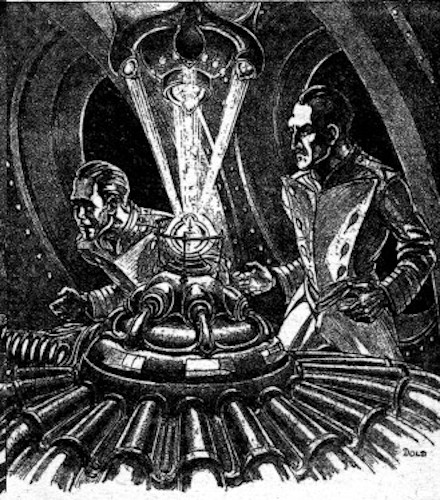
Self-contained as DuQuesne was, this statement almost took his breath away, squaring almost perfectly as it did with the tale he had so carefully prepared.
"You do not know even the name of Norlamin?" the Green scientist interrupted. "How can that be? Did not Dr. Seaton send the projections of all his party to you upon Earth, and did he not discuss matters with you?"
"I was about to explain that." DuQuesne lied instantly, boldly, and convincingly. "We heard that he had sent a talking, three-dimensional picture of his group to Earth, but after it had vanished all the real information that any one seemed to have obtained was that they were here in the Green System somewhere, but not upon Osnome, and that they had been taught much of science. Mrs. Seaton did most of the talking, I gather, which may account for the dearth of pertinent details.
"Neither my friend Loring, here, nor I—I am Stewart Donovan, by the way—saw the picture, or rather, projection. You assumed that we are Seaton's close friends. We are engineers in his company, but we have not the honor of his personal acquaintance. His scientific knowledge was needed so urgently that it was decided that we should come out here after him, since the chief of construction had heard nothing from him for so long."
"I see." A shadow passed over the seamed green face. "I am very sorry indeed at what I have to tell you. We did not report anything of it to Earth because of the panic that would have ensued. We shall of course send the whole story as soon as we can learn what actually did take place and can deduce therefrom the probable sequence of events yet to occur."
"What's that—an accident? Something happened to Seaton?" DuQuesne snapped. His heart leaped in joy and relief, but his face showed only strained anxiety and deep concern. "He isn't here now? Surely nothing serious could have happened to him."
"Alas, young friend, none of us knows yet what really occurred. It is highly probable, however, that their vessel was destroyed in intergalactic space by forces about which we have as yet been able to learn nothing; forces directed by some intelligence as yet to us unknown. There is a possibility that Seaton and his companions escaped in the vessel you knew as Skylark Two, but so far we have not been able to find them.
"But enough of talking; you are strained and weary and you must rest. As soon as your vessel was detected the beam was transferred to me—the student Rovol, perhaps the closest to Seaton of any of my race—so that I could give you this assurance. With your permission I shall direct upon your controls certain forces which shall so govern your flight that you shall alight safely upon the grounds of my laboratory in a few minutes more than twelve hours of your time, without any further attention or effort upon your part.
"Further explanations can wait until we meet in the flesh. Until that time, my friends, do nothing save rest. Eat and sleep without care or fear, for your flight and your landing shall be controlled with precision. Farewell!"
The projection vanished instantaneously, and Loring expelled his pent-up breath in an explosive sigh.
"Whew! But what a break, chief, what a—"
He was interrupted by DuQuesne, who spoke calmly and quietly, yet insistently: "Yes, it is a singularly fortunate circumstance that the Norlaminians detected us and recognized us; it probably would have required weeks for us to have found their planet unaided." DuQuesne's lightning mind found a way of covering up his companion's betraying exclamation and sought some way of warning him that could not be overheard. "Our visitor was right in saying that we need food and rest badly, but before we eat let us put on the headsets and bring the record of our flight up to date—it will take only a minute or two."
"What's biting you, chief?" thought Loring as soon as the power was on. "We didn't have any—"
"Plenty!" DuQuesne interrupted him viciously. "Don't you realize that they can probably hear every word we say, and that they can see every move we make, even in the dark? In fact, they may be able to read thoughts, for all I know; so think straight from now on, if you never did before! Now let's finish up this record."
He then impressed upon a tape the record of everything that had just happened. They ate. Then they slept soundly—the first really untroubled sleep they had enjoyed for weeks. And at last, exactly as the projection had foretold, the Violet landed without a jar upon the spacious grounds beside the laboratory of Rovol, the foremost physicist of Norlamin.
When the door of the space ship opened, Rovol in person was standing before it, waiting to welcome the voyagers and to escort them to his dwelling. But DuQuesne, pretending a vast impatience, would not be dissuaded from the object of his search merely to satisfy the Norlaminian amenities of hospitality and courtesy. He poured forth his prepared story in a breath, concluding with a flat demand that Rovol tell him everything he knew about Seaton, and that he tell it at once.
"It would take far too long to tell you anything in words," the ancient scientist replied placidly. "In the laboratory, however, I can and will inform you fully in a few minutes concerning everything that has happened."
Utter stranger himself to deception in any form, as was his whole race, Rovol was easily and completely deceived by the consummate acting, both physical and mental, of DuQuesne and Loring. Therefore, as soon as the three had donned the headsets of the wonderfully efficient Norlaminian educator, Rovol gave to the Terrestrial adventurers without reserve his every mental image and his every stored fact concerning Seaton and his supposedly ill-fated last voyage.
Even more clearly than as if he himself had seen them all happen, DuQuesne beheld and understood Seaton's visit to Norlamin, the story of the Fenachrone peril, the building of the fifth-order projector, the demolition of Fenor's space fleet, the revenge-purposed flight of Ravindau the scientist, and the complete volatilization of the Fenachrone planet.
He saw Seaton's gigantic space cruiser Skylark Three come into being and, uranium-driven, speed out into the awesome void of intergalactic space in pursuit of the last survivors of the Fenachrone race. He watched the mighty Three overtake the fleeing vessel, and understood every detail of the epic engagement that ensued, clear to its cataclysmic end. He watched the victorious battleship speed on and on, deeper and deeper into the intergalactic void, until she began to approach the limiting range of even the stupendous fifty-order projector by means of which he knew the watching had been done.
Then, at the tantalizing limit of visibility, something began to happen; something at the very incomprehensibility of which DuQuesne strained both mind and eye, exactly as had Rovol when it had taken place so long before. The immense bulk of the Skylark disappeared behind zone after impenetrable zone of force, and it became increasingly evident that from behind those supposedly impervious and impregnable shields Seaton was waging a terrific battle against some unknown opponent, some foe invisible even to fifth-order vision.
For nothing was visible—nothing, that is, save the released energies which, leaping through level after level, reached at last even to the visible spectrum. Yet forces of such unthinkable magnitude were warring there that space itself was being deformed visibly, moment by moment. For a long time the space strains grew more and more intense, then they disappeared instantly. Simultaneously the Skylark's screens of force went down and she was for an instant starkly visible before she exploded into a vast ball of appallingly radiant, flaming vapor.
In that instant of clear visibility, however, Rovol's mighty mind had photographed every salient visible feature of the great cruiser of the void. Being almost at the limit of range of the projector, details were of course none too plain; but certain things were evident. The human beings were no longer aboard; the little lifeboat that was Skylark Two was no longer in her spherical berth; and there were unmistakable signs of a purposeful and deliberate departure.
"And," Rovol spoke aloud as he removed the headset, "although we searched minutely and most carefully all the surrounding space we could find nothing tangible. From these observations it is all too plain that Seaton was attacked by some intelligence wielding dirigible forces of the sixth order; that he was able to set up a defensive pattern; that his supply of power-uranium was insufficient to cope with the attacking forces; and that he took the last desperate means of escaping from his foes by rotating Skylark Two into the unknown region of the fourth dimension."
DuQuesne's stunned mind groped for a moment in an amazement akin to stupefaction, but he recovered quickly and decided upon his course.
"Well, what are you doing about it?" he snapped.
"We have done and are doing everything possible for us, in our present state of knowledge and advancement, to do," Rovol replied placidly. "We sent out forces, as I told you, which obtained and recorded all the phenomena to which they were sensitive. It is true that a great deal of data escaped them, because the primary impulses originated in a level beyond our present knowledge, but the fact that we cannot understand it has only intensified our interest in the problem. It shall be solved. After its solution we shall know what steps to take and those steps shall then be taken."
"Have you any idea how long it will take to solve the problem?"
"Not the slightest. Perhaps one lifetime, perhaps many—who knows? However, rest assured that it shall be solved, and that the condition shall be dealt with in the manner which shall best serve the interest of humanity as a whole."
"But good heavens!" exclaimed DuQuesne. "In the meantime, what of Seaton and Crane?" He was now speaking his true thoughts. Upon this, his first encounter, he could in nowise understand the deep, calm, timeless trend of mind of the Norlaminians; not even dimly could he grasp or appreciate the seemingly slow but inexorably certain method in which they pursued relentlessly any given line of research to its ultimate conclusion.
"If it should be graven upon the sphere that they shall pass they may—and will—pass in all tranquility, for they know full well that it was not in idle gesture that the massed intellect of Norlamin assured them that their passing should not be in vain. You, however, youths of an unusually youthful and turbulent race, could not be expected to view the passing of such a one as Seaton from our own mature viewpoint."
"I'll tell the universe that I don't look at things the way you do!" barked DuQuesne scathingly. "When I go back to Earth—if I go—I shall at least have tried. I've got a life-sized picture of myself standing idly by while some one else tries for seven hundred years to decipher the indecipherable!"
"There speaks the impetuousness of youth," the old man chided. "I have told you that we have proved that at present we can do nothing whatever for the occupants of Skylark Two. Be warned, my rash young friend; do not tamper with powers entirely beyond your comprehension."
"Warning be damned!" DuQuesne snorted. "We're shoving off. Come on, Loring—the quicker we get started the better our chance of getting something done. You'll be willing to give me the exact bearing and the distance, won't you, Rovol?"
"We shall do more than that, son," the Green patriarch replied, while a shadow came over his wrinkled visage. "Your life is your own, to do with as you see fit. You have chosen to go in search of your friends, scorning the odds against you. But before I tell you what I have in mind, I must try once more to make you see that the courage which dictates the useless sacrifice of a life ceases to be courage at all, but becomes sheerest folly.
"Since we have had sufficient power several of our youths have been studying the fourth dimension. They rotated many inanimate objects into that region, but could recover none of them. Instead of waiting until they had derived the fundamental equations governing such phenomena they rashly visited that region in person, in a vain attempt to achieve a short cut to knowledge. Not one of them has come back.
"Now I declare to you in all solemnity that the quest you wish to undertake, involving as it does not only that entirely unknown region but also the equally unknown sixth order of vibrations, is to you at present utterly impossible. Do you still insist upon going?"
"We certainly do. You may as well save your breath."
"Very well; so be it. Frankly, I had but little hope of swerving you from your purpose by reason. But before you go we shall supply you with every resource at our command which may in any way operate to increase your infinitesimal chance of success. We shall build for you a duplicate of Seaton's own Skylark Three, equipped with every device known to our science, and we shall instruct you fully in the use of those devices before you set out."
"But the time—" DuQuesne began to object.
"A matter of hours only," Rovol silenced him. "True, it took us some little time to build Skylark Three, but that was because it had not been done before. Every force employed in her construction was of course recorded, and to reproduce her in every detail, without attention or supervision, it is necessary only to thread this tape, thus, into the integrator of my master keyboard. The actual construction will of course take place in the area of experiment, but you may watch it, if you wish, in this visiplate. I must make a short series of observations at this time. I will return in ample time to instruct you in the operation of the vessel and of everything in it."
In stunned amazement the two men stared into the visiplate, so engrossed in what they saw there that they scarcely noticed the departure of the aged scientist. For before their eyes there had already sprung into being an enormous structure of laced and latticed members of purple metal, stretching over two miles of level plain. While it was very narrow for its length, yet its fifteen hundred feet of diameter dwarfed into insignificance the many outlandish structures near by, and under their staring eyes the vessel continued to take form with unbelievable rapidity. Gigantic girders appeared in place as though by magic; skin after skin of thick, purple inoson was welded on; all without the touch of a hand, without the thought of a brain, without the application of any visible force.
"Now you can say it, Doll; there's no spy ray on us here. What a break—what a break!" exulted DuQuesne. "The old fossil swallowed it bodily, hook, line, and sinker!"
"It may not be so good, though, at that, chief, in one way. He's going to watch us, to help us out if we get into a jam, and with that infernal telescope, or whatever it is, the Earth is right under his nose."
"Simpler than taking milk away from a blind kitten," the saturnine chemist gloated. "We'll go out to where Seaton went, only farther—out beyond the reach of his projector. There, completely out of touch with him, we'll circle around the Galaxy back to Earth and do our stuff. Easier than dynamiting fish in a bucket—the old sap's handing me everything I want, right on a silver platter!"
VIII.
Six mighty rotating currents of electricity impinged simultaneously upon the spherical hull of Skylark Two and she disappeared utterly. No exit had been opened and the walls remained solid, but where the forty-foot globe of arenak had rested in her cradle an instant before there was nothing. Pushed against by six balancing and gigantic forces, twisted cruelly by six couples of angular force of unthinkable magnitude, the immensely strong arenak shell of the vessel had held and, following the path of least resistance—the only path in which she could escape from those irresistible forces—she had shot out of space as we know it and into the impossible reality of that hyperspace which Seaton's vast mathematical knowledge had enabled him so dimly to perceive.
As those forces smote his vessel, Seaton felt himself compressed. He was being driven together irresistibly in all three dimensions, and in those dimensions and at the same time he was as irresistibly being twisted—was being corkscrewed in a monstrously obscure fashion which permitted him neither to move from his place nor to remain in it. He hung poised there for interminable hours, even though he knew that the time required for that current to build up to its inconceivable value was to be measured only in fractional millionths of a single second.
Yet he waited strainingly while that force increased at an all but imperceptible rate, until at last the vessel and all its contents were squeezed out of space, in a manner somewhat comparable to that in which an orange pip is forced out from between pressing thumb and resisting finger.
At the same time Seaton felt a painless, but unutterably horrible, transformation of his entire body—a rearrangement, a writhing, crawling distortion; a hideously revolting and incomprehensibly impossible extrusion of his bodily substance as every molecule, every atom, every ultimate particle of his physical structure was compelled to extend itself into that unknown new dimension.
He could not move his eyes, yet he saw every detail of the grotesquely altered space ship. His Earthly mentality could not understand anything he saw, yet to his transformed brain everything was as usual and quite in order. Thus the four-dimensional physique that was Richard Seaton perceived, recognized, and admired as of yore his beloved Dorothy, in spite of the fact that her normally solid body was now quite plainly nothing but a three-dimensional surface, solid only in that logically impossible new dimension which his now four-dimensional brain accepted as a matter of course, but which his thinking mentality could neither really perceive nor even dimly comprehend.
He could not move a muscle, yet in some obscure and impossible way he leaped toward his wife. Immobile though tongue and jaws were, yet he spoke to her reassuringly, remonstratingly, as he gathered up her trembling form and silenced her hysterical outbursts.
"Steady on, dear, it's all right—everything's jake. Hold everything, dear. Pipe down, I tell you! This is nothing to let get your goat. Snap out of it, Red-Top!"
"But, Dick, it's—it's just—"
"Hold it!" he commanded. "You're going off the deep end again. I can't say that I expected anything like this, either, but when you think about things it's natural enough that they should be this way. You see, while we've apparently got four-dimensional bodies and brains now, our intellects are still three-dimensional, which complicates things considerably. We can handle things and recognize them, but we can't think about our physical forms, understand them, or express them either in words or in thoughts. Peculiar, and nerve-wracking enough, especially for you girls, but quite normal—see?"
"Well, maybe—after a fashion. I was afraid that I had really gone crazy back there, at first, but if you feel that way, too, I know it's all right. But you said that we'd be gone only a skillionth of a second, and we've been here a week already, at the very least."
"All wrong, dear—at least, partly wrong. Time does go faster here, apparently, so that we seem to have been here quite a while; but as far as our own time is concerned we haven't been here anywhere near a millionth of a second yet. See that plunger? It's still moving in—it has barely made contact. Time is purely relative, you know, and it moves so fast here that that plunger switch, traveling so fast that the eye cannot follow it at all ordinarily, seems to us to be perfectly stationary."
"But it must have been longer than that, Dick! Look at all the talking we've done. I'm a fast talker, I know, but even I can't talk that fast!"
"You aren't talking—haven't you discovered that yet? You are thinking, and we are getting your thoughts as speech; that's all. Don't believe it? All right; there's your tongue, right there—or better, take your heart. It's that funny-looking object right there—see it? It isn't beating—that is, it would seem to us to take weeks, or possibly months, to beat. Take hold of it—feel it for yourself."
"Take hold of it! My own heart? Why, it's inside me, between my ribs—I couldn't, possibly!"
"Sure you can! That's your intellect talking now, not your brain. You're four-dimensional now, remember, and what you used to call your body is nothing but the three-dimensional hypersurface of your new hyperbody. You can take hold of your heart or your gizzard just as easily as you used to pat yourself on the nose with a powder puff."
"Well, I won't, then—why, I wouldn't touch that thing for a million dollars!"
"All right; watch me feel mine, then. See, it's perfectly motionless, and my tongue is, too. And there's something else that I never expected to look at—my appendix. Good thing you're in good shape, old vermiform, or I'd take a pair of scissors and snick you off while I've got such a good chance to do it without—"
"Dick!" shrieked Dorothy. "For the love of Heaven—"
"Calm down, Dottie, calm down. I'm just trying to get you used to this mess—I'll try something else. Here, you know what this is—a new can of tobacco, with the lid soldered on tight. In three dimensions there's no way of getting into it without breaking metal—you've opened lots of them. But out here I simply reach past the metal of the container, like this, see, in the fourth dimension? Then I take out a pinch of the tobacco, so, and put it into my pipe, thus. The can is still soldered tight, no holes in it anywhere, but the tobacco is out, nevertheless. Inexplicable in three-dimensional space, impossible for us really to understand mentally, but physically perfectly simple and perfectly natural after you get used to it. That'll straighten you out some, perhaps."
"Well, maybe—I guess I won't get frantic again, Dickie—but just the same, it's altogether too perfectly darn weird to suit me. Why don't you pull that switch back out and stop us?"
"Wouldn't do any good—wouldn't stop us, because we have already had the impulse and are simply traveling on momentum now. When that is used up—in some extremely small fraction of a second of our time—we'll snap back into our ordinary space, but we can't do a thing about it until then."
"But how can we move around so fast?" asked Margaret from the protecting embrace of the monstrosity that they knew to be Martin Crane. "How about inertia? I should think we'd break our bones all to pieces."
"You can't move a three-dimensional body that fast, as we found out when the force was coming on," Seaton replied. "But I don't think that we are ordinary matter any more, and apparently our three-dimensional laws no longer govern, now that we are in hyperspace. Inertia is based upon time, of course, so our motion might be all right, even at that. Mechanics seem to be different here, though, and, while we seem solid enough, we certainly aren't matter at all in the three-dimensional sense of the term, as we used it back where we came from. But it's all over my head like a circus tent—I don't know any more about most of this stuff than you do. I thought, of course—if I thought at all, which I doubt—that we'd go through hyperspace in an instant of time, without seeing it or feeling it in any way, since a three-dimensional body cannot exist, of course, in four-dimensional space. How did we get this way, Mart? Is this space coexistent with ours or not?"
"I believe that it is." Crane, the methodical, had been thinking deeply, considering every phase of their peculiar predicament. "Coexistent, but different in all its attributes and properties. Since we may be said to be experiencing two different time rates simultaneously, we cannot even guess at what our velocity relation is, in either system of coördinates. As to what happened, that is now quite clear. Since a three-dimensional object cannot exist in hyperspace, it of course cannot be thrown or forced through hyperspace.
"In order to enter this region, our vessel and everything in it had to acquire the property of extension in another dimension. Your forces, calculated to rotate us here, in reality forced us to assume that extra extension, which process automatically moved us from the space in which we could no longer exist into the only one in which it is possible for us to exist. When that force is no longer operative, our extension into the fourth dimension will vanish and we shall as automatically return to our customary three-dimensional space, but probably not to our original location in that space. Is that the way you understand it?"
"That's a lot better than I understood it, and it's absolutely right, too. Thanks, old thinker! And I certainly hope we don't land back there where we took off from—that's why we left, because we wanted to get away from there. The farther the better," Seaton laughed. "Just so we don't get so far away that the whole Galaxy is out of range of the object-compasses we've got focused on it. We'd be lost for fair, then."
"That is a possibility, of course." Crane took the light utterance far more seriously than did Seaton. "Indeed, if the two time rates are sufficiently different, it becomes a probability. However, there is another matter which I think is of more immediate concern. It occurred to me, when I saw you take that pinch of tobacco without opening the tin, that everywhere we have gone, even in intergalactic space, we have found life, some friendly, some inimical. There is no real reason to suppose that hyperspace is devoid of animate and intelligent life."
"Oh, Martin!" Margaret shuddered. "Life! Here? In this horrible, this utterly impossible place?"
"Certainly, dearest," he replied gravely. "It all goes back to the conversation we had long ago, during the first trip of the old Skylark. Remember? Life need not be comprehensible to us to exist—compared to what we do not know and what we can never either know or understand, our knowledge is infinitesimal."
She did not reply and he spoke again to Seaton:
"It would seem to be almost a certainty that four-dimensional life does in fact exist. Postulating its existence, the possibility of an encounter cannot be denied. Such beings could of course enter this vessel as easily as your fingers entered that tobacco can. The point of these remarks is this—would we not be at a serious disadvantage? Would they not have fourth-dimensional shields or walls about which we three-dimensional intelligences would know nothing?"
"Sweet spirits of niter!" Seaton exclaimed. "Never thought of that at all, Mart. Don't see how they could—and yet it does stand to reason that they'd have some way of locking up their horses so they couldn't run away, or so that nobody else could steal them. We'll have to do a job of thinking on that, big fellow, and we'd better start right now. Come on—let's get busy!"
Then for what seemed hours the two scientists devoted the power of their combined intellects to the problem of an adequate fourth-dimensional defense, only and endlessly to find themselves butting helplessly against a blank wall.
Baffled, they drifted on through the unknowable reaches of hyperspace. All they knew of time was that it was hopelessly distorted; of space that it was hideously unrecognizable; of matter that it obeyed no familiar laws. They drifted, and drifted—futilely, timelessly, aimlessly, endlessly—
IX.
When Skylark Three left Norlamin in pursuit of the fleeing vessel of Ravindau, the Fenachrone scientist, the occasion had been made an event of world-wide interest. From their tasks everywhere had come the mental laborers to that stupendous event. To it had come also, practically en masse, the "youngsters" from the Country of Youth; and even those who, their life work done, had betaken themselves to the placid Nirvana of the Country of Age returned briefly to the Country of Study to speed upon its epoch-making way that stupendous messenger of civilization.
But in sharp contrast to the throngs of Norlaminians who had witnessed the take-off of Three, Rovol alone was present when DuQuesne and Loring wafted themselves into the control room of its gigantic counterpart. DuQuesne had been in a hurry, and in the driving urge of his haste to go to the rescue of his "friend" Seaton he had so completely occupied the mind of Rovol that that aged scientist had had no time to do anything except transfer to the brain of the Terrestrial pirate the knowledge which he would so soon require.
Of the real reason for this overweening haste, however, Rovol had not had the slightest inkling. DuQuesne well knew what the ancient physicist did not even suspect—that if any one of several Norlaminians, particularly one Drasnik, First of Psychology, should become informed of the proposed flight, that flight would not take place. For Drasnik, that profound student of the mind, would not be satisfied with DuQuesne's story without a thorough mental examination—an examination which, DuQuesne well knew, he could not pass. Therefore Rovol alone saw them off, but what he lacked in numbers he made up in sincerity.
"I am very sorry that the exigencies of the situation did not permit a more seemly leave-taking," he said in parting, "but I can assure you of the coöperation of every one of us whose brain can be of any use. We shall watch you, and shall aid you in any way we can."
"Farewell to you, Rovol, my friend and my benefactor, and to all Norlamin," DuQuesne replied solemnly. "I thank you from the bottom of my heart for everything you have done for us and for Seaton, and for what you may yet be called upon to do for all of us."
He touched a stud and in each of the many skins of the great cruiser a heavy door drove silently shut, establishing a manifold seal.
His hand moved over the controls, and the gigantic vessel tilted slowly upward until her narrow prow pointed almost directly into the zenith. Then, easily as a wafted feather, the unimaginable mass of the immense cruiser of space floated upward with gradually increasing velocity. Faster and faster she flew, out beyond measurable atmospheric pressure, out beyond the outermost limits of the Green System, swinging slowly into a right line toward the point in space where Seaton, his companions, and both their space ships had disappeared.
On and on she drove, now at high acceleration; the stars, so widely spaced at first, crowding closer and closer together as her speed, long since incomprehensible to any finite mind, mounted to a value almost incalculable. Past the system of the Fenachrone she hurtled; past the last outlying fringe of stars of our Galaxy; on and on into the unexplored, awesome depths of free and absolute space.
Behind her the vast assemblage of stars comprising our island universe dwindled to a huge, flaming lens, to a small but bright lenticular nebula, and finally to a mere point of luminosity.
For days communication with Rovol had been difficult, since as the limit of projection was approached it became impossible for the most powerful forces at Rovol's command to hold a projection upon the flying vessel. In order to communicate, Rovol had to send out a transmitting and receiving projection.
As the distance grew still greater, DuQuesne had done the same thing. Now it was becoming evident, by the wavering and fading of the signals, that even the two projections, reaching out toward each other though they were, would soon be out of touch, and DuQuesne sent out his last message:
"There is no use in trying to keep in communication any longer, as our beams are falling apart fast. I am on negative acceleration now, of an amount calculated to bring us down to maneuvering velocity at the point to which the inertia of Skylark Two would have carried her, without power, at the time when we shall arrive there. Please keep a listening post established out this way as far as you can, and I will try to reach it if I find out anything. If I fail—good-by!"
"The poor, dumb cluck!" DuQuesne sneered as he shut off his sender and turned to Loring. "That was so easy that it was a shame to take it, but we're certainly set to go now."
"I'll say so!" Loring agreed enthusiastically. "That was a nice touch, chief, telling him to keep a lookout out here. He'll do it with forces, of course, not in person; but at that it'll keep him from thinking about the Earth until you're all set."
"You've got the idea, Doll. If they had any suspicion at all that we were heading back for the Earth they could block us yet, easily enough; but if we can get back inside the Solar System before they smell a rat it will be too late for them to do anything."
He rotated his ship through an angle of ninety degrees upon her longitudinal axis and applied enough downward acceleration to swing her around in such an immense circle that she would approach the Galaxy from the side opposite to that from which she had left it.
Then, during days that lengthened into weeks and months of dull and monotonous flight, the two men occupied themselves, each in his own individual fashion. There was no piloting to do and no need of vigilance, for space to a distance of untold billions of miles was absolutely and utterly empty.
Loring, unemotional and incurious, performed what simple routine housekeeping there was to do, ate, slept, and smoked. During the remainder of the time he simply sat still, stolidly doing nothing whatever until the time should come when DuQuesne would tell him to perform some specific act.
DuQuesne, on the other hand, dynamic and energetic to his ultimate fiber, found not a single idle moment. His newly acquired knowledge was so vast that he needs must explore and catalogue his own brain, to be sure that he would be able instantly to call upon whatever infinitesimal portion of it might be needed in some emergency.
The fifth-order projector, with its almost infinitely complicated keyboard, must needs be studied until its every possible resource of integration, permutation, and combination held from him no more secrets than does his console from a master of the pipe organ. Thus it was that the Galaxy loomed ahead, a stupendous lens of flame, before DuQuesne had really realized that the long voyage was almost over.
To his present mentality, working with his newly acquired fifth-order projector, the task of locating our Solar System was but the work of a moment; and to the power and speed of his new space ship the distance from the Galaxy's edge to the Earth was merely a longish jaunt.
When they approached the Earth it appeared as a softly shining, greenish half moon. With fleecy wisps of cloud obscuring its surface here and there, with gleaming ice caps making of its poles two brilliant areas of white, it presented an arrestingly beautiful spectacle indeed; but DuQuesne was not interested in beauty. Driving down from the empty reaches of space north of the ecliptic, he observed that Washington was in the morning zone, and soon his great vessel was poised motionless, invisibly high above the city.
His first act was to throw out an ultra-powered detector screen, with automatic trips and tighteners, around the entire Solar System; out far beyond the outermost point of the orbit of Pluto. Its every part remained unresponsive. No foreign radiation was present in all that vast volume of space, and DuQuesne turned to his henchman with cold satisfaction stamped upon his every hard lineament.
"No interference at all, Doll. No ships, no projections, no spy rays, nothing," he said. "I can really get to work now. I won't be needing you for a while, and I imagine that, after being out in space so long, you would like to circulate around with the boys and girls for a couple of weeks or so. How are you fixed for money?"
"Well, chief, I could do with a small binge and a few nights out among 'em, if it's all right with you," Loring admitted. "As for money, I've got only a couple of hundred on me, but I can get some at the office—we're quite a few pay days behind, you know."
"Never mind about going to the office. I don't know exactly how well Brookings is going to like some of the things I'm going to tell him, and you're working for me, you know, not for the office. I've got plenty. Here's five thousand, and you can have three weeks to spend it in. Three weeks from to-day I'll call you on your wireless phone and tell you what to do. Until then, do as you please. Where do you want me to set you down? Perhaps the Perkins roof will be clear at this hour."
"Good as any. Thanks, chief," and without even a glance to assure himself that DuQuesne was at the controls Loring made his way through the manifold airlocks and calmly stepped out into ten thousand feet of empty air.
DuQuesne caught the falling man neatly with an attractor beam and lowered him gently to the now-deserted roof of the Perkins Café—that famous restaurant which had been planned and was maintained by the World Steel Corporation as a blind for its underground activities. He then seated himself at his console and drove his projection down into the innermost private office of World Steel. He did not at first thicken the pattern into visibility, but remained invisible, studying Brookings, now president of that industrial octopus, the World Steel Corporation.
The magnate was seated as of yore in a comfortably padded chair at his massive and ornate desk, the focus and the center of a maze of secret private communication bands and even more secret private wires. For Steel was a growing octopus and its voraciously insatiable maw must be fed.
Brookings had but one motto, one tenet—get it. By fair play at times, although this method was employed but seldom; by bribery, corruption, and sabotage as the usual thing; by murder, arson, mayhem, and all other known forces of foul play if necessary or desirable—Steel got it.
To be found out was the only sin, and that was usually only venial instead of cardinal; for it was because of that sometimes unavoidable contingency that Steel not only retained the shrewdest legal minds in the world, but also wielded certain subterranean forces sufficiently powerful to sway even supposedly incorruptible courts of justice.
Occasionally, of course, the sin was cardinal; the transgression irremediable: the court unreachable. In that case the octopus lost a very minor tentacle; but the men really guilty had never been brought to book.
Into the center of this web, then, DuQuesne drove his projection and listened. For a whole long week he kept at Brookings' elbow, day and night. He listened and spied, studied and planned, until his now gigantic mentality not only had grasped every detail of everything that had developed during his long absence and of everything that was then going on, but also had planned meticulously the course which he would pursue. Then, late one afternoon, he cut in his audio and spoke.
"I knew of course that you would try to double-cross me, Brookings, but even I had no idea that you would make such an utter fool of yourself as you have."
As he heard the sneering, cutting tone of the scientist's well-remembered voice, the magnate seemed to shrink visibly; his face turning a pasty gray as the blood receded from it.
"DuQuesne!" he gasped. "Where—are you?"
"I'm right beside you, and I have been for over a week." DuQuesne thickened his image to full visibility and grinned sardonically as the man at the desk reached hesitantly toward a button. "Go ahead and push it—and see what happens. Surely even you are not dumb enough to suppose that a man with my brain—even the brain I had when I left here—would take any chances with such a rat as you have always shown yourself to be?"
Brookings sank back into his chair, shaking visibly. "What are you, anyway? You look like DuQuesne, and yet—" His voice died away.
"That's better, Brookings. Don't ever start anything that you can't finish. You are and always were a physical coward. You're one of the world's best at bossing dirty work from a distance, but as soon as it gets close to you you fold up like an accordion.
"As to what this is that I am talking and seeing from, it is technically known as a projection. You don't know enough to understand it even if I should try to explain it to you, which I have no intention of doing. It's enough for you to know that it is something that has all the advantages of an appearance in person, and none of the disadvantages. None of them—remember that word.
"Now I'll get down to business. When I left here I told you to hold your cockeyed ideas in check—that I would be back in less than five years, with enough stuff to do things in a big way. You didn't wait five days, but started right in with your pussyfooting and gumshoeing around, with the usual result—instead of cleaning up the mess, you made it messier than ever. You see, I've got all the dope on you—I even know that you were going to try to gyp me out of my back pay."
"Oh, no, doctor; you are mistaken, really," Brookings assured him. He was fast regaining his usual poise, and his mind was again functioning in its wonted devious fashion. "We have really been trying to carry on until you got back, exactly as you told us to. And your salary has been continued in full, of course—you can draw it all at any time."
"I know I can, in spite of you. However, I am no longer interested in money. I never cared for it except for the power it gave, and I have brought back with me power far beyond that of money. Also I have learned that knowledge is even greater than power. I have also learned, too, however, that in order to increase my present knowledge—yes, even to protect that which I already have—I shall soon need a supply of energy a million times greater than the present peak output of all the generators of Earth. As a first step in my project I am taking control of Steel right now, and I am going to do things the way they should be done."
"But you can't do that, doctor!" protested Brookings volubly. "We will give you anything you ask, of course, but—"
"But nothing!" interrupted DuQuesne. "I'm not asking a thing of you, Brookings—I'm telling you!"
"You think you are!" Brookings, goaded to action at last, pressed a button savagely, while DuQuesne looked on in calm contempt.
Behind the desk, ports flashed open and rifles roared thunderously in the confined space. Heavy bullets tore through the peculiar substance of the projection and smashed into the plastered wall behind it, but DuQuesne's contemptuous grin did not change. He moved slowly forward, hands outthrust. Brookings screamed once—a scream that died away to a gurgle as fingers of tremendous strength closed about his flabby neck.
There had been four riflemen on guard. Two of them threw down their guns and fled in panic, amazed and terrified at the failure of their bullets to take effect. Those guards died in their tracks as they ran. The other two rushed upon DuQuesne with weapons clubbed. But steel barrel and wooden stock alike rebounded harmlessly from that pattern of force, fiercely driven knives penetrated it but left no wound, and the utmost strength of the two brawny men could not even shift the position of the weird being's inhumanly powerful fingers upon the throat of their employer. Therefore they stopped their fruitless attempts at a rescue and stood, dumfounded.
"Good work, boys," DuQuesne commended. "You've got nerve—that's why I didn't bump you off. You can keep on guarding this idiot here after I get done teaching him a thing or two. As for you, Brookings," he continued, loosening his grip sufficiently so that his victim could retain consciousness, "I let you try that to show you the real meaning of futility. I told you particularly to remember that this projection has none of the disadvantages of a personal appearance, but apparently you didn't have enough brain power to grasp the thought. Now, are you going to work with me the way I want you to or not?"
"Yes, yes—I'll do anything you say," Brookings promised.
"All right, then." DuQuesne resumed his former position in front of the desk. "You are wondering why I didn't finish choking you to death, since you know that I am not at all squeamish about such things. I'll tell you. I didn't kill you because I may be able to use you. I am going to make World Steel the real government of the Earth, and its president will therefore be dictator of the world. I do not want the job myself because I will be too busy extending and consolidating my authority, and with other things, to bother about the details of governing the planet. As I have said before, you are probably the best manager alive to-day; but when it comes to formulating policies you're a complete bust. I am giving you the job of world dictator under one condition—that you run it exactly as I tell you to."
"Ah, a wonderful opportunity, doctor! I assure you that—"
"Just a minute, Brookings! I can read your mind like an open book. You are still thinking that you can slip one over on me. Know now, once and for all, that it can't be done. I am keeping on you continuously automatic devices that are recording every order that you give, every message that you receive or send, and every thought that you think. The first time that you try any more of your funny work on me I will come back here and finish up the job I started a few minutes ago. Play along with me and you can run the Earth as you please, subject only to my direction in broad matters of policy; try to double-cross me and you pass out of the picture. Get me?"
"I understand you thoroughly." Brookings' agile mind flashed over the possibilities of DuQuesne's stupendous plan. His eyes sparkled as he thought of his own place in that plan, and he became his usual blandly alert self. "As world dictator, I would of course be in a higher place than any that World Steel, as at present organized, could possibly offer. Therefore I will be glad to accept your offer, without reservations. Now, if you will go ahead and give me an outline of what you propose. I will admit that I did harbor a few mental reservations at first, but you have convinced me that you actually can deliver the goods."
"That's better. I will show you very shortly whether I can deliver. I have prepared full plans for the rebuilding of all our stations and Seaton's into my new type of power plant for the erection of a new plant at every strategic point throughout the world, and for interlocking all these stations into one system. Here they are." A bound volume of data and a mass of blue prints materialized in the air and dropped upon the desk. "As soon as I have gone you can call in the chiefs of the engineering staff and put them to work."
"I perceive what seem to me to be obstacles," Brookings remarked, after his practiced eye had run over the salient points of the project and he had leafed over the pile of blue prints. "We have not been able to do anything with Seaton's plants because of their enormous reserves of power, and his number one plant is to be the key station of our new network. Also, there simply are not men enough to do this work. These are slack times, I know, but even if we could get every unemployed man we still would not have enough. And, by the way, what became of Seaton? He apparently has not been around for some time."
"You needn't worry about Seaton's plants—I'll line them up for you myself. As for Seaton, he was chased into the fourth dimension. He hasn't got back yet, and he probably won't; as I will explain to his crowd when I take them over. As for men, we shall have the combined personnel of all the armies and navies of the world. You think that even that force won't be enough, but it will. As you go over those plans in detail, you will see that by the proper use of dirigible forces we shall have plenty of man power."
"How do you intend to subdue the armies and navies of the world?"
"It would take too long to go into detail. Turn on that radio there and listen, however, and you'll get it all—in fact, being on the inside, you'll be able to do a lot of reading between the lines that no one else will. Also, what I am going to do next will settle the doubt that is still in your mind as to whether I've really got the stuff."
The projection vanished, and in a few minutes every radio receiving set throughout the world burst into stentorian voice. DuQuesne was broadcasting simultaneously upon every channel from five meters to five thousand, using a wave of such tremendous power that even two-million-watt stations were smothered at the very bases of their own transmitting towers.
"People of Earth, attention!" the speakers blared. "I am speaking for the World Steel Corporation. From this time on the governments of all nations of the Earth will be advised and guided by the World Steel Corporation. For a long time I have sought some method of doing away with the stupidities of the present national governments. I have studied the possibilities of doing away with war and its attendant horrors. I have considered all feasible methods of correcting your present economic system, under which you have had constantly recurring cycles of boom and panic.
"Most of you have thought for years that something should be done about all these things. You are not only unorganized, however; you are and always have been racially distrustful and hence easily exploited by every self-seeking demagogue who has arisen to proclaim the dawn of a new day. Thus you have been able to do nothing to improve world conditions.
"It was not difficult to solve the problem of the welfare of mankind. It was quite another matter, however, to find a way of enforcing that solution. At last I have found it. I have developed a power sufficiently great to compel world-wide disarmament and to inaugurate productive employment of all men now bearing arms, as well as all persons now unemployed, at shorter hours and larger wages than any heretofore known. I have also developed means whereby I can trace with absolute certainty the perpetrators of any known crime, past or present; and I have both the power and the will to deal summarily with habitual criminals.
"The revolution which I am accomplishing will harm no one except parasites upon the body politic. National boundaries and customs shall remain as they now are. Governments will be overruled only when and as they impede the progress of civilization. War, however, will not be tolerated. I shall prevent it, not by killing the soldiers who would do the actual fighting, but by putting out of existence every person who attempts to foment strife. Those schemers I shall kill without mercy, long before their plans shall have matured.
"Trade shall be encouraged, and industry. Prosperity shall be world-wide and continuous, because of the high level of employment and remuneration. I do not ask you to believe all this, I am merely telling you. Wait and see—it will come true in less than thirty days.
"I shall now demonstrate my power by rendering the navy of the United States helpless, without taking a single life. I am now poised low over the city of Washington. I invite the Seventieth Bombing Squadron, which I see has already taken to the air, to drop their heaviest bombs upon me. I shall move out over the Potomac, so that the fragments will do no damage, and I shall not retaliate. I could wipe out that squadron without effort, but I have no desire to destroy brave men who are only obeying blindly the dictates of an outworn system."
The space ship, which had extended across the city from Chevy Chase to Anacostia, moved out over the river, followed by the relatively tiny bombers. After a time the entire countryside was shaken by the detonations of the world's heaviest projectiles, but DuQuesne's cold, clear voice went on:
"The bombers have done their best, but they have not even marred the outer plating of my ship. I will now show you what I can do if I should decide to do it. There is an obsolete battleship anchored off the Cape, which was to have been sunk by naval gunfire. I direct a force upon it—it is gone; volatilized almost instantly.
"I am now over Sandy Hook. I am not destroying the coast-defense guns, as I cannot do so without killing men. Therefore I am simply uprooting them and am depositing them gently upon the mud flats of the Mississippi River, at St. Louis, Missouri. Now I am sending out a force to each armed vessel of the United States navy, wheresoever situated upon the face of the globe.
"At such speed as is compatible with the safety of the personnel, I am transporting those vessels through the air toward Salt Lake City, Utah. To-morrow morning every unit of the American navy will float in Great Salt Lake. If you do not believe that I am doing this, read in your own newspaper to-morrow that I have done it.
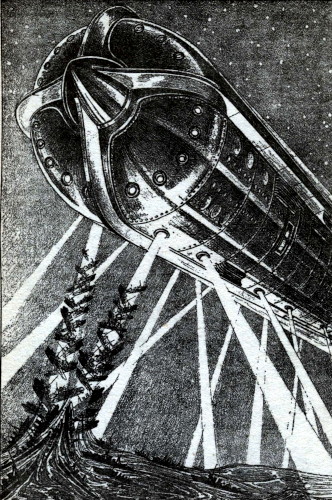
"To-morrow morning," the cold, clear voice went on, "every unit of the American navy will float in Great Salt Lake."
"To-morrow I shall treat similarly the navies of Great Britain, France, Italy, Japan, and the other maritime nations. I shall deal then with the naval bases of the world and with the military forces and their fortifications.
"I have already taken steps to abate the nuisance of certain widely known criminals and racketeers who have been conducting, quite openly and flagrantly, a reign of terror for profit. Seven of those men have already died, and ten more are to die to-night. Your homes shall be safe from the kidnaper; your businesses shall be safe from the extortioner and his skulking aid, the dynamiter.
"In conclusion, I tell you that the often-promised new era is here; not in words, but in actuality. Good-by until to-morrow."
DuQuesne flashed his projection down into Brookings' office. "Well, Brookings, that's the start. You understand now what I am going to do, and you know that I can do it."
"Yes. You undoubtedly have immense power, and you have taken exactly the right course to give us the support of a great number of people who would ordinarily be bitterly opposed to anything we do. But that talk of wiping out gangsters and racketeers sounded funny, coming from you."
"Why should it? We are now beyond that stage. And, while public opinion is not absolutely necessary to our success it is always a potent force. No program of despotism, however benevolent, can expect to be welcomed unanimously; but the course I have outlined will at least divide the opposition."
DuQuesne cut off his forces and sat back at the controls, relaxed, his black eyes staring into infinity. Earth was his, to do with as he wished; and he would soon have it so armed that he could hold it against the universe. Master of Earth! His highest ambition had been attained—or had it? The world, after all, was small—merely a mote in space. Why not be master of the entire Galaxy? There was Norlamin to be considered, of course—
Norlamin!
Norlamin would not like the idea and would have to be pacified.
As soon as he got the Earth straightened out he would have to see what could be done about Norlamin.
X.
"Dick!" Dorothy shrieked, flashing to Seaton's side; and, abandoning his fruitless speculations, he turned to confront two indescribable, yet vaguely recognizable, entities who had floated effortlessly into the control room of the Skylark. Large they were, and black—a dull, lusterless black—and each was possessed of four huge, bright lenses which apparently were eyes. "Dick! What are they, anyway?"
"Life, probably; the intelligent, four-dimensional life that Mart fully expected to find here," Seaton answered. "I'll see if I can't send them a thought."
Staring directly into those expressionless lenses the man sent out wave after wave of friendly thought, without result or reaction. He then turned on the power of the mechanical educator and donned a headset, extending another toward one of the weird visitors and indicating as clearly as he could by signs that it was to be placed back of the outlandish eyes. Nothing happened, however, and Seaton snatched off the useless phones.