Front matter (continued 3)
Reading edition
"Might have known they wouldn't work!" he snorted. "Electricity! Too slow—and those tubes probably won't be hot in less than ten years of this hypertime, besides. Probably wouldn't have been any good, anyway—their minds would of course be four-dimensional, and ours most distinctly are not. There may be some point—or rather, plane—of contact between their minds and ours, but I doubt it. They don't act warlike, though; we'll simply watch them a while and see what they do."
But if, as Seaton had said, the intruders did not seem inimical, neither were they friendly. If any emotion at all affected them, it was apparently nothing more nor less than curiosity. They floated about, gliding here and there, their great eyes now close to this article, now that; until at last they floated past the arenak wall of the spherical space ship and disappeared.
Seaton turned quickly to his wife, ready to minister again to overstrained nerves, but much to his surprise he found Dorothy calm and intensely interested.
"Funny-looking things, weren't they, Dick?" she asked animatedly. "They looked just like highly magnified chess knights with four hands; or like those funny little sea horses they have in the aquarium, only on a larger scale. Were those propellers they had instead of tails natural or artificial—could you tell?"
"Huh? What're you talking about? I didn't see any such details as that!" Seaton exclaimed.
"I couldn't, either, really," Dorothy explained, "until after I found out how to look at them. I don't know whether my method would appeal to a strictly scientific mind or not. I can't understand any of this fourth-dimensional, mathematical stuff of yours and Martin's, anyway, so when I want to see anything out here I just pretend that the fourth dimension isn't there at all. I just look at what you call the three-dimensional surface and it looks all right. When I look at you that way, for instance, you look like my own Dick, instead of like a cubist's four-dimensional nightmare."
"You have hit it, Dorothy." Crane had been visualizing four-dimensional objects as three-dimensional while she was speaking. "That is probably the only way in which we can really perceive hyperthings at all."
"It does work, at that!" Seaton exclaimed. "Congratulations, Dot; you've made a contribution to science—but say, what's coming off now? We're going somewhere."
For the Skylark, which had been floating freely in space—a motion which the senses of the wanderers had long since ceased to interpret as a sensation of falling—had been given an acceleration. Only a slight acceleration, barely enough to make the floor of the control room seem "down," but any acceleration at all in such circumstances was to the scientists cause for grave concern.
"Nongravitational, of course, or we couldn't feel it—it'd affect everything about the ship alike. What's the answer, Mart, if any?" Seaton demanded. "Suppose that they've taken hold of us with a tractor ray and are taking us for a ride?"
"It would appear that way. I wonder if the visiplates are still practical?" Crane moved over to number one visiplate and turned it in every direction. Nothing was visible in the abysmal, all-engulfing, almost palpable darkness of the absolute black outside the hull of the vessel.
"It wouldn't work, hardly," Seaton commented. "Look at our time here—we must be 'way beyond light. I doubt if we could see anything, even if we had a sixth-order projector—which of course we haven't."
"But how about our light inside here, then?" asked Margaret. "The lamps are burning, and we can see things."
"I don't know, Peg," Seaton replied. "All this stuff is 'way past me. Maybe it's because the lights are traveling with us—no, that's out. Probably, as I intimated before, we aren't seeing things at all—just feeling them, some way or other. That must be it, I think—it's sure that the light-waves from those lamps are almost perfectly stationary, as far as we're concerned."
"Oh, there's something!" Dorothy called. She had remained at the visiplate, staring into the impenetrable darkness. "See, it just flashed on! We're falling toward ground of some kind. It doesn't look like any planet I ever saw before, either—it's perfectly endless and it's perfectly flat."
The others rushed to the plates and saw, instead of the utter blackness of a moment before, an infinite expanse of level, uncurving hyperland. Though so distant from it that any planetary curvature should have been evident, they could perceive no such curvature. Flat that land was, and sunless, but apparently self-luminous; glowing with a strong, somewhat hazy, violet light. And now they could also see the craft which had been towing them. It was a lozenge-shaped affair, glowing fiercely with the peculiarly livid "light" of the hyperplanet; and was now apparently exerting its maximum tractive effort in a vain attempt to hold the prodigious mass of Skylark Two against the seemingly slight force of gravitation.
"Must be some kind of hyperlight that we're seeing by," Seaton cogitated. "Must be sixth or seventh-order velocity, at least, or we'd be—"
"Never mind the light or our seeing things!" Dorothy interrupted. "We are falling, and we shall probably hit hard. Can't you do something about it?"
"Afraid not, Kitten." He grinned at her. "But I'll try it—Nope, everything's dead. No power, no control, no nothing, and there won't be until we snap back where we belong. But don't worry about a crash. Even if that ground is solid enough to crash us, and I don't think it is, everything out here, including gravity, seems to be so feeble that it won't hurt us any."
Scarcely had he finished speaking when the Skylark struck—or, rather, floated gently downward into the ground. For, slight as was the force of gravitation, and partially counteracted as well by the pull of the towing vessel, the arenak globe did not even pause as it encountered the apparently solid rock of the planet's surface. That rock billowed away upon all sides as the Skylark sank into it and through it, to come to a halt only after her mass had driven a vertical, smooth-sided well some hundreds of feet in depth.
Even though the Osnomian metal had been rendered much less dense than normal by its extrusion and expansion into the fourth dimension, yet it was still so much denser than the unknown material of the hyperplanet that it sank into that planet's rocky soil as a bullet sinks into thick jelly.
"Well, that's that!" Seaton declared. "Thinness and tenuosity, as well as feebleness, seem to be characteristics of this hypermaterial. Now we'll camp here peacefully for a while. Before they succeed in digging us out—if they try it, which they probably will—we'll be gone."
Again, however, the venturesome and impetuous chemist was wrong. Feeble the hypermen were, and tenuous, but their curiosity was whetted even sharper than before. Derricks were rigged, and slings; but even before the task of hoisting the Skylark to the surface of the planet was begun, two of the peculiar denizens of the hyperworld were swimming down through the atmosphere of the four-dimensional well at whose bottom the Earth vessel lay. Past the arenak wall of the cruiser they dropped, and into the control room they floated.
"But I do not understand it at all, Dick," Crane had been arguing. "Postulating the existence of a three-dimensional object in four-dimensional space, a four-dimensional being could of course enter it at will, as your fingers entered that tobacco can. But since all objects here are in fact and of necessity four-dimensional, that condition alone should bar any such proceeding. Therefore, since you actually did take the contents out of that can without opening it, and since our recent visitors actually did enter and leave our vessel at will, I can only conclude that we must still be essentially three-dimensional in nature, even though constrained temporarily to occupy four-dimensional space."
"Say, Mart, that's a thought! You're still the champion ground-and-lofty thinker of the universe, aren't you? That explains a lot of things I've been worrying myself black in the face about. I think I can explain it, too, by analogy. Imagine a two-dimensional man, one centimeter wide and ten or twelve centimeters long; the typical flatlander of the classical dimensional explanations. There he is, in a plane, happy as a clam and perfectly at home. Then some force takes him by one end and rolls him up into a spiral, or sort of semisolid cylinder, one centimeter long. He won't know what to make of it, but in reality he'll be a two-dimensional man occupying three-dimensional space.
"Now imagine further that we can see him, which of course is a pretty tall order, but necessary since this is a very rough analogy. We wouldn't know what to make of him, either, would we? Doesn't that square up with what we're going through now? We'd think that such a thing was quite a curiosity and want to find out about it, wouldn't we? That, I think, explains the whole thing, both our sensations and the actions of those sea horses—huh! Here they are again. Welcome to our city, strangers!"
But the intruders made no sign of understanding the message. They did not, could not, understand.
The human beings, now using Dorothy's happily discovered method of dimensional reduction, saw that the hypermen did indeed somewhat resemble overgrown sea horses—the hippocampus of Earthly zoölogy—but sea horses each equipped with a writhing, spinning, air-propeller tail and with four long and sinuous arms, terminating in many dexterous and prehensile fingers.
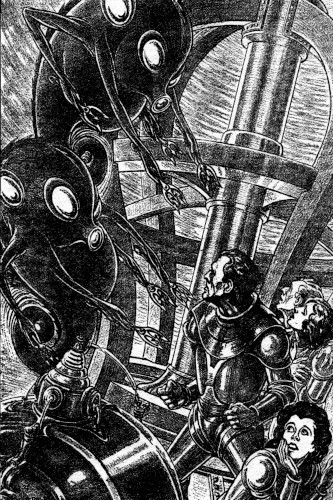
Using Dorothy's method of dimensional reduction, Seaton and the Cranes saw that the hypermen did indeed somewhat resemble overgrown sea horses.
Each of those hands held a grappling trident; a peculiar, four-dimensional hyperforceps whose insulated, interlocking teeth were apparently electrodes—conductors of some hyperequivalent of our Earthly electricity. With unmoved, expressionless "faces" the two visitors floated about the control room, while Seaton and Crane sent out wave after wave of friendly thought and made signs of friendship in all the various pantomimic languages at their command.
"Look out, Mart, they're coming this way! I don't want to start anything hostile, but I don't particularly like the looks of those toad-stabbers of theirs, and if they start any funny business with them maybe we'd better wring their fishy little necks!"
But there was to be no neck-wringing—then. Slight of strength the hypermen were, and of but little greater density than the thin air through which they floated so easily; but they had no need of physical strength—then.
Four tridents shot out, and in a monstrously obscure fashion reached past clothing, skin, and ribs; seizing upon and holding firmly, but painlessly and gently, the vital nervous centers of the human bodies. Seaton tried to leap to the attack, but even his quickness was of no avail—even before he moved, a wave of intolerable agony surged throughout his being, ceasing only and completely when he relaxed, relinquishing his pugnacious attempt. Shiro, leaping from the galley with cleaver upraised, was similarly impaled and similarly subdued.
Then a hoisting platform appeared, and Seaton and Margaret were forced to board it. They had no choice; the first tensing of the muscles to resist the will of the hyperman was quelled instantly by a blast of such intolerable torture that no human body could possibly defy it for even the slightest perceptible instant of time.
"Take it easy, Dot—Mart," Seaton spoke rapidly as the hoist started upward. "Do whatever they say—no use taking much of that stuff—until Peg and I get back. We'll get back, too, believe me! They'll have to take these meat hooks out of us sometime, and when they do they'll think a cyclone has broken loose."
XI.
Raging but impotent, Seaton stood motionless beside his friend's wife upon the slowly rising lift; while Crane, Dorothy, and Shiro remained in the control room of the Skylark. All were helpless, incapable alike of making a single movement not authorized by their grotesque captors. Feeble the hypermen were, as has been said; but at the first tensing of a human muscle in revolt there shot from the insulated teeth of the grappling hypertrident such a terrific surge of unbearably poignant torture that any thought of resistance was out of the question.
Even Seaton—fighter by instinct though he was, and reckless as he was and desperate at the thought of being separated from his beloved Dorothy—had been able to endure only three such shocks. The unimaginable anguish of the third rebuke, a particularly vicious and long-continued wrenching and wringing of the most delicate nerve centers of his being, had left him limp and quivering. He was still furious, still bitterly humiliated. His spirit was willing, but he was physically unable to drive his fiendishly tortured body to further acts of rebellion.
Thus it was that the improvised elevator of the hypermen carried two docile captives as it went past—not through—the spherical arenak shell of Skylark Two and up the mighty well which the vessel had driven in its downward plunge. The walls of that pit were glassily smooth; or, more accurately, were like slag: as though the peculiarly unsubstantial rock of the hyperplanet had been actually melted by the force of the cruiser's descent, easy and gradual as the fall had seemed to the senses of the Terrestrials.
It was apparent also that the hypermen were having difficulty in lifting the, to them, tremendous weight of the two human bodies. The platform would go up a few feet, then pause. Up and pause, up and pause; again and again. But at last they reached the top of the well, and, wretched as he was, Seaton had to grin when he perceived that they were being lifted by a derrick, whose overdriven engine, attended though it was by a veritable corps of mechanics, could lift them only a few feet at a time. Coughing and snorting, it ran slower and slower until, released from the load, it burst again into free motion to build up sufficient momentum to lift them another foot or so.
And all about the rim of that forty-foot well there were being erected other machines. Trusses were rising into the air, immense chains were being forged, and additional motors were being assembled. It was apparent that the Skylark was to be raised; and it was equally evident that to the hypermen that raising presented an engineering problem of no small magnitude.
"She'll be right here when we get back, Peg, as far as those jaspers are concerned," Seaton informed his companion. "If they have to slip their clutches to lift the weight of just us two, they'll have one sweet job getting the old Skylark back up here. They haven't got the slightest idea of what they're tackling—they can't begin to pile enough of that kind of machinery in this whole part of the country to budge her."
"You speak as though you were quite certain of our returning," Margaret spoke somberly. "I wish that I could feel that way."
"Sure I'm certain of it," Seaton assured her. "I've got it all figured out. Nobody can maintain one hundred per cent vigilance forever, and as soon as I get back into shape from that last twisting they gave me, I'll be fast enough to take advantage of the break when it comes."
"Yes; but suppose it doesn't come?"
"It's bound to come sometime. The only thing that bothers me is that I can't even guess at when we're due to snap back into our own three-dimensional space. Since we couldn't detect any motion in an ether wave, though, I imagine that we'll have lots of time, relatively speaking, to get back here before the Skylark leaves. Ah! I wondered if they were going to make us walk to wherever it is they're taking us, but I see we ride—there comes something that must be an airship. Maybe we can make our break now instead of later."
But the hyperman did not relax his vigilance for an instant as the vast, vague bulk of the flier hovered in the air beside their elevator. A port opened, a short gangplank shot out, and under the urge of the punishing trident the two human beings stepped aboard. A silent flurry ensued among the weird crew of the vessel as its huge volume sank downward under the unheard-of mass of the two captives, but no opportunity was afforded for escape—the gripping trident did not relax, and at last the amazed officers succeeded in driving their motors sufficiently to lift the prodigious load into the air of the hyperplanet.
"Take a good, long look around, Peg, so that you can help find our way back," Seaton directed, and pointed out through the peculiarly transparent wall of their conveyance. "See those three peaks over there, the only hills in sight? Our course is about twelve or fifteen degrees off the line of the right-hand two—and there's something that looks like a river down below us. The bend there is just about on line—see anything to mark it by?"
"Well, there's a funny-looking island, kind of heart-shaped, with a reddish-colored spire of rock—see it?"
"Fine—we ought to be able to recognize that. Bend, heart-island, red obelisk on what we'll call the upstream end. Now from here, what? Oh, we're turning—going upstream. Fine business! Now we'll have to notice when and where we leave this river, lake, or whatever it is."
They did not, however, leave the course of the water. For hundreds of miles, apparently, it was almost perfectly straight, and for hours the airship of the hypermen bored through the air only a few hundred feet above its gleaming surface. Faster and faster the hypership flew onward, until it became a whistling, yelling projectile, tearing its way at a terrific but constant velocity through the complaining air.
But while that which was beneath them was apparently the fourth dimensional counterpart of an Earthly canal, neither water nor landscape was in any sense familiar. No sun was visible, nor moon, nor the tiniest twinkling star. Where should be the heavens there was merely a void of utter, absolute black, appalling in its uncompromising profundity. Indeed, the Terrestrials would have thought themselves blind were it not for the forbidding, Luciferean vegetation which, self-luminous with a ghastly bluish-violet pseudo-light, extended outward—flat—in every direction to infinity.
"What's the matter with it, Dick?" demanded Margaret, shivering. "It's horrible, awful, unsettling. Surely anything that is actually seen must be capable of description? But this—" Her voice died away.
"Ordinarily, three-dimensionally, yes; but this, no," Seaton assured her. "Remember that our brains and eyes, now really pseudo-fourth-dimensional, are capable of seeing those things as they actually are; but that our entities—intelligences—whatever you like—are still three-dimensional and can neither comprehend nor describe them. We can grasp them only very roughly by transposing them into our own three-dimensional concepts, and that is a poor subterfuge that fails entirely to convey even an approximate idea. As for that horizon—or lack of it—it simply means that this planet is so big that it looks flat. Maybe it is flat in the fourth dimension—I don't know!"
Both fell silent, staring at the weird terrain over which they were being borne at such an insane pace. Along its right line above that straight watercourse sped the airship, a shrieking arrow; and to the right of the observers and to left of them spread, as far as the eye could reach, a flatly unbroken expanse of the ghostly, livid, weirdly self-luminous vegetation of the unknowable hyperworld. And, slinking, leaping, or perchance flying between and among the boles and stalks of the rank forest growth could be glimpsed fleeting monstrous forms of animal life.
Seaton strained his eyes, trying to see them more clearly; but owing to the speed of the ship, the rapidity of the animals' movements, the unsatisfactory illumination, and the extreme difficulty of translating at all rapidly the incomprehensible four-dimensional forms into their three-dimensional equivalents, he could not even approximate either the size or the appearance of the creatures with which he, unarmed and defenseless, might have to deal.
"Can you make any sense out of those animals down there, Peg?" Seaton demanded. "See, there's one just jumped out of the river and seemed to fly into that clump of bamboolike stuff there. Get any details?"
"No. What with the poor light and everything being so awful and so distorted, I can hardly see anything at all. Why—what of them?"
"This of 'em. We're coming back this way, and we may have to come on foot. I'll try to steal a ship, of course, but the chance that we'll be able to get one—or to run it after we do get it—is mighty slim. But assuming that we are afoot, the more we know about what we're apt to go up against the better we'll be able to meet it. Oh, we're slowing down—been wondering what that thing up ahead of us is. It looks like a cross between the Pyramid of Cheops and the old castle of Bingen on the Rhine, but I guess it's a city—it seems to be where we're headed for."
"Does this water actually flow out from the side of that wall, or am I seeing things?" the girl asked.
"It seems to—your eyes are all right, I guess. But why shouldn't it? There's a big archway, you notice—maybe they use it for power or something, and this is simply an outfall—"
"Oh, we're going in!" Margaret exclaimed, her hand flashing out to Seaton's arm.
"Looks like it, but they probably know their stuff." He pressed her hand reassuringly. "Now, Peg, no matter what happens, stick to me as long as you possibly can!"
As Seaton had noticed, the city toward which they were flying resembled somewhat an enormous pyramid, whose component units were themselves mighty buildings, towering one above and behind the other in crenelated majesty to an awe-inspiring height. In the wall of the foundation tier of buildings there yawned an enormous opening, spanned by a noble arch of metaled masonry, and out of this gloriously arched aqueduct there sprang the stream whose course the airship had been following so long. Toward that forbidding opening the hypership planed down, and into it she floated slowly and carefully.
Much to the surprise of the Terrestrials, however, the great tunnel of the aqueduct was not dark. Walls and arched ceiling alike glowed with the livid, bluish-violet ultra-light which they had come to regard as characteristic of all hyperthings, and through that uncanny glare the airship stole along. Once inside the tunnel its opening vanished—imperceptible, indistinguishable from its four-dimensional, black-and-livid-blue background.
Unending that tunnel stretched before and behind them. Walls and watery surface alike were smooth, featureless, and so uniformly and weirdly luminous that the eye could not fix upon any point firmly enough to determine the rate of motion of the vessel—or even to determine whether it was moving at all. No motion could be perceived or felt and the time-sense had long since failed. Seaton and Margaret may have traveled in that gigantic bore for inches or for miles of distance; for seconds or for weeks of hypertime; they did not then and never did know. But with a slight jar the hypership came to rest at last upon a metallic cradle which had in some fashion appeared beneath her keel. Doors opened and the being holding the tridents, who had not moved a muscle during the, to the Terrestrials, interminable journey, made it plain to them that they were to precede him out of the airship. They did so, quietly and without protest, utterly helpless to move save at the behest of their unhuman captor-guide.
Through a maze of corridors and passages the long way led. Each was featureless and blank, each was lighted by the same eerie, bluish light, each was paved with a material which, although stone-hard to the hypermen, yielded springily, as yields a soft peat bog, under the feet of the massive Terrestrials. Seaton, although now restored to full vigor, held himself rigorously in check. Far from resisting the controlling impulses of the trident he sought to anticipate those commands.
Indeed, recognizing the possibility that the captor might be aware, through those electrical connections, of his very ideas, he schooled his outward thoughts to complete and unquestioning submission. Yet never had his inner brain been more active, and now the immense mentality given him by the Norlaminians stood him in good stead. For every doorway, every turn, every angle and intersection of that maze of communicating passageways was being engraved indelibly upon his brain, he knew that no matter how long or how involved the way, he could retain his orientation with respect to the buried river up which they had sailed.
And, although quiescent enough and submissive enough to all outward seeming, his inner brain was keyed up to its highest pitch, eager to drive Seaton's gigantic and instantaneously reacting muscles into outbursts of berserk fury at the slightest lapse of the attention of the wielder of the mastering trident.
But there was no such lapse. The intelligence of the hyperman seemed to be concentrated in the glowing tips of the forceps and did not waver for an instant, even when an elevator into which he steered his charges refused to lift the immense weight put upon it.
A silent colloquy ensued, then Seaton and Margaret walked endlessly up a spiral ramp. Climbed, it seemed, for hours, their feet sinking to the ankles into the resilient material of the rock-and-metal floor, while their alert guardian floated effortlessly in the air behind them, propelled and guided by his swiftly revolving tail.
Eventually the ramp leveled off into a corridor. Straight ahead, two aisles—branch half right—branch half left—first turn left—third turn right—second doorway on right. They stopped. The door opened. They stepped into a large, officelike room, thronged with the peculiar, sea-horselike hypermen of this four-dimensional civilization. Everything was indescribable, incomprehensible, but there seemed to be desks, mechanisms, and tier upon tier of shelf-like receptacles intended for the storage of they knew not what.
Most evident of all, however, were the huge, goggling, staring eyes of the creatures as they pressed in, closer and closer to the helplessly immobile bodies of the man and the woman. Eyes dull, expressionless, and unmoving to Earthly, three-dimensional intelligences; but organs of highly intelligible, flashing language, as well as of keen vision, to their possessors.
Thus it was that the very air of the chamber was full of speech and of signs, but neither Margaret nor Seaton could see or hear them. In turn the Earthman tried, with every resource at his command of voice, thought, and pantomime, to bridge the gap—in vain.
Then strange, many-lensed instruments were trundled into the room and up to the helpless prisoners. Lenses peered; multicolored rays probed; planimeters, pantographs, and plotting points traced and recorded every bodily part; the while the two sets of intelligences, each to the other so foreign, were at last compelled to acknowledge frustration. Seaton of course knew what caused the impasse and, knowing the fundamental incompatibility of the dimensions involved, had no real hope that communication could be established, even though he knew the hypermen to be of high intelligence and attainment.
The natives, however, had no inkling of the possibility of three-dimensional actualities. Therefore, when it had been made plain to them that they had no point of contact with their visitors—that the massive outlanders were and must remain unresponsive to their every message and signal—they perforce ascribed that lack of response to a complete lack of intelligence.
The chief of the council, who had been conducting the examination, released the forces of his mechanisms and directed his flashing glance upon the eyes of the Terrestrials' guard, ordering him to put the specimens away.
"—and see to it that they are watched very carefully," the ordering eye concluded. "The Fellows of Science will be convened and will study them in greater detail than we have been able to do here."
"Yes, sir; as you have said, so shall it be," the guard acknowledged, and by means of the trident he guided his captives through a high-arched exit and into another labyrinth of corridors.
Seaton laughed aloud as he tucked Margaret's hand under his arm and marched along under the urge of the admonishing trident.
"'Nobody 'ome—they ain't got no sense,' says his royal nibs. 'Tyke 'em awye!'" he exclaimed.
"Why so happy all of a sudden, Dick? I can't see very much change in our status."
"You'd be surprised." He grinned. "There's been a lot of change. I've found out that they can't read our thoughts at all, as long as we don't express them in muscular activity. I've been guarding my thoughts and haven't been talking to you much for fear they could get my ideas some way. But now I can tell you that I'm going to start something pretty quick. I've got this trident thing pretty well solved. This bird's taking us to jail now, I think, and when he gets us there his grip will probably slip for an instant. If it does he'll never get it back, and we'll be merrily on our way."
"To jail!" Margaret exclaimed. "But suppose they put us—I hope they put us in the same cell!"
"Don't worry about that. If my hunch is right it won't make a bit of difference—I'll have you back before they can get you out of sight. Everything around here is thin almost to the point of being immaterial, you know—you could whip an army of them in purely physical combat, and I could tear this whole joint up by the roots."
"A la Samson? I believe that you could, at that." Margaret smiled.
"Yeah; or rather, you can play you're Paul Bunyan, and I'll be Babe, the big blue ox. We'll show this flock of prop-tailed gilliwimpuses just how we gouged out Lake Superior to make a he-man's soup bowl!"
"You make me feel a lot better, Dick, even if I do remember that Babe was forty-seven ax handles across the horns." Margaret laughed, but sobered quickly. "But here we are—oh, I do hope that he leaves me with you!"
XII.
They had stopped beside a metal grill, in front of which was poised another hyperman, his propeller tail idling slowly. He had thought that he was to be Seaton's jailer, and as he swung the barred gate open he engaged the Terrestrial's escort in optical conversation—a conversation which gave Seaton the mere instant of time for which he had been waiting.
"So these are the visitors from outer space, whose bodies are so much denser than solid metal?" he asked curiously. "Have they given you much trouble?"
"None at all. I touched that one only once, and this one, that you are to keep here, wilted at only the third step of force. The orders are to keep them under control every minute, however. They are stupid, senseless brutes, as is of course to be expected from their mass and general make-up. They have not given a single sign of intelligence of even the lowest order, but their strength is apparently enormous, and they might do a great deal of damage if allowed to break away from the trident."
"All right; I'll hold him constantly until I am relieved," and the jailer, lowering his own trident, extended a long, tentacular arm toward the grooved and knobbed shaft of the one whose teeth were already imbedded in Seaton's tissues.
Seaton had neither perceived nor sensed anything of this conversation, but he was tense and alert; tight-strung to take advantage of even the slightest slackening of the grip of the grappling fingers of the controller. Thus in the bare instant of the transfer of control from one weird being to the other he acted—instantaneously and highly effectively.
With a twisting leap he whirled about, wrenching himself free from the punishing teeth of the grapple. Lightning hands seized the shaft and swung the weapon in a flashing arc. Then, with all the quickness of his highly trained muscles and with all the power of his brawny right arm, Seaton brought the controller down full upon the grotesque head of the hyperman.
He had given no thought to the material character of weapon or of objective; he had simply wrenched himself free and struck instinctively, lethally, knowing that freedom had to be won then or never. But he was not wielding an Earthly club or an Osnomian bar; nor was the flesh opposing him the solid substance of a human and three-dimensional enemy.
At impact the fiercely driven implement flew into a thousand pieces, but such was the power behind it that each piece continued on, driving its relentless way through the tenuous body substance of the erstwhile guard. That body subsided instantly upon the floor, a shapeless and mangled mass of oozing, dripping flesh. Weaponless now, holding only the shattered butt of the ex-guard's trident, Seaton turned to confront the other guard who, still holding Margaret helpless, was advancing upon him, wide-open trident to the fore.
He hurled the broken stump; then, as the guard nimbly dodged the flying missile, he leaped to the barred door of the cell. He seized it and jerked mightily; and as the anchor bolts of the hinges tore out of the masonry he swung the entire gate in a full-sweeping circle. Through the soft body the interlaced bars tore, cutting it into ghastly, grisly dice, and on, across the hall, tearing into and demolishing the opposite wall.
"All right, Peg, or did he shock you?" Seaton demanded.
"All right, I guess—he didn't have time, to do much of anything."
"Fine, let's snap it up, then. Or wait a minute, I'd better get us a couple of shields. We've got to keep them from getting those stingarees into us again—as long as we can keep them away from us we can do about as we please around here, but if they ever get hold of us again it'll be just too bad."
While Seaton was speaking he had broken away and torn out two great plates or doors of solid metal, and, handing one of them to his companion, he went on: "Here, carry this in front of you and we'll go places and do things."
But in that time, short as it was, the alarm had been given, and up the corridor down which they must go was advancing a corps of heavily armed beings. Seaton took one quick step forward, then, realizing the impossibility of forcing his way through such a horde without impalement, he leaped backward to the damaged wall and wrenched out a huge chunk of masonry. Then, while the upper wall and the now unsupported ceiling collapsed upon him, their fragments touching his hard body lightly and bouncing off like so many soft pillows, he hurled that chunk of material down the hall and into the thickest ranks of the attackers.
Through the close-packed phalanx it tore as would a plunging tank through massed infantry, nor was it alone. Mass after mass of rock was hurled as fast as the Earthman could bend and straighten his mighty back, and the hypermen broke ranks and fled in wild disorder.
For to them Seaton was not a man of flesh and blood, lightly tossing pillows of eiderdown along a corridor, through an assemblage of wraithlike creatures. He was to them a monstrous being, constructed of something harder, denser, and tougher than any imaginable metal. A being driven by engines of unthinkable power, who stood unharmed and untouched while masses of stone, brickwork, and structural steel crashed down upon his bare head. A being who caught those falling masses of granite and concrete and hurled them irresistibly through rank after rank of flesh-and-blood men.
"Let's go, Peg!" Seaton gritted. "The way's clear now, I guess—we'll show those horse-faced hippocampuses that what it takes to do things, we've got!"
Through the revolting, reeking shambles of the corpse-littered corridor they gingerly made their way. Past the scene of the battle, past intersection after intersection they retraced their course, warily and suspiciously at first. But no ambush had been laid—the hypermen were apparently only too glad to let them go in peace—and soon they were hurrying along as fast as Margaret could walk.
They were soon to learn, however, that the denizens of this city of four-dimensional space had not yet given up the chase. Suddenly the yielding floor dropped away beneath their feet and they fell, or, rather, floated, easily and slowly downward. Margaret shrieked in alarm, but the man remained unmoved and calm.
"'Sall right, Peg," he assured her. "We want to go clear down to the bottom of this dump, anyway, and this'll save us the time and trouble of walking down. All right; that is, if we don't sink into the floor so deep when we hit that we won't be able to get ourselves out of it. Better spread out that shield so you'll fall on it—it won't hurt you, and it may help a lot."
So slowly were they falling that they had ample time in which to prepare for the landing; and, since both Seaton and Margaret were thoroughly accustomed to weightless maneuvering in free space, their metal shields were flat beneath them when they struck the lowermost floor of the citadel. Those shields were crushed, broken, warped and twisted as they were forced into the pavement by the force of the falling bodies—as would be the steel doors of a bank vault upon being driven broadside on, deep into a floor of solid concrete.
But they served their purpose; they kept the bodies of the Terrestrials from sinking beyond their depth into the floor of the hyperdungeon. As they struggled to their feet, unhurt, and saw that they were in a large, cavernous room, six searchlightlike projectors came into play, enveloping them in a flood of soft, pinkish-white light.
Seaton stared about him, uncomprehending, until he saw that one of the hypermen, caught accidentally in the beam, shriveled horribly and instantly into a few floating wisps of luminous substance which in a few seconds disappeared entirely.
"Huh! Death rays!" he exclaimed then. "'Sa good thing for us we're essentially three-dimensional yet, or we'd probably never have known what struck us. Now let's see—where's our river? Oh, yes; over this way. Wonder if we'd better take these shields along? Guess not, they're pretty well shot—we'll pick us up a couple of good ones on the way, and I'll get you a grill like this one as a good club, too."
"But there's no door on that side!" Margaret protested.
"We should fret a lot about that—we'll roll our own as we go along."
His heavy boot crashed against the wall before them, and a section of it fell outward. Two more kicks and they were through, hurrying along passages which Seaton knew led toward the buried river, breaking irresistibly through solid walls whenever the corridor along which they were moving angled away from his chosen direction.
Their progress was not impeded. The hyperbeings were willing—yes, anxious—for their unmanageable prisoners to depart and made no further attempts to bar their path. Thus the river was soon reached.
The airship in which they had been brought to the hypercity was nowhere to be seen, and Seaton did not waste time looking for it. He had been unable to understand the four-dimensional controls even while watching them in operation, and he realized that even if he could find the vessel the chance of capturing it and of escaping in it was slight indeed. Therefore, throwing an arm around his companion, he leaped without ado into the speeding current.
"But, Dick, we'll drown!" Margaret protested. "This stuff must be altogether too thin for us to swim in—we'll sink like rocks!"
"Sure we will, but what of it?" he returned. "How many times have you actually breathed since we left three-dimensional space?"
"Why, thousands of times, I suppose—or, now that you mention it, I don't really know whether I'm breathing at all or not—but we've been gone so long—Oh, I don't believe that I really know anything!"
"You aren't breathing at all," he informed her then. "We have been expending energy, though, in spite of that fact, and the only way I can explain it is that there must be fourth-dimensional oxygen or we would have suffocated long ago. Being three-dimensional, of course we wouldn't have to breathe it in for the cells to get the benefit of it—they can grab it direct. Incidentally, that probably accounts for the fact that I'm hungry as a wolf, but that'll have to wait until we get back into our own space again."
True to Seaton's prediction, they suffered no inconvenience as they strode along upon the metaled pavement of the river's bottom, Seaton still carrying the bent and battered grating with which he had wrought such havoc in the corridor so far above.
Almost at the end of the tunnel, a sharklike creature darted upon them, dreadful jaws agape. With his left arm Seaton threw Margaret behind him, while with his right he swung the four-dimensional grating upon the monster of the deeps. Under the fierce power of the blow the creature became a pulpy mass, drifting inertly away upon the current, and Seaton stared after it ruefully.
"That particular killing was entirely unnecessary, and I'm sorry I did it," he remarked.
"Unnecessary? Why, it was going to bite me!" she cried.
"Yeah, it thought it was, but it would have been just like one of our own real sharks trying to bite the chilled-steel prow off of a battleship," he replied. "Here comes another one. I'm going to let him gnaw on my arm, and see how he likes it."
On the monster came with a savage rush, until the dreadful, outthrust snout almost touched the man's bare, extended arm. Then the creature stopped, dead still in mid-rush, touched the arm tentatively, and darted away with a quick flirt of its powerful tail.
"See, Peg, he knows we ain't good to eat. None of these hyperanimals will bother us—it's only these men with their meat hooks that we have to fight shy of. Here's the jump-off. Better we hit it easylike—I wouldn't wonder if that sandy bottom would be pretty tough going. I think maybe we'd better take to the beach as soon as we can."
From the metaled pavement of the brilliantly lighted aqueduct they stepped out upon the natural sand bottom of the open river. Above them was only the somberly sullen intensity of velvety darkness; a darkness only slightly relieved by the bluely luminous vegetation upon the river's either bank. In spite of their care they sank waist-deep into that sand, and it was only with great difficulty that they fought their way up to the much firmer footing of the nearer shore.
Out upon the margin at last, they found that they could make good time, and they set out downstream at a fast but effortless pace. Mile after mile they traveled, until, suddenly, as though some universal switch had been opened, the ghostly radiance of all the vegetation of the countryside disappeared in an instant, and utter and unimaginable darkness descended as a pall. It was not the ordinary darkness of an Earthly night, nor yet the darkness of even an Earthly dark room; it was indescribably, completely, perfect darkness of the total absence of every ray of light, unknown upon Earth and unknowable to Earthly eyes.
"Dick!" shrieked Margaret. "Where are you?"
"Right here, Peg—take it easy," he advised, and groping fingers touched and clung. "They'll probably light up again. Maybe this is their way of having night. We can't do much, anyway, until it gets light again. We couldn't possibly find the Skylark in this darkness; and even if we could feel our way downriver we'd miss the island that marks our turning-off point. Here, I feel a nice soft rock. I'll sit down with my back against it and you can lie down, with my lap for a pillow, and we'll take us a nap. Wasn't it Porthos, or some other one of Dumas' characters that said, 'He who sleeps, eats'?"
"Dick, you're a perfect peach to take things the way you do." Margaret's voice was broken. "I know what you're thinking of, too. Oh, I do hope that nothing has become of them!" For she well knew that, true and loyal friend though Seaton was, yet his every thought was for his beloved Dorothy, presumably still in Skylark Two—just as Martin Crane came first with her in everything.
"Sure they're all right, Peg." An instantly suppressed tremor shook his giant frame. "They're figuring on keeping them in the Lark until they raise her, I imagine. If I had known as much then as I know now they'd never have got away with any of this stuff—but it can't be helped now. I wish I could do something, because if we don't get back to Two pretty quick it seems as though we may snap back into our own three dimensions and land in empty space. Or would we, necessarily? The time coördinates would change, too, of course, and that change might very well make it obligatory for us to be back in our exact original locations in the Lark at the instant of transfer, no matter where we happen to be in this hyperspace-hypertime continuum. Too deep for me—I can't figure it. Wish Mart was here, maybe he could see through it."
"You don't wish so half as much as I do!" Margaret exclaimed feelingly.
"Well, anyway, we'll pretend that Two can't run off and leave us here. That certainly is a possibility, and it's a cheerful thought to dwell on while we can't do anything else."
They fell silent. Now and again Margaret dozed, only to start awake at the coughing grunt of some near-by prowling hyperdenizen of that unknown jungle, but Seaton did not sleep. He did not even half believe in his own hypothesis of their automatic return to their space ship; and his vivid imagination insisted upon dwelling lingeringly upon every hideous possibility of their return to three-dimensional space outside their vessel's sheltering walls. And that same imagination continually conjured up visions of what might be happening to Dorothy—to the beloved bride who, since their marriage upon far distant Osnome, had never before been separated from him for so long a time. He had to struggle against an insane urge to do something, anything; even to dash madly about in the absolute blackness of hyperspace in a mad attempt—doomed to certain failure before it was begun—to reach Skylark Two before she should vanish from four-dimensional space.
Thus, while Seaton grew more and more tense momently, more and ever more desperately frustrate, the abysmally oppressive hypernight wore illimitably on. Creeping—plodding—d-r-a-g-g-i-n-g endlessly along; extending itself fantastically into the infinite reaches of all eternity.

XIII.
As suddenly as the hyperland had become dark it at last became light. There was no gradual lightening, no dawning, no warning—in an instant, blindingly to eyes which had for so long been straining in vain to detect even the faintest ray of visible light in the platinum-black darkness of the hypervoid, the entire countryside burst into its lividly glowing luminescence. As the light appeared Seaton leaped to his feet with a yell.
"Yowp! I was never so glad to see a light before in all my life, even if it is blue! Didn't sleep much either, did you, Peg?"
"Sleep? I don't believe that I'll ever be able to sleep again! It seemed as though I was lying there for weeks!"
"It did seem long, but time is meaningless to us here, you know."
The two set out at a rapid pace, down the narrow beach beside the hyperstream. For a long time nothing was said, then Margaret broke out, half hysterically:
"Dick, this is simply driving me mad! I think probably I am mad, already. We seem to be walking, yet we aren't, really; we're going altogether too fast, and yet we don't seem to be getting anywhere. Besides, it's taking forever and ever—"
"Steady, Peg! Keep a stiff upper lip! Of course we really aren't walking, in a three-dimensional sense, but we're getting there, just the same. I'd say that we were traveling almost half as fast as that airship was, which is a distinctly cheerful thought. And don't try to think of anything in detail, because equally of course we can't understand it.
"And as for time, forget it. Just remember that, as far as we are concerned, this whole episode is occupying only a thousandth of a second of our own real time, even if it seems to last a thousand years.
"And, above all, get it down solid that you're not nutty—it's just that everything else around here is. It's like that wild one Sir Eustace pulled on me that time, remember? 'I say, Seaton, old chap, the chaps hereabout seem to regard me as a foreigner. Now really, you know, they should realize that I am simply alone in a nation of foreigners.'"
Margaret laughed, recovering a measure of her customary poise at Seaton's matter-of-fact explanations and reassurance, and the seemingly endless journey went on. Indeed, so long did it seem that the high-strung and apprehensive Seaton was every moment expecting the instantaneous hypernight again to extinguish all illumination long before they came within sight of the little island, with its unmistakably identifying obelisk of reddish stone.
"Woof, but that's a relief!" he exploded at sight of the marker. "We'll be there in a few minutes more—here's hoping it holds off for those few minutes!"
"It will," Margaret said confidently. "It'll have to, now that we're so close. How are you going to get a line on those three peaks? We cannot possibly see over or through that jungle."
"Easy—just like shooting fish down a well. That's one reason I was so glad to see that tall obelisk thing over there—it's big enough to hold my weight and high enough so that I can see the peaks from its top. I'm going to climb up it and wigwag you onto the line we want. Then we'll set a pole on that line and crash through the jungle, setting up back-sights as we go along. We'll be able to see the peaks in a mile or so, and once we see them it'll be easy enough to find Two."
"But climbing Cleopatra's Needle comes first, and it's straight up and down," Margaret objected practically. "How are you going to do that?"
"With a couple of hypergrab-hooks—watch me!"
He wrenched off three of the bars of his cell grating and twisted them together, to form a heavy rod. One end of this rod he bent back upon itself, sharpening the end by squeezing it in his two hands. It required all of his prodigious strength, but in his grasp the metal at last, slowly, flowed together in a perfect weld and he waved in the air a sharply pointed hook some seven feet in length. In the same way he made another, and, with a word to the girl, he shot away through the almost intangible water toward the island.
He soon reached the base of the obelisk, and into its rounded surface he drove one of his hyperhooks. But he struck too hard. Though the hook was constructed of the most stubborn metal known to the denizens of that strange world, the obelisk was of hyperstone and the improvised tool rebounded, bent out of all semblance and useless.
It was quickly reshaped, however, and Seaton went more gently about his task. He soon learned exactly how much pressure his hooks would stand, and also the best method of imbedding the sharp metal points in the rock of the monument. Then, both hooks holding, he drove the toe of one heavy boot into the stone and began climbing.
Soon, however, his right-hand hook refused to bite; the stone had so dulled the point of the implement that it was useless. After a moment's thought Seaton settled both feet firmly and, holding the shaft of the left-hand hook under his left elbow, bent the free end around behind his back. Then, both hands free, he essayed the muscle-tearing task of squeezing that point again into serviceability.
"Watch out, Dick—you'll fall!" Margaret called.
"I'll try not to," he called back cheerfully. "Took too much work and time to get up this far to waste it. Wouldn't hurt me if I did fall—but you might have to come over and pull me out of the ground."
He did not fall. The hook was repointed without accident and he continued up the obelisk—a human fly walking up a vertical column. Four times he had to stop to sharpen his climbers, but at last he stood atop the lofty shaft. From that eminence he could see not only the three peaks, but even the scene of confused activity which he knew marked the mouth of the gigantic well at whose bottom the Skylark lay. Margaret had broken off a small tree, and from the obelisk's top Seaton directed its placing as a transit man directs the setting of his head flag.
"Left—'way left!" His arm waved its hook in great circles. "Easy now!" Left arm poised aloft. "All right for line!" Both arms swept up and down, once. A careful recheck—"Back a hair." Right arm out, insinuatingly. "All right for tack—down she goes!" Both arms up and down, twice, and the feminine flagman drove the marker deep into the sand.
"You might come over here, Peg!" Seaton shouted, as he began his hasty descent. "I'm going to climb down until my hooks get too dull to hold, and then fall the rest of the way—no time to waste sharpening them—and you may have to rally 'round with a helping hand."
Scarcely a third of the way down, one hook refused to function. A few great plunging steps downward and the other also failed—would no longer even scratch the stubborn stone. Already falling, Seaton gathered himself together, twisted bars held horizontally beneath him, and floated gently downward. He came to ground no harder than he would have landed after jumping from a five-foot Earthly fence; but even his three-ply bars of hypermetal did not keep him from plunging several feet into that strangely unsubstantial hyperground.
Margaret was there, however, with her grating and her plate of armor. With her aid Seaton struggled free, and together they waded through the river and hurried to the line post which Margaret had set. Then, along the line established by the obelisk and the post, the man crashed into the thick growth of the jungle, the woman at his heels.
Though the weirdly peculiar trees, creepers, and bamboolike shoots comprising the jungle's vegetation were not strong enough to bar the progress of the dense, hard, human bodies, yet they impeded that progress so terribly that the trail-breaker soon halted.
"Not so good this way, Peg," he reflected. "These creepers will soon pull you down, I'm afraid; and, besides, we'll be losing our line pretty quickly. What to do? Better I knock out a path with this magic wand of mine, I guess—none of this stuff seems to be very heavy."
Again they set out; Seaton's grating, so bent and battered now that it could not be recognized as once having been the door of a prison cell, methodically sweeping from side to side; a fiercely driven scythe against which no hyperthing could stand. Vines and creepers still wrapped around and clung to the struggling pair; shattered masses drifted down upon them from above, exuding in floods a viscous, gluey sap; and both masses of broken vegetation and floods of adhesive juices reënforced and rendered even more impassible the already high-piled wilderness of débris which had been accumulating there during time unthinkable.
Thus hampered, but driven to highest effort by the fear of imminent darkness and consequent helplessness, they struggled indomitably on. On and on; while behind them stretched an ever-lengthening, straight, sharply cut streak of blackness in the livid hyperlight of the jungle.
Seaton's great mass and prodigious strength enabled him to force his way through that fantastically inimical undergrowth without undue difficulty, but the unremitting pull and drag of the attacking vines eventually wore down the woman's much slighter physique.
"Just a minute, Dick!" She stopped, strength almost spent. "I hate to admit that I can't stand the pace, especially since you are doing all the real work, as well as wading through the same mess that I am, but I don't believe that I can go on much longer without a rest."
"All right—" Seaton began, but broke off, staring ahead. "No; keep on coming one minute more, Peg—three more jumps and we're through."
"I can go that much farther, of course. Lead on, MacDuff!" and they struggled on.
Seaton had spoken truly. In a few more steps they broke out of the thick growth of the jungle and into the almost-palpable darkness of a great, roughly circular area which had been cleared of the prolific growth. In the center of this circle could be seen the bluely illuminated works of the engineers who were raising Skylark Two. The edge of the great well was surrounded by four-dimensional machinery; and that well's wide apron and its towering derricks were swarming with hypermen.
"Stay behind me, Peg, but as close as you can without getting hit," the man instructed his companion after a hasty but comprehensive study of the scene. "Keep your shield up and have your grating in good swinging order. I'll be able to take care of most of them, I think, but you want to be ready to squash any of them that may get around me or who may rush us from behind. Those stickers of theirs are bad medicine, girl, and we don't want to take any chances at all of getting stuck again."
"I'll say we don't!" she agreed feelingly, and Seaton started off over the now unencumbered ground. "Wait a minute, Dick—where are you, anyway? I can't see you at all!"
"That's right, too. Never thought of it, but there's no light. The glimmer of those plants is pretty faint, at best, and doesn't reach out here at all. We'd better hold hands, I guess, until we get close to the works out there so that we can see what we're doing and what's going on."
"But I've got only two hands—I'm not a hippocampus—and they're both full of doors and clubs and things. But maybe I can carry this shield under my arm, it isn't heavy—there, where are you, anyway?"
Seeking hands found each other, and, hand in hand, the two set out boldly toward the scene of activity so starkly revealed in the center of that vast circle of darkness. So appalling was the darkness that it was a thing tangible—palpable. Seaton could not see his companion, could not see the weapons and the shield he bore, could not even faintly discern the very ground upon which he trod. Yet he plunged forward, almost dragging the girl along bodily, eyes fixed upon the bluely gleaming circle of structures which was his goal.
"But Dick!" Margaret panted. "Let's not go so fast; I can't see a thing—not even my hand right in front of my eyes—and I'm afraid we'll bump into something—anything!"
"We've got to snap it up, Peg," the man replied, not slackening his pace in the slightest, "and there's nothing very big between us and the Skylark, or we could see it against those lights. We may stumble over something, of course, but it'll be soft enough so that it won't hurt us any. But suppose that another night clamps down on us before we get out there?"
"Oh, that's right; it did come awfully suddenly," and Margaret leaped ahead; dread of the abysmally horrible hypernight so far outweighing her natural fear of unseen obstacles in her path that the man was hard put to it to keep up with her. "Suppose they'll know we're coming?"
"Maybe—probably—I don't know. I don't imagine they can see us, but since we cannot understand anything about them, it's quite possible that they may have other senses that we know nothing about. They'll have to spot us mighty quick, though, if they expect to do themselves any good."
The hypermen could not see them, but it was soon made evident that the weird beings had indeed, in some unknown fashion, been warned of their coming. Mighty searchlights projected great beams of livid blue light, beams which sought eagerly the human beings—probing, questing, searching.
As he perceived the beams Seaton knew that the hypermen could not see without lights any better than he could; and, knowing what to expect, he grinned savagely into the darkness as he threw an arm around Margaret and spoke—or thought—to her.
"One of those beams'll find us pretty quick, and they may send something along it. If so, and if I yell jump, do it quick. Straight up; high, wide, and handsome—jump!"
For even as he spoke, one of the stabbing beams of light had found them and had stopped full upon them. And almost instantly had come flashing along that beam a horde of hypermen, armed with peculiar weapons at whose use the Terrestrials could not even guess.
But also almost instantly had Seaton and Margaret jumped—jumped with the full power of Earthly muscles which, opposed by only the feeble gravity of hyperland, had given their bodies such a velocity that to the eyes of the hypermen their intended captives had simply and instantly disappeared.
"They knew we were there, all right, some way or other—maybe our mass jarred the ground—but they apparently can't see us without lights, and that gives us a break," Seaton remarked conversationally, as they soared interminably upward. "We ought to come down just about where that tallest derrick is—right where we can go to work on them."
But the scientist was mistaken in thinking that the hypermen had discovered them through tremors of the ground. For the searching cones of light were baffled only for seconds; then, guided by some sense or by some mechanism unknown and unknowable to any three-dimensional intelligence, they darted aloft and were once more outlining the fleeing Terrestrials in the bluish glare of their livid radiance. And upward, along those illuminated ways, darted those living airplanes, the hypermen; and this time the man and the woman, with all their incredible physical strength, could not leap aside.
"Not so good," said Seaton, "better we'd stayed on the ground, maybe. They could trace us, after all; and of course this air is their natural element. But now that we're up here, we'll just have to fight them off; back to back, until we land."
"But how can we stay back to back?" asked Margaret sharply. "We'll drift apart at our first effort. Then they'll be able to get behind us and they'll have us again!"
"That's so, too—never thought of that angle, Peg. You've got a belt on, haven't you?"
"Yes."
"Fine! Loosen it up and I'll run mine through it. The belts and an ankle-and-knee lock'll hold us together and in position to play tunes on those sea horses' ribs. Keep your shield up and keep that grating swinging and we'll lay them like a carpet."
Seaton had not been idle while he was talking, and when the attackers drew near, vicious tridents outthrust, they encountered an irresistibly driven wall of crushing, tearing, dismembering, and all-destroying metal. Back to back the two unknown monstrosities floated through the air; interlaced belts holding their vulnerable backs together, gripped legs holding their indestructibly dense and hard bodies in alignment.
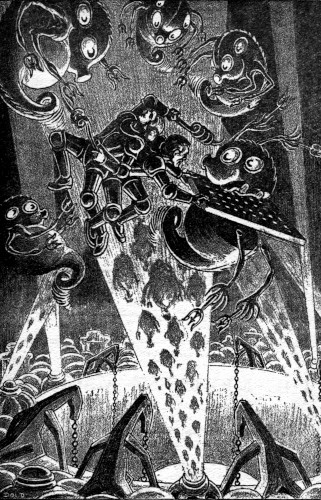
The hypermen encountered an irresistibly driven wall of crushing, tearing, dismembering and all-destroying metal.
For a time the four-dimensional creatures threw themselves upon the Terrestrials, only to be hurled away upon all sides, ground literally to bits. For Margaret protected Seaton's back, and he himself took care of the space in front of him, to right and to left of them, above and below them; driving the closely spaced latticework of his metal grating throughout all that space so viciously and so furiously that it seemed to be omnipresent as well as omnipotent.
Then, giving up hope of recapturing the specimens alive, the hyperbeings turned upon them their lethal beams. Soft, pinkly glowing beams which turned to a deep red and then flamed through the spectrum and into the violet as they were found to have no effect upon the human bodies. But the death rays of the hypermen, whatever the frequency, were futile—the massed battalions at the pit's mouth were as impotent as had been the armed forces of the great hypercity, whose denizens had also failed either to hold or to kill the supernatural Terrestrials.
During the hand-to-hand encounter the two had passed the apex of their flight; and now, bathed in the varicolored beams, they floated gently downward, directly toward the great derrick which Seaton had pointed out as marking their probable landing place. In fact, they grazed one of the massive corner members of the structure; but Seaton interposed his four-dimensional shield and, although the derrick trembled noticeably under the impact, neither he nor Margaret was hurt as they drifted lightly to the ground.
"Just like jumping off of and back into a feather bed!" Seaton exulted, as he straightened up, disconnected the hampering belts, and guided Margaret toward the vast hole in the ground, unopposed now save for the still-flaring beams. "Wonder if any more of them want to argue the right of way with us? Guess not."
"But how are we going to get down there?" asked Margaret.
"Fall down—or, better yet, we'll slide down those chains they've already got installed. You'd better carry all this junk, and I'll kind of carry you. That way you won't have to do anything—just take a ride."
Scarcely encumbered by the girl's weight, Seaton stepped outward to the great chain cables, and hand under hand he went down, down past the huge lifting cradles which had been placed around the massive globe of arenak.
"But we'll go right through it—there's nothing to stop us in this dimension!" protested Margaret.
"No, we won't; and yes, there is," Seaton replied. "We swing past it and down, around onto level footing, on this loose end of chain—like this, see?" and they were once more in the control room of Skylark Two.
There stood Dorothy, Crane, and Shiro, exactly as they had left them so long before. Still held in the grip of the tridents, they were silent, immobile; their eyes were vacant and expressionless. Neither Dorothy nor Crane gave any sign of recognition, neither seemed even to realize that their loved ones, gone so long, had at last returned.
XIV.
Seaton's glance leaped to his beloved Dorothy. Drooping yet rigid she stood there, unmoving, corpselike. Accustomed now to seeing four-dimensional things by consciously examining only their three-dimensional surfaces, he perceived instantly the waxen, utterly inhuman vacuity of her normally piquant and vivacious face—perceived it, and at that perception went mad.
Clutching convulsively the length of hyperchain by which he had swung into the control room he leaped, furious and elementally savage.
So furious was his action that the chain snapped apart at the wall of the control room; so rapid was it that the hyperguard had no time to move, nor even to think.
That guard had been peacefully controlling with his trident the paralyzed prisoner. All had been quiet and calm. Suddenly—in an instant—had appeared the two monstrosities who had been taken to the capital. And in that same fleeting instant one of the monsters was leaping at him. And ahead of that monster there came lashing out an enormous anchor chain, one of whose links of solid steel no ordinary mortal could lift; an anchor chain hurtling toward him with a velocity and a momentum upon that tenuous hyperworld unthinkable.
The almost-immaterial flesh of the hyperman could no more withstand that fiercely driven mass of metal than can a human body ward off an armor-piercing projectile in full flight. Through his body the great chain tore; cutting, battering, rending it into ghastly, pulpily indescribable fragments unrecognizable as ever having been anything animate. Indeed, so fiercely had the chain been urged that the metal itself could not stand the strain. Five links broke off at the climax of the chain's black-snakelike stroke, and, accompanying the bleeding scraps of flesh that had been the guard, tore on past the walls of the space ship and out into the hypervoid.
The guard holding his tridents in Crane and Shiro had not much more warning. He saw his fellow obliterated, true; but that was all he lived to see, and he had time to do exactly nothing. One more quick flip of Seaton's singularly efficient weapon and the remains of that officer also disappeared into hyperspace. More of the chain went along, this time, but that did not matter. Dropping to the floor the remaining links of his hyperflail, Seaton sprang to Dorothy, reaching her side just as the punishing trident, released by the slain guard, fell away from her.
She recovered her senses instantly and turned a surprised face to the man, who, incoherent in his relief that she was alive and apparently unharmed, was taking her into his arms.
"Why, surely, Dick, I'm all right—how could I be any other way?" she answered his first agonized question in amazement. She studied his worn face in puzzled wonder and went on: "But you certainly are not. What has happened, dear, anyway; and how could it have, possibly?"
"I hated like sin to be gone so long, Dimples, but it couldn't be helped." Seaton, in his eagerness to explain his long absence, did not even notice the peculiar implications in his wife's speech and manner. "You see, it was a long trip, and we didn't get a chance to break away from those meat hooks of theirs until after they got us into their city and examined us. Then, when we finally did break away, we found that we couldn't travel at night. Their days are bad enough, with this thick blue light, but during the nights there's absolutely no light at all, of any kind. No moon, no stars, no nothing—"
"Nights! What are you talking about, Dick, anyway?" Dorothy had been trying to interrupt since his first question and had managed at last to break in. "Why, you haven't been gone at all, not even a second. We've all been right here, all the time!"
"Huh?" ejaculated Seaton. "Are you cuckoo, Red-Top, or what—"
"Dick and I were gone at least a week, Dottie," Margaret, who had been embracing Crane, interrupted in turn, "and it was awful!"
"Just a minute, folks!" Seaton listened intently and stared upward. "We'll have to let the explanations ride a while longer. I thought they wouldn't give up that easy—here they come! I don't know how long we were gone—it seemed like a darn long time—but it was long enough so that I learned how to mop up on these folks, believe me! You take that sword and buckler of Peg's, Mart. They don't look so hot, but they're big medicine in these parts. All we've got to do is swing them fast enough to keep those stingaroos of theirs out of our gizzards and we're all set. Be careful not to hit too hard, though, or you'll bust that grating into forty pieces—it's hyperstuff, nowhere near as solid as anything we're used to. All it'll stand is about a normal fly-swatting stroke, but that's enough to knock any of these fan-tailed humming birds into an outside loop. Ah, they've got guns or something! Duck down, girls, so we can cover you with these shields; and, Shiro, you might pull that piece of chain apart and throw the links at them—that'll be good for what ails them!"
The hypermen appeared in the control room, and battle again was joined. This time, however, the natives did not rush to the attack with their tridents; nor did they employ their futile rays of death. They had guns, shooting pellets of metal; they had improvised crossbowlike slings and catapults; they had spears and javelins made of their densest materials, which their strongest men threw with all their power. But pellets and spears alike thudded harmlessly against four-dimensional shields—shields once the impenetrable, unbreakable doors of their mightiest prison—and the masses of metal and stone vomited forth by the catapults were caught by Seaton and Crane and hurled back through the ranks of the attackers with devastating effect. Shiro also was doing untold damage with his bits of chain and with such other items of four-dimensional matter as came to hand.
Still the hypermen came pressing in, closer and closer. Soon the three men were standing in a triangle, in the center of which were the women, their flying weapons defining a volume of space to enter which meant hideous dismemberment and death to any hypercreature. But on they came, willing, it seemed, to spend any number of lives to regain their lost control over the Terrestrials; realizing, it seemed, that even those supernaturally powerful beings must in time weaken.
While the conflict was at its height, however, it seemed to Seaton that the already tenuous hypermen were growing even more wraithlike; and at the same time he found himself fighting with greater and greater difficulty. The lethal grating, which he had been driving with such speed that it had been visible only as a solid barrier, moved more and ever more slowly, to come finally to a halt in spite of his every effort.
He could not move a muscle, and despairingly he watched a now almost-invisible warden who was approaching him, controlling trident outthrust. But to his relieved surprise the hyperforceps did not touch him, but slithered past him without making contact; and hyperman and hyperweapon disappeared altogether, fading out slowly into nothingness.
Then Seaton found himself moving in space. Without volition he was floating across the control room, toward the switch whose closing had ushered the Terrestrials out of their familiar space of three dimensions and into this weirdly impossible region of horror. He was not alone in his movement. Dorothy, the Cranes, and Shiro were all in motion, returning slowly to the identical positions they had occupied at the instant when Seaton had closed his master switch.
And as they moved, they changed. The Skylark herself changed, as did every molecule, every atom of substance, in or of the spherical cruiser of the void.
Seaton's hand reached out and grasped the ebonite handle of the switch. Then, as his entire body came to rest, he was swept by wave upon wave of almost-unbearable relief as the artificial and unnatural extension into the fourth dimension began to collapse. Slowly, as had progressed the extrusion into that dimension, so progressed the de-extrusion from it. Each ultimate particle of matter underwent an indescribable and incomprehensible foreshortening; a compression; a shrinking together; a writhing and twisting reverse rearrangement, each slow increment of which was poignantly welcome to every outraged unit of human flesh.
Suddenly seeming, and yet seemingly only after untold hours, the return to three-dimensional space was finished. Seaton's hand drove through the remaining fraction of an inch of its travel with the handle of the switch; his ears heard the click and snap of the lightning-fast plungers driving home against their stop blocks—the closing of the relay switches had just been completed. The familiar fittings of the control room stood out in their normal three dimensions, sharp and clear.
Dorothy sat exactly as she had sat before the transition. She was leaning slightly forward in her seat—her gorgeous red-bronze hair in perfect order, her sweetly curved lips half parted, her violet eyes widened in somewhat fearful anticipation of what the dimensional translation was to bring. She was unchanged—but Seaton!
He also sat exactly as he had sat an instant—or was it a month?—before; but his face was thin and heavily lined, his normally powerful body was now gauntly eloquent of utter fatigue. Nor was Margaret in better case. She was haggard, almost emaciated. Her clothing, like that of Seaton, had been forced to return to a semblance of order by the exigencies of interdimensional and intertime translation, and for a moment appeared sound and whole.
The translation accomplished, however, that clothing literally felt apart. The dirt and grime of their long, hard journey and the sticky sap of the hyperplants through which they had fought their way had of course disappeared—being four-dimensional material, all such had perforce remained behind in four-dimensional space—but the thorns and sucking disks of the hypervegetation had taken toll. Now each rent and tear reappeared, to give mute but eloquent testimony to the fact that the sojourn of those two human beings in hyperland had been neither peaceful nor uneventful.
Dorothy's glance flashed in amazement from Seaton to Margaret, and she repressed a scream as she saw the ravages wrought by whatever it was that they had gone through.
But Seaton's first thought was for the bodiless foes whom they might not have left behind. "Did we get away, Mart?" he demanded, hand still upon the switch. Then, without waiting for a reply, he went on: "We must've made it, though, or we'd've been dematerialized before this. Three rousing cheers! We made it—we made it!"
For several minutes all four gave way to their mixed but profound emotions, in which relief and joy predominated. They had escaped from the intellectuals; they had come alive through hyperspace!
"But Dick!" Dorothy held Seaton off at arm's length and studied his gaunt, lined face. "Lover, you look actually thin."
"I am thin," he replied. "We were gone a week, we told you. I'm just about starved to death, and I'm thirstier even than that. Not being able to eat is bad; but going without water is worse, believe me! My whole insides feel like a mess of desiccated blotters. Come on, Peg; let's empty us a couple of water tanks."
They drank; lightly and intermittently at first, then deeply.
At last Seaton put down the pitcher. "That isn't enough, by any means; but we're damp enough inside so that we can swallow food, I guess. While you're finding out where we are, Mart, Peg and I'll eat six or eight meals apiece."
While Seaton and Margaret ate—ate as they had drunk, carefully, but with every evidence of an insatiable bodily demand for food—Dorothy's puzzled gaze went from the worn faces of the diners to a mirror which reflected her own vivid, unchanged self.
"But I don't understand it at all, Dick!" she burst out at last. "I'm not thirsty, nor hungry, and I haven't changed a bit. Neither has Martin; and yet you two have lost pounds and pounds and look as though you had been pulled through a knot hole. It didn't seem to us as though you were away from us all. You were going to tell me about that back there, when we were interrupted. Now go ahead and explain things, before I explode. What happened, anyway?"
Seaton, hunger temporarily assuaged, gave a full but concise summary of everything that had happened while he and Margaret were away from the Skylark. He then launched into a scientific dissertation, only to be interrupted by Dorothy.
"But, Dick, it doesn't sound reasonable that all that could possibly have happened to you and Peggy without our even knowing that any time at all had passed!" she expostulated. "We weren't unconscious or anything, were we, Martin? We knew what was going on all the time, didn't we?"
"We were at no time unconscious, and we knew at all times what was taking place around us," Crane made surprising but positive answer. He was seated at a visiplate, but had been listening to the story instead of studying the almost-sheer emptiness that was space. "And since it is a truism of Norlaminian psychology that any lapse of consciousness, of however short duration, is impressed upon the consciousness of a mind of even moderate power, I feel safe in saying that for Dorothy and me, at least, no lapse of time did occur or could have occurred."
"There!" Dorothy exulted. "You've got to admit that Martin knows his stuff. How are you going to get around that?"
"Search me—wish I knew." Seaton frowned in thought. "But Mart chirped it, I think, when he said 'for Dorothy and me, at least,' because for us two time certainly lapsed, and lapsed plenty. However, Mart certainly does know his stuff; the old think tank is full of bubbles all the time. He doesn't make positive statements very often, and when he does you can sink the bank roll on 'em. Therefore, since you were both conscious and time did not lapse—for you—it must have been time itself that was cuckoo instead of you. It must have stretched, or must have been stretched, like the very dickens—for you.
"Where does that idea get us? I might think that their time was intrinsically variable, as well as being different from ours, if it was not for the regular alternation of night and day—of light and darkness, at least—that Peg and I saw, and which affected the whole country, as far as we could see. So that's out.
"Maybe they treated you two to a dose of suspended animation or something of the kind, since you weren't going anywhere—Nope, that idea doesn't carry the right earmarks, and besides it would have registered as such on Martin's Norlaminianly psychological brain. So that's out, too. In fact, the only thing that could deliver the goods would be a sta—but that'd be a trifle strong, even for a hyperman, I'm afraid."
"What would?" demanded Margaret. "Anything that you would call strong ought to be worth listening to."
"A stasis of time. Sounds a trifle far-fetched, of course, but—"
"But phooey!" Dorothy exclaimed. "Now you are raving, Dick!"
"I'm not so sure of that, at all," Seaton argued stubbornly. "They really understand time, I think, and I picked up a couple of pointers. It would take a sixth-order field—That's it, I'm pretty sure, and that gives me an idea. If they can do it in hypertime, why can't we do it in ours?"
"I fail to see how such a stasis could be established," argued Crane. "It seems to me that as long as matter exists time must continue, since it is quite firmly established that time depends upon matter—or rather upon the motion in space of that which we call matter."
"Sure—that's what I'm going on. Time and motion are both relative. Stop all motion—relative, not absolute motion—and what have you? You have duration without sequence or succession, which is what?"
"That would be a stasis of time, as you say," Crane conceded, after due deliberation. "How can you do it?"
"I don't know yet whether I can or not—that's another question. We already know, though, how to set up a stasis of the ether along a spherical surface, and after I have accumulated a little more data on the sixth order it should not be impossible to calculate a volume-stasis in both ether and sub-ether, far enough down to establish complete immobility and local cessation of time in gross matter so affected."
"But would not all matter so affected assume at once the absolute zero of temperature and thus preclude life?"
"I don't think so. The stasis would be sub-atomic and instantaneous, you know; there could be no loss or transfer of energy. I don't see how gross matter could be affected at all. As far as I can see it would be an absolutely perfect suspension of animation. You and Dot lived through it, anyway, and I'm positive that that's what they did to you. And I still say that if anybody can do it, we can."
"'And that,'" put in Margaret roguishly, "as you so feelingly remark, 'is a cheerful thought to dwell on—let's dwell on it!'"
"We'll do that little thing, too, Peg, some of these times; see if we don't!" Seaton promised. "But to get back to our knitting, what's the good word, Mart—located us yet? Are we, or are we not, heading for that justly famed distant Galaxy of the Fenachrone?"
"We are not," Crane replied flatly, "nor are we heading for any other point in space covered by the charts of Ravindau's astronomers."
"Huh? Great Cat!" Seaton joined the physicist at his visiplate, and made complete observations upon the few nebulae visible.
He turned then to the charts, and his findings confirmed those of Crane. They were so far away from our own Galaxy that the space in which they were was unknown, even to those masters of astronomy and of intergalactic navigation, the Fenachrone.
"Well, we're not lost, anyway, thanks to your cautious old bean." Seaton grinned as he stepped over to an object-compass mounted upon the plane table.
This particular instrument was equipped with every refinement known to the science of four great Solar Systems. Its exceedingly delicate needle, swinging in an almost-perfect vacuum upon practically frictionless jeweled bearings, was focused upon the unimaginable mass of the entire First Galaxy, a mass so inconceivably great that mathematics had shown—and even Crane would have stated as a fact—that it would affect that needle from any point whatever, however distant, in universal space.
Seaton actuated the minute force which set the needle in motion, but it did not oscillate. For minute after minute it revolved slowly but freely, coming ultimately to rest without any indication of having been affected in the least by any external influence. He stared at the compass in stark, unbelieving amazement, then tested its current and its every other factor. The instrument was in perfect order and in perfect adjustment. Grimly, quietly, he repeated the oscillatory test—with the same utterly negative result.
"Well, that is eminently, conclusively, definitely, and unqualifiedly that." He stared at Crane, unseeing, his mind racing. "The most sensitive needle we've got, and she won't even register!"
"In other words, we are lost." Crane's voice was level and calm. "We are so far away from the First Galaxy that even that compass, supposedly reactive from any possible location in space, is useless."
"But I don't get it, at all, Mart!" Seaton expostulated, paying no attention to the grim meaning underlying his friend's utterance. "With the whole mass of the Galaxy as its object of attachment that needle absolutely will register from a distance greater than any possible diameter of the super-universe—" His voice died away.
"Go on; you are beginning to see the light," Crane prompted.
"Yeah—no wonder I couldn't plot a curve to trace those Fenachrone torpedoes—our fundamental assumptions were unsound. The fact simply is that if space is curved at all, the radius of curvature is vastly greater than any figure as yet proposed, even by the Fenachrone astronomers. We certainly weren't out of our own space a thousandth of a second—more likely only a couple of millionths—do you suppose that there really are folds in the fourth dimension?"
"That idea has been advanced, but folds are not strictly necessary, nor are they easy to defend. It has always seemed to me that the hypothesis of linear departure is much more tenable. The planes need not be parallel, you know—in fact, it is almost a mathematical certainty that they are not parallel."
"That's so, too; and that hypothesis would account for everything, of course. But how are—"
"What are you two talking about?" demanded Dorothy. "We simply couldn't have come that far—why, the Skylark was stuck in the ground the whole time!"
"As a physicist, Red-Top, you're a fine little beauty-contest winner." Seaton grinned. "You forget that with the velocity she had, the Lark couldn't have been stopped within three months, either—yet she seemed to stop. How about that, Mart?"
"I have been thinking about that. It is all a question of relative velocities, of course; but even at that, the angle of departure of the two spaces must have been extreme indeed to account for our present location in three-dimensional space."
"Extreme is right; but there's no use yapping about it now, any more than about any other spilled milk. We'll just have to go places and do things; that's all."
"Go where and do what?" asked Dorothy pointedly.
"Lost—lost in space!" Margaret breathed.
As the dread import of their predicament struck into her consciousness she had seized the arm rests of her chair in a spasmodic clutch; but she forced herself to relax and her deep brown eyes held no sign of panic.
"But we have been lost in space before, Dottie, apparently as badly as we are now. Worse, really, because we did not have Martin and Dick with us then."
"'At-a-girl, Peg!" Seaton cheered. "We may—be lost—guess we are, temporarily, at least—but we're not licked, not by seven thousand rows of apple trees!"
"I fail to perceive any very solid basis for your optimism," Crane remarked quietly, "but you have an idea, of course. What is it?"
"Pick out the Galaxy nearest our line of flight and brake down for it." Seaton's nimble mind was leaping ahead. "The Lark's so full of uranium that her skin's bulging, so we've got power to burn. In that Galaxy there are—there must be—suns with habitable, possibly inhabited, planets. We'll find one such planet and land on it. Then we'll do with our might what our hands find to do."
"Such as?"
"Along what lines?" queried Dorothy and Crane simultaneously.
"Space ship, probably—Two's entirely too small to be of any account in intergalactic work," Seaton replied promptly. "Or maybe fourth-, fifth- and sixth-order projectors; or maybe some kind of an ultra-ultra radio or projector. How do I know, from here? But there's thousands of things that maybe we can do—we'll wait until we get there to worry about which one to try first."
XV.
Seaton strode over to the control board and applied maximum acceleration. "Might as well start traveling, Mart," he remarked to Crane, who had for almost an hour been devoting the highest telescopic power of number six visiplate to spectroscopic, interferometric, and spectrophotometric studies of half a dozen selected nebulae. "No matter which one you pick out we'll have to have quite a lot of positive acceleration yet before we reverse to negative."
"As a preliminary measure, might it not be a good idea to gain some idea as to our present line of flight?" Crane asked dryly, bending a quizzical glance upon his friend. "You know a great deal more than I do about the hypothesis of linear departure of incompatible and incommensurable spaces, however, and so perhaps you already know our true course."
"Ouch! Pals, they got me!" Seaton clapped a hand over his heart; then, seizing his own ear, he led himself up to the switchboard and shut off the space drive, except for the practically negligible superimposed thirty-two feet per second which gave to the Skylark's occupants a normal gravitational force.
"Why, Dick, how perfectly silly!" Dorothy chuckled. "What's the matter? All you've got to do is to—"
"Silly, says you?" Seaton, still blushing, interrupted her. "Woman, you don't know the half of it! I'm just plain dumb, and Mart was tactfully calling my attention to the fact. Them's soft words that the slatlike string bean just spoke, but believe me, Red-Top, he packs a wicked wallop in that silken glove!"
"Keep still a minute, Dick, and look at the bar!" Dorothy protested. "Everything's on zero, so we must be still going straight up, and all you have to do to get back somewhere near our own Galaxy is to turn it around. Why didn't one of you brilliant thinkers—or have I overlooked a bet?"
"Not exactly. You don't know about those famous linear departures, but I do. I haven't that excuse—I simply went off half cocked again. You see, it's like this: Even if those gyroscopes could have retained their orientation unchanged through the fourth-dimensional translation, which is highly improbable, that line wouldn't mean a thing as far as getting back is concerned.
"We took one gosh-awful jump in going through hyperspace, you know, and we have no means at all of determining whether we jumped up, down, or sidewise. Nope, he's right, as usual—we can't do anything intelligently until he finds out, from the shifting of spectral lines and so on, in what direction we actually are traveling. How're you coming with it, Mart?"
"For really precise work we shall require photographs of some twenty hours' exposure. However, I have made six preliminary observations, as nearly on rectangular coördinates as possible, from which you can calculate a first-approximation course which will serve until we can obtain more precise data."
"All right! Calcium H and calcium K—Were they all type G?"
"Four of them were of type G, two were of type K. I selected the H and K lines of calcium because they were the most prominent individuals appearing in all six spectra."
"Fine! While you're taking your pictures I'll run them off on the calculator. From the looks of those shifts I'd say I could hit our course within five degrees, which is close enough for a few days, at least."
Seaton soon finished his calculations. He then read off from the great graduated hour-space and declination-circles of the gyroscope cage the course upon which the power bar was then set, and turned with a grin to Crane, who had just opened the shutter for his first time exposure.
"We were off plenty, Mart," he admitted. "The whole gyroscope system was rotated about ninety degrees minus declination and something like plus seven hours' right ascension, so we'll have to forget all our old data and start out from scratch with the reference planes as they are now. That won't hurt us much, though, since we haven't any idea where we are, anyway.
"We're heading about ten degrees or so to the right of that nebula over there, which is certainly a mighty long ways off from where I thought we were going. I'll put on full positive and point ten degrees to the left of it. Probably you'd better read it now, and by taking a set of observations, say a hundred hours apart, we can figure when we'll have to reverse acceleration.
"While you're doing that I thought I'd start seeing what I could do about a fourth-order projector. It'll take a long time to build, and we'll need one bad when we get inside that Galaxy. What do you think?"
"I think that both of those ideas are sound," Crane assented, and each man bent to his task.
Crane took his photographs and studied each of the six key nebulae with every resource of his ultrarefined instruments. Having determined the Skylark's course and speed, and knowing her acceleration, he was able at last to set upon the power bar an automatically varying control of such a nature that her resultant velocity was directly toward the lenticular nebula nearest her former line of flight.
That done, he continued his observations at regular intervals—constantly making smaller his limit of observational error, constantly so altering the power and course of the vessel that the selected Galaxy would be reached in the shortest possible space of time consistent with a permissible final velocity.
And in the meantime Seaton labored upon the projector. It had been out of the question, of course, to transfer to tiny Two the immense mechanism which had made of Three a sentient, almost a living, thing; but, equally of course, he had brought along the force-band transformers and selectors, and as much as possible of the other essential apparatus. He had been obliged to leave behind, however, the very heart of the fifth-order installation—the precious lens of neutronium—and its lack was now giving him deep concern.