Front matter (continued 4)
Reading edition
"As a matter of fact, wasn't he mistaken?"
"In what way?" said McKenna, steeling himself under an appearance of surprise.
"Were not the detectives your own men—placed by you at Mr. Slade's orders to acquaint him with every move of Mr. Majendie?" persisted Mrs. Kildair.
"That would make a good Sunday thriller," said McKenna, laughing boisterously.
"That is my guess," she said, drawing back as though satisfied. "I am certain that Majendie committed suicide through the blunder of believing he was threatened with arrest."
"My dear Mrs. Kildair," said the detective, rising, "I see that what you want to know is, am I for or against Mr. Slade. If I'm not in his employ you think I'm retained by his enemies. Well, I don't intend to give you any information."
She made no answer, but, rising in turn, glanced at the clock.
"Since you are here," she said carelessly, "you may as well look over the ground." And, without waiting, she went to the door. "This is my bedroom. The ring was placed here."
He had hardly made his quick professional scrutiny when there came a ring at the door, and at a sign from Mrs. Kildair they returned to the studio.
"What now?" thought McKenna, who remembered her glance at the clock. "Slade or who?"
To his surprise, it was Beecher who entered. Mrs. Kildair went directly to him, a smile of confidence and welcome on her face, holding out an eager hand, and by the elation of her movements, the detective comprehended how she had played him.
"Teddy," she said directly, "I have a favor to ask you, and I trust you so completely that I know I need not explain it further. Mr. McKenna and I have had a very complete understanding. I wish him to represent me entirely. I do not mean that you should not continue to work on the case," she added quickly, as she felt instinctively the gesture of warning McKenna made behind her back. "All I wish you to tell him is that anything I may have told him or will tell him shall be considered confidential until the time I am able to tell you myself. I must throw myself on your chivalry and protection as the fine gentleman I have seen you to be," she added, looking at him with a moistening of the eyes in which there was respect and a more tender emotion.
McKenna, though perceiving how completely she had prepared the isolation of the confidence he had just heard, did not again signal his objection, perhaps divining the futility of opposing such an appeal.
Beecher bowed in assent.
"Certainly, Rita," he said, with a pride that brought a smile of amusement to McKenna's lips. "I wish McKenna to do everything he can for you and in exactly the way you wish."
"Thank you," she said, with a little pressure of his hand. Then turning, she added: "This I will say to you both. I have my reasons for believing that the ring will be returned within ten days; if it isn't then I shall have more to disclose."
"Returned?" said Beecher, struck by the similarity of her prophecy and that of Nan Charters.
"Exactly. Until then, I believe all that is necessary is to wait for developments." She turned toward the detective, who waited like a statue. "Mr. McKenna, I know you are a busy man. I won't keep you. Mr. Beecher has come to assist me on a very painful errand, one on which I would trust no other man that I know in New York." She held out her hand. "I do not often make mistakes in men, or I should not have told you what I did. Good-night; I shall call you soon."
McKenna bowed, experiencing, despite his resentment at her mastery of the evening, a feeling of respect and deference.
"Beecher is a kitten in her hands," he said to himself as he entered the street. "She played me as she wanted to. One thing's certain. She wants to employ me to keep me from doing anything. Evidently her own game is more important than the ring—or is there blackmail mixed up in this? I have it! Mrs. Kildair knows the thief, but is afraid to act until—until certain things straighten out between her and Mr. John G. Slade."
"And now, Teddy," said Mrs. Kildair, as soon as the door had closed behind the detective, "you know what I want of you. I have arranged everything. My carriage is waiting."
Half an hour later, Mrs. Bloodgood joined them, heavily veiled. They drove to the house next to that of Majendie, and, at a word from Mrs. Kildair, Beecher remained below on guard in the flickering obscurity of the street. The two women went hurriedly up the steps of Majendie's home, where the door was opened for them by some one who had been awaiting their arrival.
For a full half-hour Beecher, prey to a profound melancholy, continued his aimless, mechanical pacing, his head raised, glancing past the jagged black silhouettes of the house-tops at the reddened clouds of the unreal night, which brought him not a clear vision of immense and purifying spaces but the heavy reflection of the illuminated, surging streets.
"What will my life be?" he thought, conjuring up the future. "Calm and commonplace? Or shall I ever be linked to some such tragedy—torn to pieces, all in a day—wrecked!"
The door opened and two shadows passed down the steps. He returned hastily, saw them into the carriage, and stood with uncovered head, a lump in his throat, as they drove on. Then he went directly to his rooms, and, exhausted by the emotions of the day, fell heavily into a sleep that was almost a stupor.
CHAPTER XV
The next morning he was awakened by Gunther's abrupt hand.
"Up, up, you sluggard!"
He jumped out hastily and found it was almost half-past eight.
"Nice time to sleep," said Gunther sarcastically. "Have you forgotten a little visit we're to make to that sweet person, Mr. Garraboy? You've got just twenty-two minutes to beautify yourself and fill the inner being."
"If we're to see your charming friend, Mr. Garraboy," said Gunther half an hour later, as they were speeding for the congested, stirring, lower city, "we've got to nip our man before the opening of the Stock Exchange. Now let's hear what happened at Mrs. Kildair's last night."
The events in which Mrs. Bloodgood was concerned were sealed in confidence; but Beecher felt at liberty to recount to his friend the bare details of McKenna's visit as he had known them.
"What the deuce is behind it all?" said Gunther, puzzled. "I got McKenna on the wire and that's all he would tell me. What's the reason she wants to bottle up everything? What's her mix-up with Slade? Depend upon it, Ted, that woman knows more than we do—or why should she expect the ring to be returned? She's got a reason for that."
"If it's returned," said Beecher, "it's Mrs. Bloodgood who took it."
"Never! No woman ever got that ring out of the apartment—not alone; not a Mrs. Bloodgood, or a Nan Charters, or a Mrs. Cheever, or—" Suddenly he reflected. "Ted, there's one person I'd like to meet."
"Miss Lille?"
"Yes. Supposing we look her up a little more."
"I've thought quite a lot about her," said Beecher musingly; and, remembering all at once her self-possession on the night of the theft, he added: "There's nothing weak about her certainly; still, I can't see the motive."
They had left behind them the free, unbounded sky, boring their way through the towering sides of the sky-scraping district, where buildings rose in regular, comb-like structures, with their thousands of human cells tenanted by human bees. Entering a street where the obstructed sun never shone, they were swept on by the feverish rush of fellow-beings and shot up sixteen stories to their destination. The office-boy in the antechamber took their cards with the condescension which only an office-boy between the ages of twelve and sixteen can feel, and disappeared within.
"The old screw'll keep us waiting half an hour, said Gunther, who disliked all delays.
"Bet he's trying to figure out what we're here for?" said Beecher, who admitted to himself a delicious satisfaction at the prospective humiliation of the man he cordially disliked.
The next moment Garraboy himself appeared at the rail, dapper, dried up, and severe.
"How do you do?" he said sharply, but without inviting them in. "What can I do for you? It's a very busy day for me."
"I assure you I don't intend to take any more time than I am compelled to," said Beecher stiffly, with an accent that gave another meaning to the phrase. He plunged his hand into his pocket. "I have an order for you."
"Oh, yes, I remember now," said Garraboy, with a malicious drawing up of his lips. "You can save yourself the trouble."
"What do you mean?" asked Beecher, greatly surprised.
"You have an order on me to deliver certain stocks I hold for Miss Charters?"
"I have."
"Well, Miss Charters has changed her mind," said Garraboy, letting his glance rest on Beecher with the vacant, impudent stare of which he was master.
"You have seen Miss Charters?" said Beecher, growing very angry.
"I have; and when I explained to her that she had been unduly excited by some one who evidently is not aware that there are laws in civilized countries adequate to deal with those who attack the reputations or interests—"
"Sir!" exclaimed Beecher, moving so quickly toward the rail that Garraboy hastily retreated.
"When Miss Charters learned that, and likewise that she had parted with stocks worth considerably over twenty thousand dollars, she changed her mind very quickly."
"Mr. Garraboy," said Gunther abruptly, "all this is not to the point. We have a formal order on you for certain stocks. Ted, present it."
"True, I forgot," said Garraboy, and produced from his coat a letter, which he looked over with nonchalant delay and finally handed to Beecher. "I presume you are acting from altruistic motives and are not standing on technicalities. Here is a little note which Miss Charters requested me to give you."
"That has nothing to do with it," said Gunther at once, for the personality of the broker aroused the pugnacious side of him. "Your transaction has been closed. Get your stocks."
Beecher, frowning, unable to conceal the vexation that this unexpected check brought him, opened the letter. The address by its formality completed his irritation:
DEAR MR. BEECHER:
Mr. Garraboy has called and explained everything satisfactorily. I am afraid I was needlessly alarmed last night and did him an injustice. As he has shown me how advantageous it will be for me to transfer my holdings to other stocks, now far below their market value, I have decided not to lose the opportunity. Thank you just the same for your interest in this matter. I shall be in at five this afternoon and will explain to you more fully.
Cordially yours,
NAN CHARTERS.
The two watched him read to the end, fold the letter carefully, and put it in his pocket.
"Well?" said Garraboy.
"Insist on the delivery, Ted," said Gunther militantly. "If Miss Charters wants to return them again, that's her affair. The stocks are yours."
He looked at his friend with a glance of warning which sought to convey to him the distrust he could not openly phrase.
"If Mr. Beecher wishes to stand on technicalities," said Garraboy, in his even, oily voice, "he can do so. He can make a very nice profit. Which is it? I repeat, I can not give you much time."
"Miss Charters' letter is sufficient," said Beecher suddenly. "Good-day."
The feeling of mortification and chagrin which her action had brought on him dominated all other feelings. He went out in a rage, tearing the letter into minute fragments. Without a word they reached the street and entered the automobile.
"Last time I ever try to help a woman!" he said, between his teeth.
"What the deuce did you play into his game for?" said Gunther. "He's bamboozled her. I believe the fellow is an out-and-out crook—he's got a rotten bad eye. Why the deuce didn't you get the stocks?"
"She can take her own risks," said Beecher furiously. "It's her own affair if she's going to blow hot and cold. By Jove, Bruce, I never met any one who could make me so mad clear through and through."
He stopped, biting his lips, and Gunther with a shy glance stored away for future comment the impression he received.
"What's the use of taking them seriously?" he said, with a shrug of the shoulders. "Amuse yourself, but don't let them absorb you. Suppose we take a turn at the Curb and see what's doing."
With the opening of the market, all the giant sides of Wall Street seemed suddenly animated with the fury of a disturbed ant-hill. Every one was rushing in and out, carrying with them the pollution of disaster and alarm. Eddie Fontaine and Steve Plunkett hurried past them with quick nods. At the curb market the brokers were shrieking and flinging their frantic signals in the air. They entered the Stock Exchange, nodding to the doorkeeper, who knew Gunther, and reached the balcony, their ears suddenly smitten with the confused uproar from below. They stood there a few minutes, marveling at that Inferno of speculation and embattled greed flung before them in all the nakedness of man's terror; and then left, oppressed by the too frank exhibition of their mortal counterparts.
"What's doing?" asked Gunther as they returned.
The doorkeeper, with a shrug of his shoulders, flung down his thumb—the gesture of the Roman circus.
"You like that?" said Beecher, when once more they were in the automobile and the din and oppression of cell-like monstrosities had receded.
"I do," Gunther replied, locking and unlocking his broad hands.
"Horrible!"
"That's only one side of it—speculation," said Gunther warmly; "but even that is impressive. Look beyond those little mobs we saw, get the feeling of the whole country, the vast nation, rising in anger—flinging over hundreds of thousands of holdings—sweeping down the little gamblers with the tremendous waves of its alarm. Beyond that the whole vibrating industry of the nation is here, within a quarter of a mile—the great projects of development, the wars of millions, the future of immense territories to the West and the South. There's a big side to it—a real side—that gets me. I've a mind to walk down now and face the old governor and tell him I'm ready."
"Why don't you?" said Beecher. He himself had felt the restlessness of indecision and enforced idleness. He gave a laugh. "You know, Bruce, I'm beginning to feel the same way. Either I've got to get into the current somewhere, or I'm going to pack off for Africa some fine day."
"By the way, Tilton's up at the club. He's here for a few days, getting ready for a lion hunt or something."
"Tilton?" exclaimed Beecher joyfully. "By Jove, I must get hold of him. I'd go in a minute!"
He believed what he said. The whirl of emotions into which he had lately been plunged—revealing to him as it had all the mercenary, clutching side of the city—had left him disturbed, rebellious, longing to be away from the mass of men in general, and of women in particular, the brilliant, keen, and calculating women of the city with whom he had been thrown. Impatient and disillusionized, without realizing the true cause, he repeated:
"By Jove, I'd go in a minute!"
In the afternoon he went to call on Miss Charters. After having declared twenty times that he would not go near her, he suddenly remembered, at the end of a wearied discussion between his conscience and his inclination, that his check for twenty thousand dollars was to be reclaimed and, at once seizing such a satisfactory reason, he abandoned the attitude of embattled dignity which he had logically built up.
"That's true; I must get the check," he said, and he set out.
But as he neared his destination and began to rehearse all the grave causes for offense that he held against her, he was surprised at the slender stock of ammunition he held.
"Why, it was perfectly natural," he thought, struck by the idea—having considered her reasons for the first time. "If Garraboy called and explained everything to her satisfaction, why shouldn't she change her mind? Besides, there is nothing against Garraboy—nothing definite. After all, I may have been unjust to him."
Very sheepish, he felt his irritation slipping away as he yielded to the eager desire of once more entering her presence.
"What the deuce was I so wild about?" he asked himself, amazed, as he entered the elevator.
But all at once he remembered that she had allowed him to receive the news at the hands of a person intensely disagreeable to him.
"Why didn't she telephone me? That's the whole point."
And, all his irritation restored by this one outstanding fact, he entered the apartment with the dignity of a justly offended person.
She was seated by the fire in an easy-chair, and she did not rise as he entered. She was bending eagerly forward, an open manuscript in her hand, and, without turning, she made a little sign to him to be seated until she should have finished.
"Wonderful!" she cried at last, dropping the play in her lap. "It is wonderful!" she repeated, her whole body vibrating with the enthusiasm of her mood. "Wonderful—astonishing—what a scene!" And, tapping the manuscript with a gesture of decision, she exclaimed: "I will play that part—it will be an enormous sensation!"
Her mind still obsessed by the thought of the newly discovered masterpiece, she turned toward Beecher, who was seated like a ramrod on the edge of his chair.
"A marvelous play! Really, that Mr. Hargrave is a coming man." Forgetting her previous estimate, she rushed on: "Isn't it strange—I always knew he would do it, from the very first! What is extraordinary is the subtlety of it—how he twines two or three emotions together in the same scene. What a glorious chance for an actress! I must telephone the office."
As she rose, a slip of paper which she had been using as a marker fluttered to the floor. She picked it up, recognized it, and handed it to him.
"Oh, yes, here's your check!" she said. "I put it there so as not to forget it. Thanks very much. I'll explain in a minute. I must telephone Stigler; I'm all excited!"
Beecher, more annoyed by this revelation of her professional life than by the rub to his vanity, took the check and pocketed it—not having pronounced a word since his arrival.
She considered him carefully from the corner of her eye as she took up the telephone; but her personal emotion was too buoyant for trivial interruptions.
Stigler, her manager, was out, and she put down the receiver with a jar of impatience. She looked at Beecher again, and, perceiving that there was an explanation due, sought at once to shift the responsibility.
"Do you know, really, you were ridiculously alarmed last night," she said, a spirit of opposition in her voice. "I don't know what made you so panicky."
"Of course," he said sarcastically, "I realize now that I should never have stirred you up, when everything was so calm. It's strange that I did not explain to you the natural reasons for Mr. Garraboy's not calling you up—but then, I usually lose my head at such times."
"You are angry!" she said.
"What a strange idea! On the contrary, it was a charming experience to enter Mr. Garraboy's office and be so delightfully reassured that everything was so prosperous with him."
She did not like irony, or know how to combat it, so she frowned and said:
"I telephoned you."
"Why should you do that? You might have deprived me of the pleasure of meeting your charming friend, Mr. Garraboy."
"I telephoned. You were not in."
"When?"
"Last night. Four times."
He was mollified by this, but tried not to show it.
"And this morning?"
"But I never get up before ten," she cried, aghast.
"Your explanations are crushingly convincing," he said, with a bow and a smile.
She watched him with an uneasy look, totally unconscious of any sense of obligation, accustomed as she was to have her requests for service regarded as favors. The reaction from their last interview had left her in a coldly antagonistic state, determined to pluck in the bud this progress toward intimacy which had so threatened her scheme of life. Now, seeing him collected and ironical, she was instinctively alarmed at the distance which he, not she, had placed between them.
"My dear Teddy," she began, in a more confidential tone.
"Teddy?" he said, smiling.
He was perfectly good-natured, and as she felt that he was not irritated, but amusing himself at her tricks which he had divined, she was uneasy under this ironical examination. She felt that he had escaped her; and, disturbed by this thought, she looked at him, seeing all at once his quality. As he had made not the slightest reference to the very apparent obligation which he had been willing to undergo for her, she felt his social superiority and his reticence of good breeding. Besides, other women—brilliant women—had been attracted by him: Mrs. Craig Fontaine, Mrs. Kildair, and, above all, Emma Fornez. But another mood had possession of her, the mood of the artist transformed by the joy of personal sensation. She wished to keep him, but at the moment she was irritated that such a little thing should come to interfere with the joy of the imagined future triumph.
"Don't be horrid, Teddy," she said impatiently, and, wishing to appease him quickly, that she might talk to him of the play, she continued: "The fact is, Mr. Garraboy has done everything he could for me. He sold my stocks a week ago, foreseeing this panic, and saved me several thousand dollars. He offered to give me his check for twenty-two thousand five hundred dollars, or to reinvest it for me when the time came in the enormous bargains that can be picked up now. What was I to do?"
"You're quite right, and I made a great mistake to mislead you so," he answered, with great seriousness.
"It wasn't your fault," she said abruptly.
"Wasn't it?" he said, opening his eyes with a show of surprise.
She comprehended that she would have to surrender, and, changing her tone to one of gentleness, she said:
"It was a great thing for you to do what you did, Teddy—I shall never forget it."
"Nonsense," he said, persisting in misunderstanding her. "I often get up early—that was nothing at all."
"You are not at all the way you were last time," she said reproachfully, forgetting that that was just what she wished to avoid.
But at this moment the telephone rang. Stigler, her manager, was calling. Immediately she forgot their misunderstanding, carried away by the enthusiasm of the moment. Beecher, with a clear vision, followed her, noticing in her voice, as she sought to cajole the manager, the same caressing pleading which she had employed a moment before with him.
"Now I really see her," he thought, with a liberation of his spirit. "Emma was entirely wrong. She's not a woman—she always an actress."
"I'll send you the play right away," she was saying. "Mr. Hargrave is coming. I'll have him take it to the hotel. But you must read it tonight. Promise! Oh, yes, lots of comedy—delicious! Heart interest and big scenes—yes, sensational. Just the part for Fannestock. I must have him for the part! You'll see him in every line! Now, Mr. Stigler, please read it tonight!"
"Ah, there's Fannestock too," said Beecher grimly to himself.
She rose from telephoning, joyous and excited.
"Oh, if Stigler will only see it! It's a great part—a great part! There's a wonderful scene at the close of the third act, between the two women and the father, that will bring down the house."
Miss Tilbury came in to announce that Mr. Hargrave was calling. An expression of delight lit up the features of the actress. But all at once she turned anxiously to Beecher, who had risen stiffly.
"By Jove, I've overstayed my time," he said readily, glancing at the clock.
She was grateful, and yet dissatisfied that he had suggested what she wished, and, recalling his new spirit of independence, she said anxiously, with a compensating smile:
"Teddy, call me up in the morning—this is so important."
In the hallway he stepped aside while Hargrave, a frail, oldish-young man, entered, with his famished, doubting glance.
"Oh, it is wonderful—wonderful!" cried the actress, seizing both his hands. "I am still thrilled. Wonderful—-wonderful!"
"You liked it?" said Hargrave timidly. At her words, he saw heaven open before his eyes in a confused vision of frantic audiences, applauding critics, checks for thousands for royalty, all confused by rolling automobiles, magnificent bouquets and languishing feminine eyes.
"Like it!" continued Nan Charters, retaining hold of one hand to draw him into the salon. "It is marvelous! How could you know all this so young!"
Beecher, in the excitement, quietly made his escape. In the elevator, to the surprise of the wondering bell-boy, he was seized with a mad laughter, which continued to convulse him as he rolled into the street.
"Heaven be praised!" he exclaimed. "Cured—cured, by Jove! I wouldn't have missed it for worlds!"
On turning the corner of his club, he ran into Becker, a club acquaintance whom he tolerantly disliked.
"Becker, old boy," he said, seizing his arm and flourishing his cane in the direction of the club, "what can I buy you? Come on—en avant!"
"What the deuce has got in you?" said that correct youth.
"Joy, laughter, everything! I'm happy as a Croton water-bug on a hot marble slab!"
At the bar, he gathered every one in sight, slapping them on their shoulders. His comrades looked at him with envy and awe, believing that he had profited by a tip to make a killing in the market. Their own enjoyment was little enough. The market, outdoing the day before, had plunged like a wild steer into the maelstrom of panic. A billion dollars had receded, scattered, evaporated in the mad day. The disaster had reached the whole country; every bank was threatened. The United States Treasury had been implored to come to the assistance of the country. Gunther, Fontaine, Marx, Haggerty, were in hourly conference; while before the swelling hurricane of fright, every paper was imploring its readers to stand firm.
CHAPTER XVI
The next day Beecher did not consider for a moment telephoning to Nan Charters, despite her last request. He felt that it was a chapter closed in his life—one of those innumerable false paths down which one plunges, only the quicker to return. His own serenity did not even surprise him. He went off for the morning to play rackets with Bruce Gunther, and lunched at the club with Tilton, who urged him to join his hunt, an invitation which he discussed with enthusiasm.
The news from the stock market was the same—ten point losses in the early trading. Banks all over the country had suspended payments for a week in order to weather the storm. The panic had ceased to be one of speculative concern only. Every one was anxiously asking if a permanent blow had not been dealt to the industries of the country. Many freely prophesied that, if the downward rush were not checked within three days, it would take the country ten years to restore its shattered prosperity. There was a rumor that the big men of the Street had made up a fund, reaching to many millions, which would be brought on the morrow to the support of the market. The run on the Associated Trust still continued, checked though it was by delay and technicalities. Yet the fall of Slade was hourly predicted.
Beecher lingered after luncheon, played a hundred points at billiards and won, an hour's bridge and won again. Then he went off in high spirits to call on Emma Fornez, an appointment arranged over the telephone.
"So, you bad boy, you and your little Charters have quarreled," said the prima donna, greeting him with an accusing smile, though in her voice was the pitch of the nervous excitement which her coming début that night had communicated.
"Not in the least," he said, a little surprised at the insinuation.
"Ta-ta-ta! Enough of your stuff and nonsense," she said, with a shrug of her shoulders. "You are too big a simpleton—a little woman like that will always get the best of you."
"But there is no quarrel, and I am not in the least interested."
"Oh, avec ça—keep away—better keep away! You will burn your fingers. Just the kind of a little doll that is dangerous. Women like that are like half colors between one thing and the other—very dangerous! A young girl—jeune fille—would bore you now, and an old campaigner like Emma Fornez would amuse you; but a little thing like that is too puzzling for you. I see just how it is," she continued, placing her hands on her hips and bobbing her head energetically, while Beecher, very much pleased to be so lectured, listened with a mocking look. "Yes, yes, I know very well! She gets you—how do you say?—going and coming. When she is an actress you say she is different from the rest—what a child! And when she is playing the child, you say what a difference—she is such an artist! You laugh—see!"
Beecher broke out laughing at this characterization which came so near the truth.
"What I have said is very good—very good," repeated Emma Fornez, pleased. "It's all studied, very carefully studied out, but it takes with young simpletons, big geese, good-looking boys—don't I know? Est-ce-que j'en ai joué de ces tours là? Come, now, what did you fight about?"
Beecher had an inclination to take her into his confidence; but he resisted the impulse, and to turn the conversation said artfully:
"By Jove, you look stunning! You won't have to sing a note."
She was in a filmy peignoir, and, as his glance showed an amused admiration, she said, with a look of apology which she did not feel at all, gathering the peignoir closer with a perfectly simulated modesty:
"It's very bad—my receiving you like this. I am going through my costumes. They are dreams. Wait, you shall see—you wish to see them? Good!" All at once she stopped and, seizing his arm, cried: "Teddy, I am in a cold fright—I shiver all over whenever I think of it. New York audiences are terrible. It will be a big, big failure, won't it?"
"There, I'll give you my lucky piece," he said, patting her shoulder as he would a child's.
"Will you!" she cried, delighted; and; running into the bedroom, she called back: "I will show you the costume for the second act first. You will fall down and adore me. Keep me talking, Teddy—I shall go into hysterics. Oh, I am so frightened!"
She tried her voice, singing a scale, inquiring anxiously, her head peering around the door: "That sounds bad, hein?"
"Marvelous!" said Beecher, who did not know one note from another.
Reassured, she entered radiantly, took two or three steps forward, and, lifting the castanets on her fingers, flung herself into the pose of Carmen exulting in the return of her lover.
"Carmen, Teddy," she cried, with a toss of her head. "Carmen is different from all other rôles. To succeed in Carmen, one must be a Carmen one's self—enfant de la Bohême. You like this? Wait—wait a moment."
Back in her bedroom, she continued, pausing from time to time to shriek at her maid: "Teddy, you do me so much good—you take my mind off.... Victorine, tu m'assassine! ... Teddy, they will think me beautiful, hein? You will stay—you will talk to me until I go?"
"Wish I could," said Beecher, to whom this peep behind the scenes was novel. "The deuce is, I'm dining with Mrs. Fontaine—going in her box."
"And Chartèrs—she is going too?"
"I don't know."
"What—you don't know?" she said, emerging, a shawl of shaded luminous greens flung over the shoulder of a russet taffeta. She seized him by the chin with the savage gesture of the Bohemian. "You lie to me! You love her—and you know!" Then, slipping on the sofa beside him, half playful, half feline, she pleaded: "Tell me, Teddy—tell me just to distract me. Be a nice boy—you see how nervous I am—please!"
Beecher did not resist. He recounted lightly, making little of the few passages at arms between him and Nan Charters, ending with a droll reproduction of his laughing exit, cured and disillusionized.
"Ah, my poor Teddy!" said Emma Fornez, shaking her head. "Everything you say proves what I feared."
"What?"
"You are in love; you are beyond hope!
"What, after I've told you this?"
"Exactly. She asked you to telephone, you didn't. Why? Because you are in love—you are afraid."
"Emma, I will tell you the truth," he said, with an excusing shrug.
"Aha!"
"I was attracted—"
"Good!"
"But I saw what an idiot I would be."
"Very good!"
"I am completely cured, and if I didn't telephone, it is—"
"Because you are in love," said Emma promptly.
"Nonsense!"
"You will see her tomorrow; if not, day after tomorrow. And the longer you stay away, the worse for you."
The arrival of Spinetti, the conductor, to run over a last few points, broke in upon this interesting discussion. Beecher departed, after a promise to come behind after the second act with a budget of news. He returned to his rooms, undisturbed by the charges of Emma Fornez.
"I haven't thought of her the whole day," he said contentedly. "If I didn't telephone, it's because—well, because—what's the use? I have other things more interesting to do."
In his apartment he found McKenna waiting for him, in company with Gunther, who was already dressed for dinner at Mrs. Fontaine's.
"Hello, McKenna," he said, surprised. "What's up?"
The two had been discussing energetically, and the little difficult hesitation told him that he himself had been the subject of conversation.
"I'm called off on an important case," said McKenna. "Thought I'd better have an understanding with you first."
"What understanding?" he said. His eye was attracted by the heaped-up mail on a side table, and he moved over to examine it, with a curiosity, utterly illogical, to see if Miss Charters had written him.
"Mr. Beecher, I have a request to make of you," said McKenna quickly.
"What's that?"
"Don't open any letters or answer the telephone until I am gone."
"Why, yes; but—" He cut off with a look of interrogation.
"Pump it into him, Mac," said Gunther, throwing himself back and puffing forth great volumes of smoke.
"The truth is, Mr. Beecher," said McKenna, smiling, "Mrs. Kildair played us both to the queen's fashion."
"What was I to do?" said Beecher warmly. "Whom does the ring belong to, anyway? Is there any reason I should do what she doesn't want me to?"
"No—no," said McKenna slowly.
"Could I have refused a direct demand from her like that? And what reason could I give if I had?"
"You couldn't," said McKenna, eying the end of his cigar. "She did the job neatly. I admire that woman—don't know when I've met one of that sex who's caught my fancy so."
"I suppose you're sick of the case and want to get out," said Beecher, believing he had divined the errand. "Don't know as I blame you."
"No, I don't want to quit," said McKenna slowly, while Gunther smiled to himself. "I should say, rather, there are things in this case that make me particularly interested—interested for my own curiosity to go a little deeper. Only, I want to be sure we understand things the same way. You don't understand from anything Mrs. Kildair said, do you, that I am prevented from going on working on my own hook?"
"Why, no; of course not," said Beecher, reflecting. "I understand two things: one, that Mrs. Kildair wishes to keep in confidence what she said to you, which I should say was the explanation of certain facts connected with her having the ring."
"Second?" said McKenna.
"Second, that she believes the ring will be returned, and until she is sure it is she doesn't wish to give us certain suspicions or knowledge that she has."
"First rate—just right," said McKenna, rising quickly, showing satisfaction in the instant alertness of his movements. "That's what I understand; we understand each other." As he spoke, the telephone rang. He made a quick gesture of opposition as Beecher started, saying: "Not now, sir; I'd rather you wouldn't answer—not just now."
Beecher looked at Gunther, who nodded and said:
"McKenna's got a good reason. You'll understand later."
"Now, Mr. Beecher, I've just one thing to say before I go," said McKenna, while the insistent bell continued its querulous summons. "I'd prefer you wouldn't mention to any one that you saw me. At any rate, as Mrs. Kildair evidently isn't anxious for quick results, there's nothing to be done now. Perhaps by tomorrow there may be a different turn to the case."
"What do you mean?" said Beecher. "Why don't you tell me what you know?"
"You forget, Mr. Beecher; you yourself have stopped me there," said McKenna, with a slightly malicious smile. "However, there's going to be a little meeting tonight that may have a whole lot to do with the fortunes of a good many people; and when it's over it may, or may not, throw a new light on this case."
"They're going to put Slade through the same initiation they gave Majendie," said Gunther, at a look from Beecher. "There's a meeting of the big fellows at the governor's tonight—a sort of sheep-shearing—though Slade's not much of a lamb."
"And his wool grows close to the hide," said McKenna, with one of his rare laughs. "However, I can tell you this much: whatever happens I don't believe there'll be any exit by the bullet route—not if I know John G. Slade. Now, sir, I've got to disappear for a while on my own troubles."
"Where can I get you?" asked Beecher.
"You can't get me," said McKenna, with one of his sudden contractions of the eyelids. "That's the whole point—not till I get you. I'm off, and you don't know where," he added, offering his hand. "Maybe two days; maybe a week."
"I don't understand," said Beecher, with a puzzled expression.
"I do," said Gunther, pulling his sleeve.
"Now, there are two little points may interest you gentlemen as expert deducers," said McKenna, with his hat on his head. "One is, I've found out who those detectives were that night—they're crooks. Second—and don't forget this—I share Mrs. Kildair's opinion that the ring is going to be returned."
"Then you know who took it!" exclaimed Beecher, while Gunther looked up suddenly.
"I don't know a single thing," said McKenna, "but I'm getting to the suspicious stage. So long."
The telephone had stopped. Beecher, left open-mouthed by the exit of McKenna, turned to Gunther, who had resumed his easy lounge.
"What the deuce is going on, Bruce? What's all this mystery?"
"Look over your mail," said Gunther irrelevantly.
Beecher obeyed the suggestion. At the end of a moment he exclaimed:
"Hello! Why, here's a note from Mrs. Kildair—sent by messenger, evidently."
"Read it."
Beecher glanced at it hurriedly.
DEAR TEDDY:
Have been trying all day to get hold of McKenna, but they tell me at his office he's out of town. I want to see him very much. If you know where he is, please have him call me up. Shall see you at Mrs. Fontaine's tonight.
RITA.
P.S. Please find McKenna if you possibly can.
"By Jove—McKenna!" he exclaimed, and hastened toward the door, only to be stopped by Gunther.
"Ted, you blockhead, what are you doing?"
"Going after McKenna."
"Just what he doesn't want."
Beecher stopped short, suddenly comprehending.
"That's it, is it?" he said, returning. "He wants to keep clear of Mrs. Kildair's, then?"
"You see," said Gunther, "it is not often that McKenna gets double-crossed. When he does, he doesn't particularly relish it. Mrs. Kildair may be perfectly right in bottling up the whole affair; but, after what happened yesterday, Mac isn't going to stop until he gets to the bottom."
"But why disappear?"
"Because, you little white fluffy toy donkey, the last thing in the world Mrs. Kildair wants is to have him do anything at all, and, as you are putty in the hands of any pretty woman, he doesn't intend to have you call him off."
"I'll see Mrs. Kildair at Louise's. What am I to say?"
Gunther shrugged his shoulders.
"Wonder if she's really playing to be Mrs. Slade," he said grimly. "If she is, she'll give that up after tonight."
"What's going to happen to him, Bruce?"
"He'll come out with so little left that a Committee on Virtue will arrest him for indecent exposure—and the country will be saved."
Beecher stopped before the telephone.
"Wonder if Mrs. Kildair really was on the 'phone?" he said meditatively. The thought recalled Miss Charters, but without disturbing his equanimity.
"Bruce," he said joyfully, rushing to dress, "Tilton's crazy to have me go to Africa with him. By Jove, I've half made up my mind! Give me a man's life; a life with men, out in the open—dogs and horses, and nothing but a few lions and fat elephants to bother you!"
When they arrived at Mrs. Fontaine's, they found, to their surprise, that Mrs. Kildair had been delayed by an automobile breaking down, and would only join them later at the opera.
Not one of them had the faintest suspicion, when later Mrs. Kildair calmly entered the box, that she had passed through two hours of supreme agitation that had left her torn between hope and dread—her whole future staked on one turn. Slade, face to face with the crisis that would determine whether he would survive as one of the figures of the financial world, or return staggering into the oblivion of the commonplace, had gone to see her in the afternoon.
Confronted, too, by the imminent outcome of a gamble that had absorbed all her ambitions and her hopes, she had recklessly thrown aside all the restraints which she had interposed between them; and by an impulse of daring which makes such women irresistible to men, having invented an excuse for Mrs. Fontaine, had kept him to dinner, trusting to his protection, insisting on his confidence.
Afterward she had driven him to the gray, prison-like structure which Gunther called a home, and seen him, defiant with a defiance she had breathed into him, with the scorn of the gambler who comes at length to the ultimate stake walk up the steps past the group of newspaper men, who, suddenly ceasing their chatter, huddled together and watched him with a unanimous craning of their heads.
CHAPTER XVII
Mrs. Craig Fontaine's box was in the lower grand tier in that favored circle which, in the present struggle for social supremacy, is the ultimate battlefield. Her entrance was one of the six important arrivals of the night which affected the immense audience with a curiosity only less intense than the entrance of the prima donna. Mrs. Fontaine, approaching the curtain that shut out the swimming vision of faces, took a preparatory glance, and as the row of boxes still showed a profusion of gaps, she delayed their entrance on the pretext of waiting for Mrs. Kildair. Besides Gunther and Beecher, there were in the party Lady Fitzhugh Mowbray, a young woman of the striking English blonde type, and the Duke de Taleza-Corti, of the royal house of Italy, a cosmopolite, dry, frail in body, affecting the English monocle, with a perpetual introspective smile on his keen lips.
The absence of Mrs. Kildair had left Mrs. Fontaine in very bad humor. Not only did she consider an invitation to her box as a sort of royal command that should take precedence over all calamities, and render accidents impossible, but she felt that she would miss the effect which her well-balanced party had promised. Fortunately, at that moment the door opened and Mrs. Kildair entered.
"My dear Mrs. Fontaine," she said immediately, in a voice that could not be heard by the rest, "the explanation I sent you is not true. It was not a question of a break-down. There are crises in our lives that cannot be put off. I can tell you no more than this, but I know you will understand that nothing except a matter of supreme importance would ever make me miss an invitation of yours."
Mrs. Fontaine looked at her and, seeing beyond the surface calm the fires of a profound agitation, was pleased that Mrs. Kildair had not sought an easy excuse, but had thrown herself on her woman's generosity. Also she perceived that she was strikingly dressed in a robe of that luminous, elusive green that breaks forth in the flickering driftwood, subdued and given distance by a network of black lace. It was exactly the contrast that she would have chosen as a foil to her own costume. She smiled, pressed her guest's hand sympathetically and signaled to Gunther, who removed her wrap.
Mrs. Kildair murmured an involuntary tribute while the Duke de Taleza-Corti, with the over-frank admiration which the Latin permits, said point blank:
"If I am to sit behind you, Madame, you must bandage my eyes."
Mrs. Fontaine had chosen the one color which, above all others, seemed to have been created to frame her dark imperious beauty—a warm purple, the tone of autumn itself, which gave to her shoulders and throat the softness of ivory. About her neck was a double string of pearls which were worth ten times the receipts of the house.
"Let's go in," she said, glancing at Gunther with a hope that she might find his eyes a little troubled. She signed to him to take the seat behind hers, placing Beecher back of Mrs. Kildair, and while the rest of her party immediately swept the house with their opera-glasses, she remained quiet, conscious of the sudden focus, unwilling to show herself curious of other women.
"Look," said Mrs. Kildair to Beecher in a low aside; "Mrs. Bloodgood is in her box. What daring!" she added after a moment's examination. "She has dressed herself in black."
Beecher, following her directions, beheld Mrs. Bloodgood, without a single jewel or a relieving touch of color, sitting proudly, looking fixedly at the stage, disdainful of the stir and gossip which her dramatic appearance occasioned. Behind in the crowded box Mr. Bloodgood was standing, smiling and contented, showing himself with a malicious enjoyment.
"How can she do it?" he said.
"After the first act," said Mrs. Kildair, with a sudden impulse of generosity, "go and see her. Take Mr. Gunther. It will give her strength."
"It is decidedly brilliant," said Lady Mowbray. "The parterre is much more effective than Covent Garden."
"There should be a guide to tell us all the histories of these boxes," said Taleza-Corti, with his keen perception of values. "The opera is the record of society. The history of America for the next twenty years will be written here by those who descend from the galleries into the orchestra, and those who force their way from the orchestra into the boxes. I like to think of your millionaires who might have begun up there under the roof. Fonda, our great novelist, says that the opera is the city reduced to the terms of the village. It always impresses me. Magnificent!"
No one listened to him. The women nodded from time to time as their glasses encountered those of acquaintances; Beecher, troubled at a figure which he had half perceived in the orchestra and which he sought to distinguish, fancied a resemblance to Nan Charters; Gunther, bored by a spectacle which had no novelty for him, watched Mrs. Kildair, noting the nervous hands and the occasional quickly taken breaths, asking himself what had been the real cause of her absence, half divining in a confused way the truth.
Mrs. Fontaine was languidly curious of those who had a right to her interest. She was in her element—jealous of this multitude as an actress, pleased at the fine effect she had produced. And in her triumph she was recalled to the one thing she desired to complete her ambition, to give her that command of this assemblage which she was forced to acknowledge to another. Her glance went to the box in the middle of the horseshoe, as it did covetously each night.
"Your father isn't here tonight," she said to Bruce Gunther with a little surprise.
"No. There is some big pow-wow on," he answered.
Mrs. Kildair took up her glasses suddenly, turning them haphazard. The remark revived in her all the agitation of the afternoon.
"I shall never be able to sit through this," she said to herself, leaning forward. "If I only knew—"
Mrs. Fontaine, could she have known the thoughts that were galloping through the brain of her guest, would have been astounded at their similarity. Mrs. Kildair, too, had her ambitions, ambitions as passionately held and nourished on one hope. The interview that afternoon with Slade, an interview in which for the first time she had made him feel the need of her, had all at once brought the prize within her grasp. If he could but emerge from this one supreme danger, she said to herself that she had at last the opportunity to rate herself here among the leaders of this society which she coveted, had always coveted and would never cease to covet.
"Give me Slade and twenty millions even," she said to herself with a great intaking of breath, "and I can do anything. I will dominate this in five years." But the more violently burned the fire of her desire, the more weak and faltering was her hope. "Ah, will he win out—can he—how is it possible?" she said bitterly. "Oh, what a gamble it all is—and I must sit here—continue to sit here like a stone—while in an hour it may all be decided!"
"You've seen Fornez in Carmen?" said Taleza-Corti to Gunther. "Very fine."
"First appearance here," said Gunther briefly. He touched Beecher on the arm. "Friends of yours over there, Ted."
"Who?"
"The Cheevers—little to your right—row above. Hello," he added suddenly. "See who's with them?"
"Who?" said Beecher, who did not recognize the rest of the party.
Gunther placed his finger on his lips, with a warning glance at Mrs. Kildair, and then, bending forward, said:
"I say, Mrs. Kildair, who is that tall, rather black chap in the box with the Stanley Cheevers? He's looking this way now."
Mrs. Kildair raised her glasses.
"Mr. Mapleson," she said directly.
"He's the head of Sontag & Company, the jewelers, isn't he?"
"Yes, I believe so."
"Queer looking chap—ever know him?"
"Yes. Why?"
She turned, looking at the questioner with a fixity that told him she was not entirely ignorant of his real interest.
"He must have been in Paris when you were," he said quickly. "I hear he had quite a career there."
She turned away with indifference, gazed once more through her glasses and said:
"Yes, there were quite a number of stories about his rise. He is a man with a genius for friendships."
"Rather attentive to Mrs. Cheever, isn't he?" persisted Gunther.
"I didn't know it."
Beecher did not then seize the drift of the inquiry, still absorbed as he was in the attempt to gain a clearer view of the profile in the orchestra which reminded him of Nan Charters. Lady Mowbray continued silent, busy as a true Briton in the search for the ridiculous in this assemblage which at first glance had impressed her.
All at once the lights went out and the first act was on. The entrance of Emma Fornez was eagerly awaited as a new sensation to an audience which yearly must be served with the novel and startling. It had been rumored that her impersonation was even a bit shocking, and the house, stirred by the expectation, waited hopefully. At the end of the act opinions were divided: the galleries applauded frantically, moved by the sure magnetism of a great artist, but the boxes and most of the orchestra waited undecided, each afraid to be the leader.
"But I don't see anything shocking at all," said the voice of a young woman in the next box, a note of complaint in her voice.
"Wait—it's in the second act," answered the sarcastic note of a man.
"Ah, the love scene," said the woman mollified.
The two young men rose, giving their places to arriving visitors, and went into the corridors on their rounds. Beecher was thoughtful. He had at last assured himself that he had not been mistaken—Miss Charters was present. He had detected her with her glasses on his box, but he had not succeeded in seeing who was her companion.
"I'd give a good deal to know how well Mrs. Cheever knows Mapleson," said Gunther eagerly.
"I say, what do you mean by poking me?" asked Beecher suddenly.
"Didn't you get on? Mapleson is the head of Sontag & Company; Sontag & Company sold the ring to Slade. Now if Mapleson and Mrs. Cheever are intimate it's possible—just a chance—Mrs. Cheever may have known the facts. See?"
Beecher shrugged his shoulders.
"It's a long shot."
"But a chance. I'll pick up some one here in five minutes who can tell me."
Beecher entered the Bloodgood box and, making his way to the front, gave his hand to Mrs. Bloodgood. Four or five men, impelled by curiosity, were before him, mentally registering their reports to add to the fund of gossip. Mrs. Bloodgood, glad to avail herself of the opportunity, had turned her back on the audience and was holding her head against these social scouts, who discussed Slade, which was a manner of discussing Majendie.
She welcomed Beecher's arrival as that of an ally and made him the pretext of withdrawing from the general conversation. The moment he looked at her, he had the tact to perceive that any display of sympathy would be an offense. There was no trace left of the weak and desperate woman. Instead, he was aware of an immense change in her, a transformation that was moral, and looking into her eyes he could not realize that he had ever seen them weep.
"They'll force out Slade," said a voice.
"Where are you tonight?" she asked quietly.
"In Mrs. Craig Fontaine's box," he said.
"Mrs. Kildair is there, isn't she?"
"Yes." He hesitated, but did not deliver her message. The woman before him asked compassion from no one. In the commotion at his side he caught a phrase: "Wonder if Slade will kill himself too?"
"Do you like Fornez?" he said hastily, and despite himself he looked into her eyes to see what effect the remark had made.
"Very much," she said coldly, a little staccato. And then calmly, to end a subject that was disagreeable to her, she turned to the other. "Fornez has made a success, don't you think?"
Beecher left presently, oppressed by the hardness that he felt in her.
"There's a woman who will never have any pity," he thought as he left. Mr. Bloodgood, who remembered him with a malicious smile, shook his hand with extra cordiality.
"Did you give my message?" asked Mrs. Kildair as he took his place.
"It was wiser not," he said. Then all at once, struck by the fatigue in her face, he asked anxiously: "Are you very tired?"
"Yes, very," she said.
In this box, too, nothing had been spoken of except the drama, which at that moment was centered about John G. Slade. As nothing could possibly be known, every one arrived with a fresh rumor, and the burden of all was the annihilation of the Westerner. The sudden darkness came to her as a relief. She relaxed wearily in her chair and forced her mind to forget itself in the sudden access of gaiety from the stage.
This second act was a veritable triumph for Emma Fornez. In the scene of Don Jose's return she acted with such fine and natural primitive passion that all the constricted little feminine natures in the audience were stirred by the pulsing exhibition of an emotion they had carefully choked or reduced to mathematics, and, really moved, trembling in their imprisoned bodies, they applauded for the first time. Then suddenly they ceased—a little ashamed.
In descending the stairway to go behind the stage, Beecher perceived Miss Charters in the distance of the shifting crowd. He stopped, by a movement he did not analyze, to speak to a purely chance acquaintance, hoping that she would perceive him. Then he continued to the dressing-room of the prima donna.
Emma Fornez was in a state of frenzied delight.
"I have them, Teddy—I have them! Is it not so?" she cried, clapping her hands together as a child. She flung her arms about him, embracing him. In fact, she embraced every one—even Victorine, her maid.
"The house is wild with enthusiasm," he said, laughing.
"Aha! I made them sit up, didn't I—your cold women! It's the second act, Teddy—the second—you get them there. Bah! They don't even know what I did to them." All at once she stopped, seriously assuming a countenance of terror. "Oh, but the critics—what will the monsters say! They never like it when the audience is too enthusiastic."
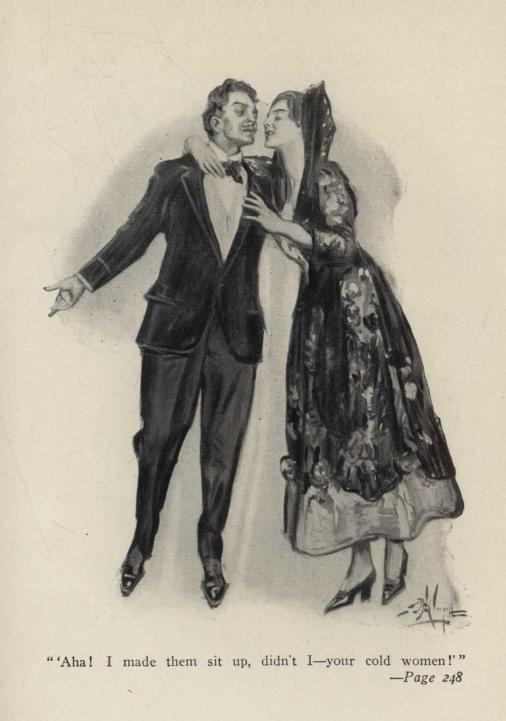
"'Aha! I made them sit up, didn't I—your cold women!'"
"I saw Macklin applauding, Madame," said Spinetti, putting his head into the room.
"Angel!" cried Emma Fornez, and she embraced Spinetti. Then, knowing in herself that the day was won, she began to amuse her audience. "Do you know what the critics will write? I'll tell you. The audience was carried off its feet in the second act. They will praise the first. They will say the second was obvious, and they will praise the third act, because there I shall do a little trick to them—in the card scene. I shall be very noble—very tragic. I will make a little picture of death before my eyes—with all his bones rattling and his great big hollow eyes, and they shall see it on my face—so! And I'll look very steady—noble—profound—like a queen. See?—a thing which Carmen would nevère, nevère do, for she's a little wretch of an animal that would be frightened to death. But you will see they will all like it—it's their moral that you have to serve up to them."
"Third act—third act," came the running call from the flies. "All on the stage for the third act."
When Beecher entered the corridor, Miss Charters was only a short distance away. He was prepared for Lorraine as a companion, but he felt a sudden anger at the sight of Garraboy, who in turn, suddenly comprehending the aim of his partner's maneuvers, looked anything but pleased.
She nodded to him, holding out her hand.
"She is wonderful, Teddy, wonderful. Have you seen her? Is she pleased?"
"She is a great, great artist," he said with extra warmth. "She is pleased as a child."
The two men had nodded with that impertinent jerk of the head which in society conveys the effect of a bucket of water.
"Come and see me after the next act," she said, looking at him closely.
"If I can," he said hastily.
He went up the steps and from the tail of his eye saw her linger, watching him as he went. A little contrition, a sudden sympathy came to him, but he repressed it angrily, saying to himself between his teeth:
"Garraboy—how can she stand for that!"
When he returned to the box, Mrs. Kildair and Mrs. Fontaine were in the anteroom in low converse. He was suddenly struck with the look of age in Mrs. Kildair's face.
"But I assure you—I can go alone," she was saying.
"I would not allow it," said Mrs. Fontaine firmly. Then turning to Beecher she said, so as not to reach the others: "Teddy, as soon as the curtain is up, step out. Mrs. Kildair is not well. You will take her home. I have ordered the automobile. You can get back for the last act."
Mrs. Kildair made no further remonstrance—she was at the end of her tether.
"Sit here," she said to Beecher, sitting down on the couch. "I don't want to be noticed."
"You're ill!" he said alarmed.
"Yes, ill," she said mechanically.
At this moment the house became still. She rose with a return of energy and signaled him that she was ready. Five minutes later they were in the automobile fleeing uptown.
A moment of weakness was rare in her life, yet she comprehended it without seeking to delude herself.
"At twenty I should not even have trembled," she said to herself, sinking back into the cushioned seat and watching the lights of the streets flash past the window with a comforting emotion of speed. "Now it is different. Every life has one supreme opportunity—this is mine. I know it."
Had a woman been at her side instead of Beecher, she would have given her confidence in the terrible necessity for sharing the emotion that was too vital to her. As it was, she restrained herself, remaining silent by a last effort of her will, but her hand on the window-frame began a nervous syncopated beating, imitating the click of the fleeing rails which one hears on a railroad train.
"You are feeling better?" said the young man in a troubled voice.
"Open the window—just for a moment," she answered.
The sudden blast of cold air, damp as though laden with the tears of the city, terrified her with its suggestion of despair and defeat.
"No, no, shut it!" she said hurriedly.
He obeyed and then to distract her, began:
"I received your note, Rita, just before coming, McKenna—"
"No, no," she said, interrupting him, "that is nothing. Just let me be quiet a moment—get hold of myself."
But in a few moments she was forced to seek the stimulus of the air again, and she cried hurriedly, not concealing her agitation:
"Open, open quick!"
The crisis which she felt approaching with every block which fell behind was so immense, the stake so ardently coveted, so weakly feared, that she had in the last eternal waiting moments a sensation of vertigo, that swept down and seized her even as on the football field before the blowing of the whistle the stanchest player feels his heart lying before him on the ground. She opened her lips, drinking in the chill, revivifying draught, unaware of the strange impression her disordered countenance in the embrasure of the window made on the occasional passers-by.
"Better first in a village than second in Rome."
She found herself repeating the saying mechanically, without quite understanding how it had so suddenly leaped into her mind. Then, as the automobile turned into her street, and she felt that he was there waiting as he had promised, successful or ruined; that now in ten minutes all would be over, she would know; all at once, without that sense of humor which deserts us in great stress, she began to pray confusedly to some one immense, whom she had never understood, but one who seemed to hold all fates in the balancing of his fingers.
"Are you better? What shall I do? Shall I come up with you?" asked Beecher, totally in the dark.
"No, no—wait," she said hurriedly, as the machine ground to a stop. She did not rise at once, stiffening in her seat, grasping the arm of the young man until he winced under the contraction of her fingers.
"Good!" she said suddenly; and before he could prevent her she was out on the sidewalk. "No, no; stay in. Thanks, thanks a thousand times. I'll send you back."
Before he could protest, she shut the door firmly and nodded to the chauffeur.
The elevator boy was already at the swinging glass doors, holding them open for her entrance.
"Mr. Slade here, Jo?" she said instantly.
"Yes, ma'am; upstairs."
"How long?"
"About half an hour."
She entered the elevator and descended at the landing, waiting until it had disappeared.
"Now for it!" she said, pressing the bell. And by a last display of her will, she sent through her body a wave of cold resolution that left her outwardly impassive with a little touch of scorn on her lips.
CHAPTER XVIII
It is only in the supreme crisis of a colossal disaster that a nation, which fondly believes it elects its governing bodies, perceives its real masters, and then in the alarm and confusion of its apprehension, it does not recognize what it is shown. The group of ten men who were assembled at Gunther's, awaiting the arrival of Slade, either in themselves or through the influences they represented, could bring to their support over ten billions of capital. If it were possible to conceive of a master spirit who could unite these ten men, forgetting mutual jealousy and distrust, into one unanimous body with but a single object, in five years these ten men, without the impediment of law, could own every necessary newspaper and magazine in the country, operate every railroad, and, by the simple process of reinvesting their earnings annually, control every important industry, every necessary chain of banks, the entire food supply of the nation, and, at the cost of twenty million dollars every four years and by remaining unknown, control the necessary number of candidates in both political parties in matters essential to their financial interests. That such a coalition will remain a fantasy, is due to two factors: the human nature of such individuals and the human nature of multitudes which, were they successful, would find the corrective in massacre. When such a monetary alliance does take place, it is usually from the necessity, as they see it, of saving the country by the simple process of enriching themselves.
When Slade arrived, he entered by the separate entrance to Gunther's personal apartments, which were situated in a lower wing of the monstrous turreted granite structure which might have served for a miniature Bastile. One of the secretaries was at the door carefully scrutinizing all arrivals. The moment he entered, he was aware that his fate was not the only one that was under discussion.
The wing of the house was laid out in the form of a Maltese cross, with a square anteroom in the center, heavily spread with silk Persian rugs, and furnished with easy divans and upholstered chairs. Above was a skylight, now transformed into a vast reflector for the burst of electric lights.
Four entrances of equal height in heavy Florentine relief gave on this anteroom; from Gunther's private office, from the library, from the rooms of the private secretaries, and from the outer entrance by which Slade advanced. In the middle of the anteroom Gunther was seated at a small card-table, studiously engrossed in a game of solitaire. He was a medium-seized man who, without an effect of bulk, conveyed an instant impression of solidity, while the head, remarkable in the changed physiognomy of the present day, had the falcon-like, eerie quality, characteristic of the spreading eyebrows and deep-set glance of the American before the Civil War. Slow in movement, slow in speech, he was likewise slow in the deliberation with which his scrutiny left the face he was considering.
At the vigorous shock of Slade's coming, he completed a row of carefully laid cards and lifted his head.
"How do you do, Mr. Gunther?" said Slade, whose eye was instantly set on the half-opened doors leading into the library, from which sounds of altercation were issuing.
Slade's arrival seemed to surprise Gunther, who looked at his watch and said, without rising:
"You're ahead of time, Mr. Slade."
"Always like to look over the ground when there's a battle," said Slade, who in fact had intentionally effected a surprise.
"Sit down."
He motioned to the secretary, who, moving on springs, brought cigars and a light.
"I'll have to keep you waiting, Mr. Slade. There is a conference taking place."
Slade glanced from the library to the closed doors of the secretaries' room.
"How many conferences have you?"
Gunther turned over a card, studied it and carefully laid it down. It was his manner of settling a question he did not wish to answer.
Slade was not offended by the rebuff. Holding most men in antagonism, he had conceived a violent admiration for Gunther and as he was the man above all others whom he wished to impress, he imitated his taciturnity, turning his imagination on the probable groups behind the three double doors, which once had closed on a famous conspiracy in a palace of turbulent medieval Florence.
Gunther at this moment was probably the most powerful personal force in the United States, and, what was more extraordinary, in an era of public antipathy to its newly created magnates, enjoyed universal respect. As he showed himself rarely, never gave interviews, and surrounded himself by choice with that inciting element of seclusion which Napoleon by calculation adopted on his return from Italy, the public had magnified what it could not perceive. Even as royal personages of distinctly bourgeois caliber have been impressed on history by the exigencies of the kingly tradition as models of tact and statesmanship, so events and the necessities of the public imagination had combined to throw about the personality of Gunther an atmosphere of grandiose mystery. Just as it is true that what is a virtue in one man is a defect in another, the imagination he possessed was much less than he was credited with and his power lay in his ability to control it. For imagination, which is the genius of progress, in a banker approaches a crime.
His strength lay in being that inevitable man who results as the balance wheel of conflicting interests. For beyond the Stock Exchange, which is a purely artificial organization, the financial powers will always create what amounts to a saving check, around one inevitable personality, whom they can trust and about whom, in times of common danger, they can rally as to a standard. At this moment, the invested wealth of the country, frightened at the cataclysm which threatened it, had thrown its resources implicitly into the hands of this one man, who came forward at the psychological time to stop the panic, issuing his orders, and marshaling his forces with a response of instant obedience.
"What's going on here?" said Slade to himself. "And what's the proposition they're reckoning on squeezing out of me? I'd like to know what's going on behind those doors."
As though in response to his wish the doors of the secretaries' room swung, and a round, rolling little man of fifty, in evening dress, came hurriedly out, holding in his hand a slip of paper. He approached the stolid player with precipitation, and yet, obeying a certain instinct of deference, which showed itself despite his disorder, he waited until Gunther had completed a play he had in hand before blurting out:
"Mr. Gunther, this is the best we can do."
Gunther took the slip which was offered to him, glanced at it and returned it abruptly.
"Not sufficient," he said and took up his pack of cards.
The emissary, crestfallen and desperate, returned to the conference and at the opening of the door the sound of violent discussion momentarily filled the anteroom as a sudden blast of storm.
"I have it," said Slade, who had recognized Delancy Gilbert, of the firm of Gilbert, Drake & Bauerman, brokers and promoters of mining interests in Mexico, whose failure had been circulated from lip to lip in the last forty-eight hours. "I see that game. Gilbert's to be mulcted of his Osaba interests—for whom though? The United Mining, undoubtedly."
Five minutes later the doors of the library opened in turn and a military figure, gray, bent, with tears in his eyes, came slowly out, the type of convenient figureheads which stronger men place in the presidencies of subsidiary corporations. He likewise placed a sheet of paper before the financier, watching him from the corner of his eye, his white finger working nervously in the grizzled mustache.
"We've agreed on this, Mr. Gunther," he said desperately, in a voice shaken by suppressed emotion. "That's as far as we can go—and that means ruin!"
Gunther examined the sheet with slow attention, nodding favorably twice; but at a third column he shook his head and, seizing a pencil, jotted down a figure, carefully drawing a circle around it.
"That's what I must have," he said and returned to his solitaire.
The emissary hesitated, seemed about to argue, and then, with a hopeless heave of his shoulders, retired. Gunther frowned but the frown was called forth by an unfavorable conjunction of the cards. Not once had he seemed to notice the presence of Slade. In the same position the promoter could not have helped stealing a glance to witness the effect. Slade registered the observation, mentally admitting the difference.
"What does he keep me here for?" he thought, but almost immediately answered the question: "Effect on the others, of course. Well, let them pull their own chestnuts out of the fire."
In the last emissary he had recognized General Arthur Roe Paxton, President of the Mohican Trust, exploiter of certain Southern oil fields, equally involved in the Osaba speculation. The knowledge of the operations which were being discussed—which he readily divined were the surrender of important holdings—prepared him for the demands he must expect to meet.
At this moment Gunther swept the cards together, glanced at his watch, and pressed an electric button.
"Mr. Slade," he said, fixing his lantern-like stare upon the promoter, "I need not tell you that we are in a desperate situation, that it is time for action—decisive and immediate action."
Slade answered by an impatient jerking of his thumb, and, rising as he beheld the secretary returning from the private office where he had been sent by a look of Gunther's, said:
"I understand perfectly. If the gentlemen whom I am to meet understand the situation as well as I do, we shall have no trouble."
Gunther continued to study him thoughtfully, struck by the confidence of his attitude where desperation might have been expected. He seemed for a moment about to say something, but presently, giving a sign to his secretary, began thoughtfully to shuffle the cards.
In the private office a group of men were assembled about the long table. The disposition of Slade had been but an incident in the discussion which had been called to decide upon the methods to be pursued in coming to the support of the market, and the deliberation had left its marks of dissension. Slade, on entering, rapidly surveyed the group, perceived its discord, and divided it into its component interests.
"The United Mining is the key," he said, on recognizing Haggerty and Forscheim.
The group was like a trans-section of that conflicting America which seems to hold the destiny of types. Fontaine, one of the landed proprietors of the city, French of descent and aristocratic by the purifying experience of two generations, was next to Haggerty, a cross-grained, roughly hewn type of the indomitable Irish immigrant of the seventies, who had risen to power out of the silver mines of the eighties. Leo Marx, olive in tint, whispering in manner, thin-veined and handsome, represented the Jewish aristocracy that had ingrained itself in the great banking houses of New York; while Forscheim, leading spirit of five brothers, abrupt, too aggressive or too compliant, cunning and unsatisfied, was the Hebrew of speculation, the creator of the great corporation known as the United Mining.
Judge Seton B. Barton, representative of the great oil interests, was the grim Yankee, unrelieved by his modifying humor, implacable in small things as well as great, knowing no other interest in life except the passion of acquiring.
Kraus, an ungainly, bulky German-American, had not moved from the half-retreating position he had taken on seating himself. He answered with a short movement of his head, watching every one with covetous, suspicious eyes that glimmered weakly over the spectacles which had slipped to the bridge of his nose, never suggested a move, and gave his assent the last. He was the owner of a fortune estimated at three hundred millions, acquired in lumber holdings over a territory in the West which would have made another Belgium.
McBane, one of the strongest figures which the rise of the great steel industry had propelled into the public light, was a short, fussy, brisk little man, tenacious, agile, obstinate in opinion, while outwardly smiling with a general air of delighted surprise at his own success. He was the present active force in the group of steel magnates whose personal fortunes alone amounted to over three quarters of a billion.
Marcus Stone, president of the greatest banking force of the country, the Columbus National, was a middle-westerner, sprung from the hardy soil of Ohio, virile, deep-lunged, direct and domineering, agent of colossal enterprises, rooted in conservatism and regarding his vocation as an almost sacred call. He accounted himself a poor man; he was worth only three millions.
Rupert V. Steele, head of the legal firm of Steele, Forshay & Benton, corporation lawyers, was the type of the brilliant Southerner, adventuring into the Eldorado of New York as the Gascon seeks Paris or the Irishman the lure of London. He might almost be said to have created a new profession—the lawyer-promoter—and in his capacious, fertile head had been evolved the schemes of law-avoiding combinations that others received the credit for. In public he was one of the stanchest defenders of the Constitution and an eloquent exponent of the sanctity of the judiciary.
With the exception of Fontaine and Marx, in this varied group of master-adventurers, all had begun life with little better than the coats on their backs, and the colossal fortunes which roughly totaled two billions had been amassed in virtually twenty years. This is a point which future economists may ponder over with profit.
At Slade's entrance the conversation abruptly ceased and each in his own manner studied the new arrival; some with languid, confident curiosity; Forscheim, who had old scores to settle, with a glance of unrestrained satisfaction; Steele, leaning a little forward, eager in his inquisitorial mind to divine the attack, already convinced that such a personality as Slade would not come without an aggressive defense.
The second glance reassured Slade, for he distinguished in the group the conflicting rivalries and perceived by what slender checks the irrepressible jealousies and antagonisms had been stilled.
"If they've got together," he said to himself with a sudden delight in a favorable hazard, "it's because they're scared to the ground and they want to shut off the panic first and trim me second. Good! That's what I wanted to be sure of."
He advanced to the head of the table, swinging into place a heavy chair which he swept through the air as though it had been paper, and, resolved to acquire the advantage of initiative, said:
"Well, gentlemen, let's get right down to business. I've come to get five millions."
In their astonishment several pushed back their chairs with a harsh, grating sound. Forscheim laughed aloud insolently, but Steele, sensitive to small things, instantly determined to employ caution, to be the last to crush him if he failed, and the first to support him if he had indeed the power to survive.
"Mr. Slade," said Stone in his blasting manner, "your remark is in bad taste. The situation you are facing is an exceedingly serious one and only a prompt compliance on your part with the measures we have determined upon to avert a national calamity, will save you from bankruptcy"—he stopped, but not from hesitation, adding with a sudden flush of anger—"and worse."
"We are here," said McBane, in tones of conviction which produced a nodding of assenting heads, "in the performance of a public duty. In carrying that out we do not intend to allow the fate of one man or a dozen to interfere with the steps we intend to take to restore public confidence."
"And I repeat," said Slade, with a disdainful smile, "that I am here to get five millions; and you are going to give it to me."
An outburst of exclamations followed this assertion, half angry, half contemptuous, above which was heard Forscheim's shrill nasal voice saying:
"Dere is a shtate examiner, Mr. Shlade, don't forget dat."
"My books are kept as carefully as yours, Forscheim," said Slade, with a sudden angry concentration of his glance. He had once in a committee meeting taken Forscheim by the throat and flung him out of doors—a fear which the other could never forget. Then he struck the table a resounding blow with his fist, stilling the clamor.
"Wait!" he exclaimed, rising until his bulky figure towered over the table. "Don't let's waste time. Come to the point. You think I've come here to receive your terms. You are mistaken. I've come here to deliver an ultimatum—my ultimatum."
"Do you realize, sir," said Judge Barton sternly, "what the object of this meeting is? We are here to preserve the prosperity of this country for the next ten years, the homes and savings of millions of persons."
"No, that is not why you are here," said Slade contemptuously. "I'll tell you why you are here. You are here to protect your own interests—first, last, and always! Because a panic to you means hundreds of millions, the end of development, the closing of markets; because at the end of a stock market panic is an industrial panic, and the end of any protracted individual depression means the colossal flattening out of your billion dollar trusts. That's why there'll never be another '93—that's the one good thing in the present situation the public doesn't know. There isn't going to be a '93 now, and you know it and I know it."
"Suppose, Mr. Slade, you listen to our stipulations first," said McBane, but in a more conciliatory tone.
Beyond his exposition which had struck all with its piercing verity, Slade had effected over them an almost physical mastery, which men grudgingly are forced to yield to masculine strength.
"I know your demands," said Slade instantly. "Oh, there is no informer present. Nothing difficult. I know you and the way your minds work. You have three conditions: first, I am to resign the presidency of the Associated Trust; second, sell my stock control to a syndicate you have organized, which will stand as a guarantee to the public; third, the taking over of all my holdings in the Osaba territory by the United Mining Company. Am I right?"
He did not need to wait for a reply; the answer was plain upon their countenances.
"Now, gentlemen, I'm going to finish up," he said, pursuing his advantage. "Remember one thing: I'm not a Majendie. I fight to the last breath and when I'm downed I carry everything I get my hands on down with me.
"Now, let's be perfectly plain. I know where I stand. If Majendie and the Atlantic Trust hadn't gone to smash, there wouldn't be a ghost of a show for me; you'd squeeze every last cent I had. I know it. I knew it then when I knew it was Majendie or me. But you see Majendie's dead and the Atlantic Trust—three hundred and eighty millions—has closed its doors. That makes all the difference in the world. You don't want to trim me—not primarily. Forscheim and the United Mining do—that's their private affair. What you men who count want, I repeat, is to stop this panic—to get me out of the way and stop the panic if you can; if you can't get me out of the way, to stop the panic at once—now—within twenty-four hours! Now, gentlemen, I defy you to let the Associated Trust close its doors tomorrow and prevent, with all your money, the wreck of every industry in the country."
"You overestimate the importance of such a failure," said Fontaine slowly, but without aggressiveness.
Slade's attack had made a profound impression.
"I have taken particular care that if the Associated fails, it'll be the biggest smash on record," said Slade, ready now to play his trump card.
"What do you mean?" demanded Haggerty, startled, while the others waited expectantly.
"Just that," said Slade, not unwilling that they should know the depth of his game. "If the Associated fails, sixty-seven institutions fail from here to San Francisco. I have taken care of that in the last two months."
"You haf ingreased your oplications at sooch a time!" fairly shrieked Forscheim, who saw his victory eluding him.
"You bet I did," said Slade. "I made sure that I couldn't be allowed to fail."
He took from his pocket a folded sheet and handed it to Steele, who had a moment before finally determined to come to his support.
"That's what failure means. Pass it around," he said.
The lawyer elevated his eyebrows in astonishment. The disclosure of how Slade by negotiating loans with a number of subsidiary institutions throughout the country had made them united in his general fate, completed the dawning recognition of a master which had been forming in his mind.
"He will beat them," he thought, passing on the paper. "He will go far. I must be his friend." Aloud he said carefully: "Of course, Mr. Slade, at the bottom the affairs of the Associated Trust are absolutely solvent."
"Solvent under any system of banking in the world which does not withhold ready money on proper guarantees," said Slade, looking at him with a glance that showed the lawyer he had received his alliance; "solvent as the Atlantic Trust was, is, and will be proved to be. You gentlemen know that as well as I do."
"Of course, Mr. Slade," said Steele, with an appearance of aggressiveness which the other understood perfectly, "one thing must be understood—the present speculative operations of the Trust Companies can not go on."
"Now, gentlemen, to finish up," said Slade, who seized the hint. "Here's my answer: I will agree to any legislation, in fact will urge it, that will place the Trust Companies on the basis of the National Banks; that is, on the same conservative basis of loans and transactions. That is right. I am now convinced that it is for the best." He allowed a slight smile to show and continued: "I will resign as President of the Associated Trust three months from to-day. That I had already determined on. For what I wish to do, that would only be an embarrassment. You will lend me the five millions I wish and, better still, tomorrow morning make a simple announcement to the effect that, having consulted on the affairs of the Associated Trust, you have found no reasons for apprehension, and announce that you will come to its support. Sign it Fontaine, Gunther, McBane, Marx and Stone, and the run on the banks will end in twenty-four hours. Tomorrow morning I will personally assure Mr. Steele, by an examination of my books, that affairs are as I have described. After this examination you can place five millions to my disposal—if necessary. Believe me, this is a much better way to end the panic. You reassure public confidence by your guarantee. The other way, by forcing my resignation, you create an impression that everything is rotten. Besides, the first way has this advantage—it is the only way. That's my word, gentlemen; if you intend to stop the panic you've got to float me!"
An hour later, having yielded not a jot of his position, turning a deaf ear to threats, expostulations and arguments, he rose victorious.
In the anteroom he went up to Gunther, who was still bowed over his solitaire, waiting grimly until his word had been carried out.
"Mr. Gunther," said Slade, stopping at the table, "we have come to an understanding. The gentlemen in the other room were agreeably surprised at my exposition of the affairs of the Associated Trust. They are going to lend me five millions."
"Indeed!" said Gunther in a sort of grunt but with a countenance so impassive that Slade was moved to admiration.
"Gunther," he said, suddenly carried away by a feeling of prophetic elation, "up to now you've known me only as a speculator. Now I'm going to become a conservative force. In a month I'm coming to you with a proposition. You're the only man I would ever trust. Good-night."
His automobile was waiting. He threw himself riotously into it, giving the address of Mrs. Kildair's apartment; and as he felt the pleasant, exhilarating sensation which the speed of his machine conveyed to him, he repeated, feeling suddenly how at last he had emerged from the perils of the first phase which he had once so frankly defined:
"Now, I'll be conservative!"
Unlike Gunther, who had behind him the traditions of generations of authority, Slade had that typical quality so perplexing in the American millionaire of sudden fortune—the childlike eagerness for admiration. When he arrived at Mrs. Kildair's and found that she was still absent, he was consumed with a nervous impatience. He seated himself at the piano, playing over clumsily refrains of the crude ranch songs which came to him as an echo of his earlier struggling days. But these echoes of a past conflict seemed only to whet his impatience. He ended with a crashing discord and rose, lighting another cigar, pacing the broad space of the studio with rapid, restless strides, surprised at the annoyance which her absence brought him.
When Mrs. Kildair entered, let in by Henriette, her maid, Slade flung aside his cigar and strode impatiently forward.
One glance at his triumphant face told her what she wanted to know. She made a quick sign to him with her hand and turned her back, disengaging her opera cloak with exaggerated slowness, drawing a deep breath. Then she sent Henriette upstairs to her room to wait until she called.
"Congratulations," she said calmly, entering the studio and extending her hand. "You have won!"
"How do you know?" he said, taken back by her composure.
"It is there—in your eyes," she said, passing her fingers so close to them that he seemed to feel their soft contact. "Tell me all about it."
"Yes, I've beaten them—Fontaine, Barton, Forscheim, Haggerty, the whole lot of them," he cried with a gleeful laugh. "More, I've forced myself into their hidebound circle. You'll see—in a month I'll be one of them."
At times roguishly delighted as a boy, at others with flashes of primitive power, he related to the eager woman all the details of the night and the desperate stake he had played to make a failure so colossal that they themselves would recoil before it.
"And if Majendie had not killed himself?" she said breathlessly, womanlike perceiving the hazards of fate.
"But he did!" he cried impatiently, unwilling to admit the element of chance in the destiny he had hewn for himself. But the thought sobered him. He looked down from the height to which his ambition had flung him. "It's true. It was either Majendie or me," he said quietly. "Shall I tell you something? That night we were here I knew he was lost—that he would do it. Don't ask me how I knew!" Then, shaking off the memory as an evil dream, he continued, extending his arm in crude magnetic gestures: "Well, that's over. I am where I want to be; the rest is easy. In a month—two months—they will see, Forscheim and Haggerty, how the trap they laid for me has sprung against them. Tonight will be worth twenty millions to me."
"How do you mean?" she said eagerly, but she did not look at him. Slade, triumphant in his brute power, inspired her with an emotion she did not dare to show him yet.
"Forscheim and Haggerty, the United Mining," he said, forgetting his habitual caution in the now present desire to dazzle and overcome this woman who had so resisted him, who had become so suddenly necessary to him, "have laid their trap to get hold of the Osaba territory. They've stripped Gilbert and old General Paxton of their holdings, and they were sure they'd strip me. The Osaba gold fields will be one day worth hundreds of millions—another Eldorado. Well, they'll get a third interest tonight. I've got a third, and Striker and Benz. Mexican United, who've fought them tooth and nail, have another third. Each now has got to have what I've got or get out. I've got the control and when I sell—" He ended with a laugh. "I've licked Forscheim before but it will be nothing to this. They thought they had me down and they played into my hands!"
Suddenly he changed his tone as the memory came to him of Gunther impassively waiting in his anteroom.
"Now they'll see what I can do," he said savagely. "Gunther's the only real man among them. I must have Gunther. With him I can do what I want—construct, construct!"
She rose, stopping him as he most wanted to continue.
"You must go now," she said quietly; "I've already done what I shouldn't."
He stopped, infuriated at this check to his inclinations, for, beyond his victory over the men he had fought, she still eluded him.
"Did you care what happened to me—much?" he asked savagely.
"Yes; I was surprised how much I cared," she said slowly, keeping her eyes on his.
There are certain strong, direct characters who are most vulnerable in the moment of their greatest exaltation as the generality of men are weakest in their defeats. She saw in his eyes how much she lacked to his complete triumph and suddenly seized the opportunity by the forelock.
"Why are you afraid to marry?" she said vigorously. "You are a child; you don't understand life. You don't know how to draw from it the incitements it can give you. You wish to be a great figure and you think you can remain an outcast."
"What do you mean?" he said roughly, and advancing he took her by the shoulders without her recoiling.
"You want to be another Gunther," she said, meeting his glance with an intensity of ambition greater than his, "and you wish to fight like a guerrilla. You think you need no one, and you need admiration, confidence, to be spurred on, flattered, cajoled, made to feel your greatness, to have it dinned into your ears day and night, to be surrounded by it. You have the vanity of a god and you don't know how to feed it."