Front matter (continued 3)
Reading edition
"Lunching at the club?"
"Not to-day."
"It'll be a cheerful funeral. So long."
After his departure Beecher studied the jotted figures on the pad. In the twelve minutes of the opening, Lynch had lost a clear thirty-two thousand dollars.
By the time he had dressed and breakfasted, he had answered the telephone a dozen times, messages from men he knew, anxious to learn if his intimacy with young Gunther had brought him any valuable information; inquiries as to the effect on his personal fortunes, and rumors of individual losses.
He himself remained undisturbed by the frenzy. His own fortune, thanks to the wise provision of a hard-headed father, was safely invested in solid properties, and the world of speculation had not entered his ken. He returned to his newspapers, read everything bearing on the personal fate of John G. Slade, which interested him extraordinarily since his encounter with that abrupt and forceful personality, and, rising, asked himself how he could kill the time until the hour of his luncheon with Rita Kildair.
The irritation he had felt at the end of his ride with Nan Charters had disappeared. Studying the evening calmly, he analyzed her words with a clearer perception. He comprehended that, beyond all the cleverness of her attitude, she had been veritably piqued by his indifference and his absorption by Emma Fornez, who treated her as a little actress. Considering the encounter thus, he smiled occasionally, congratulating himself that the conversation had ended so abruptly—when a continuance would have led him perhaps to say some of those sudden, illogical remarks which are irresistibly drawn from a man by the provoking contact of certain feminine personalities.
"She may say what she wants," he said, selecting a cigarette. "She was caught by her own tricks." He took several steps, and grinned to himself. "It's an amusing game, and a game that will be amusing to play."
Despite this feeling of confidence and elation, he had an irresistible desire to telephone her, to indulge himself in the pleasure of hearing her voice again. He had resisted the impulse several times, convincing himself of the tactical error; and yet, the more he argued against it, the more the desire haunted him.
Ordinarily he spent an agreeable half-hour after breakfast, calling up on the telephone those of the opposite sex with whom he was in the relation of a good comrade. He enjoyed these morning snatches of intimacy, with an enjoyment untouched with any seriousness. This morning, as he took the telephone in hand, he thought first of Emma Fornez, but as he had neglected to make his adieu to her on leaving with Nan Charters, he considered a moment while he formulated an acceptable apology.
The prima donna answered him from the languid idleness of her bed, where she was resting in a state of complete exhaustion.
"I am ab-so-lutely fini," she said in an anguished tone. "It is fright-ful. I shall never be able to sing—never!" Then she remembered. "I am very angry with you—yes, yes,—very angry."
Beecher explained, with crocodile tears, how he had been forced to come to the aid of a distressed and helpless female.
"Ta-ta-ta! Stuff and nonsense! You could have boxed her up in a carriage and sent her home—yes, yes, you could. But you are in love—you are weak—you wanted an excuse—she made a fool of you—she twisted you around her finger!"
Beecher denied the charge with indignation.
"If you wanted to, you could have come back to me—yes, you could."
"But you had deserted me—I was furious."
The conversation continued ten minutes on these purely conventional lines and ended with a promise to drop in that afternoon for tea.
He had hardly ended when Mrs. Fontaine called up with an invitation to her box, for Mme. Fornez's début in Carmen the following week.
Then he called up Miss Rivers, not because he particularly wished to talk with her, for he had determined on her decapitation, so to speak, but in order to appease somewhat the desire he had to telephone some one else. In conversing over the telephone, he felt a revival of interest and promised to try to drop in for a call that afternoon.
He rose, looking down at the telephone in a dissatisfied way, and, turning his back, went in search of his hat.
"She'll expect me to telephone, of course," he thought; "besides, what excuse could I give? I'm not going to play into her game—not by a long shot. I know the kind—entirely too much brain-work to suit me. Oh, yes, she'd like to annex me—because I've been attentive to Emma Fornez—sure; but when it comes down to business. Mr. Charles Lorraine has a hundred thousand a year and I have thirty. She knows that." He laughed disdainfully and repeated, "You bet she knows that—well, so do I."
He returned to the sitting-room and selected a cane, glancing out of the corner of his eye at the accursed telephone.
"I won't," he said, taking three steps toward it and then turning abruptly away.
At the moment when he stood wavering, it began to ring. He went to it hastily. Miss Charters was calling him...
"How lucky!" he said purposely. "I was just going out. I heard you from the hall."
"You know, I never realized until this morning what I had done," said the voice at the other end. "I was so upset by Mr. Lorraine's condition that I forgot you were there with Madame Fornez."
"Clever girl," he said to himself, smiling. Then aloud: "Oh, I explained matters."
"I was afraid I'd got you into trouble."
"No, indeed. Madame Fornez is a good sort; she understood at once."
"I'm so glad. You've 'phoned her already then?"
"Yes."
He remembered McKenna's suggestion, but he did not wish to make the demand direct.
"Something of a smash in Wall Street to-day," he said carelessly.
"You weren't caught, were you?" she said, with a note of quick sympathy which he admired.
"No; I don't speculate."
"I was afraid you might have."
"By Jove," he said, "I hope you didn't lose anything."
"No, I don't think so," she said doubtfully. "I had some money invested, but I suppose if I hold on that'll come up again."
"Not on margins?"
"No, indeed."
"Who's your broker?"
"Mr. Garraboy."
"Who?"
"Mr. Garraboy."
The news produced on him a strangely ominous effect. He forgot all the parleying and the tactical planning of his campaign, overshadowed by a sudden sense of sympathy.
"I want to talk to you about that," he said anxiously. "Have you much in his hands?"
"Much for me—about twenty thousand."
"Are you going to be in this afternoon? Can I see you?"
"I wish you would."
Something in her voice struck him by its weakness.
"You are not worried, are you?" he said.
"A little."
"Why don't you call him up?"
"I've been trying to."
He was going to offer to telephone for her, when he remembered the antagonism he had felt for the broker, and refrained until a fuller knowledge. He reassured her, making light of her doubts, though feeling an instinctive anxiety for himself. Then he called up McKenna; but the detective was out, and, leaving word that he would try later, he went for his morning ride.
A little before one o'clock he was in the softly lighted studio of Mrs. Kildair, waiting for his hostess with the pleasurable anticipation of a confidential tête-à-tête. On one thing he was thoroughly resolved—to convince her of the seriousness of his purpose in offering his assistance. As he paced slowly and irregularly about the room, his mind, perplexed by the mystery of the disappearance of the ring, instinctively considering the possibilities for concealment, he was surprised to hear, behind the closed doors of the bedroom, the sound of voices in agitated discussion. He stopped, perplexed, for in his walk about the room he had arrived at a point in such close proximity that the tones were easily distinguishable.
"But I have already made up my mind," cried a voice which he recognized at once as Mrs. Bloodgood's.
Mrs. Kildair answered her, but in a lower tone—a note of warning and remonstrance.
"Oh, what do I care for the world!" repeated the voice, on a higher note. "The world is all against me. I have only one life—I want to live some of it."
Beecher, ill at ease, realizing that he had stumbled on a situation which he had no right to surprise, tip-toed away. Hardly had he seated himself when the door opened brusquely, and Mrs. Bloodgood appeared, saying:
"No, no; it is decided. I'm going. My only regret is that we waited so long."
Two spots of red showed on her dark cheeks, while her head was carried defiant, alive with sudden energy. Beecher was struck with the unwonted brilliancy and youth which the emotion that possessed her had communicated to her whole body. Mrs. Kildair followed her, with the frown of one who disapproves, but who knows the futility of any contradiction.
Beecher rose hastily, emerging from the shadow. The two women stopped, surprised at his presence, considering him nervously. The few snatches of conversation he had heard, coupled with what Gunther had revealed to him of the infatuation of Mrs. Bloodgood and Majendie, made him divine the intention of elopement they had been discussing. His sympathy was touched by the distress of the young woman, and, advancing quickly, he said, with a pretense of shame:
"By Jove, I must have been nodding! A thousand pardons."
"How long have you been here?" said Mrs. Kildair.
"About ten minutes," he said, rubbing his eyes and laughing. "Confound that chair—it's infernally comfortable, after being up all night. You made me jump."
Mrs. Bloodgood had regained her calm. She embraced Mrs. Kildair and held out her hand to Beecher.
"Won't you let me see you to your carriage?" he said eagerly, with a smile of such good will that she perceived that whatever he had overheard, she had no need to fear.
"It's not necessary—but thank you," she said, giving him a grateful smile.
He went to the door, opening it with a little exaggerated courtesy, and returned thoughtfully to Mrs. Kildair, who was watching him fixedly.
"You overheard?" she said directly.
"A little."
"And what did you understand from it?"
"Why, frankly, knowing what I do, I should believe that Mrs. Bloodgood had decided to run away," he answered slowly; "which means, of course, one man. I am sorry. I could not help hearing."
Mrs. Kildair had seated herself on the Récamier sofa and was studying him, undecided as to what she should say.
"You have heard too much, Teddy, not to know all," she said, reassured by the directness of his glance. "Besides, in twenty-four hours it will be in every paper in the country. I do not need to ask your promise to keep secret what you have heard. She is leaving her home and going openly away with Mr. Majendie—this very afternoon."
"Majendie running off?" said Beecher, astounded.
"Yes."
"Now—at such a time as this—when he is under fire? I don't believe it!"
"I should not have believed it either," said Mrs. Kildair thoughtfully.
"I know his kind," declared Beecher warmly; "he would never commit such a folly—never!"
"And yet, that is what is going to happen."
"That is terrible. Doesn't she realize that he lays himself open to every charge? He'll be called a defaulter and an absconder—it is worse than death!"
"She realizes nothing," said Mrs. Kildair in a solemn voice, "except that she has hated one man and lived with him ten years, and that now, when everything is against the man she adores, she will sacrifice anything to be at his side."
"But the sacrifice he is making—"
"Her sacrifice is too great—she doesn't realize that," said Mrs. Kildair, rising. "Poor Elise! Her life has been terrible. She is wild with anxiety, with the thought of what Majendie may do. When one has suffered as much as she has, one more sorrow will not stop her."
Beecher was silent, overcome by the vision of an emptiness which he could divine only in a general way, having as yet little knowledge of the silent tragedies that pass at our elbows. When Mrs. Kildair turned again, it was with all her accustomed poise.
"We can do nothing," she said calmly. "Let us forget it. Luncheon is a little late. We shall be three; I asked Mr. Slade to join us. By the way, you were kind enough to offer me your help in the matter of my ring. I shan't need it now, but thanks all the same."
"What do you mean?" he asked, surprised.
"My detectives assure me they are on the right track," she said carelessly. "All I ask of you, as I have of every one, is to keep this unfortunate occurrence to yourself."
Beecher had been on the point of informing her of his retaining McKenna, confident of her approval. Ignorant as he was of Mrs. Kildair's dread that Slade's ownership of the ring might come to light, with all the consequent public misunderstanding, he was disagreeably impressed by her announcement. He did not for one moment believe her statement that the right clue had been found. All he understood was that, for some reason, she desired to keep him out of the case, and this understanding irritated him. And the introduction of Slade at what he had considered his privileged hour annoyed him even more. His curiosity increased twofold as he was forced to retain his information. Then he remembered McKenna's hint, and said carelessly:
"By Jove, that reminds me—I want the address of your detective agency."
She raised her eyes very slowly, and her glance rested on his for a full moment.
"Why do you ask that?" she said.
He repeated the story he had prepared of a friend's demand, mentioning Gunther's name.
Mrs. Kildair rose as though reluctantly, motioning him to wait, and, going to her room, returned after a long moment with an address on a slip of paper.
"There, Teddy," she said, giving it to him. Her manner had completely changed. She was again the Rita Kildair who treated him en camarade. "You are disappointed in not working out an exciting mystery," she said, laughing. "Do you know, Teddy, I am quite surprised at you."
"How so?" he said warily.
"I should have thought by this time you would have engaged half the detectives in New York," she said, turning from him to arrange the cushions at her back. "And here you have done nothing."
Beecher was not deceived by the innocence of the interrogation.
In the last days his wits had been trained by contact with different feminine personalities. He understood that she wished to find out what he had done and assumed at once an attitude of boyish candor.
"It's not my fault, Rita," he said contritely. "You put me off—you remember."
"That's so," she said. She motioned to him with a little gesture of her fingers and indicated a chair at her side. "Come here, you great boy," she said, smiling. "You are furious at me, aren't you?"
"Why?" he said, sitting near her, with a resolve to resist all her curiosity.
"You like to be the confidant of pretty women, Teddy," she said, laughing as he blushed. "To be on the inside—to know what others can't. Well, you shan't be deprived."
He looked at her in surprise.
"What I told you is not true," she said candidly. "I have no clue, as yet, and am quite in the dark. I give you permission to do all you can. You see," she continued, holding out her hand with a charming smile, "I give you my full confidence—confidence for confidence—n'est ce pas?"
Beecher made a rapid mental reservation and repeated her phrase, expecting a direct examination, but her manner became thoughtful again and she said pensively:
"Besides, you have stumbled on a confidence yourself, and if you are to be trusted with that you should be trusted entirely." She looked at him quietly for a moment, and then added: "As a proof of my trust, Teddy, I am going to ask you to be my ally now. Mr. Slade will be here shortly. I do not wish to be alone with him. Do not go until he is gone."
This request, implying as it did his own superior intimacy, delighted Beecher. He felt half of his suspicions vanish as he answered wisely:
"I understand. He is quite daffy about you, isn't he?"
"Quite. But he has to be kept in place."
"Oh, of course."
"And now you are happy again," she said, tapping his arm with a little friendly gesture and smiling inwardly at the satisfaction which began to radiate from his face. "Teddy, you are a nice boy. I will teach you what the world is; you shall be my confidant, and we will laugh together; only, you must not be sentimental, you understand."
"Never," he said with vigorous assertion. Then his conscience began to reprove him, and he blurted out: "I say, Rita, I haven't been quite honest, but you rubbed me the wrong way. I really have been on the job."
"Besides Gunther, whom else have you talked with?" she asked.
"McKenna, the detective; and he's dead keen on the case," he said enthusiastically, not noticing what she had implied.
"Oh, McKenna!" she said, nodding appreciatively. "You have done well."
She sat up, suddenly serious, and, extending her hand, took from him the address she had given him.
"Did McKenna tell you to find out my detective?" she said slowly.
Beecher comprehended all at once how he had played into her game, but, with her glance on his, it was impossible to deny.
"Yes," he said; "he told me that he'd been on a dozen cases where the detectives who had come in to make a search had gone partners with the thief. He wanted to be certain there had been a real search."
This seemed to reassure her, for she nodded with a return of her careless manner, as though comprehending the situation. Then, crumpling in her hands the paper with the address, she allowed her body to regain its former languid position and said:
"I should like to meet McKenna; you must bring him around. How is he starting on the case?"
Before Beecher could answer, the bell rang and Slade's bulky figure crowded the frame of the doorway. He entered, and the portières, at his passing, rolled back like two storm clouds.
Whether or not Mrs. Kildair had calculated the effect of the intimacy of Beecher's position, Slade saw it at once as he noted savagely the involuntary separating movement which each unconsciously performed, and, perceiving it, exaggerated its importance. The look he gave the younger man revealed to the amused woman how much he would have liked in barbaric freedom to have seized him and crushed him in his powerful arms.
"Sorry to be late," he said abruptly, glancing at the clock. "I've taken the liberty to leave your telephone number, Mrs. Kildair, in case something important turns up."
They passed immediately into the dining-room, Mrs. Kildair enjoying this clash of opposite personalities. Slade was not a man of small talk, disdaining the easy and ingratiating phrases with which other men establish a congenial intimacy. For the first quarter of an hour he withdrew from the conversation, and, being hungry, ate with relish. Beecher, abetted by his hostess, taking a malicious pleasure in the superiority he enjoyed, chatted of a hundred and one things which he shared with his listener, incidents of the party at Lindabury's, gossip of the world they knew, Emma Fornez and Holliday, Mrs. Fontaine and Gunther. Then, naturally drawn to the one topic that charged the air with the electricity of its drama, he related the uproar in the city, the long lines of depositors before the banks, the incident of Bo Lynch in the morning, and the effect on the men they knew. In this both he and Mrs. Kildair had an ulterior motive—to make Slade talk: Mrs. Kildair, for reasons of her own, Beecher alive to his dramatic closeness to the one man about whose success or ruin all the storm of rumor and gossip was raging.
"Stocks are still dropping," said Mrs. Kildair, glancing at Slade, who appeared quite unconscious. "An enormous quantity of holdings have been thrown on the market."
"How long do you think it will keep up?"
"That depends; a day, a week—Mr. Slade knows better than any one."
Slade looked up suddenly.
"What do they say about me?" he asked grimly.
"Every one expects the Associated Trust to be the next," said Beecher frankly.
"Probably. I'll tell you one bit of news," he added quietly. "The Clearing-house will refuse to clear for us this afternoon."
"But that means failure," said Mrs. Kildair, with a quick glance at him.
"We shall see."
"But the run has already started."
"Oh, yes; we have paid off five depositors already," he said, with a smile that was almost imperceptible.
"Only five?"
"It takes a long time to verify some accounts. Then the law allows discretion in payment—takes quite a while to count out five thousand in half dollars." All at once he leaned forward heavily and began to speak, contemplatively interested. "The real truth is the thing that is never known. The newspapers never print the news. Sometimes it is given to them in confidence, to make certain that they won't print it. How much do you suppose will ever be known of the real causes of the present crisis? Nothing. They may let the market go to the dogs for three days, six days, a month, ruin thousands of victims, and the public will never know that the whole thing can be stopped now, in twenty-four hours, by ten men. And, when they get ready, ten men will stop it. Then there'll be columns of adulation—patriotic services, unselfish devotion, and all that; and what will have happened—ten men will be in pocket a few millions as the result of their sacrificing devotion. The public must have a victim in order to be calmed, to be satisfied that everything has been changed. Then a weak man, some unlucky lieutenant, will be served up, and things will go on again, until one group of millions is ready to attack another. How the public will howl! Majendie has taken the gambler's risk; Majendie has failed. There's the crime—failure; and yet, ninety per cent. of the fortunes today have turned on the scale—up or down—win or lose. For every promoter that wins, twenty fail with a little different turn of the luck.
"We're all criminals—only we don't steal directly. We get it done for us. We want franchises for a great railroad system. We shut our eyes—hire an agent—go out and get this, no strings, no directions—show us only your results! Everything is in irresponsibility. A million dollars can commit no crime. After all, it's in the motive—a man who steals because he's hungry is a thief; a corporation that bribes a legislature and steals franchises, to create a great system of transportation, is performing a public service. It's all in what you're after. There're two ways to look at every big man; see the two periods—first, when he is trying to get together money—power; and second, what he creates when he has it. Same in politics—a man's better in office than running for it. Every man of power wants to arrive, anything to arrive, but when he gets there—then's the second period. The way to judge us is whether we want money only, or money to create something big."
"And you?"
"I want sixty millions," said Slade abruptly. "Will I get it?" He shrugged his shoulders, and taking a knife balanced it in seesaw on his finger, letting it finally drop with an exclamation of impatience. "That's the danger—the getting of it. I may have it in two years more and then again—" He opened his hand as though flinging sand in the air, and added: "In a week it may be over. Rouge et noir—one bad turn at the beginning and Napoleon Bonaparte would have been shot as a conspirator. Up to the present, I've been living the first period—afterward I'll justify it; I'll build."
"In what way?" said Mrs. Kildair, who, while following his brutal exposition with the tribute instinctive to force, was nevertheless aware that this unusual revelation of himself had likewise a trifling object—the over-awing of the younger rival.
"Railroads—a great system—an empire in itself," said Slade; and there came in his eyes a flash of the enthusiast which surprised her. But, unwilling to enlarge on this topic, he continued: "What I've said sounds raw, doesn't it? So it is. If I do what I want, I justify myself. There are only two classes of human beings—those like you two here, who get through life with the most pleasure you can, who get through—pass through; and then a few, a handful, who create something—an empire, like Rhodes, invent a locomotive or a system of electric production, add something to human history. What if they steal, or grind out the lives of others? They're the only ones who count. And the public knows it—it forgives everything to greatness; it's only petty crime it hates. Look at the sympathy a murderer gets on trial—look at the respect a great manipulator gets. Why? Because to murder and steal are natural human instincts. A couple of thousand years ago, it was a praiseworthy act for one ancestor, who coveted a hide or a cave that another ancestor had, to go out and kill him. All animals steal by instinct. We are only badly educated animals, and we admire in others what we don't dare do ourselves. Only succeed—succeed! Ah, there is the whole of it!"
At this moment the telephone rang, and Slade rose and went to it with a little more emotion than he usually showed.
"Is this the cause of his outburst?" thought Mrs. Kildair, while she and Beecher instinctively remained silent.
At the end of a short moment, Slade returned. The two observers, who glanced at him quickly, could not find the slightest clue of what had transpired. Only he seemed more composed.
"Speaking of stealing, take the case of the ring," he said, relaxing in a chair. "We know this—incredible as it may seem—that there were at least two thieves in the company; as a matter of fact, there were many more. My own opinion is that the crime was not an ordinary one—that whoever took it the second time took it out of an uncontrollable spirit of bravado, an overpowering impulse to do an almost impossible thing."
"By the way—" Beecher began, and then suddenly looked at Mrs. Kildair interrogatively. Then, receiving permission, he continued: "You know who returned that night?"
Slade nodded.
"Yourself, Mrs. Cheever, Garraboy, and Miss Charters."
"Miss Charters?" said Beecher, turning in amazement to Mrs. Kildair.
She nodded, with a little frown.
"As I told Mrs. Kildair," said Slade, not noticing that Beecher, overwhelmed by this discovery, did not hear him, "I do not believe for a moment that the thief would return. Any one who had the daring to seize the ring the second time had the daring to carry off the ring; in fact, had some such plan in mind. Whoever came back may have come back out of sympathy, or with the idea that the ring was still in the studio—in which case, we have a third manifestation of instinct."
They had passed into the studio again. Slade spoke with all his old decision, the energy of action replacing the bitterness of his former meditative mood. He glanced at the clock, and took his leave in a quick, impersonal manner. Beecher, ignoring the looks Mrs. Kildair sent him, departed with Slade, refusing an invitation to join him in the automobile, and continuing on foot.
He was absolutely at a loss to account for Miss Charters' returning to the studio after having gone to her apartment. If she had any suggestion to offer, why had she not waited, or even requested him to return with her? Why, in fact, could she not have waited until the following day—instead of risking the journey at such an hour?
Full of disturbing surmises, he continued his walk until he reached the great thoroughfare of Forty-second Street, where he turned eastward toward the station, oblivious to the excitement in the street, the break-neck arrival of the newspaper wagons and the sudden, shrill scattering of urchins, extras in hand.
All at once, at the western corner of the station, he raised his eyes instinctively. A coupé with trunks behind it disengaged itself from the confusion of traffic and, turning, slowly passed him. Inside, he recognized the dark, defiant eyes of Mrs. Enos Bloodgood.
In a moment he guessed the full significance of her presence: she had come to meet Majendie, to burn all bridges behind her, in the supreme sacrifice of everything for the possession of a happiness she had never known.
The next instant he was gazing horror-stricken at the head-lines of an extra that a newsboy flung in his face:
SUICIDE OF BERNARD L. MAJENDIE
He became perfectly collected, clear in mind and instinctive in action, with the decision he had felt in the last charges of a wounded elephant. If Mrs. Bloodgood were here, it was because she expected to meet Majendie; because she was ignorant of the tragedy that had taken place.
Retracing his steps, he arrived at the carriage the moment Mrs. Bloodgood's hand had thrown open the door.
"Excuse me," he said, with an authority which instantly impressed the woman by its ominous seriousness. "Something terrible has happened. I must speak to you." Then, turning to the coachman, without being overheard, he gave him Mrs. Kildair's address, saying: "Drive there quickly. Five dollars to you if you get me there in ten minutes."
Then he opened the door and joined the woman who, drawn back in the corner like an animal at bay, already trembling with what she did not know, awaited him.
CHAPTER XI
For an interval, while the coachman, spurred on by the prospect of reward, tore through the short streets, Beecher continued looking into Mrs. Bloodgood's eyes—eyes that were aghast with mute, terrified interrogations which she did not dare to phrase.
Suddenly she perceived the extra which he had bought. She extended her hand, looking at it fearfully.
"Give it to me," she said.
He hesitated, and in the moment of irresolution she seized it. A cry of pain, a low cry torn from the soul, made him stiffen in his seat, steeling himself against the expected. But no further sound came. When he turned, she was sitting transfixed, staring wide-eyed at the newspaper which seemed glued to her fingers. Alarmed at the rigidity of her emotion, he leaned over and disengaged the paper from her unresisting fingers. The action seemed abruptly to revive her. She gave another cry, and tore the newspaper from him with such energy that a great, ill-shaped fragment remained in her clutch.
"No, no, not that—no, no!" she cried, frantically seeking to decipher the bare six lines that recorded the tragedy. All at once she flung the sheet from her, turning to read the truth in his face.
"Ah, it is true!" she cried, and her hand, as though holding him guilty of the fact, violently pushed him from her.
"Mrs. Bloodgood—" Beecher began hesitatingly, frightened at the paroxysm that shook her body.
But the emotion was still of horror, without as yet the realization of the finality that had come. She felt that Majendie was in danger—in terrible danger; that she must get to him, somehow, some way, and fling herself in front of that awful something that threatened him, ward off, in some way prevent, the thing that was coming. She seized the arm of the terrified young man, imploring him, still dry-eyed:
"Take me to him—at once—no—I must—take me—Bernard—oh!"
She fell back exhausted, faint.
"Be calm; please be calm," he repeated, helpless before the utter disorder of her suffering.
All at once the annihilation of self into which she had fallen was succeeded by a quick paroxysm of energy. She bounded upright on the seat, seizing his arm so that the nails hurt him.
"I will go to him!" she cried. "You shall not stop me. He may be only wounded. The report is false—must be false. I will go to him!"
"The very thing that you must not do—that you can not do," he said firmly; and then, seized with an inspiration, he added: "Listen—listen to me, Mrs. Bloodgood, I am taking you to Rita's; if you must go to him, go with her. Two women can go; one would cause a great scandal. You can not put that on him—you must think of him now. We are going to Rita's—Rita's!" he added, putting his lips to her ears to make her hear him.
He put his hand on her shoulder and forced her gently back. She held her clasped hands rigidly strained between her knees, staring out beyond the confines of the carriage.
"He is not dead," she said in a whisper; "he is wounded."
"As soon as we get to Rita's," he continued reassuringly, "I will telephone. I'll find out everything."
"Wounded," she repeated, nodding—without hearing him.
"If he is, we three can go—it will seem quite natural," he said hastily, eying nervously her dry, uncomprehending grief, fearing the coming outburst of realization.
"Almost there," he said, looking out of the window. "Hold on to yourself. Be game. There are always a few persons below."
She did not answer, but her lips curled slightly in contempt, and she put her hand spasmodically to her throat.
"You're right, the whole thing may be false—a wild rumor," he said quickly, talking to her as to a child. "A fake story—who knows? See, there are no details. Here we are. A little courage! Go right into the elevator."
He signaled the driver to wait, and followed her hastily into the elevator, standing between her bowed figure and the boy.
Mrs. Kildair was in the studio, pacing the floor; and at the first glance each saw that she knew the report, and that it was true. Mrs. Bloodgood crumpled on the floor, without consciousness.
"My smelling-salts are on my bureau," said Mrs. Kildair quickly. "Lift her on the sofa first, and then get them."
"Is it true?" he said, raising the slender, lifeless body.
"Yes."
"Dead?"
"Yes."
"When did it happen?"
"At two o'clock."
"She wishes to go to him," he said warningly. "The carriage is below. She has her trunks. She was to have met him at the station. What shall I do?"
"She must be gotten back to her house as soon as possible," said Mrs. Kildair with energy. "The trunks must return at once. Everything hangs on a hair; I know Bloodgood." She cast a glance at the still inanimate body and added: "Wait. Spirits of ammonia will be better. I'll get it."
Mrs. Bloodgood returned to consciousness slowly, looking from one to the other with a dazed, pleading look.
"Then it is so," she said at last.
The two looked at her without being able to answer. Suddenly she bounded up erect, her fists striking her forehead.
"It is I who have done it!" she cried, and for the second time fell back lifeless on the floor.
"Go down now; send the trunks back," said Mrs. Kildair to Beecher. "Tell him to do it as quickly as possible—no, tell him nothing. Go quickly."
When Beecher returned, Mrs. Bloodgood was on her feet again, passing from spot to spot ceaselessly, one hand clutching a handkerchief to press back the sobs that shook her from time to time, the other stretched out in front of her, beating a mechanical time to the one phrase which she repeated again and again:
"I've done it—I've done it—I've done it!"
Mrs. Kildair, leaning by the piano, knowing that each period must have its expression, awaited the right moment. Beecher, at a sign from her, slipped quietly into a chair.
"Yes, it's I—it's I—I!" said the indistinguishable voice.
"You have done nothing," said Mrs. Kildair solemnly. "It is fate."
"No, no. Only I am to blame," she answered, stopping short, each word coming slowly through the torrents of tears.
Mrs. Kildair passed quietly to her side.
"You are not to blame, dear," she said; "don't think that."
"Oh, you don't know," she said, suddenly acquiring a terrible calm that froze the young man. "At what time did he—did it happen?"
"At two."
"I knew it! Ten minutes before, he telephoned me; he said—oh, what do I know?—said a thousand things but the one in his mind. Asked me if I still was resolved to go."
"But then, Elise—"
"You don't understand! It was I who insisted on his going—I—I! I told him, if he would not go, I would come openly to his house—I would not be separated from him. Oh, my God! I didn't know—I didn't!"
She abandoned herself to her transports once more, flinging herself on her knees and praying, as an uncomprehending child prays:
"O God, don't let it be true—please don't let it be so!"
Beecher covered his eyes suddenly with his hands. Mrs. Kildair allowed her for a moment to tire herself in supplication and anguish. Then she went to her, grasping her shoulder.
"Elise."
Mrs. Bloodgood stopped, rose, and went to the window, where she stood swaying.
"I'm going to him," she said, pressing her knuckles against her temples.
"Get hold of yourself," said Mrs. Kildair, avoiding the error of opposition.
For a long moment neither spoke, while Mrs. Bloodgood, passing to and fro, struggled to fight down the sobs that were choking her. At last she stopped, facing Mrs. Kildair.
"I am going to him," she said.
The other woman, with a look of great compassion, shook her head in a slow negation, looking full at her.
"But he said I could!" she cried, stretching out her hands toward Beecher.
"You can't."
"But he said so—he promised."
"No; it is impossible."
"I will go!"
"There are twenty reporters waiting for just that," Said Mrs. Kildair. Then, raising her voice, she said impressively: "Elise, there is something you must do—something ten times more terrible."
"What?"
"Return home—and at once."
"Never!" The cry burst from her as her whole body was shaken with indignation. "Never in the world—never again!"
"Listen," said Mrs. Kildair, seizing her arm, and Beecher was struck with the savageness of her energy. "Things are no longer the same. You are alone—absolutely alone. Do you understand what that means—without a cent—alone?"
"What do I care?"
"Not now; but in a week, in a month— You think you know the greatest suffering in the world; you don't—the greatest is poverty. Whatever has happened, you are Mrs. Enos Bloodgood. Only yourself can destroy that. One life is ended in you. You have loved. That will never come again—not the same. Life is long and terrible."
"What, you can suggest such a thing?" said Mrs. Bloodgood, raising her head indignantly. "Such an infamy?"
"Yes—because I know. The world is not an equal one. A woman can not fight as a man can. A year from now, when you can suffer no further, do you want to wake up in a dingy boarding-house, cut off from all you have lived in? For a great love—perhaps—but to be alone? No, no! Elise, you will do as I say because I can see better than you. You are Mrs. Enos Bloodgood—you have everything that a million women covet. It is your life; you will go back."
"Ah, how can you say that to me now?" said Mrs. Bloodgood, pressing her handkerchief to her eyes.
"Because the world is different from the world of this morning—because everything is different, Elise. There are no longer the reasons that existed. You are alone against the world. You know your husband—one public word or action, and he will cast you off like an old shoe."
"How can I go back?" she said, sitting down, half subdued. "How can I get the strength? I don't know yet what has happened. I can't realize it—oh, if I had only had my way! If he had only let me leave a month—two months ago. If I'd only been firm; if we had gone that night—that night we were here—when I begged him to. If he had only loved me more than his honor, as I loved him. If only I—"
"Elise," said the quiet voice of Mrs. Kildair.
The young woman checked herself, breaking off and moving again; but almost immediately broke out again:
"And now you want me to go back to him. Oh, if you knew how I hate him, how I loathe him—what that life means—how cruel he can be, how he can make me suffer by a word or a look—how he enjoys—"
"Elise, Elise!"
"I can't go, Rita, I can't! Don't ask me to go now. Let me stay a while here, just tonight, where I can weep," she cried.
"No, no. It must be now—soon. You have left your home with your trunks—he knows it. If you return—you return because you are worried—the panic—on his account."
"Ah, what a lie!"
"Elise," said Mrs. Kildair, coming forward again and arresting the other's arm, "listen. You are not what I am. You are not strong—you are weak. You are a woman of the world, worldly, loving worldly things, who for a moment has been transformed by a great passion. The whole earth has no such passion any longer. Do you understand? Something is gone—your youth is ended. Keep tight hold of the little that is left. Come, be strong. Dissimulate as you have before. Come."
"Not now," said Mrs. Bloodgood, terrified.
"Yes, now. If possible, you must be back before he returns."
And Beecher, from his chair where he had watched, forgotten by both women, saw Mrs. Kildair, who not for a moment had deviated from the vital issue, draw the unresisting woman by the very force of her energy into the bedroom, from which shortly they emerged again.
"I am ready," said Mrs. Bloodgood in a voice that was scarcely distinguishable. She had thrown over her head a thick veil, behind which her features were only dimly visible.
"Telephone for a carriage," said Mrs. Kildair.
"I have done so," said Beecher, who had availed himself of the interval.
"But the trunks?" said Mrs. Bloodgood, turning helplessly.
"They went back long ago."
"Ah!" She took a few weak steps and turned. "But I shall see him?"
"I give you my word."
"Tonight?"
"Tonight."
Mrs. Bloodgood made a little sign of acquiescence, and passed out of the door. The carriage was waiting. Beecher silently handed her into it, feeling the sudden heaviness on his arm. They rolled away. She did not lift her veil, and he could not guess what look was on her face. Twice she made him change their course, in order to put off the final dreaded moment.
"You have been kind," she said at last. "I owe you much. Thank you. Now I will go back."
"Don't speak of thanks at such a time," he said hastily. "If I can help you in any way, any time—"
"I know." All at once, forgetting his presence, she burst out: "Oh, how I loved him! I would have done anything for him—anything! I can't believe it. It doesn't seem possible!"
"Be careful, Mrs. Bloodgood," he said, alarmed. "Be careful—please."
"You need have no fear," she said slowly. "All that is over." But, still obsessed, she seized his arm. "Only I want you to know that I loved him so that nothing made any difference. Any one can know it. I would have gone—"
"I know it," he said quickly, taking her hand to quiet her.
"Oh, yes, I loved him—the only real thing in my life!" she repeated, sinking back.
Ahead he saw the great Italian façade of the Bloodgood residence, where twenty servants awaited the call of this shadow at his side, whose invitation could make a social reputation. Then his quick eye, as they neared the steps, perceived the squat, stolid figure of Mr. Enos Bloodgood at the door.
"He is just come out—your husband," he said hurriedly, with a sudden new sensation of dread. And he repeated, a little excitement in his voice, fearing she did not understand the danger: "Be careful; he is there—your husband."
"Yes, I saw him."
She took the veil from her hat, and, folding it, handed it to him, her face set in hardness and contempt.
"You might say Mrs. Kildair had invited—"
"I know what to say," she said, checking him, and a smile incongruous at the moment gave the last touch of tragedy to the imagination of her companion. "Open the door."
He gazed at her, struck with the strange, dual personality in the frail, proud body—the abandon of the woman who loved and the calm of the woman who hated. She who a moment before had cared nothing for what she revealed to him in the unrestraint of her sorrow, did not hesitate now a moment, face to face with the peril of such a confrontation.
"Open the door," she repeated sharply.
Recalled to his senses, he sprang out and gave her his hand, accompanying her to the chiseled marble steps, where he left her, with a lift of his hat to the husband above who awaited her with a quiet, cynical enjoyment.
"I thought, my dear, you had gone off for a jolly little jaunt," said Mr. Bloodgood, without variation in the provoking evenness of his voice.
She came up the steps to his level, and acknowledged his presence with an inclination of her head.
"I intended to," she said, in the same ceremonious tone. "But I was so alarmed at the news from Wall Street that I did not wish to leave you at such a time."
"Indeed? I am quite touched," he answered, with perfect solemnity. "You are always so thoughtful, my dear."
She entered. He followed her as though shutting off all retreat, and the gorgeous flunky who had run out disappeared, too. To Beecher, with all the anguish of the scene at Rita Kildair's still vivid in his mind, it was as though he had seen a living woman enter her appointed tomb.
"Where shall I drive, sir?" said the driver.
"Anywhere!" he cried furiously.
But at the end of five minutes he emerged from the stupor into which he had been plunged, the somber horror rolling away like scudding storm-clouds. A new emotion—the inevitable personal application—broke over him like a ray of light.
"To be loved like that—" he thought suddenly, with a feeling of envy. "Terrible, terrible—and yet how marvelous!"
He gave directions to drive to Nan Charters' with a new curiosity in his soul—the inevitable personal emotion that, strangely enough, even against his will, dominated all the somber melancholy which this reverse of a glittering medal had brought him.
CHAPTER XII
He had completely forgotten, in the press of dramatic events, the disturbing fact of Nan Charters' return the night of the theft. He remembered it suddenly, as one remembers sorrow after a profound sleep. But the recalling of it affected him differently. The revelation of Mrs. Bloodgood's hidden life had left him in a dangerous and vulnerable mood—a mood of quickened compassion and outgoing sympathy. He was still determined to force a direct answer from Miss Charters, but already he had formed that answer in his heart, as he for the hour felt no longer the selfish combat of vanity, but the need of charity and gentleness.
In one of the profound moods which color the visible world, he stood at the window of the little sitting-room, awaiting her arrival, looking out on the serried flight of unutterably commonplace roofs, gray and drab with the gray of the turning day. And it seemed to him that this twilight was different from other twilights, heavily weighted down with more of the sadness of inexplicable lives. One tragedy seemed to invoke a thousand tragedies, in the cramped immobility of these inscrutable windows which had not yet begun to warm with the flicker of human cheer. He saw only the brutal struggle to live, and felt only the mystery of suffering, which was still a thing apart from his life. Standing reverently thus, he asked himself two questions which, sooner or later, each man of heart and sensibility puts to himself in the awakening to conscious existence:
"Why do they go on?"
"What is my justification?"
And in his heart, still young and stirred to sympathy, he felt the beginning of a revolt at what he had been, at his inability to find a satisfying answer to that second question. He no longer awaited the interview in the spirit of strife, but with a sudden feeling of impulsive friendliness which, had he been an older man, might have alarmed him with its dangers. The profound melancholy of youth, violent because unconquered and strange, had him still in its grip when, all at once, he felt an emotion of well-being and returning comfort.
She came into the room and without formal greeting gave him her hand with a welcome in her eyes, as though their friendship were of such strong duration that formalities were out of place.
"Draw the curtains," she said, going to the electric lamp on the table, which woke like a golden sun from the shadows. "It's cozier. Shall we light the fire? Yes, it's more cheery."
"Let me," he said hastily.
"Quite unnecessary."
He watched her sudden stooping movement, that brought the loose, intricate tea-gown about her agile body, outlining the limbs, which had the quick animal grace that is peculiar to the unconquered maiden. Her pose, strong and alive with power and self-reliance, recalled to him sharply the sense of opposition. He was annoyed that she should have done so naturally what he should have done, feeling in her too much self-reliance.
She rose, looking down with a childish delight at the sudden burst and roar of the flame. Then she turned, studying his face. The artist in her made her quickly aware of the remnants of the emotion which had stirred him.
"What is it?" she said, with the gentleness that was tantalizing to him. "You have a strange look."
"Yes," he answered; "I have been behind the scenes."
"What do you mean?"
"I have been with Mrs. Bloodgood all the afternoon—found her at the station as she was leaving."
"Mrs. Bloodgood was running away," she said, puzzled, but with a fear in her eyes that did not escape him.
"What—you did not know!" he exclaimed. "Majendie killed himself this afternoon at two o'clock."
"Majendie—Mrs. Bloodgood!"
She looked at him a moment with a face struck with horror, and then fell back into a chair, seized with the suddenness of the climax.
"I beg your pardon; I thought you knew," he blurted out.
"No, no—nothing. Tell me—tell me all," she said; and he saw that back of her alarm was a significance to her that heightened the effect of the tragedy.
He told her first the bare details of the suicide as he knew them; and then, in response to her hurried questions, began to retell the afternoon. He spoke impulsively, almost as an echo of the drama he had witnessed. Occasionally she stopped him with a more detailed question. Moved out of his self-consciousness, he described, more eloquently than he knew, the conflict between the two women at Mrs. Kildair's, and the emotions which had suddenly brought him wide-eyed to the spectacle of the black, turbulent river of despair.
"I can't forget it—it haunts me now," he said, when he had ended with Mrs. Bloodgood's return into the home of her husband. "It makes me see something in life I didn't understand—that I am just beginning to see."
He looked at her. Her face was wet with tears. All at once, astonished, he recalled what he had told.
"What have I done?" he cried, aghast. "I had no right to repeat it. I didn't realize what I was saying!"
"Don't fear," she said, shuddering, and she extended her hands to the fire, as though the recital had frozen her body. "Poor woman—poor, lonely woman!"
He sat down near her, close to the fire, and, stretching out his hand, touched her arm.
"Listen, Nan," he said, so profoundly that she could not mistake the emotion. "It has made a great difference in me. It may be a mood—it may pass; but I hope it won't. It makes me dissatisfied. Look here—I don't want to go on as we have, thrusting and parrying. I don't want it to be just a game. The real feeling in me toward a woman is different—it's one of chivalry, I know. Let's drop all artifices. Let's be honest with each other—good friends, or something else, as it may come."
She considered the depths of the fire a moment, and turned, looking at him dreamily, feeling how much older she was in the knowledge of the doubts of the world than the young, impulsive nature that looked out at her from such honest eyes.
"Will you?" he asked, as she looked away again.
She shook her head, in doubt as to an answer; but the good in her stirred by the good in him expressed itself in the quick pressure of thanks which her hand conveyed to him.
"I am not the least in love," he said quickly. "What I say I say because—oh, I don't know! I'm dissatisfied with myself. This thing has gotten below my skin. Life's too rotten. I want you to believe in me—in my strength. You are sympathetic—multa sympatica. I don't know; I hate to think of your fighting alone such a rotten hard fight."
She nodded slowly, understanding perhaps better than he his thought, yet half won to his appeal already.
She took his hand in both of hers, pressing it in emphasis from time to time, not looking at him, staring at something that formed before her eyes.
"No one has ever spoken to me just like this," she said gently. "One thing I would never want to happen, Teddy—I would never want to hurt you! That is why I hesitate—why I am afraid. You are only a great big boy. You won't understand me. I am very selfish—very worldly."
"You are nothing of the sort," he said furiously, withdrawing his hand. "You may think so, but I know you better."
She turned, amused; but her smile left her as she looked into his eyes. To her surprise, a feeling of unease came to her; she felt a new longing—to be for a moment quite childlike and helpless.
"Don't blunder into anything, Teddy," she answered, shaking her head, herself a little disturbed. "With some men I would not care. With you—yes, it would make me feel like a criminal to hurt you."
He understood that she was warning him of the futility of expecting to find in her a woman. But if she had calculated, which she had not, on any move surer to arouse him, she could have found no better expedient. The impossibility implied, coupled with the impulsive generosity in her voice, made her a thousand times more desirable. He rose brusquely, and, standing with his back to the fire, looked down at the dramatic face, which the flames lighted with the flare of footlights.
"There are certain things that we must understand together," he said with authority, obeying the instinct which told him that to succeed he must take the upper hand.
Her eyebrows came together in a straight flight.
"I have not hesitated to trust in you—you must in me. Tell me. You have reason to suspect that Mrs. Bloodgood took the ring—at least, the first time?"
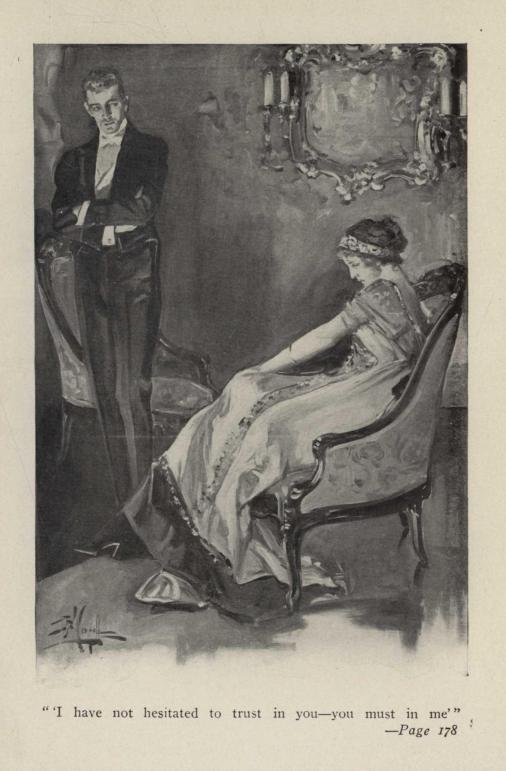
"'I have not hesitated to trust in you—you must in me'"
She shook her head, but without anger.
"Don't you understand," he said quickly, "that I must know why you acted as you did?"
Still her only answer was a deep-taken breath.
"I swear to you, if Mrs. Bloodgood did take it," he said, "I would not condemn her. On the contrary, I would pity her."
"Why should Mrs. Bloodgood, who has millions, do such a thing?" she said quietly.
"Because, from what I know, Mrs. Bloodgood, who has millions, as the wife of Enos Bloodgood, has not as much money in her pocket as you or I." He stopped. "She took it to have some means of escape, didn't she?"
"No, she did not take it," she answered, but in a tone that brought no conviction.
"You see, I know that you returned to Mrs. Kildair's that night," he said, irritated.
"How did you know?" she said quickly.
"Mrs. Kildair told me—no, that's not true; some one else did."
"Mrs. Kildair herself called me on the telephone and asked me to come," she said slowly.
"And questioned you?"
"Yes."
"As to what you had seen?" he said, with a great feeling of relief that should have warned him of his true interest.
"Yes."
"What did you answer?"
She rose and approached him, looking at him with only friendliness.
"If the ring is not restored in two weeks," she said, "then I will tell you what you wish to know."
"You think that, if Mrs. Bloodgood took it, she will now have no use for it," he persisted, seizing the idea.
"I know nothing at all," she answered, emphasizing the "know." "This promise must satisfy you. I only have a suspicion, and I don't want to do an injustice to another—remember that. I have never said it was Mrs. Bloodgood I suspected. Now I want to talk to you about my own affairs."
He was covered with contrition that he should have forgotten her difficulties.
"Good heavens!" he said hastily. "What have I been thinking of? Please don't think I don't care; I've been in such a whirl—"
She checked him with a gesture and a smile, motioning him to sit down again.
"Have you had any word?"
She shook her head.
"Of course, it's a terrible day on the Street," he hastened to reply. "Everything's up in the air—they're like a lot of lunatics. Garraboy hasn't had time to think. That oughtn't to alarm you."
"But I left word at his office for him to telephone me, and it is now," she said, glancing at the clock, "an hour and a half since the close."
"There are probably a hundred inquiries of the same sort awaiting him," he said to reassure her. "What are you afraid of?"
"I don't know—and yet I am a little anxious. Suppose he has used my stocks? Such things happen every day."
"The best thing is to find out at once how Garraboy stands—if he's been caught in the drop or not. Then we can take our measures."
"How'll you do that?"
"Call up Bruce Gunther and get him on the trail. May I telephone?"
"Do so."
"He's probably at the club now," he said, taking up the receiver and giving a number. "Yes, he's in. That's lucky. I'll get him in a moment." Then he added irritably: "How the deuce did you ever come to deal with Garraboy?"
"Why, I've known him ever since I came to New York. I wanted to invest some money—I didn't know any one else; and then, he was very—friendly; wanted to make some money for me. That's how it was."
"Hello," said Beecher. "Is that you, Bruce? It's I—Ted."
"Where the deuce have you been?" said the voice at the other end. "I've been trying to get you all over town."
"You have?"
"You bet I have; McKenna's turned up a real clue—wants to see you at once. Pick me up here at the club, will you?"
"All right. But say, Bruce, I want you to do something for me. Find out all you can about Garraboy—you know, the fellow we spoke about. Has he been on the wrong side of the market or not? Understand? It's important."
"I'll do it. Anything else?"
"Yes. A friend of mine has some stocks with him, about twenty thousand worth—you see the situation—and she's a little bit worried. Can't get any satisfaction."
"Wants 'em back?"
"Yes. What's the best way to do?"
"Um! Get a transfer to you and call for them tomorrow."
"Of course; see you later."
He put down the telephone and turned gaily to his companion, who was waiting with anxiety.
"That's all right. Bruce will get the information and I'll telephone you this evening. Now, the best way to operate is this." He took out his check-book and wrote a check for twenty thousand dollars to her name. "I'll buy those stocks. Here's my check; give me an acknowledgment for the shares, with an order on Garraboy to deliver."
She looked at him doubtfully, holding the check gingerly in her fingers.
"What's the matter?" he said. "If there's any little difference one way or the other, we can arrange that later."
"Supposing Garraboy has failed and sold my stocks?"
"He hasn't."
"But if he has?"
"That's my risk," he started to say, but checked himself. "Why, of course, then it's off. This is just to give me the power to get them away at once. A man can do what a woman can't."
She was grateful to him for his perception of delicacy.
"On that basis, yes," she said. Then she stopped and looked at him with a whimsical but favoring smile. "As it is, Teddy, what do you know of me to take even this chance?"
The opening was too direct. She saw it at once, and, to forestall his answer, said more lightly:
"It is a great service. Tell me what to write."
As she was drawing up the paper under his directions, a placid, emotionless woman of forty entered from the rear.
"That Mr. Hargrave is here, Nan dear," she said. "You gave him an appointment, you know."
"Mrs. Tilbury, my companion," said Miss Charters. "Very well; in a moment."
Mrs. Tilbury passed patiently out to deliver the message. Beecher was delighted with the correctness and cold respectability of such a chaperon.
"Mr. Hargrave is a young dramatist," said Miss Charters, finishing the document. "He's coming to read some masterpiece to me. He wrote a one-act piece three years ago that was very clever, and now, of course, I can't risk refusing to hear him—he might have a work of genius at last. This is my fourth trial." She put the paper from her impatiently. "I'm sorry."
He was displeased also at this sudden recall of the other life in her, the world of the theater, which crowded the walls with its signed photographs.
"I'll telephone as soon as I know," he said, dissembling his irritation.
She went to the door with him, annoyed also at the interruption.
"I'm coming tomorrow," he said, and he held out his hand with a little defiance.
She did not resent the assumption of right, still introspectively puzzled at the new moods into which she had fallen. And, still pensive, she said:
"Come."
Below, in the anteroom, he sent a look of antagonism and scorn at a young man, a little extravagantly dressed, who carried a portfolio under his arm with a sense, too, of irritation and pride.
CHAPTER XIII
When he had gone into the brisk air of the street, his mental vision returned with the crispness of the night. He was astonished at what he had said and done.
"But I am not in love—not in the least," he repeated. "Then what was it?"
He was quite perplexed at perceiving the astonishing difference her presence and her absence made in his attitude. He repeated to himself quite seriously with a little wonder that, if he were in danger of falling in love, he would be a prey to that disturbing emotion now, absent as well as present.
"I am perfectly calm," he said, flourishing his cane. "Not in the least excited. It's very queer."
All the same, he returned to the interview, and recalled the incidents without illusion. He comprehended now what he had not comprehended then, the full significance of his offer of friendship—in fact, that it was not an approach to friendship but to something very different, and the relations which had now been established between them were those of confidence and intimacy that lay on the borderline of great emotions.
"It's very odd," he said, "I wish to be honest and open with her, and yet I said what I don't feel—suggested what I have not the least thought of. I'll be hanged if I understand it, unless she has the power to make me believe in emotions that don't exist,—Emma Fornez was right, she is the type that provokes you. I must be very careful."
But one thing he did not perceive—that the city no longer oppressed him with its bleak struggle and serried poverty, that he swung lightly over the crisp pavements, breathing the alert and joyous air, that in him the joy of living awakened, as the myriad lights awoke the city of the night, the city rising from the fatigue of labor with its avid zest for pleasure and excitement.
"What is the clue McKenna's got hold of?" he thought eagerly, as the massive, cheery windows of the club came into view across the stirring, care-fleeing homeward rush of the Avenue.
The moment he entered the crowded anteroom, the tragic day returned with redoubled gloom. The death of Majendie oppressed every voice—nothing else was discussed. He found himself caught up in the crowd at the bar, listening with a strange sense of irony to those who touched in haphazard the event which he knew so profoundly. The wildest rumors were current. Majendie had shot himself after the discovery of an enormous shortage in the funds of the Atlantic Trust. The Atlantic Trust had been looted, the effect on Wall Street had been to confirm the wildest rumors, the market would plunge down to-morrow, the awful loss of the day would be surpassed; it was the panic of '93 over again. The inevitable mysterious informant in the crowd arrived with a new rumor: Majendie had tried to escape, had been prevented by detectives, who had been shadowing him for days, and had then gone in and shot himself just as the warrant for his arrest arrived. Another gave this version; Majendie had not shot himself, he had been murdered.
Every one exclaimed at this.
"That's the story in the Associated Press offices," continued the informant obstinately. "A man whose whole fortune was locked up in the Atlantic—a small depositor—got into the house on some pretext, and shot him—crazy, of course. It's not been verified, but that's the story."
"Tell you what I heard," said another, in a low voice, to a group that eddied about him. "It's true he was shot, but he wasn't shot in his own home. He was shot last night in his box at the opera by a man who is as well known as old Fontaine. The old story, of course, trespassing in married quarters. The whole thing was kept dark—got him out of the box after the crowd went out, and took him home, where he died at midnight. Heard the names in the case, but pledged not to repeat them."
Each rumor received a momentary credence, in the excitement of the moment. Some one defending the personal friend, insisted on melancholia and despondency, citing the example of an uncle who had taken his life after the disgrace of his son. No one spoke the name of Mrs. Bloodgood, waiting the moment of confidences à trois. In the stupefaction of the moment, even the personal losses, which had been tremendous, were momentarily forgotten. Gradually inquiries began to be made as to the extent of the panic. Then at once a division was apparent. There was already the party of the shorts, eager and vociferous, staking their last chance of recouping on a still wider spread of the devastating drop, which they now as ardently desired as though a thousand homes would not suffer for every point acquired.
Beecher separated himself from these enthusiasts of failure, and passed into the front room, where he was signaled by Gunther, who was in one of the numerous small groups. He found a chair and joined the party, in which were Fontaine, Lynch, and Steve Plunkett. The conversation, which was controversial, continued without interruption.
"Don't be an ass, Ed," said Lynch, with irritation; "nothing can stop the market."
"The Atlantic Trust is as solvent as Gunther & Co.," insisted Fontaine, with a nervous, emphatic gesture. "Every depositor will be paid in full."
"It'll be in the hands of a receiver before the week's over—bet you five to three."
"Possibly; but then—"
"Moreover, what of the public? What's the public going to do when it hears Majendie's committed suicide? What'll it think? It'll think the whole blamed institution is rotten to the core—looted!"
"Sure," said Plunkett, and he added savagely, his glance lost in the distance: "Damn it, if I'd known the news an hour earlier, I could have made fifty thousand."
"Why, look at the situation," continued Bo Lynch, excited by his own images. "The Clearing-house closed against the Associated Trust and all its allies; runs on banks all over the country; Slade forced to the wall, out of it in a couple of days, perhaps—God knows, another suicide, maybe; two failures up into the hundreds of millions—everything in the country thrown on the market! Look at the sales to-day; they'll be doubled to-morrow. Nothing can hold out against it. The country'll go crazy! I tell you, '93 was nothing to it."
Gunther rose.
"What do you think, Bruce?" said Plunkett anxiously.
"Don't know a thing about it," said Gunther brusquely. "Neither does Eddie or Bo. If you want to gamble, gamble."
He nodded to Beecher, and they moved out together.
"Let's cut out of this den of lunatics," he said. "My machine's here; supposing we run down to McKenna's and get him off for a quiet chop. I've already telephoned."
"He's got some news?"
"Yes, but I don't know what it is. Jump in."
"What about Garraboy?"
"Rumor is, he's in heavy. McKenna's looking that up, too."
"I say, Bruce, what do you really think about the situation?" said Beecher, forced to contain his curiosity. "Are we going to the bow-wows?"
"If you ask what I think," said Gunther meditatively, "I think it's the devil to pay. Far as I can see, a lot depends on John G. Slade. There's no doubt there's a crowd after his scalp."
"Will they get it?"
"Looks so; but he's got nine lives, they say."
"Where the deuce are we going?" said Beecher, suddenly aware of the swift flight through the now deserted regions of the lower city.
"Down to McKenna's offices."
"As late as this?"
"Guess these days keep him pretty busy."
"Didn't he say anything about his clue?"
"Said he'd traced the history of the stone."
They soon came to a stop in one of the blocks on Broadway within a stone's throw of old Trinity, and, descending, entered a dingy four-story building pinched in among the skyscrapers. At the second flight of worm-eaten stairs, Gunther pushed open a smoky glass door and entered a short antechamber inclosed in sanded glass with sliding pigeon-holes for observation. Their arrival being expected, they were immediately shown down a contracted hallway studded with doors, to an open room, comfortably furnished, with a fire burning in the grate.
"Join you in a moment, gentlemen," said McKenna, nodding around the door of the adjoining room.
Gunther unceremoniously helped himself at the open box of cigars.
"Ted," he said enthusiastically, "why the deuce do the novelists concoct their absurdly stalking detectives, who deduce everything at a glance, with their impossible logical processes? Don't they see the real thing is so much bigger? It's not the fake individual mind that's wonderful; it's the system—this system. A great agency like this is simply an expression of society itself—organized order against unorganized disorder. It's an unending struggle, and the odds are all on one side. By George, what impresses me is the completeness with which society has organized itself—made use of all inventions, telephone, telegraph, the photograph, the press, everything turned on the criminal to run him down. For a hundred detectives employed here, there are a thousand allies, in every trade, in every depot, in every port, along every line of travel. When you think of the agencies that McKenna can stir up by a word, then you begin to realize the significance of the detective in the structure of society."
McKenna, who had heard the last words, entered, vitally alert and physically excited by the joy of unusual labor.
"Now I'm with you," he said, appropriating an easy-chair. "Let's see where we'll begin. Oh, Mr. Beecher, you wanted certain information about that broker Garraboy, didn't you?"
"What have you found out?" said Beecher, with a conscious eagerness that struck both hearers.
"It just so happened I had a line on your man from another direction," said McKenna. "Well, he's hit the market right. What would have happened if this panic hadn't come just right, is another question—a rather interesting question. However, Garraboy's known to have been heavy on the short side, and, from all reports, stands to make a killing."
"Then Miss Charters' stocks are all right?"
"They're all right—yes—now," said McKenna carefully; "but my advice is to get hold of them—P.D.Q. Mr. Garraboy is somewhat of a gambler. Now, here's a bit of history about a certain ruby that will interest you," he continued, drawing out a memorandum. In his manner was a little amused self-satisfaction, as one who relished the mystification of the outsiders. "In the first place, your ruby ring is not worth fifteen thousand."
"No?" said Beecher in amazement.
"It's worth considerably more," said the detective, with a grin. "Its last sale was at the price of thirty-two thousand dollars."
"What!" said both young men in chorus.
"Just that."
"But then, why should Mrs. Kildair value it at fifteen?" exclaimed Beecher.
"That's rather an interesting point," said McKenna, "and we'll touch on that later. The stone is as well known in the trade as John L. Sullivan to you and me. It was first sold in New Amsterdam in the year 1852 to a firm of Parisian jewelers. From them it was bought for a well-known, rather frisky lady called La Panthère by a Count d'Ussac, who ruined himself. La Panthère was killed later by a South American lover and her effects sold at auction. The ruby was bought by the firm of Gaspard Frères, and set in a necklace which was sold to the Princess de Grandliev. At the fall of the Second Empire, the necklace was broken up and this particular stone went over to England, where it was set in a ring and sold to a young dandy, the Earl of Westmorley, who was killed steeplechasing. A woman named Clara Hauk, an adventuress, had the ring in her possession, and successfully defeated the efforts of the family to regain it. She got into bad water in the '80's and sold it to a South African, who carried it off to the Transvaal with him. It reappeared in the offices of Gaspard Frères in 1891 on the finger of a young Austrian woman who sold it for twenty-two thousand dollars and disappeared without giving her name. An Italian, the Marchese di Rubino, bought it for a wedding present to his daughter, who kept it until 1900, when she pledged it to pay the gambling debts of her husband. It was then brought to this country by the wife of a Western rancher, who sold it five years later to Sontag & Co. The last sale known was just two months ago."
"Two months?" said Beecher, craning forward.
"The price, as I said, was thirty-two thousand, and the purchaser was a certain gentleman very much before the public now—John G. Slade."
This announcement was so entirely unexpected that it left the two young men staring at each other, absolutely incapable of speech.
"But then," said Gunther, the first to recover, "the ring was given her by Slade!"
"At a cost of thirty-two thousand," said the detective in a quick, businesslike tone.
"You are sure?"
"As positive as any one can be. There are only three other rings—"
"That's why she wanted to keep it quiet!" exclaimed Beecher, rousing himself from his stupor. The whole machination of Mrs. Kildair became comprehensible to him on the instant. "Now I see!"
"Precisely," said McKenna. "Of course there is a chance that Slade did not give her the ring; that I'll know tomorrow."
"How?"
"Make an inquiry—for a supposed purchaser, of course; find out if the ring is still at Slade's."
"It's useless," said Beecher firmly. "I know that McKenna's right. This explains everything," he continued, turning to the detective. "That's why she acted so strangely "—he checked himself. "I saw Mrs. Kildair—took lunch with her—to-day—"
"Did you find out whom she employed?" said McKenna quietly.
Beecher opened his lips to answer in the affirmative, and stopped abruptly. For the first time, he realized that Mrs. Kildair had taken back the address. He rose nervously, frowning at the stupidity he would be forced to disclose.
"By Jove, I am an ass!" he said, dropping his glance; and he related the scene in which Mrs. Kildair had first given him the address and then taken it away.
"It's not important, Mr. Beecher," said the detective pensively, his mind working behind the recital. "She didn't give you the right address."
"How do you know?" said Beecher, turning.
"Because she recovered the paper as soon as she found out you were employing me," he answered; but his mind was still out of the room. He took out a pencil and began tapping his memorandum with quick, nervous jots. "Her mind worked pretty quick," he said.
"Why do you want to know her detectives?" asked Gunther.
"You see, the case is complicated," said McKenna, rousing himself. "I won't go into her relations with Slade just now, but it's quite evident to any one they were such that Mrs. Kildair prefers to lose the ring rather than to have it discovered how it came to her. See?"
"I see," said Gunther.
Beecher, silent, was turning over in his mind all the incidents of Slade's and Mrs. Kildair's conduct, striving to reach some explanation but the natural one that forced itself on him.
"That's why," continued McKenna, "I'd like to know, first, if the detectives are straight—can be depended upon; second, if they were told to make a search; and, third, if they were told not to find the ring."
"But why not?"
"Because, Mr. Gunther, whoever took that ring the second time didn't take it on impulse or without a plan; whoever took it probably—I don't say certainly—knew enough of its history to know that Slade gave it to Mrs. Kildair, and reckoned on the fact that she would not dare to make it public. See?"
The corners of his eyes contracted suddenly, as though through the movement of propelling forward the quick, decisive glance.
"Then you think," said Beecher slowly, "that she is—"
"Look here, Mr. Beecher," said the detective quickly, "there is one thing no human being can ever say offhand; what says the Bible—the way of a man with a maid—well, make that woman in general. You don't know, and I don't know, what the situation is right there, and we may never know. All the same, we're now started on solid ground; it may lead to something, and it may not, but what I want to know before we get much further is who and how many there that night knew or guessed Slade gave her the ring."
"Of course," said Gunther. "But how—"
"By patience and by running down every alley till we find it is an alley," said McKenna. "That's one thing to keep in mind, and let's put it this way. Was there any one there that night who had to have money quick, and who knew that the fact of Slade's giving the ring would tie Mrs. Kildair's hands? Now, if that condition existed, we're on a strong motive."
"You don't consider that the only lead," said Beecher, convinced as he was of the probability of Mr. Majendie's participation.
"Lord, no. Here's one other point to work on, Mr. Beecher. What's the situation today between Slade and Mrs. Kildair? Has there been any quarrel—say within the last ten days?"
"I don't think so; and yet—" Beecher stopped, remembering Mrs. Kildair's curious request for him to outstay the promoter. "What if there was?"
"Slade's a remarkable character," said McKenna, smiling. "Just how remarkable a few people will learn shortly. If he had quarreled or she's been trying to trick him—just like him to take the ring the second time."
"By George!" said Gunther. "Why not?"
"That's only something to be kept in the background," said McKenna, rising.
He turned to Beecher, considering him profoundly.
"Sorry you told Mrs. Kildair I was on the case," he said.
Beecher blushed at the memory of the way in which he had been brought to disclose the information, and the confusion all at once revealed to the detective the probable means she had taken.
At this moment the door opened and a voice called him.
"Telephone, sir—personal."
When the detective had left, Beecher and Gunther looked at each other in amazement in which a curious doubt was beginning to form.
"Why the deuce should Slade give her the ring, Ted?" said Gunther abruptly.
"I don't know," Beecher answered, perplexed. "I know what you think—that's natural; but I don't believe it. She's deeper than that—that is, I think so."
But he ended perplexed, contracting his eyebrows, nervously jerking at a button on his coat.
McKenna reentered, and on his face was a smile of anticipation and mischief.
"Some one called me up just then," he said shortly; "some one I've been expecting to call me up. Guess who?"
"Slade," said Gunther, startled.
"Mrs. Kildair," said Beecher.
"Mrs. Kildair is right," said McKenna. "I'm going up to see her tonight." And he added meditatively, "It ought to be quite an interesting little chat."
CHAPTER XIV
At eight o'clock promptly McKenna presented himself at the door of Mrs. Kildair's apartment. Kiki, with his velvet glide, ushered him into the studio. The electric chandeliers were dull; only the great standing lamp was lit, throwing a foggy luster about the room, massing enormous dark silhouettes and spaces in the corners.
"Is it a precaution?" he thought grimly, considering this serviceable obscurity.
He felt a sudden heightened sense of curiosity and defiance, a feeling that had been growing within him ever since the discovery of Slade's connection with the ring, and the brief, disjointed details of Beecher's interview. Every profession develops, back of its elaborate technique, a sudden quality of instinct which exists as the almost mechanical and unguided operation of the disciplined mind. McKenna had no sooner entered the room than he perceived the woman with a quick defensive "on guard" of all his faculties.
He stopped in the center of the room, like a pointer flushing his game, and in the second's rapid inhalation he completely changed his scheme of attack. He felt at once that he had to do not alone with—what he expected—a woman of unusual physical attraction, clever, with the defensive intuition of one who has evaded the scrutiny of society; but with a woman of mental grasp and decision. He felt it everywhere: in the remarkable adjustment of the square room which broke it up into half a dozen separate groups, distinctive and sure as though so many separate selves; in the harmony of color and proportion, which he felt without analysis; in the seduction of the Récamier couch with its eastern drapery of blue and gold; in the friendly comfort of the grouped chairs by the baronial fireplace; in the correct intimacy of the reading-table at one end and the formality of the grouped chairs by the piano. All these notes were to him notes of the hand that had arranged them, as he felt in the struggling muscles of the bared marble torsos, wrestling on the mantel, and the lithe, virile body of the discus-thrower on the table, the virility and aggressiveness of the woman. This perception awoke his defiance as though one personality had been substituted for another.
"What does she want with me?" he thought. "Is she daring enough to tell me all, or is she worried at what I may know?"
While he was still in the midst of his reflections, Mrs. Kildair entered. She was in street costume: a tailor-made dress of dark blue, edged with black braid, the stiffness and sobriety relieved by a full fichu at her throat. The red flight of a feather crossed the Gainsborough hat.
"How do you do?" she said, nodding to him, a crisp, businesslike abruptness in her voice. "A little more light would be better. Thanks. The button is by the door."
Prepared as he had been to be surprised, he had not expected this businesslike manifestation. He went to the wall, following her directions, and threw on the lights.
"Only the side lights," she said. "That's it. Shall we sit here?"
She took her position by the reading-table in a great high-backed upholstered arm-chair. Obeying her gesture, he drew up his chair to a position opposite. In the varied experiences of thirty years, he had come into contact with women of all walks of life. Without the psychological analysis of subtleties of the lawyer and the novelist, he had an unerring instinct for the crux of character. "Is she good or is she bad?" was the question that, in ninety cases out of a hundred, he put to himself at the turning-point of his campaigns. For the first time, despite his previous prejudice, he was in doubt for an answer, but he recognized in her at once the stamp of that superior brood which raises some men to fame and fortune where others by one trait of conscience or weakness end in a disgraceful failure.
"I have wanted to meet you for a long time, Mr. McKenna," she said directly, but without the accompanying smile of feminine flattery. "Mr. Slade has told me much about you."
"Slade?" he said, with a quick simulation of surprise, while admiring the abruptness, amazing in a woman, with which she had launched her attack.
"You realize, of course, Mr. McKenna," she continued quietly, without giving him time to deny her first implication, "that Mr. Beecher, in engaging you, has, quite without his knowledge, brought on a situation that is very embarrassing to me."
"Good!" thought the detective. "She has made up her mind to tell the whole story." Aloud he said, without change of expression: "In what way, Mrs. Kildair?"
"A situation exists which makes it extremely difficult for me to recover my ring without disclosing to the public matters in my own private life that at present are liable to great misconstruction."
She spoke professionally, without variation in her voice, as a doctor speaking with dispassionate directness. McKenna did not answer, resolving by his silence to force her to talk.
"A week," she continued without pause, though her eyes remained without wavering on his, "—ten days at the most—may completely change this position. I won't conceal from you that I am extremely sorry that you have been brought into the case." McKenna could not control an expression of surprise. "But, now that you are in it, I shall be forced to give you a confidence against my inclination."
"But—" began the detective.
"One moment," she said, interrupting him. "Before I give you this confidence I wish to ask one question."
"Mrs. Kildair, I must remind you," said McKenna warily, "that I am engaged in the interests of Mr. Beecher, and can do nothing without his permission."
"Are you representing any one besides Mr. Beecher?" she said, ignoring his objection.
"What do you mean?" he said carefully, to gain time.
"Are you, in this particular case, representing Mr. Slade?" she said directly.
"I have never said that I was employed by him, Mrs. Kildair," he said slowly, comprehending now the full purpose of her opening question.
"Mr. Slade has told me himself of your work in connection with the Gray Fox Mines, the Farmers' and Travelers' Bank, and the more personal affair of your recovery of his letters from a Miss Minna Weston. You see, I am informed."
"I have worked for Mr. Slade," said McKenna.
"And are you doing so now?" she asked sharply.
"I never refer to my clients, Mrs. Kildair," he said stiffly.
"I desire to put this matter entirely in your hands—without reserve," she said quickly. "All I ask from you is a promise that, notwithstanding your relations with him past or present, nothing I say to you shall be repeated to Mr. Slade, or to any one else."
"Mrs. Kildair," said McKenna, every faculty joyfully grateful for the contest of wits he felt impending, "I must remind you that my employer is Mr. Beecher, and that I can promise nothing that will keep him from doing anything he desires.
"Mr. Beecher is acting for me," she said calmly. "Very well; your position is correct. I will put it this way. Subject to Mr. Beecher's approval, will you give me your word that you will repeat nothing of what I may tell you?"
"If Mr. Beecher is willing, I am," said McKenna obstinately. "That's my word."
"Now I can speak to you freely," said Mrs. Kildair.
"I have not promised yet," broke in McKenna.
"I will take the risk," she said, brushing aside the obstacle with an impatient gesture.
"I remain entirely free to communicate anything to Mr. Beecher," interposed the detective instantly.
"You do not understand," she said, without irritation. "Mr. Beecher, in retaining you, did so to assist me, and only after he had secured my permission. Now I desire, in order to arrive at quicker results and to be free to give you my full confidence, to transfer that authority direct to me. In other words, Mr. McKenna, I wish to retain you myself and for myself only."
"That, Mrs. Kildair, depends entirely on Mr. Beecher," repeated the detective.
"But if he acquiesces, will you act in my interests only?"
McKenna was about to interpose another evasion, when he reflected that he would have time to acquaint Beecher with what had happened and to advise him either to accept or to refuse.
"Very well," he replied cautiously, feeling instinctively that some trap was being prepared without yet perceiving what it could be. "I will leave it that way."
"Good," she said, with a little nod of her head. "Now, what have you done?"
"I can not answer that, Mrs. Kildair," he said, smiling; "not under my present arrangement."
"You have, of course, discovered that the ring belongs to Mr. Slade?"
Quite unconsciously, she had adopted his own tactics, the tactics of the inquisitor, who hurls the vital question at the suspect, and then seeks the answer in the almost imperceptible response in the eyes.
"Yes, I know that," said McKenna, who felt that the surprise he had experienced at having the tables thus turned on him had revealed the truth to the questioner. "That is, I know the ring did belong to Mr. Slade."
"Have you informed Mr. Beecher of the fact?"
"It has just come to my knowledge," said McKenna; "I shall, naturally, inform him."
Mrs. Kildair looked at him a moment with an appearance of reflection.
"The question was quite unnecessary," she said. "Of course, you have told him, and you have every right to deny it." Then she continued with more decision: "This is exactly my danger—you see, I won't mince words. It is a situation which constantly occurs, and which is inexplicable except by one construction in the eyes of society. Now—"
"I warn you," again objected the detective.
"I do not propose to explain my relations with Mr. Slade," continued Mrs. Kildair coldly. "They are such that a great deal depends on the events of the next few days. At present it is enough that I can not explain my possession of the ring in any way that can satisfy publicity."
"Mr. Slade did not give you the ring?" said McKenna, in slow progression.
She carefully considered the question.
"Mr. Slade sent me the ring with an offer of marriage," said Mrs. Kildair evenly, with an appearance of great frankness. "The ring arrived on the night of the party, and I committed the imprudence of wearing it. If its source now becomes known, I must appear before the world either as Mr. Slade's mistress or as his fiancée; and at present I have not made up my mind whether I shall marry him."
The directness of this avowal left McKenna immersed in thought. He looked at her, unaware of the fixity of his stare; and, inclined as always to skepticism, he asked himself if back of all the outer gilt of this proud, determined woman, there were not a stalking shadow of insistent poverty, whether the game she was playing with Slade were not a greater drama than that in which he was engaged; whether, in fact, it lay not on a turn of the balance whether the world should know her as the wife or that very alternative which she had dreaded in the exposure of the ownership of the ring?
"What does she really want of Slade?" he said to himself, staring so profoundly beyond the set gaze of the woman that, for the first time, she moved with a little annoyance.
"Mr. McKenna!" she said sharply.
"I beg your pardon," he said, stiffening abruptly.
"You perceive now the delicacy of my position," she said; "and why I desire to have you completely in my interests."
"I do," he answered, but still clinging to the saving rope of defiance. "I only regret that you told me this before Mr. Beecher's—"
"Now ask me any questions you wish," she said, interrupting him impatiently.
"I don't feel at liberty to do so, Mrs. Kildair," he said warily, convinced that her whole motive was to find out the extent of his knowledge. "I prefer to know first where I stand."
"Very well," she said. "Let us talk of other things, then." Her manner changed to one of a lighter, inconsequential curiosity. "There is one point in the frightful happenings of the day I should like to know."
"What, madam?" said McKenna, whose instinct warned him to adopt a tone of artless attention.
"Majendie was followed by detectives, was he not?"
"That is the report."
"And he was on the point of leaving when he perceived that he would be followed?"
"That is what I have been told."
"And, believing that he was about to be arrested, he returned to the house and shot himself."
"That's the story."