Front matter (continued 2)
Reading edition
"I know nothing in the world about you, Miss Charters, but my instinct tells me that is absolutely impossible."
"Only?"
"Only I can not forget your agitation at certain moments."
"Naturally; that is my temperament."
"You are perfectly calm now, and you were perfectly calm at certain times tonight."
She turned suddenly in her seat and faced him, saying sharply:
"What do you mean?"
"May I speak frankly?"
"I ask you to do so," she said peremptorily.
"I think—in fact, I am convinced—that you suspect who took the ring in the first place."
The cab was grinding against the curb. She put out her hand hurriedly, as if the impulse were to jump from the carriage. But immediately she checked the movement, and turned, saying very simply and directly:
"Do you wish to be my friend?"
"You know I do," he said, surprised.
"Then, if you do, and trust me, never ask that question again—or make the slightest reference to it."
She held out her hand. He took it, but without an answer, opened the door, saw her to her vestibule, and returned silent and moody, turning over again and again in his mind the sudden contradiction in her character.
"I wonder if she repels or attracts me most," he said, tramping over the quiet pavements, which flung back the riotous thumping of his cane. But, as he went aimlessly along, he felt again creeping over him the suddenness of her charm and a certain unsatisfied restlessness to see her again, which came to him with the faint scent of the perfume that had clung to his coat.
All at once he stopped.
"I've got to get to the bottom of all this affair," he said abruptly. "I believe she's as straight as they make 'em; I'd wager my soul on it—but I've got to know!"
And, boarding a surface car, he returned to Rita Kildair's.
CHAPTER V
He had arrived at the studio building and entered the lower vestibule before he was aware of the lateness of the hour. He pulled out his watch, and found that it was almost midnight.
"Good heavens!" he said, taking a step back. "I quite forgot the time." He started to go, then turned to the switchboard. "Could I telephone up to Mrs. Kildair's apartment?"
"Go right up, Mr. Beecher," said the hallboy, rising.
"Are you certain?" he said doubtfully.
"Sure. Orders is to send up any one who calls."
A little surprised, he entered the elevator. At that moment a ring sounded, and on the indicator the figure 4 dropped.
"That's her floor now," said the boy, starting up the elevator.
At the fourth he came face to face with Garraboy, who saw him with a start of surprise and a sudden look of malice. The two nodded, without cordiality.
"Hello," said Garraboy, looking at him with a curious fixity which he remembered after. "What are you doing here?"
"What are you?" said Beecher abruptly.
"Some valuable information to volunteer?" persisted the other, with a deliberate accent of irony.
"Perhaps."
"Indeed? Then you have come to assist in restoring the ring," said Garraboy in a low voice; and on his young, wrinkled face was a faint glimmer of a smile.
"Perhaps," said Beecher, flushing angrily. "Does that annoy you?"
"Not in the least," said Garraboy drily. "On the contrary, I am interested—exceedingly so." He lifted his hat slightly and stepped into the elevator.
"Now, what in the devil has he got in his mind?" thought Beecher angrily. "And what was his idea in coming back? Nice look he gave me. Thought he had such an all-fired important engagement that he had to hurry away!"
He tried the door absent-mindedly, and found it locked. A long moment after he had pressed a second time upon the bell, the door was opened by Rita Kildair herself, who drew back in evident astonishment.
"You?" she said, frowning.
"I was going to telephone," he said, a little embarrassed; "but they told me downstairs to come up."
"Quite right."
"Look here, Rita," he said, with a sudden feeling of intuition. "I know you probably think I'm a prime representative of the pinhead family, but I'm awfully broken up by what happened. Can't I help out some way?"
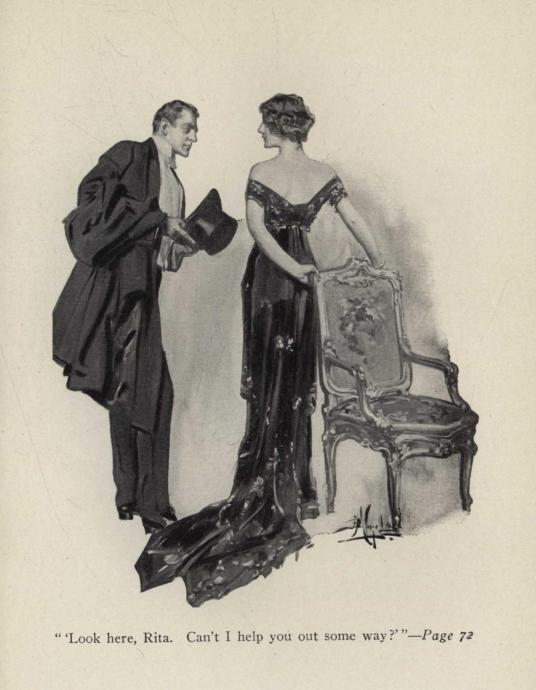
"'Look here, Rita. Can't I help you out some way?'"
"Is that why you've come?" she said slowly.
"Of course," he said, meeting her scrutiny with a puzzled glance.
She considered a moment and then said abruptly:
"Go in and sit down. I'm busy at the telephone. I'll be back in a moment."
The studio was still blazing with the electric chandeliers, the dining-table still crowded with the untouched dinner, with that sense of desolation and fatigue which the aftermath of a banquet presents. Lighted up as it was, the studio had none of the mystery that charmed—rather, something of the cruel garishness of the white sun.
He moved about aimlessly, arms crossed, his imagination repeopling the room with the strongly accentuated personalities who had gathered there an hour before, saying to himself over and over:
"Now, why the deuce did Garraboy come back?"
He approached the table and abstractedly took an almond and began munching it. Then, perceiving the chafing-dish, reached over, with a smile, and lifted the cover. But, at the moment his hand was outstretched, his eyes, obeying some mysterious instinct, rose to a long Venetian mirror opposite. In the clear reflection that showed the balcony of the second floor, he distinctly beheld the head of a woman protruding a little beyond the curtain.
"What the deuce!" he said, covering the chafing-dish with a bang. "It can't be Rita—who then?"
All at once he comprehended. If the ring had not been found in the search, it was because it had been concealed in the room, and the woman in the balcony was a detective set to watch the trap—if the real thief had the daring to return.
At this moment Rita Kildair entered from the bedroom.
"Good heavens, Rita!" he said directly. "You don't mean to say you suspect me?"
"What do you mean?" she said, stopping short, her glance instinctively seeking the balcony.
"I mean you've stuck a detective up there to see what I do the moment I come into the studio. Good heavens! what do you think I came for?"
"My dear Teddy," she said, frowning at the stupidity of her spy, "is there any one who can't be suspected? Do you blame me?"
"No, I suppose not," he blurted out. "Only, it gives a fellow a deuced creepy feeling to have a couple of eyes looking through him from behind the curtain. I say, why don't you search the place? The ring must be here!"
"That is possible, of course," she said thoughtfully, her lip between her little teeth, an impulsive movement when she was plunged in thought.
"Or are you waiting for the thief to come back here and try to recover it? Of course, that's the plan."
"There's one thing," she said, with a quick, imperative gesture, looking at him closely, "I want you to remember. There is nothing public to be known. Whatever is done must be done quietly."
"Oh, of course," he said hastily. "I say, Rita, let me try to work this out with you—give me your confidence! I wish you would."
She considered a moment, as though puzzled by his offer.
"I don't think it will ever be found," she said, shaking her head and looking at him.
"But you suspect some one," he persisted.
She hesitated a moment, and then shook her head.
"No."
The second's delay convinced him.
"Man or woman?"
"It is only a speculation," she answered slowly, "but I believe it was a woman."
"Both times?"
"Both times."
He took a turn, moodily disturbed, and came back.
"Tell me this, Rita," he said. "Who else came back here tonight?"
"Garraboy," she answered slowly, "and—Mrs. Cheever."
"Mrs. Cheever!" he exclaimed, astonished. "Why, she was on the verge of prostration."
Mrs. Kildair smiled a thin, elusive smile, and was about to reply when there came a ring at the door.
Instantly her manner changed. Placing her finger on her lips, at the same time sending him a glance that commanded the utmost silence, she took his hand and led him softly from the studio, through her bedroom into the further obscurity of the dining-room, which was lit only by the weak reflection which filtered through from the hall.
"Sit here, and not a sound," she said, placing her lips so close to his ear that he felt the warm contact of her cheek. She gave him a slight pressure of her fingers, and went back into the studio by way of her bedroom, closing both doors.
Beecher, left in the darkness, strained every nerve to catch the sound that would reveal the identity of the new arrival. It seemed to him that he heard the sound of another woman's voice, and then presently, as a shadow came to him through the twilight of the hall, he heard Mrs. Kildair saying:
"—to telephone. Be back in a moment."
The next instant she was at his side, pressing his hand to prevent the whisper that was on his lips. They sat thus side by side for what seemed a full five minutes before she rose and silently passed into the hall again. Beecher remained in complete bewilderment, unable to detect the slightest sound of the conversation that was taking place. That the same test was being applied to the new-comer which he himself had detected, he understood; but which one of the many guests it might be, he could not discover.
At the end of an interminable interval, he heard a few faint sounds, the closing of the outer door, and presently the rustle of Mrs. Kildair's approach.
"Come now," she said, waiting for him in the hall.
"Who came back then?" he asked eagerly.
She shook her head.
"I can not tell you—at least, not now. There are reasons why it would not be quite fair," she said. Then, seeing his irritation, she tapped him on the arm and added: "Listen, Teddy. It is too late to talk over things. Run away now. Come in tomorrow at five."
"I want to help, you know," he said, taking her hand, guiltily conscious of the smile with which she examined him—a smile that seemed to convict him of treason. For the moment, however, the memory of the younger woman was dimmed. He was conscious only of the indefinite lure of mystery which Rita Kildair always exerted over his curiosity the moment they were alone.
"Look here, Rita," he said impulsively, "I should think, in a case like this, you'd want all the help you can get!"
Her smile disappeared. She looked at him a moment with almost a masculine penetration, and then, her smile returning, said quietly:
"It's curious, but each person who came back here tonight came back just to—help."
Not only her words, but her manner, struck him with a sense of discomfort.
"Come in tomorrow," she said, pushing him gently toward the door. She made a quick little motion with her fingers, looked at him with a penetrating seriousness, and disappeared, leaving him thoroughly confused and irritable.
"Why, she acts as though she suspected me!" he said, remembering her continual examination. "Who the deuce came back then? What's Garraboy in all this? Does he suspect me, too, and has he been saying anything to Rita? What is terrible in such a situation is that any one may be suspected." Suddenly he perceived that he had repeated the very words that Nan Charters had used in the coupé.
"By George, what a rotten mess! I feel like a pickpocket already," he said, with a sudden cold horror in his back. "Why shouldn't Rita suspect me as well as any one else? This is no pleasure party; this is serious—dead serious. I've got to work it out!"
CHAPTER VI
Teddy Beecher was a fair representative of the second generation. He still retained the rugged democracy of the father who had fought his way to a moderate fortune in the troubled regions of the coal-fields. To him a man was a man, whatever the quality of his coat. Left an orphan at fourteen, he had passed victoriously through boarding-school and college without seriously troubling the peace of mind of those who were competing for scholarship honors. He was liked because he liked every one, not with a politic assumption, but from a veritable enjoyment of life and men.
After graduation, he had gone West on a ranch with several of his classmates, for the pure love of adventure and the delights of the great open spaces. Having thus begun his education, he continued it by knocking about the world, with periodic excursions in search of big game. He had known a great many types of men without knowing them in the least, and he appealed to all women without being deeply impressionable to their influence. His philosophy of life was very well summed up in a remark he had made on his return to New York—that he would probably go to work if he couldn't find anything better to do.
When he awoke the day after Rita Kildair's party, it was with the clear and dispassionate vision of the morning. The dramatic occurrences of the night before flashed instantly into his consciousness, arousing all the energy of his young curiosity. He recalled the promise to solve the mystery he had made in a moment of enthusiasm, and with a renewed zest began to consider how he should prove himself.
Several things immediately rose up to perplex him in the strange and dramatic climaxes at which he had assisted—the twisted undercurrents of which he was still completely ignorant. Why had Garraboy, and then Rita Kildair, adopted an attitude of suspicion toward him when he had returned? For Garraboy's hostility he found a ready answer in the mutual antagonism that had risen from the first exchange of glances; but the reception he had received at the hands of Mrs. Kildair thoroughly mystified him.
"Of course, if the ring wasn't found in the search," he said, getting out of bed and ringing for his man, "it's got to be in the studio; of course—no way around that. Whoever took it the second time didn't get much opportunity to hide it, either—unless it was hidden after the candle was lit; there was a chance then—every one was stumbling around. By Jove! I believe that's how it was done. But then, why the deuce should more than one person return?"
He stopped and suddenly remembered his own return.
"That's so; a man might come back to offer help. But why a woman? And who the deuce came back after I did—Miss Lille or Mrs. Bloodgood?"
At this moment the door opened on Charles, whom he had inherited with one half of the luxurious apartment from Freddie Duyckerman, who had gone to England for the hunting season.
"Your bath is ready, sir," he said, standing with that perfectly vacuous expression which had been carefully trained to express neither joy, grief, hilarity, nor the natural surprise which he might have experienced at beholding his master, brush in hand, standing absent-mindedly before a great copper platter that was near the window.
"Telephone up to the stables; I'll take Judy to-day," said Beecher, passing into the bathroom.
A touch of the cold shower set his nerves to tingling and sent his mind to recalling pleasantly the pretty faces of the evening before, after the manner of young gentlemen of leisure with a proper share of vanity. Two figures rose immediately—Rita Kildair and Nan Charters. He remembered them both without excitement, but with different emotions.
"By George, Rita's a thoroughbred," he said. "She has them all beat—mysterious as a sphinx. Prettiest sight in the world, seeing her manipulate a crowd. Jove, but she has nerve!" Then he reflected a little guiltily that he had rather deserted her for other shrines, and he resolved enthusiastically to make amends by throwing himself, heart and soul, into the recovery of the ring.
"By George, it's something to have the confidence of a woman like that!" he exclaimed, sublimely fatuous. "That old mammoth of a Slade would give ten years of his life, I'll bet, to stand where I do with her."
Then he remembered Nan Charters, with a little movement of impatience at the thought of his sentimentality.
"What the deuce got into me last night?" he said, displeased with himself. "I acted like a school-boy. I suppose she thinks she's got me on her scalp-belt—easy as a stage-door Johnny. What the deuce got me wabbling so? These actresses are full of tricky stuff."
He resolved that he would show her his complete indifference by not calling for at least a week, maybe two, and concluded, with profound penetration:
"Good game. She'll remember how I started in, and wonder what changed me. That's it—keep 'em guessing."
He went into the dining-room, where the coffee was boiling in the percolator, and sat down, after assuring himself by a trip to the opposite bedroom that Bo Lynch was still sleeping the profound sleep of the unjust..
But hardly had he begun on the iced grape-fruit when a lank figure in peppermint pajamas appeared at the doorway, brushing from his sleep-laden eyes the long wisps of hair which, carefully treasured to conceal the bare upper regions, now hung about his sharp, supercilious nose.
"Why the devil don't you breakfast with a chap?" he said, emerging.
"Hello, Bo," said Beecher pleasantly. "Up till four or five, training for your polo match this afternoon?"
"Well, Fontaine was there; we call it pairing off."
"Auction?"
"Yes, damn it. I cut that little wild ass of a Plunket six times running. He'd gamble away his grandmother on a couple of aces. I say, Teddy," he continued, with a little more animation, emptying a bottle of mineral water which Charles, knowing what might be termed the regularity of his habits, had set out for him, "do you ever try a flier in the market?"
"I have been such a fool."
"Look here; I've got a sure thing. Eddie Fontaine gave it to us last night—in dead secrecy, of course. Worried it from the old man, and you know old man Fontaine is the real thing. The whole Atlantic Trust business was patched up at a conference yesterday afternoon. Majendie's to get all the backing he needs."
"Well, what of that?"
"Why, you ignoramus, that means the banks have let up on the trust companies and are coming to the support of the market. Everything's 'way down below where it ought to be. Stocks'll go up twenty points in two weeks. I've taken another thousand of Northern Pacific myself. Better get in on it."
"Thanks; I'll circulate my money on a horse-race—something I know about. By the way, Majendie was there last night."
"He was, was he?" said Lynch, with more animation. "How did he seem?"
"Cool as a cucumber," said Beecher, who, however, was surprised to find how little he remembered of any one else's conduct. "I was in at one of Mrs. Kildair's affairs. By the way, Nan Charters was there."
"Oh, was she?" said Lynch sleepily, hesitating between the call of his bedroom and the cooling aspect of the waiting grape-fruit.
"Know anything about her?" asked Beecher, perceiving he would gain nothing by indirection.
"Never met her," said Lynch. "Charlie Lorraine was crazy about her a couple of years ago. We thought he was going to marry her. I believe they were engaged, or had an understanding."
"No scandal?"
"Oh, she's perfectly straight. Charlie's a good proposition, but that didn't seem to hurry her any. She has a lot of 'em buzzing after her."
"I say, Bo," said Beecher suddenly, "did you ever run up against a fellow called Garraboy?"
"What's he do?"
"He's a broker."
Lynch reflected, yawning behind his hand. His occupation in life was supposed to be stocks and bonds, according to the city register.
"Nope, never heard of the fellow."
"Who'd know at the club?"
"Ask Jack Lindabury or Tom Bovee. Well, ta-ta; I'm going to sleep out a bit for the match. Tell Charles to default me to the manicure and the scalpist," said Lynch, who termed thus the prim, middle-aged person who had guaranteed to preserve his numbered hairs. "By the way, how about a little bet on the match? I'll give you six to five."
"Done for fifty," said Beecher obligingly.
"See you at luncheon," said Lynch, who was soon heard plunging heavily into bed.
Beecher belonged, without yet being one of them, to that set who live what in England is called a gentleman's life—racing, hunting, playing polo, seeking the sensations of big game or big fish, rather courting danger, drinking hard as a matter of pride, on the theory of the survival of the fittest, consuming the night in battles of cunning and physical endurance at the card-table. Beecher had returned to this society partly because most of his friends "belonged," partly because, being an idler himself, he liked their busy days dedicated to sensation, and their curious standards of what was and what was not permitted to be done. He had not as yet plunged into the whirl, being more curiously interested in the various sides of New York life that opened before him. He preserved, in the midst of the nervous American excess of his companion, a certain old-world moderation. He entered their card games in a desultory way for an hour or two at a time, but without that engulfing, brutal passion for mastery which kept Bo Lynch at the card-tables until dawn. When he joined a group at the bar, he drank with them as long as he wished and no longer—a difficult matter where a withdrawal usually was greeted with taunts; but there was about Beecher, young as he was, an atmosphere of authority which came from having proved himself among men the world over.
He was rising from the table when the telephone rang, and, mindful of his afternoon engagement with Rita Kildair, he refused an invitation to join a party to the polo match. A call from Bruce Gunther urged him to be one of a gay party of six, bent on a lark for the evening.
He enjoyed a furious gallop in the park, dressed, and swung alertly up the Avenue to his club for luncheon.
There, all the talk was of the stock market which had gone up several points on the morning's tradings. Bo Lynch and Eddie Fontaine buttonholed him and besought him to avail himself of the opportunity: it was the chance of a lifetime, the crisis was over, stocks simply had to go up. The friends of Majendie, who was one of the directors of the club, were relieved and jubilant. He had weathered the crisis; there was nothing more to fear. The story which was told from lip to lip as being direct from headquarters was, that at the meeting on the afternoon before, Fontaine had declared, with his fist on the table, that he would never be a party to any movement that would jeopardize the future of his lifelong friend, Bernard Majendie. Some who still clung to the short interest even added, with an air of knowing more than they could tell, that the attack would now be concentrated on the Associated Trust with the intention of making an example of John Slade, a Western intruder who was protected by no ties of association and friendship.
Beecher, true to his habits of caution, laughingly refused all offers to double his fortune. Bruce Gunther drew him aside, outlining his program for the evening.
The thought of Nan Charters came into Beecher's mind, and he wondered curiously if she would be there.
"I say, Bruce, what's all this hip-hurrah?" he asked as Gunther led him to the dining-room and they took seats at the long mahogany table. "Has Majendie really pulled through? Is the story true about Fontaine? Would you go into the market?"
"They tell it on Fontaine now, do they?" said Gunther, with a short laugh. "It started with my old man, but I guess he was too tough a weight to carry. Ted, I don't know any more than you, but I know this—keep out."
"My opinion," said Beecher, nodding to a new arrival.
Bruce Gunther was his closest friend—a chum from boarding-school days. He was a stocky, rather ugly type, direct to the point of rudeness, with more than a trace of his father's power. Gunther Senior had, from a long and merciless examination of men, come to regard youth as a natural malady, an ebullition of heated blood to be lived down before a man was fit for great opportunities and the vision of great affairs. When young Gunther was graduated, he called him to his desk, wrote him out a check, and told him to take five years, sow his oats, and be through with it—at the end of which time his career would begin at the bottom of the great banking offices of Gunther & Company, New York, London, and Paris. Young Gunther was now completing the last year of his contract with a compressed savageness that would have wrecked any but the strongest constitution. At heart he awaited the end of his holiday with a feeling of relief and enthusiasm. He was quite unspoiled, and a terror to sycophants and boot-lickers. It was these sturdy, passionate qualities of energy and directness in him that had attracted Beecher.
"Bruce, I'm on a very curious chase," he said, pushing back from the table, "and I want your help. It's too long and too confidential to tell you now. But two things I wish you would do for me: find out all you can quietly about two men—Enos Bloodgood and a fellow called Garraboy, a broker."
"Garraboy—the brother-in-law?" said Gunther instantly. They left the table and went for cigars and coffee to the first room, to a window that gave on the Avenue. "I know him. He was blackballed here a couple of years ago. There were some ugly stories about him; I'll look 'em up. Bloodgood's another matter. I have heard rumors he was hard hit by the market. It's easy enough; I know several men I can call up. Can't you tell me the whole thing now?"
When Beecher had finished, Gunther remained a long moment immersed in reflection.
"By the Lord Harry, that is a problem," he said, suddenly waking up. "The dickens of a tangle! What the deuce was Slade doing there?" He relapsed into silence again, and as suddenly said decisively: "You're wrong on one point, Ted. It's not Garraboy or Bloodgood we ought to suspect first; it's Cheever—the Cheevers."
"How the deuce are we going about it?" said Beecher.
"I suppose Mrs. Kildair wants the whole thing kept quiet," said Gunther, rapping absent-mindedly on the arm of his chair.
"Naturally; besides, I promised."
"Of course. Well, we'll begin in a practical fashion. You don't mind spending a little money, do you?"
"I expect to."
Gunther rose and went to the telephone booths, where he remained for some time.
"Half-past six in my rooms, Ted," he said, returning. "I'll put you up against the most interesting character in the United States—a real detective. Dress and come over."
"But the girls," objected Beecher, remembering their engagement.
"The girls can go hang," said Gunther, shrugging his shoulders. "They can always wait half an hour. This is something real."
At five o'clock Beecher called on Mrs. Kildair, and found her out, to his considerable vexation. The bell-boy gave him a little note, which he opened and read:
DEAR TEDDY:
Forgive my breaking my engagement. All sorts of sudden and exciting things have crowded in on me to-day. Come to-morrow for luncheon.
RITA.
P.S. Remember—nothing public about last night!
The prospect of a tête-à-tête with Mrs. Kildair appeased him somewhat, but his anticipations for the afternoon were sorely disappointed, and he started aimlessly back, with a feeling that a great hole had been made in the day. As he reached the corner, a red automobile cut in close to the curb, causing him to step hastily back. Inside he recognized Slade. He watched the red machine come to a stop before Mrs. Kildair's and then whirl away, after depositing the massive figure of its owner. Beecher, with a little wounded vanity, lingered a moment, hoping to see him reappear; but, as the sidewalk continued empty, he was forced to conclude that he had come by appointment.
"She might at least have seen me," he said angrily. "What the deuce has she got to see Slade for?"
All at once he perceived that his steps had led him in the general direction of the quarter in which Nan Charters resided, and, as he had come to make an impression on one woman, he soon began to consider transferring his attack on another. Only, he remembered that he had determined to treat Miss Charters with indifference, to correct any erroneous ideas that she might have formed from his previous impulsive conduct.
"That's so," he said, angry now at himself, at her, and at a condition of affairs that left him with an hour of idleness on his hands. "If I call now, she'll think I'm hot on the trail. I could stop, though, and inquire about her health," he thought, hesitating; "that would seem natural, after last night."
But he rejected this as a subterfuge, and continued his slow, uneven progress down Seventh Avenue, which he had selected at random in search of a little oddity and interest; and gradually he recognized that the vexation he felt was, in reality, not at being unable to find an excuse for calling on Miss Charters, but the keen sense of disappointment he had in missing an intimate hour with Rita.
It was essentially the woman of the world in her that fascinated him, the woman of mysterious experience, of sure knowledge and complete command of situations. He wished to increase the intimacy of his position, because to be favored by her meant something—something that awoke his masculine sense of supremacy and fed his vanity. Determined on a long bachelorhood that would open to him all sorts and conditions of society and adventurous experiences, he had determined likewise to avoid the dangerous field of young girls of his own set and to exercise his curiosity with women of the world—older women, professional women, with whom an impulsive infatuation brought no risks, but something to be taken at value, a mood that was charming because it would pass.
All at once an idea came to him that reconciled his easily satisfied conscience and appeared sublimely politic. He would drop in on Nan Charters, just to show his indifference.
"I'll stay fifteen minutes—be quite formal and a little bored," he said, chuckling.
And he went without too much enthusiasm toward his destination, thinking of Rita Kildair and planning in his imaginative mind a series of confidential conversations for the tête-à-tête on the morrow.
"To see Miss Charters," he said, giving his card to the boy in the elevator, who turned it over doubtfully, hesitated, and disappeared like a float in an opera, mounting heavenward.
Beecher ceased to think of Rita Kildair, and prepared himself, smiling astutely, for his approaching scene with the young actress whom he intended properly to discipline for her effrontery in imagining that he—Edward T. Beecher—had entertained for a moment any other than a polite social interest. Miss Charters excused herself—she was lying down and dining out.
He cast a furious look at the telephone-booth, by means of which she might personally have assured him of her great regret, and stalked out in a worse temper than ever—Rita Kildair, Nan Charters, all the women in the world consigned to perdition.
"Confound them all!" he said, brandishing his cane. "What a lot of time a man wastes over them. She might have telephoned me. They only exist in this world to distract us from what we ought to do. I wonder if she did it on purpose—just to give me an appetite. Well, if she did—she's succeeded," he said ruefully.
He went to his rooms, resolved to meet her at every opportunity, to revenge himself by showing her he could play the game more cleverly than she could; and in his angry resolve there was very little trace of the indifference of which he had been so confident.
CHAPTER VII
Gunther had a suite in one of the newer hotels that tower over the eastern entrance to the park. When Beecher arrived, a quiet, powerfully built man was standing in front of the fireplace, smoking with enjoyment. Beecher recognized immediately Cyrus McKenna, formerly of the United States Secret Service, founder of the great detective agency that bore his name.
"Ted, shake hands with my good friend Mr. McKenna," said Gunther, appearing in the doorway with a refractory collar in his grasp. "McKenna, shake hands with Mr. Beecher. Fire away, Ted. I'll be out in a second."
"Glad to know you," said McKenna, grasping his hand.
Beecher was aware of the quick, estimating scrutiny and a sense of unusual physical vitality. But he was disappointed in his first glance at this man whose investigations had been the terror of corrupt politicians and unscrupulous agitators. McKenna was physically the ideal detective, in that not a feature possessed a trace of oddity which could betray him to the public, in which he thus mingled without fear of recognition. He was neither short nor tall, neither thin nor unusually heavy. His head was round, well-spaced, and evenly formed, without affectation of mystery or astuteness, lit up by a jovial good humor when animated, and quite blank and indecipherable when in repose. The eyes alone, like the eyes of a painter or a sculptor seeking tones or modelings that escape the common glance, were noticeable for a certain quality of penetration, expressed in the countenance by innumerable fine lines that gathered in the eye-pits.
"Mr. McKenna," said Beecher, who had an instinctive desire to impress the detective with the lucidity of his observations, "I will give you quickly the details that are important. First, here is the plan of the apartment, which may or may not be of use."
He went to the low table-desk at the side, and drew out paper and pencil. McKenna brought up a chair at his side, and Gunther, coming in, sat down opposite.
"It concerns the theft of a ruby ring worth over fifteen thousand dollars," said Beecher, busy with his pencil, "taken last night, between eight and eleven, at the apartment of Mrs. Rita Kildair. The circumstances are so extraordinary that you will be interested in the problem itself."
The detective smiled in a slightly amused way and asked:
"Am I retained in her interest or in yours?"
"In mine," said Beecher quickly. "The theft took place at a social gathering, you understand, and in the party were persons well known in New York society. Mrs. Kildair, as is natural, particularly desires that nothing shall become public."
"Does she know that you intend to consult me?"
"No—and I am not sure I wish her to know."
"Is she employing detectives?"
"Yes."
"Whom did the ring belong to?"
"To Mrs. Kildair," said Beecher, annoyed that he had forgotten this rather important detail.
"Let me see the plan," said McKenna, who glanced at it a moment and nodded. "Now go on."
"There were eleven persons present, including Mrs. Kildair," said Beecher, after a moment's pause. McKenna took the pencil and prepared to inscribe the list. "Myself, Mr. and Mrs. Stanley Cheever—"
"I can give you a pointer on them," said Gunther, speaking for the first time.
"Unnecessary," said McKenna. "I know the card episode."
"Mr. and Mrs. Bloodgood."
"Mrs. Bloodgood—yes."
"Mr. Garraboy."
"Joseph L. or Edward C., the broker?"
"The broker. Miss Nan Charters."
"The actress—yes."
"Miss Maud Lille."
"Know anything about her?"
"She's a journalist; writes books too, I believe."
"Well?"
"Bernard L. Majendie and John Slade."
The detective raised his eyebrows in surprise.
"They were there—together?"
"They came separately. Slade joined the party at the last moment; he was not expected."
"A very interesting crowd," said the detective slowly, studying the list. "What servants?"
"None."
"You are sure?"
"Mrs. Kildair has only two, a Japanese butler and a lady's maid, both of whom were out."
"You are positive?"
"Absolutely. The occasion was an informal supper. Mrs. Kildair, while preparing the dishes, placed her three rings on the pin-cushion of her dressing-table—at this point here on the plans—fastening them with a hatpin. The table, as you see, can be easily seen both from the studio and the dining-room."
"What were the circumstances of her placing the rings on the pin-cushion? First, when did it occur? After all the guests had arrived?"
"Yes," said Beecher, who immediately corrected himself. "No, I'm wrong; Slade arrived later. But, as I say, he was a surprise. Majendie was the last of the invited party to come. Immediately afterward Mrs. Kildair went into her bedroom to put on an apron and take off her rings."
"Who was in the room?"
"Mrs. Cheever, Miss Lille, and Garraboy," said Beecher slowly.
"They saw her take off the ring?"
"Yes; they even announced it later."
"Was there much passing to and fro?"
"All the time. I am quite sure every one was in the room several times."
"Did any one use the hall?" said the detective, indicating it on the plan. "I see it opens into the dining-room also."
"Quite a number," said Beecher. "I remember using it myself. We were all going and coming, carrying dishes, glasses, bottles, provisions."
"One question: did you notice the ring on the pin-cushion yourself?"
"Yes; I distinctly remember seeing two or three rings, I don't remember which."
"Go on."
"After about three quarters of an hour of preparation, we took our places at the table, with the exception of Mrs. Kildair, who was still moving about us. It was then that Slade came in, was introduced, and took his place."
"He did not pass into the bedroom, then?"
"No. Mrs. Kildair went in immediately, took off her apron, and discovered the loss of the ruby ring."
Beecher, without further interruptions from McKenna, recounted in detail the return of Mrs. Kildair, the locking of the doors, the extinguishing of the lights, the announcement of the theft, the beginning of the counting, the sound of the ring on the table, and the discovery of its second disappearance. Then he stopped, awaiting the questioning of the detective.
"No; go right on," said McKenna, with a little gesture of his pencil that dotted an imaginary i.
Beecher continued, describing the lighting of the lights, the confusion in the room, the sending for the detectives, the discussion as to the order of search, and the failure to recover the ring. Omitting his personal observations of Miss Charters and their conversation in the cab, he recounted his return to Mrs. Kildair's, his meeting with Garraboy, the discovery of the detective, the strangeness of Mrs. Kildair's attitude, and her concealment of the identity of the next visitor. He concluded, and both young men looked at the detective as if they expected him to solve the problem on the instant—an attitude that was not lost on McKenna.
"I suppose you young men believe every word that has been written on deduction," he said, grinning and biting off the end of another cigar. "Presume you've already determined that a woman took the ring, and lacked the nerve to face the risk—that the strong, daring nature of a man seized the opportunity the second time, and, because Slade and Majendie are millionaires and Bloodgood the respectable owner of a newspaper, the thief is either Garraboy, a gambler in stocks, or Cheever, with an ugly reputation."
The two young men smiled guiltily.
"But I say, McKenna, you don't reject deduction entirely," said Gunther.
"Oh, no, I believe in 'deduction forward,'" said McKenna, laughing. "If I know there's a thief in the company, I deduce he'll steal if he gets the chance. Now, before I put a few more questions to you, let me tell you this. My business isn't in deducing how the theft was done (I get my man and sweat him out; he'll tell me that), but who did it; and for that it don't take any deduction, either. Give me time, money, and no strings on me, there isn't any crime can't be worked out."
"But how the deuce are you going to locate a ring," said Beecher, "if you don't know whom to follow?"
"The ring's the easiest part," said the detective. "You may not know it, but every stone of great value is what's called a named stone; every jeweler knows of it. Now, there aren't many rubies worth over fifteen thousand floating around. If you don't believe it, I'll show you how easy it's done. Inside a week I'll give you the history of the stone and just how it came into the hands of Mrs. Kildair."
"You mean no one can dispose of it to a jeweler without its being recognized?"
"Unless he's done it within these twenty-four hours, which is quite probable if a certain suspicion of mine isn't far wrong."
"Deduction," said Gunther, laughing.
"Not entirely; and, besides, that's not quite fair. It just happens that I may be interested in a couple of persons in your party from another tack. No, gentlemen; deduction's all right, if it's honest deduction and if you use it in its place; but the great thing's motive. Ninety-nine times out of a hundred, get down to your motives and you get your criminals. Show me the person who needed to steal that ring, or who just simply had to steal it, and you've got your man."
"But suppose that applies to two persons there, or even three," said Gunther, who perceived that the detective did not intend to commit himself.
"Possibly."
"Or it may be the hysterical act of a woman who will never attempt to sell the ring."
"Possible—more than possible."
"And then it will never be found."
"That's right."
"But you don't think that's the case," said Gunther. "And you have an opinion."
McKenna gave him a quick look of appreciation.
"That's right; but it's not who took it, but why it was taken. In forty-eight hours I'll know a little bit more about the habits of the ladies and gentlemen we're dealing with, and then I'll be more communicative." He paused, with a little pardonable pleasure in the mystification he was preparing, and added: "In forty-eight hours I'll give you a little story about each of the persons who were at that party which'll beat anything in the story-telling line you ever came up against. Now, Mr. Beecher, before we get down to questions, here's one thing I want you to do. Find out from Mrs. Kildair what's her detective agency. Say you've a friend who's trying to track a valet for stealing and want a good address—see?"
"You are not going to shadow the detectives?" said Gunther curiously.
"You bet I am, till I know more about them," said McKenna. "Young man, I can tell you more than twenty cases I've been on where the detective who was called in to make a search went cahoots with the thief."
"Detectives!" said Beecher, amazed.
"You bet. I don't trust my own, when I've got anything that's got to be done right. I don't trust any one man; I put two on it. My dear fellow, the crooks that pick your pocket or break into your house are only amateurs. The real criminal, the criminal of brains, joins a police force, becomes a detective, a clerk, goes slowly, gets to be a cashier or president of a bank. You think I'm joking. Not at all. Look here; just stop and think it over, and you won't laugh. For every bank president who takes the funds of his bank, speculates, and loses, how many do you think win out and never get caught?"
"That's so," said Gunther thoughtfully.
"It's too big a subject," said McKenna, smiling. "I shake hands every day with gentlemen who ought to be breaking rocks. Now, let's get back to business. Mr. Beecher, what did you notice of any kind last night that would make you suspect any one? I don't mean opinions, but eyes."
Beecher hesitated an interval that did not escape the notice of the detective.
"Nothing," he said at last, unwilling to mention the name of Nan Charters. He added, to cover the hesitation: "I suspected Garraboy, but I admit there's no proof—personal dislike."
"Why do you dislike him?"
Beecher shrugged his shoulder and his glance went to one side.
"Mr. Gunther, will you get me my office?" said McKenna, suddenly looking at his watch. "You know the number."
Gunther disappeared in the hall in search of the telephone.
"Now, Mr. Beecher," said McKenna, smiling, "I'm like a doctor, you know. There's no use calling me in unless you give me all the facts. What's the name of the lady who excited your suspicion, whom Mr. Garraboy was so attentive to, and on account of whom, I rather guess, you got interested in this case?"
The startled look Beecher gave him amply gratified McKenna, who continued:
"What's Miss Charters' position in this business?"
Beecher admitted the correctness of the surmise with a laugh, and, Gunther being absent, quickly recounted the different moments of Nan Charters' agitation and the conversation in the cab.
At this moment Gunther returned. "I say, McKenna," he said, "some one's trying to get you on the wire."
McKenna passed to the telephone, and almost immediately returned.
"Look here, gentlemen," he said, "if you want to try your hand at deduction, here's something to work on. The Clearing-house has just refused to clear for the Atlantic Trust, Majendie's resignation has been accepted, and tomorrow there'll be a run on every bank in the city—and God help those who're caught in the stock market!"
CHAPTER VIII
The two young men and McKenna descended by the elevator into the lobby of the hotel. The news of the Clearing-house's drastic action against the Atlantic Trust was already in the scare-heads of the evening papers, though Majendie's resignation was still unknown. The halls were crowded with a fleet of newspapers, spread out, fluttering feverishly. Everywhere was a suppressed murmur and nervous tension, which occasionally exploded in exclamations when acquaintances met. The news was indeed staggering to the little man of the Street; the great Atlantic Trust with its hundreds of millions of deposits was on the verge of collapse and this at the end of a period of depression and alarm!
As they proceeded toward the carriage entrance, Gunther stopped to speak to one of the clerks at the desk, who, with a frightened face, came out to seek his advice. McKenna profited by the moment to say to Beecher:
"By the way, if you're a friend of Miss Charters', find out if she has any money invested in Wall Street, and who she's dealing through."
"Does it mean a panic?" said Beecher, surprised. "Do you mean she ought to get out?"
"Too late," said McKenna. "Find out what I asked you. I'm in a hurry. Say good-night to Mr. Gunther for me. And, say, if you're so interested in this case, get him to put you wise to Majendie and Mrs. Bloodgood."
He gave a quick nod, and mingled in the crowd about the north entrance. Beecher watched him with a feeling of disillusionment. The detective had expressed no opinion, had brought to bear on the problem none of the instantaneous analysis which he had expected; in fact, had deliberately avoided even a discussion of the natural probabilities. Had this complete reticence been associated with an individuality of impressive oddity, he would have perhaps regarded it with respect. As it was, he was conscious only of being defrauded as though some one were tearing away a precious illusion.
"There's a poor devil; got all his money tied up in the Atlantic Trust," said Gunther, joining him and passing out to the waiting automobile.
"The Atlantic Trust can't fail," said Beecher, amazed. "Things aren't as bad as that."
"Don't know. Lots of queer things have been worked lately. Anyhow, what's bound to happen is—I should say—a receivership and closed doors to-morrow."
"But that means panic."
"Sure."
Beecher was silent a while. He thought of Majendie of the night before, correct, restrained, prodigal of small courtesies.
"By Jove, how game he was!" he said aloud. "I should hate to think there was anything crooked in him."
They had reached Forty-second Street in their smooth and rapid flight. There, newsboys were shrieking the latest extra, dodging under the heads of horses, swinging on the steps of surface-cars, bumping their shrill way through the crowd, with their hysterical instinct for heightening the effect of a sensation.
Gunther stopped the automobile and bought a handful of papers which a dozen urchins fought to press into his hands. On every sheet, front page, accompanied by sudden scare-heads, was the photograph of Bernard L. Majendie, whose resignation had been demanded and accepted.
The two scanned the pages for additional details. Some papers hinted at criminal actions—the district attorney had been suddenly summoned to town. Scattered through the sheets were photographs entitled, "Majendie's Palace on Fifth Avenue." "$100,000 Yacht of Deposed President." "Newport Estate of Millionaire."
"Is he a crook after all?" said Beecher, flinging down the extra.
"No, he is not a crook," said Gunther quietly, repeating the words with slow emphasis. "He is a speculator, a great speculator, and he has been made the victim of greater speculators who covet his territory. Then, there is this to be said: I doubt if at the present moment any great public corporation would face an investigation without alarm."
"What do you mean?" said Beecher, with his thoughts still wandering back to the handsome, stoic features of the Majendie of the night before.
Gunther began to speak, and, as he became serious and animated, Beecher followed him with surprise, noting the vigor and vitality that transformed the young idler.
"The present era we are passing through," said Gunther, "is probably America at its worst. We see only the gorgeous façades of things: the skyscraper, the industries that have developed into little kingdoms. We only try to comprehend statistics, and we are satisfied that we have bounded into greatness. As a matter of fact, the true test of the industrial greatness of a country is honesty. Dishonesty and graft are economic weakness—waste. A railroad that is spending a million a year to fight off hold-up state laws is by so much handicapped in its function of promoting commerce by low freight rates. A corporation that secures its franchise by bribing aldermen has taught them to blackmail in the future. It is difficult to say where the responsibility began—whether capital corrupted politics, or whether, in our unscientific political system, corruption was not inevitable."
"What do you mean by that?"
"At this time, when our political history is one of business development, we are over-burdened with useless offices. Aldermen and legislators who receive on an average less than a thousand a year—often less than it costs to be elected—are suddenly intrusted with the responsibilities of laws and franchises involving millions. When you ask yourself how a man is to continue a political career, support a family, and fight a costly fight for reelection on a thousand a year, the wonder is that any remain honest. We have not the slightest conception of values in America; the worst paid professions are those the vigor of the nation depends on most—the minister, the teacher, and the legislator. There are ministers living on five hundred a year, teachers on six hundred, legislators on less, while the carpenter or plumber who doesn't make at least $5 a day is unorganized." Then, perceiving that he had wandered from his subject, he added: "You see, Ted, this state of affairs results: politics becomes the business of business. Industry is at the mercy of the legislator, and the legislator knows it. He may restrict the field of business of insurance companies, prohibit others from operating in his state, add or detract from the wealth of individuals by tariffs, force the adoption of certain building material on contractors, regulate rates of railroads and force them to adopt certain life-preserving devices; can create rival franchises or tax out of existence corporations that refuse to pay its blackmail.
"That is why there are, back in the secret life of every great business, ledgers it is not good the public should see. That is one reason why business goes into politics, nominates its men, and assists them—in order to protect itself against strikes and blackmail. The great political alliance of business is almost always expressed by the railroad which is the natural agent. All this is known; every newspaper that will shriek out horrified editorials next week knows this; but when the Atlantic Trust is caught in a business depression, and is unable to get ready money from influences it has antagonized, the public will learn only that one institution has secretly contributed to a political party, maintained a huge fund for lobbying purposes, made loans on securities that were speculative, and transgressed the letter of the law. The public will be indignant, and Majendie will be disgraced."
"But, Bruce," said Beecher, who was thinking of the analysis that had been made, "if we are so riddled with corruption, where is it all going to end?"
"The end will come in the opening of another phase of national life. We will become honest through the purifying process of another generation. Honesty, you see, has this one great advantage over corruption—it is the goal of corruption. Those who acquire, wish to retain, to resist those who in turn wish to graft from them. Stealing was an attribute of distinction, until men came to live together. The next generation will purify and reorganize."
"I didn't know you'd gone into things so deeply," said Beecher, impressed.
"I've worked like a pup since I started to amuse myself," said Gunther, with a laugh.
The automobile drew up before the glittering doors of Lazare's, and a gilded footman, recognizing it, flashed obsequiously to their door.
"Say, let's cut this out," said Gunther, frowning. "I'm out of the mood now. Let's run off for a chop and a baked potato somewhere. I'm tired of this."
"Too late," said Beecher, laughing and pointing to an upper window where a feminine arm was waving frantically. "We're caught." Then, suddenly he remembered the hint of McKenna's, and added: "I say, what's the story about Majendie and Mrs. Bloodgood? I'm not up on the gossip, you know."
Gunther signaled impatiently to the flunky to close the door, and related, what every one knew, the attachment of the financier and the wife of the owner of the New York Star.
"Of course, every one believes what he chooses in such matters," he said. "Personally, knowing Majendie, I believe it's purely platonic—such things do happen. He has a sort of old-fashioned chivalry, you know. Bloodgood is a hard old nut, leads his own life—chorus girls' friend and all that—thirty years older than his wife—parents got her into it—and I shouldn't be surprised if he took advantage of the situation to touch up Majendie through the Atlantic Trust for a good-sized loan. The rumor was that Mrs. Bloodgood was to get a divorce. If so, it may have been held up by this rotten business. One thing's clear: she's crazy about Majendie, and doesn't care who sees it—poor devil. Well, let's get out."
They entered Lazare's, saluted by a sudden storm of clatter, music, and shrill laughter. Lazare himself, seeing Gunther, came up hurriedly, anxiety in his olive face, while several employees hovered near, with eager ears. Gunther exchanged again a few words on the financial situation, and led the way into the elevator.
"McKenna's a great one," he said. "Rather puzzled you, didn't he? There's no show about him—he's direct. You'll see the way he works. It'll be a revelation."
Beecher did not answer.
The disclosure of the relations of Majendie and Mrs. Bloodgood had suddenly recalled the suspicion that had come to him the night before, while following the agitation of Nan Charters; and he was asking himself, in a bewildered manner, if Mrs. Bloodgood, desperate, perhaps on the verge of a separation, had not in an uncontrollable moment taken the ring. Gunther continued in praise of McKenna:
"It's the organization that's wonderful. It's like a spider-web, and McKenna sits in the center and pulls the threads. What the public never gets is this—that half of the work's done before McKenna's on the case. He knows to-day where every forger is living, every cracksman. He's got his informers in every saloon, in every cheap hotel, where thugs congregate. If a bank's robbed, nine times out of ten he can tell in a day who's done the job, because he knows who's disappeared from his regular haunts. A detective agency is a great news bureau that never prints its news."
"I guess the case is more complicated than I thought," said Beecher, struck by the new lead. "It begins to look as though a whole lot of persons might have taken the ring."
"Thinking of Mrs. B?" said Gunther quickly.
"Yes," said Beecher meditatively. They were in the corridor leading to the private dining-rooms. He put his hand out and checked his companion.
"I say, who's Madame Fornez?"
"Opera squealer," said Gunther irreverently; "Carmen and all that sort of thing. Bob Holliday's daffy about her. Come on; let's face the music."
He nodded to the attendant waiting with extended ears, who now sprang forward to open the door on the flaring room and the dazzling white of the richly covered table set for five.
Holliday and two women in décolleté instantly burst into exclamations of reproach.
"Sorry; couldn't be helped—business," said Gunther, without taking the pains for a more elaborate apology. Then, sure of his explanation, he added: "You probably missed it. Poor old Majendie's up the spout. Forced resignation. There'll be the devil to pay to-morrow."
The reproaches ceased, succeeded by a rush of excited questions. Holliday, a tall, scoured blond, who had been drumming at the piano, was so disturbed by the news that he forgot his duties as a host.
"Allons, Bobbie," said Mme. Fornez, turning her great Spanish eyes on Beecher with an expression of approval, "introduce your nice-looking friend."
Beecher, amid laughter, was presented. Mme. Fornez, who, from pride perhaps, chose to retain the freedom of the peasant, tapped him familiarly on the arm and said: "I like you. You don't look so clean and stupid as most of your dollar men. You will sit by my side. I select you. Monsieur Gunthère, Bobbie—enough of your old panics and your stocks; you have two charming ladies present, that's all you need to know. Bobbie, obey me at once!"
Beecher was giving his hand to Mrs. Craig Fontaine, a young widow, slight, with quick eyes, and almost masculine vitality, and an extraordinary elegance of dress and carriage, whom Gunther called Louise. She was scarcely twenty-six, possessed of a large fortune from her husband, who had been killed in a steeplechase three years before. Her position in society was unquestioned, and, being of a singular temperament, she did as she pleased. She was seen everywhere with young Gunther, and gossip had already arranged their marriage—an eventuality which she alone, who ambitiously desired it, knew to be impossible.
Beecher, who was particularly sensitive to the air of distinction that always surrounded her, even when most unbending, took her hand with a little extra gallantry, saying:
"I changed my mind on your account only, Louise, and I expect you to reward me."
Between the two, from his college days, had been a sort of confidential intimacy which Beecher had the knack of cultivating.
Holliday having ordered the dinner, Mme. Fornez took special delight in countermanding everything that could be countermanded, substituting other wines and abolishing the soup, scolding her escort all the while with a calculated tyranny which Mrs. Fontaine admired with a slight smiling tribute of her lips, as the clever advertisement of a professional woman that Mr. Holliday's fetch and carry attentions were entirely on her own sufferance.
"How have you escaped being married?" said Mrs. Fontaine in a bantering tone to Beecher, after Mme. Fornez had relinquished him for a moment.
"Because I fly like a coward," he said, pleased at the compliment implied.
"Seriously, Teddy, you've been back in civilization two months and you are not yet caught?"
"I am not the marrying kind," he said, with conviction.
"What's he say—your Teddy?" said Mme. Fornez, turning, with a laugh.
Beecher repeated his statement.
"Allons donc, you!" She broke into a ripple of laughter. "What do you say, Madame Fontaine?"
Mrs. Fontaine's reply was a tolerant, amused smile, and, leaning over, she pinched his ear.
Beecher furiously defended himself.
"Yes, that's what all you women say. You think you can catch any man. It irritates you to think any man can resist you."
"Ah, no, no," said Mme. Fornez energetically. "There are lots of men who can't be married. I don't say that, but what I say is this: a woman knows, the moment she meets one of you, if he is the kind that marries. A clever woman knows if she can marry him, but all women know if he is the marrying kind the moment they look in his eye. Is it not so, Madame Fontaine?"
"Of course," said Mrs. Fontaine calmly, with a glance around the table.
"Nonsense," said Beecher valiantly; "women are as easily fooled as men."
Mme. Fornez, drawing back her head, surveyed him critically.
"Teddy, you will marry the first pretty woman who makes up her mind to marry you," she said, tapping the table, amid laughter. "I see it; I know it."
"I say, how do you see it?" said Holliday, who was what might be called "un faux Anglais."
"It is in the eye; it responds or it does not respond," said Mme. Fornez, who shrugged her shoulders in Holliday's direction, and said: "You, you will never marry unless—unless there is one big panic. Teddy, here, has the responsive eye. I saw it at once when I said he was a nice boy. Oh, you needn't be furious and blush," she added, pulling his other ear. "It is quite right. I like you. You shall play with me. You are much nicer than Bobbie, who is all collar and cuffs."
"And Mr. Gunther?" said Beecher, to cover his confusion.
Mme. Fornez looked at him with the same critical estimation.
"Ah, Monsieur Gunthère is very interesting," she said. "What do you think, Madame Fontaine?"
She asked the question with a little of that malice which women can not help showing toward one another. But Mrs. Fontaine, with the perfect control that never left her, answered at once:
"Bruce will marry, but he is not the marrying kind. He will marry when he pleases and how he pleases, not the least sentimentally, a woman, a young girl, who will raise up a family of children—a son to succeed him, as he will succeed his father."
"Yes, yes, that's it," said Mme. Fornez excitedly. "He can not be caught; any woman would know that."
Gunther smiled without embarrassment.
"Perhaps," he said.
"Yes, any woman would know it," repeated Mrs. Fontaine, looking at him with a little smile. "The reason is, as Madame Fornez says, in the eyes—they don't respond. It's more than that, they make no distinction. They look at a woman as they do at a man. He is quite to be congratulated."
"Ah, la pauvre femme," said Mme. Fornez—who was very romantic—in a whisper, pressing Beecher's arm. Then aloud, taking pity, "Allons, mes enfants, we are getting too serious. Bobbie, jump up and play us something lively."
The dinner continued gaily. They reached the theater in the middle of the second act of the operetta, and deranged the whole orchestra in the five minutes necessary for Mme. Fornez to be sure that she was properly recognized. Then, having carried off Elsie Ware, a dainty prima donna with the wiles and figure of a child, they proceeded to the party at Lindabury's studio, Mme. Fornez complimenting Elsie Ware on the quality of her voice, which was insignificant, and saying nothing of her acting, which was distinguished for its charm and natural gaiety.
Beecher, squeezed in between Louise Fontaine and Mme. Fornez, slightly bewildered by the fragrance of soft, filmy wraps, immensely flattered by the favor he had won, nevertheless was wondering to himself whether among the gay party he was approaching would be the laughing eyes and rebellious ashen hair of Nan Charters, whom he intended to treat en ennemi, and whom he particularly wished to witness his triumphant entry at the side of the celebrated Emma Fornez.
CHAPTER IX
The party was in full progress when they arrived. Jack and Tom Lindabury resided, as far as they could be said to reside anywhere, in a great green stone house of the 1860 period, with a deep garden in the back on which originally stood a stable, access to which was had, in the Parisian style, by a long, vaulted passage at one side. The Lindaburys, having discovered, as many other young men of fortune did at this period, the social adaptability of the artist's atelier, had transformed the stable into a great studio, with a kitchen and two or three dressing-rooms, which served when the place was given over to amateur theatricals or to the not always restrained fêtes of the brothers' invention.
Gunther's party emerged from the hollow passage into the sudden cool of the short garden, where masked stone seats and arbors were faintly disclosed by the great stable lantern which swung at the entrance of the studio. Several couples, profiting by the obscurity, could be seen moving in the sudden shadows of the garden, laughing with a nervous, stifled laughter, as groups crossed or joined one another.
Holliday and Beecher, recognizing acquaintances, saluted them with the light banter, which was the note of the evening. Mme. Fornez, inside, called her companions with exclamations of surprise which drew the whispered curiosity of every one to her entrance.
"Oh, how funny it is! Look, Teddy, what do you call it? It is your—cowboy life, is it not?"
The great room had been transformed into a mining saloon of the type made popular by a certain play of the day. A bar ran across one end, presided over by an impossibly wicked bartender. A roulette-wheel was crowded at one side, while a negro orchestra, in 1850 costume, was busily sawing away, led by a cotton-head darky on a soap-box, who droned out his directions. Three-fourths of the room were in costume, Indian, Spanish, cowboy or frontier At the appearance of the new arrivals in evening dress, a shout went up:
"Tenderfeet, tenderfeet!"
"Fine them!"
"Shoot 'em up!"
But, in deference to Mrs. Fontaine and Emma Fornez, the protest was not so boisterous or accompanied by such rushing tactics as had greeted others. Nevertheless they were fined and escorted to one of the dressing-rooms. The men were forced to don dusters and white top-hats, and the women were given sombreros and mantillas.
Mme. Fornez, despite the frowns of Holliday, clung to Beecher's arm, insisting on being personally conducted, plying him with innumerable questions.
"Oh what a terrible man! What an awful knife. I like the black men—sont ils rigolots—with their red and white collars. I want to see the bar-man toss drinks—so, in the air, Teddy. Come this way."
All at once she stopped, and, facing about, took him by the lapels of the coat.
"It does not annoy you that I adopt you—that I call you Teddy?" she said, with a simulation of timidity and a sudden concentration of her swimming black eyes.
"Emma," he said, laughing, "if you stop there I shall die of disappointment."
She frowned a little at the "Emma," but yielded the point.
"You are not very responsive, Monsieur Beecher," she said, with a flash, "when I am so nice to you."
"My dear Emma," said Beecher, who, not being in love, could see clearly, "if I don't fall at your feet, it's because I know very well that the moment I did you would bulldoze me like Bob Holliday."
Emma Fornez looked at him with a sudden gay approval.
"Teddy, you are very nice," she said decidedly. "You understand how to play. I forbid you to fall in love, to get caught by any other woman, you understand. You are to be mine for the whole season—hein?"
"Nothing promised," said Beecher, laughing.
Holliday came with two or three friends, clamoring to be introduced. Beecher profited by the confusion to make the turn of the room, which was crowded with laughing groups striving to penetrate the disguises of others while maintaining their own. At the faro table, a group from his club called to him to join them, but he kept on, saluting the dealer, costumed according to Bret Harte, with an approving wave of the hand.
The assembly was one of those curious social demarcations which prevail when formal society essays to be Bohemian, and which is probably evolved by the women in their always curious desire to study at close range those whose lives they are generally condemning. As is usually the case, the guests were made up of those who remained wrapped up in a mantel of inquisitive respectability, and would go early; a large body who waited impatiently for this first secession; and a certain element, not all professionals, at present exceedingly punctilious, who would inherit the right to put out the lanterns and close up the doors.
Young Beecher, pacing restlessly, nodding and smiling, searched in the crowd without quite admitting to himself what it was he sought. In the short period of his return, he had gone into many different sets, always retaining the prerogatives of his own. The women, besides those of the younger married women whom he knew, were of the opera, the stage, one or two, even, whose names were electrically displayed in vaudeville. He was caught up, greeted enthusiastically, and extricated himself with deftness, seeking in a general way to reach the great fireplace near which he had detected the figure of Mrs. Kildair.
The men, without exception, were of his own kind—of that second generation which is the peculiar problem of America. They were strong, well put together, with heads chiseled somewhat on the vigorous lines of the father spirits, condemned by the accident of wealth to the most un-American of professions, the idler. Without the mental languor of the foreign dilettante, consumed in reality by their own imprisoned energy, they were a restless, dissatisfied testimony of the error of their own civilization, the inability of the great, barbaric, money-acquiring American to comprehend the uses of wealth. Tonight, threatened with tomorrow's disaster, stirred by the restlessness of the multitude, this excess of baffled energy was felt everywhere: at the bar, in the Anglo-Saxon intensity; at the faro table where the play had a certain desperate counterpart of the spirit that had assembled the future; in the momentary sudden accesses of gaiety that began to spread through the hesitant crowd, as an overturned bottle spreads its fluid over the cloth.
Beecher, too, without comprehending it, felt the stimulus, awakening all the nervous unemployed funds of energy within him and the intoxication of movement and laughter that brought him a sudden feverish hilarity, brought also a sense of unrest and dissatisfaction. Underneath all the over-excited spirits of frivolity was a current of grave apprehension which he felt in the occasional groupings of men and the low snatches of conversation which reached him.
"Bo Lynch's cleaned out."
"—not the only one."
"—and thousands thrown on the market."
"Eddie Fontaine's crowd."
"Copper'll blow up higher than a kite!"
"—if Slade goes too."
"They say there's a line formed in front of the Atlantic."
In his progress he encountered Jack Lindabury, lank and broad-shouldered, with the magnificent shell of a head that might have been set on the shoulders of a Gladstone. They shook hands with cordiality.
"Devil of a mess about Majendie," said Lindabury.
"Are you hit?"
"Of course; Eddie Fontaine's had us all in on his tip. Some of the crowd are liable to be wiped out. They tell me Bo Lynch had plunged every cent in the world."
"Shouldn't wonder," said Beecher, reflecting. "Is he here?"
"Sure; he's the bartender," said Lindabury.
Beecher, surprised, nodded and made his way toward the end that had been converted into a frontier saloon, where, behind enormous mustaches, he recognized the long features of his fellow lodger.
"What'll y'have?" said Lynch, in hoarse accents. Then, perceiving that he was recognized, he drew Beecher aside and said anxiously:
"You owe me fifty, Ted; we pulled it out. Go over and stake it at the table for me, if you've got it."
"Sorry," said Beecher, eying him critically and resolving to lie.
"Oh, well," said Lynch philosophically, "it'll look big as a house to-morrow."
"Are you cleaned out, Bo?" said Beecher anxiously.
"Oh, no; I'm worth thousands," said Lynch, with a grin, "until the market opens to-morrow."
"Tough luck."
"Steve Plunkett's worse—he's got to negotiate his gold fillings, they say."
A party came up, clamoring for attention, and Lynch hastened to the rescue. Beecher continued curiously toward the faro table, admiring with an admiration tinged with compassion the sang froid of the losers, who in a desperate attempt to recover the imminent loss of the morrow, were staking sums that made the spectators raise their eyebrows in amazement.
"Supposing that Jap came back and sneaked the ring the second time," said Gunther, taking his arm.
Beecher started in surprise.
"I wasn't thinking of that," he said.
"But I was. That puzzle of yours has been running in my head ever since. I've got six people now absolutely logically worked out for the thief—perfect deduction. Take me over to Mrs. Kildair; I want to meet that woman."
"I say, Bruce," said Beecher as they started to cross the room, "it's going to be an awful smash. All the boys are caught. There'll be the deuce to pay here later on."
"Shouldn't wonder—they started in pretty fierce."
"Eat, drink, and be merry—eh?"
"Sure."
By the hazards of the crowd they found themselves opposite Nan Charters, who was on the arm of Charlie Lorraine, a clean-cut, pleasant type of the racing set, decidedly handsome in a dark way.
"Hello, fellows, any old clothes to give away?" said Lorraine, who had the topic of the evening in jest. "I speak first. How the deuce did Eddie Fontaine miss you two? Heard what we are doing? We are organizing the Eddie Club. Every one who's taken his tip is going up to live on Eddie's farm for the winter—great idea, eh?"
While Gunther and Lorraine were laughing over this plan, a creation of Bo Lynch's, Beecher was listening to Nan Charters, with a difficult attempt at calming the sudden emotion which her appearance with Lorraine had fired within him.
"What a dreadful time you chose to call!" she said directly. "Don't you know that it takes a modern woman hours to mix her war-paint?"
She looked at him with a little tantalizing malice in her eyes.
"Coquette," he thought furiously. "She is delighted because I was ass enough to call and give her the opportunity to refuse to see me."
"Oh, not a call," he said aloud, committing the stupidity of lying. "I was just rushing downtown, and stopped to inquire how you were after last night."
This answer brought a natural pause. Each looked at the other, he with defiance, she with laughter in her eyes.
"You're staying late," he said at last, because her listening attitude forced him to say something.
"Yes, indeed."
"It'll be more amusing when it thins out," he said in a purposely languid tone.
"When the sight-seers have left—yes," she said, smiling.
Wishing to show what slight importance he attached to the encounter, he contrived to nudge Gunther as a signal that he was ready; but, his friend proving insensible, he was forced to proceed.
"Did you come with Mrs. Kildair?" he said perfunctorily.
"No."
"With whom?" he asked, regretting the question as soon as it was uttered.
"With Mr. Lorraine—of course," she said, looking down modestly, but beneath her eyelids he divined again the cunning malice.
At this moment, to his delight, Emma Fornez perceived him, and, being profoundly bored by her chance cavalier, a purely passive listener thoroughly bewildered by her sallies, gave a cry of joy:
"Teddy, traitor, where have you been?"
Dismissing her companion with a bob of her head, she seized Beecher's arm, exclaiming:
"Heavens—save me! I have been shrieking at a deaf-mute."
In the crowd, the head of her late companion could be seen, rolling his uncomprehending eyes. Beecher, overjoyed at the arrival, which gave him an advantage he was quick to perceive, nodded to Miss Charters and departed, exaggerating, for her benefit, the confidential intimacy which Mme. Fornez's attitude permitted.
"Who is that woman?" said Emma Fornez immediately. "She is watching us. She doesn't seem pleased. Tant pis!"
"Nan Charters—one of our younger actresses."
"Ah! Good?"
"Yes."
"She is pretty—in a way," said Mme. Fornez, using her lorgnette, without caring in the least that Miss Charters perceived it. "Pas mal—pas mal. Not much temperament—afraid to uncover her shoulders. It is not an actress; it is a woman. You are interested, Teddy?"
"No."
"Oh, avec ça. You are in love?"
"I met her last night for the first time."
"That's not an answer. Yes, you have a guilty look. You are a little taken—she provokes you—these little dolls always do. I will give you good advice; I will help you."
"How?" said Beecher, a bit confused.
"I will be very, very nice with you," said his companion gaily, her feet dancing to the music. "A woman always wants what another woman wants, particularly when she is a little actress and I am Emma Fornez. It's very simple, but it never fails; only, I will not help you if you are really in love, you understand?"
Beecher solemnly assured her that she need have no fear.
"Very well, then. Be sure to pay attention to Madame Fontaine too; she likes you. We are the two women most distinguished here tonight—both high, high above your little Charters. It will double the effect. Do as I say; it'll be amusing."
Gunther joined them, protesting.
"I say, Madame Fornez, it's not fair. We'll have to get up a Whitecaps party and kidnap Ted, if you don't stop."
"Oh, we understand each other perfectly," said Beecher, delighted to perceive that Nan Charters was still following his progress. "Whenever Emma wants to escape from some one, she remembers that she's crazy about me. It is all arranged."
Emma Fornez burst out laughing and gave him a little pat on his shoulder with the lorgnon.
"We are—chums, you say—hein, Teddy? Monsieur Gunthère is different. I like to talk with him—seriously."
But at this moment, in response to a clamor, one of the negroes began dancing a shuffle in a quickly formed circle. Emma Fornez rushed off, with a cry of delight, deserting both young men.
"You've made a killing, Ted," said Gunther, laughing.
"Pooh! she'll forget my name tomorrow," said Beecher, who, however, believed nothing of the sort. "Come on."
Mrs. Kildair was standing by the great Italian fireplace, her glance playing incessantly through the crowd, nodding from time to time, but without hearing the remarks of two or three older men who surrounded her. So different was the magnetic animation of her whole attitude from the ordinary feline languor of her pose, that Beecher noticed it at once, an impression heightened by the flash of the eyes and the almost electric warmth of her hand as she greeted him. Mrs. Kildair, who had followed his entrance with Mrs. Craig Fontaine and Emma Fornez and moreover was particularly pleased at his presenting young Gunther, was unusually gracious.
Gunther, with his direct, almost obtrusive stare, studied her with unusual curiosity, conversed a little, and departed, after receiving a cordial invitation from her to call.
"What is the matter with you, Rita?" said Beecher immediately.
"Matter—how do you mean?"
"I have never seen you so excited."
"Really, do I seem so?" she said, waving to some one on the floor.
"Extraordinarily so."
"I am generally—dormant," she said, laughing. "Yes, I am excited tonight."
"You are on the track of the ring—you have found it," he said instantly, with a pang of disappointment.
"No, not that," she said, with a frown.
An idea came to him. He imagined that she too, like the good gambler he felt her to be, was laughing before the irretrievable disaster of the morrow.
"Look here, Rita," he said sympathetically, "you're not caught in the stock market, are you?
"No, no, of course not." She saw the look on his face, and was touched by it. "Ruined and dying game? No, no; I am excited, very much excited, that's all. Will you ask me to dance, sir?"
"Are they dancing?"
"Of course. Hurry up!"
Some of the more ardent spirits, impatient for the crowd to thin out, were whirling about, clearing an expanding circle by force of their revolving attacks. In a moment they were moving among the dancers.
Mrs. Kildair danced remarkably well. In this lithe body, so pliant and yet so inspired with the vertigo of the waltz, Beecher was again aware of the strange excitement that seemed to animate her whole being, and continued to ask himself the cause of such an unusual emotion. From time to time, the light fingers on his arms contracted imperiously, urging him to a wilder measure. He had a strange sensation of mystery and flight, as though he were no longer dancing, but whirling around with her in his arms, each striving, in the frantic flight, to conquer the other.
The dance ended. The spectators burst into applause. Mrs. Kildair, half opening her eyes, thanked him with a grateful smile. He walked away with her on his arm, agitated and troubled. What all the brilliance of Emma Fornez had not been able to accomplish, one touch of Rita Kildair had effected.
"I've lots of things to ask you," he said hurriedly, remembering McKenna's suggestions.
"No, no; not now—tomorrow," she said breathlessly, with the same caressing, half-veiled look. She gave him her hand in dismissal.
He understood. The sensation which had come in the few moments of their vertigo had been too extraordinary to be dimmed by a descent to conversation.
He left her, as always, aware of the artist in her, that never failed in the conception of a situation.
"If I fall in love, it won't be with Nan Charters," he said, following Mrs. Kildair with his eyes.
Then, mindful of Emma Fornez's advice, he joined Mrs. Fontaine, staying with her until she gave the signal to leave for those who had come to watch.
With this departure, in which Mrs. Kildair joined, a certain element of restraint disappeared. The unmistakable rising note of loosened tongues freed from Anglo-Saxon restraint by the scientifically contrived punch, began to mount above the rhythmic beat of the music, which itself seemed suddenly possessed of a wilder abandon. At the roulette table the players, coldly concentrated, continued in strained attitudes, oblivious of all but the blinding green nap before them.
Toward two o'clock the thirty or forty who still remained formed a circle, camping on the floor, Indian fashion, clamoring for songs and vaudeville turns. Jack Lindabury and Bo Lynch gave their celebrated take-off on grand opera. Elsie Ware, riotously acclaimed, accompanied by an hilarious chorus, sang her famous successes, turning to and fro coquetting with first one man and then another.
Emma Fornez, excited as a child, without waiting to be urged, ran to the piano and struck the first riotous chords of the "Habanera" of Carmen. Instantly there was a scramble for the sides of the long piano, and when she looked up again it was into a score of comically adoring faces, each striving to attract her attention. But Beecher, first to a position of vantage, received the full concentration of the diva's glances. Flushed with the peculiar fleeting intoxication of exuberant youth—the knowledge of the evening's success with women others coveted—he leaned far over the piano, resting his chin in his hands, gazing with a provoking malice into the eyes of the singer, exaggerating the intensity of his look, maliciously obvious of Nan Charters, whom he felt at his side. Emma Fornez, lending herself to the maneuver, opened her wide, languorous eyes, singing to him alone, with a little forward leaning of her body:
"L'amour est enfant de la Bohême,
Il n'a jamais connu de loi
Si tu m'aimes."
The song ended in a furore. Mme. Fornez was overwhelmed with spontaneous adulation, and Beecher, laughing and struggling, was choked and carried away by the indignant suitors. Escaping, he came back, happy and resolved on more mischief. He had always had a passion for what is called fancy dancing, and in Europe had learned the dances of the country. He proposed to Emma Fornez a Spanish dance, and the idea was received with shouts of enthusiasm. Every one camped on the floor again, while three or four of the men, converting their sombreros into imaginary tambourines, shook them frantically in the air, led by Bo Lynch, who had somehow procured a great tin tray.
"You dance—are you sure?" asked Emma Fornez, looking at his flushed face with an anxious look; for some of the men, notably Lorraine and Lynch, were in a visibly excited state.
"Very well," he said confidently.
"Allons, then!"
The dance he had chosen was one somewhat akin to the tarantella, a slow movement gradually and irresistibly singing up into a barbaric frenzy at the climax—one of those dances that are the epitome of primal coquetry, of the savage fascinating allurements of the feline, provoking to the dancer, doubly provoking to the spectator, bewildered by the sudden antagonisms of the poses and the brusque yieldings. At the end, according to Spanish custom, the dance ended in an embrace. Emma Fornez, surprised to find so inspired a partner, transported by the mood, ended laughingly with a kiss, her warm arms remaining languidly a moment about the shoulders of the young man, whom she complimented with expressions of surprise. Besieged at every side with cries for an encore, they repeated the dance, freer in their revolving movements from the intimacy of the first passage.
From time to time Beecher had managed to steal a glance in the direction of Nan Charters. She was sitting straight and unrelaxing, her eyes never leaving him, the lines of her mouth drawn a little tightly. When Emma Fornez had embraced him for the second time, Beecher, relaxing, perceived that Nan Charters turned her back and was conversing volubly, her shoulders rising and falling with little rapid movements, while her fan had the same nervous lashing that one sees in the uneasy panther.
He was delighted at his success, at the revenge he had inflicted, at the superiority he had regained. The dances began again, but he did not dance. He held himself near the entrance, surveying the scene triumphantly. The experience was new to him; in the few years he had passed since college, he had been really out of the world. This game—the most fascinating of all the games of chance that can fascinate the gambler in each human being—the game between man and woman, came to him as a revelation, with a zest that was almost a discovery of his youth.
All at once a feminine hand was laid on his arm and the voice of Nan Charters said:
"Come outside—in the garden. I want to speak to you. Come quietly."
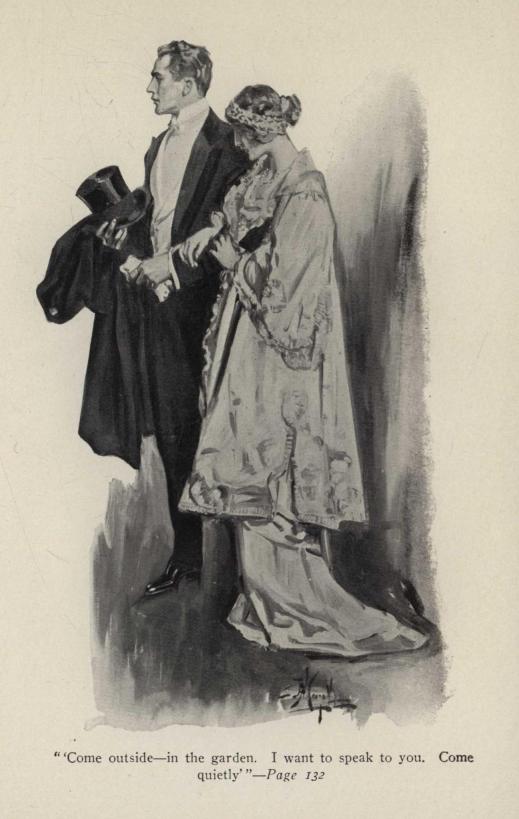
"'Come outside—in the garden. I want to speak to you. Come quietly'"
Elated by a strange, almost cruel feeling of conquest, he followed her, with a last look back at the studio, at the littered bar, where Bo Lynch was still calling raucously for customers, at the silent intensity of the gamblers, whom he occasionally perceived between the flitting dresses of the dancers. In the middle of the floor Lorraine and Plunkett, stumbling and unsteady, were solemnly waltzing in each other's arms—the specter of the morning forgotten.
He closed the door softly and joined the young actress, who was waiting for him at some distance.
"Can you take me home?" she asked directly. "Mr. Lorraine is in such a condition that I do not wish to go with him."
"Certainly," he said, a feeling of protection replacing the first victorious perception of the fire of jealousy he had awakened in her.
Gunther's automobile was waiting, and they entered it. She did not say a word to him, and he, determined to force her to begin the conversation, waited with a pleased enjoyment until three-quarters of the journey had been accomplished. All at once she turned, and, taking him by the lapels of the coat, brought him toward her as one scolds a child.
"Are you so angry because I didn't see you this afternoon?" she said, smiling.
The feminine defensive instinct of avoiding the issue by ambushing it with subterfuges, is equaled only by that instinct for attack which brushes aside all preliminaries and strikes directly. Beecher, taken off his guard, was a prey to two contrary impulses. Two replies, absolutely opposed and illogically joined, came to his lips. One brutal, still charged with the savageness of the evening, to say:
"Angry? Not at all. Aren't you claiming a little too much?"
And the other, a warm, yielding desire to blurt out frankly:
"Yes, I was angry. I wanted to see you."
She waited. Her large eyes, seeming larger in the dim light of the carriage, continued steadily on him. The first impulse dominated the second, but was modified by it.
"Angry? What a curious idea!" he began, with a half laugh. "You were so upset—"
She interrupted him, shaking her head.
"Why did you act the way you did tonight? Don't do things that are not like you. That is not the way we began."
He was silent, not knowing what to answer. Presently she withdrew into her corner, glanced out of the window, as if to assure herself that they were near their destination, and, placing her hand over his, said gently:
"You are very sympathetic to me. Keep it so."
For all that he said to himself that it was his favor with other women that made him precious to her, he felt a certain yielding of the spirit. He wondered if he could take her in his arms; but he restrained himself, and closed his two hands over hers.
"Yes, we are very sympathetic," he said; but he did not say all he meant.
"What a foolish boy you are," she said finally, looking up at him. "Don't you know that if I say one word you will go wherever I want you to?"
He was so taken by surprise at the audacity and confidence of her remark, that he could not collect himself for an answer, outgeneraled by the woman who had so calculated to a nicety her last words that the arrival of the automobile left him without response.
He went home, repeating to himself what she had asserted, resisting a wild desire to return to the Lindaburys' and forget there the disorder in his soul; and, though he rebelled scornfully against her confident assertion, the incessant repetition of it did leave an impression.
As he passed the great marble façade of the Atlantic Trust, an unusual sight made him bend out of the window. In the chill gray of the coming dawn, a thin line of depositors was waiting, some standing, others huddled on campstools. At the sight the seriousness of life smote him, and he returned home, the tremulous turns of the human gamble he had played feverishly blended and confused with the dark realities of the rising tragedy of speculation.
CHAPTER X
When, the next morning, Beecher struggled out of a profound stupor, it was to be awakened by the sounds of Bo Lynch at the telephone. He rolled out of bed after a startled gaze at his watch, recalling in a flash the incidents of the night before. As he emerged he heard the final phrase, and the click of the released receiver:
"Sell at once—throw them over."
Bo Lynch, a pad of paper in one hand, a tumbler of cracked ice in the other, already dressed for the day, greeted him nonchalantly:
"Morning."
"How late did you stay?" asked Beecher.
"Oh, we breakfasted together," said Lynch, with a wry smile; "charming little repast. But I picked up enough to pay for my winter's stabling."
Beecher glanced at the clock, which was approaching the hour.
"Waiting for the opening?"
"Yes." His glance followed Beecher's with a sudden concentration, and, taking up a matchbox, he struck a match and threw it away. "Waiting to see if I can escape working another year."
Beecher, comprehending that sympathy would be distasteful, picked up the morning papers. The scareheads were alive with the note of panic: a dozen banks were threatened with runs; a rumor was abroad that the Atlantic Trust and two other great institutions might close their doors within the next twenty-four hours; an interview with Majendie protested against the action of the Clearing-house, asserting the recklessness of the move and the solvency of the Trust Company; a riot was feared on the East Side, where the small Jewish depositors, always prey to alarms, were in a state of frenzy; vague, guarded hints of further actions to be expected by the Clearing-house against another prominent chain of banks, and a report that John G. Slade was to tender his resignation, were joined with rumors from the office of the State Examiner of Banks that there might be grounds for the criminal prosecution of certain officials.
The telephone rang. Lynch went to the receiver, arranging his pad methodically on the table. Beecher stopped reading, listening to the broken threads.
"All right, go ahead." ...
"How much?" ...
"Whew! Give me the Northern Pacific figures now." ...
"Yes—yes—I see." ...
"Something of a break, isn't it?" ...
"All right." ...
"No—that's all in the game. Thank you. I'll send my check to-day. Thanks."
He put up the receiver, glanced curiously at the clock, which marked twelve minutes after ten, and studied the pad.
Beecher had never been intimate with Lynch, but he liked him and his standards of Britannic phlegm. He belonged to that curious freemasonry of men, an indefinable, invisible standard of association, but one that cannot be counterfeited.
"How did you come out?" he said carelessly.
"About as I expected. The market has gone wild."
Bo Lynch poured out a morning peg, adjusted his cravat critically in the mirror, and took up his hat.