Volume 1 — Introductory material (continued 6)
George Burnham Ives translation
"I have been sad myself because I have passed them away from you," Emile replied.
"Is it possible! Such is life, such is man. To make oneself suffer by making others suffer! That is a convincing proof of the brotherhood of souls."
Emile passed two hours with the marquis, and found him more confidential and more affectionate than he had ever been. He felt that his attachment to him became stronger, and he determined that he would cause him no more suffering. And when, upon taking his leave, he expressed some anxiety because he had allowed him to talk so earnestly, the marquis replied:
"Never fear. Come again to-morrow and you will find me on my feet. That is not the kind of thing that tires one; it is the absence of opportunities for pouring out one's heart that dries up and kills."
XX THE FORTRESS OF CROZANT
The marquis was in fact almost well on the following day, and breakfasted with Emile. Thenceforth nothing disturbed that curious friendship between an old man and a very young man; and, thanks to Monsieur de Châteaubrun's final declarations, the painful apprehensions of insanity no longer impaired the pleasure which Emile took in Monsieur de Boisguilbault's society. He refrained, as he had promised Antoine, from ever mentioning his name, and made up for it by opening his heart to the marquis concerning all his other secrets; for it was impossible for him not to describe his past life, not to impart to him his plans for the future, and, as a consequence thereof, the suffering, allayed for a time, but inevitably lasting, which his father's opposition had caused him and was certain to cause him at the first provocation.
Monsieur de Boisguilbault encouraged Emile in his projects of respect and submission; but he was amazed at the pains Monsieur Cardonnet had always taken to stifle the legitimate instincts of a son so well inclined to work and so richly endowed.
The liking for agriculture and the intelligent understanding of it displayed by Emile seemed to point to a noble and generous vocation for him, and the marquis said to himself that if he had had the good fortune to possess such a son, he would have been able to make use in his lifetime of the great fortune which he had destined for the poor, but of which he had been unable to make any use in the present.
He could not refrain from saying with a sigh that a man was blessed of heaven who found in a son, in a friend, in another self, a mind fertile in invention and the means of completing in all seriousness the work of his destiny. In his heart he accused Cardonnet of seeking to consecrate to evil purposes the forces and the instruments which God had given him to assist him in doing good, and he looked upon him as a blind and obstinate tyrant, who placed money above the happiness of his fellows and his own, as if man were the slave of material things and not the servant of truth before all else.
Monsieur de Boisguilbault was not however essentially religious. Emile found him always too indifferent in that respect. When the marquis had said: "I believe in God," he thought that he could dispense with saying: "I adore Him." When his thoughts, taking the highest flight of which he was capable, rose to a sort of invocation which was not so much prayer as homage, he said to God: "Thy name is wisdom!" Emile added: "Thy name is love!" Whereupon the old man would reply: "It is the same thing;" and he was right.
Emile could hardly contradict him; but in that disposition to insist upon the sublime character of the divine logic and rectitude, one could but be conscious of the absence of that exalted passion for the inexhaustible loving-kindness of the Omnipotent, which Emile bore in his bosom. But, when the facts, the miseries of life, human weakness, and all the evil that is done on earth seemed to give the lie to that theory of a merciful Providence, and Emile became in a measure discouraged, the old logician triumphed in the superiority of his faith.
He never doubted, he could not doubt. He did not need to see in order to know, he said, and the coming and going of the plagues of this world no more disturbed in his eyes the moral order of eternal affairs than the passing of a cloud over the sun disturbed their physical order. His resignation was not due to a feeling of humility or affection; for he admitted that he had never been able to reconcile himself to his own sorrows except outwardly; but he believed in a well-spring of optimistic fatalism for the universe at large which was in striking contrast with his personal pessimism, and which formed the most unique feature of his mind and his character.
"Just see," he would say, "logic is everywhere! It is infinite in the works of God; but it is incomplete and intangible in everything, because everything is finite, even man himself, although he is the most impressive reflection of the infinite on this little earth. No man can understand infinite wisdom except as an abstract idea; for, if he looks within himself and about him, he cannot grasp it or fix it in his mind in any way. You often call me a logician; I accept the name: I love logic and cultivate it. I have a tremendous craving for it and I care for nothing that is not akin to it. But am I logical in my acts and my instincts? Less than any one on earth. The more I test myself, the more conscious I am of the abyss of contradictions, the chaotic confusion within me. Very good; I am a special example of what man is in general; and the more illogical I am in my own eyes, the more strongly I feel that the logic of God is soaring over my poor feeble head, which would go astray without that celestial compass and would foolishly hold the earth responsible for its own weakness."
Once he took Emile into the country and they explored, on horseback, the marquis's vast estates. Emile was struck by the small income produced by such territorial wealth.
"All these farms are let at the lowest possible price," said the marquis; "when one is unable to escape from the present economical notions, the best he can do is to bear as lightly as possible on the hard-working cultivator of the soil. These people are grateful to me, as you see, and wish me long life. God save the mark! They consider me very kind, although they do not much like my face. They do not know that I do not care for them as they understand the word, and that I see in them only victims whom I cannot save, but whose executioner I do not choose to be. I know very well that, under logical legislation, this estate should produce a hundred times as much as it does. My dissatisfaction is allayed when I think of it; but in order to think of it and to sustain myself with the certainty that it will some day be the instrument of the voluntary labor of a multitude of prudent men, I must avoid seeing it in its present state, for this spectacle saddens me and turns me cold; for this reason I very rarely expose myself to it."
It was in fact about two years since Monsieur de Boisguilbault had visited his farms and made the circuit of his domain. He could make up his mind to do it only in case of absolute necessity. He was greeted everywhere with demonstrations of respect and affection which were not without a touch of superstitious terror; for his solitude and eccentric habits had given him the reputation of a sorcerer with many peasants.
Many a time, during a storm, they had said sadly: "Ah! if Monsieur de Boisguilbault chose to prevent the hail, he could do it! but, instead of doing what he can, he is always looking for something else that nobody knows and that he will never find perhaps!"
"Well, Emile, what would you do with all this, if it were yours?" said the marquis as they rode home; "for in asking you to make this tiresome round of visits with me, I had no other purpose than to question you."
"I would try!" Emile replied, warmly.
"Of course," said the marquis, "I would try to found a genuine commune if I could. But I should try in vain, I should fail. And you, too, perhaps!"
"What does it matter?"
"That is the generous, insane cry of youth: what does it matter if you fail, providing only that you are doing something, eh? You yield to a craving for activity and do not see the obstacles. There are obstacles, however, and the worst of all is this: that there are no men. In that sense your father is right in appealing to a brutal but none the less powerful fact. Men's minds are not ripe, their hearts are not well-disposed; I see much land and many arms, but I do not see a single mind detached from the ego which governs the earth. A little more time, Emile, for the idea to bloom and spread; it will not be so long as people think; I shall not see it, but you will. Be patient, therefore!"
"What do you mean? does time do anything without us?"
"No, but it will do nothing without us all. There are times when one should be consoled for not being at work, if one is learning; then comes the time when one can learn and work at the same time. Do you feel that you are strong?"
"Very!"
"So much the better! And I believe it!—Well, Emile, we will talk some day—soon perhaps, in my next attack of fever, when my pulse beats a little faster than it does to-day."
In such conversations as this Emile found strength to live through the hours that he could not pass with Gilberte. There was something lacking in his friendship with Monsieur de Boisguilbault: it was the being able to speak to him of her and to tell him of his love. But there is in happy love a something superb which can do very well without advice of others, and the time when Emile would feel the need of complaining and of seeking a support under the burden of despair had not yet arrived.
In what did this happiness consist, do you ask? In the first place, he was in love—that is almost enough for him who loves dearly. And then he knew that he was loved, although he had never dared to ask the question and she would have dared even less to tell him so.
Meanwhile clouds were gathering on the horizon and Emile was destined to feel the approach of the storm. One day Janille said to him as he was leaving Châteaubrun: "Don't come again for three or four days; we have some business to attend to in the neighborhood and we shall be away." Emile turned pale: he thought that he was receiving his sentence, and he hardly had strength to ask what day the family would have returned to its penates. "Oh! toward the end of the week, I suppose," said Janille. "Indeed it is probable that I shall stay here; I am too old to run about over mountains, and you might come in as you ride by and ask if Monsieur Antoine and his daughter have returned."
"You will allow me then to call upon you?" said Emile, striving to conceal his mortal suffering.
"Why not, if your heart bids you?" replied the little old woman, drawing herself up with an air in which the distrustful Emile fancied that he could detect a touch of malice. "I am not afraid of being compromised!"
"It's all over," thought Emile. "My assiduity has been observed, and although Monsieur Antoine and his daughter have no suspicion as yet, Janille has made up her mind to turn me out. Her power here is absolute and the critical moment has arrived. Well, Mademoiselle Janille," he said, "I will come to see you to-morrow. I shall take great pleasure in talking with you."
"How well that happens," said Janille; "I am very anxious to talk too! But I have some flax to pick to-morrow and I shall not expect you until the next day. That is understood; I shall be at home all day; don't fail to come. Good-night, Monsieur Emile, we will have a good friendly talk. Oh! you see I too am very fond of you!"
There was no longer any doubt in Emile's mind; the housekeeper at Châteaubrun had opened her eyes to his love. Some officious neighbor was beginning to be surprised to see him so often on the road to the ruins. Antoine knew nothing as yet, nor Gilberte; for the latter, when she told him that her father was going away for a few days, could not have foreseen that Janille would arrange for her to go with him. The shrewd housekeeper had laid her plans well: first to get Emile out of the way, and then to arrange for Gilberte to go away unexpectedly, thus making sure of a few days in which to avert the little outbreak which she anticipated on the young man's part.
"Well, then, I must speak," said Emile to himself; "and why should I recoil from the inevitable end of my secret aspirations? I will tell her loyal governess and her excellent father that I love her and aspire to her hand. I will ask for a little time to broach the subject to my father and come to an understanding with him as to my choice of a career, for I have made none as yet, and my fate must be decided. There will be a fierce struggle, but I shall be strong, for I love. It is not a question of myself alone, so I shall have invincible courage, I shall have the gift of persuasion, I shall carry the day!"
Despite all this confidence, Emile passed the night in horrible perplexity. He imagined the conversation he was about to have with Janille, and he could have written out the questions and answers, so well he knew the little woman's self-possession and outspokenness.
"Ah! but you must speak to your father first of all, monsieur,"—she would surely say,—"and have an understanding with him; for it is quite useless to disturb Monsieur Antoine's mind with a conditional request, with projects that may not be realized. Meanwhile, do not come here any more, or come very little, for no one is supposed to be aware of your intentions, and Gilberte is not the girl to listen to you unless she is sure that she can be your wife."
Then, too, he feared that Janille, who was very matter-of-fact, would treat the possibility of Monsieur Cardonnet's consent as a pure delusion, and would forbid him to make frequent visits unless he should produce satisfactory proof that he was at liberty to choose for himself.
Thus was it fully demonstrated that Emile must enter upon the conflict with his father first of all, and must govern his actions accordingly; that is to say, go infrequently to Châteaubrun until he had reason to entertain a strong hope of victory, or, if he had no ground for hope, to abstain forever from destroying the happiness of the family of Châteaubrun by fruitless overtures—in a word, he must go away and renounce Gilberte.
But it was utterly impossible for Emile to include that alternative among the possibilities. The idea of death would find its way more easily into an infant's head than that of renouncing the woman he loves into the head of a man who is deeply in love.
Thus Emile could more readily conceive the possibility of blowing out his brains before his father's eyes than of yielding to his will. "Very well!" he said to himself, "I will speak to-morrow to this terrible master, and I will speak to him in such a way that I shall be able to appear at Châteaubrun with my head erect."
And yet, when the morrow came, Emile, instead of feeling inspired by all the force of his determination, felt so exhausted by insomnia, and so overwhelmed by sadness, that he feared his own weakness and did not speak. Indeed, what can be more painful, when the heart has revelled in a blissful dream, than to find oneself brought suddenly face to face with a cruel reality? When one has enjoyed all by oneself the delicious secret of a chastely hidden passion, to be forced to reveal it in cold blood to those who do not understand it or who scorn it?
Whether Emile should make the avowal to his father or to Janille, he must lay bare his heart, filled as it was with a modest languor and a holy ecstasy, to hearts that had never known or had long been closed to sentiments of that nature. And he had dreamed of such a sublime dénouement! Should not Gilberte, alone with him under the eye of God, be the first to receive in her heart the sacred word love when it should escape from his lips?
The world and the laws of honor, so unfeeling in such cases, were to deprive the virginity of his passion of all that was purest and most ideal about it! He suffered intensely, and it seemed to him that a century of bitter sorrow had elapsed between his dreams of the day before and the gloomy day that was beginning.
He mounted his horse, determined to seek at a distance, in some solitary spot, the calm and resignation necessary to enable him to withstand the first shock. He intended to avoid Châteaubrun; but he found himself near the ruin, unconscious how he had come thither. He rode by without turning his head, ascended the rough road where, in the howling storm, he had first seen the château by the light of the lightning flashes. He recognized the rocks behind which he had found shelter with Jean Jappeloup, and he could not realize that more than two months had passed since that night when he was so light-hearted, so self-controlled, so different from what he had since become.
He rode on toward Eguzon, in order to see once more the whole of the road he had then passed over, as he had not visited it since. But when he reached the first houses, the sight of the villagers scrutinizing him caused the same thrill of horror and misanthropy which Monsieur de Boisguilbault would have been likely to feel at such a time. He turned sharply into a dark, wooded road at his left and rode into the country, without any definite goal.
This rough but fascinating road, passing now over broad, flat rocks, now over the fresh green sward, now over fine sand, and bordered by venerable chestnuts with furrowed trunks and enormous roots, conducted him to vast moors, where he rode slowly along, content to be alone at last in a desolate region. The road stretched before him, sometimes in zigzag fashion, sometimes straight up and down, through fields covered with broom and furze, and over sandy hillocks intersected by brooks that had no well-defined bed and no fixed course.
From time to time a partridge skimmed along the grass at his feet, or a kingfisher flew like an arrow across a swamp, a flash of blue and fiery red.
After an hour's ride, being still absorbed in his thoughts, he saw that the path became narrower, plunged into the bushes, and finally disappeared under his feet. He raised his eyes and saw before him, beyond steep precipices and deep ravines, the ruins of Crozant rising like a sharp arrow over curiously jagged peaks of such extent that one could hardly embrace the whole at a single glance.
Emile had already visited that interesting fortress, but by a more direct road, and as his preoccupation had prevented him from taking his bearings, he was uncertain for a moment where he was. Nothing could be more consonant with his frame of mind than that wild locality and those desolate ruins. He left his horse at a hut and descended on foot the narrow path that led down to the bed of the torrent by a series of steps cut in the rock. Then he ascended by similar means and buried himself in the ruins, where he remained for several hours, a prey to an intensity of suffering which the aspect of a spot that was so horrifying and so sublime exalted at times almost to delirium.
Few fortresses so advantageously situated as that of Crozant were erected in the first centuries of feudalism. The mountain on which it stands descends perpendicularly on all sides, to two mountain streams, the Creuse and the Sédelle, which unite tumultuously at the end of the peninsula and keep up a constant roaring as they leap over huge fragments of stone. The sides of the mountain are very peculiar, bristling everywhere with long, grayish rocks, which rise from the abyss like giants or hang like stalactites over the torrent.
The ruins of the château have taken on so completely the color and shape of the surrounding rocks that in many places one can hardly distinguish them at a little distance.
It is hard to say which was the bolder and the more tragically inspired in that spot, nature or man, and one cannot imagine, upon such a stage, other than scenes of implacable fury and unending despair.
A drawbridge, several dark posterns and a double encircling wall, flanked by towers and bastions, the remains of which can still be seen, made this fortress impregnable before the invention of cannon. And yet almost nothing is known of the history of a place that was of such importance in the wars of the Middle Ages.
A vague tradition attributes its construction to certain Saracen chiefs who are said to have defended themselves there for a long while. The frost, which is severe and of long duration in that region, accelerates each year the destruction of those fortifications which cannon-balls have shattered and years have reduced to dust. The great square donjon, however, which has the aspect of a Saracen structure, still stands in the centre, and, being undermined, threatens to fall at any moment, like all the rest. Several towers, of which a single side only is standing, planted upon cone-shaped points of rock, present the appearance of sharp rocky peaks around which clouds of birds of prey scream incessantly.
The circuit of the fortress cannot be made without danger. In many places there is no trace of a path, and the foot trembles on the brink of precipices over which the water plunges headlong.
The approach of the enemy could be detected only from the top of the towers of observation; for on a level with the lower portions of the buildings and the summit of the mountain, the view was restricted by other barren mountains. But to-day there are gaps in their rocky sides, patches of fertile soil where noble trees grow freely, often uprooted by the rising of the waters when they have reached a considerable height.
A few goats, less wild than the wretched children who guard them, cling to the ruins and climb fearlessly over the precipitous cliffs.
The whole spot is so magnificently desolate and so rich in contrasts that the painter knows not where to stop. The imagination of the artist would find a superfluity of material in that gorgeous panorama of terror and menace.
Emile passed several hours there, plunged in the chaos of his uncertainty and his projects. As he had left home at daybreak, he was consumed by hunger, but paid no heed to the physical discomfort which aggravated his mental distress. Stretched out upon a rock, he was watching the vultures hovering overhead and thinking of the tortures of Prometheus, when the distant sound of a man's voice, which seemed not unfamiliar to him, sent a thrill through his whole being. He rose and ran to the edge of the precipice and saw three persons descending the path on the opposite side of the ravine.
A man in a blouse and broad-brimmed gray hat rode ahead, turning from time to time to warn those who came behind to be careful; next to him came a peasant leading a donkey by the bridle, and on the donkey was a woman in a faded lilac dress and a simple straw hat.
Emile darted to meet them, without asking himself if Janille had spoken, if they were on their guard against him, if they were likely to greet him coldly. He ran and leaped like a stone thrown down the steep side of the ravine. He ran as the crow flies, crossing the stream, which bounded with empty threats over the slippery stones, and reached the other slope to receive a hearty welcome from honest Antoine, and to take from the hands of Sylvain Charasson the bridle of the modest steed who bore Gilberte and her sweet smile and her blushing cheek and the joyous air which she tried in vain to restrain. Janille was not there. Janille had not spoken!
How much sweeter joy seems after sorrow, and how quickly love makes up for the time wasted in suffering! Emile no longer remembered the day before and thought no more of the morrow.
When he was among the ruins of Crozant once more, leading his beloved in triumph, he broke off all the branches he could reach and threw them under the donkey's feet, as the Hebrews of old strewed pearls along the track of the divine Master's humble beast.
Then he took Gilberte in his arms to put her down upon the loveliest bit of greensward he could find, although she needed no such assistance to alight from so small and placid a creature. Emile was no longer timid, for he was mad; and if Antoine had not been the least clear-sighted of mankind, he would have realized that it was of no more use to think of holding in check that exalted passion, than of preventing the Creuse or the Sédelle from flowing and roaring.
"Well, I am dying of hunger," said Monsieur Antoine, "and before I inquire how it happens that we meet so opportunely, I should like to hear something about luncheon. One guest more does not alarm us, for Janille has stuffed us with provender. Open your game-bag, you young rascal," he said to Sylvain, "while I go and cut a hole in the bag that my daughter has en croupe. Then Emile will run to the house yonder and obtain a supply of brown bread. Let us stay by the stream, it is pure water from the rock and is excellent when taken in small quantities with a generous quantity of wine."
The repast was soon spread on the grass, Gilberte took a huge lotus leaf for a plate, and her father carved with a sort of sabre which he called a clasp-knife. In addition to the bread, Emile brought milk for Gilberte and wild cherries which were voted delicious, their bitter taste having at all events the merit of stimulating the appetite. Sylvain, perched like a monkey on an overhanging bough, had as generous a share as the others and ate with the more enjoyment, he said, because Mademoiselle Janille's eyes were not there to count his mouthfuls with an air of reproof. Emile was satisfied in a moment. Laugh as you will at the heroes in novels who never eat, it is very certain that lovers have little appetite, and that therein novels are as true as life itself.
What bliss for Emile, after believing that when he saw Gilberte again, she would be stern and distrustful of him, to find her as he had left her the day before, entirely without constraint and overflowing with dignified trustfulness! And how he loved Antoine for being incapable of a suspicion and for displaying the same open-hearted gayety.
Never had he felt so light-hearted himself; never had he seen a lovelier day than that mild September day, never a more cheerful and enchanted spot than that frowning fortress of Crozant! And Gilberte wore that day her lilac dress, which he had not seen for a long while, and which reminded him of the day and hour when he had fallen madly in love with her!
He learned that they had set out to visit a relative at La Clavière before going to Argenton for two days, and that, finding no one at that château, they had determined to make a detour to Crozant and remain there until evening; and it was only midday! Emile imagined that he had all eternity before him. Monsieur Antoine lay down in the shade after luncheon and slept soundly. The two lovers, followed by Charasson, undertook to make the circuit of the fortress.
XXI MONSIEUR ANTOINE'S NAP
The page of Châteaubrun amused the young couple for a few moments with his ingenuous remarks; but he was speedily vanquished by the longing to run, and started off in pursuit of the goats, narrowly escaped having trouble with their keepers, and ended by making it up with them and playing at quoits on the bank of the Creuse, while Emile and Gilberte attempted to follow the course of the Sédelle on the other side of the mountain.
As the torrent has eaten away the base of the cliff in many places, they had sometimes to crawl, sometimes to retrace their steps, sometimes to step on stones that were level with the water, and all of this not without some difficulty and some danger. But youth is adventurous and love is afraid of nothing.
A special providence protects both alike, and our lovers came bravely forth from all the perils of their undertaking,—Emile trembling with an emotion very different from fear when he lifted Gilberte or held her in his arms; Gilberte laughing to conceal her confusion or to forget it.
Gilberte was strong, active and brave, like a true child of the mountain; and yet, by dint of passing over a constant succession of obstacles, she became breathless, sank on the moss beside the leaping stream, and threw her hat on the grass, having to put up her hair which had fallen over her shoulders.
"Do go and pick me that lovely digitalis over yonder," she said to Emile, thinking that she would have time to rearrange her locks before he returned. But he went and came again so quickly that he found her still inundated by the golden flood which her little hands could hardly gather up into a single braid.
Standing beside her, he gazed in admiration at those treasures which she twisted up behind her head with more impatience than pride, and which she would have cut off long before as being an annoying burden, if Antoine and Janille had not strenuously objected.
At that moment, however, she was grateful to them for refusing to allow it; for, although she was little inclined to coquetry, she saw that Emile was lost in admiration, and she had done nothing to arouse it. If there are some triumphs of beauty, which love cannot refuse to enjoy, they are those above all which are unforeseen and involuntary. That beautiful hair would have been a genuine compensation to an ugly woman, and in Gilberte's case it was a lavish outlay of nature added to all her other gifts.
It should be said that Gilberte, like her father, was industrious rather than clever with her hands, and moreover, she had lost all her pins while running and the heavy braid, hurriedly twisted, twice burst its bonds and fell to her feet.
Emile's eyes were still fixed upon her; Gilberte did not see them, but she felt them, as if the atmosphere were filled with the fire of that passionate gaze. She soon became so confused that she forgot to be merry, and finally, as ordinarily, made an effort to relieve, by a jest, their mutual emotion.
"I wish this hair was my own," she said; "then I would cut it off and throw it into the stream."
There was an opportunity for a well-turned compliment; but Emile was careful not to take advantage of it. What could he say about that hair which would express the love he bore it? He had never touched it and he was dying with the longing to do so. He glanced furtively about. A circle of rocks and shrubs isolated Gilberte and himself from the whole world. There was no spot on the mountain from which they could be seen. One would have said that she had selected that sheltered retreat to tempt him, and yet the innocent maiden had not thought of it, nor did she think that she was in any danger there.
Emile was no longer master of himself. Insomnia, alarm, grief and joy had kindled fever in his blood. He knelt beside Gilberte and took a handful of her rebellious hair in his trembling hand; then, as she started, he dropped it again, saying:
"I thought it was a wasp, but it is only a bit of moss."
"You frightened me," said Gilberte, shaking her head; "I thought it was a snake."
Meanwhile Emile's hand was clinging to her hair and could not let it go. On the pretext of assisting Gilberte to collect the scattered locks of which the breeze disputed possession with her, he touched it a hundred times, and at last put his lips to it stealthily. Gilberte did not seem to notice it, and hurriedly replacing her hat upon the ill-assured mass, she rose and said with an air which she strove to render unconcerned:
"Let us go to see if my father has awakened."
But she was trembling; a sudden pallor had driven the brilliant color from her cheeks; her heart was ready to burst; she staggered and leaned against the rock to keep from falling. Emile was at her feet.
What did he say to her? He did not know himself, and the echoes of Crozant did not retain his words. Gilberte did not hear them distinctly; she had the roar of the torrent in her ears, increased a hundredfold by the throbbing of the blood in her arteries, and it seemed to her that the mountain, seized with convulsions, was swaying to and fro over her head.
She had no legs with which to fly, indeed she did not think of it. In vain does one fly from love; when it has found its way into the heart, it takes root there and accompanies it everywhere. Gilberte did not know that there was any other peril in love than that of allowing her heart to be taken by surprise, and, in truth, there were no others for her with Emile. That danger was great enough, Heaven knows, and the vertigo it caused was full of irresistible delights.
All that Gilberte could say was to repeat with a sort of terror, instinct with regret and pain:
"No, no! you must not love me!"
"That means that you hate me then!" rejoined Emile; and Gilberte turned her face away, for she had not the courage to lie. "Very well," he continued; "if you do not love me, what harm does it do for you to know that I love you? Let me tell you so, since I can conceal it no longer. It is a matter of indifference to you, and one does not fear what one despises. Know that it is true then, and if I leave you, if I am to see you no more, at all events understand why it is: it is because I am dying for love of you, because I cannot sleep or work, because I am losing my wits and shall soon find myself telling your father what I am telling you now. I would rather be driven away by you than by the others. So drive me away; but you shall hear me now, because my secret is suffocating me; I love you, Gilberte, I love you so that it is killing me!"—And Emile's heart was so full that it overflowed in sobs.
Gilberte attempted to leave him; but she sat down only a few feet away and began to weep. There was more joy than bitterness behind those tears. So that Emile soon went to her to comfort her and was soon comforted in his turn; for there was naught but affection and regret in the terror that she felt.
"I am a poor girl," she said, "you are rich and your father, they say, thinks of nothing but increasing his fortune. You cannot marry me, and I ought not to think of marrying in my position. It would be by mere chance if I should fall in with a man as poor as myself, who had received a little education; and I have never counted on that chance. I said to myself long ago that I must make the best of my lot, in order to accustom myself to a sense of true dignity, which consists in not envying others and in forming oneself to simple tastes and honorable employment. So I do not think of marriage at all, since it would probably be necessary to change my way of thinking in order to find a husband. I must tell you that Janille got an idea into her head several days ago that troubles me a great deal. She wants my father to seek a husband for me. Seek a husband! Isn't that shameful and humiliating? Can you imagine anything more repulsive? And yet the dear old soul cannot understand my objection, and as my father was going to Argenton to receive the quarterly payment of his small pension, she suddenly decided this morning that he must take me and introduce me to some of his acquaintances. We can't resist Janille, so we started; but my father, thank heaven! doesn't know how to find husbands, and I shall be so cunning about helping him not to think of it, that this little excursion will result in nothing. You see, Monsieur Emile, that you mustn't pay your court to a girl who has no illusions and who has made up her mind, without regret or shame, to remain unmarried. I supposed that you would understand this, and that your friendly sentiments would prevent you from seeking to ruffle my quiet life. So forget this folly which has passed through your mind, and look upon me simply as a sister, who will forget what you have said, if you promise to love her with a calm and brotherly love. Why should we part? it would be a great sorrow to my father and me!"
"It would be a great sorrow to you, Gilberte?" said Emile; "why is it that you weep when you say such cold words to me? Either I do not understand you, or you are concealing something from me. And do you want me to tell you what I think that I divine? that you have not enough esteem for me to listen to me with confidence. You take me for a young madman, who prates of love without religion or conscience, and you think that you can treat me like a child to whom you would say: 'I forgive you, don't do it again.' But, if you believe that a genuine, serious passion can be allayed by a few cold words, you are a child yourself, Gilberte, and you have no feeling at all for me in the depths of your heart. O my God, can it be possible? and do those eyes that avoid mine, that hand that spurns me, mean contempt or incredulity?"
"Haven't I said enough? Do you think that I can consent to love you, with the certainty that you will belong to another sooner or later? It seems to me that love means living together forever: that is why, when I renounced the thought of marriage, I had to renounce the thought of love."
"I understand it so, too, Gilberte: love means living together forever! To my mind not even death can put an end to it; did I not say all that to you when I told you that I loved you? Ah! cruel Gilberte, you failed to understand me, or else you do not choose to understand me; but if you loved me you would not doubt. You would not tell me that you are poor, you would forget all about it as I do."
"O mon Dieu! I do not doubt you, Emile; I know that you are as incapable as myself of being guided by self-interest. But I ask you again, are we stronger than destiny, than your father's will, for instance?"
"Yes, Gilberte, yes, stronger than the whole world, if—we love each other."
It is quite useless to repeat the remainder of the interview. We might describe certain interludes of dismay and discouragement, when Gilberte, becoming reasonable, that is to say miserable, once more, pointed out obstacles and manifested a pride which, while not strongly marked, was sufficiently intense to lead her to prefer eternal solitude to the humiliation of a struggle against arrogance and wealth. We might tell by what honorable and manly arguments Emile sought to restore her confidence. But the strongest arguments, those to which Gilberte found no reply, are those which we cannot transcribe, for they were all enthusiasm and ingenuous pantomime.
Lovers are not eloquent after the manner of rhetoricians, and their words written down have never had much meaning for those to whom they were not addressed. If we could remember in cooler moments the insignificant remark that caused us to lose our wits, we should not understand how it could be and should jeer at ourselves.
But the tone and the glance find magical resources in passion, and Emile soon succeeded in persuading Gilberte of what he himself believed at that moment: namely that nothing was simpler or easier than for them to marry, consequently that nothing was more legitimate and necessary than that they should love each other with all their strength.
The noble-hearted girl loved Emile too dearly to harbor the thought that he was a rash and presumptuous youth. He said that he would overcome any possible resistance on his father's part, and Gilberte knew nothing of Monsieur Cardonnet except by vague rumors. Emile guaranteed his loving mother's consent and that assurance set Gilberte's conscience at rest. She soon shared all his illusions, and it was agreed that he should speak to his father before applying to Monsieur Antoine.
A selfish or ambitious girl would have been more prudent. She would have made the avowal of her feelings depend upon harsher conditions. She would have refused to see her lover again until such time as he should come prepared to go through with all the formalities, including the request for her hand. But Gilberte's mind never entertained such precautions.
She felt in her heart a something infinite, a faith in and respect for her lover's word, which had no bounds. She was no longer disturbed save by one thing; the thought that she might become a source of discord and affliction in Emile's family on the day that he spoke to his father.
She could entertain no doubt of the victory which he was so certain of winning; but the thought of the battle pained her and she would have liked to postpone the awful moment.
"Listen," she said, with angelic naïveté, "there is no hurry; we are happy as we are, and young enough to wait. I am afraid indeed that will be your father's principal and strongest objection; you are only twenty-one, and he may fear that you have not made your choice with sufficient care, that you have not examined your fiancée's character closely enough. If he talks to you about waiting, and asks for time to reflect, submit to every test. Even if we should not be united for several years, what does it matter, provided that we see each other, since we cannot doubt each other's constancy?"
"Oh! you are a saint!" Emile replied, kissing the edge of her scarf, "and I will be worthy of you."
When they returned to the place where they had left Antoine, they saw him at some distance talking with a miller of his acquaintance, and they went to the foot of the great tower to meet him.
The hours passed for them like seconds, and yet they were as full of events as centuries. How many things they said to each other, and how many more they did not say! Then the happiness of looking at each other, of understanding and loving each other, became so intense that they were seized with a wild gayety, and, joining hands, ran down the steep slopes, leaping like deer, throwing stones to the foot of the precipices, so transported with an unfamiliar joy that they were no more conscious of danger than young children.
Emile pushed the débris from his path or jumped over it excitedly. One would have said that he fancied that he was confronted by obstacles placed in his way by destiny. Gilberte had no fear, either for him or for herself. She laughed aloud; she shouted and sang like a bird in the air, and forgot to fasten up her hair, which floated in the wind, and sometimes completely enveloped her like a veil of fire.
When her father surprised her in the midst of her excitement she rushed to him and embraced him passionately, as if she wished to communicate to him all the joy with which her heart was flooded. The good man's hat fell off during this sudden embrace and started to roll into the ravine. Gilberte darted like a flash to catch it, and Antoine, terrified by her impetuosity, darted to catch his daughter. Both were in great danger when Emile passed them, seized the flying hat on the wing, and, as he replaced it on Antoine's head, took his turn at pressing that fond father in his arms.
"Vive Dieu!" cried Antoine, ordering them back to a less perilous spot, "you both receive me very warmly, but you frighten me even more! For God's sake did you meet the devil's goat that makes those whom it bewitches with its glance run and jump about like lunatics? Is it the mountain air that makes you so wild, little girl? All the better say I, but don't run such risks as that. What color! What a sparkling eye! I see that I must take you out for a walk often, that you don't have enough exercise at the house. She has made me anxious lately, do you know, Emile? She doesn't eat, she reads too much, and I have been thinking of throwing all your books out of the window if it goes on. Luckily she seems different to-day, and, that being the case, I am tempted to take her as far as Saint-Germain-Beaupré. It's a fine place to look at. We will pass the day there to-morrow, and if you choose to come with us we will have a royal good time. Come, Emile, what do you say? What does it matter if we go to Argenton a day later, eh, Gilberte? And even suppose we spend only one day there?"
"Or don't go there at all?" said Gilberte, jumping for joy. "Let's go to Saint-Germain, father; I have never been there. Oh! what a fine idea!"
"We are on the road," continued Monsieur de Châteaubrun, "but we must go to pass the night at Fresselines, for staying here is not to be thought of. However, Fresselines and Confolens are well worth seeing. The roads are not good, and we must start before dark. Monsieur Charasson, go and give poor Lanterne some oats. She likes journeys, for they are the only opportunities she ever has for feasting. You will take the donkey back to the people who lent him to you, up at Vitra, and then go to wait for us, with the barrow and Monsieur Emile's horse, on the other side of the stream. We will be there in two hours."
"And I," said Emile, "will write a line to my mother, so that she won't worry over my absence, and I will find a child somewhere to carry my note."
"Send one of these little savages so far? that won't be easy. Upon my word! we are in luck, for yonder is someone from your place if I am not mistaken."
Emile turned and saw Constant Galuchet, his father's secretary, who had just thrown his coat on the grass, and, having enveloped his head in a pocket handkerchief, was engaged in baiting his hook.
"Hallo! Constant, do you come as far as this to catch gudgeons?" asked Emile.
"Oh! no indeed, monsieur," replied Galuchet, with a serious air, "I cherish the hope of catching a trout."
"But do you expect to return to Gargilesse to-night?"
"Certainly, monsieur. Your father didn't want me to-day, so he gave me permission to take the whole day; but as soon as I have caught my trout, please God, I shall leave this wretched spot."
"And suppose you catch nothing?"
"Then I shall curse still more bitterly the idea that occurred to me of coming so far to see such a hovel. What a horrible place, monsieur? Can anyone imagine a more melancholy country and a château in worse condition? And to think that tourists tell you that it's superb, and that nobody should live on the Creuse without going to see Crozant! Unless there are fish in this stream, I'll be hanged if you ever catch me here again. But I have no faith in their stream. This clear water is detestable for angling, and the constant noise makes your headache. I am sick with it."
"I see that you haven't had a very pleasant walk," said Gilberte, who had never seen Galuchet's absurd face before, and who was sorely tempted to laugh at his prosaic scorn. "But you must agree that these ruins are very impressive; at all events they are unique. Have you been up in the great tower?"
"God forbid, mademoiselle!" replied Galuchet, flattered by Gilberte's attention, and gazing at her with his wide-open round eyes, which were extraordinarily far apart and separated by a curious little bunch of sandy eyebrows. "I can see the interior of the barrack from here, as it is open on all sides like a lantern, and I don't think it's worth the trouble of breaking one's neck." And taking Gilberte's smile for approval of this stinging satire, he added, in a tone which he considered jocose and clever: "A fine country, on my word! not even dog-tooth will grow here! If the Moorish kings were no better housed than that, I congratulate them! Those fellows had vile taste, and they must have cut a curious figure! Doubtless they wore clogs and ate with their fingers."
"That is a very wise historical commentary," said Emile to Gilberte, who was biting her handkerchief to avoid laughing outright at Monsieur Galuchet's knowing tone and comical countenance.
"Oh! I see that monsieur is very sarcastic," she replied. "He is entitled to be, as he comes from Paris where everybody is witty and has fine manners, while here he is among savages."
"I cannot say that at this moment," retorted Galuchet, shooting a killing glance at the fair Gilberte whom he found very much to his liking; "but frankly, this province is a little behind the times. The people are very dirty. Look at those barefooted, ragged children! In Paris everybody has shoes, and those who haven't any don't go out on Sunday. I tried to get something to eat at a house to-day: there was nothing except black bread that a dog wouldn't eat, and goat's milk that smelt decidedly rank. Those people have no shame, to live so miserably!"
"May it not be that they are too poor to do better?" said Gilberte, disgusted by Monsieur Galuchet's aristocratic tone.
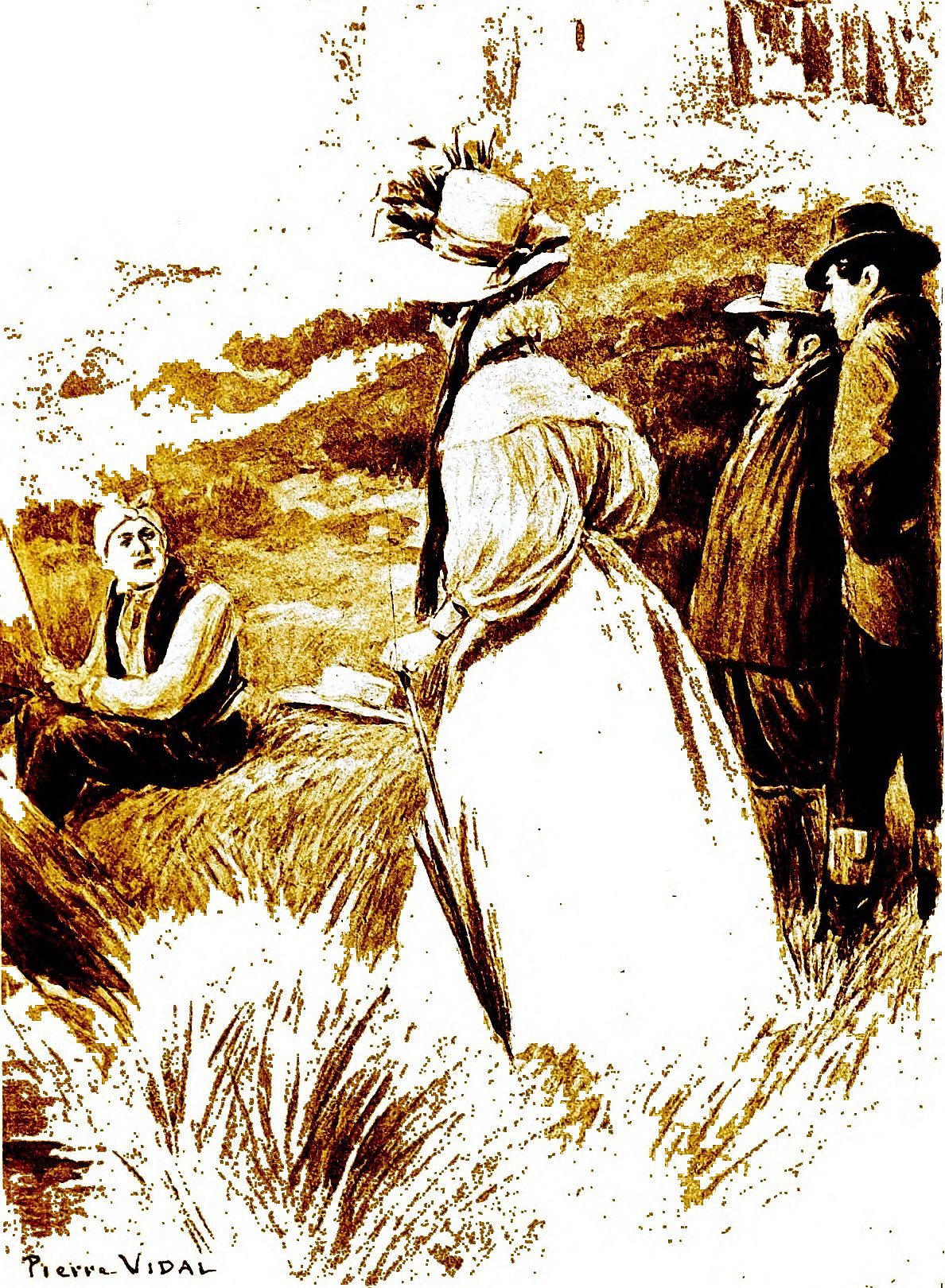
GALUCHET SURPRISED.
Emile turned and saw Constant Galuchet, his father's secretary, who had just thrown his coat on the grass, and, having enveloped his head in a pocket handkerchief, was engaged in baiting his hook.
"It is rather because they are too lazy," he replied, somewhat bewildered by that suggestion, which had not occurred to him.
"What do you know about it, pray?" retorted Gilberte, with an indignation which he did not understand.
"This young woman is very piquant," he thought, "and her little air of determination pleases me immensely. If I should talk to her long, I would show her that I am no blockhead of a provincial."
"Well," said Emile to Gilberte, while Constant hunted for worms under the stones, in order to bait his hook, "you have seen the features of a perfect idiot."
"I am afraid he is more conceited than foolish," she replied.
"Come, come, children, you are not indulgent," observed honest Antoine. "That young man is not handsome, I agree, but he seems to be a good fellow, and Monsieur Cardonnet is well satisfied with him. He is very obliging and has offered several times to do little favors for me. Indeed he once gave me a very nice line, such as we can't find hereabout; unfortunately I lost it before I went home, so that Janille scolded me that day almost as much as she did the day I lost my hat. By the way, Monsieur Galuchet," he added, raising his voice, "you promised to come to fish in our neighborhood; I don't disturb my fish much, I haven't your patience, so that you are likely to find some. I count upon seeing you one of these days; come to breakfast at the house and then I will take you to a good place; there are plenty of barbel, and they are good sport."
"You are too kind, monsieur," said Galuchet; "I will certainly come some Sunday, since you are pleased to overwhelm me with your courtesy."
And Galuchet, enchanted to have perpetrated that sentence, bowed as gracefully as he could and took his leave, after Emile had given him his message for his parents.
Gilberte was somewhat disposed to find fault with her father for such excessive benevolence to so dull and unattractive a subject; but she was too kind-hearted herself not to overcome her repugnance very quickly, and in a moment she had ceased to think of it, the more readily because on that day it was impossible for her to feel vexed at anything.
Thanks to their frame of mind, our lovers found all the incidents of the remainder of their journey agreeable and amusing. Monsieur Antoine's old mare, hitched to a sort of open buggy, which he was justified in calling his wheelbarrow, performed prodigies of skill and courage in the shocking roads that they had to follow to reach their destination. The vehicle had room for three persons, and Sylvain Charasson, seated in the middle, drove the peaceful Lanterne superlatively—to use his own expression.
The horrible jolting of a carriage so poorly hung in no wise disturbed Gilberte and her father, who were accustomed to occasional discomfort and never allowed their plans to be disarranged by the weather or the state of the roads.
Emile rode in front on horseback, to give warning and to help them to alight when the road became too dangerous. Then, when they came out on the soft sandy soil of the moors, he dropped behind, to chat with the others, and above all to look at Gilberte.
Never was dandy in the Bois de Boulogne, darting his eyes into his triumphant mistress's superb calèche, so happy and so proud as Emile, as he followed the lovely country girl whom he adored, along the ill-defined roads of that desert, by the light of the first stars.
What did it matter to him whether she was seated on a sort of litter drawn by a sorry nag, or in a fine carriage? whether she was dressed in silk and velvet, or in a faded calico? She wore torn gloves which showed the tips of her pink fingers resting on the back of the wagon. To save her Sunday scarf she had folded it and placed it on her knee. Her graceful figure, slender and willowy, was even more graceful without it. The soft evening breeze seemed to caress with zest her alabaster neck. Emile's breath mingled with the breezes and he was bound like the slave to the chariot of the conqueror.
There was one time when the vehicle, owing to Sylvain's lack of caution, stopped short, and nearly came in collision with Emile's horse's head.
Monsieur Sacripant had placed one paw on the step, to signify that he was tired and that they must take him inside. Monsieur Antoine alighted to seize him by the skin of his neck and toss him in on the floor of the wagon, for the poor beast no longer had enough spring in his legs to jump so high. Meanwhile Gilberte patted Corbeau's nose and passed her little hand through his black mane. Emile felt that his heart was beating as if a magnetic current conveyed her caresses to him. He was on the point of making some remark concerning Corbeau's happiness, as naïve as those Galuchet would have been likely to make on such an occasion; but he contented himself with being stupid silently. One is so happy when, having no lack of wit, he is conscious of an attack of such stupidity!
It was quite dark when they reached Fresselines. The trees and rocks had become simply black masses, whence the solemn and majestic roar of the stream came forth.
A delicious lassitude and the cool night air cast Emile and Gilberte into a sort of blissful drowsiness. They had before them the whole of the next day, a whole century of happiness.
The inn at which they alighted, and which was the best in the village, had only two beds, in two different rooms. They decided that Gilberte should have the better room, and that Monsieur Antoine and Emile should share the other, each taking a mattress. But when they came to inspect the beds, they found that there was but one mattress to each, and Emile took a childish pleasure in the thought of sleeping on the straw in the barn.
This arrangement, which threatened Charasson with a like fate, seemed sorely to displease the page of Châteaubrun. That young man liked his comfort, especially when he was travelling. Being accustomed to attend his master in all his journeys, he made amends for the austere régime of Janille at Châteaubrun by eating and sleeping to his heart's content when away from home.
Monsieur Antoine, while making sport of him with a rough sort of gayety, overlooked all his whims and made himself his slave, talking to him as to a negro all the while. Thus, while Sylvain made a pretence of grooming the horse and harnessing him, it was always his master who handled the curry-comb and lifted the shafts.
If the child fell asleep while driving, Antoine would rub his eyes, pick up the reins, and struggle against sleep rather than wake his page.
If there were only one portion of meat at supper, Monsieur Antoine would say to Charasson, as he feasted his eyes on the appetizing dish: "You may share the bones with Monsieur Sacripant;" but the goodman would, almost unconsciously, gnaw the bones himself and leave the best piece for Sylvain. Thus the crafty urchin knew his master's ways, and the more he was threatened with having to go hungry and work and lose his sleep, the more surely he relied on his lucky star.
However, when he saw that Monsieur Antoine paid no attention to the matter of his sleeping accommodations, and that Emile was content with the straw, he began, while he was serving the supper, to yawn and stretch, and to observe that they had a long journey, that infernal place was at the world's end, and that he had really thought they would never get there.
Antoine turned a deaf ear to it all, and, although the supper was far from dainty, ate with excellent appetite.
"This is how I like to travel," he said, clinking his glass against Emile's every other minute, as a consequence of the habit he had fallen into with Jean Jappeloup; "when I have all the comforts and everybody I love with me. Don't talk to me about taking long journeys in a post-chaise or on a ship, wandering about the world, alone and miserable, in quest of fortune. It's very nice to enjoy the little money one may have, riding about a beautiful region where you know everybody you meet by name, and every house, every tree and every rut! Am I not just as comfortable here as at home? If I had Jean and Janille at the table, I should think I was at Châteaubrun, for I have my daughter here and one of my best friends; and my dog, too, and even Monsieur Charasson, who is as pleased as a king to see the world and be quartered according to his deserts."
"It pleases you to say that, monsieur," replied Charasson, who, instead of waiting on the table, had seated himself in the chimney corner; "this is an abominable inn, and they make you sleep with the dogs."
"Well, you good-for-naught, isn't that too good for you?" retorted Monsieur Antoine, in his sternest voice; "you're very lucky not to be sent to perch with the hens! Deuce take it, you sybarite, you have straw to sleep on; but I suppose you are afraid of dying of hunger in the night, eh?"
"Excuse me, monsieur, the straw here is hay and hay makes your headache."
"If that's so, you can lie on the floor at the foot of my bed, to teach you to complain. You stand like a hunchback, so a hard bed like that will do you a deal of good. Go and prepare your master's bed and spread the horse blanket for Monsieur Sacripant."
Emile wondered what would be the end of this jest, which Monsieur Antoine seemed determined to carry on to the end with a sober face, and, when Gilberte had gone to her room, he followed Monsieur Antoine to his to find out whether he would persuade his page to make the best of the straw.
The count amused himself by causing himself to be waited on like a man of quality. "Come," he said, "pull off my boots, give me my nightcap and put out the lights. You can stretch yourself on the bricks here, and look out for yourself if you are unlucky enough to snore! Good-night, Emile. Go to bed; you won't be vexed with the company of this rascal, who would prevent you from sleeping. He'll sleep on the floor, to punish him for his absurd complaints."
After about two hours' sleep, Emile was awakened with a start by the fall of a heavy body on the straw beside him. "It's nothing, it's only I," said Monsieur Antoine; "don't let me disturb you. I undertook to share my bed with that good-for-naught; but my gentleman, on the plea that he is growing, must needs have the fidgets in his legs, and he kicked me so many times that I abandoned the field to him. Let him sleep in a bed, as he's so set upon it! for my part, I shall be much more comfortable here."
Such was the exemplary punishment which the page of Châteaubrun underwent at Fresselines.
XXII INTRIGUE
We will leave Emile to forget his appointment with Janille, and to wander over hill and dale with the object of his thoughts; and we will take up the thread of the events in which his destiny is involved, at the Cardonnet factory.
Monsieur Cardonnet was beginning to be seriously annoyed by Emile's continual absences, and to say to himself that the time would soon come to keep watch on and regulate his actions. "Now that his mind is diverted from his socialism," he thought, "it is time for him to take hold of some profitable reality. Argument will have little effect on a mind so addicted to discussion. It seems that his hobby-horse is in the stable for a while, and I won't do anything to make him take him out; but let us see if we cannot replace theories by practice. At his age a man is led by instinct rather than by ideas, although he proudly fancies that the contrary is true; first of all let us bind him down to some practical work and make him devote himself to it, against his will, if necessary. He is too hard-working and intelligent not to do well what he is compelled to do. Gradually whatever employment I may have provided for him will become a necessity to him. He was always like that. Even although he detested the study of the law, he learned the law. Very good, let him finish his law-studies, even if he is destined to hate it more and more, and to relapse into the aberrations which have disturbed me so. I know now that it won't take very much time or a very clever coquette to rid him of the coat of pedagogy of the new schools."
But it was the middle of vacation, and Monsieur Cardonnet had no immediate pretext for sending Emile back to Poitiers. Moreover, he had great hopes of his stay at Gargilesse; for, little by little, Emile overcame his repugnance to the occupations which his father marked out for him from time to time, and seemed to be no longer engrossed by the object for which he had fought so earnestly. All the work that Emile did he did in a superior way and Monsieur Cardonnet flattered himself that he could drive love from his mind when he chose, without impairing the submission and the talents of which he sometimes reaped the fruits.
Nothing was farther from Madame Cardonnet's intention than to call her husband's attention to Emile's strange conduct. If she could have divined the joy which her son derived from absenting himself thus, and the secret of that joy, she would have assisted to save appearances and with more affection than prudence, would have become his accomplice. But she imagined that Monsieur Cardonnet's manner, which was often cold and sarcastic, was the only cause of the discomfort Emile suffered in his father's house; and, nursing a secret grudge against her lord and master therefor, she suffered bitterly because she enjoyed so little of her son's society. When Galuchet returned with the information that Monsieur Emile would not be at home until the evening of the next day or the next but one, she could not restrain her tears, and said in an undertone: "Now he has begun to pass the night away from home! He is not willing even to sleep here; he must be very unhappy!"
"Upon my word, that's a pretty subject for lamentation!" said Monsieur Cardonnet with a shrug. "Is your son a girl, that you are so frightened for him to pass a night away from home? If you begin this way, you are not at the end of your troubles; for this is only the beginning of the escapades a young man is likely to indulge in! Constant," he said to his secretary when they were alone, "who were the people in whose company you met my son?"
"Oh! a very agreeable party, monsieur. Monsieur Antoine de Châteaubrun, who is a high-liver, a stout, jovial man, altogether agreeable in his manners; and his daughter, a superb woman, with a perfect figure, the most attractive creature you can imagine."
"I see that you are a connoisseur, Galuchet, and that you missed none of the damsel's charms."
"Dame! monsieur, when a man has eyes, he uses them," said Galuchet, with a loud laugh of self-satisfaction; for it very rarely happened that his employer did him the honor to talk with him on a subject unconnected with his duties.
"And it is with these same persons, I suppose, that my son continued his romantic excursions?"
"I think so, monsieur; for I saw him in the distance on horseback, as if accompanying them."
"Have you ever been to Châteaubrun, Galuchet?"
"Yes, monsieur, I went there once when the masters were absent, and if I had known that I should find no one there but the old servant I wouldn't have been such a fool."
"Why?"
"Because I might have seen the château for nothing at another time, I have no doubt; whereas that old witch, after showing me around her den, demanded fifty centimes, monsieur, as the price of her condescension! It's a shame to bleed people for showing them such a ruin!"
"I thought that old Antoine had made some repairs since I was there."
"Repairs, monsieur! it's a pitiful sight! They have rebuilt one corner, about as big as your hand, and they didn't even have money enough to put wall-papers on their rooms. The master isn't half so well lodged as I am in your house! It's a depressing place, inside! Heaps of stones in the courtyard to break your legs over, nettles, brambles, no door under a great archway that resembles the entrance to the château of Vincennes and which would be pretty enough if they would give it a coat of plaster of Paris; but all the rest in such a state! Not a wall secure, not a staircase that doesn't shake, cracks big enough to hold a man, ivy that they don't even take the pains to tear down, although it would be easy enough, and rooms that have neither floor nor ceiling! On my word, the people hereabout are genuine Gascons for boasting about their old châteaux, and sending you about on break-neck roads, to find what?—ruins and thistles! Crozant is a stupendous fraud, and Châteaubrun is little better than Crozant!"
"So you were not charmed with Crozant either? But my son seemed to like it immensely, I'll be bound?"
"Monsieur Emile might very well like it, with such a pretty slip of a girl on his arm! If I had been in his shoes I shouldn't have complained overmuch about the place; but for my part, as I went there hoping to catch a trout and didn't get as much as a gudgeon, I am not very well satisfied with my walk, especially as it is twenty kilometres each way, making four myriameters on foot."
"Are you tired, Galuchet?"
"Yes, monsieur, very tired and very dissatisfied! they'll never catch me in their Moorish kings' fortress again."
And Galuchet, recalling with pride his jest of the morning, repeated complacently and with a cunning smile:
"Those kings must have cut a curious figure! doubtless they wore clogs and ate with their fingers."
"You are very bright to-night, Galuchet," rejoined Monsieur Cardonnet, not deigning to smile; "but, smitten as you are, if you were brighter you would find some pretext for calling on old Châteaubrun from time to time."
"I need no pretexts, monsieur," replied Galuchet in an important tone. "I am well acquainted with him; he has often invited me to fish in his stream, and again to-day he urged me to go to breakfast with him some Sunday."
"Very well, why don't you go? I am glad to allow you a little recreation from time to time."
"You are too kind, monsieur; if you don't need me, I will go next Sunday, for I am very fond of fishing."
"Galuchet, my boy, you are an idiot!"
"What's that, monsieur?" said Galuchet, disconcerted.
"I tell you, my dear fellow, you are an idiot," Cardonnet calmly repeated. "You think of nothing but catching gudgeons, when you might be paying court to a pretty girl."
"Oh! I don't know about that, monsieur!" said Galuchet, scratching his ear with a fatuous air; "I should like the girl well enough, that's true! she's a jewel! blue eyes, fair hair that's a metre and a half long, I'll wager, superb teeth, and a mischievous little glance. I could be dead in love with her, if I chose!"
"And why don't you choose?"
"Dame! if I had ten thousand francs of my own, I might suit her! but when one has nothing, one is hardly a suitable match for a girl who has nothing."
"Is your salary equal to her income?"
"Why her income is contingent, and old Janille, who is supposed to be her mother—I must confess, it would be a little distasteful to me to be the son-in-law of a servant,—old Janille would certainly insist on a small sum to begin housekeeping with."
"Do you think ten thousand francs would be enough?"
"I have no idea; but it seems to me that those people have no right to be very ambitious. Their hovel isn't worth four thousand francs; the mountain, the garden, a bit of meadow on the edge of the stream, all overgrown with rushes, and the orchard where there are some fruit trees good for nothing but to burn,—all those together wouldn't bring in a hundred francs a year. They say Monsieur Antoine has a little capital in government securities. It can't be much, judging from the life they lead. But, if I were sure of a thousand francs a year, I would arrange matters with the girl. She pleases me and I am old enough to settle down."
"Monsieur Antoine has twelve hundred francs a year, I know."
"Reverting to his daughter, monsieur?"
"I am sure of it."
"But, although he has recognized her, she is a natural daughter and entitled to only half of it."
"Well, do you feel that you can aspire to her hand now?"
"Thanks, monsieur! What are we to live on? and bring up children?"
"Of course you would need a little capital. We might be able to find that for you, Galuchet, if your happiness absolutely depended on it."
"I do not know how to acknowledge your kindness, monsieur, but——"
"But what? come, don't scratch your ear so much, but answer."
"I don't dare, monsieur."
"Why not? don't I talk to you as if I were your friend?"
"I am deeply touched by it," rejoined Galuchet, "but——"
"But you annoy me. Speak, in heaven's name!"
"Well, monsieur, even though you should call me a fool again, I will say what I think. I think that Monsieur Emile is paying court to that young lady."
"Do you mean it?" exclaimed Monsieur Cardonnet, feigning surprise.
"If monsieur is not aware of it, I should be very sorry to be the cause of trouble between him and his son."
"Is there any common rumor to that effect?"
"I don't know whether people are talking about it; I pay little attention to gossip; but I myself have noticed that Monsieur Emile goes to Châteaubrun very often."
"What does that prove?"
"That is as monsieur may choose to think, and it is all the same to me. I simply meant to say that if I had any idea of marrying a young woman, I should not be very well pleased to come in second."
"I can imagine that. But it is hardly likely that my son would pay serious attention to a young woman whom he neither would nor could marry. My son has lofty sentiments, he would never descend to a falsehood, to false promises. If the girl is virtuous, be assured that her relations with Emile are entirely innocent. Isn't that your opinion?"
"I will have whatever opinion monsieur may desire on that subject."
"That is altogether too accommodating! If you were in love with Mademoiselle de Châteaubrun, wouldn't you try to find out the truth for yourself?"
"Certainly, monsieur; but I can hardly be in love with her, having seen her but once."
"Well, listen to me, Galuchet: you can do me a service. What you have just told me makes me a little more anxious than it makes you, and all that we have been saying, by way of conjecture and jest, will have at all events, the serious result of having warned me of certain dangers. I tell you again that my son is too honorable a man to seduce a penniless, inexperienced girl; but it might happen to him, if he sees her too often, to conceive for her somewhat too warm a feeling, which would expose them both to temporary but unnecessary suffering. It would be very easy for me to cut the whole thing off short by sending Emile away at once; but that would interfere with the plan I have formed of training him to share my occupations, and I regret to be compelled for so unimportant a reason to part with him under present circumstances. Consent therefore to help me. You are sure of a warm welcome at Châteaubrun; go there often, as often as my son; make yourself the friend of the family. Père Antoine's unsuspecting nature will assist you. Look about you, observe, and report to me all that happens. If your presence annoys my son, it will be a proof that the danger exists; if he tries to have you turned out, stand your ground, and pose unhesitatingly as an aspirant to the young lady's hand."
"And what if I am accepted?"
"So much the better for you!"
"That depends, monsieur, on how far things have gone between her and your son."
"You must be very simple if with time and address you can't find out about that, as you are going there in the quality of an observer."
"And suppose I find that I have arrived too late?"
"You will retire."
"I shall have made a ridiculous campaign, and Monsieur Emile will bear me a grudge for it."
"Galuchet, I don't ask anything for nothing. Certainly, all this can't be done without some ennui and some unpleasantness for you; but there's a good bonus at the end of all the sacrifices I ask you to make."
"That's enough, monsieur, and I have only one other word to say; and that is that in case the girl should suit me, and I should suit her too, I should be too poor at this moment to go to housekeeping."
"We have already anticipated that contingency. I would assist you to make a position for yourself. For example, you undertake to work for me for a certain time, and I make you an advance of five thousand francs on your salary, and a bonus of five thousand francs in addition, if necessary."
"This is no longer a jest, a conjecture, I suppose?" said Galuchet, scratching his head harder than ever.
"I don't often jest, as you know, and this time I am not jesting at all."
"Very good, monsieur; you are too kind to me. I will plant myself beside Monsieur Emile, and he will be very shrewd if I lose sight of him!"
"He will be shrewder than you, and that will not be difficult," thought Monsieur Cardonnet as soon as Galuchet had retired; "but a rival of your sort will be enough to make him feel humiliated by his choice, very soon; and if she prefers a dull lout like you for a husband to a handsome chance suitor like him, he will have received a useful lesson. In that event a trifling sacrifice for Monsieur Galuchet's establishment would not be draining the sea dry, especially as that would keep him in my service and cut short his ambition to leave me. But that is the worst possible result of my plan, and Galuchet has twenty chances to one of being shown the door sooner or later. Meanwhile I shall have had time to think of something better, and I shall at all events have succeeded in worrying Emile, in disenchanting him, in fastening to his sides an enemy whom he will hardly know how to combat—ennui in the shape of Constant Galuchet."
Cardonnet's idea did not lack depth, and if it had not been too soon or too late for Emile to renounce his illusions, it might have been successful. Any sort of competition stimulates vulgar minds, but a refined mind suffers from an unworthy rivalry. An exalted nature will infallibly be disgusted with the being who takes pleasure in the homage of stupidity; the mere fact that the object of his adoration tolerates such homage too patiently may be enough to cause him to blush and take himself away. But Cardonnet reckoned without Gilberte's pride.
Emile returned from his excursion more inflamed with passion than ever, and in such a state of blissful enthusiasm that it seemed to him impossible that he should not triumph over everything. The generous Gilberte had powerfully assisted his illusion by sharing it, and therein she had shown herself, by her lack of prudence and her openness of heart, the worthy child of Antoine. Emile might well have reproached himself, however, for having gone so far with her without having first made sure of Monsieur Cardonnet's consent. That was a terrible imprudence; indeed it was culpable rashness; for, unless a miracle should happen, he could reckon on his father's refusal. But Emile was in that state of delirious excitement in which one reckons on miracles and deems himself almost a god because he is loved.
However, he returned to Gargilesse without having made up his mind at what moment he would announce his sentiments to his family; for Gilberte had insisted that he should do nothing suddenly, and had received his promise to begin by gradually appealing to the affection of his parents, by governing his conduct in accordance with their wishes. Thus Emile was to make amends for an absence which had doubtless caused them some anxiety, by staying with them all the rest of the week and working zealously at whatever his father chose to give him to do. "You must not come to see us until next Sunday," Gilberte had said when they parted, "and then we will arrange our plans for the following week." The poor child felt that she must live from day to day, and, like Emile, she derived infinite pleasure from caressing in her thoughts the mystery of a love of which they alone realized the charm and the depth.
Emile kept his word. He did not absent himself from home during the week, and contented himself with writing Monsieur de Boisguilbault an affectionate letter to set his mind at rest concerning his sentiments, in case the suspicious old man should take alarm because he did not see him. He followed his father like a shadow; he even asked him for employment, and devoted himself to the construction of the factory like one who took the deepest interest in the success of the undertaking. But, as it is not natural to do violence to one's own heart for long, it was impossible for him to push the indolent workmen. Monsieur Cardonnet derived no sort of benefit from the employment of men of that description. They lacked energy, and the rivalry of the more active produced discouragement in them instead of emulation. They were well paid, but, as they saw, from the master's dissatisfaction, that they would not be retained long, they determined to make the most of the present, and consequently economized in their food. When Emile saw them sitting on the damp stones, with their feet in the mud, eating a piece of black bread and raw onions, like the Hebrew slaves employed in building the Pyramids, he had such a feeling of compassion for them that he would have preferred giving them his own blood to drink, to abandoning them to that slow death of toil and starvation.
Thereupon, he tried to persuade his father, since he could not save all those numerous lives, to afford them at all events some temporary relief by feeding them better than they fed themselves, or by giving them, at least, a little wine. But Monsieur Cardonnet reminded him, only too justly, that, as all the vines were frozen in the preceding year, they could not obtain wine in that country except at a very high price, and that it was for the table of the bourgeois only. Where no general system of economy was practised, it was easy to prove that economy in special directions was powerless to bring about any important amelioration, and to demonstrate, by the unanswerable evidence of figures, that they must either abandon the idea of building or compel the mechanic to undergo the unpleasant necessities of his position. Monsieur Cardonnet did his utmost to remedy the evil, but that utmost was confined within narrow limits. Emile submitted and sighed; he could give Gilberte no stronger proof of his love than to hold his peace.
"Well," said Monsieur Cardonnet, "I see that you will never be very sharp in the matter of superintending; but when I am no longer in this world, it will be enough if you realize the need of having a good superintendent in my place. The material part of the work is the least poetic; you will find your field of activity in the direction of art and science, which have their place in manufacturing as in everything else. Come to my study, help me to understand the things that escape my comprehension, and place your genius at the service of my energy."
During that week Emile had to read, to study, to comprehend and to summarize several works on hydrostatics. Monsieur Cardonnet did not think that he really needed to have that work done, but it was one way of testing Emile, and he was overjoyed by his rapidity and mental keenness. Such studies could arouse no disgust in a mind occupied with theories. Anything connected with science may have some useful application in the future, and when one has not under his eyes the deplorable conditions through which social inequality compels the men of the present day to pass, in the execution of any work, he may well become deeply interested in the abstract theories of science. Monsieur Cardonnet recognized Emile's lofty intelligence and said to himself that, with such eminent faculties, it was not possible that he would always close his eyes to what he called evidence.
When Sunday arrived, it seemed to Emile that a century had passed since he had seen that enchanted palace of Châteaubrun, where, in his eyes, nature was lovelier, the air softer and the light more glorious than in any spot on earth. He began with Boisguilbault however; for he remembered that Constant Galuchet was to breakfast at Châteaubrun, and he hoped that uninteresting individual would have departed or would be busy with his fishing when he arrived; but he was far from anticipating Monsieur Constant's Machiavelism. He found him still at table with Monsieur Antoine, a little overburdened by the native wine, to which he was not accustomed, shuffling about on his chair and making commonplace remarks, while Gilberte, sitting in the courtyard, waited impatiently until a relaxation of vigilance on Janille's part should enable her to go out on the terrace and watch for her lover's coming.
But Janille did not relax her vigilance; she was prowling about in every corner of the ruins and was on the spot to receive half the salutation which Emile addressed to Gilberte. But Emile saw, at the first glance, that she had said nothing.
"Really, monsieur," she said, lisping with more affectation than usual, "you are not polite, and you have nearly caused a rivals' quarrel between my girl and me. What! you lead me to hope that you will come and keep me company in her absence, you even go so far as to appoint a day, and then, instead of coming here, you go and enjoy yourself taking an excursion with mademoiselle, on the pretext that she is forty years younger than me! as if that was my fault, and as if I am not as light of foot and as lively to talk with as a mere girl! It was very rude on your part, and you have done well to let my anger lie for a few days; for if you had come sooner you would have had a very cold reception."
"Hasn't Monsieur Antoine justified me," rejoined Emile, "by telling you how entirely unforeseen our meeting at Crozant was, and that our trip to Saint Germain was suggested by him on the spur of the moment? Forgive me, dear Mademoiselle Janille, and be sure that nothing less than being ten leagues away would have induced me to break my appointment with you."
"I know, I know," said Janille, in a meaning tone, "that it was Monsieur Antoine who did all the harm; he is so inconsiderate! but I should have thought that you would be more reasonable."
"I am very reasonable, my dear Janille," replied Emile in the same tone, "and I have proved it by passing the week with my father, working to please him, in spite of my longing to come and obtain my pardon."
"And you did well, my boy; for it is a good thing for young men to be employed."
"You will be satisfied with me hereafter," said Emile, glancing at Gilberte, "and my father has already forgiven me for the time I have wasted. He is very kind to me, and I will show my appreciation of his kindness by forcing myself to undergo the most painful sacrifices, even that of seeing you a little less frequently henceforth, Mademoiselle Janille; so scold me to-day, quickly, but not too hard, and forgive me even more quickly, for I shall probably be able to come here very seldom for several weeks. I have much work to do, and my courage would fail me if I knew that you were angry with me."
"Well, well, you are a good boy, and no one can bear you a grudge," said Janille. "I see," she added with a knowing air, lowering her voice, "that we understand each other perfectly without any further explanation, and that it's a good thing to have people of honor and good sense like you to deal with."
This result of the explanations threatened by Janille relieved Emile from a great anxiety. His position was quite serious enough, without being complicated by the alarms and questions of that faithful retainer. The advice Gilberte had given him, to come more rarely and to let time do its work, was thus proved to be most judicious, and if she had been a trained diplomatist, she could not have acted more shrewdly on that occasion. In very truth, how many marriages between persons of unequal fortune would become possible, did not the woman, by her exactions, her pride or her suspicion, involve the man enamored of her in a labyrinth of suffering and anxiety, amid which his prudence and courage in overcoming obstacles fail him! With Gilberte's childlike innocence was blended calm common sense and unselfish courage. She did not look upon her union with Emile as possible until after several years, and she felt that her love was strong enough to wait. That cruel future appeared to her heart, overflowing with faith, like a day radiant with sunshine; and therein she was not so foolish as some might think. It is faith and not prudence that moves mountains.
XXIII THE DEVIL'S ROCK
Emile had forgotten even Constant Galuchet's name when he found himself once more within the walls of the dear old château; and when he went in to salute Monsieur Antoine, the stupid features of his father's clerk produced the same effect upon him that a caterpillar produces upon one who puts out his hand unsuspiciously to pluck a fruit. Galuchet had prepared to greet Emile with the assured air of a man who has taken possession first of a coveted seat, and who can afford an affable greeting to those who come too late. A little more and he would have done the honors of the château to Emile. But the young man's cold and mocking glance, as he replied to his familiar and effusive salutation, disconcerted him sadly; that glance seemed to say to him:
"What are you doing here?"
Meanwhile Galuchet, who thought much more of earning Monsieur Cardonnet's liberality than of winning Gilberte's good graces, made a mighty effort to recover his self-possession, and his face, while not expressing actual hostility, assumed an unaccustomed air of insolence which was, under the circumstances, as injudicious as possible.
Emile had determined to make the best of the native wine, and, in order not to offend Monsieur de Châteaubrun, he did not refuse to drink with him on his arrival. It may be that, by virtue of the utter fascination which took possession of him in the place where Gilberte passed her days, he really considered that thin, sour beverage better than all the choice wines in his father's cellar. But on this occasion it seemed bitter to him, when Galuchet, assuming the air of a man who condescends to howl with the wolves, put out his glass toward his, proposing to touch glasses after the manner of Monsieur de Châteaubrun. He accompanied this familiarity with an unpleasantly vulgar movement of the elbow and shoulder, thinking to imitate in jovial mood Monsieur Antoine's patriarchal simplicity.
"Monsieur le comte," said Emile, ostentatiously treating Antoine with even more respect than usual, "I fear that you have induced Monsieur Constant Galuchet to drink too much. See how red his eyes are and how he stares! Be careful; I warn you that his head is very weak."
"My head weak, Monsieur Emile! why do you say that my head is weak?" retorted Galuchet. "You have never seen me drunk, so far as I know."
"This will be the first time that I shall have had that pleasure, if you continue to drink as you are doing."
"So it would give you pleasure to see me commit an impropriety?"
"I trust that will not happen, if you follow my advice."
"Very good," said Galuchet, rising, "if Monsieur Antoine cares to take a walk, I shall be glad to offer my arm to Mademoiselle Gilberte, and then you can see if I walk crooked."
"I prefer not to risk the experiment," said Gilberte, who was sitting at the door of the pavilion, caressing Monsieur Sacripant.
"So you take sides against me, too, Mademoiselle Gilberte?" rejoined Galuchet, walking toward her; "do you believe what Monsieur Emile says?"
"My daughter takes sides against no one, monsieur," said Janille, "and I don't understand why you bother your head about somebody who doesn't bother her head about you."
"If you forbid her to take my arm," replied Galuchet, "I have nothing to say. It seems to me, however, that it's no breach of true French courtesy to offer a young lady your arm."