Volume 1 — Introductory material (continued 5)
George Burnham Ives translation
He had had to make several detours to reach the foot of the hill, and the distance in a straight line was not so great that the two young people could not see each other quite plainly. Gilberte observed the hesitation of the horseman, who could not make up his mind to lose sight of her; so she went behind the rose-bushes, to conceal herself from him, but she continued to watch him for a long time through the branches.
Janille had walked in the opposite direction to meet her master. Not until Gilberte heard her father's voice did she break the spell that held her. It was the first time that she had ever allowed Janille to anticipate her in going to meet him and relieve him of his game-bag and his stick.
As he approached Boisguilbault, Emile made and remade a hundred times his plan of attack upon the fortress where that incomprehensible individual lay entrenched.
Impelled by his romantic disposition, he had a sort of presentiment that Gilberte's destiny—and consequently his own—was written in mysterious characters in some obscure corner of that old manor, whose high gray walls rose before him.
Tall, gloomy, melancholy and silent as its aged lord, that isolated abode seemed to defy the bold attacks of curiosity. But Emile was spurred on by a passionate determination. As Gilberte's confidant and agent, he said to himself, pressing the rose, already withered, against his lips, that he would have the necessary courage and address to triumph over every obstacle.
He found Monsieur de Boisguilbault alone on his stoop, idle and impassive as always. He made haste to apologize for delaying the old gentleman's dinner, on the plea that he had lost his way, and, being as yet unfamiliar with the neighborhood, had passed nearly two hours finding it.
Monsieur de Boisguilbault asked no questions as to the route he had taken. One would have said that he dreaded the name of Châteaubrun; but, with refinement of courtesy, he assured his guest that he had no idea of the time and had not thought of being impatient. He had been somewhat disturbed, none the less, as Emile soon discovered from some faltering remarks that he made, and the young man fancied that he could see that, amid the profound tedium of his solitary life, the marquis's sensitive nature would have suffered keenly if he had broken his word.
The dinner was excellent and served by the old retainer with scrupulous punctuality. He was the only servant to be seen in the château. The others, buried in the kitchen, which was underground, did not appear at all. It seemed that this was the result of a sort of standing order, and that their dean was the only one who did not offend the master's eye.
The old man was very infirm, but he was so accustomed to his duties that the marquis had to say almost nothing to him; and when it happened that he did not anticipate his master's desires, a sign was sufficient to convey them to him.
His deafness seemed admirably suited to Monsieur de Boisguilbault's taciturnity, and perhaps the latter was not sorry to have about him a man whose impaired vision made it impossible for him to read his features: he was rather a machine than a servant; for, being deprived by his infirmities of the power of mental communication with his fellow-men, he no longer had any desire or occasion therefor.
One could readily conceive that those two old men were well fitted to live together without a thought of being bored by each other's company, there was so little apparent life in either of them.
The dinner was served with due regularity, but not rapidly. They were two hours at table. Emile observed that his host ate almost nothing, and seemed to have no other purpose in eating than to induce him to taste all the dishes, which were appetizing and toothsome. The wines were exquisite, and old Martin poured them from bottles covered with the dust of ages, which he held horizontally, taking care not to jar them in the slightest degree.
The marquis barely wet his lips, but motioned to his old servant to fill Emile's glass, who, being habitually very abstemious, kept close watch upon himself, to see that he did not allow his reason to succumb to the repeated experiments with the numerous specimens from that seignorial cellar.
"Is this your ordinary fare, monsieur le marquis?" he asked, marvelling that such a sumptuous repast should be provided for two persons.
"I—I really don't know," the marquis replied; "I have nothing to do with it. Martin is my housekeeper. I never have any appetite, and I never notice what I eat. Do the things seem good to you?"
"Exquisite; and if I had the honor of being admitted to your table often, I should beg Martin to entertain me less splendidly, for I should be afraid of becoming a gourmand."
"Why not? it's one variety of enjoyment. Happy are they who have many others!"
"But there are those which are more elevating and less expensive," rejoined Emile; "so many people lack the necessaries of life that I should be ashamed to find that the luxuries were necessary to me."
"You are right," said Monsieur de Boisguilbault, with his accustomed sigh. "Well, I will tell Martin to serve you a simpler dinner another time. He supposed that at your age you would have a large appetite; but it seems to me that you eat like a man who has finished growing. How old are you?"
"Twenty-one."
"I should have thought that you were older."
"From my face?"
"No, from your ideas."
"I would like my father to hear your opinion, monsieur le marquis, and to become imbued with it," rejoined Emile with a smile; "for he always treats me like a child."
"What sort of a man is your father?" said Monsieur de Boisguilbault, with an ingenuous absent-mindedness which removed the sting from what might have seemed at first blush a most impertinent question.
"My father," replied Emile, "is a friend whose esteem I desire and whose blame I dread. I can think of no better way to describe an energetic, stern and just character."
"I have heard it said that he was a very able man, very wealthy and very jealous of his influence. Those are not disadvantages if he makes a good use of them."
"What in your opinion, monsieur le marquis, is the best use that he can make of them?"
"Ah! it would take a long while to tell!" sighed the marquis; "you ought to know as well as I."
And, roused momentarily by the confidence Emile designedly manifested in him in order to induce a similar confidence on his part, he relapsed into his torpor, as if he feared to make an effort to throw it off.
"I absolutely must break this secular ice," thought Emile. "Perhaps it's not so difficult as people think. Perhaps I shall be the first who ever tried it!"
And, while maintaining, as he was bound to do, a discreet silence concerning the apprehensions which his father's ambition aroused in him, and concerning the painful conflict between their respective opinions, he spoke freely and enthusiastically of his own beliefs, of his sympathies and even of his dreams for the future of the human race.
He was certain that the marquis would take him for a madman, and he amused himself by inviting contradictions which would enable him at last to penetrate that mysterious mind.
"If I could only bring about an explosion of contempt or indignation!" he said to himself; "then I could discover the strength or weakness of the citadel."
And he unconsciously adopted with the marquis the same tactics that his father had recently employed with him; he affected to attack and demolish everything that he assumed to be in any degree sacred in the old legitimist's eyes; "the nobility, the money power, large estates, the power of individuals, the slavery of the masses, the Jesuitism of the church, the alleged divine right of kings, the inequality of privileges and pleasures which is the basis of society as at present constituted, the domination of man over woman, who is treated as merchandise in the marriage contract and as real estate in the contract of public morality; in a word, all those heathenish laws which the Gospel has failed to banish from our institutions and which the political scheming of the Church has consecrated."
Monsieur de Boisguilbault seemed to listen more attentively than usual; his great blue eyes were wide open, as if, in default of wine, his amazement at such a sweeping declaration of the rights of man had utterly stupefied him.
Emile glanced at his glass, which was filled with tokay a hundred years old, and resolved to have recourse to it for inspiration if the natural warmth of his youthful enthusiasm was insufficient to avert the avalanche of snow that was about to fall upon him.
But he did not need that stimulant; for, whether because the snow had become too hard to be detached from the glacier, or because Monsieur de Boisguilbault, while seeming to listen, had heard nothing, the rash profession of faith of that child of the century was not interrupted and came to an end in the most profound silence.
"Well, monsieur le marquis," said Emile, amazed by this listless toleration of his views, "do you subscribe to my opinions, or do they seem to you unworthy of being combated?"
Monsieur de Boisguilbault did not reply; a wan smile played about his lips, which moved as if to speak but emitted only the problematical sigh. But he placed his hand on Emile's, and it seemed to the younger man that he felt a cool moisture, which imparted to that hand of stone some symptom of life.
At last he rose and said:
"We will take our coffee in the park.—For I am entirely of your opinion," he added after a pause, as if he were finishing aloud a sentence he had begun under his breath.
"Really?" cried Emile, resolutely passing his arm through his host's.
"Why not, pray?" rejoined the latter coolly.
"Then all these things are indifferent to you?"
"God grant it!" replied Monsieur de Boisguilbault, with a more pronounced sigh than usual.
XVII THAW
Emile had as yet admired the park of Boisguilbault only over the hedges and through the gate. He was more than ever impressed by the beauty of that pleasure-ground, by the luxuriance of the plants and their happy arrangement.
Nature had done much, but art had seconded her with great taste and judgment. The sloping ground was diversified by innumerable picturesque irregularities, and an abundant spring, bubbling up among the rocks, sent forth streams in all directions, keeping all things green under the superb trees.
The valley and the slope on the other side, which also belonged to the marquis, were covered with a dense vegetation which partly concealed the division walls and hedges, so that from all the elevated points, which afforded views of a beautiful and extensive landscape, the park seemed to extend to the horizon.
"This is an enchanted spot," said Emile, "and one needs only to see it to be sure that you are a great poet."
"There are many great poets of my sort," replied the marquis, "that is to say, people who feel poetry but cannot express it."
"Is the spoken or written word alone interesting, I pray to know?" exclaimed Emile. "Is not the painter who nobly interprets nature a poet too? And if that is incontestable, does not the artist who actually improves upon nature, and modifies it in order to develop all its beauty,—does not he produce a grand poetic result?"
"You express that very well," rejoined Monsieur de Boisguilbault, in a tone of indolent indifference, which was not, however, wholly devoid of kindliness.
But Emile would have preferred discussion to this careless assent to everything he said, and he was afraid that his main attack had failed. "What can I invent to vex him and make him come out of his shell?" he said to himself. "There is no one of the famous sieges in history that can be compared to this."
The coffee was served in a pretty Swiss chalet; the exactness of the copy and the scrupulous neatness aroused Emile's admiration for a moment; but the absence of human beings and domestic animals in that rustic retreat was so noticeable that it was impossible to maintain the illusion. And yet nothing was missing: the moss-covered hillside studded with firs, nor the thread of sparkling water falling into a stone basin at the door, and flowing from it with a gentle murmur; the chalet, constructed entirely of resinous wood with a pretty arrangement of balustrades and built against huge granite rocks, the pretty overhanging roof, the interior furnished in the German fashion, even to the service of blue earthenware—all new and clean and glistening and deserted—resembled a dainty Fribourg toy rather than a rustic dwelling.
Even the stiff, lifeless figures of the old marquis and his old majordomo gave one the impression of painted wooden images, placed there to complete the resemblance.
"You have been in Switzerland, I presume, monsieur le marquis," said Emile, "and this is a reminiscence of some favorite spot?"
"I have traveled very little," Monsieur de Boisguilbault replied, "although I set out one day with the intention of making the tour of the world. Switzerland happened to be in my way; the country pleased me and I went no farther, saying to myself that I should probably find nothing better after taking a deal of trouble."
"I see that you prefer this country to all others, and that you have come back here forever?"
"Forever, most assuredly."
"This is Switzerland in miniature, and if the imagination is less keenly aroused by grand spectacles, the fatigues and dangers of travel are much less great."
"I had other reasons for settling down on my own estate."
"Is it indiscreet to ask you what they are?"
"Are you really curious to know, then?" said the marquis with an equivocal smile.
"Curious! no; I am not curious in the impertinent and ridiculous meaning of the word; but to one of my age, one's own destiny and other people's is an enigma, and one always imagines that he may derive valuable information from the experience and wisdom of certain men."
"Why do you say certain men? Am I not like the rest of the world?"
"Oh! not at all, monsieur le marquis!"
"You surprise me greatly," said Monsieur de Boisguilbault in exactly the same tone in which he had said, a few moments earlier: I am entirely of your opinion. And he added: "Won't you put some sugar in your coffee?"
"I am more surprised," said Emile, mechanically helping himself to sugar, "that you do not realize how solemn and impressive your solitude, your gravity, and I will venture to add, your melancholy, must be to a child like myself."
"Do I frighten you?" said Monsieur de Boisguilbault with a deep sigh.
"You frighten me terribly, monsieur le marquis, I frankly admit; but do not take my ingenuousness in bad part, for it is no less certain that I am impelled by an entirely contrary sentiment of irresistible attraction, to overcome that sentiment of fear."
"That is strange," said the marquis, "very strange: pray explain it to me."
"It is very simple. As a young man of my age goes about seeking the solution of his own future in the present or in the past of men of maturer years, it terrifies him to see an invincible sadness and a dumb but profound distaste for life, written upon austere brows."
"Yes, that is why my external appearance repels you. Do not be afraid to say it. You are not the first and I expected it."
"Repel is not the word, since, notwithstanding the sort of magnetic stupor into which you cast me, I am drawn toward you by a peculiar attraction."
"Peculiar!—aye, very peculiar, and you are the more eccentric of us two. I was struck, the first moment I saw you, by the manifest dissimilarity of your character to that of the men whom I knew in my younger days."
"And was that impression unfavorable to me, monsieur le marquis?"
"Quite the contrary," replied Monsieur de Boisguilbault in that voice, utterly without inflection, which made it impossible to estimate the bearing of his replies. "Martin," he added, leaning toward his old servant who bent himself double to hear him, "you can take all this away. Are there any workmen left in the park?"
"No, monsieur le marquis, nobody."
"In that case, close the gate when you go away."
Emile remained alone with his host in the solitude of the vast park. The marquis took his arm and led him to a seat on the cliffs above the chalet, where there was a lovely view.
The sun, as it sank toward the horizon, projected the shadows of the tall poplars from one side to the other of the ravine, like a dark curtain intersected by brilliant streaks. The violet rays shot up into an opal-hued sky, above an ocean of dark verdure; and as the sounds of toil in the fields died gradually away, the voice of the mountain streams and the plaintive note of the turtle doves could be heard more distinctly.
It was a magnificent evening, and young Cardonnet, turning his eyes and thoughts upon the distant hills of Châteaubrun, fell into a pleasant reverie. He was reflecting that he might venture to indulge in that mental recreation before making another assault, when his adversary suddenly made an unexpected sortie and broke the silence.
"Monsieur Cardonnet," said he, "if, when you told me that you felt a sort of sympathy for me despite the ennui that I cause you, you did not say it simply to be polite, or by way of jest, this is the reason: we profess the same principles, we are both communists."
"Can it be true?" cried Emile, astounded by this declaration and thinking that he must be dreaming. "I thought just now that you answered me as you did simply to be courteous or by way of jest; but am I really so fortunate as to find in you a justification of my desires and my dreams?"
"What is there surprising in that?" rejoined the marquis calmly. "May not the truth make itself known in solitude as well as in a crowd, and have I not lived long enough to be able to distinguish good from evil, the true from the false? You take me for a very matter-of-fact, very cold man. It is possible that I am; at my age a man is too tired of himself to care to examine himself; but, outside of our individuality, there are general realities sufficiently worthy of interest to divert our thoughts from our ennui.
"For a long time I retained the opinions and prejudices in which I was reared; my natural indolence was content not to scrutinize them too closely, and then I had internal anxieties which kept me from thinking about them. But since old age has set me free from all pretension to happiness and from every sort of regret or special interest in anything, I have felt the need of obtaining an insight into the general life of my fellow-men, and, consequently, into the meaning of the divine laws as applied to mankind.
"Certain Saint-Simonian pamphlets fell into my hands by chance, I read them to pass the time, having as yet no idea that they could go beyond the bold theories of Jean-Jacques and Voltaire, with whom careful study had reconciled me.
"I determined to know more of the principles of this new school, and I passed from that to the study of Fourier. I admitted everything, although I did not very clearly distinguish their contradictions, and it still saddened me to see the ancient world crumble under the weight of theories invincible in their system of criticism, confused and incomplete in their principles of organization. It was not until five or six years ago that I accepted with perfect disinterestedness and great mental satisfaction the principle of a social revolution.
"The attempts at communism had seemed to me monstrous at first, on the faith of those who combated them. I read the newspapers and publications of all the schools, and I gradually lost myself in that labyrinth, without being repelled by fatigue. Little by little the communist hypothesis came forth from its clouds; able expositions shed light into my mind. I felt that I must go back to the teaching of history and to the tradition of the human race.
"I had a well-selected library of the best documents and the most serious works of the past. My father had been fond of reading, and I had hated it for so many years that I did not even know what precious resources he had left me for my old age. I set to work all alone. I learned again the dead languages, which I had forgotten; I read for the first time, in the original sources, the history of religions and philosophies, and the day came at last when the great men, the saints, the prophets, the poets, the martyrs, the heretics, the scholars, the enlightened orthodox believers, the innovators, the artists, the reformers of all times, all countries, of all the revolutions and of all the forms of worship seemed to me to be in accord, proclaiming in every form, and even in their apparent contradictions, one eternal truth, as logical and as clear as the light of day, namely the equality of rights, and the inevitable necessity of equality of enjoyment thereof as a rigorous consequence of the first.
"Since then I have been surprised by only one thing, and that is that in the time in which we live, with so many resources and discoveries, so much activity, intelligence and freedom of opinion, the world is still plunged in such utter ignorance of the logical results of the facts and ideas which are forcing it to transform itself; that there are so many self-styled theologians encouraged and supported by the State and by the Church, and that no one of them has ever thought of devoting his life to the very simple labor which led me to certainty; and lastly, that while rushing onward to the catastrophe of its dissolution, the world of the past thinks to preserve itself by the strength and wrath of the destiny which hurries it on and swallows it, whereas those who know the secret of the law of the future have not as yet sufficient tranquillity and good sense to laugh at insults and to proclaim, with head erect, that they are communists and nothing else.
"You talk of dreams and Utopias with eloquence and enthusiasm, Monsieur Cardonnet; I forgive you for making use of those expressions because at your age truth arouses enthusiasm, and one makes of it an ideal which he purposely places rather high and rather far away, in order to have the pleasure of reaching it by earnest effort. But I can not work myself up as you do over this truth, which seems to me as simple, as manifest and as incontestable as it seems to you novel, bold and romantic. In my case it is the result of a deeper study and of a more firmly seated certainty. I do not dislike your vivacity, but I should not blame myself if I were to combat it a little in order to prevent you from endangering the doctrine by over-eagerness.
"Beware of that: you are too happily endowed ever to become ridiculous, and you will please even those people who fight against you; but be careful lest, by talking too fast and to too many disaffected persons of matters so serious and so worthy of respect, you tempt them to resort to systematic contradictions and to defend themselves in bad faith.
"What would you say of a young priest who should deliver sermons at the dinner-table? You would say that he belittled the majesty of his texts. Communistic truth is as deserving of respect as gospel truth, since it is in reality the same truth. Let us not speak of it lightly, therefore, and after the manner of political discussion. If you are excited, you must make sure that you are entirely master of yourself before proclaiming it; if you are phlegmatic, like me, you must wait until you acquire a little self-confidence and mental activity before opening your heart to other men on such a subject.
"You see, Monsieur Cardonnet, people must not have a chance to say that this is all folly, idle dreaming, feverish declamation, or a vision of mysticism. That has been said quite enough, and enough weak minds have given people the right to say it.
"We have seen Saint-Simonism pass through its phase of trances and feverish and disordered visions; that did not prevent the survival of whatever was viable in Saint-Simonism.
"Despite the aberrations of Fourier, the lucid portions of his system survive and will bear a critical examination. Truth triumphs and pursues its way through whatever disguise one views it and in whatever disguise one clothes it. But it would be much better that, in the age of reason which we have reached, the ridiculous manifestations of a blind enthusiasm should disappear entirely. Is not that your opinion? Has not the hour struck when serious-minded people should take possession of their true domain, and when those things that are logically proved should be professed by logicians?
"What does it matter if they are said to be inapplicable? Does it follow, because the majority of men still know and practise only what is wrong and false, that the clear-sighted man must follow the blind over the precipice?
"It's of no use to urge upon me the necessity of obeying bad laws and wrongful prejudices. Although my acts may be forced to conform to them, my mind will be only the more firmly convinced of the necessity of protesting against them.
"Was Jesus Christ in error because, during eighteen centuries, the truths demonstrated by him have germinated slowly, and have not yet bloomed in legislation?
"And now that the problems suggested by his ideal are beginning to approach a solution in the minds of some of us, how is it that we are taxed with madness because we see and believe what will be seen and believed by all men a hundred years hence? Be assured therefore that it is not necessary to be a poet or a seer to be perfectly convinced of the reality of what you are pleased to call sublime dreams. To be sure, truth is sublime, and the men who discover it are sublime as well. But they who, having received it and touched it, conform their lives to it as an excellent thing, have not really the right to be proud; for if, when they have once understood it, they reject it, they would be nothing less than idiots or madmen."
Monsieur de Boisguilbault spoke with a facility most extraordinary for him, and he might have talked on for a long while before the stupefied Emile would have thought of interrupting him.
Emile would never have believed that what he called his faith and his ideal could bloom in so cold and apathetic a mind, and he asked himself at first if it were not enough to sicken himself with it to find himself in the company of such an adept. But, little by little, notwithstanding his moderate way of speaking, the monotony of his accent and the immobility of his features, Monsieur de Boisguilbault acquired an extraordinary influence over him. That impassive man seemed to him an embodiment of the living law, the voice of destiny pronouncing its decrees over the abyss of eternity.
The solitude of that beautiful spot, the cloudless sky which, as the afterglow faded, seemed to raise its blue vault higher and higher toward the empyrean, the darkness gathering under the great trees, and the murmur of the rippling stream, which seemed in its placid continuity, the natural accompaniment of that calm, even voice—all combined to plunge Emile into a profound emotion akin to the mysterious awe which the response of the oracle in the sacred oaks must have produced in the youthful neophytes.
"Monsieur de Boisguilbault," said the young man, deeply impressed by what he had heard, "I cannot better express my submission to your enlightened views than by asking your pardon, from the bottom of my heart, for the way in which I extorted them from you. I was far from believing that you entertained such ideas, and I was drawn toward you by curiosity rather than by respect. But be sure that you will find in me henceforth the devotion of a son if you deem me worthy to manifest it."
"I never had any children," replied the marquis, taking Emile's hand in his and retaining it several moments; for he seemed to be revivified, and a sort of vital warmth enlivened his soft, dry skin. "Perhaps I was not worthy of having them; perhaps I should have brought them up badly! Nevertheless, I have deeply regretted that I have never had that joy. Now, I am entirely resigned to death; but if a little affection should come to me from without, I should accept it gratefully. I am not very trustful. Solitude breeds distrust. But I will make for your sake some effort to overcome my natural disposition, so that you may not be offended by my defects, especially by my surly humor, which horrifies everybody."
"That is because nobody knows you," rejoined Emile. "People look upon you as very different from what you are. You are thought to be proud and obstinately attached to the chimera of ancient privileges. You have evidently taken care, with great cruelty toward yourself, not to allow your real character to be divined by any one."
"Why should I have explained myself? What does it matter what people think of me? for, in the society in which I vegetate, my real opinions would seem even more ridiculous than those commonly attributed to me. If the cause which my mind has embraced would derive any benefit from a public declaration of my homage or my adhesion, no ridicule would turn me from it; but such adhesion on the part of a man so little loved as I am would be more harmful than useful to the progress of the truth. I cannot lie, and if any one had ever taken the trouble to come and question me, during these latter years since my opinions became fixed, it is probable that I should have said to him what I have said to you; but the circle of solitude grows wider about me every day and I have no right to complain. One must be amiable, in order to please, and I do not know how to make myself amiable, God having denied me certain gifts, which it is impossible for me to feign."
Emile strove earnestly and affectionately to allay, so far as he could, the secret bitterness concealed beneath Monsieur de Boisguilbault's resignation.
"It is very easy for me to be content with the present," said the old man with a sad smile. "I have very few years to live; although I am neither very old nor very ill, I feel that my vital thread is worn out, and my blood congeals and thickens every day. I might perhaps complain of having had no joys in the past; but when the past has fled, what does it matter what it was?—bliss or despair, strength or weakness, it has all vanished like a dream."
"But not without leaving traces behind," said Emile. "Even if memory itself should disappear, our emotions, according as they were pleasant or painful, will have deposited their balm or their poison, and our hearts will be tranquil or broken according to the experience they have had. I think that you must have suffered terribly in the past, although your brave heart refuses to descend to lamentation, and that suffering, which you conceal with too much pride, perhaps, increases my respect and my sympathy for you."
"I have suffered more from the absence of happiness than from what is commonly called unhappiness. I agree that a sort of pride has already prevented me from seeking a remedy in the sympathy of others. Friendship must needs come to seek me out, for I could not run after it."
"But in that case, would you have accepted it?"
"Oh! certainly," said Monsieur de Boisguilbault, still in a cold tone, but with a sigh that went to Emile's heart.
"And is it too late now?" asked the young man, with profound and respectful pity.
"Now—why, I should have to believe in it," replied the marquis, "or dare to ask for it—and from whom, pray?"
"Why not from him who listens to you and understands you to-day? Perhaps he is the first who has done so for a long time."
"That is true!"
"Very well, do you despise my youth? Do you deem me incapable of a serious sentiment, and do you fear that you will grow younger by bestowing a little affection on a boy?"
"But suppose I should make you grow older, Emile?"
"Very good; as I shall strive, for my part, to make you retrace your steps, the struggle will be advantageous to both of us. I shall gain in wisdom unquestionably, and perhaps you will find some alleviation of the wearisome monotony of your life. Believe in me, Monsieur de Boisguilbault: at my age one cannot pretend; if I dare to offer you my respectful attention, it is because I am capable of performing the duties that accompany it, and of appreciating the advantages of your affection!"
Monsieur de Boisguilbault took Emile's hand once more, and pressed it very warmly, but made no reply.
By the light of the moon, which was just rising, the young man saw a tear glisten an instant on the old man's withered cheek and disappear in his silvery whiskers.
Emile had conquered; he was happy and proud.
The youth of to-day profess a malignant contempt for old age, but our hero, on the contrary, felt a legitimate pride in triumphing over the reserve and distrust of that venerable and unhappy man. He was flattered by the thought that he had brought some consolation to that desolate patriarch and had made up to him for the neglect or injustice of other men.
He walked with him a long time in his beautiful park, and asked him many questions, the confiding artlessness of which did not offend the marquis. He expressed his surprise, for instance, that Monsieur de Boisguilbault, being wealthy and unhampered by family ties, had not tried to put his opinions in practice and to found some communistic association.
"That would be impossible for me," the old man replied. "I have not a trace of the initiative spirit; my indolence is invincible, and I have never, in my whole life, been able to exert any influence upon others. I should be less fitted for it now than ever, especially as it would not be merely a matter of devising a simple plan of organization applicable to the present time, but we must have moral and religious formulas, an exposition of principles and sentiment. I recognize the necessity of sentiment to convince men's minds; but it is not in my line. I have not the faculty of laying my heart bare, and my heart has not enough vitality to impart eloquence to my words. Nor do I think the time has come—you do not think that it has, do you? Very well, I do not propose to disturb your conviction; you are built for difficult enterprises, may you find the opportunity to act! As for myself, I have projects for the future—after my death. Some day, perhaps I will tell you what they are. Look at this beautiful garden that I have created—I have not done it without a purpose—but I want to know you better before explaining my plans; will you forgive me?"
"I bow to your wish, and I am certain beforehand that your predilection for this earthly paradise is not simply the mania of an idle landowner."
"I began in that way, however. My house had become distasteful to me; nothing gratifies indolence and disgust like immutable order, and that is why the house is so carefully kept and orderly. But I care for nothing that it contains, and I may tell you in confidence that I have not slept in it for fifteen years. The chalet where we took our coffee is my real home. There is a bedroom there and a study, which I did not show you and which no one has entered since they were built, not even Martin. Please not mention this to anybody, for perhaps public inquisitiveness would follow me there. It already besieges the park persistently enough on Sundays. All the idlers of the neighborhood stay here until eleven o'clock at night, and I stay away until the closing of the gates compels them to leave. On Monday I rise very late so that the workmen may have time to remove all traces of the invasion before I have seen them. Martin looks out for that. Don't accuse me of misanthropy, although perhaps I deserve the charge to some extent. Try rather to explain the anomaly of a man thoroughly imbued with the necessity of life in common, and yet compelled by his instincts to shun the presence of his fellow-men. I belong to this generation of individual egotists, and that which is a vice in others is a disease in me. There are reasons for this. But I prefer not to discuss them in order that I may not have to recall them."
Emile dared not ask any direct questions, although he resolved that he would discover one by one all Monsieur de Boisguilbault's secrets, or at least all those in which the Châteaubrun family was interested. But he considered that he had won enough victories for one day, and that he must win the marquis's esteem and affection, if possible, before obtaining his full confidence.
He desired simply to obtain access to the library, and the marquis promised to throw it open to him at their next interview, for which, however, they appointed no time. Monsieur de Boisguilbault, perhaps because of a return of his former distrust, wished to see if Emile would come again soon of his own motion.
XVIII STORM
From that day Emile no longer lived at his parents' house. He was there in the body at night, to be sure, and during some hours of the day; but his mind was more frequently at Boisguilbault and his heart almost always at Châteaubrun.
He went frequently to Boisguilbault, more frequently than he would have done, perhaps, had it not been for the proximity of Châteaubrun and the pretexts afforded by his first visit.
In the first place there were books to carry to Gilberte, and although the marquis gave him permission to draw upon the library at his discretion, he was careful to carry them one by one, so that he might always have an excuse for calling upon her.
It did not occur to Monsieur Antoine or Janille to be surprised at the pleasure which Gilberte derived from reading, or to superintend her choice of books; for Janille could not read, and prudence was not Monsieur Antoine's forte. But the maid's guardian angel was no more heedful of the purity of her thoughts than was Emile. His love enveloped Gilberte with an inviolable respect, and the child's saintlike innocence was a treasure of which he showed himself a more jealous guardian than her father, to whom, as Janille expressed it, good fortune had always come when he was asleep.
How carefully therefore did he turn the leaves of a volume before handing it to her,—whatever its subject,—history, morals, poetry or romance,—lest it should contain some word that might make her blush!
If, in her trustful ignorance, she asked him to procure her some book in which he remembered that there were certain passages that ought not to be put before the eyes of a young virgin, he would reply that he had looked through the collection at Boisguilbault in vain; that it was not there.
A mother could have acted no more wisely under such circumstances than Gilberte's young lover, and in proportion as the father, in his affectionate heedlessness, unwittingly smoothed the way for attempts at corruption, Emile made it his sacred and cherished duty to justify the confidence of those ingenuous hearts.
Emile's opportunities for talking with Gilberte as to what took place between himself and Monsieur de Boisguilbault were very rare and brief, for Janille almost never left them; and when they were with Monsieur Antoine, Gilberte instinctively and from habit clung to her father's side.
However she soon learned that the friendship between young Cardonnet and the old marquis was making great strides, and that it was based upon a remarkable harmony of principles and ideas. But Emile did his best to conceal from her the ill success of his attempts to bring about a reconciliation between the two families: we shall set forth, in due time, the result of his efforts in that direction.
Hoping always to succeed in time, Emile dissembled his frequent rebuffs; and Gilberte, divining the embarrassments and the delicate nature of the mission he had accepted, did not press him in the fear of displaying too great eagerness and persistence.
And then, it should be said that Gilberte gradually became less interested in the success of the enterprise, while Emile, for his part, felt that his resolution became day by day more earnest.
Love absorbs every other thought; and these two young people, by dint of thinking of each other soon had no leisure to think of anything else. Their whole existence became sentiment, that is to say passion, and the hours flew by in the intoxication of being together, or dragged heavily in anticipation of the moment which was to bring them together.
It was a strange thing to Monsieur Cardonnet, who was watching his son closely, and to Emile, who no longer realized what was going on within him, and yet it was entirely natural, inevitable indeed, that the passion which had absorbed our hero's first youth,—that is to say, the desire to acquire knowledge, to understand and take part in general life,—gave place to a gentle slumber of the intellect and to something like forgetfulness of his favorite theories.
In a society where all things were in harmony, love would surely become a stimulant to patriotism and to social virtue. But when bold and generous impulses are doomed to maintain a painful conflict with the men and things that surround us, the personal affections capture us and dominate us to the point of producing a sort of numbness of the other faculties.
The common people seek in intoxication by alcohol oblivion of their privations, and the lover finds in the intoxication produced by his mistress's eyes a sort of philter that induces oblivion of everything else. Emile was too young to know how to suffer and to desire to suffer, but he had already suffered much. Now that happiness had come in search of him, how could he think of eluding it? Let us admit, without too much shame for the poor boy, that he no longer thought of laws or facts or the future, of the past of the world, of the vices of society, or the means of saving it, of human misery or the divine will, of Heaven or earth. Earth, Heaven, God's law, destiny, the world—his love was all of these; and provided he could see Gilberte and read his fate in her eyes, it mattered little to him if the universe crumbled about his ears.
He could not open a book or sustain a discussion. When he had tired himself out scouring all the paths that led in the direction of his beloved, he dozed beside his mother's chair or read the newspapers to her without understanding a word of what his voice said; and when he was alone in his chamber, he would undress very hurriedly so that he could put out his light and avoid the sight of external objects.
Then the darkness would be illuminated by the inward fire which gave him life, and his radiant vision would appear before him. In that ecstatic state he ceased to have the sensations of sleep or of waking. He dreamed with his eyes open, he saw with his eyes closed.
A word of playful affection, a smile from Gilberte, the touch of her dress brushing against him as she passed, a blade of grass which she had broken and which he had seized upon,—any one of these was enough to occupy his mind during the night; and no sooner did the first rays of dawn appear than he ran to groom his horse himself so that he might start the earlier. He forgot to eat and considered it perfectly natural that he should live on the morning dew and the breeze that blew from Châteaubrun.
He dared not go there every day, although he might have done so without fear that Monsieur Antoine would receive him less warmly. But there is in love a shrinking modesty which takes fright at happiness at the moment of grasping it. So he wandered about in every direction, and hid in the woods, where he could gaze at the ruins of Châteaubrun through the branches, as if he were afraid of being caught in the act of adoration.
At night, when Jean Jappeloup had finished his day's work, as he did not as yet earn enough to hire a house and did not choose to be a burden to his friends, and as the nights were warm and pleasant, he repaired to a small abandoned chapel, on the hill which formed the centre of the village, and before lying down on the straw with which he had made a bed, went to say his prayers at the pretty little church of Gargilesse.
He went down, from preference, into the Roman crypt which still bears traces of the curious frescoes of the fifteenth century. From the daintily-carved window of that underground apartment one overlooks walls of rock and the green ravines through which the Gargilesse flows.
The carpenter had been deprived longer than he liked of the sight of his dear native place, and he often interrupted his placid, pensive prayer to gaze on the landscape, still half-praying, half-musing, in that peculiar frame of mind characteristic of simple-hearted folk, peasants, especially after the fatigue of the day.
It was then that Emile, when he had dined and walked a while with his mother, came to join the carpenter, to admire the pretty structure with him, and then to chat on the hill-top of everything that he could not talk about at home—of Châteaubrun, Monsieur Antoine, Janille, and, lastly, of Gilberte.
There was one person who loved Gilberte almost as dearly as Emile, but with another kind of love: that person was Jean. He did not precisely look upon her as his daughter, for, blended with the paternal sentiment, there was a sort of respect for a nature so adorable, a sort of unpolished enthusiasm which he would not have had for his own children. But he was proud of her beauty, of her goodness, of her common sense and of her courage, like a man who knows the value of those qualities, and feels keenly the honor of a noble attachment.
The familiarity with which he expressed himself concerning her, dropping the title of mademoiselle in accordance with his habit of calling every one by his or her name, in no wise detracted from his instinctive veneration for her, and Emile's ears were not wounded thereby, although he would never have dared do the same.
The young man took keen delight in hearing of Gilberte's childish sports and pretty ways, of her kindly impulses, of her generous and delicate attentions to the friend who, but for her, would have lacked everything.
"When I was wandering in the mountains not long ago," said Jappeloup, "I was pressed so close sometimes that I dared not leave the hole in the cliff or the branches of some tree with dense foliage, in which I had hidden in the morning. At such times hunger took hold of me, and one night when I was thoroughly done up with weakness and fatigue, and was creeping round the mountain, saying to myself that it was a long, long way to Châteaubrun, and if I should happen to meet gendarmes on the way I shouldn't have the strength to run, I saw a little wagon on the road with several bundles of straw, and Gilberte walking alongside and making signs to me. She had come all that distance with Sylvain Charasson, looking for me everywhere, and watching like a little quail under a bush. I lay down and hid in the straw. Gilberte sat down by my side, and Sylvain led us back to Châteaubrun, where I went in under the noses of the gendarmes, who were hunting for me not two steps away.
"Another time we had agreed that Sylvain should bring me something to eat and put it in the hollow trunk of an old willow about a league from Châteaubrun. It was horrible weather, pelting rain, and I had a strong suspicion that the little rascal, who likes to be comfortable, would pretend to forget me or would eat my dinner on the road. However, I went there at the time agreed upon, and I found the little basket well filled and well out of sight. But what do you suppose I spied near the willow? The print of a cunning little foot on the damp sand, and I was able to follow the poor little foot along the ground, where it had sunk in more than once over the ankle. The dear child had got wet through, dirty and tired, because she wouldn't trust anyone but herself to look after her old friend!
"And still another day she saw the bloodhounds marching straight for an old ruin, where, thinking that I was perfectly safe, I was calmly taking a nap at midday. It was terribly hot that day! It was the very day you arrived in the neighborhood. Well, Gilberte took the short cut, a very rough and dangerous path, where the horsemen could not have followed her, and arrived a quarter of an hour ahead of them, all red and all out of breath, to wake me and tell me to make tracks. She was sick afterward, poor dear heart, and her people knew nothing about it. That was what made me particularly anxious that evening, when we took supper at Châteaubrun and Janille told us that she had gone to bed.
"Ah! yes, the little one has always had a great heart. If the King of France knew her worth he would be too much honored to obtain her hand for the best of his sons. When she was no bigger than my fist, any one could see that she would be as pretty and lovable a creature as ever was. You may seek as you will among the greatest and richest ladies, my boy, you will never find a Gilberte like Gilberte de Châteaubrun!"
Emile listened with delight, asked him innumerable questions, and made him repeat the same stories ten times over.
It was not long before Monsieur Cardonnet discovered the cause of the change that had taken place in Emile. There was no more melancholy, no more painful reticence, no more indirect reproof. It seemed as if Emile had never been in opposition to him on any subject whatever, or at least had never noticed that his father had different ideas from his own. He had become a child once more in many respects. He did not heave sighs at this or that plan of study; he seemed not to see things which might have offended his principles; he dreamed of naught but lovely, sunny mornings, long walks, precipices to climb, solitudes to explore; and yet he brought back neither sketches, nor plants, nor mineralogical specimens, as he would have done at other times.
Country life pleased him above all things. It was the loveliest region in the world; the open air and exercise in the saddle did him a vast amount of good; in a word, everything was for the best, provided that he was allowed to have his way; and if he fell into a fit of musing, he would come out of it with a smile that seemed to say:
"I have things within me to occupy my mind, and what you say to me is nothing compared to what I think."
If Monsieur Cardonnet, by some artifice, succeeded in keeping him at home, he seemed distressed for a moment, then, suddenly assuming an air of resignation, like a man whom it is impossible to dispossess of his stock of happiness, he made haste to obey, and set about his task in order to have done with it the sooner.
"There's a pretty girl at the bottom of all this," said Monsieur Cardonnet to himself, "and it is love that makes this rebellious mind so docile. It's a very good thing to know. So the philosophical, argumentative fever may give way to thirst for pleasure or to sentimental reveries! I was very foolish not to reckon on his youth and the passions of youth! I must let this storm rage—it will blow away the obstacle upon which I should have gone to pieces; and when it is time to stay the storm, I will see what it is best to do. Make haste with your riding about the country and your loving, my poor Emile! It's the same with you as with this mountain stream that has declared war on me: you will both submit when you feel the hand of the master!"
Monsieur Cardonnet was not conscious of his cruelty. He believed neither in the force nor duration of love, and attached no more importance to a young man's despair than to a child's tears. If he had thought that Mademoiselle de Châteaubrun could become the victim of his plan of waiting, he might perhaps have been conscience-stricken. But the spirit of a proprietor and of everyone for himself, prevented him from foreseeing the danger of another.
"It's old Antoine's business to look out for his daughter," he thought. "If the old sot sleeps on his own perils, he has at all events a servant-mistress who has nothing better to do than put the key of the famous pavilion in her pocket at night. I can open the duenna's eyes when the time comes."
With this persuasion he left Emile almost free, both as to his time and his acts. He confined himself to ridiculing and bitterly decrying the family of Châteaubrun when opportunity offered, in order to protect himself from the reproach of having openly encouraged his son's suit.
In his opinion, Antoine de Châteaubrun was really a poor creature, a man of no consideration, whom poverty had degraded and idleness brutalized. He saw with vainglorious pleasure the former lords of the soil, thus fallen from their high estate, take refuge in the arms of the people, not daring to have recourse to the protection and companionship of the newly rich.
Monsieur de Boisguilbault found no favor in his eyes, although it was difficult to reproach him with dissipation and impropriety of conduct. The wealth which he had succeeded in retaining gave much more umbrage to Cardonnet than the name of Châteaubrun, and while he despised the count, he had a sort of hatred for the marquis. He declared that he was a fit subject for the lunatic hospital, and he blushed for him, he said, because of the idiotic use he had made of so long a life and so vast a fortune.
Emile took pains to defend Monsieur de Boisguilbault, but without avowing that he saw him two or three times a week. He was afraid that his father, by suggesting to him that he must make his visits more infrequent, would deprive him of the excuse he had for making a short call on the family at Châteaubrun as he rode by. He needed that excuse particularly on Gilberte's account, for he was confident that Monsieur Antoine would make no comment; but he was afraid that Janille might convince Mademoiselle that her dignity demanded that she should keep at a respectful distance a young man who was too wealthy to marry her, according to worldly ideas.
He foresaw clearly enough that the day would come when his assiduity would be observed.
"But by that time," he said to himself, "perhaps she will love me, and I can explain the seriousness of my attentions."
This thought naturally led him to anticipate a long and vehement opposition on Monsieur Cardonnet's part; but thereupon there rose in him a sort of well-spring of courage and determination; his heart beat like that of a soldier rushing forward to the assault, burning to plant his flag on the breach with his own hand; he felt that he quivered like the war-horse intoxicated by the smell of powder.
Sometimes, when his father overwhelmed one of his workmen with his cold, concentrated wrath, he would fold his arms and involuntarily measure him with his eye.
"We shall see," he would say to himself, "if such things will terrify me, and if such a blast will make me bend when he raises his hand against the sacred ark of my love.—O father! you have succeeded in turning me aside from the studies to which I was devoted, in stifling all my aspirations in my bosom, in wounding my self-esteem with impunity and trampling on my sympathies. If you demand the sacrifice of my intelligence and my inclinations, why, I will submit once more. But the sacrifice of my love! Ah! you are too prudent, too discerning to demand it, for if you did, you would see that, while I am your son to love you, I have your blood in my veins to resist you. We should shatter ourselves against each other, like two machines of equal strength, and you would have to become a parricide in order to win the victory."
Awaiting that terrible day, which Emile accustomed himself to contemplate, he allowed his father's secret rancor to vent itself in empty words against the worthy Antoine and his faithful Janille. It had even become a matter of indifference whether he did or did not allude to the doubtful parentage of the count's daughter. It mattered little to him whether she had plebeian blood in her veins, and he hardly heard what Monsieur Cardonnet said on that subject.
It seemed to him, furthermore, that it would have been an insult to Gilberte's father to seek to defend him against the other accusations of his father. He smiled almost like a martyr, who receives a wound and defies pain.
Thus, despite all his shrewdness, Cardonnet was on the wrong road and was dragging his son with him into the abyss, flattering himself that he could readily hold him back when they had reached the brink. He thought that he knew the human heart, because he knew the secret of human weaknesses; but he who knows only the weak and miserable side of men and things, knows only half of the truth.
"I have made him submit on more important occasions," he said to himself; "an amourette is of no account."
He was right as to amourettes; perhaps he had had experience of them; but a great passion was to him an inaccessible ideal, and he had no conception of the sublime or disastrous resolutions it can inspire.
It may be that Monsieur de Boisguilbault contributed in some degree to allay Emile's tempestuous ardor in regard to social questions; sometimes his tone of glacial security had aroused the impetuous youth's impatience; but more frequently he realized that tranquil prophet was right in submitting patiently to the present, in view of what the future was certain to bring forth.
When the marquis discoursed to him in the name of the logic of ideas—sovereign of all worlds and mother of human destinies—instead of irritating him as Monsieur Cardonnet did by invoking the false and clumsy logic of facts, he succeeded in pacifying and convincing him.
If the contrast between the two sometimes caused a sort of generous irritability in the least patient of the two, the more tranquil soon recovered his influence and disclosed the power that was concealed within him and that made him, so to speak, superior to himself.
Monsieur Cardonnet's raillery had wounded Emile deeply, and had almost driven him to the exaggeration of fanaticism. Monsieur de Boisguilbault's exalted good sense reconciled him to himself, and he felt proud to have the sanction of an old man so enlightened and so rigid in his deductions. As they were in perfect accord as to the fundamental points, their discussions could not last long, and as communism was the only subject capable of rousing the marquis from his usual taciturnity, it often happened that they were silent for a long while in a sort of reverie à deux.
But Emile was never bored at Boisguilbault. The beauty of the park, the library, and, above all, the reserved but indubitable pleasure which the marquis derived from his society, made his visits agreeably restful and delightful to him as a relief from more intense emotions. He created for himself there, unconsciously, a second home, much more in conformity with his tastes than the noisy factory and his father's household, managed as it was with military strictness.
Châteaubrun would have been a retreat even more after his heart. There he loved everything and everybody, without exception: the family, the old ruins, even the domestic animals and the plants. But to enjoy the happiness of passing his life there, he must scale the walls of heaven; and as he must needs fall back to the earth after his dream, Emile found that the fall was less severe at Boisguilbault than at Gargilesse. Boisguilbault was a sort of half-way station between the bottomless pit and heaven; the limbo between purgatory and paradise. He was so warmly welcomed there, and so warmly urged to remain, that he became accustomed to the idea that he was at home there. He busied himself about the park, arranged the books, and took riding-lessons in the main courtyard.
Gradually the old marquis yielded to the pleasures of companionship, and sometimes his smile indicated genuine cheerfulness. He did not realize the fact or did not choose to admit it: but the young man became necessary to him and brought life to him. For hours at a time he seemed to accept the boon indifferently, but when Emile was about to leave him that pale face would gradually change its expression, and the wheeze of asthma would become a sigh of affection and regret when the young man leaped upon his horse, impatient to descend the hill.
At last it became evident to Emile, who was learning day by day to decipher that mysterious book, that the old man's heart was affectionate and sympathetic, that he regretted, secretly but constantly, that he had adopted a life of solitude, and that he had other reasons for taking that course than a misanthropic temperament simply.
He believed that the time had come to probe the wound and suggest the remedy. The name of Antoine de Châteaubrun, which he had already mentioned many times to no purpose, and which had died away, leaving no echo, in the silence of the park, came once more to his lips and clung there more obstinately. The marquis was forced to hear it and make some reply.
"My dear Emile," he said, in the most solemn tone he had as yet assumed with him, "you can cause me much pain, and if such is your purpose, I will furnish you with the means, namely, to speak to me of the person you have just mentioned."
"I know," replied the young man, "but——"
"You know!" Monsieur de Boisguilbault interrupted him; "what do you know?"
And, as he asked this question, he seemed so indignant, and his lifeless eyes were filled with such threatening fire, that Emile, taken by surprise, remembered what was said at their first interview about his alleged irascibility, although it was said in such a tone that at the time he had been unable to view it in any other light than as a boastful joke.
"Answer me!" continued Monsieur de Boisguilbault, in a milder voice but with a bitter smile. "If you know the causes of my resentment, how dare you remind me of them?"
"If they are serious," replied Emile, "I certainly know nothing of them; for what I have been told is so frivolous that I am entirely unable to credit it, seeing how angry you are with me."
"Frivolous! frivolous! In heaven's name what has anyone told you? Be honest: don't hope to deceive me!"
"Since when, pray, have I given you the right to suspect me of anything so base as falsehood?" retorted Emile, becoming a little heated in his turn.
"Monsieur Cardonnet," said the marquis, taking the young man's arm in a hand that trembled like the leaf fluttering in the autumn breeze, "I do not think that you will seek to make sport of my suffering. Speak, therefore, and tell me what you know, for I must hear it."
"I know what people say and no more. They say that you broke off a friendship of twenty years' standing because of a quarrel about a deer. One of those creatures, which you had tamed for your amusement, escaped from your enclosure, and Monsieur de Châteaubrun, having fallen in with it a short distance from your park, was inconsiderate enough to kill it. It would have been exceedingly inconsiderate, it is true, as there are no deer in this region, so that he must have known that it was one of your pets; Monsieur de Châteaubrun has always been very absent-minded, and that is not an injury of the sort for which one cannot forgive a friend."
"Who told you that story? He, I suppose?"
"He has never mentioned the subject to me. It was Jean, the carpenter, another man whom you won't talk about, although you have been very kind to him, who told me that he has never known of any other reason for misunderstanding between you."
"And from whom did he obtain this interesting explanation? from the maid-servant, doubtless?"
"No, monsieur le marquis. The servant never mentions you any more than the master does. What I have told you is the story generally believed among the peasants."
"And the basis of it is true," rejoined Monsieur de Boisguilbault, after a long pause, which seemed to restore his tranquillity entirely. "Why should you be surprised, Emile? Don't you know that it only takes a drop of water to make a lake overflow?"
"But if your lake of bitterness was filled with such drops of water only, how can I fail to be surprised by your sensitiveness? I can discover no other fault in Monsieur de Châteaubrun than constant inertia and heedlessness. If it was a series of absent-minded freaks and gaucheries that made his presence insupportable to you, I must say that I do not recognize your accustomed good judgment and tolerant spirit. I, whom you often call a volcano in eruption, should have been more patient than you, for Monsieur Antoine's fits of abstraction amuse me rather than irritate me, and I see in them a proof of his openness of heart and the artlessness of his mind."
"Emile, Emile, you are not qualified to judge of such matters," rejoined Monsieur de Boisguilbault with an embarrassed air. "I am very absent-minded myself, and I suffer from my own mistakes. Those of other people are evidently more than I can stand, you see. Affection lives only upon contrasts, they say. Two deaf or two blind men are sadly bored together. In short, I was tired of that man! say no more to me about him."
"I cannot believe that prohibition is intended seriously. O my noble-hearted friend, turn your wrath upon me alone; if I insist; but it is impossible for me to avoid seeing that this rupture is one of the principal causes of your sadness. At the bottom of your heart you reproach yourself with it as an act of injustice; and who can say that it is not the only source of your misanthropy? We find it difficult to tolerate other men when there is in the depths of our minds something for which we cannot give ourselves absolution. I believe, and I dare to tell you, that you would be comforted if you should repair the injury which you inflicted on one of your fellow-men so many years ago."
"The injury I inflicted on him? What injury, pray? What revenge did I take on him? to whom did I ever say an unkind word of him? to whom have I complained? what do you yourself know of my inmost feelings toward him? The miserable fellow had better hold his peace! he will commit a great sin if he complains of my conduct."
"He does not complain of it, monsieur le marquis, but he deplores the loss of your friendship. That regret disturbs his sleep and sometimes obscures the serenity of his amiable and resigned heart. He does not of his own accord mention your name, but if anybody mentions it in his presence, he speaks of you in the highest terms and his eyes fill with tears. And then, too, there is some one very near to him who suffers even more than himself in his sorrow, some one who respects you, who fears you and who dares not implore you, but whose affection and gratitude would be a blessing in your loneliness and a support in your old age."
"What do you mean, Emile?" said the marquis, painfully affected. "Are you speaking of yourself? Does your friendship for me depend upon that condition? That would be very cruel on your part."
"There is no question of me in this matter," Emile replied. "My attachment to you is too profound, and my sympathy too instinctive for me to put any price on them. I am speaking of some one who knows you only through me, but who had already divined your character and who does full justice to your noble qualities; of a person a thousand times more estimable than I, whom you would love with a father's affection if you knew her; in a word, I am speaking of an angel, of Mademoiselle Gilberte de Châteaubrun."
Emile had no sooner pronounced that name, upon which he relied as a magic charm, than he saw his host's expression change in an alarming manner. The knobs of his thin, sallow cheeks flushed purple; his eyes started from their sockets; his arms and legs twitched convulsively. He tried to speak and stammered unintelligible words. At last he succeeded in saying this:
"Enough, monsieur, that is enough, too much. Never be so misguided as to mention that demoiselle's name to me!"
And, leaving the cliff in the park, where this conversation took place, he entered the chalet and closed the door violently behind him.
XIX THE PORTRAIT
Emile did not return to Boisguilbault for several days. His sorrow was deep-seated. At first he was annoyed and angry at the marquis's distressing and incomprehensible caprice. But soon, after reflecting upon that strange episode, he conceived an immense pity for that diseased mind, which, amid ideas so lucid and instincts so affectionate, nourished a deplorable sort of mania, paroxysms of hatred or resentment closely akin to mental alienation.
That was the only explanation that the young man could conceive of the violent effect produced on his venerable friend by the adored name of Gilberte. He was so dismayed by the discovery, that he no longer felt the courage to pursue so hopeless an undertaking and determined to inform Mademoiselle frankly of his failure.
He bent his steps toward the ruins one evening, depressed by his discomfiture, and for the first time he was sad on his arrival. But love is a magician who overturns all our anticipations by unexpected favors or cruelties.
Gilberte was alone. To be sure, Janille was not far away; but as she left the house to find one of her goats, and as Gilberte did not know in what direction she had gone, so that they could not go to meet her, they had a plausible excuse for indulging in a tête-à-tête. Gilberte also seemed a little sad. She would have been sorely embarrassed to say why, or how it happened that, after passing five minutes with Emile, she entirely forgot that she had had any gloomy thoughts prior to his arrival.
They had dined at Châteaubrun long before: according to a custom of many years' standing, they ate at the same hours as the peasants, that is to say, in the morning, at noon, and after the day's work—a perfectly logical arrangement for those who do not turn night into day.
The sun was sinking when Emile arrived: it was the hour when all things are lovely—grave and smiling at once. Emile fancied that he had never before appreciated Gilberte's beauty, he was so impressed by it at that moment; as if it were the first time, as if he had not been living for six weeks in an ecstasy of contemplation.
No matter; he persuaded himself that he had hitherto noticed only the half of her hair and only the hundredth part of the charms contained in her smile, of her grace of movement, of the inestimable treasures of her glance.
He had some important things to say to her, he remembered nothing. He could think of nothing but looking at her and listening to her. All that she said was so striking, so novel to him! How redolent she was of the richness of nature, how she made him realize the perfection of its most trivial details! If she showed him a flower, he discovered shades of coloring therein whose delicacy or beauty he had never before appreciated; if she spoke in terms of admiration of the sky, he discovered that he had never seen the sky so lovely. The landscape at which she gazed assumed a magical aspect and he could think of nothing to say, except:
"Oh! yes, how lovely it is! Oh! you are right. Of course, of course, what you see and what you say is so true!"
There is a delicious stupidity in the mind of a lover: everything means I love you! and it would be a vain task to seek any other meaning to their monotonous agreement on all subjects. Still, although she was even less experienced than Emile, Gilberte, being a woman, understood a little more clearly what she herself felt, whereas Emile loved, as we breathe, without reflecting that a problem or a prodigy is connected with every minute of our lives.
Gilberte questioned herself more and was more overcome with astonishment. She speedily made an effort to change the form of their conversation, in which, by dint of saying nothing at all, they said far too much.
She mentioned Monsieur de Boisguilbault, and Emile was compelled to say that he had no hope. All his disappointment reawoke at that admission and he bitterly lamented the destiny that deprived him of his sole opportunity to make himself useful to Monsieur de Châteaubrun and to gratify Gilberte.
"Oh! have no fear on that score," said the girl innocently, "I shall be none the less under obligation to you; for thanks to your zeal and courage my mind is at rest on the main point. Let me tell you what worried me most. In view of the marquis's haughty obstinacy and my father's generous humility, an intolerable suspicion had found its way into my mind. I fancied that my dear father might have inflicted some grave injury upon him—unintentionally, I am sure,—and I was anxious to discover the secret so that I could take upon myself to repair it. Oh! I would have done it at the cost of my life! But now——"
"But now! well, now," said Monsieur Antoine, suddenly appearing around a clump of wild shrubs, and smiling with his usual expression of frank trustfulness, "what the deuce are you telling in such a serious tone, and what is it that you would repair at the cost of your life, my dear love? I see, Emile, that she has taken you for her confessor, and that she is accusing herself of killing a fly with too much temper. What is it? Come, speak out; for your embarrassed air makes me long to laugh. Can it be by any chance that you have secrets from your old father?"
"Oh! no, father! I never will have a secret from you!" cried Gilberte, throwing an arm around Antoine's neck and laying her pink cheek against his copper-colored one. "And then you listen at keyholes in the open air, so you are going to be compelled to hear what is under consideration. If you find any reason to blame us, remember that you have forfeited the right to do it by taking me by surprise and criticising my words. Listen, Monsieur Emile, I am going to tell him everything, for it is much better that he should know it. My dear father, you are unhappy over Monsieur de Boisguilbault's unjust resentment against you on account of a mere trifle."
"Ah! diantre! do you propose to talk about that? What's the use? You know well that it's a painful subject to me!" said Monsieur Antoine, his good-humored face suddenly becoming clouded.
"You must talk about it, as it is for the last time," said Gilberte. "What I am going to say will pain you, and yet I am sure that it will take a great weight off your heart. Come, come, dear father, don't turn your head away, and don't put on that careworn expression that makes your Gilberte feel so pained. I know very well that you don't want me to mention the marquis's name before you; you say that it's none of my affair and that I can do nothing to bring you together. But it is too bad to treat me as a little girl, and I am quite old enough to know a little something of your sorrows so that I can help you to find consolation for them. Very good; I was making inquiries of Monsieur Cardonnet,—who sees Monsieur de Boisguilbault frequently, and to whom he has given his confidence on many important matters,—as to that gentleman's frame of mind toward us. I was saying to him that to relieve you from the regret which you still feel for having unintentionally wounded him, I would give my life—wasn't that what I was saying?"
"And then?" queried Monsieur de Châteaubrun, putting his daughter's pretty hand to his lips with a preoccupied air.
"And then," she continued, "Monsieur Emile had already told me what I wanted to know, namely, that Monsieur de Boisguilbault still nourishes an intense resentment, but that we need think no more about it, because it is founded upon nothing at all, and you have, thank God! nothing with which to reproach yourself! Indeed, I was sure of it, dearest father; I simply dreaded one of your fits of absent-mindedness. But now you can set your mind at rest, although you will be distressed, I am sure, at your old friend's deplorable condition. Monsieur de Boisguilbault really is what he is said to be, and you must recognize it as everybody else does—the poor man is mad."
"Mad!" cried Monsieur Antoine, terror-stricken and grief-stricken at once, "really mad? Have you heard him talk wildly, Emile? Does he suffer much? does he complain? has he been pronounced mad by the doctors? Oh! that is horrible news to me!"
And honest Antoine, sinking upon a bench, tried in vain to repress his sobs. His robust breast swelled as if it would burst.
"O mon Dieu! see how he loves him still!" cried Gilberte, throwing herself on her knees at her father's feet and covering him with kisses. "Oh! forgive me, forgive me, father dear! I spoke too hastily! I have pained you! Come and help me to console him, Emile."
Emile started when Gilberte, in her excitement, forgot for the first time to call him monsieur. It seemed that she looked upon him as a brother, and, in an outburst of emotion, he too knelt beside poor Antoine, who seemed to be threatened with an apoplectic stroke, he was so red and so oppressed.
"Never fear," said Emile, "matters have not reached that point and never will, I trust. Monsieur de Boisguilbault is not ill; he has the full enjoyment of all his faculties. His monomania, if we may so describe his professed repulsion for your family, is not a new disease; only, finding that strange freak in a man so tranquil and tolerant in all other respects, I believed for a long while that there must be some serious reasons for it, and I am forced to admit now that there are none; that it is a streak of temporary madness, which he will forget if it is not stirred up again, and that you are not the sole object of it, since other persons, of whom he has never had any reason to complain, and whom he does not know at all, inspire the same unhealthy feeling of horror and repulsion."
"Explain yourself," said Monsieur Antoine, beginning to breathe once more; "who are these other persons?"
"Why, Jean, for one," replied Emile. "You know very well that he has no reason to dread his presence as he does, and that excellent man is entirely at sea as to any possible cause of ill-will the marquis can have toward him."
"He has no reason to reproach him, nor anyone else; but I know very well what he imagines. Go on! if Jean is the only other one, the marquis is not mad in the least degree, he is simply unjust or mistaken as to our friend the carpenter. But it is as impossible to convince him of his mistake as to close the wound that is bleeding in his heart. Poor Boisguilbault! Ah! Gilberte, I would gladly sacrifice my life to enable him to forget the past. Let us say no more about it."
"One word more," said Gilberte, "for that word will enlighten you, father. Jean Jappeloup is not the only one whom the marquis detests so bitterly; he has the same feeling against me, whom he has hardly seen, who have never spoken to him, and of whom he most assuredly can have no reason to complain. Upon mentioning my name, with the purpose of calming him, Monsieur Cardonnet, who will tell you so himself, found that his anger sprang up afresh, and he slammed the door, shouting, as if he had heard the name of a mortal enemy:
"'Woe to you if you ever mention that demoiselle to me!'"
Monsieur de Châteaubrun hung his head and sat for some moments without speaking. Several times he wiped the perspiration from his broad brow with his coarse blue and white handkerchief. Then he took Gilberte's hand and Emile's in his, unconsciously placing them so that they touched, so engrossed was he by every other subject except the possibility of their love.
"My children," he said, "you thought that you were doing me good, and you have added to my grief. I thank you none the less for your kind intentions, but I wish you both to give me your word not to refer to this subject again with me, nor with each other, nor in Janille's presence or Jean's, nor you, Emile, with Monsieur de Boisguilbault. Never, never—do you understand?" he added, in the most solemn and impressive tone of which he was capable. Then, addressing Emile more particularly, and pressing his hand against Gilberte's with less consciousness than before of his acts:
"My dear Monsieur Emile," he said, with emotion, "you have been led by your friendship for me to do a very imprudent thing. Remember that the first time you went to Boisguilbault I said to you: 'Do not mention my name in that house, if you do not wish to injure my friend Jean!' And now you have injured me myself by forgetting my injunction. All that I can tell you is that Monsieur de Boisguilbault is no more insane than any of us three, and that, if he is unjust to Jean or my daughter, who are both innocent of my wrong-doing, it is because one naturally includes an enemy's friends and kindred in the hatred which he inspires. Monsieur de Boisguilbault would be very cruel not to forgive me if he could read my heart; but his suffering is too great to allow him to do it. Respect his grief, therefore, Emile, and do not call a man insane whose misfortunes deserve the consolation of your friendship and all the consideration of which you are capable. Come! promise me that you will not conspire together for my repose any more, for whatever you do will really be conspiring against it."
Emile and Gilberte promised, trembling with excitement; whereupon Antoine said to them: "That is well, my children; there are incurable diseases and griefs that one must learn to submit to in silence. Now let us go to see if Janille has found her goat. I have in my basket some apricots I have been picking for you two; for I saw Emile coming up the path, and I was determined to regale him with the first ripe fruit from my old trees."
After divers efforts, Antoine recovered his cheerful humor—with greater ease than Gilberte and Emile. The latter dared make no further comments or investigations; for whatever concerned Gilberte was sacred to him, and Antoine's earnest injunction to give no more thought to the matter was sufficient inducement for him to try and put it out of his mind. But there were many other subjects of anxiety in his heart, and love had taken such deep root there that he fell into fits of abstraction more complete than Monsieur Antoine's.
When he found himself on the road to Gargilesse, at the point where the road to Boisguilbault branches off, his horse, which was equally attached to both places, turned toward Boisguilbault. Emile did not notice it at first, and, when he did notice it, he said to himself that Providence willed it so; that he had left the melancholy old man, whom he had promised to love as his father, all alone for three days; and that, at the risk of being coldly received, he must go at once and obtain his pardon.
The gates of the park were not closed for the night when he arrived at the foot of the hill. He entered and rode in the direction of the chalet, expecting that, even if he did not find the marquis there, he would surely arrive as soon as it was dark.
Having hitched Corbeau to the balcony rail of the ground floor, he knocked softly at the door of the Swiss chalet, and, as a little breeze had sprung up with the sunset, it seemed to him that he could hear sounds inside and the marquis's feeble voice bidding him come in. But it was a pure illusion, for when he had opened the door he noticed that the interior was empty.
However, Monsieur de Boisguilbault might be in the invisible room to which he was accustomed to retire at night. Emile coughed and stamped on the floor to give notice of his presence, determined to go away without seeing him, rather than pass through the door that was closed to everybody without exception.
As no sound replied to the noise he made, he concluded that the marquis was still at the château, and he was about to walk in that direction when a gust of wind blew a window violently open, also a door at the end of the room. He turned toward the door, expecting to see Monsieur de Boisguilbault, but no one appeared, and Emile found himself looking into a small study, the disorderly arrangement of which was as noticeable as the scrupulous neatness of the apartments at the château.
He would have considered it an impertinence on his part to enter the room or even to scrutinize from a distance the cheap, common furniture and the mass of old books and papers which he saw confusedly at the first glance. But there was one thing that arrested his attention in spite of himself—a life-size portrait of a woman, hung at the farther end of that den, directly opposite him, so that it was impossible for him not to see it, to say nothing of the fact that it would have been difficult not to gaze at so fine a painting and so charming a face.
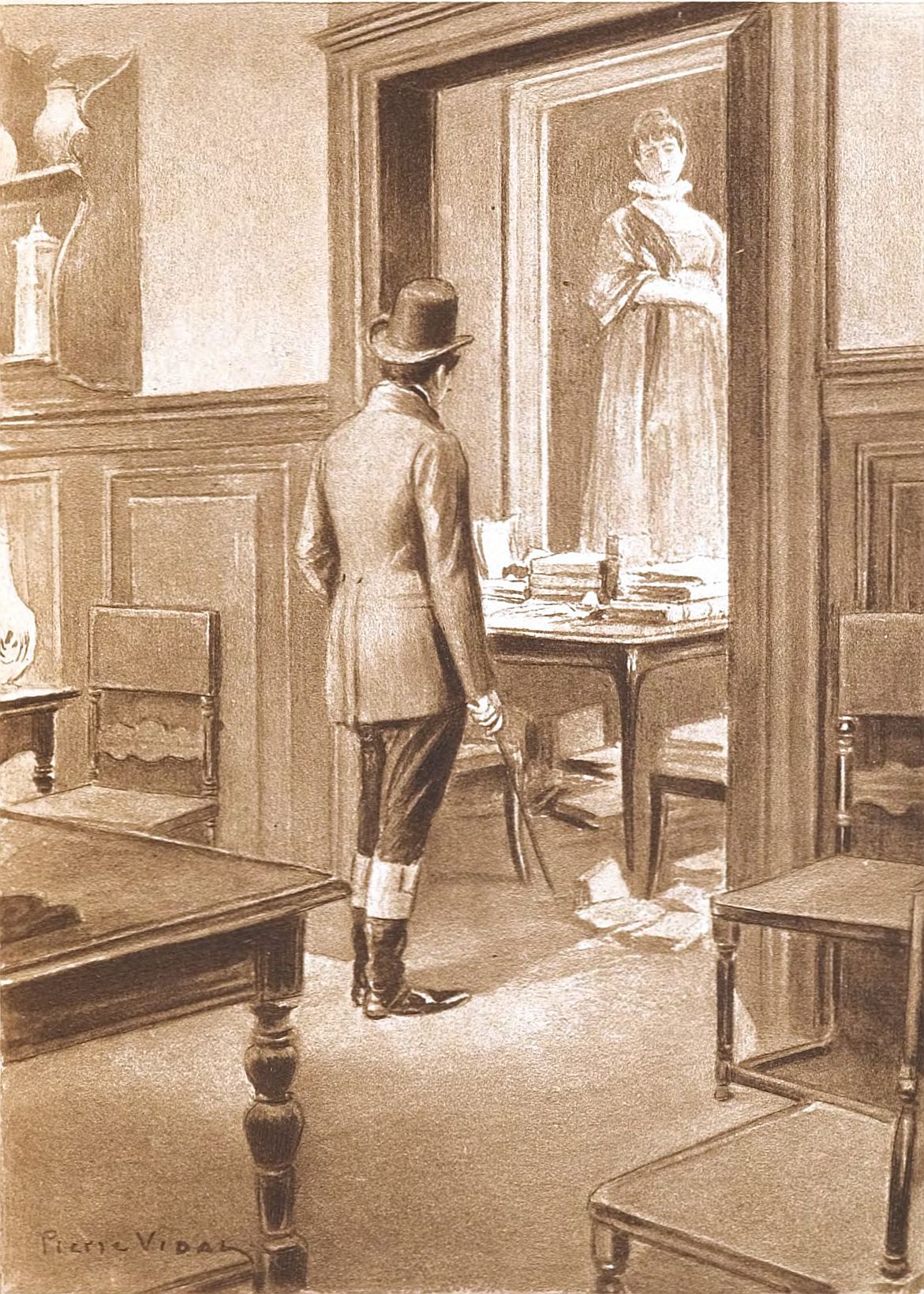
EMILE EXAMINES THE PORTRAIT OF THE MARQUISE DE BOISGUILBAULT.
Nothing could be more refined and charming than that youthful face; doubtless it was Madame de Boisguilbault, and our hero forgot himself altogether as he gazed with deep interest at the features of that woman, whose life and death must have had so vast an influence on the destiny of the recluse.
The lady was dressed in the style of the Empire; but a sky-blue shawl richly embroidered and draped over her shoulders, concealed the apparent deformity produced by the fashionable short waist of that period. The arrangement of her hair, in so-called natural curls, was most becoming, and the hair itself was of a magnificent golden hue.
Nothing could be more refined and charming than that youthful face; doubtless it was Madame de Boisguilbault, and our hero forgot himself altogether as he gazed with deep interest at the features of that woman, whose life and death must have had so vast an influence on the destiny of the recluse.
But it rarely happens that a portrait gives us a just idea of the original; indeed, in the majority of cases one may say that nothing resembles the person so little as his image.
Emile had thought of the marchioness as a pale, melancholy creature; he saw a fashionable beauty, with a proud, sweet smile, with a noble and triumphant bearing. Was she like that before or after her marriage? Or was hers a nature entirely different from what he had supposed?
One thing of which he was certain was that he had before him a most fascinating face, and, as it was impossible for him to look upon the image of youth and beauty without thinking instantly of Gilberte, he began to compare the two types, in which it seemed to him that he discovered points of resemblance. The light was rapidly failing, and, as Emile dared not take a step toward the mysterious study, the outlines of the portrait soon became very indistinct. The white flesh and golden hair, standing forth from the shadow, produced so powerful an illusion upon him, that he thought that he had a portrait of Gilberte before him, and when he could no longer see aught but a sort of mist filled with dancing sparks, he had to make a strong effort of his will to remember that in his first impression, the only reliable one under such circumstances, there had been no thought of a resemblance between Madame de Boisguilbault's face and Mademoiselle de Châteaubrun's.
He left the chalet, and, meeting no one in the park, went on to the château.
The same silence and solitude reigned in the courtyard. He mounted the stairs in the turret, but did not as usual meet Martin coming to announce him in that ceremonious tone from which he never departed, even with the only habitué of the house.
At last he reached the salon, which was always very dark, the blinds being closed night and day; and, seized with a vague alarm, as if death had entered that house in which there was so little life at the best, he ran through the other rooms and at last found Monsieur de Boisguilbault lying on a bed. He was as pale and motionless as a corpse. The last rays of daylight cast a vague and melancholy reflection into the room, and old Martin, whose deafness prevented him from hearing Emile's approach, had every appearance of a statue as he sat at his master's pillow.
Emile darted to the bed and seized the marquis's hand. It was burning; and as the two old men awoke, one from the troubled sleep of fever, the other from the drowsiness of fatigue or inaction, the young man soon satisfied himself that the marquis's indisposition was in itself of little consequence. However, the ravages which two days of illness had wrought in that feeble, worn out frame were most disquieting for the future.
"Ah! you have done well to come!" said Monsieur de Boisguilbault, pressing Emile's hand feebly; "ennui would soon have consumed me if you had abandoned me!"
And Martin, who had not heard his master's words, but seemed to receive his thoughts on the rebound, repeated in a louder voice than he supposed:
"Ah! Monsieur Emile, you did well to come! Monsieur le marquis was suffering terribly from ennui because you didn't come."
Thereupon he told him that monsieur le marquis had been taken with the fever as he was about to go to the park two nights before, and had tranquilly made up his mind that he was going to die. He had insisted on going to bed in that very room, although he was not accustomed to sleep there, and he had given him instructions as if he never expected to get up again. He had a very restless night and the next morning he said to him:
"I feel much better; this will not amount to anything; but I feel as tired as if I had made a long journey and I need to rest a little. Perfect silence, Martin; little light, little nursing and no doctor; those are my orders. Don't be alarmed about me."
"And as I couldn't help being frightened," continued the old retainer, "monsieur le marquis said to me:
"'Never fear, my dear fellow, my time hasn't come yet.'"
"Is monsieur le marquis subject to such attacks?" Emile inquired; "are they serious? do they last long?"
But he had forgotten that Martin could hear nobody but his master, and, at a signal from the latter, he had already left the room.
"I allowed the poor old deaf fellow to have his say," said Monsieur de Boisguilbault, "for it would have been of no use to try to interrupt him. But don't take me for a coward from his story. I am not afraid of death, Emile; I used to long for it; now I await it calmly. I have been conscious of its approach for a long time; but it comes slowly, and I shall die as I have lived, without haste. I am subject to intermittent fevers which take away my appetite and my sleep, but which no one ever discovers because they leave me enough strength for the little I have to do. I do not believe in medicine; thus far it has found no means of curing disease without attacking the vital principle. In whatever form it assumes, it is empiricism, and I prefer bending under God's hand to leaping and capering under the hand of a man. This time I was harder hit than usual; I felt weaker mentally, and I will confess without shame, Emile, that I realized that I could no longer live alone. Old men are like children for falling in love with a new pleasure; but when it comes to losing it, they are not easily consoled like children. They become old men again and die. Don't be embarrassed by what I say: it is the fever that makes me so talkative. When I am cured, I shall not say it, I shall not even think it; but I shall always feel it as an instinct beneath my apathy. Do not feel that you are chained henceforth to my sad old age. It is of little importance whether I live a year more or less, or whether a friendly hand closes the eyes of him who has lived alone. But I thank you for coming again. Let us talk no more of me, but of you. What have you been doing during these sad days?"