Volume 1 — Introductory material (continued 4)
George Burnham Ives translation
"There is more pride than you think in this puerile gentleness. Am I not your father, your best friend? Should I not force you to hear the truth when you are deceiving yourself and lead you back when you go astray? Come! a truce to vanity between us! I think more of your intelligence than you do yourself, for I do not propose to allow it to degenerate by feeding on unhealthy food. Listen to me, Emile! I know very well that it is the fashion among the young men of to-day to pose as legislators, to philosophize on every subject, to reform institutions that will last much longer than they will, and to invent religions and social systems—a new morality. The imagination delights in these chimeras, and they are very innocent when they don't last too long. But we must leave it all on the benches at school, and learn to know and understand society before destroying it. We soon discover that it is far superior to us, and that the wisest course is to submit to it, with shrewd tolerance. You are too big a boy now to waste your desires and reflections on a subject that has no bottom. I wish you to become interested in real, positive life; to study the meaning and application of the laws by which we are governed, instead of exhausting yourself in criticizing them. On the other hand, if such study tends to create a spirit of reaction and of disgust with the truth, you must abandon it and set about finding something useful to do for which you feel that you are fitted. Come, we are here to have an understanding and arrive at some conclusion: no vain declamations, no poetic dithyrambs against heaven and mankind! Poor creatures of a day that we are, we have no time to waste in trying to ascertain our destiny before and after our brief appearance on earth. We shall never solve that enigma. It is our bounden duty to work incessantly here on earth and to go hence without a murmur. We must account for our labors to the generation that precedes us and shapes us, and to that which follows us and which we shape. That is why family bonds are sacred and the rights of inheritance inalienable, despite your fine communistic theories, which I have never been able to understand, because they are not ripe and the human race must still wait for centuries before accepting them. Tell me, what do you propose to do?"
"I have absolutely no idea," replied Emile, overwhelmed by this avalanche of narrow-minded, cold commonplaces, uttered with brutal and arrogant fluency. "You solve with so much assurance questions which it will probably require my whole life to solve, that I am unable to follow you in this ardent race toward an unknown goal. I am too weak and my intelligence is apparently too limited to find in my own energy the motive or the reward of so many efforts. My tastes in no wise incline me to make them. I love mental labor, and I should love bodily labor, if it should become the servant of the other in procuring the gratification of the heart; but to work in order to hoard, to hoard in order to retain and increase one's hoard, until death puts an end to this unreasoning thirst—that has neither sense nor any attraction to me. I possess no faculty which you can employ for that object; I am not born a gambler and the enthralling chances of the rise and fall of my fortune will never cause me the slightest emotion. If my aspirations and my enthusiasm are chimeras unworthy of a serious mind, if there is no eternal truth, no divine reason for the existence of things, no ideal which we can carry in our heart to sustain ourselves and guide our footsteps through the evils and injustices of the present, then I no longer exist, I no longer believe in anything; I consent to die for you, father; but as to living and struggling like you and with you, I have neither the heart nor the arm nor the head for that sort of work."
Monsieur Cardonnet quivered with rage, but he restrained himself. Not without design had he thus awkwardly aroused his son's indignation and spirit of resistance. He had determined to lead him on to speak out his whole thought, and to test his enthusiasm, so to speak. When he realized from the young man's bitter tone and desperate expression that it really was as serious as he had feared, he determined to go around the obstacle and to manœuvre in such a way as to recover his influence.
XIII THE STRUGGLE
"Emile," rejoined the manufacturer with well-feigned calmness, "I see that we have been talking for some moments without understanding each other, and that if we continue on this tack you will pick a quarrel with me and treat me as if you were a young saint and I an old heathen. With whom are you in such a passion? I was quite right, at the outset, to try to put you on your guard against enthusiasm. All this warmth of brain is simply youthful effervescence, and when you are as old as I am and have had a little experience and are accustomed to doing your duty, you won't think it necessary to flap your wings in order to be honest, or to shout your convictions so loud. Beware of emphasis, which is nothing more than the language of self-satisfied vanity. Tell me, boy, do you happen to believe that honor, morality, good faith in keeping engagements, humane sentiments, pity for the unfortunate, devotion to country, respect for the rights of others, domestic virtues and the love of one's neighbor are very rare and substantially impossible virtues in these days and in the world we live in?"
"Yes, father, I do firmly believe it."
"Well, I believe nothing of the kind. I am less misanthropic at fifty than you are at one-and-twenty; I have a better opinion of my fellow-men, apparently because I don't possess your lights and your infallible glance!"
"In heaven's name! do not make fun of me, father; you break my heart."
"Very well, let us talk seriously. I will assume with you that those virtues are the religion and the rule of life of a small number of people. Will you at least do me the honor to assume that they are not wholly foreign to your father's character?"
"Most of your acts, father, have convinced me that to do good was your sole ambition. Why then do your words seem to attempt to show me that you have a less noble aim?"
"That is precisely what I want to come at. You agree that my conduct is irreproachable, and yet you are scandalized to hear me appeal to calm common sense and to the counsel of sound logic! Tell me, what would you think of your father if, every hour in the day, you should hear him declaiming against those who do not follow his example? If, setting himself up as a model, and all puffed out with self-love and self-admiration, he should weary you at every turn with his own praises and with anathemas hurled at the rest of mankind? You would hold your peace and throw a veil over that annoying absurdity; but, do what you would, the thought would come that your worthy father had one deplorable weakness and that his vanity detracted from his merit."
"Doubtless, father, I prefer your reserve and your judicious modesty; but when we are alone together, and on the rare and solemn occasions when you deign to open your heart to me, should I not be overjoyed to hear you extol noble ideas and kindle a holy enthusiasm in my heart, instead of hearing you sneer at my aspirations and trample them contemptuously in the dirt."
"I do not despise noble ideas, nor do I laugh at your worthy aspirations. What I do spurn and what I desire to stifle in you are the declamation and braggadocio of the new humanitarian schools. I cannot endure their holding up principles as old as the world in the guise of truths unheard of until this day. I would like you to love duty with immovable tranquillity, and perform it with the stoical silence of genuine conviction. Believe me, an acquaintance with good and evil doesn't date from yesterday, and I did not wait to learn justice until you had sucked in the celestial manna while smoking your cigar on the sidewalks of Poitiers."
"All this may be true, generally speaking," said Emile, heated by Monsieur Cardonnet's persistent irony. "There are old citizens who, like you, father, practise virtue without ostentation, and there may be impertinent students who preach it without loving it and, as it were, without knowing what it is. But your last shaft of satire I can not take to my own account or that of my young friends. I do not claim to be anything more than a child and do not pride myself on any experience I may have had. On the contrary, I come with respect and confidence, actuated only by good instincts and good intentions, to ask you for the truth, for advice, example, assistance and instruction. I have on my side only my youthful ideas, and I lay them at your feet. Disgusted as I am by the shocking contradictions which the laws of society recognize and sanction, I implore you to tell me how you have been able to accept them without protest, and to remain an honest man. I confess that I am weak and ignorant, for I cannot conceive the possibility of such a thing. So tell me, I pray you, instead of heaping freezing sarcasm on me. Am I blameworthy in asking for light? am I insolent and mad because I desire to know the laws of my conscience and the aim of my life? Yes, your character is noble and your conduct judicious and wise; your heart is kind and your hand liberal; you assist the poor man and you pay him handsomely for his labor. But whither are you going by this straight, sure road? It seems to me that you sometimes lack indulgence, and your severity has often frightened me.
"I have always said to myself that your sight was clearer and your mind more provident than those of tender, timid natures, that the momentary suffering you inflict was with a view to doing lasting good and to strengthening the foundations of talent; and so, notwithstanding my distaste for the studies you imposed upon me, notwithstanding the sacrifice of my tastes to your hidden purposes, and the constant denial and stifling of my desires at their birth, I made it the law of my life to follow you and obey you in everything. But the time has come when you must open my eyes if you wish me to succeed in this superhuman effort; for the study of the law doesn't satisfy my conscience; I cannot imagine myself ever engaging in legal contests, still less compelling myself, like you, to urge men on to toil for my benefit, unless I see clearly whither I am going and what sacrifice beneficial to mankind I shall have consummated at the cost of my happiness."
"Your happiness then would consist in doing nothing and living with your arms folded, staring at the stars? It seems that work of any sort vexes and tires you, even the study of the law, which all young men learn in sport?"
"You are well aware that the contrary is true, father; you saw me become passionately interested in the most abstract studies, and you stopped me as if I were rushing to my destruction. You know well, however, what my wishes were, when you urged me to seek some material application of the sciences I preferred. You were not willing that I should be an artist or a poet; perhaps you were right; but I might have been a naturalist, or at least an agriculturist, and you forbade that. And yet that was a real, practical application.
"Love of nature impelled me toward life in the country. The infinite pleasure that I took in investigating nature's laws and mysteries led me naturally to the discovery of its concealed forces and to the attempt to guide them and make them more fruitful by intelligent toil. Yes, that was my vocation, you may be sure. Agriculture is in its infancy; the peasant wears himself out in monotonous routine tasks; vast tracts of land are untilled. Science would increase tenfold the richness of the soil and lighten the labor of man.
"My ideas concerning society were in accord with my dreams of such a future. I asked you to send me to some model farm to study. I should have been happy to become a peasant, to work with mind and body, to be constantly in contact with men and things as nature knows them. I would have applied myself with zeal, I would have ploughed farther than some others perhaps in the field of discoveries! And some day I would have founded, upon some desert, naked tract of land transformed by my labors, a colony of free men living together like brothers and loving me as a brother. That was my only ambition, in that direction alone was I thirsty for fortune and glory. Was it an insane freak? and why did you require me to go and work like a slave to learn a code of laws that will never be mine?"
"There you are! there you are!" said Monsieur Cardonnet shrugging his shoulders; "there we have the Utopia of Brother Emile, Moravian brother, Quaker, Neo-Christian, Neo-Platonist and God knows what. It is magnificent, but it is absurd."
"Pray tell me why, father? for again you pronounce sentence without giving any reasons."
"Because, mingling your socialistic Utopias with your vain speculations as a scientist, you would have poured treasures upon the barren rock, you would not have raised wheat from the sterile soil nor would you have raised men capable of living as brothers from the communistic idea. You would have spent foolishly with one hand what I had saved with the other; and, at forty years of age, with your imagination run dry, at the end of your genius and your confidence, disgusted with the imbecility or the perversity of your disciples, mad perhaps—for that is what excitable and romantic minds come to when they seek to put their dreams in practice, you would have come back to me, crushed by your helplessness, angry with mankind, and too old to return to the right road. Whereas, if you listen to me and follow me, we will travel together over a straight, sure road, and within ten years we shall have made a fortune of which I don't dare name the amount, for you would not believe me."
"Let us admit that this is not a dream also, father, for it makes little difference for my present purpose; what shall we do with this fortune?"
"Whatever you choose, all the good that you may then dream of doing; for I am not at all disturbed about your common sense and prudence, if you will wait for experience of life and allow your brain to mature in peace."
"What do you say? we will do good! you must tell me about that, father, and I will be all ears! What is the blessing with which we will endow mankind?"
"You ask the question! In heaven's name, what divine mystery do you expect to find in human affairs? We shall have bestowed upon a whole province the benefits of industrial activity! Are we not already on the way? Is not work the source and sustenance of work? do we not employ more men here in a day than agriculture and the petty uncivilized trades that I propose to put down used to employ in a month? Do they not receive higher wages? Are they not in a fair way to acquire the spirit of order, prudence, sobriety, all the virtues that they lack? Where are these virtues, the poor man's only blessing, concealed? In absorbing work, in salutary fatigue and in proportionate wages. The good mechanic has the family spirit, respect for property, submission to the laws, economy, and the habit and the advantages of saving. Idleness, with all the wretched arguments it engenders, is what ruins him. Keep him busy, overwhelm him with work; he is strong, and will become stronger; he will cease to dream of overturning society. He will become orderly in his conduct, his house will be well kept, he will introduce comfort and tranquillity there. And if he lives to be old and infirm, however willing you may be to assist him, it will not be necessary. He will have thought of the future himself; he will no longer need alms and a protector like your friend Jappeloup the vagabond; he will be really a free man. There is no other way to save the people, Emile. I am sorry to tell you that it will take longer to carry out this plan than to conceive a fine Utopian scheme; but if it be a long and hard undertaking, it is worthy of a philosopher like you, and I do not consider it beyond the strength of a hard worker of my sort."
"What! is that the whole ideal of industry?" said Emile, crushed by this conclusion. "Have the people no other future than incessant toil, for the benefit of a class that is never to work at all?"
"That is not my idea," Monsieur Cardonnet replied; "I hate and despise idlers; that is why I don't like poets and metaphysicians. I think that everybody should work according to his powers, and my ideal, as that word seems to please you, is not far removed from that of the Saint-Simonians: 'To every one according to his capacity,' recompense proportioned to desert. But in these days the manufacturing industry has not yet become so firmly established that we can think about a moral system of subdivision. We must look at what is and not speculate as to what is possible. The whole movement of the age tends toward manufacturing. Let it reign and triumph then; let all men work, some with the arm, some with the brain; it is for him who has more brain than arm to direct the others: it is his right and his duty to make a fortune. His wealth becomes sacred, since it is destined to increase in order that there may be more work and higher wages. Society should lend a hand therefore in every way to establish the power of the sagacious man; his sagacity is a public blessing; and he himself should struggle constantly to increase his activity; it is his duty, his religion, his philosophy. In short he must be rich in order to keep growing richer, as you said, Emile, not realizing that you were uttering the most valuable of axioms."
"So, father, you would give to a man only as long as he works? Pray, do you make no account of the man who cannot work?"
"I find in wealth the means of assisting the infirm and the insane."
"But the sluggard?"
"I try to correct him, and if I fail, I turn him over to the law, since he is certain before long to become a nuisance and to incur its penalties."
"In a perfectly constituted society that might be just, because the sluggard would be a monstrous exception; but in exercising authority according to such strict rules as yours, when you demand from the workingman all his strength, all his time, all his thoughts, all his life, ah! how many would be dismissed as sluggards and abandoned to their fate!"
"With the advantages accruing from the increase of manufacturing, we should very soon succeed in increasing the well-being of the poorer classes to such an extent that we could easily found schools where their children would be taught the love of work at almost no expense."
"I think that you are mistaken, father; but even if it were true that the rich would give their attention to the education of the poor, the love of incessant work, without other compensation than the certainty of a pittance for one's old age, is so contrary to nature that you can never kindle it in children. A few exceptional natures, consumed by energy or ambition, will sacrifice their youth; but whoever is simple-hearted, loving, inclined to reverie, to innocent and legitimate pleasures, and under the influence of that craving for affection and tranquillity which is the lawful privilege of the human race, will fly from this jail of incessant toil in which you seek to confine him, and will prefer the chances of poverty to the security of slavery. Ah! father, your rugged constitution, your untiring energy, your stoical sobriety and your inveterate habit of working make you an exceptional man, and you imagine a society formed after your image, you do not see that there is no suitable place there for any but exceptional men. Permit me to tell you that that is a Utopian conception far more appalling than mine."
"Well, Emile, I wish that you believed in it," said Monsieur Cardonnet warmly; "it is a source of strength, and an invaluable stimulant in this society of dreamers, idlers and apathetic creatures in which I am devoured with impatience. Be like me, and if we should find in France, at this moment, a hundred men like us, I promise you that there would be no more exceptions a hundred years hence. Activity is contagious, magnetic, miracle-working! it was through activity that Napoléon held sway over Europe: he would have owned all Europe if he had been a manufacturer instead of a fighting man. Oh! since you are an enthusiast, be enthusiastic for my ideas! shake off your languor and share my fever! If we do not attract the whole race, we shall make great breaches through which our descendants will see it moving about in a sacred frenzy."
"No, father, never!" cried Emile, dismayed by Monsieur Cardonnet's terrible energy; "for that is not the road for mankind to follow. There is in it no trace of love or pity or gentleness. Man was not born to know naught but suffering and to extend his conquests over matter only. The conquests of the intellect in the domain of ideas, the pleasures and refinements of the heart, which, according to your plan, should be carefully regulated accessories in the workingman's life, will always be the noblest and sweetest aspiration of every normally constituted man. Do you not see that you cut off one whole side of the benevolent intentions of God? that you do not give the slave of toil time to breathe and to know himself? that education directed solely to moneymaking will make mere brutish machines and not complete men? You say that you conceive an ideal to be realized in the course of centuries, that a time may come when every one will be rewarded according to his capacity. Well, I say that your formula is false because it is incomplete, and unless we add to it: 'To everyone according to his needs,' it is unjust, it is simply asserting the right of him who is strongest in intellect or will, it is aristocracy and privilege under other forms. O father, instead of fighting with the strong against the weak, let us fight with the weak against the strong. Let us try! but in that case let us not think of making our fortunes, let us renounce the idea of hoarding for our own benefit. Give your consent, for I, for whom you are working to-day, give my consent. Let us try to identify our ideals in this way, and let us renounce personal profit while devoting ourselves to work. Since we cannot by ourselves alone create a society in which all the members have an equal interest, let us be the workmen of the future, devoted to the weak and incapable of the present."
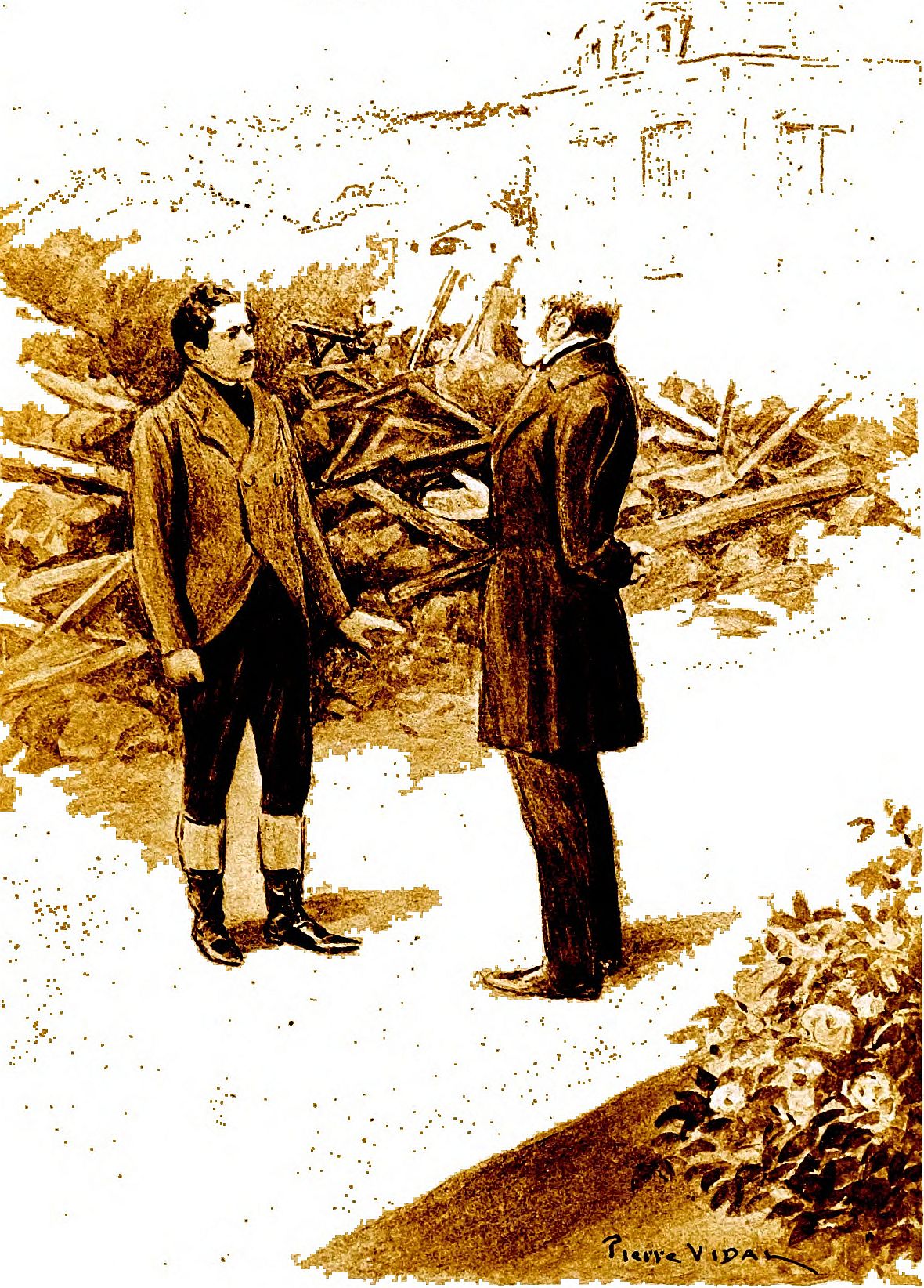
EMILE IN CONFERENCE WITH HIS FATHER.
When he realized from the young man's bitter tone and desperate expression that it really was as serious as he had feared, he determined to go around the obstacle and to manœuvre in such a way as to recover his influence.
"If Napoléon's genius had been trained to this doctrine, perhaps it would have converted the world; but let us find a hundred men like us, let this fever to acquire wealth become a divine zeal, let the longing to practise charity consume us, let us give all our workmen a share in all our profits, let our great fortune be not your property and my heritage, but the property of all those who have assisted us, according to their abilities and their strength, in amassing it; let the workman who brings his stone be put in a way to know as much of the material joys of life as you who bring your genius; let him too be able to live in a fine house, to breathe pure air, to eat healthy food, to rest after fatigue, and to educate his children; let us find our reward, not in the useless luxury with which you and I can surround ourselves, but in the joy of having made others happy—I can understand that ambition and be carried away by it. And then, father, dear father, your work will be blessed.
"This indolence and apathy which irritate you, and which are simply the result of a struggle in which a few triumph to the detriment of the vast majority who lose their courage and succumb, will themselves disappear in the natural course of things. Then you will find so much zeal and love about you that you will no longer be obliged to wear yourself out alone in order to stimulate all the others. How could it be otherwise to-day, and of what do you complain? Under the law of selfishness each one gives of his strength and his energy in proportion to the share of the profits he receives. A marvellous result, truly, that you, who receive all the profit, should be the only zealous, assiduous worker, while the paid worker, who receives in your employ a trifle more alms than he would receive elsewhere, brings you only a little more of his zeal. You pay higher wages—that is a fine thing, certainly, and you are more to be commended than the majority of your rivals, who would prefer to lower them; but you have it in your power to increase the zeal of your employés tenfold, a hundred-fold, to kindle as by a miracle the flame of devotion, the intelligence of the heart in those benumbed and paralyzed creatures, and you do not choose to do it!—Why not, father? It is not that you care for the enjoyments of luxury; for you enjoy nothing unless it be the intoxication of your plans and your triumphs. Very well; do away with your individual profit; you have only to do it, and I will abandon my claim to it with the greatest joy! Let us be simply the trustees and managers of the common profits. This fortune that you dream of, of which you dare not tell me the amount, will so surpass your anticipations and your hopes, that you will soon have the means to give your workmen moral, intellectual and physical pleasures which will make new men of them, complete men, true men! and such men I have never seen anywhere. All equilibrium is destroyed; I see only knaves and brutes, tyrants and slaves, powerful and greedy eagles and stupid and cowardly sparrows destined to be their prey. We live according to the blind law of the savage nature; the code of savage instinct which governs the brute is still the soul of our pretended civilization; and we dare to say that the manufacturing industry will save the world without departing from that path! No, no, father, all these declamations of political economy are false and misleading! If you compel me to be rich and powerful, as you have said so many times, and if, by reason of the vulgar influence of money, the adorers of money send me to represent their interests in the counsels of the nation, I shall say what I have in my mind; I shall speak, and I suppose that I shall speak only once: for they will put me to silence or force me to leave the hall; but people will remember what I say, and they who chose me will have reason to repent their choice!"
This discussion was prolonged far into the night, and it will be readily understood that Emile did not convert his father. Monsieur Cardonnet was not evil-minded, nor impious, nor voluntarily blameworthy toward God or man. Indeed, certain practical virtues were very strongly accentuated in him, and he had great talent in one special field. But his iron will was the result of the entire absence of idealism in his character.
He loved his son but could not understand him. He was kind and attentive to his wife, but he had never failed to stifle in her any thought capable of interfering with his daily routine. He would have liked to be able to reduce Emile to subjection in the same way; but, realizing that was impossible, he was intensely annoyed and tears of vexation moistened his burning eyes more than once during that stormy interview. He sincerely believed that he was logically right; that his ideas were the only really admissible and practicable ones.
He asked himself by what fatality he happened to have a dreamer and a Utopian for a son, and more than once he raised his powerful arms to heaven, asking with indescribable pain what crime he had committed that such a calamity should be visited upon him.
Emile, worn out by fatigue and disappointment, was moved to pity at last for that wounded heart and that incurable blindness.
"Let us talk no more about these matters, father," he said, wiping away his own tears, which had their source farther down in his heart; "we cannot become identified with each other. I can only continue to show my submission and my filial love, thinking no more of myself and of a happiness which I sacrifice to you. What are your orders? Shall I return to Poitiers and go on with my studies until I pass my examinations? Shall I stay here and act as your secretary and steward? I will close my eyes and work like a machine so long as it is possible for me to do it. I will look upon myself as your employé; I will enter your service——"
"And you will cease to look upon me as your father?" said Monsieur Cardonnet. "No, Emile; stay with me, but be perfectly free. I give you three months, during which, living as you will in the bosom of your family, far from the declamations of the beardless philosophers who have ruined you, you will recover your senses unassisted. You are blessed with a robust temperament, and it may be that absorbing mental labor has overheated your brain. I look upon you as a sick child whom I have taken into the country to cure. Walk, ride, hunt; in a word, amuse yourself in order to reestablish your equilibrium, which seems to me more disturbed than that of society. I hope that you will abate your intolerance when you see that your home is not a hotbed of wickedness and corruption. Before long, perhaps, you will tell me voluntarily that profitless musing bores you, and that you feel that you must help me."
Emile bowed, without speaking, and left his father, after embracing him with a feeling of profound sorrow. Monsieur Cardonnet, having been able to do nothing better than temporize, tossed about a long while in his bed, and finally fell asleep, saying, to himself, contrary to his custom, that one must sometimes rely more upon Providence than upon oneself.
XIV FIRST LOVE
The energetic Cardonnet, entirely engrossed by his daily occupations, or sufficiently self-controlled not to allow the slightest trace of his inward suffering to appear on the surface, resumed his air of glacial dignity on the following day.
Emile, overwhelmed with dismay and sadness, strove to smile in presence of his mother, who was disturbed by his distraught air and altered expression. But she was so overawed that she lacked even the penetration peculiar to her sex. All her faculties had grown rusty, and at forty she was already an octogenarian, mentally speaking. And yet she loved her husband, as the result of a need of loving which had never been satisfied. She had no definite grievances to allege against him, for he had never openly maltreated her or made a slave of her; but every impulse of the heart or the imagination had always been stifled in her by irony and a sort of contemptuous pity, and she had accustomed herself to entertain no thought or desire outside of the circle drawn about her by an inflexible hand.
To oversee all the details of the housekeeping had become something more than a wise and self-imposed occupation. It had been made a law of her existence, so serious and so sacred that she might have been compared to a Roman matron in respect to the trivial solemnity of domestic toil, if in no other respect.
Thus she presented in her person the strange anachronism of a woman of our own time, capable of reasoning and feeling, but who had insanely forced herself to retrograde some thousands of years in order to make herself like one of those women of ancient times whose glory it was to proclaim the inferiority of their sex.
The strange and sad feature of her position was that she did not realize it, and that she acted as she did—so she would say in a whisper—for the sake of peace. And she did not obtain it! The more she immolated herself, the more she bored her lord and master.
Nothing weakens and destroys the intelligence so quickly as blind submission.
Madame Cardonnet was an example of this truth.
Her brain had shrivelled in slavery, and her husband, not realizing that it was the result of his domination, had reached the point of despising her in secret.
Several years earlier Cardonnet had been terribly jealous, and his wife, although faded and worn, still trembled at the idea that he might impute a vicious thought to her. She had acquired the habit of not listening or looking, so that she could say confidently when any man was mentioned to her: "I didn't look at him; I don't know what he said; I paid no attention to him." The utmost that she dared do was look at her son and question him; for, as to her husband, if she was made anxious by the unusual pallor of his cheeks or the increased severity of his glance, he would speedily compel her to lower her eyes, saying: "In heaven's name, what is there extraordinary about me that you should stare at me as if you didn't know me?" Sometimes, at night, he would notice that she had been weeping, and he would become affectionate once more after his fashion. "Tell me, what's the matter? Is something troubling the poor little woman? Would you like a new shawl? Would you like me to take you to drive? No? Then it must be because the camellias are frozen? We will have some sent down from Paris that are more hardy and so beautiful that you won't regret the old ones." And, in truth, he lost no opportunity to gratify his helpmeet's innocent tastes, at any price. He even required her to dress more richly than she cared to do. It was his idea that wives are children who must be rewarded for being good with toys and gimcracks.
"It is certain," Madame Cardonnet would say to herself at such times, "that my husband loves me dearly, and he is very attentive to me. What have I to complain of, and what is the reason that I always feel depressed?"
She saw that Emile was gloomy and downcast, and she could not extort the secret of his trouble from him. She questioned him at tedious length concerning his health, and advised him to go to bed early. She had a feeling that it was something more serious than the result of insomnia; but she said to herself that it was much better to allow a sorrow to fall asleep in silence than to keep it alive by trying to allay it.
That evening Emile, as he was walking near the entrance to the village, met Jean Jappeloup, who had returned several hours earlier and was joyously celebrating his arrival with several friends, in the doorway of a rustic dwelling.
"Well," said the young man holding out his hand, "are your affairs settled?"
"With the authorities, yes, monsieur, but not with poverty. I made my submission, I argued as well as I could with the king's attorney and he listened to me patiently; he said a few stupid things by way of sermon; but he's not a bad fellow and he was just about to dismiss me, saying that he would do his best to prevent any prosecution, when your letters arrived. He read them without making a sign; but he paid some attention to them, for he said to me: 'Well, set your mind at rest, settle down somewhere, don't poach any more, find some work, and everything will be all right.'—So here I am; my friends have received me warmly, as you see, for I have already been asked to lodge in this house while I look about. But I must give my mind to my most pressing necessity, which is to earn something to buy clothes with, and before night I am going to make the tour of the village, to look for work among the good people."
"Listen, Jean," said Emile, walking beside him; "I have no large amount of money at my disposal; my father makes me an allowance, but I don't know whether he will continue it now that I am to live at home; however, I have a few hundred francs for which I have no use here, and I beg you to accept them, to buy clothes and provide for your first needs. You will make me feel aggrieved if you refuse. In a few days your ill-founded anger against my father will have passed away and you will come and ask him for work; or better still, authorize me to ask him for you; he will pay you higher wages than you will get anywhere else, and he will relax the severity of his original terms, I am sure; so——"
"No, Monsieur Emile," the carpenter replied. "I will take neither your money nor your father's work. I don't know how Monsieur Cardonnet treats you, nor how much money he gives you, but I know that a young man like you is always embarrassed when he hasn't a piece of gold or silver in his pocket to gratify his whims when occasion offers. You have done enough for me; I am well pleased with you, and, if I find an opportunity, you will see that you didn't offer your hand to an ingrate. But as for serving your father in any way, never! I was very near committing that folly and God would not permit it. I forgive him for the way in which he caused my arrest by Caillaud, but it was a contemptible act! However, as he may not have known that boy is my godson, and as he has since written kindly of me to the king's attorney to obtain my pardon, I must think no more of my grievance. In any event I would trample it under foot now because of you. But as for helping to build your factories—no! you don't need my arms, you will find plenty of others, and you know my reasons. What you are doing is a bad thing and will ruin many people, if it doesn't ruin everybody some day. Already your dams and your reservoirs are drowning all the small mills on the stream above you. Already your piles of stone and dirt have ruined the meadows all around, for the flood carried them all onto your neighbors' land. Thus, you see, the rich man injures the poor man even against his will. I don't choose to have it said that Jean Jappeloup lent his hand to the ruin of his neighborhood. Don't say any more about it. I mean to take up my trade again in a small way, and I shall have no lack of work. Now that your great enterprises employ all my fellows, no one in the village can find anybody to work for him. I shall inherit their customers but must give them back when your work fails. For mark my words; your father greases his wheels by paying a high price for the sweat of the workingman's brow to-day; but he won't be able to continue long on that footing, or his expenses will exceed his profits. The day will come—and perhaps it's not far away!—when he will run his factories at a loss, and then, woe to those who have sacrificed their position on the strength of fine promises! They will be forced to do whatever your father chooses and the time will have come to make them disgorge. You don't believe it? So much the better for you! that proves that you won't be at all responsible for the trouble that is brewing; but you won't be able to prevent it. So good night, my fine fellow! don't speak in my behalf to your father, for I should give you the lie. The good Lord has helped me out of my trouble; I propose to please Him in everything now and to do only such things as my conscience will never blame me for. Being poor myself, I shall be more useful to the poor than your father with all his wealth. I will build houses for my equals and they will make more by paying me small wages than by earning big wages with you. You will see that I am right, Monsieur Emile, and everybody will tell you so some time; but it will be too late to repent of having put their necks in the halter!"
Emile could not overcome the carpenter's obstinacy, and he returned home even more depressed than when he went out. That incorruptible workingman's predictions caused him a vague alarm.
As he approached the factory he met his father's secretary, Monsieur Galuchet, a stout young man, very talented in the way of ciphering, but of very limited capacity in other respects.
It was the hour of repose and Galuchet was taking advantage of it to fish for gudgeons. This was his favorite pastime; and when he had a goodly number in his basket, he would count them, and adding the count to the total of his previous catches, would say proudly as he wound up his line:
"This is the seven hundred and eighty-second gudgeon I have caught with this hook in two months. I am very sorry I didn't count what I caught last year."
Emile leaned against a tree to watch him fish. The fellow's phlegmatic watchfulness and puerile patience disgusted him. He could not understand how he could be perfectly happy just because he had a salary that placed him out of reach of want. He tried to make him talk, saying to himself that he might perhaps find beneath that thick envelope some ray of light, some sympathetic chord which would make that young man's society a source of comfort to him in his distress. But Monsieur Cardonnet selected his subordinates with an unerring eye and hand. Constant Galuchet was a fool; he understood nothing, knew nothing outside of arithmetic and bookkeeping. When he had been at work at his figures for twelve hours he had just enough reasoning power left to catch gudgeons.
However, Emile by mere chance led him to say certain things that cast an ominous light into his mind. That human machine was capable of reckoning profits and losses and of figuring the balance at the foot of a sheet of paper. While exhibiting the most complete ignorance of Monsieur Cardonnet's plans and resources, Constant observed that the wages of the men were exorbitant and that, if they were not reduced by half in two months, the funds invested in the enterprise would be insufficient.
"But that doesn't disturb monsieur your father," he added; "you pay your workmen as you feed a horse, according to the amount of work you require of him. When you double his work you double his pay, as you double the quantity of oats; then, when you're no longer in such a hurry, you cut down the pay or the rations proportionately."
"My father won't do that," said Emile; "he might with horses, but not with men."
"Don't say that, monsieur," rejoined Galuchet; "monsieur your father knows what he's about, he won't do anything foolish, never fear."
And he carried off his gudgeons, delighted to have had an opportunity to set the son's mind at rest concerning the father's apparent imprudence.
"Oh! if that should be true!" thought Emile, as he walked excitedly along the bank of the stream; "if it should prove that this temporary generosity conceals inhuman cunning! Suppose that Jean's suspicions were well-founded! that my father, while following the blind doctrines of society, has no greater store of virtue or intelligence than other speculators have, to diminish the disastrous results of his ambition! But no, it is impossible; my father is kind-hearted, he loves his fellow-men."
But Emile had death in his heart; the thought of all this waste of energy and of life for the benefit of his future made him recoil in horror and disgust. He wondered how it was that all these men who were working to build his fortune did not hate him, and he was ready to hate himself in order to balance the scales of justice.
On the following day, he was still profoundly distressed, but he hailed with something like delight the day which he was to devote in part to Monsieur de Boisguilbault, because he had made up his mind to go and pass the day at Châteaubrun without saying a word to anybody. As he mounted his horse, Monsieur Cardonnet made divers satirical remarks:
"You are starting early to go to Boisguilbault! it would seem that the amiable marquis's society has charms for you; I should never have suspected it, and I can't imagine what secret method you have of keeping awake after each of his remarks."
"If this is your way of informing me that you do not like what I am doing," said Emile, impatiently preparing to dismount, "I am ready to give it up, although I accepted an invitation for to-day."
"I not like it!" rejoined the manufacturer; "why it is a matter of perfect indifference to me whether you are bored there or somewhere else. As your father's house is the place where you find least pleasure, I am anxious that you should derive some recompense from the society of the noble personages with whom you associate."
Under any other circumstances, Emile would have postponed his departure in order to prove, or at least to make him believe that the rebuke was not merited; but he was beginning to understand that it was his father's tactics to rally him when he wished to make him talk; and as he felt invincibly drawn toward Châteaubrun he determined not to allow himself to be trapped.
Although nothing in the world stung him more keenly than the ridicule of those whom he loved, he made an effort to seem to take it in good part.
"I anticipate so much pleasure at Monsieur de Boisguilbault's," he said, "that I propose to go there by the longest road, and my détour will probably extend to five or six leagues, unless you need me, father, in which case I will gladly sacrifice to you the delights of a ride in the hot sun over perpendicular roads."
But Monsieur Cardonnet was not deceived by his stratagem and replied with a clear and penetrating glance:
"Go where the devil of youth drives you! I am not disturbed about you, for a very good reason."
"Very good," said Emile to himself as he galloped away, "if you're not disturbed about me, I won't disturb myself about your threats."
And, feeling the fire of anger blazing in his breast, in spite of his efforts, he indulged in a long, hard run to calm himself.
"O God," he said after some time, "forgive me for these angry outbreaks, which I cannot repress. Thou knowest that my heart is full of love, and that it asks nothing better than to respect and venerate my father, who makes it his business to stifle all its impulses and to freeze all its affections."
Whether from hesitation or from prudence, he made a long detour before he turned his horse's head in the direction of Châteaubrun; and when, from the crest of a hill, he saw that he was a long distance from the ruins, which stood out against the sky on the horizon, he so bitterly regretted the time he had wasted that he drove the spurs into his horse's sides in order to arrive there more quickly.
He did in fact arrive there from the valley of the Creuse in less than half an hour, almost as rapidly as a bird on the wing, having endangered his life a hundred times leaping ditches and galloping on the brink of precipices. A violent longing, which he did not choose to analyze, gave him wings.
"I don't love her," he said to himself; "I hardly know her; I cannot love her! In any event I should love her to no purpose! It is not she who attracts me any more than her worthy father, his romantic château, his environment of repose, happiness and freedom from care. I long to see people who are happy, so that I may forget that I am not and never shall be!"
He met Sylvain Charasson, who was engaged in stretching cloth in the Creuse. The child ran to meet him with an eager delighted air.
"You won't find Monsieur Antoine," he said. "He's gone to market to sell six sheep; but Mademoiselle Janille's at home, and Mademoiselle Gilberte, too."
"Do you think I shall not disturb them?"
"Oh! not at all, not at all, Monsieur Emile; they'll be very glad to see you, for they often talk about you with Monsieur Antoine at dinner. They say that they think a great deal of you."
"Take my horse, then," said Emile, "I can go faster on foot."
"Yes, yes," replied the child. "Look, just behind what used to be the terrace. You climb the breach, take a little jump and you'll be in the courtyard. That's Jean's road."
Emile leaped down on the grass, which deadened the sound of his footsteps, and approached the square pavilion without frightening the two goats, who seemed to know him already.
Monsieur Sacripant, who was no prouder than his master, and did not disdain to perform at need the duties of sheep dog, although he belonged to the nobler breed of hunters, had escorted the sheep to market.
As he was about to enter, Emile found that his heart was beating so fast—a fact that he attributed to his rapid climb up the side of the cliff—that he paused a moment to recover himself and make his entrée with due dignity. He heard the sound of a spinning-wheel inside, and no music had ever struck more pleasantly on his ear. Then the dull hissing of the little instrument of toil ceased and he heard Gilberte's voice saying:
"Well, it's quite true, Janille, that I don't enjoy myself the days that father is away. If you weren't here with me, I should be bored outright!"
"Work, my child, work," replied Janille; "that's the way to avoid being bored."
"But I do work, and still I am not amused. I know well enough that there's no need of being amused; but I always am, and am always ready to laugh and jump when father's with us. Confess, little mother, that if we had to live long away from him, we should lose all our happiness and good spirits! Oh! it would be impossible to live without father! I should much rather die at once."
"Well, well, those are pretty ideas!" said Janille. "What in heaven's name will you think about next, little head? Your father is still young and well, thank God! so what has put all this nonsense into your head these last two or three days?"
"What do you say? these last two or three days?"
"Why, yes, fully two or three days; several times you have chosen to worry about what would become of us if we should lose your dear father, which God forbid!"
"Lose him!" cried Gilberte. "Oh! don't speak of such a thing; it makes me shudder, and I never thought of it. Oh! no, I could never think of it!"
"Well, upon my word, if you're not crying! Fie! mademoiselle, do you want to make your dear Mère Janille cry too? Oh! Monsieur Antoine would be very pleased to see you with your eyes all red when he comes home! He would be quite capable of crying too, the dear man! Come, you haven't walked enough to-day, my child; fasten up your wool and we'll go and feed the hens. It will amuse you to see the pretty partridges your little Blanche has just hatched."
Emile heard the motherly kiss from Janille which closed this speech, and as the two women would surely find him at the door, he stepped back and coughed slightly to warn them of his presence.
"Someone in the courtyard!" cried Gilberte. "I am so happy; I am sure it's father!"
And she ran eagerly to meet Emile, so fast, that when she found herself face to face with him on the threshold, she almost fell into his arms. But great as her confusion was when she discovered her mistake, it was less than Emile's; for, in her innocence, she threw it off with a hearty laugh, while the young man lost his self-possession altogether at the bare idea that he had been very near receiving an embrace which was not intended for him.
Gilberte was so lovely with her eyes still moist with tears and her rippling, childish laugh, that he was dazzled as it were, and ceased to wonder whether it was honest Antoine, the lovely ruins or the fair Gilberte that he had been in such haste to see once more.
"Well, well," said Janille, "you almost frightened us; but you are welcome, Monsieur Emile, as our master says; Monsieur Antoine will return before long. Meanwhile you must have something cool to drink. I will go to the cellar and draw some wine."
Emile remonstrated, and said, holding her back by the sleeve:
"If you go to the cellar, I will go with you; not to drink your wine, but to see the cellar itself, which you said is so interesting, so dark and deep."
"You mustn't go now," said Janille; "it's too cold there and you are too warm. Yes, you are warm! you're as red as a strawberry. You go and rest a bit, and then, while we are waiting for Monsieur Antoine, we'll show you the cellars, the underground vaults and the whole château, which you haven't examined very thoroughly yet, although it's well worth while. Ah! there are people who come a long way to see it; it's a little bit tiresome to us, and my girl goes to her room and reads while they are here; but Monsieur Antoine says that we can't refuse to admit them, especially travellers who have come a long way, and that, when you're the owner of a curious and interesting piece of property, you haven't any right to prevent other people from enjoying it."
Janille attributed to her master the argument she had put into his mind and his mouth. The fact is that she collected a considerable amount from exhibiting the ruins, which she employed, like everything belonging to her, in secretly adding to the comfort of the family.
Emile, eagerly accepting whatever they chose to offer him, consented to take a glass of water, and as Janille ran to fill her pitcher at the fountain, he was left alone with Mademoiselle de Châteaubrun.
XV THE STAIRCASE
While a practised rake may congratulate himself upon the unhoped-for accident which procures him a tête-à-tête with the object of his pursuit, a pure-hearted young man, who is sincerely in love, is more likely to be confused, almost terrified, when such good fortune comes to him for the first time.
So it was with Emile Cardonnet: the respect that Mademoiselle de Châteaubrun inspired was so profound that he feared to raise his eyes to hers at that moment, lest he should show himself in any degree unworthy of the confidence reposed in him.
Gilberte, even more naïve than he, did not feel the same embarrassment. The thought that Emile could abuse, even by a careless word, her isolation and her inexperience, found no place in a mind so noble and innocent as hers, and her sacred ignorance preserved her from any suspicion of that sort. So she was the first to break the silence, and her voice, as by enchantment, brought tranquillity to the young visitor's agitated breast. There are voices so sympathetic and so penetrating, that to hear them pronounce two or three trivial words is enough to fill one with affection for the persons whose characters they describe, even before one sees them. Gilberte's voice was of this number. On hearing her speak or laugh or sing, you felt that there had never been in her mind an evil or unkind thought.
The thing that moves and charms us in the song of birds is not so much the melody, opposed to all our musical conventions, or the extraordinary power of their flexible organs, as a certain accent of primitive innocence, of which nothing in the language of men can convey an idea. It seemed, on listening to Gilberte, that the same comparison could be aptly applied to her, and that the most indifferent things acquired, on passing between her lips, a meaning much deeper than that which they expressed by themselves.
"We saw our friend Jean this morning," she said; "he came at daybreak and carried away all my father's tools, in order to do his first day's work; for he has found work already, and we have strong hopes that there will be no lack of it. He told us all that you did and tried to do for him last evening, and I assure you, monsieur, that, for all the pride and perhaps roughness of his refusal, he is as grateful as he ought to be."
"What I have been able to do for him amounts to so little that I am ashamed to speak of it," said Emile. "I am especially grieved that he allows his obstinacy to deprive him of a certainty of employment, for it seems to me that his position is still very precarious. To begin a life of toil, at sixty, and to have neither a house, nor clothes, nor even the necessary tools, is a terrifying prospect, is it not, mademoiselle?"
"Still, I am not terrified," replied Gilberte. "Brought up as I have been in uncertainty, and living from day to day, as it were, perhaps I have myself fallen into the habit of looking upon poverty with that same happy indifference. Either I am naturally of that disposition, or Jean's heedlessness reassures me; it is certain that none of us felt the least uneasiness in the congratulations we exchanged this morning. It takes so little to satisfy Jean! He is as sober and as healthy as a wild man. He has never been better than during these two months that he has lived in the woods, walking all day and sleeping most of the time in the open air. He declares that his sight has grown keener, that his youth has returned again, and that, if the summer would last all the time, he would never need to come back to the village to live. But in the bottom of his heart he has an invincible affection for his native place, and furthermore he would not be satisfied to be idle long. We urged him this morning to settle down here with us, and to live as we do, without thought for the morrow.
"'There is room enough here and plenty of material for you to build yourself a house,' said my father. 'I have all the stone you need and enough old trees for your frame, and I'll help you to put it up as you helped me with mine.'
"But Jean wouldn't listen to that.
"'Very good,' said he, 'but what in heaven's name should I do to kill time when you have set me up as a country gentleman? I can't live on my income, and I don't propose to be a burden to you during the thirty years that I still have to live, it may be. Even if you were rich enough to support me, I should die of ennui. It's all right for you, Monsieur Antoine, you were brought up to do nothing. Although you're no sluggard and you have proved it—it costs you nothing to resume the habit of living like a monsieur; but there's no more hunting and coursing for me; pray, am I to sit with folded arms? I should go mad at the end of the first week.'"
"So," said Emile, thinking of his father's theory of incessant toil and no repose in old age, "so Jean will never feel the longing to be free, although he makes so many sacrifices to his alleged freedom?"
"Why, are freedom and idleness the same thing?" said Gilberte, in a tone of surprise. "I think not. Jean is passionately fond of work, and all his freedom consists in choosing the work that pleases him; when he works to gratify his inclination and his natural inventiveness, he works with all the more ardor."
"Yes, mademoiselle, you are right," said Emile, with sudden melancholy, "and that is the whole secret. Man is born to work always, but to work according to his aptitudes and in proportion to the enjoyment he derives from it! Ah! if only I were a skilful carpenter! with what joy I would go and work with Jean Jappeloup, for the benefit of such a wise and unselfish man!"
"Well, well, monsieur," said Janille, as she returned to the room, ostentatiously balancing her earthenware pitcher on her head, to display her strength, "you talk just like Monsieur Antoine. If you'll believe it, he wanted to go to Gargilesse this morning with Jean and work with him as a journeyman, as he used to do! Poor dear man! his kind heart carried him to that length.
"'You helped me to earn my living long enough,' he said; 'now I propose to help you earn yours. You refuse to share my table and my house; accept at least the price of my work, as I don't need it.'"
"And Monsieur Antoine would have done as he said. At his age and with his rank, he would go and hammer away like a deaf man on those great blocks of wood!"
"Why did you prevent him, Mère Janille? Why did Jean obstinately refuse? My father's health would have been no worse for it, and it would be consistent with all the noble impulses of his life. Ah! why cannot I too wield an axe and serve my apprenticeship to the man who supported my father so long, while I, knowing nothing about our means of existence, learned to sing and draw to please you. Really, women are good for nothing in this world!"
"What's that! what's that! women good for nothing!" cried Janille; "very good, let us both start out, climb up on the roofs, square timber and drive nails. Upon my word I could do better at it than you, old and small as I am; but meanwhile, your papa, who's about as clever with his hands as a frog with his tail, will spin our flax and Jean will iron our caps."
"You are right, mother," replied Gilberte; "my wheel is loaded and I have done nothing to-day. If we make haste we shall have cloth enough to make clothes for Jean before next winter. I am going to work and make up for lost time; but it's true none the less that you are an aristocrat, not to want my father to be a workman again when he pleases."
"Let me tell you the truth then," said Janille, with a solemn, confidential air. "Monsieur Antoine never succeeded in being a good workman. He had more courage than skill, and my only reason for letting him work was to prevent him from getting depressed and discouraged. Ask Jean if he didn't have to work twice as hard to mend Monsieur's mistakes, as he would have done if he'd been working alone. But Monsieur always seemed to be doing a lot of work, so the customers were satisfied and he was well paid. But it's true all the same that I was never easy in my mind in those days and that I don't sigh for them. I always shuddered for fear Monsieur Antoine would hit his arm or his leg instead of a timber, or would fall off his ladder when, in his absent-minded way, he would sit down on the rung as if he were by his own fireside."
"You frighten me, Janille," said Gilberte. "Oh! if that is the case, you did well to disgust him, by your joking, with the idea of working again, and in that, as in everything else, you are our Providence!"
Mademoiselle de Châteaubrun spoke even more truly than she knew. Janille had been the good angel of Antoine de Châteaubrun's existence. Without her prudence, her motherly domination and her shrewd judgment, that excellent man would not have passed through the slough of poverty without deteriorating a little morally. At all events he would not have retained his external dignity as well as the generous purity of his instincts. He would often have sinned by too great resignation and self-abandonment. Being naturally inclined to effusiveness and prodigality, he would have become intemperate; he would have acquired as many faults of the common people as of their good qualities, and perhaps he would have ended by meriting in some degree the disdain which fools and vainglorious parvenus felt justified in entertaining for him, even as it was.
But, thanks to Janille, who, without thwarting him openly, had always maintained the equilibrium and instilled moderation, he had emerged from the test with honor and had not ceased to deserve the esteem and respect of judicious people.
The sound of Gilberte's spinning-wheel interrupted the conversation, or at least made it less coherent. She was unwilling to interrupt her work again until her task was completed; and yet she seemed to display more ardor than the apparent motive of her activity called for. She urged Emile not to subject himself to the tedium of listening to that monotonous clattering, but to go with Janille and explore the ruins; but, as Janille also wanted to finish her spinning, Gilberte unconsciously worked even faster than before, in order to finish as soon as she, and to be one of the party.
"I am ashamed of my inaction," said Emile, who dared not gaze too fondly at the young spinstress's lovely arms or watch her motions too closely, for fear of attracting Janille's sharp little eyes; "haven't you some work to give me?"
"What can you do?" queried Gilberte with a smile.
"Whatever Sylvain Charasson can do, I flatter myself," he replied.
"I might send you to water my lettuce," said Janille, laughing outright, "but that would deprive us of your company. Suppose you wind up the clock, which seems to have stopped?"
"Oh! it stopped three days ago," said Gilberte, "and I haven't been able to make it go. I think there's something broken."
"Ah! that's the job for me," cried Emile; "I have studied mechanics a little—unwillingly, to be sure—and I don't believe that this cuckoo affair is very complicated."
"And suppose you break my clock altogether?" said Janille.
"Oh! let him break it if it amuses him," said Gilberte, with a good-natured air in which he could detect her father's easy-going heedlessness.
"I ask the privilege of breaking it, if that is its destiny," said Emile, "provided that I may be permitted to replace it."
"All right!" said Janille, "if it turns out so, I want one just like it, no finer and no larger; this one suits us: it strikes clear and yet doesn't deafen us."
Emile set to work; he took the little German clock apart, and, having examined it, found nothing more to do than remove a little dust from the interior. Leaning over the table near Gilberte he carefully cleaned and readjusted the rough machinery, exchanging with the two women an occasional remark of a playful turn, which led to a pleasant sort of familiarity between them.
It is commonly said that people become expansive and confidential while eating together; but intimacy comes more readily and naturally to those who work together. All three of them felt it; and when they had finished their various tasks they were almost members of the same family.
"You're right at home at that business," said Janille, when she saw that her clock was going; "you would almost do for a clockmaker. Now let's go for a walk; I will go first and light my lantern to take you into the cellars."
"Monsieur," said Gilberte, when Janille had left the room, "you said just now that you expected to dine with Monsieur de Boisguilbault. May I not ask you what sort of impression that gentleman made upon you?"
"I should have difficulty in defining it," replied Emile. "It is a mixture of repulsion and sympathy, so strange that I feel that I must see him again, examine him closely and then reflect further, before attempting to interpret so odd a character. Don't you know him, mademoiselle, and can you not assist me to understand him?"
"I do not know him at all; I have seen him only once or twice in my life, although we live very near him; and, because of what I had heard about him, I was very anxious to see him; but he was riding on the same road with my father and myself, and the instant that he caught sight of us, he spurred his horse, bowed to us without looking at us, apparently without knowing who we were, and was out of sight in a moment: you would have said he was trying to hide in the dust that his horse's feet kicked up."
"Has Monsieur de Châteaubrun no relations with him, although he is so near a neighbor?"
"Oh! that's a very strange thing," said Gilberte, lowering her voice confidentially, "but I may speak to you about it, Monsieur Emile, because it seems to me that you may be able to solve the mystery. My father was very intimate with Monsieur de Boisguilbault in his younger days. I know that much, although he never speaks of him, and Janille avoids answering me when I question her; but Jean, who knows no more than I do about the cause of their rupture, has often told me that he can remember a time when they were inseparable. That is what has always made me think that Monsieur de Boisguilbault is neither so proud nor so cold as he seems; for my father with his good humor and vivacity could never have been on warm terms with a haughty disposition and a cold heart. I must tell you too that I have overheard some conversation about him between my father and Janille, when they thought that I was not listening. My father said that the only irreparable misfortune of his life was the loss of Monsieur de Boisguilbault's friendship, that he should never be consoled for it, and that he would not hesitate to sacrifice an eye or an arm or a leg to recover it. Janille called his lamentations nonsense and advised him not to make the slightest step toward reconciliation because she knew the man well and he would never forget the affair that had made the trouble between them.
"'Very well,' said my father, 'I would prefer to have an explanation, to submit to his reproaches; I would rather have fought a duel with him, when we were of almost equal strength, than have to endure this implacable silence and frigid persistence which cuts me to the heart. No, Janille, no, I shall never be reconciled to it, and if I die without shaking hands with him, I shall regret that I ever lived.'
"Janille tried to divert his mind, and she succeeded, for my father is impressionable and too affectionate to be willing to depress others with his melancholy. But you, Monsieur Emile, who love your parents so dearly, will understand that this secret grief of my father's has weighed heavily on my heart ever since I discovered it. So that I can think of nothing that I would not undertake to relieve him from it. For a whole year I have been thinking about it constantly, and twenty times I have dreamed that I went to Boisguilbault, threw myself at that unforgiving man's feet and said to him:
"'My father is the best of men and your most faithful friend. His virtues have made him happy in spite of his ill-fortune; he has but one sorrow, but it is a deep one and you can dispel it with a word.'
"But he repulsed me and turned me out of his house in a rage. I woke in deadly terror, and one night when I called his name, Janille got up and took me in her arms and said:
"'Why do you think about that wretched man? he has no power over you and he wouldn't dare attack your father.'
"From that I saw that Janille hated him; but whenever she happens to say a word against him, my father warmly defends him. What is there between them? Almost nothing, perhaps. A puerile sensitiveness, a dispute about hunting, so Jean Jappeloup declares. If that were certain, wouldn't it be possible to reconcile them? My father dreams of Monsieur de Boisguilbault too, and sometimes, when he dozes in his chair after supper, he mutters his name in a tone of profound distress. Monsieur Emile, I appeal to your generosity and prudence to induce Monsieur de Boisguilbault to speak, if possible. I have always intended to grasp the first opportunity that presented itself to reconcile two men who have been so closely attached to each other, and if Jean had been fully taken back into the marquis's favor, I should have hoped great things from his boldness and his natural shrewdness. But he too is the victim of a strange caprice on Monsieur de Boisguilbault's part, and I can think of nobody but you who can help me."
"You cannot doubt that will be my most constant endeavor henceforth," said Emile, with fervor. And as he heard Janille returning, her little clogs clattering on the flagstones, he stood on a chair as if to adjust the clock, but really to hide the blissful confusion born of Gilberte's confidence.
Gilberte also was moved. She had made a great effort to summon courage to open her heart to a young man whom she hardly knew; and she was not so childish or so countrified that she did not realize that she had gone beyond conventional propriety.
The loyal creature was distressed at the thought that she had a secret from Janille; but she took comfort in the purity of her intentions, and it was impossible to believe Emile capable of taking advantage of her. For the first time in her life the instinctive craft of her sex guided her action when the housekeeper returned. She felt that her face was on fire, and she stooped to pick up a needle which she had purposely dropped.
Thus Janille's penetration was routed by two children who were far from adroit in all other respects, and they set forth gayly to explore the subterranean regions.
The passage directly beneath the square pavilion led to a steep staircase which descended to a terrifying depth in the solid rock. Janille went first, at a deliberate gait, with the composure due to her frequent exercise of the functions of cicerone with visitors. Emile followed her, to feel the way for Gilberte, who was neither awkward nor timid, but for whose safety Janille was constantly alarmed.
"Take care, my dear," she said at every step. "Hold her if she falls, Monsieur Emile. Mademoiselle is absent-minded like her dear father: it runs in the family. They're a pair of children who would have killed themselves a hundred times over if I had not always had my eye on them."
Emile was happy to be able to share Janille's task. He pushed the rubbish aside, and, as the staircase became more and more dilapidated and difficult, he deemed himself justified in offering his hand, which was declined at first, but afterward accepted as necessary.
Who can describe the violence and ecstasy of a first love in an ardent heart? Emile trembled so when he took Gilberte's hand in his that he could no longer talk and joke with Janille nor reply to Gilberte, who continued to jest at first, but gradually became more and more agitated until she could think of nothing to say.
They descended in this way only ten or twelve steps, but meanwhile time ceased to move for Emile; and when he passed the whole of the following night trying to review the emotions of that moment, it seemed to him that it had lasted a century.
His past life appeared thenceforth like a dream, and his personality was transformed. When he recalled his childhood, the years at school, the tedium or the pleasure of study, he was no longer the passive, fettered creature he had hitherto felt himself to be; it was Gilberte's lover who lived through those years, thenceforth radiant, enlightened with a new light. He saw himself as a mere child, then as an active, impetuous school-boy, and, finally, as a dreamy, earnest student; and those various personages, who had seemed to him to differ like the phases of his life, became in his eyes a single being, a privileged being, who moved triumphantly forward toward the bright daylight where Gilberte's hand was to be placed in his.
The underground staircase led to the base of the rocky hill which was crowned by the Château. It was a means of exit in case of a siege, and Janille was not sparing of encomiums upon that difficult and scientific piece of work.
Although she lived on terms of absolute equality with her masters, and would not have waived the privilege at any price, so thoroughly convinced was she of her rights, the little woman none the less had some strangely persistent feudal ideas; and, by dint of identifying herself with the ruins of Châteaubrun, she had reached the point of admiring everything in their past history, of which she had, to tell the truth, a very confused idea. Perhaps, too, she thought it her duty, to humble the pride of the wealthy bourgeoisie by vaunting loudly before Emile the ancient might of Gilberte's ancestors.
"See, monsieur," she said, escorting him from dungeon to dungeon, "this is where they brought people to their senses. You can still see the iron rings to which they fastened prisoners after their fetters were put on. This is a dungeon where they say three men were devoured by a huge serpent. The great noblemen of long ago had such creatures at their disposal. We will show to you the oubliettes in a moment: it was no joke to get into them! Ah! if you had come down here before the Revolution, perhaps you would have done well to make the sign of the Cross instead of laughing!"
"Luckily we can laugh here now," said Gilberte, "and think of something else besides those horrible legends. I thank the good Lord that I was born in an age when it is very hard to believe in them, and I prefer our old nest as it is to-day, demolished and harmless forever. You know, Janille, what my father always says to the people of Cuzion, when they come and ask him for some of our stone for building purposes: 'Help yourselves, my friends, help yourselves; it will be the first time it ever served any good purpose!'"
"Never mind," rejoined Janille, "it's worth something to have been first in one's province and the master of everybody else!"
"It makes me realize all the more forcibly," replied the girl, "the pleasure of being everybody else's equal and of no longer causing fear to anybody."
"Oh! that is a glory and a joy which I envy!" cried Emile.
XVI THE TALISMAN
If Gilberte had been told a week earlier that a day was coming when the tranquillity of her heart would be disturbed by strange commotions, when the circle of her affections would not only be extended to admit a stranger to a place beside her father, Janille and the carpenter, but would suddenly be broken in order that a new name might be placed among those cherished names, she would not have believed that such a miracle could be and would have been terrified by the suggestion.
And yet she had a vague feeling that henceforth the image of this young man with the black hair, sparkling eye and slender figure, would dog her footsteps and follow her even in her sleep.
She spurned the thought of such a fatality, but she could not escape from it. Her chaste and gentle heart did not go forth to meet the intoxicating emotion that came to seek it; but she was destined to feel it when Emile's hand quivered and trembled on touching hers.
Incredible and mysterious power of attraction which nothing can turn aside and which determines the fate of youth before it has had time to become acquainted with itself and to prepare for attack or defence!
Somewhat excited by the first stings of this secret flame, Gilberte received them playfully. Her serenity was not disturbed on the surface, and while Emile was already compelled to put force upon himself in order to conceal his emotion, she continued to smile and to talk freely, pending the time when regret at his departure and impatience for his return should make her understand that his presence was rapidly becoming imperatively necessary to her.
Janille did not leave them again; but their conversation gradually drifted to subjects which Janille, despite her keen penetration, was far from understanding.
Gilberte had received as thorough an education as any girl educated at a Parisian boarding-school, and it is undoubtedly true that the education of women has made notable progress in the majority of those establishments in the past twenty years. The learning, the good sense and the manners of the women who have charge of them have undergone a similar amelioration, and talented men have deemed it not beneath their dignity to give courses of lectures in history, literature and elementary science for the benefit of that intelligent and perspicacious moiety of the human race.
Gilberte had acquired some notion of what are called "accomplishments"; but, while complying with her father's wishes in this respect, she had given more attention to the development of her intellectual faculties.
She had seasonably reflected that the fine arts would be but a feeble resource in a life of poverty and retirement, that household cares would take too much of her time, and that, as she was destined to work with her hands, it was her duty to train her mind so that she might not suffer from absence of thought and from a disorderly imagination.
A sub-mistress, a woman of much merit, of whom she had made a friend and the confidante of her precarious future, had advised this employment of her faculties, and the girl, impressed by the wisdom of her advice, had followed it implicitly.
This very pleasure in learning and retaining useful information had, however, caused the child some unhappiness since she had been deprived of books in the ruins of Châteaubrun. Monsieur Antoine would have made any sacrifice to procure books for her, if he could have detected her desire for them; but Gilberte, seeing how restricted their means were, and desiring more than all else that her father's comfort should not be impaired, was very careful not to mention the subject.
Janille had said to herself, once for all, that her girl "had learning enough," and, judging her by herself—for the old lady was coquettish still in the matter of dress, with all her parsimony,—she employed her little savings in buying for her from time to time, a calico dress or a bit of lace.
Gilberte feigned to receive these little gifts with extreme pleasure, in order not to lessen the pleasure which her old nurse derived from bringing them to her. But she sighed to herself at the thought that with the modest price of that finery she might have given her a volume of history or poetry.
She devoted her hours of leisure to reading again and again the few books she had brought from her school, and she almost knew them by heart.
Once or twice, without divulging her purpose, she had persuaded Janille, who held the strings of the common purse, to give her the money intended for a new gown. But on these occasions it happened that Jean needed shoes, or that some poor people near by had no clothes for their children; and Gilberte supplied what she called the most urgent needs, postponing the purchase of her books to better days.
The curé of Cuzion had lent her an Abridgment of some of the Fathers of the Church, and the Lives of the Saints, upon which she had feasted for a long time; for, when you have no choice, you compel your mind to enjoy serious things, despite the youthful impulse to indulge in less austere amusements.
This necessity is sometimes a salutary thing for healthy minds, and when Gilberte artlessly lamented her ignorance to Emile, he was astonished to find her, on the contrary, so well informed as to certain fundamental matters which he himself had accepted on the faith of others, without studying them.
Love and enthusiasm aiding, he speedily discovered that Gilberte was an accomplished young woman, and proclaimed her, in his own mind, the most intelligent and most perfect of human creatures; and it was relatively true. The greatest and best of mortals is the one who is most sympathetic with us, who understands us best, who is best able to develop and nourish the best qualities of our mind; in a word, the one who would make our life most blissful and complete if our lives could be absolutely blended.
"Ah! I have done well to keep my heart empty and my mind pure hitherto," said Emile to himself, "and I thank thee, O God, for having assisted me! for surely this is the woman who was destined for me, and without whom I should simply have vegetated and suffered."
While talking on general subjects, Gilberte allowed her regret at being deprived of books to appear, and Emile speedily divined that regret was deeper than she cared to reveal to Janille.
He reflected sorrowfully that there was not a single volume in his father's house except commercial and industrial treatises, and that, expecting to return to Poitiers, he had left there what few books he owned.
But Gilberte suggested that there was a very extensive library at Boisguilbault. Jean had done some work long ago in a large room full of books, and it was much to be regretted that the families were at odds, for she might have taken advantage of the proximity of such a treasure.
At this juncture, Janille, who always knitted as she walked, raised her head.
"It's probably a lot of tiresome old books," she said, "and for my part I should be very sorry to put my nose into them; I should be afraid they would make me a lunatic like the man who lives on them."
"Why, does Monsieur de Boisguilbault read very much?" asked Gilberte; "he must be very learned."
"Well, what good has it done him to read so much and be so learned? He has never done anybody any good with it, and it hasn't made him loving or lovable."
Janille, unwilling to expose herself to further questions concerning a man whom she hated, without knowing or caring to say why she hated him, walked toward her goats as if to prevent them from nibbling a vine which grew around the door of the square pavilion.
Emile took advantage of this moment to say to Gilberte that, if there were so many books at Boisguilbault, she should soon have them at her disposal, even if he had to borrow them stealthily.
Gilberte could only thank him with a smile, not daring to add a glance thereto; she was beginning to feel embarrassed with him when Janille was not there.
"On my word!" said Janille, retracing her steps, "Monsieur Antoine is in no hurry to return. I know him: he's chattering somewhere at this minute! He has met some old friends and is treating them at the wineshop, forgetting the time and spending his money. And then, if some whining creature wants to borrow ten or fifteen francs to buy a miserable goat or a brace or two of scrawny geese, he'll let him have it! He'd give away all he has about him if he wasn't afraid of being scolded when he comes home. He took six sheep, you see, and if he only brings back the price of five in his purse, as it happens too often, let him look out for ma mie Janille! he won't go to market again without me! Hark—there's the clock striking four—thanks to Monsieur Emile, who fixed it so well,—and I'll bet that your father has no more than just started for home, at the best."
"Four o'clock!" exclaimed Emile; "why that's Monsieur de Boisguilbault's dinner-hour. I haven't a moment to lose."
"Go at once then," said Gilberte, "for we mustn't make him any more ill-disposed toward us than he is already."
"What difference does it make to us whether he bears us ill-will or not?" said Janille. "Do you really mean to go without seeing Monsieur Antoine?"
"I must, I am very sorry to say!"
"Where is that little villain of a Charasson?" cried Janille. "Asleep in a corner, I'll warrant, and not thinking about bringing up your horse! When monsieur is absent, Sylvain disappears. Here, you wicked rascal, where are you hiding?"
"I wish that you could provide me with a charm!" said Emile to Gilberte, while Janille was seeking Sylvain and calling him in tones more vociferous than really angry. "I am going forth, like a knight errant, to enter the wizard's den and try to extort from him his secrets and the words that will put an end to your distress."
"Here," said Gilberte, laughingly, taking a flower from her belt, "here is the loveliest rose from my garden; perhaps its fragrance may possess the salutary power of putting its enemy's prudence to sleep and softening his ferocity. Leave it on his table, try to induce him to admire it and smell it. He is a horticulturist, but I doubt if he has in his great garden so fine a specimen as this product of my last year's graft. If I were a châtelaine of the good old days which Janille regrets, perhaps I could invoke a spell that would impart a magic power to this flower. But, being a poor girl, I can only pray to God to instill mercy into that cruel heart, even as he caused the dew to fall and open this rose-bud."
"Must I leave my talisman, pray?" said Emile, hiding the rose in his breast: "may I not keep it to use another time?"
The tone in which he asked this question and the emotion discernible upon his face caused Gilberte a moment's artless surprise. She looked at him with an uncertain expression, unable as yet to understand the value he attached to the flower taken from her girdle. She tried to smile, as at a jest, but felt that the blood rose to her cheeks; and as Janille reappeared, she made no reply.
Emile, drunk with love, descended with reckless speed the dangerous path down the hill. When he was at the foot he ventured to turn, and saw Gilberte following him with her eyes from her rose-covered terrace, her hands apparently busied trimming her favorite plants.
She surely was not dressed more daintily than usual that day. Her dress was clean, like everything that passed through Janille's scrupulous hands; but it had been washed and ironed so many times that the color had changed from lilac to that indefinable tint which the hortensia assumes just as it withers.
Her superb golden hair, rebelling against the fetters imposed upon it, escaped from its confinement and formed a sort of halo of gold about her head. A snow-white, tightly-fitting chemisette surrounded her lovely neck and suggested the graceful outlines of her shoulders. In Emile's eyes she was resplendent in the sunbeams falling full upon her, for she made no effort to shield herself from them. Sunburn was powerless to impair that rich carnation, and her pale, faded costume made her seem all the fresher.
Moreover, the imagination of a lover of twenty years is too rich to be embarrassed by a mere matter of dress. That faded gown assumed in Emile's eyes a hue more gorgeous than that of all the richest stuffs of the Orient, and he wondered why the painters of the Renaissance had never been able to clothe their smiling madonnas and their triumphant saints so magnificently.
He stood as if nailed to the spot for several minutes, and, except for the impatience of his horse tossing his head and pawing the ground, he would have forgotten entirely that Monsieur de Boisguilbault had another hour to wait for him.