Front matter
Reading edition
(Author of "Into the Fourth Dimension," "Beyond the Stars," etc.)
Here Is Another Classic Science Fiction Novel, Reprinted by Your Request.
Illustrated by Smolenski.
Out of the misty reaches of time came a man and girl of the distant future-New York to wreak vengeance upon Dr. Turber, prominent physician of 1945. But what mystery lay behind Turber's Indian assistant, who seemed to belong to the New Amsterdam of Peter Stuyvesant, and how could Turber menace Great-New York of 2445? An absorbing book-length novel by one of science fiction's prime favorites.
[Transcriber's Note: This etext was produced from Science Fiction Quarterly Spring 1942. Extensive research did not uncover any evidence that the U.S. copyright on this publication was renewed.]
CHAPTER I
WHAT THE TELEVISION SHOWED
The extraordinary and mysterious visions of the shadow girl appeared on the television screen which Alan and I had just erected in his workshop. It was nearly midnight—a hot sultry evening of late June. The instrument was a Farodyne polychrome receiver; latest model of the multiple-cell semi-oscillating type. We had worked all evening installing it. Alan's sister, Nanette, sat quietly in a corner, modeling a little statue in green clay. Occasionally she would ask us how we were getting along.
We were planning to receive the broadcasting from the powerful Bound Brook station—a program which had been advertised for 11.30 p.m.
The room was dark as we sat at the small instrument table with the six-foot screen erect against the wall and only the flashing beams from the whirling color-filters to cast a lurid glow upon us. The screen hummed as the current went into it. But at once we saw that something was wrong. The screen lighted unevenly; we could not locate with any precision the necessary frequency ranges; not one of the three near-by broadcasting studios which we knew were at that moment on the air, would come in.
Nanette was disappointed and impatient as I manipulated the dials at random, and Alan verified the connections. "Is there nothing on it?"
"Presently, Nan. Alan must have grounded it badly—I'm sure we have everything else—"
I stopped abruptly. My grip tightened on her arm. We all sat tense. An image was forming on the screen.
Alan said sharply: "Don't touch it, Ed!" I relinquished the dials.
We sat watching, tense, and interested. Then mystified, awed. And presently upon us all there settled a vague, uneasy sense of fear.
For this, confronting us, was the Unknown.
The screen glowed, not with the normal colors of an interior studio set, but with what seemed a pale, wan starlight. A blurred image; but it was slowly clarifying. A dim purple sky, with misty stars.
We sat staring into the depths of the television screen. Depths unmeasurable; illimitable distance. I recall my first impression when in the foreground faint gray-blue shadows began forming: was this an earthly scene? It seemed not. Blurred shadows in the starlight, crawling mist of shadows, congealing into dim outlines.
We saw presently the wide area of a starlit night. A level landscape of vegetation. Grassy lawns; trees; a purpling brook, shimmering like a thread of pale silver in the starlight. The image was sharp now, distinct, and without suggestion of flicker. Every color rounded and full. Deep-toned nature, pale and serene in the starlight.
A minute passed. In the center foreground of the vista a white wraith was taking form. And suddenly—as though I had blinked—there was a shape which an instant before had not been there. Solid reality. Of everything in the scene, it was most solid, most real.
A huge, gray-white skeleton tower, its base was set on a lawn where now I could see great beds of flowers, vivid with colored blossoms. The brook wound beside it. It was a pentagon tower. Its height might have been two hundred feet or more, narrowing at the top almost to a point. Skeleton girders with all the substantiality of steel, yet with a color more like aluminum.
We were, visually, fairly close to this tower. The image of it stood the full six feet of our screen. A balcony girded it near the top. A room, like an observatory, was up there, with tiny ovals of windows. Another larger room was midway down. I could see the interior—ladder-steps, and what might have been a shaft with a lifting car.
The tower's base was walled solid. It seemed, as we stared, that like a camera moving forward, the scene was enlarging—
We found ourselves presently gazing, from a close viewpoint, at the base of the tower. It was walled, seemingly by masonry, into a room. There were windows, small and high above the ground. Climbing vines and trellised flowers hung upon the walls. There was a broad, front doorway up a stone flight of steps.
And I became aware now of what I had not noticed before: the gardens surrounding the tower were inclosed with a high wall of masonry. A segment of it was visible now as a background to the scene. A wall, looped and turreted at intervals as though this were some fortress.
The whole lay quiet and calm in the starlight. No sign of human movement. Nanette said:
"But, Edward, isn't any one in sight? No people—"
And Alan: "Ed, look! There—back there on the wall—"
It seemed on the distant wall that a dark figure was moving. A guard? A pacing sentry?
And now, other movement. A figure appeared in the tower doorway. The figure of a girl. She came slowly from within and stood at the head of the entrance steps. The glow of an interior light outlined her clearly: a slim, small girl, in a robe faintly sky-blue. Flowing hair, pale as spun gold with the light shining on it like a halo.
She stood a moment, quietly staring out into the night. We could not see her face clearly. She stood like a statue, gazing. And then, quietly, she turned and I caught a glimpse of her face—saw it clearly for an instant, its features imprinted clearly on my mind. A young girl, nearly matured; a face, it seemed, very queerly, singularly beautiful—
She moved back into the tower room. There was a sudden blur over the scene. Like a puff of dissipating vapor, it was gone.
The television screen before us glowed with its uneven illumination. The color-filters whirled and flashed their merging beams. Everything was as it had been a few moments before. The broadcasting studios would not come in. Our apparatus was not working properly. The frequency ranges were indeterminate. It was grounded badly. Or our fundamental calibration was in error. Something wrong. What, we never knew.
But we had seen this vision—flung at us, from somewhere. A vision, shining clear in every detail of form and color and movement. The image of things solid and real. Things existing—somewhere.
That was the first of the visions. The second came that same night, near dawn. We did not dare to touch our instrument. The dials, we found, had been set by me at random with a resulting wave-length which could not bring in any of the known broadcasting studios. We left them so, and did not try to find what might be wrong with the hook-up. The image had come; it might come again, if we left things as they were.
We sat, for hours that night, watching the screen. It glowed uneven; many of its cells were dark; others flickered red and green.
Nanette at last fell asleep beside us. Alan and I talked together softly so as not to disturb her. We had promised that if anything showed, we would awaken her. We discussed the possibility. But often we were silent. The thing already had laid its spell upon us. This vision, this little glimpse of somewhere. It had come, perhaps, from some far-distant world? Incredible! But I recall that instinctively I thought so.
Yet why should I? A tower, and a dim expanse of starlit landscape. And a girl, humanly beautiful. Surely these were things that could exist now on our earth. The atmosphere, we knew as a matter of common everyday science, teems with potential visions and sound.
Alan strove to be more rational. "But, Ed, look here—we've caught some distant unknown broadcaster."
"But who broadcasts an outdoor scene at night? This is 1945, Alan, not the year 2000."
He shrugged his wide, thin shoulders. His face was very solemn. He sat with his long, lean length hunched in his chair, chin cupped in his palm, the attitude of a youthful, pagan thinker, fronted with a disturbing problem. But there was a very boyish modernity mingled with it; a lock of his straight black hair fell on his forehead. He seized it, twisted it, puzzled, and looked up at me and smiled.
Then Alan said a thing very strange; he said it slowly, musingly, as though the voicing of it awed him.
"I think it was on Earth. I wonder if it was something that has been, or that will be—"
It came again, near dawn. The same tower; the same serene, starlit spread of landscape. The same grim encircling wall, with stalking dark figures upon it. We did not at first see the girl. The tower doorway stood open; the room inside glowed with its dim light. A moment of inactivity; and then it seemed that at this inexplicable place at which we were gazing—this unnamable time which seemed the present on our screen—a moment of action had come. A dark figure on the wall rose up—a small black blob against the background of stars. The figure of a man. His arm went up in a gesture.
Another figure had come to the tower doorway, a youth, strangely garbed. We could see him clearly: white-skinned, a young man. He stood gazing; and he saw the signal from the wall, and answered it. Behind him, the girl appeared. We could see them speak. An aspect of haste enveloped all their movements—a surreptitious haste, furtive, as though this that they were doing was forbidden.
The signal was repeated from the wall. They answered. They turned. The youth pushed the girl aside. He was stooping at the doorway, and her eager movements to help seemed to annoy him. He straightened. He had unfastened the tower door. He and the girl slid it slowly closed. It seemed very heavy. They pushed at it. The doorway closed with them inside.
We had awakened Nanette. She sat tense between us, with her long braids of thick, chestnut hair falling unheeded over her shoulders, her hands gripping each of us.
"Tell me!"
Alan said: "That door's heavy. They can't close it—yes! They've got it closed. I fancy they're barring it inside. The thing is all so silent—but you could imagine the clang of bars. I don't see the guard on the wall. It's dark over there. There's no one in sight. But, Nan, you can see that something's going to happen. See it—or feel it. Ed, look! Why—"
He broke off. Nanette's grip tightened on us.
A change had fallen upon all the scene. It seemed at first that our instrument was failing. Or that a "hole" had come, and everything momentarily was fading. But it was not that. The change was inherent to the scene itself. The tower outlines blurred, dimmed. This image of its solidarity was dissolving. Real, solid, tangible no longer. But it did not move; it did not entirely fade. It stood there, a glowing shimmering wraith of a tower, gray-white, ghostlike. A thing now of impalpable aspect, incredibly unsubstantial, imponderable, yet visible in the starlight.
The wall was gone! I realized it suddenly. The wall, and the garden and the flowers and the stream. All the background, all the surrounding details gone! The tower, like a ghost, stood ghostly and alone in a void of shapeless gray mist.
But the stars remained. The purple night, with silver stars. But even they were of an aspect somehow different. Moving visibly? For an instant I thought so.
Time passed as we sat there gazing—time marked only by my dim knowledge that Alan was talking with Nanette. Changes were sweeping the scene. The gray mist of background under the stars held a distance unfathomable. A space, inconceivable, empty to my straining vision.
And then, presently, there were things to see. It seemed that the infinite had suddenly contracted. The wraith of the tower stood unchanged. But abruptly I saw that it stood in a deep wooded area, rearing itself above a tangled forest. A river showed, a mile or so away, crossing the background in a white line. The stars were gone; it was night no longer. A day of blue sky, with white-massed clouds. The sun shone on the distant river.
The tower stood, faded even more in the daylight. I searched the forest glade around its base. Figures were there! Familiar of aspect; a group of savages—of this earth? Yes, I could not mistake them: Indians of North America. Red-skinned, feathered figures, in vivid ceremonial headdress as though this day they had been dancing in the forest glade. And saw the strange apparition of this tower. Saw it? Why, they were seeing it now! Prostrated in a group on the mossy ground, awed, fear-struck; gazing fearfully upon this thing unknown; prostrate because this thing unknown must therefore be a god; and being a god, must be angry and threatening and to be placated.
An instant; and I knew that this which Alan Tremont, Nanette Tremont, and Edward Williams were vouchsafed was a mere pause. A tableau. A snatched vision from somewhere—sometime; presented all in an instant and whirled away.
But the phantom of the tower stood motionless, unchanged. The gray background whirled, pregnant with things unseeable. No! It was night. There were the familiar, unchanging stars. I became aware that the wraith of the tower was solidifying. The gray shadows under it were turning dark. Gray—then black—then deep green. Trees and grass. A small white spread of water near at hand.
The tower now was solid, tangible and real of aspect as we had first seen it. The doorway was still closed. Around it now was the dark stretch of a cultivated parklike space. All clear and distinct. A reality here, beyond anything we had seen before.
I gasped. Alan's swift words to Nanette echoed as though from my own thoughts. This was wholly familiar! This familiar space, pictured in quiet detail upon the screen. Familiar trees, little paths with benches along them, grassy lawns, a small, starlit lake. A winding roadway, with lights at intervals. In the distance, behind the tower, I could see plainly a large, low building of stone. A city street behind it, beyond the park. All familiar.
Alan gasped: "Why, it's here! This is barely a mile from us! That's Central Park! That's the Metropolitan Museum!"
Central Park, New York City. But when? We knew there was no tower like that in Central Park. Was this the future of Central Park at which we were staring?
The vision was more than a glimpse now. It held, vividly persisting in every reality of its smallest detail. The same space of that forest glade. But now man called it "Central Park." No ignorant savages were prostrated here now, before this phantom of the tower. No one here—
And then I saw, in the foreground, a man in a blue uniform standing on one of the paths of the park. A light shone on him. He stood, pressed backward against the light-pole; staring at the tower with a hand upflung against his mouth. Instinctive fear. But not prostrate upon the ground. He stood tense. And dropped his hand and stood peering. Incredulous.
"Ed—see that police officer there! He sees the tower!"
The tower door opened. I fancied I saw the figure of the girl step furtively out and disappear into the shadows of the starlit park. I could not be sure. It was dark. But in the background, above the Metropolitan Museum, above the city buildings lining Fifth Avenue, I could see that the east was glowing with the coming dawn. A mass of billowing clouds flushed pink.
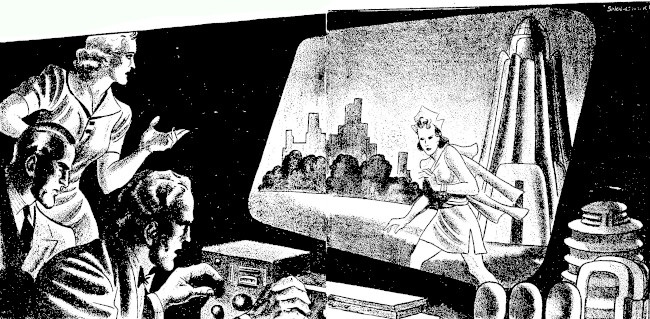
I saw the girl step furtively out into the starlit park.
The tower doorway was closed again. The tower melted into a specter, illusive, tenuous, but still there. A gossamer tower. And then, it was gone. Everything was gone. But as though, in my fancy, or perhaps merely the persistence of vision, for one brief instant I seemed to see the park empty of the intruding tower; and the policeman, standing there incredulous at this that he had seen which was now vanished.
The television screen was empty of image. Alan was on his feet. "Ed! Look at the sky out there! That's the same sky!"
The workshop faced to the east. The same star-strewn sky of the vision was outside our window—the same sky, with the same modeling of clouds, flushed with the coming day.
Alan voiced my realization. "Why, that's this dawn we've been seeing! That tower—in the park behind us—that policeman is out there now—he saw it! That's today! That just happened—now!"
CHAPTER II
THRESHOLD OF A MYSTERY
It was clear to us, or at least in part, what had occurred. The little fragment of Space occupied by Central Park, was throughout both the visions, what we had been seeing. The tower was there; the tower had not moved—in Space. We had first seen it in some far-distant realm—of Time. And it had moved, not in Space, but in Time. We had glimpsed the tower almost stopping, frightening those savages who, in what we call the Past, were roaming this little island of Manhattan. The same Space. The same inclosing rivers. But no city back then. Or perhaps, near the southern end, where the converging rivers merged in broader water, there might just then have been a group of struggling settlers. Cabins of hewn, notched logs, stockaded against the marauding redskins of the adjacent forest. A dense forest then, was north of the trail called "Maiden Lane." Far up there was this Space which now we call Central Park, with the great New York now around it, grown in three short centuries from the infant New Amsterdam.
And the tower, immovable in Space, had come in Time to 1945. Had paused. Now. This very morning. Had stopped; and frightened a policeman of 1945, in Central Park. And then had become again a phantom, and in another instant, wholly invisible.
I recall my surprise at Alan's apparent understanding of this incredible thing which had come, all unheralded, upon us.
I found suddenly that there were things in the life of Alan which I did not know. Things he shared with Nanette; but not with me. An eagerness was in his manner as we discussed this thing. His dark cheeks were flushed with emotion; his dark eyes had a queer glow of excitement.
"I think, Ed, that I can understand a good many things of this. Things father knew, in theory—things he told me—" He checked himself. And when I questioned, he stopped me.
"Wait, Ed. It's confusing. It seems—tremendous." He stumbled over the word, but repeated it. "Tremendous." And then he added: "And perhaps—dastardly."
What could he mean by that? Nanette said: "But, Alan—that girl—there was a girl, came here to New York this morning—"
The girl! The shadow girl, from out of the shadows! She, at least, was something tangible now. We had seen her in Central Park this morning. The television screen now was vacant. It was destined never again to show us anything, but that we did not know. We had seen a girl arriving? Then, if so, she must be here—in Central Park, now.
Alan said: "I wonder if we should report it. That girl probably will be found." He had been into one of the other rooms of the small apartment a few moments before. He drew me there now. "Ed, I want to show you something significant. Perhaps significant—I don't know, yet."
Nanette followed after us. The bedroom faced south. We were high in a towering apartment building, just east of Fifth Avenue.
Over the lower roofs of the city I could see far to the south. In the waning starlight down there a single searchlight beam was standing up into the sky.
"Where is it?" I demanded. "The Battery? A ship in the harbor? Or Staten Island?"
Somewhere down there, a white shaft of light standing motionless. It was fading in the growing daylight.
"On Staten Island," said Alan. "It's a small searchlight on the roof of the Turber Hospital. It often stands like that. Haven't you ever noticed it?"
I supposed I had. But never thought of it. Why should I?
Alan added musingly: "It's queer—because I was wondering if it would chance to be there now, and there it is."
"But, Alan, see here—you're making a mystery of this. Heaven knows it's mysterious enough of itself, without your adding more."
He smiled. I saw suddenly a grimness as the smile faded and he set his wide, thin lips. There were things which he was beginning to piece together. Things, involving us so soon into such a maelstrom of events! But now, Alan only said:
"This Dr. Turber—Wolf Turber—have you ever heard of him?"
"No," I said. "What has he to do with this? Whatever it is, you've guarded it very carefully from me, Alan."
There must have been a touch of bitterness in my tone. He laughed. "Nonsense! I haven't known anything worth discussing."
Nanette touched me: "It was something father told us just before he died. Just a theory of his—a suspicion."
"So inexplicable," said Alan. "But he was so earnest, that morning he died. Telling us what might be things of scientific fact, but probably would never be disclosed—to us or any one. Yet now it may be—these things this morning seem to fit in. Ed, it's no secret—not from you."
"Then," I said, "who is Dr. Turber? What is he to you?"
"Nothing. He was, in 1925, a young medical student. Then, for a short while, he worked for father. He now owns the Turber Hospital—a private institution, a sort of sanatorium. He is, in his way, a genius. A specialist in nervous disorders. And father said he was—or would have been, had he stuck at it—an eminent physicist. But he did not. He left father—he stole, father thought, a large sum of father's money. I don't know the details. They're not important. Nothing was proved. He became—well, you might call him father's enemy. Certainly they disliked each other. I've met him casually several times. A scoundrelly sort of fellow, by his look. And that—of what I actually know—is all."
We were back in the workshop. The television screen still glowed, but it was empty of image. Nanette said gently: "Tell him, Alan, about Dr. Turber, and me."
It gave me a start. Alan said: "He seems to have fallen head over heels in love with Nanette. He had always liked her—"
"I was always afraid of him," she put in.
"And when Nanette grew up, even though then he was father's enemy, Turber came to him—wanted to marry Nanette—"
I could well imagine it. Nanette was tall, slim, with long chestnut hair incongruous in this day of short-haired girls. To me she was very beautiful indeed.
Alan went on: "I won't go into details. His persistent attentions were unwelcome. Father told him so, and Nanette told him."
"I was always afraid of him," she repeated.
Alan smiled wryly. "I threw him out once—a snaky sort of fellow. We want none of him—do we, sister?"
"No," she said. "Tell Edward about Dr. Turber's life—father's theory."
"It wouldn't mean much to you, Ed. There were things—so father thought—of mystery about this Turber. Things inexplicable. His curious, unexplained absences from the hospital. Things about him which father sensed. And the searchlight, that for no apparent reason for years now has been occasionally flashing from the hospital roof. It marks Turber's absence, I know that much."
"And Turber's assistant," said Nanette. "That Indian—whatever he is—at the hospital."
"Yes. He, too. Father pieced it together into a very strange, half-formed theory. I have always thought it must have been born of father's dislike for the fellow. And father told it to me the morning of his death. That, too, I felt, must have colored it. Father's mind, there at the last, roaming a little—not quite clear. But this, Ed—this morning—these visions of ours—we saw them, you know, we can't deny that. They seem vaguely, to fit. Oh, there's no use theorizing—not yet. That girl we saw—"
Upon the girl it hinged, of course. The vision was gone. And at best it was only a vision. But the girl might be real—here in 1945.
We did not report what we had seen to the police. Perhaps we had fancied that a girl came out of a phantom tower in Central Park this morning. And, if we had seen it on the television, even so, it might not actually have happened.
Had there actually been a policeman, there in the park, who had seen it? And was there existing, here in New York today, this girl of the shadows?
We waited, and the thing turned tangible indeed! Became a reality, for presently we learned that it had touched others than ourselves.
The early afternoon papers carried a small item. Some of them put it on the front page. But it was only a joke—a little thing to read, to laugh at, and forget. There had been in actuality, a policeman at dawn in Central Park; and he had been less reticent, more incautious than ourselves. He had told what he saw. And the newspapers wrote it:
Ghost of Eiffel Tower Invades Central Park
Policeman Fights Phantom
Something to laugh at, and forget. A chuckle, donated to a busy city by earnest Officer Macfarland who undoubtedly was already sorry that he had not kept his mouth shut.
And the girl?
The later afternoon papers carried another item. Who would connect the two? Who, indeed! For this other item was still smaller, unobtrusive, not even amusing. Nor novel—and therefore, worthy of nothing but a passing glance:
Unknown girl found at gate of Central Park. Unable to speak intelligibly. Victim of amnesia. Taken to Bellevue. Later transferred to Turber Hospital, Staten Island.
Who would think anything of that? But we three knew that we stood upon the threshold of a mystery, with its shadowy portals swinging wide to lure us in.
CHAPTER III
THE GIRL PRISONER
We left Nanette at home and Alan and I started for the Turber Hospital about three o'clock that same afternoon.
Was this the girl of our visions, now the "victim of amnesia" at Dr. Turber's Sanatorium? Or was it merely some other girl whose memory had gone, and whose prosaic parents soon would come to claim her? Things like that frequently happened. We determined to find out. Both of us were sure we would recognize her.
From the ferryhouse on Staten Island we took a taxi, a few miles into the interior. It was an intensely hot, oppressive afternoon—the sun was slanting in the west when we reached our destination.
I found the Turber Hospital occupying a fairly open stretch of country, about a mile from the nearest town. It stood on a rise of ground—a huge quadrangle of building, completely inclosing an inner yard. It was four stories high, of brick and ornamental stone; balconies were outside its upper windows, with occasional patients sitting in deck chairs with lattice shades barring the glare of sunlight.
There were broad shaded grounds about the building—the whole encompassing, I imagined, some twenty or thirty acres. Trees and paths and beds of flowers. A heavy, ten-foot ornamental iron fence with a barbed wire top inclosed it all. A fence which might have been to keep out the public, but which gave also the impression of keeping in the inmates. The place looked, indeed, very much like the average asylum. There was an aura of wealth about it; but, unlike most such places, also a look of newness.
"Turber built it in the last eight years," said Alan. "He's doing very well—rich patients of the neurotic, almost insane but not quite, variety."
There were some of them about the grounds now. Off at one end I could see tennis courts with games in progress.
"Spent a lot of money," I commented.
"Yes—they say he's very rich."
Bordering the grounds was a scattered, somewhat squalid neighborhood of foreigners. We had crossed a trolley line and ascended a hill arriving at the main gateway of the institution. I glanced back through the rear window of our taxi. We were on a commanding eminence; I could see across the rolling country, over several smoky towns to New York Harbor; the great pile of buildings on lower Manhattan was just visible in the distant haze.
The gatekeeper passed us at Alan's request to see Dr. Turber. Our taxi swung up a winding roadway to the porte-cochere at the side of the building.
"Will he see us?" I demanded.
"If he's here, I imagine he will."
"But you're not, even outwardly, friends?"
He shrugged. "We speak pleasantly enough when we have occasion to meet. So long as he lets Nanette alone."
We were ushered into the cool quiet of a reception room. The white-clad nurse said that doubtless Dr. Turber would see us presently—he was busy at the moment. She left us.
It was a fairly large room of comfortable wicker chairs; Oriental rugs on a hardwood, polished floor; a large wicker center table strewn with the latest magazines. A cool, dim room; there were broad French windows, with shades partly drawn and additionally shrouded with heavy velvet portieres across the window alcove.
We had seated ourselves. Alan drew his chair nearer to mine. He spoke softly, swiftly, with an eye upon the archway that gave onto the main lower corridor down which the nurse had gone.
"I was thinking, Ed—when Turber comes—we've got to have some excuse for seeing the girl."
"Yes, but what?"
"Tell him—I'll tell him you're a newspaper man. Some of them have been here already, no doubt. We won't go into it—you won't have to say much."
I was, in actuality, a pilot in the mail service from Bennett Field down the coast to Miami. I was off now, these three summer months. But posing as a newspaper man was out of my line.
"I don't know," I said dubiously. "I have no credentials. If he asks me—"
"I'll do most of the talking, Ed." He jumped up suddenly, went to glance into the corridor, and came back. "Come here, I want to show you something."
He drew me to the windows. We pushed the portieres aside, and raised one of the shades. We were some ten feet above the level of the paved inner courtyard. Alan murmured: "Just look, Ed—queer construction of this place! I've often wondered, and so did father."
Queer construction indeed! The quadrangular building completely inclosed this inner yard. At the basement level it was all normal enough. Windows and doors opening from what seemed engine rooms; the kitchen; the laundry. And at this first story it was normal also. These windows through which we were looking; and other windows and occasional balconies in each of the wings. But above this first story there were three others and then the flat roof above them. And in these three upper floors so far as I could see there was not a window! Nothing but the sheer, blank stone walls!
"What would you make of that, Ed? Crazy architecture—they said that when the place was built. There are no courtyard rooms at all in the upstairs floors—nearly half the building goes to waste. Turber designed it—"
"But what did he say?"
"Nothing much, I fancy. It was his own business. Perhaps, merely that he could afford the luxury of all outside rooms for his patients. And look at that inner building—"
The courtyard was perhaps two hundred feet long, by half as wide. In its center was an oblong brick building, a hundred feet by sixty possibly—and not quite as high as the roof of the main structure. From the angle at which we were gazing, I could see the full front face of this smaller building, and part of one of its ends. It had not a window! Nor a door, except one, very small, at the ground in the center of the front!
"Turber's laboratory," said Alan. "At least, that's what it's supposed to be. That one door—nothing else. It's always locked. Nobody has even been in there but Turber, and his Indian assistant. Father once talked with the builders of this place, Ed. That laboratory is nothing but two small rooms at the ground level here in front. All the rest is just four solid brick walls inclosing an inner empty space! What's it for? Nobody knows. But people talk. You can't stop them. Turber's employees here. And most of all, his patients—not quite sane. They talk—of ghosts—things mysteriously going on inside those walls—"
People—not quite sane—talking of things unknowable. But I was wholly sane; and as I stood there, gazing at the shadows of twilight gathering in this inner courtyard; the blank upper walls of the large building turning dark with night; the smaller one, standing blank and silent in the courtyard—the whole place seemed suddenly ominous, sinister!
A step sounded in the room behind us. I started violently; I had not realized how taut were my nerves. We dropped the portieres hastily, and left the window. Turber?
But it was not he. A young man stood before us. He was dressed in flannels and a shirt open at the throat. He carried a tennis racket.
"Well," said Alan. "How are you, Charlie? Been playing tennis? You remember me, don't you?"
A good-looking young fellow. He said: "Do I? You were here once before, weren't you? I saw you in here with Dr. Turber."
"Yes," said Alan. "Let's sit down, Ed. How are you, Charlie?"
We sat down. Charlie stood before us. "I've been playing tennis. Is the doc coming here to see you?" His face clouded. "You're all right, aren't you? My mother said—" He was addressing me. "My mother said—but look here, don't pay any attention to your mother if she says you're sick. Don't you do it! I did it, and my mother said I'll put you in here and make you well. So look what happened to me—I'm in here."
I met Alan's glance. Alan said: "Well, that's fine, Charlie. And you're better, aren't you?"
"Yes." He hesitated; then he added: "I'm better, and I'd like to help you get better. I was thinking that, last time I saw you. I like you—very much."
"Do you, Charlie? That's nice of you."
"Yes. You're a friend of mine—'Friends sturdy and true' I was thinking—that's us."
He turned suddenly away. He took a step toward the window, and came back. His face had wholly changed; a look of cunning was on it; his voice low, quivering, dramatic.
"You were looking out there when I came in. Strange things go on out there—but you can't see them in the daytime!"
"Can't you?" said Alan. "I was looking—"
"I've seen them—at night. I've got a way to see them any time I want to. From the roof. If you get put in here—I'll show you—maybe. Because we're friends."
It galvanized Alan into action. He jumped to his feet and gripped Charlie.
"I'd like you to show me."
"Yes, I can do it. There's a girl came this morning. I saw her—"
"A girl?"
"Beautiful girl. She was beautiful—I saw her. They took her upstairs. I know where."
Alan gestured to me. "Watch out if anybody comes! Charlie, tell me!"
I moved nearer the corridor entrance. Alan and Charlie stood by the window. I could hear them.
"She's sick, but her mother didn't bring her. Men brought her—in a taxi like I saw you come in."
"Charlie, if I should come here—"
"I've got a key to the roof. You're not allowed up there. Nobody's ever been up there but me. I'm too smart for them—'Keys to open Bluebeard's room'—you can't open anything without a key. Keys to open Bluebeard's—"
"Charlie, stop that!"
"Well, I have. It's dark. Nothing ever happens in the light. You can see it from the roof, because you're higher up and you can look down inside."
"Inside what?"
"His laboratory. That's what they call it. 'Four walls to hide what devils do'—that's Shakespeare. I studied it, when I was in school. But mother said I was sick—"
"Wait, Charlie. That girl—"
"She's sick, I guess. We're all sick. But she was frightened, too. I'm not frightened. I passed them in the hall. She looked at me—I saw she was frightened. I said then to myself I guess I can help that girl. I'm smart—I've got keys."
If Turber should come! But the corridor was empty.
"You know which room is the girl's, Charlie?"
"Yes."
"You've got a key to it?"
"Key? I've got a key to Bluebeard's closet—"
Alan shook him. "The girl's room—where they've got her now."
"Key to Bluebeard's room—don't get excited—I'm not excited." He was trembling. "When you come to live here—"
"Charlie, listen! I want to help that girl—get her out of here. She isn't sick."
"I can get out of here—but my mother told me not to. I've got a key to the little gate in the fence behind the tennis court. I've had it a long time. You know how to make a key? You take wax and get an impression—I had a locksmith make the key when I was home at Christmas. Mother thought it was my trunk key—but it wasn't. I thought I might use it to slip out and go home some night. Only mother would be angry. And I had Bluebeard's key made at the same time—that's the key to the roof, where you can see things—"
From the door I caught a glimpse of a man approaching along the corridor.
"Alan! Here he comes!"
Alan said vehemently: "Charlie, listen! Get this right! Tonight, about ten o'clock! Can you have your keys and come to the tennis court gate?"
"Yes! Tonight—"
"Can you get there, alone? Tell nobody? Let nobody see you!"
"Yes. At night—dark deeds, alone." He heard Dr. Turber's step. He added swiftly: "I'll be there—ten o'clock tonight! I can hide you in my room. At eleven, they're all asleep—we'll go to the roof—I call it Bluebeard's—"
"Not a word to anybody, Charlie! For the girl's sake!"
"Yes! And because we're friends—"
Alan pushed him away; and said, conversationally: "So you had a good game, Charlie? That's fine—but you'd better go wash up for supper."
"All right, I will. Mother said never be late for supper."
We all turned as Dr. Turber entered the room.
I saw Dr. Wolf Turber as a man of about forty, obviously of extraordinary personality. There are many men in this world who have a power, for good or evil, which marks them apart from their fellows. A radiation—an aura—a something in their unconscious bearing; a confidence, a flash of the eye, all unmistakable. Dr. Turber was such a one. Marked for big things—good or evil.
He was, to me at least, at once physically repellent of aspect. A very heavy, powerful frame, with wide shoulders, thick and solid; a deep chest; long powerful arms. Had he stood erect, he might have been fully six feet tall. But he was hunched. Not exactly a hunchback; rather, a permanent stoop which had rounded his shoulders almost to a deformity.
His head was massive, set low on a wide, short neck. Close-cropped black hair, turning gray at the temples. A solid, wide-jawed face, smooth-shaved, with dark eyes gazing through a pair of incongruously dapper rimless glasses, from which a wide black ribbon depended.
He stood before us; stooped, but with the strength of a gorilla seeming to lie hidden in his squat frame, masked by the dapperness of his clothes. Pointed patent leather shoes; gray trousers; a dark gray jacket with a white waist-coat, to which the black eyeglass ribbon was fastened. He stood with a hand toying with the ribbon.
"He annoyed you, Tremont? Charlie's a good boy. A little off mentally—like most of them here."
Charlie had been summarily dismissed. Turber added: "You do not bring the charming little Nanette. Where is she? I would far rather see her than you, Tremont."
Alan, from his six-foot height, gazed down at Turber. He ignored the reference to Nanette, and said:
"There was a girl found in Central Park this morning. Amnesia case, the papers say. Transferred here from Bellevue. My friend Williams here does some newspaper writing—he'd like to see her."
Turber's face remained calmly polite. His gaze went to me. It made my heart leap—his quiet, keen scrutiny, as though without effort he might read my thoughts.
"A girl? Amnesia case? No girl came here." His glance swung between us; but his wide, thin-lipped mouth was smiling ironically. He added: "You believe what you read, evidently. You are trustful."
Alan's shortness of temper surprised me. "Then you won't let us see her."
"No, why should I?"
"But you admit that she's here?"
There was no love lost between these two! Turber rasped:
"Why should I bother to let you cross-examine me?"
It quieted Alan. "I know she's here. What you mean is, I have no right to demand seeing her."
Turber bowed ironically.
"I can get that fixed up," said Alan.
"Perhaps."
"Oh, I think I can." Alan was smiling now, with recovered poise. "In the first place, she is undoubtedly a public charge until her identity is established. Why Bellevue sent her to you, I can't imagine—"
"That, like everything else you are saying, is none of your business."
"But I intend to make it my business. They'll give Williams and me an order to see her." Quite evidently Alan knew his ground. "Come on, Ed—we're wasting time. Let's go see what they say at Bellevue. There are a lot of things about this I don't understand."
Turber said abruptly: "If you come as a friend, Tremont—"
His imperturbable smile remained; but it was evident that Alan's persistence was disturbing. I could even fancy, alarming. "But you come, gruffly demanding—and you bring the power of the Press." The faint inclination of his head toward me was a bow of mockery. "You frighten me—"
"Why? Is it something mysterious?"
"It seems to be. Your sudden insistence—I have not seen you in a year. I have had several amnesia patients here, all ignored by you."
Beneath his bantering manner he was trying, no doubt, to fathom what Alan knew.
Alan was silent. I said: "Well, I'd be mighty interested to write up the case. But if we have to get an order from the Health Department—"
"We'll get it," said Alan.
Turber made an abrupt decision. "You may see her. You're an annoying young cub, Tremont. I know you well enough to realize that."
"Can we see her now?" Alan demanded.
"Yes. But only for a moment. Her memory is gone. I was hoping, with my routine treatment, we could get it back."
He led us into the corridor, stalking ahead of us with his heavy head. "This way—she is upstairs."
He turned a corner. Alan whispered: "Watch where we're going! Try to remember the location of the room! How old is she, Dr. Turber?"
"About twenty, apparently. A strange-looking little creature. I would say, of a cultured family."
We mounted a staircase. Passed down another corridor. I tried to keep my sense of location. I said: "Is she an American?"
"Probably not." He shrugged. "She is dressed very strangely. She resisted the matrons at Bellevue who would have changed her robe. She looks as though she might have wandered from some fancy dress affair last night. But by now something would be known of it, I suppose. The police have full details. I shall send her back to Bellevue—I'm not looking for any bizarre publicity."
We passed occasional inmates in the halls; they stared at us curiously, scattering and vanishing at Turber's glance. One was the young fellow, Charlie. He appeared magically at my elbow, flashed me a swift, knowing glance, and disappeared.
Abnormality was in the air, everywhere about this place. Heavy carpeted hallways; dim, with lights not yet lighted in the afternoon twilight. These patients—most of them seemed to be young men—free to move about, in apparent health; indefinably, but unmistakably abnormal. The whole place struck me as almost gruesome.
"This way, Tremont."
We were in the upper story, close under the roof. There was an elevator in the front of the building; we had not used it, but had mounted three separate flights of stairs, each remote from the other. I fancied we were at the top of the wing across from the reception room.
Turber paused and took a key from his pocket. I had noticed as we came along the halls that all the rooms opened outward; the inner side facing the courtyard was always a blank corridor wall, with no suggestion of rooms. But Turber now paused at a small, heavy mahogany door—on the courtyard side.
"She is here, Tremont. I have her locked in. She escaped from somewhere. It is often a trait of these cases—the desire to escape. If she eluded me here, the authorities would have plenty to say."
He stood a moment, cautioning us in low tones. The girl would be startled—she was startled at seeing any one. But to be mildly startled might be good for her. He smiled. "Amnesia has been cured by a blow upon the head. But I don't recommend it."
We were to do no more than stand in the doorway. For a moment only.
"May I talk to her?" I suggested.
"That," he said, "would be useless. She could not understand; and her own words are wholly unrecognizable."
There was another door directly across the hall. It stood open, disclosing a bedroom, into the windows of which the setting sun was streaming. A man came to its doorway. Turber's Indian assistant, Alan afterward told me; evidently he was here on guard. He did not speak; he saw Dr. Turber, and moved back into the room.
But for that instant he was visible I think I have never had a more startling impression. A man, clad in trousers and white shirt; of huge stature, well over six feet. Straight black hair, parted in the middle; a red-brown face, flat-nosed. But more than that. I saw something about him which was uncanny. An indescribable impression of something incredibly sinister. Something weird.
He had a magazine in his hand. If it had been a tomahawk dripping blood, if his face with its broken nose had been streaked with ocher, if his body had been bare of those civilized garments—it would have seemed far more normal. He grunted as he met Dr. Turber's glance and turned away.
Turber repeated: "I think I would not speak to her—but you may if you like."
He knocked on the girl's door. He then turned the lock and pushed the door inward.
We crowded at the threshold. It was a small, comfortably furnished bedroom. Windowless. A wicker table, with an electrolier giving a soft glow of yellow light. The girl stood like a startled fawn in the center of the room. It was the girl we had seen on the television!
A creature, here in life, of fairy-like delicacy. Almost unreal. She was not over five feet tall; slight and delicate of mold; a girlhood upon the brink of maturity. A fairy creature, like a vision of girlhood in a child's fairy dream. White-limbed; wearing a pale, sky-blue robe—a drapery rather than a dress. Flowing hair, pale as spun gold. A face, oval and small, exquisite, delicate as a cameo. Eyes, sky-blue—
They stared at us, those sky-blue eyes. Startled. But they were not vacant eyes, nor confused; not the eyes of a person mentally deranged. They swung toward Dr. Turber; and as momentarily he turned away they came back to Alan. And in them I read—and Alan read—a mute, furtive look of appeal!
CHAPTER IV
THE SECRET OF THE COURTYARD
The gray walls of the Turber Sanatorium were painted red by the falling sun when we departed in our waiting taxi. The episode with the girl had taken only a moment. I had spoken to her; I said fatuously:
"Don't you know us?"
She did not seem to try to answer. Her gaze swung from Alan to me. She took a step backward; as though the sound of my voice were frightening; but I could have sworn she was watching Turber; it was Turber of whom she was afraid, not us.
"Come," he said. "That's enough." We had not crossed the threshold. He closed the door upon the girl; her gaze seemed still searching Alan's face as it closed.
Turber led us back downstairs. He chatted pleasantly about the girl's case; he accompanied us to the door and smilingly bowed us out.
"I shall hope to see you again, Tremont. Bring Nanette when you come next time, will you?" He said it sardonically. But more than that, for beneath his banter there was an intensity that made me shudder. And a pang of fear for Nanette swept me. We had left her home alone.
Turber stood gazing after us as we drove away. I recall him, standing there on the steps of the porte-cochere; hunched forward; his gorilla figure so immaculately garbed, fingers toying with his black eyeglass ribbon, his mouth twisted with a faint sardonic smile. Sinister figure! Satanic! A very modern Mephistopheles, this fellow Turber. A genius—for evil; of that, at least, I was now convinced.
We were silent on the way back in the taxi. My mind was on Nanette. It seemed suddenly that she must be in danger; my greatest desire was to get back as quickly as we could.
We dismissed the taxi. At the ferryhouse I said abruptly: "Alan, let's telephone Nanette."
"Why?"
"I'm worried about her," I stammered. "Alan, that fellow Turber—"
We called the apartment. She answered promptly.
"You all right, Nanette?" I demanded.
"Why, yes, of course, Edward. When will you be back? I've been worried about you."
"We'll be there in an hour."
I hung up. I felt unutterably relieved. We boarded the ferry.
"What do you propose to do next?" I asked Alan.
"Get our car—come back tonight."
"With Nanette?"
"Yes. I know how you feel. That fellow Turber—this weird thing—"
"No time to leave Nanette alone. I wish she weren't there now."
"We'll be there shortly. When we come back, you'll stay in the car with her," Alan directed.
While he was meeting Charlie at the tennis court gate? I did not fancy so inactive a role.
"It's best, Ed. Only one of us should go in. With both of us, the chance of being discovered would be greater. Besides, we daren't leave Nanette."
"You think he'll let you in?"
"Charlie? I think so. They're very cunning, fellows like that. He said he would hide me in his room."
We discussed it. There was so much—and yet so little that was tangible—to discuss! But I realize now that Alan, with his greater knowledge of what all this might mean, had formed fairly definite plans. To discuss them with me then, was futile. He did not do it.
We got home to Nanette, and had supper. My own reticence matched Alan's when it came to going into details with Nanette. It would have led us far afield in fantastic, meaningless theory. But the girl was there, held virtually a prisoner; we wanted to release her. That we told Nanette, but nothing more. It was, indeed, as definite a plan as I could form myself.
It was a hurried supper. Nanette had it ready for us when we came in.
It was eight o'clock when, after hurried preparations, we started. Alan brought his car from the near-by garage. Nanette, with her hair braided and piled upon her head, was ready. We all wore outer coats. The evening was cooling; the sky was overcast.
Alan went into his workshop; came out with a small cloth bag. "Nanette, get your black cloak—I couldn't find it."
"I thought I'd wear this coat and hat, Alan. Don't I look all right?"
Eternal feminine! The subconscious strain under which we were laboring made us laugh.
"Of course you do! We're not going to the opera! I want your cloak—for something else."
She went and got it. The car was a big sedan. Alan put on the back seat the cloak and his cloth bag—they were tools from the workshop, he had told me briefly when I questioned. We all three sat in front, as was our custom. Alan drove.
I recall as we left the apartment that I vaguely gazed ahead those few hours to when we would return. The futility of gazing ahead!
"We've got to hurry," said Alan. "Hope we can catch a ferry, without too long a wait."
He threaded us skillfully south through the crowded city streets. I gazed around. This was New York of 1945. I suddenly felt wholly apart from it.
We just made the ferry. The sky continued overcast. It rained a little, and then stopped. We left the ferry, drove into Staten Island toward Turber's.
"I think I know a secluded place," Alan had told us.
He found it, an unlighted country road. He stopped and switched off the headlights. The darkness leaped at us.
"Where are we?" I demanded.
"A mile from Turber's—not much more. You can see it off there."
We climbed to the road. The sky was solid gray. We were in a lonely neighborhood; a fence was here, bordering a field; but no house was in sight. The road went up a rise here through a cut. Alan had drawn the car to one side; a spreading tree hung over it. Beyond the trees, I could see the lights of a near-by settlement; a trolley car—a lighted roadway winding off there; and the hill with the lights of Turber's. The searchlight was not lighted.
"Hadn't we better get closer, Alan?"
"No, this is all right. It's barely a mile."
"You know where we are? You'll be able to find us, coming back?"
"Yes. Just keep your lights out and wait."
"How long, Alan?" Anxiety flooded me. "If you don't come back—say by midnight—what shall I do?"
"I will come back. You just wait, Ed."
He kissed Nanette. I sat at the wheel with her beside me. Alan's figure, carrying his small bag and the black cloak, showed dimly down the road for a moment, then was gone.
It was nine forty. With all the lights of the car extinguished, we sat in the darkness, waiting. Alan had taken a small revolver, and I had one also.
Ten o'clock. A distant bell marked it; I snapped on the dash light to verify it. Nanette felt me move.
"What is it, Ed?"
"Nothing. I was looking at the time."
"Ten o'clock?"
"Yes."
We fell silent. Alan would be at the gate of Turber's by now. But what reliance could we place upon that boy Charlie's word for what he would do? Perhaps he had no key to the tennis court gate at all. Or even if he had, he would forget to come. Or Turber would see him and stop him. Or worse, follow him and trap Alan. A thousand doubts and fears for Alan's safety rose to beset me.
Ten thirty. Eleven o'clock. What was Alan doing now? But I told myself: "This is 1945—not the dark ages of the past. This is civilized New York." If Turber caught Alan prowling on the premises, what of it? He wouldn't dare murder Alan. Or would he?
Waiting is a difficult thing to do. The mind grows too active. I began to think that Alan wasn't coming back. Nanette crept against me in the darkness.
"Ed, what time is it?"
"Nearly midnight."
"Ed, I'm so frightened—"
I began to plan what I would do. Wait here until midnight, or one o'clock perhaps. Then drive up to Turber's and boldly ask for Alan. At worst, they would have caught him—arrested him as a marauder. I set my teeth. Why, before morning, if I couldn't locate Alan I'd have all the police of Staten Island up at Turber's looking for him!
"Don't be frightened, Nanette—he'll be back presently."
No one had passed along this road; we seemed wholly secluded. The sky remained overcast; there was not a star showing; off in the distance lightning had flared for a time and we heard the distant thunder, but the storm had now receded. There had been a cool wind, but it died. The night was black and dark. Breathless. And I think it was my apprehension, too, that made me breathless. I sat, with Nanette huddled against me; and stared, straining my eyes in the darkness for Alan's coming.
Midnight passed.
From the roof of the Turber Hospital the searchlight beam abruptly flashed into the sky! It hung motionless.
I told Nanette.
"What does it mean? What could—"
"I don't know."
We sat tense, every faculty alert. Nanette, with sharpened fancy and a hearing always keener than normal, cried out suddenly:
"There was a shot! Listen! There's another!"
I seemed, myself, to hear the sound of distant shots. At Turber's?
"An automobile tire blowing out," I said. "Or a car back-firing."
But she insisted: "I thought I heard screams—some one screaming—"
"Nonsense!"
Another interval. The searchlight off there hung steady.
"Ed, what is that? Don't you hear?"
I heard nothing; but Nanette did, quite evidently.
"Someone coming! Can't you hear them?"
Then I heard it. Running, approaching footsteps, clattering faintly in the darkness on the stony road!
Alan crept up to the Turber place. He heard the clock chime ten. An Italian settlement lay in a fringe along the east side of the hospital grounds. The main gateway was there. Alan skirted to the west. A cemetery lay on the west slope of the hill, with a narrow road like a trail bordering the high iron fence. It was all dark along here; but Alan remembered that the tennis courts were in this far corner. According to Charlie there should be a small gate somewhere here in the fence.
Would Charlie keep his word? Alan, in talking to me, had seemed confident. But he was hardly that. Everything that Charlie had said might be the wanderings of an unhinged mind; the boy might have forgotten it all by now.
Abruptly Alan came to a small iron door in the fence. A dark figure stood behind it.
"Charlie?"
"Yes."
"Alone?"
"Yes."
"Let me in."
The door swung inward. Alan slipped through; closed it carefully.
"Where's the key, Charlie?"
"Here."
"You keep it. We'll leave this unlocked—when I'm gone you can lock it after me."
"Yes."
Alan could just make out Charlie's figure at the edge of the tennis court.
"No trouble getting out here, Charlie?"
"No."
"Nobody saw you? Sure?"
"Nobody. I'm supposed to be in bed. I was, but I got up—look how I'm dressed."
He moved to where a yellow glint from a lighted window of the near-by building fell upon him. He wore a long dark dressing gown.
"And my brown tennis shoes, see? Dark clothes for dark deeds at night!"
Alan seized him. "Come out of that light! Shall we go to your room first? Wait for the place to get to sleep?"
"Yes. I can get you there. A side door—I know where it is."
They started, along the edge of the court, then under the shadowy trees of the lawn.
"Won't they lock the side door at night, Charlie?"
"They did, already. It's a spring lock—I opened it from the inside and left it unlatched."
There seemed, even at this early hour, few lights about the building.
"Almost all in bed," Charlie whispered. "All but the doc. He never goes to bed."
Charlie knew where the girl's room was. The Indian was on guard there across the hall. But Alan felt that there was no reason why the girl's door should be watched too closely. They could not anticipate any one's trying to get her out. That Indian would relax by midnight; probably would go to sleep in his own room, with his hall door open so that he could hear if the girl made any disturbance.
Charlie and Alan came to a small entryway at the ground level.
"Are the halls empty?"
"Yes. Nobody will see us. They're dark, too, at night. If you want to go to my room first—"
"I do."
There was a dim night light in this small inside hallway. It showed Charlie with rumpled hair, white face and gleaming eyes. He was shaking with excitement.
"Come on. What's that you're carrying?" the boy asked.
Alan wore black rubber-soled shoes; his long, lightweight dark overcoat and a dark cap. The bag was under his arm. In his overcoat pocket he had the small revolver.
"Tools, Charlie. To open the door of the girl's room—later, when that Indian gets to sleep—"
The bag contained a chisel, a screw-driver and other implements with which he might force a lock. And a vial of chloroform and a sponge.
They crept along the hallway, into the main lower corridor. Alan feared that at any moment they would be discovered. He would make a dash to get out the way they had come in—
"Here! Come in here." Charlie twitched him suddenly by the arm. Through an archway, and Alan found himself in a familiar room—the reception room. It was unlighted. Its furniture showed dimly in the light from the corridor. Like shadows they slid into the recess behind the portieres of the windows.
"What is it, Charlie? Some one coming?"
"No. I want to show you—outside here. Big things afoot here tonight—dark deeds of mystery. I know—I've seen them!"
They cautiously raised one of the shades a trifle. Alan saw that the main courtyard was dark and silent. The single door of the laboratory building was closed.
"What, Charlie? Shall we stay here awhile?"
"Yes. Big things going on. You'll see."
"But what? What have you seen?"
"Things you can't see from here. From the roof you can see them because you're higher than those other walls. Shall we go to the roof? I've got the key—that's Bluebeard's key—"
"No. Stay here awhile."
They were comparatively safe, here behind the portieres. Alan was waiting until later, when he could go up to the girl's room.
They crouched at the window. Half an hour passed. An hour. It was getting toward half past eleven. No lights showed now in any of the courtyard windows; it was all dark out there.
Once or twice Alan had heard footsteps in the main corridor outside the reception room. But no one had entered; and for half an hour now there had been no sound of anyone.
Another interval.
"We've been here long enough," Alan decided.
"All right." The boy was shaking again. "It's midnight, isn't it? 'The very witching time of night when churchyards yawn, and hell itself breathes out contagion to this world. Now could I drink hot blood and do such bitter business as the day would quake to look on—'"
"Charlie, stop that!"
"It's Hamlet. I'm like Hamlet—a little mad, but though they fool me to the top of my bent they cannot play upon me!"
"Stop it! Let's go upstairs now."
"Shall we? All right. Go where?"
"To the girl's room. Can you lead me there?"
"Yes. But she isn't there!"
"What?" It electrified Alan. "Not there!" He gripped Charlie. "What do you mean?"
"Don't! You hurt!" The lad jerked away.
"Sorry, Charlie! But hush, you make too much noise!"
"All right. But you hurt me. The girl isn't up there."
"Why in Heaven's name didn't you say so long ago? Where is she?"
Charlie gestured to the window. "Over there—in the laboratory. They took her over there—just before I went to let you in."
"They? Who?"
"The doc. And the Indian. That's Uncas, as we call him. Uncas was a Mohican—you know that."
"Where are they now?" Alan's heart sank. This changed his plans wholly. Was it true?
"They? Who? The girl? She's over there now. They locked her in over there—then they came back."
"Where? When was this?"
"About ten o'clock. I saw them start over here from the laboratory, but then it was time for me to go and let you in."
"They came over here—to the main building?"
"Yes. They're in the doc's rooms, I guess. They're getting ready for something. You'll see. That's what I've been waiting for—they'll be going back over to the laboratory soon."
Alan felt that it was true. There were many things which Charlie had said that fitted into Alan's own beliefs.
"Charlie, can you get us down there?"
"In the courtyard? Yes. Sure I can. Two or three ways. This isn't a jail—you can go where you like if you know the way. I've been almost everywhere, and nobody ever caught me."
They slipped into the dim corridor. A flight of stairs was near at hand. The lower story was wholly dark. Charlie found a cross hall and opened a door.
They were on the courtyard pavement. Near by an end of the inner building was visible as a dark outline; they moved noiselessly across the open space and crouched against the brick wall of the laboratory.
"How far are we from the door, Charlie?"
"Not far. There's a wheelbarrow there somebody left this afternoon. Let's hide by it."
They came upon the wheelbarrow. It was standing up against the laboratory wall. Its shelter was hardly necessary; the yard here was solid black.
"Where's the door?" Alan whispered.
"Right here. What you going to do?"
Alan stood at the door. His fumbling hands felt of it. There was no knob; an iron door, set in a brick and iron casement. His fingers felt a lock, sunk in the metal of the door.
Alan laid his bag at his feet. No chance of forcing this lock. Turber and the Indian would doubtless be coming presently. Whatever Alan could do must be done now.
In the solid darkness at his elbow, Charlie's voice whispered again: "What you going to do?"
Alan acted wholly upon impulse. He thought that the girl was inside, alone. She might be able to help—
He knocked, very softly on the door.
"What you—" Charlie began.
"Sh!"
He knocked again.
It happened unexpectedly; yet Alan by instinct was ready for it.
The door abruptly opened!
It swung, just a few inches; a guttural voice sounded, speaking unintelligible words!
Whatever surprise it was to Alan, the Indian within was undoubtedly far more surprised. Alan stuck his foot into the door opening; he shoved violently with his powerful body, his shoulder against the door. It yielded; opened wide with a rush, knocking the Indian backward.
Alan burst into the room. The Indian, unarmed, recovered his balance to find himself staring at Alan's leveled revolver.
"Don't you move! Put your hands up!"
Behind him, Charlie yelped shrilly: "He can't understand English! He's a Mohican!"
But Alan's menace was enough; the fellow backed against the wall. His hands went up.
"You've got him! You've got him!"
"Charlie, shut up!"
A confusion of swift impressions surged upon Alan. A small, bare room with a vague glow of light. The girl was here! She stood near the Indian. Frightened, shrinking against the wall; but she saw Alan, recognized him. She took a step forward.
Charlie was making too much noise. The door through which Alan had burst was open. If Turber saw the glow of light—or heard Charlie's voice—or if any one else heard this uproar—
A confusion of instantaneous impressions.
"Charlie, shut up! You'll have the whole place aroused! Take the girl out—she'll go with you! Grab her arm—we'll make a run for it."
The girl understood. If not Alan's words, at least his swift gestures. She moved toward Charlie. Alan backed, his weapon leveled upon the Indian. "Go on! Run, Charlie! Get her out at once! I'll follow. Get us to the tennis court."
Alan backed, with the two of them behind him. He had been in that room certainly not over thirty seconds. He left it with Turber's secret laid bare to him! The room had an archway, opening inward. Alan had stood facing it. Charlie had seen it and yelped with excitement.
In the inner court stood a large gray-white vehicle—a cabin airplane. A spread of canvas for a concealing roof was over it. A vehicle for traveling through Time—like the Time-traveling tower we had seen in Central Park!
CHAPTER V
THE FLIGHT IN CENTRAL PARK
Alan found himself outside the laboratory. Its door was open, with a yellow glow streaming out. Charlie, clinging to the girl, was with him. The glow fell on them; Alan shoved them aside.
"Which way, Charlie? We've got to get out of here!"
They stood in the darkness a moment against the laboratory wall. The hospital was aroused. A voice had shouted. Others were taking it up. Lights were showing in several of the windows. An uproar—growing now of its own momentum. Some one lighted a light in the reception room. A shade snapped up.
The courtyard was brightening with yellow glints of light. No one as yet seemed to notice the three figures standing by the wall.
"Which way, Charlie?" Alan was momentarily confused. They would have to pass through the lower part of the building, get into the garden, fight their way through if necessary.
The girl stood docile: Charlie was chattering with fright. A desperation was on Alan; he shoved at Charlie. "Come on!"
But he stopped abruptly. The Indian had come to the laboratory door. He shouted—vehement, guttural words. An answer came. Dr. Turber! The man appeared in the light of a lower doorway in the main building.
All thought of flight was momentarily stricken from Alan's mind. "Charlie, wait!" They were standing by the upright wheelbarrow. "Look!"
Turber came running. The shaft of light from the doorway picked out his running figure. He was heading for the laboratory door. Not to menace these intruders; knowing only that his secret was discovered. With his hospital in uproar around him, Turber was in flight.
The Indian disappeared back into the room; Turber went at a full run through its doorway. Alan had not thought to try and stop him. Instead, he moved to the door, fascinated.
The room already was empty; Turber had gone through it; was leaping into the vehicle of the inner courtyard. An instant. Then the huge aero—it was nearly a hundred feet long—with all its gray solidity, began melting. Dissolving. A wraith of a cabin with wings—a dissipating phantom—
The inner courtyard was empty!
Charlie's voice: "Look! There it is! There it is!"
From the top of the laboratory building—perhaps automatically operated by the going of the aero—the searchlight beam was standing up into the air!
Alan found his wits. "Charlie, for God's sake lead us out of here! You don't want to get caught in this affair."
Figures were now in the courtyard; voices, questioning; at a window of the first story a boy in white nightclothes stood gazing down. The excitement set him screaming—shrill, piercing, unearthly screams! Voices began shouting at him.
It was a welcome diversion. Alan gripped the girl by the arm. She seemed to understand what was going on. She ran with Alan as they followed Charlie across the courtyard, into a lower doorway. In a corridor a man opposed them. He ducked away from Alan's waving weapon.
Through a dim room, crowded with the silent machinery of a laundry. Through another door. A hall. At the foot of a staircase two nurses in dressing gowns saw the running figures and screamed.
Charlie fumbled at a door; opened it. They were in the side garden.
"Which way?" Alan demanded. "You go back! Nobody recognized you? Pretend you had nothing to do with it."
"This way! There's the tennis court—to fight and run away—live again to fight—"
There were people in the outer grounds now. The presence of intruders was recognized. A voice called, "Which way did they go?" One of the inmates began screaming again. Some one fired a revolver—several shots into the air to arouse the neighborhood.
At the little gate Alan paused. "Lock it after us! Throw the key away! Don't let them find it on you! Thanks, Charlie—you're a brick. Say nothing—know nothing."
"All right, I won't." He touched the girl. "Good-by—the maiden fair is gone!"
"Yes, Charlie. Thanks for what you did—we won't forget you—"
The gate thumped closed. Its lock turned. Charlie whirled and vanished in the shadows of the trees.
The girl clung to Alan's hand and ran swiftly, lightly as a fawn, beside him. The uproar at the hospital faded into the distance.
Within ten minutes, running through the darkness over the stony road, Alan and the girl were at our car.
We bundled the girl into the back seat. Nanette sat with her. "Wrap her in the cloak, Nanette! Is it there?"
"Yes."
"Move over, Ed," Alan said. "I'll drive."
In the silence other shots sounded off at Turber's. Alan hastily backed the car and turned it.
"Raising hell up there! But I got her!"
We sped away into the night.
The thing was clear to us now. This girl had come in a Time-traveling tower from the Past—or the Future. Turber also possessed a Time-vehicle; one more effective than the tower, since it seemed a vehicle also capable of traveling through Space. This girl undoubtedly knew Turber in some other Time-world. And feared him—just as Nanette feared him.
With purring motor we were speeding along one of the island's highways, almost deserted at this hour of the night.
"Which way you going, Alan? Not to the ferry?"
"No. West, over the bridge into Jersey. Get back to New York that way. We're safe enough."
"What are you going to do with the girl?" I asked.
He hardly knew. "Take her home, I guess. See if we can't learn to understand her. She's intelligent—she speaks some kind of language."
We sped through a quiet, sleeping village. It was a long drive, around this way through Jersey. The night was well advanced toward the new dawn when we were again in Manhattan.
We had stopped once on a lonely Jersey road. Stopped by Nanette's voice.
"Alan! She's trying to talk to me!"
We drew down the car curtains; lighted the tiny dome light. The girl was much smaller than Nanette; she sat, with her blue robe crushed about her, enveloped in Nanette's long cloak. She was smiling, gesturing.
"She's beautiful, Alan. She's been talking—I can't understand."
Her voice was soft; queer liquid syllables, queerly intoned. A voice like music; the wind in harp strings, stirring them to murmur—but it meant nothing intelligible to us.
But there were gestures.
I said: "She understands! She's trying to show us she understands—"
Nanette demanded: "Is she looking at me? Look, dear—I'm Nanette—understand? Oh, you can see—and if you can see, you must understand! I'm Nanette." She laid her hand on her own breast. "Can you say it? Nanette—"
The girl said, quite clearly, "Nanette!" And laughed with a low ripple of pleasure. "Nanette! Lea! Nanette! Lea!" She was indicating herself. "Lea!"
"Her name is Lea! Yes, dear, we understand you."
I murmured: "And at Bellevue—"
With quick hearing she caught the word. "Bellevue," she said. She had evidently learned it while there. "Bellevue." She repeated it, frowning. She made a gesture, meaningless, and sank back, huddled against Nanette.
Alan switched off the dome light. "We'd better get started—some one might see us." He drove on. "Keep on trying, Nanette."
We decided to take her to Alan and Nanette's apartment. The Turber staff at the hospital would report that Turber and his assistant and the girl suffering from amnesia had vanished. What else could they say? Charlie probably would not talk; and Alan doubted if himself or Charlie had been recognized. Our connection with the mysterious midnight disturbance at Turber's might never be established.
We were in the quiet, mid-town streets of New York when Nanette called us again.
"She understands the word 'tower'! She just said it. Lea, what do you mean? Try! Say something else to Nanette!"
Lea was murmuring: "Tower! Tower!" She seemed trying to look out of the side window. I leaned back and drew up the shade.
"That all right, Alan?"
"Yes. What does she want to do?"
She was peering through the window. We went on a few blocks in silence. Alan said nothing. But he had told me he intended crossing Forty-Second Street to the East Side. He did not. He went north to Fifty-Ninth. Then turned east. Soon we were passing along the southern edge of Central Park.
Lea had been peering intently. She recognized the park. She murmured: "Tower! Tower!" Insistently. She even turned and plucked at Alan's shoulder. "Tower! Tower!"
Understanding swept me. "Alan, she—"
"Yes. Wait, Ed! Don't say anything—just watch her."
He silenced Nanette's questions. We turned up Fifth Avenue. The dark, tree-dotted park was on our left. Nanette sat quiet, trying to fathom the sudden tenseness which had come to us. Lea stared through her window at the park. Intent. Motionless.
We came into sight of the Metropolitan Museum a few blocks ahead. Alan slowed the car.
"Lea—"
She turned at the sound of her name. She smiled; gestured at the park; reached toward the door of the car.
I exclaimed: "She recognizes it, Alan! She wants to get out. What are you doing?"
He had turned into the cross-street. "Stop here. See what she wants to do."
We opened the car door. I stood at the curb. This cross-street was dim and deserted.
"Lea." She turned again as Alan spoke. She smiled and gestured again toward the park. And pulled at Nanette.
"What is it, Lea, dear?"
"She wants you to get out, Nanette."
"Shall I, Alan?"
"Yes. Help her, Ed."
I guided Nanette. Lea plucked at Alan. He put the lights of the car out and locked it. His fingers were trembling.
"You walk with Lea, Nanette. Let her guide you. We'll follow. See what she wants to do."
Four of us; unnoticed by the great, sleeping city, all unaware of us. And what would it have cared?
We crossed the avenue; plunged into the shadows of the park. To the east the leaden sky over the house-tops was brightening with the coming dawn.
We crouched in the shrubbery by the edge of a path. Trees were over us; a lake near by; a winding park roadway off there with lights along it; the shadowy building of the Museum at the edge of the park was in the distance.
Lea had marked well this landscape! It was familiar to her, as it was to Alan and me, who had been here so often, and had seen the vision of it on the screen last night. This open spread of lawn here, with the lake near it, this path bordering it.
My mind swung back. A forest glade was here, three hundred years ago. Three thousand years ago, what? A virgin forest? And three hundred thousand years ago? Primitive man, hiding here—as we of 1945 now were crouching?
This same Space; the spread of this lawn in Central Park—what would it be in another hundred years? Or a thousand? This little Space, from the Beginning to the End so crowded with events and only Time to hold them separate!
Lea was in advance of us. I whispered to Alan. "That tower we saw here—coming again?"
"Of course! Don't you think so? She's waiting for it—expects it."
This empty lawn—no! Not empty!
The tower materialized all in an instant. It stood gray and silent. We were on our feet—Alan and Nanette off to one side.
The tower doorway opened. The young man stood there with the light behind him. Stood gazing—
No vision this! Reality! Empty space, two moments ago. Then a phantom, a moment ago. But a real tower, now! Solid. As real, as existent—now—as these rocks, these trees!
Suddenly, even nearer at hand, another shape materialized. The Turber vehicle! It came from nothing into visibility. It settled like a giant airship upon the lawn. Its door opened. Figures sprang out.
There was a moment when we were all too surprised to move. Lea gave a cry. The young man from the tower rushed toward us. From the Turber aero three men came running. They were no more than twenty feet away.
"Ed! Run!" I became aware that Alan had turned to run with Nanette. She stumbled, fell, and before he could pick her up they were caught.
I leaped for them. It was Turber; and his Indian; and a huge, half-naked man in an animal skin. He swung a stone ax. Alan was fighting; he fired his revolver, but missed. The ax struck him; he went down, but he was not badly hurt, for from one knee he fired again. The giant with the ax swayed and dropped to the grass.
I leaped for Turber. Another man came running from the aero. Turber was holding Nanette; he flung his coat over her to stifle her screams. I did not dare fire. I launched into them. From behind something struck me. I dropped; but I recall that I was still struggling—gripping Turber's legs, but he kicked me off. Then some one leaped on me; struck me again. I fell insensible.
Alan was again on his feet. Turber was carrying Nanette away. Alan dared not fire at them; he swayed on his feet, trying to run after them. He saw the Indian strike me. And then the Indian whirled. Incredibly swift. Alan was hurt. The dim park swayed before him. He saw Lea and the young man from the tower standing together. Both seemed unarmed. They stood horrified, undecided what to do.
Alan, reeling dizzily, was no match for the Mohican. He blindly fired his revolver; but he missed. The Indian's tomahawk caught him a glancing blow on the head.
He must have recovered consciousness in a moment. Lea and the young man were bending over him. The aero was gone, taking Nanette and me with it.
Alan was not badly hurt. He sat up, then he stood. Lea urged him toward the tower. But he resisted her. And then she used force. The youth with her seized Alan. He was too weak and shaken to withstand them. They hurried him to the tower. He saw upon the grass the motionless body of the giant, with a primitive stone ax lying beside it.
The tower door closed after him. Lea sat him in a chair; the young man went to a table of instruments.
Alan felt a flash, a reeling of all his senses and of all the world.
CHAPTER VI
FIVE THOUSAND YEARS INTO THE FUTURE
Alan did not lose consciousness. But it was a terrible sensation of falling; a soundless, clattering chaos. The room seemed going dim; glowing silver-bright, with every smallest detail sharp and clear—and then fading. There was the sense that his body was suddenly spectral, with a lightness of thistledown, whirling away in all this soundless confusion.
The sensations were momentary; the room presently was almost normal again. Alan sat still and gazed around him. A solid, white metal floor; gray-white metal walls; a metal ceiling, windows and doors, all closed. A solid room, unmoving—standing in the bottom of a tower planted solidly upon the ground. It felt like that. Almost normal. But not quite. For under his feet Alan could feel the floor vibrating. A whirring, infinitely tiny, infinitely rapid vibration. It thrilled up into his body like a gentle current; it gave him a sense of lightness, buoyancy.
Alan knew that the tower was traveling in Time. Into our Past, or our Future he could not tell which. Across the room at a table of instruments Lea and the young man sat gazing at a bank of whirring dials. They talked together in low tones; words unintelligible to Alan. Lea, glancing over, caught his gaze and smiled. He stood up; stood trembling and dizzy. At once she came and took his arm.
"Let me see the dials," he said. He knew she could not understand the words, but he gestured, and she understood and steadied him to a seat by the table.
"San," she said, and pointed to her companion.
The young man smiled, and offered his hand in the fashion of Alan's time. He was a trifle taller than Lea; similar of aspect—a gentle-looking youth, but with strongly masculine features. Blue eyes, like Lea's, brown hair, long to his neck; a robe of fabric, dark-blue, in form not unlike hers. It revealed his delicately molded limbs. A very gentle, handsome young fellow, but there was nothing girlish, nothing effeminate about him. He stood up with a quiet dignity—almost an unconscious aspect of superiority, as though he were a gracious little prince, shook hands with Alan, and sat again at his dials.
Alan surmised he was Lea's brother. Certainly they looked alike. Alan made them understand that he wanted to read the dials. Most of the dials were unintelligible, but there was one, with a slowly moving pointer, which Alan could read. It marked 1980 A.D. Into the future! Alan cursed the fact that he could not talk to his two companions. His mind leaped back to Nanette and to me. Captured by Turber. Taken—where? He did not know. But one thing was clear, Lea and this San were friendly to him. They had forced him into the tower because they knew it was the best thing for him. They were taking him now—ahead, into what we call the Future. Doubtless to their own Time-world.
Alan believed it must be far into the future—a time when English was lost and forgotten, a dead language of history. But once there, Alan thought that they would have a way of communicating with him. Their smiles were reassuring. Lea examined his head and shoulder wounds. They were no more than severe bruises.
"Nothing," said Alan. "I'm all right. But Nanette?" He tried to gesture to make it mean something.
"Nanette," said Lea. She smiled again, but then her face went solemn.
San said abruptly: "Lea—San—Alan." His gesture included the three of them. And then he pointed to the dial. Alan understood. He was indicating the year to which they were going.
It was the year 7012 A.D.
"But Nanette," Alan insisted. "Nanette? Turber?" He swung his finger over the dial. But they both shook their heads. They were solemn, perturbed. They did not know Turber's destination. Alan's heart sank, yet there was nothing he could do but wait.
Presently Lea was showing him about the tower room. It was some thirty feet square, occupying the entire base of the tower. There was furniture which seemed to be of metal. A gray-white room, windows closed now and covered by opaque metal plates, a dim glow of light, the source of which he could not determine, lighted all this gray interior.
Two small sections of the room were divided off by hangings of what might have been a gray metallic fabric—one inclosure where it seemed food was stored; the other, an instrument room. A low hum came from there. Alan saw lines of tiny wires of cobweb fineness, which began there and spread like a tiny white network woven into the walls and ceiling and floor of the room. And, in one corner, there was a small metal staircase—an incline spiraling upward through a trapdoor of the ceiling. Lea gestured.
"Want us to go up?" said Alan.
She evidently did. She showed him the dials again. They were passing the year 1995. She spoke to San. He remained at the instruments; Alan and Lea went up into the tower.
Amazing sight! They stood on the narrow balcony which girdled the small tower room near its top. Alan had not dared to look down as they climbed the ladder. It seemed that around him was a gray, luminous fog. On the balcony he clung to the breast-high railing and stared.
A gray monochrome of city—blended colors of whirling days and nights, seasons, years—all blended into this flat, shadowless gray. A blurred scene, crawling with movement. Melting outlines, changing with the progressive altered aspect of the passing years.
1995! 2000! Our great city of 1945, here just a few moments ago, now seemed so small and antiquated! What a tremendous giant, rearing itself here now around him! And it was still growing. Its great buildings had come up and were encroaching upon the park. They loomed far higher than the tower.
He saw, off where Broadway traversed its diagonal path, a roof appear over the street. A great shadowy spread of roof—over Broadway—then over other streets. Growing giant of a city. The outlines of the huge buildings came nearer. The park was dwindling as the city flowed over it. Structures which Alan fancied might be great airplane stages rose high on stilted tower legs. One was quite near. It came up all in an instant—twice the tower's height, with an enormous platform upon its top. Once, for just an instant, Alan fancied he saw the shape of an airliner resting there. A thing which, because it persisted long enough for him to see it, must have been lying there for many months.
The city seemed a single solid structure now—a vast building of tumbled, storied wings, and walls, towers and spires. A city, roofed over. The roof was over the tower now. The buildings had long since flowed over the park. No trees here now. No sky; no light from nature. The persisting man-made lights now were visible, blurred spots of dull yellow-red glow. It seemed suddenly a city infernal. Teeming multitudes here under one vast roof. Spider-like aerial bridges and viaducts were everywhere.
The tower presently was set in the space of a street. Alan could see very little of the city's extent—a street of many pedestrian levels one above the other, flanked with great lights.
The street had come into being, risen around the tower—endured for a moment. And then, as though leprous, it began dismembering. A portion of it melting away; then another. But other buildings—other viaducts—other towers rose to fill up the gaps. And always larger structures.
The tower now seemed traveling faster. Alan could imagine the city—this one vast roof with the rivers flowing beneath it. Staten Island with the space of Turber's hospital, was doubtless under this same roof. And all the upper bay; and the New Jersey shore of the Hudson; and Brooklyn and all this end of Long Island.
Incredible millions of people, living here in this enormous, monstrous beehive—living pallid; some of them perhaps, in the poverty-stricken sections, never having seen the moon save as its light might struggle through their translucent roof; not knowing the sunlight rays; never having seen the sea, with only gloomy rivers flowing through tunnels to represent it; wondering, perchance, what grass might be, and things that people richer and more traveled spoke of as trees. Pallid people of the monstrous city, slaves to their own machinery!
Alan clung to the balcony rail, with Lea beside him. Her hand was on his arm as though to steady him. Occasionally she met his glance and smiled; or gestured to indicate the gray shifting wonders of the scene around them.
Alan noticed now that in this constricted area where the tower was set, there seemed few changes. These vast structures, of a material the engineers of this age may fatuously have termed indestructible, were enduring over larger periods. They melted away occasionally and others took their places. But the form was about the same.
As though now mankind here were resting. The peak of civilization here, and perhaps upon all the earth, was reached. Man resting upon the summit of his achievements. But in nature there is no rest! A thousand years, here upon civilization's summit. And then—a little step backward! Mankind, softened by ceasing to advance, turning decadent. A little backward step.
As though this city here were a symbol of it, Alan could see the decline. A rift in the street—and it was not rebuilt. Another rift. A leprous slash—a hole that gave Alan a wide extent of vista to the east.
Doubtless, upon an earth so unified by transportation as this age must have been, it was not only New York decaying—but also a decadence of all mankind over all the world. Alan saw it here. By what might have been the year 5000 A.D., the shadows of the vast city lay in ruins around the tower. Broken buildings, crumbling visibly as Alan stared at them. Fallen roof—the whole ramified and multiform structure everywhere lowering as nature pulled it down. It lay piled in shadowy mangled fragments.
There were trees now! Vegetation springing up. A wild, neglected growth. A forest growing in the ruins of the city, where the occasional broken spires still stood like headstones; and then melted down.
The forest grew around the tower; the city was almost buried. Lea plucked at Alan. She murmured something.
"Shall we go down?" he said.
She smiled. She said, quite distinctly, "Yes."
She led him down the ladder. He felt more secure now. There was no sense of movement of the tower; the ladder-steps were firm and solid. Alan saw the forest melting. A sylvan landscape seemed coming.
In the lower tower room they found San still intent upon his dials. He drew Alan over and indicated that single dial which to Alan was legible. It marked 6650 A.D. The pointer was traveling much faster than when Alan had seen it before; but as he watched it now he could see that it was slackening. He sat regarding it; listening to the musical, unintelligible words of his two companions.
Then they gave him food and drink. And Lea again examined his bruised shoulder and the gash on his head. But they were not serious; he had forgotten them.
6700 A.D. 6800 A.D. The tower's flight was slowing; the hum of the room seemed progressively at a lower pitch. They were nearing their destination; preparing to stop in 7012.
Alan's mind again went to Nanette and me. Where were we in all these whirling years? A sense of loneliness, depression swept him. He felt utterly baffled, helpless. But he tried to shake it off. He said aloud, as though to cheer himself:
"Lea—see here—I've got to talk to you. Understand?" It seemed almost that she did. "My sister, Nanette—that villain Turber has her—he's always wanted her, understand? I've got to get her back, Lea. Damn it, I've got to find him—get her away from him!"
But all Lea could do was touch him sympathetically.
Baffled. This cursed barrier of language! "Lea, what is Turber to you?"
San, with readier wit, pointed again to the dial. Indicated 7012, and then gestured to his lips.