Front matter (continued 3)
Reading edition
The fluid of Time at the Beginning will not tolerate anything cooler. Will not tolerate any change at all. So it shifts a changed replica of the restless thing along a bit. An event has occurred. A new thing exists, beside the old thing. Both lie there side by side—and the difference between their aspects is the change. Also, it is movement.
Not the movement of something tangible as we are wont to conceive it. That is a fallacy; there is no such movement—nor is there anything of absolute tangibility to move! The aspect of the old thing, compared—like a motion picture—to the aspect of the new thing beside it, is what we call movement.
It is also an interval of Time. And that interval—that pseudo-movement—that tangible difference between intangible things—is all that our human senses can perceive. They lie inert in Time. But we are aware of the progressive difference between them. Upon it we have built our conception of Substance, Matter. We are ourselves a part of this ceaseless change—and to a phantom every other phantom is solid!
I need not pursue the analogy of the Time-fluid. You can conceive the building Universe—every instant reborn: leaving itself lying there in Time, and changed replicas of itself existing progressively in the new positions.
Widen your imagination now. You can fancy Time like a giant ribbon of motion-picture film of infinite length. The whole story lies there upon it, inert, motionless, unchanging.
Our consciousness is created. It has a certain vibratory rate—certain characteristics by which its energy is made manifest. There is only one portion of Time—one instant of Time—to which that vibratory rate is compatible. Time sorts us out; starts each consciousness in its proper niche.
We become thus, part of the Great Pattern. We are aware only of the Time-intervals between our changes. And so it seems to us that we move forward in Time—or that Time ticks past us, as you will. But in reality, upon the great Record of Time, is engraven as it were a myriad pictures of us in our progressive changes—and we have the consciousness to be aware of them. Not as pictures of stillness; but of change; of pseudo-motion from one picture to another.
I will repeat: the Record of Time—the whole Great Story—stands complete. Engraven upon Time, for always. And always it has been there, since the Beginning.
The Time-traveling tower and everything within the sphere of what might be termed its magnetic field was altering in its essential physical and chemical characteristics. We were, let me say, changing our inherent vibratory rate. And thus Time was thrusting us along—toward that portion of the Time-scroll with which we could be compatible.
Is that clear? I trust so. To me it seems no more abstruse than the tuning in of a radio receiver.
No more of this! But if you have pondered it, you will find much upon which your imagination may roam.
There are more things in heaven and earth than are dreamed of in our philosophy. The bard who said that spoke truer than he knew.
CHAPTER XVII
THE ARRIVAL
Turber took Nanette back to the aero. A dozen canoes had arrived now, the treasure was nearly all loaded aboard. The Indian legends here had told of it—these chests buried on the shore of the water, up the river a day's journey. How it got there no one can say. Left by some Mongol outlaw, perhaps—of that Eastern civilization which was here centuries before and which merged gradually into these savages the white man called Indians.
Turber had laid his plans. The renegade Dutchman—one Melyn from the Staten Island region—had been supplied with money by Turber. He had purchased trinkets—had bribed the Indians—organized and fitted out an expedition.
"And now we have it, little Nanette," said Turber. "You will love me for all this wealth and luxury and power that I will lavish upon you."
The aero was everywhere littered with the treasure. Piles of broken, moldy chests; scattered jewels strewn in heaps in the various cabins. Jewels fashioned in strange devices of beaten gold and silver; anklets of gold, garlanded with insets of rubies and emeralds; a heap of sapphires glowing like the tropic sea at night; gemmed bangles of a myriad designs; great metal vases, ornate with hydra-headed images—religious trappings of a heathen age, and fabulous Eastern riches.
The aero started almost as soon as Turber and Nanette came aboard. It flashed forward in Time; and flew slowly in Space. Not far in Space—south down the Hudson River, across the harbor until it poised over Staten Island.
Turber sat with Nanette in the control room. She heard Josefa's voice, but Turber ordered the woman away. Bluntnose was at the controls. How Josefa explained our escape Nanette never knew. Perhaps by blaming it upon the Indian—her word was as good as his. Turber with his treasure, and having recovered Nanette, was in too good a humor to bother with probing it.
Nanette knew that they were upon the last of the voyage now. Headed for the Great City of New York in the Time-world of 2445. Their permanent home.
"No more traveling, Nanette. We will conquer the world, you and I, and rule it together."
Nanette was frightened, but she would not let him see it. Alone now. Alan and I, she thought, were gone from her forever.
It was a brief trip. They stopped, just for a moment, in the year 1779. It was a fairly large settlement here now on Staten Island, and the aero, selecting a safe landing place, came down in a field near it.
A Colonial settlement, they called it; but it was in the hands of the enemy. Sir William Howe had landed in the Narrows two years before, and now held all the island.
It was night again when the aero stopped.
Nanette sat in the control room and attentively listened to the new voices. All English now.
"Wolf Turber, we failed—"
"Yes?" His quiet voice was unruffled. "Did the sloop get in?"
"Last week. I have been here every night since—you come late, tonight of all nights! They're fighting over in the marshes—this traitorous Mercer and his men."
Turber interrupted: "About the sloop, Atwood! Who cares about Mercer?"
"Gad! You can brush me aside, but I've had a hellish time."
"All right, Tony, I believe you."
"It's well you should. I had thought if you did not come tonight, by tomorrow Mercer's troops might be here. And where would I be? Not here—that I promise you. As it is, Sir William does not think any too much of me. He called me somewhat of an ugly name last week. I think I am insulted."
"Well, you didn't get the gold?"
"No. The sloop got in—ninety days from the Bermudas in weather of the vilest sort. And then the blockade—but it got through. I have Somerset's letter. Your money was spent—"
Turber laughed. "I fancy it was!"
"—spent in what I warrant must have been no less than a digging up of all the beach on Cooper's Island. Treasure there was none." He added: "I did what I could. I hope this is your last passing, egad, it had better be, and take me with you. They'll be sending me on a still longer journey if I stay around here."
They took him aboard. The aero hung over Staten Island and sped forward again in Time. Through the 1800's. The 1900's. And then, while the huge city grew under it, sped on five hundred years farther. It took only half an hour.
Turber said: "We are here." The aero had settled—a phantom settling down in a shadowy city. It rested on that same rise of ground on Staten Island which in 1945 held the Turber Hospital.
It flashed to a halt in 2445. Through the windows Nanette heard the tumultuous roar of the monstrous city. Turber led her from the aero.
CHAPTER XVIII
TURBER'S ULTIMATUM
Alan and I, in the tower with Lea and San, were simultaneously heading for the same Time-place to which Turber now took Nanette. We did not know that Turber stopped in 1779. It would have availed us nothing. But we did know his final destination. The knowledge was poor consolation. Turber was practically impregnable in that giant city. Old Powl had said it; we knew that Lea and San thought so. All our efforts had been to keep Turber from taking Nanette there. It was his final strong-hold.
As our tower sped forward in Time from the forests of little New Amsterdam, Alan and I found ourselves again with the barrier of language between us and Lea and San. Lea was beginning to talk a little. Her ability to learn was far in excess of what was normal to Alan and me. Already she seemed to understand much of what we said. But it was still an awkward barrier.
We made them understand that we would stop in the giant city. San would land us there at a time similar to Turber's arrival.
Alan said: "We'll go to the authorities, Ed. They will be intelligent, scientific people. They'll understand this tower—it won't be magic to them. We'll make them organize an expedition against Turber. Rescue Nanette—get her back safely."
My heart was heavy. It was all the rational plan we could make. But that giant city! What new conditions with which we would have to cope! A new civilization, all strange to us.
Lea said: "Yes. That best." She indicated 2445 A.D. on the dial. "You and Alan there. San and I got to—"
She indicated the year 5000 A.D. Alan knew what she meant. She and San would make a hurried trip on to that Time when the city was in ruins, and would search in the ruins for that super-powerful weapon. They would get it and bring it back to us.
Lea added: "Tell them—not yield to Turber. Weapon coming—Lea and San bring it in tower."
We sped forward—a trip of much less than an hour. The Indian forests melted away. The city flowed up around the tower. Central Park was here. We saw the city flow over it. We saw huge streets about us. Then a roof over us, with our tower set in a monstrous metal street.
Lea shook our hands. "Good-by, Alan—until we come with weapon."
The tower lurched to a halt. A surge of noises flooded in through the windows. The noise of the huge city. And there were shouts of human voices. And dazzling lights everywhere. Turber was here in this same city, now, with Nanette. We were to make our last desperate play against Turber here.
San flung the door open. Alan and I leaped from the tower steps. Behind us, the tower flashed into a phantom and was gone.
The city street was a roaring torrent of voices, human and electrical; a confusion of strange sounds and stranger sights. The street was solid metal. Traffic levels rose in tiers one above the other. Vehicles were passing: scurrying cars on wheels; a monorail hanging from a trellis, with dangling cars showing as a string of lights high overhead. And a great translucent spread of roof like glass above it all.
A blare of blue and yellow lights. A moving sidewalk on one of the lower tiers was jammed with human figures. They craned down to see the commotion we were causing.
The empty street space showed a mangled vehicle which had evidently been too close when the tower materialized. Twisted, blackened metal; and there were three human bodies lying dead in the street.
"Stand still, Ed! Let them take us!"
I clung to Alan. A crowd of strangely garbed figures rushed at us. But they did not approach too close; a ring of them, milling about; shouting—but too fearful to seize us.
We stood confused. Out of a million new impressions, my mind grasped so few! Mechanisms everywhere; gleaming mirrors with moving images; traffic lights and signals; clanking, clattering mechanisms; movement everywhere.
I saw fifty feet up the tiers of sidewalks, a street of open-faced shops with merchandise on display. The narrow viaducts were a lacework of metal overhead. The city roof above them glowed with light—I think it was daytime.
Alan said: "There ought to be an official."
The milling crowd was mostly men. All garbed in sober colors—black and grays. Hatless, with close-clipped bullet heads. Close-fitting trousers with legs like jointed stove-pipes; short black jackets. Women with dark skirts like inverted funnels; hair close-clipped.
An official in white appeared. A roaring electrical megaphone on his chest magnified his voice. The crowd scattered obediently. He waded through it. He stood near us and roared at the congesting traffic. A halted swinging train above us, moved along. Signal lights flashed. The tangle of vehicles began struggling to sort itself out. Other officials—all in white uniforms—showed on the bridges, and in small rostrums on the different levels. A magnetic crane swung out into the air. It seized an offending vehicle—lifted it clear of the jam.
The officer gripped us. "Come with me."
English, readily understandable, yet wholly strange. I cannot set it down here. I cannot approximate its swift brevity—its suggestion of eliminated syllables; its close-clipped intonations. Compared with it, our own speech was ancient, flowing and flowery.
"Come—"
"We're friends," said Alan hastily. "Don't hurt us—take us to your government headquarters. You can do that, can't you?"
The fellow stared. Astonished, I think, at Alan's strangely antiquated English.
"They have already sent for you," he said. "Come."
He led us swiftly away. The crowd stared after us.
Into a small tunnel. A lighted car whirled us aloft. It passed endless floors—or streets, or tiers. People everywhere. The car stopped its vertical movement; it rolled sidewise upon a track. Our captor spoke into a mouth-piece on his chest. I heard the answering voice.
"Room 400—tier 8 Tappan Government House, Westchester, Section 6 N. W."
"Yes," he said. He repeated it to the operator of our car who sat at a switch.
The microscopic voice added: "Bring them."
"Coming now."
Our car whirled off, along a track; went over bridges of glaring, tumultuous streets; through vaulted passages of buildings where behind transparent panes I could see what seemed busy commercial offices; up a long incline until I fancied we were almost under the roof—
Looming spires were now beneath us—streets and house-tops; then a great building through which we plunged along a lighted passage. Rooms with busy workers were everywhere.
This giant beehive!
I heard once above the mingled commotion of sounds: "Turberites expect to buy city—" A broadcasting voice; and as we sped over a bridge, dangling now from a single overhead track, I saw in the blur of light far beneath us a giant oblong area of light, with moving letters. A news-bulletin. I read:
Four Hundred and Fifty Thousand Billions—Wolf Turber's price—payable in minted gold, silver, platinum and ancient jewels.
And then:
Council of Ten in Session. Turberites' Ultimatum expected soon.
We flashed into a black vacuum tube. It was a trip of perhaps ten minutes. We emerged into an area where the city was less congested. Descended to a trestle near the ground. The roof was lower. In places it was gone. I saw the daylight—a gray overcast summer day. This was the morning of June 12, 2445 A.D.
Alan whispered: "This must be about Tarrytown. There's the river."
To the left we saw the Hudson. A solid ground level of metal buildings spread beneath us. Only the streets were roofed over here. Streets were laid out in orderly parallels. Our single car sped above them, flashing over switches.
I saw that there were no docks along the river. No sign of boats; occasional low covered bridges crossed over to the other shore which was solid with houses.
"Say, look behind us," Alan murmured.
A glare of light was back there. The roof seemed nearly a thousand feet up; tracks and viaducts and traffic levels came from it like a tangle of exposed veins and arteries spreading out over this wider northern area.
Our guard said: "Here."
The car stopped within a towering building near the river. We emerged into a lighted metal corridor. Guards passed us along it; we went through great swinging baize doors.
We stood in the presence of the government council.
I think most strange of all this age, was its rapidity. Its machine-made precision permeating every detail. Within half an hour, at this council of the Anglo-Saxon Republic, of which Great New York and Great London were twin capitals, we were understood and accepted; the part we might play in this crisis Turber was precipitating was grasped by these leaders.
I recall now our amazement at the dispatch with which fundamentals were reached. The arrival of our tower had already been investigated; witnesses in some local court near the scene had been interrogated; the reports transmitted to scientific authorities—and the whole lay now before this council.
Turber had carefully guarded his aero in that portion of the city which he owned. It had never been seen by the governmental authorities. But its existence was suspected and understood as an explanation of the presence of Turber's rabble.
Within half an hour the main details of what we had to tell were drawn from us by swift questions. There were no by-paths. No astonishment; no theories. Half a dozen men of science arrived shortly after we were brought in. They listened; they stated the scientific laws—well known in this age—which made credible what we had to say.
It was a narrow room of metallic, vaultlike aspect. Ten men sat around a table littered with documents, reports and summaries of the Turber affair; and the more recently compiled data on us. Mirrors and grids with moving images of distant scenes were on the walls; ovals of windows and a swinging door disclosed an adjacent room humming with the sounds of instruments; messengers passed in and out. There was a table in a corner with instruments and two intent operators.
The business concerning us was dispatched with a celerity that left us both confused. The interrogation of us was suddenly nearly over. The president of the Great New York Branch of Anglo-Saxonia demanded of Alan:
"You say your tower will return with a weapon for us to use against Turber?"
"Yes. That is, we hope so."
"What sort of a weapon?"
"We don't know. A projector—"
"Electronic, probably." He was obviously greatly interested.
I said: "But you must have such weapons here."
"No. Our world aerial power makes them inoperative. There was a class of weapons up to the years around 2000, called explosives. And then came the electronic weapons. We have none of them. They would not operate—and war itself is obsolete—"
Was it? I doubted that, with the menace of Turber here. The president seemed to read my thoughts. He said:
"We are business men. We know nothing of war." His grave face clouded with anxiety. He repeated as though to himself: "We know nothing of war."
I regarded Alan. Then I said: "We have come here to have you help us. And to help you. My friend's sister is held by Turber—"
An expedition against Turber to release Nanette. We urged it.
The president said impatiently: "You know nothing of what you talk. That is utterly impossible of success."
Alan said: "We know nothing of your conditions—that's true. But we must release my sister. Our purpose is the same as yours—if we can kill Turber—his Empire, as you call it, would go to pieces with his death. That's obvious from what you say."
We listened while the council went on with its business. Gradually it was growing upon us how impregnable was Turber in this Time-world. This was only five hundred years in the future of our own world of 1945! And less than eight hundred years in the future of that little New Amsterdam! My mind went back to those forests with their roving Indians. This same Space which now was this giant city! Eight hundred years is not a long time in history.
What a stupendous change!
The Council was discussing the aerial power-vibrations broadcast over the world from the main power plant in Scotland. The city comptroller said: "The Turberites refused today to pay the rental fees." He gestured to the table before him. "Here is the report—a protest from the Great London office. The Turberites are pirating the power now. Stealing it—the Wolves!
"How can we stop them? We cannot, without war."
My mind clung to Nanette. Cut off from us. No chance to get to her—it would start the warfare, which of everything else I understood at once was what this Council feared. There were mirrors here—and hundreds more in the adjoining room—picturing present scenes all over the city, and over the world. But none from the Turber area—that was insulated against them.
How changed was this world from ours of 1945! Changed in every smallest detail. Our familiar nations were gone. White, Yellow and Black nations now, in a trinity of alliance. The White Nation was headed by Anglo-Saxonia.
It was a vast world of business unified by transportation. There were no ships, it seemed, on the seas, save perhaps locally in very small areas. No great railroads. The age of the air.
Power was universally distributed by aerial vibrations. It was broadcast by a central plant in Scotland. Transformers were at Niagara, the Iguazu in South America, and Victoria Falls in Africa. The power was tapped by air-liners; by the city trains; by the factories which now were spread over every rural district; it operated all lights—all motors down to the smallest.
There was now spread before us, in terms of this super-modern world, the culmination of Turber's plans. There was a Turber Empire here now.
He had brought, with many trips of his aero, a constant stream of villains gathered from the Past. How many thousands of them, we never knew. And brought his treasure.
The city here knew him first as a wealthy man with a business organization, buying up small sections of the city. His wealth and his power grew, until now, ten years after his appearance in this Time-world, he was a figure gigantic. He and his followers—his organization—owned now all the southern area of the city. In ancient terms: Staten Island—New York Harbor—a portion of Brooklyn—and adjacent New Jersey.
Outside the city the Turberites owned and had colonized a strip of land some twenty miles wide by six hundred miles long. Bought with gold—like a gigantic railroad right-of-way. The strip ran from the New Jersey edge of the city southward through New Jersey, Pennsylvania, Maryland, Virginia, and into the Carolina Mountains. All ancient terms, these, of course.
An agricultural section; and factories; and mines. A wall of metal and masonry, huge as the old Great Wall of China, hemmed in this Turber Colony. Food and all the supplies necessary to life were produced by Turberites for their section of Great New York. They had organized their own air transportation.
And now, the Turberites were ready to show their true colors! They stopped paying for the use of the aerial power. That was just today—June 12, 2445. They had flung up insulation a week ago—against the government news mirrors. They demanded—the demand had come today—that the city sell itself for the sum of four hundred and fifty thousand billions of dollars. The government was to sell for this sum, incredibly too small; to pay the citizens, each for his proportionate property ownership, what would be a mere pittance; and order every one to leave the city. In one transaction, they were to abandon this world capital; disorganize its business; fling thirty million people into unemployment!
It was unthinkable. And it had given to the world a hint of the real menace of Turber. This was the beginning of his intended ruling of the world. By money power, and by force of arms, he meant to extend his despotism over all humanity.
We heard it all discussed, now at this Council meeting. And I saw these men, gigantic governmental Captains of Industry. Men of business, nothing more. Business men, trying to meet a crisis of war and handling it by business principles. An impossibility!
The president's thin face was haggard and harassed. His stiff circular coat was rumpled; he passed a hand over his face and dropped his close-clipped gray head. An old man, utterly tired. But in a moment he looked up again. He spoke, more vehemently than I had heard any of these men speak before.
"We must learn what weapons the Turberites have. If he is to attack us—when? We have plenty of men—the city police army—"
"Armed how?" asked Alan.
"With the needle-swords. And the steel slingshots—our men are very expert—and they have projectors of compressed air, and sleeping gas."
Primitive weapons, modernized! My heart sank.
"How many of the police are available?" I asked.
"We have some two hundred thousand here. And Great London will send us by liner all the police we need."
"Are your air-liners armed?" Alan asked.
"No. How could they be? Except with short-range slings."
Another man said: "If Turber cuts off the incoming supply ships—if his ships are armed—our city here will starve in a day."
A commotion in the adjoining room interrupted us. A messenger came out.
"A communication from Turber!"
The president read the document.
"It has come!" He spoke with a strained hush to his voice. "He gives us but half an hour. An ultimatum! He says we vacillate like children all this morning, and give him no answer to his business proposal. Either we accept his purchase price—and our citizens must start leaving the city within thirty minutes—or he will begin war! We must tell him now. He gives us just sixty seconds to answer!"
Some one said huskily: "We shall have to yield."
The president looked at Alan. "That projector which your tower went to get—if we had it we could ask that the world-power be shut off. Then we could use it, against Turber."
No one answered him. He added:
"Do you think your tower will bring it?"
"Yes," said Alan.
Messages were flooding in from the other world governments. Demands for details. They passed ignored.
The president stood up; his slim figure wavered. "I think—I think, gentlemen, we should not yield. If you are against defending ourselves—defending the world from these wolves, stand up now and say so."
No one moved. He turned suddenly; his voice rang out:
"Tell the Wolves we are not afraid."
He stood listening for the answer. It came within a few seconds. Clattering messages from the southern—the Manhattan section of the city.
Turber's attack had started!
CHAPTER XIX
THE BATTLE OF GREAT NEW YORK
History will record that the battle of Great New York began on the morning of June 12, 2445 A.D. For three days it raged. I can give but fragmentary pictures. It whirled Alan and me into a maelstrom. I recall the morning of June 13. A day of the battle was passed. Inconceivable events of horror! Inconceivable ramifications of gruesome tragedy!
I recall that that morning Alan and I sat before a mirror-grid in the Westchester section of this monstrous beehive city. The fighting was farther south. We could see its ghastly details mirrored on a score of grids around us. We had been in it at times. And snatched food and sleep. But we were worn now to the verge of exhaustion. And worn with fear. The Turberites could not be stopped.
And Nanette? How could we dare hope that we would ever see Nanette again amid this torrent of killing?
The Hoboken area across the lower river had been the scene of bloody fighting all afternoon of June 12, the evening, and through the night. The Manhattan-Hudson terraces and most of the network of Hudson bridges down near the lower end were held now by the Turberites. They had penetrated through all the corridors of the Hoboken area south of the power rooms. Factory rooms and offices were here, shops and storage warehouses of local food supplies. The Turberites now swarmed them. The terminus of the north-south traffic artery on the Manhattan side of the river tunnel was taken from us.
The city traffic system of internal railways was long since paralyzed. It added to the panic of the people who were caught in the city the morning before, when the fighting so abruptly started, and who had not yet been able to get away. A resident population of thirty million now in this monstrous city! Ten million more as a daily average of visitors. They, too, were caught in the maelstrom of the panic. And another thirty million who commuted in to work.
Millions had escaped now. Every moment black streams of them came pouring out. But transportation was hourly becoming more difficult.
Inconceivable ramifications of tragedy! The mirrors before us pictured it in a myriad horrible details. My gaze caught one of them and clung, fascinated.
It was a vaulted corridor, with tiers of levels from the ground up to the thousand-foot roof. The loading platforms of the shuttles which normally whirled local travelers away to the main departing stages of the Northbound Local Coast Flyers were on these levels; forty of them, one above the other, on each side of the corridor. The shuttle cars stood ready on their tracks; the escalators still were in movement.
A tremendous throng of people was struggling here, trying to get onto the shuttles which occasionally were departing. The Hudson River—nearly closed over here by the ground tracks, surface viaducts and the network of bridges to the Hoboken terraces—showed occasionally in patches of sullen, yellow-stained water.
The crowd milled and fought for place in the inadequate cars. Every level, every smallest bridge, was thronged. From a line of doorways and trans-corridors up near the roof a horde of advancing Turberites appeared—a mob of bloodstained villains with the blood-lust upon them. They came clambering and leaping through a hundred doors and windows; they spread down the inclines, the stairways, running over the spider-bridges. Within a moment they seemed everywhere.
I saw a low, unroofed kiosk upon the edge of a sidewalk level. Tables and chairs were there, as though this were a street cafe. It was black with men and women, thrust in there by the press of others outside. The furniture was overturned.
From twenty feet overhead a dozen figures of Turberites leaped a rail and plunged down. Men in torn and blood-soaked uniforms of red cloth, grotesque with epaulets and golden braid. Their swords flashed. The little cafe was in a moment strewn with the mutilated dead and dying. Some of the bodies went like plummets over the low rails. I could see the white splashes as they struck the sullen river.
There was a mirror giving a close detail in another section—a room in the honeycomb of cells that occupied an area of southeast Manhattan. The Turberites had reached there now in a drive for the great air-stage where the transcontinental liners were departing.
Our police forces still held the roof-tracks and all the arteries of official travel up there; and the subterranean arteries were still ours all over Manhattan. But in the metal honeycomb of squalid living quarters which in my day was called the lower East Side the Turberites had forced us back.
There was, on my mirror, this chance close detail of a single room. A woman in it, thin and pallid and frail; wasted frame—a woman old and haggard at thirty, with wisps of yellow hair turning white. In metal bunks her brood of children were huddled. Cut off here in their home, lost and forgotten in the turmoil. The woman had barred her door—there were no windows; it seemed that perhaps her ventilator had ceased to operate; she huddled, gasping, with a baby against her breast.
The door burst inward. A savage who in a different age had stalked the forests of this same space stood expectantly upon the threshold. His painted face was grinning. Other faces behind him peered to watch. He bounded in; his tomahawk whirled. The woman mercifully went down at once; the children lay where he had thrown them in a gruesome little heap. He seized the baby, which still seemed alive. He held it aloft and gestured to his grinning, feathered companions. He tossed its white body toward the ceiling and flung the dripping tomahawk at the falling mark. The weapon cleaved the baby's head as it fell to the floor.
And there were other scenes, indescribable. Rooms of small factories. I saw one of them, where for this whole day a group of young girls had been trapped. The swinging viaduct leading from their doorway had fallen with the press of a fleeing mob; a girder had fallen, pinning their door so that they could not open it. They were trapped; and though the official safety emergency station in that area was still in our hands, it was too flooded with similar calls, and too disorganized, to heed this one.
A room of young girls. And by some chance, when the Turberites advanced, a leering giant had peered through a narrow ventilator orifice and seen them. With his huge stone ax he hacked away at the ventilator. Others took his place when he was winded. They came through at last into the room—
A news-mirror beside us—one of the few circuits still in operation—flashed a message:
"Turber attacking the local ventilating power-house. To shut off our power—paralyze our ventilating system."
So, with that done, he could use his gas fumes! I had not heard of an attack at the ventilating power-house. The one mentioned was in Lower Manhattan—local to that area. It was far underground.
The subterranean city was a vast catacomb with a depth everywhere of several hundred feet. We still held our sections of it.
"Alan! What will Central Headquarters do about that? Has it been moved yet? Central Headquarters moved?"
No one near us seemed to know. Every city function was disorganized. The government archives were at this moment being transported with difficulty from the financial area into new quarters beyond the Spuyten Duyvil flood gates. From the subterranean treasury vaults the tremendous gold reserve was being moved northward. All our instrument-room headquarters were being shifted to the northern outskirts. It was almost a flight—a rout. But our massed fighters in all the important corridors were still holding firm.
The day wore on. We slept for a few hours, and awoke to find the situation immeasurably worse. San and Lea had not come. And now our tower Space was menaced! A mob of Turberites—there must have been ten thousand of them—had broken through our men in the tiers of Lower Manhattan. They swarmed there in all the vacant rooms and corridors and pedestrian viaducts. The lifting shafts were out of operation now; the moving sidewalks were stilled. They swarmed up the inclines, the emergency stairs and ladders.
The city forces were driven back, and the local machinery rooms, where the ventilating system of this area was controlled, fell to the Turberites. They had been after it all day. They smashed it. The air currents were stilled.
It was as though all this vital section of the city-structure had ceased to breathe. The foul air pouring into the chemical vats was not renewed; it surged in for a time and burst the coils. The pumps used up their reserve pressure and stopped. The emergency systems operated for another hour, then they too went dead.
The first Turberites attacking here were armed with pikes and swords—side-arms of ancient fashion. Sabers; the cutlass; broad-swords; muskets, useless to fire, but used as bludgeons, or fitted with a bayonet; spears and lances of every type. Lurid cutthroats they were, slashing their way in a bloody torrent of hand-to-hand fighting.
Our police held them at occasional points of vantage. There were rooms in which the police intrenched themselves; there were cannons set up from which great balls of steel were hurled by compressed air and huge coiled springs.
But these Turberites fought with a recklessness that the police of this modern business era could not equal. They slashed and plunged and flung themselves to wage always a combat at close quarters.
A myriad hand-to-hand encounters. Needle blades and polished clubs of the city police. Lengths of steel wire with small metal balls at the ends; the police were expert at throwing them to lasso the legs of a running criminal. Small knives, tipped with harmless anesthetic, to be thrown like a dart. Or bombs of sleeping gas which in days of peace could be flung in a well ventilated street at an escaping criminal—but could not be used here.
Almost everywhere the city forces were worsted. But it took time. It was not an utter rout. A hundred thousand personal combats. Inconceivable sanguinary warfare this! All indoors!
When the local ventilating system was broken, Turber must have known it at once. Within an hour the type of fighting in this section was wholly changed. The Turberites had fought their way northward up Broadway with the city forces scattering east and west as they advanced. The attackers permeated every passage and tunnel and room. Thousands of them must have wandered aimlessly, lost. Wandering—killing and plundering as they went. The civilians were nearly all out of this area now.
A wedge of the Turberites reached what in my day was Columbus Circle. There seemed leaders among them to direct what they were after. They worked their way northward, and then shifted to the east—toward the corridor-street where our tower-space was located.
The danger was recognized by the high command. Police troops were withdrawn from the Hoboken section, where similar scenes were transpiring south of the main city power station, and troops were brought from other sections. Our lines on the roof over the harbor were weakened—but there seemed little activity up there.
The strengthened police squads fought their way into mid-Broadway. The upflung wedge of Turberites was cut off. Inhuman with their heedlessness, their reckless thirst for blood; but here for the first time we saw them falter. Cut off from possible retreat, a panic swept them. A thousand or more of them tried to get back. The city troops drove them out of the Broadway corridor and hunted them down as they tried to escape into the honeycomb of the city. We gained ground here for a time. But new mobs of the enemy came pouring northward.
All this within an hour or two. The ventilating system of Mid-Manhattan was failing. Turber knew it—and presently the whole character of the fighting there changed. The Turber mobs began withdrawing from this newly captured area. The air was turning fetid, but the police pursued the retreating Turberites as best they could.
The Manhattan exits of the vehicular tunnels under the harbor network of islands were all held by Turber now. From them a new horde of his fighters began pouring. Strange figures in black hoods with goggling mouth tubes. They came prowling in the north-south corridors. They worked their way north. The fetid air did not seem to impede them. They held strange round objects in their hands. They threw the objects, which shattered and spread heavy-lying chlorine gas. And mustard gas.
The corridors and rooms choked up—with fumes and the fallen bodies of our police. The strange Turberite figures prowled like ghouls among them.
Strange familiar warfare! Alan and I recognized it. These grenade-like missiles—these gas bombs—these figures with gas masks—
The Great War of 1940-42 flashed to our memory.
The air throughout the levels of Park-Circle 90 was maintained fairly clear. The city troops made a stand there, in a great amphitheater of local tracks where many corridors converged. In my day it was called the Grand Central region.
The Turberites had stormed the eastern warehouse depots of what was once Long Island City. Hordes of them began spreading west. It was part of this drive toward our tower-space.
A message now came:
"Turberites making drive in Van Cortlandt tubes toward our main dynamos."
Had they got up that far? It seemed incredible. An attack in the subterranean northern city toward the main lighting plant! If successful it would plunge us into darkness. And these Turberites had obsolete flash lights from my own age, no doubt, with which our forces were not equipped.
I saw upon the mirrors later a few scenes of this attack. The vast buried bowels of the city. The upright girders drilled and set deep into the rocks; the deep-set foundations of the pneumatic lifts; the gigantic sewerage system; the underground traffic tubes; the storage vats of chemicals. Narrow, gloomy tunnels of streets; vertical ladders; pneumatic tubes for freight transfer strung everywhere like capillaries in a section of flesh laid bare.
The Turberites came prowling; and finding the ventilation still working, brought hordes of their fellows.
I saw, in the subterranean city, in a dark open area of tracks on a viaduct beneath the Hudson River, where a hundred or two of the city troops were making a stand. In my day, this was about Dyckman Street.
The city forces had set up a battery of air-cannons on a metal terrace; the missiles rained down; but as though the terrace were some ancient rampart, the Turberites stormed it. Gas bombs were thrown by both sides, but the ventilation cleared the fumes away quickly. The terrace, with its northward underground corridor toward the light plant, was stormed and taken, after a siege of half an hour. A rain of missiles—nondescript chunks of metal thrown by hand; spears and javelins and darts—a cloud of poisoned arrows from a band of Indians posted at a distance; and arrows flaming with fire. Scaling ladders such as firemen of my day might have used came up from below and swarmed with men carrying dirks in their teeth as they climbed.
The terrace was finally carried. The Turberites ran northward to where at some other point the police were making a stand. Or climbed up the spirals into the city overhead. It was difficult to keep track of them. Groups appeared suddenly in many sections well within our safely held areas. They had to be hunted down and killed.
Of what use to mention my own and Alan's futile parts? There was a time, near the evening of this second day, when for hours I stood only a few hundred feet south of our tower-space—stood at one of the top levels, where I had been told to guard an isolated transverse corridor. Occasional Turberites, lost from their fellows, wandered through. My part to stand in ambush and dispatch them with a rapier, as they appeared. Gruesome business! Like a sharp-shooter of our Civil War posted in the bushes.
Or again, for a time I fed round steel bullets to an air-cannon where a battery of ours was intrenched on a bridge. A horde of savages with flying arrows and tomahawks assaulted us there, from the network of overhead tracks along which they had climbed.
There were times when Alan was sent off on other duties, and I watched at our tower-space and prayed for the tower to come. One time Alan was so long gone that I feared he might not return; and then he joined me, bleeding, torn from combat.
I have hardly mentioned the panics that swept the civilian population which was caught in the city. The panics were worst the first day. Millions everywhere trying to get away into the north rural sections. The panics killed far more, that day, than did the fighting. For a time the authorities tried to cope with them. The traffic squads were on duty. The moving sidewalks, elevators—escalators—the trams and monorails—were moving. But it was soon all paralyzed. Most of the main vehicular arteries were soon in a tangle. Abandoned cars. Accidents everywhere.
A wandering, milling jam of people, mad with panic, their screams rang throughout all the rooms and every smallest corridor of the monstrous beehive—a pandemonium of horror. Soon there were dead everywhere. Millions died—but millions got away. Millions wandering on in a frenzy until they got northward to the open air.
A million must have walked through the tubes. They were always flooded with people; the East and West Side bridges were black with fighting mobs. A million climbed on foot up the Hoboken terrace area and wandered in the city sections there. And other millions fought their way to the north roof and embarked on the departing air-liners.
The business of the city had ceased within an hour that first morning when the battle began. Inconceivable industrial details all were abruptly at a standstill. Food gave out. The Turberites captured many of the city's food depots. The incoming freight liners found no one to receive them. No further orders were issued. They soon stopped coming.
Gigantic business ramifications of Great New York. When they ceased, within a day disorganization spread over the world like waves in a pond. Confusion of industry everywhere. Everything to its smallest detail was interwoven with Great New York. The world was in confusion. The gigantic world-business machine of perfection was well oiled in its every smooth-running part; but the paralyzation of Great New York threw it all into disorder.
The world governments watched with amazement this sudden tragedy. Food was brought by liners from Great London. There was one arriving at the Tappan Terminal nearly every hour. Food, and fighting men, and such weapons as this era provided.
I saw the mirrored scene as the sleek silver body of one of these liners came in sight over the Long Island coast. The air over the city roof had been occasionally invaded by marauding Turber ships. They had dropped missiles, but with little damage. But they had frightened off the food freighters and greatly impeded the local passenger ships which—the first and second days of the battle—stood bravely trying to transport the fleeing millions.
The transatlantic liner came like a giant silver flying-fish with glistening outspread wings. Alan and I watched it on the mirror as its image grew. This was at sunset of the battle's second day. The sky in the mirrored scene was red and gold. Great fleecy clouds lined with the vivid colors, with a background of deepening purple. I had almost forgotten that there was a sky! The liner came speeding. But from the south a Turber ship loomed up—a narrow thing of black, a ship, fleet and darkly piratical of aspect. Like a wasp it came. Catapulted missiles preceded it, but they fell upon the transport liner comparatively harmlessly.
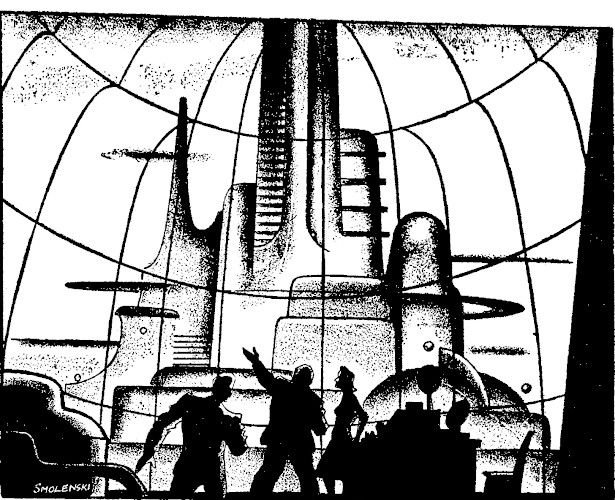
Turber indicated high points of the vast future-city.
The Turber ship circled, but the transport came steadily on. We could see its decks thronged with troops. It had been hastily armed in Great London. Its cannon answered the Turber fire. But presently it came over the city roof, and ceased its fire that the balls might not fall and do damage. It slowed into a great lazy circle, preparing to land on the Tappan stage.
The Turber pirate ship followed it. We gasped. The Turber ship plunged for the liner; it kept on coming. They collided! Alan exclaimed:
"Look at this other mirror!"
A telescopic image of the scene, greatly magnified, showed on another mirror. We saw the decks of the Turber ship. No one there! Its control room held mechanisms only! There was no living soul on this Turber ship!
A vessel, like the crude steering devices of our own time, aerially controlled! Within some instrument room in the Turber section of the city this helmsman sat. We had no such ships. There was no need for such mechanism in this age. It had been lost and forgotten now with the passing centuries. But Turber had located it and brought it here—adapted it to this world-power with which the ether was flooded and which all ships used.
We saw the collision. The great white liner turned over. The two ships, locked together with broken girders, wavered and fell. We turned away as the mirrors showed us close views of the strewn human forms on the roof-top.
That was the first of the Turber suicide ships. He had others. One more was used when the next liner appeared. After that Great London ordered the others back. We were cut off from the world.
That night of June 13, when the battle had been raging some thirty-eight hours, found Alan and me quartered for needed sleep in a building of northern Westchester. Exhausted beyond all ability to talk or even to think, we slept.
Late in the evening we awoke. The tower still had not come. The battle raged everywhere with undiminished fury. The Turberites now had more than doubled their original area. The Hoboken power-house still held out; but in all the rest of the Jersey section the enemy was in full possession. Our forces at the power-house were surrounded; they could not hold it much longer.
The harbor islands were all Turber now. And the Brooklyn and Queens sections. Lower Manhattan, without local lights, with its ventilation gone, was a tomb of black corridors and rooms strewn with the dead, while Turberites with gas masks and flash lights prowled among them.
Broadway and all to its west toward the Hudson River was taken, up nearly to the Van Cortlandt region. But we still held the mid-section, which once had been Central Park; and Harlem, with widening lines into the Bronx. Still held the vital space of the tower.
But it could not be held much longer!
CHAPTER XX
ON THE CITY ROOF
Alan and I sat, that late evening of the battle's second day, upon our bed where we had just been sleeping. The news tapes and mirrors gave us the details of what had happened while we slept. Turber was winning. There could be no doubt of that.
The sleep had refreshed us; and suddenly, as I met Alan's eyes, I realized that his thoughts were the same as mine. There must be something we could do to try and rescue Nanette. We were no longer total strangers here.
We knew the city now; and by personal contact, or by reputation, we were known to most of the commanders of the city forces.
"That fellow Van Dyne," said Alan, "the Marshal of the West Manhattan area, likes us. I was thinking—"
I interrupted: "Get him to organize a small squad. It could be done without general orders. Make a secret raid into the Turber section—try to get to the aero—"
Make a desperate play; no matter how desperate! We were all desperate. The situation was almost as bad as it could be.
Alan shook his head. "I think the more men we took, the less chance of success. There's no chance, Ed, to fight our way into the Turber city. We'll have to try to get there by our wits—just you and I. I was thinking—"
He had a plan. We discussed it; elaborated it. We called on the audiphone here by our bed for Van Dyne. He was available. Luck was with us. He was where we wanted him to be, on the roof, on patrol duty.
The least of the fighting so far had been on the city roof. The Turberites had made sorties, but often had abandoned the region they took. Van Dyne told us now:
The Hoboken roof section was mainly in Turber hands. And Brooklyn. But this central Manhattan section and all north of it we held.
Van Dyne was on the roof, over mid-lower-Manhattan.
"We want to come up and see you," said Alan.
"Where are you?"
Alan told him our location in northern Westchester. "Can you order us transportation?"
"Yes," he said. "But it's round-about. Only a few official lines running."
"I know," said Alan. "Order us a guide to get us up to you. Hurry it, please."
A guide appeared in our room in a moment. He led us out to a small rail-car. It whirled us south. Then by lift to the roof. An official transport car on a narrow-gauge roof-track was operating with emergency battery. It took us south, over the roof-top.
The roof spread like a great rolling expanse of rumpled canvas. Dark everywhere, with a few dotted lights. It never was level for very far. It rose in terraces, up and down, heaped up in peaks to cover huge, looming structures beneath. A roof, built haphazard, piecemeal, through many centuries. It rose to the right, over Hoboken, and ahead of us, over mid-Manhattan, it loomed in great terraced steps.
The open sky was over us. It seemed so strange to be out in the open air! A black night, with heavy, sullen clouds.
The roof surface was a dark metal labyrinth. Narrow metal roadways crossing it; viaducts, sometimes on stilts to strike a more level path; inclines up the terraces; footpaths and ladders. The air landing stages—all now abandoned—were up here.
There were low metal towers at intervals; observation and instrument towers; occasional low metal buildings—the meteorological station; observatories; metal posts were set at points of vantage holding the image finders for the city mirrors; and there were occasional official kiosks covering the entrances downward to the city. And an intricate system of drainage sluiceways, with heat projectors to melt the winter snows.
A maze of metal structure, this roof-top. It was all official—the public always was barred up here. Its activity was paralyzed now. The buildings were abandoned. The lights were nearly all out. It lay dark and mysterious, with only the glow of the city showing in occasional irregular patches where the roof-structure was translucent.
Our car was frequently challenged as we passed prowling patrols of the city police. Then we came to Van Dyne.
A friendly fellow. Alan, in confidence told him our plan, and he passed us. His post here was the end of our territory. Beyond it the roof was abandoned—a sort of No Man's Land, where figures prowled; but for hours now there had been no fighting.
"Good luck," Van Dyne said.
We slipped past and ran south. We followed a narrow viaduct which bent to the right to avoid the higher terraces. The roof surface was some six feet beneath it, with occasional steps leading down. It was all solid black.
We were armed with the needlelike swords; and each of us carried a small dagger. It had been our original plan to have Van Dyne secure for us two uniforms of the Turberites. There were many bodies in the city in our territory.
But it was not necessary, Van Dyne told us promptly. The roof up here had been the scene of many bloody skirmishes. We could pick for ourselves.
We went south perhaps a mile. Alert, but we encountered nothing alive. Occasionally upon the roof we saw a heap of dead. Our little viaduct in one place was blocked with bodies. Turber's rabble was always garbed in the costumes of its native Time-worlds. It seemed a conceit of his. We lifted the dead bodies here. Grisly business! We selected two of about our size. They wore the red-coated uniforms of the British army of the Revolutionary War. In the darkness on the trestle-like viaduct we changed clothes. And then we found two dark cloaks. Threw them over our heads. In the darkness we might thus pass unnoticed. But if challenged we hoped we might be thought Turberites. Our native language—with uniforms like this—would be English, which is why we selected them. We discarded our police needle-swords and carried only the daggers.
Again we started south. The roof was at a low altitude here over the Hudson River section. We passed down to where the fence of the original Turberite area ranged in an irregular line east and west across the roof.
"Think we can get through it, Ed?"
"Van Dyne said the gates were more or less abandoned—some were smashed by the fighting up here."
"Yes. But we'll be challenged."
We had expected constantly to be challenged. The metal fence loomed close before us. It seemed thirty or forty feet high. There was a gateway near by.
"Over there," whispered Alan.
We were down on the roof-structure itself now, clambering forward over its sluiceways.
"Ed!" He gripped me. In the air over us the Turber Time-aero came sailing! It was solid—not traveling in Time—merely sailing here in Space. Two or three hundred feet above us, moving slowly north!
We stared with sinking hearts. This was so wholly unexpected. The aero seemed descending, as though it might land on the roof. A moment; and then it flashed, faded into phantom. There was an instant when I thought it had gone through the roof. The wraith of it vanished.
We stood stricken. Was Turber taking Nanette into some other Time-world? Abandoning his enterprise here? It did not seem likely when he was winning.
Or was the aero going into Time to try to find our tower? Had Turber some inkling that Lea was bringing us a superweapon? Was he sending his aero to try and prevent that? If so, were he and Nanette in the aero? We had no way of knowing.
"I think we should go on," Alan whispered at last. "Nanette may be in the city. If they'll accept us as Turberites—if we can only get to her—"
We got through the gateway. A guard was there. He chanced to speak English. We flung back our cloaks.
"Special business for Dr. Turber. Good news!"
There seemed only one fellow here. Then off to one side we saw a dozen or more, seated on the roof in a glow of light, lolling about, smoking.
The fellow passed us. We went on.
The Turber roof was dim with dotted lights. But it was all in operation. Groups of soldiers at intervals; occasionally a transport car passing along on its narrow rails.
The fellow at the gate had waved vaguely toward this viaduct we now were traversing. We had followed his gesture. Our idea was to locate some Turber official whom we might fool—or force—into giving us information about Nanette.
A low metal building showed ahead of us. It was small; it seemed perhaps of only one room. An isolated, dark spread of roof was around it. This viaduct we were on led to it. The little house had open windows, low to the floor, and there was a glow of light within.
I whispered: "Some official may be on duty there. If we can rush him—make him tell us—"
A kiosk leading down into the city showed a hundred feet or so beyond the little building.
We left the viaduct. We crept forward over the dark open roof. We came to one of the open windows of the building. There must have been at that instant a dark figure lurking near us on the roof. Watching us. But we did not see it.
The window stood with its sill at our knees. We dropped low, peered in.
A single metal room with a glow of light. A metal table-block held a strange instrument of tubes and coils. Strange to me; but not to Alan. It was a Time-vision instrument! Its screen stood facing us; upon it was an image of our tower, a phantom speeding tower!
A man sat with his back to us, hunched over the instrument. It was Turber! He was alone in the room. Alan's lips went to my ear:
"I'll go first."
The Time-vision was humming. It covered the slight noise we made. We got through the window; stalked noiselessly.
With a leap we seized Turber. He seemed unarmed, he did not struggle or cry out. He was startled; but he sat back with almost instantly recovered poise.
"Well! You here?"
We stood over him. Alan gripped him. There was a moment when I thought that Alan might plunge the dagger into him and have it over.
"Alan—easy!"
Alan shook him. He did not resist. Alan gritted: "God, I ought to kill you! Where is Nanette?"
"Nanette? Nanette?"
He began to stall. It was too much for me.
I cuffed him in the face with the flat of my hand. He winced and went livid white; his eyes bored into me. But he held firm.
He said: "Why—Nanette? Take your hands off me, young fellow!"
Alan eased up. He motioned me off. "We want Nanette, understand? We're desperate, Turber. If you balk I'll stab you now and have done. Understand?"
He said: "Yes." He managed a wry smile. "If I raise my voice I can bring a dozen of my men here in a minute."
"But we'll kill you first," said Alan.
He could not doubt it. He said: "All right—then let's be quiet. I'm no more anxious to die than you are." His poise was coming back. He was gauging us; his glance seemed roving the room. "What do you want?"
"Nanette," I said. "Where is she? The truth, damn you!"
I felt he was going to say in the aero.
Instead he said: "Down in the city, not far from here."
There was a local audiphone hanging on a hook near him. Alan said: "Order her up. Be quick! Give the order and have one man only bring her up."
He moved his hand to take down the receiver. He stopped. He said: "You see, I've told you the truth. I could just as easily have said she was in my aero. Did you see my aero passing?"
"Yes," said Alan.
"I've sent it after your tower. With Bluntnose and Jonas." The Time-vision instrument was still operating; he gestured to the screen, which still showed our speeding phantom tower. The dials here were illegible to us. Turber added:
"Where has your tower been? I just picked up this image. Is your tower coming here?"
I realized he was again stalling. I said: "You take down that receiver—"
He took it down. He said: "Shall I open the circuit?"
"Yes," commanded Alan. "And speak quietly—if you say a wrong word I'll run this dagger in your throat."
This clever scoundrel! We realized afterward that he had drawn our attention to the screen and thus had turned our backs to the door of the room which he could see out of the tail of his eyes. As we bent alert while he reached for the audiphone a figure crept up behind us; launched full upon us.
We were taken wholly by surprise—knocked against the table. The woman Josefa! She had doubtless followed Turber to the roof, jealous of his every movement. He had seen her behind us in the doorway. She leaped upon us. Turber heaved upward. Alan's dagger grazed his arm.
Turber shouted. He struck with his fist at me and flung himself backward. The woman managed to cling to us both, heedless of our knives. She clung; kicked, bit and tore at us. It took a moment for us to shake her off. But in that moment Turber was near a window. He flung a heavy metal chair at us; and turned and leaped like a misshapen cat through the window. His shouts sounded outside, as he ran, giving the alarm.
We would be trapped here in another moment.
"Alan, come on! Get out of here!"
I was free of the woman. I tore her from Alan. She panted: "You let him alone! You let him alone!"
We turned and ran. Leaped into the darkness of the roof, where a turmoil of the alarm was beginning.
How we ever got back I do not know. Hunted, as two rats would have been hunted in that metal labyrinth by a pack of wolves. But we got through safely; found a broken section of the division fence. Ran northward.
The pursuit behind us presently died away. Then we came upon a city police patrol. They saw our red uniforms and very nearly killed us before we could speak. But we convinced them of our identity.
One said: "The tower came!"
It galvanized us. "The tower?"
"Came, but did not stop. Just a phantom."
What could that mean? Lea and San, passing, but not stopping!
We got transportation down into the city, avoiding the areas where the fighting was raging. An official car took us by devious route to the tower-space. The street here was heavily guarded by the city forces, but the Turberites were fighting close to the south. Only a few blocks away we could hear the sounds of the battle.
The tower had come and passed. Its marked space in the street was empty. Our guards surrounded it. We stood among them.
A phantom showed over our heads! A moving phantom of the Turber aero! It darted across the tower-space and vanished.
Now we understood! San and Lea were trying to land. Bluntnose, with the aero, was endeavoring to prevent them. He had followed the tower through Time. Two speeding phantoms! The aero could wing its way directly through the tower without contact—when they were speeding phantoms! But not if they stopped.
The tower showed again. A brief wraith of it. Just an instant; but in that instant the aero also materialized, circling, darting. Then they both were gone.
Would San dare stop? Would he risk that Bluntnose might wreck the aero and kill himself, just to wreck the tower?
Another moment. Again the phantoms showed. The aero was slightly above the tower, and to one side.
The tower did not pass. In a breath it materialized into solidity before us. My heart seemed to stop. San had dared!
The aero seemed half to turn. And then the wraith of it vanished!
Bluntnose had not dared risk it.
From the tower came Lea and San, dragging apparatus. The projector! They had been successful.
The guards in the street were shouting triumphantly. A turmoil was around us. I stood at the foot of the tower steps; I saw Lea fling herself impulsively into Alan's waiting arms.
The tower, with San, sped safely away.
But my heart was cold. Whatever the outcome here a fairyland of happiness for me was gone—the lost what-might-have-been for Nanette, and me.
CHAPTER XXI
THE EYE OF DOOM
"Why, Ed! With this thing we can rock the city—bring death—"
"Death! Yes. But, Alan—"
"Death to them all! To Turber! If we can catch his aero before he can get to it we can kill them all!"
"But, Alan!" I was trying to say. "What about Nanette?"
He echoed: "Nanette?" Here was a tangible death for her in this weapon Lea had brought. Death for Nanette as well as destruction of the Turberites which was being planned here now. We would see it; we, indeed, might very well be chosen to accomplish it. And we stared wordlessly at each other and knew that it was inevitable.
It was about 1 A.M. of the night of June 13-14, 2445 A.D. Momentous night of history! Culmination of the Battle of Great New York! We sat, Alan and I, in a corner of one of the rooms of the Hudson Machine Shops, watching Lea with the corps of engineers who had been summoned to assemble her weapon.
These electronic experts recognized it; not in its working form, but in its principle. An electronic beam, with the harmless aspect of a spreading searchlight ray. Like most scientific devices of importance, its practical working mechanism was complicated, with a basic scientific principle of the utmost simplicity. It carried—this harmless-looking beam of light—vibrations both etheric and atmospheric. They were communicable—as are all vibrations.
Harmless of aspect, this bronzed projector! I would have said, with a casual glance, that it was a searchlight of my own time. I have seen many like it. But it had a focussing grid of wires across its face instead of a lens. Wires of a metal no one could name. A focussing and firing mechanism; and insulated wires leading to a cylindrical tank, long as a man—the battery, in which was stored some unnamable electronic force.
Alan and I examined the apparatus as Lea showed how it should be assembled. Within the projector was an elaborate mechanism of tiny disks and thin metallic tongues, which in operation would whirl and vibrate. There were condensing coils; and bulbs of vacuum with laceworks of filament—lights to cast the beam. I saw that the light would pass through an intricate magnifying system of prisms—condensed finally to a focal point where a whirling mirror-disk cast it loose through the projecting grid of wires.
Tremendous latent energy in this harmless-looking white light! A cold light—with a latent power diabolic. Falling upon a distant object—touching anything of material substance—the energy of its vibrations was loosed.
"If that touches a building," Alan exclaimed, "this building, for instance—why, these walls in a moment would be trembling—quivering, shaking until presently they would fall—"
The principle was known even in my own age. This cold, white light, with its inconceivably rapid vibrations, would in a moment set up similar vibrations in anything it rested upon! Nothing of material substance could for more than a moment hold its form under the lash of such inconceivable trembling! With this beam we could rock the city—smash through its roof—bring death to every living thing upon which we could get the light!
The whole apparatus was carefully insulated. It would not operate here because of the world aerial power. The insulation was to protect it now.
It could not be operated with this insulation. If we removed it, our power would instantly destroy the filaments and coils, and in a moment or two detonate the battery. The world-power would have to be shut off during its operation.
There had been a consultation of the world governments fifteen minutes ago when in code our city government had asked that the world power be discontinued. We now had the decision. At the Trinight Hour—three hours after Midnight this night—the huge Scotland plant would go dead for sixty minutes. No more time than that could be given us. Most of the air-liners—and all the civic lighting and ventilating and traffic systems—had emergency batteries for sixty minutes. Beyond that limit the whole world would go into disaster.
Sixty minutes, beginning two hours from now! It gave plenty of time to assemble the apparatus and mount it in a swift ship. Lea was to be beside the man who would be chosen to control the projector.
Now Alan and I sat whispering, for upon us had come the realization that this would mean Nanette's death.
I said: "But Nanette—this is death for Nanette!"
"Edward!"
An audible answer! A microscopic aerial voice here in the workshop room-corner! Alan heard it also. And it came again:
"Edward!"
Hushed accents! Imperative! Vehement! Nanette's voice!
"Edward, don't move! Don't look surprised! I know you're there—you and Alan—I've heard you talking."
Tiny voice, materializing from the air! Alan murmured something, but I gripped him. We sat tense.
It came again.
"Don't show surprise! It may be that they have an image of you at some other receiver! I'm alone here now—just for this moment."
I said softly: "Shall I speak? This is Ed—can you hear me?"
"Yes, Edward. They've been listening—Jonas was in here, at an aerial, eavesdropping on you. They've lifted their barrage for this one finder. Located you—they've been listening to the men there with you—Lea's weapon."
Aerial eavesdropping! Turber was aware of our plans!
Nanette's voice added:
"Turber is off somewhere, but Jonas thinks he can locate him. I wanted you to know it. I think Turber may take us in the aero and go."
I exclaimed: "Yes, Nanette! Go!"
Alan tried to speak, but I silenced him. This at least was mine! These few last minutes—Nanette's and mine!
"Go, Nanette!"
"Jonas wants us to go now, to escape without Turber! But he does not know how to operate the aero. The Indian does—Bluntnose the Indian—but he won't go now—he wants to wait for Turber. Edward, I must talk quickly—I heard what you and Alan were saying. About me—death—but I know that, of course.
"Tell Lea I said good-by. I can hear Jonas coming back now! You must have your men stop talking there—or whisper very carefully! And—can Alan hear me? Good-by, Alan, dear."
He gulped: "Oh, Nanette, little sister—"
"And—good-by. Edward—"
I stammered: "Good-by." I choked over it.
"Good-by—Edward, I—always loved you—very much—ah, so much! And I want you to know it."
I thought: "Dear God!" I stammered: "Nanette, darling—I've always loved you—"
"He's here! Don't speak!"
I gasped hurriedly: "Get away in the aero, Nanette!"
"Edward! No more! Good-by, dear."
We waited, but there was only silence.
CHAPTER XXII
SIXTY MINUTES
"Alan, will you be all right? Can you do it?"
"Yes, I must." He set his jaw grimly. "I must."
I touched his hand, where it rested on the projector; his fingers were cold, but steady.
This forward gondola-cabin, hanging almost under the nose of the swift, small ship, was silent, with only a low thrum audible from the rear motors.
From where we sat, with Lea beside us at the projector, the wide transparent windows gave us an unobstructed view forward and down. We were rising now from the Hudson air-stage—a brief flight, and we would be over the city roof. Sixty minutes! The world-power was off now; in sixty minutes it would flash on again and our weapon would be useless. Sixty minutes! A very little time! Yet, it can be an eternity.
The officials at the Hudson shops had said to Alan and me: "You know this girl—and she knows the weapon—its operation. The Council ordered that one of you operate it, with the girl beside you."
I looked at Alan. My heart was pounding. I wanted Alan to speak, and he did not. It seemed that he never would. Then he said: "I'm older—I'll do it, if—if they think I should."
No executioner at his switch in the little room behind an electric chair of our day could ever have shuddered as Alan now must be shuddering. But he held himself firm when once we were in the ship's cabin. The controls, with a white-faced young pilot seated at them, were near us. There were several other men in the cabin, with observation instruments; and at a bank of mirrors, receivers and audiphones three operators held us in close communication with the city authorities. Our commander moved quietly about; seldom speaking; but intent upon every detail.
Sixty minutes! Five of them were already gone when—with the world-power dead at the Trinight Hour—we hastily stripped our mechanism of its insulation and rose from the landing-stage. The gigantic city loomed into the sky before us. The night was still overcast.
We climbed steeply, then levelled, and presently we were over the city roof; a thousand feet over it perhaps; and beneath us it spread in the darkness like a great rolling expanse of soiled canvas.
We had not heard Nanette's voice again. Precautions were taken against the eavesdropping. What Turber personally may have learned of our plans we never knew. Nothing probably, until near the end. He had no warning that the world-power was to be shut off. The battle everywhere in the city was undiminished in its fury. It was raging down there now. Our mirrors, here in the cabin, occasionally shadowed it, but there was no other sign.
Turber had carried our tower Space. San was gone with the tower—with orders from Lea to swing slowly past at intervals. The Turberites, finding the tower was gone, left a guard there and swept on—fighting our troops northward. The Hoboken power-house still was surrounded, but holding out. The attack there seemed momentarily to have slackened as Turber concentrated on his northern drive.
There was still no fighting on the roof. Our lines had withdrawn northward as the Turber mobs swept north through the city. Most of this roof area seemed deserted. We could make out occasionally the dark forms of the Turberites patrolling this captured area. We crossed over the Turber wall. The roof from this height was very little different of aspect.
Our projector had not yet flashed. All our lights were carefully hooded. But we thought that by now some Turber ship would have come up to assail us. There had been occasional Turber patrol ships here all day, but none were here now.
I thought that the harbor with its lacework of causeways and islands must be beneath this area of the roof. It was difficult for me to estimate. Far off, ahead to the right where the roof ended beyond Staten Island, I could see the banks of lights that marked the great Turber wall inclosing this end of his rural territory. There was no ship in sight.
I murmured: "When do we turn it on, Alan?"
"Soon. When we get near where Turber houses the aero."
"Yes, but where is that? I don't know where we are."
We had no idea where the aero was either; but our orders were to attack its usual housing place.
The pilot heard me. He said: "Approximately approaching Staten. We have little information of the Turber city. But his aero is kept some two or three miles farther ahead."
Our beam had an effective range of about fifteen hundred feet. From this present altitude we would have to direct it almost vertically downward.
Lea murmured something. We followed her gesture ahead through the observation pane into the darkness of the sky. Our pilot saw it at the same instant—a black shape looming—a Turber patrol ship rushing at us! With all my air experience, my senses reeled as we dropped. I gripped my bench. We made a forward loop—nose down.
I heard the rush of air as the Turber ship almost brushed us. We righted. The pilot muttered an oath. Somebody said: "Where did it go?" There was a flurry in the cabin.
We could see nothing in the darkness. We flew onward. Then we made out the Turber ship, not following us, but flying north. As I turned to gaze behind us, to the north on the roof-top fighting was beginning. Torchlight gleamed—waving, moving lights there.
We caught some close details on our mirrors. Our troops had come up and were assailing the Turber patrol lines. The Turberites were falling back; but beneath us, in a moment, lines of re-enforcements appeared. There were tracks here on the Turber-owned roof. We saw spots of illumination where cars were loading with fighters to be rushed north. Our image-finders showed the Turber ship. It had been rushing north—like ourselves, without lights—to meet this roof attack. A rain of missiles dropped from it.
Our commander said suddenly:
"Now, Tremont! Start here—ten degrees off the vertical, to the left about another ten. Hold the course as you have it, Pierson."
Our orders to flash the beam! Alan and I set the range-dials. Lea with nimble fingers made the last adjustments, wound the firing tensions, and then crouched on the floor by the battery to handle the gauges of its current-flow.
The projector-face swung downward through an opened aperture in the window-shield. I focused it at the agreed-upon spreading of the beam. From our instrument table some one sang out: "Eleven hundred feet altitude here, Williams. Roof ahead averages nine to eleven hundred under us—"
I made the adjustments; the beam would strike with a circle of light about a hundred feet in diameter.
Alan's voice: "All ready, Ed?"
"Yes!"
He added: "Lea?"
In the dimness of our cabin interior I saw her white arm go up in answer from where she crouched. She said: "Yes—ready."
Alan snapped on the current.
I sat back; I was limp and cold all over. There was nothing for me to do. Nothing but watch—and listen.
The light-beam grew very slowly into being. A low whirring—a trembling; it purred, this diabolic thing, like a smug cat licking its lips. Purred, and then seemed to hiss as its anger grew. Whirring, tiny vibrations of sound; they went up the scale in pitch; always soft—higher until the thing was screaming with its microscopic voice. Higher, faster until it faded away, too rapid for audibility.
But the low hiss and sputter of the current remained. And the light-beam grew. Darkness at first; then a radiance of faint dull red, streaming down from our projector; red and then up through the spectrum to violet; then white. Cold white—nothing but the mingling of all colors made too rapid for separate visibility.
A minute of this process. Our ship was hovering—horizontal propellers holding us poised. Some one said:
"His vehicle ought to be about here."
Beneath us now was the same Space which in my Time held the Turber Sanatorium! I gazed down our white, slightly spreading beam. It fell on the roof here with a hundred foot circle of white illumination. It showed a small metal house on the roof-surface, with a group of Turberites on guard along a railed trestleway near it. They had evidently been lounging about; they were on their feet now, surprised by the light.
I stared, cold with fascination. I heard Alan murmur: "God!"
The men stood with upflung hands against the dazzling light. Stood transfixed—and then tried to run. I saw one fall; another turn, waver and crumple. Others, stronger, tried to stagger—weirdly swaying with arms flinging wildly and legs bending, crumpling—they did not lie mercifully still at once, but writhed gruesomely.
The figures were strewn in a moment. Some, near the edge of the circle, got out of it and away. Confusion—horror down there. Other figures came like frightened animals running into the light; stood stricken and fell—or managed to get back.
Lea appeared beside me. She bent over Alan—showed him other adjustments. The circle of light narrowed upon the small house.
I had been aware of a sound from below.
A throbbing—a rhythmic throb. The house and all this immediate section of the roof was vibrating—trembling—shaking—
It grew louder. Like a pendulum, where at the end of each swing your finger gives it an added push, the impulse of our beam was shaking this little building—rocking this roof-segment.
A corner of the building split off and fell; a crack seemed to open in the roof; the little house broke apart and slithered through the crack. The human figures spilled down.
A jagged hole was here. The light bored down into it. A ragged broken cross-section of the great city-structure. Our glimpse went down through rending, clattering walls, falling ceilings, collapsing floors and tiers. Human figures engulfed. A turmoil, a chaos of sound and movement.
The destruction seemed to spread inward. One tier brought down another. A widening jagged wound was here in the metallic city. It extended a hundred or two hundred feet down from the roof level. But our range from this altitude could go no deeper. Was the aero down there in some fortified room underneath this tangled wreckage? Nanette, down there perhaps, still alive—
"Move us along, Pierson. Tremont, spread the beam! We'll go down to five hundred feet."
The roof broke in larger fragments as the light widened and intensified with our descent. This whole section of the city must have been quivering now; we could hear its ragged pulse, mingled with the rending of metal, the crash and crack of trembling, collapsing interior walls.
With the first breaking of the roof insulation-barrage, our mirrors began picking up interior images. I did not see them—I sat at the projector with Alan, watching the widening break in the roof as our beam bore down from this lower altitude. But I heard the comments of the men behind me in the cabin. The panic of defeat was spreading throughout the Turber-owned city. Mobs of Turberites, soon in a wild rush to come this way; against all reason, rushing in a panic of terror toward this quaking, falling area! Because the Time-aero was near here!
We realized it. But no Turber mob ever reached the vehicle. We found later that it was fortified with metallic barriers. They shut off the mob which tried for safety—barred those few who got past or around the falling area.
The panic spread up north to the battle lines. The tide of the fighting abruptly turned. The Turberite wolves, suddenly stricken with rumors of defeat, began trying to withdraw. Our troops pursued them. Soon it was a rout. I heard no orders—no talk of the taking of prisoners. Like wolves trying to run, the Turberites were hunted down.
Lea plucked at me. I turned again to look back toward Manhattan. There were torches everywhere on the roof to the north—our police troops, suddenly heartened, were surging up triumphant and sweeping the enemy back. In the glare of the lights the black Turber ship up there showed as it winged away. Escaping—and in a moment one of our ships rose up and took after it.
Some one said: "Look! The Turber Jersey landing-stage!"
Far ahead, where the city ended beyond the Staten Island section, a group of Turber ships came up. Coming to attack us! The thought flashed to me. But it was not so. Turber ships—escaping. They sped off to the south, over the Turberite rural district.
I prayed that one of them might be carrying Nanette.
Someone said: "Forty minutes; twenty left!"
Had this all been only forty minutes?
"Pierson! Lower! There it is!"
We dropped nearly down to the roof level. The roof-structure was gone now over a segment of fully a mile. The beam, with Alan oscillating it, bathed the whole shattered area in white light. Indescribable scene of ruin! A vast honeycomb of metal city, shaken into ruins as though by some persistent earthquake; girders of metal piled in a tangled mass like jackstraws. Stone and mortar; plaster; wood—all the innumerable shattered substances strewn in a wreck inconceivable. Fires were starting in a dozen places; lurid glare of red-yellow flames; black smoke rolling up.
And sounds inconceivable—a torrent of crashes—explosions—and, I think, an undertone built with the myriad screams of the dead and dying.
As we descended almost to the level of the hole where a huge slice of the roof was dangling, our light struck into an open area of the city. There was less wreckage here; we could see down to the ground level. It was not very far down—a rise of ground was here; a hill—and it seemed an open parklike space of metal pavement surrounded by high metallic barriers.
They crumbled, these barriers, within a moment as the white beam caught them. There had been a low roof over the park, but it was fallen.
The aero stood exposed, but still unharmed. It rested motionless on the pavement. Our beam touched it. Horror surged at me. I gasped: "Alan—" He swung the beam away. What he said I do not know. But he had seen it—as I saw it; the white light always showed everything with intense clear detail; the figure of Nanette standing in the aero doorway! We could even see her now, dim but distinguishable—standing there—wavering from the shock of the light as it had so briefly struck her.
"Alan—don't!" An anguished cry that sounded like my voice; and our commander's voice: "On the vehicle, Tremont! God, don't let it get away!" The walls around the park were falling. There was a mingled glare of our beam and the yellow light of the burning ruins near by. It showed a man's figure appearing in the aero doorway; he jerked Nanette backward into the interior. He stood for a moment in the doorway; Bluntnose, the Indian! He flung up his arm like a signal. And other figures showed, running forward. Turber; and Josefa. Trapped somewhere in the city and just now arriving at the waiting Time-vehicle. Turber, with his knowledge of the city labyrinth just now able to get here. His figure, and the woman who clung to him, avoided our circle of light; Alan in his confused horror had swung it farther away.
Instant impressions. A second or two while we sat cold and stricken. Our commander's voice: "Tremont! Good God, man! Is that Turber?"
The commander bent over Alan and seized the projector. The light swung to Turber and the woman. They staggered, but kept on. Then the woman fell. She lay twitching. Turber left her. He stumbled, fell; but got up. Gruesomely contorted—staggering with twitching steps. Almost at the aero's entrance he fell again. Relief surged over me. The aero, bathed in the white and yellow glare, went thin as a ghost. An apparition—with the solid broken figure of Turber lying huddled. A wraith of the vehicle. It was gone!
But only for a moment! Why, what was this? The horror surged back to me. Unimaginable horror! The aero had gone. But had gone only a moment into our future, and then had stopped. And in that moment we had caught up with it.
As we stared at the empty space, with that passing moment the Time-aero materialized again. It lay in a tangled, disintegrating heap of metal with lurid green tongues of gas-flame licking at it!
CHAPTER XXIII
UNRECORDED HISTORY
To me, the rest of those sixty minutes were a vague, drab dream of things horrible to see. Awesome—but though the rocking, shattering Turber city went down while I watched, it all seemed dreamlike. My mind was on that torn heap of wreckage which had been Turber's Time-vehicle. Nanette's body lying somewhere there.
Alan seemed dazed. A man shoved him away and took his place. He sat huddled by Lea. I sat, numbly staring. Then someone said: "Two minutes! That's enough, Grantson! Get the girl and those ancients to insulate the projector. Hurry! We won't need it any more, but no use ruining it."
The world-power was about to come on again. We hastened to insulate our projecting mechanism. The light-beam died. But its work was through. All this end of the Turber-owned city was in ruins. The black waters of what had once been New York Bay were exposed. The islands and the causeways and all the structure there was strewn and tumbled and broken. All of what had been Staten Island was wrecked. Fires and explosions everywhere, and masses of lurid smoke mounting; and all the upper air pungent with the smell of chemicals.
The gas clouds hid the Staten Island hill, with its wrecked aero.
We swung back toward Manhattan as the world-power flashed on. Our sixty minutes were over.
Aftermath of the battle; I need not detail it. To Alan and me it was all unimportant. We kept Lea close with us. Gentle little creature! Why, I suppose her ethereal beauty could not be matched in all the world. But my mind went always to Nanette.
I recall how vaguely I gazed at the mirrors as they pictured the rout and final destruction of the Turberites. The hunt for the panic-stricken mobs ceased in a few hours; those still alive were allowed to escape. I recall sitting with triumphant city officials and hearing it all discussed. The Turberites would be banished to various other localities—scattered. I heard the triumph when searching parties in the ruins found the Turber Treasure Vaults. His tremendous wealth would go to enrich the city government; to rebuild the destroyed area.
Turber and all his leaders were dead. His Empire was broken; its menace met and conquered. There was official government praise and thanks for Lea, Alan and myself. Our interest in it all was apathetic. We had lost Nanette—we found that our greatest desire was to get away from this world which had taken her from us.
Alan and I did not go with the party of searchers who brought back the bodies from the wreckage around Turber's vehicle. Nanette was not found—but they told us there were many bodies not recognizable. We did not go to see them.
A day passed—then another—and on the third a message came which took Lea and Alan and me in shuddering trembling haste to where now workmen were cleaning away the wreckage of the shattered area.
Nanette!
Three workmen had seen it happen. They were working just now, close beside the mangled pile of metal which was Turber's vehicle. From the air a few feet above their heads—the empty air—a human form came hurtling. They saw it all in an instant materialize. A shadow—a ghost—but in a second, when it struck the ground almost at their feet, it was solid. A human form. A girl—lying broken and unconscious. But still alive!
We were taken to see her in the improvised morgue and hospital near the ruins. It was Nanette. We could see that. And we looked just once, and then they led us away.
She was still alive. Oh, I thanked God for this era of progress of 2445! Five hundred years ahead of my own lifetime these surgeons and physicians who for days were working over Nanette! They said she might live. Her broken body might be restored to a semblance of itself.
Our tower with San arrived. It waited, this time.
Then, at last, they said that Nanette surely would live. They took us one day to see her. She lay so swathed in bandages that not much more than her eyes were visible. We spoke to her, just for a moment; bending low, we could hear her murmuring answers. Then Lea held her close and crooned to her, and she went back to sleep.
Another week. We saw her again; propped up for a moment in bed to receive us. The bandages were gone now from her face and head and shoulders. She sat, staring into the direction of our voices.
My poor Nanette! Her face, shriveled and scarred! She raised what seemed a twisted arm to welcome us. She tried to smile. A travesty—a mockery. I recalled her gentle beauty, her sweet womanly dignity—that little smile, so sweet, that she used to have.
I leaned over her. "Nanette, darling!"
"Edward, you came—I didn't want them to let you come—"
I said: "Lea is here. Do you recognize her voice?" I bent over her as though with a great secret. "Nanette, she and Alan love each other. We're just waiting for you to get well—it won't be so long now. Then we're going home."
"No," she murmured. "They say it won't be long now. And they say—"
"San is here with the tower. But he stays always in it. That's why he hasn't been to see you."
Oh, I had phrased it wrongly! She shuddered.
"Edward—that time, you remember—when I said good-by over the aerial? I—I thought that it was—really good-by. You understand?" She was stammering.
"I don't understand, Nanette."
"I mean—I—I told you that I loved you. That was very wrong of me. I do not—I do not love you. I n-never did."
She could not see the rush of moisture that clouded my eyes. I gulped, but I managed a laugh.
"You can't get out of it that way. Of course you love me! I'll make you!"
But she held me off. "No."
From across the room the watching nurse said: "She should be kept quiet, Mr. Williams."
I relaxed and sat back. "We'll forget it, Nanette—not talk about it now, because—"
"Yes, forget it. They say, these surgeons—"
"Nanette, listen—we're rich! You didn't know that. The city government here has awarded us—the four of us—and some for San—some of the Turber gold. In 1945, Nanette, what we four have will be accounted at nearly a million dollars."