Front matter (continued 2)
Reading edition
Alan nodded. "Yes, I understand—when we get there we can talk."
They came to the year 7000. Traveling slowly now.
Then Lea had an idea. In the automobile, coming from Staten Island, she had been wrapped in Nanette's cloak. It was discarded now; but it lay here in the tower room. She picked it up and stood before Alan. Fragile, beautiful little creature! The soft folds of the sky-blue drapery fell about her figure; the golden tresses lay in a mass over her shoulders. Her eyes, clear pale blue as a morning sky, were fixed on Alan. A wave of emotion swept him; it seemed that he had never seen a girl so beautiful.
"Nanette," she said, lifting the cloak.
"Yes," he responded. "Nanette's cloak. I understand. But what—"
She took Alan's finger and moved it over the dial. Aimlessly. She said: "Nanette—Turber—Edward—"
And shook her head. She did not know where we were. But then she indicated the cloak again, and smiled, and said, "Yes—yes."
What could she mean by that? Was she trying to convey that with Nanette's cloak they would be able to learn where Nanette was? It seemed so.
A tenseness had come to San. He was alert at his mechanisms. He spoke sharply to Lea. Her hand went to Alan, steadying him. Alan braced himself. San flung a switch-lever. The tower seemed almost to lurch physically.
They had reached their destination. Alan's senses had suddenly reeled; but they cleared at once. The tower room was vibrationless; the hum was stilled. San opened the door. A warm sunlight streamed in.
The Space of Central Park, five thousand years in our future!
Lea and San led Alan from the tower.
CHAPTER VII
OATH OF VENGEANCE
They went down a flight of stone steps to the ground. Alan found that the tower now was set in the midst of a garden of gloriously vivid blossoms. The air was redolent with their perfume. A brook of sunlit water flowed near by. There were cool bushes and shade trees, green and brown; cool green lawns of sward; little winding paths.
A garden of a few acres. It was all inclosed by a wall of masonry—a wall some twenty or thirty feet high, looped and turreted. The figure of a man was on the top of the wall, over a gateway fairly near at hand. As they stepped from the tower his arm went up with a gesture of recognition.
Realization swept Alan. This garden, this wall, this pacing sentry—all this we had seen on the television. We had witnessed then the tower's departure; by some vagary of Nature's laws the etheric waves carrying this image had come to us of 1945.
They passed through the gateway of the wall. The guard on its top called down something; and stared at Alan curiously as they passed through.
Beyond the wall a sylvan landscape was spread to Alan's gaze. The Space of Manhattan Island. He could still recognize it. A river behind him. Another river ahead a mile or so. The Hudson shimmering in its valley. He could see the cliffs of its further bank.
Near at hand the open country was dotted with trees, checkered with round patches of cultivated fields. There were figures working in the fields. And occasional habitations—low, oval houses of green thatch.
A road of dull smooth white wound from this gateway over the countryside toward the river. Animals, strange of aspect, were slowly dragging carts.
A city was off there, along this nearer bank of the river—a stretch of houses more closely set. City! It seemed some primitive village. All this—primitive; as though here might be some lost Indian tribe of our early ages. The field workers, garbed in vivid colors. Their squat little carts, slow-moving with broad-horned oxen. The quiet village strung along the calm-flowing river. All picturesque and primitive.
But Alan knew it was not barbarism, but decadence. Civilization had reached its summit, and declined. Fallen back, to this.
Lea was in advance of Alan and San. She turned into a small gateway. They passed through a garden profuse with flowers. A low house stood here, half hidden by the verdure. An old man was at the doorway—a stalwart old fellow with a furious white beard; a shaggy white mane of hair; a robe of sober gray, monklike with its rope about his bulging middle.
He greeted Lea and San with a gesture of affection. He stared open-mouthed at Alan. Lea explained to him swiftly. And then came relief to Alan. This old patriarch spoke what he doubtless called the ancient English. He said slowly, with a meticulous, careful intonation:
"I thank you for saving Lea from Wolf Turber."
"But we've got to locate them," Alan insisted. "How can we? With this cloak? Yes, it belongs to my sister."
"I will take you shortly to my instrument room," said the old man. "I have had Lentz, my assistant, preparing the Time-vision—we cannot do it more quickly."
They had talked now for perhaps half an hour—old Powl, as he was called, interpreting for Lea and San. He was their grandfather. It was he who had discovered the secret of this Time-traveling tower. He had built it; and had constructed also a series of instruments which he called Time-vision. He was, in this age of decadence, one of the few living scientists. And he was a language student as well—he had trained himself in many of the dead languages of the past.
"My son," Powl said, "the father of Lea and San took my tower and once stopped in the year you call about 1925. He paused for just a moment, but when he returned here there was found a young man with him. A stowaway, as you would call it. That man was Wolf Turber."
It was all presently clear to Alan. Turber had come here; had stolen the secret of the tower and the Time-vision, and getting followers had built himself his Time-vehicle—and departed.
"He said he was in love with Lea. But she was afraid of him—his attentions were unwelcome. We told him so."
Like Nanette! "I understand," said Alan bitterly. "My sister—"
"He has her now, you tell me. That is bad. You must get her back. And kill him."
The old man's mild blue eyes suddenly flashed. Lea spoke. He interpreted.
"She says, I must tell you—we have sworn to kill Turber. He murdered my son—father of Lea and San. Stole our platinum treasure—and murdered my son, who was defending it."
Alan thought he had never heard such intensity as came into the old man's voice. "We are careful with our tower—we do nothing evil with it. Turber's vehicle is all for evil. My son died—and there as he died we swore—myself and Lea and San—that some time we would kill Turber and destroy his vehicle."
Lea and San understood what he was saying. They stood beside him, with faces white and solemn. He added: "But there seems little that we can do. There are no weapons here. We have no need in this age for any scientific weapons. I cannot travel in the tower—I am too old to stand the shock. San must always stay with it—to guard it. And so it all falls to Lea. She has passed through the different ages in the tower. There are weapons in the Past, of course. But I have not wanted Lea to stop. And Turber is very powerful, very elusive."
Lea interrupted again. Powl said: "We know that Turber has a strong-hold in the year 2445 A.D."
"Five hundred years in the future of my Time-world," said Alan.
"Yes. Your city of New York is then about at its height. Turber is powerful there—impregnable. There is only one other Time in which Turber habitually stops. The year 1945. Lea went there. But it was foolish, we all realize now. As you know—she could accomplish nothing. And but for you, Turber would have had her!"
Again Lea interrupted. Powl translated: "She wants me to say that now she will learn your Ancient English. There are so many dead languages—but she is very quick to learn—when interested."
"Interested?" said Alan. His gaze went to Lea's eager face. A wave of color swept her; but her eyes remained level and she held out her hand. Its touch thrilled Alan. As though the clasp were sealing a compact; unspoken, but he could read her eyes and feel, surprisingly, the sudden answer in his own heart.
San, too, held out his hand. Powl said: "My children find in you a friend—sorely needed." Again the old man's eyes flashed. "We have sworn that Turber will die. He has your sister, and your friend. Your own purpose—"
"To get them back," said Alan. "But where is he? I don't think he will return to 1945. You say he is impregnable in 2445—"
"Yes. But he is not there now. If he stops—in some earlier age, as we hope—then will be your opportunity."
A man came to the doorway of the room, spoke to Powl, and disappeared. Powl stood up. He said, with brisk energy:
"The instruments are ready. Turber, we think, is still traveling in time. We will try, with your sister's cloak, to locate him as soon as he stops anywhere."
They left the house, crossing the gardens toward an outbuilding in which was the instrument room. Alan's mind was tumultuous with his thoughts. This incredible catastrophe into which so unexpectedly he and those he loved had fallen! Alan had always been one to walk alone in life. He made few friends; his friendship for me, his love for Nanette—to these he could now add an emotion, as yet barely understood, his feeling for Lea.
Into this, his world, Turber had suddenly thrust himself, abducting Nanette; capturing, perhaps killing me. What could Alan do about it? Suppose they located the Time-world to which Turber had gone? Alan could go there—with this girl Lea to help him and San to guard the tower. Hopeless adventure! He had one small weapon, his revolver. And a frail girl for companion. There seemed no one else from whom he could get help. No one in this Time-world of Lea's.
His mind roved the possibility of getting help elsewhere. His own world of 1945? Who could he get there to do more than smile incredulously at his fantastic tale? He envisaged all the other centuries. But to go to any one of them for help—for weapons and men—was hardly practical. He would be a stranger; he would fall into a strange civilization with only this same incredible story to aid him. He would be imprisoned perhaps—or, at best, be disregarded as a lunatic.
Lea had faced all this. She had tried it in 1945. It was not feasible. Alan saw now that he would have to depend upon himself. The tower would transport him. The rest lay with himself, his own wits. He felt that very probably I was dead. He would rescue Nanette from Turber's clutches if he could. For the rest—this oath of vengeance sworn by Lea and her brother against Turber—Alan gritted his teeth; and as he thought of Nanette's gentle beauty and Turber's grinning, satanic visage, he swore to himself a similar oath. He would kill Turber if he could!
"This way," said Powl. "Stoop down—you are so tall for our door openings."
It was a low-vaulted room, dimly illumined. A laboratory crowded with strangely fashioned apparatus. Powl made no attempt at explanation of his devices. Nor was Alan interested, except in one—the Time-vision which might disclose Nanette.
"My assistant," said Powl. "He is called Lentz—he speaks a little of your ancient language."
A man of about thirty rose from a seat before one of the instruments. He offered his hand. Powl added to Alan:
"You may speak openly before Lentz. He is my trusted helper—the only person besides ourselves who knows the secrets of my Time-vision and of the tower."
He was an undersized, heavy-set fellow, garbed in a short robe like San's. His black hair was clipped close on a bullet head. He wore goggles which now were pushed up on his forehead.
"I speak very little," he said as he shook hands. "I am ready if it is you have the cloak."
The tubes of this instrument might have been Neon lamps by their aspect. There were coils; a multiplicity of wires; a tiny series of amplifiers; a system of prisms and mirrors; beams of lights, whirling from tiny mirrors swiftly rotating. There was a metal tube like a small microscope; a rack beneath it, upon which a dull red light was focused. There were rows of dials—tuning dials, and indicators; and a large fluorescent screen which seemed under electronic bombardment from the rear. The whole apparatus occupied a table some six feet long, with the dials to one side and the screen upright at its end.
Lentz placed Nanette's cloak upon the rack; he focused the red light upon it; then stood gazing into the eyepiece of the tube as one might gaze into a microscope.
Lea and San stood by Alan. Lea gestured toward the screen; it was empty of image. Then she pointed to one of the dials. Alan saw it bore figures he could understand—figures ranging over thousands of centuries. Some of it B.C.; the rest A.D. There was a point on it marked zero. The indicator stood there at rest.
"Your ancient calendar," said Powl. "With this garment belonging to your sister we may be able to tune our receivers and make connection. The image of her is here in the ether—if we can adjust to it."
Lentz was twirling the tuning knobs. The pointers on all the dials stirred a little; images seemed trying to form on the fluorescent screen.
A minute. Ten minutes. Then Lentz relaxed.
"Not now," he said. "It will not come. Presently we try again."
"They may still be traveling," said Powl. "It would be difficult to get the image—"
They waited; then tried again, but failed. Where was Nanette? Despair flooded Alan. Over all these diversified centuries, how could they ever find her? She seemed so hopelessly far away. And yet he realized not far in Space. A few miles from here probably, no more.
"We will never find her," said Lentz.
Alan gazed at him sharply. "You think not?"
"No." The fellow seemed confused under Alan's eyes. "That I mean—I hope so, but it seems not."
"We must keep trying," said Powl. "The other instrument is more sensitive. Have you the tubes for it connected?"
"No," said Lentz.
The tubes were in an adjoining room. Lentz went in to prepare them. The connecting door was open; Alan heard Lentz moving about, and heard presently the hiss and snap of a current as he charged the tubes.
San and Lea sat murmuring together in low tones. They addressed Powl. He listened. He said to Alan:
"Lea wants me to explain—if Turber takes your sister directly to the great city of 2445, still it is not quite hopeless. We think we have located a weapon—a single very powerful weapon—"
The old man's voice lowered. Lea and San bent forward intently. There was a weapon—a projector, Powl called it—which was mentioned in history. It had been built as an historical curiosity. It stood in a museum of Greater New York. The contemporary history of that Time—when weapons of such a kind were long since abandoned—said that this specimen in the museum was in perfect working order. Its operation was described. It was scientifically preserved in the museum against the ravages of time.
Lea and San—traveling in their tower—had seen the Time-world when the city was crumbled into ruins. The museum was abandoned; there would be no one there to stop Lea if she went and searched in the ruins of the museum for the projector.
Powl was talking very softly. A tenseness was on him.
"This we have told no one."
"What Time-world?" Alan asked.
"We think the best year to try for it would be about 5000 A.D."
It chanced that of the four of them, only Alan was facing the doorway of the connecting room. The sound of Lentz moving about was suddenly stilled. The realization of that struck Alan.
A segment of the other room was visible through the open door; Lentz was not in sight, but it seemed as though a shadow of him lay on the floor near the doorway.
Alan whispered sharply, "Quiet." He leaped to his feet; he darted noiselessly across the room with the startled glances of his companions upon him. Beyond the doorway he came upon Lentz standing close against the wall. A tube was in his hand; he was polishing it with a piece of cloth.
"Oh," said Alan. "I didn't know you were here."
"The instrument will be ready quite shortly." Lentz moved back to his work.
Alan returned to his seat. He murmured to Powl: "Let's talk about that later—not now."
Lea touched his arm. She whispered: "Yes—yes, understand—not now."
The thing startled them all. There was a brief silence; they could hear Lentz moving normally about the other room.
Alan asked Powl at last: "Can you operate your instrument here? Without Lentz to do it?"
"Lea and San can," said Powl. "Though not so well as Lentz."
"Let's try it again, but wait a minute."
Alan went to the door. "Lentz, how soon will you be ready?"
Lentz looked up from his work. "Quite shortly."
"Good. I'll close this door. Knock when you're ready." He ignored the fellow's surprise, and dropped the door closed with a bang.
"Now," said Alan. "Try it."
With Nanette's cloak again, Lea and San tried the instrument. Almost at once results came. The screen showed an image. A starlit night. A forest glade. Turber's aero lay glistening in the starlight. Figures were moving about the glade. Strangely garbed, burly figures of men; and a group of half-naked, feathered savages stood near by, upon the shore of a river. A canoe lay there. To one side, a camp fire showed its dull yellow light through the forest underbrush.
There was an air of inactivity about the scene. Turber came presently and stood in the cabin doorway of the aero. His familiar hunched figure, with the starlight on him and a yellow-red glow from the camp fire. Turber, waiting here for something!
The dial marked 1664 A.D. Powl was trembling with eagerness. Lea and San snapped off the instrument. San had recognized the location of the scene. It was the Hudson River shore of Manhattan Island, no more than a mile from the tower-space. Powl said hurriedly: "San has the exact reading—the year, month and day. Turber will not expect you, that night there in the forest. If you can creep up on him with your revolver—"
It might be possible, in the gloom of the forest, to get up to the aero unobserved.
They made a few hurried preparations. San and Lea would not be able to talk with Alan; they made their plans now, with Powl for interpreter. Back at the tower, Powl stood by its steps.
"Good-by. Do your best." He gripped Alan's hand.
The tower door closed upon Alan, Lea and San. A moment, and they had started. The room reeled, but this time Alan was prepared for it. He recovered in a moment. He stood by Lea and smiled. He said: "Not so bad this time."
"No," said Lea. "All right."
There was a sound in the humming, vibrating room. A rustling behind them. From a shadowed corner a figure rose up.
Lentz! His swart face was smiling. He was by the door. He had followed them in. He said to Alan: "I thought better I come, so I can talk for you and them. We must plan carefully what we do. I want to help you."
CHAPTER VIII
UNFATHOMABLE SCOUNDREL
I must go back now to that time at dawn in Central Park, when we were set upon by Turber and his men. I recall that something struck me and I fell. Turber was holding Nanette. I caught him by the legs as I went down, but he kicked me off. Then I was struck again and everything went black.
When I recovered consciousness I was lying on a bunk in a small cabin of Turber's aero. I seemed not greatly hurt. I sat up, wholly confused at first; then lay down again, listening to the hum of the room, feeling the metal bunk vibrating beneath me.
My head was roaring; my hair was matted with blood from a ragged scalp wound, and I was sore and bruised all over. But I lay and felt my strength coming back.
I was alone in the tiny cabin. It was not much more than twice the size of the bed. There was a vague silver glow in it; I could see a small window with a transparent pane. And a door. The door stood ajar.
I got to the floor on my feet and stood swaying dizzily. I felt queerly light-headed—as though I were about to float away. My revolver was gone; so were my overcoat and hat and outer jacket.
I lurched to the window. The aero seemed poised a hundred feet or so above the ground. I gazed, incredulous, at a blurred, shifting, melting landscape.
The aero was traveling in Time. But I recall that in my confusion, only half conscious, I could not realize what this might mean. And suddenly I was faint. I tumbled back onto the cot. I fainted—or drifted away into sleep.
I was awakened by a sound near me. I sat up abruptly, this time fully conscious and clear-headed. Turber stood in the cabin regarding me.
"Well, you've come to yourself at last?"
I sank back on one elbow. "Yes. What are you doing to me?" I gulped with a sudden thought. "Where is—where's Nanette?"
"So you're worried about her? Be consoled—she's worried about you. And she has cause."
He stood toying with his ribbon, dangling his glasses. He was dressed as I had seen him at the hospital. He regarded me sardonically.
"You're alive—let that suffice."
I moved to get up, but he waved me back. "Don't bother. You will annoy us if you come out. Are you hungry?"
"No," I said.
"Nanette and I will be breakfasting presently."
I added, "I am hungry."
That amused him. My mind was active now—fully alert. I asked: "We're traveling in Time, aren't we? Where are we going? What do you want with Nanette and me? This is all very strange."
I was trying to gauge him. I managed a smile, as though my situation were annoying, but nothing more. "Shall I come out and have something to eat with you?"
His smile broadened. Satanic scoundrel. Inscrutable. He said:
"Yes. I'll call you." And then his whole face changed as though a mask had dropped upon it. He rasped: "You, Edward Williams—what are you to Nanette?"
It took me wholly by surprise. I stammered: "Why, an old friend."
"Yes?" He changed again. He purred it. His hunched shoulders were exaggerated as he leaned forward, and his fingers were unconsciously stroking his waist-coat. "Yes? Nothing more than that?"
More than that! It flooded me now; I knew in that instant what all my life I had not known before—how dear Nanette had grown to me—of all the world, most dear.
I must have been stammering. He cut me short. "Strange that Fate should have delivered you into my hands." Purring again; he seemed like a cat, licking his lips. His eyes roved me. "She loves you."
I gathered my wits. "What are you talking about? Nanette love me? What nonsense!" My tone sounded hollow; his black gaze was boring into me. I said boldly: "Why should it bother you?"
I wondered why he had not already killed me. He answered, not only my question, but almost my thought.
"A girl who amounts to nothing, but it happens that I love her. Wolf Turber—the great Wolf Turber—you would not think it of me, would you?"
Unfathomable fellow! There was almost sincerity mixed with the irony of his tone. "And because I want her love—she has just a little hold over me." He added wryly: "I've just now promised her I would not kill you. She thinks of nothing else, so I promised her—to get it off her mind."
I managed, "Well, I thank you both."
"You need not. Her brother Alan—there is no complication with him since we left him dead back there in the park."
It sent a shudder over me; but somehow I did not believe it.
A man stood at the door. "Wolf Turber, will you come?"
"Coming, Jonas."
Turber leaned smilingly over me. Against all my will, I shrank back from his grinning, massive face.
"I will not kill you. But this you need not mention to Nanette—there are things not so pleasant as being swiftly killed. We will take you with us. She and I—we'll take you to my great city. And when we get there she will see you as a hideous object, Williams." His chuckle was gruesome. "If she has love in her heart for you, it will vanish when she beholds you as you will be then."
He straightened. "Lie where you are. When I call you can come out—if you promise not to be troublesome."
He closed the door upon me.
CHAPTER IX
THE WOMAN JOSEFA
This Time-voyage in the Turber aero seemed in duration four or five hours. Crowded hours! A cosmorama of whirling eons. Turber flung us far backward in Time. I did not see any of this part of the trip. I lay in the cabin, pondering what Turber had said—wondering what I could do to escape with Nanette. And wondering if Alan really were dead.
Then Turber called me for the meal. I found Nanette white and solemn and very silent. She spoke to me, casually, it seemed cautiously. I had always known Nanette to have a will of her own; and she was nimble-witted. I saw now that she was wholly on her guard. She was silent, apparently docile with Turber. Watchful. She found opportunity once to press my hand. And to murmur, "Careful, Edward—do not anger him."
A new mood was upon Turber. He seemed in a high good humor. He was courtly with Nanette. Pleasant enough with me; but there was an edge of irony to his pleasantness.
"A long trip, Williams, but we are comfortable enough. If you cause no trouble you may sit in the control room later. A wonderful view from there."
I asked, "Where are we going?"
"Nowhere," he said. "In Space we are not moving. I have us poised over what you and I used to call the shore of the Hudson River. You remember it? About the foot of Eightieth Street."
He seemed pleased to talk—probably for Nanette's benefit, to please his vanity by exalting himself. "I'm taking us back in Time—back near the beginning of life on this earth. Then coming forward. I have several stops to make. Mere pauses—though in the year 1664 we shall have to make a longer stop. Stay there perhaps for the passing of a night. It's a quaint world here, in 1664." He chuckled. "It is to yield me, I hope, quite a little treasure. Gold and jewels. Money, as you know, is an all-powerful thing."
There were just the three of us at the meal. The interior of this hundred-foot aero was capacious, but there seemed only a few people on board. Turber once made reference to the fact that upon this, his last passing, we had many people to gather. But what few I now saw made a motley crew indeed! There were several men, brown, white, hairy of body, clothed in crude animal skins; heads which showed retreating foreheads upon which the tangled, matted hair grew low; dangling, gorilla-like arms. Men from some primitive age, snatched up by Turber. They seemed stupidly docile; animal-like.
There was a fellow who seemed the opposite extreme. Turber called him Jonas. A man of about thirty, small and slender, with a long white robe, a golden-tasseled sash, and a gold band about his forehead. His wavy brown hair was long to the base of his neck. His skin was pale white. His features delicately molded; his nose thin, high-bridged; his mouth loose-lipped. He was obsequious with Turber. He suggested Lea and San a trifle. I surmised that he might belong to their Time-world.
The giant Indian, he of the flat, broken nose, was operating the controls of the aero. Turber called him Bluntnose. He was, I learned later, a Mohican Indian of New York State.
Motley crew! And there was one woman. Turber addressed her as Josefa. She served us the meal. She wore a waist and a gaudy skirt with a vivid sash. Her thick black hair fell on her shoulders. Her face had a barbaric beauty with a mixture of races stamped upon it. She spoke English, with occasional Spanish words intermingled.
She served us with what seemed a defiant sullenness. It contrasted with Turber's good humor. He reached for the woman once as she passed him—reached for her with a coarse caress. But she drew away; and his grin at me was a leer of amusement.
This pantomime—which Nanette did not see—was to be plain enough. And a moment later, as I chanced to look around, I saw the woman standing watching us; staring at Nanette and Turber. And there was upon her face a blazing intensity of hate. She stood tense, hands upon her hips. Her fingers were writhing; and in the folds of her sash I saw protruding the handle of a dagger.
CHAPTER X
PLANNING THE ESCAPE
We finished the meal. Turber rose. "Come into the control room. We can see better from there."
There was only Bluntnose in the control room. He sat at his instruments and dials. His face was inscrutable as he looked up and saw Nanette and me.
"We will sit here," said Turber. "Here, Nanette—by me."
He pushed me away with silent vehemence. I sat down by a window. The door to the corridor which ran the length of the aero was behind me. I saw the woman Josefa out there; she was staring after us, but in a moment she moved away.
Turber spoke to his Indian. "You have been pausing, Bluntnose?"
"Yes." The Indian spoke with a low guttural intonation. "Yes. Saw nothing where could stop."
"No," said Turber. "Well, we'll go forward now." He turned to me. "We had hoped, along here in these primitive ages there might be some great reptile lying dead. One with tusks." He grinned. "In civilized times, ivory is very valuable."
He sat beside Nanette. "I'm not sure that we shall stop, child. Except in 1664. I am impatient to get back home with you. We will have a wonderful life, Nanette—riches and power. Master and mistress of all the world. Wolf Turber—master of the world. You'll be proud of me."
I could not catch her answer. I could see her involuntarily shrinking away from his caress.
I sat alert with roving thoughts. Nanette and I would have to escape; but how? If the aero paused in one of these primitive ages, could I snatch Nanette and leap out? Unthinkable! But in 1664? If we paused there for a night, I would make my play then. Nanette and I, to live out our lives together in little Dutch-English New York.
There was nothing I could do now, and presently I was engrossed, listening to Turber's voice, and regarding the vast scene spread before us through these windows. The control room was in the bow-peak of the aero. Banks of windows on both sides gave nearly an unobstructed view.
Tremendous cosmorama! We were still poised motionless about two hundred feet in the air. My mind went to my own Time-world. New York City of 1945. Beneath me here would be the New York Central Railroad tracks; Riverside Drive; the Hudson. Grant's Tomb, just a short distance to the north. And behind me, the spread of New York's streets and solid buildings.
This same Space, how different now! Turber was saying to Nanette: "We are about one billion years, B.C. That's a long time in the past, isn't it? But we are traveling forward very fast."
I gazed out upon a landscape gray and misty; blurred, unreal as a shimmering ghost. The colors of nature were blended into gray; melting phantoms—the changes of a century encompassed within an instant of my consciousness. It created a pseudo-movement; a blurred, changing outline.
An unreality, a ghostly aspect upon all the scene. Yet I was the speeding phantom; and these things at which I stared were the realities.
A vast area of gray land and water lay spread around us. The water lashed and tumbled; swirls of mist and steam rose from it. The land lay with a gray look of movement. A naked land. No vegetation here yet. No soil. A land perhaps almost viscous, congealed from the lashing ocean. It spread like a great gray plain; the mists and vapors rose from the land-crust as from the sea. Mists and swirling masses of steam, surging up into the orange-gray of the sky. Condensing, dissipating, forming the atmosphere.
I fancied as we plunged through these early centuries that vast storms were here. Vast cataclysms of nature. Torrential deluges of hot rain pouring down from the clouds that these mists were forming. Dire winds that plucked and tore at the sea; earthquakes that rocked and tumbled this land and swept this sea with tidal waves gigantic.
Life here? This was the Beginning. There was a shore line quite near us. It wavered and blurred as the centuries altered it. A reach of shallow water where the waves rolled up against the bleak land-rocks. Life was beginning there. In the shallows of the sea I could envisage the microscopic protoplasms, like algae that form the green scum on a pond, lying here in the shallows. Restless, irritable organisms! Desiring food to eat. Urged by the primitive spark of life to eat and grow and multiply.
Unending sweep of changing land and sea and these living things within it! A million years swept into the Past in a moment. An unfamiliar scene here now. A different sweep of land—a different reach of sea. A land rising to the west as though a great serrated mountain chain had heaved up in those whirling centuries. Gray, shadowy mountains—bleak ghosts of rocky peaks. Dark valleys dank with heavy vapors; a coastal plain against which the sea was beating.
I could fancy that on the lower steppes of this more solid crust vegetation now was taking hold. We were passing too fast for any details. There were fleeting glimpses of what might have been vegetation. A forest—springing from nothing, existing and vanishing while I blinked. But I could seem to see a forest, springing into lush life from the heated soil; growing to a jungle; whirled away in a cataclysm that tore and ripped all this land and water. Or a forest that grew, lived and decayed; enriched the soil with other, different giants of trees to live after it.
We were going forward too fast for such tiny details. But the great changes were obvious.
Again, beyond what I actually saw, my fancy roamed. From the shore-water protoplasms, the restless living things had ventured now. The ocean was peopled. Great swimming reptiles had been here and were here now. Nature's first efforts—from the microscopic protoplasms to these great monsters of the sea! Millions of years developing toward size only. The ages of life gigantic! We were sweeping through them now.
Amphibians were living now. I can conceive the first such sea creature with its restless urge for experimentation—the urge within it, forcing it to try for something better—I can imagine it coming from the deeps into the shallow water of the shore. Venturing further; rearing its great head up from the water into the air. Trying again; lunging—dragging its great length up to the land. Feeling the sunlight.
The ages of the giants! Huge, heavy-armored things—armored so that the battle for existence might be won and life go on. Tremendous swimming, walking and flying reptiles, peopling the sea, the land and the air. Evolving through one-celled to many-celled organisms; to sea-squirts and sluggish giant sea-worms; and, millions of years still farther, to the vertebrates, and then the giant mammals. Nature struggling for size in the individual. The ages of the giants!
As restless as the changing life was the changing environment. I saw the mountains rise and drop; and the sea surge in and back again; an instant when for ten thousand centuries there must have been great heat here—and then a sweep of ice.
Throughout it all, life struggled, adapting itself, patiently trying new forms; driven away from here by hostile nature—but coming back again. Struggling.
An hour or two must have passed as I sat there engrossed. Turber had been talking steadily to Nanette.
I heard him say:
"We are entering now the last million years before the Time of Christ."
1,000,000 B.C.! Out of the thousand such intervals, only one was left!
There had been no attempt by Turber to stop our flight in any of these centuries. I wondered why he had made this trip.
He had said to Nanette: "I have really done this to show it to you." But I doubted that. He had told me, with a grin, that he might stop for an ivory tusk of some prehistoric monster. But I did not believe it; especially since he had made no effort to stop.
I got the answer now; his real reason. The fellow Jonas came into the control room. He stood by Turber. They talked for a moment, softly, but I could hear them.
"You think, Jonas, that we have shaken off that cursed Time-vision?"
"Yes, I think so."
"Lentz would do his best to fool them."
This meant nothing to me. Had Alan been here, how well he would have understood it!
"Yes. But Lea and San are persistent. You should have laid plans, master, to capture that tower."
Turber smiled wryly. "I suppose so. But I've been busy, Jonas. If Lentz had any sense he would have wrecked the tower for me."
"And left himself stranded? You expect too much, Master. Lentz wants to join us."
I could only partially understand. But it was clear that Turber wanted to shake off pursuit. He was planning to stop in 1664. He wanted no interference there.
If I had known that presently Alan would be speeding there in the tower to help me!
There was just a moment when Nanette and I were left alone. Turber went out of the room with Jonas. Bluntnose, the Indian, sat at his dials. But he was some distance away and his back was toward us.
I moved to Nanette. I touched her. I whispered:
"Nanette."
"Edward?"
"We're alone. Only the Indian—his back is turned."
"Edward, be careful of yourself." Her dear hand clung to me. "Careful!"
"Nanette, listen—we're going to stop in the year 1664. It will be night, Turber said. We'll be here all night."
"Yes. I heard him. But, Edward—"
"I'm going to try to get us out of here then. I can't tell you how—I don't know. But I'll watch a chance for us."
A step sounded behind us. My heart leaped. I half rose from my seat. The woman Josefa was bending over us. At my movement she hissed:
"Hush, you fool! Stop that!" Her glance went to the Indian in the distant forward part of the cabin. "He'll hear you. Dios! Sit quiet."
"What do you want?"
"I tell you. Only a moment I have—Turber will be back."
"What? What do you want to tell me?"
"This. When we stop—night in the forest, you understand? I will watch for a way to help you. It will be dark—I can get you out, you and this girl." She paused breathlessly, then blazed. "Take her! Never let Turber see her again!"
I could gladly agree to that. I whispered vehemently: "Yes, of course. That's what I want. How will—"
"Later I find a way. Madre di Dios, he—"
She saw Turber down the corridor. She murmured swiftly: "You be ready."
She turned and was gone. In the corridor I saw her pass Turber. He seized her and kissed her; and this time she submitted.
Turber joined us. "Ah, so you are entertaining my little Nanette?" I moved away at his command. He sat down. "We are only half a million years before the Time of Christ now."
500,000 B.C.! A new land was here now. A shadowy, rolling area of forests. Fertile jungles. Miasmic. Primeval tangles of rank vegetation. Land reptiles were here. We could not see them—not even the shadows of them. The great life-span of one of them, had it lain motionless beneath us, would have been too swift and brief a shadow for our sight. But I knew that they were here. Giant things. Dinosaurs and monster birds. Land vertebrates.
And the mammals were here now as well. The end of ancient life was come. The end of the great reptiles was at hand. Nature had made an error, and was busy now in rectifying it. The giants, handicapped by their huge size, unwieldy bulk and dull-witted brains, were sorely pressed in the great struggle for existence. Creatures smaller were evolving; creatures more agile of body; more quick-witted of brain. They fought their environment better. They lived; they thrived.
Another few minutes while we sat at the cabin windows. The giant reptiles went down into defeat. The archaic mammals flourished and rose into the higher mammals. The lemurs were here. And then the anthropoids. Apes of pseudo-human form skulking in these lush jungles.
The stage was set for man.
I saw all life here driven away into defeat with a glacial sweep of ice coming down. It enveloped the aero for an instant. We must have been within it—glaciers over us with our phantom vehicle speeding through them.
The ice age passed. The land and the sea sprang once more into shadowy form. The gray phantom jungles were here again. The living things, driven elsewhere, came back. The giant mammals like all the giants were losing the battle. The smaller creatures were surviving. The ice came again, and passed. And again. Vast climate changes. Was the axis of the earth altering in its inclination? I think so.
The ice ages passed. The apelike man had been roaming Java for nearly half a million years now. Roaming, and spreading.
Two hundred thousand years and, a little less apelike, the Heidelberg man was wandering throughout Europe—and Asia perhaps. The Piltdown men flourished and fell and left their record in England and Europe. I wondered if here in this Space of New York City there could have been men like apes in those ages. We did not stop; there is no one to say.
The glaciers withdrew. The Neanderthal race gave way to higher forms. The Cro-Magnons struggled with their primitive thinking.
Reason had come. Man—true mankind—was upon the earth at last. His earth!
He held it now, rising against environment and against all the efforts of the beast to hold him down!
The Indian at the dials said abruptly: "25,000 B.C."
"Ah," said Turber, "the age of civilization, little Nanette. We are entering it now. It starts here—and when it reaches its peak, I will be master of it. Ruling the world—with you."
His fingers touched her hair. Enigmatic, unfathomable scoundrel! I sat, ignored by him, tensely regarding him. And I could have sworn that he was wholly sincere. His fingers gently stroked her hair.
"Ruling the world, Nanette. I have selected its greatest Time—the peak of civilization. I will be Master of it, and you its Mistress. A wonderful destiny for you, child."
He waited, and she murmured awkwardly: "Why—yes—"
He frowned a little. "You do not love me yet. Oh, Nanette, don't you understand? It is your love I want. Not you without your love."
"Yes," she said. "I understand."
A pang went through me. An impressive scoundrel this! He went on earnestly:
"I think there will be a great battle, Nanette. But we will win. We will conquer Great New York of 2445. And you'll live out your life five hundred years in the future of that world in which you and I were born."
He turned to the window. "This is a backward Space, Nanette. Elsewhere on the earth man now in these eras before Christ is leaving the impress of his struggle. But not here. It's all still empty—no evidence of civilized man. But its outlines are familiar. Why, if you could see it, Nanette, you'd recognize it now. The ocean is to the east of us. The shores; the islands. This is Manhattan Island beneath us. Slower, Bluntnose! Remember, we stop at that appointed night of 1664. Go slower! We want no shock to harm my little Nanette."
His voice went on.
We passed through the centuries with constantly decreasing speed, and entered the Christian era. Then to 1000 A.D. The Mongols had come from the Eastern world, come here and lived, cut off upon this backward continent. Without contact, they remained backward. Primitive savages. They were here now—the American Indian with his wigwams set in the forests of these wooded slopes; his signal fires rising above the trees; his bark canoes floating on these sheltered waters. But his impress upon Nature was too slight for us to see.
Men, risen higher in civilization's scale, were in Europe now. Thinking. Wondering. Soon they would be here, adventuring.
1500 A.D. Columbus had come into the west now. Seeking his passage to China he had come, and returned disappointed in his quest. We passed 1550. And 1600. 1609 A.D. was gone by in a moment. Henry Hudson had been here now! The Half Moon had come sailing up this placid river. A flash, those days, so brief to us that we saw nothing. But with my mind's eye, I saw it. Quaint little ship, adventuring here. Passing our island; navigating the river up beyond where Albany was to be; seeking the passage to China, running aground up there in the narrowing river and deciding with complete correctness that here was no easy way to China; and turning back and departing, disappointed.
Turber was saying: "Ah, here is man—at last—"
The standard of civilized man! Something enduring of man's handiwork was visible off there through one of the windows. Shadows—tiny blurs—of what might have been houses were materializing on the marshes of the Jersey lowlands; a settlement. It persisted, and grew. And now, another—here on our island near at hand.
To the south—the lower tip of Manhattan Island—the outlines of a fort had appeared; it endured; a fort with a stockade. In a breath, like tiny chickens clustering about the mother hen, little buildings were appearing. All within the stockade at first.
The Dutch were here! New Amsterdam existed here, now! The humble, struggling beginning of the great city. But it persisted. It grew. Tiny shadows of houses flowed into shadowy being as we stared. All were down at the lower end of the island—and the savages roamed up here.
The years went by. The hardy Dutchmen were thriving. On all the distant shores we could see the small settlements appearing. All over the busy scene the Dutch were imprinting evidence of their hardihood. The peppery Peter Stuyvesant was stamping his wooden leg about here now. I could imagine him upon his brash forays into enemy country. Warring upon the savages; and upon greater game. Voyaging with trenchant belligerence to attack the Swedes of the Delaware.
We were nearly at our destination. The aero was going very slowly. Soon there was almost color in the scene. Soundless flashes of what seemed alternate light and darkness.
Turber stood up. "Just sit quiet, Nanette! Hold the arms of your chair; don't be frightened."
He went over and stood by Bluntnose. "The exact night—don't mistake it."
"No."
There was a long period of daylight. Long? It may have been a second or two.
Then darkness. Then light again. My heart was pounding. Outside in the corridor I saw the woman Josefa standing against the wall.
Darkness outside again. The cabin reeled. It lurched. The humming vibration was gone. I heard Turber's voice: "Good enough! Not much after sunset."
We hung in the air; poised over the river.
A quiet starlight night. Early evening. The aero's horizontal propellers were whirling; I could hear their throb. We sank gently to the ground, with the depths of the forest about us and the starlit river near by.
CHAPTER XI
THE ESCAPE
Nanette and I sat quiet. The figure of Josefa had disappeared from the corridor. Turber had gone out hastily with a command to Nanette and me.
"Don't move. Stay in your chairs."
We were alone in the control room, except for the Indian, Bluntnose. He had ignored us throughout the trip, but he was not ignoring us now. He stood a few feet away, like a statue in the gloom, watching us closely. A tomahawk was hung at his belt; a modern automatic revolver was in his hand.
The aero, inside and out, was in confusion. The tramp of feet; a babble of voices. Through the windows I could see a dark forest glade with the yellow light of a camp fire near by. And the glint of a starlit river, with a shadowy cove quite near us.
I whispered: "The Indian is watching us, Nanette—we mustn't move."
Turber presently came in. A short sword was strapped to his belt; and a revolver in a holster.
"Good news," he said. "It's coming! They're bringing it by water from up the river."
The Indian grunted.
"It will take several hours, Bluntnose. But the first of it is almost here—a canoe is in sight."
He was jubilant. He dashed away, but I called to him.
"Dr. Turber."
He came back.
"Let us go out and see it," I said. "What is it? Your treasure?"
"Yes." He hesitated. "Nanette—if only you could see this added wealth coming to us now!"
"I'd like to go out," she said. I could feel her fingers tighten on my arm.
Turber spoke to Bluntnose. The fellow Jonas appeared in the corridor. He called excitedly: "The first canoe is very nearly landing, Wolf Turber. There's another in sight. Are you coming?"
Turber hastened away. I urged the Indian: "Let us go out and see it."
"Come, then." He shoved us before him, down the corridor to the main side doorway. I did not see Josefa.
"Careful, Nanette." I helped her down the small ladder. Bluntnose was very watchful. He said:
"Sit over there. Don't move."
He sat us by the bole of a great tree some twenty feet from the vehicle. In the glow of the firelight I saw the dark shadowy forms of Indians moving about. A group of them were waiting down by the shore. A fat Dutchman was with them, round as a barrel in his leather jerkin and pantaloons. He jabbered excitedly in English.
"Did I not tell you, Wolf Turber? I've done it—such a treasure! Come here, vrouw!" His wife stood beside a tree. "This is the great Turber, woman. Do we go with you now, Wolf Turber?"
"Yes."
"Glad I am to get out of here. The blow-hard Stuyvesant meets his match tomorrow. Did you know that? The English are coming."
"Yes," said Turber. He turned toward the shore. The Dutchman followed him. "Our boat is here. Unload your things, woman. Carry them up—get them in this airship. We're going to a better world, good wife."
His voice was lost as they moved away.
Nanette sat beside me, silent, motionless. But I knew that she was alert—waiting for what I might command her to do.
I whispered: "Not yet. The Indian is here, close. I don't see Josefa. But I'm watching for a chance to get away."
The pressure of her hand answered me. Brave little Nanette!
The Indian seemed never to take his eyes from us. The automatic was ready in his hand; I could not have made a move.
Where was Josefa? If she could distract this Indian even for a moment—
Five minutes passed. Ten minutes. My mind strayed to Alan. Was he dead? In reality, Alan and the tower were at this instant materializing in the forest no more than a mile away.
Out in the river a long Indian war canoe appeared. It was heading for the cove. Its paddles gleamed rhythmically in the starlight. It landed. I saw that it was piled with moldy chests. The Indians began carrying them to the aero. The Dutchman and his wife struggled back and forth with their household effects.
Turber and Jonas were giving commands. Then I saw Josefa! She was down by the shore. She spoke to Turber. I saw him reach into a broken chest and haul forth a huge jeweled bangle. He tossed it to her and moved away.
She came toward us. I did not move. She stood by Bluntnose.
"Look what the Wolf gave me. What jewels we have now. This pleases me more than all Turber's platinum and golden wealth."
She was standing in front of Bluntnose, blocking his sight of us. He pushed her away.
I cursed myself. Had my chance come and gone? But it had only been an instant. He would have shot at Nanette and me before we had gone ten feet.
I caught the woman's significant glance. She was trying to make my opportunity. Nanette felt me stir. Nanette knew that the moment had almost come.
Josefa said: "Turber wants you, Bluntnose—there is a chest that fell in the water. These fool Indians—not Mohican like you, are they, Bluntnose? Not one of them will dive, even for jewels."
The Indian hesitated. Turber fortunately was not within sight. There was an Indian wading in the shallows of the shore.
"These captives—"
"He told me to watch them. Dios! If I could not shoot better than you! Give me that ugly thing."
She took the automatic; took it gently from him. Her face was upraised; her smiling lips were mockingly alluring.
He yielded the weapon; and suddenly leaned down and kissed her with a rough caress.
"You bad Indian! Never let Wolf Turber see you do that! Go now—show him you fear no river when it has jewels in it. I'll keep the prisoners safe."
She covered us with the automatic; she stood ten feet away. "Hurry back, Bluntnose."
He went. She stood tense. She met my glance, but did not answer it. Her gaze roved the near-by glade. There was a moment when no one near by was observing us. She gestured with the automatic.
"Go! Run south toward the village. I'll fire presently—and I'll tell them you went north. Run fast!"
"Nanette—run!" I lifted her up; held her hand; we slid into the underbrush and ran.
CHAPTER XII
IN THE FOREST DEPTHS
In the tower, Alan, with Lea, San, and Lentz, came speeding back to this night in 1664. San plunged the tower to its swiftest pace—the trip seemed less than an hour.
At first they sat in the lower room. Alan could not make up his mind about Lentz. The fellow appeared loyal enough. Anxious to help; and certainly his presence was an advantage. But Alan determined to watch him closely, always.
Both Lea and San were startled at Lentz's appearance in the tower. That was obvious; and several times Alan seemed to read in their expressions that they, too, were suspicious of the man.
Lentz interpreted:
"San must stay always with the tower. He wants me to be sure you understand that."
"Yes, I do."
"And Lea says she will go with you—"
The Turber aero was on the river bank not much more than a mile from where the tower would land. It was Alan's plan to try and creep up on it.
"What weapons have you?" Lentz asked.
Alan showed him the revolver. Lentz reached to take it.
"No," said Alan. "I'll keep it. What have you?"
Lentz had a knife—a long, thin blade in a sheath. Alan wondered what else. For an instant he had an impulse to search the fellow. But he decided it would be a wrong move. He smiled.
"That might be handier than mine. Mine makes a noise. You'll go with me, Lentz?"
"Yes. That is what I think best. I have so often seen this forest with the instruments—I can guide you."
"And—me?" said Lea.
"You stay here," said Alan decisively.
She burst into a flood of words to Lentz.
"She says she speaks the dialect of these Indians of 1664. She has studied it in the dead-language books—She can talk to the Indians. She stopped there once—they thought she was a goddess."
Lea said: "Yes. Yes—magic—this tower."
"She means," said Lentz, "they saw the tower. It was magic to them—she says, if we meet any band of savages she can get them to help us."
Alan decided against it. Haste was necessary; they could not be sure how long Turber's aero would remain.
"No," he said. "Tell Lea, I think not. You and I will go, Lentz. She and San had better remain with the tower."
Lea was disappointed, but she yielded.
Near the end of the trip San remained at the controls; the others went to the top of the tower. It presently lurched and stopped.
Alan saw that they were in the forest. A quiet, starlit evening. From this height at the tower's top, the distant Hudson showed plainly. A dark, rolling area of woods, thick with underbrush. To the south a few lights in the little city of New Amsterdam were visible. Almost directly west, by the river, there was a yellow glow.
"That's where Turber is," said Lentz.
"Yes," Lea agreed. And she pointed southeast. Another camp fire was off there—a mile or so away, perhaps. A band of Indians encamped.
As well as he could, Alan tried to keep in mind the lay of this strange land. Strangely dark and sinister forest. Yet Alan was born right here in this same Space! He had lived here all his life. This, in 1945, was Central Park. The Turber aero lay over by Riverside Drive. But how different now!
Out in the Hudson River a large canoe was coming south. It seemed heading in the direction of the Turber aero.
They went back to the lower tower room. Through the windows here the black woods crowded like a wall.
"Tell them, Lentz, to watch closely. At any sign of trouble, tell them to take the tower and escape."
Lentz told them. They nodded solemnly. Lea gave Alan her hand. Again, as always, its touch thrilled him. She said:
"Good-by, Alan. Good—luck."
"Good-by, Lea."
In the woods, Lentz and Alan crept through the underbrush.
"You lead," Alan whispered. He felt safer with Lentz in front of him. But he told himself that was foolish; Lentz seemed perfectly friendly.
"Quiet, we make no noise. In these woods, it seems, savages are everywhere."
It was rough, heavy traveling. The underbrush was thick; there were fallen trees, tiny streams occasionally; deep, solemn glens, thick with leafy mold and huge ferns. And the solid wall of trees. Wild brier, dogwood, sumach, and white birch occasionally, gleaming, ghostlike, in the gloom.
Silent, sinister recesses. At every crackling twig beneath their tread, Alan's heart leaped. The Indians of this forest could glide through it soundlessly. Alan felt a dozen times that he and Lentz were being stalked.
"Where are we, Lentz? Wait a minute."
They crossed perilously on the top of a fallen tree, which spanned a deep ravine. Lentz waited at its end for Alan to come. Lentz whispered: "Let me help you."
There was an instant when it flashed to Alan that Lentz might push him off. Alan drew back.
"Move on—I'll get down."
They crouched at the end of the tree. It occurred to Alan that he had been foolish to bring Lentz. His mistrust of the fellow was growing. But it seemed an unreasonable mistrust.
"Where are we, Lentz?"
"Halfway there, I think. Or more. We should see the light of the camp fire soon."
They started again. Presently Lentz stopped. Alan could see him, ten feet ahead, standing against a tree-trunk.
"What is it?" Alan advanced until they stood together. Lentz pointed. Two eyes gleamed in the brush ahead. Alan impulsively raised his weapon, but Lentz checked him.
"Quiet! Some animal."
Not an Indian. Alan relaxed. Of course not—human eyes do not glisten like that in the darkness.
It may have been a wildcat. The eyes moved; there was a rustling; the thing was gone.
"Shot would spoil everything," Lentz whispered. "Come on."
Once more they started. The stars were almost hidden by the thick interlacing of the forest trees. Alan had long since lost his sense of direction. This space—Eighty-Sixth Street, from the park to Riverside Drive. How different now!
Alan was lost. He followed Lentz. But it seemed that Lentz was bending always too much to the left. Once Alan said:
"That way, isn't it?"
"No. I think not. That is north. This is west."
But to Alan the feeling persisted. They plunged down into a dell, at the bottom of which ran a tiny, purling brook. They waded it.
"Lentz!" he whispered.
They crouched together. There was something close ahead of them in the woods. Figures—unmistakable human figures—stood lurking against a tree off there!
In the silence Alan could almost hear his pounding heart. He was afraid to move; a crackling twig would have sounded like a shot.
A moment. Then there was a rustling ahead. The figures moved. They ran.
The underbrush cracked under them. They had seen Alan and Lentz and were running. They reached, in a few feet, an open space of starlight. Alan saw them clearly.
He gasped, and then he called softly, cautiously:
"Nanette! Ed—stop! It's Alan—"
It was Nanette and I, wandering lost.
CHAPTER XIII
THE TRAITOR
We stood together, there in the forest glen, for a minute or two exchanging swift whispers. The fellow Lentz—I did not know who he was then, unfortunately—stood a few feet from us. He was listening to the woods. Then he came to us.
"I thought we might have been heard. Was any one following you?" He addressed it to me.
Nanette and I had feared pursuit, but there had seemed none. We had tried to head south—Josefa had said she would direct our pursuers the other way. She was to have fired a shot—to make plausible her story that we had escaped her. We had heard no shot. Nor had Alan and Lentz. And in these silent woods the shot would have been heard plainly.
Nanette and I were wholly lost. I realized it when I tried to tell Alan which way we should go to reach the tower.
"We must get there at once," said Alan. He gestured toward Lentz. He whispered: "That fellow—I may be wrong, but I don't trust him."
We could not agree on where we were, or which way might be the tower.
"Oh, Lentz!" He came closer to us. Alan whispered: "Which way would you say?"
The patch of starlight overhead was too small to help us. I suggested: "I'll climb one of these trees. If I can see the camp fire at Turber's—"
But it would take too long. By now there was undoubtedly a Turber party of Indians in these woods searching for us. They might cut us off from the tower, or locate the tower itself.
"I think," said Lentz, "this way."
To me it seemed that he was right.
"But that's south," said Alan.
I did not think so. Lentz said: "I led you wrong before—it was my mistake. But I am sure now."
His frankness convinced us. We started. Lentz was leading; Alan and I guided Nanette. Slow, careful going. We made as little noise as we could. We came to a slight rise of ground. A distant gleam of water showed ahead of us.
"Alan, look!"
"That's the East River."
"Yes, I think so."
It seemed so; it was very faint through the trees. Lentz had not seen it—or he ignored it. But he heard that we had stopped; he turned and came back.
"What is it?"
"That water—the river off there! We're going wrong."
I became aware that we were standing in a patch of starlight. "Not here, Alan! Don't stand here!"
Almost in a panic we left the hillock and crouched in a thicket at its foot.
Lentz whispered: "That river—that's to the east. Then Turber's aero is off there—the western river." He pointed behind us. "And then the tower would be this way."
It seemed so. We started again at almost right angles to our former course. For what might have been half an hour we crept along. It was eerie. The woods seemed empty of all human life save ourselves. But in the silence, the insect life screamed with tumultuous voices.
We heard, in the distance, the mournful hooting of an owl. Or was it an owl? Was it, perhaps, some Indian signaling?
My nerves were tense; I was trembling, straining my eyes to see, and my ears to hear. It was difficult, keeping Nanette from falling. It seemed as though the noise we made must reverberate through all these woods. How far we went I do not know. It seemed miles.
A glow of light showed ahead of us! The tower? We stopped. Not the tower. Why—a stockade! A high picket fence. A building. A northern outpost of New Amsterdam!
Realization swept us. That river we had glimpsed was not the East River, but the Hudson. We had turned exactly the wrong way; had wandered far to the south. Or had been misled by Lentz. At one time, until we checked him, we were headed for the Turber camp. The fellow realized we understood. He was beside Alan; and as Alan turned on him Lentz leaped and struck with his knife. Alan fired. The shot roared like a cannon in the woods. It caught Lentz in the hand; the knife dropped.
So quick, all this, that I had not moved from Nanette. Like a cat, Lentz eluded Alan. Leaped behind a tree. And then ran, with Alan after him.
I called, frantically: "Alan, come back! We'll lose each other!"
Alan's revolver spat again. Then he came back; we could hear Lentz plunging off through the underbrush.
"What rotten shooting!" Alan groaned.
We seized Nanette and ran north; heedless of noise. Voices were behind us. Torches showed back there.
"Not so fast, Alan. We're making too much rumpus!"
We slowed. Then we stopped to listen. The woods seemed full of voices. Heavy tread of feet, pounding in the brush. Behind us. Then ahead of us! We crouched; no use running now. We were surrounded. Torches flared. A dog was howling. I saw, off in the trees, the heavy figure of a man holding a blazing torch aloft. He held an ancient fowling piece half raised; the dog was on a leash leading him.
Figures closed in on us. They saw us in the light of their torches.
"No use, Alan."
Alan stuck his revolver in his pocket. We stood up, holding Nanette.
The Dutchman seized us, and stood jabbering. Sturdy fellows, in shirts and broad jackets, flowing pantaloons and hobnailed shoes. They were almost all bareheaded; hastily dressed. They stood amazed at us. They pulled at Nanette.
"Let her alone," said Alan.
It was a mistake. English! One of them spoke English. He said:
"You English?"
They tore us apart from each other. They hurried us off. I heard one say: "English! The damned English here already! Well can I speak it! Ho, but our good Peter will be pleased at this midnight foray."
They dragged us south, into New Amsterdam.
CHAPTER XIV
THE BARGAIN WITH STUYVESANT
It seemed a long march. We had aroused a single fort—a northern outpost of the city. They took us past that; following a crude corduroy road. A noisy, blustering cortege we made in the woods. Some fifty Dutchmen, armed with fowling pieces and swords; carrying torches.
We came to other outposts. Our party augmented. We passed through a long, armed stockade and were in the little city.
It was well toward midnight now. But the city needed no arousing. The houses were all lighted. Crude log houses, most of one story, but some with two. The winding streets, bounded by picket fences and the houses with little gardens and vegetable patches, were thronged with excited Dutchmen. For this was a momentous night. The English were coming. Nichols, emissary of the Duke of York, already had sent his demand that Peter Stuyvesant surrender this little Dutch Empire to English rule. His fleet now had been sighted; it would anchor in the bay tomorrow.
All day, and now far into the night, the little city had been in a turmoil. The streets were littered with groups of jabbering patroons firing up their great pipes and vowing that the thing was dastardly. How dare the English duke demand their surrender! They rushed at us; stared open-mouthed; but our captors fended them off, and vouchsafed nothing.
I seized upon this fellow who spoke English.
"Where are you taking us?"
"To the Governor. He is in Council now."
Down by the Bowling Green, near where the main fort displayed its flag and menaced the bay with its cannon, Peter Stuyvesant sat in the upper story of his home deliberating with his Council upon this crisis. But we never reached there. We went only a block or two from the northern edge of the city. The Dutchmen on the street corners gazed up at their tin weathercocks and prayed for a storm that would blow Nichols's fleet to perdition. They came running out from their gardens to regard us, and jabbered some more. The city was flooded with words this night.
An argument broke out among our captors. We were faced about, taken north again.
"What is it?" I demanded.
"Keep you here," said our interpreter. "The good Peter will come up to see you."
We were taken back. Out beyond the stockade, a little blockhouse stood on a rise of ground. The woods were thick around it.
"Leave you here," the fellow told us. "There is enough trouble in the city tonight. Peter will come up to see you." He chuckled. "Tomorrow they will bargain with Nichols's emissary at the Bowling Green—unless, as I hope, the Council decides to have our fort blow up these cursed English ships as soon as they appear. But if there is a bargain, by the gods it is nice to have you English out here secluded in the woods as hostages."
He evidently thought we were strangely dressed, important personages connected with the English invasion. Sent ahead, perhaps, to stir up the Indians in the northern woods. He said something like that; and how could we contradict it?
The log fort was a heavy-set structure. Two rooms in the lower story with an open space like an attic under the peaked roof. We were flung into one of the rooms. Its windows were barred with solid planks. The Dutchmen bound us with lengths of rope and laid us like bundles on the floor.
"Lie there—keep quiet."
They slammed the oak door upon us. We lay in the darkness. In the next room when most of them departed, we fancied some half a dozen had been left to guard us. We heard their voices; the light from their candles showed through the chinks of the interior log wall.
We whispered to each other. We were worried about Nanette but she was unhurt.
"Yes, all right, Alan. But I'm so frightened."
"At least it's better than being in Turber's hands, Nanette." If we could escape now, there might still be time to get back to the tower. If not—well, we might be stranded here to live out our lives in New Amsterdam. But at least, these Dutchmen probably would not murder us.
But could we escape? It seemed impossible. We lay in the darkness on the log floor, bound securely.
An interval went by. There was a stir outside. Thumping. More voices. The door opened. Peter Stuyvesant came in. He stood, balanced upon his wooden leg and regarded us in the light of a candle held aloft. Eyed us as though we were some monstrosities; poked at us with the peg of his leg; and turned and stumped back to the doorway.
And in the doorway then, I saw Wolf Turber standing! Turber, in his black cloak, his white shirt gleaming beneath it. His sardonic gaze upon us.
The thing struck us with such surprise and horror that neither Alan nor I moved, or spoke. The door was left open. Turber and Stuyvesant sat at a table. The candlelight showed them plainly. There seemed now only one other man in the room—some trusted patroon, no doubt.
Turber spoke this contemporary Dutch. They conversed. We could hear them, but could not understand a word.
What they said, never will be disclosed. Unrecorded history, this! A furtive, hidden incident—who was there ever to record it? Did Stuyvesant think Turber some magician? Or just a rich adventurer?
A bargain was struck. From a bag Turber produced jewels. And coins, and chunks of gold. He piled them on the table in the candlelight. He and Stuyvesant drank from their goblets to seal the bargain. Stuyvesant gathered up the treasure and stuffed it in the pockets of his great-coat.
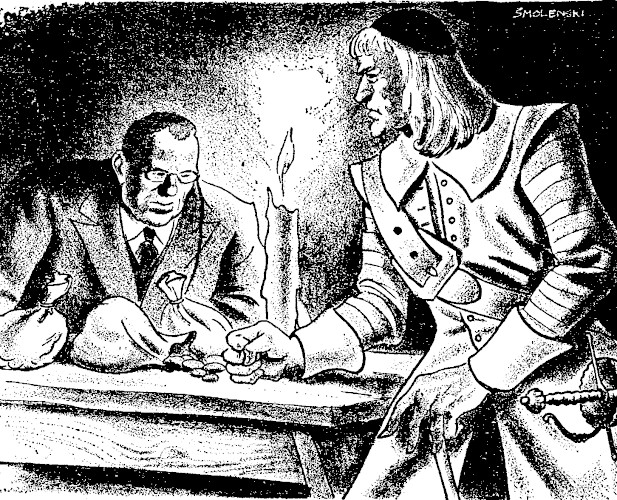
A bargain was struck with Peter Stuyvesant.
Turber came in to us. He bent down. "If you speak or move, I'll have them kill you now." He chuckled. "Say good-by to Nanette—quite a little fortune I paid for her, but she's worth it."
He lifted up Nanette. He untied her thongs. She cried out—just once.
"Don't be frightened, child. I won't hurt you."
Alan and I were straining at our bonds.
"Quiet, you fools!" We had helplessly tried to menace him with words.
He led Nanette from the room. The door closed upon us. We could hear Stuyvesant leaving. And then Turber taking Nanette away. His voice reached us:
"Don't be frightened, child."
There was silence.
Another interval passed. There were again guards in the room outside. I whispered: "Alan, it must be nearly dawn."
We had no idea. There were spaces in the outer log walls where the morticed filling had fallen away. But only blackness showed.
In the adjoining room there was candlelight, and the drowsy voices of the Dutchmen.
"Alan, what's that?"
A thud had sounded; something striking the roof over our heads. Then another. Off in the woods there was a shout. A war-whoop! And other thuds. A rain of arrows falling upon the roof and the side of the little fort.
An Indian attack! The Dutchmen in the adjoining room made short work of getting out of this isolated building. They did not come in even to look at us. They decamped into the woods, running for the village stockade.
We were left alone. Helpless!
The rain of arrows kept on. We could hear the Indians shouting, but they did not advance.
The dawn was coming. Or was it the dawn? A red glow showing through the log walls. Red and yellow. I smelled smoke! Alan coughed with a sudden choking.
The little log blockhouse was being bombarded with flaming arrows. It was on fire, filling up with smoke which already was choking us!
CHAPTER XV
THE RESCUE
Lea and San—after Alan and Lentz left them—kept watch in the tower. They talked together in their own language.
"How long do you think, brother, that they will be gone?"
"Until dawn perhaps. We can only hope for the best. Alan is resourceful—he got you away from Turber, Lea."
They could not guess what Alan and Lentz would do to rescue Nanette and me. They discussed Lentz. A fellow of their own Time-world. Their father had always put great trust in him. But Lentz had known Turber there. Was he a traitor now? A fellow in the pay of Turber? There had been several little things which Alan had brought to light—things to make them suspicious of Lentz. And they knew Alan did not trust him.
The hours passed. The forest was a black wall of silence about the tower. Lea often stood in the doorway, staring out. Small, graceful figure in flowing blue robe and golden hair. We had seen her on the television like that—our first sight of her.
San would not be still. As always when the tower was at rest in a strange Time-world, he constantly paced the room; peering alternately from each of its windows; always within a few feet of the tower controls so that at any hostile sign outside, in a second or two the tower would speed away.
Time dragged by. Lea grew increasingly worried. Alan should be back by now.
"If he would have taken me," she said. "You remember, San, when we were here once before? There was an old chief—Silver Water, you remember? I could have got him then to help me try for Turber in one of Turber's passings. But you would not let me."
"You are over-bold, Lea." San shrugged. "I am helpless—always here with the tower."
"I could, tonight, have enlisted a band of these Indians," she said. "They worshiped me for a goddess—the 'God of Magic,' old Silver Water called the tower."
The Indians had been prostrate before the tower, that other night, and from its steps Lea had talked to them, while San watched at the controls.
"That was one thing," he said. "Safe enough. But to have you leave—tonight—off in these woods to try and find your friendly, gullible Indians—too dangerous, Lea. Alan knew it. He was right."
She presently mounted the tower, while San remained alert below. From the top she could see the Turber camp fire. And the Indian fire to the southeast.
Silence. And then, far away to the south where the pale-face city held the southern tip of the island, Lea thought she heard a shot. Then another. But they were very faint.
Dark spread of silent woods! What was going on out there? The shots were Alan firing at Lentz when we discovered his treachery. But Lea could not know that.
The Hudson River shone in the starlight. Lea saw a huge Indian canoe moving south toward the glow of light which marked the location of the Turber aero. It was one of the canoes bringing in the Turber treasure. But that, too, she did not know.
She went down again and joined San. They waited through what seemed another interminable period.
"We must leave at dawn," said San.
But Lea shook her head. "We will not leave until we know Turber has left—and Alan has failed."
And there was the chance that Alan and Lentz would be in the woods, and return at last, unsuccessful.
"We cannot abandon them, San."
They both suddenly felt that the venture was doomed to failure.
"San! Did you hear that?"
They were at one of the windows. A cautious call had come from the woods. A low hail.
"Lea!" It came again. "Lea! Don't start the tower! I'm coming."
Lentz's voice! They both recognized it. Lea went to the doorway. San was alert at the controls with his gaze on her.
"Wait, San." She gestured. "Wait! I see him."
Lentz appeared from a thicket near by.
"Lea?"
"Yes, Lentz. Where is Alan?"
"I'm coming in. Don't start the tower." He approached. "Disaster, Lea. We could do nothing. Alan was killed by Turber."
Her heart went cold. She stood on the steps. Lentz was alone. He came up the steps, into the tower room. There was blood on his right hand; one of its fingers was mangled. He held out the wounded hand.
He said: "Don't start us yet, San. I want to talk to you. I've been hurt—Turber shot me."
They stood with him in the middle of the room. For that instant the tower controls were neglected. Lentz held out his wounded hand for inspection. His other hand was behind him. It came up over his head. He struck with a dagger at San.
A swift blow, but Lea was quicker. She shoved at him. The blow missed, and San was upon him. And Lea leaped at him also, fighting desperately. They bore him down. His wounded hand was a handicap. The dagger was in his awkward left hand. San fought for it as they rolled on the floor with Lea bending over them.
A brief struggle. San twisted and got the dagger, stabbed with it. Lentz gave a shuddering cry and relaxed.
San climbed to his feet, white and shaken. Lea was trembling.
"Got him, Lea. Accursed traitor."
San's first thought was the controls. Lea stopped him.
"Wait! How do we know Alan is dead? A lie, perhaps, what Lentz told us."
They went to the windows. There was no one in sight. A groan from Lentz brought them back. He lay, gruesome on the floor, with the knife in him and a red stain widening. But he was not dead. Lea bent over him.
"Lea—I want to—tell you the truth."
He died in a moment, but before he died he gasped out the truth of what had happened. He had lurked in the woods and seen us captured by the Dutchmen. Had followed us—himself like an Indian, for he was skilled in woodcraft. He had been here before with Turber, laying plans to get the treasure. He knew these woods well.
He had seen us finally thrown into the fort with half a dozen Dutchmen left to guard us. Then he had gone to Turber. Had told what happened. Turber had set off to see Stuyvesant. Lentz had come back to the tower. If he had killed San, he would perhaps have killed Lea also, and escaped with the tower.
But now he lay dead. He gasped his last words of the confession. Blood gushed from his lungs.
Lea turned away. There was barely time for her to tell San what Lentz had said—they were standing at the doorway—when they became aware of dark figures in the shadowed glade near at hand! Again San would have flung the tower into Time. But again Lea stopped him.
Figures of savages were out there—not menacing, but prostrate upon the ground at the edge of the near-by thickets. It was so dark by the forest edge—the figures were dark and motionless—that Lea and San might not have seen them had not there come a low wail. Mournful cry! A prostrate savage placating this magic god of the forest. This strange tower, with a god and goddess in its doorway standing in this glade which the redskins well knew to be usually empty of such a vision.
Lea's thoughts were swift. Alan and I and Nanette were held by the Dutch in an isolated fort some two or three miles to the south. Lea could control these Indians. She had already proved her power upon one of their chieftains.
She murmured her plans to San. It was hardly a minute from the time they had first seen the prostrate figures.
San stood alert, watching. Lea advanced to the top of the tower steps. She called in the Indian dialect: "Rise up, children of the forest. I would not hurt you. I bring you only good."
She descended the steps slowly. San called anxiously:
"Careful, Lea!"
"Yes, San. Stand on your feet, men of the forest."
Slowly she advanced upon them. Watchful.
They rose at the gesture of her upraised arms. Some ten of them—young braves prowling here in the forest, attracted by the tower's dim light.
They trembled before Lea. Savages of the year 1664! Well might they have thought her a goddess; white, fairy-like creature with flowing blue robe and dangling golden tresses—and the Time-traveling tower behind her.
"I bring you commands," she said, "from the Spirit Land where your fathers hunt now in peace and happiness. You have a chieftain—a man of much power here in these woods. He is called Silver Water—name like a woman, but he is a man very old, and wise, and very good."
One of the Indians stepped forward. "I know him. His lodge—off there by the water of the dawn—not far."
He pointed to the southeast.
"I will go with you," she said. "Lead me. Be not afraid, young braves."
"Lea, come back!" San called.
She turned. "I'll be careful. No danger, San. Watch out for Turber."
She followed the Indians into the dark shadows of the forest.
"But, Goddess of the Sun, I have buried the hatchet with the pale-face intruders here." The old sachem was troubled. He sat by his camp fire with his braves about him. The East River flowed near by. The wigwams of his village stood along it—dark-coned shapes in the gloom. The curious women and children hovered in the background.
Lea stood straight and commanding with her back against a tree. The firelight painted her. She held her arms upraised.
"I am at peace here," the old Indian repeated. "The pale-face chief with the one live leg sat here at my fire and smoked the pipe of peace with me. And you would command me to break my oath—"
"No," she said. "There is one little fort, this side of the city. You know it."
"I know it," he said.
"And it is in your woods."
He nodded gravely. "Yes. They press always farther, these pale-face intruders. But I want no fighting. The white men are very good at killing—and I have heard this day that more of the pale-face ships are coming. One of my braves was in the city today. He came back drunk with firewater, but he had the tale."
"Have they ever broken their word with you?" she demanded.
"Yes—many times."
"Well, it is not my wish you should start any fighting. Merely frighten away the guards of the little fort."
"My braves," he said, "run wild when deeds of violence start. We want no killing."
"No," she agreed. "I will be careful of that."
Lea at last convinced him. There were two gods, and another goddess like herself, held in that little fort by the Dutch. A score of braves and herself could go and frighten away the Dutchmen and rescue them. If they were left there—if evil came to them—then evil would fall upon all this forest.
He listened. Abruptly he stood up and flung his gray braids with a toss of his head; and wound his vivid blanket around him. Dignified, venerable figure. But he was afraid of Lea. Her curse upon these, his forests—his people—
"It shall be as you command. You shall have thirty of my braves. In a moment they will be ready."
The little blockhouse stood in the trees on a rise of ground. Lea, with her Indians about her, moved silently through the underbrush. It was her intention to creep up and surprise the Dutch guards, and to overcome them without arousing the near-by village. The door of the blockhouse faced the other way. The building stood black and silent. Were we in there? Was any one in there? She did not know.
Without warning, taking Lea wholly by surprise, at the edge of the thickets the savages knelt abruptly and shot their arrows.
"Why—" Momentarily she lost her poise.
The young brave beside her drew her back behind a tree-trunk. It startled her. But she saw that he was reverential.
"We will go no farther," he said. "Drive them away."
The lust of battle abruptly swept over the young Indians. With the launching of the first arrow they seemed to forget Lea. The forest rang with their shouts. They spread out; creeping forward. And then with flint and steel bartered from the pale-face, they set their arrows into flame. And launched them.
The young leader standing by Lea murmured: "They are running! See them go—off there—running for their village. The fort will burn."
It was already burning. Dry walls and roof; the flaming arrows struck and caught the bark. Spots of spreading flame.
"Wait!" commanded Lea. "Enough!" She stopped them at last. The fort was blazing. The Dutchmen had decamped.
She added: "Come!" But the young Indians feared to advance; suddenly fearful of what they had done; the great pale-face village could pour out many wrathful men upon occasion.
"Then stay here," said Lea hurriedly.
She left them. She dashed across the short intervening space. She ran around the corner of the burning building. A prayer was in her heart that Alan and Nanette and I were inside and still safe.
She came to the door. It stood open. The room was full of smoke. Its candles gleamed dully; but she saw that the room was empty. And saw a door across it.
She rushed in. The smoke choked her. She held her breath.
The door between the rooms was not fastened. She flung it open. Saw, in the yellow glare of the burning roof—saw Alan and me lying bound and helpless.
We called: "Lea!"
She came—saw the ropes binding us. She dashed back to get a knife lying on the table by the candles. We rolled so that she might cut our ropes. We were all gasping in the smoke. She helped us up; we could barely stand at first, but with her help we staggered out into the blessed cool air of the night.
The building was blazing all over its side and roof. To the south, by the city stockade, the Dutchmen were shouting, but none of them advanced. We ran back to Lea's waiting Indians. There seemed still a chance that Turber's aero might still be there. The Indians led us to the spot. But it was gone, and the camp was deserted.
Then we crossed swiftly east to the tower. It was daylight when we left the braves, prostrate before the tower as it melted into a phantom and vanished.
We were safe—all but Nanette. Of what use to me, this safety? Nanette, to me of all the world most dear, was gone. And this time I had a premonition that she was lost to me forever.
CHAPTER XVI
WHICH THE READER MAY SKIP IF HE CHOOSES
I think it advantageous to my narrative now to set down a few scientific facts. The laws, for instance, under which our Time-traveling tower operated. The Indians of 1664 thought the tower was magic. But it was based upon solid science.
The laws of Time and Space—the true aspect of the Material Universe—all this is, in our age of 1945, imperfectly understood. So I set down here a few succinct truths. Those of you who care to ponder them may do so. You will find that the scientific aspect of my narrative is much clearer. Those of a different turn of mind may pass over this brief chapter.
The basis of the Material Universe is Energy. Energy we can also call by another name—Change. Everything exists because it is changing. The living cell feeds itself and grows; multiplies itself; dies and decays; turns to other forms, liquid and gas—and is not lost, but reconverted. The rocks were gas, then liquid, then solid. The wind and water erodes them—they break, they powder, they blow away, or wash away as dust, and come again in other forms of other things.
The atoms, the very electrons of all matter in the universe, are breaking down or building up. All changing. All are nothing but manifestations of Energy. And Matter itself? Take a fragment of solid gold—we find it built of loosely massed molecules, all in movement; and each molecule a group of agitated atoms; and each atom, whirling electrons and a nucleus—infinitely tiny things to which we give these arbitrary names—things which in themselves in their essence are nothing at all save Energy!
There is no mass. Nothing of solidity! Whirlpools—vortexes of nothingness! Of such unsolid stuff you who read this are built. And your home, and your city, and the Earth under you, and all the stars of the Heavens!
At the basis of all this, also, is unceasing change of position. Every tiny fragment of everything is restless—and every thing, in its entirety, is in motion. We move in space about our tiny Earth. Our Earth whirls us all along; and the Sun sweeps onward, dragging the Earth, itself following some distant Star, which with other Stars is going somewhere. We know all this, now in 1945.
We know, too, that nothing has a continuous existence. Your body, as you now sit reading what you may feel are idle theories, at one instant is existing and at the next is blotted out. And lives again another instant. A changed body, just a little different in every tiny essence of your being from what it was before.
Like a motion picture. There is nothing difficult to grasp in that thought. We see a motion picture as a continuous flow of movement; but we know that in reality the seeming movement is merely a rapid change from one still picture to the next.
So with all our Material Universe. It is as though Time, like a whirling knife-blade, were slashing through us—blotting us out, letting us live only in the progressive instants between the whirling blades.
"Time" is the factor of all this which we find most unnatural to envisage in its true aspect. I would have you imagine now, what I might term the physical aspect of Time. Consider it, for instance, as an all-pervading etheric fluid. Consider it strewn in a line from the Beginning to the End. Our minds are so limited that we must conceive everything in terms of tangibility—even the intangible. So I would have you picture Time as a stream of imponderable, invisible fluid. Imagine it in shape so that it could lie in some gigantic pipe—perfectly straight—of some inconceivable length. We put the Beginning and the End to bound it.
This Time-fluid, then, you must picture as being at rest—the one thing of all things which does not move nor change. It lies there—forever.
But do not forget this pipe-line of Time-fluid in which all this is happening! Let us cling to simple physical analogies. We must imagine, for instance, that the Time-fluid is progressively of different physical character along all its length from its Beginning to its End. Like water in a pipe—hot at one end, cold at the other, with every gradation of temperature in between. Or, to be just a trifle closer to fact, perhaps, the stream of Time might be imagined as a beam of light—red at one end and violet at the other—with every tint and shade merging along the way.
Something then—like a Thought—is put into the pipe-line of Time at the Beginning. If you have conceived the fluid of Time as being hot at the Beginning—then imagine that this foreign, intangible substance which has been placed there is the same temperature. Because of that, let us say, it can remain there. But only for an instant! Because the foreign substance instantly desires to change its character. It desires, let us say, to become a bit cooler. It wants to reexist; to perpetuate itself in changed form.