Chapter XV · SEA WEEDS (continued 2)
Reading edition
Plate VIII.
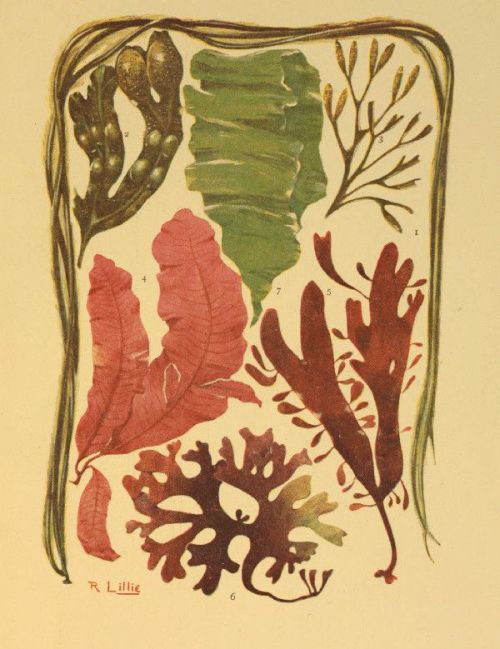
SEA-WEEDS
1. Chorda filum4. Delesseria (Maugeria) sanguinea
2. Fucus vesiculosus5. Rhodymenia palmata
3. Fucus canaliculatus6. Chondrus crispus
7. Ulva lactuca
Alaria esculenta is an edible species known as the Badderlocks in Scotland, and also locally as the Henware, Honeyware, and the Murlins. It has a fibrous root, and a stalked, lanceolate, entire frond with a distinct midrib throughout. The stem is winged with finger-like leaflets, in which the spores are arranged in oblong clusters.
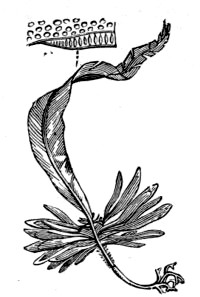
Fig. 270.—Alaria esculenta
In the genus Chorda the frond is a simple, cylindrical tube, divided internally by numerous transverse membranes, and the spores are distributed over the surface. The commonest species is C. filum (see Plate VIII.), the frond of which is very slimy, and often from ten to twenty feet in length. In its young state it is covered with gelatinous hairs, but these are worn off as the plant develops. A smaller species (C. lomentaria) is sometimes found on our shores. Its fronds are constricted at intervals, taper at the tip, and grow in tufts. It is seldom more than a foot long, and is not of a slimy nature.
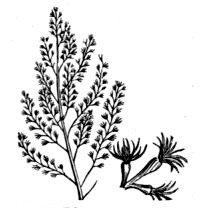
Fig. 271.—Sporochnus pedunculatus
The Sporochnaceæ have inarticulate, thread-like fronds, and the spores are contained in oblong, stalked receptacles, each of which is crowned with a tuft of slender jointed filaments. The typical genus contains only one British species—Sporochnus pedunculatus—and even that is by no means common. It is, however, a very pretty weed of a delicate texture and pale olive-green colour. Its stem is long and slender, pinnately branched, and the branches bear numerous small thread-like tufts.
The same order contains the genus Desmarestia, in which the frond is long and narrow, thread-like or flattened, with a tubular jointed thread running through it. Young specimens have marginal tufts of branching filaments. The species decay very rapidly after removal from the water, and should therefore be dried and mounted as quickly as possible. D. ligulata, so named from the flat, strap-like frond, is common on all our coasts. It is pinnately branched, and all the branches and branchlets taper towards both ends. D. viridis has a cylindrical, thread-like and freely-divided frond, with opposite branches and branchlets. It occurs more commonly on the northern shores.
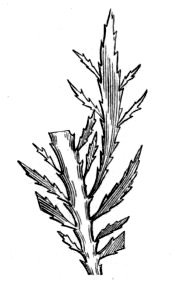
Fig. 272.—Desmarestia ligulata
The last order of olive-spored weeds is the Fucaceæ, some species of which are so abundant between the tide-marks, from high-water to low-water levels, that they form a very important characteristic of our shores. They are mostly large, tough, and leathery weeds, without joints, and the spores are contained in spherical receptacles embedded in the substance of the frond.
In the typical genus—Fucus—the root is a conical disc, and the frond flat or compressed and forked. Most of the species are furnished with one-celled air-vessels in the substance of the frond, and these serve to buoy up the plants and keep them more or less erect when submerged. The spore-receptacles are usually embedded near the tips of the branches, but are sometimes borne on special branches or shoots. They are filled with a slimy mucus and contain a network of jointed filaments. The weeds are very hardy, capable of withstanding long exposures to air and sun, and are sometimes to be found above high-water mark, where they are watered only by the spray of the waves for a brief period at intervals of about twelve hours. Although they are not usually looked upon as ornaments in the collector’s herbarium, they will repay examination for the tufts of smaller and more beautiful weeds to which they often give attachment and shelter.
Four species are common on our coasts, and these may be readily distinguished by the most cursory examination. The Serrated Wrack (F. serratus) has a flat, forked frond with toothed edges and a strong midrib, ranging from one to four feet long, and no air-vessels. The Knotted Wrack (F. nodosus—Plate VII.) may be known by its flattened, thick and narrow frond, without a distinct rib, from one to five feet long. The branches are narrow at the base, pointed at the tip, and are jointed to short projections on the main stem; and both these and the main stem have very large oval air-vessels. The spore-receptacles are mounted on slender stalks which arise from projections on the branches, and are of a bright yellow colour when mature. This species does not grow so near to high-water mark as do the others. Another species, the Twin-Bladder Wrack (F. vesiculosus—Plate VIII.)—is abundant everywhere along the coast, and is largely used by agriculturists both as manure and as fodder for cattle. The frond is flat, with a distinct midrib, and a non-serrated edge. Air-vessels are not always present, but when they are they usually occur in pairs, one on each side of the midrib, and are globular in form. The spore-receptacles are situated at the tips of the branches, are full of mucus, and are frequently forked. The last of the common species is the Channelled Wrack (F. canaliculatus—Plate VIII.), distinguished by a narrow frond, rounded on one side and channelled on the other. It has no midrib or air-vessels, and the fruit is contained in forked receptacles at the tips of the branches. This is the smallest of the genus, and may be found at all levels between the tide-marks. Stunted specimens may also be seen in situations where they are never submerged, but watered only by the spray of the highest tides.
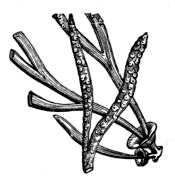
Fig. 273.—Himanthalia lorea
The genus Himanthalia provides us with a single species (H. lorea) which is very peculiar on account of the small size of the frond as compared with the enormous dimensions of the spore-receptacles. The young frond is a pear-shaped sac which soon becomes flattened into a hollow disc. This disc then becomes solid, and concave above, and from its centre there arises a bi-forked, strap-like receptacle that often reaches a length of three or four feet, and may be mistaken for the frond of the weed by those who do not take the trouble to examine it. This weed is commonly known as the Sea Thong.
Belonging to the genus Cystoseira we have a few well-known weeds with conical disc-roots, and shrubby fronds with woody stem and alternate branches. The air-cells are in the substance of the frond, and the spore-receptacles at the tips of the branches. One of the species (C. ericoides) is of a heath-like habit, with a short, woody stem, and slender branches bearing hooked, leaf-like branchlets. Its air-cells are small, and are arranged singly near the tips of the branches; and the spore-receptacles are cylindrical, with hooked points. This weed is common on the south and west coasts, and may be readily distinguished by the beautiful iridescence it displays when in the water. C. fibrosa is very similar in general form, but is larger, and the air-vesicles are more conspicuous. It is not iridescent when in the water. A third species is named C. granulata from the rough and knobby appearance of the stem, due to numerous oval projections, from some of which spring the slender, much-divided branches. The air-vesicles are arranged in groups of two or three, and the spore-receptacles are at the ends of the branchlets. Our last example is C. fœniculacea, found on the south coast only, and readily distinguished by the numerous blunt spines that cover its long branches. The air-vesicles are narrow and pointed, and situated just below the forkings of the branchlets.
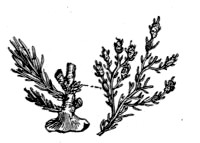
Fig. 274.—Cystoseira ericoides
We conclude our résumé of the British sea weeds with a short description of the Podded Sea Oak (Halidrys siliquosa), which grows in the tide pools from high-water to low-water mark, the specimens inhabiting the shallow pools being only a few inches long, while those that grow in deep water often reach a length of three or four feet. It is an olive, shrub-like weed, with a conical, disc-like root that adheres very firmly to the rock, and a pinnately-branched frond with leaf-like branchlets. The air-vesicles are cylindrical and pod-like, divided internally into about ten cells, and the spores are contained in globular receptacles at the tips of the branchlets.
The young algologist will probably meet with many difficulties in his attempts to classify his sea weeds and name the various species in his collection. In dealing with an unknown weed we strongly recommend him to first determine the order to which it belongs. The genus should next be settled; and then, if possible, the species. It must be remembered, however, that he who has made himself acquainted with the principles of classification has done good work, and that it is far better to be able to arrange the weeds into properly-classified groups than to merely learn the names of the different species without regard to the relations which they bear to one another. The following table will probably assist the reader in the determination of the orders, but it must be remembered that a microscope will often be necessary for the examination of the spores and the minute structure of fronds.
CLASSIFICATION OF SEA WEEDS
A. Chlorospermeæ—Green-spored weeds. Fronds usually grass-green, and filamentous or membranous.
1. Confervaceæ—Frond thread-like, composed of cylindrical cells placed end to end. Spores very minute, formed within the cells.
2. Ulvaceæ—Frond grass-green or purple, flat or tubular. Spores minute, ciliated, formed in the cells of the frond.
3. Siphonaceæ—Frond a single, thread-like, branching cell, or a spongy mass of many such cells.
B. Rhodospermeæ—Red-spored weeds. Spores in globular conceptacles. Tetraspores (four-clustered spores) in globular or cylindrical cells. Frond red, reddish brown, or purple.
4. Ceramiaceæ—Frond thread-like, jointed, one-siphoned, and more or less covered with a layer of cortical cells. Spores grouped in transparent, membranous sacs, sometimes surrounded by a whorl of short branchlets.
5. Spyridiaceæ—Frond thread-like, jointed, one-siphoned, more or less covered with small cells. Spores formed in the upper cells of branched, jointed, radiating threads, enclosed in a cellular membrane in external conceptacles.
6. Cryptonemiaceæ—Frond more or less cartilaginous, composed of numerous jointed threads compacted by gelatine. Spores grouped without order in internal cells or in external conceptacles.
7. Rhodymeniaceæ—Frond inarticulate, membranaceous, composed of polygonal cells, the surface cells forming a continuous layer. Spores in beaded threads in external conceptacles.
8. Wrangeliaceæ—Frond inarticulate, thread-like, traversed by a jointed tubular axis. Spores formed in the terminal cells of clustered, branching, naked threads.
9. Helminthocladiæ—Frond cylindrical, gelatinous, composed of filaments imbedded in gelatine. Spores formed on branching, radiating threads that are enclosed in the frond without conceptacles.
10. Squamariæ—Frond lichen-like, rooted by under surface, composed of vertical filaments imbedded in firm gelatine. Spores in beaded threads in wart-like projections.
11. Spongiocarpeæ—Frond cylindrical, branching, cartilaginous, composed of netted filaments imbedded in firm gelatine. Spores large, in radiating clusters in wart-like excrescences.
12. Gelidiaceæ—Frond cartilaginous, inarticulate, composed of hair-like filaments. Spores attached to slender threads in internal conceptacles.
13. Sphærococcoideæ—Frond leaf-like or thread-like, inarticulate, cellular. Spores formed in beaded threads in external conceptacles.
14. Hapalidiaceæ—Frond minute, calcareous, composed of a single layer of cells.
15. Corallinaceæ—Frond calcareous. Spores in tufted threads at the bases of the conceptacles.
16. Laurenciaceæ—Frond rounded or flattened, branching, inarticulate, cellular. Spores in external oval or globular conceptacles. Tetraspores irregularly scattered over the branches.
17. Rhodomelaceæ—Frond leafy, thread-like, or jointed, composed of polygonal cells. Spores in external conceptacles. Tetraspores in distorted branchlets or in receptacles.
C. Melanospermeæ—Olive-spored weeds. Frond tough, leathery. Spores in globular cavities in substance of frond.
18. Ectocarpaceæ—Frond jointed, thread-like. Spores attached to or imbedded in branchlets.
19. Chordariaceæ—Frond gelatinous or cartilaginous, composed of interlacing vertical and horizontal filaments. Spores internal, attached to the filaments.
20. Dictyotaceæ—Frond inarticulate. Spores superficial, arranged in definite spots or lines.
21. Laminariaceæ—Frond inarticulate. Spores covering the whole frond or in cloud-like patches.
22. Sporochnaceæ—Frond inarticulate. Spores attached to jointed filaments which are either free or compacted.
23. Fucaceæ—Frond inarticulate, large and tough. Spores in globular cavities.