Chapter XII · MARINE MOLLUSCS (continued 2)
Reading edition
The reader has probably experienced the difficulty of detaching a limpet from its hold on the rocks. The tenacity of the grip is not due to the mere adhesive power of the foot itself, but to atmospheric pressure, the effect of which is complete on account of the total exclusion of air from under the disc of the foot; and when we remember that this pressure amounts to fifteen pounds on every square inch of surface, we can readily understand the force required to raise a large limpet from its position.
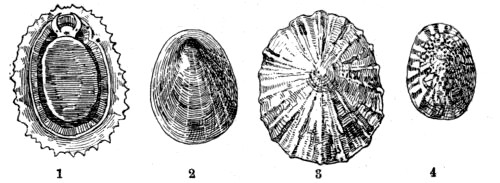
Fig. 166.—Patellidæ
1. Patella vulgata. 2. P. pellucida. 3. P. athletica. 4. Acmæa testudinalis
The Common Limpet (Patella vulgata) is found on all our rocky coasts between the tide-marks, often at such a level that it is left exposed to the air for eight or nine hours at a time. The apex of the shell of this species is nearly central, and the exterior is sometimes nearly smooth, but more commonly relieved by radiating ribs.
Although the shell itself is not a particularly pretty object, it is often rendered very beautiful and interesting by the various animal and vegetable organisms that settle on it. Those shells that are left dry for hours together are commonly adorned with clusters of small acorn barnacles, while the limpets that have found a home in a rock pool and are perpetually covered with water, often resemble little moving gardens in which grow beautiful tufts of corallines or other weeds, as well as polyzoa and other animal forms.
It appears that limpets are not great travellers, the appearance of the rock from which they have been removed being such as to point to a very long period of rest. Those on hard rocks are generally situated on a smooth surface just the size of the shell and generally worn slightly below the surrounding level by the constant friction of the shell; while others that have settled on very rugged spots have their cones adapted to the irregular surface. It has been suggested that the animals make occasional short excursions from their chosen spot, but return again to it; and whether or not this is the case, it is evident that they frequently keep to one small spot for a considerable length of time.
Limpets on chalk and other soft rocks are sometimes in circular pits so deep that even the apex of the shell is below the general level around; and though it is possible that the abrasion is produced entirely by the friction of the shell as the animal turns, yet, in the case of chalk, the action may be partly due to the carbonic acid gas given off by the animal as a product of respiration, for it is a well-known chemical fact that this gas, in solution, has the power of dissolving calcareous material.
The other British Limpets include P. pellucida, which lives on the fronds and stalks of the tangle, the form of the shell varying according to that of the surface on which it rests; also the Horse Limpet (P. athletica), the bold radiating ribs of which are irregularly notched; and Acmæa testudinalis—the Tortoiseshell Limpet, with reddish-brown mottlings on the exterior, and a dark-brown patch at the apex within. The last-named species lives principally on sea weeds, and has a single pectinated gill in the cavity between foot and mantle, which is protruded on the right side when the animal is extended. This latter feature is interesting since it shows a tendency to that one-sided development already referred to as characteristic of the typical gasteropod, resulting in the spiral form of the adult.
In the limpets the lingual ribbon is proportionately long, and is easily removed for examination. In P. vulgata it may exceed an inch in length, and the teeth are arranged in rows each of which contains four central, with laterals on either side, while in Acmæa there are only three laterals on each side of the central line.
Other so-called limpets belong to separate families. Thus we have the Cup-and-Saucer Limpet and the Bonnet Limpet in the Calyptræidæ. Both these differ from Patella in that the apices of their shells show a tendency to assume a spiral form, thus denoting a somewhat closer relationship to the more advanced univalves. They have distinct heads, with prolonged muzzles, and well-formed antennæ and eyes. The teeth of the lingual ribbon are single, with dentated laterals on either side.
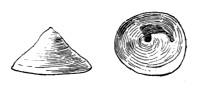
Fig. 167.—Calyptræa sinensis
The Cup-and-saucer Limpet (Calyptræa sinensis) is so called on account of a curved plate that projects from the interior of the shell, at the apex; and though this plate takes the form of a half-cup rather than of a cup, the whole shell has suggested the popular name, while the generic name is derived from calyptra, which signifies a cap. This mollusc is occasionally found among stones at low tide, but usually lives beyond this line, thus necessitating the use of a dredge. The Bonnet Limpet (Pileopsis hungaricus) is of similar structure and habit, but the nucleus of the shell is a more decided spiral (see Plate V.). Both these animals adhere to stones and rocks, and, like the common limpet, seldom or never move from their selected sites; hence their shells are variable in form, being adapted to the rock below, and the movements of the shell often cause a little hollow to be scooped out of the softer materials.
Yet other limpets belong to the next family Fissurellidæ, which is characterised by a perforation or a notch in the shell. In these, too, the shell is conical, with a tendency to assume the spiral form, but the curve of the nucleus, which is always apparent in the young shell, frequently disappears as the growth proceeds.
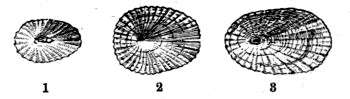
Fig. 168.—Fissurellidæ
1. Puncturella noachina. 2. Emarginula reticulata. 3. Fissurella reticulata
In the Keyhole Limpet (Fissurella reticulata) which is found chiefly on our southern shores, the perforation is at the summit of the shell; but as the animal grows the hole increases in size, encroaching on the curved nucleus until the latter quite disappears. In the genus Puncturella the perforation is just in front of the recurved apex, and is surrounded by a rim internally; while in the Notched Limpets (genus Emarginula) it is represented by a fissure on the anterior margin of the cone. In all, however, the hole or notch serves the same purpose, for it is the means by which water enters the siphon.
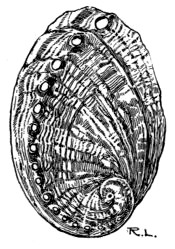
Fig. 169.—Haliotis
It is doubtful whether we ought to claim the beautiful Ear shell (Haliotis tuberculata) as one of our own, but it is generally included among the British molluscs on the ground that it is abundant on the coast of the Channel Islands, where it is called the Omar; and it is certainly too beautiful an object to be excluded from the British species without ample cause.
It belongs to the family Haliotidæ, and our illustration will show that the shell is less elevated than that of limpets, and that the spire, though not prominent, is a fairly well-formed spiral. All along the outer lip of the very large aperture is a series of perforations, occupying the summit of a prominent, spiral ridge, and becoming gradually smaller and smaller towards the spire. The whole shell is pearly in structure, and displays a great variety of rich colouring. It is used largely for inlaying and other ornamental purposes, and for making the so-called pearl buttons. The animal is used largely as an article of food in the Channel Islands, but it is of so tough a nature that it requires a vigorous beating previously to being cooked.
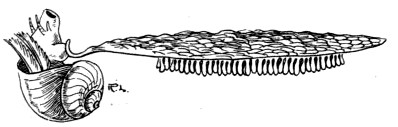
Fig. 170.—Ianthina fragilis
The same family contains the beautiful violet Ianthina, which also is not a British species, but a free-swimming oceanic snail. It is, however, occasionally drifted to our shores, though generally in an imperfect condition. In the Atlantic and the Mediterranean it sometimes abounds in such multitudes as to distinctly colour the surface of the sea.
It will be seen that the shell is round, with a well-formed spiral. The spire is white, but the base is of a deep violet colour. The animal is very remarkable in some respects. In the first place, though it has pedicels similar to those on which the eyes of the higher univalves are placed, yet it has no eyes. Then the foot, which is in itself small, secretes a float or raft so large that it cannot be retracted into the shell, with numerous air vesicles to render it light, and the egg-capsules of the animal are attached to the underside of this. The animal has no power of sinking, but lives exclusively at the surface; and, when disturbed, it exudes a violet fluid that colours the surrounding water. It is apparently the only gasteropod that lives in the open sea and has a large and well-formed spiral shell.
Passing now to the family Turbinidæ we meet with turbinated or pyramidal shells that are of a brilliant pearly lustre within, and frequently without also when the epidermis is removed. The animals inhabiting them have well-formed heads with a short muzzle, long and slender tentacles, and eyes mounted on peduncles. The sides are ornamented with fringed lobes and several tentacle-like filaments, and the aperture of the shell is closed, when the animal is retracted, by a spiral operculum. They are all vegetable feeders; and, as is usual with the plant-eating molluscs, the teeth on the lateral portions of the lingual ribbon are very numerous.
We have a few common species belonging to this group, mostly members of the typical genus Trochus and commonly known as Top Shells. In these the shell is a pyramid formed of numerous flat whorls, with an oblique and rhomboidal aperture. Of the three species figured (including two on Plate V.) T. umbilicatus and the Large Top (T. magnus) are umbilicated, the umbilicus being very large in the latter; and the former is characterised by the zigzag greyish or reddish markings that run radially across the whorls. The other (T. zizyphinus) is usually of a yellowish or pink colour and has no umbilicus.
The same family contains the pretty little Pheasant Shell (Phasianella pullas), which is richly coloured with red, brown, and yellow on a light ground; and Adeorbis subcarinatus, shown in the same group.
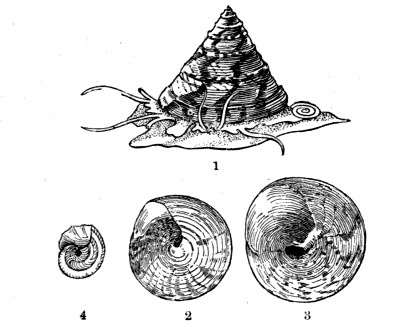
Fig. 171.—1. Trochus zizyphinus. 2. Under side of Shell. 3. Trochus magnus. 4. Adeorbis subcarinatus
The well-known Periwinkle (Littorina littorea) and the species to the right of it on Plate V., belong to the family Littorinidæ, the members of which are similar in structure and habit to Trochus, but the shell is usually more depressed, and is never pearly. The shell of the Periwinkle is thick, having but few whorls, and is not umbilicated; and the lingual ribbon, which is coiled up on the gullet, contains no less than about five hundred rows of teeth; but only a little more than twenty of these rows are in action at any one time, the remainder being a reserve stock to come into active service as the ribbon grows forward. In the genus Lacuna there is a narrow umbilicus, and the aperture of the shell is semilunar in form; and the species of Rissoa are very small, with white or horny shells, much more pointed and having more whorls than those of the Littorina.
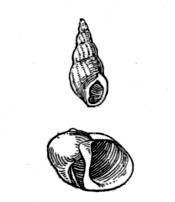
Fig. 172.—Rissoa labiosa and Lacuna pallidula
Our next illustration shows three shells of the family Turritellidæ, so named from the resemblance of the shells to a tower or spire. The form indeed is so characteristic that they can hardly be mistaken. It will be seen that Turritella communis is striated spirally, while the surface of Scalaria communis (Plate V.) is relieved by strongly marked transverse ribs. Both these species are very common, and the latter is peculiar for its power of ejecting a dark purple fluid when molested. The other representative of the family—Cæcum trachea—has a shell something like that of Dentalium (p. 238), being cylindrical and tubular, but it differs in being closed at one end.
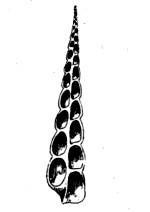
Fig. 173.—Section of Shell of Turritella
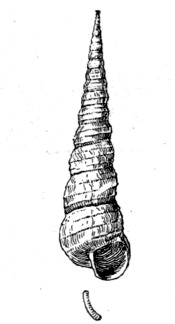
Fig. 174.—Turritella communis and Cæcum trachea
In the succeeding shells, of the family Cerithiadæ, the spire is also considerably produced, so much so that some of the species closely resemble the Turret shells, but they are distinguished by usually having an expanded lip, at least in the adult form; and the mouth is channelled in front, and sometimes also behind. The animals of the group have short muzzles that are not retractile, the tentacles are wide apart, and the eyes are mounted on short pedicels. The median teeth are arranged in a single row, with three laterals on either side of each.
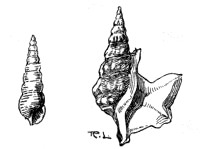
Fig. 175.—Cerithium reticulatum and Aporrhais pes-pelicani
Cerithium reticulatum receives its generic name from its appearance to a small horn, and the specific name refers to the netted appearance of its surface due to the presence of numerous little tubercles arranged in rows—a feature that serves to distinguish it from the small Turret shells. It is a common shell, as is also the other representative of the family illustrated, but the latter is rendered conspicuous by the enormously expanded lip that has earned for it the popular name of Spout Shell. Its scientific name is Aporrhais pes-pelicani, and the application of the specific term will be understood when the shell is viewed from above, for the expanded lip is drawn out into long finger-like lobes that suggest the foot of a bird. This is a very solid shell, sometimes reaching a length of two inches; and the animal inhabiting it is carnivorous.
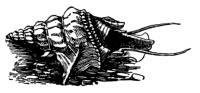
Fig. 176.—Aporrhais pes-pelicani, showing both shell and animal
We have yet some turreted shells to deal with, belonging to the family Pyramidellidæ, but they need not be confused with the preceding groups if carefully examined. In the first place, the aperture of the shell is very small; and the operculum, instead of being spiral, as in the turreted shells before mentioned, is imbricated or made up of parallel layers denoting that the growth took place on one side only. Another distinguishing feature is seen in the nucleus—that small portion of the spire that was developed within the egg—which is sinistral or left-handed. In addition to this, the animal has broad, ear-like tentacles, a retractile proboscis, and a lingual ribbon without teeth.
The British species of this family belong principally to the genera Odostomia, characterised by a tooth-like fold of the columella; Eulima, containing small, white, polished shells with numerous level whorls; and Aclis, with little polished shells not unlike Turritella.
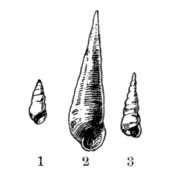
Fig. 177.—1. Odostomia plicata. 2. Eulima polita. 3. Aclis supranitida
The last family of the Holostomata is the Naticidæ, the shells of which are almost globular, with only a few whorls, and a small, blunt spire. The mouth is semilunar in form, and the lip sharp. The proboscis of the animal is long and retractile, and the foot large; but perhaps the most characteristic feature is the presence of large mantle lobes which hide some of the shell when the animal is crawling. In Natica (fig. 155), the typical genus, the shells are somewhat thick and smooth, with a large umbilicus. As the animal crawls a large fold of the mantle is reflected back over the head, completely covering it, and apparently obstructing its view; but this is not the case, for the creature has no eyes. Natica is very abundant on some sandy beaches, where it devours small bivalves and other animals; and it is frequently washed up alive by the waves. Its shell is also a favourite one with hermit crabs. Its eggs, all connected together in a spiral band, may often be seen stranded on sandy coasts. Several species of Natica are found on our shores. An allied mollusc—Velutina lævigata, so called on account of the velvety epidermis that clothes the shell, completely surrounds the shell by its mantle folds when creeping.
The Siphonostomata form a much smaller section than the last, and its members are distinguished mainly by the presence of a true siphon, formed by the prolongation of the mantle margin, and serving to convey water into the gill chamber. In all these the shell is spiral, usually without an umbilical opening, and the margin of the mouth is prolonged into a canal or distinctly notched. The operculum is horny, and lamellar or imbricated. The animal has a retractile proboscis, and the eyes or eye-pedicels are joined to the tentacles. All the species of this division are marine.
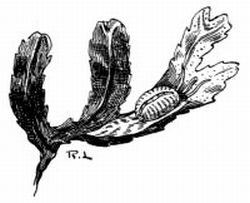
Fig. 178.—Cypræa (Trivia) europæa
We will first take the family Cypræidæ, which contains the familiar Cowries, these forming the lowest group of the division. An examination of the shells may at first seem rather puzzling, for the spire is concealed, and the whole is convoluted in such a manner as to make the mouth long and narrow, with a channel at either end. The outer lip is also thickened and bent inward, and there is no operculum.
The animal itself is particularly interesting, for, as it creeps along on its broad foot, abruptly shortened in the front, the mantle lobes bend over the top, meeting along the middle line, where they are usually fringed with little tentacle-like processes; and, as a result, the whole shell is beautifully enamelled on the outer surface. In all the Cowries the central teeth are single, and the laterals are arranged either in twos or threes.
Perhaps the commonest representative of this family is the pretty little Cypræa (Trivia) europæa (Plate V.), the shells of which are sometimes washed up in large numbers on sandy beaches. The animal lives mainly below low-water level, but it may often be found in the larger rock pools, creeping rapidly over the tangles, and may be easily secured with the aid of a net.
In the same family we have the little Erato (Marginella) lævis, the white shell of which is minutely furrowed along the lips; and also Ovulum patulum (Calpurna patula), so called on account of its fancied resemblance to a poached egg.
We have also several species of Cone shells (family Conidæ) on our coasts, readily recognised by their form, which is a cone, with a long, narrow aperture, partially closed by a minute operculum. As in the last family, the foot is abruptly shortened in front. The head is very prominent, with eyes situated on the tentacles. There are two gills, and the teeth are arranged in pairs.
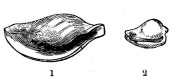
Fig. 179.—1. Ovulum patulum. 2. Erato lævis
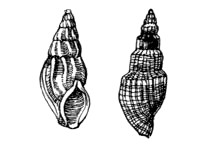
Fig. 180.—Mangelia septangularis and Mangelia turricula
The Conidæ are principally inhabitants of tropical seas, where some very large species exist. Two of the British representatives, both common shells, are shown in fig. 180.
Our next family (Buccinidæ) is so well distributed on our coasts, that it would be difficult, we imagine, to find a spot quite free from its familiar forms. It contains all those creatures commonly known as Whelks, Dog Whelks, and Dog Winkles, ranging from deep water almost to high-water mark.
In all these the shell is notched in front, or the canal is turned abruptly upward. The foot of the animal is broad, the eyes are situated either on the tentacles or at their bases, and there are two gill plumes.
All the species are carnivorous, and some are said to be very destructive to mussels and young oysters.
The Common Whelk (Buccinum undatum, Plate V.) lives in deep water, whence it is dredged up largely for the market. Its clusters of egg cases are washed up in large numbers on the beach, where they form one of the commonest materials among the refuse at high-water mark. It is not uncommon, also, especially after storms, to find the unhatched eggs stranded by the waves, and these are so transparent that the embryos, several in each capsule, may be seen within. The hole through which the young escape may also be seen on the inner side.
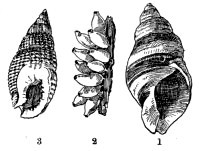
Fig. 181.—1. Purpura lapillus. 2. Egg Cases of Purpura. 3. Nassa reticulata
The Dog Periwinkle (Purpura lapillus) abounds on all our coasts and is remarkable for the production of a dull crimson or purple fluid that may be obtained from it by pressing on the operculum. This fluid turns to a brighter colour on exposure to air, and is said to have been used largely in former times as a dye. It will be seen from our figure that the spire of this shell is shorter in proportion than that of Buccinum; but both are alike in that the operculum is made up of layers with a nucleus on the external edge.
The other species figured is Nassa reticulata, popularly known as the Dog Whelk, and characterised by a tooth-like projection of the inner lip close to the anterior canal. It is very common near low-water mark, where it may be seen crawling over the rocks on its broad foot, from which project two hornlike appendages in front and two narrow tails behind.
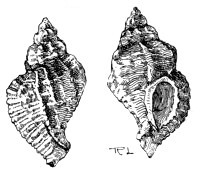
Fig. 182.—Murex erinaceus
From the last family of the gasteropods (the Muricidæ) we select two common species—Murex erinaceus and Fusus antiquus (Plate V.). In both these the anterior canal of the shell is straight and the posterior wanting. The eyes are on the tentacles, and there are two plumed gills. Both are carnivorous species, feeding on other molluscs; and the former is said to bore through the shells of its prey with the prominent beak of its shell.
Murex may be readily distinguished by the prominent longitudinal ridges of the thick shell, its rounded aperture, and by the partly closed canal running through the beak. It is known to fishermen as the Sting Winkle; the other species is called the Red Whelk in some parts, and in Scotland is known as the Buckie. Like the common whelk, it is dredged largely for the market, and is said to be far more esteemed than the former, from which it may be distinguished by the fusiform shape of the shell and the long straight canal.
We now pass to the last and highest class of the mollusca, called the Cephalopoda because they have a number of arms attached to the head, round the mouth. Unlike the majority of molluscs they are bilaterally symmetrical: and are much more highly organised, in some respects even making an approach to the vertebrates. Thus they generally have an internal hard structure, either horny or calcareous in structure, representing the vertebral column, and the circulatory system consists of arteries and veins, connected by minute capillaries. The corpuscles of the blood are also similar in form to those of the vertebrates. Externally they are all naked, with the exception of the nautilus and argonaut of the warmer seas.
The arms, so characteristic of the class, are eight or ten in number, long and muscular, and provided with numerous suckers by which the animal can cling with remarkable tenacity. These suckers are situated on the inner surface of the arms, and the disc of each one displays a series of muscular fibres, all converging from the circumference towards the centre, which is occupied by a softer structure that works inwards and outwards like the piston of a pump. Thus the suckers form a system of exhausting air-pumps by which a vacuum can be produced, and the tenacity of the grip, maintained by atmospheric pressure, is so great that the arms, strong as they are, may be torn asunder by attempting to pull them from their hold; and yet the animal can release its grip with the greatest of ease by simply releasing the pistons of its pumps.
The cephalopods are further distinguished by their very large, glaring eyes, situated on the sides of the well-formed head, and by powerful jaws that work in a vertical plane, like those of the vertebrates, but somewhat resembling the beaks of certain birds. The tongue is also very large and fleshy, and in part armed with numerous hooked spines or teeth.
The class is usually divided into two orders, one characterised by the possession of two gills, and the other of four; but the British species belong to the former, known technically as the Dibranchiata. This order is subdivided into two sections according to the number of arms; and the divisions are called the Octopoda and Decapoda respectively.
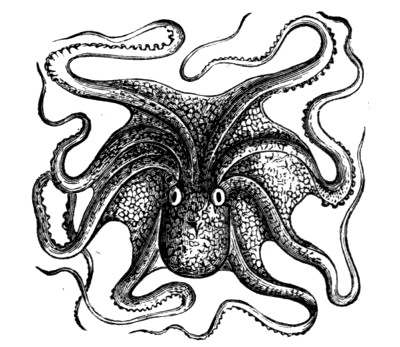
Fig. 183.—Octopus
The former section includes the Octopods, of which some species inhabit our seas. They all have eight arms, of unequal size, with the suckers arranged in two rows, and their round or oval bodies seldom have any fins, locomotion being effected by means of the arms, and by the sudden expulsion of water from the siphon. The shell is rudimentary, being represented merely by two short ‘styles’ within the mantle. The species vary considerably in size, some being only about an inch long when fully grown, while others measure two feet or more, and are looked upon as formidable creatures by man. Sometimes they are washed up on our beaches, but the best way to make their acquaintance is to examine the contents of the fishermen’s drag nets as they are hauled on the beach.
In the same manner we may secure various species of the Decapods or Ten-footed Cephalopods, which comprise the Calamaries, Squids, and Cuttlefishes. These, too, properly speaking, have but eight arms, the other two appendages being really tentacles, which are usually longer than the arms, and more or less retractile; they are also expanded at the ends. The decapods are also to be distinguished from the octopods by their elongated bodies, and a flattened, fin-like appendage on either side. Their eyes, also, are capable of being rotated within the orbits, while those of the octopods are fixed; and the shell consists of one or more horny ‘pens,’ or of a calcareous ‘bone,’ contained in a cavity so loosely that it drops out of its place when the cavity is opened.
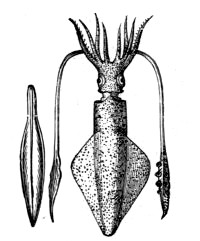
Fig. 184.—Loligo vulgaris and its Pen
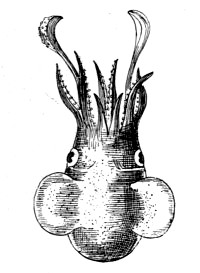
Fig. 185.—Sepiola atlantica
The Common Calamary (Loligo vulgaris) may be recognised by the accompanying illustration, from which it will be observed that the body tapers behind, bearing two rhomboidal fins in the rear. The suckers are arranged in two rows on the arms, but in fours on the expanded tips of the tentacles. The animal is a good swimmer, and sometimes crawls, head downwards, on the disc surrounding the mouth, pulling itself along by means of its arms. Its shell is a horny pen, lanceolate in form, but it divides as the age of the animal advances, so that two or more may be found in the same specimen.
Belonging to the same family we have the Common Squid (Sepiola atlantica), also a very abundant species. Here the body is shorter and purse-like, and the fins are dorsal and rounded. It seldom exceeds four or five inches in length, and, like the Calamary, is used largely as a bait by fishermen.
Another family—the Sepiadæ—contains the Cuttlefish (Sepia officinalis), the ‘bone’ of which is such a common object on the beach. This latter is a broad, curved plate of carbonate of lime, made up of a number of regular layers, and having a cavity hollowed out at the posterior end. It is exceedingly light and porous in structure, and at one time was used largely as an antacid as well as a dentifrice. It is also proportionately large, being both as long and as broad as the body of the animal.
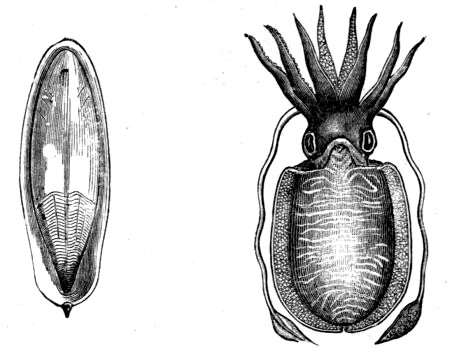
Fig. 186.—Sepia officinalis and its ‘Bone’
Cuttlefishes live principally in the shallow water close to shore, where they swim backwards by the sudden propulsion of water from their siphons; and their eggs, which look like clusters of black grapes, are frequently thrown up on the beach, generally attached to the stems and fronds of sea weeds.
As a rule the cephalopods swim slowly by the aid of their fins or by a rhythmic contraction by which water is expelled from their siphons, but when in danger the muscular contraction is so violent that they dart through the water with great speed, and even leap into the air to avoid their enemies. But they have another and much more remarkable way of escaping from their foes:—They possess a gland, the duct of which opens into the base of the funnel or siphon, that prepares an inky fluid; and when the animal is disturbed it suddenly ejects this fluid, rendering the surrounding water so cloudy that it is often enabled to retreat unobserved. The ‘ink’ of the Sepia was used for writing in former times, and is still employed in the preparation of the artist’s pigment that bears the same name. Fishermen are well acquainted with this peculiar characteristic of the animal, for they are frequently bespattered with the contents of the ink bag of the Sepia when the creature is included in the contents of their draw-nets, and have learnt to handle it cautiously until the objectionable fluid has been all discharged.
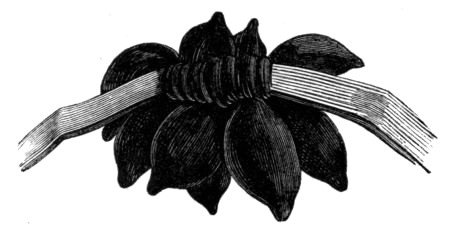
Fig. 187.—Eggs of Sepia
We will conclude this chapter by giving a tabular summary of the classification of the molluscs which will probably be useful to the collector of marine objects.
CLASSIFICATION OF THE MOLLUSCA
Class LAMELLIBRANCHIATA—Plate-gilled. Headless, usually enclosed in bivalve shell.
Section SIPHONIDA—Mantle lobes more or less united to form tubular siphons.
Families—Pholadidæ, Gastrochænidæ, Anatinidæ, Myacidæ, Solenidæ, Tellinidæ, Mactridæ, Veneridæ, Cyprinidæ, Lucinidæ, Cardiadæ, &c.
Section ASIPHONIDA—Mantle lobes free or nearly so. No true siphons.
Families—Arcadæ, Mytilidæ, Aviculidæ, Ostreidæ, &c.
Class CEPHALOPHORA—Head-bearing. Usually enclosed in a univalve shell.
Section PTEROPODA—Wing-footed molluscs.
Section GASTEROPODA—Stomach-footed molluscs.
Order Nucleobranchiata—Viscera form a nucleus on the back.
Order Opisthobranchiata—Shell generally absent. Gills more or less exposed.
Section Nudibranchiata—Naked gills.
Section Tectibranchiata—Gills covered by shell or mantle.
Order Pulmonifera—Lung-breathers. Terrestrial.
Order Prosobranchiata.
Section Holostomata—Aperture of shell entire (sea snails).
Families—Chitonidæ, Dentaliadæ, Patellidæ, Calyptræidæ, Fissurellidæ, Haliotidæ, Turbinidæ, Littorinidæ, Turritellidæ, Cerithiadæ, Pyramidellidæ, Naticidæ, &c.
Section Siphonostomata—Possess a true siphon. Carnivorous.
Families—Cypræidæ, Conidæ, Buccinidæ, Muricidæ, &c.
Class CEPHALOPODA—Sucker-bearing arms round the mouth.
Order Dibranchiata—Two gills.
Section Octopoda—Eight arms.
Families—Argonautidæ, Octopodidæ.
Section Decapoda.
Families—Teuthidæ (Calamaries, Squids), Sepiadæ, &c.
Order Tetrabranchiata—Four gills (containing Nautilidæ).