LECTURE VI THE CHINESE STATIONS
Reading edition
LECTURE VI THE CHINESE STATIONS
Fifteen hundred miles away from Singapore, guarding the northern outlet of the China Sea as Singapore guards the southern, commanding also the approach to the great commercial city of Canton and to the whole coastline of 1 southeastern China, lies the island harbour of Hongkong, the last fortified outpost of British power in this region of the world. The island is only one of a large group which fringes the coast round the mouth of the Canton river, and its area is less than thirty square miles, 2 or nearly the same as that of Labuan. It consists of a long irregular granite ridge, falling steeply to the sea, with deep-cut inlets on its southern side. To the north is the mainland, with long hill ranges ending in a mass of rocky peninsulas and headlands. Between the island and the mainland lies the narrow roadstead or harbour of Victoria.
As we round the west point of the island, the Peak is on our right, and below it are warehouses, wharves and piers, spread out for three miles along the water front. Behind is the crowded native quarter, and in the background the city rises in tier above tier of terraced houses up the lower slopes of the ridge. On the summit, too, we can see many 3 houses scattered about. Here is a panoramic view of the west end of the city, taken from the harbour. Notice the fine pile of offices and the European Club in the foreground 4 of the picture. Our next view, further east, shows the Admiralty dockyard, which makes an ugly break in the line of the sea front. The white band on the hill behind is the cable railway running up to the Peak. We pass merchant steamers, warships, and crowds of junks at anchor, and all about us the small native boats or sampans are plying busily to and fro. Opposite the middle of the town, where the low peninsula of Kaulun juts out from the mainland, the harbour narrows to rather more than half a mile, and here is the ferry. On our left as we enter is Stonecutter Island, a long bare rock heavily fortified and guarding the passage; beyond it to the north the view is everywhere 5 closed in by the mountain ridges of the mainland. Here are two views from the hill, showing the west end of 6 the harbour, with Stonecutter Island and Kaulun; a third shows the eastern passage, known as the Lai-i-mun, by 7 which we shall leave after our visit.
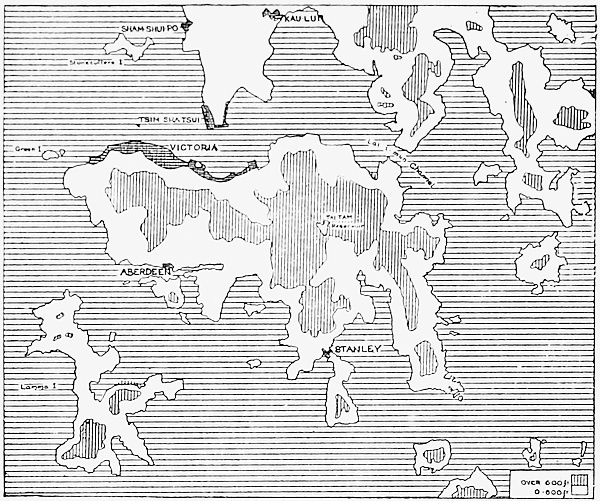
Hongkong Island.
Seventy years ago Hongkong was a mere rock, inhabited by a few fishermen; its sole value lay in its anchorage beyond the reach of Chinese troops. For two centuries the East India Company had traded on sufferance at Canton, but in 1834 its trade monopoly was abolished and the servants of the Company gave place to a British official. The Chinese failed to understand the change; they wished to treat our representative just as they had treated the merchants. In the end the foreign community was forced to leave Canton, and we despatched an armed expedition to support our claim to trade and to place the interests of British subjects on a secure footing. The war which followed is often styled the opium war; but the opium trade was only one item in the quarrel which involved recognition by the Chinese of international relations.
Our merchants, driven from Canton, and warned off from Macao by the Portuguese, who feared the Chinese and were jealous of our trade, took refuge in the roadstead of Hongkong, though the Chinese placed batteries on Kaulun and threatened to fire on the ships. In this way we first came to the island, which was ceded to us by the Treaty of Nanking in 1842. In 1860, at the conclusion of 8 another war, we obtained full possession of the Kaulun peninsula, which we had already leased from the local authorities as being necessary for the security of the harbour. Finally, in 1898, we leased the New Territory at the back of Kaulun, amounting in area to about 370 square miles. This was just as necessary under present conditions as the peninsula of Kaulun had been in the past, since Victoria with its shipping would be at the mercy of long-range artillery mounted on the hills of the mainland. From the first the Chinese people, recognizing the value of the security given by British rule, flocked to the island; so that we now have over 300,000 Chinese residents in the island and peninsula, excluding the leased Territory, and on the native boats and junks, while the European population numbers only a few thousand. The Chinese seem to prefer our system of government to their own. Hongkong is not merely a fortress; it is a free port, except as regards the importation of alcohol, and one of the greatest commercial centres in the world; but without the Chinese its trade could not be carried on for a single day.
Let us now land and learn something of the city and its 9 inhabitants. We stroll along Queen’s Road, the main artery of the town from west to east, with its offices and shops and its general air of prosperity. Then we turn off into a street running upwards from the harbour; it is 10 Pottinger Street, named after Sir Henry Pottinger, the trainer of the treaty of 1842. The tall houses and narrow roadway remind us that there is very little level ground in Victoria and that space is valuable. We could judge this also from the general views of the Peak which we saw as we entered. Trade needs money, and there are various banks in the city; one of the finest buildings is that of the Hongkong and Shanghai Bank, which is well known in England and has a large branch in London. If we go into one of these banks we find that many of the clerks and cashiers are native Chinese. Here is the entrance to the 11 Hongkong and Shanghai bank and here is the back of the great block of fine buildings. The statue in the corner is that 12 of the late Queen Victoria, and the figures in the foreground are Chinese women carrying pigs in baskets. The whole of this area, with its open spaces, including a cricket ground, and the mass of buildings which we saw from the harbour, has been reclaimed from the sea. In one of the narrow 13 streets we may see something of native customs. It is New Year’s Day, a great festival among the Chinese; all over the ground there is a litter of crackers, and we may perhaps see them solemnly firing a huge cracker in front of some important house as a kind of New Year’s greeting. At a corner we come on a scene which reminds us of 14 London: the road is up and labourers are at work, but here they are Chinese. Down on the water front is another aspect of native life. Here we have a large 15 population living always in covered boats; there are millions of Chinese living in this fashion on the rivers and waterways of the mainland.
To see how the Europeans live we must leave the busier part of the town and climb up the hill. Down below, in the native quarter, the houses are crowded together and the air is close. Higher up are trees and gardens and 16 open spaces. Here is a view from Battery Path, on our way up. We end our walk at Government House, where 17 we see the inevitable Chinese gardener at work.
To get a view of the island we must take the cable railway to the very summit of the Peak. It is much cooler here and there are many European houses. Hongkong is on the edge of the Tropics and is wet and warm in summer, while the town of Victoria is shut off from the sea breezes by the surrounding heights. But the upper part of the ridge is open to the Southeast Monsoon winds blowing in from the sea, and so it is a healthy residence for Europeans not unlike the hill stations of India.
In the matter of health, the island in past years had not a good name. On the southeast coast is Stanley, 18 a primitive little village on a beautiful bay; here is the spot where the British troops first landed in 1840. Further west, behind a sheltering island, is Aberdeen, which was also occupied for a time. But both were found to be unhealthy and so the troops were withdrawn. Stanley is a mere fishing village, though the graves of the soldiers and their wives are there to remind us of the price which we pay for our Empire. Aberdeen is a little more important, as it possesses a dock. But its main industry is fishing; and 19 here we can see the fishermen, watched by an admiring crowd, dragging out a large rock fish, which will be towed alive, behind a launch, to the market at Victoria. The mass of the population of the island is concentrated in Victoria, which is greatly overcrowded. Much has been done for health by improved drainage, and the great reservoir at Taitam, in the southeast corner of the island, with the concrete channels for gathering the heavy rains on the hill slopes, provides an ample supply of good water; but the Chinese have peculiar ideas as to sanitation, and plague and epidemic diseases are frequent, so that Hongkong has drawbacks as a place of residence, especially for European children. Though the hill is cooler than the town, it is damp, so that many prefer the drier Kaulun district on the other side of the water. Here a new Victoria 20 is growing up with busy wharves and docks. Land is being reclaimed from the sea, and in the surrounding 21 hills we find granite quarries with abundant material for the building of docks and sea walls. On a small hill near the landing stands a curious tower, with masts and flag-staffs 22 around it. This is the observatory, which watches the weather and especially gives warning of the approach of the dreaded typhoons of the China seas. These are fierce whirling storms which sweep in, usually in the autumn, from the ocean to the south-east, and then curve northwards along the coast of China towards Japan, carrying ruin in their track. In 1906, the warning failed to come: many large steamers were sunk or driven ashore; trees were rooted up and buildings beaten to the ground, and enormous damage was done to the piers and quays on the 23 water-front. Here is the signal which is hoisted to give notice of the coming of a typhoon.
Behind Kaulun is the New Territory: a land of mountain and torrent, with here and there a broader valley 24 with fields of rice and sugar-cane. Here we see some of these rice fields on the route of the new railway. 25 Notice how the ground is flooded. The population, about 100,000 in all, is not very dense and is grouped in scattered villages. Here is a view of the picturesque country at the 26 back of Kaulun, with a cattle depôt in the foreground to remind us that the city must be fed from the surrounding 27 country. Here again we see a street in Tai-wo-shi and a group of villagers gathered round the village 28 well. Let us pay a short visit to Wun-yin, or “Pottery” village, for a glimpse of a native industry. We see a 29 potter at work, painting the little bowls, but he does not look quite the same as the ordinary Chinese of the 30 south. He is a Hakka, as is also this native woman, who does not seem in the least nervous in front of the camera. Neither is handsome, but they are very useful in Hongkong, since they do much of the hard manual work which is necessary in a great port. The Hakkas are immigrants, of a different race from the natives of the Canton district, and they have different habits. Among other peculiarities they do not bind the feet of their women.
In the New Territory we are already changing the face of the country. Water is being impounded in great 31 reservoirs for the supply of Kaulun, and a railway twists and burrows through the valleys and mountains, and connects at the frontier with the Chinese railway to Canton. So the Territory has a future of its own, but its real importance is as a protecting barrier to the harbour of Hongkong.
Hongkong is an excellent instance of the attraction which a free port, under a Government which gives security for life and property, and deals out even-handed justice, has for an industrious native race. The liberality with which the wealthier Chinese support public objects in Hongkong, such as schools and hospitals, is the best proof that they appreciate the methods and value of British rule.
The close connexion which has always been maintained between Canton and Hongkong, and the fact that the British Concession at Canton is an interesting survival from an earlier stage of our relations with China, justify us in paying a flying visit to that city before continuing our voyage northwards. So we board one of the small local steamers and pass up the broad river, with the old forts on its banks, which more than once have been bombarded by our fleets, until the growing crowd of native shipping tells as that we are approaching the great commercial 32 city. Here are junks and sampans packed together or moving slowly about the river, and huge shallow-draught steamers, resembling pictures of the old boats on the Mississippi, fifty years ago. We land at last on the 33 Shameen, the British settlement outside the walls. It was originally a mere mud bank, facing the main river and protected by a narrow creek at the back. Now it 34 is laid out as a European town, with open spaces, a church, and European houses and gardens. Here is a view of the 35 creek with the English bridge. Across the creek is a Chinese suburb, thickly packed with native houses, 36 and beyond are the high walls of the vast city with its million of turbulent people. We cross the bridge and make our way to the massive gates; if we are wise we shall take a guide with us. From the top of the old wall we look down over a sea of roofs, with here and there a fire lookout or a huge building, a pawnshop, showing above the general level. Hidden below is a mass of narrow and winding streets, and far away, in the very 37 midst of the city, towers the great Flowery Pagoda. Just below it is a building which we must visit, the old British Yamen, at one time the residence of our officials, though they now prefer the greater comfort of the Shameen. Here, in the heart of Canton, in the former palace of a high Chinese official, we established a British representative. It was a great change from the days when British merchants carried subservient messages to the city gates and the Chinese refused to interview or in any way recognize British officials. This interesting building is of great 38 significance in the history of our relations with the great Empire of the East. Here are two views of the Yamen; 39 we seem to be very much in the heart of China.
Canton has, to some extent, lost its former importance for us, and its merchants no longer have the monopoly of the whole external trade of China; so we return to Hongkong without further delay, and rejoining our ship steam out through the narrow eastern passage, the Lai-i-mun, and turn northwards on our voyage.
Our next port of call is Shanghai, a most important (1) centre of British trade and influence and in close connexion with British stations in the East, though not one of them itself. Hongkong is the great exchange station for shipping and trade in the Far East; Shanghai is the market and business centre for the great basin of the Yangtse river and for much of North China as well. Its importance may be measured by the fact that over half the total trade of China passes through the hands of its merchants. There are two Shanghais, and the contrast between them 40 is great; on the one hand we have the old native walled city, dirty and decaying and purely Chinese, and on the 41 other the new Foreign Settlement, where all the business is done. This part has grown steadily in size and prosperity. The French still have entire control of their own section, but in the International Settlement, which was at one time purely British, Germans and Americans have now a considerable share. We have here a very curious system: a foreign municipality established on Chinese soil and governing itself, subject only to the control of the foreign Consuls and the Ministers at Peking. It is responsible for a few thousand Europeans and over half a million Chinese. At Hongkong we are supreme in everything; but at Shanghai, though the citizens of foreign nations are subject to their own laws, the city is still legally part of China, so that the natives are under the jurisdiction of Chinese officials. This has been the cause of great trouble in the past, as Chinese and Western ideas of law are widely different. It is a very strange position. Here is a small body of foreign merchants, practically unprotected, in the midst of a vast native population, yet responsible for the well-being of one of the greatest commercial cities in the world.
Trade is the sole foundation of this new Shanghai, and 42 trade depends on the river Hwangpu; for though Shanghai is the outlet for the Yangtse basin, it stands at some distance from the main river and the sea, at the head of the tideway of a small tributary and in close contact with a great network of canals and rivers in the fertile country to the west. The bank of the river is lined with wharves, warehouses and factories, and the Settlement is spreading steadily down towards Wusung. The flat country round has been built up of silt brought down by the main river; centuries ago Shanghai may have been on the coast. The river is still at work: great banks are formed under water, and in a few generations become dry land thickly populated. In the whole breadth of the Yangtse mouth there are only two channels navigable by large vessels. Everywhere the land is gaining on the sea. Into the broad silt-laden estuary the little Hwangpu empties itself below Wusung; it brings down no silt, but the incoming tide sweeps in the muddy water of the main river. The silt is dropped and the stream is too weak to scour it away. At the mouth of the Hwangpu is a great bar, which is still growing; and so much has the channel changed and shallowed that it is no longer safe for the largest vessels to approach Shanghai. We may see the same process going on in England, in the Humber and the rivers flowing into the Wash. The Chinese are at last beginning to move; a new channel has been cut for traffic on the Hwangpu; the bed of the river has been dredged and its course straightened, and an embankment built to keep out the silt from the main river. But the size of the vessels engaged in trade increases every year and the future of Shanghai is in the balance; it remains to be seen whether modern engineering will win the day against the vast forces wielded by the Yangtse. Any decline in the activity of Shanghai would be likely to result in more business for Hongkong.
We leave Shanghai for the last stage of our long voyage 43 from Europe. As we steam northwards, the coast on our left is low, fringed with banks and without harbours or inlets; it is the edge of the great alluvial plain of China. But on the second day we come in sight of high bare cliffs, backed by dark mountains. We are approaching the promontory of Shantung, an isolated block of highland, cut off sharply by the sea on its eastern edge and sinking on the west to the shifting beds of the Hwang-ho and the maze of waterways which covers the great plain. Towards the southwest corner of the peninsula lies Kiaochau, now a possession of Germany; in the middle of the north side is the old Treaty Port of Chifu; and between Chifu and the extreme eastern point of the promontory is the bay and port of Wei-hai-wei. The map shows us that north of Shantung the coast again becomes low and uniform, difficult of access and without good seaports; but a hundred miles away, across the water, another mountainous peninsula, Liaotung, stretches out to meet Shantung, where a string of little islands partly bridges the broad channel. In Liaotung, as in Shantung, are headlands and deep inlets and harbours; here we have Port Arthur and Talienwan. The two great promontories seem framed by Nature to guard the approach to the Gulf and the capital province of China. On the one, two foreign Powers are established by diplomacy; two more have fought for the control of the other.
We steam round the eastern headland, with its white 44 lighthouse nestling below the gloomy hills, and soon a wide bay begins to open out ahead of us. We have reached the end of our voyage. The bay forms a rough semicircle, about six miles across, ringed in by hills to the south and west, but open to the northeast, except where for two miles across the entrance stretches the island of Liukung, hilly in the west but tapering off to a long low reef in the east. The island and the northeastern bend of the mainland enclose an anchorage sheltered from the northerly gales which sweep in from the sea in winter. This is the harbour of Wei-hai-wei. In the midst of the broad southern channel, a mere dot upon the water, is a rocky islet, I-tao, or Sun Island, crowned with the ruins of strong fortifications. There are other such ruins on the high ground to the north and south, commanding the two entrances to the bay. These relics contain the history of Wei-hai-wei.
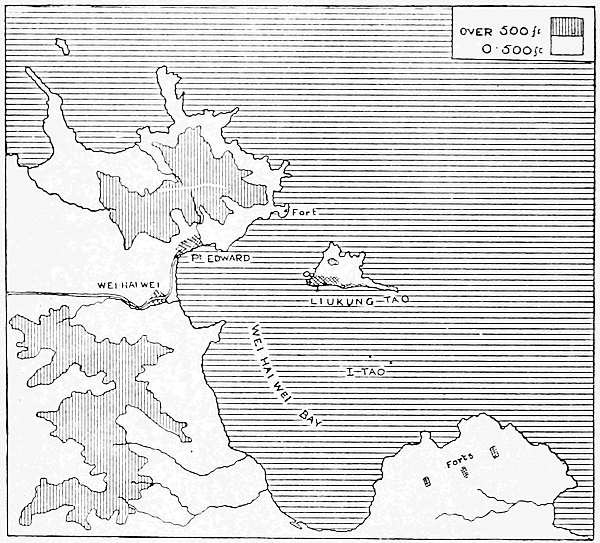
Wei-hai-wei.
It was here that the Chinese fleet, during the war with Japan in 1895, took refuge after the loss of Port Arthur and the defeat off the Yalu. Japanese troops landed further east and captured the forts on the mainland, while their fleet attacked the booms drawn across the wide entrances. The nearness of the mainland was a source of weakness to the island and the Chinese fleet; and Admiral Ting, assailed both from land and sea, was at length compelled to surrender, so that Japan now held the two defences of the passage-way to Peking, and China’s case was hopeless. Early in 1898, Germany obtained a lease of Kiaochau, as compensation for the murder of some missionaries; a few weeks later Russia seized Port Arthur, and in July of the same year Wei-hai-wei was leased to us. It was not merely by chance that the three events followed one another so closely.
Wei-hai-wei was adopted as a naval base and for the protection of our commerce, since Hongkong is over a thousand miles away. The control of a considerable zone on the neighbouring mainland is necessary for the security of the harbour, so that the leased territory covers in all an area of 285 square miles, or about twice the size of the Isle of Wight. The case is like that of Kaulun. 45 We are fortunate in the time of our visit, as the fleet is at anchor in the bay and the crews are practising mining operations; but at another time we might find the place deserted. There is no permanent garrison, as Wei-hai-wei is only to be used as a flying base and practice ground for the fleet. On the island are the marine 46 barracks, which remind us of England, and the naval hospital, which looks quite Chinese, in spite of its English occupants. The hospital is the more important, since our squadrons in the Eastern seas have great need of a sanatorium, and Wei-hai-wei, with its temperate climate, is the most healthy of all our positions in this part of the world. There is a cricket pitch on the parade ground and English sailors are everywhere to be seen in the little town; but we turn a corner and come upon a building which is 47 peculiarly Chinese, an open-air theatre, to remind us that we are merely visitors among a foreign people with customs very different from our own. Let us climb the hill towards the golf links, and crossing over look down on the northern channel. There is no town here, as the shore is rugged and unsheltered and lashed by heavy seas in the winter storms. The island is a natural breakwater and this is the seaward side.
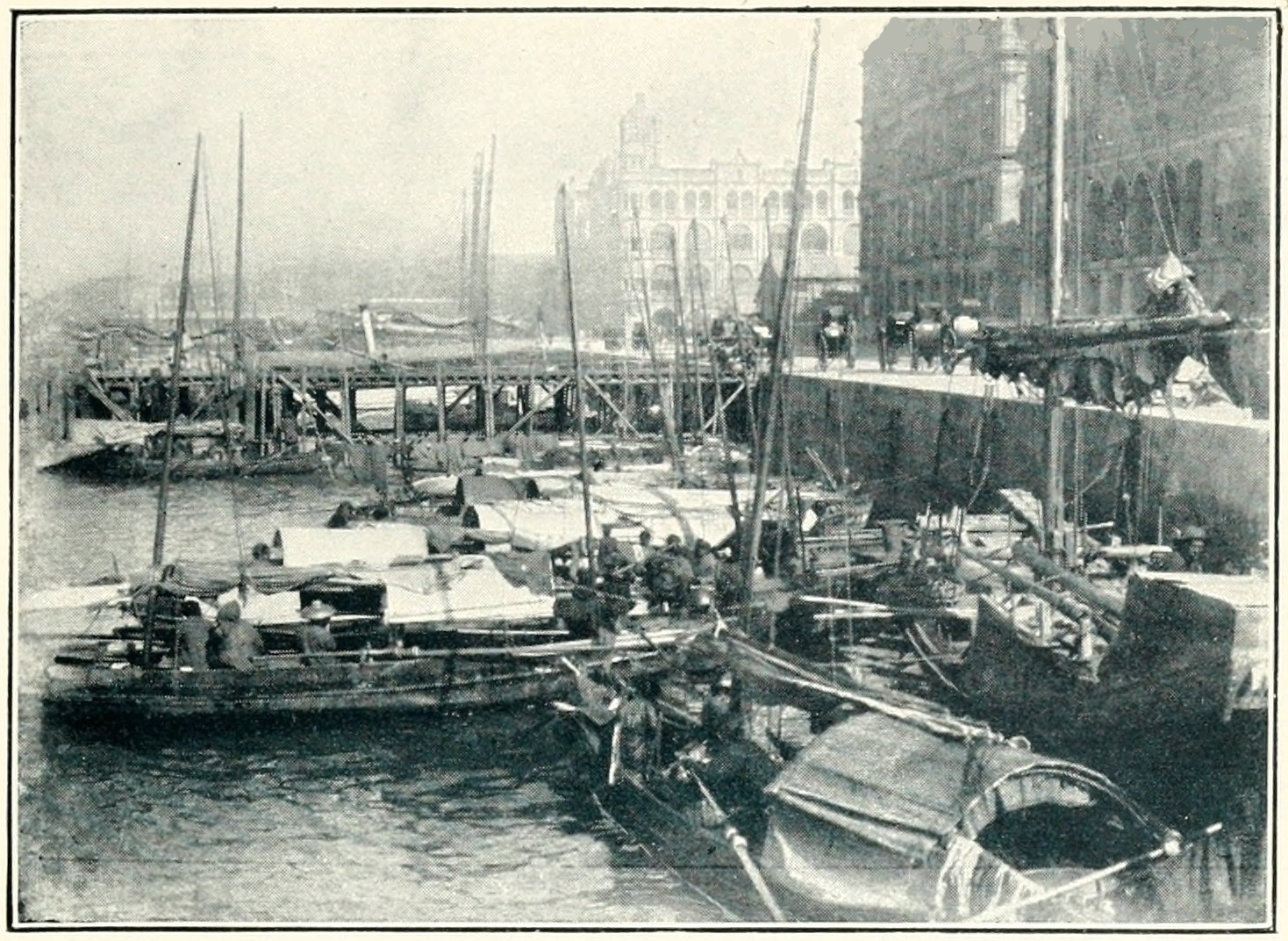
Copyright.]
[See page 103.
Victoria: The Water Front.
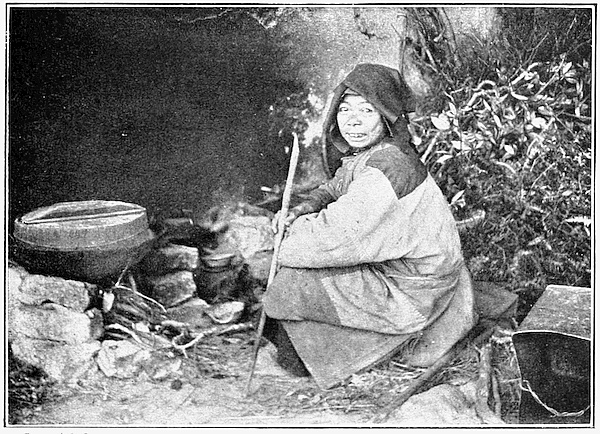
Copyright.]
[See page 105.
A Hakka Woman.
Copyright.]
[See page 111.
Naval Hospital, Liukungtao.
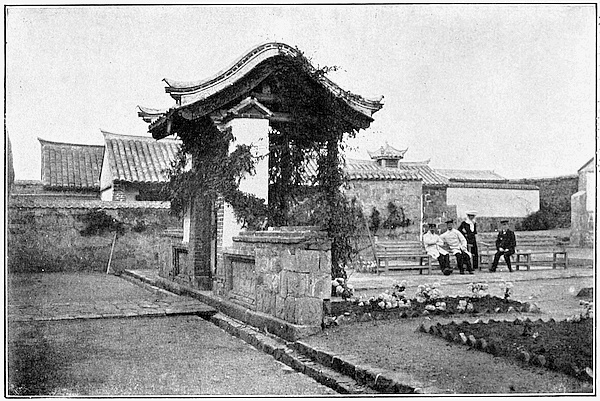
We will now cross in the steam launch to the mainland 48 and step ashore at Port Edward. Here is a general view of the new town, with its ugly modern hotel and its European houses scattered about the lower slope of the hill. The territory on the mainland is rather more interesting than (44) the island. It is little more than a strip, ten miles wide, along the coastline of the bay, though we have certain rights over a larger area. Mountain ridges, rising to over a thousand feet, with sharp peaks still higher, cross it from west to east, dark and bare with deep-cut ravines which are torrents in rainy weather. A low isthmus divides the high ground round Port Edward from the main mass of the Territory; through it runs the new road towards Chifu, and at its eastern end, close to the sea, stands the Chinese walled town of Wei-hai-wei, from which the whole district takes its name. Far away in the southwest are the high mountains of Chinese Shantung. The old city, though within sight of Port Edward, is not like the surrounding territory under British control. Let us pay it a short visit to see what a Chinese provincial town is like. We 49 can go in by the eastern gate and look along the street and visit the temple of Confucius, the great Chinese 50 teacher and philosopher, who was a native of the Shantung province. Much of the space within the walls is not built on; the whole town seems sleepy and decaying, and our ideas as to cleanliness and sanitation are quite unknown to the Chinese. In the British area there are no such towns, but hundreds of little agricultural villages scattered about in the low-lying parts of the country. The Chinese peasant here is very different from the coolie or shopkeeper of Hongkong and is governed in a very different way. A Civil Commissioner, assisted by a few Europeans and a small force of police, is responsible for the control of over 150,000 Chinese. At one time there was 51 a regiment of soldiers, recruited from the natives; when this force was disbanded, some of its members became police. Even in the central offices many natives are employed on the staff, while the villages practically rule themselves through the local headmen. Here we 52 have a portrait of a typical headman, and here a group receiving medals as a reward for good service. The 53 Governor of Shantung is the nearest high official representative of China; and we may see him here in his 54 chair of state on his way to pay a formal visit to the Commissioner. Here again is a group of the two high 55 officials and their respective staffs. We are a long way from those early days, in the middle of the nineteenth century, when Chinese officials refused even to write to our representatives on terms of equality.
Let us now see something of the natives and their occupations. It is market day in Port Edward; the streets are alive with crowds, buying, selling and haggling, 56 and crowding round the food stalls with their piles of strange delicacies in bowls and saucers. In one corner they are bargaining for pigs, in another are piled loads of fuel, scrub oak and fir, brought in from the country round on the backs of donkeys and mules. There is no coal, and the peasant has stripped the country of most of its woods, here as in other parts of China. Here again we have a 57 village market and a group of peasants with sacks of grain and bundles of brushwood for sale. Outside the village 58 they are threshing the grain in a primitive way with a roller, and drying peanuts on the threshing floor. Everywhere, on the banks of the streams, we find the village 59 washing-places, where clothes are washed and pounded in the fashion which the Chinese adopt all the world over. 60 Down on the shore we see the fishermen cutting up sharks for the fins, which are greatly prized by the Chinese as a relish. Mat’ou was a fishing village on the site of the present port before the Japanese occupation, and fish of all kinds swarm in the neighbouring seas. Agriculture and fishing are still the main business of the people. It is 61 true that here at Port Edward we see them repairing junks, and a great quantity of timber is lying about; but the timber must all be brought from the Yalu river, 62 and the old iron which is piled near has been salved from the sunken warships at Port Arthur. Notice the pony, with his load of brushwood, in the foreground. There are as yet no materials for local industries, and it does not seem likely that Wei-hai-wei, in its isolated corner, will grow into a great commercial centre. None the less we may see an important European settlement develop on the site of the old native fishing village. It is not too far away from Peking and Shanghai; the rainfall in the year is about the same as in London, though there are far fewer rainy days, as the rain falls more in heavy showers; while the summer is dry, and cooler than in most of China. There is already a school for European boys at Port Edward, and it seems well fitted as a summer watering-place for those whose work takes them to the Far East. In winter it is less pleasant. The northern gales bring 63 snow, as we see in this picture, and the cold is so severe that the thick ice is collected, as in northern Europe, to be stored for use in summer.
We have visited Canton and Shanghai because there we find a few Englishmen, living on Chinese soil, but under their own laws and with certain limited powers of self-government. In Shanghai, even these privileges are not exclusive, as they are shared with other foreigners; and they do not imply any interference with the political sovereignty of China. Wei-hai-wei and the New Territory behind Kaulun we govern, but only on lease; Hongkong and the peninsula of Kaulun alone are ours in full possession. So we return to Hongkong, as the last outpost of British power in the Far East and the real terminus of our voyage.
Let us pause here, on the outer rim of our Eastern 64 Empire, and try to realize its position with reference to the great lines of the world’s traffic. South of us lies the route which we have traced from Singapore and India; while another route, as yet in its infancy, leads past Borneo to Australia. Across the Pacific, from the eastward, come the steamers from British Columbia and San Francisco; and soon, when the Panama Canal is finished, there will be direct communication from the Atlantic seaboard of the United States. So we see a great concentration of routes on our Eastern Empire, in the region where the influences of India and China meet and overlap. The key to this frontier region is in Singapore, but behind Singapore lies India.
We have approached India from the northwest, by the passage of the Mediterranean and the Suez Canal; and we have seen how our interests in the Mediterranean, at first purely European, have become more and more related to the control of the seaway to India. Southwest is the older route, by way of the Atlantic and the Cape, a route still valuable for some purposes. Here the control of the route led us on to the occupation of the neighbouring mainland of Africa. Southeast again we reach Australia, either directly across the ocean or threading the island group of Malaya; while the Indian Ocean has its own system of minor local routes. So we have lines of traffic from every part of the world converging on the Indian region, with its vast trade and swarming population; the natural junction of all these sea roads, great and small, is Colombo, close to the mainland of the Peninsula, yet at the same time well out in the open sea, the centre of control from which India reaches out in every direction and dominates the Indian Ocean.