THE SAUCIEST BOY IN THE SERVICE
Reading edition
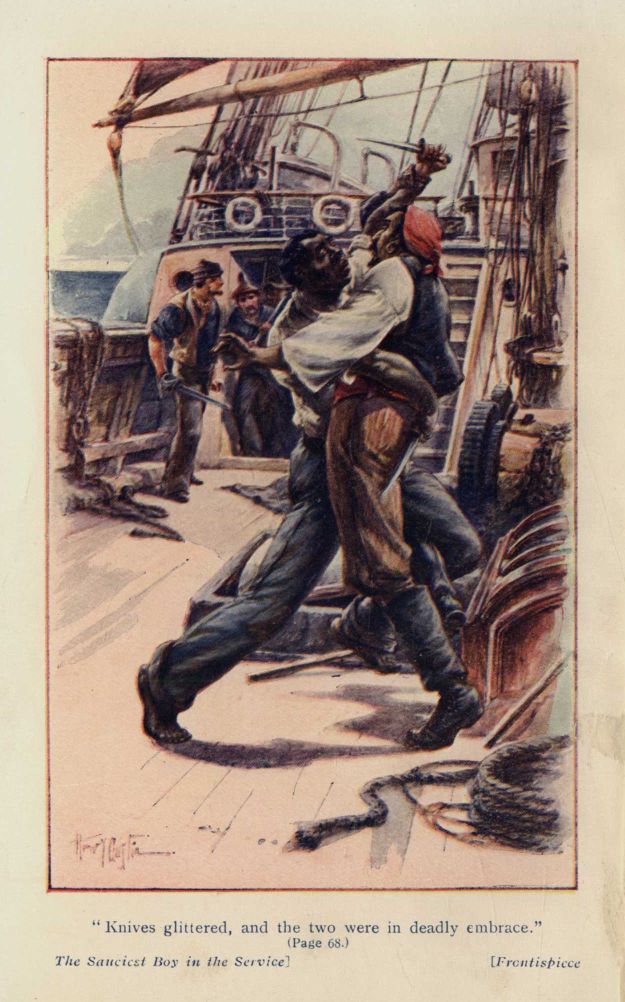
"Knives glittered, and the two were in deadly embrace." (Page 68.)
THE SAUCIEST BOY IN THE SERVICE
A Story of Pluck and Perseverance
By W. GORDON-STABLES M.D.; C.M. (SURGEON ROYAL NAVY)
Author of "In Regions of Perpetual Snow," "The Ivory Hunters," "In a Great White Land," etc., etc.
COLOURED ILLUSTRATIONS BY HENRY AUSTIN
WARD, LOCK & CO., LIMITED LONDON, MELBOURNE AND TORONTO 1911
PREFACE
Boys' books do not really need a preface. I only write a line or two to say my "Sauciest Boy" is a character drawn from real life.
Most of the adventures are from experiences of my own.
Scenery all painted from Nature, seascapes, cloudscapes and landscapes, with the glamour of old ocean over all.
W. GORDON-STABLES
THE JUNGLE, TWYFORD, BERKS.
TO LADY ANNE
CONTENTS
CHAP.
I The Glamour of the Ocean II Kep was Gone III "Any Spot on Earth is a Home for the Brave" IV In Search of a Ship V The Ship "Macbeth"--Horrible Mutiny VI The Hurricane--Crusoes in Great Snake Island VII Sunken Gold--Jack's Career in Sidney VIII A Breezy Ship, a Breezy Captain, and a Breezy Crew IX Through the Hawse Hole X The Broadsword-Men of the Breezy--Kep Cuts off a Leg XI On the "Scout" XII A Startling Adventure in the Woods--The Chief's Plot XIII Preparing for the Fight XIV Within a Yard of them lay poor Fisher's Head XV The Attack upon the Barracoon XVI Poor Bungle! Just let him Sleep XVII The Midget Fleet--Bombardment--Fearful Scenes XVIII Furious Fighting on Sea and Land XIX Kep Commands a Dhow--A Deposed Sultan XX "That Bar of Gold was Stolen from Me," Said Kep XXI Tragedy on an Island--A Cannibal Witch XXII In Slumbering Woods--Kep Captured by Savages XXIII Fierce Fighting with the Cannibals XXIV "Good Heavens, this is my Sister Madge!" XXV A Great Ocean Race--"Goddard began to Shoot" XXVI Something Extraordinary Happened XXVII The Home-Coming of the Sauciest Boy XXVIII Not another "But" about It
CHAPTER I
THE GLAMOUR OF THE OCEAN
There were few things that gave Kep Drummond more real pleasure than the graphic little descriptions of sea-scapes which occurred every here and there in the boys' stories he read. He knew the true from the false, and avoided tales by authors who had probably never been further from shore than one could pitch a biscuit.
Oh, if ever the glamour of old ocean had got right round a lad's heart and altered all his life and thoughts, that lad was Kep Drummond. The passages he chiefly delighted in were those that seemed to bring the scene right up before the boy's mind's eye, like pictures from a magic lantern. Though but little over fourteen years of age, he had a wonderful imagination and was full to the brim with the poetry of true feeling. En rapport, in fact, with all that is charming in nature, part and parcel of all the life and love he could see around him on such a sunny summer's day as that on which I now present him for the first time to my readers' notice.
Seated he is on the high and grassy top of a rocky cliff that beetles over what he calls his own sea, because the land all around here belongs to his father. Those tremendous rocks are the guardians of his father's Cornish estate. Behind him stretch wild moorlands and rising hills, while down below--peeping over the greenery of elm woods--red rise the turrets of what the boy knows as home.
But he leans his back against a hillock of tasseled turf, and opens a book; and as he reads his thoughts, his dreams, fly straight away through space, six thousand miles and over to the sylvan-bound silver sands of the Indian Ocean. And this is what he is reading: "How windless and warm it is! One's shoes take up the pitch and soil the ivory-white quarter-deck. We are only a gun-boat, but there isn't a yard-arm one inch out of the square, a rope's end uncoiled, nor a capstan bar awry; the wood work scintillates, the brass work shines like burnished gold, and our guns have the shimmer of papier maché. But our men to-day all look fagged and lazy. They are sun-weary. Yet every Jack amongst them is as neatly dressed as if he were about to take part in a nautical opera.
"The water round the ship, which is lying at anchor, is clearer to-day than gum copal. Five fathoms beneath we can see the bottom well; see the coral rocks, see patches of coral sand and the ever waving mysterious-looking seaweed, the home of crustaceans black or blue and grey, and of curious fishes that glide and dart, clad in every colour of the rainbow.
"Nearer the surface are scores and scores of splendid medusæ or jelly-fishes; under their waving limbs glint and radiate rubies, emeralds and sapphires. On this brightest day of tropical sunshine they float lazily along with the tide, but they are perilously near to the shore, and hundreds will be stranded on the beach. Many a little azure nautilus or 'Portuguese man o' war' sails hither and thither on the gently-heaving waves.
"Seawards, if we look, the ocean's breast is flecked and patched with tender graze greens and with opal tints, but towards the horizon it is as blue as the sky itself. Landwards, in long white lines, the breakers roll in on the snow-white sands that are at present all but deserted by both negro and Somali, who will sleep in the shadows till the sun sinks lower and lower and kisses the sea good-night. Yonder are the silvery house-blocks of Zanzibar, but the flags on the various consulates droop listlessly roofwards, and our own white ensign is almost trailing in the waters astern."
Kep closes the book, closes his eyes, too, but he is not going to sleep, but only just to day-dream, and his long brown fingers keeps the place for him.
There is the thunder of waves beneath the cliffs leaping lion-like on the black and weed-trailed rocks; there is the scream of the British sea-mew too, and the long lorn wail of many another sea-bird that floats all day 'twixt sky and sea. They are all the boy's friends and favourites, and when at morn or noon he dashes into the water and breasts the billows far off the shore, they fly friendly around his head, or float so white and near he might almost touch their paddling feet.
The glamour of the ocean!
Yes, and all things of the ocean that he has ever seen or read about appeal to Kep. Realities, I mean. He thinks himself a man, and would be ashamed to recite "The boy stood on the burning deck." That was sheer nonsense. Why could he not have leapt into the blue bosom of kindly Mother Ocean? That is what Kep would have done. Some of the folk lore of the sea, however, still enamoured him. He wanted to believe, or liked to believe, there were real mermaids and sirens also, that sung by night on the rocks of fairy islands to lure the unsuspecting mariners to their doom.
But there were real sea-poems, that night after night in his turret chamber among the elm trees he loved to fall asleep thinking about.
Well for Kep Drummond, I ween, that he had such little sea-poems to call upon, especially during the long dark nights of winter, for he was a somewhat excitable brainful boy. His chamber was an eerie one, but he had chosen it himself chiefly for that very eerieness. After bidding his father good-night and kissing Madge, his sister, and her pet Newfoundland, Bounder, he had to climb high, high up the winding stone stairs. There was said to be a ghost at Martello Castle, as the place was called, and if by any chance you had met the pensive dark-eyed boy, candle in hand, in the narrow stairway, you might have been somewhat startled.
The room itself was not large, and it was round. Kep's hammock was slung at one end near to two long narrow windows, and in winter time the leafless fingers of the elm-trees had an uncanny way of tapping on the panes. There were no blinds to these windows, because the boy liked to see out when skies were clear and stars shone, or the moon glinted laughingly through the branches.
One night as Kep was going to bed he met old Elspet coming down. A faithful old retainer she, but to-night her eyes were round and glassy, and the very flaps of her mob-cap seemed to have been stiffened with fear.
"Go not up, Keppie, darling; there is that in your room no boy should see!"
"Oh, if it is the ghost," cried Kep, "here's a boy who does want to see it, badly."
She tried to hold him. "It was a white face glaring in through the black, dark window!" she hissed. But Kep was off. She might as well have tried to restrain an eel.
The window was dark certainly, and yonder sure enough was the white face.
No ghost though, only the wondering eyes of a great white owl that often came to see the boy, for he laid up a little store of meat for this strange visitor, and sometimes a dead mouse or rat.
"It's you, is it?" said Kep, throwing open the casement. "Come in, Bob, and have your supper."
And Bob did. He ate and seemed thankful, and then spread his great white wings and flew out into the night and the darkness, taking the largest piece of meat with him.
As, like a true manly boy, Kep slept with open windows, and didn't put his light out until he had done reading by his small table, great bats often flew in, and did not leave until the candle was extinguished. Then seeing a distant star perhaps, they flew out towards that.
In this turret chamber Kep was high above the rookery, and could in February look down into the nests. But the birds all knew Kep.
When the boy tired of reading, then he crept into bed. He said his prayers, repeated some Latin hymns to himself, and soon after that--the sea-poems. One after another these sea-poems of his used to spread themselves out before him, and indeed he seemed part and parcel of the poem itself, and is it any wonder that he should go to sleep right in the middle of one of them, the waking thoughts merging into delightful sea, seldom terrifying, dreams, and these into the sweetest, soundest kind of sleep that any young lad e'er enjoyed.
Mermaids were not realities. They belonged to the folk-lore of the ocean. Yet there were some nights he used to delight to dwell with them in their diamond-lit caves far down among the brown trailing sea-weed. He would imagine their revels and mingle with sea-fairies in their gladsome dances, or sit on rocks full fifty fathoms deep with strange wee water babies, listening to their stories or telling them stories of his own. Meanwhile there would be music everywhere in those fairy submarine gardens, for even the floating sea-weed emitted sweet sounds; the very sand was musical, and from under rocks or from caves came the songs of the sea-folk and the tinkle of lutes. And down there the mermaid peoples dwelt and would dwell ever and ever and ever, always, always happy and gay.
But the scene is changed--it is another sea-poem, but true, and tells its own story of the wonders of the mighty deep. For sailors who had been to the far-off northern seas had told him that oft-times when the ship was becalmed in a lonely expanse of ocean, mayhap a thousand miles wide, a solitary whale would be sighted, rising and falling on the sea's dark bosom, but heading steadily southwards, never varying a single point. What guided the lonesome leviathan? What story had it to tell could it but speak? Had it no friends? Had the great beast been deserted by all it had loved, and was it, with the sorrow of night at its heart, moving, sailing, plunging southwards and southwards, reckless, forsaken, unheeding, to be stranded on a reef and to die?
Mother Carey's chickens, the stormy petrels, were another sea-poem to Kep. He could see in his mind's eye the rise and fall of the stern of a big black ship, the quickly obliterated wake, the spume of a wind-tortured ocean, and across and across, darting over, darting under, these mysterious chips of darkness, the petrels, and he could hear their quick sharp shriek--was it a song or was it a wail? Did it portend joy to the crew, or sorrow and a sailor's grave? Bird of mystery! Ah, yes, but what a poem!
A shoal of porpoises. They seemed always busy always merry--diving, gambolling around a ship on voyage. Then dashing off again or disappearing over the horizon, followed by blessings from the seamen for the luck they always bring.
These are but samples of this strange boy's sea-poems. He would hear many more before he left his teens.
But now on the grassy cliff-top, Kep sits up once more and continues his story. Not for very long, however, because over the cliff-top yonder, or from, some part of the precipice itself, he can hear a young voice hailing him. Then two great black paws, like those of a bear, claw at the cliff-brink. There is a serious black face with a long pink tongue and flashing ivory teeth between these paws, and, dropping his book, Kep dashes forward and at some risk to himself seizes Bounder's collar and brings the noble fellow to bank.
Then, facing the sea, the dog stands up to bark at Kep and towards the cliff.
"Poor Madge is down yonder," he seems to say. "Aren't you going to help her up also?"
But wild Madge needs no help. Next minute, with her lustrous black eyes a-sparkle, her cheeks aglow with exercise and pleasure, she stands beside her brother.
"It was a feat of rare daring, I suppose," she said, laughing, "and father will scold when I tell him. But Bounder is a poor cragsman, and I had to help him half the way."
Tall for her age--sixteen--hair and eyes as dark as night, an Italian night, and she was half Italian, ripe parted lips that showed even teeth as white as Bounder's, Madge Drummond was really a beautiful girl. Slender, though round in features, and with garments that draped naturally to her shapely limbs.
Kep saw little of all this. He only saw his big sister Madge and Bounder. And he felt but like a baby beside her.
"So you ran away from us, Kep," she said.
"Ran away to read, Madge."
"Well, come back from the cliff and sit down. I've had enough of that, and so has Bounder. And what have you been reading? Oh, a sea-story. Well, I like those, too, but I love a school-story with a somewhat naughty girl in it better."
It was the most natural thing in the world that Kep should slip his hand into Madge's and be led back to his seat.
"Well," she said a little later on, in answer to a remark of Kep's, "we are both of us sailors already. Haven't we been everywhere in father's yacht? Haven't we lived in sunny Italy, more on its waters than on shore? Have we not lived in France and Spain, and in Algiers itself? Father would let you go anywhere in his yacht, Kep, but you don't want to leave our father's Cornish home. Oh, I should miss you so. There would be nobody but me and Bounder and old nurse Elspet. Bounder is sympathetic, and sits and listens to my stories and licks my cheek or ear now and then, to show he understands. Ah! Kep, if you run away from home as you want to, I'd miss our mother more and more. I'd want to go back and sit and sing on her grave to keep her company."
Kep was silent for a short spell. His eyes were turned towards the horizon, his thoughts were far beyond it.
Oh, that glamour of the ocean!
When he spoke again it was more to himself than to his sister Madge.
"Yes, I must go to sea. Father will not send me. But they call me!"
"Who calls you?"
"The spirits that ride on the clouds, spirits of the wind and the waves. The sea itself is calling me now--listen to its friendly boom. It is the waves that speak. 'You are son of ours,' they are crying. 'Come to us. Come to us.' And the wild mews; Madge, hear you not their voices? 'Come--come--away--away--away--ay!'"
* * * * *
Slowly down the glen, hand in hand, sister and brother, to Martello Castle, and across the Martello lawns, but the lad's mind is made up. Kep will be a sailor.
CHAPTER II
KEP WAS GONE
Far round the point yonder, though it could not be seen even from the cliff top, was a town, an old-fashioned seaport, into which even big ships often came for shelter, such times as the sea-birds flew far inland. A town of narrow streets and quaintly gabled houses, a town that smelt of tar from end to end, and a beach with boats and broad-beamed fishermen who wore jerseys or baggy breeches and braces only, sou'-westers, and the everlasting short pipes that they leaned against post or pillar to smoke.
These seafaring folk looked lazy, dreamy and very quiet in manner, yet never were they afraid to face the stormiest billows on the stormiest of nights if danger or duty called. There was the might of Old England and its daring and pride of pluck in their half-shut eyes, and this only wanted waking. In the season, a signal from a hill would set them all astir like a swarming hive of bees. The mackerel or pilchards had been spotted in silvery millions, and if the French themselves had been threatening a landing, the stir and commotion could scarce have been more.
Kep Drummond loved that old town. There was the odour of brine about it. Sometimes, I must admit, even the odour of unburied fish that might have been better out of the way; but still a run over to Marshton to yarn with the fisher-folk was always a most pleasant trip for the boy.
The fishermen idolized him, so did their honest, rough and witty wives, because Kep possessed the power of making them laugh at will. That is at his will, they had to laugh whether they willed it or not. There was not much about a ship of any kind that Kep wasn't up to long before he was fourteen. One might therefore have dubbed him a sailor born, and not been very far wrong.
But Kep had another reason for visiting Marshton, and that lay in the fact that here he met men of many various nations, and delighted in talking to them in their own languages.
Apart from his marvellous musical powers, he had one great gift, namely, that of language. To say nothing of English, French, Italian and Spanish, he could converse in several other tongues, and could pick up almost any language in an incredibly short time.
My own opinion is that music and the gift of tongues go hand in hand, and that they are far more common in foreign European countries than they are in Britain. Iverach Drummond, the children's father, was a true type of the wealthy Scotsman, and of the wandering Scot. One of the best yachtsmen who ever trod on the weather side of a quarter-deck, his devotion to travel took him everywhere, and when he got married to a noble Italian lady, for her sweet sake he bought the estates of Martello, so that she might be as near to the Mediterranean as possible.
Madge and Kep had been born here, but hitherto had been educated by worthy priests at their grandfather's home on the shores of the blue Levant.
When his wife died Drummond was inconsolable. He seemed to care no more for yachting, because at sea everything spoke to him of that gentle lady and mother of his children who had always been by his side in fair weather or in foul.
He was, at the commencement of this story, as handsome a specimen of the true Highlander as one could wish to see. But honourable, strict, and sternly religious. He had, moreover, that pride of birth and lineage which we find clings to the scions of Scottish chiefs, be they ever so poor.
The result, therefore, of an interview that Kep had with his sturdy father, some days after Madge's adventure on the cliff, is not to be wondered at.
"Father," said Kep, peeping round the edge of the library door, "may I come?"
"Certainly, my dear boy."
"Sure you are not too much pre-occupied to listen to what I have to say?"
"Unbend, my boy, unbend," cried Drummond, laughing, "that is hardly conversational English. What do you want? A new pony? Or have you taken the motor-car fever?"
"Oh no, my handsome and dearest father. I should smash a motor-car to pieces in a week. A steam-launch would be more in my way."
"And that shall be yours, Keppel, if you really think you can't live without it."
"I can live without it, father, and mean to. But I am a man now--fourteen last month--and so I want to go down to the sea in ships and see the Lord's wonders in the mighty deep."
"Well, my yacht is as taut and trim as she was on the day she was launched. Ah, lad, it was my--it was your dear mother who provided and baptized her."
"But----" The boy hesitated, as well he might. "I want to go farther afloat than any yacht could ever take me. I wish to go and see wild places such as my best authors speak of, to kill wild beasts, to fight with savages, and snakes, and sharks, and tigers."
"Pile it up, boy. You're not at all ambitious, are you? But, Kep, I'm not rich enough to buy you a ship, and I have other views for you. You are my only son, and heir to all my property. I want to take you into London society. I want you to have a career, to become member for the county, and probably eventually Leader of the House."
"Father, you are not at all ambitious, are you? But I hate society, I hate London, I hate M.P.s, and I hate the Leader of the House. I'd rather," he added determinedly, "go to sea before the stick, and if you do not send me to sea, I fear I'll run away."
Iverach Drummond was trying to keep down his prideful wrath. He sat silent and stern now, so stern that Kep was frightened.
"Oh father, oh daddy, you're not angry at little Kep?"
He was kneeling by the chief's side, passionately holding his father's hand and weeping.
"Your anger would kill me, dearest and best."
"Then you won't speak of sea to me again."
The boy let go his father's hand. There was a flash of Italian pride in his eyes. But he speedily turned them downwards, then glided away and closed the door.
And something at that moment told Drummond he should not see his boy more.
* * * * *
Martello Castle was really a fine old place, and historical also. Drummond--what will not love do--was as patriotic a Celt as ever drew blood in the Stuart cause, but for his wife's sake he had expatriated himself and come to live here, far away from his own mountain wilds.
And yet he had the satisfaction of remembering that Cornwall itself had been a land of Celts, and, to some extent, the same blood that burned so fiercely in the bosoms of the ancient inhabitants was still alive in the people around him.
Drummond had shooting on this estate all the year round, and was lord of the manor, and yet, like Walter Scott, he would have died had he been prevented from seeing the heather that blooms on the Highland hills at least once a year.
He had, up to the time of his dear wife's death, mingled cheerfully with the landed gentry and best families of the county, but at present and lately he had been somewhat more of a recluse. He was feeling old now, he avowed, though he was but little over forty. And all his hopes and fears centred in his boy Keppel and his daughter Madge. For their sakes he was at home to all who did him the honour of calling. And Madge was as contented and cheerful as ever a girl needs to be, and had more than the average girl's opportunities of living an ideal life in her own grand gardens, or in woods and wilds. Though not so romantic and poetic at soul as her brother Kep, and with none of his extraordinary longings to see foreign life and seek for adventures abroad, she was nevertheless one of nature's children.
On the same day upon which Kep had held that meeting with his father, he picked up his little rifle, kissed his sister, and told her he was going for shooting practice over the hills. There was something in his face that told Madge he was not happy, and but for the fact that her governess was with her she would have accompanied him.
Kep went to the hill to practise making bull's eyes at boulders, as he phrased it, but his heart was not in the sport to-day, and presently he threw down the gun, and lay down himself to look at the sea, and to think.
What was he going to do? he asked himself. Going to run away from his parent, his sister, his home? There was only one word to answer the question, and that was "Yes."
But the morale of these questions was what puzzled his most, for he had been strictly religious trained. Was he about to commit deliberately a sin for which he might never be forgiven?
This was a question that took him a long time to argue. There were many sides to it. He was going to sea in obedience to an impulse. Nothing was there to prevent him. There are fathers and fathers, some of these would send forth a hue and cry and bring a boy back nolens volens. His father, Kep knew well enough, was not one of these. He would be too proud to search for his lost boy, and he knew also the nature of that boy, knew that restraint and compulsion could only tend to harden him, and that the disgrace of being brought back a prisoner would break his brave heart.
No, there was little, if any, fear of pursuit, and he had some money of his own, enough at any rate to purchase his kit and rig-out. Yes, the world was all before him. Yet the "sin" attached to his flight--ah! that was the word he could not keep from ringing in his ears.
His father's priest was Kep's best friend, and his tutor besides. Should he go and tell him? Perhaps he should, but he would not. You may get pardon for sins you have done--if you are genuinely penitent--but not for those you have it in your heart to commit. He would not see his priest. What, never again? The lad's heart gave an uneasy throb. That "never" is a long, long saddening word. So he told himself that he was not running away for good and all, only just for a few years, then if his father forgave him and asked him to return he would.
But his sister Madge--ah! how she would cry, and how bitter and hot and blinding would be those tears, for they loved each other, those two mitherless bairns, as only young sister and brother can. Kep was all the world to Madge. No boy ever so kind and gentle, so brave. None ever so pleasant and so wildly mirthfully, gleesome and humorous.
As he thought of this he took from his side pocket a tiny little black orchestra flute or piccolo. Not much bigger nor thicker was it than a fountain pen, but oh, the marvellous music he was wont to elicit from it. Mostly all Italian and German, chiefly operatic, yet the birds that perched on the golden scented furze in spring used to stop their songs to listen when Kep played, and little anxious creatures in fur used to peep wonderingly out of their holes. He took his pipe from his pocket, I say, and began to play--merrily at first, but soon mournfully and sadly. The music that he breathed into it or that welled out of it was such as he himself had never heard before. It seemed to come from his very soul, to be the very own voice of that soul; and what more sweet, if pure, than the soul of a boy of his still tender years?
This did not, could not, last long.
He dropped the magic pipe, and threw himself on his face to weep.
"Oh, Madge, oh, Madge," he sobbed, "I am going away, away--I am following destiny--and you--you--how I love you, sister! but distance can never, never divide nor sunder us. Never, Madge, never."
He spoke through his tears, as if his sister were close at his elbow.
"I'll write often and often, and you shall write to me. I may not always get your letters, but you shall always have mine. What is this?" he added, speaking more to himself now. He picked something off a bush of ling. It was one of wild Madge's hair-ribbons--they often sat down to rest, the brother and sister, in this very spot.
He looked at it. He held the bonnie blue silk to his lips, and sighed a sigh which gave him comfort. Then he attached the ribbon to his wee flute and tied it to a button hole.
He would never part from either ribbon or flute, go where he might, over sea or land. The ribbon would be his mascot and charm danger away, the tie that would knit him to his sister and to home.
Don't laugh at poor Kep, if I tell you that he must now kneel down by the bush and pray. He marched off down the glen after this, but no farther than the house of Duncan Rae, one of his father's keepers.
Duncan was at home and glad to see Kep. Would he not step inside and have a bowl of milk, his wife would be so pleased.
"And there," continued Duncan, "comes Colie to bid you welcome and my two little lassies evermore. But has our good laird's boy been crying? But see, Keppie, my lad, go to the brook and wash your face, and it is myself that will run for a towel for you."
Kep always felt easy at that homely fireside, and in five minutes' time he was sitting with a child girl on his knee and two more curly-haired tots listening to and laughing at his strange stories.
"But you'll play a bit to us, Keppie, and sure the bairns will dance, for it is you that is the grand whistler. Never could scream of plover in the mist equal the shrill sweet music of your flute."
And Kep did play, and forgot his sorrow for the time. Then he got up to go, and handed Duncan Rae his little rifle to keep until he called for it.
"But eh! boy, there is the big sorrow in your heart this moment, and there is something there you won't tell your poor Duncan."
"No sorrow, Duncan. Only joy to come."
And he forced a smile as he waved his hand.
And Duncan stood looking after him till the hazel copse hid him from view.
Then he sighed and went in doors.
* * * * *
Bob, the great white owl, came that night to stare in at the window of the little turret chamber, but all was dark.
And the cawing of the rooks to greet the rising sun brought no young face to the window next morning.
Kep was gone.
CHAPTER III
"ANY SPOT ON EARTH is A HOME FOR THE BRAVE."
About a week after this, rather a crack little cruiser was lying with steam up, or fires alit anyhow, in Plymouth Sound. Long, low, rakish she was, and looked just the craft to go anywhere and do anything, howsoever daring.
Kep Drummond stood gazing at her from the Hoe.
There was a sailor sitting on the end of a bench near by, and him Kep addressed. "What ship is that, mate?" he said.
"That is the Breezy, my son. She sails to-morrow."
"Do you belong to her?"
"Not I. Just come from China station."
"I think I should like to sail in that craft. There is a bit of romance about her, lying with her bowsprit pointing to the breakwater. I like her looks, and what a lot of boats are passing to and fro. How had I best get on board?"
"Why, with a shore-boat, of course. You don't imagine, do you, that they would call away the first whaler for a kinchin like you, though you do look pretty fit."
"Well, anyhow, I'm going to join that ship and sail in her."
The seaman laughed aloud.
"As what?" he asked. "Second lieutenant, paymaster, or what? Mebbe you'd like to take command of her. I'm sure you have only to wire the Admiralty to get appointed right away."
Kep's eyes were riveted on the Breezy, and he was all a-quiver with a new-born excitement.
"How old are you, sonny?"
The man now laid a kindly hand on his shoulder.
"Fourteen and begun again."
"Run away from your parents, haven't you?"
"That's my business, matey."
"Well, but take a man-o'-war sailor's advice. Don't go on board the Breezy; if you do, you'll get copped and sent home again. And it is there you should be. If I did my duty now----"
"Come and have a pint, Jack."
"Oh, I'm nothing loath," said Jack.
"Then we can yarn about it," said Kep.
They were soon seated in the parlour of an inn, where Jack seemed to be well known. There was a foaming tankard in front of the sailor and one by Kep, which he pretended to sip, but fought shy of.
Kep told Jack little bits about himself, but no more than Jack could conveniently swallow.
"Have you been much abroad, sir?" said Kep. The "sir" almost stuck in the boy's throat, but then, this man had many stripes on his sleeve, and Kep thought it as well to err on the safe side.
"Been kicked about a lot, sonny, if that's what you mean. I'm eight and twenty, and next commission may be my last--"
"Why, you think you'll be drowned then?"
"No, no, lad, only if I do two years more, my time will be about up, but I'll join on again, 'cause I dearly love the sea. I say, young fellow, you're not drinking yours."
"Never meant to. Ordered it for company's sake."
"Thought so. There's a pal o' mine in the bar, he could let daylight inside that tankard if your lordship will allow me to call him in."
"Certainly--delighted."
The pal, a young man, clean-shaven and very baggy about the lower garments, did let daylight into the tankard after nodding frankly to Kep.
The boy had heard of boozing kens, and he wondered if he was in one now. Anyhow, he believed he could take care of himself.
A buxom middle-aged landlady presently came in, and Jack said something to her in an undertone. She smiled most pleasantly, and patted Kep's hand. "Poor boy!" she said, "nothing must come over him then."
Kep called for more stout all round, and threw down a sovereign. But this fresh supply stood for some time untouched, for the lads of the Royal Navy are not now what they were in the days of Dibdin.
"I'll call Katie, my daughter," said the landlady, "as I must attend to duty. Katie dear, come this way."
Kep thought he had never seen so winsome a girl before and he asked her to have something, but she took positively no notice.
Only a minute after, she pulled Kep on to her knee.
"The sweet little lamb," she said, "and oh, the black eyes of him. Jack, he is his mother's wopsy-popsy, I'll bet."
"What--how--why," the boy cried, wriggling away from her. "Can't you see I'm a man? Fourteen and began again?"
But Katie soothed him. "I'm sure you'd like a cup of tea," she said.
Kep would.
Yet he had some suspicions that if this were in reality a boozing den, the tea might be drugged, and that being hocussed, he might be robbed. But one look at sweet Katie convinced him that his suspicions were really unmanly.
"You'll sleep here to-night, won't you?" she said.
"Yes, if they don't keep me on board the Breezy."
Jack roared with laughter and Katie couldn't help joining in.
"I think," said Jack, "that even the first lieutenant has been appointed, and they will have to dispense with your services, sonny. Why didn't you 'phone to the Port Admiral, and say you were coming?"
"You funny boy!" said Katie. "But how much money is in that purse of yours, that makes your trousers pocket bulge out so?"
"Oh, enough to pay for the tea, twenty times over."
"Why dear, I don't mean that," and the girl reddened a little.
"Well," she added, "you'll count all your gold out there on the table, and give it to my mother except just a handful of silver. She'll give you a receipt for it, and you'll come back here to sleep."
Kep looked at Jack, and Jack nodded. Then the boy counted his gold and notes out as innocently as a boy of nine might have done, and Mrs. Monck, the landlady of the Blue Ensign, took it in charge.
Jack told him he would meet him here again that evening, told him also where to charter a shore-boat.
"Hillo you, what's the fare to the Breezy?"
"Three bob to you, cap'n."
"Take ye for 'arf," cried another.
"Jump in," said Kep.
The men jumped in and off they pulled. There was a rudder, and Kep took the tiller.
"Been at this game before, young sir?"
"I know what a boat is."
"Be ye a-goin' to join, sir?"
"Don't know yet. Going to see the first officer."
"Humph! well, that means the commander or first luff. The Breezy is a warship."
The way Kep steered that boat along-side the Breezy--sta'board side mind you--was a source of great fun to some middies.
"Admiral's sweep, by Jove! Why, he thinks himself quite a little toff. Wonder who the devil he is?"
"Couldn't say, I'm sure. May as well have sideboys, anyhow."
And down the steps the side-boys rattled and handed Kep the pipe-clayed ropes.
He was half-way up, when the man hailed, "Am I to wait, sir?"
"Er--um--you may as well, I think."
The side-boys were caught on the giggle and Kep frowned at them.
He saluted the quarter-deck as if to the manner born.
"What--er--can I do you for, youngster?" This from the midshipman of the after watch.
"I want to see the commander or Captain."
"Neither on board. Here comes the second lieutenant.
"Hullo, my lad"--he wasn't much more than a lad himself--"have you friends on board?"
"Soon will have, I hope, sir. I want to join the service, and this ship. Rather like the looks of her."
The middies pulled their handkerchiefs out, and seemed strangely convulsed. The officer raised his eye-brows, but appeared much amused.
"Come down to the ward-room, my boy," he said. "There is really nobody on board, yet. Sit down. You are smartly dressed, is your father a gentleman?"
"Yes, and all my forefathers, and I'm a gentleman myself."
"Undoubtedly, but you've run away from home, haven't you? What is your father's name?"
"Not over anxious to divulge, sir," replied Kep.
"Well, what name do you sail under?"
"Not particular. Call me Mr. Bowser."
"Well, Master Bowser, you say you are desirous of doing us the honour of sailing with us. May I presume to ask in what capacity?"
Kep jumped up.
"You are making fun of me, poking fun at me," he cried, now furiously red in the face.
"Sit down, you spitfire, and don't be a little fool, else, but there! now calm yourself and answer my question. What use do you think you'd be on H.M.S. Breezy?"
"Oh, I'm so willing, sir! I can be anything, or do anything. Could take charge of a watch or my turn at the wheel, or help the cook, or clean the boots. I can reef and steer, and box the compass, splice the main-brace, or work out the reckoning or----"
"Suppose, now, our captain were taken ill?"
"Oh, sir. I could soon learn to do the simple duties of a Naval Captain."
"Is there any other capacity in which you could serve?"
"Oh yes, I can speak six or seven languages fluently, and I could play on this little pipe while the sailor men danced."
The lieutentant was more amused than ever. He wanted a little fun, anyhow.
"Play something to me."
"What shall it be? Nocturne, Sonata, Valse, or, just name your opera. Come, here is a little bit of Wagner." The officer leaned back in his chair, really or truly delighted.
"Why," he said, "you are--why you are a juvenile freak. Come on deck with me."
"Quartermaster, just take this lad forward, and he'll play you a hornpipe."
He did. Kep played, and didn't the men dance too. It was half an hour of the best fun ever seen on board a man-o'-war.
Then the young lieutentant gave the boy ginger wine, grapes, and much good advice, and bade him be sure to go home to his parents.
No, Kep had not succeeded in joining the Breezy, but he really had made an impression on board, and those who met him would not soon forget him.
The boy did not go directly back to the Blue Ensign. The day was very beautiful and though already far spent there was plenty of time of stroll around and see things.
Now Plymouth down by the docks is always a busy place. It was ten times more so just at present, for complications had once more arisen betwixt this country and Russia. Since the close of the terrible war against the Japs, the Russians appeared to be intriguing very much in European politics. She desired a war with Britain, she longed to invade India, but the trouble was that unless supported by another power there was little chance of her being able to regain her lost prestige.
Be that as it may, orders had only a few days before Kep's arrival been received at Plymouth dockyards that make things hum, as the saying is, and the lad wondered a good deal at all he saw in the dockyards. A swarm of bees about to swarm could not have been more busy and bustling.
The tall policemen who guarded the gates eyed everyone who sought entrance with considerable suspicion unless wearing the king's uniform, and even Kep came in for his share of this.
"Are you a young officer, sir?" said one, as the lad essayed to pass in, just as coolly as if the place were all his own.
"Halt! Are you a young gentleman, sir?"
Kep smiled his blandest, though with a slight air of hauteur in his manner.
"I hope so," he replied emphatically.
The policeman touched his hat.
And an Irish marine who was doing sentry-go, seeing this, shouldered arms as he passed, and Kep returned the salute with a flourish of his hand capwards as he had seen real officers do on the street, when the blue-jackets saluted.
"This is all very sweet," thought Kep, though the fact was that he was sailing under false colours, for the policeman's "young gentleman," really meant "junior officer," although it ought to have struck him as strange that even a naval cadet, if appointed, should be marching through the dockyard in mufti. And this incident, trifling though it appears, pleased Kep. It proved that he looked a little gentleman, and not a second-class boy, nor shop-keeper's apprentice out for a day.
But everybody was not quite so polite to our little hero, for during his peregrination he happened to stumble against a red-faced pompous looking old officer, and made bold to salute.
This officer was in uniform and stopped to eye Kep for a moment.
"Hillo! young fellow, who are you, and what are you doing here?"
"Just having a look around, sir."
"Cool. You don't belong to the service?"
"No, sir. That is not yet."
The officer laughed.
"Here is sixpence for you," he said. "I rather like a cheeky boy. Yonder is a gate, they'll let you out and they shouldn't have let you in. Go and buy buns."
Poor Kep reddened to the roots of the hair. He took the coin, though it seemed to burn his fingers and marched on towards the gate.
A bo's'n'smate accosted him next. "What ho! younk, whither away? What's your tally?"
"I'm only just a little boy going to buy buns," said Kep, and they parted.
The first thing he did, when he emerged, was to give that sixpence to a small gutter-snipe girl. She examined it wonderingly.
"'Taint a reel un, is it boss?"
"Yes, quite, go and buy buns for yourself."
"Well, you be a softy, anyhow," she cried and darted off, shrieking with delight. And, next moment, Kep ran right up against Jack himself.
"Come to bring you back home, sonny," said the kindly fellow. "Make sure, you know, that you don't fall into mischief."
About two hours after this, Kep might have been seen in the tap-room of the Blue Ensign piping to a lot of jolly young sailors, as he stood on the top of a table. A position, which I must admit was a trifle infra dignitate--beneath the dignity--of Keppel Drummond, only son of a lord of a manor. But Kep enjoyed it and so did the blue-jackets.
Well, Kep had supper with the landlady, Katie and Jack, in the cosy bar parlour, quite a private party, be assured, and a very merry one as well. This happened after ten o'clock, when the house was shut up for the night.
To have seen Kep now, and heard his ringing laughter, as Jack spun his droll service yarns, you could scarce have believed that he had any sorrow at all at his heart. He did have though, and it is not easy to forget so happy a home as that which he had just forsaken, only care lies lightly on the shoulders of a lad of fourteen. He compounded with his conscience, moreover, by promising to write nice letters home the very next morning.
He bade his friends good-night at last, and was shown up to his little room, a bit rough, perhaps, but everything as sweet and clean as new silver.
Never a dream, and it was far into the morning before the sun shimmering in through the window awoke him, and soon he was down to breakfast. There came word now that the Breezy was off, and so she was. Jack and Kep started for the Hoe to see her sail past.
And Kep sighed. How he would have liked to be on board that low long craft. Not perhaps so poetic-looking was she as a ship under sail with every inch of canvas set to woo the wind, but her build and shape, and clean cut bows suggested terrific force, terrible possibilities.
The variegated flutter of her signal flags as she flew through the blue water, her great white ensign floating astern, and the sweet music of her band playing, "Good-bye, sweetheart, good-bye," everything about her in fact, thrilled poor Kep till the tears filled his eyes.
They watched her getting smaller and smaller as she went stretching seawards. Yes, and many more than they were watching her, for when our sailors leave their native bonnie British shores, they leave many a tearful face and many a breaking heart behind them.
There was more of sadness in Kep's breast as he walked back to the Blue Ensign than he had ever felt since the day his mother died.
He would work some of that off, however, by writing to his sister, and his father, to say nothing of the good old priest and Duncan Rae. He had much to write about to Madge, and, indeed, he felt somehow as if years had elapsed since he had sat beside her on the green cliff-top.
The landlady of the inn vouchsafed to Kep some very good advice. He must, she said, go back to his parents--Kep had not told her his story--there was nothing else for it.
Kep patted her white podgy hand, and thanked her. "Your advice, mammy," he said, "is very excellent in its way, but it is advice of the feminine gender, and I shall go to sea, whatever happens. I shall not return home until I can do so with honour. My proud father shall never have to say that his son is unworthy of his grand old name."
"And you really will go," said Katie mournfully.
"I must, Katie, but cheer up, my dear. O'er many seas and lands I'll roam. Yet the heart of your sailor shall ever be true, and when my wanderings are over, I'll return to Merrie England and marry my Katie."
This wasn't bad for a boy of fourteen, was it?
"Well, go if you must," said the landlady, "where are you bound to?"
"Yes," said Jack, "what is your next port, sonny?"
"I shall consider. Have you a Bradshaw, Katie?"
He opened the book at random, at the place where it tells one of steamers that sail away to every part of the known world. It opened at Southampton.
He closed his eyes now fast and hard, and stuck a pin into one of the pages. It struck the West Indies.
Even Jack, old sailor though he was, was taken aback at the boy's boldness.
"I shall go there!" he said. "My dear and charming Katie," he added heroically, "Any spot on earth is a home for the brave."
CHAPTER IV
IN SEARCH OF A SHIP
That same day Keppel Drummond bade his friends of the Blue Ensign goodbye.
The good landlady gave the boy her blessing. Katie gave him a bunch of ribbons and he gave Katie a kiss. He was saucy enough almost for anything.
"Goodbye, sonny," said Jack, "the world isn't so very wide, and we may meet again."
Then with his bag over his shoulder Kep bore up for the railway-station straight away, and in due time was deposited at Southampton.
The ship would sail in two days' time, so he went straight away and booked himself a second-class passage. Then set out to purchase his travelling box and kit. Kep did not mean to let the grass grow up between his toes it he could help it.
I suppose the lad really had a good share of Scottish forethought in his nature, as well as Italian frugality, and he counted his cash again, and counted all costs before he booked. The landlady at the Blue Ensign on giving him back his money had refused to accept a single coin for her hospitality, and the boy had turned red when he remembered that he had at first positively taken her pretty little hostelry for a boozing ken.
He did not go on board the Paramaribo until the very last bell, thinking that his youthful appearance might cause enquiries. It is so seldom, if ever, that a boy of fourteen starts on so long a voyage without a friend or guardian.
He posted another letter to Madge, his sister, before leaving, and a little pink note to Katie, quite a boy's love letter in fact and of no more value than most juvenile love letters. Only it pleased Katie. In addition to Jack Stormalong, she could now boast that she had a little boy lover far away on the stormy main.
Jack Stormalong was one day--if not eaten by blue sharks--going to marry Katie, and the two were to have the Blue Ensign. But she showed Kep's letter to Jack.
Jack took a pull at his beer and laughed. "Why, he is a precockshious lad and no mistake," he said. "He's bound to fall on his feet, Katie. Bound to come out top-dog, or die for it."
Once on board, and settled down, our Kep was not long in making himself friends. His flute with its blue ribbon did that for him. Of course, it was away forward that he made his first friends. But soon his fame became noised abroad and then Kep was invited aft to play. The boy's knowledge of music was really phenomenal, and his execution on the piano astonished everybody.
He called himself Charlie Bowser because in his pride he considered it would be lowering his father's caste somewhat to travel second class with his own name.
But apart from his musical talents some of the ladies aft took a great fancy for our saucy self-contained boy. There was a mystery about him, too, which was fascinating to many. Nor, when asked, did he hesitate to say that he was travelling under an assumed name.
"But why should you run away from home, Charlie?" asked one lady, "so bright a lad as you?"
"Only just to see a little life, dear lady," said the boy. "Perhaps there is something radically wrong with my idiosyncracy, you know, but I assure you I'm not running away an account of any evil I have done. I'm not cut-purse and I never held up a coach nor even a motor-car."
"You are very young, Charlie!"
"A man," he replied, "is just as old as he feels, so I must be quite twenty."
"I had the best Italian masters," he replied to another lady, who was praising his musical talents. "My father talks several languages."
"And your mother, Charlie."
"Mother talked many more languages than father. But mother is with the saints in Heaven, madam." This with a sigh.
"And in Heaven," he added, "they talk Latin, I suppose, or a kind of refined Volapuk."
* * * * *
How very quickly the days flew by in the Paramaribo, the "old Pram," as the sailors unceremoniously called her. But the life to Kep was all so new and delightful.
The voyage came to an end at last, and at Jamaica a really pleasant old lady, as Kep called her in his own mind, resolved to carry the boy away inland. Well, as he did not object to see a little of the beautiful interior, he readily consented.
What a tropical paradise it was she brought him to! And life amidst the sublimity of such mountain scenery, under a tropical sky, and with such magnificence of flowers around him, was to Kep with his ardent temperament and his love of romance and poetry like a foretaste of Heaven.
The house itself was larger than his father's, as white as the snows of Ben Nevis, wherever a glimpse could be caught of its walls, through the wealth of climbing flowers that surrounded it and clustered over its verandas.
The gardens were gorgeous, and Kep laughed with delight to see the bright-winged birds dashing through and through the white spray of the fountains, that played here and there on the sward.
The lady had a quiet and gentle husband who seemed to be her loving slave, so fond was he of her. She had children too, boys and girls, dark-eyed like himself and browned-skinned as Ethiops.
"Live here always, and for ever," said little Zuleika to him one day, "and be our brother."
But there was restlessness in the boy's heart before he had been among these enchanted hills and dells a fortnight.
"No, Zulee," he said. "I must away and soon," and then he told the child all about his sister and his own English home, all that she could understand.
"But take Zulee with you, home to your home, and your sister shall be Zulee's sister."
"Well," said Kep, returning her innocent embrace, "I must leave Zulee and come back for her some day--perhaps."
Kep was really burning to get away to sea in some capacity or another, so promising to return and bid his new friends all adieu, as soon as he had got a ship, our Kep journeyed back once more to Jamaica.
He had spent such a happy time, and they had been so good to him--but then everybody was.
"Heigho!" the boy sighed. "Heaven must be such a nice place, just because when you do make friends you keep them, and there are no more cruel partings."
Kep found apartments in a tiny cactus-surrounded cottage, not far from the busy parts of the city, yet cool and quiet--a little oasis in a somewhat objectionable desert.
He counted his cash again, and found to his surprise that it could not last for ever.
He must find work, and that work must be on board some sailing ship or steamer.
Now, strangely enough, he did not find this so easy to do as he had imagined. No one appeared to want a really talented boy on board ship, and his repeated rebuffs began to tell on him. He grew just a trifle less buoyant and hopeful.
How different were the shippy parts of the city into which trading skippers dived here in search of wretched crews from those of his own dear England.
There were "houffs" here, partly brandy shops, partly cafés, where these same skippers were wont to call. And rough seamen frequented these in search of a job--seamen ever so rough, gallows rogues of all nations, apparently. And into these Kep had often to go and sit at some vile little table sipping his black coffee and waiting.
These places reeked with the scum of all kinds of sea-bred rascality. Reeked with sin and language so horrible that Kep was often terrified as he sat in his half dark corner waiting for that something that was sure to turn up some day, he told himself, but drink besotted men would swagger in with knives in their belts that Kep felt sure had been used in many a horrid melée. Then men would play dominoes with others of the same calibre, drinking the while, and using terrible imprecations. Or they would quarrel and fight or, if extra friendly, indulge in the aguardiente, until they reeled and got kicked into corners there to lie and snore, awaking only to call for more of their fiery potations.
Kep never took his money to such places, preferring to leave it at his little cottage. This was the house of two Creoles, but they were kindness personified to their brave little lodger, so he had no fear of dishonesty.
When Kep wrote to his sister now, he did not tell her a word about his anxiety and hardships, which would have grieved her, so all his letters breathed the poetry and romance of the beautiful island into which Fate had thrown him.
The boy was sitting one afternoon in a somewhat dark corner of a dingy café, making his cup last as long as possible before calling for another, when there entered and sat down at the long table about half a dozen men. One who appeared to be chief called for coffee and brandy.
The men whom the skipper, for such he turned out to be, was endeavouring to engage as seamen, were a mixed lot, and as villainous-looking as any Kep had yet seen in this particular café. Badly dressed, hulking fellows, with a cast of the butcher in every one of them. The boy felt sure these men would do anything or commit any crime for money. But the skipper experienced great difficulty in bargaining with them. One was an immense hulk of a negro, who spoke English after a fashion. Of the other five one only was a Britisher, and easily dealt with. It was different with the big Turk, the Italian, and the two Spaniards.
"I fear it is no go," grunted the skipper, himself an American. "Garçon!"
"Oui, m'sieu."
"Have you anyone in your place that can translate me the garble these chaps are talking? Can pay for an interpreter?"
Kep had been hustled into a corner by this tall skipper and was only waiting for a chance to escape.
As the garçon was unable to solve the difficulty and get the skipper out of the clove-hitch, the boy tapped him modestly on the shoulder.
He turned at once and gave Kep a little more room.
"Strike me lucky!" he said, "if I knowed there war any crittur there."
Kep smiled conciliatively.
"I know all that these men are saying," he said.
"Well, fire away, younk, and I pay you smartly."
"I don't want pay. I'm looking for a ship like the rest of them, and if you can help me, I'll be glad to do anything I can for you."
"You're true blue? Nothing of this sort?"
As he spoke he adroitly picked his red silk handkerchief from his own pocket and nimbly palmed it.
Kep laughed rightly merrily.
"Oh, no, I'm not a thief," he said.
"Waal, then, just look jerky, and tell these beggars all I ask you to."
So jerky did Kep look and act that in two minutes' time the men were engaged.
"And that," said the skipper, "makes up my complement, and when they've signed articles, we'll sail."
"Bothered!" he added, "if I don't think you'd do, boy, to help our steward and cook. You look a play-acting kind of a chap, can ye do anything likely to amoose us."
"I can pipe if the men want to dance on a Saturday night, or when you're heaving the capstan."
"Pipe? Waal, I'd like to hear yer."
Out came the little piccolo, and in half a minute Kep commanded the whole situation. Drunken sailors crawled out of their corners to dance, sailors' sweethearts all kinds and colours joined in, and even the doorway was blocked by dusky faces listening.
It was a mad five minutes.
"Hurrah!" cried the skipper, beating the table with his brown fist. "Strike me lucky if ever I heard its equal! Why, siree, the pied piper of Hamelin wouldn't be in it with you. Give us yer flipper, younk. Will you sign on?"
"Yes, you are going to queer places evidently. I'll sign on. I'll see life."
Something like a cloud shadow darkened the skipper's face for just an instant.
"You'll maybe see death, too, lad. But there, you look a good plucked one. Come, we'll march these beggars on board, else they'll get drunk and bilk us."
They had a long way to row, but at last found themselves alongside a tall dark taper-masted barque. Though the paint was washed off her sides a bit, she looked good and sea-worthy, and Kep liked the golden hue of her copper bottom as she heeled over now and then to the swell.
The skipper invited Kep down to the cabin, which was large and roomy with doors off it, leading into staterooms at each side and the spirit-room abaft. It was comfortably, though not luxuriously furnished, and the great black tom-cat asleep in the captain's easychair gave an air of extra cosiness to the place.
"Have a drink? No? Better not. Had Nat Stainer, and that's me, never touched, tasted nor handled, he'd have been a Commodore in the United States Navy by this time."
Kep was sent on shore, promising to be off early in the morning.
He paid his bill, and bade his hostess a kindly good-bye, and at two bells next forenoon watch, his boat was rasping against the sides of the Macbeth.
A Jacob's ladder was thrown him carelessly, and up he scrambled and stood once more on deck.
General confusion reigned throughout, but probably not more than we usually find on ships of this kind about to leave for a long voyage. But this confusion was worse confused, owing to many of the crew being unacquainted with the language in which orders were given, for the second mate who had charge of this watch was a Finn.
To him Kep reported himself, saluting as he did so. All he received in return was a kind of grunt.
"We don't care much for man-o'-war prattle here," he said. "Go and find something, do. Translate my orders to these grub-eaters."
After doing so for a whole hour, Kep, who was willing and cheerful, bolted down the after companion to the pantry, where he found the steward, a little black-haired young man, with a pleasant face. He was an Austrian, or Swiss, at any rate he talked good French, and for this Kep was thankful.
He had not much to say at first, and the boy was unwilling to force the conversation. Presently, however, he wheeled round on Kep, rubbing hard at a spoon as he did so.
"I think you weel like dis sheep?" he said.
"I don't know yet," returned Kep. "I hope so. Do you?" He spoke in French now. The steward shook his head.
"Glad," he said, "you talk French; we will be companions, comrades. But I am so poor, I must sail in anything. See here."
He took two strides farther forward as he spoke and picked up an electric lantern.
"Follow me. The Capitan has not yet come off, and we sail this evening." He led the way into the saloon, and through it to the spirit-room door, which he opened with a bright and shining key. He now let the lantern's glare fall on the deck inside. It was splatched and spotted with black, so were the bulkheads.
"Claret?" said Kep.
"Blood," said the little steward. "They fought in there. Now come this way." He threw open the door of the Captain's stateroom and kicked away a grass mat. Ominous stains again. "Just there," he continued, "the first mate died. Shot down he was by the master."
"Murder?" And Kep shuddered a little.
"Who can say, the mate had a knife, the Capitan was quicker, he had a revolver."
Kep was undoubtedly brave, yet for some seconds he seemed to be turned into stone.
"Was there an inquest, an enquiry?"
"No, we were far at sea. The mate was buried two hours afterwards sans ceremonie. The blood kept dropping through the blanket we had sewn him in, and the stains will never leave the stairs."
"But surely such things call aloud for----"
"Hush! hush!" cried Dolphin (his name was Adolphus), "we speak not so here. And list, that is the Capitan's voice, he is just coming over the side."
Dolphin hurried to the pantry and was singing cheerfully at his work when the Captain came down below.
He nearly run Kep down, being sun-blind for a time. "Hullo, little piper, I can feel it is you. Can't see much, though. Dolphin, knock the head off a bottle of fizz. We'll be out o' here by five."
"I say," he continued after swallowing a smoking tumblerful of the champagne. "I say, Dolphin, mum's the stuff I'm drinking, ain't it?"
"It is, sir."
"Waal, mum's the word you've got to remember when talking to any new hand, else----"
The rest of the sentence was hissed into the steward's ear, and the little man turned a shade paler.
There was some sort of mystery and horror about this ship that crept coldly round our Kep's heart. He had half a mind to ask to be put on shore, but that would have been cowardly. He did not even like the barque's name--Macbeth. There was something ominous about it, and the word rhymes with death.
"You are to be told off to do all sorts of odd jobs," said Dolphin, soon after this, "but I think you'll be principally the Capitan's servant and interpreter."
"I'll be glad to be busy," said Kep.
The anchor was got up, and sail set, and with much noise, and terrible shouting. Then she slid away towards the open sea, but the first watch had well begun before the cargo, heavy barrels and boxes, was stowed away even temporarily. Should it come on to blow a bit during the night this cargo would shift, and there would be more noise than ever.
Adolphus and Kep had a wretched little state-room next to the pantry. Hardly six feet square was it, with a ventilator in the door and one scuttle which could only be carried open in calm weather.
There was the evil odour of cockroaches here too, and as soon as the light was put out they rustled and ran all over the beds in a way which was not at all pleasant for our hero.
But Kep was tired and was soon in the land of dreams.
He was up at four bells, and went on deck bare-footed--the men were washing decks--to plash about and see the red sun rise over hills of rolling water.
CHAPTER V
THE SHIP "MACBETH."--HORRIBLE MUTINY
Wind some points abaft the beam, the Macbeth on the starboard tack, and heeling prettily over to it, doing about ten knots.
On such a morning as this, in these warm and sparkling seas, on which showers of diamonds seemed to be falling, with the light blue overhead and the darker below, who could help being joyful.
In their curious and mixed "garble" the men laughed and joked, and even sang as they sluiced the water about and plied their scrubbers.
Now and then half a watch, obedient to the mate's command, would take a pull at the traces, "Lee-hoe-ing" as they did so, as musically as the song of the sea-birds, until the shout "Belay!" fell on their ears.
By sunset of that first day every man was acquainted with his quarters, so to speak, and the crew had settled down. The skipper, first and second mates, and bo's'n lived in the saloon, the older and best men, chips, the cooper, and so forth were in the half-deck, and forward, below or above deck, as suited them, the rest of the crew bunked.
Despite the terrible tale which Dolphin had told him, the tragedy of last voyage, Kep thought he was bound to be happy. At the same time he had already made up his mind that he would try to find another vessel when they reached Sidney. So he waited at table, he helped cook and steward, and he piped or played to the men in the evening, as well as being interpreter to the crew. He found that none of the officers or crew, except Dolphin, had been in her last voyage; I suppose the skipper made sure of that.
The men had all nicknames which seemed to grow upon them, or be suggested by their general appearance. There was one low-built squat fellow his comrades called "Kruger." A black man of gigantic strength "Slogger." From the first Kep was half afraid of this fellow. His great bare black feet and ankles, his immense naked neck and tattoed chest, his brutal figure-head and daring looks, all were repulsive. And he was so black that when in the sunshine he scratched one forearm, he left white streaks on it. But he was a good seaman. There was only one worse-looking man in the ship, though he was white. This was "Bloody Tom." Then there was "Long-shanks," expressive enough; "Spider-legs," the "Turk," and so on and so forth.
These I have named were the men that really dominated the rest of the crew, and whom, some time after this, Kep had good reason to remember.
They all of them, notwithstanding their looks, were good to Kep. This almost goes without saying, for away forward, after sundown, he could spin yarns that kept them laughing by the hour.
The Turk turned out a decent kind of hulk, and Kep would tell even him droll stories in his own tongue.
One day this man, while alone with Kep in the ship's waist, asked the boy to feel the keenness of a huge knife he carried.
"If anything ever happens," he told the boy, "I'll be your friend."
This Turk was called the "Prophet." Why, Kep could not tell.
The Macbeth was partly in ballast, but she landed a good deal of stuff at Rio and took in much more heavy cargo. No man on board, except the captain, knew what this cargo was. It consisted chiefly of huge, square, very heavy boxes.
Some thought it must be specie, but the Turk declared it was sand.
But why sand? We shall soon see. The ship was now stretching away down the South Atlantic, and in good time for such a slow and heavy sailer she doubled Cape Horn, and now bore north and west. Dolphin said he had no faith in the skipper, and that he merely told this story of their being bound for the Cape as a blind. He was going to do something bad. Dolphin was sure of this.
Dolphin told Kep one night after they had retired, told him in French and in whispers, that when the skipper was on deck the day before, and it was "all hands shorten sail," he had found papers in the old man's stateroom which proved that the Macbeth was a coffin ship, and that he and the first mate had agreed for a large sum of money to scuttle and sink her first chance. There was to be no bloodshed if possible. The men were to take to the boats when not far off a certain island, and would be picked up by another vessel sent on purpose by the same company.
The Macbeth, of course, with her supposed cargo of considerable value, was heavily insured.
It might not be supposed that in the year of our Lord 1906, the date of this tale, such things could be possible; but list, my lads. Though this story is predated, the facts actually occurred only a few years ago. And what happened in 1901 may well occur in 1906. As you are not reading fiction altogether, I like to paint the sea and sea-life in as bright colours as I can, but ah! while there is a romance about it, which is beautiful and glorious, the sea also hath its perils and its grim tragedies; and we are bound sometimes to look at the dark side.
Kep did not sleep a deal that night. He lay long awake thinking, and when slumber did at last seal his eyelids, it brought with it dreams that had more terror in them than even his waking thoughts.
The ship anyhow had not only proved herself a leaky and unseaworthy tub, the rattle of the pumping engine being heard in every watch, but the crew speedily became a discontented one. The skipper and first mate were only pleasant towards evening, while in their "cups." By day they behaved, often enough, like very fiends to the men. Rope's-ending was a daily matter of occurrence; men, lashed to the lower rigging, especially the young ones, were often heard shrieking in their agony.
One poor fellow was booted off the poop by the captain himself, and though his leg was smashed, he was clapped in irons for what was called mutinous conduct.
Adolphus now set himself to watch the captain and mate, who of a night used to be very much together in the chief state-room.
The steward about ten o'clock would beg leave to retire.
"Put the brandy and glasses in my room, then, and you may go, Dolphin," would be the usual reply.
But as soon as the saloon was in darkness and he could hear the sounds of carousal in the state-room, Dolphin crept on hands and knees towards the sanctum. The two conspirators one night had the chart between them.
"It is down here, just off these islands, we are to do the job," the former was saying.
He placed a finger on the chart as he spoke; and, raising himself gently--for death would have speedily followed discovery--the steward drew aside the curtain till he could see the very spot the finger indicated.
The mate started. "I declare I saw the curtain move, sir."
"The motion of the ship, you donkey."
"But I declare I saw a white face peep in."
"Here--here--drink this quickly, or you'll have those 'D.T.'s' again."
Adolphus had slipped speedily back, and he declared to Kep that should he live till doomsday he would not forget the expression on that evil mate's face.
The ship was steered south and away now, and every day the weather got colder and colder. Adolphus had been long at sea, and probably knew as much about plain-sailing as the mate himself, and every time he had a chance he studied the chart, the compass, and the mate's reckoning slate.
"It cannot be long now," he told Kep one evening; "the wind is going down. We'll be becalmed to-morrow, mark my words, not far from the spot where the deed is to be done--the ship scuttled."
He was right, and next morning there was almost a complete calm. A round heaving swell, however, was coming in from the south-east, and the vessel rolled and pitched in a very uncomfortable fashion. The third mate came down below to report that she was making more water than ever.
"Strained herself, I suppose," growled the skipper. "She's only a bally old clothes'-basket at best. Waal, put more hands to the spare pumps and keep the engine going."
The third mate went on deck, and almost immediately after there was a hail from the mast-head.
"Land on the port bow!"
A long, low, cloud-like streak, with here and there a conical hill, that is all the men saw, and probably only the captain and mate knew what that land really was.
There was a gloom over the ship this forenoon that not even the bright sunshine could dispel. Now and then the land was obscured as if by rising clouds or fog.
Hardly a sound to be heard save that of the pumps at work. Never a word of command. The idle men in groups here and there about the fo'c'sle or ship's waist, but all silent and moody, though they cast wondering glances aft occasionally to where on the poop the skipper was walking up and down with the mate.
The quiet to-day seemed ominous. Nature herself appeared to be waiting and waiting for something to happen.
The skipper paused in his walk to leisurely fill his pipe, casting now and then furtive glances at the mate.
"God! sir," cried the latter at last, "don't look at me like that. See, sir, we--that is you and I--are both shareholders in this ship. If our plan succeeds we will win the stakes, but if I thought you meant to play me false, by heavens! I'd scupper you on the spot. You say it is all square between us? Then--don't eye me again like that."
"It is all right, mate, and you know it. There! don't be a fool. Go below and have some rum to straighten you out a bit."
"I've had too much. I'll be seeing things soon."
"Hillo! Dolphin. What do you want?"
"I came to know if I should draw enough grog to splice the main-brace."
"Do as you please. Go to the devil if you like."
The steward said no more. Leaving the two together, he hurried below, and entered the skipper's state-room. The spirit-room door was already open, and Kep was waiting for the men's grog. Dolphin opened a drawer, the keys of which had been left in it, and quickly and quietly possessed himself of a pair of revolvers and several ugly-looking knives. These he put in the pantry, and, returning, secured a hammer and chisel which were under the little chart-table.
That was all. The skipper came below and looked at him somewhat suspiciously.
"Been making your bed, sir. Shall you want some 'fizz'?"
"Yes. Ah! you know my little ways and weaknesses."
"I do," said Dolphin to himself.
The grog was served out, and, as usual, Kep piped to the crew while they ate their dinners. And so the afternoon wore on till within an hour of sunset.
Dolphin was forward again with a huge can containing double allowance of rum.
"Saturday night, gentlemen, and the captain says it is his birthday, and you are to drink his health."
Kep served out the double dose. Dolphin was talking down in the galley, talking seriously, but somewhat excitedly, with Kruger, Slogger, and the Turk.
"There must be no blood. We'll do things better than that. I'll give the signal."
Good luck or the devil seemed to be playing into Dolphin's hands, for just as he entered the saloon again he noticed the door of the skipper's state-room being silently shut. Both he and the mate were in there. Like a tiger on its prey, he sprang silently aft, and next moment the door was locked--the conspirators were prisoners.
They had heard the click of the lock, however, and at once began shaking the door.
"What in thunder does this mean?" roared the mate. "Dolphin, you devil, I'll have your life's blood."
"Listen!" replied Dolphin calmly; "if you remain quiet you will be safe; if not, I cannot be accountable for your lives."
The men by this time were fully alive to the horror of the situation.
The ship was slowly sinking. By either mate or master or by both she had been scuttled, and now these men were prisoners. They must get out the boats and leave her and those devils to their doom. Why work the pumps a moment longer?
There were many discontented voices, but evil took the lead, and Slogger, the terrible-looking negro, took command--the black would rule the white as an evil spirit ruled all.
"Aft, men; aft!" he shouted. "Let us up with the boats, get provisions and arms, and down with the men who would prevent us."
The brute bared his arm and flourished a knife as he spoke.
The Turk had run towards the saloon just as the mischief began to brew.
"You won't be safe, friend boy," he cried to poor Kep. Then he hurried the lad into his little cabin and locked the door.
He met the leader and mutineers as they were making aft.
"No blood," he cried. "Shed no blood."
The black man dashed him to the deck. Not stunned though, it would take a deal to quiet so powerful a Turk, he was on his feet in a moment; knives glittered, and the two were in deadly embrace. Both fell, but only one rose, and a rivulet of blood was straggling towards a scupper hole. The black man was triumphant.
It was the spirit-room that was first stormed, and soon the rum began to do its deadly work. Kep trembled in his den to hear the singing, shouting, and stamping. But there were wiser men on deck, and very quickly and even orderly the boats were hoisted to the davits and loaded. Some of the cases were opened, and found to contain sand, not specie.
I do not wish to redden my pages by describing the fearful scenes that followed, when the mutineers in the saloon quarrelled and fought.
Sounds of thuds and blows and shrieks and groans! It must indeed have been a terrible pandemonium.
After this, silence for a time. A consultation was evidently being held on deck. It was followed by a rush of feet down into the saloon again, and Kep could hear that the captain's stateroom was being opened--could hear the captain's voice, too, appealing for mercy.
Mercy from mutineers! He was being dragged on deck. A wild scream and a splash alongside--that was the mercy.
But for the mate a more ghastly doom was reserved. Dead men tell no tales, but a derelict ship may. The Macbeth might not sink soon enough. She might float till sunrise and be found by the islanders, the very islanders on whose shores the mutineers were to land with a lie on their lips.
The mate, then, was gagged and bound and laid on the state-room deck. Not far from him was placed a barrel of gunpowder, and in this a lighted candle was stuck. When it tilted or fell, or when it burned down say in two hours' time, the gunpowder would explode and the mate, who had kicked the poor young sailor off the poop, would go to his doom, and the ship be blown to pieces.
A whole hour went past, such a silent, such a nightmare hour, and Kep knew he was alone in a sinking ship with the dead.
Poor boy! he could do nothing there but weep and pray.
But he started up presently; there was a scuffling, rasping noise overhead, and coming nearer and nearer to the companion. Now he could hear a groan, then some one staggered or half fell down the companion.
The key was turned in Kep's cabin-door, and next moment he was free.
"Thank Allah! I could not come before." It was the voice of the poor faithful Turk.
He never spoke more. He lay there dead and still in the passage.
CHAPTER VI
THE HURRICANE--CRUSOES IN GREAT SNAKE ISLAND.
Kep stepped lightly over the body of his friend, and found his way into the saloon. He sat down there, burying his face in his hands, and thanking God for something he hardly knew what.
Then the glimmer of the candle alight in the skipper's state-room attracted his attention. It was shining through the partially open doorway, and on tiptoe fearfully he approached it.
He saw at a glance what had happened and what had been intended.
Steadily now, slowly, almost mechanically he lifted out the guttering candle.
A little flat red crust had formed on the top of the wick, and this fell off just as he entered the saloon again.
Then the poor lad fainted.
Daylight was streaming in through the skylight when Kep re-opened his eyes, and found Dolphin himself bending over him.
"Oh, it is all so terrible!" were the first words Kep uttered when Dolphin helped him on deck, and the fresh air revived him.
"There is hope though," said the steward.
"Hope?"
"Yes, hope, friend, hope. They had locked me in forward, but I forced my way out and came aft. I thought you dead, so passed you by and entered the store-room. The mutineers had rifled this, and in doing so severed a rope and saved the ship."
"I do not understand?"
"No; but I will tell you. It was, of course, by mere accident that the rope was severed, and the men could not have known what they had done; but that rope communicates with a sea-valve in the bilge--a hellish contrivance. I got down to the hold with the electric light, and when I pulled that rope the water was at once agitated as if by a huge spring beneath; when I let slack all was quiet again.
"And now, Kep, there are no living responsible beings on this ship but ourselves. For the mate----"
"Ah! yes; he is dead, is he not?"
"No; he was simply bound and gagged, but now, oh, horror, he is a gibbering maniac. He had been watching that candle getting shorter and shorter, knowing well what must follow. Is it any wonder he went mad?"
For long weeks Kep and the steward drifted to and fro with wind or tide in the derelict ship. They had managed to get up the dead from the charnel-house saloon, and, one by one, they were thrown overboard.
But over the Turk, who seemed peacefully sleeping, Kep shed many tears, and he was the only one they sewed up in a hammock and ballasted so that it might sink speedily down to the bottom, beyond the reach of the blue sharks with which this region abounds.
Then the mate. Well, they had cast off the ropes, for though he jabbered, he was quiet. He had apparently lost all memory, and it was sad to see him smile as he wandered about the deck touching things and trying to speak.
But on the third day he died, and was at once thrown overboard.
Strange it is, reader, that though the saying "Murder will out" does not often come true on shore, at sea it is nearly always so, and murders and mutinies on the high seas have been discovered in the most miraculous ways.
Well Dolphin, or Adolphus, as we had best now call him, in order to get the odour of that ghastly ship out of our thoughts, had taken the bearings of the land near to which the tragedy had occurred, as well as--from the mate's own slate--its latitude and longitude.
After a time, the weather being clear and fine, Adolphus and Kep managed to set a jib and a bit of square canvas also, and glad enough they were to find that she obeyed her helm.
So they took trick and trick at the wheel, and all day long were for ever on the watch for a sail.
But they had somehow drifted far out of ocean highways, and it was weeks before they could possibly get near one again, for they were doing little more than three knots an hour.
In their spare time they did all they could to clean ship, but the terrible stench still hung around the after cabin or saloon, and so they concluded to bunk aft. This was more cheerful, and Kep found heart enough to play on his marvellous piccolo again.
He called himself Captain Vanderdecken, and so baptized the ship the Flying Dutchman.
"Ah," he would say, "I fear, Adolph, we will never round the Cape."
* * * * *
One day the sky grew thick and dark to windward and the barometer went down and down, the mercury column sinking cup-shaped, and rapidly. Something was coming.
And something did come too, with a vengeance. Cold, bitterly cold; so cold that Adolphus had to blow on his hands at the wheel; dark, too, though it was but mid-day, and hail, which was accompanied by a storm of thunder and lightning, lay on the deck inches deep.
But the strength of the two of them could not command that wheel when the tempest began to blow and roar in earnest. Their bits of sails were soon torn into rattling rags, and they themselves, drenched and worn out, sought refuge below.
Would she founder?
They expected her to almost at any moment, but the Macbeth was heavily ballasted and broad in beam; she tumbled and rolled like a log or a dead porpoise, but staggered on or was driven on. They had managed to batten down fore and aft, and perhaps that saved her, for overcome by fatigue both slept at last, and when Kep, who was first awake, managed to get up on deck, he saw that his Flying Dutchman was sadly battered; bulwarks like sheep hurdles and yards fallen; but he saw something else that astonished him still more, for around the wreck were high rocks and cliffs, with bushes on top, and upon and among these rocks the ship was hard and fast, but on a very even keel.
It did not take him long to awaken Adolphus.
"Adolph," he shouted, as he let himself down the ladder. "Come on deck. Come at once. Here is a sight! Here is a plight!"
Adolph was quickly by his side.
"Well," he said, after a glance about him, "this is really better than foundering, Kep."
"Yes," admitted Kep, "we are still above the crust; but what are we going to do? What----"
"What--indeed. There are so many 'what's' about it, that I don't know which what to ask first. You've never seen a tidal wave, Kep?"
"Aren't all waves tidal?"
"Well, I don't know. The tides are caused by the suction of the sun and moon, a German philosopher told me once. Especially the moon; and I think it was suction he said. Never mind. Sometimes a black spot grows suddenly up in the sun--that is the sun-mouth perhaps. Then he takes a bigger suck than usual, and this raises up tornadoes and whirlwinds and big, big tidal waves down below in the world here."
"I understand."
"Well, then, here is just what has happened. A huge, great tidal wave has been raised during the hurricane, and has rushed in up here into a kind of dry dock. It has gone now, and such another wave may not come again for a hundred years."
"You are much wiser than I thought, Adolph."
"No doubt, Kep; but no ordinary tide can touch us or poop us here, so we are not so badly off. We have provisions enough to last us for a year and more."
"But we are a kind of Crusoes, aren't we, comrade?"
"Kind of ----. Yes, true."
"And there will be a bit of fun in being Crusoes, won't there?"
"No doubts of that."
"And mayn't there be some savages on this island, if it be an island? Mayn't there?"
"There may be."
"And that would mean some danger, wouldn't it, Adolph?"
"Yes--yes--yes. But really, from the way you talk, Kep, one would think you really wanted savages and danger too."
"Oh, if we are to be Crusoes, I should like everything ship-shape, and even the mark of the naked foot in the sand."
"I suppose, Kep, you could manage to get up the cliffs?"
"Dear me, yes, Adolphus," answered Kep somewhat proudly; "my sister Madge and I were awfully good cragsmen. Oh, shouldn't I like if Madge and Bounder were here."
"Well, Madge isn't here, and you can't write home if you wished to. So content you."
"But goodness knows, Adolph, there are scores and scores of empty bottles on board. Suppose we write scores and scores of letters and send them adrift in the scores and scores of bottles?"
"What would be the use?"
"Oh, some would be picked up, and then a ship would be sent to take us off."
"Off? Do you know where we are, latitude and longitude and all that? If not, how could you tell them where to come to?"
Kep scratched his wise head. "I daresay that is the drawback," he said.
"We'll just have to wait till the ship comes, Kep, as patiently as a penguin on a rock."
"But the ship is sure to come, ain't it?"
"I reckon it will, some day."
"And we'll take turns at lighting fires on the rocks, and make a broom and hoist it. I think, Adolph, we can look forward to some real good fun."