THE SAUCIEST BOY IN THE SERVICE (continued 3)
Reading edition
Kep smiled at this. Had the sentry only known how near to him Kep was!
By raising a little of the foliage that screened him, the boy could not only hear better, but see the faces of the men as well. One was a bold and peculiarly good-featured man. His sword and sword-belt were bejewelled. He wore a gilded turban, and the huge dark-green cloak that covered him, showed he was a scion of the prophet's. The others addressed him with tokens of great respect, and listened almost in silence to his proposals.
One of these was of so terrible and daring a character that Kep could hardly believe that they were made in earnest, and he shuddered as he listened.
The plot that more immediately concerned Kep was one to get the British cruisers sent off from the equatorial part of the coasts, in order that they might run an immense cargo of slaves from villages far in the interior, and get safely away before they could possibly be discovered.
This chief was well known to the gun-boats and cruisers on the coast. A price had been set on his head. If caught, his would indeed be a short shrift, for he had been guilty of wholesale murder and slaughter.
At this moment he had a fleet of dhows under his command, of which he was admiral; he had a whole army of Arabs and Somalis on shore, of which a brother of his was general; and the two between them had managed to make fools of the British times without number.
Abdularram, as the chief was called, and his brother had been very active lately. The latter had journeyed into the far interior of Africa with his followers. In this wild foray the brother of Abdul had been more than usually fortunate. He had made a détour, and had come to pastures new, swooping down upon defenceless village after defenceless village, laying them waste with fire and sword, and bearing thence the strongest and youngest of the men and women.
These attacks were accompanied by all the horrors incidental to the slave trade, but probably worse even than ever they had been in the older days.
They were worse, for this reason. As a rule, the Arabs do not at once attack primitive villages. They prefer to pretend friendship for the unsuspecting and innocent natives. They follow the same tactics as did the brutal soldiery at the massacre of Glencoe. When they succeed in lulling to sleep every suspicion, and causing the poor blades to believe firmly that the strangers are their friends, then they rise. And for a night or two hell itself seems let loose upon earth. The midnight darkness is lit up by the blazing of the grass huts; in the lurid glare the wild and beautiful scenery, its rolling hills, its waving woods and lakes, look strangely weird; but in the stillness of the night the most heart-rending screams and mournful pleadings for mercy may be heard even miles away, the pop-pop-popping of rifles also, if resistance has been made to the onslaught; if not, sounds that are more sickening still--dull, heavy thuds that speak of brains dashed out and of old men and women lying murdered in cold blood.
But in the present instance there had been no time to form sham friendships with the natives. The attack on each village had been therefore made suddenly, and without warning of any kind. The fighting natives were speedily driven in, the conqueror followed, and the butchery began.
The best of the natives were soon weeded out and placed in chained gangs, paralysed with fear, smitten to the heart with the awful calamity that had come upon them like a bolt from the blue, and hardly daring to utter a cry, though low moans and piteous cries escaped the poor women as they saw perhaps their babies tossed on the spears of the Arabs, and their grey-headed fathers and mothers clubbed as ruthlessly as if they were but cattle led out for slaughter.
Village after village was raided and laid in ashes, and probably the biggest haul of slaves ever taken eastward was soon en route for the distant coast.
All this and much more Kep learned from the conversation of these Arabs to-night.
He was thanking his stars for his good fortune, when close beside him in the bush there was a rustle and the sound of a breaking twig.
The sentry had heard it too, and suddenly gave the alarm. Every Arab sprang to his feet and laid his hand on his sword.
Poor Kep's heart seemed to cease beating. He thought his last hour had come, but he kept his place and remained quiet and still. Suddenly the chief broke into a fit of laughing, as an enormous grey and warty lizard crept silently into the light.
Kep's life was spared. Had this lizard gone the other way and not been seen by the Arabs, spears would have prodded the bush, and his doom would have been sealed.
As it was, he was glad when they left, glad to find himself alone once more, and gladder still when he reached the friendly Arab's house and received his evening welcome from him and little Zeena.
CHAPTER XIII
PREPARING FOR THE FIGHT
Two weeks passed away, and happy though he was, Kep was longing for his ship to return in order that he might report what he had found out, and so frustrate the plans of the savage Arab chief.
He watched for her in vain however.
But one evening while alone with his friends, the door was quietly opened, and Bungle himself entered as silently as a gecko lizard.
That he had something important to communicate could, however, be seen in his very look and gesture.
"Hist!" he said, pointing towards the door, which he had carefully closed. "P'haps bad man he follow Bungle."
He spoke in a solemn whisper, and coming nearer to Kep's side, uttered just two words that caused our little hero's heart to rejoice.
"Ship come."
"Truly?"
"Foh true, sah. She dere now."
Kep forgot everything else in his excitement. For the time being even his little Zeena counted for nothing.
He hurried beachwards alone.
There was a ship in the roadstead certainly, but it was not the Breezy.
He was not even certain she was British, but he waited and waited. And not far off Bungle was waiting too.
By and bye a white boat came rushing through the water shorewards, and Kep could tell even by the sturdy thump-thump of oars in rowlocks that they were hearts of oak who manned her.
She was smartly hauled up, and a young lieutenant sprang out.
Kep rushed up to him.
"You wantee one boy guide, sah? I plenty goodee guide, plenty goodee!"
The lieutenant looked down.
"Thank you, little man, but I know my way. I am going no further than the Consulate to-night."
But Kep followed, as if importunate, and when they were alone--
"One moment, sir," he said in a low voice, "I am not what I seem, but interpreter to H.M.S. Breezy. I have most important news to give or to send."
"Can you not come off with me then, and see our Captain?"
"No, sir, if I did so I should be suspected as a spy and my throat cut, for I must remain in this town until the Breezy returns. I will now pretend to be guiding you to a hotel, and tell you all as I trot along by your side."
"All right, boy. You seem to be trustworthy."
"I am true as steel."
Then he shouted as Arab guide boys do.
"Dis way den. Dis way, sah, to de best hotel in Zanzeebar."
And in this clever way he was able to tell the officer this whole story.
The ship lying in the offing, the officer told Kep, was the cruiser gun-boat Marten, and she was on her way to the Cape with important despatches to the Admiral of that station. But he must first see the British Consul, and report to him what had already happened. The Marten was on her way, it appeared, from Bombay, and had received orders to look out for and capture if possible a large three-masted ship called the Annabel Lee. This capture the Marten was only to effect if she fell in with the ship (which was flying American colours), before she, the gun-boat, reached Zanzibar. However, the Marten had broke down for a time, and while undergoing repairs a current had drifted her nearer to the coast than she ought to have been, and her fore-foot got on a bank. This was bad enough, certainly, but what made it all the more provoking was the fact that it came on to blow to the extent of a ten-knot breeze, and that during the night--it was one of the brightest moonlight--a large ship, answering in every way to the description given of the Annabel Lee, sailed past within a quarter of a mile of her.
The Marten had fired a gun or two; but the vessel took not the slightest notice, simply keeping on her course. She was seen, however, to hoist more sail, and soon she disappeared. After a delay of a day, the Marten got off the bank with merely the loss of a portion of her false keel, and made the best of her way to a town not far from Zanzibar; but only to find that the American ship--if she was American--had been there and had hurriedly bought and shipped stores; after which she speedily hoisted sail and bore up for the south. It was the opinion of every one, therefore, that the Annabel Lee was a slaver. So the Marten, hardly delaying an hour, set off in chase, but in three days' time came here unsuccessful, to Zanzibar roadstead, and anchored.
So Kep promised to meet this officer next day, meanwhile going as far with him as the British Consulate, for everything bordering on suspicion must be avoided. The Arabs even then might be watching.
Kep then returned to his home, and thinking that something terrible had happened, for it was now long past eleven, the Arab had sat up for him with little Zeena, who was on the ottoman weeping when the lad entered.
He had to tell all his story now with the girl on his knee.
Bungle sat thinking.
"He is one devil," he said at last.
"Who are you talking about, Bungle?"
"About de wicked Chief Abdularram."
"From what I heard him say that night in the jungle," returned Kep, "he is not one devil, but a thousand devils rolled into one."
The Marten was busy coaling next forenoon, but men were allowed on shore after twelve o'clock, and when the liberty boat returned at six o'clock from the shore two of them were missing. Very early next morning a party of marines, under the charge of a sergeant, landed to hunt these men up.
They found them at last, or rather they found their dead bodies. The poor fellows had been inveigled into a compound, some little way off one of the main streets, and then stabbed to the heart, and their faces frightfully gashed and mutilated. They had not been robbed. Both men possessed watches and had money also, but nothing had been abstracted. It was a cases of revenge pure and simple. Not that the Arab perpetrators had borne any personal grudge against these men. They were Britishers, that was all.
Next day, with others, Kep went to the spot where the men were murdered. Bungle was there also, but they pretended not to know each other.
Kep noticed that this clever little fellow picked up something with his toes, and slipped it into his hand, and that same evening he came as before to our young hero's quarters and showed him the something.
It was a beautiful large ring, set with sparkling stones, and evidently of great value.
When Kep saw it he started.
"Good gracious!" he cried, "that very ring I saw on the chief's finger as he squatted by the forest fire."
The Marten started next morning. The despatches would not wait, but the officer left letters at the Consulate for the Breezy, which was now overdue, and left orders also with the Consul to investigate the murder and punish, if possible, the perpetrators of this terrible crime.
Just three nights after this, and at the very time that Kep was thinking of turning in, the boy Bungle again appeared. There was joy on his face this time.
"One oder ship come," he cried. "'Tis you ship foh true dis time."
Kep bade the Arab and his little daughter a hurried adieu! He must get on board at all risks immediately.
Poor little Zeena was inconsolable, and he only got away with a promise to come back again some day.
"Ah!" he thought to himself, "that some day may never come!"
Yet he really meant to return to see his little Araby maid, as he called her, if ever he got a chance.
Bungle met him on the beach, and together they walked fully a mile along it, and here they found Bungle's dug-out, and quickly entering it shoved off.
There was a strong current running, but they managed to stem it, and in due time got near to the Breezy.
"Boat ahoy," shouted a sentry.
"No, no," was the answering hail, which meant that the occupants would come on board at the port side.
Most of the officers had turned in. Only the doctor and Wynn sat together, working out some sort of problem.
"I'll be shot," cried McTavish, "if that isn't young Bowser's voice."
He didn't need to be shot, for next moment Kep, still dressed as an Arab, walked in and saluted.
You may be certain the welcome he received was a hearty one.
"May I bring Bungle in?"
"Certainly, lad," said the first lieutenant, "and meanwhile I'll report your arrival to the Captain."
When Wynn returned the captain was with him. The assistant paymaster and the young marine both crept in with only their pyjamas on.
Then the boy told his story, pausing here and there to permit Bungle to work in a word or two.
Then Kep, during the brief spell of silence that followed, handed the ring to Captain Breezy.
"What is this?"
"That is the chief murderer's ring."
The chief murderer, however, had sailed days ago, probably to join his brother. Indeed, from further evidence brought next day by an old interpreter, there was little doubt left that Abdularram was in hiding somewhere about the line or farther north, with a fleet of northern or fighting dhows, and also that his brother was marching upon the coast with his slaves, if indeed he had not already reached his barracoon. Their object, therefore, was to strike a blow both on shore and at sea that the Arabs would feel the effects of for many and many a day to come.
Fore and aft, on this very account, the officers and bluejackets were the merriest of the merry; swords and cutlasses were being sharpened; guns received an extra polish; revolvers were cleaned and cartridges were served out; while, though they were all busy attending to the duties that devolved upon them, laughing and joking were heard all day long.
A row was coming, and they would be in it, and from the fight they felt certain they would come out victorious.
CHAPTER XIV
WITHIN A YARD OF THEM LAY POOR FISHER'S HEAD
Admittedly the best warrant officer on board the Breezy was the chief boatswain, Fisher. He had been on the coast years and years ago, and knew the Arabs well, and all their tricks and manners too. He hated them with a fiery kind of hatred that nothing could have quenched.
Nothing ever did, he once told McTavish, except blood, and that blood had to be Arab blood.
"If you had seen what I have seen in the old days," he added, "but now I'm wearin' on, sir, and soon will get my pension, or my last shot."
"You've been wounded before, then?"
"Good lord, yes! You see this slash across my brow, doctor?"
"A blind man could see that, Fisher."
He drew up his right trouser leg and disclosed an ugly hole below the knee.
"A bullet, sir. No, it didn't splinter. It went clean through. I have another in the right wrist. Another skirmish, sir. And I had a spear-wound right through me. I stuck to my man that day though, and pretty nigh cut him to the chin. Oh yes, I've knocked about a piece. Most of the swell Arabs know me and would pot me anywhere if sure of getting away with whole skins or an unstretched neck."
In the coming affray this man had command of a boat.
Well, the Breezy stole away in the evening, and those that watched her from cocoa-nut trees saw her heading south and went to bed contented. But after darkness, the Breezy put all lights out and passed Zanzibar once again.
There was another cruiser on this coast not far off, and to her Captain Breezy sent a wireless message to follow on after and assist.
Instead of landing his forces south of the Lamoo river at Durva, and proceeding thence to the interior to attack the brother of Abdularram with his wild hordes of Arabs and Somalis, the Commander of the Breezy ought to have awaited the arrival of the other cruiser, which had been hourly expected at Zanzibar, and gone north in her company.
McTavish had even proposed this to him, but he only laughed.
"No, Doctor, no," he said. "I won't wait. Do or die is my motto. You don't catch me sharing prize-money or honour and glory and hopes of promotion with any one. Not if I can help it."
They landed at night, and a dark and starless night it was, although towards morning the moon would sail silently up from the sea. But they did not wish for her light to guide them up the tree-shaded creek, for the presence of the moon might but serve to reveal their position to the eyes of a watchful foe.
They were all armed to the teeth; even Bungle had been entrusted with a cutlass and a revolver. They rowed silently and with muffled oars towards the shore, and no one spoke a word above his breath.
Their whole force consisted of but sixty blue-jackets and ten marines. Captain Breezy, their commander, being himself in charge, with Guilford and Fisher under him.
Bungle was their guide, and right faithfully and well he did his duty. It certainly was no fault of his that the expedition, which from the very beginning was one of great peril and danger, came to so disastrous an end. Nor was it from any lack of courage and daring on the part of the brave sailors and marines and those who led them.
The boats were hidden under the trees, five men being left in charge of them. But these five men were probably the best in the ship, and they left them with their Maxim gun, which they found it would be inconvenient to take with them inland.
Then began the long silent march through the woods towards the barracoon, which was full fifteen miles from the shore.
It was a forced march, and one that only men in the very best form could have accomplished in the comparatively short space of five hours.
When within about three miles of the barracoon a halt was called, or rather whispered, and sentries being set, the men lay down to rest, after partaking of food.
They had dressed Bungle, while on board the Breezy, in a tailor-made coat and trousers, which latter he afterwards abandoned, and now, when of his own accord he proposed to go forward and reconnoitre, he divested himself even of his coat.
The moon had by this time risen, so that the men had to lie close among the long rank grass and stunted bushes, for they were now in a kind of open country. But more than once that night, before the sun rose up over the woods, Kep thought he could perceive dark figures skulking in the bush or stealing through the grass. Was their presence in the forest already discovered? This, was a question it was impossible as yet to answer. Alas! it was answered all too soon for their comfort.
What a long, long time Bungle seemed to be absent. One hour, two hours glided by, and still there was no sign of his return. Meanwhile, and just as day-dawn was beginning to reveal itself in the east, like the reflection of some far-off city, Jones, a sturdy marine, crept up towards the Captain and whispered--"Bungle is amissing, sir!"
Meanwhile the sun had risen, and with it a babel of sounds from the woods, which was very far indeed from being musical, for they were not far from the river, and birds of all kinds abounded, and inquisitive chattering apes as well.
The men now made a hurried meal, and prepared to advance.
"Bowser," Captain Breezy said to Kep, "do you know what I begin to think?"
"Perfectly well," Kep replied. "You think my boy Bungle has led us astray, and probably into an ambuscade. But, sir, I will stake my life on his honesty and faithfulness."
Hardly had he finished speaking when a shout was heard from the bush ahead, and every man immediately fell into order prepared for an attack. But next minute Bungle himself, wounded, and limping along, entered the little camp.
"No timee talk, no time," he cried excitedly, half rising from the ground on which he had thrown himself, "in two tree minute, plaps, de wild Arab man come fightee. He two tree tousand strong!"
Here was news with a vengeance!
Although the boy had lost much blood, the wound was not serious.
Kep stayed behind to attend to him, and his companions went on.
Just before they started, Fisher came running up. He pulled out his flask.
"Here, Bungle," he cried, "have a drop of my rum."
Whether it was the rum or not I cannot say, but in twenty minutes' time Bungle was able to bring up the rear guard with Kep. That is, Bungle and Kep formed the rear guard; their friends were far ahead.
They had not proceeded a mile when they heard firing in front of them. The gallant fellows were at it, hammer and tongs, and the boys redoubled their speed.
But Bungle stopped short.
"No good go dat way, sah! Def lie in dat dilection, foh true."
Thinking it was wise to be guided by the boy, Kep followed him, and they made a wide détour. If he had been obstinate the probability is that both would have been killed. They reached the barracoon at last, just in time to enter with the bluejackets.
And these were victorious; but, alas! victory had cost them dear.
For more than three hours the men had fought with clouds of Arabs and spear-armed Somali Indians. They had at last cut their way right through them; and, scaling palisade after palisade, captured the barracoon, driving the defenders into the woods at the point of the bayonet.
All throughout that long, hot day, McTavish laboured hard among his wounded men, of whom no less than twenty had been brought in, and at least fifteen lay dead in the forest. Among these last was poor Fisher. Nor had it been possible to recover his body.
The enemy had drawn off, although we knew it would be but for a time.
The doctor had so much to do that it was within an hour of sunset before he could find time to look about him. But at last he finished making the poor men as comfortable as circumstances would permit, and then went in search of the Captain.
He was busy enough, so were the men under the charge of Guilford, the gunner, and the officer of marines.
But the palisades, both the inner and the outer, had been already repaired, and the whole place put into position to stand a siege of days--so they hoped, at least.
Guilford came up to him, smiling. "Why, Doctor," he said, "how pale you look!"
"Tired," McTavish answered brightly.
"Have a drop of my rum."
Next minute the flask was popped into his hand.
"We've got a thrashing, haven't we?"
"Rayther," he replied. "Out-numbered, you see. Only five-and-thirty men left in whole skins. And poor Fisher, he--he----"
He turned away to hide a tear.
"Come," he said, fronting McTavish again. "Let us take a turn round the camp before it gets dark. Can you spare me, sir?"
"Certainly," said the commander.
Then away they went.
They had captured 720 slaves in all. And so quickly had the bluejackets, after cutting their way through the Arab horde, scaled the palisades, and driven the barracoon-keepers out, that these had had no time to scatter the rice and waste the water, which otherwise they certainly would have done. The water was bad enough in all conscience, but it was better than none.
"Come in here," said Guilford.
McTavish entered a compound with him, and there to his astonishment found a grass tent, furnished not only with luxury, but with some degree of elegance also. And there, too, was a supply of excellent water, with plenty of fruit and even wine, so that his wounded men would be in clover.
This tent doubtless belonged to the general himself.
Once more the sun went down, and almost immediately afterwards it was night.
Soon the Captain himself entered the tent, and all hands had dinner.
"Doctor," said the Captain, "I have sent the boy Bungle back to report to the ship the fix we are in. If the Arabs attack us to-night, or even to-morrow, nothing I fear will save us. But if a few more bluejackets can reach us, and the Maxim gun, we can defy these Arab fiends, and give a good account of them."
After dinner, Guilford and the surgeon went towards the spot where, under a canopy of green boughs, the latter had placed his wounded men.
They found Kep wandering about busy enough in his own way, soothing and sympathising with the patients, administering a drop of water or wine to one, and an orange or lime to another; but shedding comfort in every place where the light from the hurricane lamp he carried fell.
However small this boy's capabilities as a surgeon or physician might be, he made a very excellent nurse.
Guilford kindly took the first watch with the wounded men, so that the doctor might have a few hours' sleep, and Kep as well.
McTavish awoke quite refreshed about four o'clock, and took watch himself.
"I have a mind to sit with you a short time," said Guilford, and down they both sat, after the doctor had taken a turn or two among the men. Meanwhile the moon had risen and was shedding her silvery light all over camp and barracoon, beautifying and spiritualising everything.
They had hidden the hurricane lamp behind a bush, and were talking low to each other, as they sat beneath a banana tree.
Suddenly McTavish clutched Guilford by the shoulder.
"Hush!" he whispered. "Did you not hear a sound as of advancing footsteps?"
They had both drawn their revolvers and sat waiting, fearfully, hardly daring to draw breath.
A moment after something fell with a dull thud almost at their feet.
"What was that?" said Guilford.
"A cocoa-nut, I think."
McTavish lit a match and held it above his head.
Judge of the feeling of horror that took possession of them now.
There, within a yard of them, lay poor Fisher's head.
CHAPTER XV
THE ATTACK UPON THE BARRACOON
More accustomed to seeing fearsome sights than his friend Guilford, the doctor called to him to make all speed and alarm the sentries, to cut off if possible the retreating enemy. Then he took up the head. Superstitious themselves to a degree, it is no uncommon thing for an Arab foe to endeavour to strike a strange terror into the hearts of their enemies by such ghoulish tricks as this. But it had certainly failed in its object for once.
McTavish stroked the cold, hard brow and pressed down the lids on the half-open eyes; and then laid it aside, covering it with a cloth and bushes, so that it might receive Christian burial when they should succeed in finding the body.
When daylight returned there were no signs of an attempt to renew the fight. Indeed, from the outlook station, which was the top of a tall cocoa-nut palm, there was nothing to be seen of the enemy.
Not a sound came from bush or forest except that made by birds or beasts, nor was there any smoke curling up into the now clear air.
Being accustomed from his boyhood to climbing trees, Kep got up into the feathery crown of the palm. The exercise revived him, the fresh air, breathed at this elevated situation, calmed the nerves and brain. The scene all around as far as eye could reach was very impressive, very beautiful; but nearer at hand, near to the palisades and here and there in the bush close beneath, was many a dark spot, that it needed not lorgnettes to tell were the bodies of the slain. He would not let his eyes rest on these. They saddened him, and one should never seek for the sorrow it is possible to avoid.
But was the forest and bush as deserted as it seemed? Well, all knew it was not. Every bush concealed a foe. They were thirsting for blood, and their object in lying hidden was but to entice the British out. These felt thankful, however, in their very souls, that the attack which they knew would be made was delayed.
Meanwhile, there was plenty to do in the camp. The doctor had his wounded to attend to, and those poor slaves were in charge of all.
It was difficult at first to make them understand that they were really free. But they had knocked those galling chains off, and they fed them and talked to them kindly. True, they might not understand the words, but the actions and the tone of the men's voices were unmistakable.
There were several dead among those poor, unhappy wretches, and these their companions buried. Luckily they found Arab spades and other tools in the barracoon, and hours were spent by the male liberated slaves in attending to the sanitary condition of the whole camp. And much, indeed, it had needed such attention.
The day wore slowly by. Before eventide, despite every attention, despite even the nursing of Kep, no less than five of the wounded men had crossed the bourne whence travellers ne'er return. But the others bade fair to do well.
Meanwhile, they counted the hours that must elapse before poor wounded Bungle could possibly return with relief. At the very shortest another night must pass before he could come--if come he ever would.
Towards sunset it was determined to make a sally, and to bring in the dead for burial. The graves were already dug. They took with them a very large carrying party, consisting of the sturdiest of the freed slaves, under command of a gunner, an old coast hand who could talk a little of nearly all the native languages.
Would the Arabs attack? that was the question. Luckily they did not; and not only was poor Fisher's body found, but the bodies of every one of the brave fellows.
It was not difficult to understand why the Arabs had refrained from attacking. Their object was to lead to the belief that they had gone. Could they but succeed in enticing the Breezy's people from the barracoon, then, hampered as they would be with the wounded and the slaves, their victory would be an easy one indeed. It would be nothing less than a massacre.
And sad was the burial scene. The dead were laid out in rows, and before a prayer was said the men were allowed to walk round, to speak to, to apostrophise and bid farewell to their dead chums and messmates. Many of the severely wounded were assisted to the spot where the bodies lay, just that they might say "Good-bye" to "poor Jack" or "poor Bill," or whatever might be the name of a dead comrade.
Captain Breezy himself read the burial service from memory. He got no further than "We give their dead bodies to the dust," before stopping suddenly, with choking voice.
Nor was there a dry eye amongst the crew.
But the last sod is laid over the dead. No one will ever disturb them in this lonesome spot, so the burial party come sadly and silently away, and leave them to sleep.
Then fell night and darkness over the forest land.
Would the Arabs now attack?
Extra ammunition was given out, and those of the brave fellows not on watch or doing sentry-go slept beside their loaded rifles, their bayonets fixed and loaded revolvers in their belts.
But all the men that could be shared to watch were hardly sufficient to guard against attack, so the freed men were requisitioned.
And indeed all of these that were strong enough to fight were armed with weapons of some kind; empty rifles to use as clubs, tools of various kinds, and the spare cutlasses that had belonged to those now dead or to the wounded.
Slowly and wearily the night wore away, and I do not think that anyone really slept.
Guilford and McTavish were watching among the wounded, and towards morning the latter had fallen into an uneasy kind of doze, when he was suddenly awakened by Kep himself.
"A negro wants to speak to you, sir."
Beside the boy Kep, and full in the light of the newly risen moon, stood one of the freed slaves, wildly but silently gesticulating and pointing to a far-off corner of the barracoon.
Something must have happened; in a few minutes the camp was astir, and the men had fallen in, prepared for anything.
The quick ear of the savage had detected the advance of armed men. But whether friends or foes as yet they could not tell. Birds, however, were flying over the camp in dozens, and it was this fact that had told the clever savage that people were approaching.
The British sentries would have taken but little, if any, heed of a sign like this, and the probability therefore would have been that an attack in force would have been made before the men were half awake.
They now lay concealed in the bush, rifles pointed towards the still coming flights of birds.
Nearly a whole hour passed. The moon was high and the night very clear. Now and then a wild and uncanny scream was heard far away in the forest depths; but whether it proceeded from man or beast no one could tell.
A whole hour! Yes, and what an interminable time it seemed to be.
But list! Beyond the palisade there are sounds now. Ay, and shouts too; and next moment, between them and the moonlight, they could see the whole top of the barricade covered with yelling Arabs.
But the men had their orders, and not a shot was fired on these.
They were allowed to leap inside.
Mercy on us, what an end was theirs! The freed men caught them almost before they had alighted, and the wild screams and demon shouts told of the fearful tragedy that was being enacted.
But another row of devil Arabs lines the palisades, and now rifles speak out. Pop-pop-pop-pop-pop-pop-pop-pop. It is one continuous rattle, and as fast as the Arabs scale the height, just as fast do they fall; while those who succeed in leaping down are quickly seized upon and butchered by the very men to whom they had dealt out such fearful treatment in their far-off peaceful land.
Worsted for a time, the Arabs withdrew, after making several attempts to carry the barracoon by storm.
But that they would return ere long right well those Breezies knew.
Although the Arabs had fired volley after volley, yet, strange to say, they had not in this attack a single man wounded, so well did they keep to the bush and so steady was their fire.
All the Arabs that fell into the hands of the blacks were slain; indeed, they were almost rent limb from limb, and it was with the greatest difficulty Captain Breezy succeeded at last in preventing the freed men from expending their fury on the mutilated corpses, which they even bit and tore with their teeth, till, dancing there in the moonlight, they looked more like devils incarnate than human beings.
There was but little chance that the enemy would attack again at the same place, so a little black slave was sent up the tree, instructed to signal whenever the foe was approaching, and point out his position.
They found they had still about seventy rounds of ammunition left per man, but, as this would not stand a long siege, orders were given not to throw way a single shot.
The next attack was made about half an hour before sunrise, and a sudden determined and terrible one it was.
The first the Breezies knew of its commencement was from a fusillade delivered from the bush. Although such splendid swordsmen, the Arabs are not good marksmen, and their rifles are usually bad. In this case it appeared they had determined to make sure. Not fewer than twenty rifles must have been aimed at the cocoa-nut palm, hidden in which was our little black sentry.
Next moment his body fell at their feet with a dull and awful splashing thud, the sound of which could never be forgotten.
The Arabs attacked about five minutes after, and from a side of the barracoon--so wily were they--that the white men fancied they would never attempt to scale.
Before they had fired two volleys they were over the palisade, not in scores but in hundreds apparently. One more rifle volley was filed, then the Breezies advanced at the double to meet the foe.
I cannot describe that terrible mêlée. The charge of those sword-armed Arabs seemed like "the shock of Hell" that Scott speaks of in Marmion.
Sword in hand, McTavish was in it. He was stunned very early in the engagement by a blow from something, he knew not what, and fell between two dead men, namely, an Arab whom Kep's sword had gone clean through, and a freed slave that the Arab had cloven to the chin.
When the surgeon recovered consciousness and looked up, the tide of battle had rolled away from him. Strangely enough, as he gazed for a few moments, still confused and bewildered, at the fearful fight that was raging, a passage from Scott kept running in his mind and memory--
They close in clouds of smoke and dust,
With sword-sway and with lance's thrust,
And such a yell was there,
Of sudden and portentous birth,
As if men fought upon this earth,
And fiends in upper air.
While he was staggering to his feet, a sound fell upon his ears that told him they were saved. It was the rolling, rattling sound of a maxim gun.
The Arabs heard it too. Next minute the great gate of the barracoon was burst open, and not twenty bluejackets, but fully a hundred came pouring in. That brave British cheer, as the bluejackets came rushing onwards, cutlass in hand, was the signal for the enemy's flight.
Seeing the gate open, they made a slight détour, which was but a feint; then rushed madly for the opening.
Outside was the maxim gun!
Does not that one little sentence tell a tale. That maxim gun! How awful its voice. How deathlike its rattle!
Well, the battle was won.
Did they extend mercy to the retreating Arabs? Not very much, I fear. In fact, the freed slaves took up the chase, and in the bush completed the deadly work the maxim gun had begun.
Right faithfully and well had poor Bungle done his duty. But, poor fellow, it was noticed at once he was not among the new comers, who consisted chiefly of men from the other cruiser under the command of the first lieutenant, a larger vessel than the Breezy.
Kep hastened to inquire about his little friend.
"He arrived at the place where you left your gun and boats," was the reply, "almost dead. He had only time to tell your fellows that assistance was sorely needed and that they must take the gun and follow your trail, when he fainted. Your men came off to our ship, and here we are."
"But the boy is not dead?" Kep asked anxiously.
"I fear that by this time he is."
"Why, Guilford, who is this?" said McTavish next minute, for as they walked slowly towards the tent they came across the corpse of a richly-dressed Arab, who, the doctor felt certain at first, was Abdularram himself.
Guilford only laughed. "That's the general." he said. "And I guess he's only waiting patiently to be buried."
"Who killed him? Guilford, you did!"
Guilford only laughed again, but said nothing.
* * * * *
It took them two whole days to reach the coast with the wounded and slaves, and very anxious Kep was to know the fate of Bungle.
They arrived at the creek safely at last, and here a temporary camp was formed and fortified, in which to house these freed slaves until an opportunity came to ship them off to Zanzibar.
CHAPTER XVI
POOR BUNGLE! JUST LET HIM SLEEP
Sail in sight!
It was a shout from a man on the outlook on the fore-topmast cross-trees.
"Where away?" sang Guilford, who was on duty.
"On the starboard bow, sir. Well in towards the land. Just coming round the wooded point yonder."
"Why, sir," he hailed a few minutes afterwards, "it ain't one, but three, four o' them there is."
Guilford went scrambling up into the maintop with his glasses slung over his shoulder. He was too tall to make a very graceful sailor, but he got there all the same.
It was in the forenoon watch, just two days after they had left the slave camp in the creek. The other cruiser had gone on before with a large cargo of the freed slaves, and would be in Zanzibar ere now.
At the very first hail from aloft everyone had hurried on deck, to get if possible a peep at the enemy, for no one doubted for a moment that these great dhows, now slowly rounding the point, were the fighting fleet of the daring Arab Viking, Abdularram.
They were prettily manoeuvred, and at first it was hoped that they would bear down upon the Breezy and attack.
But Abdularram--who had not been killed after all--was too good an admiral to do anything of the kind. His tactics were those of naval guerilla warfare, and now he filled sail and stood out to sea, bearing up for the south and east. The reason was simply because the wind blew in this direction, and before a breeze a well-rigged dhow is as fleet as a drifting cloud.
"Prepare for action!"
Right merrily now the bugle rang out over the clear, blue rippling water. The very sea-birds seemed to rejoice at the sound, and came sweeping nearer and nearer, apparently trying to repeat the call.
In a few minutes' time all was ready as far as arms were concerned.
Full speed was now the order on board the Breezy, and steam was got up, for the fires had only been banked.
Meanwhile, it is needless to say that the doctor was not idle, nor his able assistant, Kep, either. The wounded men, with the exception of a few of the worst cases that had been sent on in the other ship, had been placed under a canvas screen, forward near the bows on the upper deck, and these had to be carefully moved below.
Your British tar makes a most kindly and gentle nurse, and it was a pleasure to note how tenderly the seamen McTavish had called to his assistance bore their shipmates down below, and laid them on the deck.
Meanwhile the chase went on. The dhows had a long start; but by afternoon the wind had gone down somewhat, and the Breezy was soon coming up hand over hand. At three o'clock she succeeded in disabling two with shot and shell. A third had escaped. Seeing boats lower to board the crippled dhows, No. 4 bore down upon them and prepared to render assistance, but a shell from the Breezy went screaming through her rigging; then she filled and fled, leaving her comrades to their fate. They made a gallant resistance; but their defenders were finally beaten off their own blood-slippery decks and battened down below. Prize crews were put on board with orders to bear up for Zanzibar; and then the Breezy went on after the largest dhow, the flagship of Abdularram himself.
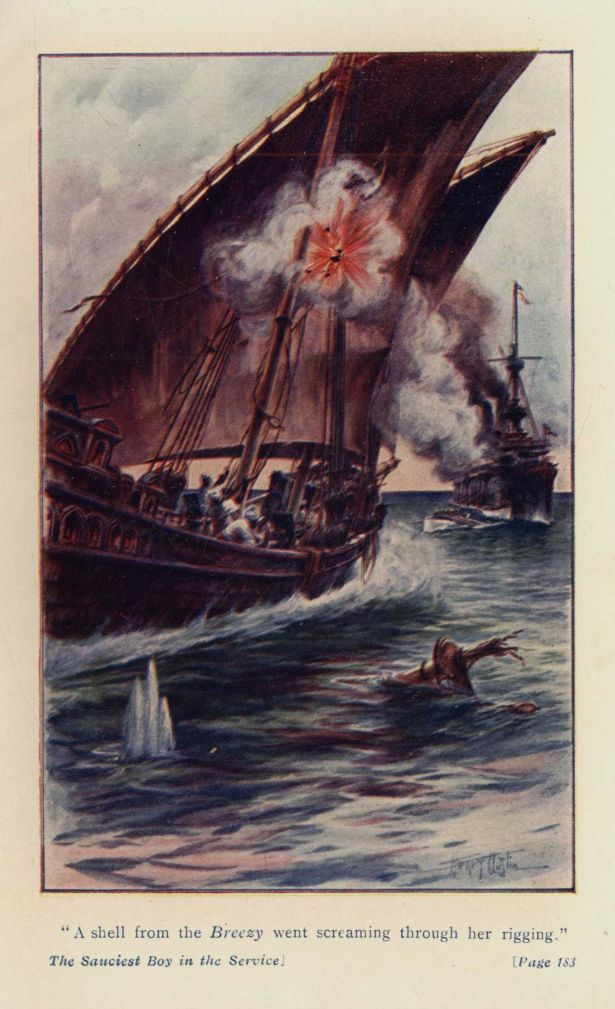
"A shell from the Breezy went screaming through her rigging."
Abdularram in his great dhow escaped entirely when the darkness fell like a pall over sea and land, for to-night there was never a star, the glass was going down, and there was every likelihood of a storm. And it soon began to blow.
This made it hard for every one.
"Bad luck," said Guilford, "not to catch that scoundrel."
"Bad luck for the wounded also," said McTavish; and so it turned out, for several of these died before morning, the pitching and rolling of the Breezy being very great.
"How is your boy Bungle?" asked one of the middies as Kep, looking somewhat crest-fallen, entered the gun-room.
"He is very low indeed," replied Kep, "and the doctor thinks he cannot live."
"Going to slip his moorings, is he? Poor little devil! Is he sensible?"
"Oh, yes, and bears his sufferings like a small hero, as indeed he is."
"Ah, well!" said the middy, "that's the tack we'll all be on--some day. Mellor, give that decanter of wine you seem to stick to, a fair wind this way."
"I'm holding on to it," said Mellor, "because it has a ball-bottom and won't stand on the table."
"Of course it won't. It was made like that on purpose, you untamed idiot, so that dolts like you should pass it round."
* * * * *
The Breezy arrived at Zanzibar all right in two days' time, in spite of the storm.
War-worn and weary, that same night the good surgeon had sunk to sleep among his wounded men on deck, and some kind-hearted sailor had drawn a tarpaulin over him. It was broad daylight when he awoke him.
"I let you sleep, sir. I thought you needed it. Another man dead, sir, and poor boy Bungle going fast, I fear. Insensible now."
"Just let him sleep," said McTavish.
But when Kep went back to the brave little lad's hammock Bungle opened his eyes, and smiled faintly.
"Is there anything you would like, Bungle?"
"In dis world, no," was the faint reply. "But you speakee my ole mudder. Tell she, dat Bungle nevah fo'got."
Then his left hand was half raised to his brow as if to touch his forelock. Next moment it fell heavily on the coverlet.
Bungle was gone.
Only a little black boy? True, but may we all do our duty as bravely and well in the world as Bungle did his.
The wounded were all sent to hospital. They would be conveyed to the Cape by the very next steamer.
But something was in the wind surely, for the fleet on this station now received orders by cable to return to Symon's Bay with all speed after taking in sufficient coal.
Kep had time to go on shore. He went in mufti, not his Arab dress. In mufti and after dark. He could do nothing to find out the whereabouts of little boy Bungle's "ole mudder," and so she would never know what had been the fate of her little son.
Perhaps it was better so. For she would do now as most mothers do--just live on in hope of one day seeing him back again.
Taking great care not to be seen, Kep now went to pay a visit to his friend the Arab and to wee Zeena.
I need not waste a sentence in telling of the reception he had nor of the happy evening he spent, or the farewells said. Zeena was Kep's little romance, and it would be very long indeed before he could forget the child.
* * * * *
Why had the ships been ordered down to the Cape? It is a question I cannot really answer. It was now the year 1908, and notwithstanding the great advances in every kind of science, there will still be a few blind men at the Admiralty and in the Government generally. The consequence was that there was far too much wire-pulling. Much was lost by our fleets on the various stations having to wait for orders from home.
The scare on this particular occasion was brought about by what was called an unpremeditated attack by a supposed German cruiser on some British merchant steamers.
In fact some of the latter had been looted and sunk, and their crews and passengers landed almost starving on the nearest land. But as the Germans disclaimed all knowledge of the cruiser, which they advanced in their arguments must be a sort of pirate or Alabama, then the British bull-dog began to growl, and the peace-at-any-price tried to appease him, and said he must not fly at poor Germany, for that heavenly land and all in it were most friendly to the bull-dog. Negotiation, negotiation, that, they said, would settle all disputes.
Well, it eventually did in this case at all events. But there were wheels within wheels, political mining and counter-mining, and intrigues deep and shallow.
Be all this as it may, Zanzibar was for the present left unprotected save by its own fleet. Now this fleet was a very good one, as I have before hinted, and if manned by British seamen it could really have done some splendid execution when it came to be wanted. At present it lay in the open roadstead, and was even anchored without much system.
The new Sultan was very easy-minded. The ships made a fine show. That was delightful, and especially did he love to look upon them on gala days. In fact, he made gala days and kept birthdays and high days, just for the pleasure of seeing his war-ships dressed all over with bunting. And such a blaze of colour had really a fine back-ground by day in the blue bright Indian Ocean.
Then when darkness came the Sultan spent a deal of his pocket money precisely as boys do in the first week in November. He went in heavily for fireworks, and the ships were all lit up with blue or crimson fire. The Sultan of Lamoo was not a fool, and he had some heavy men (of other nations be it whispered) who backed him. He had, moreover, a splendid admiral in Abdularram. Perhaps he knew more about dhow-fleets than gun-boats or cruisers, but he had men on board the spit-fire shiplets of Lamoo that knew far more about the newest class of torpedoes than they did about the Koran.
There is a tradition (as in a former book of mine I mentioned) that one time--date forgotten--when Zanzibar was not so valuable a possession, but a city nevertheless of some 300,000 inhabitants, an enormous fleet of armed dhows suddenly appeared like a cloud of locusts on the distant horizon. And like the locust-cloud, it bore right down upon the city, and an army of strange men was thrown upon the beach and at once attacked the Sultan's forces. These had soon been made an end of, and the palace was robbed.
The whole town was looted--women carried off, and all who resisted slain.
But, so says the tradition, the army at last re-embarked, carrying with them their dead and wounded, then this Armada put to sea again. They disappeared beyond the horizon and were never seen nor heard tell of in this world again.
They were foreign men, they were foreign dhows, foreign devils all, but who they were or whence they came may never be known.
However, history was now going in some measure to repeat itself, without so much of the mysterious.
Down the beautiful river, therefore, which after gliding through a quiet landscape of green and charming forest, rolls over a sandy bar and empties itself into the Indian Ocean, there dropped one day the midget fleet of Lamoo, and one by one braved the danger of the only opening in the reef, and got clear and safely out.
They were small vessels, very, but every one of them carried death on her decks, and death between decks, in the shape of guns and torpedoes.
They numbered only ten and were all of the same class.
If they were lacking in anything it was speed, and although they had good gunnery men on board their engineers had none too much skill. In addition to sailors proper their decks were crowded with dare-devil fighting Arabs, many of the chiefs of whom had old scores to settle with the inhabitants of Zanzibar.
They had orders from the Sultan of Lamoo to bring back with them the Sultan of Zanzibar--alive. He must be alive, Lamoo said, for in the fierce heat of the tropics, "if dead he would not keep a day."
The Sultan of Lamoo found great pleasure in preparing quarters for his coming sovereign guest. The palace, which looks a very noble one and quite imposing from the broad river front, was specially refurnished, and all that the art of the twentieth century could suggest was lavished thereon. He had even ordered new dresses for himself all ablaze with the most precious stones, and the ladies of his harem were also, much to their delight, refitted as it were. For this wicked Sultan was to lead his august prisoner all through the palace--securely manacled of course--in order to dazzle his eyes with its gorgeousness.
He had bought the best new gramophones and pianolas for this especial purpose, with pictures galore, and carpets as soft as feather beds. Indeed he had not regarded expense in any way, and determined even to permit his majesty to have a peep inside his beautiful harem, the ladies of which he had specially trained to close on his entry in every form of gracefulness imaginable, and on these as they posed colour flash lights were to be turned.
This was all very delightful, especially for Lamoo himself, but his guest's bedroom had also to be refitted and replenished, for here he was to remain for a week, or as much longer as he chose to live without food, unless he chose to devour the awful rats and reptiles with which this slimy dungeon was purposely stored.
When the fleet was once fairly at sea, the three happiest men anywhere on the coast of Africa were Admiral Abdularram, who gloated on the thoughts of the coming bombardment, the Sultan of Zanzibar because he was in blissful ignorance of what was to happen, and Lamoo himself, as he mused all day and dreamt all night about the treat he had in store for his kingly guest.
CHAPTER XVII
THE MIDGET FLEET. BOMBARDMENT. FEARFUL SCENES
When nations or peoples go to war, they invest the Supreme Being with a new title, which is, in my opinion, blasphemous in the extreme. They speak of Him, address Him, pray to Him, as the God of War, or God of Battles.
And, indeed, the priests of both sides do a large amount of praying. Each thinks his own cause the most just, and endeavours to invoke from Heaven strength for armies and navies, and blessings on every shot, so to speak, that shall be fired. And yet, every bursting shell may send hundreds into eternity and seal their doom for ever.
The Prince of Lamoo certainly did his share of praying. He prayed so much on that holy carpet of his, that he narrowly escaped having housemaid's knee.
But--and it is just here where the absurdity of the situation comes in--between the hours of prayer he went to have another look through his splendid palace, or gave orders for a few more loathsome reptiles to be introduced into the coming king's bedroom.
And as his fleet sailed south and away, Abdularram prayed also many times and often, never failing between whiles to note whether or not the scimitars and swords of his men, and his own pet dagger, which had so often wept blood, possessed sufficient keenness of edge to please him.
In four or five days' time the midget fleet were within an easy distance of Zanzibar, but stopped dead now till the darkness should fall.
About six o'clock, as usual in those regions, the sun sank behind the horizon, casting a red gleam of light across the waves, crimson as the blood that would flow ere he once more appeared in the golden east.
Wireless telegraphy had reached its highest pitch of perfection by this time. Indeed, it was possible then to wire wirelessly round the world, as an Irishman expressed it.
And long before the arrival of the little Armada, a passenger steamer, which had it seen it, came tearing into Zanzibar, and made her report to the British Consul.
There was not a moment to spare. A rumour of something terrible on the wing had already reached his ears, and he lost no time in dispatching messages in every direction.
He warned the Sultan also, and his fleet. Then he warned different consulates.
The Sultan had the utmost confidence in his fleet. The fleet hardly scarcely troubled to prepare.
The insolent Armada could be sunk very easily when it came--to-morrow.
The torpedo nets and booms were all in beautiful confusion, but, of course, they could be easily put into order and lowered if necessary--to-morrow.
It was observed, however, that the German and Portuguese consulates had already retired into their forest homes, and as for the Americans, well, they took the hint so kindly given.
The U.S.A. Consul, in a polite note to the British, thanked him for the tip, which would be taken forthwith. The consulate, luckily, he said, was well insured against burglars and fire, in five or six offices. Meanwhile, would the British Consul be good enough to give his, the American Consul's compliments to the ladies, and say, under the circumstances, it would be impossible to play that game of poker next evening, but that he hoped, etc., etc., etc.
But before either battle or bombardment began, needles began to waggle and prattle on no less than three British cruisers that were on their way from India, also in the wireless telegraphic office at the Cape, and from that messages flew over the sea to send back the Breezy, and on towards Zanzibar with all speed. If the midget fleet had done any mischief, they were to capture, burn, or in other ways destroy it, wherever it could be found.
Nor were the Americans behind hand. The signalling station might be knocked down, or fired, so they must make good use of it before such an accident befel it. As good luck would have it, two Yankee battle-ships of tremendous strength were well within hail. The consul wired them at once, well, he wirelessly wired them, and the message ran somewhat as follows:
"If this Marconi reaches the American battle-ships, Niagara and Delaware, alias Blue Blazes, and the Plunger, will they please make all speed hither to save us, and other American citizens, from the wrath to come to-morrow. Come with your thunders and defend the flag. A fleet of pirates is now on its way to bombard us, and in Zanzibar to-morrow the devil himself will be let loose, and the whole show painted red."
Nothing more could be done. For shortly after dark, cleared for action, the midget fleet was once more on the wing. A darker nor more dismal night had never been seen in the roadstead before. Nor a wilder, for as if to aid the Armada, a breeze had sprung up, which rapidly increased to half a gale, with the usual accompaniments in these latitudes, of loud thunder and rain, that at one time more resembled the bursting of a waterspout than anything else.
The Sultan's ships twitched and tugged at their anchors, which some of them even dragged.
On so fearful a night surely the Armada would dare to do nothing, could do nothing. Like the Spanish Armada of the brave days of old, Lamoo's midget fleet would be scattered or sunk.
The Breezy was making good way southward, when old Marconi began to speak.
Sometime after, little Sneyd ran into the ward-room with a bit of flimsy in his hand. The officers were discussing nips of sherry and bitters, or curaçoa and brandy, or anything good and handy, that would encourage the appetite. Very wrong this was indeed, but dinner would soon be laid, and there was a sad want of excitement among all hands, the depression that always follows a fight, whether victorious or the reverse.
"Honolulu!" cried Sneyd, "I'd give a day's pay to know who on earth does hold the ribbons in the British Navy."
"If you did," said Guilford quietly, "you would make things hum, wouldn't you, my dear little jumping Moses?"
"But look here. Here's a pretty go. Here is a blooming muddle! First, we were ordered to fly to the Cape, now we are called back, ordered back, kicked back, confound 'em, I say,
"Confound their politics,
Frustrate their Navy tricks."
"Hurrah! Hear, hear; but what is it all about?"
"They're going to board and burn Zanzibar, as far as I can see of it--a fleet from Lamoo is going to bring down the sleepy Sultan by the run."
The Captain at this moment sent for the first lieutenant, and in two minutes' time, if not less, the Breezy had turned almost on her own length, and was rushing through the waves at full speed, on her way back to the city of the Arab Sultan.
At this time it was quite the fashionable thing for the foreign resident gentry of this place to have lodges in the sylvan interior, to which they could retreat for real quiet, and real hygiene, for as regards matters sanitary, there was still in the city itself much to be desired.
There were good roads thereto, so men mounted their motors, and hurried their families into what they looked upon as places of safety.
But for the most part, they themselves returned to see the fun, as they phrased it. Then came on the terrible storm. Whatever might happen now, they must bear the brunt of it.
* * * * *
Abdularram was as fierce in his wrath as any Viking of old, for his hatred of his foes, the British, no amount of blood could ever quench. He had felt highly honoured when he was appointed Arab Admiral of the midget fleet. His Sultan told him that he admired his courage, his wisdom, and fighting qualities. But, there was one proviso that, brave as he was, Abdularram did not quite care about. He, this mighty chieftain, would remain Admiral of the fleet as long as he lived, on one condition only, namely, that he returned to the palace with his enemy alive, if he did not, he should be deposed, and cast into the dungeon, so well prepared, there to die and rot. He even permitted Abdularram to take a lantern, and enter the dreadful place, and have one look around. This, he felt certain, would impress his Admiral. Abdularram did as he was bid, had one peep round, and rushed out again, apparently in all the terrors of some ghastly nightmare. The dungeon had certainly impressed him, so much so, that he made a vow never to enter there again.
On such a night as this no officer of the Sultan's fleet dreamt of an attack. If the enemy were really approaching, they would wait for sunrise, then the Sultan's fleet would be under weigh to meet theirs.
Had it been calm, it would have been impossible for a ship of any kind to approach the anchored fleet without being heard. There were the roar of the wind, the rage of the lashing waves, lit up every now and then by spectral lightning, and the artillery crash of the thunder.
But shortly before midnight, and while the British Consul himself, with one or two friends, sat in an unlit room, smoking and occasionally gazing seawards, suddenly the pitch darkness out yonder was lit up with the fires of death and destruction. An explosion was heard, far louder and awe-inspiring than any that ever before had shaken the city's foundations.
One of the biggest ships was blown up, literally broken into two gigantic fragments, the red ends of which shot up into the air in the centre of a perfect volcano of light and fire. In the midst of this, could be seen, along with debris of every description, the mangled and dismembered bodies of scores of poor wretches, who had not been given time even to utter a cry or explanation.
Then a seething plunge, as the wreck sunk down, followed by a darkness that could be, metaphorically speaking, cut with a sabre.
But pieces of the wreck were hurled as far as the sands, on which they fell, still hot and blazing.
Another explosion took place very soon after. It was, if anything, more horrible. A third, a fourth, and a fifth.
The torpedoes had done their terrible work with a completeness that had never before been equalled.
Two vessels, had not been sunk, but one of these had taken fire, white smoke spued up from her first, then flames quickly spreading fore and aft.
And by the light of this blaze of war the Sultan's flagship could still be seen swaying safe and stately at her moorings.
A more terrible, because less sudden fate was reserved for her.
Abdularram knew his business. He knew that three or four times a week the youthful Sultan was in the habit of sleeping on board this battle-ship, the after quarters having been furnished for his sake with all the luxuriousness of an eastern palace.
"He may be there to-night," thought the great chief, "and I have orders to make him prisoner. Never a torpedo must be fired in her direction, never a hair of the monarch's head must fall to the ground."
Guided by telephonic communication with Admiral Abdularram's ship, the midget fleet had pierced the darkness in two lines, and taken up positions in the same formation in which Nelson had placed his ships at the battle of the Nile.
Arab's eyes are more used to darkness than a European's, so with their twinkling lights, that the Zanzibarees had not even taken the precaution to put out, each ship in the anchored fleet could be correctly positioned. Apart from this, the lightning that flickered and flashed ghost-like about their hulls would have given the clue to the enemy.
This great flagship now began to vomit forth fire and shot and shell, and the rattle of her belching guns was louder far than the loudest thunder.
But in the inky night there was now no visible target, for the burning ship had soon blown up. They might as well have fired in the empty air.
Then flashlights were turned upon her by the enemy, lighting her up fitfully, and for a moment or two only.
For the time being, the streams of electric light were only necessary to guide the midgets towards her.
Five of these latter surrounded her, and a hellish legion of fierce cutlass-armed fighting Arabs swarmed on board of her.
There had been a sudden lull in the storm, the thunder had also ceased to rattle, though the seas still lashed in fury. It was as if Nature appalled, held her breath to witness the horrors of the fight that was now raging on the battle decks of the Sultan's flagship.
The cries, the yells, the wild appeals for mercy, could be distinctly heard at the Consul's window, and added to the horror of this terrible night.
But it was soon over. The crew had all been slain, or leapt overboard in wild panic, and those who remained alive were rushed below and imprisoned, The Sultan was not found.
The flagship's fires had been found banked, and soon after her capture, with every light extinguished, she was steaming out to sea.
About the same time flash lights began to gleam from the Sultan's palace, and the forts opened fire at last.
A bit of useless braggadocio, for had the enemy been visible, which they were not, those gunners could not have hit a single ship. In fact, there is strong reason for believing that when a gun was trained, or a broadside to be fired by electricity the men placed their fingers in their ears and fell flat on the gallery floor.
The midget fleet, it was believed, had gone for the night. It was swallowed up in the black beyond. The Sultan, terror-stricken now, and weeping like a boy of ten, had been shut up in the inner recesses of his palace, and his bodyguard tripled.
The enemy had retired, it is true, but in three hours' time it gave ample evidence that, instead of having gone for good, it lingered out yonder for evil.
Without doubt it had come to stay until it had accomplished the object of its mission.
But now the sky had cleared, and the calm had come.
Out shone the radiant stars, and a moon in its last quarter shed silver radiance on the sea.
The beach at Zanzibar is of clearest sand, the blocks of buildings facing the roadstead whiter than granite, and in the dim light of the stars and scimitar moon they could be easily seen at a distance of two miles, and even at this long distance, with his midget fleet, Abdularram, knowing well the accuracy of his gunners' aim, commenced the bombardment of Zanzibar.
Their plan was to watch and wait till a volume of white smoke with a centre of fire showed out on shore, and to aim and fire at that particular spot.
The Admiral of the fleet thought that by this means he would manage soon to silence the forts.
He knew the British Consulate, and guns were laid, and, indeed, for every white block of building it was possible to distinguish, with the exception of the palace itself.
His desire was to show the Sultan that so long as he remained there he was safe.
Zanzibar's guns, however, took much longer to silence than Abdularram could have credited; and when the sun once more rose over the sea, the shells from the fort being now better planted, he considered it prudent to take up a position farther away, where he knew his vessel would be safe.
This Arab Viking, if the truth must be told, was more at home in a sailing fighting dhow than in a ship of war.
He had, nevertheless, performed one of the most wonderful feats of modern times, namely, the boarding and carrying by cutlass and revolver of a great and mighty battle-ship.
After a time there was a lull in the firing from both sides.
Abdularram felt himself sure of that city. Zanzibar, he told his captain, was sure to fall, and its Sultan, to say nothing of the best part of his harem, would be in his power.
"And after that, your Highness?" the captain asked, with an evil glare in his eye.
"After that," replied Abdularram, "the looting and sacking of the city."
He smiled grimly as he thought of it. The cruelty of the pirates in days of old has hardly any parallel in the twentieth century, and I now ask myself, ere penning the concluding lines of this chapter, whether I should tell my young readers anything of the tragedy that now took place on board the conquered battleship. I shall do so in the simplest language I can command, and in the least graphic. And I do this much, because I know and feel that our British boys, who I trust will grow up good and brave defenders of their fatherland, may realize some of the horrors of naval warfare.
And savage and ruthless as Abdularram was, he was no worse than Napoleon Buonaparte, who slew his prisoners by thousands.
Few Arabs are such devils at heart as Buonaparte was, and even this man before giving orders for the deed of horror to be committed, led gradually up to it in a conversation with Captain Suleiman.
"My Captain," he said, "those men of the Mahomed's Pride (the flagship) fought well and bravely."
"Alas! yes, as our dead and wounded can testify," was the cautious reply.
"They nevertheless encumber us greatly; but though, no doubt, you have them securely battened down they were sealed up so quickly that it was impossible disarm them. They have still their swords and cutlasses?"
"Yes, sahib."
"I mean to man the guns of Mahomed with our own brave fellows, and turn them against the city.
"Yes, good sahib."
"But what if, at the very commencement of the fight, the prisoners break loose from the hold, like a horde of foul fiends, and attempt to retake the ship, and if successful, turn her powerful guns on our midget fleet?"
"I do not fear for that; we could overpower them, I think," said Suleiman.
"Yes, I believe we might, but the slaughter would be harrowing."
His captain did not answer. He waited.
"It would be best of all," said the Admiral, at last, "to get rid of them in a more humane and safer way. Suleiman," he added, "it must be done!"
And Suleiman knew what was meant, and that the order for the execution of two hundred prisoners had to be given by him.
"The die is cast!" said Abdularram.
And he walked aft to smoke a pipe of opium. The plank was rigged, it was long, wide, well-balanced, and commanded at the ship end by a strong rope.
The further end was made slippery with vegetable oil.
The prisoners were then ordered up in batches of ten--disarmed, of course.
The poor fellows knew their doom, and most of them went quietly to death.
But the scene was soul-harrowing, for some of them refused to mount, and even attempted to fly at the necks of their enemies.
I'll go no further, only to say, that all throughout this awful and sickening execution, the battle-ship was going ahead at full speed, lest some of the unhappy wretches should attempt in their agony to clamber back on board again.
When it was all over, the decks were sluiced down, but not properly cleaned, so that blood still lurked dark in cracks and seams.
Then laying down his little pipe, Abdularram, in his jewelled uniform, stalked stately forth from his room.
"They have gone?" he said.
"Yes, sahib."
"Thank Allah! He has delivered His enemies and ours into our hands. Breakfast, and prayers, now, Suleiman."
The breakfast was no mockery, but surely the prayers were.
After all this, well knowing the advantage and restorative power of rest, Abdularram ordered every man who could be spared to lie down and sleep.
And motionless for hours upon the blue bosom of the great deep, lay the midget fleet, and the huge and stately battleship.
CHAPTER XVIII
FURIOUS FIGHTING ON SEA AND LAND
The bombardment began in earnest about midday.
The midget fleet remained at a respectable distance, keeping up a plunging fire. Abdularram meant to keep his own ships afloat though he cared nothing about the mighty leviathan that had been flagship to the feeble-kneed young Sultan of Zanzibar. Indeed, she was advanced later on in the day very close indeed to the city.
She was prettily manoeuvred too, and poured broadside after broadside into the principal part of the town, which now lay completely at its mercy.
The British Consul had remained and also the American, and about four in the afternoon they succeeded in getting audience of the Sultan himself. They had been unable to see him sooner. He had a headache, and was lying down, his prime minister told them.
The Sultan received him in what we may call his reception room, for want of a better name.
He remained seated and looked ghastly pale and old. Indeed, though little more than twenty, he seemed quite an aged man, with the exception of his black and flowing locks.
The British Consul stopped to bow at the audience chamber door.
So quickly had he stopped that the tall raw-boned American Consul, who appeared always to be in a hurry, and who was coming up behind, ran foul of him with such force that both were precipitated on the carpet.
The carpet was exceedingly rich and soft, yet, to say the least of it, this was rather an undignified way of entering into the presence of so great a Sultan.
"Come, I say," cried Munro the American, as he gathered himself up, fold after fold, from off the floor, "why the old Harry did you stop and protrude your stern like that? I believe I've split my blessed breeches."
Before Mr. Johnson could gather himself up, for he was somewhat John Bull-ish fore and aft, Munro had stepped over him, and advanced to the regal chair.
"Shake," he said, holding out a long, bony, twelve-inch hand.
The Sultan moved not, nor answered. Was he not a king?
"Shake!" shouted the Consul, in a voice that made the jewelled ornaments round the room ring and tinkle. "How long have you been deaf?"
The Sultan now condescended to shake hands with both Consuls.
Munro wheeled quickly round to a liveried or uniformed attendant.
"I say," he cried, "fetch us two brandies and a split, I see this is going to be dry work."
The gentleman whom he addressed was really one of the Sultan's ministers and advisers.
He smiled as he looked comically at Munro. "Would ye no hae a drap o' the auld kirk," he said. "It's prime stuff and a' the wey fae Glendronach."
"Ho, ho, ho," laughed Munro. "You're Scotch are you?"
"Ay, man, and a Banffshire laddie for bye. But, dod, man, I have ma ain adees (troubles) wi' that fushionless sinner, yonder."
A shell at this moment burst in the air outside, and the concussion shivered the glass in the window.
"Losh!" said the Scot, "that's gey near and vera emphatic."
The Sultan leapt up and would have bolted had not Sandie caught him by the skirts and thrust him back into his chair of state again.
"Off you go, my friend, and order the drinks; I'm going to talk big to this little Arab."
There was no respect for "nigger Sultans" in Munro's mind.
"I say, young fellow," he cried, "this is a pretty kettle of fish, ain't it? You're in a jolly tight corner you know."
"Oh! Can you save me?" whimpered the Sultan. "That pirate king will slay us all."
"Not he. He will pay some degree of respect for the Stars and Stripes and the Yewnion Jack, you may bet your bottom dollar on that. No, young fellow, it is you they are after, and they're going to catch you alive too. Your fleet is all down below among the jelly-fish except your flag-ship. They are knocking everything about but sparing your palace."
"Where shall I hide? whither shall I fly? I must hie me to my harem.
"Nary a hie my dear boy; if that pirate king, as you call him, comes on shore, one of the first places he will visit will be your harem. He will soon have you out of there."
"But where--where--can I go?"
"Well, to tell you the truth the coal cellar would be the best place for a potentate like you. Ah, here come the drinks. I suppose your Highness won't join us? No?"
"Now then," he continued, "let us finish this talkee-talkee. I'm not giving John Bull here a show, but he can put in his oar when he pleases."
"I'll leave the talking to you, sir," said Johnson.
"And, young fellow, have you called out your troops?"
"They are assembling. They are now in the bush," said the Sultan.
"Well, I'd keep them there for a time. How many maxims?"
"Only a few."
"Get them under weigh. Then I think we may be able to repel these fellows if they attempt to land. Write us a note now, introducing us to your general, and John Bull and I will take it."
"Meanwhile where shall I hide my august person?"
"There is a rare lot of the august about your high-and-mightiness I must say, but 'pon honour, old chap, you'll feel safer and more at home in the coal cellar. I'm not joking, really."
Then both consuls bowed, and made for the door.
Mr. Johnson lingered a moment to smile and say, "Keep up your heart, Sultan; it is sure to come right in the end."
"Allah be praised for those words of comfort!" whimpered the Sultan, "I shall do what is best in His sight."
At this moment the bombardment seemed to be at its fiercest and the inhabitants of the doomed city were terror-stricken. Never before had anyone here, Arab, Parsee, Hindu, or negro slave, heard the sound of a gun fired in anger, nor the sound of a bursting shell. For the most part they lay low in their houses, fearing to go into the open or trust themselves in the bush, so that the usually crowded streets were now almost deserted.
Johnson and Munro got horses from the Sultan's stables and went tearing out to the sylvan suburbs.
They found here about 5,000 Arab soldiers. Only the ghost of an army, for of late years it had been much neglected, and many of the men were now unarmed while others had merely the long, old-fashioned Arab guns. But they had all spears and swords.
Darkness fell before the two consuls were able to evoke something like order and arrangement in this force. Only their presence had been a comfort to the officers, while the men were in good spirits and evidently burning for a fight.
Would the enemy land, and if so where and when? A complete row of sentinels were spread within hail of each other as far round the beach as they could be extended, and the Sultan's troops were held in readiness to march, upon any given spot.
But the night passed quietly away. Abdularram saw the futility now of wasting his ammunition in the darkness.
The name of the gunner who fired the shot in a moment of forgetfulness at the palace itself, was taken, and for the present he went unpunished, as the Admiral could not spare him, but he was to fight now under the not very comforting assurance that the moment the city capitulated or was carried by assault he would be hanged or thrown into the sea, which after the fearful tragedy of the day before was now alive with monstrous sharks. The hundreds of poor fellows who had become their prey had only whetted their appetites as a few oysters before dinner would that of a gourmand.
Many of the houses far beyond the beach had been knocked down by shells, and set fire to over the heads of the buried inmates, alive or dead. The glare from these lit up the sky, but as yet there was no general conflagration.
Another night wore on, and at sunrise the bombardment was recommenced and kept up intermittently all day long. The shooting of the Zanzibar gunners was very bad indeed. But the forts themselves, which had only been built to replace older walls about a year ago, were of great strength, and faced with metal, so that it was evident they would take a much longer time to silence than Abdularram had calculated on. As some of these commanded the entrance of the palace, silenced they would have to be before Lamoo's great admiral could capture the Sultan.
Day after day the desultory fire was kept up, but on the sixth it became fierce and fearful, and it was evident to everyone that Abdularram was about to attempt a coup de main.
That night shells rained and burst over the old town itself, and soon it was on fire from end to end, and the flame-stricken inhabitants, hundreds of whom had been slain, were fleeing to the bush for their lives.
From the sea the conflagration was an impressive and awful spectacle.
It must be seen from the mainland even from B---- itself and Abdularram had two of his best vessels to intercept any vessel who might send assistance. These did patrol duty and warned off all ships of all sorts.
Meanwhile in the darkness, and in a distant part of the island, Abdularram had landed 2,000 of his fighting braves. This from the flag-ship and with very great caution, his object being to make a forced, but silent march on the city, taking it in flank or rear.
The sentinels, there were six of these to one mile of beach, were keeping their lonely vigil, honestly enough, but they neither saw nor heard a black and armed boat glide in and land about a dozen warriors. The oars had been muffled, and the men were half naked and black from head to foot. Armed with daggers only.
They crept silently through the bush in pairs, and approached as stealthily as tigers till within a yard or two of their victims, and these were knifed before they could utter a cry or give an alarm.
The beach thus cleared offered an easy landing to the troops, and long before daylight they had reached the camp of the Sultan's army, and attacked it with such fearful determination that in a few minutes what remained of it were scattered panic-stricken into the woodlands, or hurled back towards the flaming city.
Few who witnessed even a tithe of the horrors of that dread night will be likely to forget it till their dying day.
Those victorious tigers of the sea cared neither for drink nor food, it was blood, blood, blood, they thirsted for, money that they sought, but vice and lust also held their souls enthralled, and it is well to draw a veil--it needs a big one--over the scenes that took place in almost every street that the fire had spared.
But in the darkness they must attack and carry the palace.
Little did they know what was prepared for them. For here by the gates maxim guns had been stationed manned by men, both British and American, men who knew what maxims were too, for some had been volunteers in well-beloved Britain, and others had served in American regiments.
Abdularram's little army was foiled. It was driven back decimated by the hell-fire of these guns without having been able to cross a bridge or force a gate.
They retreated in some sort of order, however, and made their way to the beach, and here they speedily threw up trenches some distance away from the frowning forts.
They were making signals, too, for assistance. And just before daylight assistance did come. But it was not for them.
The brave Breezy had come in by stealth, attracted by the lights of the flagship some time after she had landed the fighting forces.
They understood now at once what the position of affairs was and, before Abdularram realised what was up, torpedoed the ship, which, although she but lifted her bows a little way out of the water, it was evident had received her death blow, for she began now to fill rapidly and to settle. Abdularram himself was seen on her deck, coolly giving orders for guns to be fired at the Breezy.
Before the broadside could be delivered, however, the doom of the mighty battleship was sealed. Even after she had sunk, men were seen struggling in the seething waters, and boats from the Breezy were at once sent to save them.
Many, glad of their lives, were quiet enough, but others drew their knives as soon as they got over the gunwale and attacked the sailors. They wounded several before they had their quietus.
Swimming powerfully in the glare of the searchlight and heading for the shore was a tall and powerful Arab officer. His turban had fallen off and his long black hair was floating on the water like sea-weed.
He was caught by the boat commanded by Guilford himself, and in which Kep had entered to help the rescue.
He drew his dagger, and the blow he aimed at Kep had it descended would have closed this story as far as that poor boy was concerned.
But Abdularram, for it was no other, was struck down by a blow from the fist of the stroke-oar. And that man was Jack Stormalong.
The Arab Admiral fell on his face at Kep's feet, and to all appearance dead, for he had been put to sleep and had an ugly gash on the forehead caused by coming in contact with the side of the boat.
"Thank you, Jack, a thousand times and o'er," said Kep with a smile; "my old friend here, who now so lowly lies, certainly didn't mean to be sparing in his attentions to poor little me."
"You're kindly welcome, sir," said Jack; "you would do as much for me any day, that I know."
"Ay, that I would."
It was the boats of the Breezy that were coming in and that the piratical soldiers mistook for their friends. They were at once undeceived, as soon as the quick-firers opened upon them.
They were driven into desperate confusion.
But now the Sultan's troops, whom the American Consul had succeeded in getting together, approached and quickly attacked the pirates at the point of the bayonet. And the battle was soon over.
There was still the fleet to deal with, and for hours it looked an ugly business for the Breezy. She had to make a running fight of it all day long, but after getting two of the midget fleet well away from the others, she attacked now with her heaviest guns, and was not long in sinking both.
Meanwhile others of the fleet had made a détour, and cutting her off from the south and seaward began to close in upon her from all round.
"By George!" cried the Captain, "this is being between the devil and the deep sea with a vengeance."
But suddenly the enemy ceased firing, and went off at full speed towards the south. And while everyone on the Breezy was wondering what this extraordinary move meant, there came a hail from one of the fighting tops.
"Two powerful battle-ships just in sight on the horizon. No, sir, I can only raise their tops."
A middy was sent up at once and presently he hailed:
"I can see the flags, sir."
"Well, what can you make of them?"
The middy had another long look.
"Why sir, they are Stars and Stripes."
"That must be the Niagara and the Delaware."
On board the Breezy there was shaking of hands all round, and laughing and talking and general jollity fore and aft.
Then up marched the doctor.
"Pardon me, sir, but I think that the crew now will be none the worse of some medical comforts.
"Certainly, by all means," replied Captain Breezy. "Pipe to dinner, officer of the watch, and we'll splice the main-brace, Surgeon McTavish."
* * * * *
The end had not yet come however. The midget fleet must not escape.
So now, although she was somewhat damaged, the Breezy put on all speed in order to meet the Americans as quickly as possible, and hold a conference, and in about an hour's time the two nations, Britain and America, were exchanging salutes.
When Captain Breezy of H.M.S. Breezy went on board the Niagara, he found the Captain of the Delaware there already, and Captain Breezy, wasting as few words as possible, told the whole sad story, and it was unanimously agreed that something must be done at once.
"There is no doubt," said Breezy, "that the Lamoo fleet will get back to their own Sultan as soon as possible, and there is only one way for them to get there, they must cross the bar one by one, and," he continued, "it is better, in my opinion, that we should sail for the mouth of that river and wait their appearance. Their sailing south was only to avoid meeting you. They will make a wide détour after they are out of sight, and come straight for the equatorial coast again."
This was agreed to. A steam launch was sent back to Zanzibar to advise the consuls as to their movements.
They were going on a punitive expedition now--that was the message--they were to be found near to the mouth of the river, and should a torpedo boat or destroyer come in as well as the large man o' war which had been signalled, the former were to come to the river's mouth, the latter to lie at Zanzibar to defend it.
CHAPTER XIX
KEP COMMANDS A DHOW. A DEPOSED SULTAN
The weather was now splendid, and the sea smooth and blue like the sky itself. Just a snow-flake of a cloud here and there, and that was all.
So quickly did these three grand ships dash through the water that they reached their destination in little over a day's time.
They kept well out to sea however. Had they gone close enough to the shore to be seen by a sentinel from Lamoo, no doubt the Sultan would have been apprised of their arrival, and suspecting that something had gone wrong would have adopted some means or other of warning his ships.
With steam up they lay at a little distance north of the river, for if some tell-tale dhow had met them to the south, it was within the bounds of possibility that the master thereof might have reported their presence.
But only one dhow appeared, and she was requisitioned, much to her disgust. She was two-masted and very fleet. Her men were taken on board the battleship to be well tended and cared for. Then the dhow was manned with enough Kroomen to sail her, and to his great delight Kep himself, once more got up as an Arab, was put in charge.
This clever lad had spent nearly all his spare time since he joined the Service in learning the duties of a midshipman, and so hard a student had he been, that already he could have done all that was required of such an officer.