THE SAUCIEST BOY IN THE SERVICE (continued 4)
Reading edition
He was now to cruise in his dhow near to the mouth of the river, and on the appearance of the midget fleet coming east again make all sail far enough to signal to the warships.
It was a glorious thing, Kep thought, to tread the decks of his own ship. For the time being he felt a real captain and monarch of all he surveyed. It would be only for a short time, but Kep would have liked to be skipper of this dhow for a year he thought. The owner of the craft, had a most superbly furnished poop saloon. The dhow was one of the largest of its class, and its owner evidently a man of wealth.
By day and by night watches were kept and a constant look out. But it was the morning of the fourth day before Kep caught sight of the midget fleet creeping up in line and as near to the wooded shore as it could get with safety, but slowly, because two were crippled.
"Ready about!" shouted Kep, and at the touch of the helm the great sails came round and the dhow was soon dashing eastwards.
As soon as the tops of the warships were visible he signalled, and in a very short time he had the pleasure of seeing them bearing down towards him.
He waited until he could point out the right direction, and as he was not ordered to come on board he thought he might as well follow on in his dhow and see the fun.
It was terrible fun, for the warships certainly gave the enemy little time to say his prayers. The result was that half the fleet was sunk, and four captured, others escaped to be captured another day.
It was lucky they had captured those four midgets for the Breezy could never have crossed that fearful bar. There was but one opening in and that not wide, and breakers roar and dash to starboard and port as you enter.
The day was spent in manning and re-arming those midgets, and there could be no getting up the river in the darkness.
But when another glorious day awakened those silent forests to life and love, the bluejackets and marines, to the number of seventeen hundred Americans and British, and with a few sturdy Kroomen, were put on board and started with three ringing cheers; there was little else but standing room, for Jack Stormalong knew every inch of this river, and he was made pilot. Captain Breezy himself took command, Guilford was there as well as the tall athletic surgeon, and Kep, still in his Arab dress, was taken as interpreter.
In dealing with savages or semi-savages, and the inhabitants of Lamoo were little better, there is nothing beats audacious coolness coupled with firmness.
This scoundrel Sultan was taken unawares, the flower of his little army had gone with the expedition. Those he had left he could not trust, so, as Jack Stormalong phrased it, he was up aloft and the rigging cut.
Captain Breezy in full uniform landed with Kep in his own, with only a few marines as a body guard, and landed on the beach with the greatest sang froid. This sailor had never known what fear was, and the British navy owned no braver man. He asked for a guide to the Sultan's palace and half a dozen sooty scoundrels begged for the honour of conducting him.
They were dressed only in cummerbunds or little canvas kilts, and each carried a spear. Corner boys were they of this wild city, the only thing stately about which were the forts and the lofty palace.
When the Sultan heard an hour before this that his fleet was returning triumphant, he rejoiced and was exceedingly glad. His greatest enemy would soon be in his clutches and he would have the rarest fun on earth.
He was resting in his audience chamber when Captain Breezy with Kep--leaving the marines outside--were shown in. If a half-black Arab could turn pale that Sultan would have done so now. The Captain and Kep bowed low and the Sultan advanced and held out his hand. Captain Breezy did not see it.
"Tell the fellow all I told you," he said to Kep.
Kep appeared to grow suddenly three inches taller. He held his head erect and cleared his throat.
"Ahem! you see before you, Mr. Sultan," he said in his best Arabic, "the might, and pomp, and power of the British nation."
That seemed a good beginning, and the Sultan, who really was a splendid specimen of the dark Arabs, looked at Kep from toe to top somewhat curiously.
"You see before you," continued Kep, "the offended dignity of that nation. Your accursed fleet has laid most of the city of Zanzibar in ashes, has destroyed and burned the British and American Consulate, and we come in our might and strength to demand redress."
An amused and somewhat haughty smile was visible for a moment on the Sultan's face. Then an angry frown.
"What is to hinder me," he cried, "from throwing the might and power of Britain, in the persons of you two badly armed men, into my handsomely furnished dungeon. One word and----"
"You dare not. If we are not safely back in one brief half hour, our fleet shall silence your forts, set your palace on fire, and your city as well, and you shall see the inside of a British ship as our prisoner, on your way to Ceylon or St. Helena.
"And now we leave you to your reflections. If we have no answer in one hour's time we shall proceed to action."
Next moment they marched out with marvellous coolness and soon reached the boat.
Breezy took out his watch.
"A quarter to twelve," he said. "By a quarter to one the men will have finished dinner, and then for business, for I expect no answer from that fellow."
The forts, although the guns were good, were badly positioned, and the little fleet lay just round the bend of the river in a most commanding situation.
Now this Sultan--Said Hassam to name--was the most unpopular man on the coast at this time, and his own people were only waiting for an excuse to depose him.
It was half-past twelve when a magnificently adorned gondola-looking barge swept round the corner, and three richly dressed Arabs requested audience of Captain Breezy.
The interview took place aft on the upper deck, and was just as brief as it was important. One a very old man, who looked like a prophet, Kep thought, told the Captain, through Kep, that they had been opposed to the sending of an expedition against Zanzibar, but were over-ruled by the Sultan himself, and that the city had been about to rise and depose him even had the ships not arrived.
"This is very satisfactory if true."
"You have our word of honour."
"We shall have to be paid a large indemnity, which my Government," said Breezy, "must fix."
"We will pay it willingly if not too large and if time be allowed us."
"And the present Sultan must be deposed immediately. We shall take him prisoner with us to the Cape."
"He is already deposed," answered the old minister smiling grimly, "and his son reigns in his place. It was all done very quietly."
"He must be brought here," said the Captain, and Kep translated.
"But he is here. I will give orders to have him up at once."
He stepped to the side, and next minute a powerful and burly black staggered up the ladder with a heavy sack, and, much to the astonishment of all, threw the body of the late Sultan at the Captain's feet.
There was no mistake about it. He had been deposed with a vengeance.
But this is only an example of the neat and effective way they have of settling political difference in those regions.
There was no danger now in landing, and not only the officers but even boatloads of the crews were allowed to go on shore and stretch their legs.
All agreements having been arranged to the satisfaction of Captain Breezy, and visits interchanged with the great men of the town, the fleet dropped down the river next morning, and their friends very much astonished as well as pleased at their early return.
On the other hand Captain Breezy was not surprised that during his absence Abdularram had succeeded in committing suicide. He preferred death to imprisonment.
On board the mighty American ship the British officers dined that evening, and to his great delight Kep was among the invited.
The Admiral himself took a great pleasure in talking to him.
Kep dined in his handsome Arab suit, and after dinner delighted the Americans with his marvellous fluting and piano-playing.
He was permitted to go forward while the elder men sat at their wine.
As in the British Service, the men had all extra grog to-night, and a merry hour was spent in dancing when Kep came amongst them.
Among the toasts of the evening was one which I hope will never be forgot. It came from the lips of Admiral Gray himself. "This is the first time," he said, "that the British have fought shoulder to shoulder with the Americans. Together may we stand in many a stout fight yet to come."
CHAPTER XX
"THAT BAR OF GOLD WAS STOLEN FROM ME," SAID KEP
In six weeks' time they were once more leaving Zanzibar and heading southward for the Cape.
The men of the midget fleet, whom they had taken prisoners, were left at Zanzibar, and in due time would be tried for piracy and murder on the high seas, and no doubt many of them would meet the doom they so richly deserved.
Kep had searched for his Arab friend high and low, but he was not to be found, and neither he nor dear Zeena would he ever see again. He would have given a good deal to know they were safe, or even to know something of their fate, whate'er it may have been.
Kep's little romance was ended.
There were no letters from either Madge or his father, for whom he cared so much, but he felt sure that both must have written and that their letters had been destroyed in the bombardment.
The Breezy entered Symon's Bay in triumph. No wonder, for under her wing were the four captured gun-boats of the midget fleet. And all the English-speaking world had been singing the praises of the broadsword-men of the Breezy.
Dispatches, of course, and private letters from men in the Admiralty.
Very simple had been the narrative which the bold sailor Breezy had sent to the Lords Commissioners. But they could read between the lines, and he was promised his promotion at once if he chose to leave the ship and go home to take it up.
He decided to hold on to the end of the commission. The officers, too, would certainly be promoted, and even Kep, it was hinted, was to receive an appointment when he arrived in England that doubtless would be very much to his taste--this was mentioned in private letters only. The Admiralty never forgets its dignity. But what pleased the Captain most of all was an autograph letter from the King himself, thanking him and his officers for so bravely upholding the glory of the Royal navy. The King commanded him also to visit him on his return, if God in His goodness should spare both their lives.
A mail came in from England before the Breezy once more sailed for the still-farther east.
There were letters from home for nearly all hands, and one from Kep's father inside Madge's. Sore and sad was Kep's heart when he read it.
Both were well and likewise Bounder, but Martello Castle and lands were let, and they were living in a small cottage near the sea. "Very happy, though," Madge's letter said, and poverty made her love her father all the more, and he is now proud of you, Kep, so he told her, and we all long so much to see our dear boy again. There was a postscript, as there is in most young ladies' letters. It ran as follows: "P.S.--Old Elspet sends her love, and I haven't married the wealthy Israelite yet."
The last word was strongly underlined. Kep kissed the letter, and there were tears in his eyes as he refolded it.
He would put it under his pillow to-night just to see what he should dream about. Well, I for one cannot laugh at Kep, for often enough when far away at sea I've kept letters from home under my pillow for weeks. It was hours and hours before Kep fell asleep that night, notwithstanding. Madge's letter brought the past back again so vividly. Ah! he had been happier than he knew of.
The splendid old castle, the cliffs and rocks and moorlands wild and wide, and his own little turret chamber high above the rookery in the rustling elms. Was he never to see them more?
Never as a boy, and, ah! boyhood is life's brightest happiest season.
The Breezy had been in commission nearly two and a half years, and there was at least a year to go by yet, and then Kep was to have an appointment.
It could not be as a middy, or anything of that sort, of course, because the laws of the Admiralty are inflexible. The executive officers have all to enter the service between the ages of twelve and thirteen.
Never mind, Kep determined to continue his study of languages, and of everything else, and who could tell what he might not rise to in course of time.
Kep, the reader does not need to be told, was very clever, and moreover he had a first-class idea of himself, and I never blame any boy for that.
At all events one never does get to the top of the tree unless he tries to, and Kep made a vow that night that he was going to try and keep on trying hard as ever he knew how to.
As to the letter under his pillow well--he never dreamt a single dream.
That was droll perhaps, but a fact.
* * * * *
Before stretching away out into the limitless ocean again, the Breezy lay for a few days at Cape Town.
Do you know Cape Town, boys, and the charming scenery around? The wild mountains that frown over it, ablaze with greenery, and the crimson of heaths and wild flowers, such as we in this tame domestic England can only cultivate in our hot-houses.
The brown soil and the bare brown bluffs that peep through here and there, only adding an extra charm to their beauty. To see these grand old hills even at a distance and gaze up into their enchanted glens and valleys, is something worth journeying six thousand miles to behold. Beautiful under the midday sun, still more lovely when sunset sheds its rainbow hues over them and over the sea; something to dream about when the mystic moonlight tones and softens their lines. Have you seen them at a distance? Nay, but have you wandered among them, wandered and wondered at all you saw! Then have you in reality seen a bit of life.
A fig for some men and women, who have rushed such places, hurriedly and excitedly "doing" them. These know no more about their true grandeur, beauty and solemnity than does a child with a South African picture postcard in its chubby hands.
Well, Kep asked leave to go on shore one day here, and of course obtained it, and was permitted to take his friend Adolph with him.
They were going to have a little pic-nic all to themselves.
"Take your gun, Charlie," McTavish said, and bring me off the biggest black snake you can find. I want to skeletonise the beggar, in order to solve a little problem in Natural History that Mr. Wynn and I are not on the same platform about.
They landed in a shore-boat, he and Adolph, as they wanted to be all by themselves. Past the busy quays and docks and along through the busy well-thronged streets--Kep loved not these, loved not civilization of any kind. It was nature, and its wilds alone that had charms for this strange boy.
They did not speak a deal until they got out of the suburbs, and up, up, up to the top of a high mountain. Adolph was a little out of wind ere he reached the summit, and had to lie down for a breather. But Kep, as light as a lark and as hard as heather, felt fit to soar to any height.
"Oh, look around you, Adolph. Look at the sea. Doesn't its beauty thrill you? Ah! who could settle down as a landsman, who has ever felt the glamour of old ocean in his heart. But now, old comrade, let us eat and drink, and then talk. It is just like old times to have you all to myself. Do you mind the Island of Snakes, Adolphus?"
He spoke in French.
"Oui, oui," said Adolph, "and I remember the gold also. I knew when you brought me here that you meant to speak of that. But the gold is all yours, Kep. It was you who found it. You who dived and discovered the treasure, and----"
"Hold one minute, comrade. That gold is not yet found. Don't forget that; or there may be so little to find, that it may not pay the expense of searching for it."
"Ah, but, Kep, I know you mean to try."
"Mean to? Well, yes, and I long to do so so far more now than ever. I have had letters from home and they have stirred and subdued me. Nay, but they have aged me. I'm a boy no longer, but a thinking, busy-brained man."
Adolph was silent.
"My father has let and left his fine estate. He has come down in the world, Adolph, and I fear it may break the old man's heart. He is living by the sea which he loves so well, living in peace and quiet, that is if a seaman-bred can ever be restful. And I fear that Madge, my dear sister, may now think it her duty to marry a certain wealthy man whom she hates, in order to please father. He is older far than she, and on his death all the wealth would be hers."
"I should say she could not do better. That is my continental view of the matter, Kep."
"Ah! but comrade, poor Madge has had a little affaire de coeur, which I did not tell you. Only a child's romance."
"That might alter the case," said Adolph demurely enough now, because he saw that Kep was very much in earnest.
"See," said the boy, "I have worn myself almost thin, brain-working and studying, for a time to come, when I shall be great, though never perhaps wealthy."
"What, not even if we recover those sunken millions?"
"I don't even allow these to count for anything, Adolph. Money can do much, but it never can satisfy the longings of an ambitious boy. I have," he added, "a double incentive now to struggle to rise. I have always loved my father and he loves me, although we are both too Scotch ever to have shown it. But, Adolph, I never felt I loved him half so much as I find I now do.
"He, the quiet, the unobtrusive unselfish man, who never in all his life lived half so much for himself as for those around him, he, a true-born Nature's King, to be hurled from his high estate and forced to live in a cottage. He whom--Oh, but I cannot bear to speak of it, Adolph, and I groan in bed when I think that my conduct may have contributed extra sorrow to his blameless life. But listen, Adolphus----"
Here the boy sprang to his feet on the mountain top, extending his right arm heavenwards in the impressive attitude the Scottish people assume when taking an oath--
"Young in years though I be, I shall now live for the father I have wronged, live for him, work for him, until he is once more restored to his princely Martello Castle. Don't smile at me even in your heart, Adolphus. I am romantic, impulsive, foolish, but, oh comrade, I am sincere." Then Kep became the boy again.
"I'm happier now," he said laughing. "I've found a peg to hang my mental hat upon. I feel I have now something to live for. Come, I shall pipe to show you I am quite recovered."
"A touch of Wagner then," said Adolph merrily, "and we'll imagine we're back again on the island."
It was like the piping of Pan. It appeared not to come from any earthly instrument. In the silence it seemed to stir the mountains all around. Shrill yet poetical, as the song of the lark, or sweet and sad, like the love notes of Philomel in his native England.
Then suddenly it ceased, and Kep threw himself down to gaze for a moment at a white-winged ship on the blue of the far-off horizon.
"Ah! my old comrade," he said at last, "we must let our millions slumber for a time down in old ocean's slimy bed, and when we have time we may go in search of them. You got the latitude and longitude, didn't you, and have written it down?"
"There it is, Kep, that is your copy; I have mine, and I keep it under the lining of my sea-chest lid. It must neither be lost not shown to anyone."
"True."
"Yes, true, because I have more hopes than you."
"But even should there be gold there, it is safe. No one could dream of diving for sunken treasure in a place like that."
"I suppose," said Adolph, "you still have the bar of gold, though it was not large, which you brought up."
"Oh! I forgot to tell you. That bit of stuff was stolen from me on board the ship that saved us!"
"Bad news, Kep. I don't half like it. Did you suspect anyone?"
"Only that first mate. He drank on the sly, and he was the only one who ever came in to yarn with me."
"Well, Kep, it may be all right. But that evil-looking man, if ever his mind was a moment clear, would naturally wonder where you got that bar. It was a shelly-looking piece, and he would judge it came from the sea-bottom, and---- Well, there are a good many 'ands,' for it is always the improbable that happens on the ocean-wave, Kep."
"Nothing is going to trouble me," said Kep, "one way or the other. But now come, let us be going. I've got Dr. McTavish's snake to shoot yet."
CHAPTER XXI
TRAGEDY ON AN ISLAND--A CANNIBAL WITCH
The Breezy would have reached the shores of that marvel island, New Guinea, far sooner, had she not to go south, to lonely Kerguelin, on her voyage, to take some soundings there, and also chart some rocky bottom on the coast of New Zealand, as well.
Kep was permitted to go down to the sea bottom sometimes by day. He wanted to get thoroughly up to the workings of the bell. The invention was altogether so perfect, and at the same time so simple, that he soon mastered it.
It sunk sometimes as low as 350 feet. Strong though the plate-glass windows were, had it sunk much lower the pressure of the water would have smashed them, then you may judge yourself, reader, what a horrible death those inside would have met.
It was at night, when off the New Guinea rocks, that Kep loved best to go down. What a terrible sight it was, the illimitable marine aquarium he saw around him. There was a silent solemnity about it that is indescribable. And not in Dante's Inferno itself could more horrible monsters exist than those which occasionally flitted to and fro in the glare of that submarine flash-light. Here also was beauty mingled with the fearful, for the foliage and flowers of the deep-sea gardens waved and moved in a thousand tints and colour, on the white sands. Sea ferns grow here, ocean cactuses, trees and flowers and shrubs.
But there was a spice of danger down here, for great sharks, three fathoms long, with terrifying open mouths, made for the windows, and grabbed at Kep. They knew not what glass was, and thought that to swallow the boy was the easiest thing in the world. When they found that they had not succeeded, they would swish their tails about, and dash off angry and disappointed.
Fishes with large glaring eyes and heads clad in shields of bone at times dashed against the plate-glass. They looked like miniature iron-clads, as they sailed towards Kep, and the marvel was that they did not break the diving bell to pieces.
* * * * *
If you look at a good map of the world, gentle reader--by the way, are you gentle, I wonder?--you will be able to discover at a single peep where New Guinea is. But the map is not made yet that can show you all the outs and ins, the gulfs and bays and locks of the island's entrancing fore-shores.
You will look up north from Australia for New Guinea, and be surprised at its strange, ungainly shape, its points and promontories, its immense size, and the multitude of small islands around it on every side. Nor'ard and west, if you wandered along its beautiful shores, north and west and far away, you would find yourself--if you had not previously been killed and eaten by cannibals--at McLuer inlet, or Triton Bay, or at Cape Spencer on the shores of Dampier Strait, looking out across a fiery blue ocean at clusters of green cocoa-nut crowned islands, on almost any one of which you could have but little difficulty indeed in becoming something of a real Crusoe. But after a time, I guess, it would not be one marked footprint on the wet sand you might find, but fifty.
You would naturally imagine then, that you were come for, and that you were soon to figure as a cold sirloin or side-dish at a feast and wild dance given by some Papuan chief. N.B.--The inhabitants of New Guinea are called Papuans.
Oh dear, what a region of beauty and romance is embodied in these simple words, "the South Sea Islands."
But if up there, you got a dhow, and went cruising west, and had the good luck not to be eaten, and thus enjoy yourself instead of being devoured for the enjoyment of some else, a blue shark for example, the trip would be delightful, though dangerous. You would have plenty of food, and the seas are studded with green islands, that appear from a distance to be floating, like great emeralds, twixt sea and sky, so that, when thirsty, you could go on shore, and get little black boys to climb the tasseled trees and pitch down cocoa-nuts for you. It would be a charming holiday, and you would not want much to wear. But in time you would reach Celebes itself, another great spreading insect of an island, on which many and many a terrible murder has been committed, and many a missionary massacred.
Resuming your journey, you would in time reach Borneo. Well, by its shores you would find that civilization and trade, and all that has made the marvellous progress of our world, was there to greet you. You would meet English-speaking friends there, but you would have to run up a pretty heavy tailors' bill before you could, with any show of modesty, visit their houses.
You've heard of the "Wild Man of Borneo"? Well, he is still up there, among the midland mountains, and though he might still lick his lips after eating some roast long-pig, he is now a much more respectable member of society than when I first knew him. At that time he was a real and terrible head-hunter. He wanted me to part with mine. I told him I could not see where the fun came in. Then he tried to convince me, by waving a terrible iron-spiked club. But not being used to carry on a conversation through such a medium, I shot him through the shoulder, and he bolted home to thrash one of his fifteen wives.
But when I last met him, he was wearing a long, somewhat shabby top-hat, and a frock-coat without any sleeves to it. Nothing else earthly, except his long black bare legs and his black bare arms.
He was quite chatty, too, and asked kindly after "de Breetish King ob Englan'."
"I quite civilise now, all same," he said, and had I any rum?
Well, so far so good, and a map is a handy contrivance, but, alas! a map tells you nothing of the magnificence of New Guinean forests, woods, and wilds, of the heights of its ranges of mountains that are everywhere, nor the solitary grandeur of its scenery, whether in inland glens or mirrored in the deep bosom of its lonely lochs and bays.
The home these latter are of the strangest-looking fishes in the sea, and millions of birds of the ocean, whose nesting places are on the rocks, above the rocks, or in the woods themselves. Some of these sea-gulfs, I feel sure, are haunted. I've taken a little boat and rowed me all alone for miles up darksome inlets, o'erhung with wild woods thickening green, but so drearily silent in the sunshine, that when I have lain on my oars, as sailors say, not a sound could I hear except the drip, drip, from the blades.
Yet sometimes a wild, unearthly scream would come out of the forest, so wailing, so agonizing, that I have felt sure some terrible tragedy had just been enacted within its darkest shades.
* * * * *
It was among such scenery as this that the gallant broadswords of the Breezy lived and laboured, surveying, charting, and learning the tricks and manners of the vast varieties of natives we find in these islands, but all the while keeping a good look out for British interests.
The old days of kidnapping were then about over. If there was now any such thing, it was on a smaller scale, just as smuggling is still carried on around our little island at home here.
But Captain Breezy and his officers, did not forget that nearly every-man-Jack in the ship was supposed to be studying to become a pilot of these maritime regions.
Our men-o'-war's men are the best and most daring seamen in the world, and so carefully are they trained, no matter should they come in the first place from the lowest slums of Edinburgh or London, that they become wise and thinking men. And I believe that seven month's cruising and surveying among the South Sea Islands, and around New Guinea generally, would enable even an ordinary seamen to pilot a ship through the channels or along the shores.
Moreover, of so much consequence did the Admiralty consider good sea-charts, that copies of those made were sent to the lower decks, and the men were advised to study them, and copy them as often as they chose. Of course, a deal of chart-making was done in the ward-room.
Kep was marvellously clever at this kind of thing, though the navigating officer was better. On the other hand, the marine officer, or Sodjer, was a capital sketcher in water-colours, as well as an excellent photographer.
Many of the men made small collections of "curios," but McTavish himself studied the geology of the coast; its flora and fauna, and its peoples. Even their folk-lore was not neglected by him.
The language was different on almost every island; but Kep, with his wondrous gifts, was not long in finding out, that through all there ran a thread which, when found out, made a good clue for the study of all.
Independently of this, there were many men and women who had been recruited here--bought and sold in fact--and who, after spending years in Queensland, had been sent back, and getting clear for ever of the white man's clothes and the white man's religion, returned again to the life of a happy-go-lucky naked, or nearly naked, savage. And these understood English.
But the cruise of the Breezy had a political side as well; for the eastern side of New Guinea belonged to Germany, the west to Britain, with, in some places, only in the far interior, a kind of no-man's-land, usually mountainous, between the two countries. In these inland recesses still existed, which no white traveller had ever entered, or if he had, was only too glad to get away again with a whole skin.
The Germans could do what they liked with their territory, they are bad colonizers at best, but we Britons have long necks; we look into futurity, and we see and know that, in years to come, this same island will be a gem in the crowns of our coming kings. Even at the date of this part of my story, 1909, the real riches of the great land was only being discovered, its splendid agricultural districts, and above all, its mineral wealth.
"Our surplus population," as Lieutenant Wynn well said one evening, "needs some great outlet. We cannot be content even with Africa, and in this far off New Guinea it yet will live and thrive."
You will note then that the Breezy was not only a happy ship, but a very busy one.
There were few places now where they could receive letters from home. But letters were sent to England, and despatches also, by every opportunity, and such opportunities come to ships long at sea far oftener than landsmen would or could imagine.
It was only by overhauling mercantile vessels that any news of the country at all could be obtained. But some of these had somewhat recent newspapers, and what a grand gift to the Breezy was a bundle of them!
They were read and re-read by the officers. Their pages were kept as clean as the leaves of a Bible. When the ward-room officers had them about all by heart, the warrant officers had them, and finally, the best of the crew, who read them to their respective messmates.
The adventures of the men of the Breezy were mostly those of all men who go down to the sea in ships. But, dangers and difficulties more numerous. They saw, during those busy nine months, every conceivable phase of sea life. They had to battle with winds and currents, encountered terrible storms, the life of the ship and the lives of the crew oftentimes hanging literally on the thread of a screw, or on a bolt.
It was the shoal water and the reefs, however, that formed the principal danger, and these they were nearly almost among.
The savages they seldom feared, but the savages feared them, never having seen such a strange naval monstrosity as the Breezy in their lives before. Some of the islanders, both men and women, were meek and mild, as well as fearless, and though armed to the teeth, the men at least, with bows and poisoned arrows, and clubs, axes and spears, it was safe enough to mingle with them.
They would part with anything for calico, tobacco, or tinned provisions. They surrounded the Breezy in canoes laden to the gunwale with all manner of delicious fruit and vegetables, to say nothing of edible birds, lizards, etc., some even brought flowers.
On the other hand, they expressed themselves ready and willing to barter their wives or daughters away, or even fine fat little baby boys, for anything.
I never have found why savage islanders sometimes press sailors to purchase a fat little baby boy. I suppose they fancy our fellows make meat of such little chaps, because I've heard of one being offered in barter along with a bunch of forest fowls, or edible lizards.
Some rather wild adventures our Breezy men had among the wilder and more treacherous of these islanders, many of them loaded with Brummagem rifles, which, though they could carry farther than arrows, were seldom well aimed.
But boats going in search of young cocoa-nuts, yams, and fruit, and "yum-yums" generally, were more than once led into an ambuscade. The Breezy men had learned by experience to be suspicious of beaches on which only children played or the belles disported their charms.
They were black sirens, and their braves were hidden in the bush not far off, only they didn't get over Jack. Captain Breezy was ever on the alert to avert anything that was likely to lead to bloodshed, and even if fired upon by tribes who in all probability had good reason to hate and fear white men, he did not retaliate, unless sailors were wounded. But then, he taught the savages to respect man-o'-war's men in the future.
They dread our firearms, but it is better to go on shore apparently unarmed. Some savages are untameable, and the sight of a rifle, or even a fowling piece, causes them to think they are to be attacked, and their wives and little ones carried off. Yet it is best always to carry a tiny revolver in your hip-pocket, presuming that you know how to hit a haystack. The Breezy's men were mostly all crack shots.
It is not so well known as it should be, that to some portions of the territory that fringes the sea come, at times, wandering tribes from the very far interior.
In Kanaka days, when among the Sandwich Islands kidnapping and massacre too was common enough, the recruiters being most to blame, ships of this sort often visited the Papuan coasts, and found great trouble from these wandering tribes. The more peaceful 'longshore natives had nothing to do with it. And yet, if a white man were killed, boats' crews would land, and the real culprits having fled back into their fastnesses, take terrible revenge.
Captain Breezy was a very patient man, but of course patience has a limit. That limit was reached one day. An old chief begged to come on board, to see the ship. He talked pidgin English, and had seen the world. With him was a very handsome young lady, though, like the heroine in "Tam o' Shanter," she wore but scanty clothing, consisting for the most part of bangles, anklets, and beads.
He introduced her as his last new wife, and was high in her praises.
He received some presents, and so did the lady, and then he wandered forward among the crew, and had a little gentle talkee-talkee, and the men laughed a good deal, especially a reckless fellow, called Tom Haslar. Tom was about the only bad hat in the ship.
He drank too, when he could find liquor, and he would and did manage to buy their allowance from those men who did not care much for it.
Tom felt in form, as he called it, that forenoon, and full of fun.
He chaffed the chief a bit, and even dug him in the fat stomach, but this savage seemed splendidly good-natured.
"Ah!" he returned, "you are one goodee boy. You been dlinkee--dlinkee. You too muchee laugh now. Bymebye you muchee thlisty and sad. Savez?"
"You've been there yourself," said Tom, "my gay and reverend seignor."
"You come alonga me, Jack."
"Tom, please, Tom Haslar, at your royal highness's service!"
"Den Tom, you come along ashore? I get you plentee dlinkee. Plenty dam goodee gin."
The boatswain's mate intimated now to the chief that his absence would be a deal better than his company, and after a little further palaver, he got into his dug-out and landed.
It was a cocoa-nut wooded beach, with a rather better class of plantain-covered cottages, well back in the shade, and the natives were supposed to be harmless.
It was very dark that night, and Tom was in the middle watch. Next morning he was missing. He had evidently swam on shore, to complete his orgie, enticed by the affable chief's promise.
That same chief was off in his dug-out early next morning.
"I hab Tom Haseelar," he cried, "I keep 'im fah away in de bush. Keepee all same one hostage. What you pay me foh Tom?"
"Nothing, you scoundrel, and if he isn't returned in half an hour I will fire your village." Thus spoke Guilford, whose watch it was.
There was plenty of bobbery and noise in the village now, and armed savages were seen rushing about, waving their spears aloft.
It was a beautiful, but a wild scene. How white the sands, how green the forests that climbed up the romantic glen and to the top of the highest hills. There was the bright blue of a calm sea, a cloudless azure sky, and every tree stem had a shadow black as night.
Another hour was spent, waiting in vain for Tom. Then the order was given by the Captain:--
"Man and arm boats."
"May I go, sir?" said Kep.
"Most certainly."
And away the boats sped with all the way on them that lusty arms could lend.
There was now silence in the village, a stillness indeed, that was ominous. But fearing an ambush, Guilford advanced his men with great caution.
Every cottage was empty. The savages had fled to the forest, nor in its dark recesses could any trail be found visible to white men's eyes.
So the men, in some sort of skirmishing order, but almost within touch of each other, went on and on up the wooded defile, expecting to be attacked at any moment.
Nearly at the top of the glen, suddenly out from the black darkness of a small cave sprang the most hideous-looking old hag of a naked savage anyone had ever looked upon.
She stood upon a ledge of a rock, and stretched a skinny arm towards Guilford.
"What seek you, white man?"
"Who are you, and where are the rest of the tribe?" shouted the officer.
"I one witch. I been Queensland. You not come kidnap poh Gwalee once moh? Ha, ha, ha. I too ole now, and ugly. My tribe gone ober de sea in big, big war canoe. You seek you white sailor? He down in de ribber pool."
Near by, under the cliff, was a still, brown pool in the stream, and from this was fished out poor Tom's body, the neck half severed with a battle axe.
Poor Tom, it was his last adventure on this shore.
The island, which was not large, was searched from end to end, but no other human body was found.
To have fired the forest could have done no good, only birds and beasts and the old witch would have suffered. So before the sudden darkness of a tropical night fell, the men entered the boats and shoved off.
One boat contained the remains of their unfortunate shipmate, and next morning steam was got up, and Tom sleeps in the green depths of the coral sea.
How quickly such things are forgotten in the Service. Tom's clothes were sold by auction, but his ditty box and its trinkets of value, including a letter from the lass who had loved Tom, were kept, and sent home to England, to his old mother. These trinkets and the letter were sacred things, they were holy, no man on board would have bought them. Then everything went on us usual on board the Breezy.
CHAPTER XXII
IN SLUMBERING WOODS--KEP CAPTURED BY SAVAGES
Brawny Surgeon McTavish, and almost equally sturdy Stormalong, with Kep, had many a ramble among the woods and hills of New Guinea. They were collecting specimens, they were studying Nature in the concrete. God's glorious and thrilling fantasia of woods and wilds and water and of rolling tree-clad hills. But into the deepest darkness of the forests they seldom penetrated, tempting though it looked. For it was not merely bright-winged birds and strange mammals that these stately forests gave homes to, but wandering savages, as implacably fierce as any the world contains.
And still, as seen from the sea, these landscapes looked so peaceful and serene, one could scarcely believed that any evil thing could dwell therein. There was a charm to a mind like the doctor's about its very stillness, that often lured him farther into it than it was at all times safe to venture. Wherever he went, the others would follow.
Creeping one day through the slumbering woods and by the broad river's banks, they came suddenly upon a somewhat elderly chief, who was seated on a rock, with a fish net depending from a long rod. In the evening of his days he was enjoying himself apparently at this placid sport. With the exception of beads and bangles, and his massive crown of feather-adorned hair, he was naked as the lizards that crawled on the adjoining trees.
Beside him lay bow and arrows and spear, while an ugly knife was fastened to his girdle of rope.
Our heroes had been a good ten miles into the interior that day, and were now returning, Kep carrying specimens of flora and fauna, Stormalong with a wild pig slung over his back.
Fishing is so civil a pastime that they at once threw down their burdens and squatted near the fellow.
A more hideous savage Kep had not yet beheld. Tattooed all over the body, peleles in his ears, a ring of gold attached to one nostril, and the upper lip slit in two to show his terrible red-stained triangular teeth.
One glance at that mouth, and his black hide spotted with red paint, proclaimed him a cannibal.
He clutched his bunch of poisoned arrows, and started to his feet.
"Sit down, my friend," said McTavish coolly. "I could lift you by the neck, man, and throw you across the boulders into the centre stream. Sit down, friend, and tell me all about yourself."
This chief grumblingly obeyed.
He had in his youth been kidnapped to Queensland and knew the white man's speech.
Strangely enough this fellow, like all who have come back from civilization to their native fastnesses, are the fiercest and most wily savages of all.
"What fob you callee me 'fliend'? I not lub de Engleese.
"The natives are all friends of mine."
"Ugh! Dat because you one big woman."
McTavish wore a plain grey kilt and badger-head sporran.
"By gum!" said Stormalong, laughing, "there is enough of you, sir, to make two women instead of one."
"You big bigee woman, and lub ebery man. Dat is how. But," he went on, "Fadder-landee[1] much more goodee as Bleetish man. Bleetish man wuff--wuff (rough and unkind), he call me, Gobolohlo, one dam niggah. All same Gobolohlo chief from far ober de mountain."
[1] The German Colonist.
He struck his painted chest with his fist, to show that he was Gobolohlo, and that he wasn't to be scorned.
But McTavish appeased him with tobacco, which he began to tear and chew.
"Fadder-landee," he continued, "he come on soh (shore) in he boat. He seek for Gobolohlo in de fah inteliol (far interior). He touch Gobolohlo, he gibee me mooch dlink to dlink, mooch fine baccy, and so I lub he.
"Den he say to me, Gobolohlo, he say, 'Fadder-landee not make goodee meat. Engleese man mooch fine long-pig. Fadder-landee no goodee eat. Taste.' Den I take he hand and lick. Foo--foo. Bad, bad.[2] But, 'poh chief,' he tellee me now. You lookee pale. All you fightee men lookee sick. Go to de Bleetish side, and get flesh (fresh) air, you soon be bettah after dat.
[2] This German officer had no doubt rubbed his hands with quinine. A good idea when one visits cannibals.
"So, Gobolohlo he come back. Plenty fightee man yondeh in de bush."
Soothed by the baccy, Gobolohlo grew more communicative.
"Kill missionaly one day," he told the surgeon confidentially. "Missionaly fly in bush to hidee he'sef. But my walliols dey soon catchee he, and kill fo' rost. Ah dat Bleetish missionaly, he make fine pork. Yum! yum!"
He patted his stomach as he spoke.
McTavish was a man of quick action, when he saw his duty clear before him.
He hit that cannibal chief clean off the boulder on which he sat. And before he woke, our heroes had bound and gagged him.
"Leave that wild pig," said the doctor quietly, "and hoist this wilder pig on your broad back, Stormalong. Why, we've caught the very cannibal who killed poor Mr. Tain, just three years ago. And now, lads, let us to our boat. We may be attacked at any moment. Sly dogs those Germans! but they've played into our hands this time."
There was about half a mile of open country near the beach, with a village in its rear, a village of friendlies. If they could but reach this, they thought they would be safe.
However, Kep was sent off in front, to signal the ship for armed assistance. Poor lad, he never reached the shore, and it was not till an hour later that Captain Breezy noticed that there was mischief on shore.
The ship lay in deep water not far off, and the day was singularly quiet and still.
Both McTavish and Stormalong, carried two revolvers each, and the ringing of these, followed by the wild cries of the attacking cannibals, told its own terrible tale.
Never were boats manned and armed more quickly. Hardly three minutes had elapsed, before they were speeding shorewards.
They found the doctor and gunner besieged in the strongest house of the village, into which they had dragged their prisoner Gobolohlo.
A message from the ship, in the shape of a shell, that burst in the rear of the bamboo village, had startled the savages, who imagining they were being surrounded, fled into the forest.
Neither McTavish nor his companion were injured. They had fought with their clubbed rifles, and more than one dead cannibal lay out there on the street of sand to prove their prowess.
The bluejackets chased the enemy a long distance, and giving them pepper, so there was plenty of food for rats and ants in the woods that night.
* * * * *
Meanwhile, where was Kep?
Far enough away by this time. He had been captured by the cannibals, and borne off inland. Indeed, in his haste, he had stumbled right into the arms of natives, who had been hurried to the beach to try to outflank the doctor.
Gobolohlo was placed in irons in the cells, as soon as taken on board, and a sentry set to watch him. No wild beast ever looked more terrible behind bars than did this fearful cannibal.
The mountain savages were in full retreat now, back to the recesses of their own land. Kep, bound hand and foot, was carried on a litter in the vanguard, for even savages have some method in their military madness.
The cannibals kept up their march until nearly midnight, and at last lit fires, and huge ones they were.
Kep, who knew a little of their language, lay for a time in a kind of apathetic stupor. He did not even feel afraid. He had been terribly frightened at first, but knowing what his end must be, and that, as soon as he was bludgeoned, he would be cooked and eaten, all fear had fled. He only hoped it would all be over quickly. He even found himself wondering apathetically on which of the fires the rude gridiron of hard wood would be placed to receive his body.
Then two of the very wildest and most grotesquely tattooed savages approached the spot where he lay. Each had an ugly naked knife in his belt, and one carried a large wooden bowl.
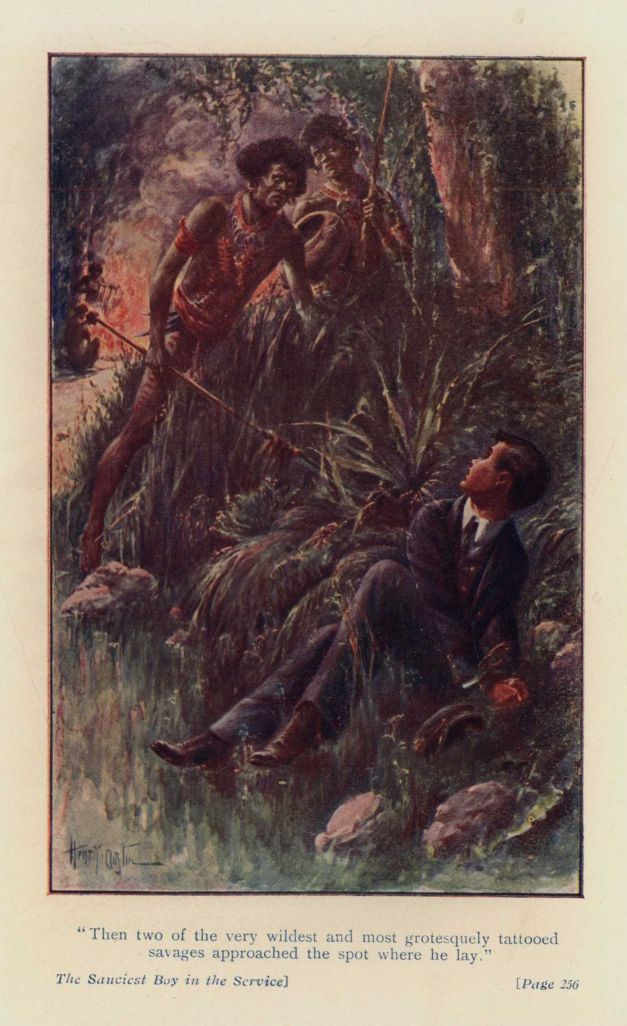
"Then two of the very wildest and most grotesquely tattooed savages approached the spot where he lay."
They were coming to kill him. And a knife is so much more awful than a bludgeon.
He closed his eyes, and shuddered a little.
They murder their victims with coolness, too, these cannibals. They are as pitiless, as merciless, as a butcher slaying a lamb. They made him sit up now.
"Be quick, be quick," cried the poor lad. "Oh God, be quick!" But Kep was mistaken.
The bowl was not to hold his blood. It was filled with a mess of fruit, mixed with cocoa-nut milk, made by rubbing the kernel down in water.
"Dlink," they told him, and Kep managed to empty the basin, under threats of instant death if he refused.
They now felt him all over, and pinched his arms and legs. Kep was hard and firm, but carried no fat. The boy knew the worst now, he was to be fattened up for a feast.
Tired and weary, he sank into a deep sleep so soon as his captors had left him, and could hardly remember all he had come through, when he at last awoke, just as the red gleams of the newly risen sun shone like fire among the tallest trees.
Again was he fed. This time with some sort of grain, like arrow-root, boiled, and mixed with a little kava.
Camp was then struck, and the march was a long one of some fifty miles, but during the day, he was fed three or four times. And, tied to one of the most brutal-looking of the savages, was led as if he had been a wild beast. He had to walk nearly all the distance. Luckily for him, he was strong enough to stand it, else would he have been clubbed to death. Hope now began to tell him a flattering tale? Was there not a chance of escape. It seemed impossible, but----
The thought of it, anyhow, made the poor prisoner happier.
He had not forgotten his piccolo, the little black flute that had charmed even cobras. They had not taken this away, for he wore that under his jersey, and though his captors had felt it, they evidently thought it was a rib.
His couch by night, was made of green boughs, and his sleep was sound enough.
One day a band of armed savages came shouting to meet them, and then Kep knew that he had reached his new home.
The camp that night was at the foot of a mountain, that towered high and steep for full four thousand feet into the blue sky. It was up to the top of this hill he had to march next morning, and very much surprised he was when he found himself in the crater of an extinct volcano. It was fully a mile in diameter, with a very large building in the centre.
The village--a very quaint one--was built around this palace of Gobolohlo. There he had dwelt with his two wives, who if they were not widows already, would very soon be.
The depths of this crater, and even the sides all around, were covered with bushes and verdure, and adorned by Nature with the rarest and most beautiful of flowers.
Now, right to this palace, Kep was dragged, and introduced to the cannibal queens, who were well clad in short, bright-coloured frocks of calico, with feather-fringed skirts. Both were young, both interesting looking, and one really pretty. Their naked ankles and bare arms were encircled with bands of gold set with precious stones.
They evidently admired the boy, just as a farmer or butcher may admire a calf. For they prodded him with their little fat forefingers, then laughed scornfully and shook their heads.
"He not much meat," said the younger queen, in English. She had been captured by the recruiters, when a mere child, and carried to Queensland, but was sent back in a few years to her own wild island.
"I'm no good to eat at all, your lovely majesty."
"In three weeks' time, though," she smiled.
Then Kep's food was brought, his hands were freed, and Gobolohlo's queens screamed with laughter to behold him eat so heartily, which on this occasion he really did, to please them.
He was ordered to sit down till they should study him a little longer.
He really appeared to afford great fun to their majesties.
But when he took out his piccolo, and begun to breathe his griefs and sorrows into that, their mirth changed into pensive melancholy. They listened enraptured. He changed his tune, and turned on the sailor's hornpipe. They were all smiles once more, and giving the attendants a sign, they withdrew, and in about half an hour the hall was nearly filled with dancing flower-adorned cannibal maidens.
It was a strange wild scene, and stranger from the fact, that in this case, youth and beauty was dressed in nothing else save flowers and feathers.
At the end of the ball, the younger queen rushed forward and saluted Kep, by rubbing her nose against his.
"You good, good, goodee boy," she cried. "For tree week you play to me, den----"
"Then what, your majesty?"
"I lub you so much den, dat I eatee you. Plenty ob kava and spice--Yum! yum!"
"This is something to look forward to, with a vengeance," said Kep to himself.
The next two days and evenings, passed in much the same way.
Their majesties had been told of the capture of their united husband, but it didn't affect them a great deal.
"Pah!" the younger said, "Gobolohlo good king, but he not make plenty good meat fo' de Bleetish mans ob war."
But the very next day, Boona, the younger queen, seemed very sad, and after the boy had done piping, she came and squatted beside him.
"You too good foh kill. All same to-mollow you be kill and eat."
This was certainly somewhat disquieting news, and he naturally wanted to know why this change of plans had come about.
His voice trembled a little as he spoke.
"De oder queen, she hate pooh Boona. Den she think I lub you vely mooch. She de stronger queen, and so she killee you to-mollow."
Kep could see now that it was a case of jealousy. Boona laid her naked arm across Kep's shoulder, and once more rubbed noses.
"Goodeebye," she said; "only I nebber see you mo, till you dead and roas', and de odder queen, she eatee all de bes' bits ob my boy. No let Boona taste."
For the last two or three nights Kep had been allowed to sleep without the galling fetters, but this evening he was more strongly bound than ever.
He did not close his eyes once. He knew the end had come, and that his messmates would be able only to guess how he had suffered.
It was late next day, when he was dragged from his prison, and made to sit down, not far from a bigger fire than he had yet seen. And the great grid was being got ready.
This was all so horrible, that Kep felt going out of his mind. He could only close his eyes and pray.
Pray for death; delivery, he believed, was out of the question. If they would kill him first; but he had received the news, very unceremoniously given, that he was to be stripped, and tied alive to the gridiron, which would then be lowered over the fire, when the latter was fierce enough.
He had been too deep in thought, and too distrait--he felt that he was going mad--to notice a great cloud that was rising slowly up in the east.
But now the day suddenly grew as dark as night, and the rain came down in torrents, while thunder pealed nearer and nearer, the savages looking like demons in the lightning's glare.
Then Kep remembered no more. He had fainted away.
When he came to himself again, the darkness all around was intense.
CHAPTER XXIII
FIERCE FIGHTING WITH THE CANNIBALS
Impenetrable darkness! Nothing to be seen.
Not a sound to be heard save now and then the cry of a night bird far below in the forest, or the rustle of a lizard in the now dry grass. He could not tell the time. Morning might already be close at hand, and up from the sea the sun would leap and silver the trees and the clouds.
Kep trembled when he thought that this day would surely be his last, and that the fearful death was yet before him.
List! It is a step that comes softly nearer and nearer. Then he feels warmth on his cheek as some one by his side whispers in his ear. "Hushee. Hush. No speak me."
Then his bonds are severed with a sharp knife or dagger and he is free though weak and feeble in his knees.
"Are you the beautiful queen?"
"I is Boona. But come alonga me. You too good, vely good a boy to eat. Sides you no fat yet."
He felt himself being led by a soft, soft hand. Out and away into the blackness of night. Out and away through the flowers of the bushes, and up the crater's craggy side.
"Run, run, we mus' be fah, fah away before the sun he shinee again. Run, cause if dey catches we, bof must die. I hab jus' kill de ugly old queen."
Despite his gratitude, Kep shivered a little as he thought that the hand which held his was that of a murderess, and that the backs of the fingers might still be stained with human blood. Yet who was he that he should judge of or attempt to weigh the sum of this girl's guiltiness.
In the days of his real boyhood he had been used to running barefooted in moors and on hills, so he hardly missed the shoes the savages had stolen from him.
Long before daybreak they were fifteen miles at least from Cannibal Mountain, and soon they found themselves on the banks of a broad river.
The queen made Kep rest far up in the green foliage of a vast spreading tree while she herself ran off to find food. She soon returned bringing many kinds of delicious fruits. For a while they rested, then from the bushes close by the river she dragged a light black canoe, and beckoned him to take his seat.
He did so, and next moment the boat was rapidly being paddled down the beautiful river.
Kep was too full of thought to take much heed of the sweet romantic scenery that changed and changed at every bend of the stream. But he observed by looking at the sun and judging the time, that they were not taking the direction in which the Breezy lay. Sometimes, indeed, they were facing directly east.
This was indeed a mystery. But he determined not even to ask the queen, lest he might seem to doubt her goodness and honesty.
Just one question however he asked. Did, he wanted to know, the lovely young queen Boona kill the ugly old one with her own hands.
"Pah! no," she answered. "I not hab her black blood run ober my hands and spit on my booful dless (dress). No, no, Boona hab plenty fliends in the palace."
She rose higher in his estimation now. Much higher. He was not sitting near a murderess after all. So now he determined to let things slide. And thinking thus, the boy, just where he sat, dropped into a sound sleep unlike anything he had ever enjoyed before.
* * * * *
We must be done now with the cannibal chief, Gobolohlo. He was tried just there on the beach by drum-head court martial, sentenced, tied to a tree, and a volley of rifle bullets fired into him. His body was left for the ants to pick.
Meanwhile Jack Stormalong was missed, but before an hour had passed his manly voice was heard singing aloud, as he came staggering along, bearing the wild pig on his back.
"Catch Jack," he said as he flung it down, "leave a bit o' good food like that to go to waste."
No trace nor trail had the savages left behind, so Jack Stormalong, who was perfectly at home among savages, retreated once more, while at the same time boats were plying hastily twixt ship and shore and a punitive expedition was being formed.
He was not long in finding a beach-man who knew the stronghold of Gobolohlo and his queens. A bargain was soon struck, and that very night sixty fully armed bluejackets and marines with one maxim were on track and trail of the cannibals, and moving eastwards with all possible speed.
Their route however could not be the same direct one which the savages had taken but a longer and easier.
Kivi, the guide, seemed faithful and honest, but he was very well watched indeed, in case he might lead the party into an ambush.
Luckily the weather kept fine and clear. They were making forced marches.
They passed through or up wide valleys, forded rivers carrying the maxim, and clambered over bare hills and plunged into deep, dark forests.
With them they had brought red paint, beads, calico, sugar, and tinned meats, with trinkets of Birmingham gold and silver, so that though the wild natives would take no silver it was easy to barter for fruit, fowls, or whatever they needed.
The villagers usually retired at first into their sago-palm dwellings, but were afraid to attack, but a present brought them to reason, then they swarmed around the British bluejackets and were only too familiar.
The doctor or Guilford warned their guide to keep strict silence. If he but opened his mouth to speak one word, they told him he would have his tongue cut out.
Sometimes they had to cut down great trees to form bridges across the dark deep streams.
It was a hard and hazardous march, which few save British sailors could have continued with so little sleep.
At one village of unfriendly savages arrows were fired and spears thrown. One of the marines was injured so that it became necessary to stop to fight these wild fellows. After a volley or two, however, they fled howling into the forest. Only after this the watch by night was stricter than ever.
There was but little hope, they knew well, of saving poor Kep, but they were determined to punish the cannibals, and to know the youth's fate.
One broiling hot day, the sun so fierce that birds with gaping bills sat silent on the boughs, and the very lizards panted, they were suddenly confronted by a tall burly naked savage. He was as much taken aback as the sailors themselves.
He let fly an arrow and then turned and fled. Jack Stormalong and a first-class boy took up the running and kept the savage in sight for miles, till he began to scramble up a high mountain's side, when they returned.
"Dat am Gobolohlo palace," said their guide, "all along de mountain top."
"Hurrah!" cried McTavish, and began singing--
Now's the day and now's the hour
See the point of battle lower.
"We may not find the boy," he said to Guilford, "but I for one feel brimful of fight, and we will at any rate revenge his death."
They were guided out now on to the open, and after feeding, it could hardly be called dinner, they started away across the moor, for that it was in every respect.
Gobolohlo's mountain soon came in view, and then the front of battle did begin to lower.
The mountain path seemed alive with wildly gesticulating savages brandishing clubs and spears and shouting.
They formed themselves into all sorts of grotesque attitudes too; they crawled or crept like wild beasts, and one lot on a bit of flat ground stood, one above the other, in a spear-armed pyramid.
"Bring down that top fellow, Jones," cried Guilford.
Jones was the crack shot of the ship, and one bullet brought the savage's body right on top of the spears of his comrades.
The pyramid dissolved itself after that, and presently a cloud of these blacks came leaping and yelling down.
Three or four volleys were fired and did good service, but, finding that the rear-guard was pushing on, the marines had recourse to the maxim, and soon scores of cannibals were in a heap, wounded or dead, and the rest were flying for their lives up the mountain side.
There was only one gateway or rent in the mountain top to give admission to the crater, and this was stoutly held.
Showers of arrows came pouring down and several of the Breezy's men fell.
A charge was made now with fixed bayonets, and the officers' revolvers begun to do their deadly work.
But in less than ten minutes the gangway, as Stormalong called it, was carried and the enemy were in full flight down into the crater. The bluejackets and marines must follow up their victory till it became a permanent one. This they did with splendid heroism, but the foe had rallied, and at one time it was touch and go with the athlete McTavish and Stormalong. They were completely surrounded, but they stood back to back, and fought like lions at bay, the surgeon with his broadsword, Jack with his great pet cutlass.
It was a grand but terrible sight, and both sides paused, as if by common consent, to witness it.
Here was brawny Scotland and brave England fighting back to back in the same cause, turning round and round as they hung together, and showering their blows like wintry rain.
Guilford declared afterwards that no less than five men were cloven to the shoulders by the claymore of McTavish.
The fight on the side of the cannibals was but feebly sustained after this; and when the maxim was once again brought into play the dusky warriors turned and fled.
They could be seen on the ridge of the crater escaping, and many were shot and their bodies rolled over the hilltop. The whole place was then cleared and sentries set to guard the gangway.
Expecting a night attack, no fires were built, and the men laid themselves down and slept, tired and weary enough, till at last the sun appeared over the rim of the crater and saw them safe.
Their own casualties were but small, though seven poor fellows would never see the chalky cliffs of dear old England again.
These were solemnly borne down to be buried far in the forest shade where no foe would ever find them. The wounded were helped along.
They could find no trace of Kep, except the awful grid on which he was to have been roasted. This they smashed to pieces, the king's castle was fired, then slowly and sadly the long march back was commenced.
The guide took them a nearer way now. There was little danger from enemies and nothing else to be feared.
McTavish took the very greatest care of his wounded, and on their account solely he would not permit the march homewards to be hurried. The worst cases were carried on litters.
There would have been plenty of time even to collect specimens. But somehow the honest Scot, whose heart was the quintessence of kindness, never once left camp for that purpose.
He had become strangely attached to Kep. He was certainly a lovable lad, and besides there was still the mystery about him which had not yet been cleared up. Indeed, McTavish knowing that any reference thereto appeared to hurt the boy's feelings, refrained from making any attempt to do so.
When they had reached a spot within about ten miles of the beach shortly before sunset one evening, a halt was called for the night, and the guide, who appeared to know nothing of fatigue, was started on ahead to announce the tidings of their arrival. He was to remain on board as the rest of the track was familiar enough to both McTavish and Jack Stormalong.
All hands were glad of a good night's rest. The wounded were doing well, and the very worst cases could now walk.
So after breakfast next day, all hands feeling happier now at heart, the journey was resumed beachwards.
McTavish, trudging sturdily ahead of the troop, had just issued from the forest and sighted the Breezy.
She had never looked more beautiful in his eyes, nor had the sunshine on the soft waters, but the flag was flying half mast, and McTavish knew by this that the guide had told the tale of grim fighting and death.
But he started back in amazement to see marching as slowly along the beach as lovers twain, a handsome young gentleman and a gaily dressed brown woman.
"By George!" That is what McTavish exclaimed. But Jack who had just joined him put it stronger.
"By thunder!" he roared, "if that ain't Charlie Bowser himself, all alive low and aloft, may the winds of heaven split my bally old bags."
And Kep it was without a doubt, as smiling and as saucy as ever.
He and Boona hurried up to meet the returning heroes, and the shaking of hands and British cheering that ensued was such as had certainly never been heard before on these lonely shores.
"And now," said Kep, as soon as silence was partially restored, "now Dr. McTavish and Lieutenant Guilford, with your permissions, I will present you to Queen Boona, widow of the late Gobolohlo, whose skeleton now adorns yonder tree stem."
With much solemnity both officers lifted their caps and bowed with befitting dignity.
"She's a deuced handsome girl, anyhow," cried Guilford laughing, and the doctor nodded. He felt very happy now and still more so when Kep handed him a parcel containing his instrument. He laughed at the strange conceit of his boy friend, but willingly tuned up, and so they marched to the boats to the wild skirl of the great Highland bagpipe.
As they passed the tree at the foot of which Gobolohlo expiated his crimes, Kep pointed to the bleached skeleton that rattled in the breeze. It had been wired and fixed up on chains, and above it a large board on which were painted the words--
Here hangs The mortal remains of King Gobolohlo, Who was shot for Murder and Cannibalism, By The Crew of His British Majesty's ship Breezy. God save the King!
But when Boona smiling curtsied to the skeleton, there was some laughing in the ranks. "Good goodee bye, ole Gobolohlo, goodee bye," she cried. "I is goin' back to Queensland. Not mourn long foh you. Pah!"
Then she flung a kiss from her chubby fingers at the grinning skeleton, took Kep by the arm, and marched cheerfully down to the boats.
CHAPTER XXIV
"GOOD HEAVENS! THIS IS MY SISTER MADGE"
The Breezy was back once more in the grand old harbour of Sidney. The mails from home had come on board and been distributed. It was the reading, thinking hour on board, which invariably comes, and comes immediately, after news from England has reached a ship of war on a far-off foreign station.
Everyone on board had retired with his own letters into his own cabin, den, or cosy corner. Everybody in fact seemed to evince a desire to be as remote, for the time being, from everybody else, as possible.
But gradually, on this bright and sparkling day, with the bonnie white flag aloft, draping itself on the breeze in every conceivable shape of beauty, the ship returned to its ordinary equanimity.
Captain Breezy came now quietly into the ward-room. He was smiling bashfully somewhat. Trying in fact to hide the pleasure afloat and flowing in his heart, that couldn't be controlled.
Every face was turned towards him.
"Ordered home, sir?"
"Ordered home. Yes."
"Hurrah!" And the good news spread like wildfire from end to end of the ship. All hands had it, from ward-room to galley, from the officer on watch to the cook's slush boy. Ordered home!
Yet mingled with the joy that was general, was one little blue thread of sadness. In storm or tempest, in fair weather or foul, for three long years and a half, the broadsword-men of the Breezy had hung together. Their dangers had been one another's on sea or land, and they had fought shoulder to shoulder in many a bloody tulzie, and a spirit of camaraderie had always pervaded the ship, walked the decks, and dwelt in the hearts of the crew. The Breezy had been to them a real home and a happy one at that, a home on the ocean wave. But in a few weeks, they would all be sundered.
Ah, well, such is life to our sailors.
McTavish himself had few letters. Principally from his sisters and the old folks at home.
Nor were Kep's letters very stirring this time. Madge had not yet married the wealthy old man. Father had become settled as it were. Was falling more easily into the new groove, and really, Madge said, life in a cottage by the sea was rather nice than otherwise. "But," she added, "father is longing, and I am longing, for our dear boy and his piccolo back home again to cheer our hearts."
With Madge's letter in his pocket and a photo in it sent to show how she looked at twenty, Kep went below to the doctor's cabin and glided in. His friend was sitting there, lonesome-looking enough, and gazing at a carte intensely, earnestly, in the uncertain light.
"Do I interrupt?"
"No, no, dear boy. Sit you down."
"Mac--may I see that?"
"Oh! it is but a romance and dream I had. It is gone now, and people seldom dream the same dream over again, much though they might desire to."
Kep pulled out his letter and the two exchanged pasteboards.
Both started, as if stung.
"Good heavens!" cried the boy, "this is my sister Madge!"
"And this also is your sister Madge!"
Then hand clasped hand and there was moisture in the eyes of both.
"And I am Keppel Drummond."
"Fool and dolt I was not before to have guessed it."
"But, McTavish, though very young when she met you, she had a romance, and her romance was yours, Mac. She never told me your name, but now I see it all, all clearly."
The two sat down as if under the same impulse, and there, in the cabin alone, Kep told the doctor all his strange story from beginning to end and all his longings as a boy and ambitions as well.
McTavish was silent for a time. He was thinking out the whole situation. Then his duty seeming to stand out before him clearly and distinctly, he stood up. "Keppel," he said, "don't you think you had better tell the Captain all this? I do not wonder now that you thought fit to conceal your name from us. You believed you were doing right; so, I think, you were. You were acting honourably in hiding from the world that you were the only son of Iverach Drummond, of Martello Castle, because he was moving in the highest society and you were--well, cleaning knives and boots. But now all that is altered. You have by your energy and grit attained to a honourable position as interpreter to a King's ship, while on the other hand your father is now living under a cloud--for a time. Let us hope it is only for a time, Keppel. But now you are going to let me introduce you to the ward-room and gun-room officers as the blue-blooded boy, we have all of us, always, believed you to be. But first and foremost let us see Captain Breezy, than which a better fellow never lived."
The Captain was in his own quarters, when, passing the sentry, McTavish knocked and entered.
Very much interested indeed was he, when Kep briefly retold his story.
To their astonishment the Captain got slowly up from his chair, and took a Yorkshire weekly newspaper from his pile. Then he touched a button and Adolph himself entered.
"I am not to be disturbed," he said, "until I ring again. That is all."
And Adolph retired.
"An article in this paper caught my eye, strange to say, only a few minutes ago, but I hardly glanced at it. I think I can now read it to you with some degree of interest. It is called
"A SECRET OF THE SEA.
"A story was current three or four years ago concerning the mate of a clipper-built Australian barque or ship, who, on his return home about three years ago, boasted of the possession of a large nugget or rather bar of gold. The story he told about it was that being sent on shore one day to bring off some fruit from an uninhabited island in the South Seas he picked up this lump of gold, which it was evident had lain in the water for a period of many years.
"'Where there was one there must more,' he said, and as soon as he could charter a ship he could raise the sunken treasure and become a millionaire. As he never let his friends handle the nugget, if nugget of gold it was, and as he was somewhat dissipated in his mode of life, he got no one to believe him. He had lost his ship owing to drunkenness while in charge of a watch and hadn't found another.
"Reduced at last to penury he determined to pawn his nugget, and for that purpose it seems he visited his uncle as the saying is. The pawn-broker was a shrewd old Jew. But although he called the nugget a mere trinket, he was glad to offer money on it nevertheless. Not enough, however, to satisfy the man, who picked up the sea-worn gold and quickly left the shop. He was followed at once to his lodgings and the address taken.
"A few nights after this he was waited upon not by one Jew but two.
"They had been, they said, thinking over his story, and were willing to advance a considerable sum not on the bit of gold, but if the ex-mate would show them a chart and give the exact latitude and longitude of the unknown island.
"A magnum of champagne was sent for and they three talked over the matter.
"But the mate's ultimatum was this: he refused to give the position of the island, but would take command of the search-ship, and the Jews should have half of all the gold, the other to be his unreservedly.
"Before coming to terms one of the Jews hazarded a last shot. Doubtless, he said, they could find the latitude and longitude from some of the others that had been on board the barque at the time.
"The mate helped himself to more wine. He was a man who could fill his hold without fear of his ballast shifting.
"'That you won't,' he said. 'I knew the only two young fellows that had the secret. One was a steward, the other a ship's cook's slush boy. Both, I've heard, were killed by cannibals, and I alone possess the secret, which I means to stick to, till I find more generous partners than you. Good-night.'
"But it seems the mate's last shot told home.
"'Brother,' said the elder, 'let us accept this honest fellow's offer at once. We'll get out the ship then, though it will take a bit of time, and my brother and I will both go out in her. We'd like a bit of fresh air, anyhow.'
"Well," the article went on, "extraordinary as the story is it is a true one. The ship is a great object of interest to the residents of Cardiff, and will be all ready to leave in four months' time. She is a strongly built Aberdeen clipper, not large but well armed, and even carries a quick firer, trouble with savages being feared."
"Keppel, I fear," said Captain Breezy, "they will have the weather gauge of you. But I am interested and will see the Admiral of this station about other matters and take his opinion on this at the same time. Meanwhile you had better say nothing about the sunken treasure. Let this be our secret."
"One word, sir," said Kep, "for you are no doubt a trifle wiser than I."
The Captain couldn't help smiling at the lad's pretty conceit.
"Suppose I found those in this city willing at once to start in search of this sunken treasure, to whom would it belong when raised? To the Crown?"
"Certainly not, boy; but to you, unless the owners came back from the grave. And not only the gold, but the islands themselves, as you were the first inhabitant and it is no portion of British territory. No, the gold would be indisputably yours and Adolph's, your shipwrecked fellow Crusoe. You may go now. I have many matters to think about."
So Captain Breezy had, but he was a brisk, determined man. He lighted his cigar now and leaned back in his easy chair, and began to arrange his ideas.
"That's what I'll do," he said to himself at last.
Next minute the Captain's gig was called away, and it did not take him long to board the flagship.
He transacted all his business coolly and soon had his papers all signed and his instructions to weigh anchor and sail for home any day he pleased. Then he told him Kep's story and all about the treasure.
"And a son of Iverach Drummond. Why, dear old Drummond and I were at school together. I'm surprised, but I'm glad for Keppel's sake, or at least I should be if things go right with him."
"But about the other ship that is fitted out?"
"We'll send a cablegram at once home to hear about it."
They did and the answer came in reasonable time to the effect that the barque Fortuna, having engines on board, or what is called auxiliary steam-power, had sailed a month ago by Suez, bound for the South Sea Islands.
"A month ago. Why, Breezy," cried the Admiral, "you can beat her yet, and beat her easily unless you break down. It's only a matter of a few weeks' delay. I'll make that all right, and you have my permission now to go anywhere on your way home and do just as you please."
"A thousand thanks, sir. I shall soon speak my fond farewells to Sidney city, and be under weigh and on the wing by to-morrow forenoon. It may be a bit of a race between the Breezy and the Fortuna, but I think I know who will win, sir."
"Good morning. Shall be happy to hear from you."
And back to the Breezy went bold Captain Breezy.
* * * * *
That evening and night all farewells were said to those on shore. The broadsword-men of the Breezy had a good send off and left Sidney homeward bound next forenoon at four bells.
Said Jack Stormalong to a brother gunner as the ship got well away from the shore, "Ned, my old shippie, we're homeward bound, you know, but there's something in the wind, and I'm ready to bet my best new jacket to a pint o' tar that we won't touch England's happy shores for months to come yet."
"On with you," said Ned. "I'll have your swagger jacket or you'll have my pint o' tar with a cinder in it for luck."
CHAPTER XXV
A GREAT OCEAN RACE.--"GODDARD BEGAN TO SHOOT"
It wasn't only Jack Stormalong and his chum who "kind o' felt" there was something in the air but all hands. There was, maybe, going to be a fight with a pirate, or more savages were coming to the front, or war was declared against Germany; but they didn't mind, and A.B.'s said to each other: "We may be content if it ain't straight home, old pal. We'll git there some time."
"And the more months, the more money, eh?"
But there was no grumbling. Even little Sneyd, the Acting Paymaster, forbore to growl.
The Captain studied the chart, and sailed east and away with a point or two of south in it after they rounded Australia. Making all calculations, he believed he could reach the island some days at all events before the Fortuna, who must already have reached the straits of Java, or be about the south end of Borneo. No one could guess what the mate, who was now, of course, captain of the sail-search-of-fortune barque might do.
Now that they were fairly away at sea, there was no harm in all hands knowing the meaning of the enterprise.
It was not merely a voyage they were making, but they were engaged in a great ocean race, and there was therefore a good deal of excitement fore and aft. But all felt sure of winning.
The engineers were advised to make the best of each day's journey, but to exercise the greatest care. For to breakdown in these seas might prove a terrible calamity from every point of view.
The engines worked splendidly under the almost continual attention of the engineer-lieutenant. They were beautiful pets, these of his. He was never happier than when he was down among them, talking to them and touching them as if they were sentient beings, things of life as well as beauty.
Once or twice during the long, long voyage the engines had been suddenly stopped, and the hearts of those on board seemed to stop with them. When they went on again, however, no sweeter sound ever fell upon their ears than the hum of the polished wheels.
They were delayed for a time by a circular storm. In just such a hurricane many and many a good ship has foundered with all hands, and never more will be heard of them till the sea gives up its dead. But all was soon right again.
When in the South Seas constant watch had to be kept from the mast-head for shoal water, and greater caution had to be observed by night.
This was a trying time in a great ocean race like this.
But the depth of the sea increased at last, and they were now quite out of the ordinary ocean highways, though they at times crossed them and met ships.
They hailed every one of them in the usual way. They spoke them, as sailors say.
They might have been about three days' steam from the islands they were in search of.
Adolph had most carefully retained the position of Great Snake Island, but still there might have been an error in calculation made by the first mate of the Wampiri. He was a steady man then, though drinking when off duty, and so this was improbable.
He tried to be steady during the present voyage of the Fortuna, and touched no spirits nor wines for a time. He knew right well how much he had at stake, and was cautious.
He himself, moreover, saw to all calculations and made reckonings, and on the whole, as his two Jewish owners remarked, a more trustworthy and reliable sailing master could not have been found. This for the first five weeks.
The broadswords of the Breezy began to be a little anxious when next day passed and no Fortuna hove in sight. She must have already found the islands, and her crew by now must have commenced the work of diving.
But about an hour after sunrise next day every heart was gladdened by the appearance, far away on the weather bow, of a barque under steam and easy sail, answering exactly to the right build of the Fortuna. They overhauled her easily. Indeed, they were coming up hand over hand in her wake, then keeping off a point or two, the Breezy hailed her.
"What vessel is that?"
Everyone on the Breezy held his breath to listen.
"The Fortuna!"
At the word a little cheer had to be repressed on board the man-o'-war.
"Bound for the Horn, and home."
"So are we. We'll be there before you, though. Can we take letters?"
"No, thanks."
"Bon voyage then."
"Bon voyage!"
"Hurrah!" said Wynn. "No doubt we'll be there before her in more ways than one."
But next day, no ship being then in sight, the glass indicated a depression, the clouds rolled up till the horizon was close aboard of them, and somehow or another the broadswords' hearts went down with the falling glass. In dirty weather like what was coming anything might happen to mar their success.
It really gave the Fortuna almost as good a chance of reaching the island first as the Breezy.
The gale was at its height when the sable plumes of night trailed over the sea.
The Breezy was making good knotage, but, fearful that she might pass the small islands in the darkness, they were obliged to stop ship.
Yet this storm appeared to have driven the Breezy out of her way. There were both winds and currents to reckon with.
It was terribly tantalising, and just so near game too. But towards the middle of the morning watch sea and wind went down, the stars shone out, and the red fire of the rising sun opened a splendid day.
Probably this storm and the fact of the Breezy having been drifted to leeward saved the situation, for there--not two miles ahead--was the Island of Snakes itself, and no Fortuna in sight.
They sailed round this that they might recall the wrecked Macbeth, and enable Kep and Adolphus to take their bearings.
They found the spot, but the ship of death lay crushed and broken among the rocks.
It was easy for Kep now to point out the route to the little inlet where the treasure ship had been sunk, and in a couple of hours they had reached it.
No time was lost in sending a boat on shore.
It was the captain's gig, Captain Breezy himself on board her, with Kep and Adolph and McTavish. Everything above seemed precisely the same as when Kep and his comrade had left it years ago.
"But how about the treasure ship?" said Captain Breezy.
"Well, sir," replied Kep, "she ought to be just down there among the weeds. But I can soon see. I can dive down as I did before."
"But is there not a danger of your becoming entangled among the deep sea weeds and drowned?"
"I was entangled last time, sir, though I did not tell Adolph when I got up; so maybe, sir, I might have a bit of a life-line round me this time. I don't want to die to-day, sir, anyhow."
A pole had been brought on shore with a British flag, in order that they might hoist it and so take possession of the island in the King of Britain's name.
This pole and flag would do capitally. In less than a minute Kep was back again with another bar of gold, which he placed at the captain's feet.