THE THEORY OF THE EARTH. BOOK II. Concerning the Primæval Earth, and concerning Paradise. (continued 2)
Reading edition
Secondly, If Lunar Years were understood in the Ages of the Antediluvian Patriarchs, the Interval betwixt the Creation and the Deluge would be too short, and in many Respects 298incongruous. There would be but 1656 Months from the Beginning of the World to the Flood; which converted into common Years, make but 127 Years and five Months for that Interval. This perverts all Chronology, and besides, makes the Number of People so small and inconsiderable at the Time of the Deluge, that destroying of the World then was not so much as destroying of a Country Town would be now: For from one Couple you cannot well imagine there could arise above five hundred Persons in so short a Time; but if there were a thousand, ’tis not so many as we have sometimes in a good Country Village. And were the Flood-gates of Heaven open’d, and the great Abyss broken up to destroy such an handful of People, and the Waters rais’d fifteen Cubits above the highest Mountains throughout the Face of the Earth, to drown a Parish or two? Is not this more incredible than our Age of the Patriarchs? Besides, This short Interval doth not leave Room for ten Generations, which we find from Adam to the Flood, nor allows the Patriarchs Age enough at the Time when they are said to have got Children. One hundred twenty-seven Years for ten Generations is very strait; and of these you must take off forty-six Years for one Generation only, or for Noah, for he liv’d six hundred Years before the Flood, and if they were Lunar, they would come however to forty-six of our Years; so that for the other nine Generations you would have but eighty one Years, that is, nine Years a-piece; 299at which Age they must all be suppos’d to have begun to get Children; which you cannot but think a very absurd Supposition. Thus it would be, if you divide the whole Time equally amongst the nine Generations; but if you consider some single Instances; as they are set down by Moses, ’tis still worse; for Mahaleel and his Grandchild Enoch are said to have got Children at sixty five Years of Age, which if you suppose Months, they were but five Years old at that time; now I appeal to any one, whether it is more incredible that Men should live to the Age of nine hundred Years, or that they should beget Children at the Age of five Years.
You will say, it may be, ’tis true these Inconveniences follow, if our Hebrew Copies of the Old Testament be Authentick: But if the Greek Translation by the Septuagint be of better Authority, as some would have it to be, that gives a little Relief in this Case; for the Septuagint makes the Distance from the Creation to the Flood six hundred Years more than the Hebrew Text does, and so give us a little more Room for our ten Generations: And not only so, but they have so conveniently dispos’d those additional Years, as to salve the other Inconvenience too, of the Patriarchs having Children so young; for what Patriarchs are found to have got Children sooner than the rest, and so soon, that, upon a Computation by Lunar Years, they would be but meer Children themselves at that time? to these more Years are added, and plac’d opportunely, 300before the time of their getting Children; so as one can scarce forbear to think, that it was done on purpose to cure that Inconvenience, and to favour and protect the Computation by Lunar Years. The thing looks so like an Artifice, and as done to serve a Turn, that one cannot but have a less Opinion of that Chronology for it.
But not to enter upon that Dispute at present, methinks they have not wrought the Cure effectually enough; for with these six hundred Lunar Years added, the Sum will be only one hundred seventy three common Years and odd Months; and from these deducting, as we did before, for Noah, forty six Years, and for Adam, or the first Generation, about eighteen, (for he was two hundred and thirty Years old, according to the Septuagint when he begot Seth) there will remain but one hundred and nine Years for eight Generations; which will be thirteen Years a piece and odd Months; a low Age to get Children in, and to hold for eight Generations together. Neither is the other Inconvenience, we mention’d, well cur’d by the Septuagint Account, namely, the small Number of People that would be in the World at the Deluge; for the Septuagint Account, if understood of Lunar Years, adds but forty six common Years to the Hebrew Account, and to the Age of the World at the Deluge, in which time there could be but a very small Accesion to the Number of Mankind. So as both these Incongruities continue, though not in the same 301degree, and stand good in either Account, if it be understood of Lunar Years.
Thirdly, ’Tis manifest from other Texts of Scripture, and from other Considerations, that our first Fathers liv’d very long, and considerably longer than Men have done since, whereas if their Years be interpreted Lunar, there is not one of them that liv’d to the Age that Men do now; Methusalah himself did not reach threescore and fifteen Years, upon that Interpretation; which doth express them not only below those that liv’d next to the Flood, but below all following Generations to this Day; and those first Ages of the World which were always celebrated for Strength and Vivacity, are made as weak and feeble as the last Dregs of Nature. We may observe, that after the Flood for some Time, ’till the pristine Crasis of the Body was broken by the new Course of Nature, they liv’d five, four, three, two hundred Years, and the Life of Men shorten’d by Degrees; but before the Flood, when they liv’d longer, there was no such Decrease or gradual Declension in their Lives. For Noah, who was the last, liv’d longer than Adam; and Methusalah, who was last but two, liv’d the longest of all: So that it was not simply their Distance from the beginning of the World that made them live a shorter Time, but some Change which happen’d in Nature after such a Period of Time; namely at the Deluge, when the Declension begun. Let’s set down the Table of both States.
302A TABLE of the Ages of the Antediluvian Fathers.
Adam 930
Seth 912
Enos 905
Cainan 910
Mahaleel 895
Jared 962
Enoch 365
Methusalah 969
Lamech 777
Noah 950
A TABLE of the Ages of the Postdiluvian Fathers, from Shem to Joseph.
Shem 600
Arphaxad 438
Salah 433
Eber 464
Peleg 239
Reu 239
Serug 230
Nahor 148
Terah 205
Abraham 175
Isaac 180
Jacob 147
Joseph 110
303From these Tables we see that Mens Lives were much longer before the Flood, and next after it, than they are now; which also is confirm’d undeniably by Jacob’s Complaint of the Shortness of his Life, in Comparison of his Forefathers, when he had liv’d one hundred and thirty Years, Gen. xlvii. 9. The Days of the Years of my Pilgrimage are an hundred and thirty Years; few and evil have the Days of the Years of my Life been, and have not attained unto the Days of the Years of the Life of my Fathers. There were then, ’tis certain, long-liv’d Men in the World before Jacob’s Time; when were they, before the Flood or after? We say both, according as the Tables shew it. But if you count by Lunar Years, there never were any, either before or after, and Jacob’s Complaint was unjust and false; for he was the oldest Man in the World himself, or at least there was none of his Forefathers that liv’d so long as he.
The Patrons of this Opinion must needs find themselves at a loss, how or where to break off the Account of Lunar Years in sacred History, if they once admit it. If they say that way of counting must only be extended to the Flood, then they make the Postdiluvian Fathers longer liv’d than the Antediluvian; did the Flood bring in Longevity? How could that be the Cause of such an Effect? Besides, if they allow the Postdiluvians to have lived six hundred (common) Years, that being clearly beyond the Standard of our Lives, I should never stick at two or three hundred Years more 304for the first Ages of the World. If they extend their Lunar Account to the Postdiluvians too, they will still be intangled in worse Absurdities; for they must make their Lives miserably short, and their Age of getting Children altogether incongruous and impossible. Nahor, for Example, when he was but two Years and three Months old must have begot Terah, Abraham’s Father: And all the rest betwixt him and Shem must have had Children before they were three Years old: A pretty race of Pigmies. Then their Lives were proportionably short, for this Nahor liv’d but eleven Years and six Months at this Rate; and his Grandchild Abraham, who is said to have died in a good old Age, and full of Years, (Gen. xxv. 8.) was not fourteen Years old. What a ridiculous Account this gives of Scripture Chronology and Genealogies? But you’ll say, it may be, these Lunar Years are not to be carried so far as Abraham neither; tell us then where you’ll stop, and why you stop in such a Place rather than another. If you once take in Lunar Years, what Ground is there in the Text, or in the History, that you should change your way of computing at such a Time, or in such a Place? All our ancient Chronology is founded upon the Books of Moses, where the Terms and Periods of Times are exprest by Years, and often by Genealogies and the Lives of Men; Now if these Years are sometimes to be interpreted Lunar, and sometimes Solar, without any Distinction made in the Text, what Light or certain Rule have we 305to go by? Let these Authors name to us the Parts and Places where, and only where the Lunar Years are to be understood, and I dare undertake to shew, that their Method is not only arbitrary, but absurd and incoherent.
To conclude this Discourse, we cannot but repeat what we have partly observ’d before, How necessary it is to understand Nature, if we would rightly understand those Things in holy Writ that relate to the natural World. For without this Knowledge, as we are apt to think some Things consistent and credible, that are really impossible in Nature; so on the other hand, we are apt to look upon other Things as incredible and impossible that are really founded in Nature. And seeing every one is willing so to expound Scripture, as it may be to them good Sense, and consistent with their Notions in other Things, they are forc’d many times to go against the easy and natural Importance of the Words, and to invent other Interpretations more compliant with their Principles, and, as they think, with the Nature of Things. We have, I say, a great Instance of this before us in the Scripture-History, of the long Lives of the Antediluvians, where, without any Ground or Shadow of Ground, in the Narration, only to comply with a mistaken Philosophy, and their Ignorance of the primitive World, many Men would beat down the Scripture Account of Years into Months, and sink the Lives of those first Fathers below the Rate of the worst of Ages. Whereby that great Monument, which Providence 306hath left us of the first World, and of its Difference from the second, would not only be defac’d, but wholly demolish’d. And all this sprung only from the seeming Incredibility of the Thing; for they cannot shew in any Part of Scripture, new or old, that these Lunar Years are made use of, or that any Computation, literal or prophetical, proceeds upon them: Nor that there is any Thing in the Text or Context of that Place, that argues or intimates any such Account. We have endeavour’d, upon this Occasion, effectully to prevent this Misconstruction of sacred History for the future; both by shewing the Incongruities that follow upon it, and also that there is no Necessity from Nature, of any such Shift or Evasion, as that is: But rather on the contrary, that we have just and necessary Reasons to conclude, That as the Forms of all Things would be far more permanent and lasting in that primitive State of the Heavens and the Earth, so particularly the Lives of Men, and of other Animals.
307
Chap. V.
Concerning the Waters of the primitive Earth: What the State of the Regions of the Air was then, and how all Waters proceeded from them; How the Rivers arose, what was their Course, and how they ended. Some Things in sacred Writ that confirms this Hydrography of the first Earth; especially the Origin of the Rainbow.
Having thus far clear’d our Way to Paradise, and given a rational Account of its general Properties; before we proceed to discourse of the Place of it, there is one Affair of Moment, concerning this primitive Earth, that must first be stated and explain’d; and that is, How it was water’d; from what Causes, and in what Manner? How could Fountains rise, or Rivers flow in an Earth of that Form and Nature? We have shut up the Sea with thick Walls on every Side, and taken away all Communication that could be ’twixt it and the external Earth; and we have remov’d all the Hills and the Mountains where the Springs use to rise; and whence the Rivers descend to water the Face of the Ground: And lastly, we have left no Issue for these Rivers, no Ocean to receive them, nor any other Place to disburden themselves into. So that our new-found World is like to be a dry and barren Wilderness, and 308so far from being Paradisiacal, that it would scarce be habitable.
I confess there was nothing in this whole Theory that gave such a Stop to my Thoughts, as this Part of it, concerning the Rivers of the first Earth; how they rose, how they flow’d, and how they ended. It seem’d at first, that we had wip’d away at once the Notion and whole Doctrine of Rivers, we had turn’d the Earth so smooth, that there was not an Hill, or Rising, for the Head of a Spring, nor any Fall or Descent for the Course of a River: Besides, I had suck’d in the common Opinion of Philosophers, That all Rivers rise from the Sea, and return to it again, and both those Passages, I see, were stopt up in that Earth. This gave me occasion to reflect upon the modern and more solid Opinion concerning the Origin of Fountains and Rivers, That they rise chiefly from Rains and melted Snows, and not from the Sea alone; and as soon as I had demur’d in that Particular, I saw it was necessary to consider and examine how the Rains fell in that first Earth, to understand what the State of their Waters and Rivers would be.
And I had no sooner apply’d my self to that Inquiry, but I easily discover’d, that the Order of Nature in the Regions of the Air would be then very different from what it is now, and the Meteorology of the World was of another sort from that of the present. The Air was always calm and equal, there could be no violent Meteors there, nor any that proceeded 309from Extremity of Cold; as Ice, Snow, or Hail; nor Thunder neither; for the Clouds could not be of a Quality and Consistency fit for such an Effect, either by falling one upon another, or by their Disruption. And as for Winds, they could not be either impetuous or irregular in that Earth; seeing there were neither Mountains nor any other Inequalities to obstruct the Course of the Vapours; nor any unequal Seasons, or unequal Action of the Sun, nor any contrary and struggling Motions of the Air: Nature was then a Stranger to all those Disorders. But as for watry Meteors, or those that rise from watry Vapours more immediately, as Dews and Rains, there could not but be Plenty of these in some Part or other of that Earth; for the Action of the Sun in raising Vapours was very strong and very constant, and the Earth was at first moist and soft, and according as it grew more dry, the Rays of the Sun would pierce more deep into it, and reach at length the great Abyss which lay underneath, and was an unexhausted Store-house of new Vapours. But, ’tis true, the same Heat, which extracted these Vapours so copiously, would also hinder them from condensing into Clouds or Rain in the warmer Parts of the Earth; and there being no Mountains at that Time, nor contrary Winds, nor any such Causes to stop them, or compress them, we must consider which way they would tend, and what their Course would be, and whether they would any where meet with Causes capable to change or condense them; 310for upon this, ’tis manifest, would depend the Meteors of that Air, and the Waters of that Earth.
And as the Heat of the Sun was chiefly towards the middle Parts of the Earth, so the copious Vapours rais’d there, were most rarified and agitated; and being once in the open Air, their Course would be that Way, where they found least Resistance to their Motion; and that would certainly be towards the Poles, and the colder Regions of the Earth. For East and West they would meet with as warm an Air, and Vapours as much agitated as themselves, which therefore would not yield to their Progress that Way; but towards the North and the South, they would find a more easy Passage, the Cold of those Parts attracting them, as we call it, that is, making way to their Motion and Dilatation without much Resistance, as Mountains and cold Places usually draw Vapours from the warmer. So as the regular and constant Course of the Vapours of that Earth, which were rais’d chiefly about the Equinoctial and middle Parts of it, would be towards the extream Parts of it, or towards the Poles.
And in consequence of this, when these Vapours were arriv’d in those cooler Climates, and cooler Parts of the Air, they would be condens’d into Rain; for wanting there the Cause of their Agitation, namely, the Heat of the Sun, their Motion would soon begin to languish, and they would fall closer to one another in the Form of Water. For the Difference 311betwixt Vapours and Water is only gradual, and consists in this, that Vapours are in a flying Motion, separate and distant each from another; but the Parts of Water are in a creeping Motion, close to one another; like a Swarm of Bees when they are settled; as Vapours resemble the same Bees in the Air, before they settle together. Now there is nothing puts these Vapours upon the Wing, or keeps them so, but a strong Agitation by Heat; and when that fails, as it must do in all colder Places and Regions, they necessarily return to Water again. Accordingly therefore we must suppose they would soon, after they reach’d these cold Regions, be condens’d, and fall down in a continual Rain, or Dew, upon those Parts of the Earth. I say a continual Rain; for seeing the Action of the Sun, which rais’d the Vapours, was (at that Time) always the same, and the State of the Air always alike, nor any cross Winds, nor any thing else that could hinder the Course of the Vapours towards the Poles, nor their Condensation when arriv’d there; ’tis manifest there would be a constant Source or Store-house of Waters in those Parts of the Air, and in those Parts of the Earth.
And this, I think, was the establish’d Order of Nature in that World, this was the State of the Antediluvian Heavens and Earth; all their Waters came from above, and that with a constant Supply and Circulation; for when the Croud of Vapours rais’d about the middle Parts of the Earth, found Vent and Issue 312this Way towards the Poles, the Passage being once open’d, and the Channel made, the Current would be still continued without Intermission; and as they were dissolv’d and spent there, they would suck in more and more of those which followed, and came in fresh Streams from the hotter Climates. Aristotle, I remember, in his Meteors speaking of the Course of the Vapours, saith, there is a River in the Air, constantly flowing betwixt the Heavens and the Earth, made by the ascending and descending Vapours: This was more remarkably true in the primitive Earth, where the State of Nature was more constant and regular; there was indeed an uninterrupted Flood of Vapours rising in one Region of the Earth, and flowing to another, and there continually distilling in Dews and Rain, which made this aerial River. As may be easily apprehended from this Scheme of the Earth and Air.
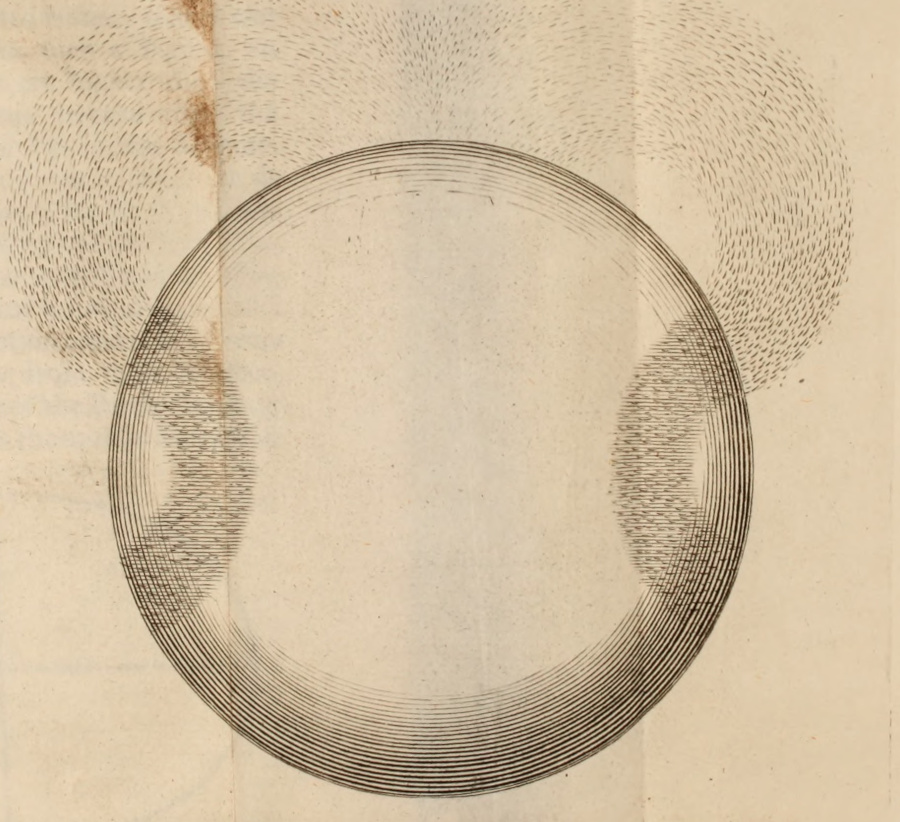
Book 2 Fig. 1.
Thus we have found a Source for Waters in the first Earth, which had no Communication with the Sea; and a Source that would never fail, neither diminish or overflow, but feed the Earth with an equal Supply throughout all the Parts of the Year. But there is a second Difficulty that appears at the End of this, how these Waters would flow upon the even Surface of the Earth, or form themselves into Rivers; there being no Descent or Declivity for their Course. There were no Hills, nor Mountains, nor high Lands in the first Earth, and if these Rains fell in the Frigid Zones, or towards the Poles, there they would stand in Lakes 313and Pools, having no Descent one Way more than another; and so the rest of the Earth would be no better for them. This, I confess, appear’d as great a Difficulty as the former, and would be unanswerable for ought I know, if that first Earth was not water’d by Dews only (as I believe some Worlds are) or had been exactly Spherical; but we noted before, that it was Oval or Oblong; and in such a Figure ’tis manifest the polar Parts are higher than the equinoctial, that is, more remote from the Center, as appears to the Eye in this Scheme. This affords us a present Remedy, and sets us free of the second Difficulty; for by this Means the Waters, which fell about the extream Parts of the Earth, would have a continual Descent towards the middle Parts of it; this Figure gives them Motion and Distribution; and many Rivers and Rivulets would flow from those Mother-Lakes, to refresh the Face of the Earth, bending their Course still towards the middle Parts of it.
314’Tis true, These Derivations of the Waters at first would be very irregular and diffuse, till the Channels were a little worn and hollow’d; and tho’ that Earth was smooth and uniform, yet ’tis impossible, upon an inclining Surface, but that Waters should find a Way of creeping downwards, as we see upon a smooth Table, or a flag’d Pavement; if there be the least Inclination, Water will flow from the higher to the lower Parts of it, either directly, or winding to and fro: So the Smoothness of that Earth would be no Hindrance to the Course of the Rivers, provided there was a general Declivity in the Site and Libration of it, as ’tis plain there was from the Poles towards the Æquator. The Current indeed would be easy and gentle all along, and if it chanc’d in some Places to rest, or be stopt, it would spread it self into a pleasant Lake, till by fresh Supplies it had rais’d its Waters so high as to overflow and break loose again; then it would pursue its Way, with many other Rivers its Companions, thro’ all the temperate Climates as far as the Torrid Zone.
But you’ll say, When they were got thither, what would become of them then? How would they end or finish their Course? This is the third Difficulty concerning the Ending of the Rivers in that Earth; what Issue could they have when they were come to the middle Parts of it, whither it seems they all tended? There was no Sea to lose themselves in, as our Rivers do; nor any subterraneous Passages to throw themselves into; how would 315they die, what would be their Fate at last? I answer, The greater Rivers, when they were come towards those Parts of the Earth, would be divided into many Branches, or a Multitude of Rivulets; and those would be partly exhal’d by the Heat of the Sun, and partly drunk up by the dry and sandy Earth. But how and in what Manner this came to pass, requires a little further Explication.
We must therefore observe in the first Place, that those Rivers, as they drew nearer to the æquinoctial Parts, would find a less Declivity or Descent of Ground than in the beginning, or former Part of their Course; that is evident from the oval Figure of the Earth, for near the middle Parts of an Oval, the Semi-diameters, as I may call them, are very little shorter one than another; and for this Reason the Rivers, when they were advanc’d towards the middle Parts of the Earth, would begin to flow more slowly, and, by that Weakness of their Current, suffer themselves easily to be divided and distracted into several lesser Streams and Rivulets; or else having no Force to wear a Channel, would lie shallow upon the Ground like a Plash of Water; and in both Cases their Waters would be much more expos’d to the Action of the Sun, than if they had kept together in a deeper Channel, as they were before.
Secondly, We must observe, that seeing these Waters could not reach to the Middle of the Torrid Zone, for want of Descent; that Part of the Earth having the Sun always perpendicular 316over it, and being refresh’d by no Rivers, would become extreamly dry and parch’d, and be converted at length into a kind of sandy Desert; so as all the Waters that were carried thus far, and were not exhaled and consum’d by the Sun, would be suck’d up, as in a Spunge, by these Sands of the Torrid Zone. This was the common Grave wherein the Rivers of the first Earth were buried; and this is nothing but what happens still in several Parts of the present Earth; especially in Africk, where many Rivers never flow into the Sea, but expire after the same Manner as these did, drunk up by the Sun and the Sands. And one Arm of Euphrates dies, as I remember, amongst the Sands of Arabia, after the Manner of the Rivers of the first Earth.
Thus we have conquer’d the greatest Difficulty, in my Apprehension, in this whole Theory, To find out the State of the Rivers in the primitive and antediluvian Earth, their Origin, Course, and Period. We have been forc’d to win our Ground by Inches, and have divided the Difficulty into Parts, that we might encounter them single with more Ease. The Rivers of the Earth, you see, were in most respects different, and in some, contrary to ours; and if you could turn our Rivers backwards, to run from the Sea towards their Fountain-heads, they would more resemble the Course of those Antediluvian Rivers; for they were greatest at their first setting out, and the Current afterwards, when it was more weak, and the Channel more shallow, was divided into 317many Branches and little Rivers; like the Arteries in our Body, that carry the Blood; they are greatest at first, and the further they go from the Heart, their Source, the less they grow, and divided into a Multitude of little Branches, which lose themselves insensibly in the Habit of the Flesh, as these little Floods did in the Sands of the Earth.
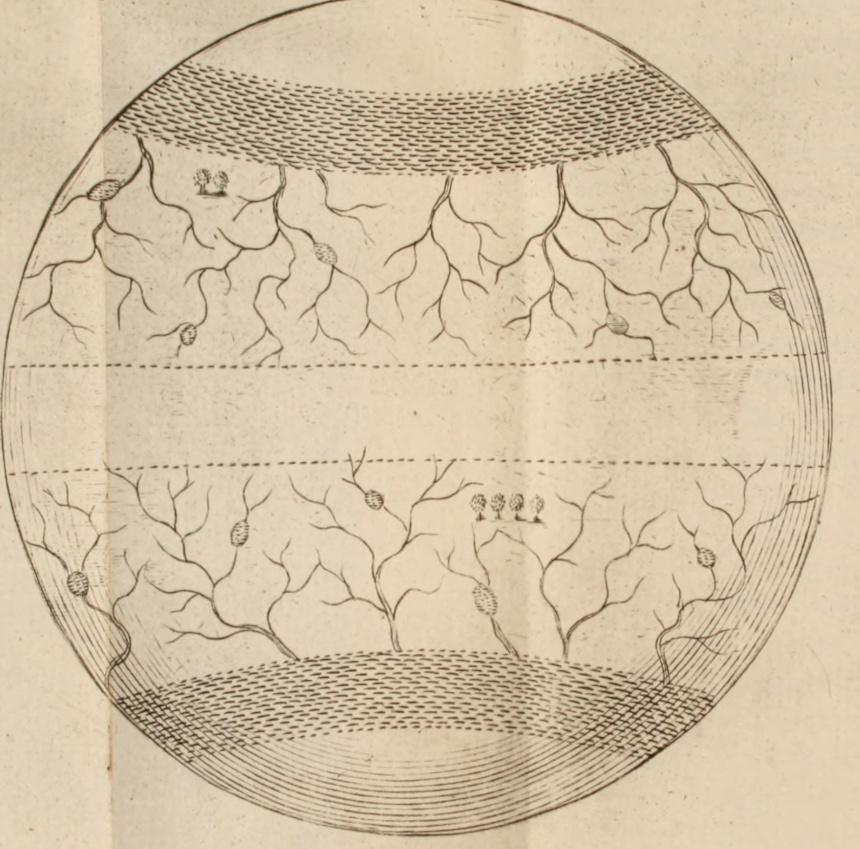
Book 2 Fig. 2.
Because it pleaseth more and makes a greater Impression upon us, to see Things represented to the Eye, than to read their Description in Words, we have ventur’d to give a Model of the Primæval Earth, with its Zones or greater Climates, and the general Order and Tracts of its Rivers: Not that we believe Things to have been in the very same Form as here exhibited; but this may serve as a general Idea of that Earth, which may be wrought into more exactness, according as we are able to enlarge or correct our Thoughts hereafter. And as the Zones here represented, resemble the Belts or Fasciæ of Jupiter, so we suppose them to proceed from like Causes, if that Planet be in an Antediluvian State, as the Earth we here represent. As for the Polar Parts in that first Earth, I can say very little of them, they would make a Scene by themselves, and a very particular one; the Sun would be perpetually in their Horizon, which makes me think the Rains would not fall so much there, as in the other Parts of the Frigid Zones, where accordingly we have made their chief Seat and Receptacle. That they flow’d 318from thence in such like Manner as is here represented, we have already prov’d; and sometimes in their Passage swelling into Lakes, and towards the End of their Course parting into several Streams and Branches, they would water those Parts of the Earth like a Garden.
We have before compar’d the Branchings of these Rivers towards the End of their Course, to the Ramifications of the Arteries in the Body, when they are far from the Heart near the extream Parts; and some, it may be, looking upon this Scheme, would carry the Comparison further, and suppose, that as in the Body the Blood is not lost in the Habit of the Flesh, but strain’d through it, and taken up again by the little Branches of the Veins; so in that Earth the Waters were not lost in those Sands of the Torrid Zone, but strain’d or percolated thorough them, and receiv’d into the Channels of the other Hemisphere. This indeed would in some Measure answer the Notion which several of the ancient Fathers make use of, that the Rivers of Paradise were trajected out of the other Hemisphere into this, by subterraneous Passages. But I confess I could never see it possible how such a Trajection could be made, nor how they could have any Motion, being arriv’d in another Hemisphere; and therefore I am apt to believe that Doctrine amongst the Ancients arose from an Entanglement in their Principles: They suppos’d generally, that Paradise was in the other Hemisphere, as we shall have occasion to shew hereafter; and yet they believ’d that 319Tygris, Euphrates, Nile, and Ganges, were the Rivers of Paradise, or came out of it; and these two Opinions they could not reconcile, or make out, but by supposing that these four Rivers had their Fountain-heads in the other Hemisphere, and by some wonderful Trajection broke out again here. This was the Expedient they found out to make their Opinions consistent one with another; but this is a Method to me altogether unconceivable; and, for my part, I do not love to be led out of my Depth, leaning only upon Antiquity. How there could be any such Communication, either above Ground, or under Ground, betwixt the two Hemispheres, does not appear; and therefore we must still suppose the Torrid Zone to have been the Barrier betwixt them, which nothing could pass either Way.
We have now examin’d and determin’d the State of the Air, and of the Waters in the Primitive Earth, by the Light and Consequences of Reason; and we must not wonder to find them different from the present Order of Nature; what things are said of them, or relating to them in Holy Writ, do testify or imply as much; and it will be worth our time to make some Reflection upon those Passages for our further Confirmation. Moses tells us, that the Rainbow was set in the Clouds after the Deluge; those Heavens then, that never had a Rainbow before, were certainly of a Constitution very different from ours. And St. Peter, 2 Epist. chap. iii. v. 5. doth formally and expresly tell us, that the 320Old Heavens, or the Antediluvian Heavens had a different Constitution from ours, and particularly, that they were compos’d or constituted of Water, which Philosophy of the Apostle’s may be easily understood, if we attend to two things, first, that the Heavens he speaks of were not the Starry Heavens, but the aerial Heavens, or the Regions of our Air, where the Meteors are: Secondly, that there were no Meteors in those Regions, or in those Heavens, till the Deluge, but watry Meteors, and therefore, he says, they consisted of Water. And this shews the Foundation upon which that Description is made, how coherently the Apostle argues, and answers the Objection there propos’d: How justly also he distinguisheth the first Heavens from the present Heavens, or rather opposeth them one to another; because as those were constituted of Water, and watry Meteors only, so the present Heavens, he saith, have Treasures of Fire, fiery Exhalations and Meteors, and a Disposition to become the Executioners of the Divine Wrath and Decrees in the final Conflagration of the Earth.
This minds me also of the Celestial Waters, or the Waters above the Firmaments, which, Scripture sometimes mentions, and which, methinks, cannot be explain’d so fitly and emphatically upon any Supposition as this of ours. Those who place them above the Starry Heavens, seem neither to understand Astronomy nor Philosophy; and, on the other hand, if nothing be understood by them, but the 321Clouds and the middle Region of the Air, as it is at present, methinks that was no such eminent and remarkable Thing, as to deserve a particular Commemoration by Moses in his six Days Work; but if we understand them, not as they are now, but as they were then, the only Source of Waters, or the only Source of Waters upon that Earth, (for they had not one Drop of Water but what was Celestial,) this gives it a new Force and Emphasis: Besides the whole middle Region having no other sort of Meteors but them, that made it still the greater Singularity, and more worthy Commemoration. As for the Rivers of Paradise, there is nothing said concerning their Source, or their Issue, that is either contrary to this, or that is not agreeable to the general Account we have given of the Waters and Rivers of the first Earth. They are not said to rise from any Mountain, but from a great River or a kind of a Lake in Eden, according to the Custom of the Rivers of that Earth. And as for their End and Issue, Moses doth not say, that they disburthen themselves into this or that Sea, as they usually do in the Description of great Rivers, but rather implies that they spent themselves in compassing and watering certain Countries, which falls in again very easily with our Hypothesis. But I say this rather to comply with the Opinions of others, than of my own Judgment: For I think, that Suggestion about the Supercelestial Waters made by Moses, was not so much according to the strict Nature and Speciality of 322Causes, as for the Ease and Profit of the People, in their Belief and Acknowledgment of Providence for so great a Benefit, by what Causes soever it was brought to pass.
But to return to the Rainbow which we mentioned before, and is not to be past over so slightly. This we say is a Creature of the modern World, and was not seen nor known before the Flood. Moses (Gen. ix. 12, 13.) plainly intimates as much, or rather directly affirms it; for he says, the Bow was set in the Clouds after the Deluge, as a Confirmation of the Promise, or Covenant, which God made with Noah, that he would drown the World no more with Water. And how could it be a Sign of this, or given as a Pledge and Confirmation of such a Promise, if it was in the Clouds before, and with no Regard to this Promise; and stood there, it may be, when the World was going to be drown’d? This would have been but cold Comfort to Noah, to have had such a Pledge of the Divine Veracity. You’ll say, it may be, that it was not a Sign or Pledge, that signified naturally, but voluntarily only, and by Divine Institution: I am of Opinion, I confess, that it signify’d naturally, and by Connexion with the Effect, importing thus much, that the State of Nature was chang’d from what it was before, and so chang’d, that the Earth was no more in a Condition to perish by Water. But however, let us grant that it signifieth only by Institution, to make it significant in this Sense, it must be something new, otherwise it could 323not signify any new thing, or be the Confirmation of a new Promise. If God Almighty had said to Noah, I make a Promise to you, and to all living Creatures, that the World shall never be destroy’d by Water again, and for Confirmation of this, Behold, I set the Sun in the Firmament: Would this have been any strengthening of Noah’s Faith or any Satisfaction to his Mind? Why says Noah, the Sun was in the Firmament when the Deluge came, and was a Spectator of that sad Tragedy; why may it not be so again? What Sign or Assurance is this against a second Deluge? When God gives a Sign in the Heavens, or on the Earth, of any Prophecy or Promise to be fulfill’d, it must be by something new, or by some Change wrought in Nature; whereby God doth testify to us, that he is able and willing to stand to his Promise. God says to Ahaz, Isai. vii. Ask a Sign of the Lord; ask it either in the Depth, or in the Height above: And when Ahaz would ask no Sign, God gives one unask’d, Behold a Virgin shall conceive and bear a Son. So when Zachary, Luke 1. was promis’d a Son, he asketh for a Sign, Whereby shall I know this? for I am old, and my Wife well stricken in Years, and the Sign given him was, that he became dumb, and continued so till the Promise was fulfilled. Accordingly, when Abraham ask’d a Sign whereby he might be assured of God’s Promise that his Seed should inherit the Land of Canaan, Gen. xv. 8. ’Tis said (ver. 17.) When the Sun went down and it was dark, behold a smoaking Furnace 324and a burning Lamp passed betwixt the Pieces of the Beasts that he had cut asunder. So in other Instances of Signs given in external Nature, as the Sign given to King Hezekiah, Isai. xxxviii. for his Recovery, and to Gideon for his Victory; to confirm the Promise made to Hezekiah, Judge vii. the Shadow went back ten Degrees in Ahaz Dial. And for Gideon, his Fleece was wet, and all the Ground about it dry; and then to change the Trial, it was dry, and all the Ground about it wet. These were all Signs very proper, significant, and satisfactory, having something surprising and extraordinary, yet these were Signs by Institution only; and to be such they must have something new and strange, as a Mark of the Hand of God, otherwise they can have no Force or Significancy. Accordingly we see, Moses himself in another Place, speaks this very Sense, when in the Mutiny or Rebellion of Corah and Dathan, he speaks thus to the People, If these Men die the common Death of Men, then the Lord hath not sent me. But if the Lord make a new Thing and the Earth open her Mouth and swallow them up, &c. then you shall understand that these Men have provoked the Lord, Numb. xxvi. 29, 30. So in the Case of Noah, if God created a new Creature (which are Moses’s Words in the forecited Place) the Sign was effectual: But where every thing continues to be as it was before, and the Face of Nature, in all its Parts, the very same, it cannot signify any thing new, nor any new Intention in the Author of Nature; and consequently, 325cannot be a Sign or Pledge, a Token or Assurance of the Accomplishment of any new Covenant or Promise made by him.
This, methinks, is plain to common Sense, and to every Man’s Reason; but because it is a Thing of Importance, to prove that there was no Rainbow before the Flood, and will confirm a considerable Part of this Theory, by discovering what the state of the Air was in the old World, give me leave to argue it a little further, and to remove some Prejudices that may keep others from assenting to clear Reason. I know ’tis usually said, that Signs like Words, signify any Thing by Institution, or may be apply’d to any Thing by the Will of the Imposer; as hanging out a white Flag is calling for Mercy; a Bush at the Door a Sign of Wine to be sold, and such like. But these are Instances nothing to our Purpose, these are Signs of something present, and that signify only by Use and repeated Experience; we are speaking of Signs of another Nature given in Confirmation of a Promise, or Threatning, or Prophecy, and given with Design to cure our Unbelief, or to excite and beget in us faith in God, in the Prophet, or in the Promiser; such Signs, I say, when they are wrought in external Nature, must be some new Appearance, and must thereby induce us to believe the Effect, or more to believe it, than if there had been no Sign, but only the Affirmation of the Promiser; for otherwise the pretended Sign is a mere Cypher and Superfluity. But a Thing that obtain’d before, and 326in the same Manner, (even when that came to pass, which we are now promis’d shall not come to pass again) signifies no more, than if there had been no Sign at all: It can neither signify another Course in Nature, nor another Purpose in God; and therefore is perfectly insignificant. Some instance in the Sacraments, Jewish or Christian, and make them Signs in such a Sense as the Rainbow is: But those are rather Symbolical Representations or Commemorations; and some of them Marks of Distinction and Consecration of our selves to God in such a Religion; they were also new, and very particular when first instituted; but all such Instances fall short, and do not reach the Case before us; we are speaking of Signs confirmatory of a Promise; when there is something affirm’d de futuro, and to give us a further Argument of the Certainty of it, and of the Power and Veracity of the Promiser, a Sign is given. This, we say, must indispensably be something new, otherwise it cannot have the Nature, Virtue, and influence of a Sign.
We have seen how incongruous it would be to admit, that the Rainbow appear’d before the Deluge, and how dead a Sign that would make it, how forc’d, fruitless and ineffectual, as to the Promise it was to confirm: Let us now on the other hand suppose, that it first appear’d to the Inhabitants of the Earth after the Deluge, how proper, and how apposite a Sign would this be for Providence to pitch upon, to confirm the Promise made to Noah and his Posterity, That 327the World should be no more destroy’d by Water? It hath a secret Connexion with the Effect it self, and was so far a natural Sign; but however, appearing first after the Deluge, and in a watery Cloud, there was, methinks, a great Easiness and Propriety of Application for such a purpose. And if we suppose, that while God Almighty was declaring his Promise to Noah, and the Sign of it, there appeared at the same Time in the Clouds a fair Rainbow, that marvellous and beautiful Meteor, which Noah had never seen before; it could not but make a most lively Impression upon him, quickning his Faith, and giving him Comfort and Assurance, that God would be stedfast to his Promise.
Nor ought we to wonder that Interpreters have commonly gone the other Way, and suppos’d that the Rainbow was before the Flood: this, I say, was no wonder in them, for they had no Hypothesis that could answer to any other Interpretation: And in the Interpretation of the Texts of Scripture that concern natural Things, they commonly bring them down to their own Philosophy and Notions: As we have a great Instance in that Discourse of St. Peter’s (2 Epist. c. iii. 5.) concerning the Deluge and the Antediluvian Heavens and Earth, which, for want of a Theory, they have been scarce able to make Sense of; for they have forcedly apply’d to the present Earth, or the present Form of the Earth, what plainly respected another. A like Instance we have in the Mosaical Abyss, or Tehom-Rabba, by whose Disruption the Deluge was made; 328this they knew not well what to make of, and so have generally interpreted it of the Sea, or of our subterraneous Waters; without any Propriety either as to the Word, or as to the Sense. A third Instance is this of the Rainbow, where their Philosophy hath misguided them again; for to give them their due, they do not alledge, nor pretend to alledge any Thing from the Text, that should make them interpret thus, or think the Rainbow was before the Flood; but they pretend to go by certain Reasons, as that the Clouds were before the Flood, therefore the Rainbow; and if the Rainbow was not before the Flood, then all things were not made within the six Days Creation: To whom these Reasons are convictive, they must be led into the same Belief with them, but not by any Thing in the Text, nor in the true Theory, at least if ours be so; for by that you see, that the Vapours were never condens’d into Drops, nor into Rain, in the temperate and inhabited Climates of that Earth, and consequently there could never be the Production or Appearance of this Bow in the Clouds. Thus much concerning the Rainbow.
To recollect our selves and conclude this Chapter, and the whole Disquisition concerning the Waters of the primitive Earth; we seem to have so well satisfied the Difficulties propos’d in the beginning of the Chapter, that they have rather given us an Advantage; a better Discovery, and such a new Prospect of that Earth, as makes it not only habitable, but more fit to be Paradisiacal. The Pleasantness of the 329Site of Paradise is made to consist chiefly in two Things, its Waters, and its Trees, (Gen. ii. and Chap. xiii. 10. Ezek. xxxi. 8.) and considering the Richness of that first Soil in the primitive Earth, it could not but abound in Trees, as it did in Rivers and Rivulets; and be wooded like a Grove, as it was water’d like a Garden, in the temperate Climates of it; so as it would not be, methinks, so difficult to find one Paradise there, as not to find more than one.
Chap. VI.
A Recollection and Review of what hath been said concerning the Primitive Earth: with a more full Survey of the State of the first World Natural and Civil, and the Comparison of it with the present World.
We have now, in a good Measure, finish’d our Description of the first and antediluvian Earth: And as Travellers, when they see strange Countries, make it part of their Pleasure and Improvement to compare them with their own, to observe the Differences, and wherein they excel, or come short of one another: So it will not be unpleasant, nor unuseful, it may be, having made a Discovery, not of a new Country, but of a new World, and travell’d it over in our Thoughts and Fancy, now to sit down and compare it with our own: And ’twill be no 330hard Task, from the general Differences which we have taken Notice of already, to observe what lesser would arise, and what the whole Face of Nature would be.
’Tis also one Fruit of travelling, that by seeing Variety of Places, and People, of Humours, Fashions, and Forms of Living, it frees us by degrees, from that Pedantry and Littleness of Spirit, whereby we are apt to censure every thing for absurd and ridiculous, that is not according to our own Way, and the Mode of our own Country: But if, instead of crossing the Seas, we could waft our selves over to our neighbouring Planets, we should meet with such Varieties there, both in Nature and Mankind, as would very much enlarge our Thoughts and Souls, and help to cure those Diseases of little Minds, that make them troublesome to others, as well as uneasy to themselves.
But seeing our heavy Bodies are not made for such Voyages, the best and greatest thing we can do in this kind, is to make a Survey and Reflection upon the antediluvian Earth, which in some Sense was another World from this, and, it may be, as different as some two Planets are from one another. We have declar’d already the general Grounds upon which we must proceed, and must now trace the Consequences of them, and drive them down into Particulars, which will shew us in most things, wherein that Earth, or that World, differed from the present. The Form of that Earth, and its Situation to the Sun, were two 331of its most fundamental Differences from ours: As to the Form of it, ’twas all one smooth Continent, one continued Surface of Earth, without any Sea, any Mountains, or Rocks; any Holes, Dens, or Caverns: And the Situation of it to the Sun was such as made a perpetual Æquinox. These two join’d together, lay the Foundation of a new Astronomy, Meteorology, Hydrography and Geography; such as were proper and peculiar to that World. The Earth by this means having its Axis parallel to the Axis of the Ecliptick, the Heavens would appear in another Posture; and their diurnal Motion, which is imputed to the Primum Mobile, and supposed to be upon the Poles of the Æquator, would then be upon the same Poles with the second and periodical Motions of the Orbs and Planets, namely, upon the Poles of the Ecliptick, by which Means the Phænomena of the Heavens would be more simple and regular, and much of that Entangledness and Perplexity, which we find now in Astronomy, would be taken away. Whether the Sun and Moon would suffer any Eclipses then, cannot well be determin’d, unless one knew what the Course of the Moon was at that time, or whether she was then come into our Neighbourhood: Her Presence seems to have been less needful when there were no long Winter Nights, nor the great Pool of the Sea to move or govern.
As for the Regions of the Air and the Meteors, we have in the preceding Chapter set 332down what the State of them would be, and in how much a better Order, and more peaceable, that Kingdom was, till the Earth was broken and displac’d, and the Course of Nature chang’d: Nothing violent, nothing frightful, nothing troublesome or incommodious to Mankind, came from above, but the Countenance of the Heavens was always smooth and serene. I have often thought it a very desirable Piece of Power, if a Man could but command a fair Day, when he had occasion for it, for himself, or for his Friends; ’tis more than the greatest Prince or Potentate upon Earth can do; yet they never wanted one in that World, nor ever saw a foul one. Besides they had constant Breezes from the Motion of the Earth, and the Course of the Vapours, which cool’d the open Plains, and made the Weather temperate, as well as fair. But we have spoken enough in other Places upon this Subject of the Air and the Heavens, let us now descend to the Earth.
The Earth was divided into two Hemispheres, separated by the Torrid Zone, which at that time was uninhabitable, and utterly unpassable; so as the two Hemispheres made two distinct Worlds, which, so far as we can judge, had no manner of Commerce or Communication one with another. The Southern Hemisphere the Antients call’d Antichthon, the opposite Earth, or the Other World. And this Name and Notion remain’d long after the Reason of it had ceas’d. Just as the Torrid Zone was generally accounted uninhabitable 333by the Ancients, even in their Time, because it really had been so once, and the Tradition remain’d uncorrected, when the Causes were taken away; namely, when the Earth had chang’d its Posture to the Sun, after the Deluge.
This may be look’d upon as the first Division of that primæval Earth, into two Hemispheres, naturally sever’d and disunited: But it was also divided into five Zones, two Frigid, two Temperate, and the Torrid betwixt them. And this Distinction of the Globe into five Zones, I think, did properly belong to that original Earth, and primitive Geography, and improperly, and by Translation only, to the present. For all the Zones of our Earth are habitable, and their Distinctions are in a manner but imaginary, not fixed by Nature; whereas in that Earth where the Rivers fail’d, and the Regions became uninhabitable, by reason of Driness and Heat, there begun the Torrid Zone; and where the Regions became uninhabitable by reason of Cold and Moisture, there begun the Frigid Zone; and these being determin’d, they became Bounds on either side to the Temperate. But all this was alter’d when the Posture of the Earth was chang’d, and chang’d for that very purpose, as some of the Ancients have said, That the uninhabitable Parts of the Earth might become habitable. Yet though there was so much of the first Earth uninhabitable, there remain’d as much to be inhabited, as we have now; for the Sea, since the breaking up of the Abyss, 334hath taken away half of the Earth from us, a great part whereof was to them good Land. Besides, we are not to suppose, that the Torrid Zone was of that Extent we make it now, twenty three Degrees and more on either side of the Æquator: These Bounds are set only by the Tropicks, and the Tropicks by the Obliquity of the Course of the Sun, or of the Posture of the Earth, which was not in that World. Where the Rivers stop’d, there the Torrid Zone would begin, but the Sun was directly perpendicular to no part of it but the middle.
How the Rivers flow’d in the first Earth, we have before explain’d sufficiently, and what Parts the Rivers did not reach, were turn’d into Sands and Deserts by the Heat of the Sun; for I cannot easily imagine, that the sandy Desarts of the Earth were made so at first, immediately and from the beginning of the World; from what Causes should that be, and to what purpose in that Age? But in those Tracks of the Earth that were not refreshed with Rivers and Moisture, which cement the Parts, the Ground would moulder and crumble into little Pieces, and then those Pieces by the Heat of the Sun were bak’d into Stone. And this would come to pass chiefly in the hot and scorch’d Regions of the Earth, though it might happen sometimes where there was not that Extremity of Heat, if by any Chance a Place wanted Rivers and Water to keep the Earth in due Temper; but those Sands would not be so early 335or ancient as the other. As for greater loose Stones, and rough Pebbles, there were none in that Earth; Deucalion and Pyrrah, when the Deluge was over, found new made Stones to cast behind their Backs; the Bones of their Mother Earth, which then were broken in Pieces, in that great Ruine.
As for Plants and Trees, we cannot imagine but that they must needs abound in the Primitive Earth, seeing it was so well water’d, and had a Soil so fruitful; a new unlaboured Soil, replenish’d with the Seeds of all Vegetables; and a warm Sun that would call upon Nature early for her First-fruits, to be offer’d up at the beginning of her Course. Nature had a wild Luxuriancy at first, which humane Industry by degrees gave Form and Order to: The Waters flow’d with a constant and gentle Current, and were easily led which way the Inhabitants had a Mind, for their Use, or for their Pleasure; and shady Trees, which grow best in moist and warm Countries, grac’d the Banks of their Rivers or Canals. But that which was the Beauty and Crown of all, was their perpetual Spring, the Fields always green, the Flowers always fresh, and the Trees always covered with Leaves and Fruit: But we have occasionally spoken of these things in several Places, and may do again hereafter, and therefore need not enlarge upon them here.
As for Subterraneous Things, Metals and Minerals, I believe they had none in the first Earth; and the happier they; no Gold, nor 336Silver, nor coarser Metals. The Use of these is either imaginary, or in such Works, as, by the Constitution of their World, they had little Occasion for. And Minerals are either for Medicine, which they had no need of further than Herbs; or for Materials to certain Arts, which were not then in use, or were supplied by other ways. These subterraneous things, Metals and metallick Minerals, are fictitious, not original Bodies, coæval with the Earth; but are made in Process of Time, after long Preparations and Concoctions, by the Action of the Sun within the Bowels of the Earth. And if the Stamina, or Principles of them rise from the lower Regions that lie under the Abyss, as I am apt to think they do, it doth not seem probable that they could be drawn thro’ such a Mass of Waters, or that the Heat of the Sun could on a sudden penetrate so deep, and be able to loosen them, and raise them into the exterior Earth. And as the first Age of the World was call’d Golden, though it knew not what Gold was; so the following Ages had their Names from several Metals, which lay then asleep in the dark and deep Womb of Nature, and saw not the Sun till many Years and Ages afterwards.
Having run through the several Regions of Nature, from Top to Bottom, from the Heavens to the lower Parts of the Earth, and made some Observations upon their Order in the antediluvian World; let us now look upon Man and other living Creatures, that make 337up the superior and animate Part of Nature. We have observed, and sufficiently spoken to that Difference betwixt the Men of the old World, and those of the present, in Point of Longevity, and given the Reasons of it; but we must not imagine that this long Life was peculiar to Man, all other Animals had their Share of it, and were in their Proportion longer-liv’d than they are now. Nay, not only Animals, but also Vegetables; and the Forms of all living Things were far more permanent: The Trees of the Field and of the Forest, in all Probability, out-lasted the Lives of Men; and I do not know but the first Groves of Pines and Cedars that grew out of the Earth, or that were planted in the Garden of God, might be standing when the Deluge came, (Ezek. xxxi. 8.) and see from first to last, the entire Course and Period of a World.
We might add here, with St. Austin, (Civ. Dei, lib. 15. c. 9.) another Observation, both concerning Men and other living Creatures in the first World, that they were greater as well as longer-liv’d, than they are at present: This seems to be a very reasonable Conjecture; for the State of every Thing that hath Life is divided into the Time of its Growth, its Consistency and its Decay; and when the whole Duration is longer, every one of these Parts, though not always in like Proportions, will be longer. We must suppose then, that the Growth both in Men and other Animals lasted longer in that World than it doth now, and consequently carried their Bodies both to a greater Height 338and Bulk. And in like Manner, their Trees would be both taller, and every Way bigger than ours; neither were they in any Danger there, to be blown down by Winds and Storms, or struck with Thunder, tho’ they had been as high as the Ægyptian Pyramids; and whatsoever their Height was, if they had Roots and Trunks proportionable, and were streight and well pois’d, they would stand firm, and with a greater Majesty. The Fowls of Heaven making their Nests in their Boughs, and under their Shadow the Beasts of the Field bringing forth their Young. When Things are fairly possible in their Causes, and possible in several Degrees, higher or lower, ’tis Weakness of Spirit in us, to think there is nothing in Nature, but in that one Way, or in that one Degree, that we are us’d to. And whosoever believes those Accounts given us, both by the Ancients (Plin. l. 7. c. 2. Strab. l. 17.) and Moderns, (Hort. Malabar, vol. 3.) of the Indian Trees, will not think it strange that those of the first Earth should much exceed any that we now see in this World. That allegorical Description of the Glory of Assyria in Ezekiel, Chap. xxxi. by Allusion to Trees, and particularly to the Trees of Paradise, was chiefly for the Greatness and Stateliness of them; and there is all Fairness of Reason to believe, that in that first Earth, both the Birds of the Air, and the Beasts of the Field, and the Trees and their Fruit, were all in their several Kinds more large and goodly than Nature produces any now.
339So much in short, concerning the natural World, inanimate or animate; we should now take a Prospect of the moral World of that time, or of the civil and artificial World; what the Order and Oeconomy of these was, what the Manner of Living, and how the Scenes of humane Life were different from ours at present. The Ancients, especially the Poets, in their Description of the golden Age, exhibit to us an Order of Things, and a Form of Life, very remote from any Thing we see in our Days; but they are not to be trusted in all Particulars; many times they exaggerate Matters on purpose, that they may seem more strange, or more great, and by that Means move and please us more. A Moral or Philosophick History of the World, well writ, would certainly be a very useful Work, to observe and relate how the Scenes of humane Life have chang’d in several Ages, the Modes and Forms of Living, in what Simplicity Men begun at first, and by what Degrees they came out of that Way, by Luxury, Ambition, Improvement, or Changes in Nature; then what new Forms and Modifications were superadded by the Invention of Arts, what by Religion, what by Superstition. This would be a View of Things more instructive, and more satisfactory, than to know what Kings reign’d in such an Age, and what Battles were fought, which common History teacheth, and teacheth little more. Such Affairs are but the little Under-plots in the Tragi comedy of the World; the main Design is of another Nature, and of 340far greater Extent and Consequence. But to return to the Subject.
As the animate World depends upon the inanimate, so the civil World depends upon them both, and takes its Measures from them; Nature is the Foundation still, and the Affairs of Mankind are a Superstructure that will be always proportion’d to it. Therefore we must look back upon the Model, or Picture, of their natural World, which we have drawn before, to make our Conjectures, or Judgment, of the civil and artificial, that were to accompany it. We observ’d from their perpetual Æquinox, and the Smoothness of the Earth, that the Air would be always calm, and the Heavens fair, no cold or violent Winds, Rains, or Storms, no Extremity of Weather in any kind, and therefore they would need little Protection from the Injuries of the Air, in that State; whereas now, one great Part of the Affairs of Life is to preserve our selves from those Inconveniencies, by Building and Cloathing. How many Hands, and how many Trades are employ’d about these two Things? Which then were in a manner needless, or at least in such Plainness and Simplicity, that every Man might be his own Workman. Tents and Bowers would keep them from all Incommodities of the Air and Weather, better than Stone Walls and strong Roofs defend us now; and Men are apt to take the easiest Ways of Living, till Necessity or Vice put them upon others that are more laborious, and more artificial. We also observ’d and prov’d, 341that they had no Sea in the primitive and antediluvian World, which makes a vast difference ’twixt us and them. This takes up half of our Globe, and a good part of Mankind is busied with Sea Affairs and Navigation. They had little need of merchandizing then, Nature supply’d them at Home with all Necessaries, which were few, and they were not so greedy of Superfluities as we are. We may add to these, what concern’d their Food and Diet; Antiquity doth generally suppose, that Men were not carnivorous in those Ages of the World, or did not feed upon Flesh, but only upon Fruit and Herbs. And this seems to be plainly confirm’d by Scripture; for after the Deluge, God Almighty gives Noah and his Posterity a Licence to eat Flesh, (Gen. ix. 2, 3.) Every moving Thing that liveth shall be Meat for you. Whereas before, in the new-made Earth, God had prescrib’d them Herbs and Fruit for their Diet, (Gen. i. 29.) Behold I have given you every Herb bearing Seed, which is upon the Face of all the Earth; and every Tree, in the which is the Fruit of a Tree yielding Seed, to you it shall be for Meat. And of this natural Diet they would be provided to their Hands, without further Preparation, as the Birds and the Beasts are.
Upon these general Grounds we may infer and conclude, that the civil World then as well as the natural, had a very different Face and Aspect from what it hath now; for of these Heads, Food and Cloathing, Building and Traffick, with that Train of Arts, Trades 342and Manufactures that attend them, the civil Order of Things is in a great Measure constituted and compounded; These make the Business of Life, the several Occupations of Men, the Noise and Hurry of the World; these fill our Cities, and our Fairs, and our Havens and Ports; yet all these fine Things are but the Effects of Indigency and Necessitousness, and were, for the most part, needless and unknown in that first State of Nature. The Ancients have told us the same Things in Effect; but telling us them without their Grounds, which they themselves did not know, they look’d like poetical Stories, and pleasant Fictions, and with most Men past for no better. We have shewn them in another Light, with their Reasons and Causes, deduc’d from the State of the natural World, which is the Basis upon which they stand; and this doth not only give them a just and full Credibility, but also lays a Foundation for After-thoughts, and further Deductions, when they meet with Minds dispos’d to pursue Speculations of this Nature.
As for Laws, Government, natural Religion, Military and Judicial Affairs, with all their Equipage, which make an higher Order of Things in the civil and moral World, to calculate these upon the Grounds given, would be more difficult, and more uncertain; neither do they at all belong to the present Theory. But from what we have already observ’d, we may be able to make a better Judgment of those traditional Accounts which the Ancients 343have left us concerning these Things, in the early Ages of the World, and the primitive State of Nature. No doubt in these, as in all other Particulars, there was a great Easiness and Simplicity, in Comparison of what is now; we are in a more pompous, forc’d, and artificial Method, which partly the Change of Nature, and partly the Vices and Vanities of Men have introduc’d and establish’d. But these things, with many more, ought to be the Subject of a Philosophick History of the World, which we mentioned before.
This is a short and general Scheme of the primæval World, compared with the modern; yet these things did not equally run thro’ all the Parts and Ages of it; there was a Declension and Degeneracy, both natural and moral, by Degrees, and especially towards the latter End; but the principal Form of Nature remaining till the Deluge and the Dissolution of the Heavens and Earth, till then also this civil Frame of Things would stand in a great Measure. And tho’ such a State of Nature, and of Mankind, when ’tis propos’d crudely, and without its Grounds, appear fabulous or imaginary, yet ’tis really in itself a State, not only possible, but more easy and natural, than what the World is in at present. And if one of the old antediluvian Patriarchs should rise from the Dead, he would be more surpriz’d to see our World in that Posture it is, than we can be by the Story and Description of his. As an Indian hath more Reason to wonder at the European Modes, than we have to wonder at 344their plain Manner of Living. ’Tis we that have left the Track of Nature, that are wrought and screw’d up into Artifices, that have disguis’d ourselves; and ’tis in our World that the Scenes are chang’d, and become more strange and fantastical.
I will conclude this Discourse with an easy Remark, and without any particular Application of it. ’Tis a strange Power that Custom hath upon weak and little Spirits, whose Thoughts reach no further than their Senses; and what they have seen and been us’d to, they make the Standard and Measure of Nature, of Reason, and of all Decorum. Neither are there any Sort of Men more positive and tenacious of their petty Opinions, than they are; nor more censorious, even to Bitterness and Malice. And ’tis generally so, that those that have the least Evidence for the Truth of their beloved Opinions, are most peevish and impatient in the Defence of them. This sort of Men are the last that will be made wise Men, if ever they be, for they have the worst of Diseases that accompany Ignorance, and do not so much as know themselves to be sick.
345
Chap. VII.
The Place of Paradise cannot be determined from the Theory only, nor from Scripture only. What the Sense of Antiquity was concerning it, both as to the Jews and Heathens, and especially as to the Christian Fathers. That they generally plac’d it out of this Continent, in the southern Hemisphere.
We have now prepared our Work for the last finishing Strokes; described the first Earth, and compar’d it with the present; and not only the two Earths, but in a good Measure the whole State and Oeconomy of those two Worlds. It remains only to determine the Place of Paradise in that primæval Earth; I say, in that primæval Earth, for we have driven the Point so far already, that the Seat of it could not be in the present Earth, whose Form, Site, and Air, are so dispos’d, as could not consist with the first and most indispensible Properties of Paradise: And accordingly, we see with what ill Success our modern Authors have rang’d over the Earth, to find a fit Spot of Ground to plant Paradise in; some would set it on the Top of an high Mountain, that it might have good Air and fair Weather, as being above the Clouds, and the middle Region; but then they were at a Loss for Water, which made a great Part of the Pleasure and Beauty of that Place. Others therefore would seat it in a Plain, or in 346a River-Island, that they might have Water enough; but then it would be subject to the Injuries of the Air, and foul Weather at the Seasons of the Year; from which, both Reason and all Authority have exempted Paradise. ’Tis like seeking a perfect Beauty in a mortal Body, there are so many Things required to it, as to Complexion, Features, Proportions and Air, that they never meet all together in one Person; neither can all the Properties of a terrestrial Paradise ever meet together in one Place, tho’ never so well chosen, in this present Earth.
But in the primæval Earth, which we have described, ’tis easy to find a Seat that had all those Beauties and Conveniencies. We have every where thro’ the temperate Climates, a clear and constant Air, a fruitful Soil, pleasant Waters, and all the general Characters of Paradise; so that the Trouble will be rather in that Competition, what Part or Region to pitch upon in particular. But to come as near it as we can, we must remember in the first Place, how that Earth was divided into two Hemispheres, distant and separated from one another, not by an imaginary Line, but by a real Boundary that could not be past; so as the first Inquiry will be, in whether of these Hemispheres was the Seat of Paradise. To answer this only according to our Theory, I confess, I see no natural Reason or Occasion to place it in one Hemisphere more than in another; I see no Ground of Difference or Pre-eminence, that one had above the other; and I am apt to 347think, that depended rather upon the Will of God, and the Series of Providence that was to follow in this Earth, than upon any natural Incapacity in one of these two Regions more than in the other, for planting in it the Garden of God. Neither doth Scripture determine, with any Certainty, either Hemisphere for the Place of it; for when ’tis said to be in Eden, or to be the Garden of Eden, ’tis no more than the Garden of Pleasure or Delight, as the Word signifies: And even the Septuagint, who render this Word Eden, as a proper Name twice, (Gen. ii. ver. 8, & 10.) do in the same Story render it twice as a common Name, signifying τρυφὴ Pleasure, (Chap. ii. 15. and Chap. iii. 24.) and so they do accordingly render it in Ezekiel, (Chap. xxxi. 9, 16, 18.) where this Garden of Eden is spoken of again. Some have thought that the Word Mekiddim, (Gen. ii. 8.) was to be render’d in the East, or Eastward, as we read it, and therefore determin’d the Site of Paradise; but ’tis only the Septuagint translate it so; all the other Greek Versions, and St. Jerome, the Vulgate, the Chaldee Paraphrase, and the Syriack render it from the Beginning, or in the Beginning, or to that Effect. And we that do not believe the Septuagint to have been infallible, or inspir’d, have no Reason to prefer their single Authority above all the rest. Some also think the Place of Paradise may be determined by the four Rivers that are named, as belonging to it, and the Countries they ran through; but the Names of those Rivers are to me uncertain, 348and two of them altogether unintelligible. Where are there four Rivers in our Continent that come from one Head, as these are said to have done, either at the Entrance or Issue of the Garden? ’Tis true, if you admit our Hypothesis, concerning the Fraction and Disruption of the Earth at the Deluge, then we cannot expect to find Rivers now as they were before; the general Source is chang’d, and their Channels are all broke up; but if you do not admit such a Dissolution of the Earth, but suppose the Deluge to have been only like a standing Pool, after it had once cover’d the Surface of the Earth, I do not see why it should make any great Havock or Confusion in it; and they that go that Way, are therefore the more oblig’d to shew us still, the Rivers of Paradise. Several of the Ancients, as we shall shew hereafter, suppos’d these four Rivers to have their heads in the other Hemisphere; and if so, the Seat of Paradise might be there too. But let them first agree among themselves concerning these Rivers, and the Countries they run thro’, and we will undertake to shew that there cannot be any such in this Continent.
Seeing then neither the Theory doth determine, nor Scripture, where the Place of Paradise was, nor in whether Hemisphere, we must appeal to Antiquity, or the Opinions of the Ancients; for I know no other Guide but one of these three, Scripture, Reason, and ancient Tradition; and where the two former are silent, it seems very reasonable to consult 349the third. And that our Inquiries may be comprehensive enough, we will consider what the Jews, what the Heathens, and what the Christian Fathers have said, or determin’d, concerning the Seat of Paradise. The Jews and Hebrew Doctors place it in neither Hemisphere, but betwixt both, under the Æquinoctial, as you may see plainly in Abravanel, Manasses, Ben-Israel, Maimonides, Eben Ezra, and others. But the Reason why they carried it no further than the Line, is, because they suppos’d it certain, as Eben Ezra tells us, that the Days and Nights were always equal in Paradise, and they did not know how that could be, unless it stood under the Æquinoctial. But we have shewn another Method, wherein that perpetual Equinox came to pass, and how it was common to all the Parts and Climates of that Earth, which if they had been aware of, and that the Torrid Zone at that time was utterly uninhabitable, having remov’d their Paradise thus far from Home, they would probably have remov’d it a little further into the temperate Climates of the other Hemisphere.
The ancient Heathens, Poets and Philosophers, had the Notion of Paradise, or rather of several Paradises in the Earth; and ’tis remarkable, that they plac’d them generally, if not all of them, out of this Continent; in the Ocean, or beyond it, or in another Orb or Hemisphere. The Garden of the Hesperides, the fortunate Islands, the Elysian Fields, Ogygia and Toprabane, as it is describ’d by Diodorus Siculus, with others such like; which as 350they were all characteriz’d like so many Paradises, so they were all seated out of our Continent, by their Geography and Descriptions of them.
Thus far Antiquity seems to incline to the other Hemisphere, or to some Place beyond the Bounds of our Continent for the Seat of Paradise: But that which we are most to depend upon in this Affair, is Christian Antiquity, the Judgment and Tradition of the Fathers upon this Argument. And we may safely say in the first Place, negatively, that none of the Christian Fathers, Latin or Greek, ever plac’d Paradise in Mesopotamia; that is a Conceit and Invention of some modern Authors, which have been much encourag’d of late, because it gave Men Ease and Rest, as to further Enquiries, in an Argument they could not well manage. Secondly, We may affirm, that none of the Christian Fathers have plac’d Paradise in any determinate Region of our Continent, Asia, Africk, or Europe. I have read of one or two Authors, I think, that fancied Paradise to have been at Jerusalem; but ’twas a mere Fancy, that no Body regarded or pursu’d. The Controversy amongst the Fathers concerning Paradise was quite another Thing from what it is now of late: They disputed and controverted, whether Paradise was corporeal or intellectual only, and allegorical; this was the grand Point amongst them. Then of those that thought it corporeal, some plac’d it high in the Air, some inaccessible, by Desarts or Mountains, and many beyond the 351Ocean, or in another World; and in these chiefly consisted the Differences and Diversity of Opinions amongst them; nor do we find that they nam’d any particular Place or Country in the known Parts of the Earth for the Seat of Paradise, or that one contested for one Spot of Ground, and another for another, which is the vain Temerity of modern Authors; as if they could tell to an Acre of Land where Paradise stood, or could set their Foot upon the Centre of the Garden. These have corrupted and misrepresented the Notion of our Paradise, just as some Modern Poets have the Notion of the Elysian Fields, which Homer and the Ancients plac’d remote, on the Extremities of the Earth, and these would make a little green Meadow in Campania Felix to be the fam’d Elysium.
Thus much concerning the Fathers, negatively; but to discover as far as we can, what their positive Assertions were in this Argument, we may observe, that tho’ their Opinions be differently exprest, they generally concenter in this, that the Southern Hemisphere was the Seat of Paradise. This, I say, seems manifestly to be the Sense of Christian Antiquity and Tradition, so far as there is anything definitive in the Remains we have upon that Subject. Some of the Fathers did not believe Paradise to be corporeal and local, and those are to be laid aside in the first Place, as to this Point; others that thought it local, did not determine any thing (as most of them indeed did not) concerning the particular Place of it; but the rest that did, tho’ they have exprest 352themselves in various Ways, and under various Forms; yet, upon a due Interpretation, they all meet in one common and general Conclusion, that Paradise was seated beyond the Æquinoctial, or in the other Hemisphere.
And to understand this aright, we must reflect in the first Place, upon the Form of the primæval Earth, and of the two Hemispheres of which it consisted, altogether incommunicable one with another, by reason of the Torrid Zone betwixt them; so as those two Hemispheres were then as two distinct Worlds, or distinct Earths, that had no Commerce with one another. And this Notion, or Tradition, we find among Heathen Authors, as well as Christian; this opposite Earth being called by them Antichthon, and its Inhabitants Antichthones: For those Words comprehend both the Antepodes and Anœci, or all beyond the Line, as is manifest from their best Authors, as Achilles, Tatius, and Cæsar Germanicus, upon Aratus, Probus Grammaticus, Censorinus, Pomponius Mela, and Pliny. And these were called another World, and look’d upon as another Stock and Race of Mankind, as appears from Cicero and Macrobius, (Somn. Scip.) But as the latter Part was their Mistake, so the former is acknowledged by Christian Authors, as well as others; and particularly St. Clement, in his Epistle to the Corinthians, mentions a World, or Worlds beyond the Ocean subject to divine Providence, and the great Lord of Nature as well as ours. This Passage of St. Clement is also cited by St. Jerome, in his Commentary upon Eph. ii. 2. and by Origen Periarchon, 353(Lib. 2. c. 3.) where the Inhabitants of that other World are call’d Antichthones.
I Make this Remark in the first Place, that we may understand the true Sense and Importance of those Phrases and Expressions amongst the Ancients, when they say Paradise was in another World. Which are not to be so understood, as if they thought Paradise was in the Moon, or in Jupiter, or hung above like a Cloud or a Meteor, they were not so extravagant; but that Paradise was in another Hemisphere, which was call’d Antichthon, another Earth, or another World from ours; and justly reputed so, because of an Impossibility of Commerce or Intercourse betwixt their respective Inhabitants. And this Remark being premis’d, we will now distribute the Christian Authors and Fathers, that have deliver’d their Opinion concerning the Place of Paradise, into three or four Ranks or Orders; and tho’ they express themselves differently, you will see, when duly examin’d and expounded, they all conspire and concur in the foremention’d Conclusion, That the Seat of Paradise was in the other Hemisphere.
In the first Rank then we will place and reckon those that have set Paradise in another World, or in another Earth; seeing, according to the foregoing Explication, that is the same thing as to affirm it seated beyond the Torrid Zone in the other Hemisphere. In this Number are Ephrem Syrus, Moses Bar Cepha, Tatianus, and of latter Date, Jacobus de Valentia. To these are to be added again such Authors as say, 354that Adam, when he was turn’d out of Paradise, was brought into our Earth, or into our Region of the Earth; for this is tantamount with the former; and this seems to be the Sense of St. Jerome in several Places against Joviniam, as also of Constantine, in his Oration in Eusebius, and is positively asserted by Sulpitius Severus. And lastly, Those Authors that represent Paradise as remote from our World, and inaccessible; so St. Austin, Procopius Gazæus, Beda, Strabus Fuldensis, Historia Scholiastica, and others; these, I say, pursue the same Notion of Antiquity; for what is remote from our World, (that is, from our Continent, as we before explain’d it) is to be understood to be that Antichthon, (Οἱκουμένη) or Anti-hemisphere, which the Ancients oppos’d to ours.
Another Set of Authors, that interpret the Flaming Sword that guarded Paradise to be the Torrid Zone, do plainly intimate, that Paradise in their Opinion lay beyond the Torrid Zone, or in the Anti-hemisphere; and thus Tertullian interprets the Flaming Sword, and in such Words as fully confirm our Sense: Paradise, he says, by the Torrid Zone, as by a Wall of Fire, was sever’d from the Communication and Knowledge of our World. It lay then on the other Side of this Zone. And St. Cyprian, or the ancient Author that passeth under his Name, in his Comment upon Genesis, expresseth himself to the same Effect; so also St. Austin and Isidore Hispalensis are thought to interpret it: And Aquinas, who makes Paradise inaccessible, gives this Reason 355for it, Propter vehementiam æstus in locis intermediis ex propinquitate Solis, & hoc significatur per Flammeum Gladium: Because of that vehement Heat in the Parts betwixt us and that, arising from the Nearness of the Sun, and this is signified by the Flaming Sword. And this Interpretation of the Flaming Sword receives a remarkable Force and Emphasis from our Theory and Description of the primæval Earth, for there the Torrid Zone was as a Wall of Fire indeed, or a Region of Flame, which none could pass or subsist in, no more than in a Furnace.
There is another Form of Expression amongst the Ancients concerning Paradise, which if decyphered, is of the same Force and Signification with this we have already instanc’d in: They say sometimes, Paradise was beyond the Ocean, or that the Rivers of Paradise came from beyond the Ocean. This is of the same Import with the former Head, and points still at the other Hemisphere; for, as we noted before, some of them fixt their Antichthon and Antichthones beyond the Ocean; that is, since there was an Ocean; since the Form of the Earth was chang’d, and the Torrid Zone became habitable, and consequently could not be a Boundary or Separation, betwixt the two Worlds. Wherefore, as some run still upon the old Division by the Torrid Zone, others took the new Division by the Ocean. Which Ocean they suppos’d to lie from East to West betwixt the Tropicks; as may be seen in ancient Authors, Geminus, Herodotus, Cicero 356de republica, and Clemens Romanus, whom we cited before. St. Austin (De Civ. Dei, lib. 16. c. 9.) also speaks upon the same Supposition, when he would confute the Doctrine of the Antipodes, or Antichthones; and Macrobius, I remember, makes it an Argument of Providence, that the Sun and the Planets, in what Part of their Course soever they are betwixt the two Tropicks, have still the Ocean under them, that they may be cool’d and nourish’d by its Moisture. They thought the Sea, like a Girdle, went round the Earth, and the temperate Zones on either Side were the habitable Regions, whereof this was called the Oicoumene, and the other Antichthon.
This being observ’d, ’tis not material whether their Notion was true or false, it shews us what their Meaning was, and what Part of the Earth they design’d, when they spoke of any Thing beyond the Ocean; namely, that they meant beyond the Line, in the other Hemisphere or in the Antichthon; and accordingly, when they say Paradise, or the Fountains of its Rivers were beyond the Ocean, they say the same Thing in other Terms with the rest of those Authors we have cited. In Moses Bar Cepha above-mention’d, we find a Chapter upon this Subject, Quomodo trajecerint Mortales inde ex Paradisi terra in hanc terram. How Mankind past out of that Earth or Continent, where Paradise was, into that where we are. Namely how they past the Ocean, that lay betwixt them, as the Answer there given explains it. And so Ephrem Syrus is 357cited often in that Treatise, placing Paradise beyond the Ocean. The Essenes also, who were the most Philosophick Sect of the Jews, plac’d Paradise, according to Josephus, beyond the Ocean, under a perfect Temperature of Air. And that Passage in Eusebius, in the Oration of Constantine, being corrected and restor’d to the true reading, represents Paradise, in like manner, as in another Continent, from whence Adam was brought after his Transgression, into this. And lastly, there are some Authors, whose Testimony and Authority may deserve to be consider’d, not for their own Antiquity, but because they are professedly Transcribers of Antiquity and Traditions; such as Strabus, Comestor, and the like, who are known to give this Account or Report of Paradise from the Ancients, that it was interposito Oceano ab Orbe nostro vel a Zona nostra habitabili secretus, separated from our Orb or Hemisphere, by the Interposition of the Ocean.
It is also observable, that many of the Ancients that took Tigris, Euphrates, Nile and Ganges, for the Rivers of Paradise, said that those Heads or Fountains of them, which we have in our Continent, are but their capita secunda, their second Sources, and that their first Sources were in another Orb where Paradise was; and thus Hugo de Sancto Victore says, Sanctos communiter sensisse, That the Holy Men of old were generally of that Opinion. To this Sense also Moses Bar Cepha often expresseth himself; as also Epiphanius, Procopius Gazæus, and Severianus 358in Catena. Which Notion amongst the Ancients, concerning the Trajection or Passage of the paradisiacal Rivers under Ground, or under Sea, from one Continent into another, is to me, I confess, unintelligible, either in the first or second Earth; but however it discovers their Sense and Opinion of the Seat of Paradise, that it was not to be sought for in Asia or in Africa, where those Rivers rise to us; but in some remoter Parts of the World, where they suppos’d their first Sources to be.
This is a short Account of what the Christian Fathers have left us concerning the Seat of Paradise; and the Truth is, ’tis but a short and broken account; yet ’tis no wonder it should be so, if we consider, as we noted before, that several of them did not believe Paradise to be local and corporeal; others that did believe it so, yet did not offer to determine the Place of it, but left that Matter wholly untouch’d and undecided: and the rest that did speak to that Point, did it commonly both in general Terms, and in Expressions that were disguis’d, and needed Interpretation; but all these Differences and Obscurities of Expression, you see, when duly stated and expounded, may signify one and the same Thing, and terminate all in this common Conclusion, That Paradise was without our Continent, according to the general Opinion and Tradition of Antiquity. And I do not doubt but the Tradition would have been both more express and more universal, if the Ancients had understood Geography better; for 359those of the Ancients that did not admit or believe that there were Antipodes or Antichthones, as Lactantius, St. Austin, and some others; these could not join in the common Opinion about the Place of Paradise, because they thought there was no Land, nor any thing habitable ἔξω τὴς οἱκουμένες, or beside this Continent. And yet St. Austin was so cautious, that as he was bounded on the one Hand by his false Idea of the Earth, that he could not join with Antiquity as to the Place of Paradise; so on the other Hand, he had that Respect for it, that he would not say any thing to the contrary; therefore being to give his Opinion, he says only, Terrestrem esse Paradisum, & locum ejus ab hominum cognitione esse remotissimum: That it is somewhere upon the Earth, but the Place of it very remote from the Knowledge of Men.
And as their Ignorance of the Globe of the Earth was one Reason why the Doctrine of Paradise was so broken and obscure, so another Reason why it is much more so at present is, because the chief ancient Books writ upon that Subject are lost. Ephrem Syrus who liv’d in the fourth Century, writ a Commentary in Genesin sine de Ortu rerum, concerning the Origin of the Earth; and by those Remains that are cited from it, we have reason to believe that it contained many Things remarkable concerning the first Earth, and concerning Paradise. Tertullian also writ a Book de Paradiso, which is wholly lost; and we see to what Effect it would have been, by his making the Torrid Zone to be the Flaming Sword, and 360the Partition betwixt this Earth and Paradise, which two Earths he more than once distinguisheth as very different from one another, (Cont. Marc. lib. 2. c. 2. c. 5.) The most ancient Author that I know upon this Subject, at least of those that writ of it literally, is Moses Bar Cepha a Syrian Bishop, who liv’d about 700 Years since, and his Book is translated into Latin by that learned and judicious Man Andreas Masius. Bar Cepha writes upon the same Views of Paradise that we have here presented, that it was beyond the Ocean, in another Track of Land, or another Continent from that which we inhabit: As appears from the very Titles of his 8th, 10th, and 14th Chapters. But we must allow him for his mistaken Notions about the Form of the Earth; for he seems to have fancied the Earth plain, (not only as oppos’d to rough and mountainous, for so it was plain; but as oppos’d to spherical) and the Ocean to have divided it in two Parts, an interior, and an exterior, and in that exterior Part was Paradise. Such Allowances must often be made for Geographical Mistakes, in examining and understanding the Writings of the Ancients. The rest of the Syrian Fathers, as well as Ephrem and Bar Cepha, incline to the same Doctrine of Paradise, and seem to have retain’d more of the ancient notions concerning it, than the Greek and Latin Fathers have; and yet there is in all some Fragments of this Doctrine, and but Fragments in the best.