THE THEORY OF THE EARTH. BOOK I. Concerning the Deluge, and the Dissolution of the Earth. (continued 4)
Reading edition
182Let us suppose then in the Dissolution of the Earth, when it began to fall, that it was divided only into three or four Fragments, according to the Number of our Continents; but those Fragments being vastly great could not descend at their full Breadth and Expansion, or at least could not descend so fast in the Middle, as towards the Extremities; because the Air about the Edges would yield and give Place easily, not having far to go, to get out of the Way; but the Air that was under the Middle of the Fragment could not without a very swift Motion get from under the Concave of it, and consequently its Descent there would be more resisted and suspended; but the Sides in the mean time would continually descend, bending the Fragment with their Weight, and so making it of a lesser Compass and Expansion than it was before: And by this Means there would be an Interval and Distance made between the two falling Fragments, and a good Part of the Abyss, after their Descent, would lie uncover’d in the Middle betwixt them; as may be seen in the annex’d Figure, where the Fragments A. B. bending downwards in their Extremities, separate as they go, and after they are faln, leave a good Space in the Abyss betwixt them altogether uncover’d: This Space is the main Channel of the great Ocean, lying betwixt two Continents; and the inclining Sides shew the Declivity of the Shores.
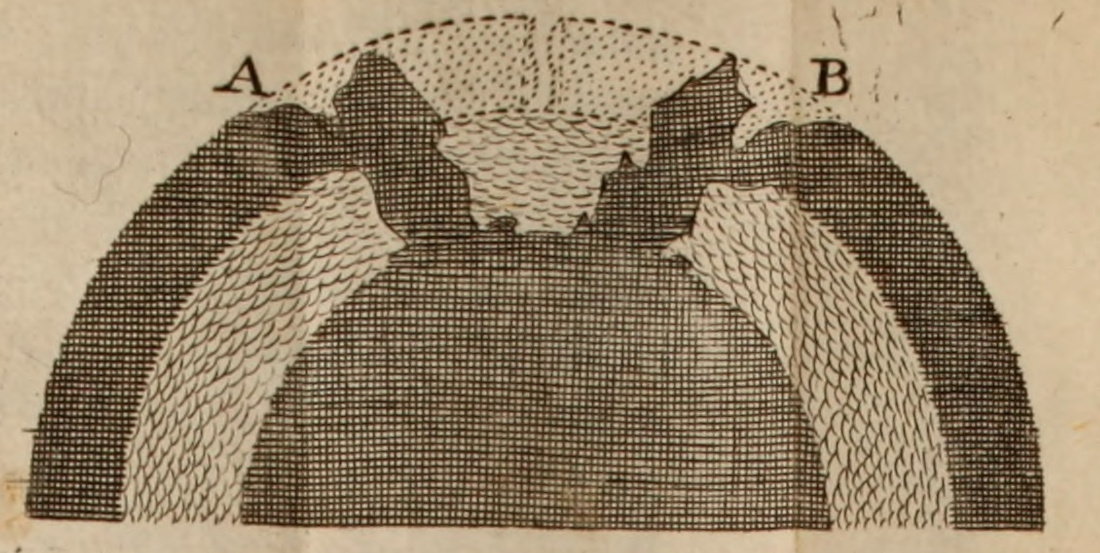
Book 1 Figure 9 Fig. 1.
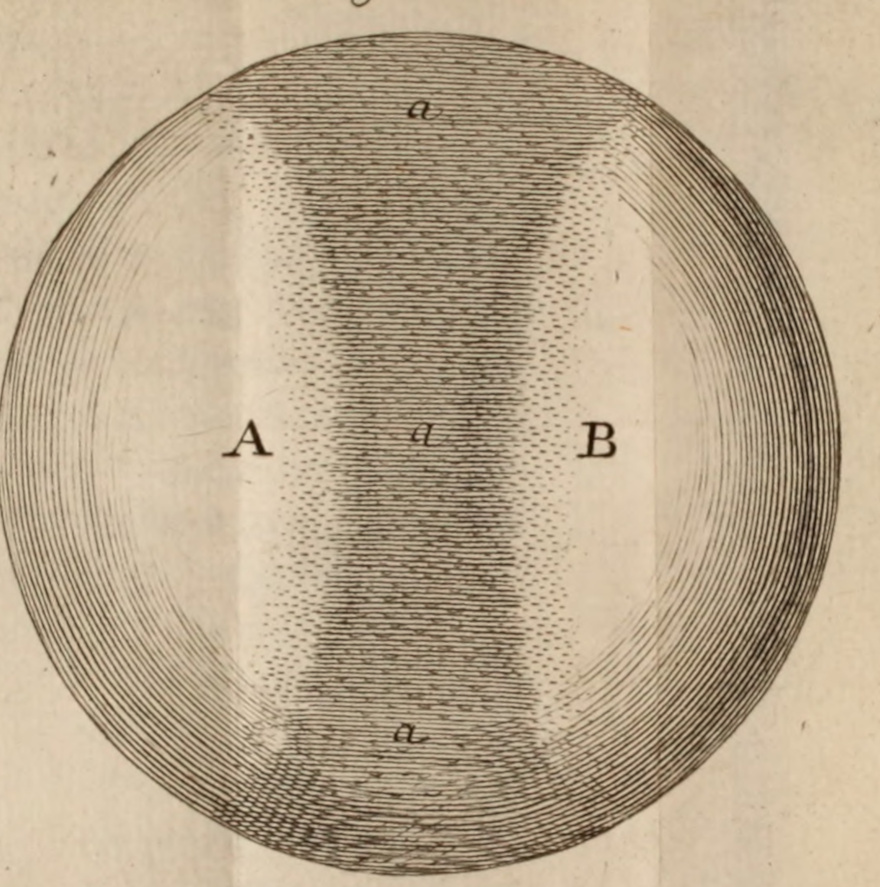
Book 1 Figure 9 Fig. 3.
This we have represented here only in a Ring or Circle of the Earth, in the first Figure; 183but it may be better represented in a broader Surface, as in the second Figure, where the two Fragments A. B. that are to make the two opposite Continents, fall in like double Doors, opening downwards, the Hinges being towards the Land on either Side, so as at the Bottom they leave in the Middle betwixt them a deep Channel of Water, a. a. a. such as is betwixt all Continents; and the Water reaching a good Height upon the Land on either Side, makes Sea there too, but shallower, and by degrees you descend into the deepest Channel.
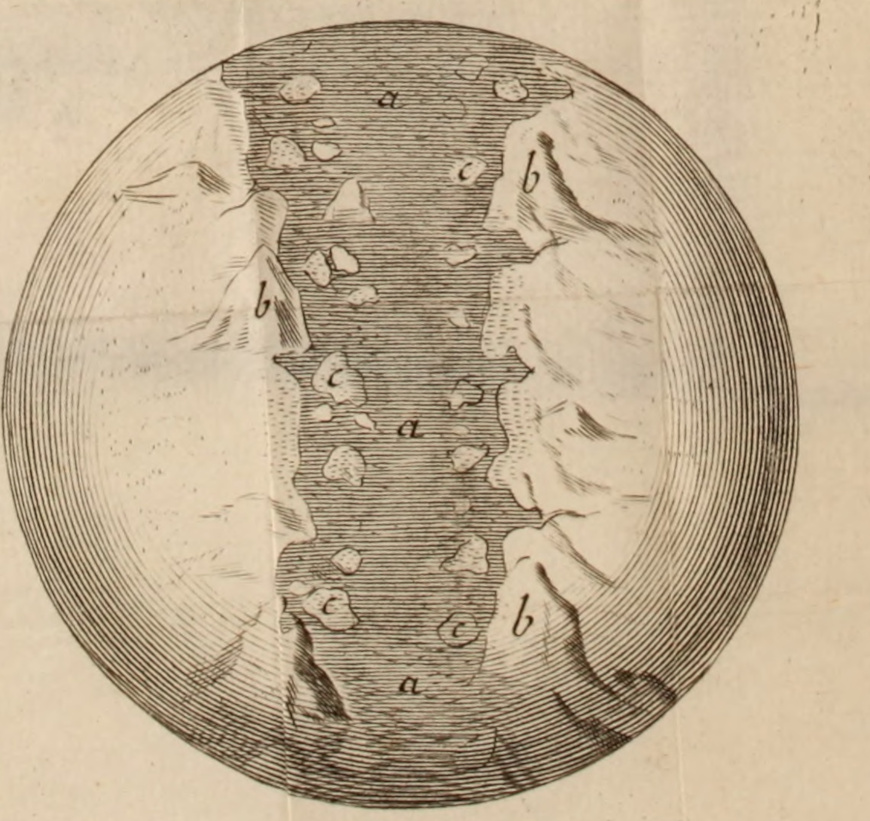
Book 1 Figure 9 Fig. 3.
This gives an Account of two Things that we mention’d to be consider’d and explain’d as to the Sea, how the great Cavity of its Channel was made, and how it was made in that general Form of Declivity in its Sides from the Land: The third Thing was the Irregularities of it, both as to its various Depths, and as to the Form of the Shores and of the Bottom. And this is as easily and naturally explain’d from the same Supposition as the former two; for tho’ we have hitherto represented the Fragments A. B. as even and regular after their Fall, because that was most simple, and there was no occasion then to represent them otherwise, yet we must suppose, that as soon as in their Fall they hit upon the Top or Bottom of the Abyss, that great Force and Weight with which they descended broke off all the Edges and Extremities, and so made innumerable Ruptures and Inequalities in the Shores, and as many within the Sea, and at the Bottom; where the broken 184Rocks and Lumps of Earth would lie in all imaginable Disorder; as you may conceive from the third Figure. For when the Motion came on a sudden to be obstructed, the Load of the Fragment still pressing it forwards, such a Concussion arose, as made thousands of lesser Fragments, of all Shapes and Magnitudes, and in all Postures and Forms, and most of them irregular. And by these Fractions and secondary Ruins the Line of the Shores was broken, and the Level of them too: In some Places they would stand high, in others low, sometimes rough, and sometimes even, and generally crooked, with Angles and In-lets, and uncertain Windings. The Bottom also by the same Stroke was diversify’d into all Manner of Forms, sometimes rocky with Pits and Gulphs, and sometimes spread in plain Beds, sometimes shallow, and sometimes deep; for those Differences would depend only upon the Situation of the secondary Fragments; and so it might come to pass, that some Places near the Shore might be excessive deep when a Rock or Rocks stood in a steep Posture, as (Figure 3.) b. b. b. and, on the contrary, sometimes Places much more advanc’d into the Ocean might be less deep, where a Fragment of Earth lay under Water, or one bore up another, as c. c. c. but these Cases would not be very frequent. To conclude, There are no Properties of the Sea-channel, that I know of, nor Differences or Irregularities in the Form of it, which this Hypothesis doth not give a fair Account of: And having thus far open’d the Way 185and laid down the general Grounds for their Explication, other things that are more minute, we leave to the Curiosity of particular Genius’s; being unwilling to clog the Theory at first with things that may seem unnecessary. We proceed now to the Consideration of Islands.
We must in the first Place distinguish between Original Islands and Fictitious Islands: Those I call fictitious, that are not of the same Date and Antiquity with the Sea, but have been made some at one time, some at another, by accidental Causes, as the Aggestion of Sands and Sand-beds, or the Sea leaving the Tops of some shallow Places that lie high, and yet flowing about the lower Skirts of them; these make sandy and plain Islands, that have no high Land in them, and are but Mock-Islands in effect. Others are made by Divulsion from some Continent, when an Isthmus, or the Neck of a Promontory running into the Sea, sinks or falls in, by an Earthquake or otherwise, and the Sea entring in at the Gap passeth through, and makes that Promontory or Country become an Island. Thus the Island Sicily is suppos’d to have been made, and all Africa might be an Island, if the Isthmus between the Mediterranean and the red Sea should sink down. And these Islands may have Rocks and Mountains in them, if the Land had so before. Lastly, There are Islands that have been said to rise from the Bottom of the Sea; History mentions such in both the Archipelago’s, Ægæan and Indian; and this seems to argue that there are great Fragments or Tracts of Earth 186that lie loose at the Bottom of the Sea, or that are not incorporated with the Ground; which agrees very well with our Explication of the Sea-Channel.
But beside these Islands, and the several Sorts of them, there are others which I call Original; because they could not be produc’d in any of the forementioned Ways, but are of the same Origin and Antiquity with the Channel of the Sea; and such are the Generality of our Islands; they were not made of Heaps of Sands, nor torn from any Continent, but are as ancient as the Continents themselves, namely, ever since the Deluge, the common Parent of them both. Nor is there any Difficulty to understand how Islands were made at the Dissolution of the Earth, any more than how Continents were made; for Islands are but lesser Continents, or Continents greater Islands; and according as Continents were made of greater Masses of Earth, or greater Fragments standing above the Water, so Islands were made of less, but so big always, and in such a Posture, as to bear their Tops above the Water. Yet tho’ they agree thus far, there is a particular Difference to be taken notice of, as to their Origin; for the Continents were made of those three or four primary Masses into which the falling Orb of the Earth was divided, but the Islands were made of the Fractures of these, and broken off by the Fall, from the Skirts and Extremities of the Continents: We noted before, that when those great Masses and primary Fragments came to dash upon 187the Abyss in their Fall, the sudden Stop of the Motion, and the weighty Bulk of the descending Fragment broke off all the Edges and Extremities of it, which Edges and Extremities broken off made the Islands; and accordingly we see that they generally lie scatter’d along the Sides of the Continents, and are but Splinters, as it were, of those greater Bodies. ’Tis true, beside these, there were an infinite Number of other Pieces broke off that do not appear, some making Rocks under Water, some Shallows and Banks in the Sea; but the greatest of them when they fell either one upon another, or in such a Posture as to prop up one another, their Heads and higher Parts would stand out of the Water and make Islands.
Thus I conceive the Islands of the Sea were at first produc’d; we cannot wonder therefore that they should be so numerous, or far more numerous than the Continents; these are the Parents, and those are the Children; nor can we wonder to see along the Sides of the Continents several Islands, or Sets of Islands, sown, as it were, by Handfuls, or laid in Trains; for the Manner of their Generation would lead us to think they would be so plac’d. So the American Islands lie scatter’d upon the Coast of that Continent; the Maldivian and Philippine upon the East-India Shore, and the Hesperides upon the Africk; and there seldom happen to be any towards the Middle of the Ocean, tho’ by an Accident, that also might come to pass. Lastly, It suits very well with our Explication, that 188there should be Mountains and Rocks, sometimes in Clusters, sometimes in long Chains, in all Islands; (as we find there are in all that are true and original) for ’tis that makes them high enough to appear above the Water, and strong enough to continue and preserve themselves in that high Situation.
And thus much may suffice for a summary Explication of the Causes of the Sea-Channel and Islands, according to our Hypothesis.
Chap. XI.
Concerning the Mountains of the Earth, their Greatness and irregular Form, their Situation, Causes, and Origin.
We have been in the Hollows of the Earth, and the Chambers of the Deep, amongst the Damps and Steams of those lower Regions; let us now go air our selves on the Tops of the Mountains, where we shall have a more free and large Horizon, and quite another Face of Things will present it self to our Observation.
The greatest Objects of Nature are, methinks, the most pleasing to behold; and next to the great Concave of the Heavens, and those boundless Regions where the Stars inhabit, there is nothing that I look upon with more Pleasure than the wide Sea and the Mountains of the Earth. There is something august and stately in the Air of these things, that inspires the Mind with great Thoughts and Passions; we do naturally, upon such Occasions, think of God 189and his Greatness: And whatsoever hath but the Shadow and Appearance of Infinite, as all Things have that are too big for our Comprehension, they fill and over-bear the Mind with their Excess, and cast it into a pleasing kind of Stupor and Admiration.
And yet these Mountains we are speaking of, to confess the Truth, are nothing but great Ruins; but such as shew a certain Magnificence in Nature; as from old Temples and broken Amphitheatres of the Romans we collect the Greatness of that People. But the Grandeur of a Nation is less sensible to those that never see the Remains and Monuments they have left; and those who never see the mountainous Parts of the Earth scarce ever reflect upon the Causes of them, or what Power in Nature could be sufficient to produce them. The Truth is, the Generality of People have not Sense and Curiosity enough to raise a Question concerning these things, or concerning the Original of them. You may tell them that Mountains grow out of the Earth like Fuzz-balls, or that there are Monsters under Ground, that throw up Mountains as Moles do Mole-hills; they will scarce raise one Objection against your Doctrine. Or if you would appear more Learned, tell them that the Earth is a great Animal, and these are Wens that grow upon its Body; this would pass current for Philosophy; so much is the World drown’d in Stupidity and sensual Pleasures, and so little inquisitive into the Works of God and Nature.
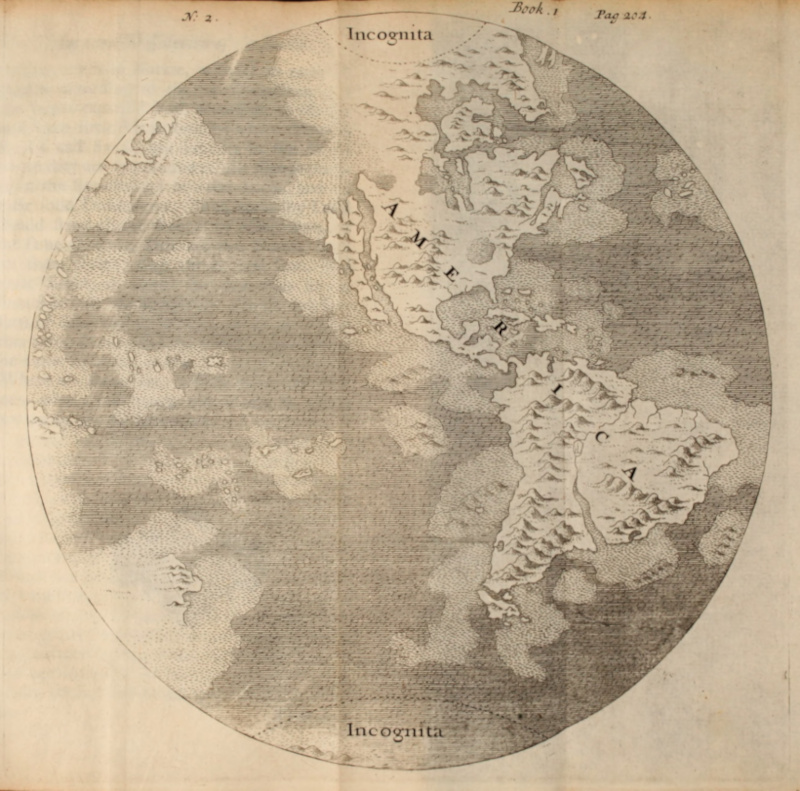
190There is nothing doth more awaken our Thoughts, or excite our Minds to enquire into the Causes of such Things, than the actual View of them; as I have had Experience my self, when it was my Fortune to cross the Alps and Apennine Mountains; for the Sight of those wild, vast, and indigested Heaps of Stones and Earth did so deeply strike my Fancy, that I was not easy ’till I could give my self some tolerable Account how that Confusion came in Nature, ’Tis true, the Height of Mountains compar’d with the Diameter of the Earth is not considerable, but the Extent of them and the Ground they stand upon bears a considerable Proportion to the Surface of the Earth; and if from Europe we may take our Measures for the rest, I easily believe, that the Mountains do at least take up the Tenth Part of the dry Land. The Geographers are not very careful to describe or note in their Charts the Multitude or Situation of Mountains; They mark the Bounds of Countries, the Site of Cities and Towns, and the Course of Rivers, because these are Things of chief Use to Civil Affairs and Commerce, and that they design to serve, and not Philosophy or natural History. But Cluverius, in his Description of Ancient Germany, Switzerland, and Italy, hath given Maps of those Countries more approaching to the natural Face of them, and we have drawn (at the end of this Chapter) such a Map of either Hemisphere, without marking Countries or Towns, or any such artificial Things; 191distinguishing only Land and Sea, Islands and Continents, Mountains and not Mountains; and ’tis very useful to imagine the Earth in this Manner, and to look often upon such bare Draughts, as shew us Nature undrest; for then we are best able to judge what her true Shapes and Proportions are.
’Tis certain that we naturally imagine the Surface of the Earth much more regular than it is; for unless we be in some mountainous Parts, there seldom occur any great Inequalities within so much Compass of Ground as we can at once reach with our Eye; and to conceive the rest, we multiply the same Idea, and extend it to those Parts of the Earth that we do not see, and so fancy the whole Globe much more smooth and uniform than it is. But suppose a Man was carried asleep out of a plain Country amongst the Alps, and left there upon the Top of one of the highest Mountains, when he wak’d and look’d about him, he wou’d think himself in an inchanted Country, or carried into another World; every Thing wou’d appear to him so different to what he had ever seen or imagin’d before. To see on every Hand of him a Multitude of vast Bodies thrown together in Confusion, as those Mountains are; Rocks standing naked round about him; and the hollow Valleys gaping under him; and at his Feet, it may be, an Heap of frozen Snow in the midst of Summer. He would hear the Thunder come from below, and see the black Clouds hanging beneath him; upon such a Prospect it would 192not be easy to him to persuade himself that he was still upon the same Earth; but if he did, he would be convinc’d, at least, that there are some Regions of it strangely rude, and ruin-like, and very different from what he had ever thought of before. But the Inhabitants of these wild Places are even with us; for those that live amongst the Alps, and the great Mountains, think that all the rest of the Earth is like their Country, all broken into Mountains, and Valleys, and Precipices; they never see other, and most People think of nothing but what they have seen at one time or an other.
These Alps we are speaking of are the greatest Range of Mountains in Europe; and ’tis prodigious to see and to consider of what extent these Heaps of Stones and Rubbish are; one way they over-spread Savoy and Dauphine, and reach thro’ France to the Pyrenean Mountains, and so to the Ocean. The other way they run along the Skirts of Germany, thro’ Styria, Pannonia, and Dalmatia, as far as Thrace and the Black Sea. Then backwards they cover Switzerland and the Parts adjacent; and that Branch of them which we call the Apennines strikes thro’ Italy, and is, as it were, the Back-bone of that Country. This must needs be a large Space of Ground which they stand upon; yet ’tis not this Part of Europe only that is laden with Mountains, the Northern Part is as rough and rude in the Face of the Country, as in the Manners of the People; Bohemia, Silesia, Denmark, Norway, Sweedland, Lapland, and Iseland, and all 193the Coasts of the Baltick Sea, are full of Clifts, and Rocks, and Crags of Mountains: Besides the Riphean Mountains in Muscovy, which the Inhabitants there use to call the Stone-girdle, and believe that it girds the Earth round about.
Nor are the other Parts of our Continent more free from Mountains than Europe, nor other Parts of the Earth than our Continent; They are in the New World as well as the Old; and if they could discover two or three New Worlds or Continents more, they would still find them there. Neither is there any Original Island upon the Earth, but is either all a Rock, or hath Rocks of Mountains in it. And all the dry Land, and every Continent, is but a kind of Mountain; tho’ that Mountain hath a Multitude of lesser ones, and Valleys, and Plains, and Lakes, and Marshes, and all Variety of Grounds.
In America, the Andes, or a Ridge of Mountains so call’d, are reported to be higher than any we have, reaching above a Thousand Leagues in Length, and Twenty in Breadth, where they are the narrowest. In Africk the Mountain Atlas, that for its height was said to bear the Heavens on its Back, runs all along from the Western Sea to the Borders of Ægypt, parallel with the Mediterranean. There also are the Mountains of the Moon, and many more, whereof we have but an imperfect Account, as neither indeed of that Country in the remote and inner Parts of it. Asia is better known, and the Mountains thereof better describ’d: Taurus, which is the principal, was adjudg’d 194by the Ancient Geographers the greatest in the World. It divides Asia into two Parts, which have their Denomination from it: And there is an Anti-Taurus the greater and the less, which accordingly divide Armenia into greater and less. Then the Cruciform Mountains of Imaus, the famous Caucasus, the long Chains of Tartary and China, and the rocky and mountainous Arabia. If one could at once have a Prospect of all these together, one would be easily satisfied, that the Globe of the Earth is a more rude and indigested Body than ’tis commonly imagin’d; if one could see, I say, all the Kingdoms and Regions of the Earth at one view, how they lie in broken Heaps; the Sea hath overwhelmed one half of them, and what remains are but the taller Parts of a Ruin. Look upon those great Ranges of Mountains in Europe or in Asia, whereof we have given a short Survey; in what Confusion do they lie? They have neither Form nor Beauty, nor Shape, nor Order, no more than the Clouds in the Air. Then how barren, how desolate, how naked are they? How they stand neglected by Nature? Neither the Rains can soften them, nor the Dews from Heaven make them fruitful.
I have given this short Account of the Mountains of the Earth, to help to remove that Prejudice we are apt to have, or that Conceit, that the present Earth is regularly form’d. And to this Purpose I do not doubt but that it would be of very good Use to have natural Maps of the Earth, as we noted before, as well as civil; and done with the same Care and Judgment.
195Our common Maps I call Civil, which note the Distinction of Countries and of Cities, and represent the Artificial Earth as inhabited and cultivated: But Natural Maps leave out all that, and represent the Earth as it would be if there was not an Inhabitant upon it, nor ever had been; the Skeleton of the Earth, as I may so say, with the sight of all its Parts. Methinks also every Prince should have such a Draught of his own Country and Dominions, to see how the Ground lies in the several Parts of them, which highest, which lowest; what respect they have to one another, and to the Sea; how the Rivers flow, and why; how the Mountains stand; how the Heaths and how the Marshes are plac’d. Such a Map or Survey would be useful both in time of War and Peace, and many good Observations might be made by it, not only as to natural History and Philosophy, but also in order to the perfect Improvement of a Country. But to return to our Mountains.
And this View of the Multitude and Greatness of them, may help to rectify our Mistakes about the Form of the Earth; so before we proceed to examine their Causes it will be good to observe further, that these Mountains are plac’d in no Order one with another, that can either respect Use or Beauty; and if you consider them singly, they do not consist of any Proportion of Parts that is referable to any Design, or that hath the least Footsteps of Art or Counsel. There is nothing in Nature more shapeless and ill-figur’d than an old Rock or a Mountain, and 196all that Variety that is among them, is but the various Modes of Irregularity; so as you cannot make a better Character of them, in short, than to say they are of all Forms and Figures except regular. Then if you would go within these Mountains (for they are generally hollow) you would find all things there more rude, if possible, than without: And lastly, if you look upon an Heap of them together, or a mountainous Country, they are the greatest Examples of Confusion that we know in Nature; no Tempest or Earthquake puts Things into more Disorder. ’Tis true, they cannot look so ill now as they did at first; a Ruin that is fresh, looks much worse than afterwards, when the Earth grows discolour’d and skinn’d over. But I fancy, if we had seen the Mountains when they were new born and raw, when the Earth was fresh broken, and the Waters of the Deluge newly retir’d, the Fractions and Confusions of them would have appear’d very ghastly and frightful.
After this general Survey of the Mountains of the Earth and their Properties, let us now reflect upon the Causes of them. There is a double Pleasure in Philosophy; first, that of Admiration, whilst we contemplate Things that are great and wonderful, and do not yet understand their Causes; for tho’ Admiration proceeds from Ignorance, yet there is a certain Charm and Sweetness in that Passion. Then the second Pleasure is greater and more intellectual, which is that of distinct Knowledge and 197Comprehension, when we come to have the Key that unlocks those Secrets, and see the Methods wherein those Things come to pass that we admir’d before: The Reasons why the World is so or so, and from what Causes Nature, or any Part of Nature, came into such a State; and this we are now to enquire after, as to the Mountains of the Earth, what their Original was, how and when the Earth came into this strange Frame and Structure? In the Beginning of our World, when the Earth rose from a Chaos, ’twas impossible it should come immediately into this mountainous Form; because a Mass that is fluid, as a Chaos is, cannot lie in any other Figure than what is regular; for the constant Laws of Nature do certainly bring all Liquors into that Form: And a Chaos is not call’d so from any Confusion or Brokenness in the Form of it, but from a Confusion and Mixture of all sorts of Ingredients in the Composition of it. So we have already produc’d in the precedent Chapters, a double Argument that the Earth was not originally in this Form, both because it rose from a Chaos, which could not of it self, or by any immediate Concretion, settle into a Form of this Nature, as hath been shewn in the fourth and fifth Chapters; as also because if it had been originally made thus, it could never have undergone a Deluge, as hath been prov’d in the second and third Chapters. If this be then a secondary and succedaneous Form, the great Question is, from what Causes it arises.
198Some have thought that Mountains, and all other Irregularities in the Earth, have Rise from Earthquakes, and such like Causes; others have thought that they came from the universal Deluge; yet not from any Dissolution of the Earth that was then, but only from the great Agitation of the Waters, which broke the Ground into this rude and unequal Form. Both these Causes seem to me very incompetent and insufficient. Earthquakes seldom make Mountains, they often take them away, and sink them down into the Caverns that lie under them; besides, Earthquakes are not in all Countries and Climates as Mountains are; for as we have observ’d more than once, there is neither Island that is Original, nor Continent any where in the Earth, in what Latitude soever, but hath Mountains and Rocks in it. And lastly, what Probability is there, or how is it credible, that those vast Tracks of Land which we see fill’d with Mountains both in Europe, Asia and Africa, were rais’d by Earthquakes, or any Eruptions from below? In what Age of the World was this done, and why not continu’d? As for the Deluge, which they alledge as another Cause, I doubt not but Mountains were made in the Time of the general Deluge, that great Change and Transformation of the Earth happen’d then, but not from such Causes as are pretended, that is, the bare rolling and agitation of the Waters; for if the Earth was smooth and plain before the Flood, as they seem to suppose as well as we do, the Waters could have little or 199no Power over a smooth Surface to tear it any way in Pieces, no more than they do a Meadow or low Ground when they lie upon it; for that which makes Torrents and Land floods violent, is their Fall from the Mountains and high Lands, which our Earth is now full of; but if the Rain fell upon even and level Ground, it would only sodden and compress it; there is no possibility how it should raise Mountains in it. And if we could imagine an universal Deluge as the Earth is now constituted, it would rather throw down the Hills and Mountains, than raise new ones; or by beating down their Tops and loose Parts, help to fill the Valleys, and bring the Earth nearer to Evenness and Plainness.
Seeing then there are no Hopes of explaining the Origin of Mountains, either from particular Earthquakes, or from the general Deluge, according to the common Notion and Explication of it; these not being Causes answerable to such vast Effects: Let us try our Hypothesis again; which hath made us a Channel large enough for the Sea, and Room for all subterraneous Cavities, and I think will find us Materials enough to raise all the Mountains of the Earth. We suppose the great Arch or Circumference of the first Earth to have fallen into the Abyss at the Deluge, and seeing that was larger than the Surface it fell upon, ’tis absolutely certain, that it could not all fall flat, or lie under the Water: Now as all those Parts that stood above the Water made dry Land, or the present habitable Earth, so such Parts of the 200dry Land as stood higher than the rest, made Hills and Mountains; and this is the first and general Account of them, and of all the Inequalities of the Earth. But to consider these Things a little more particularly: There is a double Cause and Necessity of Mountains, first this now mention’d, because the exterior Orb of the Earth was greater than the interior, which it fell upon, and therefore it could not all fall flat; and secondly, because this exterior Orb did not fall so flat and large as it might, or did not cover all the Bottom of the Abyss, as it was very capable to do; but as we shew’d before in explaining the Channel of the Ocean, it left a gaping in the Middle, or an Abyss-channel, as I should call it; and the broader this Abyss-channel was, the more Mountains there would be upon the dry Land; for there would be more Earth, or more of the falling Orb left, and less Room to place it in, and therefore it must stand more in Heaps.
In what Parts of the Earth these Heaps would lie, and in what particular manner, it cannot be expected that we should tell; but all that we have hitherto observ’d concerning Mountains, how strange soever, and otherwise unaccountable, may easily be explain’d and deduc’d from this Original; we shall not wonder at their Greatness and Vastness, seeing they are the Ruins of a broken World; and they would take up more or less of the dry Land, according as the Ocean took up more or less Space of our Globe: Then as to their Figure and Form, whether external or internal, ’tis just such as answers our 201Expectation, and no more than what the Hypothesis leads us to; for you would easily believe that these Heaps would be irregular in all manner of ways, whether consider’d apart, or in their Situation to one another. And they would lie commonly in Clusters and in Ridges, for those are two of the most general Postures of the Parts of a Ruin, when they fall inwards. Lastly, We cannot wonder that Mountains should be generally hollow; for great Bodies falling together in Confusion, or bearing and leaning against one another, must needs make a great many Hollownesses in them, and by their unequal Applications empty Spaces will be intercepted. We see also from the same Reason why mountainous Countries are subject to Earthquakes; and why Mountains often sink and fall down into the Caverns that lie under them; their Joints and Props being decayed and worn, they become unable to bear their Weight. And all these Properties you see hang upon one and the same String, and are just Consequences from our Supposition concerning the Dissolution of the first Earth. And there is no surer Mark of a good Hypothesis, than when it doth not only hit luckily in one or two Particulars, but answers all that it is to be apply’d to, and is adequate to Nature in her whole Extent.
But how fully or easily soever these things may answer Nature, you will say, it may be, that all this is but an Hypothesis; that is, a kind of Fiction or Supposition that Things were so and so at first, and by the Coherence and Agreement 202of the Effects with such a Supposition, you would argue and prove that they were really so. This I confess is true, this is the Method, and if we would know any Thing in Nature further than our Senses go, we can know it no otherwise than by an Hypothesis. When Things are either too little for our Senses, or too remote and inaccessible, we have no Way to know the inward Nature, and the Causes of their sensible Properties, but by reasoning upon an Hypothesis. If you would know, for Example, of what Parts Water, or any other Liquor consists, they are too little to be discern’d by the Eye; you must therefore take a Supposition concerning their invisible Figure and Form, and if that agrees and gives the Reason of all their sensible Qualities, you understand the Nature of Water. In like manner, if you would know the Nature of a Comet, or of what Matter the Sun consists, which are Things inaccessible to us, you can do this no otherwise than by an Hypothesis; and if that Hypothesis be easy and intelligible, and answers all the Phænomena of those two Bodies, you have done as much as a Philosopher or as human Reason can do. And this is what we have attempted concerning the Earth and concerning the Deluge. We have laid down an Hypothesis that is easy and perspicuous, consisting of a few things, and those very intelligible, and from this we have given an Account how the old World was destroy’d by a Deluge of Water, and how the Earth came into this present Form, so distinguish’d and interrupted 203with Sea and Land, Mountains and Valleys, and so broken in the Surface and inward Parts of it.
But to speak the Truth, this Theory is something more than a bare Hypothesis; because we are assured that the general Ground that we go upon is true, namely, That the Earth rose at first from a Chaos; for besides Reason and Antiquity, Scripture it self doth assure us of that; and that one Point being granted, we have deduc’d from it all the rest by a direct Chain of Consequences, which I think cannot be broken easily in any Part or Link of it. Besides, the great Hinge of this Theory, upon which all the rest turns, is the Distinction we make of the antediluvian Earth and Heavens from the Postdiluvian, as to their Form and Constitution. And it will never be beaten out of my Head, but that St. Peter, 2 Epist. chap. iii. 5, 6. hath made the same Distinction sixteen hundred Years since, and to the very same purpose; so that we have sure footing here again, and the Theory riseth above the Character of a bare Hypothesis. And whereas an Hypothesis that is clear and proportion’d to Nature in every Respect, is accounted morally certain, we must in Equity give more than a moral Certitude to this Theory. But I mean this only as to the general Parts of it; for as to Particularities, I look upon them only as problematical, and accordingly I affirm nothing therein but with a Power of Revocation, and a Liberty to change my Opinion when I shall be better inform’d. Neither do I know 204any Author that hath treated a Matter new, remote, and consisting of a Multitude of Particulars, who would not have had occasion, if he had liv’d to have seen his Hypothesis fully examin’d, to have chang’d his Mind and Manner of explaining Things in many material Instances.
To conclude both this Chapter and this Section, we have here added a Map or Draught of the Earth, according to the natural Face of it, as it would appear from the Moon, if we were a little nearer to her; or as it was at first after the Deluge, before Cities were built, Distinctions of Countries made, or any Alterations by human Industry. ’Tis chiefly to expose more to view the Mountains of the Earth, and the Proportions of Sea and Land; to shew it as it lies in itself, and as a Naturalist ought to conceive and consider it. ’Tis true, there are far more Mountains upon the Earth than what are here represented, for more could not conveniently be plac’d in this narrow Scheme; but the best and most effectual Way of representing the Body of the Earth as it is by Nature, would be, not in plain Tables, but by a rough Globe, expressing all the considerable Inequalities that are upon the Earth. The smooth Globes that we use, do but nourish in us the Conceit of the Earth’s Regularity; and tho’ they may be convenient enough for geographical Purposes, they are not so proper for natural Science, nothing would be more useful in this Respect, than a rough Globe of the largest Dimensions, wherein the Channel of the Sea should be really 205hollow, as it is in Nature, with all its unequal Depths according to the best Soundings, and the Shores express’d both according to Matter and Form, little Rocks standing where there are Rocks, and Sands and Beaches in the Places where they are found; and all the Islands planted in the Sea-channel in a due Form, and in their solid Dimensions. Then upon the Land should stand all the Ranges of Mountains, in the same Order or Disorder that Nature hath set them there: And the in-land Seas, and great Lakes, or rather the Beds they lie in, should be duly represented; as also the vast Desarts of Sand as they lie upon the Earth. And this being done with Care and due Art, would be a true Epitome, or true Model of our Earth. Where we should see, besides other Instructions, what a rude Lump our World is, which we are so apt to dote upon.
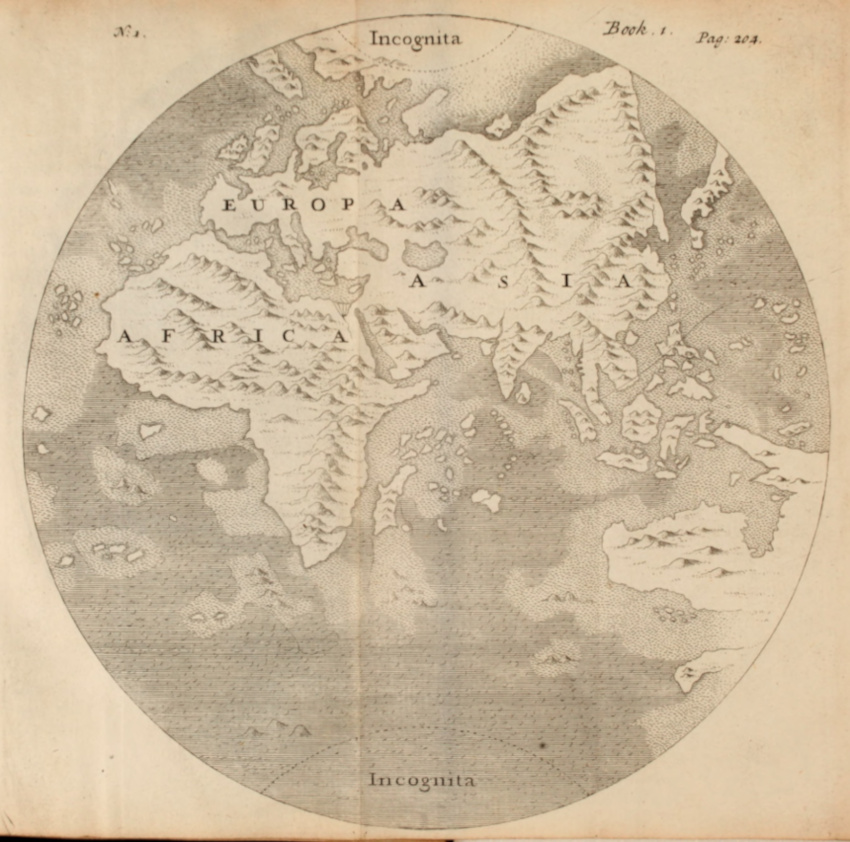
Book 1 No. 1.
Book 1 No. 2.
206
Chap. XII.
A short Review of what hath been already treated of, and in what Manner. The several Faces and Schemes under which the Earth would appear to a Stranger, that should view it first at a Distance, and then more closely, and the Application of them to our Subject. All Methods, whether Philosophical or Theological, that have been offer’d by others for the Explication of the Form of the Earth, are examin’d and disprov’d. A Conjecture concerning the other Planets, their natural Form and State compared with ours.
We have finish’d the three Sections of this Book, and in this last Chapter we will make a short Review and Reflexion upon what hath been hitherto treated of, and add some further Confirmations of it. The Explication of the universal Deluge was the first Proposal and Design of this Discourse, to make that a Thing credible and intelligible to the Mind of Man: And the full Explication of this drew in the whole Theory of the Earth; Whose Original we have deduc’d from its first Source, and shew’d both what was its primæval Form, and how it came into its present Form. The Sum of our Hypothesis concerning the universal Deluge was this; That it came not to pass, as was vulgarly believ’d, by an Excess of Rains, or any Inundation of the Sea, nor could ever be effected 207by a meer Abundance of Waters; unless we suppose some Dissolution of the Earth at the same time, namely, when the Great Abyss was broken open. And accordingly we shewed, that without such a Dissolution, or if the Earth had been always in the same Form it is in now, no Mass of Water, any where to be found in the World, could have equall’d the Height of the Mountains, or made such an universal Deluge. Secondly, We shewed that the Form of the Earth at first, and till the Deluge, was such as made it capable and subject to a Dissolution: And thirdly, That such a Dissolution being suppos’d, the Doctrine of the universal Deluge is very reasonable and intelligible; and not only the Doctrine of the Deluge, but the same Supposition is a Key to all Nature besides, shewing us how our Globe became terraqueous, what was the Original of Mountains, of the Sea-channel, of Islands, of subterraneous Cavities; things which without this Supposition are as untelligible as the universal Flood itself. And these things reciprocally confirming one another, our Hypothesis of the Deluge is arm’d, both Breast and Back, by the Causes and by the Effects.
It remains now, that, as to confirm our Explication of the Deluge, we shew’d all other Accounts that had been given of it to be ineffectual or impossible, to confirm our Doctrine concerning the Dissolution of the Earth, and concerning the Original of Mountains, Seas, and all Inequalities upon it, or within it, we must examine what Causes have been 208assign’d by others, or what Accounts given of these things: That seeing their Defectiveness, we may have the more Assurance and Satisfaction in our own Method.
And in order to this, let us observe first the general Forms under which the Earth may be consider’d, or under which it doth appear accordingly as we view it more nearly or remotely; and the first of these and the most general is that of a terraqueous Globe. If a Philosopher should come out of another World out of Curiosity to see our Earth, the first Discovery or Observation he would make would be this, that it was a terraqueous Globe: Thus much he might observe at a great Distance, when he came but near the Borders of our World. This we discern in the Moon, and most of the Planets, that they are divided into Sea and Land, and how this Division came would be his first Remark and Inquiry concerning our Earth; and how also those Subdivisions of Islands, or little Earths which lie in the Water; how these were form’d, and that great Channel that contains them both.
The second Form that the Earth appears under, is that of an uneven and mountainous Globe. When our Traveller had got below the Circle of the Moon, he would discern the bald Tops of our Mountains, and the long Ranges of them upon our Continents. We cannot from the Earth discern Mountains and Valleys in the Moon directly, but from the Motion of the Light and Shadows which we 209see there, we easily collect that there are such Inequalities: And accordingly we suppose that our Mountains would appear at a great Distance, and the shady Valleys lying under them; and that this curious Person that came to view our Earth, would make that his second Enquiry, how those Mountains were formed, and how our Globe came to be so rude and irregular? For we may justly demand how any Irregularity came into Nature, seeing all her first Motions and her first Forms are regular, and whatsoever is not so, is but secondary, and the Consequence of some Degeneracy, or of some Decay.
The third visible Form of our Earth is that of a broken Globe; and broken throughout, but in the outward Parts and Regions of it. This, it may be, you will say, is not a visible Form; it doth not appear to the Eye, without reasoning, that the Surface of the Earth is so broken. Suppose our new Visitant had now pass’d the middle Region of the Air, and was alighted upon the Top of Pic Teneriffe for his first resting Place, and that sitting there, he took a View of the great Rocks, the wide Sea, and of the Shores of Africk and Europe; for we’ll suppose his piercing Eye to reach so far; I will not say that at first Sight he would pronounce that the Surface of this Globe was broken, unless he knew it to be so by Comparison with some other Planet like to it; but the broken Form and Figure of many Parts of the Rocks, and the Posture in which they lay, or great Portions of them, some inclin’d, some 210prostrate, some erected, would naturally lead him to that Thought, that they were a Ruin; he would see also the Islands tore from the Continents, and both the Shores of the Continents and their Inland Parts in the same Disorder and irregular Situation. Besides, he had this great Advantage in viewing the Earth at a Distance, that he could see a whole Hemisphere together, which, as he made his Approaches thro’ the Air, would have much what the same aspect and countenance as ’tis represented within the great Scheme, p. 203. And if any Man should accidentally hit upon that Scheme, not knowing or thinking that it was the Earth, I believe his first Thought of it would be, that it was some great broken Body, or ruin’d Frame of Matter; and the Original, I am sure, is more manifestly so. But we’ll leave our strange Philosopher to his own Observations, and with him good Guides and Interpreters in his Survey of the Earth, and that he would make a favourable Report at his Return home, of our little dirty Planet.
In the mean time let us pursue, in our own Way, this Third Idea of the Earth a little further, as it is a broken Globe. Nature I know hath dissembled and cover’d this Form as much as may be, and Time hath help’d to repair some of the old Breaches, or fill them up; besides, the Changes that have been made by Art and human Industry, by Agriculture, Planting, and Building Towns, hath made the Face of the Earth quite another Thing from what it was in its naked Rudeness. As 211Mankind is much alter’d from its pristine State, from what it was four thousand Years ago, or towards the first Ages after the Flood, when the Nations liv’d in Simplicity or Barbarousness; so is the Earth too, and both so disguis’d and transform’d, that if one of those primitive Fathers should rise from the Dead, he would scarce know this to be the same World which he liv’d in before. But to discern the true Form of the Earth, whether intire or broken, regular or disorder’d, we must in the first Place take away all those Ornaments or Additions made by Art or Nature, and view the bare Carcass of the Earth, as it hath nothing on it but Rocks and Mountains, Deserts and Fields, and hollow Valleys, and a wide Sea. Then secondly, We must in our Imagination empty this Channel of the Sea, take out all the Waters that hinder the Sight of it, and look upon the dry Ditch, measure the Depth and Breadth of it in our Mind, and observe the Manner of its Construction, and in what a wild Posture all the Parts of it lie; according as it hath been formerly represented, Chap. 10. And lastly, we must take off the Cover of all subterraneous Places and deep Caverns, to see the inside of the Earth; and lay bare the Roots of Mountains, to look into those Holes and Vaults that are under them, fill’d sometimes with Fire, sometimes with Water, and sometimes with thick Air and Vapours. The Object being thus prepar’d, we are then to look fixedly upon it, and to pronounce what we think of this disfigur’d Mass, 212whether this exterior Frame doth not seem to be shatter’d; and whether it doth more aptly resemble a new-made World, or the Ruins of one broken. I confess when this Idea of the Earth is present to my Thoughts, I can no more believe that this was the Form wherein it was first produc’d, than if I had seen the Temple of Jerusalem in its Ruins, when defac’d and sack’d by the Babylonians; I could have persuaded my self, that it had never been in any other Posture, and that Solomon had given Orders for Building it so.
So much for the Form of the Earth: It remains now that we examine what Causes have been assign’d by others, of these Irregularities in the Form of the Earth, which we explain by the Dissolution of it; what Accounts any of the Ancients have given, or attempted to give, how the Earth swell’d into Mountains in certain Places, and in others was depress’d into low Valleys, how the Body of it was so broken, and how the Channel of the Sea was made. The Elements naturally lie in regular Forms one above another, and now we find them mix’d, confounded and transpos’d, how comes this Disturbance and Disordination in Nature? The Explications of these Things that have been given by others, may be reduc’d to two general Sorts, Philosophical or Theological, and we will try them both for our Satisfaction.
Of Philosophers, none was more concern’d to give an Account of such Things than Epicurus, both because he acknowledged the Origin 213of the Earth to have been from a Chaos, and also admitted no Causes to act in Nature but Matter and Motion: Yet all the Account we have from the Epicureans of the Form of the Earth, and the great Inequalities that are in it, is so slight and trivial, that methinks it doth not deserve the Name of a Philosophical Explication. They say that the Earth and Water were mix’d at first, or rather, the Earth was above the Water, and as the Earth was condens’d by the Heat of the Sun and the Winds, the Water was squeez’d out in certain Places, which either it found hollow or made so; and so was the Channel of the Sea made. Then as for Mountains, while some Parts of the Earth shrunk and sunk in this Manner, others would not sink; and these standing still while the others fell lower, made the Mountains. How the subterraneous Cavities were made according to them, I do not find.
This is all the Account that Monsieur Gassendi (who seems to have made it his Business, as well as his Pleasure, to embellish that Philosophy) can help us to, out of the Epicurean Authors how the Earth came into this Form; and he that can content himself with this, is, in my Mind, of an Humour very easy to be pleas’d. Do the Sun and the Wind use to squeeze Pools of Water out of the Earth, and that in such a Quantity as to make an Ocean? They dry the Earth, and the Waters too, and rarify them into Vapours, but I never knew them to be the Causes of pressing Water out of the Earth by Condensation. 214Could they compress the Earth any otherwise, than by drying it and making it hard? And in Proportion, as it was more dry, would it not the more imbibe and suck up the Water? And how were the great Mountains of the Earth made in the North and in the South, where the Influence of the Sun is not great? What sunk the Earth there, and made the Flesh start from the Bones? But ’tis no Wonder that Epicurus should give such a mean Account of the Origin of the Earth, and the Form of its Parts, who did not so much as understand the general Figure of the Body of it, that it was in some Manner Spherical, or that the Heavens encompass’d it round. One must have a blind Love for that Philosophy, and for the Conclusions it drives at, not to see its Lameness and Defects in those first and fundamental Parts.
Aristotle, though he was not concern’d to give an Account how the Earth came into this present Form, as he suppos’d it Eternal; yet upon another Consideration he seems obliged to give some Reason how the Elements came into this Disorder; seeing he supposeth, that, according to the Order of Nature, the Water should lie above the Earth in a Sphere, as the Air doth above the Water, and his Fire above the Air. This he toucheth upon in his Meteors, but so gently and fearfully, as if he was handling hot Coals. He saith the Sea is to be consider’d as the Element, or Body of Waters that belongs to this Earth, and that these Waters change Places, and the Sea is some Ages in one Part of the 215Globe, and some Ages in another; but that this is at such great Distances of Time, that there can be no Memory or Record of it. And he seems willing to suppose that the Water was once all over the Earth, but that it dry’d up in certain Places, and continuing in others, it there made the Sea.
What a miserable Account is this? As to his Change or Removal of the Sea-channel in several Ages, as it is without all Proof or Probability, if he mean it of the Channel of the great Ocean, so ’tis nothing to the Purpose here; for the Question is not why the Channel of the Sea is in such a Part of the Earth, rather than in another, but why there is any such prodigious Cavity in or upon the Earth any where. And if we take his Supposition, that the Element of Water was once higher than the Earth, and lay in a Sphere about it, then let him tell us in plain Terms how the Earth got above, or how the Cavity of the Ocean was made, and how the Mountains rise; for this Elementary Earth which lay under the Water, was, I suppose, equal and smooth when it lay there; and what reason was there, that the Waters should be dry’d in one Part of it, more than another, if they were every where of an equal Depth, and the Ground equal under them? It was not the Climates made any Distinction, for there is Sea towards the Poles, as well as under the Æquator; but suppose they were dry’d up in certain Places, that would make no Mountains, no more than there are Mountains in our dry’d Marshes: 216And the Places where they were not dry’d, would not therefore become as deep and hollow as the Sea-channel, and tear the Earth and Rocks in pieces. If you would say that this very Elementary Earth, as it lay under the Waters, was unequal, and was so originally form’d into Mountains and Valleys and great Cavities; besides that the Supposition is altogether irrational in itself, you must suppose a prodigious Mass of Water to cover such an Earth; as much as we found requisite for the vulgar Deluge, namely, eight Oceans; and what then is become of the other seven? Upon the whole, I do not see that either in Epicurus’s way, who seems to suppose that the Waters were at first within the Earth; nor in Aristotle’s way, who seems to suppose them upon the Earth, any rational or tolerable Account can be given of the present Form of the Earth.
Wherefore some Modern Authors, dissatisfied, as very well they might be, with these Explications given us by the Ancients concerning the Form of the Earth, have pitch’d upon other Causes, more true indeed in their kind, and in their degree, but that fall as much short of those Effects to which they would apply them. They say that all the Irregularities of the Body of the Earth have risen from Earthquakes in particular Places, and from Torrents and Inundations, and from Eruptions of Fire, or such like Causes, whereof we see some Instances more or less every Age; and these have made that havock upon the Face of the Earth, and turn’d things upside down, raising the Earth, 217in some Places, and making great Cavities or Chasms in others, so as to have brought it at length into that torn, broken, and disorderly Form in which we now see it.
These Authors do so far agree with us, as to acknowledge, That the present irregular Form of the Earth must have proceeded from Ruins and Dissolutions of one sort or other; but these Ruins they make to have been partial only, in this or in that Country, by piece-meal, and in several Ages, and from no other Causes, but such as still continue to act in Nature, namely, accidental Earthquakes and Eruptions of Fires and Waters. These Causes we acknowledge as readily as they do, but not as capable to produce so great Effects as they would ascribe to them; the Surface of the Earth may be a little changed by such Accidents as these, but for the most part, they rather sink the Mountains, than raise new Ones: As when Houses are blown up by Mines of Powder, they are not set higher, but generally fall lower and flatter: Or suppose they do sometimes raise an Hill, or a little Mount, what’s that to the great Mountains of our World, to those long and vast Piles of Rocks and Stones, which the Earth can scarce bear? What’s that to strong-backt Taurus or Atlas, to the American Andes, or to a Mountain that reacheth from the Pyreneans to the Euxine Sea? There’s as much Difference between these, and those factious Mountains they speak of, as betwixt them and Mole-hills.
218And to answer more distinctly to this Opinion, as before in speaking of Islands we distinguish’d betwixt factitious and original Islands, so, if you please, we may distinguish here betwixt factitious and original Mountains; and allowing some few, and those of the fifth or sixth Magnitude, to have risen from such accidental Causes, we enquire concerning the rest and the greatest, what was their Original? If we should suppose that the seven Hills upon which Rome stands, came from Ruins or Eruptions, or any such Causes, it doth not follow that the Alps were made so too. And as for Mountains, so for the Cavities of the Earth, I suppose there may be Disruptions sometimes made by Earthquakes, and Holes worn by subterraneous Fires and Waters; but what’s that to the Channel of the Atlantick Ocean, or of the Pacifick Ocean, which is extended an hundred and fifty Degrees under the Æquator, and towards the Poles still further? He that should derive such mighty Things from no greater Causes, I should think him a very credulous Philosopher. And we are too subject indeed to that Fault of Credulity in Matter of Philosophizing: Many when they have found out Causes that are proper for certain Effects within such a Compass, they cannot keep them there, but they will make them do every Thing for them; and extend them often to other Effects of a superior Nature or Degree, which their Activity can by no Means reach to. Ætna hath been a burning Mountain ever since, and above 219the Memory of Man, yet it hath not destroy’d that Island, nor made any new Channel to the Sea, tho’ it stands so near it. Neither is Vesuvius above two or three Miles distant from the Sea-side, to the best of my Remembrance, and yet in so many Ages it hath made no Passage to it, neither open nor subterraneous. ’Tis true, some Isthmus’s have been thrown down by Earthquakes, and some Lakes have been made in that Manner, but what’s this to a Ditch nine thousand Miles broad? Such an one we have upon the Earth, and of a Depth that is not measurable; what Proportion have these Causes to such an Instance? And how many thousand Ages must be allow’d to them to do their Work, more than the Chronology of our Earth will bear?
Besides, When were these great Earthquakes and Disruptions, that did such great Execution upon the Body of the Earth? Was this before the Flood or since? If before, then the old Difficulty returns, how could there be a Flood, if the Earth was in this mountainous Form before that Time? This, I think, is demonstrated impossible in the second and third Chapters. If since the Flood, where were the Waters of the Earth before these Earthquakes made a Channel for them? Besides, where is the History or Tradition, that speaks of these strange Things, and of this great Change of the Earth? Hath any writ of the Origins of the Alps? In what Year of Rome, or what Olympiad they were born? Or how they grew from little ones? How the Earth 220groan’d when it brought them forth, when its Bowels were torn by the ragged Rocks? Do the Chronicles of the Nations mention these things, or ancient Fame, or ancient Fables? were they made all at once, or in successive Ages? These Causes continue still in Nature, we have still Earthquakes and subterraneous Fires and Waters, why should they not still operate and have the same Effects? We often hear of Cities thrown down by Earthquakes, or Countries swallow’d up; but who ever heard of a new Chain of Mountains made upon the Earth, or a new Channel made for the Ocean? We do not read that there hath been so much as a new Sinus of the Sea ever since the Memory of Man: Which is far more feasible than what they pretend. And Things of this Nature being both strange and feasible, excite Admiration and great Attention when they come to pass, and would certainly have been remembered or propagated in some Way or other, if they had ever happen’d since the Deluge. They have recorded the Foundation of Cities and Monarchies, the Appearance of Blazing Stars, the Eruptions of fiery Mountains, the most remarkable Earthquakes and Inundations, the great Eclipses or Obscurations of the Sun, and any thing that look’d strange or Prodigy-like, whether in the Heavens or on Earth: And these, which would have been the greatest Prodigies, and greatest Changes that ever happen’d in Nature, would these have escap’d all Observation and 221Memory of Men? That’s as incredible as the Things themselves are.
Lastly, To comprehend all these Opinions together, both of the Ancient and Modern Authors, they seem all to agree with us in this, That the Earth was once under another Form; otherwise why do they go about to shew the Causes how it came into this Form? I desire then to know what Form they suppose the Earth to have been under before the Mountains were made, the Channel of the Sea, or subterraneous Cavities? Either they must take that Form which we have assign’d it before the Deluge, or else they must suppose it cover’d with Water, till the Sea-channels were made, and the Mountains brought forth; as in Fig. 2. p. 76. And no doubt it was once in this Form, both Reason and the Authority of Moses assure us of it; and this is the Test which every Opinion must be brought to, how the Earth emerg’d out of that watry Form? And in particular, as to that Opinion which we are now examining, the Question is, how by Earthquakes, and fiery Eruptions, subterraneous Waters, and such like Causes, the Body of the Earth could be wrought from that Form to this present Form? And the Thing is impossible at first Sight; for such Causes as these could not take place in such an Earth. As for subterraneous Waters, there could be none at that Time, for they were all above Ground; and as for subterraneous Exhalations, whether fiery or aery, there was no Place for them neither; for the Earth, when 222it lay under the Water, was a solid uniform Mass, compact and close united in its Parts, as we have shewn before upon several Occasions; no Mines or hollow Vaults for the Vapours to be lodg’d in, no Store-houses of Fire; nothing that could make Earthquakes, nor any sort of Ruins or Eruptions: These are Engines that cannot Play but in an Earth already broken, hollow and cavernous. Therefore the Authors of this Opinion do in effect beg the Question; they assign such Causes of the present Form of the Earth, as could not take Place, nor have any Activity until the Earth was in this Form: These Causes may contribute something to increase the Rudeness and Inequalities of the Earth in certain Places, but they could not be the original Causes of it. And that not only because of their Disproportion to such Effects, but also because of their Incapacity, or Non-existence at that time, when these Effects were to be wrought.
Thus much concerning the Philosophical Opinions or the natural Causes that have been assign’d for the irregular Form of this present Earth. Let us now consider the Theological Opinions, how Mountains were made at first, and the wonderful Channel of the Sea: And these Authors say, God Almighty made them immediately when he made the World; and so dispatch’d the Business in a few Words. This is a short Account indeed, but we must take heed that we do not derogate from the Perfection of God, by ascribing all Things promiscuously to his immediate Action. I 223have often suggested that the first Order of Things is regular and simple, according as the Divine Nature is; and continues so till there is some Degeneracy in the moral World; I have also noted upon several Occasions, especially in the Lat. Treat. Chap. 11. the deformity and Incommodiousness of the present Earth; and from these two Considerations we may reasonably infer, that the present State of the Earth was not Original, but is a State of Subjection to Vanity, wherein it must continue till the Redemption and Restitution of all Things.
But besides this general Consideration, there are many others, both Natural and Theological, against this Opinion, which the Authors of it, I believe, will find unanswerable. As first, St. Peter’s Distinction betwixt the present Earth and the Antediluvian; 2 Ep. Chap. iii. 5, 6. and that in Opposition to certain profane Persons, who seem to have been of the same Opinion with these Authors, namely, That the Heavens and the Earth were the same now that they had been from the beginning, and that there had been no Change in Nature, either of late, or in former Ages; These St. Peter confutes and upbraids them with Ignorance or Forgetfulness of the Change that was brought upon Nature at the Deluge, or that the Antediluvian Heavens and Earth were of a different Form and Constitution from the present, whereby that World was obnoxious to a Deluge of Water, as the present is to a Deluge of Fire. Let these Authors put 224themselves in the Place of those Objectors, and see what Answer they can make to the Apostle, whom I leave to dispute the Case with them. I hope they will not treat this Epistle of St. Peter’s so rudely as Didymus Alexandrinus did, an ancient Christian, and one of St. Jerome’s Masters; he was of the same Opinion with these Theological Authors, and so fierce in it, that seeing St. Peter’s Doctrine here to be contrary, he said, this Epistle of St. Peter’s was corrupted, and was not to be receiv’d into the Canon. And all this, because it taught, that the Heavens and the Earth had chang’d their Form, and would do so again at the Conflagration; so as the same World would be triform in Success of Time. We acknowledge his Exposition of St. Peter’s Words to be very true; but what he makes an Argument of the Corruption of this Epistle, is rather, in my Mind, a peculiar Argument of its Divine Inspiration. In the second Place, these Writers dash upon the old Rock, the Impossibility of explaining the Deluge; if there were Mountains from the Beginning, and the Earth then in the same Form as it is in now. Thirdly, They make the State of Paradise as unintelligible as that of the Deluge; For those Properties that are assign’d to Paradise by the Ancients, are inconsistent with the present Form of the Earth: As will appear in the Second Book. Lastly, They must answer, and give an Account of all those Marks which we have observ’d in Nature (both in this Chapter, and the Ninth, Tenth, and Eleventh), 225of Fractions, Ruins, and Dissolutions that have been on the Earth, and which we have shewn to be inexplicable, unless we admit that the Earth was once in another Form.
These Arguments being premis’d, let us now bring their Opinion close to the Test, and see in what manner these Mountains must have been made according to them, and how the Channel of the Sea, and all other Cavities of the Earth. Let us to this Purpose consider the Earth again in that transient, incompleat Form which it had when the Abyss encompast the whole Body of it, Fig. 2. p. 77. we both agree that the Earth was once in this State, and they say, that it came immediately out of this State into its present Form, there being made by a supernatural Power a great Channel or Ditch in one Part of it, which drew off the Waters from the rest, and the Earth which was squeez’d and forc’d out of this Ditch, made the Mountains. So there is the Channel of the Sea made, and the Mountains of the Earth; how the subterraneous Cavities were made according to these Authors, I do not well know. This I confess seems to me a very gross Thought, and a way of working very un-God like; but however, let’s have Patience to examine it.
And in the first Place, if the Mountains were taken out of the Channel of the Sea, then they are equal to it, and would fill it up if they were thrown in again. But these Proportions upon Examination will not agree; for though the Mountains of the Earth be very 226great, yet they do not equal by much the great Ocean. The Ocean extends to half the Surface of the Earth; and if you suppose the greatest Depth of the Ocean to answer the Height of the greatest Mountains and the middle Depth to the middle sort of Mountains, the Mountains ought to cover all the dry Land to make them answer to all the Capacity of the Ocean; whereas we suppos’d them upon a reasonable Computation to cover but the tenth Part of the dry Land; and consequently neither they nor the Sea-Channel could have been produc’d in this manner, because of their great Disproportion to one another. And the same thing appears, if we compare the Mountains with the Abyss which cover’d the Earth before this Channel was made; for this Channel being made great enough to contain all the Abyss, the Mountains taken out of it must also be equal to all the Abyss; but the Aggregate of the Mountains will not answer this by many Degrees; for suppose the Abyss was but half as deep as the deep Ocean, to make this Calculus answer, all the dry Land ought to be cover’d with Mountains, and with Mountains as high as the Ocean is deep, or double high to the Depth of the Abyss, because they are but upon one half of the Globe. And this is the first Argument against the Reciprocal Production of Mountains and the Sea, their Incongruency or Disproportion.
Secondly, we are to consider that a great many Mountains of the Earth are far distant 227from any Seas, as the great In-land Mountains of Asia and of Africk, and the Sarmatick Mountains, and others in Europe; how were these great Bodies flung thorough the Air from their respective Seas, whence they were taken, to those Places where they stand? What Appearance is there in common Reason or Credibility, that these huge Masses of Earth and Stone that stand in the middle of Continents were dug out of any Seas? We think it strange, and very deservedly, that a little Chapel should be transported from Palestine to Italy over Land and Sea, much more the Transportation of Mount Atlas or Taurus thorough the Air, or of a Range of Mountains two or three thousand Miles long, would surely upon all Accounts appear incongruous and incredible: Besides, neither the hollow Form of Mountains, nor the stony Matter whereof they commonly consist, agrees with that Supposition, that they were press’d or taken out of the Channel of the Sea.
Lastly, we are to consider, that the Mountains are not barely laid upon the Earth, as a Tomb-stone upon a Grave, nor stand as Statues do upon a Pedestal, as this Opinion seems to suppose; but they are one continued Substance with the Body of the Earth, and their Roots reach into the Abyss; as the Rocks by the Sea-side go as deep as the Bottom of the Sea in one continued Mass: And ’tis a ridiculous Thing to imagine the Earth first a plain Surface, then all the Mountains set upon it, as Hay-cocks in a Field, standing upon their flat 228Bottoms. There is no such common Surface in Nature, nor consequently any such Super-additions: ’Tis all one Frame or Mass, only broken and disjointed in the Parts of it. To conclude, ’Tis not only the Mountains that make the Inequalities of the Earth, or the Irregularity of its Surface, every Country, every Province, every Field, hath an unequal and different Situation, higher or lower inclin’d more or less, and sometimes one way sometimes another, you can scarce take a Mile’s Compass in any Place where the Surface of the Ground continues uniform; and can you imagine, that there were Moulds or Stones brought from the Sea-channel to make all those Inequalities? Or that Earthquakes have been in every Country and in every Field? The inner Veins and Lares, the Beds or Strata of the Earth are also broken as well as the Surface. These must proceed from universal Causes; and all those that have been alledg’d, whether from Philosophy or Theology, are but particular or topical. I am fully satisfied, in Contemplation of these Things, and so I think every unprejudic’d Person may be, that to such an irregular Variety of Situation and Construction, as we see every where in the Parts of the Earth, nothing could answer but some universal Concussion or Dislocation, in the Nature of a general Ruin.
We have now finish’d this first Part of our Theory, and all that concerns the Deluge or Dissolution of the Earth; and we have not only establish’d our own Hypothesis by positive 229Arguments, but also produc’d and examin’d all Suppositions that have been offer’d by others, whether Philosophical or Theological, for the Explication of the same things; so as nothing seems now to remain further upon this Subject. For a Conclusion of all, we will consider, if you please, the rest of the Earths, or of the Planets within our Heavens, that appertain to the same common Sun; to see, so far as we can go by rational Conjectures, if they be not of the same Fabrick, and have undergone the like Fate, and Forms with our Earth. It is now acknowledged by the generality of learned Men, that the Planets are opake Bodies, and particularly our next Neighbour, the Moon, is known to be a terraqueous Globe, consisting of Mountains and Valleys as our Earth does; and we have no Reason to believe, but that she came into that Form by a Dissolution, or from like Causes, as our Earth did. Mercury is so near the Sun, that we cannot well discern his Face, whether spotted or no, nor make a Judgment of it. But as for Venus and Mars, if the Spots that be observ’d in them be their Waters or their Sea, as they are in the Moon, ’tis likely they are also terraqueous Globes, and in much what a like Form with the Moon, and the Earth, and, for ought we know, from like Causes. Particularly as to Venus, ’tis a remarkable Passage that St. Austin (De Civ. Dei, lib. 21. c. viii.) hath preserv’d out of Varro: He saith, That about the Time of the great Deluge there was a wonderful Alteration or Catastrophe 230happen’d to the Planet Venus, and that she chang’d her Colour, Form, Figure, and Magnitude. This is a great Presumption that she suffer’d her Dissolution about the same time that our Earth did. I do not know that any such Thing is recorded concerning any of the other Planets, but the Body of Mars looks very rugged, broken, and much disorder’d.
Saturn and Jupiter deserve a distinct Consideration, as having something particular and different from the rest of the Planets; Saturn is remarkable for his Hoop or Ring, which seems to stand off, or higher than his Body, and would strongly induce one to believe, that the exterior Earth of that Planet, at its Dissolution, did not all fall in, but the polar Parts sinking into the Abyss, the middle or equinoctial Parts still subsisted, and bore themselves up in the Nature of an Arch about the Planet, or of a Bridge, as it were, built over the Sea of Saturn. And as some have observ’d concerning the Figure of Jupiter, that it is not wholly Spherical, but a Spheroid, protuberant in the Equator, and depress’d towards the Poles: So I should suspect Saturn to have been much more so, before his Disruption: Namely, That the Body of that Planet, in its first State, was more flat and low towards the Poles, and also weaker and thinner; and about the Equator higher, fuller and stronger built: By reason of which Figure and Construction, the Polar Parts did more easily fall in, or were suckt in (as Cupping Glasses draw in the Flesh) when the Abyss below grew more empty. 231Whereas the middle Parts about the Equator, being a more just Arch and strongly built, would not yield or sink, but stood firm and unbroken, and continues still in its first Posture. Planets break in different ways, according to the Quality of their Matter, the manner of their Construction, and the Nature of the Causes that act upon them. Their Dissolutions are sometimes total, as in our Earth, sometimes partial; and both of these may be under great Variety. In partial Dissolutions, the middle Parts sometimes stand, and the Polar are broke; or the Polar stand and the Middle are broke. Or one Hemisphere, or part of an Hemisphere may be sunk, the rest standing. There may be Causes and Occasions for all these Varieties and many more, in diversifying the Phænomena of an immense Universe. But to return to Saturn.
That this present uncouth Form of Saturn was not its Original Form, I am very well satisfied, if that Planet rose from a Chaos, as ours did. And if this be an adventitious Form, I know no Account can be given of it with more Probability, than by supposing it the Effect of some Fraction or Disruption in the Polar Parts. Neither do I know any Phænomenon hitherto observ’d concerning Saturn, that does disprove this Hypothesis or Conjecture.
As to Jupiter, that Planet without doubt is also turn’d about its Axis, otherwise how should its four Moons be carried round him? And this is also collected from the Motion of that permanent Spot (if it be found to be so) 232that is upon its Body. Which Spot I take to be either a Lake or a Chasm and Hiatus into the Abyss of the Planet: That is, part of the Abyss open or uncover’d, like the Aperture we made in the Seventh Figure, C. 6. p. 184. And this might either have been left so by Providence, at first, for some Reasons and Causes fitting that Earth: Or it may have fallen in afterwards, as Plato’s Atlantis, or as Sodom and Gomorrah, for some Judgment upon part of that World.
To conclude, seeing all the Planets that are plac’d in this Heaven, and are the Foster-Children of this Sun, seem to have some Affinity one with another, and have much what the same Countenance, and the same general Phænomena; it seems probable, that they rise much what the same way, and after the like manner as our Earth, each one from its respective Chaos; and that they had the same Elementary Regions at first, and an exteriour Orb form’d over their Abyss: and lastly, That every one of them hath suffer’d, or is to suffer its Deluge, as our Earth hath done. These, I say, are probable Conjectures according to the Analogy of Reason and Nature, so far as we can judge concerning Things very remote and inaccessible.
And these things being thus, and our Theory of the Deluge, and the Dissolution which brought it, having such a general Agreement both with our Heavens and our Earth, I think there is nothing but the Uncouthness of the Thing to some Men’s Understandings, the 233Custom of thinking otherwise, and the Uneasiness of entring into a new set of Thoughts, that can be a Bar or Hindrance to its Reception. But it may be improv’d, I doubt not, in many Respects, and in some Particularities rectified. The first Attempts in great Things are seldom or never perfect: Such is the Weakness of our Understandings, and the want of a full Natural History. And in assigning Causes of such great Effects, fair Conjectures are to be allow’d, till they be displac’d by others more evident and more certain. Accordingly I readily submit to these Terms, and leave this, and all other Parts of the Theory, to further Examination and Enquiries.
235