THE THEORY OF THE EARTH. BOOK I. Concerning the Deluge, and the Dissolution of the Earth. (continued 3)
Reading edition
And thus much, I think, is sufficient to have noted out of Scripture, concerning the Mosaical Abyss, to discover the Form, Place, and Situation of it; which I have done the more largely, because that being determin’d, it will draw in easily all the rest of our Theory concerning the Deluge. I will now only add one or two general Observations, and so conclude this Discourse: The first Observation is concerning the Abyss; namely, That the opening and shutting of the Abyss, 122is the great Hinge upon which Nature turns in this Earth: This brings another Face of things, other Scenes, and a new World upon the Stage: And accordingly it is a thing often mention’d and alluded to in Scripture, sometimes in a natural, sometimes in a moral or theological Sense; and in both Senses, our Saviour shuts and opens it as he pleaseth. Our Saviour, who is both Lord of Nature and of Grace, whose Dominion is both in Heaven and in Earth, hath a double Key; that of the Abyss, whereby Death and Hell are in his Power, and all the Revolutions of Nature are under his Conduct and Providence; and the Key of David, whereby he admits or excludes from the City of God, and the Kingdom of Heaven whom he pleaseth. Job xi. 10, 12, 14. Apoc. i. 18. xx. 1, 2, 3. xxi. 1. Apoc. iii. 7. Isa. xxii. 22. Of those Places that refer to the shutting and opening the Abyss in a natural Sense, I cannot but particularly take Notice of that in Job, Chap. xii. ver. 14, 15. and Chap. xi. 10. God breaketh down, and it cannot be built again: He shutteth up Man, and there can be no opening: Behold, he withholdeth the Waters, and they dry up; also he sendeth them out and they overturn the Earth. Tho’ these Things be true of God in lesser and common Instances, yet to me it is plain, that they principally refer to the Deluge, the opening and shutting the Abyss, with the Dissolution or Subversion of the Earth thereupon; and accordingly they are made the great Effects of the divine Power and Wisdom in the 13th 123Verse of Chap. xii. With God is Wisdom and Strength, he hath Counsel and Understanding; Behold, he breaketh down, &c. And also in the Conclusion ’tis repeated again, Verse 16. With him is Strength and Wisdom; which Solemnity would scarce have been us’d for common Instances of his Power. When God is said to build or pull down, and no Body can build again, ’tis not to be understood of an House or a Town. God builds and unbuilds Worlds; and who shall build up that Arch that was broke down at the Deluge? Where shall they lay the Foundation, or how shall the Mountains be rear’d up again to make Part of the Roof? This is the Fabrick, which when God breaketh down, none can build up again. He withholdeth the Waters, and they dry up: As we shew’d the Earth to have been immoderately chap’d and parch’d before its Dissolution. He sendeth them forth, and they overturn the Earth. What can more properly express the breaking out of the Waters at the Disruption of the Abyss, and the Subversion or Dissolution of the Earth in consequence of it? ’Tis true, this last Passage may be applied to the breaking out of Waters in an ordinary Earthquake, and the Subversion of some Part of the Earth, which often follows upon it; but it must be acknowledg’d, that the Sense is more weighty, if it be referr’d to the great Deluge, and the great Earthquake which laid the World in Ruins and in Water. And philosophical Descriptions in sacred Writings, like Prophecies, have often a lesser 124and a greater Accomplishment and Interpretation.
I could not pass by this Place without giving this short Explication of it. We proceed now to the second Observation, which is concerning the Style of Scripture, in most of those Places we have cited, and others upon the same Subject. The Reflections that are made in several Parts of the divine Writings, upon the Origin of the World, and the Formation of the Earth, seem to me to be writ in a Style something approaching to the Nature of a prophetical Style, and to have more of a divine Enthusiasm and Elocution in them, than the ordinary Text of Scripture; the Expressions are lofty, and sometimes abrupt, and often figurative and disguis’d, as may be observed in most of those Places we have made use of, and particularly in that Speech of Wisdom, Prov. viii. where the 26th Verse is so obscure, that no two Versions that I have yet met with, whether ancient or modern, agree in the Translation of that Verse. And therefore, tho’ I fully believe that the Construction of the first Earth is really intended in those Words; yet seeing it could not be made out clear without a long and critical Discussion of them, I did not think that proper to be insisted upon here. We may also observe, that whereas there is a double Form or Composition of the Earth, that which it had at first, or till the Deluge, and that which it hath since; sometimes the one, and sometimes the other may be glanc’d upon in these Scripture Phrases and Descriptions; and so there may be in 125the same Discourse an Intermixture of both. And it commonly happens so in an enthusiastick or prophetick Style, that by reason of the Eagerness and Trembling of the Fancy, it doth not always regularly follow the same even Thread of Discourse, but strikes many times upon some other Thing that hath Relation to it, or lies under or near the same view. Of this we have frequent Examples in the Apocalypse, and in that Prophecy of our Saviour’s, Matth. xxiv. concerning the Destruction of Jerusalem, and of the World. But notwithstanding any such Unevenness or Indistinctness in the Style of those Places which we have cited concerning the Origin and Form of the Earth, we may at least make this Remark, that if there never was any other Form of the Earth but the present, nor any other State of the Abyss, than what it is in now, ’tis not imaginable what should give Occasion to all those Expressions and Passages that we have cited; which being so strange in themselves and paradoxical, should yet so much favour, and so fairly comply with our Suppositions. What I have observ’d in another Place, Tell. Theor. lib. 2. c. 6. in treating of Paradise, that the Expressions of the ancient Fathers were very extravagant, if Paradise was nothing but a little Plot of Ground in Mesopotamia, as many of late have fancied, may in like Manner be observ’d concerning the ancient Earth and Abyss; if they were in no other Form nor other State than what they are under now, the Expressions of the sacred Writers concerning them are very strange and unaccountable, without any sufficient 126Ground, that we know, or any just Occasion for such uncouth Representations. If there was nothing intended or referr’d to in those Descriptions, but the present Form and State of the Earth, that is so well known, that in describing of it there would be nothing dark or mysterious, nor any occasion for Obscurity in the Style or Expression, whereof we find so much in those. So as, all Things consider’d, what might otherwise be made an Exception to some of these Texts alledg’d by us, viz. that they are too obscure, becomes an Argument for us: As implying that there is something more intended by them than the present and known Form of the Earth. And we having propos’d another Form and Structure of the Earth, to which those Characters suit and answer more easily; as this opens and gives Light to those difficult Places, so it may be reasonably concluded to be the very Sense and Notion intended by the holy Writers.
And thus much, I think, is sufficient to have observ’d out of Scripture, to verify our Explication of the Deluge, and our Application of it to Noah’s Flood, both according to the Mosaical History of the Flood, and according to many occasional Reflections and Discourses dispers’d in other Places of Scripture concerning the same Flood, or concerning the Abyss and the first Form of the Earth. And though there may be some other Passages of a different Aspect, they will be of no Force to disprove our Conclusions, because they respect the present Form of the 127Earth and Sea; and also, because Expressions that deviate more from the common Opinion, are more remarkable and more proving; in that there is nothing could give Occasion to such, but an Intention to express the very Truth. So, for instance, if there was one Place in Scripture that said the Earth was mov’d, and several that seem’d to imply, that the Sun was mov’d, we should have more regard to that one Place for the Motion of the Earth, than to all the other that made against it; because those others might be spoken and understood according to common Opinion and common Belief, but that which affirm’d the Motion of the Earth, could not be spoken upon any other Ground, but only for Truth and Instruction-sake. I leave this to be apply’d to the present Subject.
Thus much for the sacred Writings. As to the History of the ancient Heathens, we cannot expect an Account or Narration of Noah’s Flood, under that Name and Notion; but it may be of use to observe two Things out of that History. First, that the Inundations recorded there came generally to pass in the Manner we have describ’d the universal Deluge; namely, by Earthquakes and an Eruption of subterraneous Waters, the Earth being broken and falling in: And of this we shall elsewhere give a full Account out of their Authors. Secondly, that Deucalion’s Deluge in particular, which is suppos’d by most of the ancient Fathers to represent Noah’s Flood, is said to have been accompanied with a gaping or Disruption of the 128Earth. Apollodorus said, Bibl. lib. 1. that the Mountains of Thessaly were divided asunder, or separate one from another at that time: And Lucian (De Dea Syria) tells a very remarkable Story to this purpose, concerning Deucalion’s Deluge, and a Ceremony observ’d in the Temple of Hieropolis, in Commemoration of it; which Ceremony seems to have been of that Nature, as imply’d that there was an opening of the Earth at the Time of the Deluge, and that the Waters subsided into that again when the Deluge ceas’d. He saith, that this Temple at Hieropolis was built upon a kind of Abyss, or had a bottomless Pit, or gaping of the Earth in one Part of it; and the People of Arabia and Syria, and the Countries thereabouts, twice a Year repair’d to this Temple, and brought with them every one a Vessel of Water, which they pour’d out upon the Floor of the Temple, and made a kind of an Inundation there in Memory of Deucalion’s Deluge; and this Water sunk by Degrees into a Chasm or opening of a Rock, which the Temple stood upon, and so left the Floor dry again. And this was a Rite solemnly and religiously perform’d both by the Priests and by the People. If Moses had left such a religious Rite among the Jews, I should not have doubted to have interpreted it concerning his Abyss, and the retiring of the Waters into it; but the actual Disruption of the Abyss could not well be represented by any Ceremony. And thus much concerning the present Question, and the true Application of our Theory to Noah’s Flood.
129
Chap. VIII.
The particular History of Noah’s Flood is explained in all the material Parts and Circumstances of it, according to the preceding Theory. Any seeming Difficulties remov’d, and the whole Section concluded, with a Discourse how far the Deluge may be look’d upon as the Effect of an ordinary Providence, and how far of an extraordinary.
We have now proved our Explication of the Deluge to be more than an Idea, or to be a true Piece of natural History; and it may be the greatest and most remarkable that hath yet been since the Beginning of the World. We have shewn it to be the real Account of Noah’s Flood, according to Authority both divine and human; and I would willingly proceed one step further, and declare my Thoughts concerning the Manner and Order wherein Noah’s Flood came to pass; in what Method all those Things happen’d and succeeded one another, that make up the History of it, as Causes or Effects, or other Parts or Circumstances: As how the Ark was born upon the Waters, what Effect the Rains had, at what Time the Earth broke, and the Abyss was open’d; and what the Condition of the Earth was upon the ending of the Flood, and such like. But I desire to propose my Thoughts concerning these Things only as Conjectures, which I will ground as near as I can upon 130Scripture and Reason, and am very willing they should be rectified where they happen to be amiss. I know how subject we are to Mistakes in these great and remote Things, when we descend to Particulars; but I am willing to expose the Theory to a full Trial, and to shew the way for any to examine it, provided they do it with Equity and Sincerity. I have no other Design than to contribute my Endeavours to find out the Truth in a Subject of so great Importance, and wherein the World hath hitherto had so little Satisfaction: And he that in an obscure Argument proposeth an Hypothesis that reacheth from End to End, tho’ it be not exact in every Particular; ’tis not without a good Effect; for it gives Aim to others to take their Measures better, and opens their Invention in a matter which otherwise, it may be, would have been impenetrable to them: As he that makes the first way thro’ a thick Forest, tho’ it be not the streightest and shortest, deserves better, and hath done more than he that makes it streighter and smoother afterwards.
Providence that ruleth all things and all Ages, after the Earth had stood above sixteen hundred Years, thought fit to put a Period to that World; and accordingly it was revealed to Noah, that for the Wickedness and Degeneracy of Men, God would destroy Mankind with the Earth, (Gen. vi. 13.) in a Deluge of Water; whereupon he was commanded, in order to the preserving of himself and Family, as a Stock for the new World, to build a great Vessel or 131Ark, to float upon the Waters, and had Instructions given him for the Building of it, both as to the Matter, and as to the Form. Noah believed the Word of God, tho’ against his Senses, and all external Appearances, and set himself to work to build an Ark, according to the Directions given, which after many Years Labour was finish’d; whilst the incredulous World, secure enough, as they thought, against a Deluge, continued still in their Excesses and Insolencies, and laught at the Admonition of Noah, and at the Folly of his Design of building an extravagant Machine, a floating House, to save himself from an imaginary Inundation; for they thought it no less, seeing it was to be in an Earth where there was no Sea, nor any Rain neither in those Parts, according to the ordinary Course of Nature; as shall be shewn in the second Book of this Treatise.
But when the appointed Time was come, the Heavens began to melt, and the Rains to fall, and these were the first surprizing Causes and Preparatives to the Deluge: They fell, we suppose, (tho’ we do not know how that could proceed from natural Causes) throughout the Face of the whole Earth; which could not but have a considerable Effect on that Earth, being even and smooth, without Hills and Eminencies, and might lay it all under Water to some Depth; so as the Ark, if it could not float upon those Rain-Waters, at least taking the Advantage of a River, or of a Dock or Cistern made to receive them, it might be afloat before the Abyss was 132broken open. For I do not suppose the Abyss broken open before any Rain fell; and when the opening of the Abyss and of the Flood-gates of Heaven are mention’d together, I am apt to think those Flood-gates were distinct from the common Rain, and were something more violent and impetuous. So that there might be preparatory Rains before the Disruption of the Abyss: And I do not know but those Rains, so covering up and enclosing the Earth on every side, might providentially contribute to the Disruption of it; not only by softning and weakning the Arch of the Earth in the bottom of those Cracks and Chasms which were made by the Sun, and which the Rain would first run into, but especially by stopping on a sudden all the Pores of the Earth, and all Evaporation, which would make the Vapours within struggle more violently, as we get a Fever by a Cold; and it may be in that struggle, the Doors and the Bars were broke, and the great Abyss gush’d out, as out of a Womb.
However, when the Rains were fallen, we may suppose the Face of the Earth cover’d over with Water; and whether it was these Waters that St. Peter refers to, or that of the Abyss afterwards, I cannot tell, when he saith in his first Epistle, Chap. iii. 20. Noah and his Family were sav’d by Water; so as the Water which destroyed the rest of the World was an Instrument of their Conservation, in as much as it bore up the Ark, and kept it from that impetuous Shock, which it would have 133had, if either it had stood upon dry Land when the Earth fell, or if the Earth had been dissolv’d without any Water on it or under it. However, Things being thus prepar’d, let us suppose the great Frame of the exterior Earth to have broke at this time, or the Fountains of the great Abyss, as Moses saith, to have been then open’d; from thence would issue upon the Fall of the Earth, with an unspeakable Violence, such a Flood of Waters as would over-run and overwhelm for a Time all those Fragments which the Earth broke into, and bury in one common Grave all Mankind, and all the Inhabitants of the Earth. Besides, if the Flood-gates of Heaven were any thing distinct from the Forty Days Rain, their Effusion, ’tis likely, was at this same time when the Abyss was broken open; for the sinking of the Earth would make an extraordinary Convulsion of the Regions of the Air, and that Crack and Noise that must be in the Falling World, and in the Collision of the Earth and the Abyss, would make a great and universal Concussion above, which things together must needs so shake, or so squeeze the Atmosphere, as to bring down all the remaining Vapours; but the Force of these Motions not being equal throughout the whole Air, but drawing or pressing more in some Places than in other, where the Center of the Convulsion was, there would be the chiefest collection, and there would fall, not Showers of Rain, or single Drops, but great Spouts or Cascades of Water; and this is that which Moses seems to call, not improperly, 134the Cataracts of Heaven, or the Windows of Heaven being set open.
Thus the Flood came to its height; and ’tis not easy to represent to our selves this strange Scene of Things, when the Deluge was in its Fury and Extremity; when the Earth was broken and swallowed up in the Abyss, whose raging Waters rise higher than the Mountains, and fill’d the Air with broken Waves, with an universal Mist, and with thick Darkness, so as Nature seem’d to be in a second Chaos; and upon this Chaos rid the distress’d Ark, that bore the small Remains of Mankind. No Sea was ever so tumultuous as this, nor is there any thing in present Nature to be compar’d with the Disorder of these Waters; all the Poetry, and all the Hyperboles that are used in the Description of Storms and raging Seas, were literally true in this, if not beneath it. The Ark was really carried to the Tops of the highest Mountains, and into the Places of the Clouds, and thrown down again into the deepest Gulphs; and to this very State of the Deluge and of the Ark, which was a Type of the Church in this World, David seems to have alluded in the name of the Church, Psal. xiii. 7. Abyss calls upon Abyss at the Noise of thy Cataracts or Water-spouts; all thy Waves and Billows have gone over me. It was no doubt an extraordinary and miraculous Providence, that could make a Vessel so ill mann’d, live upon such a Sea; that kept it from being dash’d against the Hills, or overwhelm’d in the Deeps. That Abyss, which had devoured and 135swallow’d up whole Forests of Woods, Cities and Provinces, nay the whole Earth, when it had conquer’d all, and triumph’d over all, could not destroy this single Ship. I remember in the Story of the Argonauticks, Dion. Argonaut. l. 1. v. 47. when Jason set out to fetch the Golden Fleece, the Poet saith, all the Gods that Day look’d down from Heaven to view the Ship; and the Nymphs stood upon the Mountain-tops to see the noble Youth of Thessaly pulling at the Oars; we may with more Reason suppose the Good Angels to have look’d down upon this Ship of Noah’s; and that not out of Curiosity, as idle Spectators, but with a passionate Concern for its Safety and Deliverance. A Ship, whose Cargo was no less than a whole World; that carry’d the Fortune and Hopes of all Posterity, and if this had perish’d, the Earth for any thing we know had been nothing but a Desart, a great Ruin, a dead heap of Rubbish, from the Deluge to the Conflagration. But Death and Hell, the Grave and Destruction have their Bounds. We may entertain our selves with the Consideration of the Face of the Deluge, and of the broken and drown’d Earth, in this Scheme, with the floating Ark, and the Guardian Angels.
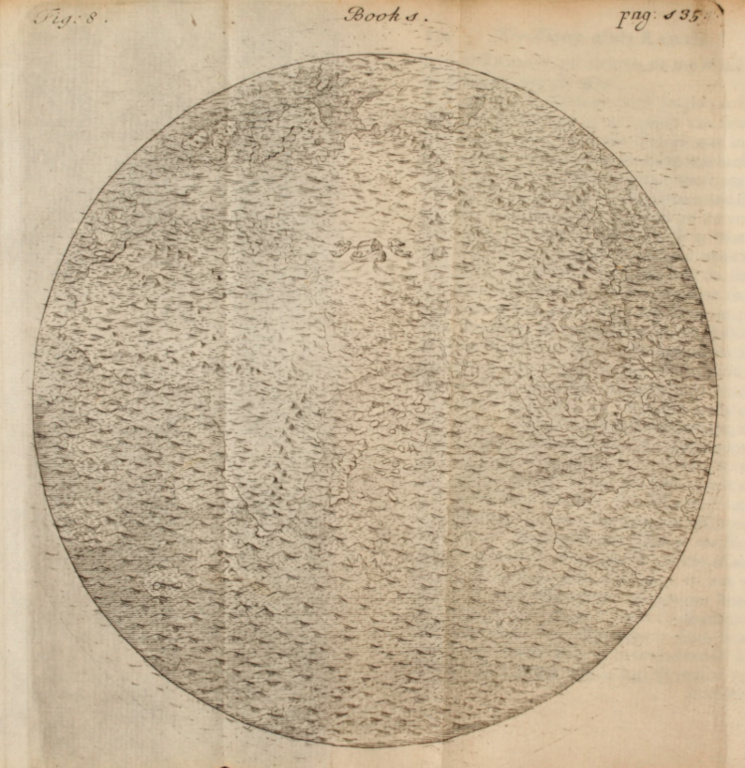
Book 1 Figure 8.
Thus much for the Beginning and Progress of the Deluge. It now remains only that we consider it in its Decrease, and the State of the Earth after the Waters were retir’d into their Channels, which makes the present State of it. Moses saith, God brought a Wind upon the Waters, and the Tops of the Hills became bare, 136and then the lower Grounds and Plains by degrees; the Waters being sunk into the Channels of the Sea, and the Hollowness of the Earth, and the whole Globe appearing in the Form it is now under. There needs nothing be added for Explication of this, ’tis the genuine Consequence of the Theory we have given of the Deluge; and whether this Wind was a descending Wind to depress and keep down the Swellings and Inequalities of the Abyss, or whether it was only to dry the Land as fast as it appear’d, or might have both Effects, I do not know; but as nothing can be perpetual that is violent, so this Commotion of the Abyss abated after a certain time, and the great Force that impell’d the Waters decreasing, their natural Gravity began to take Effect, and to reduce them into the lowest Places, at an equal Height, and in an even Surface, and level one Part with another: That is, in short, the Abyss became our Sea, fixt within its Channel, and bounded by Rocks and Mountains: Then was the decreed Place establish’d for it, and Bars and Doors were set; then was it said, hitherto shalt thou come, and no further, and here shall thy proud Waves be stopt, Job xxxviii. 10, 11. And the Deluge being thus ended, and the Waters settled in their Channels, the Earth took such a broken Figure as is represented in those larger Schemes, p. 100. And this will be the Form and State of it till its great Change comes in the Conflagration, when we expect a new Heaven and a new Earth.
137But to pursue this Prospect of Things a little further; we may easily imagine, that for many Years after the Deluge ceas’d, the Face of the Earth was very different from what it is now, and the Sea had other Bounds than it hath at present. I do not doubt but the Sea reach’d much further in-land, and clim’d higher upon the Sides of the Mountains; and I have observ’d in many Places a Ridge of Mountains some Distance from the Sea, and a Plain from their Roots to the Shore; which Plain no doubt was formerly cover’d by the Sea, bounded against those Hills as its first and natural Ramparts, or as the Ledges or Lips of its Vessel. And it seems probable, that the Sea doth still grow narrower from Age to Age, and sinks more within its Channel and the Bowels of the Earth, according as it can make its Way into all those subterraneous Cavities, and crowd the Air out of them. We see whole Countries of Land gain’d from it, and by several Indications, as ancient Sea-ports left dry and useless, old Sea-marks far within the Land, Pieces of Ships, Anchors, &c. left at a great Distance from the present Shores; from these Signs, and such like, we may conclude that the Sea reach’d many Places formerly that now are dry Land, and at first I believe was generally bound in on either Side with a Chain of Mountains. So I should easily imagine the Mediterranean Sea, for instance, to have been bounded by the Continuation of the Alps through Dauphine and Languedoc to the Pyreneans, and at the other End 138by the Darmatick Mountains almost to the Black Sea. Then Atlas major, which runs along with the Mediterranean from Ægypt to the Atlantick Ocean, and now parts Barbary and Numidia, may possibly have been the ancient Barrier on the Africk Side. And in our own Island I could easily figure to my self, in many Parts of it, other Sea-bounds than what it hath at present; and the like may be observ’d in other Countries.
And as the Sea had much larger Bounds for some Time after the Deluge, so the Land had a different Face in many Respects to what it hath now; for we suppose the Valleys and lower Grounds, where the Descent and Derivation of the Water was not so easy, to have been full of Lakes and Pools for a long Time; and these were often converted into Fens and Bogs, where the Ground being spungy, suck’d up the Water, and the loosen’d Earth swell’d into a soft and pappy Substance; which would still continue so, if there was any Course of Water sensible or insensible, above or within the Ground, that fed this moist Place: But if the Water stood in a more firm Basin, or on a Soil, which for its Heaviness or any other Reason would not mix with it, it made a Lake or clear Pool. And we may easily imagine there were innumerable such Lakes, and Bogs, and Fastnesses for many Years after the Deluge, till the World begun to be pretty well stock’d with People, and human Industry cleansed and drained those unfruitful and unhabitable Places. And those Countries that have been later cultivated, or by a lazier People, 139retain still, in Proportion to their Situation and Soil, a greater Number of them.
Neither is it at all incongruous or inconvenient to suppose, that the Face of the Earth stood in this Manner for many Years after the Deluge; for while Mankind was small and few, they needed but a little Ground for their Seats or Sustenance; and as they grew more numerous, the Earth proportionally grew more dry, and more Parts of it fit for Habitation. I easily believe that Plato’s Observation or Tradition [de Leg. li. 3.] is true, that Men at first, after the Flood, liv’d in the Up-lands and Sides of the Mountains, and by Degrees sunk into the Plains and lower Countries, when Nature had prepar’d them for their Use, and their Numbers requir’d more Room. The History of Moses Gen. xi. tells us, that some Time after the Deluge, Noah and his Posterity, his Sons and his Grand-children, chang’d their Quarters, and fell down into the Plains of Shiner, from the Sides of the Hills where the Ark had rested; and in this Plain was the last general Rendezvous of Mankind; so long they seem to have kept in a Body, and from thence they were divided and broken into Companies, and dispers’d, first, into the neighbouring Countries, and then by degrees throughout the whole Earth; the several successive Generations, like the Waves of the Sea when it flows, over-reaching one another, and striking out farther and farther upon the Face of the Land. Not that the whole Earth was peopled by an uniform Propagation of 140Mankind every Way, from one Place, as a common Center; like the Swelling of a Lake upon a Plain: For sometimes they shot out in length, like Rivers, and sometimes they flew into remote Countries in Colonies, like Swarms from the Hive, and settled there, leaving many Places uninhabited betwixt them and their first Home. Sea-shores and Islands were generally the last Places inhabited; for while the Memory or Story of the Deluge was fresh amongst them, they did not care for coming so near their late Enemy; or at least, to be inclos’d and surrounded by his Forces.
And this may be sufficient to have discours’d concerning all the Parts of the Deluge, and the Restitution of the Earth to an habitable Form, for the further Union of our Theory with the History of Moses; there rests only one Thing in that History to be taken notice of, which may be thought possibly not to agree so well with our Account of the Deluge; namely, that Moses seems to shut up the Abyss again at the End of the Deluge, which our Explication supposeth to continue open. But besides that half the Abyss is still really cover’d, Moses saith the same Thing of the Windows of Heaven, that they were shut up too; and he seemeth in both to express only the Cessation of the Effect which proceeded from their opening: For as Moses had ascrib’d the Deluge to the opening of these two, so when it was to cease, he saith, these two were shut up; as they were really put into such a Condition, both of then, that they could 141not continue the Deluge any longer, nor ever be the Occasion of a second; and therefore in that Sense, and as to that Effect were for ever shut up. Some may possibly make that also an Objection against us, that Moses mentions and supposes the Mountains at the Deluge, for he saith, the Waters reached fifteen Cubits above the Tops of them; whereas we suppose the antediluvian Earth to have had a plain and uniform Surface, without any Inequality of Hills and Valleys. But this is easily answer’d, it was in the Height of the Deluge that Moses mention’d the Mountains, and we suppose them to have risen then, or more towards the Beginning of it, when the Earth was broke; and these Mountains continuing still upon the Face of the Earth, Moses might very well take them for a Standard to measure and express to Posterity the Height of the Waters, though they were not upon the Earth when the Deluge began. Neither is there any mention made, as is observ’d by some, of Mountains in Scripture, or of Rain, till the Time of the Deluge.
We have now finish’d our Account of Noah’s Flood, both generally and particularly; and I have not wittingly omitted or conceal’d any Difficulty that occurr’d to me, either from the History, or from abstract Reason; our Theory, so far as I know, hath the Consent and Authority of both: And how far it agrees and is demonstrable from natural Observation, or from the Form and Phænomena of this Earth, as it lies at present, shall be the 142Subject of the remaining Part of this first Book. In the mean time I do not know any Thing more to be added in this Part, unless it be to conclude with an Advertisement to prevent any Mistake or Misconstruction, as if this Theory, by explaining the Deluge in a natural Way, in a great Measure, or, by natural Causes, did detract from the Power of God, by which that great Judgment was brought upon the World in a providential and miraculous Manner.
To satisfy all reasonable and intelligent Persons in this Particular, I answer and declare, first, That we are far from excluding divine Providence, either ordinary or extraordinary, from the Causes and Conduct of the Deluge. I know a Sparrow doth not fall to the Ground without the Will of our Heavenly Father, much less doth the great World fall in Pieces without his good Pleasure and Superintendency. In him all Things live, move, and have their Being; Things that have Life and Thought have it from him, he is the Fountain of both. Things that have Motion only, without Thought, have it also from him: And what hath only naked Being, without Thought or Motion, owe still that Being to him. And these are not only derived from God at first, but every Moment continued and conserv’d by him. So intimate and universal is the Dependance of all Things upon the Divine Will and Power.
In the second Place, they are guilty, in my Judgment, of a great Error or Indiscretion, that oppose the Course of Nature to Providence. 143St. Paul says, (Acts xiv. 17.) God hath not left us without Witness, in that he gives us Rain from Heaven; yet Rains proceed from natural Causes, and fall upon the Sea as well as upon the Land. In like manner, our Saviour, Mat. vi. 21. makes those Things Instances of Divine Providence, which yet come to pass in an ordinary Course of Nature; in that Part of his excellent Sermon upon the Mount, Luke xii. 24. that concerns Providence, he bids them consider the Lilies how they grow, they toil not, neither do they spin, and yet Solomon in all his Glory was not array’d like one of these: He bids them also consider the Ravens, they neither sow nor reap, neither have they Store-house nor Barn, and God feedeth them. The Lilies grow, and the Ravens are fed according to the ordinary Course of Nature, and yet they are justly made Arguments of Providence by our Saviour; nor are these Things less providential, because constant and regular; on the contrary, such a Disposition or Establishment of second Causes, as will in the best Order, and for a long Succession, produce the most regular Effects, assisted only with the ordinary Concourse of the first Cause, is a greater Argument of Wisdom and Contrivance, than such a Disposition of Causes as will not in so good an Order, or for so long a Time produce regular Effects, without an extraordinary Concourse and Interposition of the first Cause. This I think is clear to every Man’s Judgment. We think him a better Artist that makes a Clock 144that strikes regularly at every Hour from the Springs and Wheels which he puts in the Work, than he that hath so made his Clock that he must put his Finger to it every Hour to make it strike: And if one should contrive a Piece of Clock-work, so that it should beat all the Hours, and make all its Motions regularly for such a Time, and that Time being come, upon a Signal given, or a Spring touch’d, it should of its own accord fall all to Pieces; would not this be look’d upon as a Piece of greater Art than if the Workman came at that Time prefix’d, and with a great Hammer beat it into pieces? I use these Comparisons to convince us, that it is no Detraction from divine Providence, that the Course of Nature is exact and regular, and that even in its greatest Changes and Revolutions it should still conspire and be prepar’d to answer the Ends and Purposes of the divine Will in reference to the moral World. This seems to me to be the great Art of divine Providence, so to adjust the two Worlds, human and natural, material and intellectual, as seeing thro’ the Possibilities and Futuritions of each, according to the first State and Circumstances he puts them under, they should all along correspond and fit one another, and especially in their great Crises and Periods.
Thirdly, Besides the ordinary Providence of God in the ordinary Course of Nature, there is doubtless an extraordinary Providence that doth attend the greater Scenes and the greater Revolutions of Nature. This, methinks, besides 145all other Proof from the Effects, is very rational and necessary in itself; for it would be a Limitation of the divine Power and Will so to be bound up to second Causes, as never to use, upon Occasion, an extraordinary Influence or Direction: And ’tis manifest, taking any System of natural Causes, if the best possible, that there may be more and greater Things done, if to this, upon certain Occasions, you join an extraordinary Conduct. And as we have taken Notice before, that there was an extraordinary Providence in the Formation or Composition of the first Earth, so I believe there was also in the Dissolution of it: And I think it had been impossible for the Ark to have liv’d upon the raging Abyss, or for Noah and his Family to have been preserv’d, if there had not been a miraculous Hand of Providence to take care of them. But ’tis hard to separate and distinguish an ordinary and extraordinary Providence in all Cases, and to mark just how far one goes, and where the other begins. And writing a Theory of the Deluge here, as we do, we were to exhibit a Series of Causes whereby it might be made intelligible, or to shew the proximate natural Causes of it; wherein we follow the Example both of Moses and St. Peter; and with the same Veneration of the divine Power and Wisdom in the Government of Nature, by a constant ordinary Providence, and an occasional extraordinary.
So much for the Theory of the Deluge, and the second Section of this Discourse.
146
Chap. IX.
The second Part of this Discourse, proving the same Theory from the Effects and present Form of the Earth. First, by a general Scheme of what is most remarkable in this Globe, and then by a more particular Induction; beginning with an Account of subterraneous Cavities and subterraneous Waters.
We have now finished our Explication of the universal Deluge, and given an Account, not only of the Possibility of it, but (so far as our Knowledge can reach) of its Causes; and of that Form and Structure of the Earth, whereby the Old World was subject to that sort of Fate. We have not begged any principles or Suppositions for the Proof of this; but taking that common Ground, which both Moses and all Antiquity present to us, viz. That this Earth rose from a Chaos: We have from that deduc’d, by an easy Train of Consequences, what the first Form of it would be; and from that Form, as from a nearer Ground, we have by a second Train of Consequences made it appear, that at some Time or other that first Earth would be subject to a Dissolution, and by that Dissolution to a Deluge. And thus far we have proceeded only by the Intuition of Causes, as is most proper to a Theory; but for the Satisfaction of those that require more sensible Arguments, and to compleat our Proofs on either hand, we will now argue from the Effects; and from the present State of Nature, and the present 147Form of the Earth, prove that it hath been broken, and undergone such a Dissolution as we have already describ’d, and made the immediate Occasion of the Deluge. And that we may do this more perspicuously and distinctly, we will lay down this Proposition to be prov’d, viz. That the present Form and Structure of the Earth, both as to the Surface and as to the interior Parts of it, so far as they are known and accessible to us, doth exactly answer to our Theory concerning the Form and Dissolution of the first Earth, and cannot be explain’d upon any other Hypothesis yet known.
Orators and Philosophers treat Nature after a very different Manner; those represent her with all her Graces and Ornaments, and if there be any Thing that is not capable of that, they dissemble it, or pass it over slightly. But Philosophers view Nature with a more impartial Eye, and without Favour or Prejudice give a just and free Account, how they find all the Parts of the Universe, some more, some less perfect. And as to this Earth in particular, if I was to describe it as an Orator, I would suppose it a beautiful and regular Globe; and not only so, but that the whole Universe was made for its sake; that it was the Darling and Favourite of Heaven, that the Sun shin’d only to give it Light, to ripen its Fruit, and make fresh its Flowers; and that the great Concave of the Firmament, and all the Stars in their several Orbs, were design’d only for a spangled Cabinet to keep this Jewel in. This Idea I would 148give of it as an Orator; but a Philosopher that overheard me would either think me in Jest, or very injudicious, if I took the Earth for a Body so regular in it self, or so considerable if compar’d with the rest of the Universe. This, he would say, is to make the great World like one of the Heathen Temples, a beautiful and magnificent Structure, and of the richest Materials, yet built only for a little brute Idol, a Dog, or a Crocodile, or some deformed Creature placed in a Corner of it.
We must therefore be impartial where the Truth requires it, and describe the Earth as it is really in it self; and though it be handsome and regular enough to the Eye in certain Parts of it, single Tracks and single Regions; yet if we consider the whole Surface of it, or the whole exterior Region, ’tis as a broken and confus’d Heap of Bodies, plac’d in no Order to one another, nor with any Correspondency or Regularity of Parts: And such a Body as the Moon appears to us, when ’tis look’d upon with a good Glass, rude and ragged; as it is also represented in the modern Maps of the Moon; such a Thing would the Earth appear if it was seen from the Moon. They are both in my Judgment the Image or Picture of a great Ruin, and have the true Aspect of a World lying in its Rubbish. See Fig. in Chap. XI.
Our Earth is first divided into Sea and Land, without any Regularity in the Portions, either of the one or the other; in the Sea lie the Islands, scatter’d like Limbs torn from the rest of the 149Body; great Rocks stand rear’d up in the Waters; the Promontories and Capes shoot into the Sea, and the Sinus’s and Creeks on the other hand run as much into the Land; and these without any Order or Uniformity. Upon the other Part of our Globe stand great Heaps of Earth or Stone, which we call Mountains; and if these were all plac’d together, they would take up a very considerable part of the dry Land: In the rest of it are lesser Hills, Valleys, Plains, Lakes and Marshes, Sands and Desarts, &c. and these also without any regular Disposition. Then the Inside of the Earth, or inward Parts of it, are generally broken or hollow, especially about the Mountains and high Lands, as also towards the Shores of the Sea, and among the Rocks. How many Holes and Caverns, and strange subterraneous Passages do we see in many Countries? And how many more may we easily imagine, that are unknown and unaccessible to us?
This is the Pourtraicture of our Earth, drawn without Flattery; and as oddly as it looks, it will not be at all surprizing to one that hath consider’d the foregoing Theory: For ’tis manifest enough, that upon the Dissolution of the first Earth, and its Fall into the Abyss, this very Face and Posture of Things, which we have now describ’d, or something extreamly like it, would immediately result. The Sea would be open’d, and the Face of the Globe would be divided into Land and Water: And according as the Fragments fell, some would make Islands or Rocks in the Sea, others would make Mountains or 150Plains upon the Land; and the Earth would generally be full of Caverns and Hollownesses, especially in the mountainous Parts of it. And we see the Resemblance and Imitation of this in lesser Ruins, when a Mountain sinks and falls into subterraneous Water; or, which is more obvious, when the Arch of a Bridge is broken, and falls into the Water, if the Water under it be not so deep as to overflow and cover all its Parts, you may see there the Image of all these things in little Continents, and Islands, and Rocks under Water: And in the Parts that stand above the Water, you see Mountains, and Precipices, and Plains, and most of the Varieties that we see and admire in the Parts of the Earth. What need we then seek any further for the Explication of these things? Let us suppose this Arch of the Bridge, as the great Arch of the Earth, which once it had, and the Water under it as the Abyss, and the Parts of this Ruin to represent the Parts of the Earth: There will be scarce any Difference but of lesser and greater, the same things appearing in both. But we have naturally that Weakness or Prejudice, that we think great things are not to be explained from easy and familiar Instances; we think there must be something difficult and operose in the Explication of them, or else we are not satisfied; whether it is that we are ashamed to see our Ignorance and Admiration to have been so groundless, or whether we fancy there must be a Proportion between the Difficulty of the Explication, and the Greatness of the 151thing explain’d; but that is a very false Judgment, for let Things be never so great, if they be simple, their Explication must be simple and easy: And on the contrary, some things that are mean, common, and ordinary, may depend upon Causes very difficult to find out; for the Difficulty of explaining an Effect doth not depend upon its Greatness or Littleness, but upon the Simplicity or Composition of its Causes. And the Effects and Phænomena we are here to explain, though great, yet depending upon Causes very simple, you must not wonder if the Explication, when found out, be familiar and very intelligible.
And this is so intelligible, and so easily deducible from the forementioned Causes, that a Man born blind, or brought up all his Life in a Cave, that had never seen the Face of the Earth, nor ever heard any Description of it, more than that it was a great Globe; having this Theory propos’d to him, or being instructed what the Form of the first Earth was, how it stood over the Waters, and then how it was broke and fell into them, he would easily of his own accord foretel what Changes would arise upon this Dissolution; and what the new Form of the Earth would be. As in the first place he would tell you, that this second Earth would be distinguish’d and checker’d into Land and Water; for the Orb which fell being greater than the Circumference it fell upon, all the Fragments could not fall flat and lie drown’d under Water; and those that stood above would make the dry Land or habitable 152part of the Earth. Then in the second Place, he would plainly discern that these Fragments that made the dry Land could not lie all plain and smooth and equal, but some would be higher and some lower, some in one Posture and some in another; and consequently would make Mountains, Hills, Valleys and Plains, and all other Varieties we have in the Situation of the Parts of the Earth. And lastly, a blind Man would easily divine that such a great Ruin could not happen but there would be a great many Holes and Cavities amongst the Parts of it, a great many Intervals and empty Places in the Rubbish, as I may so say; for this we see happens in all Ruins more or less; and where the Fragments are great and hard, ’tis not possible they should be so adjusted in their Fall, but that they would lie hollow in many Places, and many unfill’d Spaces would be intercepted amongst them; some gaping in the Surface of the Earth, and others hid within; so as this would give occasion to all sorts of Fractures and Cavities either in the Skin of the Earth, or within its Body. And these Cavities, that I may add that in the last Place, would be often fill’d with subterraneous Waters, at least at such a Depth; for the Foundations of the Earth standing now within the Waters, so high as those Waters reach’d they would more or less propagate themselves every way.
Thus far our blind Man could tell us what the new World would be, or the Form of the Earth upon the great Dissolution; and we find 153his Reasonings and Inferences very true, these are the chief Lineaments and Features of our Earth; which appear indeed very irregular and very unaccountable when they are look’d upon naked in themselves; but if we look upon them through this Theory, we see as in a Glass all the Reasons and Causes of them. There are different Genius’s of Men, and different Conceptions, and every one is to be allow’d their Liberty as to things of this Nature; I confess, for my own part, when I observe how easy and naturally this Hypothesis doth apply it self to the general Face of this Earth, hits and falls in so luckily and surprizingly with all the odd Postures of its Parts, I cannot, without Violence, bear off my Mind from fully assenting to it: And the more odd and extravagant, as I may so say, and the more diversify’d the Effects and Appearances are, to which an Hypothesis is to be apply’d, if it answers them all and with Exactness, it comes the nearer to a moral Certitude and Infallibility. As a Lock that consists of a great deal of Workmanship, many Wards, and many odd Pieces and Contrivances, if you find a Key, that answers to them all, and opens it readily, ’tis a thousand to one that ’tis the true Key, and was made for that Purpose.
AN eminent Philosopher of this Age, Monsier des Cartes, hath made use of the like Hypothesis to explain the irregular Form of the present Earth; though he never dream’d of the Deluge, nor thought that first Orb, built over the Abyss, to have been any more than a transient 154Crust, and not a real habitable World that lasted for more than sixteen hundred Years, as we suppose it to have been. And though he hath, in my Opinion, in the Formation of that first Orb, and upon the Dissolution of it, committed some great Oversights, whereof we have given an Account in the Latin Treatise, C. 7. & lib. 2. c. 4. however he saw a Necessity of such a Thing, and of the Disruption of it, to bring the Earth into that Form and Posture wherein we now find it.
Thus far we have spoken in general, concerning the Agreement and Congruity of our Supposition with the present Face of the Earth, and the easy Account it gives of the Causes of it. And though I believe to ingenuous Persons, that are not prejudic’d by the Forms and Opinions of the Schools against every thing that looks like a Novelty or Invention, thus much might be sufficient; yet for the Satisfaction of all, we will, as a farther Proof of our Theory, or that part of it which concerns the Dissolution of the Earth, descend to a particular Explication of three or four of the most considerable and remarkable things that occur in the Fabrick of this present Earth; namely, The great Channel of the Ocean; subterraneous Cavities and subterraneous Waters; and lastly, Mountains and Rocks. These are the Wonders of the Earth as to the visible Frame of it; and who would not be pleas’d to see a rational Account of these, of their Origin, and of their Properties? Or who would not approve of an Hypothesis, when 155they see that Nature in her greatest and strongest Works may easily be understood by it, and is in no other way, that we know of, intelligible?
We will speak first of subterraneous Cavities and Waters, because they will be of easier Dispatch, and an Introduction to the rest.
That the Inside of the Earth is hollow and broken in many Places, and is not one firm and united Mass, we have both the Testimony of Sense and of easy Observations to prove: How many Caves and Dens and hollow Passages into the Ground do we see in many Countries, especially amongst Mountains and Rocks; and some of them endless and bottomless so far as can be discover’d? We have many of these in our own Island, in Derbyshire, Somersetshire, Wales, and other Counties, and in every Continent or Island they abound more or less. These Hollownesses of the Earth the Ancients made Prisons, or Store-houses for the Winds, and set a God over them to confine them, or let them loose at his Pleasure. For some Ages after the Flood, as all Antiquity tells us, these were the first Houses Men had, at least in some Parts of the Earth; here rude Mortals shelter’d themselves, as well as they could, from the Injuries of the Air, till they were beaten out by wild Beasts that took Possession of them. The ancient Oracles also us’d to be given out of these Vaults and Recesses under Ground, the Sibyls had their Caves, and the Delphick Oracle, and their Temples sometimes were built upon an hollow Rock. Places that are strange and solemn 156strike an Awe into us, and incline us to a kind of superstitious Timidity and Veneration, and therefore they thought them fit for the Seats and Residences of their Deities. They fancied also that Steams rise sometimes, or a sort of Vapour in those hollow Places, that gave a kind of a divine Fury or Inspiration. But all these Uses and Employments are now in a great measure worn out, we know no Use of them but to make the Places talk’d on where they are, to be the Wonders of the Country, to please our Curiosity to gaze upon and admire; but we know not how they came, nor to what purpose they were made at first.
It would be very pleasant to read good Descriptions of these subterraneous Places, and of all the strange Works of Nature there; how she furnisheth these dark neglected Grotto’s; they have often a little Brook runs murmuring thro’ them, and the Roof is commonly a kind of petrefied Earth, or icy Fret-work, proper enough for such Rooms. But I should be pleas’d especially to view the Sea-caves, or those hollow Rocks that lie upon the Sea, where the Waves roll a great Way under Ground, and wear the hard Rock into as many odd Shapes and Figures as we see in the Clouds. ’Tis pleasant also to see a River in the Middle of its Course throw itself into the Mouth of a Cave, or an Opening of the Earth, and run under Ground sometimes many Miles; still pursuing its Way thro’ the dark Pipes of the Earth, till at last it find an Out-let. There are many of these Rivers taken Notice of 157in History in the several Parts of the Earth, as the Rhone in France, Guadiana in Spain, and several in Greece, Alpheus, Lycus, and Erasinus; then Niger in Africa, Tygris in Asia, &c. And I believe if we could turn Derwent, or any other River, into one of the Holes of the Peak, it would groap its Way till it found an Issue, it may be, in some other Country. These subterraneous Rivers that emerge again, shew us that the Holes of the Earth are longer and reach further than we imagine, and if we could see into the Ground, as we ride, or walk, we should be affrighted to see so often Waters or Caverns under us.
But to return to our dry Caves; these commonly stand high, and are sometimes of a prodigious Greatness: Strabo [Geo. l. 16.] mentions some in the Mountains towards Arabia, that are capable to receive four thousand Men at once. The Cave of Engedi [1 Sam. xxiv. 3, 4.] hid David and six hundred Men, so as Saul, when he was in the Mouth of it, did not perceive them. In the Mountains of the Traconites there are many of these vast Dens and Recesses, and the People of that Country defended themselves a long time in those strong Holds against Herod and his Army: They are plac’d among such craggy Rocks and Precipices, that, as Josephus [Ant. Jud. l. 14. ch. 27.] tells us, Herod was forced to make a sort of open Chests, and in those by Chains of Iron he let down his Soldiers from the Top of the Mountains to go fight them in their Dens. I need add no more Instances of this 158Kind: In the natural History of all Countries, or the geographical Descriptions of them, you find such Places taken notice of, more or less; yet if there was a good Collection made of the chief of them in several Parts, it might be of use, and would make us more sensible how broken and torn the Body of the Earth is.
There are subterraneous Cavities of another Nature, and more remarkable, which they call Volcano’s, or fiery Mountains; that belch out Flames and Smoke and Ashes, and sometimes great Stones and broken Rocks, and Lumps of Earth, or some metallick Mixture; and throw them to an incredible Distance by the Force of the Eruption. These argue great Vacuities in the Bowels of the Earth, and Magazines of combustible Matter treasur’d up in them. And as the Exhalations within these Places must be copious, so they must lie in long Mines or Trains to do so great Execution, and to last so long. ’Tis scarce credible what is reported concerning some Eruptions of Vesuvius and Ætna. The Eruptions of Vesuvius seem to be more frequent and less violent of late; the Flame and Smoke break out at the Top of the Mountain, where they have eaten away the Ground and made a great Hollow, so as it looks at the Top, when you stand upon the Brims of it, like an Amphitheatre, or like a great Caldron, about a Mile in Circumference, and the burning Furnace lies under it. The Outside of the Mountain is all spread with Ashes, but the Inside much more; for you wade up to the Mid-leg 159in Ashes to go down to the Bottom of the Cavity and ’tis extremely heavy and troublesome to get up again. The Inside lies sloping, and one may safely go down, if it be not in a raging Fit; but the middle Part of it, or Center, which is a little rais’d like the Bottom of a Platter, is not to be ventur’d upon, the Ground there lies false and hollow, there it always smoaks, and there the Funnel is suppos’d to be; yet there is no visible Hole or Gaping any where when it doth not rage. Naples stands below in fear of this fiery Mountain, which hath often cover’d its Streets and Palaces with its Ashes; and in Sight of the Sea (which lies by the Side of them both) and as it were in Defiance to it, threatens at one time or other to burn that fair City. History tells us, that some Eruptions of Vesuvius have carry’d Cinders and Ashes as far as Constantinople; this is attested both by Greek and Latin Authors; particularly, that they were so affrighted with these Ashes and Darkness, that the Emperor left the City, and there was a Day observ’d yearly for a Memorial of this Calamity or Prodigy.
ÆTNA is of greater Fame than Vesuvius, and of greater Fury, all Antiquity speaks of it; not only the Greeks and Romans, but as far as History reacheth, either real or fabulous, there is something recorded of the Fires of Ætna: The Figure of the Mountain is inconstant, by reason of the great Consumptions and Ruins it is subject to; the Fires and Æstuations of it are excellently describ’d by Virgil, upon Occasion of Æneas’s passing by those Coasts.
160—— Horrificis juxta tonat Ætna ruinis;
Intendumque atram prorumpit ad ætheranubem,
Turbine fumantem piceo & candente favilla;
Attollitque globos flammarum & sydera lambit;
Interdum scopulos, avulsaque viscera montis
Erigit eructans, liquefactaque saxa sub auras
Cum gemitu glomerat, fundoque exæstuat imo.
Fama est Enceladi semustum fulmine corpus
Urgeri mole hac, ingentemque insuper Ætnam
Impositam, ruptis flammam expirare caminis.
Et fessum quoties mutet latus, intremere omnem
Murmure Trinacriam & cœlum subtexere fumo.
——Ætna, whose Ruins make a thunder;
Sometimes black Clouds of Smoke, that rowl about
Mingled with Flakes of Fire, it belches out:
And sometimes Balls of Flame it darts on high,
Or its torn Bowels flings into the Sky.
Within deep Cells under the Earth, a Store
Of Fire-materials, molten Stones, and Ore,
It gathers, then spews out, and gathers more.
Enceladus, when Thunder-struck by Jove,
Was bury’d here, and Ætna thrown above;
And when, to change his wearied Side, he turns,
The Island trembles and the Mountain burns.
Not far from Ætna lies Strombolo, and other adjacent Islands, where there are also such Magazines of Fire; and throughout all Regions and Countries in the West-Indies and in the East, in the northern and southern Parts of the Earth, there are some of these Volcano’s, which 161are sensible Evidences that the Earth is incompact and full of Caverns; besides, the roarings and bellowings that use to be heard before an Eruption of these Volcano’s argue some dreadful Hollowness in the Belly, or under the Roots of the Mountain, where the Exhalations struggle before they can break their Prison.
The subterraneous Cavities, that we have spoke of hitherto, are such as are visible in the Surface of the Earth, and break the Skin by some gaping Orifice; but the Miners and those that work under Ground meet with many more in the Bowels of the Earth, that never reach to the Top of it; Burrows and Channels, and Clifts and Caverns, that never had the Comfort of one Beam of Light since the great Fall of the Earth. And where we think the Ground is firm and solid, as upon Heaths and Downs, it often betrays its Hollowness, by sounding under the Horses Feet and the Chariot Wheels that pass over it. We do not know when and where we stand upon good Ground, if it was examin’d deep enough; and to make us further sensible of this, we will instance in two Things that argue the Unsoundness and Hollowness of the Earth in the inward Recesses of it, tho’ the Surface be intire and unbroken; these are Earthquakes and the Communication of subterraneous Waters and Seas: Of which two we will speak a little more particularly.
Earthquakes are too evident Demonstrations of the Hollowness of the Earth, being the dreadful Effects or Consequences of it; 162for if the Body of the Earth was sound and compact, there would be no such thing in Nature as an Earthquake. They are commonly accompanied with an heavy dead Sound, like a dull Thunder which ariseth from the Vapours that are striving in the Womb of Nature, when her Throws are coming upon her. And that these Caverns where the Vapours lie are very large and capacious, we are taught sometimes by sad Experience; for whole Cities and Countries have been swallow’d up into them, as Sodom and Gomorrah, and the Region of Pentapolis, and several Cities in Greece, and in Asia, and other Parts. Whole Islands also have been thus absorpt in an Earthquake; the Pillars and Props they stood upon being broken, they have sunk and fallen in as an House blown up. I am also of Opinion, that those Islands that are made by Divulsion from a Continent, as Sicily was broken off from Italy, and Great-Britain, as some think, from France, have been made the same way; that is, the Isthmus or Necks of Land, that join’d these Islands with their Continents before, have been hollow, and being either worn by the Water, or shak’d by an Earthquake, have sunk down, and so made Way for the Sea to overflow them, and of a Promontory to make an Island. For it is not at all likely that the Neck of Land continued standing, and the Sea overflow’d it, and so made an Island; for then, all those Passages between such Islands, and their respective Continents, would be extremely shallow and unnavigable, which we do not find them to be. 163Nor is it any more Wonder if such a Neck of Land should fall, than that a Mountain should sink, or any other Tract of Land, and a Lake rise in its Place, which hath often happened. Plato supposeth his Atlantis to have been greater than Asia and Africa together, and yet to have sunk all into the Sea; whether that be true or no, I do not think it impossible that some Arms of the Sea, or Sinus’s, might have had such an Original as that; and I am very apt to think, that for some Years after the Deluge, ’till the Fragments were well settled and adjusted, great Alterations would happen as to the Face of the Sea and the Land; many of the Fragments would change their Posture, and many would sink into the Water, that stood out before, the Props failing that bore them up, or the Joints and Corners whereby they lean’d upon one another: And thereupon a new Face of Things would arise, and a new Deluge for that part of the Earth. Such Removes and Interchanges, I believe, would often happen in the first Ages after the Flood; as we see in all other Ruins, there happen lesser and secondary Ruins after the first, ’till the Parts be so well pois’d and settled, that without some Violence they scarce change their Posture any more.
But to return to our Earthquakes, and to give an Instance or two of their Extent and Violence: Pliny mentions one in the Reign of Tiberius Cæsar, that struck down twelve Cities of Asia in one Night. And Fournier gives us an Account of one in Peru, that reach’d three hundred 164Leagues along the Sea-shore, and seventy Leagues In-land; and level’d the Mountains all along as it went, threw down the Cities, turn’d the Rivers out of their Channels, and made an universal Havock and Confusion: And all this, he saith, was done within the Space of seven or eight Minutes. There must be dreadful Vaults and Mines under that Continent that gave Passage to the Vapours, and Liberty to play for Nine Hundred Miles in length, and above two Hundred in breadth. Asia also hath been very subject to these Desolations by Earthquakes; and many Parts in Europe, as Greece, Italy, and others. The Truth is, our Cities are built upon Ruins, and our Fields and Countries stand upon broken Arches and Vaults, and so does the greatest Part of the outward Frame of the Earth, and therefore it is no Wonder if it be often shaken; there being Quantities of Exhalations within these Mines, or cavernous Passages, that are capable of Rarefaction and Inflammation; and, upon such Occasions, requiring more Room, they shake or break the Ground that covers them. And thus much concerning Earthquakes.
A second Observation that argues the Hollowness of the Earth, is the Communication of the Seas and Lakes under Ground. The Caspian and Mediterranean Seas, and several Lakes, receive into them great Rivers, and yet have no visible Out-let: These must have subterraneous Out-lets, by which they empty themselves, otherwise they would redound and overflow the Brims of their Vessel. The Mediterranean is 165most remarkable in this Kind, because ’tis observ’d, that at one End the great Ocean flows into it through the Straits of Gibraltar, with a sensible Current, and towards the other End about Constantinople the Pontus flows down into it with a Stream so strong, that Vessels have much ado to stem it; and yet it neither hath any visible Evacuation or Out-let, nor overflows its Banks. And besides that it is thus fed at either End, it is fed by the Navel too, as I may so say; it sucks in, by their Channels, several Rivers into its Belly, whereof the Nile is one very great and considerable. These Things have made it a great Problem, What becomes of the Water of the Mediterranean Sea? And for my Part, I think the Solution is very easy, namely, that it is discharged by subterraneous Passages, or convey’d by Channels under the Ground into the Ocean. And this manner of Discharge or Conveyance is not peculiar to the Mediterranean, but is common to it with the Caspian Sea, and other Seas and Lakes, that receive great Rivers into them, and have no visible Issue.
I know there have been propos’d several other Ways to answer this Difficulty concerning the Efflux or Consumption of the Waters of the Mediterranean; some have suppos’d a double Current in the Strait of Gibraltar, one that carry’d the Water in, and another that brought it out; like the Arteries and Veins in our Body, the one exporting our Blood from the Heart, and the other re-importing it: So they suppos’d one Current upon the Surface, which carry’d 166the Water into the Mediterranean, and under it at a certain Depth a Counter-Current, which brought the Water back into the Ocean. But this hath neither Proof nor Foundation; for unless it was included in Pipes, as our Blood is, or consisted of Liquors very different, these cross Currents would mingle and destroy one another. Others are of Opinion, that all the Water that flows into the Mediterranean, or a Quantity equal to it, is consumed in Exhalations every Day: This seems to be a bolder Supposition than the other; for if so much be consumed in Vapours and Exhalations every Day as flows into this Sea, what if this Sea had an Out-let and discharg’d by that, every Day, as much as it receiv’d? In a few Days the Vapours would have consumed all the rest; and yet we see many Lakes that have as free an Out-let as an In-let, and are not consum’d, or sensibly diminish’d by the Vapours. Besides, this Reason is a Summer Reason, and would pass very ill in Winter, when the Heat of the Sun is much less powerful: At least there would be a very sensible Difference betwixt the Height of the Waters in Summer and Winter, if so much was consum’d every Day, as this Explication supposeth. And the Truth is, this Want of a visible Out-let is not a Property belonging only to the Mediterranean Sea, as we noted before, but is also in other Seas and great Lakes, some lying in one Climate and some in another, where there is no Reason to suppose such excessive Exhalations; and tho’ ’tis true some Rivers in Africk, and in other Parts of the 167Earth, are thus exhal’d and dry’d up, without ever flowing into the Sea (as were all the Rivers in the first Earth) yet this is where the Sands and parch’d Ground suck up a great part of them; the heat of the Climate being excessively strong, and the Channel of the River growing shallower by degrees, and it may be, divided into lesser Branches and Rivulets; which are Causes that take no Place here. And therefore we must return to our first Reason, which is universal, for all Seasons of the Year and all Climates; and seeing we are assur’d that there are subterraneous Channels and Passages, for Rivers often fall into the Ground, and sometimes rise again, and sometimes never return; why should we doubt to ascribe this Effect to so obvious a Cause? Nay, I believe, the very Ocean doth evacuate it self by subterraneous Out-lets; for considering what a prodigious Mass of Water falls into it every Day from the wide Mouths of all the Rivers of the Earth, it must have Out-lets proportionable; and those Syrtes or great Whirlpools, that are constant in certain Parts or Sinus’s of the Sea, as upon the Coast of Norway and of Italy, arise probably from subterraneous Out-lets in those Places, whereby the Water sinks, and turns, and draws into it whatsoever comes within such a Compass; and if there was no Issue at the Bottom, tho’ it might by contrary Currents turn Things round within its Sphere, yet there is no Reason from that, why it should suck them down to the Bottom. Neither does it seem improbable, that the Currents of the Sea are from 168these In-draughts, and that there is always a submarine In-let in some part of them, to make a Circulation of the Waters. But thus much for the subterraneous Communication of Seas and Lakes.
And thus much in general concerning subterraneous Cavities, and concerning the hollow and broken Frame of the Earth. If I had now Magick enough to shew you at one View all the Inside of the Earth, which we have imperfectly describ’d; if we could go under the Roots of the Mountains, and into the Sides of the broken Rocks; or could dive into the Earth with one of those Rivers that sink under Ground, and follow its Course and all its Windings till it rise again, or led us to the Sea, we should have a much stronger and more effectual Idea of the broken Form of the Earth, than any we can excite by these faint Descriptions collected from Reason. The Ancients I remember us’d to represent these hollow Caves and subterraneous Regions in the Nature of a World under Ground, and suppos’d it inhabited by the Nymphs, especially the Nymphs of the Waters and the Sea-Goddesses; so Orpheus sung of old; and in Imitation of him Virgil hath made a Description of those Regions; feigning the Nymph Cyrene to send for her Son to come down to her, and make her a Visit in those Shades where Mortals were not admitted.
Duc age, duc ad nos, fas illi limina Divum
Tangere, ait: Simul alta jubet discedere late
169Flumina, qua juvenis gressus inferret, at illum
Curvata in momis faciem circumstitit unda,
Accepitque sinu vasto, misitque sub amnem.
Jamq; domum mirans genetricis & humida regna,
Speluncisque lacos clausos, lucosque sonantes,
Ibat, & ingenti motu stupefactus aquarum
Omnia sub magna labentia flumina terra
Spectabat diversa locis; Phasimque Licumque,
Et Thalami matris pendentia pumice tecta, &c.
Virgil.
Come lead the Youth below, bring him to me,
The Gods are pleas’d our Mansions he should see;
Straight she commands the Floods to make him Way,
They open their wide Bosom and obey;
Soft is the Path, and easy is his Tread,
A watry Arch bends o’er his dewy Head;
And as he goes he wonders, and looks round,
To see this new found Kingdom under Ground.
The silent Lakes in hollow Caves he sees,
And on their Banks an ecchoing Grove of Trees;
The Fall of Waters ’mongst the Rocks below
He hears, and sees the Rivers how they flow:
All the great Rivers of the Earth are there,
Prepar’d, as in a Womb, by Nature’s Care.
Last, to his Mother’s Bed chamber he’s brought,
Where the high Roof with Pumice-stone is wrought, &c.
If we now could open the Earth as this Nymph did the Water, and go down into the Bosom of it; see all the dark Chambers and Apartments there, how ill contriv’d, and how ill kept; so 170many Holes and Corners, some fill’d with Smoak and Fire, some with Water, and some with Vapours and mouldy Air; how like a Ruin it lies gaping and torn in the Parts of it; We should not easily believe that God created it into this Form immediately out of nothing: It would have cost no more to have made Things in better Order; nay, it had been more easy and more simple: And accordingly we are assured that all Things were made at first in Beauty and Proportion. And if we consider Nature and the Manner of the first Formation of the Earth, ’tis evident that there could be no such Holes and Caverns, nor broken Pieces, made then in the Body of it; for the grosser Parts of the Chaos falling down towards the Center, they would there compose a Mass of Earth uniform and compact, the Water swimming above it; and this first Mass under the Water could have no Caverns or Vacuities in it; for if it had any, the earthy Parts, while the Mass was liquid or semi-liquid, would have sunk into them and fill’d them up, expelling the Air or Water that was there; and when afterwards there came to be a Crust or new Earth form’d upon the Face of the Waters, there could be no Cavities, no Dens, no Fragments in it, no more than in the other; and for the same general Reason, that is, passing from a liquid Form into a concrete or solid, leisurely and by degrees, it would slow and settle together in an entire Mass; there being nothing broken, nor any Thing hard, to bear the Parts off from one another, or to intercept any empty Spaces between them.
171’Tis manifest then, that the Earth could not be in this cavernous Form originally, by any Work of Nature, nor by any immediate Action of God, seeing there is neither Use nor Beauty in this kind of Construction. Do we not then, as reasonably, as aptly, ascribe it to that Desolation that was brought upon the Earth in the general Deluge, when its outward Frame was dissolv’d and fell into the great Abyss? How easily doth this answer all that we have observ’d concerning the subterraneous Regions? That hollow and broken Posture of Things under Ground, all those Caves and Holes, and blind Recesses, that are otherwise so unaccountable, say but that they are a Ruin, and you have in one Word explain’d them all. For there is no sort of Cavities, interior or exterior, great or little, open or shut, wet or dry, of what Form or Fashion soever, but we might reasonably expect them in a Ruin of that Nature. And as for the subterraneous Waters, seeing the Earth fell into the Abyss, the Pillars and Foundations of the present (exterior) Earth must stand immers’d in Water, and therefore at such a Depth from the Surface every where, there must be Water found, if the Soil be of a Nature to admit it. ’Tis true, all subterraneous Waters do not proceed from this Original, for many of them are the Effects of Rains and melted Snows sunk into the Earth; but that in digging any where you constantly come to Water at length, even in the most solid Ground, this cannot proceed from these Rains or Snows, but must come from below, 172and from a Cause as general as the Effect is; which can be no other in my Judgment than this, that the Roots of the exterior Earth stand within the old Abyss, whereof, as a great Part lies open in the Sea, so the rest lies hid and cover’d among the Fragments of the Earth; sometimes dispers’d and only moistning the Parts, as our Blood lies in the Flesh, and in the Habit of the Body; sometimes in greater or lesser Masses, as the Blood in our Vessels. And this I take to be the true Account of subterraneous Waters, as distinguish’d from Fountains and Rivers, and from the Matter and Causes of them.
Thus much we have spoke to give a general Idea of the inward Parts of the Earth, and an easy Explication of them by our Hypothesis; which whether it be true or no, if you compare it impartially with Nature, you will confess at least, that all these Things are just in such a Form and Posture as if it was true.
Chap. X.
Concerning the Channel of the Sea, and the Original of it; The Causes of its irregular Form and unequal Depths: As also of the Original of Islands, their Situation and other Properties.
We have hitherto given an Account of the subterraneous Regions, and of their general Form; We now come above Ground to view the Surface of the Globe, which we find Terraqueous, or divided into Sea and Land: 173These we must survey, and what is remarkable in them as to their Frame and Structure, we must give an Account of from our Hypothesis, and shew to be unaccountable from any other yet known.
As for the Ocean, there are two things considerable in it, the Water and the Channel that contains it. The Water no doubt is as ancient as the Earth, and cotemporary with it, and we suppose it to be part of the great Abyss wherein the World was drown’d; the rest lying cover’d under the Hollow Fragments of Continents and Islands. But that is not so much the Subject of our present Discourse as the Channel of the Ocean, that vast and prodigious Cavity that runs quite round the Globe, and reacheth, for ought we know, from Pole to Pole, and in many Places is unsearchably deep: When I present this great Gulf to my Imagination, emptied of all its Waters, naked and gaping at the Sun, stretching its Jaws from one End of the Earth to another, it appears to me the most ghastly thing in Nature. What Hands or Instruments could work a Trench in the Body of the Earth of this vastness, and lay Mountains and Rocks on the side of it, as Ramparts to enclose it?
But as we justly admire its Greatness, so we cannot at all admire its Beauty or Elegancy, for ’tis as deform’d and irregular as it is great. And there appearing nothing of Order, or any regular Design in its Parts, it seems reasonable to believe that it was not the Work of Nature, according to her first Intention, or according to 174the first Model that was drawn in Measure and Proportion by the Line and by the Plummet, but a secondary Work, and the best that could be made of broken Materials. And upon this Supposition ’tis easy to imagine, how upon the Dissolution of the Primæval Earth, the Channel of the Sea was made, or that huge Cavity that lies between the several Continents of the Earth; which shall be more particularly explain’d after we have view’d a little better the Form of it, and the Islands that lie scatter’d by its Shores.
There is no Cavity in the Earth, whether open or subterraneous, that is comparably so great as that of the Ocean, nor would any appear of that Deformity if we could see it empty. The Inside of a Cave is rough and unsightly; the Beds of great Rivers and great Lakes, when they are laid dry, look very raw and rude, the Valleys of the Earth, if they were naked, without Trees and without Grass, nothing but bare Ground and bare Stones, from the tops of their Mountains, would have a ghastly Aspect; but the Sea-Channel is the Complex of all these; here Caves, empty Lakes, naked Valleys are represented as in their Original, or rather far exceeded and out-done as to all their Irregularities; for the Cavity of the Ocean is universally irregular, both as to the Shores and Borders of it; as to the uncertain Breadth and the uncertain Depth of its several Parts, and as to its Ground and Bottom and the whole Mould: If the Sea had been drawn round the Earth in regular Figures and Borders, it might have been 175a great Beauty to our Globe, and we should reasonably have concluded it a Work of the first Creation, or of Nature’s first Production; but finding on the contrary all the Marks of Disorder and Disproportion in it, we may as reasonably conclude, that it did not belong to the first Order of Things, but was something succedaneous, when the Degeneracy of Mankind, and the Judgments of God had destroyed the first World, and subjected the Creation to some kind of Vanity.
Nor can it easily be imagin’d, if the Sea had been always, and the Earth, in this Terraqueous Form, broke into Continents and Islands, how Mankind could have been propagated at first thro’ the Face of the Earth, all from one Head and from one Place. For Navigation was not then known, at least as to the Grand Ocean, or to pass from Continent to Continent; and I believe Noah’s Ark was the first Ship, or Vessel of Bulk, that ever was built in the World; how could then the Posterity of Adam overflow the Earth, and stock the several Parts of the World, if they had been distant or separate then, as they are now, by the Interposal of the great Ocean? But this Consideration we will insist upon more largely in another Place; let us reflect upon the Irregularities of the Sea-Channel again, and the possible Causes of it.
If we could imagine the Channel of the Sea to have been made as we may imagine the Channel of Rivers to have been, by long and insensible Attrition, the Water wearing by 176degrees the Ground under it, by the Force it hath from its Descent and Course, we should not wonder at its irregular Form; but ’tis not possible this Channel should have had any such Original; whence should its Water have descended, from what Mountains, or from what Clouds? Where is the Spring-head of the Sea? What Force could eat away half the Surface of the Earth; and wear it hollow to an immeasurable Depth? This must not be from feeble and lingring Causes, such as the Attrition of Waters, but from some great Violence offer’d to Nature, such as we suppose to have been in the general Deluge, when the Frame of the Earth was broken. And after we have a little survey’d the Sea-Coast, and, so far as we can, the Form of the Sea-Channel, we shall the more easily believe that they could have no other Original than what we assign.
The Shores and Coasts of the Sea are no way equal or uniform, but go in a Line uncertainly crooked and broke; indented and jagg’d as a thing torn, as you may see in the Maps of the Coasts and the Sea-charts; and yet there are innumerable more Inequalities than are taken Notice of in those Draughts; for they only mark the greater Promontories and Bays; but there are besides those a Multitude of Creeks and Out-lets, Necks of Land and Angles, which break the Evenness of the Shore in all manner of Ways. Then the Height and Level of the Shore is as uncertain as the Line of it; ’tis sometimes high and sometimes low, sometimes 177spread in sandy Plains, as smooth as the Sea it self, and of such an equal Height with it, that the Waves seem to have no Bounds, but the meer Figure and Convexity of the Globe; in other Places ’tis rais’d into Banks and Ramparts of Earth, and in others ’tis wall’d in with Rocks; and all this without any Order that we can observe, or any other Reason than that this is what might be expected in a Ruin.
As to the Depths and Soundings of the Sea, they are under no Rule nor Equality, any more than the Figures of the Shores; Shallows in some Places, and Gulphs in others; Beds of Sands sometimes, and sometimes Rocks under Water; as Navigators have learn’d by a long and dangerous Experience: And tho’ we that are upon dry Land, are not much concern’d how the Rocks and the Shelves lie in the Sea, yet a poor Shipwreckt-Mariner, when he hath run his Vessel upon a Rock in the middle of the Channel, expostulates bitterly with Nature, who it was that plac’d that Rock there, and to what purpose? Was there not Room enough, saith he, upon the Land, or the Shore, to lay your great Stones, but they must be thrown into the middle of the Sea, as it were in spite to Navigation? The best Apology that can be made for Nature in this Case, so far as I know, is to confess, that the whole Business of the Sea-Channel is but a Ruin, and in a Ruin Things tumble uncertainly, and commonly lie in Confusion: Tho’ to speak the Truth, it seldom happens, unless in narrow Seas, that Rocks, or Banks, 178or Islands, lie in the middle of them, or very far from the Shores.
Having view’d the more visible Parts of the Channel of the Sea, we must now descend to the Bottom of it, and see the Form and Contrivance of that; but who shall guide us in our Journey, while we walk, as Job saith, Chap. xxxviii. 16. in the search of the Deep? Or who can make a Description of that which none hath seen? It is reasonable to believe, that the Bottom of the Sea is much more rugged, broken and irregular than the Face of the Land. There are Mountains, and Valleys, and Rocks, and Ridges of Rocks, and all the common Inequalities we see upon Land; beside these, ’tis very likely there are Caves under Water, and hollow Passages into the Bowels of the Earth, by which the Seas circulate and communicate one with another, and with subterraneous Waters; those great Eddies and infamous Syrtes and Whirpools that are in some Seas, as the Baltick and the Mediterranean, that suck into them and overwhelm whatever comes within their reach, shew that there is something below that sucks from them in Proportion, and that drinks up the Sea, as the Sea drinks up the Rivers. We ought also to imagine the Shores within the Water to go inclin’d and sloping, but with great Inequality; there are many Shelves in the way, and Chambers, and sharp Angles; and many broken Rocks and great Stones lie rolled down to the Bottom.
’Tis true these things affect us little, because 179they are not expos’d to our Senses; and we seldom give our selves the trouble to collect from Reason what the Form of the invisible and inaccessible Parts of the Earth is; or if we do sometimes, those Ideas are faint and weak, and make no lasting Impression upon our Imagination and Passions; but if we should suppose the Ocean dry, and that we look’d down from the Top of some high Cloud upon the empty Shell, how horridly and barbarously would it look? And with what Amazement should we see it under us like an open Hell, or a wide bottomless Pit? So deep, and hollow, and vast; so broken and confus’d, so every way deform’d and monstrous. This would effectually waken our Imagination, and make us enquire and wonder how such a thing came in Nature; from what Causes, by what Force or Engines could the Earth be torn in this prodigious manner? Did they dig the Sea with Spades, and carry out the Molds in Hand-baskets? Where are the Entrails laid? and how did they cleave the Rocks asunder? If as many Pioneers as the Army of Xerxes had been at Work ever since the Beginning of the World, they could not have made a Ditch of this Greatness. Nor is it the Greatness only, but that wild and multifarious Confusion which we see in the Parts and Fashion of it, that makes it strange and unaccountable; ’tis another Chaos in its kind; who can paint the Scenes of it? Gulphs, and Precipices, and Cataracts; Pits within Pits, and Rocks under Rocks, broken Mountains and ragged 180Islands, that look as if they had been Countries pull’d up by the Roots, and planted in the Sea.
If we could make true and full Representations of these things to our selves, I think we should not be so bold as to make them the immediate Product of Divine Omnipotence; being destitute of all Appearance of Art or Counsel. The first Orders of things are more perfect and regular; and this Decorum seems to be observ’d, that Nature doth not fall into Disorder till Mankind be first degenerate and leads the way. Monsters have been often made an Argument against Providence; if a Calf have two Heads, or five Legs, straight there must not be a God in Heaven, or at least not upon Earth; and yet this is but a Chance that happens once in many Years, and is of no consequence at all to the rest of the World: But if we make the standing Frame of Nature monstrous, or deform’d and disproportion’d, and to have been so not by Corruption and Degeneracy, but immediately by divine Creation or Formation, it would not be so easy to answer that Objection against Providence. Let us therefore prevent this Imputation; and supposing, according to our Theory, that these Things were not originally thus, let us now explain more distinctly how they came to pass at the Deluge, or upon the Dissolution of the first Earth.
And we will not content our selves with a general Answer to these Observations concerning the Sea-Channel, as if it was a sufficient Account of them to say they were the Effects 181of a Ruin; there are other things to be consider’d and explain’d beside this Irregularity, as the vast Hollowness of this Cavity, bigger incomparably than any other belonging to the Earth; and also the Declivity of the Sides of it, which lie shelving from Top to Bottom: For notwithstanding all the Inequalities we have taken Notice of in the Channel of the Sea, it hath one general Form, which may, though under many Differences, be observed throughout, and that is, that the Shores and Sides within the Water lie inclin’d, and you descend by degrees to the deepest Part which is towards the Middle. This, I know, admits of many Exceptions; for sometimes upon a rocky Shore, or among rocky Islands, the Sea is very deep close to the Rocks, and the deeper, commonly the higher and steeper the Rocks are. Also where the Descent is more leisurely, ’tis often after a different Manner, in some Coasts more equal and uniform, in others more broken and interrupted; but still there is a Descent to the Channel or deepest Part, and this in the deep Ocean is fathomless; and such a deep Ocean, and such a deep Channel there is always between Continents. This, I think, is a Property as determinate as any we can pitch upon in the Channel of the Sea, and with those other two mention’d; its vast Cavity, and universal Irregularity, is all one can desire an Account of, as to the Form of it; we will therefore from this Ground take our Rise and first Measures for the Explication of the Sea-Channel.