Chapter VI · THE OCCUPATION OF MANCHURIA
Reading edition
We have given only an incomplete account of the manner in which certain Powers seemed, during the years 1897 and 1898, to vie with one another in transgressing, in effect, the principle of the territorial integrity of the Chinese Empire, to which they at the same time professed their adherence. Another principle, however,—that of the open door, or of the equal opportunity in China for the commercial and industrial enterprise of all nations,—was, as we have seen, not as openly ignored even by the most aggressive Powers. The time arrived, in 1900, when the observance of both principles appeared to be the only safeguard against a general partition of China and an internal revolution through the length and breadth of the vast Empire. The story of the Boxer trouble is too fresh in every one’s memory to need to be retold. It was during this insurrection, and during the march of the allied forces toward Peking and the long negotiations which followed it, that all the Powers concerned repeatedly and unequivocally pledged themselves to one another to maintain the two cardinal principles of Chinese diplomacy. It now belongs to us to relate, however, that it was 140in the midst of this reiterated promise of fair play that the most acute stage of the Manchurian question was reached. Evidence is abundant to show that Russia was inclined greatly to underestimate the seriousness of the troubles in North China, where a concerted action of all the interested Powers was imperative, while in Manchuria, which Russia had for years regarded as her sphere of influence,[263] she carried forward aggressive measures with great rapidity and on an enormous scale. Thus, even so late as June 20, when the railway communication of Peking with Tientsin had been cut for three weeks;[264] when Prince Tuan and his anti-foreign counselors swayed the Court, and the Tsung-li Yamên had long proved utterly impotent to cope with the situation;[265] when the 6000 Chinese 141soldiers sent against the Boxers around Tientsin betrayed themselves into inaction;[266] when the international relief corps of marines led by Admiral Seymour had already been forced backward;[267] when the Boxers had at last poured into Peking[268] and held the foreigners in siege for a week, killing many Chinese as well as the Japanese Chancellor Sugiyama;[269] and when the Taku forts had been taken by the allied squadron,[270] only to infuriate the anti-foreign sentiment all over North China;[271] when no news had been received by him even from Tientsin and Taku for the past four days,[272] and after he had dispatched 4000 Russian soldiers for the disposal of M. de Giers at Peking,[273]—Count Muravieff still held an optimistic view, and supposed that the trouble would be over within two weeks, saying that Middle and South China were under a greater peril than the North.[274] This last assertion, which he made more than once,[275] is significant when we consider that Middle and South China included regions where British interests were predominant. Although 142Russia persistently declared her firm intention to act in concert with other Powers in North China, it is not altogether impossible to suppose, as it has been alleged, that she was not unwilling to divert the attention of Great Britain and others from North China, where Russia would not have hesitated, if possible, to render her sole assistance to China to suppress the insurrection. At least, Russia declared it to be one of her objects in China to “assist the Chinese Government in the work of reëstablishing order so necessary in the primary interest of China herself;”[276] at least, the pro-Russian Li Hung-chang expressed, on June 22, an otherwise inexplicable confidence in his ability to restore peace.[277] The real 143siege and firing of the Peking Legations had begun two days before, on June 20, the day when Count Muravieff uttered his optimistic remarks at St. Petersburg. The latter died the next day, and was succeeded in the Foreign Ministry by Count Lamsdorff. On June 26, the Russian Government ordered the mobilization into Manchuria of six large corps of troops from Hailar, Blagovestchensk and Habarofsk, Vladivostok and Possiet, and European Russia.[278] One estimate put the number of the Russian soldiers who had arrived in Manchuria by August at 30,000.[279] It is not easy to determine whether Russia took the offensive in the great Manchurian campaign which now began, or whether hostile acts of the Chinese precipitated it, but it seems safe to say that rumors of impending dangers had been abundant before the Russian troops poured into the territory,[280] and also that the dispatch of the 144latter apparently provoked more extensive outrages of the rioters than would otherwise have been the case. We hear of the destruction of the railway and burning of religious establishments near Liao-yang and Mukden only from the end of June and beginning of July,[281] and the alleged determination of the Chinese troops to drive out all Russians from Manchuria was reported in the Russian Official Messenger toward the middle of July.[282] Just at this time riots occurred in the Liao-tung and its vicinity, communication by the Amur ceased, and Blagovestchensk was suddenly bombarded by the Chinese, followed by the slaughter of thousands of Chinese inhabitants by the Russian soldiers under General Gribsky.[283] Toward the south and east, the depot of Ninguta was destroyed, and several Russians were murdered at An-tung, about July 20. The Russian troops, many of whom had now arrived at different points in Manchuria, captured Hun-chun on July 27, Argun on July 30, Haibin on August 3, and Aigun and San-sin soon afterward.[284] Even the treaty port of Niu-chwang had also been seized, for which conduct the British and American consular agents could not find sufficient justification. On August 5, the port was 145placed under the civil administration of Russian authorities, under which injustice and disorder were said to have much increased.[285] It was on August 14, the day when the allied forces had almost reached Peking, that General Groderkoff in command of the northern army of the Manchurian invasion wrote to the Minister of War at St. Petersburg: “Fifty years ago Nevelskoy raised the Russian flag at the mouth of the Amur, on its right bank, and laid the foundation for our possessions on that great river. Now, after hard fighting, we have taken possession of the right bank, thus consolidating the great enterprise of annexing the whole of the Amur to Russia’s dominions, and making that river an internal waterway and not a frontier stream, whereby free and unmolested navigation of that artery through one of the vastest regions of the Empire has been secured.” Indeed, by the time when the Peking Legations were relieved, the major part of Manchuria had been reduced under a military occupation by Russia.[286] This may be said to mark a new stage in the development of the Manchurian question, for no 146longer was this vast territory a mere sphere of Russian influence; it was a prize of conquest.[287] The problem for the Government of the Czar henceforth seemed to the outside world to be not so much how it might tighten its hold upon Manchuria, as how it might convert the temporary occupation into a permanent possession.
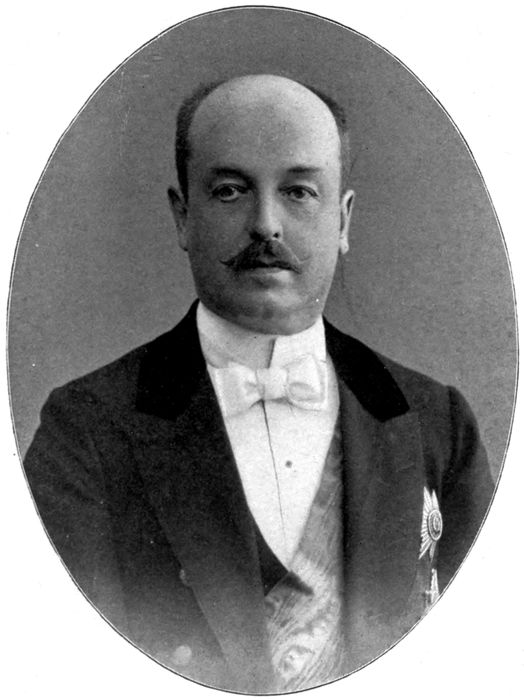
COUNT LAMSDORFF Russian Foreign Minister
147