Chapter XII · THE ANGLO-JAPANESE AGREEMENT AND THE RUSSO-FRENCH DECLARATION
Reading edition
The details of the negotiations preliminary to the consummation of this remarkable stroke of diplomacy have not been made public, but we are in possession of some salient facts from which successive steps leading up to the final conclusion may be inferred with tolerable certainty. It is well known that Great Britain, which had always occupied a predominant place in the foreign relations of Japan, had persistently opposed the latter’s ardent wish and continual struggle to revise the humiliating treaties which had, about 1858, been imposed by the Powers upon the weak feudal Government of Yedo. In 1894, however, contrary to her past policy, Great Britain led other Powers in according to Japan a cordial recognition of the latter’s progress in various lines of her national activity, and assenting to the revision of her treaties. During the war with China in 1894–5, the British attitude was one of friendly neutrality between the two Oriental Empires, but the events after the conclusion of the war, especially the forced retrocession of the Liao-tung Peninsula, closely followed by the tightening hold of the Muscovites upon the Peking Court, 198seemed to have aroused the sympathy of Great Britain with Japan, mingled probably with the fear of the loss of some of her own predominant economic interests in China. From this time on, the interests of the two Powers had been seen to coincide in the Far East to an increasing degree, and the relations of their Governments had steadily risen in cordiality.[397] At the rupture of the Boxer insurrection in 1900, the Cabinet of Lord Salisbury manifested so much faith in Japan as to request her immediately to dispatch large forces to the relief of the besieged Legations at Peking, Great Britain going even so far as to engage to undertake the necessary financial responsibilities of the proposed expedition.[398] Both during the campaign and throughout the negotiation for peace, the two Powers, as well as the United States, conducted themselves together, as is apparent from our foregoing discussion, in perfect harmony.[399] The common 199danger in Manchuria still further cemented their friendship. All this cordial relation, spontaneous as it was, would not, however, account for the formation of a definite alliance between the two Governments. It seems at least probable that the Anglo-German Agreement of October, 1900, as much by the importance of some of its principles as by its very inefficiency, served as a natural step toward a more wholesome alliance.[400] In this new direction, Great Britain is said to have taken the initiative. This supposition will appear not improbable when it is considered that her immense interests in China, which had begun to be eclipsed by other Powers, would be best secured and promoted by the maintenance of the integrity of China and the open door in her market, and that this object could not be better assured than by an alliance with the strongest Eastern Power, whose fast growing interests in the neighboring lands were in a large measure identical with hers. Suggestions for such an agreement 200are known to have been made by Great Britain to Japan under the Itō Cabinet in April, 1901, and again under the present Katsura Cabinet in July, but it was not till October of that year that definite negotiations were opened by Japan. The Premier, Viscount Katsura, seems to have ascertained in December that the elder statesmen of the Empire were in hearty accord with the agreement toward which the negotiations had pointed.[401] At this stage of the negotiations, also, there had developed other circumstances under which the “splendid” isolation of Great Britain appeared less tenable than before. 201Half a year after the Anglo-German Agreement was rendered valueless by the declarations of Herr von Bülow, the Czar paid a significant visit, in September, not only to France, but also to Germany. The ebullition of friendly sentiments between the heads of the States was not less effervescent at Danzig than at Dunkirk. The Russo-Chinese Bank presently floated a loan of 80,000,000 marks at Berlin, thus insuring to that extent the interests of the Germans in Russian success in the East. At the same time the situation in Manchuria had been growing more serious than before, while Germany had seemed no longer inclined to join Great Britain in the latter’s protests against the menacing conduct of Russia. Grave as was the danger to the political and commercial prestige of Great Britain in the East, her hands were still closely tied by the vexatious South African question. If there ever was need of an agreement with the rising Power of the Orient, it had probably been never more keenly felt by the British Government than in the last part of the year 1901. Side by side with these favorable circumstances for an understanding, the student should not for a moment lose from sight two fundamental conditions which drew together, not only the Governments, but also the people, of Great Britain and Japan with mutual attraction. One was sentimental: each of the two nations found in the other, though in different ways from one another, something of a counterpart of its geographical position, its material needs and aspirations, and 202the energy and enterprise of its individual members. This mutual sympathy was largely intensified by, not, indeed, so much the identity of their interests in the East, as the common principles under which these interests would be best protected—the independence and strength of China and Korea, and the equal opportunity therein for the economic enterprise of all nations.
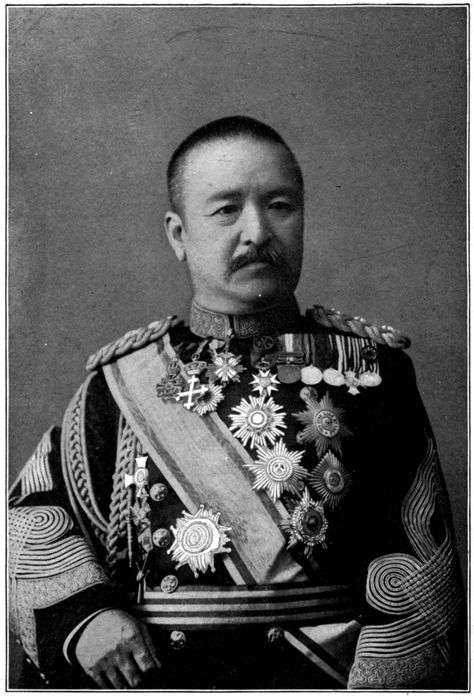
COUNT KATSURA Premier of Japan
The final outcome of the Anglo-Japanese negotiations was a remarkable product, the like of which is seldom seen in history, especially when it is considered that it united reciprocally two nations widely apart in race, religion, and history, one of which had rarely in time of peace entered into a regular alliance even with a European Power.[402] The most striking, as well as the most important for our study, must be regarded the entirely fair and open principles to which the Agreement gave clear expression. These remarks may not be better substantiated than by quoting the exact words of the document itself, and of the dispatch inclosing the Agreement from Lord Lansdowne to Sir Claude MacDonald, the British Minister at Tokio, which read as follows:—
“The Governments of Great Britain and Japan, actuated solely by a desire to maintain the status quo and 203general peace in the extreme East, being moreover specially interested in maintaining the independence and territorial integrity of the Empire of China and the Empire of Korea, and in securing equal opportunities in those countries for the commerce and industry of all nations, hereby agree as follows:—
“Article I. The High Contracting Parties having mutually recognized the independence of China and Korea, declare themselves to be entirely uninfluenced by any aggressive tendencies in either country. Having in view, however, their special interests, of which those of Great Britain relate principally to China, while Japan, in addition to the interests which she possesses in China, is interested in a peculiar degree, politically as well as commercially and industrially, in Korea, the High Contracting Parties recognize that it will be admissible for either of them to take such measures as may be indispensable in order to safeguard those interests if threatened either by the aggressive action of any other Power, or by disturbances arising in China or Korea, and necessitating the intervention of either of the High Contracting Parties for the protection of the lives and property of its subjects.
“Article II. If either Great Britain or Japan, in the defense of their respective interests as above described, should become involved in war with another Power, the other High Contracting Party will maintain a strict neutrality, and use its efforts to prevent other Powers from joining in hostilities against its ally.
“Article III. If in the above event, any other Power or Powers should join in hostilities against that ally, the other High Contracting Party will come to its assistance, and will conduct war in common, and will make peace in mutual agreement with it.
“Article IV. The High Contracting Parties agree that 204neither of them will, without consulting the other, enter into separate arrangements with another Power to the prejudice of the interests above described.
“Article V. Whenever, in the opinion of either Great Britain or Japan, the above-mentioned interests are in jeopardy, the two Governments will communicate with one another fully and frankly.
“Article VI. The present Agreement shall come into effect immediately after the date of its signature, and remain in force for five years from that date.
“In case neither of the High Contracting Parties should have notified twelve months before the expiration of the said five years the intention of terminating it, it shall remain binding until the expiration of one year from the day on which either of the High Contracting Parties shall have denounced it. But if, when the date fixed for its expiration arrives, either ally is actually engaged in war, the alliance shall, ipso facto, continue until peace is concluded.
“In faith whereof the Undersigned, duly authorized by their respective Governments, have signed this Agreement, and have affixed thereto their seals.
“Done in duplicate at London, the 30th January, 1902.
“LANSDOWNE,
His Britannic Majesty’s Principal Secretary of State for Foreign Affairs.
“HAYASHI,
Envoy Extraordinary and Minister Plenipotentiary of His Majesty the Emperor of Japan at the Court of St. James.”[403]
205“Foreign Office, January 30, 1902.
“Sir Claude MacDonald [the British Minister at Tokio]:
“I have signed to-day, with the Japanese Minister, an Agreement between Great Britain and Japan, of which a copy is inclosed in this dispatch.
“This Agreement may be regarded as the outcome of the events which have taken place during the past two years in the Far East, and of the part taken by Great Britain and Japan in dealing with them.
“Throughout the troubles and complications which arose in China consequent upon the Boxer outbreak and the attack upon the Peking Legations, the two Powers have been in close and uninterrupted communication, and have been actuated by similar views.
“We have each of us desired that the integrity and independence of the Chinese Empire should be preserved, that there should be no disturbance of the territorial status quo either in China or in the adjoining regions, that all nations should, within those regions, as well as within the limits of the Chinese Empire, be afforded equal opportunities for the development of their commerce and industry, and that peace should not only be restored, but should, for the future, be maintained.
“From the frequent exchanges of view which have taken place between the two Governments, and from the discovery that their Far Eastern policy was identical, it has resulted that each side has expressed the desire that their common policy should find expression in an international contract of binding validity.
“We have thought it desirable to record in the Preamble of that instrument the main objects of our common policy in the Far East to which I have already referred, and in the first Article we join in entirely disclaiming any aggressive tendencies either in China or Korea. We have, 206however, thought it necessary also to place on record the view entertained by both the High Contracting Parties, that should their interests as above described be endangered, it will be admissible for either of them to take such measures as may be indispensable in order to safeguard their interests, and words have been added which will render it clear that such precautionary measures might become necessary and might be legitimately taken, not only in the case of aggressive action or of an actual attack of some other Power, but in the event of disturbances arising of a character to necessitate the intervention of either of the High Contracting Parties for the protection of the lives and property of its subjects.
“The principal obligations undertaken mutually by the High Contracting Parties are those of maintaining a strict neutrality in the event of either of them becoming involved in war, and of coming to one another’s assistance in the event of either of them being confronted by the opposition of more than one hostile Power. Under the remaining provisions of the Agreement, the High Contracting Parties undertake that neither of them will, without consultation with the other, enter into separate arrangements with another Power to the prejudice of the interests described in the Agreement, and that whenever those interests are in jeopardy, they will communicate with one another fully and frankly.
“The concluding Article has reference to the duration of the Agreement which, after five years, is terminable by either of the High Contracting Parties at one year’s notice.
“His Majesty’s Government had been largely influenced in their decision to enter into this important contract by the conviction that it contains no provisions which can be regarded as an indication of aggressive or self-seeking tendencies in the regions to which it 207applies. It has been concluded purely as a measure of precaution, to be invoked, should occasion arise, in the defence of important British interests. It in no way threatens the present position or the legitimate interests of other Powers. On the contrary, that part of it which renders either of the High Contracting Parties liable to be called upon by the other for assistance can operate only when one of the allies has found himself obliged to go to war in defence of interests which are common to both, when the circumstances in which he has taken this step are such as to establish that the quarrel has not been of his own seeking, and when, being engaged in his own defence, he finds himself threatened, not only by a single Power, but by a hostile coalition.
“His Majesty’s Government trust that the Agreement may be found of mutual advantage to the two countries, that it will make for the preservation of peace, and that, should peace be unfortunately broken, it will have the effect of restricting the area of hostilities.
“I am, etc.,
“LANSDOWNE.”[404]
The singular nature of these documents stands out so clearly on their face that it hardly needs a special reference. Not only has Manchuria at last been clearly interpreted by both Powers as lying within the scope of the Agreement, but it is explicitly admitted therein that Japan possesses extensive interests in the Korean peninsula, which is for that reason included in the sphere within which the contracting parties unequivocally disavow 208aggressive tendencies. Nor does this sum up all the difference between this and the Anglo-German Agreement, for, while in the latter the denial of the parties’ aggressive designs was limited to the period of the Boxer complication, and, moreover, coupled with a reservation amounting to the recognition of the theory of readjusting the balance between the Powers at the expense of China, the new alliance unconditionally upholds the independence of China and Korea, and any measure, either peaceful or warlike, taken by either party to safeguard its interests, if they are in any way threatened, would by no means alter its devotion to the principles of the territorial integrity of the Chinese and Korean Empires and of the open door in those countries. The alliance exists solely for the purpose of effectively safe-guarding the interests already acquired by the two Powers on the common ground, and it is implied in an unmistakable manner that those interests may best be maintained by the total abstention, in any event, from all aggressive or exclusive tendencies in China and Korea, and, what is equally important, that the observation of these principles would forcibly tend to preserve the general peace in the Far East. Owing to the covert violation of these principles by another Power, however, peace has been broken, but the Anglo-Japanese Agreement has not expired. The latter would, however, fall to the ground the moment one of the parties, either as a result of a war or otherwise, should attempt to depart from the principles of the 209open door and the territorial integrity of the neighboring Empires.
Lord Lansdowne considered the Agreement “a measure of precaution,” and hoped that it would “make for the preservation of peace, and that, should peace be unfortunately broken, it would have the effect of restricting the area of hostilities.” Presently these hopes were openly seconded, but in reality neutralized, by the Russo-French Declaration of March 17, which stated:—
“The allied Governments of Russia and France have received a copy of the Anglo-Japanese Agreement of the 30th January, 1902, concluded with the object of maintaining the status quo and the general peace in the Far East, and preserving the independence of China and Korea, which are to remain open to the commerce and industry of all nations, and have been fully satisfied to find therein affirmed the fundamental principles which they have themselves, on several occasions, declared to form the basis of their policy, and still remain so.
“The two Governments consider that the observance of these principles is at the same time a guarantee of their special interests in the Far East.[405] Nevertheless, being obliged themselves also to take into consideration the case in which either the aggressive action of third Powers, or the recurrence of disturbances in China, jeopardizing the integrity and free development of that Power, might become a menace to their own interests, the two allied Governments reserve to themselves the 210right to consult in that contingency as to the means to be adopted for securing those interests.”[406]
The St. Petersburg Messager Officiel of March 20, published, with the Declaration, the statement that the Russian Government had received the announcement of the Anglo-Japanese Agreement “with the most perfect calm,” for Russia likewise insisted on the maintenance and integrity of China and Korea. “Russia,” it continued to say, “desires the preservation of the status quo and general peace in the Far East, by the construction of the great Siberian Railroad, together with its branch line through Manchuria, toward a port always ice-free. Russia aids in the extension in these regions of the commerce and industry of the whole world. Would it be to her interest to put forward obstacles at the present time? The intention expressed by Great Britain and Japan to attain those same objects, which have invariably been pursued by the Russian Government, can meet with nothing but sympathy in Russia, in spite of the comments in certain political spheres and in some of the foreign newspapers, which endeavored to present in quite a different light the impassive attitude of the Imperial Government toward a diplomatic act which, in its 211eye, does not change in any way the general situation of the political horizon.”[407]
It seems to be generally overlooked that, so far as the published documents are concerned, there occurs no statement that the Russo-French alliance extended from Europe to the Far East under precisely the same conditions as those of the Anglo-Japanese Agreement. In other words, although the general principles of the latter are indorsed, one finds nowhere that its terms of war and neutrality and its provisions regarding the duration of the validity of the instrument have also been reproduced by Russia and France in their mutual convention. Regarding the precise conditions of their alliance, therefore, the world is left much in the dark, save what it takes for granted. Nor are the principles of the integrity and the open door of China and Korea so fully and explicitly stated here as in the Agreement of the rival allies, while the reservation at the end of the Declaration does not make it clear that these principles may not be discarded, under certain circumstances, according to the interpretations of the parties themselves of the means to be taken to safeguard their interests.
Turning to the general tenor of the documents, the student will at once observe their marked characteristics. It is at least singular, one would think, that the “most perfect calm” and the “impassive attitude” of the Russian Government should be 212expressed in so many words. If, again, the allied Powers were, as they declare, in perfect accord with the principles of Great Britain and Japan, it is not intelligible why they should entertain, as it appears, so deep a suspicion toward the “political spheres” in which the Russian calmness was said to have been deliberately misinterpreted, and also toward the “third Powers” “whose aggressive action” might “jeopardize the integrity and free development” of China. This sense of distrust becomes all the more pronounced when it is contrasted with the assertion that the agreement between Great Britain and Japan brought no change on the political horizon of the East. It was reported about the time when the Russian Minister and the French Chargé d’Affaires at Tokio handed the Declaration to Baron Komura, that the allied Powers had made their Declaration because they feared that Great Britain and Japan might, in virtue of the first Article of their Agreement, object even to legitimate means of protecting the French and Russian interests in the Far East.[408] If the four Powers upheld the same principles, no such apprehension of two of them against the other two could be either cordial or even justifiable. Under these considerations, one can hardly avoid the conclusion that the allied Governments of Russia and France must have been animated less by the principles they professed than by the deep rivalry of their interests with those of the other allies. For it is at least certain that, ever since 213their memorable coalition with Germany in 1895, in the coercion of Japan, Russia and France had acted in mutual good-will, the former being mainly aided by the latter in Manchuria and Korea, and the latter by the former in the southern Chinese provinces,[409] in their diplomatic manœuvres in those countries and in their struggles with Japan and Great Britain.[410] If the Agreement and the Declaration are considered the formal expression of the cordial sentiment which had long existed and been growing between the two sets of the Powers, they may be said to have brought no change upon the political horizon; but it seems impossible to deny that their publication greatly clarified the political atmosphere in the East, and, in spite of the verbal meaning of the declaration, not a little accentuated the widening contrast between the two different policies upheld by the two powerful coalitions. In this sense, the political evolution of the Far East may be said to have now reached an important stage after the European intervention in Japan in 1895.[411]
214