Chapter XIX · THE RUSSO-JAPANESE NEGOTIATIONS, II
Reading edition
The Russian counter-note having been received on October 3, Baron Komura began to confer with Baron Rosen upon the basis of both the Japanese note and the Russian reply.[629] Meanwhile, the Japanese statesmen again held deliberations on the 10th and 24th of October,[630] and agreed upon the “irreducible minimum,” which was accordingly communicated to the Russian Minister on the 30th in the form of the following note:—
“1. Mutual engagement to respect the independence and territorial integrity of the Chinese and Korean Empires.
“2. Recognition by Russia of Japan’s preponderating interests in Korea, and of the right of Japan to give to Korea advice and assistance, including military assistance, tending to improve the administration of the Korean Empire.
“3. Engagement on the part of Russia not to impede the development of the commercial and industrial activities of Japan in Korea, nor to oppose any measures taken for the purpose of protecting those interests.
“4. Recognition by Russia of the right of Japan to send troops to Korea for the purpose mentioned in the preceding Article, or for the purpose of suppressing insurrection 325or disorder calculated to create international complications.
“5. Engagement on the part of Japan not to undertake on the coasts of Korea any military works capable of menacing the freedom of navigation in the Korean Straits.
“6. Mutual engagement to establish a neutral zone on the Korean-Manchurian frontier extending fifty kilometres on each side, into which zone neither of the contracting parties shall introduce troops without the consent of the other.
“7. Recognition by Japan that Manchuria is outside her sphere of special interest, and recognition by Russia that Korea is outside her sphere of special interest.
“8. Recognition by Japan of Russia’s special interests in Manchuria, and of the right of Russia to take such measures as may be necessary for the protection of those interests.
“9. Engagement on the part of Japan not to interfere with the commercial and residential rights and immunities belonging to Russia in virtue of her treaty engagements with Korea, and engagement on the part of Russia not to interfere with the commercial and residential rights and immunities belonging to Japan in virtue of her treaty engagements with China.
“10. Mutual engagement not to impede the connection of the Korean Railway and the Eastern Chinese Railway when those railways shall have been eventually extended to the Yalu.
“11. This Agreement to supplant all previous Agreements between Japan and Russia respecting Korea.”[631]
It will be seen from this note that Japan made several important concessions. These naturally fall 326under three classes: concessions made to an expressed wish of Russia; those in which desires of Russia were changed from a one-sided into a reciprocal form; and those made voluntarily on the part of Japan. To the first class belongs the free passage of the Korean Straits (Article 5), while the neutralization of territory on both sides of the northern frontier (Article 6), and the mutual declaration that Korea was beyond the sphere of the “special” interests of Russia, and Manchuria of Japan (Article 7), may be said to fall under the second class. Purely voluntary concessions may be said to consist of the tenth Article regarding the Eastern Chinese and Korean Railways meeting on the Yalu, and a part of the eighth Article, in which the “special” interests—not necessarily in the railway work alone, as in the first Japanese note—of Russia in Manchuria were unequivocally recognized. Other Articles are largely identical with those of the first note, except the new ninth Article, which embodied the matter-of-fact principle that the treaty rights of Russia in Korea, and of Japan in Manchuria, should be mutually respected. Taken as a whole—with the only exception regarding the preponderating interests of Japan in Korea, and the natural wishes of Japan arising from this peculiar situation, the former of which had been wholly,[632] and the latter partially,[633] recognized by Russia—the 327prevailing characteristic of the second Japanese note may be said to be its reciprocal nature. The special interests of Russia[634] in Manchuria counterbalanced the preponderant interests of Japan in Korea,[635] and each other’s right to take necessary measures to protect those interests was recognized.[636] At the same time, Manchuria was declared as far beyond the sphere of Japanese special interests as was Korea of the Russian,[637] while, on the other hand, the treaty rights of Russia in Korea, and of Japan in Manchuria, were to be respected as a matter of course.[638] If Russia was requested not to impede the economic activity of the Japanese in Korea,[639] Japan also agreed not to fortify the Korean coast.[640] The case of the neutral zone[641] need not be repeated. In spite, however, of the reciprocal nature of the note, it is unnecessary to say, so long as the control of the Eastern policy of Russia remained in the same hands as before, she could hardly be expected to acquiesce in the Japanese proposals.[642]
328As has been said, the second note was handed by Baron Komura to Baron Rosen on October 30. To this note, after a repeated application from Japan for a speedy answer,[643] Russia replied only on December 11, or more than forty days after the receipt of the Japanese note. This second reply of Russia[644] was as much a reduction of her former concessions 329as was the second note of Japan an increase upon hers; for Russia was now entirely silent on the subject of Manchuria, and, regarding Korea, repeated the restrictions proposed in September, as if the second Japanese note had never reached her, besides refusing to recognize Japan’s right to give Korea anything beyond mere advice for the reform of her civil administration. In short, the second counter-note was equivalent to the first minus the clauses regarding Manchuria and Japan’s right to assist Korea in the latter’s reform. The possibility of a reconciliation of the views of the two Powers now appeared remoter than before. If the exact contents of the reply had been publicly shown to the Japanese people, it would have been extremely difficult for the Katsura Cabinet to control their resentment against what would have been regarded under the circumstances as a deliberate insult to their country.
After another meeting of the Cabinet members and Councilors on the 16th, Baron Komura made one more attempt to appeal to the friendly sentiment of the Russian Government. The nature of the third Japanese overture will be seen from the following 330dispatch, telegraphed by the Baron to Mr. Kurino on the 21st:—
“In my interview with the Russian Minister on December 21, I pointed out that, between our original proposals and the new Russian counter-proposals, there was a fundamental difference concerning the geographical sphere of the understanding. After fully explaining how the Imperial Government had come to consider it desirable, in the general interest, to include in the proposed understanding all the regions in the Extreme East where the interests of the two Empires met, I expressed the hope that the Russian Government would reconsider their position regarding that branch of the question. I also informed him, in detail, of the amendments which the Imperial Government considered it necessary to introduce into Russia’s new counter-proposals. Accordingly, in order to remove every possibility of misunderstanding on the part of Russia respecting the attitude of the Imperial Government, you are instructed to deliver to Count Lamsdorff a note verbale to the following effect:—
“‘The Imperial Government have examined with great care the new Russian counter-proposals of the 11th instant. They regret that the Russian Government did not agree to extend the compass of the suggested understanding over the territory whose inclusion was deemed essential by Japan.
“‘The Imperial Government, in their original proposition to the Russian Government in August last, endeavored to make it entirely clear that they desired, with a view to remove from the Japanese-Russian relations every cause for future misunderstanding, to bring within the purview of the proposed arrangement all those regions in the Extreme East where the interests of the two 331Empires met. They cannot believe that a full realization of that desire could be expected if a large and important section of those regions was wholly excluded from the understanding. Accordingly, the Imperial Government feel constrained to ask the Russian Government to reconsider their position on the subject, and they hope that the Russian Government will be able to see their way to arrive at a satisfactory solution of the question.
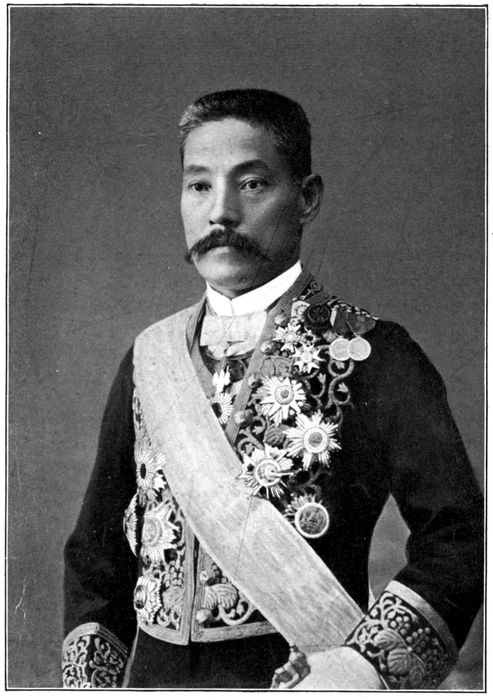
MR. KURINO Late Japanese Minister at St. Petersburg
“‘The Imperial Government also find it necessary to ask for the following amendments to the new Russian counter-proposals:—
“‘a. Article II. to read: Recognition by Russia of Japan’s preponderating interests in Korea, and of the right of Japan to give Korea advice and assistance tending to improve the administration of the Korean Empire;
“‘b. Article V. to read: Mutual engagement not to undertake on the Korean coast any military works capable of menacing the freedom of navigation in the Korean Straits; and
“‘c. Article VI. to be suppressed.
“‘Not only as the main points of these amendments cannot be said to be in excess of the modifications which were agreed to ad referendum at Tokio, but also as the Imperial Government considered those changes indispensable, it is believed that they will receive the ready agreement of the Russian Government.’
“In presenting the foregoing note to Count Lamsdorff, you will say that I have spoken to Minister Rosen in a similar sense, and you will also express the desire for a prompt reply.”[645]
Mr. Kurino carried out his instructions on December 23, and telegraphed on the same day to Baron Komura: “... He [Count Lamsdorff] 332told me he had received a telegram from Minister Rosen, stating that the latter had had an interview with Baron Komura, and that particulars would follow; but such particulars had not yet been received by him [the Count.][646] When I handed him the note verbale, he received it, and said that he would do his best to send the Russian answer at the earliest possible date; but added that he would have to communicate with Viceroy Alexieff. In conclusion I stated to the Count that, under existing circumstances, it might cause serious difficulties, even complications, if we failed to come to an entente, and I hoped he would exercise his best influence so as to enable us to reach the desired end.”[647]
When Minister Kurino saw Count Lamsdorff on January 1, 1904, the latter, as he had been persistently doing during the past few days, remarked that he saw no reason why an entente could not be arrived at, for Minister Rosen would soon be instructed to proceed with the negotiations in a friendly and conciliatory spirit.[648] Other statements of the same pacific nature were frequently made, not only by the Count, but also by the Czar, and were circulated through the press and foreign telegraphic service. When, however, the reply of Russia[649] 333reached Tokio on January 6, it was found that here again, as in the first reply of September last, the recognition by Japan of Manchuria and its coast as beyond her sphere of interest—the word “special” not preceding the last word—was insisted upon, while, as before, no mention was made of the territorial integrity of China in Manchuria. As regards the equal opportunity for the enterprise of other nations, it should be noted that Russia now agreed to insert a clause not to obstruct the enjoyment by Japan and other Powers of the treaty 334rights which they had acquired from China in regard to Manchuria, but only on the condition of maintaining the clauses on the neutral zone in Korea and the non-employment by Japan of any part of Korea for strategical purposes. Moreover, the treaty rights of other Powers in Manchuria, which Russia would respect, explicitly excluded those concerning the foreign settlements in the open ports,[650] thus again evincing her exclusive policy. Over and above these considerations, it should be remembered that, as has been pointed out by Baron Komura,[651] the treaty rights which China had accorded to other Powers could not be maintained if her sovereignty in Manchuria, the existence of which Russia declined to assure Japan that she would respect, should cease.[652]
335In a few days there took place an important event which made the Russian position untenable. The Chinese-American[653] and Chinese-Japanese[654] commercial treaties which had been concluded on October 8, 1903,[655] the date appointed for the final evacuation of Manchuria, were ratified on January 11, 1904, the former opening to the world’s trade Mukden and An-tung, and the latter, Mukden and Tatung-kao, thus not only multiplying the treaty rights, including rights of foreign settlements, of Japan and the United States in Manchuria, but also forcibly reinstating the sovereign rights of the Chinese Empire in the territory, and directly reversing the exclusive claims of Russia therein. It will be recalled that Russia had recently seized Mukden, and had been strengthening her forces upon the Yalu, on which the other two new ports were situated. The United States Government, immediately upon the ratification of the treaty, appointed Consuls for the three new open ports.
To return to the Russo-Japanese negotiations. Thus far notes and replies, exchanged three times 336within a period of five months, must have made the position of each negotiating Power perfectly clear to the other. No further discussion could possibly bring the two Governments nearer to a reconciliation of wishes so diametrically opposed. In the mean time, the Japanese people were suffering from enormous economic losses. A large part of their raw materials had ceased to come, the shipping and trade with Korea and Northern China had declined, the fishing industry had been paralyzed, and, contrary to the tendency at normal times, the banks had been embarrassed with an over-abundance of funds.[656] On the other hand, Russia, while circulating the optimistic views of her Emperor and Foreign Minister, had continued her sharp diplomacy at Seul and Peking, and pushed on land and sea her vast warlike preparations in the East.[657]
Even then the Japanese Government would not terminate its negotiations with Russia, for it was well aware that upon the conduct of these negotiations the peace of the East depended. If the principles proposed by Japan were not accepted, the integrity of China would be threatened, and the 337independence of Korea, as well as the vital interest of Japan, would be profoundly endangered; thus the entire future of the Far East would be plunged into unknown perils. Under these circumstances, it seemed that Japan owed to the world as much of patience, as she owed to herself of determination. The situation was gravely discussed by the statesmen on the 11th, and before the Throne again on the 12th.[658] On the next day, January 13, now for the fourth time, and against the wishes of the majority of the people, the Government of Tokio reminded Russia of the serious position in which the two Powers found themselves, and begged her to reconsider the situation. Observe the following telegram of the same date from Baron Komura to Mr. Kurino:—
“You are instructed to deliver to Count Lamsdorff the following note verbale in order to confirm to him the views I have communicated to Baron Rosen on the 13th January:—
“‘The Imperial Government, with a view to arriving at a pacific solution of the pending questions, and to firmly establishing for all time the basis of good relations between the two Powers, as well as to protect the rights and interests of Japan, have, from this point of view, given most careful and serious consideration to the reply of the Russian Government which was delivered by his Excellency Baron Rosen on the 26th instant. They have finally come to the conclusion that the following modifications are necessary, i. e.:—
“1. ‘Suppression of the first clause of Article 5 of the 338Russian counter-proposals (presented to the Japanese Government through Baron Rosen on December 11), that is to say, not to use any part of Korean territory for strategical purposes.
“2. ‘Suppression of the whole Article (6) concerning establishment of a neutral zone.
“3. ‘The Russian proposal concerning Manchuria to be agreed to with the following modifications:—
“a. ‘Recognition by Japan of Manchuria and its littoral as being outside her sphere of interest, and an engagement on the part of Russia to respect the territorial integrity of China in Manchuria.
“b. ‘Russia, within the limits of Manchuria, will not impede Japan nor other Powers in the enjoyment of rights and privileges acquired by them under the existing treaties with China.
“c. ‘Recognition by Russia of Korea and its littoral as being outside her sphere of interest.
“4. ‘Addition of an Article to the following effect: Recognition by Japan of Russia’s special interests in Manchuria, and of the right of Russia to take measures necessary for the protection of those interests.
“‘The grounds for these amendments having been frequently and fully explained on previous occasions, the Imperial Government do not think it necessary to repeat the explanations, beyond expressing their earnest hope for reconsideration by the Russian Government. It is sufficient to say that the suppression of the clause excluding the establishment of settlements in Manchuria is desired because it conflicts with stipulations of the new commercial treaty between Japan and China. In this respect, however, Japan will be satisfied if she receives equal treatment with other Powers which have already acquired similar rights in regard to settlements....
“‘Finally, the above-mentioned amendments being 339proposed by the Imperial Government entirely in a spirit of conciliation, it is expected that they will be received with the same spirit at the hands of the Russian Government; and the Imperial Government further hope for an early reply from the Russian Government, since further delay in the solution of the question will be extremely disadvantageous to the two countries.’”[659]
An early reply was urged by Mr. Kurino at least four times,[660] but, even so late as February 1, Count Lamsdorff declined even to name the date on which his reply would be given;[661] and, indeed, the reply[662] 340which was being framed was found later to have contained substantially the same points as the three previous replies—points some of which had been repeatedly and unequivocally demonstrated to be entirely irreconcilable with the vital interests of Japan. Just at this time, the activity of the Russian forces in the East seemed to have been accelerated: on January 21, numbers of infantry and artillery left Port Arthur and Dalny for the Korean frontier, soon to be followed by contingents from 341Liao-yang; on the 28th, Viceroy Alexieff ordered the troops on the Yalu to be placed upon a war footing; on February 1, the Governor of Vladivostok warned the Japanese Commercial Agent at the port to prepare for withdrawing his compatriots to Habarofsk, as he had received instructions from his Government and was ready to proclaim martial law at any time; and, on the 3d, all the war-vessels located at Port Arthur, excepting one, steamed out of the harbor.[663]
It was now considered by the Japanese Government that the critical point had been reached. The 342Cabinet members and Privy Councilors held a conference on February 3, and again, on the next day, before the Throne. On February 5, at 2 P. M., two notes were telegraphed to Mr. Kurino, the one communicating Japan’s decision to break off negotiations which had not been met with proper consideration and had become useless, and to reserve to herself the right to pursue an independent course of action, in order to safeguard her interests and rights and to protect her position menaced by Russia; and the other stating that Japan had been obliged to sever her now valueless diplomatic relations with the Russian Government. We subjoin the entire texts of the telegraphic messages from Baron Komura to Mr. Kurino inclosing the above-mentioned notes:—
“Further prolongation of the present situation being intolerable, the Imperial Government have decided to terminate the pending negotiations, and to take such independent action as they may deem necessary to defend our position menaced by Russia, and to protect our rights and interests. Accordingly you are instructed, immediately upon receipt of this telegram, to address to Count Lamsdorff the following signed note:—
“‘The Undersigned, Envoy Extraordinary and Minister Plenipotentiary of His Majesty the Emperor of Japan, has the honor, in pursuance of instructions from his Government, to address to His Excellency the Minister of Foreign Affairs of His Majesty the Emperor of all the Russias the following communications:—
“‘The Government of His Majesty the Emperor of Japan regard the independence and territorial integrity 343of Korea as essential to the repose and safety of their own country, and they are consequently unable to view with indifference any action tending to render the position of Korea insecure.
“‘The obstinate rejections by the Russian Government, by means of amendments impossible of agreement, of Japan’s proposals respecting Korea, the adoption of which the Imperial Government regard as indispensable to assure the existence of the Korean Empire and to safeguard Japan’s preponderating interests in the peninsula; and the obstinate refusals of Russia to enter into an engagement to respect China’s territorial integrity in Manchuria, which is seriously menaced by the continued occupation of the province, notwithstanding Russia’s treaty engagements with China and her repeated assurances to other Powers possessing interests in those regions—have made it necessary for the Imperial Government seriously to consider what measures of self-defense they are called upon to take.
“‘In spite of Russia’s repeated delays to reply without intelligible reasons, and of her naval and military activities, irreconcilable with pacific aims, the Imperial Government have exercised during the present negotiations a degree of forbearance which they believe affords sufficient proof of their loyal desire to remove from their relations with the Russian Government every cause for future misunderstanding. But finding in their efforts no prospect of securing from the Russian Government an adhesion either to Japan’s moderate and unselfish proposals or to any other proposals likely to establish a firm and enduring peace in the Far East, the Imperial Government have no other alternative than to terminate the present futile negotiations.
“‘In adopting this course, the Imperial Government reserve to themselves the right to take such independent 344action as they may deem best to consolidate and defend their menaced position, as well as to protect the acquired rights and legitimate interests of the Empire.
“‘The Undersigned, etc., etc.’”[664]
“You are instructed to address to Count Lamsdorff a signed note to the following effect, simultaneously with the note mentioned in my other telegram:—
“‘The Undersigned, Envoy Extraordinary and Minister Plenipotentiary of His Majesty the Emperor of Japan, has the honor, in pursuance of instructions from his Government, to address to His Excellency the Minister of Foreign Affairs of his Majesty the Emperor of all the Russias the following communications:—
“‘Having exhausted without effect every means of conciliation with a view to remove from their relations with the Imperial Russian Government every cause for future complications, and finding that their just representations and moderate and unselfish proposals made in the interest of a firm and lasting peace in the Far East are not receiving due consideration, and that their diplomatic relations with the Russian Government have for these reasons ceased to possess any value, the Imperial Government of Japan have resolved to sever those diplomatic relations.
“‘In the further fulfillment of the command of his Government, the Undersigned has also the honor to announce to his Excellency Count Lamsdorff that it is his intention to take his departure from St. Petersburg with the staff of the Imperial Legation on the ... day.
“‘The Undersigned, etc., etc.’”[665]
These notes were transmitted by the Japanese Minister to Count Lamsdorff on February 6, at 3454 P. M., Baron Rosen having already been informed by Baron Komura of the severance of the negotiations and general diplomatic relations between the two Powers.[666] The first naval engagement occurred at Chemulpo two days later, followed by the naval battle at Port Arthur on the night of February 8–9, and, on the 10th, war was formally declared by the Emperors of both Powers. The Russian Sovereign’s manifesto, which appeared in the Official Messenger, said:—
“We proclaim to all our faithful subjects that, in our solicitude for the preservation of that peace so dear to our heart, we have put forth every effort to assure tranquillity in the Far East. To these pacific ends we declared our assent to the revision, proposed by the Japanese Government, of the agreements existing between the two Empires concerning Korean affairs. The negotiations initiated on this subject were, however, not brought to a conclusion, and Japan, not even awaiting the arrival of our last reply and the proposals of our Government, informed us of the rupture of the negotiations and of diplomatic relations with Russia.
“Without previously notifying us that the rupture of such relations implied the beginning of warlike action, the 346Japanese Government ordered its torpedo-boats to make a sudden attack on our squadron in the outer roadstead of the fortress of Port Arthur. After receiving the report of our Viceroy on the subject, we at once commanded Japan’s challenge to be replied to by arms.
“While proclaiming this our resolve, we, in unshakable confidence in the help of the Almighty, and firmly trusting in the unanimous readiness of all our faithful subjects to defend the Fatherland together with ourselves, invoke God’s blessing on our glorious forces of the army and navy.”[667]
The Japanese Imperial Rescript, countersigned by all the members of the Cabinet, and declaring war against Russia, read as follows:—
“We, by the Grace of Heaven, the Emperor of Japan, seated on the Throne occupied by the same dynasty from time immemorial, do hereby make proclamation to all our loyal and brave subjects:—
“We hereby declare war against Russia. We command our army and navy to carry on hostilities against her with all their strength, and we also command all our officials to make effort, in pursuance of their duties and in accordance with their powers, to attain the national aim, with all the means within the limits of the law of nations.
“We deem it essential to international relations, and make it our constant aim, to promote the pacific progress of our Empire in civilization, to strengthen our friendly ties with other States, and thereby to establish a state of things which would maintain enduring peace in the East, and assure the future security of our Empire without injury to the rights and interests of other Powers. Our 347officials also perform their duties in obedience to our will, so that our relations with all Powers grow steadily in cordiality.
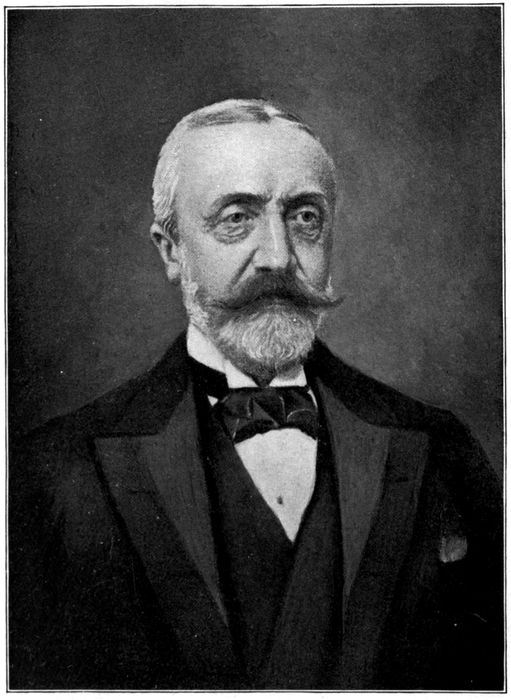
BARON DE ROSEN Late Russian Minister at Tokio
“It is thus entirely against our wishes that we have unhappily come to open hostilities against Russia.
“The integrity of Korea has long been a matter of the gravest concern to our Empire, not only because of the traditional relations between the two countries, but because the separate existence of Korea is essential to the safety of our Empire. Nevertheless, Russia, despite her explicit treaty pledges to China and her repeated assurances to other Powers, is still in occupation of Manchuria, and has consolidated and strengthened her hold upon it, and is bent upon its final absorption. Since the possession of Manchuria by Russia would render it impossible to maintain the integrity of Korea, and would, in addition, compel the abandonment of all hope for peace in the Far East, we expected, in these circumstances, to settle the question by negotiations and secure thereby a permanent peace. With this object in view, our officials by our order made proposals to Russia, and frequent conferences were held during the last half year. Russia, however, never met such proposals in a spirit of conciliation, but by her prolonged delays put off the settlement of the pending question, and, by ostensibly advocating peace on the one hand, and on the other secretly extending her naval and military preparations, sought to bring about our acquiescence. It is not possible in the least to admit that Russia had from the first a sincere desire for peace. She has rejected the proposals of our Empire; the safety of Korea is in danger; the interests of our Empire are menaced. At this crisis, the guarantees for the future which the Empire has sought to secure by peaceful negotiations can now only be sought by an appeal to arms.
348“It is our earnest wishes that, by the loyalty and valor of our faithful subjects, peace may soon be permanently restored and the glory of our Empire preserved.”[668]