Hugh Mulleneux Walmsley (continued 4)
Reading edition
Near the fire were seated the two Europeans, and in a semicircle round them the fifteen Amatonga warriors who had been their guides. Further down the stream, at a bend of the river, the walls of a brick building were visible, some ten miles away.
A perfect jungle of forest swept up almost to the spot where the group were seated, the tamarind and acacia trees growing to the river bank, covered with creeping plants, such as the convolvulus, the jasmine, the deadly nightshade, all festooned from tree to tree, while the wild guava, the pomegranate, and many a sweet-scented bush pushed upwards their luxuriant undergrowth. The bees were humming among the sweetly-scented flowers of the dholicos, and the rushing sound of the river, as it took its way to the sea past the fort of Senna, was music to the ears of the two travellers.
“Give them their due, Wyzinski, and let us be rid of them; I hate the very look of an Amatonga,” exclaimed Hughes.
The group of savages sat round, staring at the two with a steady, concentrated gaze, their long assegais raised in the air, “Matumba,” said the powerful, but stunted brave, who had been in command of the party, speaking with difficulty the Zulu tongue, “Matumba has done his duty, let the chiefs do theirs. Yonder are the walls of their brethren’s fort.”
The missionary did not at once reply, but pushing the promised arms towards the speaker, took from his belt his revolver, discharging its barrels into the air, handed it to the Amatonga.
“This is now Umhleswa’s property, and thus the white man fulfils his promise.”
“We are left with our two rifles and one revolver between us,” remarked Hughes. “If ever I get the chance of paying off these thieves, won’t I?”
Matumba took the arm, and, turning to his men, distributed the rifles among them. A sharp conversation followed, unintelligible to the Europeans, save that the Amatonga pointed several times to the two remaining rifles.
“The white men,” resumed Matumba, once more turning to them, “are near their friends. They have no need of their guns, the Amatonga are far from their kraal. Let them give the two guns, which are now useless.”
“Never, Matumba,” exclaimed Wyzinski, springing to his feet and cocking both barrels of his piece. “Look out, Hughes, they mean mischief. We have kept our word, Amatonga. Keep yours.”
A sharp conversation ensued between the natives, all talking together, the chief, Matumba, evidently trying to keep them within bounds, while they as evidently wished to take the coveted rifles by force. Placing their backs against the rocks, their rifles ready, the two waited the result, but great was their relief when the whole party, after much talking, at last moved off in Indian file, and disappeared under the deepening forest shade.
“We are well out of that, Wyzinski,” remarked Hughes, as he seated himself at the foot of the rock, “and now, what are we to do next?”
“Break ground as soon and as speedily as possible. We have but to follow the stream, and we shall be within the walls of Senna in three hours.”
The little tent was struck, the knapsacks strapped on, and their rifles at the trail, both moved rapidly away. But a deep cut they found ran between them and the Portuguese fort. It was filled with heavy timber and luxuriant undergrowth. Night came on, and there was no moon, so that the direction of the stream was soon lost, and they were brought to a stand still.
“Let us halt here,” said Wyzinski, as they pushed their way through a clump of mimosa, and gained a small clearing, hemmed in on every side by the forest.
“We can reach Senna by early morning, and I am half dead with hunger.”
A fire was lit, some strips of venison cut from an eland killed the previous day, roasted on the embers, and they made a hearty meal.
“It will be a relief to me to see the inside of the fort, Hughes,” said Wyzinski. “I misdoubt those Amatongas.”
“They have done better by us than your favourite Matabele. I never thought Masheesh would have left us thus. If you will take the first turn, I’ll have a sleep,” replied Hughes.
“Agreed,” returned the missionary, as his comrade placing his knapsack under his head, threw himself under a low bush, and was soon sleeping heavily. Hours went by, and still the missionary, with his rifle thrown across his knee, sat by the fire. He rose from time to time to collect and heap on it the dried branches. Once he heard distinctly above the noises incidental to an African night in the wilderness, the splintering of wood. He was in the act of throwing an armful of dry branches on the blaze. Stooping, he seized his rifle, and was just about to wake his companion, when the noise ceased. Stepping up to where the soldier lay, he looked at him. The starlight shone over the bronzed and travel-worn face. The cap had fallen off, and the long locks of dark hair touched the ground. “It would be a pity to wake him,” muttered the missionary. “I am not tired; the presentiment of evil is upon me, and I could not sleep even if I tried.”
Turning, he again squatted down by the fire, the cocked rifle over his knee. Once, more than an hour after, the same sound, like to the breaking of wood, reached his ear.
“It may be some heavy animal feeding,” he thought, “and my fears be groundless; the darkness of the night, the loneliness and fatigue, have unnerved me.”
Soon his thoughts were away in other lands, and with friends, some of whom had been long since dead. Then they returned to the ruined cities of this wild land. Had they any affinity to those found in Mexico? he asked himself. No, they must be Egyptian.
Suddenly a wild shout burst on his ear, a crashing blow, a whizzing in the ears, and all was darkness. The missionary lay stretched beside the embers of the fire.
How long he remained insensible on the ground Wyzinski never knew, but the grey dawn was just breaking as he struggled back to consciousness, to find his arms tightly and painfully bound behind his back, his head splitting with pain, while the clearing seemed filled with the dark forms of the Amatongas, seated in a circle, and evidently debating on their prisoner’s fate. As he lay there on his back, barely able to turn his head, his open eyes gazing upwards at the stars, whose feeble light was just paling before the first grey streaks of dawn, a black mass intervened between him and the blue sky. It was a woman’s head, the long hair told him this much, but the face was that of a demon; the beadlike eyes which peered into his flashing with malicious hatred; the thick lips parted, showing the yellow teeth clenched with passion; the flat nostrils distended with rage, and the hair, matted with grease and dirt, sweeping his face as she bent over him.
It was a face he knew, for it was that of the dead chief’s wife; and as the missionary closed his eyes to shut out the horrid vision, the hag, seeing he had again become conscious, uttered a piercing yell, and dashed into the middle of the council ring, chattering in a shrill and parrot-like voice. The missionary’s eyes remained closed, for he felt his position was hopeless, and what at this moment grieved him more was, that by his negligent watch he had sacrificed his friend. If he had been struck down and made prisoner with his rifle in his hand and wide awake, what chance was there for the sleeping soldier? He knew he should, after the fashion of this tribe, be tortured; he prayed for firmness to meet his doom, but he thought with agony of what had been his comrade’s fate during the hours he himself lay insensible and apparently dead.
A rude stroke from the sharp point of an Amatonga spear roused him, and in obedience to the command he endeavoured to struggle to his feet. Unable to effect this, two of his captors roughly seized him, dragging him up. The dawn was just lighting up the scene, as he glanced round. There lay the embers of the fire scattered about the clearing; there lay the soldier’s knapsack, and there, near it, with an ox hide thrown over it, something which took, under its coverings, the shape of a human form. There was no mistaking it.
The missionary’s eyes filled with tears, and a convulsive sob heaved his breast, as he looked on all that was left of the man who, in his dead sleep, had trusted to his friend’s vigilance.
The Amatongas seemed to have no time to lose, for hardly giving their prisoner space to realise what was passing around, they hurried him along through the bush, retracing their path until the whole group reached the foot of the Baramuana hill, where the distribution of the rifles had taken place the day before.
“My presentiment of evil did not deceive me,” muttered Wyzinski; “fool, triple fool as I was not to profit by it, and yonder,” thought he, as his eyes followed the course of the river, and the brick walls of the fort met his gaze, just tipped by the first rays of the sun, “yonder lay safety.”
Grinning, laughing, and chattering, the circle of Amatonga braves drew round him. Their prisoner was thrown to the ground and his feet bound with the palmyra rope; the woman fiend, her passion lending her strength, hauling at one end of the rough cord until it literally cut into the flesh. A stake was driven into the ground at the foot of the rock, and then the missionary knew his doom was, like Luji’s, death by fire. Next the whole band dispersed, going into the forest, and returning by twos and threes, laden with brush as dry as tinder. Quickly the semicircle of boughs and long grass grew round the stake, while close to the prisoner’s head sat the fiend-like woman, spitting out her rage, heaping imprecations on his head, and occasionally breaking out into a slow chant or death song.
The missionary’s eyes were again closed; his lips were moving in prayer. He was asking for strength to bear his fearful death, as a man should whose negligence has brought evil not only on himself, but on others. The belt of forest trees ran close to the spot where he lay, and while he prayed a dark face put aside cautiously the clusters of convolvuli which formed a flowery screen among the trees, as two black piercing eyes gazed out from among the flowers, seemed to take note of the scene, and then disappeared.
And now four of the Amatongas emerged from the bush, bearing the nameless something, covered up with skins, but yet showing the outlines of the human form. Wyzinski shuddered as he opened his eyes and saw it. The pile of brushwood grew higher and higher, and the missionary felt himself rudely dragged along the ground, and fastened to the stake. The palmyra rope which cut into his flesh was removed, and his feet firmly tied apart to two small wooden pins driven into the ground. The hideous looking woman, who had been dancing and singing round him, waving her lean arms, and clashing together her long yellow teeth, now sat down right opposite the victim, her eyes intently fixed on his, to enjoy his agony. The last armful of brush was tossed upon the heap, fire was procured, and a long twisted wisp of dry grass lighted, and placed in the widow’s hands.
Chanting out a monotonous song, the woman rose and came on. She reached the wall of dry brush, she waved the wisp of flame in her victim’s face, scorching his hair and whiskers; then, with a yell of vengeance, stooped to kindle the fire, when a flash of light seemed to quiver through the sunshine, and she fell forward, pierced through the heart by an assegai, the torch falling from her dying hands, kindling the dry grass and brushwood.
In an instant the missionary was surrounded by a semicircle of flame, the reports of rifles rang in his ears, a loud shout of “Boarders, away!” came from among the trees, as half a dozen Portuguese soldiers, led on by Hughes, the Matabele chief, Masheesh, and Captain Weber of the “Halcyon,” dashed across the open, scattered the burning brush right and left, cut away his bonds, and dragged the half-choked missionary free of the flames.
Three of the Amatongas had fallen by the first discharge, and without halting to reload, the Portuguese charged with the bayonet, led by an old seaman, whose scar-seamed face told of some recent fight. It was Captain Mason, late of the “Argonaut.” The savages, wholly surprised, at once fled, but halting as they reached the belt of forest, threw their assegais. “Forward, my lads; no quarter for the accursed scoundrels!” shouted the excited Mason. “For—,” the word was never spoken, for an assegai struck him in the left eye, piercing to the brain. He fell heavily on his face, his clubbed rifle tumbling to the ground; a deep groan, one or two spasmodic struggles, and the captain of the “Argonaut” was no more, the whole band of savages having disappeared in the bush.
Lotus-Eating on the Zambesi.
Startled from his deep sleep by the shout of the Amatongas, as they leaped into the clearing, the soldier had sprung to his feet, and possessing the faculty of instantly recovering his senses, when suddenly awoke, he at once comprehended his situation. Shouting to Wyzinski to join him, and whirling round his head the heavy knapsack held by the straps, he struck down the foremost savage: a second shared the same fate, but the leather straps broke with the blow. Springing on the third, Hughes grappled with his adversary, clutching the chief Matumba, for it was no other, fiercely by the throat—but he had met his match.
Matumba, short of stature, was yet a powerful man, and though partially stunned by the fall, and his heavy knobstick having dropped from his hands, he struggled manfully for life. The fire had been trampled out, the light of the stars was very feeble, and the two rolled over and over in the death struggle, none daring to meddle with them. A dozen dark, naked forms moved round them; the long knives gleamed in the starlight, but the Amatongas could not strike, so rapid were the movements of the two struggling men. At last, Matumba’s efforts seemed to grow weaker, the deadly grip tightened on his throat, and as he lay under him, Hughes buried his short dagger in the Amatonga’s side. Casting the body from him, with a superhuman effort, and without pausing for a moment, the soldier dashed through the circle, the savages striking at him with their knives.
Seizing his rifle as he fled, with one sweeping blow he drove back the foremost of his pursuers, and shouting to Wyzinski to follow, plunged into the bush. The ground ascended, the trees grew farther apart; he was on the verge of the forest; but one of the long knives had wounded him deeply in the left shoulder, and he was growing faint from loss of blood. Pausing to listen, he distinctly heard the crashing of the underwood. Was it Wyzinski following him? Listening attentively, he could distinguish the same noise to the right and left, and he then knew that the Amatongas, paralysed and astonished as they had been at first by the desperate nature of the resistance, had spread themselves out, and were bringing up the whole country before them on three sides, just as they did when hunting antelope. On the fourth ran the Zambesi. Moving rapidly forward, and determined to trust to the river rather than to the Amatongas, Hughes came to a nullah. Its banks were covered with brush, and the masses of convolvuli almost hid it in places. A sudden thought struck him. Jumping in, he followed its course until he came to a spot completely shut in by creepers and shrubs, then placing his rifle near him, he lay down. Minutes passed, the breaking of the bushes came near him; the cries of the savages calling to each other seemed close to; the head of an assegai was thrust into the mass of verdure which formed his only protection, striking the rock within an inch of him; the noises in the brush, and the cries passed on. Grey daylight came streaming between the leaves, the purple convolvuli opened their flowers, and the parrots and wild pigeons began to awake among the branches.
The wound in his shoulder had stopped bleeding, but he felt faint and nearly unable to move. Cautiously raising his head above the level of the bank, he glanced around. “All seems quiet. If I could only reach the river,” he muttered. “My mouth is dry and parched with thirst.”
Slowly and painfully he extricated himself from the bed of the nullah, and then, his rifle on his shoulder, followed its course.
It did indeed revive him, as he scooped up the waters of the Zambesi with his hands, and then, taking off his clothes, bathed the wounded shoulder in the cool river. What had become of his comrade was now his thought, and the idea of not ascertaining his fate for fear of personal consequences, never occurred to him. The sun would soon be up, the bees were just humming along the river banks, the patches of forest-land on the plain beyond the river looked black, in the grey dawn, and the stars were fast disappearing. He would take his way back to the clearing slowly, and cautiously. Just as he had stepped on the bank reinvigorated and refreshed, a noise struck his ears.
Turning towards the river, he leaned on his rifle, listening attentively. It was a fine broad stream the Zambesi, even here, before the Shire river pours its waters into it far below the fort of Senna; and as he looked down it, he again caught the noise distinctly.
“It is the steady pull of oars in the rowlocks,” he said, speaking aloud, unconsciously. “I cannot be mistaken. Perhaps I may find help.”
Concealing himself behind a bush, he waited. The sounds, whatever they were, became more and more distinct, and soon, slowly pulling against the stream, a boat drew clear of the bend of the river. Slowly it surged onward meeting the stream, urged on by the strokes of six rowers, the Portuguese flag streaming out from the stern, and a small carronade mounted in her bows. In the stern sheets sat a tall, upright figure, the tiller ropes in either hand, dressed in a monkey jacket, pilot cloth trousers, and a sailor’s cap. His long white hair streamed in the wind, and by his side a nearly naked savage. “Could he be mistaken? No,” said Hughes again, speaking aloud, “it is Captain Weber, and Masheesh has not deserted us. He was bringing aid, alas too late.”
“Boat ahoy!” shouted Hughes, as he stepped from behind the bush, waving his rifle in the air.
A loud shout came over the river; the next moment the skipper’s left hand gave the yawl’s bows a broad sheer towards the bank, and Masheesh and the old sailor were by his side. His tale was soon told. Not a moment was lost, and though they found the clearing empty, the spoor of the Amatonga was plain. Masheesh was sent forward to reconnoitre, the Portuguese soldiers were landed, and the result is known.
“And what is that over yonder, which I took for you?” asked the missionary.
Hughes rose from the spot where he had been sitting, the missionary’s hand in his; he stooped over the heap, and threw the skin aside.
“It is Matumba,” he said; “look at the mark of my grip on his throat, and the dark blood-stain on his side. He gave me trouble enough,” he continued, as he threw back the skins over the dead savage; “and his face with its starting eyeballs, and tongue hanging out of his mouth, is no pleasant sight. He was a treacherous savage, but died the death of a brave.”
“I don’t see,” said Weber, who now joined them, “that there is any reason why we should not pitch the bodies of these villains into the fire and have them consumed. It is more ship-shape than leaving them to the jackals.”
The thing was no sooner said than done, and the party made short work of it. The body of the captain of the “Argonaut” was carried down to the boat, and covered with the Portuguese ensign. Those of the Amatonga placed on the fire, which was burning fiercely.
“One, two, three, and yo heave ho!” shouted the sailors, as Matumba’s corpse was launched into the air, and fell with a heavy thud into the middle of the flames, sending up a shower of sparks. Fresh brush was heaped over it, and the whole was left burning.
“Poor Mason,” said Captain Weber, as the party moved off, “he never got over the loss of his ship. Of the whole crew, only yonder man now remains.”
“But what were you doing here on the Zambesi, Captain Weber, and how came you in company with Masheesh?”
The Matabele had been in great force, during the short engagement, and now with his long assegai dyed red with blood, stalked solemnly beside the missionary, who walked with great difficulty.
“It is easily explained. You will remember when you went over the ‘Halcyon’s’ side, I told you I had but a few months of my three years’ cruise, Captain Hughes,” replied the seaman, “and that I was bound for Quillimane.”
“Perfectly, and that you would give me a passage to England if I needed it,” answered Hughes. “I shall be glad to accept it, if you can land me at Delagoa Bay, Port Natal, or the Cape; for we two have nothing save our knapsacks and rifles now.”
“Avast there! Hear my tale first. It appears a special envoy has been sent out by the King of Portugal to report on this colony on the Zambesi. With his staff he has been for the last three months at Tété. The ‘Halcyon’ has been taken up for his passage home, and I am on my way to sign articles with Don Francisco di Maxara.”
“But that does not account for my seeing Masheesh at your side in yonder boat?” remarked Hughes.
“The Governor of the fort yonder was at Tété with his Excellency when the Matabele arrived, and told his tale. The Portuguese would not get under way without orders. Reaching Senna late last night, I heard of the affair, knew it must be you, and determined to send poor Mason on to sign articles, and guided by Masheesh to go to your help.”
A cordial grasp of the hand followed this.
“Why, you are burning with fever, my lad, and more fit for the sick bay than the jungle,” said Weber, looking into the soldier’s face.
“Shove off; give way, my lads; his Excellency must wait a wee,” continued the seaman, as the boat sheered down stream, and the men bending to their oars, the stout craft dashed down the Zambesi, heading for Senna.
Don Isidore Mujao, the commandant, met them at the landing place, greatly surprised at their speedy return, and still more so when he saw the use his Portuguese flag had been put to. About forty years of age; tall, dark complexioned, and sedate in manner, he welcomed the new comers, at the same time giving his orders to the men. Taking up the body of the late captain of the burned ship, six soldiers conveyed it to the little chapel, and during the pause, the new comers looked around them.
The fort was built of brick, and was in a very dilapidated condition. Situated on the right bank of the Zambesi, the river rolled its waters under the walls, and seemed a large stream, dotted with reed-covered islands.
“Captain Weber, you can spare your men a toilsome row; his Excellency will arrive either this night or to-morrow from Tété en route for Quillimane. Gentlemen,” continued the Portuguese, “you are welcome; you will meet with scant hospitality here, but we will do our best.”
Don Mujao took off his black broad-brimmed hat as he spoke, bowing low.
“Ay, ay, then I have not much time to lose. I say, Don,” exclaimed the sailor, “this is the Senhor Wyzinski, a missionary, on the loose, and whom we found in a fair way to make a grill for Davy Jones; look at his singed hair and whiskers; and this is an old friend, Captain Hughes, 150th Regiment, who looks half dead with fever.”
Again the formal Portuguese raised his hat, bowing first to one and then to the other.
“Roderigues,” he said, beckoning to a soldier who stood near, “show the Senhors to the only room we can give them. Once more I ask your consideration for our shortcomings, Senhors.”
“Come, make sail!” cried the skipper; “don’t be all day backing and filling here.”
The gate opened, then swung to again, as passing the Governor, who stood with his hat raised from his head, and preceded by the very questionable individual who had been called Roderigues, Hughes and the missionary, literally worn out with fatigue and excitement, the one wounded in the shoulder, the other his face blistered with burns, and hardly able to walk from the effects of the tightly bound palmyra rope, took their way up a narrow, winding staircase, turning out of a landing into a large room, lighted by two barred windows looking over the Zambesi and the plain beyond.
Two rude stretcher beds placed at opposite sides of the room, two large horse buckets, evidently intended for washing purposes, a coil of palmyra rope, to haul up water from the river below, and a couple of rude chairs, formed the furniture. The roof of the chamber was vaulted, and the floor was of red brick. Such was the room into which the soldier ushered the two travel-worn men, and to them it seemed a palace. Standing at attention as they passed, the Portuguese spoke some words in his own tongue, then closed the door with a clang. Placing their rifles against the wall, and throwing down the knapsacks which had been recovered, the missionary’s first act was to push the rude bolt, and offer up fervent thanks for the protection vouchsafed them during their late danger.
The water-buckets were put into use, the knapsacks rummaged, and then the two sat gazing in silence over the river.
“We must manage a passage with our friend, Weber,” said Wyzinski, at last.
“I don’t know how it is, I don’t feel any interest in anything,” languidly replied Hughes. “These shivering fits upset me. The fever has its hold of me.”
“I wonder whether they have any quinine? What a miserable, tumble-down set of wretched hovels these Portuguese have here. A town of thirty houses.”
“The country looks fertile, and the colony should prosper,” languidly returned Hughes, shivering heavily from head to foot, and his face flushing as he spoke. “Those are curiously-shaped sugar-loaf hills, the river flowing between us and them. The thick forest stretches beyond, and how beautiful the distant mountains seem.”
“Those are the hills of the Morumbala range, but what interests me more is yonder boat, swinging to her anchor. She is of English build, has a small cabin, and pulls eight oars. I should like to drop down the Zambesi to-morrow. There must be traders at Quillimane, sailing to Natal or the Cape.”
Here a prolonged, and painful shivering fit took possession of Hughes, gradually and rapidly increasing to such an extent, as soon to incapacitate him even from talking. That night the pulse was beating at a fearful pace, the temples throbbed nearly to bursting, and the terrible shivering fits shook his frame. The following day the brain was affected and the sufferer went once more through the scenes he had lately acted. The missionary dragged his cot to that of his sick comrade, and Captain Weber shared his watch, but the resources of the fort were very small, and but for his strong constitution the chances were against recovery.
The morning of the third day, there was a great bustle within the walls of the ruined fort. Weber came to say good bye. The Portuguese envoy had arrived from Tété, the agreement had been made, and the captain of the merchantman was to drop down the river that morning to finish his preparations.
Hughes was wandering, and did not know him. “It shall go hard but that you shall have your passage in the ‘Halcyon,’ if he can bear it,” said the skipper, the tears standing in his eyes as he pressed the missionary’s hand. “An hour of the fresh breeze of the Indian ocean would do more to cooper up yonder craft than all the rubbish in the world. He’s on his beam ends now, that’s sure; but may be he’ll be all a-tanto soon.”
A knock at the door, and Don Francisco Maxara entered; an elderly, grey-haired man, tall in stature, and stately in bearing.
“I cannot say it is a pleasure, Senhor,” began the old noble, as he bowed to the missionary, and made room for the merchant captain to pass, “but at all events it is a duty to place myself and all I have at your command.”
Boiling restlessly from side to side, his handsome features, bronzed by the sun, now flushed with fever, Hughes was unconscious of their presence. He was with his corps cheering on his men as he had cheered them on the plains of Chillianwallah, the day the gallant 10th Regiment melted away before the masked fire from the Sikh artillery, when gliding through the open door and passing her arm through her father’s, Dona Isabel de Maxara looked down on him.
Tall and graceful in figure, the girl’s face, was of that beautiful clear brown tint, found only in the sunny south, but one of the peculiarities which distinguished her was the network of blue veins, tracing themselves under the transparent olive of the skin; the eyes were large and intensely brilliant, shaded now by the long black lashes, which, with the slightly arched and beautifully pencilled eyebrow, told of Moorish blood. The mouth was small and beautifully cut, the lips parted now and showing the white teeth; and if there was a fault in the features, it was that the forehead, with all its lace-work of blue veins glancing under the clear olive skin, was too high and massive for a female face. The hair was brushed backwards, fastened behind by a large comb, tipped with gold, from which hung the long mantilla of Spain.
The sick man saw nothing of all this, he was busy among the guns at Chillianwallah.
“How long, Senhor,” said the girl, looking up at the missionary, and the large eyes filling as she did so with tears, which rolled one by one unheeded down her cheeks,—“how long has your friend been ill?”
“This is the third day, mademoiselle,” replied he, speaking in French, both father and daughter having used that language. “Have you any quinine, Senhor?” he continued, addressing the father.
“Yes, at your service; but not having had any before, what have you been using?” replied the noble, taking the sick man’s hands, and feeling his pulse.
“A drink made out of the kumbunga plant. It has cured me more than once.”
“Wait,” cried the girl, eager to be of use. “I will return in a moment,” and she flew out of the room, showing as she moved the beautiful foot and ankle peculiar to the Portuguese.
The old noble shook his head as he let the arm he held fall on the bed-clothes.
“There, use that at once,” said the breathless girl, as she returned with a small bottle filled with quinine. “And as soon as you can, get away from this terrible place.”
“We will leave now, my daughter; we are but in the way. Later on we may be useful. Command me, Senhor,” added the Portuguese; “whatever I have is at your service. I pray you do not spare me or mine.”
With a stately wave of the hand, as though he were quitting a palace, instead of a poor barrack-room in a dilapidated fort, the nobleman passed on.
“You will let me know,” said Isabel, pausing before she joined her father, and raising the large black eyes to the missionary’s face—“you will let me know how your poor friend is.” And with one more glance round the room, and at the wretched bed, she passed out.
Wyzinski stood looking at her. It seemed like a dream; but then there was the stoppered bottle of white powder in his hand to prove the reality. All that day, all that night, the missionary watched by the bedside. Towards midnight a heavy thunderstorm passed over the plains watered by the Zambesi. The air seemed blue with the forked lightning; the thunder rattled and roared over the fort, but the morning dawned calm and beautiful, and a cool breeze blew in at the open windows, bringing with it the sweet breath of the tamarind flowers. The quinine, too, had done its work; and the crisis which in the dreadful tertian fever of the Zambesi always occurs on the third day, had passed over favourably. These storms are of frequent occurrence in the land through which the Zambesi rolls its waters, and scarcely a week goes by without the thunder making itself heard round the dilapidated walls of Senna. Another of these periodical storms had just occurred, sweeping over the land, accompanied by torrents of rain, cooling the air, and refreshing the parched-up plains on the banks of the Zambesi. The river was high in consequence, rolling down branches and trees and quantities of driftwood past the brick walls of the crumbling fort. It has already been said that several small islands intersect the course of the river; and near one of these, not a stone’s throw from the water-gate, two boats were moored, swinging to the stream. The one a large European-looking pinnace—though really built on the Zambesi after an English model—possessed a covered cabin aft, and was capable of holding some twenty people. The other was of smaller and lighter mould. From the island came the sounds of laughter and conversation.
Under the trellised creepers, through which the rays of the afternoon sun were shining, sat a party of Europeans. The water was bubbling up in a stone basin; the purple grapes were hanging in rich clusters from the vines; and there, doing the honours of the table with a gentle grace which showed a practised ease and knowledge of the world, sat Dona Isabel Maxara. Near her, half sitting, half reclining on some cushions, Captain Hughes seemed lost in contemplation of the fair girl. Still very weak, and much pulled down by the short but sharp attack of the deadly tertian, he had got it into his head that the quinine had saved his life; and perhaps it was not a very unpleasant thing to be beholden for life to so fair a physician. And so he gazed on the tall, graceful, and beautifully-turned figure, the head carried with that dignified swan-like movement peculiar to Spain and Portugal, the long black lace veil now thrown back and floating behind. The clear olive complexion was well set off by the crimson lips of the well-cut mouth, and the large coal black eyes, with their long lashes, well matched by the luxuriant tresses of jetty hair. As she rose to carry the small cup of coffee to the invalid, he certainly thought the life it pleased him to consider she had saved, could not have a better use than devotion to her; and when the fair Isabel stooped over the young soldier, and one long tress, of the raven hair touched his hand, raised to receive the cap, the rosy flush flew up into a cheek once browned by exposure, but paled now by illness.
At a table close by, the Portuguese envoy, Dom Francisco Maxara, sat playing at chess with the Commandant of Senna; the two, wholly absorbed in their game, exchanging a word only at intervals. The missionary was unpacking, showing, and repacking, the various skins and small animals he had managed to secure. The birds were singing in the bushes round about, and above all came the buzz of insect life, and the ceaseless roll of the broad Zambesi.
The soldier lay back on the cushions sipping his coffee, his eyes half shut, a pleasant feeling of indolence enervating his frame, as he gazed. “She is very lovely,” he muttered; “and here am I, a captain of a marching regiment, allowing myself to fall in love with the daughter of a Portuguese grandee, whom I shall probably never see again.”
“And this,” continued Wyzinski, who seemed to have monopolised the conversation, “is it not a beautiful skin? Do you remember, Hughes, shooting this wild cat in the tree the morning of that terrible day among the Amatongas?”
“Indeed,” replied the other, “I am little likely to forget it. I shall always think it was the excitement, and the prostration consequent on the hunt, which so nearly consigned me to an African grave.”
“Tell me the tale,” cried Isabel. “I long to hear your adventures among the tribes of the interior. It seems so strange for us to meet here on this great African river.”
The conversation was carried on in French; and the soldier told of their travels; told how the baboon had first been found; how it had lived in the camp, and how it had died. The chess-players were disturbed by the silvery peals of laughter which rang round them as Hughes related, with some humour, the incident of the powder-flask; and Dona Isabel’s dark eyes had been fixed for a long time on the speaker’s face ere the tale was finished, and the sun sank beneath the horizon, the stars peeping out, while the fire-flies came floating around, and the cool puffs of the sea breeze swept across the river.
“Sing for us, Isabel,” said Dom Francisco, as he checkmated his antagonist, at the same time rising and making him a stately bow.
Dona Isabel took her guitar, and the sweet tones of her voice rang out among the trellised vines and over the broad river, dying away on the plains beyond, where the howl of the jackal was just making itself heard.
“You will give me my revenge, Senhor Maxara,” asked the Commandant.
“Nay, Dom Isidore, not possible—at least, until you do me the high honour of becoming my guest in our own land. We must leave to-morrow evening.”
“And the Dona Isabel,” asked Mujaio. “Is she, too, in such a hurry to leave Senna?”
“The Dona Isabel must abide by her father’s decision,” she replied; “but she may have a word to say to Dom Maxara on the subject.”
Rising, Isabel took her father’s arm, and leading him towards the river side, seemed to urge something, to which he would not consent.
“Impossible, Isabel; wholly so. The brig is an English trader, bound for the Cape, and takes us only as passengers. Her captain cannot delay beyond the stipulated day; but come, we will do our best.”
“My daughter, Dom Isidore has been urging our stay at Senna for some days longer, but I am forced to say nay. You, gentlemen,” continued the ceremonious old noble, bowing first to the missionary, then to the soldier, “seek to return to the Cape; will you so far honour my daughter and myself as to accompany us?”
The soldier’s face flushed with pleasure. It was just what he could have desired. Wyzinski courteously declined, urging that they must wait until the “Alert” gun brig should touch at Quillimane, as they were without funds, and unable to pay their passage to the Cape.
A stately wave of the hand from Dom Francisco followed this matter-of-fact declaration, which wounded the soldier to the quick. He almost hated Wyzinski, and yet the determination had been come to that morning, on hearing of the advent of the “Alert.”
“The brig ‘Halcyon’ waits us at Quillimane,” persisted the noble. “She is chartered by my government to convey me, its envoy, to the Cape, and can take no passengers, but is bound to receive my suite and guests. Will the senhors honour us by becoming the latter?”
“And you may, indeed, help us,” interposed Isabel, fixing her dark eyes on the missionary. “What shall we do on board an English brig, with no one to understand us. But will not the senhor be too weak if we leave to-morrow?”
As she stood there, with the stars shining upon her, and the fire-flies playing like an aureole round her head, it occurred to Hughes that he was strong enough to follow her anywhere. The missionary looked at him inquiringly.
“Every day will bring me strength,” he replied; “and I shall be very glad to get to the sea once more. Senhor Dom Francisco Maxara, I accept your kind and generous offer, with many thanks.”
“And I also,” joined in Wyzinski.
“Then, Senhor Commandant, we will start to-morrow evening. I shall leave my staff here until the surveys, estimates, and plans be completed, and you shall have your revenge when you come home.”
“All shall be in readiness,” replied Mujaio, as he took a whistle from his neck, and sounded a shrill call. A boat shot across the stream from the fort; the noise of the oars straining in the rowlocks was heard, and the bowman jumped ashore, holding the boat’s painter in his hand.
“Good-night, gentlemen,” said the noble. “I shall have much business to transact with the Senhor Commandant to-morrow, and may not see you. My daughter, Dona Isabel, will hope to have that pleasure in my absence. The smaller of the two boats allotted us you will look upon as yours.”
Moving towards the river, his daughter on his arm, the stately Portuguese took off his broad-brimmed hat most courteously. Senhor Mujaio followed, having first handed the missionary the silver whistle.
“When you require the boat you have only to use this. Good-night, gentlemen.”
A dark spot shot off from the bank into the starlight; the noise of the oars was again heard, and then the sound of a merry Portuguese air, in the chorus of which even the boatmen joined, though the soft, silvery female voice told who was the principal singer. Then the dark shadow thrown across the river received the boat, and all was silent. With a sigh of gratification, Hughes threw himself back on the cushions.
“Well, there is our future provided for,” he ejaculated. “Who would have thought of meeting such a divine creature here, Wyzinski? Fancy such a jewel shut up in that crumbling old fort. Why, the Amatongas even could take it.”
“There is a much more warlike tribe here to the north, named the Landeens, who have taken it more than once,” replied the missionary.
“And might do so again,” mused the other, “this very night.”
“Don’t you think you might utilise your light infantry education?” asked Wyzinski.
“What do you mean?”
“Why, I mean if you were to run away, as you did from the hippopotamus.”
“What, run away from the Landeens?”
“No, from the lady,” laughed Wyzinski; “I think it would be the wisest plan.”
“Don’t be a fool, Wyzinski; I am not strong enough to bear chaffing.”
“But quite strong enough to go down the stream—of course I don’t mean the stream of life, but of the Zambesi—with Dona Isabel de Maxara?”
The captain of the gallant 150th did not reply, but fell into a musing mood. Some Portuguese cigarettes lay on the table near the chessmen. The night was cool; and it was pleasant, looking over the flowing river, and watching the twinkling lights flashing from the windows and embrasures of the fort. The cry of the jackal was heard from time to time; a distant splash told of the hippopotami; and then the moon rose, tinging the stream with its rays, and lighting up the islands on its bosom. The well-known conical hill of Baramuana became distinctly visible; and far away to the northward, the faint, ghostlike outline of the Morumbala range could with difficulty be traced; while the flat country round, closely covered with forest growth, looked like a dark blot in the moonlight. The lights twinkled and then went out in the fort; the noise in the wretched houses of Senna gradually ceasing.
“And what are your intentions, Wyzinski, on your arrival at the Cape?” asked Hughes, after a long silence.
“To organise a party; get the support of the English Government, if possible; but, whether or not, to return to the Amatonga, and by means of the ambition of their chief, Umhleswa, fully to explore the ruins now lying buried there. Will you join me?”
“No, Wyzinski; I have had enough of African life. I long for Europe and its civilisation.”
“Say for Portugal and its water-melons, and I shall understand you better.”
“Nay,” answered the soldier, dreamily; “this fever has weakened me, and I have my regiment to think of. I must shake it off, or all hopes of advancement will be taken from me.”
“You are quite right,” replied the missionary. “Concentrate your thoughts on that, and don’t think of the Dona Isabel; that haughty old noble would as soon dream of the sun for her bridegroom, as of a captain of the 150th.”
The soldier sighed; and Wyzinski, using the whistle, the boat was soon once more at the island, and Senna, its fort, commandant, garrison, and guests, buried in deep sleep, even with the fear of the treacherous Landeens before their eyes.
Elephant Hunting on the Shire River.
Two boats have been mentioned as intended for the use of the party descending the Zambesi River. The one was a simple ordinary pinnace, but the second and larger boat had evidently been fitted out for special use, and was in fact that appropriated to the not unfrequent voyages of the commandants of the two forts of Tete and Senna. Pulling eight oars, its speed was considerable, when rowing, as in the present instance, down stream, and it was so broad in the beam as to be able to stow away luggage as well as passengers. A light wooden framework had been constructed, so as to fit on either gunwale aft, forming a cover something resembling that of a modern English wagonette, with windows let into the side. Divans and cushions served for seats, while handsome mirrors ornamented every spare corner, thus making of the roomy boat a pleasant sleeping place, enabling its occupants to escape the pest of mosquitos, incidental to the banks of the Zambesi.
Leaving Senna late, the party dropped lazily down the broad river. The moonlight was pleasant enough; and from time to time Isabel’s voice, accompanying her guitar, rang out on the night air, while many a tale of European and African life whiled away the night. Morning dawned; the beams of the rising sun tipping the tamarind trees on the banks of the Shire as the grapnel was dropped under the lee of a small island, just where the river poured its waters into the Zambesi. The men were sent ashore to pitch a tent on the right bank, and thus night was turned into day on the bosom of the broad river. That afternoon the tent was standing under the shelter of a group of mashango trees, its canvas sides being raised to admit the air; and dinner, which, with its delicacies of fish and vegetables, seemed a banquet to men who had for so long been forced to live on venison, was served under its shade. Several bottles of Bordeaux stood under there, too, swathed in wet towels, just where the warm wind was the strongest, cooling by evaporation. In front, the river, now sweeping onward, a broad majestic stream, swollen by the waters of the Shire flowing from their sources in the vast watershed of central Africa to the north. Groups of cocoa-nut and palmyra grew here and there; the gum copal threw its shadow over the glancing water; and large ebony trees of monstrous growth, thickly covered with mantling creepers, bent over the stream. There, too, was the singular palm tree, to be met with often on the Shire, which sends up its stem, dividing many times, and each one forming a fan-like top of curiously cut leaves, like giant fingers to the hand of a Cyclops; and there was the prosopis tree, long known to the settler on the Shire’s banks for the fitness of its wood for boat-building. Beyond lay the plain, one or two small kraals dotting it here and there, the patches of sugar-cane, maize, and banana showing tokens of unusual industry and civilisation. Cattle, too, were moving lazily about in the rich pasturage, or standing grouped under the shade, while far away the blue ridges of the Morumbala mountains closed the view. The day had been cool, and a slight breeze just blew out the folds of the heavy Portuguese flag, waving from the stern of the larger boat. Its cushions had been removed and placed inside the tent, and the guitar lay neglected on the ground, its fair owner listening to the soldier’s tale of the Matabele hunt and the rhinoceros, as she twisted indolently the stalk of a splendid water-lily, gathered before landing. Between Dom Francisco and the missionary was the chess-board, but both were listening too attentively to pay much attention to the game; while the boatmen and attendants were seated in small knots round the tent discussing the remainder of the dinner, emptying half-empty bottles, or laughing, talking, and tale-telling in opposition to the parrots’ screaming among the branches.
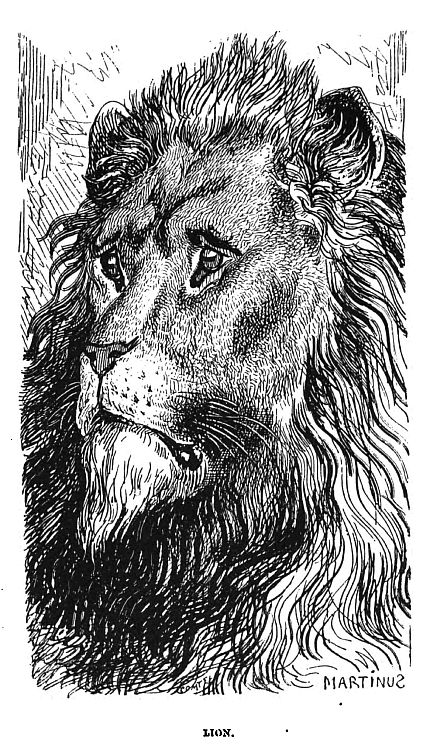
“But,” said Isabel, as Hughes concluded the story, “your rhinoceros, dangerous as it was, is nothing to the animal of the same species, which we heard of at Tete, and which many affirmed they had seen.”
“What is it?” eagerly asked Wyzinski, forgetting the game in his desire for information. “I once met a woman of the Makao tribe, who spoke of a strange species. Strange enough she was herself, with her upper lip pierced and ornamented by an ivory ring, a bark covering serving for petticoat, that and a necklace of bark for all clothing.”
Reclining back on her cushions, the black mantilla drawn over her neck and bust, one tiny slippered foot just peeping from out of the folds of the light dress, Dona Isabel carried the pure white petals of the water-lily to her face, her large black eyes peeping over the flower contrasting strangely with its whiteness, but seeming herself too indolent to reply.
Puffing a long spiral stream of smoke from his mouth, the Portuguese noble answered for her.
“It is said, and implicitly believed by the natives, many of whom assert that they have seen it, that far away to the northward there exists a rhinoceros, carrying one single sharp pointed horn right in the centre of the forehead.”
“The unicorn of old,” interrupted Wyzinski.
“The unicorn of our fathers’ tales,” replied Dom Francisco, gravely bowing. “The animal is of immense strength and savage ferocity, say the natives. It is useless for man to contend with him, and any one who meets it may count on death.”
“At all events he may take refuge in a tree, and wait until the animal goes away.”
“It is said this rhinoceros will patiently bore with his sharp horn until he has broken the tree, and then kill the man; that he will work for days until his object be accomplished.”
“See!” exclaimed Dona Isabel; “there are canoes coming up the river. What are they doing?”
There were at that moment four small boats rounding the island, just where the Shire discharged itself into the Zambesi, and their movements seemed eccentric enough to warrant the surprise expressed by Dona Isabel.
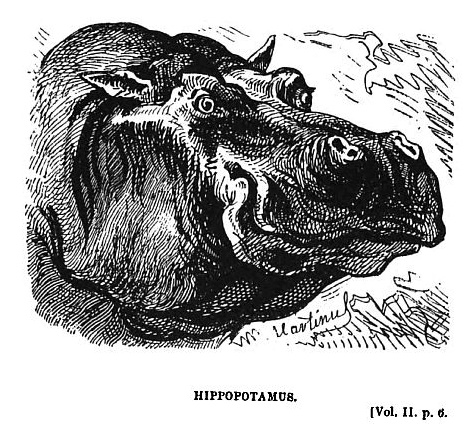
Independently of the rowers, one man stood erect in the bow of each canoe, holding in his hand an assegai, which from time to time he threw. As they neared the bank, a huge hippopotamus rose to the surface, and with a shout, the how man in the nearest canoe made his cast. The spear missed; but the second boat dashed up. Again the hippopotamus rose, and this time the assegai struck true.
“Why, it is exactly the way the Arctic seamen take the whales!” exclaimed Hughes.
A loud scream from Dona Isabel, as she started from her recumbent position, was heard. The hippopotamus had risen again, and with its great red mouth open, dashed in fury at the leading canoe.
The man in the bow seemed paralysed with fear, for he did not make a cast; the next moment the boat was floating bottom upwards, drifting with the stream, but the animal had received another assegai as he was in the act of striking the canoe.
As for its crew, they rose to the surface, and struck out for the bank, vigorously swimming like fishes, their comrades taking no notice of them. The hippopotamus seemed badly hurt now, for it rose again quickly, receiving another lance, and then, dragging itself on to the bank, fell from exhaustion and loss of blood, the natives giving a yell of triumph as they rowed up.
“Listen!” said Wyzinski, “that was a shout; here, down the river bank, to the right.”
“And there comes the owner of the cry,” replied Hughes; “he is a European, too, and well armed.”
Dressed in a light calico suit of clothes, wearing a broad-brimmed Panama hat, and carrying a rifle in his hand, while a brace of pistols were stuck into a broad crimson Andalusian sash which encircled his waist, the owner of the shout, as Hughes had called him, rode up, followed by three mounted natives.
“The Senhor Dom Francisco Maxara?” inquired the new comer, raising his sombrero.
“The same, Senhor,” haughtily returned the noble, rising and replying to the courtesy.
“I am Dom Assevédo, of Quillimane. I have a house at Nyangué, and am owner of a good deal of the land about here. Will the Senhor Maxara and his fair daughter (here the sombrero was again removed) condescend to consider my poor house at Nyangué their own for the period they may honour me by staying?”
“I thank you, Senhor, but it may not be. The ‘Halcyon’ brig waits us at Quillimane, and I must needs say no. Isabel, can you not persuade the Senhor to join us?”
“At all events, I can offer him part of my cushions,” replied the lady, “on condition he talks French, for Portuguese will not be understood by our guests.”
“Ah, the two Englishmen whom I have heard of from the Limpopo. Perhaps you, gentlemen, will honour me with a visit?”
This, too, was impossible; and Wyzinski was in the act of explaining why, when a loud clamour was heard among the natives, who were busy on the sandy bank below cutting up the hippopotamus. The excitement seemed to communicate itself to the boatmen, and, walking to the entrance, Dom Assevédo called out, “Come here, Senhora, there is a sight seldom seen.”
Looking down the stream, which was rolling slowly on its course towards the sea, between banks where the palmyra and cocoa-palms grew in clumps, seven elephants were swimming the river. With their trunks raised high in the air, and their huge black bodies rolling from side to side, the animals, notwithstanding their tremendous bulk, seemed to move with apparent ease and pleasure to themselves.
“They are heading right for the island at the mouth of the Shire!” exclaimed Hughes, all the spirit of the old shikaree reviving at the sight.
“Something must have terrified them,” said Dom Assevédo; “perhaps the jungle has been fired in their rear.”
“There they go—one, two, three, four, five, six, and seven, all on the island,” counted Hughes.
Dona Isabel had stood, her hands clasped, her eyes fixed on the strange scene, a beautiful statue, the very model of mute astonishment.
“If they don’t break out and take to the other bank, I can show you some sport, now,” exclaimed Assevédo.
A few minutes of breathless watching followed, not a word being spoken, while the spiral wreaths of smoke curled up into the calm air from Dom Francisco’s cigarette. All eyes were fixed on the island. Five minutes elapsed, lengthening into ten, and the elephants had not reappeared.
“Do any of you gentlemen speak Kaffir?” inquired Assevédo.
“I do,” replied Wyzinski; “at least the Zulu tongue.”
“Good; then do me the favour to go to the men on the river bank. Tell them you come from me, use my name, and let them get their boats together, and join us in our hunt. Senhor de Maxara, will you order your men to get your boat ready?”
“Surely you will take me with you?” asked Isabel.
“Fair Senhora, there is danger.”
“And have I not seen the bull fights of Seville?” asked the girl, her eyes flashing fire. “Let me be able to say when I return to my country, that I have also seen the African elephant hunted.”
“The animals are sure to take up the river banks for the forest land. If your boat is large enough to take my pony across, there can be no reason to say no,” replied Assevédo.
The boat was found amply sufficient. A lady’s side-saddle was rummaged out from the luggage; the rifles, of which there were no lack, loaded; and the whole party, embarked in four canoes and two boats, rowed across the river. At first they pulled up the stream, so as not to alarm the elephants, striking the opposite bank much higher than the mouth of the Shire. Landing, Dom Assevédo posted the men. The elephants, when disturbed, were certain to take to the water, swim the river, and enter the woods, which here stretched right away to the foot of the hills.
“Senhor Wyzinski, as you speak the Zulu tongue, will you take the canoes, and landing in rear of the elephants, make as much noise as possible, and fire the reeds if necessary.”
“Senhor Inglesi, you are the younger man, will you look to the Senhora Isabel, while I and Dom Francisco take our post under yonder clump of trees.”
Captain Hughes was in the act of ramming down a cartridge as he received the directions. The rifle was a heavy one, and by a lucky chance two of Devisme’s explosive cartridges fitted the bore.
Dom Assevédo then explained to Isabel that, should the elephants come her way, she was to ride for the open, where she was perfectly safe, the animals not being fleet enough to overtake her, and they would be sure to make for the forest.
The loud cries of the natives were soon heard, and Hughes looked about him. The Shire river, on whose banks they were, was not broad, though it appeared deep. They stood facing the river, under a clump of cocoa-nut trees. To the right at a little distance lay the Zambesi, and behind them, distant about a thousand yards, began the forest, which seemed gradually to increase in density until it became nearly impenetrable. To the left a comparatively open country, with fields of maize and sugar-cane ripening in the sun. Some long reeds growing about ten paces to their front served as a screen.
Not a word was spoken, and as he stood by the pony’s side, and looked up at its rider’s slender, graceful figure, and beautiful face, the soldier felt the duty he had undertaken a pleasant one.
Isabel sat on her horse like a statue, her lips parted showed the white teeth, her eyes intently fixed on the island, and her face shaded from the sun by a flapped-hat with its broad brim.
Shouts and yells came floating on the air over the Shire river, sometimes very loud and eager, at others dying away, and at last a large black mass slowly approached to the water side. Isabel clasped her hands as the elephant waded into the river, ejaculating some words in her own language; but the great animal paused, looked over the Shire towards the opposite bank, and, whether suspecting clanger or not liking a second swim, it returned to cover.
And now a faint column of blue smoke shot up from the island, telling that Wyzinski had fired the bush; it thickened as the dry reeds caught fire, the red flame darted up at intervals, and heavy masses of smoke rolled away to leeward. The fire leaped merrily onward, making rapid progress, and soon a loud trumpeting was heard, as, plunging into the river, the elephants, terribly frightened, swam towards the opposite bank, their trunks raised in the air high above the water. They would evidently land within twenty paces of where Dona Isabel was posted.
“Tighten your bridle-rein, Dona Isabel,” whispered the soldier, as he placed his hand on the snaffle. “Be ready. Here they come!”
“Madre de Dios!” ejaculated the astonished girl. “Oh! Santa Maria, how grand!”
Rolling about like seven huge porpoises, their backs, heads, and flapping ears above water, the elephants came on swimming in Indian file. The trunk raised straight up in the air gave to the black masses a strange look, while the tusks at times lowered sent the water in their front spurting into the air. Three out of the seven were males. They gained the bank, the water falling from them in sheets, and then they leisurely walked away for cover. One old male was some dozen yards behind the rest, and this elephant Captain Hughes singled out for himself. Landing, it stood for a second or two, the water dripping from its huge sides, looking curiously around. At this moment the loud reports of two rifles rang out from the forest, and the remaining elephant, alarmed, moved off in an oblique direction, which would bring it close to the spot where stood Dona Isabel and the soldier.
The former seemed quite stupefied with wonder as the great mass came onward at a trot, swinging its long trunk to and fro.
“Ride for your life, Dona Isabel!” said Hughes; “keep for the open, and ride hard.”
Hughes loosed his hold of the reins, and the pony started off. Isabel, turning in her saddle, fixed her gaze on the elephant, and in so doing turned the pony’s head right for the forest.
Hughes shouted loudly, but without effect; the girl, wholly absorbed with her astonishment, knew not her danger. For a second the elephant paused, then, trumpeting with rage, dashed after her.
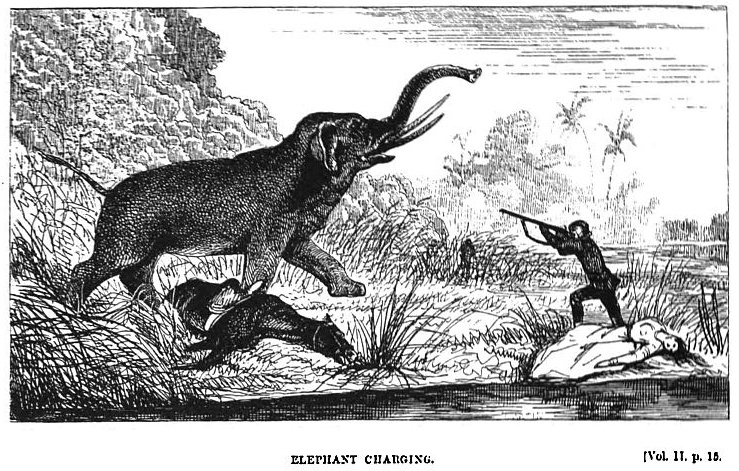
The right moment had been lost. Captain Hughes, in his endeavours to make Isabel turn, had neglected it, and when he did raise his rifle to fire, the elephant was at forty paces distant, turned from him, and going at full speed. To level his rifle, aim, and fire, was the work of a second. The elephant slackened its pace, but only for a moment, the soldier, his rifle at the trail, dashing madly after it. On swept the pony at top speed, but the elephant gained on it. Isabel’s hat had fallen, her long, jet-black hair was floating on the wind. The forest lay before her, through which she could not ride many paces; but she knew it not, for her gaze was still rivetted on the elephant. On they swept, the soldier dashing after them madly, shouting to her yet to turn for the open. The forest line was reached, and in a moment, swept from her saddle by the branches, Dona Isabel lay on the ground, the riderless pony dashing on. On, too, came the elephant, after the horse, trumpeting furiously. It passed over the prostrate form, its huge foot within an inch of the fair head, and the next moment its tusks were buried in the flanks of the agonised horse, which had been stopped by the forest undergrowth. Bearing it down, the huge elephant actually pinned the animal to the ground, where it held it impaled and writhing with agony, then deliberately kneeling on the bleeding carcass literally crushed it into a shapeless mass. Rising, the elephant turned from the dead pony, trumpeting once more as it saw lying on the ground, quite inanimate, the form of the rider. Dom Francisco and Assevédo were hurrying up, but were yet distant. They both fired, but the bullets served but to enrage still further the infuriated animal, as it came on, the blood dripping in large gouts from its reddened tusks. It was a race between it and the soldier—a race won by the man, as, breathless, and with only one barrel of his rifle loaded, he stood between the senseless Isabel and the charging animal. On it came, right upon him; if it passed it must tread down the fair girl’s body. The thought gave him nerve, it steadied his hand as he aimed right for the centre of the forehead. The report rang out, the elephant halted suddenly, swaying from side to side, and then fell with a heavy thud. A loud shout from the two men advancing over the plain, and Hughes knew that Dona Isabel was safe. Throwing aside his now useless rifle, he knelt by her side, raising her on his arm, and leaning her head back against his knee; a small red stream was flowing from her forehead, and she had fainted.
“My child—my Isabel!” moaned the old man, forgetting his pride in his sorrow, as he threw himself by his daughter’s side, panting and breathless.
“It is nothing, she has fainted. I go for water!” exclaimed Assevédo, as he hastened towards the river.
Slowly the blue veins beneath the clear olive skin began to beat again. Once more the eyes opened and closed. Hughes was busy sponging away the blood, which flowed rather freely, with a handkerchief. Dom Francisco and Assevédo, kneeling by Isabel’s side, were using the cool water of the Shire river; and close beside them, its tusks red with blood, the enormous bulk of the dead elephant; while, fifty paces away—a crushed and unsightly mass—lay the pony.
Isabel opened her eyes, and seemed for a moment utterly astonished. “Santa Maria!” she ejaculated, “where am I?”
Then suddenly the whole affair seemed to flash on her memory, and, raising herself gently, she smiled.
“I was not frightened, only astonished,” said the brave girl, as the red blood mantled in her cheeks. “Where is the elephant?”
“There,” answered her father; “and you may thank the Senhor Capitano Inglesi that it lies there.”
Isabel de Maxara turned—the dead animal with its gory tusks, and the shapeless mass which had been a horse, met her gaze. For a moment her face flushed, the red blood once more mantling richly under the clear olive skin; the next she grew deadly pale. “I thank you, senhor,” she said as she looked full at the soldier and held out her hand, “I thank you for my life.”
The rest of the party were standing by the elephant. Hughes clasped the long taper fingers, and looked into the black eyes, from which the tears were falling. For a moment they met the gaze, and then fell before his as he kissed the little hand held out to him.
“Your ball has shivered his head, Hughes,” called out Wyzinski, but the soldier paused a moment to thrust into his bosom a blood-stained pocket-handkerchief before he joined them.
The second ball, a heavy conical one, had penetrated the skull before bursting, making a frightful hole, and blowing the head to pieces; a second severe wound, behind the shoulder, showing where the first had struck.
The elephant was a very large one, and was the only one out of the seven secured.
“And now, gentlemen, let us leave the cutting up to the natives. You can scarcely refuse my late request now, after what has passed, if it is only that Dona Isabel needs rest.”
“If we comply I must make a condition, namely, that you send a messenger to Quillimane, to warn Captain Weber of the delay, and it must not be for more than twenty-four hours.”
“Agreed, and now for the boats and my house at Nyangué,” cheerfully exclaimed Assevédo.
“Senhor Inglesi, I thank you most heartily and sincerely,” said the old noble, taking off his hat, bowing, and grasping the soldier’s hand warmly in his own. “You have earned our eternal gratitude at the peril of your life.”
“Don’t you think a light infantry movement and a timely retreat would be a brilliant evolution?” whispered the missionary, as he passed Hughes. “I don’t mind backing the flavour of the water-melons of Portugal against the custard-apples of India.”
“Nonsense. Just mind your own business,” replied Hughes, as he picked up the discharged rifle, shouldered it, and joined the party on the Shire’s bank.
The “Halcyon.”
The coast of Africa, as seen from the sea, is never very prepossessing; and the sandy spit of land, with the equally sandy bar, which obstructs the entrance to the Zambesi at Quillimane, is no exception to the rule, while the banks of the river are low and flat, dotted here and there with tall cocoa-palms, and haunted by alligators. The town itself, or rather village, for it can hardly boast of any more sounding name, consists of a few better-class houses, one of which was owned by Dom Assevédo, and a number of half-ruinous huts and sheds. The anchorage is unsafe, and often untenable, while the low-lying land is a hot-bed of fever. Outside the bar, her two anchors down, the blue peter at her fore, and the English Union Jack floating at her gaff, rode the brig “Halcyon.” She was a rakish-looking craft, her long low black hull rising on the waves, and showing from time to time her bright clean copper as she rolled. Her masts raked slightly off, her sharp bows and sides round as an apple, told the seaman at once that she must be a dry ship, and her breadth of beam, if needed, attested the fact. Every bit of brass work on board was as usual rubbed bright as gold, every rope was carefully coiled down, and her decks white as snow. The “Halcyon” would not, in fact, as she rode to her anchors off the bar at Quillimane, have disgraced herself, even had she been, as she once was, her Majesty’s gun brig “Torch.”
Sold out at a time when the system of steam was rapidly changing the aspect of the navy, the “Torch” was nearly new. Bought by a Liverpool firm, she had been thoroughly overhauled and fitted out for a three years’ cruise on the African coast, trading in ivory, gold dust, and ostrich feathers.
Captain Weber, an old sailor of thirty years’ standing, commanded and partly owned her, and on such a voyage of course great latitude had been allowed him.
His three years’ trading voyage ended, and bound for the Cape, but intending once more to touch at Delagoa Bay, he had been induced to delay his departure in consideration of the handsome sum offered by the Portuguese nobleman returning from his tour of inspection of the stations on the Zambesi.
Captain Weber, as has been already mentioned, was a middle-sized stout built man, with a reddish mahogany-coloured face, and long grey hair. He was proud of his brig, lived for her, and believed in her capabilities to an unlimited extent. His first-mate, Thomas Blount, was a young man for his station in life, rather tall, and, as we have already seen, fond of dress. The two were leaning over the bulwarks, looking towards the land, one afternoon, three days after the events just narrated. The crew, which was a strong one, consisting of twenty hands, all told, were between decks.
“Our passengers should arrive this afternoon. Dom Assevédo’s messenger said so, did he not, Captain Weber?”
“Yes, and that haze to the southward and eastward tells of a blow. It will be a foul wind for us. We must make sail before sunset, Mr Blount.”
“I think,” remarked the younger man, “I see a boat crossing the bar, there, right over that Madras fellow’s stern.”
“Well, I hope it may be them. We have more fever on board than I care to see, and I hate this hot, unhealthy hole. Rouse up the watch, Mr Blount, and heave short at once.”
“Ay, ay, sir,” replied the mate, touching his cap, round which ran a narrow strip of gold lace, and moving away.
The captain remained where he was, watching the black specks, for there were three of them, rising and falling on the waves outside Quillimane bar. The decks of the brig were no longer deserted, and the shipping of the capstan bars told that the orders just given were being carried out.
“Bring to, starboard cable,” called the first officer from the quarter-deck.
“Ay, ay, sir,” was the ready response, for the seamen were tired of riding at anchor off the bar, and the click of the capstan, as they stamped round to a merry tune of the flute, was music to officers and men alike.
“Up and down, sir,” was the cry of the second mate, who on the forecastle was superintending the duty of heaving up the anchor, and which term meant that the brig was right over her anchor.
“Heaving away, sir,” came again the cheering shout, as the anchor left the ground and the men strained every nerve to run the heavy mass up to the brig’s bows.
The flute rang out a merrier tune, round and round went the capstan bars, then came the second officer’s loud shout of “Heaving in sight, sir,” as the men suddenly stopped in their merry round.
“Cat and fish the anchor, Mr Lowe. Bring to the port cable. Heave short,” were the brief words of command from the quarter-deck.
“All ready with the cat, sir,” was the responsive shout, soon followed by the customary words, “All ready with the fish, sir,” while the men, the starboard anchor being got on board, duly secured, or, in more nautical terms, catted and fished, clapped on the port or remaining anchor, which now alone held the brig, gently rolling to the swell, and that in its turn being soon up and down, Mr Blount reported to his superior officer.
“Do you make out the boats, sir?” he added, as Captain Weber still remained looking towards shore.
“Ay, ay,” replied the seaman. “There’s Dom Assevédo’s barge, the lubberly Portuguese blowing and puffing like grampus at their oars.”
“Rig out a tackle from the main yard. We shall have to hoist the lady in, and perhaps the Dom too, like a bale of cotton.”
“Ay, ay, sir,” replied the mate.
“Make sail, Mr Blount; brace up the headyards. Let me know when you are ready.”
Ten minutes later the passengers were on board, and Dom Assevédo’s barge veered astern.
“It’s rather hard I can’t speak to my lady passenger,” said Weber, as he went down below with the party.
“Tell him I can understand English, though I am afraid to speak it,” said Isabel in French to Hughes, who was by her side.
“Ay, ay, my pretty one, we’ll soon take the shame-faced-ness out of you; nothing like blue water for doing that. Well, you tell the Dom that I’ll send all his traps below. Senhor Assevédo, I can’t give you much law,” said the old seaman, in his rough hearty tones, as he turned to return to his post. “Steward, show the lady her berth. Look alive, man,” he continued, calling down the hatchway.
The brig was now riding at single anchor, the headyards braced up one way, her afteryards the other, her sails flapping heavily.
“Heave away, my lads, heave away with a will,” shouted Weber, the moment his foot touched the quarter-deck, and the remaining anchor was soon hove up, and properly stowed away on board. “Brace round the headyards. Let fall the fore course. Take a pull at the bowlines, Mr Blount. Touch her with the wheel, Adams, she will come up a couple of points yet,” were the rapid words of command, and the “Halcyon” moved through the water on a taut bowline, heading nearly her course.
“A pleasant voyage to you,” said Dom Assevédo, as he bent over Isabel’s hand in the cabin.
“Below there!” came in the captain’s rough tones, “tell the Senhor Assevédo that if he don’t want to see the Cape, he had better get on board his barge. The tow-rope won’t hold on long, I’m thinking.”
Heartily shaking hands with all, the Portuguese gentleman, whose name and kindly nature are well known to men of every nation trading on the Zambesi, stepped over the side, the boat’s painter was cast off, a last good bye shouted in Weber’s stentorian voice, and the “Halcyon,” with all sail set, to her royals, was soon standing off the bar, the bubbles flying past her rounded counter, as she slipped through the water at the rate of sonde six knots an hour.
Towards sunset the wind fell, and the brig began to lose her way. The stars came out shining through a thin haze, and sail after sail flapped against the masts, filling for a moment, then collapsing again, until soon the “Halcyon” lay rolling on the gentle swell, her cordage rattling, her blocks and tackles striking against her spars and rigging, her hull groaning, and her sails perfectly useless, not having even steerage way.
Leaning over the bulwarks, and looking towards the land, the faint outline of which could still be discovered about ten miles distant, Hughes was conversing with the captain.
“You think, then, we shall have wind?” he asked.
“I am sure of it,” replied Weber; “look at the double halo round the moon, look at the sickly, watery appearance of the clouds, look at that fog-bank away to the southward. We shall have plenty of wind before morning.”
“And from what direction?”
“Dead against us,” replied the seaman; “we want to run to the south, and the wind will blow from that quarter.”
“You have a beautiful craft, Captain Weber, and one I know can show weatherly qualities.”
“Ay, ay, sir,” answered the captain, slapping his hand down on the bulwark, “I love every stick the jade carries, every rope-yarn aboard of her; while I am at sea, she is wife and children to me. Do you hear the wind sighing aloft? You would do well to persuade the lady to turn in.”
Wyzinski, Dom Francisco, and Isabel were walking on the quarter-deck deeply engaged in conversation, and enjoying the freshness of the night.
“I did not think I should ever look back to the Zambesi with pleasure,” said Isabel, as Hughes joined the party; “but really, the unostentatious hospitality we received from Senhor Assevédo will always be remembered by me. It is a magnificent river, and I am sure must be fully half a mile wide in some parts. The coolness of the air, too; I never thought to see European vegetables, such as peas and cabbages, growing side by side with the mango and banana.”
“Ah, with its plains of wild cotton, which no one takes the trouble to cultivate, its sugar-canes, indigo, and droves of splendid cattle, the country bordering on the Zambesi might be a very rich one,” said Wyzinski.
“Which, otherwise worded, means if the colony belonged to the English instead of the Portuguese, Senhor,” tartly remarked Dom Francisco.
“Not so, Senhor de Maxara; the English in South Africa have failed in many things, as regards colonisation, nor could I be guilty of such a thought.”
“The object of my mission is to draw up a report as to the capabilities of the land, and I hope a new day may now dawn for the Portuguese colonies in South Africa,” said the noble. “The country is rich in mineral products. Cattle and animals of all kinds abound in the plains, while coal, gold, iron, and copper could be procured for the labour of taking them,” he continued; “but that is Captain Weber, is it not, leaning over the bulwarks; will you go with me, Senhor, and serve me as interpreter? I wish much to thank him for the arrangements he has made for our comfort.”
Hughes thus left with Dona Isabel, a silence ensued. The sails were banging loosely in the brails, flapping against the masts, for the night was perfectly calm, but still there was the never ceasing throb of the ocean, causing the brig to roll lazily, the cordage and blocks to strain and creak, the studding sail booms to rattle, and the timbers of the stout brig herself to groan and moan.
“I was wondering, Senhora,” said Hughes, breaking the silence at last, “what made you think of a voyage to so remote a region as Africa?”
“Oh, that is easily told. My father has a long pedigree, but a cramped estate. Our Portuguese nobility are mostly in the same position. My mother, of the old and princely house of the Guzmans, died when I was quite a child, and my life has been passed with an aunt, in France. She, too, died, and the convent of the Augustine sisters was no longer a home for me; besides, my education was finished.”
“I wish it had comprised the English language, Senhora,” said Hughes, smiling.
“I wish it had, too, for I should like to talk to Captain Weber,” replied the girl, laughing. “To continue, my father was honoured with his present mission, and was about to refuse it on my account. It may lead to a definite appointment, and as he never denies me anything, I easily persuaded him to accept, and to let me accompany him.”
The brig’s bows had been during the last hour all round the compass, but at that moment she lay with her head to the southward. A heavy puff of hot wind struck her suddenly, taking her aback and giving her sternway, the studding sail booms snapping off short in the irons, the broken ends with their gear coming tumbling down, those of the mainyard falling on the quarter-deck. The whole was over in an instant.
“In with the studding-sails, my lads, look alive,” called the captain, as the watch on deck busied themselves with the useless sails.
“You will excuse me, gentlemen,” said Captain Weber, “that puff is but a precursor of the wind that is to follow, and I must get the sails off the brig.”
Taking off his cap politely, the captain turned to his work, while, with a ceremonious salute, Dom Maxara offered his arm to his daughter to conduct her below.
“Good night, gentlemen, we shall meet again in the morning,” said the noble. A pressure of the hand, a low “Good night,” a silvery toned voice repeating the word, and Captain Hughes found himself alone, gazing over the bulwarks into the blue sea, and thinking.
Thinking of Isabel, of course. Then she was not rich, and he was glad of it. But why should he be glad? for he was not rich himself, and beyond a few hundreds a year and his pay, he had nothing to boast of. What on earth did Dona Isabel’s position matter to him? A fair wind and the brig would spread her wings. A few days and the party would separate at the Cape, in all probability never to meet again. She was of an ancient race, the blood of the Guzmans mantled in that blush. Well, he, too, was of old Welsh blood, and could count kith and kin up to the days when the Druids held their unholy rites and sacrifices on the heights of Penmaenmawr and Snowdon, when Caswallon Là Hir, his ancestor, wandered through the forests of Caerleon and Bodysgallen, clad in his mantle of skins. But what was that to him, and what had he to do with the blood of the Guzmans? He would think of other matters.
Again his thoughts wandered, and, as he gazed into the blue ocean, he called up a picture of another land. The lofty rugged mountains of Snowdonia, the iron-bound coast, washed by the waves of the Irish Channel, the ebbing and flowing waters of the Menai Straits, a house which had stood the wear and tear of ages, embowered in its trees near the beautiful Conway. Would Dona Isabel—pshaw!
“Take a pull at the larboard braces, let fly the fore and main royal halyards. In with the canvas, my lads. Starboard the helm,” shouted the captain, as the breeze from the south struck the brig, filling her remaining canvas, and making her heel over, as she gradually gathered way. “Steady! so!” and the bubbles began to glide by the vessel’s side, the noise of the water slapping up against her bows, and the rattle of the blocks and tackle, as the canvas filled, and everything drawing, the “Halcyon,” close hauled, on a taut bowline, stood her course as near as possible.
Gradually the wind freshened, and when Hughes and Captain Weber turned in at midnight, the “Halcyon” was working her way through the seas crested with foam, in that peculiar jerking manner usual to vessels close hauled; but with little cargo, and what there was light, she made splendid weather of it, topping the great waves, or wallowing in the trough, though, as Captain Weber emphatically observed, slapping his hand down on the cabin hatchway, “She didn’t ship an egg-spoonful of water.”
“Hands by the royal sheets and halyards. In royals. Mr Lowe, see to the royal braces,” were the words heard, as the two stepped below, about midnight. Morning was scarcely dawning over the ocean as Captain Weber again made his appearance on deck. According to a seaman’s instinct, his first glance was directed aloft, his second to the compass.
“Ah, I thought you would have a reef in the topsails before morning, Blount, and I see I am right.”
“We had better go about soon, Captain Weber,” replied the mate; “there is a little westing in the gale since midnight, and the brig has lain up a couple of points.”
“We will stand on until we make the coast of Madagascar, Blount; we must have made a good deal of southing, there are no islands between us and the coast, except ‘Barren Islands,’ and they lie far away to the northward.”
“How’s her head now, Jones?” asked the mate.
“South-east and by south, sir,” replied the man at the wheel.
“Then we shall fetch Cape Saint Vincent on the Madagascar coast; and it will have been a long leg.”
It was a grand sight as the little “Halcyon” struggled through the chaos of water. The change in the wind, slight as it was, had greatly aided her, but the gale was gradually increasing. Overhead the heavy clouds were flying before its fury, the long waves being an angry green, white with foam. Far as the eye could reach, one sheet of tumbling water was to be seen, bounded only by the horizon. No sail, not even a solitary gull was in sight, and through this the “Halcyon” was straggling, now rising on the foam, now falling into the bright green trough, as she dragged her way onward through the seething ocean, under her single-reefed topsails, foresail, fore-topmast-staysail, and boom-mainsail.
On swept the little brig, but the gale increased in its fury after sunrise. Towards twelve o’clock, the Senhora Isabel appeared on the quarter-deck, whither she had been conducted by the first-mate. The men of the watch lay close under the weather bulwarks, seeking what shelter they could find. A good many teaspoonfuls of salt foam came dashing on board the brig now, and even the captain was forced to allow it, as he held on by the weather main-shrouds, and looked keenly to windward.
“What a magnificent spectacle!” exclaimed Isabel, as she gazed on the seething ocean.
“At all events we are better here than riding with both anchors down at Quillimane,” replied the mate.
A report like the boom of a heavy gun was heard above the gale, and the foresail was seen flying away to leeward, blown to ribbons. A heavier blast weighed down upon the struggling brig, and before a word could be spoken, the bolts of the futtock shrouds, drawing one after another, with a splintering crash down came the fore-topmast with all its rigging and hamper, dragging with it the main-topgallant mast, and carrying away the jib-boom, the whole mass falling bodily over the side.
In an instant the watch were on their legs, and the remainder of the crew poured on deck, speedily followed by the alarmed passengers.
The captain stood for a moment surveying the wreck, and then with the true spirit of an old salt, accepted the situation.
“Keep her away,” he shouted to the two men at the wheel; “let her go free. Steady, my lads! Out axes and cut away the wreck. Pass the word below for the sail-maker to send up a new foresail.”
The wreck of the masts was now dragging under the brig’s lee, thumping heavily against her sides. Quick as thought the first-mate sprung forward, and, seizing an axe, began cutting away the ropes which kept the spars dragging after the ship. Holding on by the shrouds, the bright steel did its work, and no longer close hauled, but running free, the brig’s motion seemed much easier. Already a portion of the wreck was floating astern, a few ropes alone held the rest, and one by one they were severed, when a monster wave came rolling on towards the brig. The captain’s warning voice was heard far above the roar of the winds and waves, shouting to all to hold on. The mate alone did not hear him, as he raised his axe to sever the last rope. The blow fell, but at the same moment the brig plunged her bows into the green wave. Striking her on the counter, the vessel seemed to tremble and to pause in her career, as the green water curled over her bows and bulwarks, in one mass of white foam, falling in tons upon her deck, and rolling away to leeward, poured out of her scuppers. The little brig seemed pressed down into the ocean by the enormous weight of water, and as the wave rolled aft, there, battling with the foam, was the form of the gallant mate. Swept from his hold, the white face rose on the wave close to the brig, and Isabel screamed with horror as the helpless man, tossed about, like a cork and apparently not a yard from them, came surging along, the lips parting, and the words, “Save me! save me!” distinctly borne on the wind.
Quick as thought, Captain Weber caught up a coil of rope; his arm was in the act of casting it, when the mass of spars and cordage swept past. The coil whistled through the air, it fell right over the mate’s shoulder, he clutched at it as the fore-topmast crosstrees, with the full force of the surge, struck him from behind, and he sank like a stone.
A cry of terror ran through the brig, all for a moment forgetting their own danger in the horror of the scene.
“Silence, fore and aft,” shouted the old captain, his grey hairs streaming in the wind. “Heave the brig to, Mr Lowe. This is no place for you, lady; let the steward lead you below. All danger is over.”
“Land ho!” shouted one of the men forward, as Isabel disappeared down the hatchway.
“Where away?” asked the master.
“Broad on the port bow,” was the answering shout.
“It is the high land of Cape Saint Vincent,” said Captain Weber, shading his eyes, and gazing intently in the direction named.
The wind was increasing in violence, and the barometer in the captain’s cabin still falling. The brig had been kept away, and was now running free, but the gale was increasing rapidly.
“See that the fore and main-staysails are properly bent,” called the captain.
“Ay, ay, sir,” came the ready response, as his officer stepped hastily forward.
It is always a ticklish thing to heave a vessel to when there is a heavy sea running. The brig’s sails were reduced until she was stripped to her close-reefed main-topsails, her fore-staysail was then set, and the two officers exchanged places, the old captain sprang forward, and holding on by the weather fore-shrouds, gazed wistfully over the ocean, while his mate stood near the man-at-wheel, waiting the coming order.
Sea after sea struck her, dashing the glittering spray high into the air, and wetting the veteran sailor to the skin, as he stood anxiously gazing over the ocean. At length a moment came when the long waves seemed less heavy. Captain Weber seized it, and a motion of the hand was enough.
“Down with the helm, Adams, hard down,” shouted the watchful mate.
The brig flew up to the wind. “Set the main-staysail!” was the order thundered from the quarter-deck, and steadily executed by the trained seaman, the brig being soon hove-to under her main-topsail, fore and main-staysails, making comparatively good weather of it, and everything seemed to settle down into its usual order on board the little craft.
“He was a gallant fellow, and would have made a thorough seaman,” said Captain Weber, as he joined the party below, dashing the salt foam from his eyes and hair as he spoke. “He loved the sea, and left a quiet home to find a grave here in the Indian Ocean.” Isabel seemed violently affected by the scene which had passed before her eyes.
“His was a sailor’s death, it may be ours to-morrow,” continued the captain. “Poor Blount! he was to have had command of one of his father’s ships next voyage.”
“What do you think of the weather, Captain Weber?” asked Hughes, wishing to change the theme, for Isabel was sobbing convulsively, as the thought of the sorrowing parents came vividly before her.
“These blows seldom hold long, from the fact of their extreme violence. Should it last we shall be jammed down on the Madagascar coast: indeed, we cannot be far from it, for the land hereaway is low, or we should have sighted it at daylight.”
“Shall we feel the loss of our spars much?” inquired Wyzinski.
“Not so much while lying to; but our wings are nicely clipped. The ‘Halcyon’ has been at sea, trading on this coast, for nearly three years, without ever having the advantage of a good overhaul, or such an accident could never have happened.”
During the whole day, however, the gale continued unabated, and the dinner table was a neglected one by all save the captain. The party had been so lately at sea, as to escape all sufferings from sea-sickness, but the roar of the waves, the rattling of the ropes and blocks, the howling of the wind, and the many noises incidental to a gale, prevented, in a certain measure, even conversation. Every now and then a mass of water would tumble inboard with a loud thud, as it deluged the brig’s decks and washed away to leeward. The staysails, too, as the vessel fell into the deep trough of the angry waves, would flap with a report like distant thunder; in a word, all the discomforts of a heavy gale in a small vessel were making themselves felt.